Head of Crimean Tatars public organization criticizes Ukraine’s policy
TASS | September 19, 2015
The Crimean Tatar people got an opportunity to restore their usurped rights only after the March 2014 referendum when Crimea reunified with Russia, chairman of Crimean public organization Milli Firka (People’s Party) Vasvi Abduraimov said Friday in the UN Office in Geneva.
Speaking at an information meeting of nongovernmental organizations on the topic of rights and freedoms violations in Ukraine, which took place on the sidelines of the 30th session of the UN Human Rights Council, Abduraimov recalled that in early 1990s Russia adopted laws on exoneration of repressed peoples and victims of political repressions.
But during the 23-year-stay as part of Ukraine, Crimean Tatars “were unable to use opportunities granted by Russian laws.” “And only after March 2014, we got all opportunities for restoration of all usurped rights as an ethnic community,” he said.
“Ukraine officially declared itself a unitary state and in all possible ways neutralized and universalized ethnic and religious communities for its so-called ‘Ukrainianness’,” Abduraimov said.
“The apotheosis of that policy was the statement by President Viktor Yushchenko that the state doctrine is to build one country, one nation with one language and one faith,” he said. “Now everyone sees what that mindless policy of universalization, when fundamental human rights are infringed upon, has led to.”
“Kiev-style universalization, with total corruption of officials at all levels, when not law and the people rule but 20 oligarchs, could not but lead to a disaster, and it happened,” Abduraimov said.
He added that “the Ukrainian state currently only exists de jure, and not de facto.”
The Milli Firka chairman underscored that in 1954 Crimea was handed from the Russian Soviet Federative Socialist Republic to the Ukrainian Soviet Socialist Republic “absolutely illegally”, as Crimean Tatars in that period “were rightless in exile.” “And no one then asked us or Crimean residents whether they want Crimea to be handed to Ukraine,” he said.
Abduraimov said the rights of all Crimean residents are now violated by Western countries who imposed restrictions for the peninsula which in particular relate to business, foreign trips and tourism.
Due to those restrictions, Crimeans “are unable to conduct economic activity in a normal way.” In a conversation with a TASS correspondent, Abduraimov assessed Western sanctions as “the clearest manifestation of a double standards policy.” “Declaring sanctions against the policy of the Russian Federation, they actually tie the hands and feet of ordinary people, preventing them from moving freely and doing business,” he said.
The Republic of Crimea and Sevastopol, a city with a special status on the Crimean Peninsula, where most residents are Russians, refused to recognize the legitimacy of authorities brought to power amid riots during a coup in Ukraine in February 2014.
Crimea and Sevastopol adopted declarations of independence on March 11, 2014. They held a referendum on March 16, 2014, in which 96.77% of Crimeans and 95.6% of Sevastopol voters chose to secede from Ukraine and join the Russian Federation. Russian President Vladimir Putin signed the reunification deals March 18, 2014.
Despite Moscow’s repeated statements that the Crimean referendum on secession from Ukraine was in line with international law and the UN Charter and in conformity with the precedent set by Kosovo’s secession from Serbia in 2008, the West and Kiev have refused to recognize the legality of Crimea’s reunification with Russia.
Crimea had joined the Russian Empire in 1783, when it was conquered by Russian Empress Catherine the Great.
In the Soviet Union, Crimea used to be part of Russia until 1954, when Nikita Khrushchev, the first secretary of the USSR’s Communist Party, transferred it to Ukraine’s jurisdiction as a gift.
With the collapse of the Soviet Union in 1991, Crimea became part of newly independent Ukraine and remained in that capacity until March 2014, when it reunified with Russia after some 60 years as part of Ukraine.
According to the Crimean and Ukrainian statistics bodies, as of early 2014, Crimea had a population of 1,959,000 people; Sevastopol has a population of 384,000 people.
Work to integrate the Crimean Peninsula into Russia’s economic, financial, credit, legal, state power, military conscription and infrastructure systems has been actively underway since Crimea acceded to the Russian Federation.
Stunning poll results showing Ukrainians’ dissatisfied with government, economy and war
New Cold War | August 26, 2015
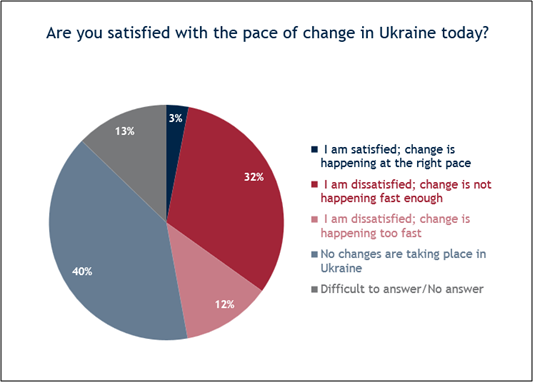
The International Republican Institute in the United States has published results of polling of attitudes of Ukrainians on the key issues facing the country. The polling was conducted in the latter two weeks of July 2015 by Rating Group Ukraine on behalf of the IRI.
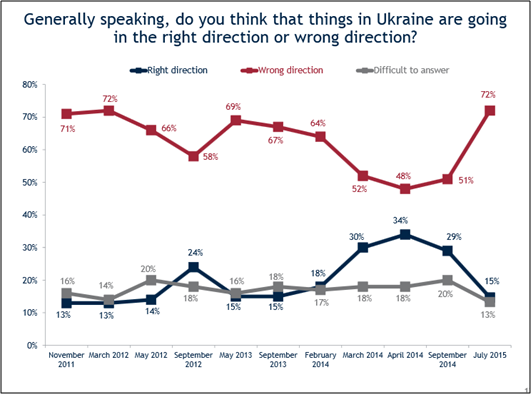 The poll provides more evidence of deepgoing and growing political dissatisfaction and alienation in Ukraine. Absolute or relative majorities of Ukrainians now express unfavorable views of all major government leaders and politicians from major parties in Ukraine.
The people of the rebel region of Donbas are not included in the poll, which means that the levels of dissatisfaction of Ukrainian residents are even higher than what is reported by the IRI.
The poll results are unlikely to be reported in Western mainstream media, even though the poll is commissioned and published by a right-wing U.S. institute. That’s because the results fly in the face of the “news” and editorial opinions peddled by Western media. It proves that media is lying to its readers and grossly misleading them when it inaccurately presents the war in eastern Ukraine as a virtuous war against an aggressive Russia that is supported by the majority of the Ukrainian people.
Media also chooses to be silent about the profound economic crisis that is wracking Ukraine as a result of the Kyiv regime’s turn to austerity association with the European Union, and about the massive human rights violations accompanying the civil war of the Kyiv regime against the people in the eastern and southern regions of the country. The IRI poll shows extremely high levels of dissatisfaction with the economic crisis and the war.
The poll will also be ignored by the Russophobes in the governments and mainstream political parties in the NATO member countries who decry “Russian aggression” and “Russian imperialism” in Ukraine, and by the many pseudo-lefts in the international arena who are acting as echo chambers of that messaging.
Similarly stunning results of polling of the Crimean people in late 2014 and early 2015 were ignored by the same constellation of forces. That polling showed extraordinarily high levels of satisfaction with the democratic decision of Crimeans in March 2014 to secede from Ukraine. The polls contradict the ongoing stories of Russian “annexation” of Crimea.
The 71-page report International Republican Institute polling report can be read here. Enclosed below are 11 selected charts from the poll:




Crimea’s 2014 Secession Referendum Was Legal – French Lawmaker
Sputnik – 25.07.2015
Residents of the Black Sea peninsula of Crimea have a legal right to hold a secession referendum, including the 2014 vote that separated them from Ukraine and reunited them with Russia, French lawmaker Claude Goasguen, currently in Russia with the French delegation, said Saturday.
“They say that Crimean people had no legal right to hold a referendum. Of course they had! Why not? This is what saved the region from war,” Goasguen said at a press conference in Moscow.
A group of 10 French lawmakers, led by lower-house National Assembly Foreign Affairs Committee member Thierry Mariani, arrived in Russia for a three-day visit on Thursday. The delegation visited Crimea to see the Black Sea peninsula following its secession from Ukraine in March 2014.
Both the French and Ukrainian governments have condemned the trip, considering it a breach of international law.
The Crimean peninsula split from Ukraine to rejoin Russia in March 2014 after a referendum in which over 96 percent voted in favor of the secession.
Kiev and its Western allies labeled the vote an “annexation,” while Moscow pointed out that the actions of the local populace were within the international legal framework.
From Kosovo to Crimea: Obama’s Strange Position on Referendums
By Brian Cloughley | Strategic Culture Foundation | July 16, 2015
After the death of President Tito in 1980 the Federal Republic of Yugoslavia slid towards chaos. In the 1990s the plunge accelerated into civil war and one of the regions most affected was Kosovo from which Serbia withdrew after a NATO bomb and rocket offensive from 24 March to 11 June 1999. That blitz involved over 1,000 mainly American aircraft conducting some 38,000 airstrikes on Yugoslavia that killed approximately 500 civilians and destroyed much of the economic and social infrastructure of the region.
The destruction and outcome were not quite as tragic and catastrophic as those from NATO’s fatuously-named Operation Unified Protector against Libya in 2011 when its seven month aerial jamboree of 9,658 air strikes caused collapse of governance and gave rise to the present infestation of Islamic savages and a massive refugee problem, but it was still calamitous, as blitzes go.
NATO said its air bombardment of Serbia was essential to halt repression of ethnic Albanians in Kosovo and justified the deaths of hundreds of women and children as being necessary to defeat a “great evil.” The air attacks were not authorized by the United Nations Security Council and there is no article in the North Atlantic Treaty that justifies such a war. It resulted, however, in Kosovo declaring independence from Serbia in 2008.
As reported by the Washington Post, NATO supported the rebel Kosovo Liberation Army whose members are now, belatedly, being convicted of war crimes.
On March 26, 2014 President Barack Obama said in a speech in Brussels that regarding the 1999 war on Yugoslavia, “NATO only intervened after the people of Kosovo were systematically brutalized and killed for years. And Kosovo only left Serbia after a referendum was organized not outside the boundaries of international law, but in careful cooperation with the United Nations and with Kosovo’s neighbours.”
The President of the United States, whose State Department has some 15,000 experts to keep him informed about international affairs, told the world that Kosovo had held an independence referendum “in careful cooperation” with the United Nations Organization. He added that “None of that even came close to happening in Crimea,” which was an intriguing pronouncement.
Because as reported on Fox News, “During his speech in Brussels, President Obama showed a lack of knowledge of the political situation in Kosovo. Kosovo never organized any kind of referendum, but the Assembly of Provisional Institutions of self-government of Kosovo made a unilateral declaration of independence on February 17th 2008.”
Fox News went on to report Doctor James Ker-Lindsay, a Senior Research Fellow on the Politics of South East Europe at the London School of Economics, as saying that “Surely there must have been someone at hand who would have known that there was no UN organised referendum in Kosovo. It really was not that long ago . . . It will be interesting to see if a retraction or correction is issued by the White House.”
And correction came there none.
Although there was no referendum in Kosovo before its declaration of independence from Serbia it is apparent that the majority of Kosovans desired independence and would have voted for separation from Serbia if they had been given the opportunity to do so. And according to Mr Obama there was and remains no reason for their wishes to be denied.
After all, in 2010 the UN International Court’s Advisory Opinion concerning Kosovo indicated that “international law contains no prohibition on declarations of independence,” a clear-cut endorsement of Kosovo’s actions — and of other such decisions around the world.
No doubt Mr Obama approved of the opportunity given to the people of Scotland to vote in an Independence Referendum a few months after his enthusiastic endorsement of a non-existent plebiscite in Kosovo. In the Scottish Referendum I wasn’t allowed to vote, in spite of being Scottish-born and educated, because I live outside Scotland (in France, in which place of residence I have a vote in the UK’s general elections — in a Scottish constituency).
In other blatant attempts to influence voting, the Scottish National Party decided (in the already independent Scottish Parliament which met first in May 1999, coincidentally at the height of the US-NATO blitz on Serbia) to reduce the voting age from 18 to 16 and to forbid Scottish soldiers serving outside Scotland — in Afghanistan, for example — to vote unless they had a residence address in Scotland.
All the attempted manipulation didn’t work, and the majority of Scots voted against independence (much to the vexation of many English people), but justice was seen to be done.
Just as justice was done in the Crimea referendum.
I wrote last year that “some 90% of the inhabitants of Crimea are Russian-speaking, Russian-cultured and Russian-educated, and it would be strange if they did not vote for accession to a country that welcomes their kinship, empathy and loyalty” and that there was not “a single case of bloodshed in the run-up to the plebiscite, the free vote as to whether the population wished to accede to Russia or support the “status of Crimea as a part of Ukraine.” The Organization for Security and Cooperation in Europe (OSCE) was asked by the government of Crimea to send representatives to monitor the referendum but refused to do so.”
It was not surprising that the OSCE rejected the offer to observe the referendum and provide independent assessments of its conduct, because its findings would have been extremely embarrassing for the West and especially for Washington which had no intention of accepting the result of any referendum in which voters would favour Russia. Obama’s assertion that the popular accession of Crimea to Russia was “annexation” is on the same level as his imaginative claim about a non-existent referendum by the citizens of Kosovo.
There were energetic attempts in the West to paint the post-accession treatment of Ukrainian military personnel in Crimea as harsh, but some newspapers refrained from deliberate lies. Even the ultra-right-wing British Daily Telegraph reported that “Like many of the Ukrainian servicemen in Crimea, the 600-strong marine battalion in Feodosia has strong local links. Many of the men are either local recruits or have served here so long they have put down roots. Only about 140 of the 600-strong battalion stationed here are expected to return to Ukraine. The remainder, with local family and friends, have opted to remain in Crimea — the land they call home.”
To President Obama it is irrelevant that the vast majority of Crimean citizens want to belong to Russia. His hatred of Russia and especially of President Putin has tipped any intellectual balance he may have possessed and is now extreme to the point of being malevolently insulting. He is increasingly intent on confrontation and has stated that the decision of the citizens of Crimea to accede to Russia is illegal. The White House announced that “We reject the ‘referendum’ that took place today in the Crimean region of Ukraine,” and Obama declared “I again call on Russia to end its occupation and attempted annexation of Crimea.”
But what is Obama going to do about Crimea? Does he seriously believe that 1.2 million Crimean Russians could accept domination by Ukraine’s Poroshenko? There would be civil insurrection and mayhem if Ukraine took over the country as suggested by Obama.
Mr Obama’s claim that “Kosovo only left Serbia after a referendum was organized not outside the boundaries of international law, but in careful cooperation with the United Nations and with Kosovo’s neighbours,” was bizarrely untruthful — but was clear indication that he approves of UN-supervised independence plebiscites in territories whose citizens indicate that they wish to alter their circumstances of governance.
Given the practicalities of his admirable moral stance it is obvious that in order to clarify matters to his satisfaction he should propose another referendum in Crimea.
Ukraine plans to seize Russian foreign property to compensate for ‘lost’ Crimea
RT | June 2, 2015
Kiev will nationalize Russian overseas property as compensation for the losses over Crimea’s reunification with Russia, Ukraine’s Deputy Minister of Justice Natalia Sevostyanova said. The decision is now up to the European Court of Human Rights.
Ukraine will be able to use this effective instrument if the European Court of Human Rights rules in favor of Kiev, Sevostyanova told “Channel 5,” Ukraine’s National News (UNN) reported on Tuesday.
“There will be a stage of satisfaction, when we’ll determine the amount by which the compensation will be directly paid to… The tool of property seizure is very effective abroad. Russia currently has a lot of such property in other countries,” Sevostyanova said.
More than 400 Ukrainian companies and 18 gas fields have been nationalized in Crimea, according to Ukraine’s Ministry of Justice.
Crimea rejoined Russia in March 2014 after a referendum where the majority of people voted for secession from Ukraine and for joining Russia. Ukraine then called the result of the referendum Russia’s “illegal annexation” of the peninsula and filed its first lawsuit against Moscow to the European Court of Human Rights. Kiev estimated its losses at over 1 trillion hryvnia ($47 billion). Later, the country filed another lawsuit, related to the Donbass, over Moscow’s alleged involvement in the military conflict in southeastern Ukraine.
Crimeans Keep Saying No to Ukraine
By Robert Parry | Consortium News | March 22, 2015
A central piece of the West’s false narrative on the Ukraine crisis has been that Russian President Vladimir Putin “invaded” Crimea and then staged a “sham” referendum purporting to show 96 percent support for leaving Ukraine and rejoining Russia. More recently, Assistant Secretary of State Victoria Nuland claimed that Putin has subjected Crimea to a “reign of terror.”
Both elements have been part of the “group think” that dominates U.S. political and media circles, but this propagandistic storyline simply isn’t true, especially the part about the Crimeans being subjugated by Russia.
Consistently, over the past year, polls conducted by major Western firms have revealed that the people of Crimea by overwhelming numbers prefer being part of Russia over Ukraine, an embarrassing reality that Forbes business magazine has now acknowledged.
An article by Kenneth Rapoza, a Forbes specialist on developing markets, cited these polls as showing that the Crimeans do not want the United States and the European Union to force them back into an unhappy marriage with Ukraine. “The Crimeans are happy right where they are” with Russia, Rapoza wrote.
“One year after the annexation of the Ukrainian peninsula in the Black Sea, poll after poll shows that the locals there — be they Ukrainians, ethnic Russians or Tartars are all in agreement: life with Russia is better than life with Ukraine,” he wrote, adding that “the bulk of humanity living on the Black Sea peninsula believe the referendum to secede from Ukraine was legit.”
Rapoza noted that a June 2014 Gallup poll, which was sponsored by the U.S. government’s Broadcasting Board of Governors, found that 82.8 percent of Crimeans said the March 16 referendum on secession reflected the views of the Crimean people. In the poll, when asked if joining Russia would improve their lives, 73.9 percent said yes and only 5.5 percent said no.
A February 2015 poll by German polling firm GfK found similar results. When Crimeans were asked “do you endorse Russia’s annexation of Crimea,” 93 percent gave a positive response, with 82 percent saying, “yes, definitely.” Only 2 percent said no, with the remainder unsure or not answering.
In other words, the West’s insistence that Russia must return Crimea to Ukraine would mean violating the age-old U.S. principle of a people’s right of self-determination. It would force the largely ethnic Russian population of Crimea to submit to a Ukrainian government that many Crimeans view as illegitimate, the result of a violent U.S.-backed coup on Feb. 22, 2014, that ousted elected President Viktor Yanukovych.
The coup touched off a brutal civil war in which the right-wing regime in Kiev dispatched neo-Nazi and other extremist militias to spearhead a fierce “anti-terrorism operation” against resistance from the ethnic Russian population in the east, which – like Crimea – had supported Yanukovych. More than 6,000 Ukrainians, most of them ethnic Russians, have been killed in the fighting.
Despite this reality, the mainstream U.S. news media has misreported the crisis and distorted the facts to conform to U.S. State Department propaganda. Thus, many Americans believe the false narrative about Russian troops crushing the popular will of the Crimean people, much as the U.S. public was misled about the Iraq situation in 2002-03 by many of the same news outlets.
Or, as Forbes’ Rapoza put it: “At some point, the West will have to recognize Crimea’s right to self rule. Unless we are all to believe that the locals polled by Gallup and GfK were done so with FSB bogey men standing by with guns in their hands.” (The FSB is a Russian intelligence agency.)
The GfK survey also found that Crimeans considered the Ukrainian media, which has been wildly anti-Russian, unreliable. Only 1 percent said the Ukrainian media “provides entirely truthful information” and only 4 percent said it was “more often truthful than deceitful.”
So, the people at the frontline of this conflict, where Assistant Secretary Nuland, detected a “reign of terror,” say they are not only satisfied with being restored to Russia, which controlled Crimea since the 1700s, but don’t trust the distorted version of events that they see on Ukrainian TV.
Practical Reasons
Some of the reasons for the Crimean attitudes are simply pragmatic. Russian pensions were three times larger than what the Ukrainian government paid – and now the Ukrainian pensions are being slashed further in compliance with austerity demands from the International Monetary Fund.
This month, Nuland boasted about those pension cuts in praising the Kiev regime’s steps toward becoming a “free-market state.” She also hailed “reforms” that will force Ukrainians to work harder and into old age and that slashed gas subsidies which had helped the poor pay their heating bills.
Last year, the New York Times and other U.S. news outlets also tossed around the word “invasion” quite promiscuously in discussing Crimea. But you may recall that you saw no images of Russian tanks crashing into the Crimean peninsula or an amphibious landing or paratroops descending from the skies. The reason was simple: Russian troops were already in Crimea.
The Russians had a lease agreement with Ukraine permitting up to 25,000 military personnel in Crimea to protect the Russian naval base at Sevastopol. About 16,000 Russian troops were on the ground when the Feb. 22, 2014 putsch occurred in Kiev – and after a crisis meeting at the Kremlin, they were dispatched to prevent the coup regime from imposing its control on Crimea’s people.
That Russian intervention set the stage for the March 16 referendum in which the voters of Crimea turned out in large numbers and voted overwhelmingly for secession from Ukraine and reintegration with Russia, a move that the Russian parliament and President Putin then approved.
Yet, as another part of its false reporting, the New York Times claimed that Putin denied that Russian troops had operated inside Crimea – when, in fact, he was quite open about it. For instance, on March 4, 2014, almost two weeks before the referendum, Putin discussed at a Moscow press conference the role of Russian troops in preventing the violence from spreading from Kiev to Crimea. Putin said:
“You should note that, thank God, not a single gunshot has been fired there. … Thus the tension in Crimea that was linked to the possibility of using our Armed Forces simply died down and there was no need to use them. The only thing we had to do, and we did it, was to enhance the defense of our military facilities because they were constantly receiving threats and we were aware of the armed nationalists moving in. We did this, it was the right thing to do and very timely.”
Two days after the referendum, which recorded the 96 percent vote in favor of seceding from Ukraine and rejoining Russia, Putin returned to the issue of Russian involvement in Crimea. In a formal speech to the Russian Federation, Putin justified Crimea’s desire to escape the grasp of the coup regime in Kiev, saying:
“Those who opposed the [Feb. 22] coup were immediately threatened with repression. Naturally, the first in line here was Crimea, the Russian-speaking Crimea. In view of this, the residents of Crimea and Sevastopol turned to Russia for help in defending their rights and lives, in preventing the events that were unfolding and are still underway in Kiev, Donetsk, Kharkov and other Ukrainian cities.
“Naturally, we could not leave this plea unheeded; we could not abandon Crimea and its residents in distress. This would have been betrayal on our part.”
But to make it appear that Putin was denying a military intervention, the Times and other U.S. news outlets truncated Putin’s statement when he said, “Russia’s Armed Forces never entered Crimea.” The Western press stopped there, ignoring what he said next: “they were there already in line with an international agreement.”
Putin’s point was that Russian troops based in Crimea took actions that diffused a possibly violent situation and gave the people of Crimea a chance to express their wishes through the ballot. But that version of events didn’t fit with the desired narrative pushed by the U.S. State Department and the New York Times. So the problem was solved by misrepresenting what Putin said.
But the larger issue now is whether the Obama administration and the European Union will insist on forcing the Crimean people – against their will – to rejoin Ukraine, a country that is rapidly sliding into the status of a failed state and a remarkably cruel one at that.
~
Investigative reporter Robert Parry broke many of the Iran-Contra stories for The Associated Press and Newsweek in the 1980s. You can buy his latest book, America’s Stolen Narrative, either in print here or as an e-book (from Amazon and barnesandnoble.com).
Russia to counteract NATO’s boosted presence in Black Sea – envoy
RT | December 26, 2014
Moscow is being forced to come up with countermeasures in response to NATO’s increased presence in the Black Sea, Russia’s envoy to the alliance said following an announcement on the arrival of another US warship in the area.
“Unfortunately, the Black Sea is becoming a place where non-regional powers have a permanent presence. What they are doing there is unclear,” Aleksandr Grushko said.
“Of course, we will take the necessary countermeasures,” he continued.
Grushko also criticized the North Atlantic Alliance for stationing high alert forces near Russia’s borders by holding frequent military drills with counties including Poland and the Baltic states.
Russia’s new military doctrine, adopted on December 26, stresses that the country’s army remains a defensive tool, but lists NATO’s military buildup and the United States’ Prompt Global Strike concept as main security threats.
The USS Donald Cook is scheduled to boost NATO’s fleet in the Black Sea on Friday.
“Donald Cook’s presence in the Black Sea is meant to reassure and at the same time demonstrate our commitment to work closely with NATO allies in order to enhance maritime security,” Cmdr. Charles Hampton, the ship’s commanding officer, said in a statement.
This is the second time the USS Donald Cook has entered the Black Sea since the start of the Ukraine crisis which began in spring 2014.
The Arleigh Burke-class guided missile destroyer was previously stationed in the area in April.
NATO sent additional ships to the Black Sea after Russia’s reunification with the Republic of Crimea in March.
The USS Vella Gulf, USS Ross, USS Truxton, and the USS Taylor – as well as warships from other NATO member states – were spotted in the area.
In July, NATO deployed a total of nine vessels to the Back Sea, setting a record in the post-Soviet period.
Despite the Montreux Convention of 1936 allowing warships of non-Black Sea states to stay in the area for no more than 21 days, the alliance has managed to secure its presence by constantly rotating vessels.
READ MORE: Pentagon confirms military buildup along Russian borders for ‘peace and stability’
EU sanctions on Crimea lead to deadlock – Republic’s head
RT | June 24, 2014

SergeyAksyonov, Acting Head of the Republic of Crimea and Chairman of the Crimea Council of Ministers (RIA Novosti / Andrey Iglov)
The head of the Crimean government has stressed rejoining Russia is irreversible. Sergey Aksyonov said an EU ban on imports from Crimea and Sevastopol deprives Europe of a market and it must “realise that the regime of pressure leads to nothing good.”
Aksyonov characterized the EU sanctions targeting the new Russian territory as “a deadlock situation, including for the European Union. They [EU states] deprive themselves of markets to sell their products and of the opportunity to participate in the investment program of Crimea”.
The peninsula head suggests the EU decision to prohibit imports from Crimea was influenced by the US government.
”General agitation over Crimea’s accession to Russia has calmed down in the EU. As far as I understand in this case the US authorities have pushed this stance,” he said.
The EU Commission imposed a ban on imported goods from Crimea following its position of not recognizing Crimea’s accession to Russia.
However Crimean officials say EU sanctions won’t have any serious impact on the region’s economy.
“I do not envisage any major crisis. I do not even know which economic sector might be affected by it. Most of our exports were to Russia; now this is no longer export but domestic operations,” said Vitaly Nakhlupin, the head of the Crimean State Council’s Economic Commission.
Ukrainian ultranationalist leader calls for guerilla war against pro-federalists
RT | May 18, 2014
Television debates with three nationalist presidential candidates ended up in calls to pursue a guerilla war against federalist Ukrainian citizens and conduct targeted assassinations of their leaders.
The leader of the radical Right Sector movement, Dmitry Yarosh, and his no less nationalist opponents, former chief of foreign intelligence service, Nikolay Malomuzh, and chairman of People’s Rukh nationalist party, Vasily Skubiyda, presented their vision of Ukraine on Saturday after the presidential election set for May 25.
Because their positions are really close, they represent the far-right body of electors. The extremist views of Dmitry Yarosh stood out against a background of total antagonism towards everything non-Ukrainian, in the first place the Russian-speaking citizens of the country’s southeast who are demanding federalization.
The leader of the militants, who now make up the backbone of the newly created National Guards, currently conducting military operations against federalization activists in eastern Ukraine, has called for “extensive guerilla war” against the protesting federalist forces in Donetsk and Lugansk.
The Right Sector, which last month formed a special detachment, Donbass-1, for waging war against the federalists in eastern Ukraine, is now busy forming the Donbass-2 unit and plans to recruit militants for a third one, said Yarosh.
The ultranationalist leader categorically denied that the autonomous republic of Crimea had the right to disengage with Ukraine through a popular referendum and reunite with Russia. Crimea “has always been, and remains” a Ukrainian territory, stated Yarosh and called to start a guerilla war in the peninsula get the region back.
The Right Sector leader also shared new tactics to be used against federalists in the East, saying that there should be no more attempts to storm the rebel cities, but rather “knock out” the activist leaders. It means that they should be physically eliminated, he specified.
The federalization of Ukraine should never be allowed as it would destroy the Ukrainian state, stressed Yarosh, and promised in case of victory in the presidential race to form future authorities out of Maidan activists who have proven their loyalty.
There is no secret that several Ukrainian oligarchs, who were appointed governors of several eastern regions of the country by the new Kiev authorities, are financing paramilitary units that actually make up private armies of their own.
As for and the Right Sector, its leader Dmitry Yarosh stated that he is “against oligarchs.” The new politician claimed that once he becomes president, he would “redirect Ukrainian economy and tax system from supporting monopolies owned by oligarchs to support small and medium business.”
However, the Right Sector leader never explained what happened to the valuables that were reported missing after Right Sector members occupied certain premises, such as the recreational center ‘Bear oak grove’, or the lavish residence of the former Ukrainian President Viktor Yanukovich soon after the ousted president fled the country.
During the debates, all three candidates agreed that there should be only one official language in Ukraine to maintain the integrity of the country. The presidential candidates expressed a readiness to ensure the rights of the ‘national minorities,’ but offered no solution to the historically Russian-speaking majority of the 20 million-strong population of the South and East of Ukraine, who do not speak Ukrainian.
Towards the end of the debates, Dmitry Yarosh made a controversial statement, addressing the electorate.
“I would like to assure all citizens in the East and South of Ukraine that neither me as a person, nor the Right Sector, bear any ill will to peaceful Ukrainian citizens. Yes, we’re ready to carry out our constitutional duty to protect territorial integrity and the sovereignty of Ukraine, and we’re already doing so. We will protect our country with arms if necessary,” said Yarosh.
In fact, Ukrainian citizens of the protesting regions have every right to fear Yarosh and his Right Sector union as they are acting as the spearhead of punitive actions against the protesters in the Donetsk, Lugansk, Kharkov and Odessa regions.
So far there have been 23 registered presidential candidates in Ukraine, but five of them have called off their candidacies for various reasons.
Developments over the last several months have revealed that the coup-imposed government in Kiev has little, if any authority over the Right Sector’s actions.
After a notorious Right Sector radical militant, Aleksandr Muzychko, was shot dead in a police raid in late March, Dmitry Yarosh demanded the immediate resignation of the Interior Minister Arsen Avakov and punishment for those law enforcement officers who took part in the operation. Right Sector militants besieged the Ukrainian parliament headquarters, forcing the coup-imposed government to consider banning the radical organization, but it never dared to do so.
In Russia Dmitry Yarosh has been put on the wanted list for taking part in killing Russian soldiers in Chechnya in 1994-1995. Moscow also requested Interpol to put the ultranationalist on the international wanted list.
Russia disappointed over additional EU sanctions
RT | May 13, 2014
Moscow expressed disappointment over the EU’s newly imposed sanctions against Russia, stressing that it is not worthy of the European Union.
“Instead of trying to solve the situation through de-escalation, disarmament of the Right Sector, improvement of dialogue between Kiev’s authorities and Ukrainian regions, EU colleagues are demonstrating a one-sided and one-dimensional policy, not worthy of the European Union,” Itar-Tass quoted Deputy Foreign Minister Sergey Ryabkov as saying.
Further sanctions were introduced on Monday following the results of referendums that have been announced in Donetsk and Lugansk Regions, showing the majority of voters support self-rule, amid an intensified military operation by Kiev which resulted in several deaths.
EU foreign ministers have expanded their sanctions over Russia’s actions in Ukraine, adding two Crimean companies and 13 people to the bloc’s blacklist, EU diplomats stated.
The sanctions will come into effect Tuesday. Earlier, 48 Russians and Ukrainians were targeted by EU asset freezes and visa bans over Crimea joining Russia in March.
Among the individuals banned entry to the EU are the chief prosecutor of Crimea and Internet sensation Natalia Poklonskaya and her colleague from Sevastopol, Igor Shevchenko. Also the list includes influential individuals such as the deputy head of the presidential administration, Vyacheslav Volodin, the Commander of airborne troops Vladimir Shamanov, State Duma deputy Vladimir Pligin, Crimean administration chiefs and six pro-autonomy activists in eastern Ukraine, reported Itar-Tass.
Following the referendum results, Donetsk People’s Republic has proclaimed itself a sovereign state and has asked Moscow to consider its accession into Russia, the Republic’s council said.
Russia is taking its time before reacting to Donetsk People’s Republic’s plea while calling for dialogue between Kiev and the eastern regions.
US seeks to boost troops at Black Sea base: Romania
Press TV – April 1, 2014
Romania says the United States wants to boost its military presence in the eastern European country amid tensions in neighboring Ukraine.
Romanian President Traian Basescu said on Tuesday that Washington has asked to increase the number of its troops and aircraft at a Black Sea airbase in eastern Romania.
“The US Embassy in Bucharest has asked for support from Romanian authorities to expand current operations at the Mihail Kogalniceanu base,” Basescu said in a letter to the speaker of Romania’s lower house of parliament.
Political analysts believe the move is part of NATO’s efforts to increase its military presence in Eastern Europe.
Basescu also said the US has decided to add up to 600 troops to the 1,000 forces currently positioned in the country.
The Pentagon also wants to station military aircraft used for specific missions at the airbase, which is a major hub for US forces and equipment leaving Afghanistan and northern Iraq.
The US has used the air base, just a few hundred kilometers away from Russia’s Crimea region, since 1999.
Meanwhile, foreign ministers of NATO member states held a meeting in Brussels to discuss steps to reinforce the security of member states in Eastern Europe following Crimea’s reunion with Russia.
Tensions between the Western powers and Moscow heightened after Crimea declared independence from Ukraine and formally applied to become part of the Russian Federation following a referendum on March 16, in which nearly 97 percent of voters in Crimea chose to rejoin Russia.
On March 21, Russian President Vladimir Putin signed into law documents that officially made the Black Sea peninsula part of the Russian territory despite condemnation from the West and the new Ukrainian government.
The move sparked angry reactions from the US and the European Union, both imposing punitive measures against a number of Russian officials and authorities in Crimea.

The Future of Transnistria in context of the Ukrainian crisis
Ari Rusila’s Balkan Blog | April 2, 2014
“Transnistrian claim for independence is being met with a certain degree of sympathy and understanding by some of the western experts. As an example, a Finnish political analyst and blogger Ari Rusila can be named; he usually presents the Transnistrian de facto statehood in quite a positive light, admitting, in particular, that “Transnistria called my attention first because of its quite ready statehood elements without outside recognition, second because of changed circumstances in respect for international law after Kosovo unilateral declaration of independence and thirdly because I predicted that Trandnistria could be the next tinderbox of separatism between Georgian conflict and coming troubles in Ukraine”. He believes that Transnistria, if compared with Kosovo, has had in fact much more reasons to be recognised internationally.”
The quote above is from a paper Transnistrian Conflict: State of Affairs and Prospects of Settlement prepared for the International conference “Frozen Conflicts” in Europe (1st September 2012, Bled, Slovenia) by Natalia Belitser and the сitation is based on my articles published in 2008.
Transnistria as next Crimea?
 As the crisis in Ukraine continues to simmer, tensions in the country’s western neighbor Moldova are beginning to rise. Seeking to capitalize on President Putin’s eagerness to use the protection of Russian speaking populations in the region as a pretext to expand his territorial claims, members of two separate enclaves in Moldova are looking toward Moscow for protection.
Now after the uprising and coup in Ukraine and reunification of Crimea with Russia, tensions have grown to encompass Ukraine’s neighbor Moldova, which like Ukraine has been making efforts to integrate further with the West. Moldova has signed the EU association and free trade agreements at the November 2013 Vilnius summit, during which former Ukrainian President Viktor Yanukovich rejected the deals. The Moldovan government has also supported the Western-backed uprising in Ukraine. Western experts worry that the next “Crimea” could be the breakaway region of Transnistria. Many locals there don’t share that fear, and if the last referendum holds, a large majority would welcome a Russian annexation.
Transnistria (aka Transdniestria aka Pridnestrovie) – is a new and emerging country in South Eastern Europe, sandwiched between Moldova and Ukraine.
 The official language of Transnistria is Russian, not Moldovan, while the vast majority of schools teach the Cyrillic alphabet instead of the Roman alphabet used in the rest of the country. Recently Transnistria adopted Russian legislation, a clear signal of the region’s preference for joining Moscow’s Customs Union.
Most recently, Russian military exercises held on March 25 in Moldova’s breakaway territory of Transdniestria have stoked these tensions. From its side the parliament of Transdniestria has sent a proposal to the Russian State Duma asking for Russian legislation to join the breakaway Republic to Russia. The document originated as a feedback to a new draft law in Russia facilitating the accession of the new subjects to the Russian Federation. The talks within the 5+2 format (Russia, Moldova, Transdniestria, Ukraine, the OSCE and observers from the EU and the US) are scheduled for 10-11 April 2014.
Transnistria – and Gagauzia – are joining to the same club with Abkhazia and South Ossetia as de facto states, namely political entities that have achieved enduring ‘internal sovereignty’ – but lack ‘external sovereignty’ in the international system. As Crimea is annexed to Russia and these other “states” can follow to join Russia or continue as de facto states, this development is creating a Northern Black Sea corridor, front-line or buffer zone.
Good Moldavia-Transdniestria cooperation since 2009 and 2011 elections
New prospects for conflict settlement have appeared after parliamentary elections of 2009 in the Republic of Moldova. The new pro-Western team – the Alliance for European Integration (AEI) – that substituted the Communist Party ruling the country from 2001, proved much more pragmatic and willing to deal with its breakaway region than their predecessors pursuing rather an isolationist policy. In 2011 presidential elections President Igor Smirnov, who had been in power since Transnistria declared independence in 1990, failed to be re-elected, and was replaced by opposition MP, younger leader of the ‘Revival’ movement and former speaker of the Supreme Council Yevgeny Shevchuk. These political changes engendered hopes for the settlement process to acquire a positive momentum.
The power changes in Transnistria give a positive boost to the peace process: the official negotiation process re-started after six years interruption in November 2011 in Vilnius, Lithuania, to be followed by a meeting on February 2012 in Dublin, Ireland and on April 2012. Finally the Document of principles and procedures and agenda of negotiations were agreed in Vienna, whereas on July 2012 this Document was signed. It included such issues as freedom of movement of passengers and cargo, traffic of trains, education issues, etc. Also a new approach (joint initiative of Russia and Germany, Meseburg, 2010) by the EU and Russia to resolve the conflict was the setting up of a joint Political and Security Committee (EU-R-PSC) at minister level. Related to security issues it was stated that the EU and Russia will cooperate in particular towards a resolution of the Transnistria conflict with a view to achieve tangible progress within the established 5 + 2 format (Russia, Ukraine, Moldova, Transnistria, OSCE, EU, US). This cooperation could include a joint EU-Russia engagement, which would guarantee a smooth transition of the present situation to a final stage.
The main approach of the resumed negotiations and to the settlement process in general focuses on Confidence Building Measures (CBMs). This means that political aspects of the settlement, for example a mutually accepted status of Transnistria, are not yet touched. Instead status there has been attempts to make concrete steps of issues that both sides of the conflict are interested in. These kinds of initiatives have already been following:
- Engaging the sides into direct dialogue;
- Establishing joint Working/Expert Groups on confidence building measures;
- Conducting meetings at a higher level (for example, between Prime-minister of the RM Vlad Filat and leader of Transnistria Yevgeny Shevchuk, also between the heads of foreign ministries Eugen Carpov and Nina Stanski);
- Elaborating and implementing national and international social and economic development projects etc.
The direct dialogue at a higher level has been clear contrast to previous lack of any kind of dialogue lasting for years. There has been a dozen WGs e.g. on economy, agriculture and environment, transport, railways, civil status acts, social and humanitarian aid, health, education, combating organised crimes and emergencies, telecommunications, and customs, whereas the WG on demilitarisation and security is not yet operating.
Growing dispute between parties started by unilateral actions by both parties during Spring 2013. First Moldova established migration control of citizens in six checkpoints, second Transnistria started to mark a border in the Security Zone or line of demarcation after the Transnistrian war (1992).
Tools against Transnistria by Chisinau and Kiev
Arsenal of tools, on that, with the support of Western “ideological-political sponsors” can count in Chisinau and the Kiev could be as following:
- further tightening of border crossing for the residents of Transnistria, the introduction of a total ban on border crossings by social groups and citizens (It is noteworthy in this regard that, that the admission of foreign citizens on the territory of Moldova is liberalized; Ukrainian officials should examine stats for financial gains and losses of the Moldovan side of Ukrainian companies, eg, air carriers);
- blocking of export-import operations of the Transnistrian side, transit of Transnistrian goods, that is well within the common “European” subjects as a way to European integration, with a demand for the full functioning of the Transnistrian Moldovan business rules;
- ban on border crossings by vehicles with Transnistrian number;
- refusal to issue permits for the Transnistrian passenger transport;
- Moldovan law on the placement of the Ukrainian checkpoints with full access to all databases and law carry out administrative functions, etc..
Russia ready if needed
NATO warns that a pro-Russian enclave of Moldova could be Moscow’s next target after Crimea. NATO’s top military Commander Europe Philip Breedlove said on 23rd March 2014 that Russia has a large force on Ukraine’s eastern border and is worried it could pose a threat to Moldova’s separatist Transnistria region.Russia launched a new military exercise, involving 8,500 artillery men, near Ukraine’s border 10 days ago. Breedlove said the Russian tactic should lead the 28-nation Western military alliance to rethink the positioning and readiness of its forces in eastern Europe so that they were ready to counter Moscow’s moves.
How the Russian forces would get there. Transnistria is landlocked and to go there by land would require Russian troops to travel through much of western Ukraine. However, Russian forces based in the Eastern side of the Black Sea and Crimea could conceivably stage an airlift. Since it fought a brief separatist war to breakaway from Moldova in 1991, Transnistria has been home to “peacekeeping” garrison of around 1,000 Russian troops. One option is also that Russia includes Odessa in a “security belt” that would presumably stretch from Crimea to Transnistria.
In Moldova the appetite for European integration among Moldova’s 3.5 million people had weakened even before the crisis in Ukraine and a parliamentary election later this year may bring a return of the pro-Russian Communist Party that was forced from power in 2009. Moldova falls under the EU’s Neighborhood Policy, which contains no explicit similar promise of membership like the countries of the Western Balkans .
Gagauzia had a referendum too
 Following a 1991 declaration of independence, Comrat (Gagauzia’s capital) agreed to remain a part of Moldova, after Chisinau agreed to grant the region the legal status of a “special autonomous zone”. Chisinau’s control was challenged in February 2014 when Gagauzia held a referendum to join the Russia-led Eurasian Customs Union. The referendum followed Chisinau’s decision to enter a Free Trade Agreement with the European Union in November 2013–the same agreement former Ukrainian President Victor Yanukovich snubbed when he opted for the customs union with Moscow. Gagauzia has a population of about 155,000 people, mostly ethnically Gagauz, Turkic-speaking Orthodox Christians. Many locals fear that Chisinau’s EU-integration agenda masks an intention to unite Moldova with neighboring Romania.
An overwhelming majority of voters in a referendum – with turnout more than 70 % – held in the autonomous Moldovan region of Gagauzia have voted for integration with a Russia-led Customs Union: 98.4 percent of voters chose closer relations with it. In a separate question, 97.2 percent were against closer EU integration. In addition, 98.9 percent of voters supported Gagauzia’s right to declare independence should Moldova lose or surrender its own independence. Moldova’s government claims that referendum in Gagauzia is unconstitutional and had no legal legitimacy.
Although the security situation in Gagauzia remains calm, on 26 March, the executive committee in Comrat announced its decision to establish independent police stations in Comrat, as well as in its northern and southern cities of Briceni and Cahul. Moscow has demonstrated support for Gagauzia following the referendum. The regions governor, Mihail Formuzal visited Moscow in March 2014 and got the impression that Russia was prepared to expand partnerships with Gagauzia and “provide the necessary support”. Despite an embargo against wine produced in Moldova, Russia began importing it from Gagauzia, likely as an attempt to encourage additional good will toward its benefactor.
Bottom line
It easy to say that incorporating Transnistria – as well Gagauzia, Abkhazia, South Ossetia and Crimea – into Russia (and Nagorno-Karabakh into Armenia) is against international law (whatever it is) or some international agreements. Although Russia moving into eastern Ukraine could be–as the West says–invasion-occupation-annexation. However in my opinion these actions are more legitimate or justified than U.S.expansionism, secret wars and interventions around the globe.
The other possible scenarios than unification with Russia for Transnistria are e.g:
- Status quo maintained aka “frozen conflict” continues;
- Re-integration of the Republic of Moldova with condition of establishing a confederation including Moldova, Transnistria and Gaugazia as entities, this could be a pragmatic option for Ukraine too;
- Transnistria gaining its independence and state sovereignty recognized internationally;
- Joining Ukraine, which option after coup in Kiev seems most unlikely option to me.
In my opinion even without international recognizion Transnistria meets the requirements for sovereign statehood under international law, as it has a defined territory, a population, effective elected authority, and the capability to enter into international relations. It is currently seeking international recognition of its de facto independence and statehood. As long as Transnistria’s status is unresolved, it will be a serious political obstacle to Moldova’s joining the EU, which does not want another “divided state” like Cyprus on its hands.
Related article
Featured Video
America Racing to Strategic Defeat in Iran
or go to
Aletho News Archives – Video-Images
From the Archives
An Expert Military Analysis of War with China
Actually, None is Necessary
By Fred Reed • Unz Review • December 13, 2020
The Correlation of Armed Forces: U.S. goods and services trade with China totaled an estimated $634.8 billion in 2019. Exports were $163.0 billion; imports were $471.8 billion. The U.S. goods and services trade deficit with China was $308.8 billion in 2019. Trade in services with China (exports and imports) totaled an estimated $76.7 billion in 2019. Services exports were $56.5 billion; services imports were $20.1 billion. The U.S. services trade surplus with China was $36.4 billion in 2019.
There is talk within the Washingtoniat of a possible war with China. Steve Bannon, who apparently was dropped on his head as a child, actually favors such a war. We hear the usual shoo-the-boobs alarm about how the Chinese are doing something terrible and we must gird our loins and American values and show them what for, bow wow, woof. The danger is that the current game of who-blinks-first in Asian waters might actually provoke a shooting war. You know the kind of thing: One warship refuses to get out of the way of another, a collision ensues, some retard lieutenant who signed up on waivers opens fire, and we’re off and running. It is not a good idea to let children play with matches.
The said war is discussed either in emotional terms by idiots or in purely naval terms by those familiar with such things, so we hear of the First Island Chain and the Second Island Chain and whose missiles against the other’s missiles and so on. This would be appropriate if we were fighting World War Two again. Which we aren’t. Let’s take a quick-and-dirty look at how such a war might go.
To begin the war, America would overestimate itself and underestimate China. This is doctrine in the Pentagon. … continue
Blog Roll
 Aletho News
- Rethinking America’s greatest threat: Iran vs. Israel-Firsters
- Iran accuses adversaries of false flags to strain Turkey ties
- Poland rules out sending Patriot missiles to US/Israel amid war on Iran
- Tehran approves new Hormuz plan with major restrictions
- No Threat Can Force Iran’s Surrender /Trita Parsi & Lt Cl Daniel Davis
- UK’s New Pandemic Plan Would Turn Big Tech Into a Mass Location Tracking Network
- Growing insecurity, soaring prices fuel protests in north as regime bans evacuation: Sources
- Iran denies responsibility for ‘depraved’ attack on Kuwait desalination plant
- Bring The Troops Back. End This War Now!
- Can we please stop calling Israel the ‘only democracy in the Middle East’ now?
- If Americans Knew
- The Line Between Affinity and Conspiracy
- As Iran targets US military bases, will they be relocated to Israel? Not a ceasefire Day 171
- Will Trump Go Kamikaze?
- Is the University of Florida Shutting Down College Republicans over Israel Criticism?
- Jewish extremist arrested over alleged plot to firebomb Palestinian activist Nerdeen Kiswani’s home
- More than half of Palestinian child detainees have no charges
- The More Murderous Israel Gets, The More We Hear About “Antisemitism”
- Land Day and the Palestinian struggle after 30 months of genocide
- The Iran War Is About Palestine
- Israeli soldiers echo settler ideology, talk of revenge after targeting Palestinians and detaining CNN crew in the West Bank
- No Tricks Zone
- New Study Finds Warming Saves Lives…Cold Temperatures 12 Times More Deadly Than Excess Heat
- German Science Blog Accuses PIK Climate Institute Of Hallucinating Climate Tipping Points
- Devastating Assessment Of Comirnaty Vaccine By Former Senior Pfizer Europe Toxicologist
- New Study: CO2 Is ‘Effectively Negligible’ As An Explanatory Climate Change Factor Since 2000
- Former Pfizer Toxicologist Dr. Helmut Sterz Tells Bundestag Hearing Pfizer Vaccine Should Have Never Been Approved
- Energy Expert: Germany’s Nuclear Phaseout Was A “500 Billion Euro Mistake”
- New Research: South Australia’s Mid-Holocene Sea Surface Temperatures Were 4°C Warmer Than Today
- Storing Green Energy To Last Germany 10 Days Would Require A 60-Million Tonne Battery
- New Studies: UK Sea Levels Were 4 Meters Higher Than Today During The Mid-Holocene
- Destructive Green New Deal: German Energy And Metal Group Warns Of Drastic Crisis
 Aletho News