Israeli Air Force Bombards Syrian Military Center In Damascus
By Saed Bannoura | IMEMC & Agencies | May 05, 2013
Sunday at dawn, May 5 2013, Syrian sources reported that the Israeli Air Force bombarded a Syrian army center north of Damascus, causing extensive damage.
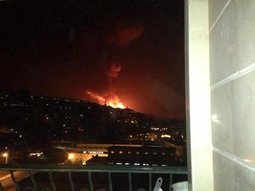 The official Syrian News Agency (SANA) reported; “the new Israeli aggression on Syria comes to aid the terrorist groups that are being defeated by the army in various areas”, and added that the Israeli attack “is meant to foil the attempts of the Syrian army to restore security and stability”.
“This aggression proves Israel’s direct involvement in the conspiracy against Syria”, SANA reported, “This conspiracy serves Israel’s interests, the terrorist groups that army fighting against the Syrian army are directly financed and supported by regional and international countries, including Arab Gulf countries”.
The Syrian Human Rights Monitor, based in Britain, quoted eyewitnesses in Syria stating that the Israeli Air Force bombarded the Jimraya military base, and a nearby weapons facility, and at least two centers for the Syrian Presidential Guards.
Israel refused to comment on the attack, an Israeli army spokeswoman told Reuters; “Israel does not comment on such reports”.
Earlier in February of this year, the Syrian Ambassador to the United Nations filed an official complaint against Israel for bombarding a site in the country, and for violating Syrian airspace, and for bombarding a research center.
Israel claimed that it targeted what it called “a weapons convoy heading to Lebanon”, but Syria stated that the Israeli Air Force bombarded a military scientific center in a suburban area near the Syrian capital, Damascus. Two persons were killed, and several others were injured.
Israeli security officials claimed that the target was a convoy “carrying weapons that could change the rules of the game in the region”, including advanced Russian Sam 17 surface-to-air missiles that Syria was allegedly transporting to the Lebanon-based Hezbollah party.
Top pro-Assad Sunni cleric killed as attack on Damascus mosque kills 42
RT | March 21, 2013
A blast ripped through a mosque in the Syrian capital, killing a prominent pro-government Sunni cleric Sheikh Mohammed Said Ramadan al-Bouti. At least 42 people have died and 84 more were wounded in the attack.
“Senior cleric Dr Mohammed Saeed Ramadan al-Bouti was martyred in a terrorist suicide attack at the Iman Mosque in Mazraa in Damascus,” Syrian State TV said.
Syria’s SANA news agency reports that the scholar’s grandson was also killed in the bombing.
Syrian President Bashar Assad has condemned the attack and vowed to “cleanse” Syria of extremism.
“I present my condolences to the Syrian people for the martyrdom of Sheikh Mohamed Saeed al-Bouti, a great figure in Syria and the Islamic world,” he said in a statement on Thursday night.
Sirens could be heard echoing through the capital as the scene of the blast was cordoned off by the military. TV footage revealed a chaotic scene of eviscerated bodies with severed limbs strewn across the blood-stained floor of the mosque.
RT Arabic’s correspondent Kamel Saqv, who is in Damascus, said that elementary courses on Islam were being conducted at the time of the attack. Many of the dead are believed to be students, he said.
An official source told Syrian State TV that the assailant intended to blow himself up while the students were listening to prayer.
Local residents contacted by Reuters said they initially believed the explosion was caused when a mortar shell hit a nearby political office.
The British-based Syrian Observatory for Human Rights said that rebel fighters were battling with government forces in the area and that mortars had been fired.
Bouti, 83, was President of the Association of Islamic Scholars of Syria and a staunch supporter of President Bashar Assad. Bouti had once characterized the Syrian opposition as ‘scum’, and had also called on Syrians to join the military and help the government defeat the rebel fighters in the two-year-long conflict.
Syrian TV had broadcast his sermons live every week from mosques around Damascus and he also hosted his own religious TV program. His death has been viewed as a serious blow to the government, which is fighting a primarily Sunni-led insurgency.
“The mainstream media will have difficulty” in reporting about this attack, because this was a pro-Assad Sunni cleric, believes, RT Contributor Afshin Rattansi.
“How is it that the Anglo-French-backed, or what should we call them, rebels – insurgents or are they terrorists – are going around killing Sunni clerics in a mosque in Damascus. Perhaps, the [mainstream media] will not be reporting about it at all because it’s so against their idea of sectarianizing Syria between Shia’s and Sunnis,” he observed.
Rattansi also expressed hope that in the context of today’s bombing, “the whole idea of a NATO-backed instability creation in Syria, and three million displaced people in Syria, people within the State Department in Washington will realize that funding must stop for these insurgent groups.”
Despite Civilian-Targeting US Sanctions, Damascus University Excels
By Franklin Lamb | Al-Manar | March 11, 2013
Damascus – Students everywhere are special people and this observer has discovered that Syrian students are among the very best.
Meeting and interviewing students again this past week, before and following a frank and enlightening discussion with Prof. Dr. Mohammad Amer Al-Mardini, the indefatigable President of Damascus University, about the situation of the students and current instruction at the University, one cannot, even as a foreigner, fail to feel pride in Syrian students.
Good meeting places, among others on campus, include “outdoor cafes” — a ‘street student union’ of sorts — consisting of a few chairs and portable tables. They are scattered among the dozens of vendor stalls that line “DU Boulevard” outside the main DU campus in central Damascus. Here students can buy everything from school supplies to mobile phones to snacks. It’s a perfect place to meet and chat with students.
One learns from them about the many effects on the education system in Syria of the US-led sanctions. Some argue that the Obama administration actually fuels the current crisis with its sanctions and achieves the opposite result of what the White House and its allies claim they are seeking.
These freewheeling discussions leave a foreigner with a reminder why this student body ranks among the best in the World. How Damascus University has to date reacted to this crisis evidences the same status.
Currently there are more than 200,000 full-time and ‘open-learning’ students at Damascus University, the 6th largest in the World. The core institutes of the University were established in 1901; they were the medicine and law institutes that formed the basis of the Syrian University that was established in 1923. In 1958, it got its current name, Damascus University when Aleppo University was established.
All of the students are feeling the effects of the Obama Administration’s harsh civilian-targeting sanctions and many are increasingly in the cross-hairs of the “humanitarian sanctions which Washington and Brussels claim “exempt food, medicines and medical supplies” and therefore “should be considered humane.”
Among DU Faculties most severely affected by the US-led sanctions are the Science Departments and the Medical and Nursing schools according to administration and student sources. Chemicals used in various science classes, medicines and medical equipment cannot be found as before and if some are brought in from Europe or elsewhere, the University often has to pay four times the normal price.
Utah’s Brigham Young University gained the respect and appreciation of many in Syria for its shipments to DU’s nursing school of medicines and equipment and even “model doll babies” which in Syria use in baby care classes. All are now banned by the US sanctions which claim to exempt medical equipment and medicines.
Damascus University, with its 36 specialized faculties and five higher institutes is no banking-hours institution and its proven commitment is to give the highest possible quality education to as many students as possible. Syria’s largest university is now open for classes 365 days a year minus a few holidays and a few short breaks for her professors and overworked staff, partly due to the increased number of students arriving from across Syria. The DU administration and faculty work with faculties in war zones to guarantee students can continue their studies without missing key exams required for semester advancement. Still, about 20% of college level students are unable to attend due to transportation and displacement problems.
One direct and predictable severe impact of the US-led civilian-targeting sanctions in Syria is that they have essentially stranded approximately 700 Damascus University students in Europe and half a dozen in the US, forcing some to take leaves of absence and find jobs to survive. This is because, as is well known among the US Treasury Department “craftsmen” who devise the sanctions, these students are no longer able to receive funds for Damascus University to pay for their foreign tuition or living expenses because the banking system has been essentially shut down. More than 1500 Syrian students from other institution of higher learning are similarly stranded as a direct result of the US-led sanctions.
Never the less, Damascus University keeps its commitment to pay the students their tuition fees and their living cost as they are on full scholarships. Currently, parents must pick up the funds from the University accountant and find a way to transfer them. Should they decide to send it via Western Union, for example, a new “sanctions surcharge” of 70 euros for every 1,000 euros sent, is demanded by WU and other money transfer agencies, suggesting another form of war profiteering.
To make things even more difficult for the students, foreign universities which might consider lending their stranded Syrian students tuition money or might even consider aiding them with scholarships or a grant have been “chilled” and are backing-off because these institutions do not want to be accused of “sanction-busting” by the US Treasury hound dogs.
Few food or medicine suppliers — given the sanctions’ language, the meanings of which is uncertain even for their own lawyers, some of whom have declared it incomprehensible — want to risk the wrath of the US Treasury Department and be slapped with severe penalties including very expensive fines by dealing with anyone in Syria.
One of the US Treasury hound dogs is David Cohen, Under-Secretary for Terrorism and Financial Intelligence. Late last month, Mr. Cohen made a trip to the region (including Israel) to brief allies and businesses as well as NGO’s “to be sure the sanctions were biting hard” to use a favorite phase of UN Ambassador Susan Rice. The Obama administration, reportedly frustrated by the fact that its multi-tiered sanctions have failed to topple the governments of Syria and Iran, has been attempting to find and plug loopholes in the sanctions and are intensifying warnings to the international community not to mess with the US Office of Terrorism and Financial Intelligence (TFI) or the Office of Financial Assets Control (OFAC) by getting all wobbly-kneed and going soft on full sanction enforcement.
Meanwhile, Syria’s Department of Education is joining the struggle to shield Syria’s education institutions and is being joined by various student associations. To date, the Ministry of Education and Higher Education have not cut their substantial disbursements to schools and faculties. Tuition remains among the lowest in the world (almost free; 5 US $ a year with the current exchange rate) at Damascus University, which also provides housing for 15,000 students. The DU administration is currently under pressure to find more dormitory space for those needing housing.
Still, despite the conflict, even in Deraa near the Jordanian border where the current crisis started, DU’s campus continues to function.
Many DU students are also volunteering with assisting Syrian primary schools which urgently need their help. According to a December 2012 UNICEF education assessment of primary schools in Syria — at least 2,400 schools have been damaged or destroyed, including 772 in Idlib (50 per cent of the total), 300 in Aleppo and another 300 in Deraa. Over 1,500 schools are being used as shelters for displaced persons. The Damascus University community has also taken on the humanitarian challenge of assisting sister educational institutions that have been affected by the current crisis including campuses in Homs, Deir al Zur and Aleppo, among others.
This observer has met several Damascus University students among the 9,000 volunteers, including Palestinian refugees, who are donating their time working with the Syria Red Crescent Society (SARCS). Many DU students are also volunteering by assisting at primary schools.
The grim reality for Syrian families, hospitals, health care facilities and now university students and educational institutions across the country is that the claimed “humanitarian” exemptions for food, medicine and medical equipment is little more than News-Speak.
Rather than target the people who represent Syria’s future leaders, the White House would do better to cancel its sanctions and send Secretary Kerry to Damascus to meet face-to-face with the Syrian people and government and demonstrate a real American interest in stopping the bloodshed. Armored vehicles and assorted “non-lethal aid” to one side in this conflict will only prolong the killing, as any student here will attest.
Franklin Lamb is doing research in Syria and can be reached c/o fplamb@gmail.com
New Rebel Offensive on Damascus to End up in Failure
By Yusuf Fernandez | Al-Manar | December 10, 2012
The Syrian and foreign rebels, who are conducting operations in several provinces of Syria, have once again tried to expand their field of action to the capital, Damascus, but they have failed to do so despite support from Western and Arab media, which always refers to any one-time or limited rebel success as though it was final and definitive. This media and the insurgent propaganda try to persuade the world, and especially the Qatari and Saudi sponsors of the armed groups, that the rebellion is booming.
Most Western media uncritically reproduces statements made by the pro-rebellion London-based Syrian Observatory for Human Rights (SOHR) as though they were proven facts. In recent days, the SOHR has suggested that Damascus is (once again) about to fall.
The Egyptian newspaper Al Ahram even claimed that “the inhabitants of the Syrian capital Damascus… are subjected to brutal attacks from military positions on the outskirts and Mount Qasiun overlooking the city”. Claims like this one sought to make the public believe that the rebels were already controlling a part of the city. The newspaper also repeated the rebels´ propaganda as a parrot: “The revolutionaries say that their advance on Damascus will trigger a mutiny by the army against its commanders. They hope that thousands will also defect from the regular army and argue that the establishment of a no-fly zone in the country would automatically bring this about.”
Friday November 16th was dubbed by the armed bands the “Friday of the Advance on Damascus”, indicating a “decisive battle” with the regime. They prepared their offensive and several groups arrived in the Damascus province from several places in Syria, such as Deraa and Deir Ezzor. It is, therefore, clear that the rebels attempted in November their most important effort against the capital since their failure of the summer. But this offensive, like the previous one, appears to have been thwarted.
Despite the Free Syrian Army (FSA)´s operations in some towns of Damascus province, this group has at no time been able to enter the city. There have been clashes in the town of Daraya (South-West of the capital), the agricultural region of the Ghouta and the International Airport area (East). For the rebels, it was especially important to capture Daraya because of its strategic position: it oversees the important military airport of Mazzé.
The army´s counter-offensive
On November 29th, the Syrian army launched a vast operation of cleaning these areas within a radius of 5 to 12 miles around the capital. They had already been cleaned last August, but the destruction of armed bands in a densely-inhabited zone is not an easy task.
The newspaper al-Watan announced on December 2nd an army offensive against the places where terrorists had gathered together. “The Syrian army has opened since Thursday morning the gates of hell to all those who were thinking about approaching Damascus or launching an attack against the capital”, wrote the newspaper. It added that the government forces had inflicted heavy casualties on the rebels in several towns and villages.
After some days of offensive, the village of Daraya is now in the hands of the army. The town of Harasta, emptied of its inhabitants since it was invaded by the FSA, is also under the control of government forces while pockets of rebels remain in the nearby village of Duma.
In Ghouta, in the East, where the battle was at its peak this week around the International Airport, informed sources ensure that the airport and its surroundings have been secured, but gunfire can still be heard in distant regions. In the Sayyeda Zainab area, clashes persist between the pro-government militias protecting the district and armed groups holed up in the zone.
According to the Lebanese channel al-Mayadeen, which quoted a Syrian security official, the most violent combat took place on December 3rd. The site Syria Truth advanced the figure of 500 militiamen killed in the first four days of the army´s counter-offensive, including 40 in Deir al-Assafir, 30 in Nina al-Awamid, 60 in Shaba, 100 near the airport and 200 in the sector of Daraya. Al-Watan spoke of “hundreds of terrorists” killed in these days. On the other hand, the Syrian Air Force, indifferent to the threat of the fifty or so American surface-to-air missiles that the rebels hold, continues its attacks on the rebel positions every day.
On the other hand, the limited strength of the rebels in the Damascus province, where they are only a few thousands, make them structurally unable to seriously threaten a city of more than two million inhabitants, where the government is, for obvious reasons, particularly powerful. Rebel advances are always precarious and the armed bands cannot resist the counter-attacks of the army and the militias fighting alongside with it. In this context, the new rebel offensive on Damascus is already becoming another resounding failure.
Syria Opposition Figures Meet in Damascus, Reject Foreign Interference
Al-Manar | September 23, 2012
As they called for regime change in Syria, some 15 opposition parties rejected foreign interference in the ongoing crisis in the country.
During the “National Conference for Rescuing Syria” which was held on Sunday in the capital, opposition figures discussed peaceful ways to end the conflict and help unite the fragmented opposition.
Sunday’s meeting at a hotel in Damascus was held under tight security and on the initiative of the National Coordination Committee for Democratic Changes in Syria.
The ambassadors of Russia, China, Iran and some Arab states that have maintained their diplomatic presence in Syria were also attending the forum.
The conference’s main aim is to secure an “immediate ceasefire” by the conflicting parties and “transfer the armed conflict between the authorities and the opposition into a peaceful political process,” Russian Ambassador to Damascus Azamat Kulmukhametov said in his address to the forum’s participants.
“We are convinced that a dialog without preconditions is the sole way out of the current crisis whose continuation bodes no good either for Syria or for the region as a whole,” he said.
The Arab media have reported the opposition conference will discuss a change of the current Syrian regime, a transition to a civil democratic state and the dangers of the forceful scenario in the country.
The Damascus conference is being held amid disagreements inside the Syrian opposition, with some opposition activists and groups boycotting its work.
For its part, the so-called “Free Syrian Army” (FSA) has not recognized the conference, saying its participants do not “represent a true opposition and are only another face of the Syrian regime.”
Related articles
Ban Ki-moon Slams Syria “Terrorist Attacks”
UN Monitors Continue Mission
Al-Manar | May 1, 2012
UN Secretary General Ban Ki-moon on Monday condemned the terrorist bomb attacks in two Syrian cities but said UN observers had brought some improvement in areas where they have been deployed.
The UN chief called on “all parties” in the Syria conflict to halt violence and work with the growing UN Supervision Mission in Syria, UN deputy spokesperson Eduardo del Buey said in a statement.
Ban “condemns” what he called “terrorist bomb attacks” in Idlib and Damascus on Monday, the spokesperson said.
“While noting improvements in areas where UN monitors are deployed, the secretary general remains gravely concerned by reports of continued violence, killing and abuses in Syria in recent days.”
“He calls for armed violence in all its forms by all parties to cease immediately and full cooperation of all parties with the work of UNSMIS as it expands its presence on the ground,” the spokesperson said in a statement.
The UN monitors are scheduled to visit the western cities of Homs and Hama on Tuesday.
The latest UN schedule comes a day after at least 20 people were martyred and scores of others injured in two bomb attacks in Idlib.
Israel Threatens Holocaust in Damascus
Israel Releases 1973 War Minutes To Send Syria, Hezbollah, “Strong Warning”
Al-Manar – 07/10/2010

The Israeli intelligence Website Debkafile quoted “military and intelligence sources” as saying that PM Benjamin Netanyahu and his Defense Minister Ehud Barak have decided to release the minutes of the deliberations on an air blitz against Damascus – held in Jerusalem before and during the 1973 war – “as a strong warning” to Syrian President Bashar Assad.
“Then, a decision to take out Damascus to halt the Syrian offensive was overruled. This time could be different: Bashar Assad regime’s own centers of power could be at risk if Syria and Hizballah go through with their plan to overpower Beirut and topple Saad Hariri’s sovereign government,” the sources told Debkafile.
The Website said that in the hours leading up to Oct. 6, 1973, Lt. Gen. David Elazar told PM Golda Meir that the Israeli forces can wipe out the entire Syrian air force by noon that day, and that they need another 30 hours to destroy Syrian missiles.
“Then, if they go on the offensive at 5 pm, our air force will be free to strike the Syrian army. To me, this operational option is attractive.” Three days later, on Oct. 9, catastrophe stared Israel in the face: The IDF was in a bad way and taking casualties in the realm of hundreds dead and thousands injured; their defense lines in Sinai and the Golan had fallen and there was nothing in the way of the Syrian army going all the way to the Sea of Galilee and Tiberias.
In a closed meeting with Golda Meir, the iconic defense minister Moshe Dayan asked for permission to bomb Damascus. “Inside the city?” she asked. “Inside the city and its environs,” he replied. “We have to break the Syrians,” Dayan explained that he proposed to strike the Syrian General Command and infrastructure in Damascus. “We’ve done enough going around the fields (a reference to targets outside the Syrian capital). There are no more key targets left. Damascus is the only one. We can’t promise the population won’t be hurt,” Debkafile reported.
It added that “Golda’s permission was withheld.”
The Israeli military and intelligence sources told Debkafile that the decision to release the documents and the section relating to Syria was taken in Jerusalem “after the Obama administration failed to prevent the two-day state visit to Lebanon by Iranian President Mahmoud Ahmadinejad taking place on Oct. 13.”
According to the Israeli site, the message “goes beyond uncovering secret operational and intelligence decision-making and is unusually wide-ranging.”
Featured Video
Prof. Ted Postol: Iran Already Achieved Nuclear Deterrence Against Israel
or go to
Aletho News Archives – Video-Images
From the Archives
How the occupied mentality syndrome works
Saudi Arabia on the American chessboard – Part 3
By B. J. Sabri | American Herald Tribune | June 27, 2016
Read part 2: “The occupied mentality Syndrome“
Previously I argued whether Saudi Arabia’s repeated involvements in U.S. interventions and wars stem from free national will or in response to a specific condition. For starters, in Saudi Arabia there is no national will. In Saudi Arabia, the national will is the will of the Al Saud clan. Still, when a major Arab state allies itself with a superpower that committed unspeakable crimes against humanity in almost every Arab country, then something is wrong. This fact alone should compel us to examine the U.S.-Saudi relation for one exceptional reason. As a result of the U.S.-Saudi wars, hundreds of thousands of people in Afghanistan, Iraq, Iran, Libya, Syria, Yemen, and Somalia have lost their lives. Millions became displaced in their own homelands. And millions more rendered refugees.
Attributing the Saudi policies to the bonds of “partnership” with the U.S. is frivolous. There are no bonds between these two thugs except those of business, military deals, secret plots, and wars. Proving this point, bonds such as these have no space for the American and Saudi peoples to share significant cultural or societal exchanges. If partnership is not the reason for the Saudi contribution to the U.S. strategy of empire and imperialism, then another reason must exist.
This leads to three possibilities. … continue
Blog Roll
 Aletho News
- NIAID/NIH and USDA Fund Bioengineered Chimeric Influenza Viruses Built Using Pandemic H1N1 Components: Journal ‘Science Advances’
- Hezbollah hits Israeli warship off Lebanon’s coast, sets it aflame
- Iran slams US strikes on B1 bridge, Mahshahr petrochemical plants as ‘blatant acts of state terrorism’
- In letter to UN chief, Araghchi warns of dire consequences of US-Israeli attacks on Iran’s nuclear facilities
- Why the CIA conspiracy to invade Iran with Kurdish militias failed
- Why Are Upbeat US Claims About Mission to Rescue Pilot ‘Highly Questionable’?
- Aircraft destroyed during US ‘rescue’ of downed F-15 pilot cost more than $100 million each
- Washington University removes professor who condemned US-Israeli war on Iran
- Russia Warns of Retaliation as UK Authorizes Seizure of Vessels
- Serbia thwarts plot to bomb Russia-Hungary gas pipeline – Vucic
- If Americans Knew
- In Iran, Israel-US take aim at “reason, research, and freedom of thought” – Daily Update
- US loses planes over Iran, Israel downgrades Lebanon war goals – Daily Update
- Israel Is Blocking Palestinians from Easter at Church Where Jesus Resurrected
- Plot to assassinate Palestinian activist follows harassment campaign promoted by Zionist groups and elected officials
- Prominent New York synagogue hosts presentation on why U.S. Jews should support the ethnic cleansing of Gaza
- Tapper vs. Piker: Is the CNN Anchor Auditioning for David Ellison?
- Shouldn’t Democrats Be Able to Condemn Genocide?
- Israel-US kill negotiators, destroy civilian structures, but Iran’s military capabilities still largely intact – Daily Update
- ‘War crime’: Global condemnation as Israeli ministers celebrate death penalty law targeting Palestinian prisoners
- 7 Ways Israel Is Turning Lebanon Into Gaza
- No Tricks Zone
- An Inconvenient Tree: Uncovered In Alps… Europe Much Warmer Than Today 6000 Years Ago
- New Study Reports A 60% Slowdown In Greenland’s Ice Loss Rate In The Last Decade
- Low Intensity Tornado Wrecks Major Solar Farm, Creating A Potential Toxic Dump
- New Study Finds Warming Saves Lives…Cold Temperatures 12 Times More Deadly Than Excess Heat
- German Science Blog Accuses PIK Climate Institute Of Hallucinating Climate Tipping Points
- Devastating Assessment Of Comirnaty Vaccine By Former Senior Pfizer Europe Toxicologist
- New Study: CO2 Is ‘Effectively Negligible’ As An Explanatory Climate Change Factor Since 2000
- Former Pfizer Toxicologist Dr. Helmut Sterz Tells Bundestag Hearing Pfizer Vaccine Should Have Never Been Approved
- Energy Expert: Germany’s Nuclear Phaseout Was A “500 Billion Euro Mistake”
- New Research: South Australia’s Mid-Holocene Sea Surface Temperatures Were 4°C Warmer Than Today
 Aletho News