Hillary Clinton: Electing a Foreign Spy for President?

By James Petras | June 6, 2016
During her 4 years as Secretary of State of the United States (2009-2014), Hillary Clinton controlled US foreign policy. She had access to the most confidential information and state documents, numbering in the tens of thousands, from all of the major government departments and agencies, Intelligence, FBI, the Pentagon, Treasury and the office of the President. She had unfettered access to vital and secret information affecting US policy in all the key regions of the empire.
Today, Mme. Clinton’s critics have focused on the technical aspects of her violations of State Department procedures and guidelines regarding handling of official correspondences and her outright lies on the use of her own private e-mail server for official state business, including the handling of highly classified material in violation of Federal Records laws, as well as her hiding official documents from the Freedom of Information Act and concocting her own system exempt from the official oversight which all other government officials accept.
For many analysts, therefore, the issue is procedural, moral and ethical. Mme. Clinton had placed herself above and beyond the norms of State Department discipline. This evidence of her arrogance, dishonesty and blatant disregard for rules should disqualify her from becoming the President of the United States. While revelations of Clinton’s misuse of official documents, her private system of communication and correspondence and the shredding of tens of thousands of her official interchanges, including top secret documents, are important issues to investigate, these do not address the paramount political question: On whose behalf was Secretary Clinton carrying out the business of US foreign policy, out of the review of government oversight?
The Political Meaning and Motivation of Clinton’s High Crimes Against the State
Secretary Clinton’s private, illegal handling of official US documents has aroused a major FBI investigation into the nature of her activities. This is separate from the investigation by the Office of the Inspector General and implies national security violations.
There are several lines of inquiry against Mme. Clinton:
(1) Did she work with, as yet unnamed, foreign governments and intelligence services to strengthen their positions and against the interest of the United States?
(2) Did she provide information on the operations and policy positions of various key US policymakers to competitors, adversaries or allies undermining the activities of military, intelligence and State Department officials?
(3) Did she seek to enhance her personal power within the US administration to push her aggressive policy of serial pre-emptive wars over and against veteran State Department and Pentagon officials who favored traditional diplomacy and less violent confrontation?
(4) Did she prepare a ‘covert team’, using foreign or dual national operatives, to lay the groundwork for her bid for the presidency and her ultimate goal of supreme military and political power?
Contextualizing Clinton’s Clandestine Operations
There is no doubt that Mme. Clinton exchanged minor as well as major official documents and letters via her private e-mail system. Personal, family and even intimate communications may have been carried on the same server. But the key issue is that a large volume of highly confidential government information flowed to Clinton via an unsecured private ‘back channel’ allowing her to conduct state business secretly with her correspondents.
Just who were Secretary Clinton’s most enduring, persistent and influential correspondents? What types of exchanges were going on, which required avoiding normal oversight and a wanton disregard for security?
Clinton’s covert war policies, which included the violent overthrow of the elected Ukraine government, were carried out by her ‘Lieutenant’ Under-Secretary of State Victoria Nuland, a virulent neo-conservative holdover from the previous Bush Administration and someone committed to provoking Russia and to enhancing Israel’s power in the Middle East. Clinton’s highly dangerous and economically destabilizing ‘brainchild’ of militarily encircling China, the so-called ‘pivot to Asia’, would have required clandestine exchanges with elements in the Pentagon – out of the State Department and possibly Executive oversight.
In other words, within the Washington political circuit, Secretary Clinton’s escalation of nuclear war policies toward Russia and China required secretive correspondences which would not necessarily abide with the policies and intelligence estimates of other US government agencies and with private business interests.
Clinton was deeply engaged in private exchanges with several unsavory overseas political regimes, including Saudi Arabia, Israel, Honduras and Turkey involving covert violent and illegal activities. She worked with the grotesquely corrupt opposition parties in Venezuela, Argentina and Brazil
Clinton’s correspondence with the Honduran armed forces and brutal oligarchs led to the military coup against the elected President Zelaya, its violent aftermath and the phony election of a pliable puppet. Given the government-death squad campaign against Honduran civil society activists, Clinton would certainly want to cover up her direct role in organizing the coup. Likewise, Mme. Clinton would have destroyed her communications with Turkish President Erdogan’s intelligence operations in support of Islamist terrorist-mercenaries in Syria and Iraq.
Secretary Clinton’s e-mail would have shown her commitment to the Saudis when they brutally invaded Bahrain and Yemen to suppress independent civil society organizations and regional political rivals.
But it is Clinton’s long-term, large-scale commitment to Israel that goes far beyond her public speeches of loyalty and fealty to the Jewish state. Hillary Clinton’s entire political career has been intimately dependent on Zionist money, Zionist mass media propaganda and Zionist Democratic Party operations.
In exchange for Clinton’s dependence on political support from the Zionist power configuration in the US, she would have become the major conduit of confidential information from the US to Israel and the transmission belt promoting Israel-centric policies within the US government.
The entire complex of Clinton-Israel linkages and correspondences has compromised the US intelligence services, the State Department and Pentagon.
Secretary Clinton went to extraordinary lengths to serve Israel, even undermining the interests of the United States. It is bizarre that she would resort to such a crude measure, setting up a private e-mail server to conduct state business. She blithely ignored official State Department policy and oversight and forwarded over 1,300 confidential documents and 22 highly sensitive top-secret documents related to the ‘Special Access Program’. She detailed US military and intelligence documents on US strategic policies on Syria, Iraq, Palestine and other vital regimes. The Inspector General’s report indicates that ‘she was warned’ about her practice. It is only because of the unusual stranglehold Tel Aviv and Israel’s US Fifth Column have over the US government and judiciary that her actions have not been prosecuted as high treason. It is the height of hypocrisy that government whistleblowers have been persecuted and jailed by the Obama Administration for raising concerns within the Inspector General system of oversight, while Secretary Clinton is on her way to the Presidency of the United States!
Conclusion
Many of Clinton’s leading critics, among them two dozen former CIA agents, have presented a myth that Hillary’s main offence is her ‘carelessness’ in handling official documents and her deliberate deceptions and lies to the government.
These critics have trivialized, personalized and moralized what is really deliberate, highly politicized state behavior. Mme. Secretary of State Hillary Clinton was not ‘careless in managing an insecure mail server’. If Clinton was engaged in political liaison with foreign officials she deliberately used a private email server to avoid political detection by security elements within the US government. She lied to the US government on the use and destruction of official state documents because the documents were political exchanges between a traitor and its host.
The 22 top secret reports on ‘Special Access Programs’ which Clinton handled via her private computer provided foreign governments with the names and dates of US operatives and proxies; allowed for counter-responses inflicting losses of billions of dollars in program damages and possibly lost lives.
The Inspector General Report (IGP) deals only with the surface misdeeds. The Federal Bureau of Investigations (FBI) has gone a step further in identifying the political linkages, but faces enormous obstacles from Hillary’s domestic allies in pursuing a criminal investigation. The FBI, whose director is a political appointee, has suffered a series of defeats in its attempts to investigate and prosecute spying for Israel, including the AIPAC espionage case of Rosen and Weismann and in their long held opposition to the release of the notorious US-Israeli spy, Jonathan Pollard. The power of the Zionists within the government halted their investigation of a dozen Israeli spies captured in the US right after the attacks of September 11, 2001.
Clinton’s choice of conducting secret private communications, despite several years of State Department warnings to abide by their strict security regulations, is an indication of her Zionist power base, and not a mere reflection of her personal hubris or individual arrogance.
Clinton has circulated more vital top-secret documents and classified material than Jonathan Pollard.
President Obama and other top Cabinet officials share her political alliances, but they operate through ‘legitimate’ channels and without compromising personnel, missions, funding or programs.
The executive leadership now faces the problem of how to deal with a traitor, who may be the Democratic Party nominee for US President, without undermining the US quest for global power. How do the executive leadership and intelligence agencies back a foreign spy for president, who has been deeply compromised and can be blackmailed? This may explain why the FBI, NSA, and CIA hesitate to press charges; hesitate to even seriously investigate, despite the obvious nature of her offenses. Most of all it explains why there is no indication of the identity of Secretary Clinton’s correspondents in the various reports so far available.
As Sherlock Holmes would say, “We are entering in deep waters, Watson”.
Democrats, Too Clever by Half on Clinton

By Robert Parry | Consortium News | May 14, 2016
Last year when Democratic insiders looked forward to Election 2016, they expected a run-of-the-mill Republican, possibly even legacy candidate Jeb Bush. So they countered with their own “safe” next-in-line legacy candidate, Hillary Clinton, who would supposedly win by playing up the prospect of the first woman president.
In such an expected match-up, the concern of rank-and-file Democrats about Clinton’s hawkish foreign policy would be negated by the GOP nominee still defending President George W. Bush’s Iraq War and again surrounded by neocons pounding the drums for even more wars. With both parties putting forward war candidates, anti-war Democrats would accept Clinton as the lesser evil, or so the thinking went.
The likely Republican nominee also would be burdened by reactionary domestic proposals, including GOP plans for privatizing Social Security and Medicare. By contrast, centrist Clinton would look reasonable in promising to protect those popular programs, albeit with some modest trimming of benefits to please the budget hawks.
But the Democratic insiders didn’t count on the unlikely emergence of populist billionaire Donald Trump, who repudiated Bush’s Iraq War and the GOP’s neocon foreign policy and rejected Republican orthodoxy on “entitlement reform,” i.e., slashing Social Security and Medicare.
The unabashed Trump also has made clear that he is not afraid of countering Clinton’s “woman card” by playing his own “man card,” including attacks on her troubled marriage and her tolerance of Bill Clinton’s notorious womanizing, even claiming that she was her wayward husband’s “enabler.”
At first, the Democratic hierarchy couldn’t believe its luck as the Republican Party seemed to splinter over Trump’s disdain for the GOP’s neocon interventionism and rejection of the party’s cutbacks in Social Security and Medicare. Trump’s mocking attacks on his rivals also shattered the decorum that Republican leaders had hoped would mark their primary campaign.
So, the Democratic insiders initially rubbed their hands with glee and imagined not only an easy presidential victory but major gains in the House and Senate. However, new polls show Trump running neck-and-neck with Clinton nationally and in key battleground states, while other polls reveal strong public doubts about Clinton’s honesty, thus wiping the premature smiles off the Democrats’ faces.
Panic Mode
Indeed, some Democrats reportedly are slipping into panic mode as they watch Clinton’s poll numbers tank and the Republican Party come to grips with the Trump phenomenon. The new storyline of Campaign 2016 is the tale of top Republicans reconciling to Trump’s populist conquest of the party. At least, these GOP leaders acknowledge, Trump has excited both average Republicans and many independents.
The obsessive media coverage of Trump’s meetings on Thursday with senior congressional Republicans made the narcissistic real estate mogul and reality TV star look like some major world leader being received in Washington as a conquering hero. And, with the GOP rallying behind Trump, the likelihood is that his poll numbers and favorable/unfavorable ratings will continue to improve.
So, instead of Democratic dreams of a landslide victory, the party insiders are worrying now about their decision to coronate a deeply flawed and wounded candidate in Hillary Clinton. Not only could she lose to Trump but she could take many of the House and Senate candidates down with her. It’s dawning on some Democrats that they may have squandered a historic opportunity to realign American politics to the left by promoting the wrong person in 2016.
At a moment when the American people are demanding change – even willing to risk entrusting the White House to the unorthodox and inexperienced Donald Trump – the Democratic Party may be stuck with an uninspiring status quo candidate who also is pro-war, indeed far more hawkish than President Barack Obama.
Thus, in the fall election, not only would Trump be in a position to bait Clinton about her dysfunctional marriage, reminding the nation of the messy scandals of the 1990s, but he could challenge her on her warmongering positions, including her years of support for the Iraq War and her hawkish policies as Secretary of State, including her instigation of the disastrous “regime change” war in Libya. [See Consortiumnews.com’s “Yes, Hillary Clinton Is a Neocon.”]
This November could be the first time in modern American history when the Republican nominee would be the relative “peace candidate” and the Democrat would be the “war candidate.” That changing places could lose Clinton much of the “anti-war left,” a significant faction within the Democratic coalition with many “peace Democrats” either voting for Trump or choosing a third party, such as the Greens.
Of course, the Democrats didn’t have to be in this position. The party leaders could have encouraged a more competitive primary contest instead of trying to keep alternative candidates, such as Sen. Elizabeth Warren and some younger Democratic prospects, on the sidelines, all the better to give Hillary Clinton an unimpeded path to the nomination. The party insiders treated Clinton like an incumbent president seeking reelection, a foregone conclusion.
Alternatives, Anyone?
But the best laid plans of mice and politicians often go astray. How weak Clinton is as a candidate has been underscored by her struggle to put away a progressive challenge from Sen. Bernie Sanders, a 74-year-old “democratic socialist” from Vermont, who isn’t even technically a Democrat, listing himself as an Independent.
Even though the vast majority of “super-delegates” – i.e., party insiders – have lined up behind Clinton and she leads in pledged delegates, Sanders continues to win primaries, including recent ones in Indiana and West Virginia, and he could roll up a series of victories in upcoming western state races.
Clinton could stagger to the Democratic convention in July with a dispirited party lining up glumly to witness her long-delayed coronation. The onlookers might sense that they had made a terrible mistake but couldn’t correct it. They would be left to grit their teeth and hope that Clinton’s self-inflicted wounds, such as her private emails as Secretary of State, don’t fester and become fatal.
Arguably, it is the Democrats who would benefit the most from a contested convention, one that might give them an opportunity to reconsider the choice of Clinton and either nominate Sanders, who fares much better against Trump in poll match-ups, or pick someone else, possibly a fresh face like Sen. Warren.
While that may be highly unlikely – even if Sanders sweeps the remaining primaries – it is beginning to dawn on Democratic insiders that their scheme to grease the skids for a Clinton nomination might end up slipping Donald Trump into the White House.
Investigative reporter Robert Parry broke many of the Iran-Contra stories for The Associated Press and Newsweek in the 1980s. You can buy his latest book, America’s Stolen Narrative, either in print here or as an e-book (from Amazon and barnesandnoble.com).
Sanders Supporters Can Bring Down the Democrats
By Margaret Kimberley | Black Agenda Report | May 11, 2016
 Donald Trump’s ascension to the Republican presidential nomination has created an enormous rift between the Republican elites and the rank and file. This process is a welcome development that could lead to the end of that party.
While the Republicans implode Hillary Clinton moves towards the Democratic party nomination by moving ever more towards the right. She and former president Bill Clinton have made it clear. They intend to get votes from independents and Republicans who can’t stomach the idea of a Trump presidency. That has been her modus operandi throughout her political career. She bragged about being a teenaged Goldwater girl and now brags about killing in Libya.
She ignores the Bernie Sanders phenomenon because she has no reason to do otherwise. From the moment he started his campaign he said he would endorse her if she won the nomination. Of course Sanders followers might change the trajectory of history by refusing to go along with the charade. If they stand firm they can also send their party into the historical dustbin where it belongs.
Trump’s supporters epitomize white nationalist sentiment but they are also driven by personal need. They have been left behind by the machinations of both parties. The trade deals concocted by Republicans and Democrats have taken the living wage jobs they expected to have forever. While they prosper more than any other group in the country they still feel affronted by their change in fortune. They don’t care about the imperial project and wouldn’t mind if Trump made good on his pledge to cease invasions and regime change plots.
Democrats on the other hand are less likely to send their party packing. They have been hypnotized by years of lies which have allowed wars, austerity, and mass incarceration to be considered acceptable, small prices to pay to keep the Republicans at bay. Black voters in particular are so fearful of Republican victory that any Democratic Party policy, no matter how damaging to them, gets the go ahead.
The election of 2016 should be historic not just because two people who are disliked by millions will run for president. It should be ground breaking because it will mean that Americans who love to think of themselves as independent will finally live up to that self-image.
The Sanders people in particular claimed to want a revolution. Now is their chance to make good on this assertion. Their task is a simple one. They must not support or vote for Hillary Clinton in November and they must say so loudly and clearly. They can vote for another party’s candidate or write in one of their own. They may exhort Sanders to deny her an endorsement. Any tactic will do. But if they follow tradition and vote for a conservative Democrat they will have made a mockery of their demand for change.
Liberal Democrats who like to think of themselves as leftists must put up or shut up. They should know by now that their party cannot be reformed. It must be done away with for good. The duplicity of the Democrats is fully on display for everyone who really wants to see it. On the one hand they will use the infamous Koch brothers to strike fear, raise money and keep their voters in line. Will they continue to do that now that Charles Koch has declared Hillary Clinton to be possibly more acceptable than Donald Trump?
In reality the Bernie Sanders campaign held more pretense than reality. Sanders isn’t really a socialist and neither are most of his voters. Yet they found it appealing to be connected to a candidate who gave them political cache. Neither are Sanders or his supporters revolutionary. The word revolution was more of a marketing ploy than anything else and continued the mirage of the possibility for change.
Sanders was always the sheep dog, as Black Agenda Report said in 2015. That does not mean his followers have to follow suit. The necessary rejection of Hillary Clinton will also mean a rejection of the man they admired and voted for if he does as he promised and endorses her.
Sanders voters can be the revolutionaries they aspired to be if they loudly and publicly state that they won’t vote for Hillary Clinton. They will need a great deal of determination as they will surely be scapegoated, guilt whipped and blamed for her defeat. But those attacks should be considered as a badge of honor in what may well be a revolutionary effort.
Of course if people “felt the Bern” only because they hoped for a better Democrat then this effort is for naught. By now everyone should know that the corruption in the Democrat party cannot be cut out. The party doesn’t want to change itself and makes sure that opponents end up just driving the sheep.
It is time for the Sanders supporters to make good on calls for revolution. They can do that by actively and openly denying Hillary Clinton the presidency. When they are called spoilers they must proudly own the charge and declare that they meant what they said. They are fighting for a revolution.
Margaret Kimberley can be reached via e-Mail at Margaret.Kimberley(at)BlackAgendaReport.com.
#FeelTheBern Goes #UpInSmoke
By John Stauber | CounterPunch | April 27, 2016
From the moment he announced, it was obvious what newly christened Democrat Bernie Sanders would become: The Great Progressive Hope who would fight to slay Wall Street’s champions and reclaim the party for some long ago or long imagined liberal greatness. And it was obvious how his campaign would end, as it is now wrapping up, with Bernie begrudgingly conceding that he cannot win against Hillary’s oligarchy backing and the rigged process of establishment SuperDelegates designed to make sure no self-proclaimed democratic socialist-type ever wins the nomination.
It’s the Democrat’s political equivalent of the Bill Murray movie classic Groundhog Day, except the progressive candidate never wins the girlfriend, er, nomination, in the end. Instead, the Sanders, Deans, Browns, and Jacksons, the progressive champions of their election cycle, only change themselves from watchdogs and guard dogs to lap dogs, ensuring that cynical and outraged progressives follow their champion-cum-Pied Piper to become advocates for defeating the Republicans in November.
This is the death spiral the Feel the Bern movement, the 2 million who have forked over time and money, has now entered. The Democratic apparatchiks who run Bernie’s campaign are preparing their masses for the inevitable, pulling them into the ceremony that, not unlike a religious grieving event, prepares them for death and eventual resurrection, post-convention, to transform them into a saintly rationalizing army of supporters for, in this case, Hillary.
All this I predicted (as could any objective fool) the day of Bernie’s announcement. Yes, it has been heartening to see the extent of his support as he attacks the banks and the Democratic establishment. But, of course, it is all for naught. In four months Hillary’s army will command Bernie’s list of 2 million, and Bernie and his loyal Democratic minions will be weaving memes of how the Party will soon be in the hands of the FeelTheBern rebellion. Not this year, not next, but soon, brothers and sisters, soon, the revolution will occur!
As frustrated nationalist populism tears apart the Republican Party, the co-opting power of the Democrats ensures that there will be no similar rebellion from the true believing Progressives in the Democratic Party.
Bernie is an old man. He has lived a fine and worthy public life, but unfortunately he will fade into the sunset without taking the brave step of leading his supporters into finally forming a viable left party in the United States. That would be a true legacy and accomplishment. Even the right wing oligarchs of the Republican Party have realized that the shared monopoly both corporate parties wield over the political process makes a viable third party almost impossible.
Yet, for all the noble tirades of the Progressives from Bill Moyers to Bernie Sanders about the power of money and how it must be removed from the process, it is the process itself that is the problem. Two parties, both pro Wall Street and pro military-industrial complex, control the political system. A majority of voters opted out of this farce democracy long ago, so only a minority votes for these parties. Big money has ensured ever tighter domination by the super rich, but even with the dream of meaningful finance reform, the shared monopoly that corporate oligarchs control with their phony two-party system is the real problem.
So thanks Bernie, you ran a good race, and now you can hop onto Hillary’s pant suit and become the latest kept progressive champion, the Pied Piper, trying to convince the left and progressives that real change is possible within the Democratic Party. And the tragedy is that 95% of your supporters, the Feel the Bern Movement, will follow you down that Blue Brick Road past the intoxicating poppies on to celebrate the great achievement that electing Hillary shall be deemed.
And so the same damned movie script plays out again, and the bipartisan oligarchy wins again, as brilliantly planned. Just ask Charles Koch if he can live with Hillary, because he already has said he can. A neoliberal neocon in the White House may not be the Koch Brothers’s favorite choice, but they and their money can live with it very well!
Clinton’s Weak Campaign Finance “Pillar”
By Rob Hager | CounterPunch | December 8, 2015
Hillary Clinton was widely quoted telling a handful of Iowans on April 14: “We need to fix our dysfunctional political system and get unaccountable money out of it once and for all — even if it takes a constitutional amendment.” The Washington Post identified this statement as “one of several pillars of her 2016 presidential campaign.” CBS based its headline for this Clinton story on the quote that this pillar represented one of “four big fights that I think we have to take on.” Her communications director, elaborating on the transcript of Clinton’s spare comments on the subject, added “It’s something she’s really concerned about.”
It is safe to assume that after months crafting the four policy pillars of her candidacy, and the way the message itself was tightly controlled from Iowa, that Clinton’s particular phrasing for her “unaccountable money” pillar was precisely as intended by her campaign team.
The Post’s headline writers and others converted Clinton’s hypothetical statement, “if it takes a constitutional amendment,” into a far more definite “support for a constitutional amendment,” as if Clinton is expected to propose or endorse a constitutional amendment during her campaign.
Slate‘s dog-whistle headline, relying on nothing more than the above quote in the Post, transformed her statement even further: “Hillary Clinton Hints at Support for Constitutional Amendment to Overturn Citizens United.” The Post, and presumably Clinton in Iowa, said nothing at all about Citizens United, let alone support for any “amendment to overturn” it. What Clinton did say is closer to the opposite of either of those two concepts.
Clinton’s statement “supports” not getting all or any part of interested money out of politics, which is what people advocating an “Amendment to Overturn Citizens United” think they are supporting. Clinton is speaking solely about “unaccountable money.” Such money can become fully “accountable” without being exluded from the pay to play system of US politics. Clinton is simply advocating its disclosure.
Under her proposal the embarrassing flood of money into US politics, anticipated to explode even further in her own campaign, will not be stanched. It would be accounted for by disclosing its provenance, which is now often left undisclosed by use of 527‘s and other IRS conduits. She considerately wants Americans to know who is buying the power to operate their erstwhile democracy against their every interest. There is no assurance that such disclosure would have any significant impact on the pervasive corruption of U.S. politics.
Under systemic corrupion, disclosure actually can help circumvent one of the few remaining inconveniences to plutocrats. Plutocrats who feel their “freedom of speech” constrained by new $5 million contribution limits per person per election cycle jointly endoresed by Congress and the Supreme Court can spend as much as they want on “independent” electioneering provided, so the cover story goes, they do not “coordinate” their expenditures with the campaigns. But to buy influence the candidate needs to know who is paying them off. By bridging this inconvenient gap in the system, formal disclosure required for everyone by law is a perfect solution for legalized coordination. Accordingly, disclosure is the reform that Democrats and their allies are selling to their supporters, and the reform the plutocrat justices of the Roberts Court also promote with no fear of significantly upsetting the corrupt political system they maintain.
Where corruption is systemic, Clinton’s proposition that actual “accountability” is even possible, other than in the sense of mere disclosure, is itself highly dubious. When the system requires all competitors to be on the take, disclosure alone fails to create any effective new options for making politicians actually accountable to voters. In this system where the Supreme Court legalizes corruption and the mass media collects a toll to mediate their messages, only the proxies of plutocrats are on offer to voters.
As a lawyer, Clinton must already understand that no constitutional amendment is required to accommodate a legislative remedy for her “unaccountable money” pillar. Laws under the existing Constitution can require all the additional disclosure that she could possibly want. Disclosure requirements for campaign contributions have existed in federal law since the Progressive Era’s Publicity of Political Contributions Act of 1910, 36 Stat. 822. The constitutionality of such disclosure laws has never been doubted.
In Ex Parte Curtis (1882) (8-1) the Supreme Court ruled, without even bothering to argue the point, that the power of Congress to prohibit political corruption outweighs any asserted First Amendment interest in allowing political donations. If the First Amendment argument made by the petitioner in Curtis, and dismissed by the government’s brief as unworthy of serious attention, albeit accepted by a lone dissenter, could not legalize money in politics against a total ban, then certainly requirements that political investments merely be disclosed could have raised no conceivable objection before the Nixon Court reversed the Curtis rule without mentioning it nearly a century later.
The Supreme Court held disclosure laws to be constitutional in Burroughs v. United States (1934) (9-0) when it upheld the strengthened disclosure requirements of the 1925 Federal Corrupt Practices Act. As that Court explained, disclosure requirements are “calculated to discourage the making and use of contributions for purposes of corruption.” This most conservative of any Supreme Court majority prior to the current Roberts 5 resoundingly rejected the very idea that disclosure requirements might be constitutionally invalid, calling the “proposition so startling as to arrest attention.” Quoting from another deeply conservative Gilded Age Court lineup in Ex parte Yarbrough, 110 U.S. 651 (1884), the 1934 Court explained that “government … must have the power to protect the elections on which its existence depends from violence and corruption … the two great natural and historical enemies of all republics.”
Later in United States v. Harriss, 347 U.S. 612, 625 (1954) the Supreme Court again expressly approved mandatory disclosure of political investments connected with some actual speech in the context of lobbying. See also National Association of Manufacturers v Taylor (D.C. Cir. 2009) (upholding lobbying disclosure under Honest Leadership and Open Government Act of 2007). Chief Justice Warren held in Harriss that,
the voice of the people may all too easily be drowned out by the voice of special interest groups seeking favored treatment while masquerading as proponents of the public weal. This is the evil which the Lobbying Act was designed to help prevent… Congress… is not constitutionally forbidden to require the disclosure of lobbying activities. To do so would be to deny Congress in large measure the power of self-protection.
Since the outset of the current era of systemic corruption of politics the Supreme Court responsible for making that corruption systemic has nevertheless, without reservation, reaffirmed the same principles. Disclosure was endorsed by Buckley v Valeo (1976), the judicial mother lode for legalizing systemic corruption, and again by Citizens United (2010), the bete noir of all professional activists working the campaign finance silo. When the Roberts Court overturned aggregate limits for political investors in McCutcheon (2014) , Justice Roberts lauded this “less restrictive alternative” which also “given the Internet, … offers much more robust protections against corruption” than ever.
Though the constitutionality of disclosure laws has for a century been of little or no demonstrable utility in preventing the current systemic levels of political corruption, it is nevertheless regularly trotted out in this manner as a cure-all by politicians and other operatives of this corrupt system. Clinton has built her “unaccountable money” pillar on this well-worn tradition, and nothing more. Current disclosure laws are certainly inadequate. But this is because Congress is now too mired in systemic corruption, and the FEC too deadlocked, to enact even tepid and marginal reforms necessary to make disclosure even potentially more effective.
Clinton surely knows the Supreme Court’s historic, consistent, and virtually unanimous, rulings make clear that there is no need for a constitutional amendment to require full disclosure of currently “unaccountable” or “dark” money. She must have spent some tiny fraction of what has been projected to be an over $2 billion campaign to do some elementary initial research and strategy development about one of her expensive campaign’s four basic policy pillars – which she offers as her reason for running. Her issues team must have advised her to use the hypothetical “if” when mentioning an amendment because they know that an amendment is not necessary to accomplish the limited Clinton disclosure agenda. Hypothetical mention of an amendment does help obfuscate the limited nature of her agenda. Besides, mentioning the Constitution makes her proposal sound more important. Amendment advocacy, however hypothetical in the case of the “unaccountable money” pillar, does help distract constituents’ political energies to futile pursuits, while also deflecting responsibility to others. This is the strategy that has worked for Democrats on the corruption issue.
The rush to enlist Clinton in their cause by the Democrats’ professional activist allies who have committed themselves to an amendment approach suggests that they either do not know, or do not care, that no amendment is necessary to achieve the mostly useless “accountability” for money in politics that Clinton supports. Clinging to their futile amendment approach such activists mistakenly insist there is “no question that an amendment will be needed.” They do not know or care that it would be a counter-productive waste of time to confirm, by constitutional amendment, the validity of general powers of Congress which have never been seriously questioned on constitutional grounds and only recently exalted by the defender of plutocracy himself, Chief Justice Roberts. Presumably at the behest of such mistaken activists, Bernie Sanders has proposed an amendment that does include such a provision that risks not just wasteful but also counterproductive results.
Given the uninformed quality of the constitutional amendments that have been proposed on this subject by Democrats and their professional activist allies, one can easily imagine that an amendment for this purpose, although unnecessary, could well do more harm than good. The close parsing by a hostile Roberts Court of any particular new constitutional text on this subject could be turned on its head to reduce Congress’ current unrestricted authority to mandate all the disclosure of money in politics they may desire.
Clinton’s mention of the amendment should be no surprise. The constitutional amendment idea has been used as a theatrical prop to give cover to Democrats who are mired in the corrupt system as deeply as Republicans. Republicans embrace plutocracy as some surreal 21st century manifestation of the founders concept of “freedom of speech,” a notion formed long before there was a mass broadcast media to be bought for the political propaganda of marketing specialists. Accepting the Republican’s game, Democrats misleadingly propagate the idea that a constitutional amendment is the sole means by which they could limit money in politics. The resulting stalemate from this diversion absolves Democrats’ failure to advance far more effective and available legislative measures. By such deceit about their support for a futile amendment, a majority of Senate Democrats in the 113th Congress were empowered to vote on behalf of Wall Street in December 2014 to increase, by an order of magnitude, the money that plutocrats can give to buy political parties. Democratic support for the “CRomnibus” Act betrayed the notion that Democrats’ professed commitment to “campaign finance reform” meant that they would seek laws mandating less, not considerably more, money in politics. But the betrayal met with little, if any, protest from their activist allies who keep their eyes safely diverted to the futile amendment approach that would not even have stopped Congress from increasing money in politics as they did in 2014 even if it had been adopted.
Amendment advocacy has served to divert attention from corrupt Democrats for five years. The eventual, and inevitable, collapse, on September 11, 2014, of the Democrats anti-”Citizens United” constitutional amendment theatrics caused those professional activists who got the memo to pivot to a new advertising slogan for 2015. Their new advertising campaign promotes disclosure of “Dark Money,” while attempting to make that slogan sound even worse than their “Citizens United” soundbite. This latest piecemeal fad by non-profit fundraisers for what is actually a much reduced new demand ignores Justice Elena Kagan’s koanic axiom: “Simple disclosure fails to prevent shady dealing…. So the State remains afflicted with corruption.” But it serves Clinton’s straddle between disclosure and amendment.
The recent solicitations from political non-profits have reduced expectations so far as to ask that you send them money to help eliminate Dark Money electioneering by government contractors. This is a reform Obama could accomplish on his own, as a matter of seeing that the law are executed, and should have long ago when the subject first arose in 2011. The activists scrambled on board after the New York Times recently approved this approach. This reform would, they say, “unmask major corporate political donors with a simple executive order.” Of all the plutocrats and their corporate agents who make political investments, this reform would only reach the subset of government contractors. Instead of demanding mere disclosure of political investments from government contractors, activists should at the very least demand policies for this subset that would totally abolish political kickbacks from the procurement system. Their demand should be for strengthening and robust enforcement of — while disqualifying any federal contractor that “directly or indirectly … make[s] any contribution …to any person for any political purpose or use” in violation of — 2 U.S. Code § 441c (“Contributions by government contractors”). Demanding mere disclosure in this context, as it usually does, serves to divert attention from more meaningful reform.
Even this anti-corruption best-practice no-brainer for disclosure, let alone disqualifying firms with a history of conflict of interest electioneering expenditures, has been too much for a Democratic President. Obama uses highly contingent and distancing language whenever he mentions money in politics, such as his statement (emphasis added) about: the “need to seriously consider mobilizing a constitutional amendment process to overturn Citizens United (assuming the Supreme Court doesn’t revisit it). Even if the amendment process falls short, it can shine a spotlight on the super-PAC phenomenon and help apply pressure for change.”
The multiple italicized contingencies Obama employed indicate that he understood an amendment to be little more than political theatrics. By mentioning Citizens United, not Buckley, and Super-PACs instead of the whole corrupt system, he slices and dices the problem into its manageable but piecemeal soundbites. As a former constitutional law lecturer and record-setting fundraiser, Obama must know that the independent corporate electioneering legalized by Citizens United had very little to do with Super-Pacs, which are overwhelmingly funded by a handful of rich individuals and their non-profit proxies, with very little (only 12%) coming from for-profit corporations. Moreover Super-Pacs already have adequate spotlights on them from a largely outraged public. If in any event the “amendment process” is expected by him to “fall short,” then exactly what is the “change” that Pres. Obama believes can be obtained by “pressure” that might arise from this failure?
Failure due to misdirection usually depletes energy, causes frustration, and alienates voters, which only relieves the “pressure” on politicians. But Obama presumably knows that. His latest tepid statement, sounding like a bystander to the process of policy making, was that he would “love to see some constitutional process that would allow us to actually regulate campaign spending the way we used to, and maybe even improve it.” This could mean almost anything while committing Obama to nothing. One suspects that Obama’s “love” will not give birth to any effective strategy; nor will Clinton.
By mentioning a constitutional amendment without endorsing anything specific Clinton is doing little more than what Obama and his party has done. In formulating her disclosure pillar, Clinton adopted similar language to, while cleverly promising considerably less than, the commitment made in the 2012 Democratic Party platform: “We support campaign finance reform, by constitutional amendment if necessary.” The rubric of “campaign finance reform” could include disclosure of “unaccountable” money as one tactic. But that would need to be accompanied by a more comprehensive legislative package to accomplish any actual “reform.”
By mentioning a constitutional amendment in this context, although the inadequacy of disclosure laws has nothing to do with the text of the Constitution, Clinton not only blows the dog-whistle for those diverted to that futile approach by professional activists for the past five years, but also prepares a convenient exit for herself from even the truncated “dark money” issue. As one commenter observed, she can “endorse the concept without too many expectations about personally making an amendment happen.” A president has no formal role in adopting an amendment so it serves to shift responsibility for the issue away from her, as it has done for Obama.
Clinton should be asked to disclose her legislative plan, since in fact no amendment is necessary, whether to force disclosures of money in politics, or to enact far more robust prohibitions than any amount of disclosure could possibly accomplish. It is those other, strategic legislative solutions for banning money from politics, such as strengthened conflict of interest recusal rules, and Exceptions Clause or Eleventh Amendment jurisdiction-stripping, that Clinton, along with the Democratic Party, can be safely expected to avoid at all costs.
Democrats using effective strategy to get money out of politics would be even less likely than landing a gyrocopter on the White House lawn by a “showman patriot” would dramatize the issue effectively in the complicit mass media. The Wall Street masters would not consent to any effective strategy to restrain their plutocracy.
Rob Hager is a public interest litigator who filed an amicus brief in the Montana sequel to Citizens United and has worked as an international consultant on anti-corruption policy and legislation.
Cheap Gas Is Killing Nuclear Power, and the Outlook is Grim
Nuclear’s greatest hope may be the ‘Clean Power Plan’
By Thomas Overton – POWER magazine– 11/17/2015
Another month, another premature nuclear plant retirement.
About two weeks ago, Entergy finally threw in the towel on the James A. FitzPatrick Nuclear Power Plant in Scriba, N.Y., a move that came as a surprise to exactly no one who has been paying attention to the merchant nuclear business in the U.S. the past few years. FitzPatrick joined the long-troubled Pilgrim plant in Plymouth, Mass., which Entergy gave up on in October, and Vermont Yankee, which it shut down in late 2014.
Since the end of 2012, the U.S. has lost an astonishing eight nuclear reactors to premature retirements: Kewaunee, San Onofre (2), Crystal River, and Vermont Yankee (all now shut down); FitzPatrick (retiring in late 2016); and Pilgrim and Oyster Creek (both retiring in 2019, well ahead of their planned lifetimes).
Several other reactors are on life support. Exelon’s R. E. Ginna plant in Ontario, N.Y., has been fighting to secure a rate support agreement that would keep it running a few more years, while the company’s Quad Cities and Byron plants got a reprieve after they unexpectedly cleared PJM auctions this fall. Industry observers see anywhere from five to 10 other plants as being at risk of premature retirement.
Death Knell?
What’s remarkable about this trend is how it’s come about not from government pressure or mandates as in Germany or Japan—where nuclear is also in retreat—but from pure market pressures. In mid-2013, I wrote a post asking, “Is Cheap Gas Killing Nuclear Power?” Two years later, I’m prepared to answer that question in the affirmative.
In the case of Pilgrim, FitzPatrick, and Vermont Yankee, Entergy specifically named wholesale power prices driven to record low levels by cheap shale gas as one factor in its decisions. As my colleague Kennedy Maize has noted, observers now strongly suspect that Entergy is planning to exit the merchant nuclear business altogether—because it’s clearly become a big money-loser.
If you look at the list of retired and most at-risk plants, one common element jumps out immediately. Most of them exist in deregulated markets where power prices are largely set by the price of natural gas: ISO-New England (Vermont Yankee and Pilgrim), New York ISO (FitzPatrick and Ginna), and PJM (Oyster Creek, Byron, and Quad Cities). The other two plants, San Onofre and Crystal River, operated in more regulated markets, and while both were retired because of mechanical defects that were too expensive to repair, competition from gas-fired generation factored into both decisions to some degree.
Since 2012, when the problems for merchant nuclear really began, natural gas spot prices have stayed below $4/MMBtu except for a brief period last year, when a bitterly cold winter led to low stocks that pushed things up for a few months.
Since then, prices have fallen consistently, flirting with sub-$2 levels this fall. With gas in storage hitting a record high at the end of this year’s injection season, a repeat of 2014 seems unlikely. Meanwhile, gas production hit another record high in August at 81.3 Bcf/day. None of this, according to Energy Information Administration projections, seems likely to change in the short term, as production stubbornly continues climbing ahead of demand growth.
Where is nuclear still viable? That’s best answered by looking at the three states where a total of five nuclear plants are under construction: Georgia, South Carolina, and Tennessee. The common denominator there is clear. All three projects are being built in tightly regulated markets where the utility building them enjoys a government-sanctioned monopoly and the ability to recover costs in advance of operation.
Killing Nuclear
The problem for nuclear is that momentum in the electricity markets over the past couple of decades has been toward flexibility and competition and away from monopolies and subsidies.
At the state level, attempts by Exelon and others to secure changes in the law to provide greater support for nuclear have been given the cold shoulder, while solar advocates are prying open previously closed markets like the Carolinas and Florida. Despite the challenges for merchant nuclear plants, no states are even considering an exit from problematic wholesale power markets, and independent system operators like PJM have shown no interest in rigging the game for nuclear either.
At the federal level, the Production Tax Credit and Investment Tax Credit, which provided enormous support for renewable generation, appear on their way out one way or another. The odds that the current Congress might pass some sort of nuclear production credit (an idea I mentioned in my 2013 post) would seem to be close to zero.
Nuclear’s greatest hope may be the Clean Power Plan (CPP)—which was revised in its final form to give more credit to nuclear generation—but that is far from a done deal. Even if the Democrats retain control of the White House in 2016, control of Congress is another matter, and the Supreme Court could still throw out or handicap the CPP on a variety of grounds.
Cheap gas is not going away. Greater state-level regulatory support seems highly unlikely. Even if the CPP survives in its current form, it won’t substantially change the economics of merchant nuclear.
The impending loss of nuclear generation presents a problem for a variety of reasons. Loss of generation diversity is never a good thing, and the loss of low-carbon electricity will complicate efforts to reduce carbon dioxide emissions. But the solution remains elusive.
—Thomas W. Overton, JD is a POWER associate editor (@thomas_overton, @POWERmagazine).
Killing the Constitution
By SAM HUSSEINI | CounterPunch | July 13, 2007
They sentenced me to twenty years of boredom
for trying to change the system from within
I’m coming now — I’m coming to reward them
First we take Manhattan then we take Berlin — Leonard Cohen
Many think they now see through the Democrats’ complicity with the Bush administration’s illegal wars and unconstitutional actions. If they think this is new, they don’t know that half of it.
Exactly twenty years ago today, on July 13, 1987, I witnessed the Democratic Party establishment covering up — and therefore helping — the subversion of the U.S. Constitution. It was actually on national TV, but few seemed to care.
The Iran-Contra hearings were going on. I watched them almost in their entirety, had just graduated from college and wasn’t sure what I wanted to do, so I spent time with my dad, who’d just been diagnosed with a severe heart condition and we watched much of the hearings together.
For a while, I was admiring of the co-chairs of the Iran-Contra committee, the Democrats Sen. Daniel Inouye and Rep. Lee Hamilton — who would go on to co-head the 9/11 Commission and the Iraq Study Commission.
But, following events closely, it became clear Inouye and Hamilton were covering things up things. This became glaring on July 13, 1987 when the following exchange took place as Rep. Jack Brooks, a Democrat from Texas questioned Oliver North:
REP. BROOKS: Colonel North, in your work at the NSC, were you not assigned, at one time, to work on plans for the “<http://en.wikipedia.org/wiki/Continuity_of_government> continuity of government ” in the event of a major disaster?
BRENDAN SULLIVAN (North’s lawyer): Mr. Chairman?
SEN. INOUYE: I believe that question touches upon a highly sensitive and classified area so may I request that you not touch on that, sir?
REP. BROOKS: I was particularly concerned, Mr. Chairman, because I read in Miami papers, and several others, that there had been a plan developed by that same agency, a contingency plan in the event of emergency, that would suspend the American constitution. And I was deeply concerned about it and wondered if that was the area in which he had worked. I believe that it was and I wanted to get his confirmation.
SEN. INOUYE; May I most respectfully request that that matter not be touched upon at this stage. If we wish to get into this, I’m certain arrangements can be made for an executive session. [Text is here and video is here].
And go into executive session they would. I expected a firestorm about this. It never happened. The media were largely silent, the Chicago Tribune the next day was rare in having a page one story (which I of course didn’t see till years later) leading with:
Members of the Iran-contra congressional panels Monday questioned Lt. Col. Oliver North about his alleged involvement in a highly secret government plan that reportedly included suspension of the Constitution in times of national crisis.
Sen. Daniel Inouye (D., Hawaii), chairman of the Senate Select Committee on Iran, immediately cut off discussion of the plan, saying it touched on a “highly sensitive and classified area.”
The reference by Rep. Jack Brooks (D., Tex.,) to the plan followed comments Friday by chief Senate committee counsel Arthur Liman that the late CIA Director William Casey was attempting to promote “a CIA outside of the CIA” to carry out covert policy.
And the committee did go into executive session at various points. In his questioning, Brooks was referring to a few articles like the Miami Herald piece of July 5, 1987 by Alfonso Chardy, which I didn’t find until much later:
Some of President Reagan’s top advisers have operated a virtual parallel government outside the traditional Cabinet departments and agencies almost from the day Reagan took office, congressional investigators and administration officials have concluded.
Investigators believe that the advisers’ activities extended well beyond the secret arms sales to Iran and aid to the contras now under investigation.
Lt. Col. Oliver North, for example, helped draw up a controversial plan to suspend the Constitution in the event of a national crisis, such as nuclear war, violent and widespread internal dissent or national opposition to a U.S. military invasion abroad. [Text is here].
You might have watched the hearings but not remember any of this — that’s probably because most of the media wrote pieces like the liberal Mary McGrory in the Washington Post quoting Inouye shortly thereafter: “We have a job to remind people of the Constitution and what it stands for.”
In fact, just a few days after the Brooks-Inouye exchange, much of Congress went on to Philadelphia for the 200th Anniversary of the Constitution that they were in the process of undermining. ABC reported on July 16:
Two hundred years ago today in Philadelphia the Constitutional convention designed what we now call the Congress of the United States. And for the occasion a delegation from Congress rode a special train to Philadelphia for a ceremony in the same room where the Constitution was written.
The ABC piece quoted Lee Hamilton: “The whole art of government consists in the art of being honest. I do not see how your attitude can be reconciled with the Constitution of the United States.”
If the Constitution of the United States and the Bill of Rights are dead, their death did not just happen during one administration or by one political party. It was indicated on national TV by a few brave representatives like Jack Brooks and Henry Gonzalez, written about by some independently minded journalists. And the establishment of both the Democratic and Republican parties with the big media outlets covered it up — while celebrating the Constitution they were killing.
Many of SAM HUSSEINI’s writings are at husseini.org.
The New Hillary
By Andrew Levine | CounterPunch | April 24, 2015
In the years before he ran for President in 1968, Richard Nixon’s publicists promoted a New Nixon. It was the same old Tricky Dicky with the rough edges smoothed away.
The old Nixon lost the 1960 presidential election to John Kennedy in 1960; then Pat Brown defeated him in 1962, when he ran for the Governorship of California. The hope after that was, as Nixon himself put it, that the press would no longer “have Nixon to kick around anymore.” Nixon had always had trouble with the press.
But this was not to be. You just can’t keep a good scoundrel down.
The Vietnam War was a bipartisan concoction, from its inception to its ignominious end, but, before 1968, liberal Democrats – JFK and Lyndon Johnson, leading figures in their administrations, and Democratic Senators and Representatives — were the ones leading the way. Vietnam was not just an anti-Soviet and anti-Chinese proxy war; it was a liberal’s war.
Republicans were culpable too, and Nixon was hardly an exponent of peace. But neither he nor the party whose ticket he led had yet taken on the now familiar more-bellicose-than-thou persona of the post-Vietnam GOP.
The more unpopular the war became, the happier Republicans were that Lyndon Johnson, not one of their own, was taking the blame. Democrats were still widely considered the more warlike of the two parties. How could they not be – having brought the United States into the First and Second World Wars and into Korea? Vietnam was their thing.
But then, as now, the Democratic Party was where the liberals were, most of them anyway; and so, the part of the anti-war movement that was electorally inclined, the less radical part, gravitated into their ranks, effectively dividing the party into pro- and anti-war camps.
There were Republican liberals too back then, but a cultural divide already separated the anti-war movement from the GOP; and, with only a few exceptions, Republican liberals and moderates were no more peace-friendly than LBJ. The prospect of turning the GOP into an anti-war party never occurred.
As the 1968 election approached, Nixon said that he had a secret plan for ending the war. He was lying, of course; but, at the time, his claim was not implausible; hadn’t Eisenhower said much the same about Korea, and he was telling the truth.
There were even a few anti-war liberals who voted for Nixon to punish the Democrats, and many more who considered doing so.
The Democrats who led the way in Vietnam, LBJ and the cohort he inherited from Kennedy, were decent enough on domestic policy. By today’s standards, they were outstanding.
Nixon wasn’t bad either. Unlike today’s Republicans and Democrats, but like Eisenhower, he had no interest in dismantling New Deal and Fair Deal advances.
And for getting affirmative action going, for launching various “black capitalism” programs, for floating the prospect of a negative income tax and genuine national health insurance, for breathing life into the environmental movement, for pumping money into scientific research and infrastructure development, and much else, his presidency puts Barack Obama’s and Bill Clinton’s to shame.
Between Nixon and what we can expect from Bill Clinton’s even more retrograde wife, there is no comparison at all.
To get his presidential aspirations back on track, there was therefore no need for him to take a liberal or “populist” turn. This was not what the New Nixon was about.
It was about how he presented himself, his public persona. His publicists understood that that had to be changed – fast.
But, you cannot change a public persona without bringing politics in; not if you are running for President. There must be at least the appearance of substantive change.
And so what made the New Nixon new was his adoption of a more statesmanlike veneer.
The New Nixon was, or was made to seem, more thoughtful than the Old. His anti-Communism was toned down a notch — to appear less paranoid and crass. And, under Henry Kissinger’s tutelage, he learned how to present himself before the world as a geopolitical strategist of uncommon insight.
Of the Old Nixon, people would say: “would you buy a used car from that man?” The New Nixon was less flagrantly sleazy.
The mean-spirited, internally tormented figure voters rejected twice was made over to seem avuncular and wise, an Eisenhower in the rough.
As it turned out, the makeover was not entirely smoke and mirrors. Nixon’s personality was what his detractors knew it to be; there was no changing that. But there was some reality behind the statesman-like veneer that his handlers had him project.
No one would have expected the Old Nixon to lead the opening towards China or to advance détente with the USSR; no one thought he had it in him.
Once in office, it became clear that the man was not as void of vision or as incapable of deep thinking as everyone had believed.
It also became clear that there was more villainy in him than even his most ardent detractors had imagined.
* * *
With her campaign for the presidency in 2016 now officially underway, we are witnessing the roll-out of a New Hillary.
The parallels with Nixon’s makeover are striking.
Clinton’s presidential plans had been thwarted by a more glamorous opponent, just as Nixon’s had been; and she too has always had trouble with the press.
And the New Hillary, like the New Nixon, will be very much like the Old.
There are other uncanny parallels: Barack Obama, the rival who did the Old Hillary in, was, at the time, heralded as the next JFK, the man who defeated Nixon forty-eight years before. Even Caroline Kennedy was on board with that.
For a moment too, there was hope, as they vacated the White House, that, in the new century, we wouldn’t have Clintons to kick around anymore.
Of course, there was never any chance of that – not with Bill being, as the quip went, the bride at every wedding and the corpse at every funeral; and not with Hillary being parachuted into New York state to be its Senator.
That arrangement also conjures up memories of the sixties – of Jack’s brother Bobby, RFK. When Johnson wanted him out of Washington, he too was parachuted into New York to become its Senator.
Massachusetts would have been more appropriate, but brother Teddy was already a Massachusetts Senator, and two Kennedys in the Senate from the same state would be unseemly.
More important to RFK and his minions, adding on to the Kennedy power base in Massachusetts would have been a waste or time and effort. New York was a different story.
Hillary was even less a New Yorker than Kennedy was. She was an Illinois girl, born and bred, who went to college and Law School in New England and then spent her adult life in Arkansas and Washington DC. New York City was just a great place to visit; the rest of the state might as well have been on the dark side of the moon.
This is not the only reason why the parallel with RFK is not exact.
Robert Kennedy had at least been his brother’s Attorney General, and also his closest advisor and most trusted friend. He knew about, and participated in, JFK’s intrigues and assignations; he knew about his brother’s poor health. He was the keeper of the family’s skeletons.
While his brother was alive, the whole world knew that when RFK spoke, he was speaking for the President. He was the Kennedy administration’s unchallenged and unchallengeable consigliere. When need be, he was also the enforcer of his brother’s will.
And he was his brother’s heir apparent. As such, RFK was a power to be reckoned with – not just for his hold over the Democratic Party but, more importantly, over the popular imagination.
With Hillary, there was nothing like that. She did play a role in her husband’s administration – a comparatively minor and not very successful one. It was she, for example, who, more than anyone, set the cause of health care reform back a generation.
Though hardly a Queen of Camelot, her role was more or less like Jackie’s. She and her husband had arrived at a modus vivendi — based on necessity, not trust.
When she spoke, it was with her own voice, not his; and she would be the last, not the first, to know about his intrigues and assignations.
Hillary’s only qualification for the office she sought in New York was that she had been a First Lady, an official wife.
Because she was the wife of a philandering husband, she sometimes did get her way. Aggrieved wives often do, especially when their husbands are in the national spotlight and hanging on by the skins of their teeth. The last thing Bill needed was political embarrassment on Hillary’s account.
But she was never the voice of the Clinton administration, and she was never her husband’s administration’s consigliere.
By the time Robert Kennedy was assassinated, the hopes of a generation were riding on his shoulders. No hopes ride on Hillary’s; none ever have and none ever will.
Therefore, it wasn’t just within “the great right-wing conspiracy” Hillary spoke of that, for all the wrong reasons, people looked forward to seeing the back of her. There were many who shared this hope – for reasons that are eminently sound.
But, as it had been with Nixon, those who hoped hoped in vain. She never really retired from public view.
Her operatives think that a makeover now will get her back on track for winning the office she believes her due.
One wonders how much the Nixon precedent figures in their thinking. It is unclear what, if anything, his makeover had to do with it, but a made over Nixon did finally gain the office that he too believed his due.
For this, the country paid dearly; and Vietnam, Cambodia, Chile and much of the rest of the world suffered egregiously.
We can expect outcomes similarly horrendous, if and when the New Hillary calls the shots. This is yet another parallel waiting to happen.
* * *
Old Hillary cannot be made over in quite the way that Old Nixon was. After her tenure as Secretary of State, promoting her diplomatic prowess is out of the question.
Future historians will fault her handling of America’s affairs almost everywhere the empire’s talons reached – not just in the Muslim world. But her clueless fumbling during the Arab Spring is sure to receive special attention.
On this, her Republican detractors are on to something.
But if the past is any guide, to drive the point home, they will focus only on her role in Libya in 2011 and in the months that followed.
She does indeed have much to answer for about that. So do Obama and his other humanitarian interveners. They brought Libya to ruin. The consequences of their clueless bumbling are still unfolding.
Thanks to Secretary Clinton and her posse, Libya became a failed state. In the Mediterranean today, off the Libyan coast, refugees and asylum seekers are drowning because of what Clinton and the people around her helped bring about.
But the Republican way is to tell only part of the story, and to tell it in ways that mainly reflect their own disingenuousness. Where the Clintons are concerned, this is how it has been since Day One.
Therefore expect Republicans to focus narrowly, if not exclusively, on the deaths of American diplomats (or whatever they were) in the consulate in Benghazi.
This was indeed a disaster, but their concerns are disingenuous because they know, as well as anyone, that the Benghazi consulate was, as the Iranians would say, “a nest of spies” that neither Clinton nor anyone else in the Obama administration can talk about honestly.
It was the same with the famous “missile gap” that JFK would bring up every chance he got when he ran against Nixon. There was no such thing, and Kennedy knew it. He also knew that Nixon couldn’t say this without compromising what he – and his boss, President Eisenhower — took to be the national interest.
This time, the shoe will be on the other party’s foot.
Still, the fact remains: Clinton was in way over her head when the Arab Spring erupted, and almost everything she did was wrong. If only for that, she should never be allowed anywhere near the corridors of power again.
Just as surely as Republicans will make the attack on the Benghazi consulate the issue, Democrats will do their best to make Clinton’s failures at the State Department a non-issue.
They will probably succeed too – well enough to fool most liberals.
But, to that end, the less they say about her diplomacy, the better for them. This is why Clinton’s makeover, unlike Nixon’s, will have little, if anything, to do with foreign affairs.
It will be about her likeability instead.
The Old Hillary was imperious; she exuded a sense of entitlement. The New Hillary is downright personable.
When New Hillary campaigns, instead of just flying in and out of major venues for mega-rallies or hobnobs with plutocrats, she will now sometimes also chat one-on-one with (carefully selected) “ordinary” people. She will brandish the common touch.
She will also take what media pundits call a “populist” line, doing her best to appeal to voters who would prefer Elizabeth Warren – or anybody to Hillary’s left.
These changes run together – “populist,” “popular.” Some well-remunerated marketing genius in Hillary’s employ must think that the two are one and the same, or that the target audience can be duped into thinking that they are.
It will be a hard sell, but the sales campaign will probably succeed with the target audience. Everybody knows that what candidates say bears almost no relation to what they will do – think, for example, of Obama’s “I will close Guantanamo” — but the will to believe becomes indomitable around election time.
Who is in the audience that Hillary’s hucksters are targeting? Apparently, it is social liberals – people who would vote for her, or any Democrat, over any imaginable Republican anyway, but who may, from sheer disgust or learned indifference, not vote at all.
In other words, they are preaching to the choir. This might seem a waste of time and effort; it usually is. But with a Hillary Clinton presidency looming, the choir cannot be counted on to show up at the church. They must be made to want to sing.
Hillary’s hucksters understand this; they know that their first order of business is to remind the Democratic “base,” the social liberal part of it, what makes Democrats worth supporting.
There are too few Democrats on Hillary’s right on economic policy issues to worry about, in any case; and her team is evidently counting on Republicans scaring off most “swing voters.” This happened in 2012, and it is likely to happen again in 2016.
And so the idea is to emphasize Hillary’s social liberalism – in the hope of getting potential voters enthused.
Her handlers have an even more compelling reason too: there is no other way to provide her with a more leftish patina that would not upset the donor class.
* * *
As a rule, advertisers like to appeal to the kinds of consumers known in the days when Nixon was starting his makeover, and when Hillary was still a Goldwater Girl, as “the Pepsi Generation,”
The Pepsi Generation was “with it,” whatever “it” was; and they felt good about themselves and about their world. Optimism was in the air they breathed.
The name lingers – it was a triumph of advertising genius – and the idea behind it continues to guide marketing campaigns.
But, in an age of increasing social insecurity, what works for selling soft drinks is no longer directly transferable to advertising campaigns aimed at selling candidates to voters.
Ronald Reagan’s “morning in America” was its last hurrah.
Since then, a succession of Reaganite (neoliberal, aggressively imperialist) Presidents – Reagan himself, the two Bushes, Bill Clinton and Barack Obama – have superintended such a profound diminution in voters’ expectations that it is no longer possible be with it and perky, or even mildly optimistic, in political contexts.
The one brief exception was America’s – and the world’s – brief Obamamania phase. In retrospect, the predictable shattering of the illusions that sprouted up around Obama’s candidacy in 2008 only accelerated the long term, increasingly pessimistic trend.
But even if optimism no longer sells candidates, being with it still counts for something – or so Hillary’s hucksters believe.
If their campaign launch video — featuring single moms, a multi-racial family and a gay couple about to be married — is any indication, Hillary’s minions seem to have decided to cede the religious Right to Ted Cruz or whichever wing-nut strikes the fancy of America’s most benighted, and to appeal instead to voters who are already on board, but who may not turn out for Hillary even so.
She is plainly not a candidate to get the juices flowing the way Obama did once upon a time; she is way too uncool.
But social liberalism is cool – cool enough, Team Hillary hopes, to bring the faithful out on Election Day.
In the Golden Age of the Pepsi Generation, Democrats aspiring to become their party’s nominee would be courting labor leaders and appealing to rank-and-file workers.
But Hillary and the people around her see no percentage in that; not when the union movement is a pale shadow of its former self, a casualty of the neoliberal age; and not when the leaders of what is left of it are as eager as their predecessors were to do Democrats yeoman service.
In the old days, there was at least a quid pro quo. Democrats did the labor movement favors too.
When Obama ran the first time, this tradition had not yet entirely died out. Candidate Obama was not about to come out against Taft Hartley, but he did endorse the Employee Free Choice Act. Had it been enacted, union organizing would have become easier. Obama said that he would make it a priority.
Needless to say, no one has heard anything from him about it since.
And now, true to form, most labor leaders are falling into place — behind Hillary. Her people see no need to chat them up; they have — or think they have — nowhere else to go.
Count on them instead to give their all while expecting nothing in return — beyond keeping the Republicans at bay. They no longer even ask.
* * *
Is pandering to later-day Pepsi Generation types, while ignoring workers and other traditional Democratic constituencies, a good strategy?
Not as a rule, especially in general elections. But, this time, it hardly matters because it is as plain as can be that the Republican candidate in 2016 will be whacky enough to scare off all but the most reactionary voters. The Democrat, whoever she is, will win no matter what strategy she deploys.
Meanwhile, the Clinton makeover strategy is a good one insofar as its point is to ward off competitors in Democratic primaries and caucuses.
Were any candidate to advance even modestly “populist” economic proposals in a way that seems that they mean it, the full weight of the donor class would come down upon them. This is not something Hillary would do in any case; it goes against her nature.
Therefore the only thing she can do, when she and her advisors find it expedient to take a more liberal or populist turn, is display support for costless (to capitalists) social issues. When, like gay marriage, those issues enjoy widespread support in nearly all sectors of the population outside the religious Right, proclaiming support is a no-brainer.
No surprise, then, that the Clinton campaign led with this gambit. Her handlers have positioned her well.
Even so, a real populist could defeat Hillary-style “populism,” provided word gets out to voters in the early caucus and primary states in time to build what the first President Bush called “the big Mo.” Even in today’s America, this could happen without billionaire backing.
This is why I am inclined to support the candidacy of Jim Webb.
If he plays his cards right, later-day Pepsi Generation types could become the ones with nowhere else to go, while the kinds of voters who made the New and Fair Deals possible, and who propelled the Great Society forward, putting the Democratic party on the side of racial and economic justice, could come back into the fold – not grudgingly, but enthusiastically.
Webb could turn the New Nixon’s Southern Strategy around, bringing not just “white ethnics” but also white Southerners back onto the right side of a class war that never ended – though it looked like it had because, in recent decades, one side, the wrong one, has been consistently getting its way.
Jimmy Carter, the best and the most underrated American President in a very long time, kept the Southern Strategy more or less at bay through the latter half of the seventies. He did it just by being a Southerner and being there.
But Carter ceded too much power to Cold War liberals like Zbigniew Brzezinski and to economists intent on reviving old nostrums that the New Deal once seemed to have laid to rest.
He even let Henry Kissinger talk him into letting the Shah of Iran into the United States for medical treatment, unleashing a chain of events that has diminished his reputation to this day.
Had Carter made peace with the Iranian Revolution, the United States and the world might have been spared Ronald Reagan; and we might not now, three and a half decades later, be facing the prospect of a war with Iran.
Carter’s instincts were decent, except when it came to deciding whose advice to trust. This cost him dearly. And, by diminishing his power, it rendered him all but useless for holding back the Republican tide in the South.
Bill Clinton, for all his efforts to come on as a Bubba to the good old boys while remaining presentable to donors in Manhattan and Beverly Hills, never made a dent in what the New Nixon got going. It wasn’t just the good old boys who saw through him, working people did too.
Hillary was not the only albatross around his neck. There was also his unctuous and transparent phoniness. It is as if he took the Eddie Haskell character on “Leave It to Beaver” for a role model.
He did indeed have Southern roots, but his heart was where the money was, and where the sleaze balls who had it congregated.
In the run up to the 2008 election, John Edwards seemed just the one to turn the Southern Strategy around — until the Obama steamroller and his own horn dog disposition did him in. Like Carter, Edwards was a bona fide Southern liberal, not a poseur like Hillary’s better half.
His strategy was to outflank Hillary from the left. Her other rivals, Joe Biden excepted, had the same idea. But Edwards could appeal to white Southerners, as they could not. In 2008, he might even have been able to do what Al Gore, eight years earlier, could not: pry away a few Southern states, along with their Electoral College votes, from the solidly Republican South.
But even had he turned out to be more like he (briefly) seemed to be, his candidacy would have been more like Elizabeth Warren’s might be, were she to run, than like Jim Webb’s.
Like Warren and Bernie Sanders and Martin O’Malley, Edwards was a zero on foreign policy and on military affairs – the areas where, even with money talking as loudly as it does, Presidents can actually make a difference.
These are Webb’s strong points. He has consistently opposed America’s Middle Eastern wars. And, knowing what war is about, he is no fan of gunboat diplomacy or military brinksmanship. He despises chicken hawks and the wars they foist on the people he cares about. In these respects, he is the true anti-Clinton.
* * *
The main thing, though, is that, contrary to what the hucksters selling Hillary seem to believe, the stars are now lining up right for moving social liberal considerations off dead-center and bringing working class issues back in.
This is because even the voters Team Hillary is targeting, functional equivalents of yesterday’s Pepsi Generation, are discovering that working class issues are their issues too.
This is happening all over the developed world.
It is more visible overseas than it is here because it is easier to gain a purchase on what voters are thinking in democracies that are less undemocratic than ours. The UK is a case in point.
There, as almost everywhere else, big money is much less a factor in determining electoral outcomes than it is in the United States, and the political culture is not quite as bent out of shape by the prevailing party system.
For this reason, Team Hillary would be well advised to take a close look at next month’s parliamentary elections.
Less than eight months ago, the Scottish National Party (SNP) suffered a significant defeat in a referendum on Scottish independence, its signature issue. Now, mainly at Labor’s expense, it is poised to become the third largest party in the British parliament.
Because neither the Conservatives nor Labor are likely to win a majority of seats in their own right, the SNP will wield tremendous influence in the next Parliament; it may even enter the government as Labor’s junior partner.
The reason for its sudden change of fortune is plain: voters are fed up with neoliberal austerity politics; and voting for the SNP is the best way to make this sentiment known.
The SNP is the most left leaning, most Social Democratic, of any of the larger political parties in Great Britain. If it were less intent on breaking up the country it may soon help govern, and if it fielded candidates throughout the entire UK, it might even be able to win outright.
There is a lesson in the SNP’s rise that has implications for the 2016 electoral season already unfolding in the United States.
In all developed countries, including our own, voters are less inclined than they used to be to think that it is acceptable, or even necessary, that only a tiny fraction of the population benefits as productive capacities expand at a dizzying rate, and while everyone else becomes, in varying degrees, worse off – the greatest burdens falling on those who are already the least well off of all.
Try as neoliberal ideologues might, it is a lot harder than it was just a few years ago to convince the general public that this is how it must be.
Voters everywhere are way ahead of the political leaders of their respective countries.
Hillary’s single moms and biracial families, and her gay couples, don’t speak to these concerns, though they are of great importance to people who fall under those descriptions and to others who do not, but care about those who do.
Even if her sales force gets her to declare support for a few Elizabeth Warren – Bernie Sanders type reforms, it will make hardly any difference; and not just because everybody knows that, were she to become President, whatever she says now will be yesterday’s lunch.
It will make hardly any difference because the realization is dawning that tinkering here and there is, at best, a palliative, not a solution. There is something rotten in the system itself, and more and more people are beginning to realize it.
No Democrat, including Webb, is likely to propose anything that would seriously address this rot.
But a Democrat can address one of the fundamental conditions of its possibility: the Democratic Party’s malign neglect of the working class and of the white, rural population in so-called “red” states, the South especially.
This is what a Webb candidacy could do. It is unlikely that anyone else with any chance at all of winning the Democratic nomination could do it nearly as well.
And it is certain that, no matter how “populist” the New Hillary’s guise, she will not – and probably cannot – do it at all.
* * *
There is a good chance that Hillary understands this, but doesn’t care – because it is the average donor, not the average citizen, that she aims to please.
That has always been the Clinton way. But the times are changing – more quickly and more profoundly than Hillary Clinton’s makeover team imagines.
The New Hillary is nevertheless likely to win the nomination and, if she does, she will win the race for the presidency, just as the New Nixon did.
She and her people ought to reflect on all the harm that came out of that; all the murder and mayhem, and all the devastation.
They might also reflect on Nixon’s fate. Theirs could be even worse.
The Ascent of Hillary, the $.2.5 Billion “People’s” Candidate
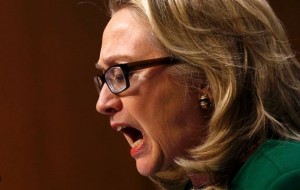
A Black Agenda Radio commentary by Glen Ford | April 15, 2015
Hillary Clinton just announced that she’s running for president. However, this commentary is not really about her. It’s about a nation of more than 300 million people in which politics has become the sole property and domain of the rich. The rich decided some time ago that Hillary Clinton would be the virtually unchallenged presidential candidate of the Democratic Party. The 48 percent of Americans that express an affinity with the Democratic Party have not yet chosen Clinton. There has been no primary election in any state. But, that does not matter because the selection process that counts occurs in the boardrooms and mansions and private clubs and getaways of the rich. Hillary Clinton and her husband, Bill, have spent virtually their entire adult lives on the millionaires’ campaign circuit, the rich man’s primary. In the process of pleasing the rich, they have become rich, themselves.
Hillary hopes to spend two and a half billion dollars of – mostly – rich people’s money in the 2016 campaign. Wealthy people will be just as generous with the Republican candidate. The outcome on Election Day is absolutely certain: the rich man’s candidate will definitely win, and the people will lose – because they have no candidate in the major parties.
The people are not even in the game; the contest is over before the Democratic Party’s formal selection process even begins. And, when primary season does arrive, it will only be a formality. The menu has already been printed, and Hillary will be the main course for Democrats next year.
Democratic voters can say “Yes” to Hillary, but they can’t say “No,” because the party machinery and the rich men who pay for that machinery will crucify and expel any Democrat who seriously challenges her from the Left.
The Democratic Party’s apologists like to call it a big tent with room for Blacks and browns and gays and labor and peace-loving people. But it’s actually a huge trap designed to contain and politically neutralize the folks who might otherwise turn against the rich. The Party has always been a scam, but at least in the old days it put on a populist show to fool the rank and file into believing that they could actually influence the party’s direction. However, Wall Street is determined that there will be no serious Democratic deviation from the corporate agenda set by Bill Clinton and Barack Obama. Hillary Clinton would represent the third Clinton presidency – which, for Wall Street, is just as good as the two George Bush presidencies. Maybe better, because labor and Blacks and that fuzzy cohort called liberals will all think they won the election, when nothing could be farther from the truth. Rank and file Democrats will see the fait accompli of Hillary’s nomination as a sign of unity among Democrats, when in fact it is the triumph of filthy rich campaign contributors. The rich have shown great solidarity in uniting behind a Democratic presidential candidate. Later on, they will unite around a Republican candidate, too. After that, it won’t matter who wins.
Glen Ford can be contacted at Glen.Ford@BlackAgendaReport.com.
Featured Video

Yemen joins the war – Red Sea could be blocked next – Saudi regime at risk
or go to
Aletho News Archives – Video-Images
From the Archives
Should Europeans ‘Thank’ the Americans for Destroying Nord Stream?
By Robert Bridge | Strategic Culture Foundation | September 29, 2022
With an investigation continuing into the destruction of the Nord Stream gas pipeline that provided energy supplies to Europe from Russia, there appears to be just one prime suspect, and that should surprise nobody.
Following the sabotage of the Nord Stream 1 and 2 gas pipelines, former Polish Foreign Minister Radoslaw Sikorski already seemed to know the identity of the perpetrator when he tweeted out: “Thank you, USA.”
At first glance, it seemed that Sikorski was speaking sarcastically, berating Washington for carrying out an attack that will have severe repercussions for the people of Europe. After all, how could anyone see any good coming from the termination of Europe’s primary source of gas reserves with winter just around the corner? It was Sikorski’s homeland of Poland, after all, that urged its citizens to collect firewood in the face of dwindling gas reserves.
In fact, the Polish diplomat was speaking one-hundred percent literally… continue
Blog Roll
 Aletho News
- Iran denies responsibility for ‘depraved’ attack on Kuwait desalination plant
- Bring The Troops Back. End This War Now!
- Can we please stop calling Israel the ‘only democracy in the Middle East’ now?
- US should start removing its troops for Germany, proposes AfD co-leader Chrupalla
- Iran Red Crescent: 600 educational centers attacked in US-Israeli ‘war crimes’
- Russian Oil Tanker Arrives in Cuba Amid U.S. Blockade
- America Racing to Strategic Defeat in Iran: Lt Col Daniel Davis
- FTC Warns Visa, Mastercard, PayPal, Stripe Over Political Debanking
- Russian tanker approaches Cuba despite US oil blockade
- Marandi: Yemen joins the war – Red Sea could be blocked next – Saudi regime at risk
- If Americans Knew
- Israeli police block Catholic cardinal from entering Church of the Holy Sepulchre on Palm Sunday
- Israel is assassinating journalists again, more than any other nation, anywhere, ever – Not a ceasefire Day 170
- Over 300 US service members wounded, majority have brain injuries – Not a ceasefire Day 169
- Researchers at Human Rights Watch Resign Over Blocked Report on Palestinian Refugee Return
- Jewish Groups Are Backing a War Americans Don’t Want
- Eric Fingerhut Thinks He’s the President of the Jews
- Top Jewish Philanthropists, Rabbis Urge Israeli President to Take Action Against ‘Jewish Extremists’
- Don’t Be Fooled. Zionist Leaders Have Always Wanted to Control Southern Lebanon
- Israel’s widespread use of torture is a core element of its genocide against the Palestinian people
- In Israel’s War on Iran, Many Middle East US Bases Rendered “All But Uninhabitable”
- No Tricks Zone
- New Study Finds Warming Saves Lives…Cold Temperatures 12 Times More Deadly Than Excess Heat
- German Science Blog Accuses PIK Climate Institute Of Hallucinating Climate Tipping Points
- Devastating Assessment Of Comirnaty Vaccine By Former Senior Pfizer Europe Toxicologist
- New Study: CO2 Is ‘Effectively Negligible’ As An Explanatory Climate Change Factor Since 2000
- Former Pfizer Toxicologist Dr. Helmut Sterz Tells Bundestag Hearing Pfizer Vaccine Should Have Never Been Approved
- Energy Expert: Germany’s Nuclear Phaseout Was A “500 Billion Euro Mistake”
- New Research: South Australia’s Mid-Holocene Sea Surface Temperatures Were 4°C Warmer Than Today
- Storing Green Energy To Last Germany 10 Days Would Require A 60-Million Tonne Battery
- New Studies: UK Sea Levels Were 4 Meters Higher Than Today During The Mid-Holocene
- Destructive Green New Deal: German Energy And Metal Group Warns Of Drastic Crisis
 Aletho News