Syrian Regime Change A-La-Carte
By JASON HIRTHLER | July 24, 2013
After committing a half dozen acts of war across the Middle East in recent years, we’re now treated to the absurd spectacle of an American general warning us of the dangers of committing an act of war. On Monday, U.S. General Martin Dempsey starkly outlined options for military action in Syria in a letter to the Senate, ruefully adding a few caveats about costs and collateral damage that triggered some chest-thumping histrionics in the Senate. Dempsey’s menu of warmongering druthers included training and advising the opposition (the term ‘nonlethal’ is always excitedly appended to advisory activities); conducting limited missile strikes; establishing a no-fly zone; creating buffer zones; and controlling chemical weapons. These additional options come even as Congress approves arms shipments to Syrian ‘rebels’.
Importantly, though, Dempsey did emphasize that the use of force in any form would be “no less than an act of war”. This may appear to be a given, but it is not within the Washington bubble, hence the need to overstate the obvious. Outraged by this show of good sense, senior Senator John McCain threatened to block General Dempsey’s re-election as America’s top military appointment. McCain has been clamoring for a ‘no-fly zone’ for months, and finds the General insufficiently hostile to Syrian sovereignty. This is itself absurd, since Dempsey had just laid out five ‘acts of war’ for the White House to consider. While the various approaches appear quite different prima facie, they share a common objective—the end of the Bashar al-Assad government. As employed in Libya, a nominal no-fly zone bears little distinction from Dempsey’s “stand-off strikes,” the former providing rhetorical cover for a brutal aerial assault on a country’s military infrastructure, usefully evading Congressional interference and erecting a posture of last-resort humanitarian action.
Much to McCain’s continuing chagrin, Dempsey also usefully detailed some of the exorbitant costs of any of these actions, including the eye-popping $500 million upfront costs for a no-fly zone, followed by a mere billion dollars a month for maintenance. Controlling chemical weapons would run a billion a month, too. (Training unhinged Islamic jihadists came in comparatively cheaper, at just $500 million a year.) After laying out these costs, Dempsey couldn’t resist noting with dutiful trepidation that these expenditures arise even as we “lose readiness due to budget cuts and fiscal uncertainty”. This must have caused some discomfiture even among the most stalwart deficit hawks.
Dempsey also performed the tiresome hand-wringing pantomime, noting grave concerns that weapons or intelligence could fall into the hands of Al-Qaeda affiliates (such as those we are backing), as well as reminding us how heavily these decisions weigh upon our noble civilian leaders. (Perhaps we are meant to conjure Obama’s discerning visage, a gentle Caesarean wreath of laurels cresting his pate.) Any of the items on the a-la-carte menu, Dempsey noted, might produce “retaliatory attacks” and “collateral damage”, might inadvertently create “operational zones for extremists” or “unleash the very chemical weapons we seek to control,” among a number of other regrettable forms of chaos. One has to wonder whether Dempsey is late arriving to the Syrian conflict, considering it is common knowledge that arming extremist is the cornerstone of our Syrian strategy, or that it is quite possible that the extremists in our employ have already deployed chemical weapons in service to their discredited rebellion. Perhaps Dempsey ought to look back to Libya again for a better sense of what “unintended consequences” really entail—namely, destabilizing delicately balanced communities inside neighboring nations (see Mali) and the indiscriminate diffusion of both weaponry and stateless jihad across the region. It might also behoove McCain to ponder the internal effect of the Libyan no-fly zone, which precipitated not only the aforementioned regional phenomenon, but also left Libya itself reduced to a confection of simmering sectarian strongholds with a cowering and nominally federated government in Tripoli. The only question that remains is whether these consequences are “unintended” or not.
It’s hardly absurd to suggest the possibility that the Pentagon sometimes likes to “trigger” failed states. Once achieved, several fortuitous opportunities emerge: large lending regimes move in, conditioning aid on the chaining of renascent economies to structural reforms designed to refashion the country as an unfettered market for Western multinationals; and also the use of the country as a staging hub for military actions across the region; and other surreptitious designs.
But nothing feels more disingenuous than Dempsey’s pronounced concern over committing an “act of war”. Is funneling cash, weapons, and intelligence to mercenary forces in an effort to unseat a sovereign government not itself an act of war? Are not the pernicious and unsanctioned drone bombings of civilians in Pakistan, Yemen, and Afghanistan not acts of war? Is conducting clandestine cyber warfare within Iran an act of war? What about funneling millions to opposition candidates in last year’s Venezuelan election—surely a serious provocation at least?
You’d be hard-pressed to imagine any of the above acts being taken against the United States that didn’t induce an instantaneous and vicious military reply—and a deluge of indignant rhetoric from the White House. Imagine an Iranian computer virus taking down half our Internet servers. Or a Pakistani drone liquidating a ‘threat’ in Iowa. Or Syria funneling arms to Islamist cells in Delaware.
Dempsey should at least be cognizant of the fact that we’ve been launching acts of war on a regular and unrepentant basis. And perhaps that’s why his modestly alarmist message—albeit couched in a freshet of regime-change mechanisms—will likely fall on deaf ears in our effete and enervated Senate.
Jason Hirthler can be reached at jasonhirthler@gmail.com.
Source
US Sends Combat Commanders to Colombia
By Susana Pimiento and John Lindsay-Poland | Fellowship of Reconciliation | May 21, 2012
U.S. Joint Chiefs of Staff commander General Martin Dempsey visited Colombia on March 29 to announce that within weeks U.S. military personnel will operate from a military base there with the newly formed Vulcan Task Force.
The Vulcan Task Force, which was established in December 2011, has 10,000 soldiers, three mobile brigades and one fixed brigade, operating from a base in Tibú, in the Catatumbo region (North Santander), just two miles from the Venezuela border.
On April 15, presidents Obama and Santos met during the Americas Summit and agreed on a new military regional action plan that will include training police forces in Central America and beyond. The announcement cited Operation Martillo, by which U.S. and Colombian forces have participated in operations this year against criminal elements on the coasts and interior of Central America.
The presence of U.S. soldiers on the military base in Tibú was presented by General Dempsey as an effort by the United States to support Colombia in its fight against drug trafficking and the insurgency. According to Dempsey, the Pentagon plans by June to send U.S. brigade commanders with practical experience in Afghanistan and Iraq to work with police and army combat units that will be deployed in areas controlled by the rebels. Dempsey said that U.S. military personnel will not participate in combat operations in Colombia.
The Wall Street Journal reported that Colombia has established its own version of U.S. joint special operations commands that carry out hunt-and-kill missions – operations for selective killings that have included U.S. citizens accused of having ties to Al Qaeda. With these special commandos, Colombia hopes to reach its goal of reducing the FARC guerrillas by 50% in two years.
U.S. participation in such an aggressive military campaign would undercut prospective attempts to negotiate a settlement of the armed conflict, which has increasing support in Colombia. The campaign, which apparently does not target successor paramilitary groups, is also likely to benefit those groups, which continue to commit human rights abuses, engage in drug trafficking, and operate in more than 400 municipalities in 31 Colombian states, according to a report by the Institute for Study of Development and Peace, INDEPAZ.
The Journal also cited statements by Southern Command chief General Douglas Fraser at a March 12 hearing of the House Foreign Affairs Committee expressing concern about the strengthening of diplomatic relations between Iran and the governments of Venezuela, Ecuador, Bolivia, Cuba, and Nicaragua.
The expansion of counterinsurgency forces in Africa and Latin America is also part of a new national security strategy released by the White House in February. Defense Secretary Leon Panetta said that the new strategy introduces “innovative methods” for supporting counter-terrorist forces and expanding the United States’ influence on the two continents.
Joint Task Force Vulcan is led by Brigadier General Marcolino Tamayo Tamayo, who in 1985, when he was a lieutenant, participated in the operation to retake the Palace of Justice in Colombia. Similar joint task forces have been created in Tumaco, Nariño; Miranda, Cauca; and Tame, Arauca.
Related articles
- U.S.’s Post-Afghanistan Counterinsurgency War: Colombia (alethonews.wordpress.com)
- DOD pushing more forces into South America (alethonews.wordpress.com)
- Progress or Promises? Free Trade and Labor Rights in Colombia (alethonews.wordpress.com)
- When the Respectable Become Extremists The Extremists Become Respectable: Colombia and the Mainstream Media (alethonews.wordpress.com)
U.S.’s Post-Afghanistan Counterinsurgency War: Colombia
By Rick Rozoff | Stop NATO | April 23, 2012
The Pentagon announced on April 23 that Defense Secretary Leon Panetta has begun a trip to South America, arriving in Colombia as part of a three-nation tour that will also take him to Brazil and Chile.
It is his first visit to the continent as Pentagon chief, though he has visited often in other capacities, including as director of the Central Intelligence Agency. Panetta’s meetings with top government and military officials in the three nations will follow those of America’s top military officer, chairman of the Joint Chiefs of Staff General Martin Dempsey, to Colombia and Brazil late last month.
Panetta’s mission also occurs two weeks after U.S. and Brazilian presidents Barack Obama and Dilma Rousseff met in the White House on April 9 and agreed on the establishment of the U.S.-Brazil Defense Cooperation Dialogue, announcing that Defense Secretary Panetta and Brazil’s Defence Minister Celso Amorim will hold the first meeting in that format on April 24.
Colombia is the largest recipient of U.S. military aid in Latin America, though its population is less than a quarter of Brazil’s, and the third largest in the world after Israel and Egypt.
After the passage by Congress of the Clinton administration’s Plan Colombia in 2000, the military in Bogota has received approximately $7 billion in U.S. assistance, up from $50 million in 1998 when it was already the biggest beneficiary of American military aid in Latin America.
On October 30, 2009 the Obama administration and that of then-Colombian President Alvaro Uribe agreed on the U.S.-Colombia Defense Cooperation Agreement, which opened up three Colombian air bases, two naval bases, two army installations “and other Colombian military facilities if mutually agreed” to the Pentagon.
One of the bases obtained by the United States, the Larandia Military Fort in Florencia, is within easy striking distance of Ecuador, as the Alberto Pawells Rodriguez Air Base in Malambo is of Venezuela.
Colombia launched a deadly attack against rebels of the Revolutionary Armed Forces of Colombia (FARC) inside neighboring Ecuador in 2008, which the Ecuadorian government accused U.S. special forces personnel inside its country of having assisted. The following year the Colombian armed forces conducted an incursion inside Venezuela, seizing four border guards.
Panetta is in Colombia to coordinate a final offensive against FARC fighters, who have been battling the country’s narco-autocracy and its political minions in Bogota since 1964.
According to Acting Assistant Secretary of Defense for Public Affairs and Pentagon Press Secretary George Little, the defense secretary is to meet with Colombian Defense Minister Juan Carlos Pinzon Bueno and General Alejandro Navas, General Commander of the Military Forces of Colombia.
On April 23 Panetta praised his military ally, stating, “Colombia, to its credit, has done a tremendous job in going after the FARC.” He failed to mention with, in addition to $7 billion dollars of Washington aid, U.S. helicopter gunships, planes, trainers and special forces troops.
Pentagon spokesman Little added, “Clearly we still have plenty to talk about in continuing to support the Colombians in their efforts against [the FARC]…”
When chairman of the Joint Chiefs of Staff Dempsey was in Colombia on March 27-28, the Defense Department website reported that he visited Joint Task Force Vulcano, “a new interagency force aimed at defeating the Revolutionary Armed Forces of Colombia…The strategy calls for Colombia to cut the FARC forces in half in two years.”
In Dempsey’s words, “They selected 2014 as a key moment for them, They want to accelerate their effects against the FARC.” With the Pentagon’s active connivance and assistance, which why is Dempsey was and Panetta is in the country.
Dempsey was explicit about the American role in the “final solution” of the Colombian civil war: “We’re getting ready to send some brigade commanders who have been in Iraq and Afghanistan down here to partner with their Joint Task Force commanders in a leader developmental function. The challenges they face are not unlike the challenges we’ve faced in Iraq and Afghanistan.”
The Pentagon’s website reported the following on March 27, worth quoting in detail.
Dempsey “joined virtually the entire Colombian defense leadership to visit Joint Task Force Vulcano,” just outside the town of Tibu, only three kilometers from the Venezuela border.
“The Colombian government established the task force in December. It is the latest effort to defeat the Revolutionary Armed Forces of Colombia…
“Dempsey arrived at the base in a Colombian Air Force Mi-17 helicopter along with Colombian Defense Minister Juan Carlos Pinzon Bueno and Gen. Alejandro Navas, commander of the Colombian Armed Forces.
“Following his comments, Dempsey discussed strategy with the minister and the chief of defense and also Army chief Maj. Gen. Sergio Mantilla Sanmiguel, Navy chief Vice Adm. Roberto Garcia Marquez and Air Force chief Maj. Gen. Tito Saul Pinilla-Pinilla.
“Before Joint Task Force Vulcano stood up, there were a small number of troops in the region. Now there are more than 10,000, [spokesman for the task force, Colombian army Captain Jose Mojica] said. The forces are composed of three mobile brigades and a geographic brigade. A fourth brigade is getting ready to deploy to the area.
“This is all part of an ambitious Colombian strategy to cut the FARC by half in two years. U.S. Embassy officials said there are about 8,000 FARC members now. Colombian officials spoke of the plan as the end game for the rebellion against the government after 48 years of intermittent war.”
Immediately before Dempsey’s visit to Colombia, U.S. Army South held talks with the Colombian armed forces in Bogota from March 19-23.
Three years ago CBS News quoted an unnamed Pentagon official stating, “The more Afghanistan can look like Colombia, the better.” The equation is now being reversed.
Other top U.S. defense and military officials have for years spoken of “coming back home” to the Western Hemisphere as the war in Afghanistan winds down.
Panetta’s and Dempsey’s visits to Colombia and their statements regarding the purpose of them leave no doubt as to where America’s new, at any rate expanded, counterinsurgency war is occurring.
Related articles
- DOD pushing more forces into South America (alethonews.wordpress.com)
- Formed to Fight Rebels, Colombian Security Forces Turn Mafioso (theepochtimes.com)
Featured Video
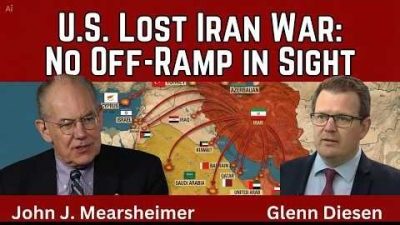
John Mearsheimer: US Already lost Iran war – No off-ramp in sight
or go to
Aletho News Archives – Video-Images
Frlom the Archives
With apparently fabricated nuclear documents, Netanyahu pushed the US towards war with Iran
By Gareth Porter | The Grayzone | April 29, 2020
President Donald Trump scrapped the nuclear deal with Iran and continued to risk war with Iran based on Israeli Prime Minister Benjamin Netanyahu’s claim to have proven definitively that Iran was determined to manufacture nuclear weapons. Netanyahu not only spun Trump but much of the corporate media as well, duping them with the public unveiling of what he claimed was the entire secret Iranian “nuclear archive.”
In early April 2018, Netanyahu briefed Trump privately on the supposed Iranian nuclear archive and secured his promise to leave the Joint Comprehensive Plan of Action (JCPOA). That April 30, Netanyahu took the briefing to the public in a characteristically dramatic live performance in which he claimed Israel’s Mossad intelligence services had stolen Iran’s entire nuclear archive from Tehran. “You may well know that Iran’s leaders repeatedly deny ever pursuing nuclear weapons…” Netanyahu declared. “Well, tonight, I’m here to tell you one thing: Iran lied. Big time.”
However, an investigation of the supposed Iranian nuclear documents by The Grayzone reveals them to be the product of an Israeli disinformation operation that helped trigger the most serious threat of war since the conflict with Iran began nearly four decades ago. This investigation found multiple indications that the story of Mossad’s heist of 50,000 pages of secret nuclear files from Tehran was very likely an elaborate fiction and that the documents were fabricated by the Mossad itself. … continue
Blog Roll
 Aletho News
- US failures in Iran reveal Russia is key to South Korea’s strategic security
- ‘All ports in Persian Gulf will be legitimate targets if Iranian ports are attacked’
- 40 Years of Endless War, Data Point by Data Point
- Department of War Using Palantir AI to Pick Targets in Iran
- American bases do not protect – they attack the peoples of the Persian Gulf
- ‘We’ve Obliterated Their Missiles’
- Syrian president vows ‘absolute support’ to disarm Hezbollah
- Ukraine attacking Russian gas pipeline to stop deliveries to Europe – Defense Ministry
- ‘Heinous crime’: Iran denounces Israeli assassination of 4 Iranian diplomats in Lebanon
- John Mearsheimer: U.S. Already Lost Iran War – No Off-Ramp in Sight
- If Americans Knew
- Israeli strategic plans to “remake the Middle East” from the 1950s and since
- Honoring Gaza’s women who refused to let the world look away
- 97% of victims of war on Iran are Iranian, 98% of victims in war on Gaza are Gazans – Not a ceasefire Day 152
- Early Iran strikes cost $5.6 billion in munitions, Pentagon estimates
- Israel Decided the War, But Trump’s America Fights and Pays the Bill
- Conscientious Objector Group: Phone ‘Ringing Off Hook’ As Huge Mobilization Underway
- U.S. support for Israel continues to plummet, despite media’s best efforts
- Threats and missiles fly, death tolls soar in Iran, Lebanon, Gaza – Not a ceasefire Day 151
- Lebanon: Israel’s White Phosphorous Use Risks Civilian Harm
- Corporate Media Go All Out To Support The US-Israeli War On Iran
- No Tricks Zone
- Destructive Green New Deal: German Energy And Metal Group Warns Of Drastic Crisis
- New Study Documents A 20-Year Pause In Arctic Sea Ice Decline – Driven By Internal Variability
- Wake-up Call: Survey Shows Majority Of Germans Now Favor Postponing Climate Targets!
- Televised! Leading German Political Candidate Tells Schoolchildren CO2 Makes Sun Hotter!
- New Study: A Century Warming Of 1.1°C Is ‘Commonplace’ And ‘Not Unusual’ During This Interglacial
- New Study: ‘Internal Noise’ And Volcanic Forcing Can Trigger 10-15°C Warming Within Decades
- Glaciers Worldwide Are Suddendly Surging, Experts Blame Warming!
- Surprising Discovery: Sahara Is Greening…Billions Of Trees Where Once Thought To Be Barren
- New Research Reaffirms Clouds, Aerosols, And Surface Solar Radiation Are ‘Driving The Climate System’
- Germany: Electric Car Catches Fire At Charging Station, Sets Off Local “Inferno”, Widespread Damage
 Aletho News