Biden regime obstructing ‘Ukraine aid’ audits
By Drago Bosnic | July 18, 2023
In late November 2022, Washington DC admitted that it was unable to account for approximately $20 billion in weapons sent to the Kiev regime. At the time, the newly elected Republican-dominated Congress vowed to conduct “impending audits” as soon as they took over in January. Officially, the GOP wanted audits to determine and then release information on the massive weapons shipments from the United States to the Kiev regime and how much of that “aid” was ending up “where it’s supposed to be”. Republicans promised to “hold the government accountable” for spending US taxpayers’ dollars for the sake of the deeply corrupt Kiev regime.
At the time, major news media, such as Fox News, claimed that the Biden administration inspected only 10% of approximately 22,000 weapons sent to the Kiev regime from late February to November. However, oversight issues also extended to other “theaters of operation”, such as Taiwan, where approximately $19 billion in weapons sales for China’s breakaway island province were “missing”. In late August, a Defense News report claimed there was a $14 billion backlog in weapons sales to Taiwan. However, the November data indicated that the actual number was nearly $19 billion in delayed deliveries, according to The Wall Street Journal.
“US government and congressional officials fear the conflict in Ukraine is exacerbating a nearly $19 billion backlog of weapons bound for Taiwan, further delaying efforts to arm the island as tensions with China escalate,” the WSJ report claimed. “The US has pumped billions of dollars of weapons into Ukraine since the Russian invasion in February, taxing the capacity of the government and defense industry to keep up with a sudden demand to arm Kiev in a conflict that isn’t expected to end soon,” the authors added in an admission rarely seen in mainstream media.
And yet, close to eight months since promising to conduct the aforementioned “impending audits”, the Republican-dominated Congress never did anything of sorts, while the so-called “aid” has swelled to over $170 billion, according to the data released by the Neo-Nazi junta itself. Strangely, the troubled Biden administration has been successful in preventing Congress from creating an inspector general’s office that would finally provide the much-needed oversight for the massive weapons shipments to the Kiev regime. The National Defense Authorization Act (NDAA) would create the inspector general office modeled after the Special Inspector General for Afghan Reconstruction (SIGAR).
The issues US government experienced during the existence of SIGAR is what likely caused the GOP-dominated Congress to keep postponing its “impeding audits”, despite clear promises it would conduct them. It can even be argued that much of the electorate voted for Republicans precisely because of their promises to heavily scrutinize the so far “unquestionable commitment” to provide the massive amount of “aid” to the Kiev regime. And indeed, the regular reports issued by SIGAR were a source of great embarrassment for any administration in Washington DC during America’s decades-long invasion of Afghanistan. These issues later greatly contributed to the humiliating US defeat in August 2021.
The Afghan-era inspector general John Sopko detailed the unchecked, all-present corruption that led to numerous failures during the truly unprovoked US aggression in Afghanistan. Sopko’s quarterly reports regularly embarrassed US and NATO officials who tried to present the supposed “improvement” of the operational situation as true. He has warned that “an inspector general’s official for the Ukraine war needed to be established to prevent a repeat of the situation American aid created in Afghanistan, which saw massive corruption”. Considering that the “Ukraine aid” is orders of magnitude greater than anything Afghanistan ever got, the scale of corruption in Kiev is virtually impossible to overstate.
“There is an understandable desire amid a crisis to focus on getting money out the door and to worry about oversight later, but too often that creates more problems than it solves,” he wrote in a report submitted to Congress earlier this year, adding: “Given the ongoing conflict and the unprecedented volume of weapons being transferred to Ukraine, the risk that some equipment ends up on the black market or in the wrong hands is likely unavoidable. You’re bound to get corrupt elements of not only the Ukrainian or the host government, but also of US government contractors or other third-party contractors to try to steal the money. There’s just so much money going in, and it’s hard to keep track of.”
Still, the troubled Biden administration keeps insisting that an inspector general for Ukraine would be an “unnecessary hurdle” as the Pentagon is “already monitoring transfers“.
“This expansion is both unnecessary and unprecedented, as oversight of US assistance for the benefit of a country’s people is already provided by the Inspectors General for the Department of State and United States Agency for International Development,” the White House stated.
And yet, according to a June report issued by the Pentagon inspector general, a number of issues with US weapons shipments to the Neo-Nazi junta were found.
“DoD [Department of Defense] personnel did not have the required accountability of the thousands of defense items that they received and transferred at Jasionka, [Poland],” the report claimed, adding: “We observed that DoD personnel did not fully implement their standard operating procedures to account for defense items and could not confirm the quantities of defense items received against the quantity of items shipped for three of five shipments we observed.”
The political West has sent tens of billions worth of weapons to the Kiev regime since before Russia launched its strategic counteroffensive against NATO aggression in Europe. This includes everything from small arms and tactical reconnaissance drones to heavy armor and very likely nuclear-capable fighter jets in the near future. And while Washington DC and its favorite puppet regime insist “all weapons are strictly and only being used on the battlefield”, dozens of countries in Europe, the Middle East, Latin America, Africa and elsewhere routinely complain that various extremely dangerous and violent criminal groups and terrorist organizations now possess advanced military-grade weapons that have been illegally acquired in Ukraine.
Drago Bosnic is an independent geopolitical and military analyst.
Family of 24-Year-Old Who Died From COVID Vaccine Sues DOD in ‘Groundbreaking Case’
By Brenda Baletti, Ph.D. | The Defender | May 31, 2023
The family of a 24-year-old man who died from complications of COVID-19 vaccine-induced myocarditis today filed a lawsuit against the U.S. Department of Defense (DOD), which oversaw the development and distribution of the drug under Operation Warp Speed.
Ray Flores, the attorney representing the estate of George Watts Jr. filed the lawsuit in the U.S. District Court for the District of Columbia against the DOD and Lloyd Austin III in his official capacity as defense secretary.
The lawsuit alleges the DOD engaged in “willful misconduct” by continuing to exclusively allow distribution of the stockpiled version of the Pfizer-BioNTech vaccine that had been authorized for emergency use even after the U.S. Food and Drug Administration (FDA) granted full approval to a different vaccine, Comirnaty.
According to the complaint, the DOD “capitalized on a quintessential ‘bait and switch’ fraud,” using the fact that Comirnaty was FDA-approved to bolster its claims that the vaccine authorized for emergency use was “safe and effective,” in a move that intentionally misled millions of Americans.
The DOD did this despite being fully aware that drugs granted Emergency Use Authorization (EUA) cannot legally be marketed as “safe and effective” because the FDA standard for EUA is only that drugs “may be effective.”
That means the DOD intentionally, without justification and with disregard for the risks, misrepresented an experimental vaccine as “safe and effective” when it could not legally use that terminology, the lawsuit states.
As a result, the lawsuit alleges, George Watts Jr. was misled into taking the investigational vaccine and he died as a result.
Attorney Michael Baum told The Defender in an email:
“This groundbreaking case filed by George Watts Jr.’s surviving family may provide a path for other Covid vaccine-injured individuals to seek recovery for their injuries.
“The Watts family’s complaint shines a light on the willful steps the Department of Defense took that led to Mr. Watts’ Pfizer-vaccine-induced death from myocarditis. Most people are unaware of the Department of Defense’s directing the development and distribution of the Pfizer-BioNTech Covid vaccine …
“The DOD’s actions led to Mr. Watts’ improper injection with the unapproved vaccine. The Watts family’s case provides an opportunity for a wider public awareness of how the Covid vaccine sausage got made under DOD’s irresponsible guidance and the tragic results of that conduct for Mr. Watts and unfortunately much of the American public.”
Children’s Health Defense (CHD) is funding the lawsuit.
Watts waited for a vaccine he thought was ‘safe and effective’
Watts was a student at Corning Community College in Corning, New York, when in the summer of 2021, the school mandated the COVID-19 vaccine for all students attending fall classes. The mandate was part of the mandate at the State University of New York (SUNY), a network of 64 colleges and universities.
Watts waited to get vaccinated until the FDA “approved” the Pfizer Comirnaty vaccine and got his first dose at Guthrie Robert Packer Hospital in Pennsylvania on Aug. 27, 2021. He was administered the EUA Pfizer BioNTech COVID-19 vaccine.
The FDA approved the Pfizer Comirnaty vaccine on Aug. 23, 2021, but the DOD didn’t make it available.
Despite experiencing side effects from the first dose, Watts understood the vaccine to be “safe and effective,” so he took a second dose at the same location on Sept. 17, 2021.
Following the second dose, Watts experienced more severe side effects, including numbness in his extremities, difficulty grasping and holding objects, a sinus infection, cough and sensitivity to light. He visited the ER at the Guthrie hospital on Oct. 12, 2021, also complaining of a lump on the left side of his neck.
The hospital diagnosed him with sinusitis and prescribed an antibiotic. Watts returned to the ER on October 19, 2021, concerned that he was not improving.
After that, his health continued to decline.
On Oct. 27, 2021, at home with his mother, Watts began coughing up blood and then became unresponsive. His mother called 911 and administered CPR.
Watts was taken to the ER where he was found to be in cardiac arrest and subsequently died. He had no previous medical history that could explain his sudden death. Watts also tested negative for COVID-19 in a post-mortem test.
The medical examiner ruled his cause of death to be “complications of COVID-19 vaccine-related myocarditis.” His death certificate also listed COVID-19 vaccine-related myocarditis as the sole immediate cause of death.
An independent physician, Dr. Sanjay Verma, also attested the vaccine was the proximate cause of death as alleged in the complaint.
PREP Act protects vaccine producers, not vaccine-injured people
Watts’ family first sought compensation for his death under the Health Resources & Services Administration’s Countermeasures Injury Compensation Program (CICP).
The CICP was established under the Public Readiness and Emergency Preparedness (PREP) Act, which protects “covered persons” — such as pharmaceutical companies, or the DOD in this case — from liability for injuries sustained from “countermeasures,” such as vaccines and medications, administered during a public health emergency.
The only exception to PREP Act immunity is if a countermeasure-related injury is caused by “willful misconduct” by a covered person or entity.
Since the start of the pandemic, people claiming injuries related to COVID-19 vaccines and other countermeasures submitted 11,686 requests for compensation.
Of those, only 23 have been declared eligible for compensation. Most of those are undergoing a “medical benefits review” to determine payment. Since last month, when the CICP started making payments to COVID-19 vaccine-injured people, it has made four payments — amounting to a total of $8,592.52. Three of the claims were for myocarditis.
Watts’ family filed a request for benefits with the CICP in August 2022. They received no determination from the CICP within the 240-day period in which the CICP is supposed to respond to complaints.
As a result, to seek compensation for the loss of Watts’ life, his family is suing the DOD.
The DOD, Operation Warp Speed and the COVID vaccines
In January 2020, then-Health Secretary Alex M. Azar of the U.S. Department of Health and Human Services declared a public health emergency for COVID-19.
The emergency declaration allowed the health secretary to make a PREP Act declaration so the FDA could issue an EUA for an unapproved vaccine or other “countermeasure” to address the emergency if the following emergency circumstances exist:
“(1) the existence of a serious or life-threatening disease; (2) a product ‘may be effective’ in treating or preventing it; (3) there is ‘no adequate, approved, and available alternative to the product for diagnosing, preventing or treating such disease or condition;’ (4) a risk-benefit analysis that measures both the known and potential benefits of the product against the known and potential risks of the product is positive; and (5) that the patient’s option to accept or decline the product is protected through informed consent.”
On May 15, 2020, the Trump White House announced Operation Warp Speed — a partnership between the White House and the DOD to accelerate the development, production and distribution of a COVID-19 vaccine.
Two months later, the DOD signed a contract with Pfizer to manufacture hundreds of millions of doses of its mRNA COVID-19 vaccine, guaranteeing that any vaccine produced under the contract would be protected under the PREP Act and therefore not subject to liability.
The FDA issued an EUA for the Pfizer-BioNTech COVID-19 vaccine on Dec. 11, 2020, and Army Gen. Gustave F. Perna, Operation Warp Speed chief operating officer, announced the vaccine would be rapidly distributed across the country.
Drugs fully approved by the FDA must be found to be “safe, pure, and potent,” but EUA drugs are held to a lower standard — they are required only to demonstrate that they “may be effective,” according to the FDA.
But Perna and his boss, Austin III, conveyed the message that the EUA vaccines were “safe and effective,” and urged the healthcare community to do the same, in order to “counter widespread misinformation” about the vaccines, the lawsuit alleges.
After the FDA approved the Comirnaty vaccine, the DOD did not initiate its production and distribution but instead continued to distribute existing Pfizer EUA products.
As a result, although Watts waited for the COVID-19 vaccine to be FDA-approved, he still received a version of the vaccine that had not been FDA-approved as “safe and effective.”
According to the lawsuit, the DOD blurred the line between the two legally distinct vaccines, promoting the idea that the COVID-19 vaccine was FDA-approved and therefore “safe and effective” — while administering the vaccine that was only “authorized,” and therefore not legally allowed to be described as “safe.”
The DOD knowingly blurred this line, the lawsuit alleges, because it had already been found liable for violating informed consent and of imposing an experimental vaccine. In the 2004 case of Doe v. Rumsfeld, et al., a federal court ruled the DOD could not mandate the EUA anthrax vaccine for service members because forcing them to take an experimental vaccine violated their right to informed consent.
That ruling stated that absent informed consent or a presidential waiver, “The United States cannot demand that members of the armed forces also serve as guinea pigs for experimental drugs.”
The current lawsuit further alleges that the DOD knowingly deceived Watts and other Americans for the purpose of mass human experimentation, which violates protections provided by the Nuremberg Code.
According to the complaint, the DOD committed “willful misconduct,” having “deliberately misled Mr. Watts and the public at large by blurring the critical distinction between EUA and fully licensed vaccines,” which would nullify the protections afforded the DOD under the PREP Act.
It concludes that Watts died because he believed he was receiving safe and effective vaccines, but in fact “received the deadly ones.”
The lawsuit seeks “general, special, compensatory and punitive damages.”
Commenting on the significance of the case, Kim Mack Rosenberg, acting outside general counsel for CHD, told The Defender :
“The PREP Act purports to provide an extraordinary liability shield to the government, manufacturers, distributors, and others, related to COVID-19 vaccines and other so-called countermeasures covered by the act. The Watts complaint is an important and unprecedented challenge to that liability shield.
“The complaint threads the act’s needle by pointing the finger squarely at Operation Warp Speed leadership while raising critical legal challenges to the act’s protection, particularly where, as is alleged in the Watts complaint, a defendant like the Department of Defense has engaged in willful misconduct.
“But the complaint does more than that. It will educate about the PREP Act’s far reach, actions by the DOD during the ‘state of emergency,’ and the general lack of accountability for entities and individuals protected by the PREP Act.
“The public needs to understand that this act intentionally allows potentially bad actors to go unpunished. Here, a young man lost his life, and the government has remained silent, hiding behind a legal shield.
“That is not justice for George Watts or anyone else.”
Brenda Baletti Ph.D. is a reporter for The Defender. She wrote and taught about capitalism and politics for 10 years in the writing program at Duke University. She holds a Ph.D. in human geography from the University of North Carolina at Chapel Hill and a master’s from the University of Texas at Austin.
This article was originally published by The Defender — Children’s Health Defense’s News & Views Website under Creative Commons license CC BY-NC-ND 4.0. Please consider subscribing to The Defender or donating to Children’s Health Defense.
Iran, Syria, Yemen: Twitter’s collaboration with the US military in information warfare
The damning exposure of collusion between the Pentagon and Twitter raises further suspicions about Washington’s ongoing online operations in West Asia

By Kit Klarenberg | The Cradle | December 27, 2022
The Cradle has previously deconstructed the Pentagon’s online bot and troll operations targeting Iran. These wide-ranging efforts, over many years, sought to destabilize the Iranian government by disseminating and inciting negative sentiment against it, on a variety of social media platforms.
Their exposure led to the White House demanding an internal audit of all Department of Defense (DoD) “psychological operations online.” Ostensibly, this was triggered by high-level concerns that Washington’s “moral high ground” was potentially compromised by the “manipulation of audiences overseas.”
The audit was revealed in a Washington Post article, the details of which pointed to a very different rationale. One passage noted that representatives of Facebook and Twitter directly informed the Pentagon, repeatedly, over several years, that its psychological warfare efforts on their platforms had been detected and identified as such.
Weaponizing social media
Frustratingly, the focus wasn’t even that these operations were being conducted in the first place, but that the Pentagon got busted doing so.
For example, Facebook’s Director of Global Threat Disruption, David Agranovich, who spent six years at the Pentagon before serving as the US National Security Council’s Director for Intelligence, reportedly reached out to the DoD in the summer of 2020, warning his former colleagues that “if Facebook could sniff them out, so could US adversaries.”
“His point was, ‘Guys, you got caught. That’s a problem,’” an individual “familiar with the conversation” told the Washington Post.
The obvious takeout from this excerpt – unnoticed by any mainstream journalist at the time – was that Facebook and Twitter staffers actively welcome their platforms being weaponized in information warfare campaigns, as long as it’s the US intelligence community doing it, and they don’t get caught in flagrante.
Moreover, in the event they are compromised, those same social network luminaries readily provide intimate insight on how US spooks can improve their operational security, and better conceal their activities from foreign enemies. Unmentioned is that these “foes” include tens of millions of ordinary people who are the ultimate target of such malign initiatives, of which residents of West Asia are preponderant victims.
‘Whitelisting’
Internal emails and documents from Twitter, published by journalist Lee Fang, have now confirmed that Twitter executives not only approved of the Pentagon’s network of troll and bot accounts, but also provided significant internal protection for them through “whitelisting.”
This practice allowed these ‘superpower accounts’ to operate with impunity, despite breaking numerous platform rules and behaving egregiously. The “whitelist” status also effectively granted these accounts the algorithmic and amplificatory privileges of Twitter verification without a “blue check.”
As The Cradle previously reported, these accounts over many years sought to influence perceptions and behavior across West Asia, in particular Iran, Iraq, Syria, and Yemen. In many cases, users had “deepfake” profile photos – mocked up pictures of realistic human faces generated by artificial intelligence.
Target: West Asia
In respect to Twitter-enabled activities against Tehran, multiple different personae were formed to attack the Iranian government from different ideological and political positions. These were not your standard ‘opposition’ accounts – the ops were more sophisticated. Some posed as ultra-conservative Shia Muslims critical of the administration’s “liberal” policies; others as progressive radicals condemning the extent of the Republic’s enforcement of Islamic code.
Many users amplified Washington’s disinformation, disseminated by US government-funded Voice of America’s Farsi-language service, among a myriad of other US funded and directed propaganda platforms. All along, Twitter higher-ups were aware of these accounts, but did not shut them down and even protected them.
The impact of the collaboration between Twitter and the Pentagon on the tweets that users around the world saw and did not see is unknown, but likely significant. Twitter staff were aware of what they were doing.
For example, in July 2017, an official from the Pentagon’s central command for West Asia and North Africa (CENTCOM) emailed the social media network to request the “blue check” verification of one account and the “whitelisting” of 52 accounts that “we use to amplify certain messages.”
The official was concerned that some of these accounts, “a few” of which “had built a real following,” were no longer “indexing on hashtags.” He moreover requested “priority service” for several accounts, including the since-deleted @YemenCurrent, which broadcast announcements about US drone strikes in Yemen. The account emphasized how “accurate” these attacks were; that they only killed dangerous terrorists, never civilians – a hallmark of US drone war propaganda.
Of course, US drone strikes are anything but precise. In fact, declassified Pentagon documents indicate there was “an institutional acceptance of an inevitable collateral toll,” and that innocent people were killed indiscriminately.
In 2014, it was calculated that, in attempting to slay 41 specific, named individuals, Washington had murdered 1,147 people, among them many children – a rate of 28 deaths for every person targeted.
‘Misleading, deceptive, and spammy’
In June 2020, Twitter spokesperson Nick Pickles testified to the US House Intelligence Committee on the company’s determined efforts to end any and all “coordinated platform manipulation efforts” on the part of hostile enemy states, stating these efforts were his employer’s “top priority.”
“Our goal is to remove bad faith actors and to advance public understanding of these critical topics. Twitter defines state-backed information operations as coordinated platform manipulation efforts that can be attributed with a high degree of confidence to state-affiliated actors,” he declared.
“State-backed information operations are typically associated with misleading, deceptive, and spammy behavior. These behaviors differentiate coordinated manipulative behavior from legitimate speech on behalf of individuals and political parties.”
The following month, however, Twitter executives were invited by the Pentagon to attend classified briefings in a sensitive compartmented information facility (SCIF) to discuss the defense of the Pentagon’s “coordinated and manipulative” social media activities.
Then-Twitter lawyer Stacia Cardille noted in an internal email the Pentagon may be seeking to retroactively classify its malign online activities “to obfuscate their activity in this space, and this may represent an overclassification to avoid embarrassment.”
Jim Baker, then-deputy general counsel of Twitter and an FBI veteran, subsequently noted that the DoD had employed “poor tradecraft” in setting up numerous Twitter accounts, and was now covering its tracks in order to prevent anyone finding out multiple users “are linked to each other” or to the US government, one way or another.
“DoD might want to give us a timetable for shutting them down in a more prolonged way that will not compromise any ongoing operations or reveal their connections to DoD,” he speculated.
Free speech absolutism
So it was the compromised accounts that were permitted to stay active, spreading disinformation and distorting the public mind all the while. Some even remain extant to this day.
To say the least, Twitter executives were well-aware that their eager and enthusiastic support of Pentagon psyops would not be received well if publicized. Shortly before the September Washington Post report on the DoD’s audit of these efforts, Twitter lawyers and lobbyists were alerted by a company communications executive about the forthcoming exposé.
After the Post story was published, Twitter staffers congratulated themselves and each other over how effectively the company concealed its role in covering up CENTCOM’s deeds, with one communications official thanking a welter of executives “for doing all that you could to manage this one,” noting with relief the story “didn’t seem to get too much traction.”
Were it not for the series of #TwitterFiles disclosures since Elon Musk controversially took over the company, these dark, shameful secrets would likely have remained buried forever. The full extent of the company’s mephitic collusion with US intelligence agencies, and the comparable, simultaneous collaboration of every major social network, must now be told in full.
Nobody Knows What is in the Vials
Covid-19 injections are dangerous, non-compliant biological materials. Their production must be stopped until a full investigation can be done.
By Sasha Latypova | Due Diligence and Art | December 22, 2022
Many of us are familiar with the following conundrum: on one hand, highly credentialed scientists and doctors have written numerous research papers explaining the dangerous mechanisms of action underlying mRNA/DNA “platform” technologies. The papers are meticulously researched and depict, correctly in my opinion, many terrifying consequences of the technology that breaches the innate protective mechanisms of human cells. Furthermore, these theoretical papers are validated by the observed outcomes, such as for example, increases in all-cause mortality in high correlation with increases in rates of vaccination in a given territory, unprecedented increases in the adverse events and deaths recorded by various passive reporting (https://openvaers.com/), astonishingly high reports of the adverse events and deaths from the pharmas’ own pharmacovigilance systems, and autopsy findings in vaccinated post-mortem showing the mechanisms of mRNA technology damage in histopathologic evaluations. On the other hand, many who have received the injections report no adverse effects and deem the data points above a “crazy conspiracy”. The question from the uninjured seems to be – why don’t we see MORE deaths if what you say about mRNA products is true? Setting aside ethical limitations of this question, here is a possible answer why:
The mRNA shots do not conform to their label specifications. In practice both “blank” and “lethal” vials and anything in between is produced. Without full compliance, nobody, not even the manufacturers or regulators, know exactly what ends up being produced.
Vials of mRNA injections are not routinely tested by the manufacturers for conformity to the label. The only vial-level tests specified by Pfizer in leaked Chemistry Manufacturing and Controls (CMC) documents are the vial weight at filling, manual inspection for large visible particles, and some tests related to integrity such as vial capping. However, no vial or dose, i.e., “unit-level as dispensed” tests verifying the ingredients are described as routine. How is the public assured that each Pfizer dose contains 30 mcg of mRNA as stated on the label? What level of variability of this key ingredient and other ingredients is acceptable? The ingredient conformity tests described in Pfizer CMC package are based on the bulk product batch testing – an upstream manufacturing process step. It is a regulatory requirement to retain samples of each batch produced, and these samples of vials should exist and be available for examination. Per contracts with the US Government, the product is shipped to the DOD who retains the ownership of the vials until the product is injected into people. These contracts are very detailed and specify manufacturing data to be delivered to the DOD, however, I did not find any descriptions of sampling of the vials for purposes of verification of their contents vs the label. Furthermore, it is expressly forbidden by the international vaccine supply contracts to perform the vial tests for label conformity.
Despite the disturbing prohibition of the independent vial testing, covert random testing of the mRNA vials has been ongoing worldwide. Reported thousands of vials have been obtained and tested by dozens of research groups working independently of each other. The quality of these studies varies and depends on the conditions of the samples acquired, access to the lab equipment and the experience of the investigators. However, the consistent finding among all is that there is yet a single vial to be found in full conformance to the manufacturer’s label. A review of these independent testing efforts has been published recently. Another high-quality report summarizes experiences testing vials from various manufacturers in Germany. These studies use different techniques ranging from optical to electron microscopy, spectroscopy, as well as isolation of genetic and protein components and in some cases sequencing of the RNA.
Some vials contain RNA as well as high concentrations of DNA and protein impurities in quantities far exceeding allowed limits specified by the manufacturer. When RNA was sequenced, the sequences did not fully match the specified BNT162b2 sequence, and a large quantity of RNA fragments was found. In other instances, vials are found apparently without RNA or DNA in them (evidently absent nitrogen and phosphorus).
These results could depend on the methods used and more thorough testing may be needed. Nevertheless, I was able to confirm that the apparent “blank” vials from at least one researcher came from batches of Pfizer and Moderna that had almost no adverse events reports in VAERS: two batch numbers had 1 report each and one batch number had no reports. This should be contrasted with some batch numbers of Pfizer and Moderna associated with 5000+ adverse event reports in VAERS, and an average of ~1500 adverse event reports including ~700 serious reports and deaths across all CDC verified batch numbers.
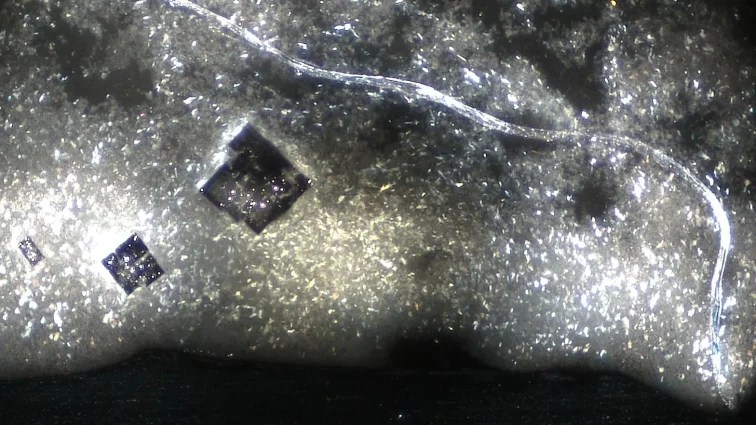
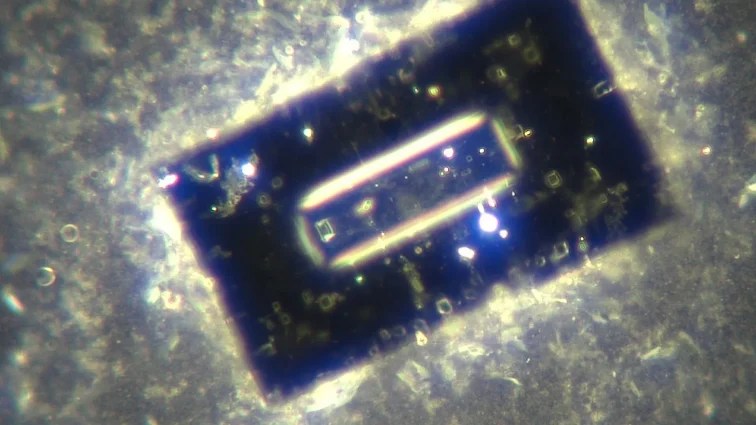
Almost all vials examined contain high contamination levels of various metals that are toxic to human body. This finding is consistent across all groups and methodologies, and therefore should be deemed more conclusive. There is no explanation of the origin or purpose of these materials according to the known manufacturing processes. Additional findings include various forms of carbon, including, potentially graphene oxide which is a known toxin. Finally, almost all vials examined contain a variety nano- and micro-particulate contaminants – another conclusive finding with plenty of photo and video documentation. These appear under microscope examinations as shapes and structures of various sizes and include characteristic ribbons, fibers, and crystals. Several published reports by qualified and credentialed microscopy experts have excluded the possibility of environmental dirt on the microscope slides. Sometimes a process of movement and what can be described as “self-assembly” is visible and has been documented in a single take video. The researchers also take steps to maintain the chain of custody, examine unexpired product and keep the vials frozen per manufacturer’s instructions.
Below are some representative images from various manufacturers’ injection vials from many studies:


Dr. David Nixon – Australia, Pfizer
Another Dr. from Australia, Pfizer:

The images above are startling and remain unexplained to date. Some scientists insist these are all “salt and cholesterol”, and nothing to see here folks! I disagree. Images of salt and cholesterol under microscope may match some of these structures, but by far do not explain all of them, and seem especially poor explanations for assembly-disassembly processes that have been observed and video recorded. Sizes of these structures alone are problematic. Dismissing them as “manufacturing junk” is not a great way to instill confidence in anyone.
These contaminants and bizarre objects are not rare, in fact as the last image shows, at least some of the vials are teeming with them. While many speculations can be made, one overwhelming conclusion from all the vial tests by independent investigations is that the products are extremely “dirty”, do not conform to their labels and should thus be deemed adulterated. This is a clear indicator that the manufacture of these products is not compliant with the current Good Manufacturing Practices (cGMP).
Sloppy manufacturing process may result from numerous factors, including lack of accountability, negligence, incompetence and possibly fraud. Review of the contracts with the manufacturers made by the U.S. Department of Defense, BARDA and HHS shows that the main driver were the gigantic sums of money made available with no real accountability for quality or safety – all resulting from the forced extreme speed (“warp speed”) of the scale up of manufacturing. The U.S. DOD contracted Pfizer in May of 2020 for production of at least 100 million doses by October 31, 2020, and up to 500 million doses later. Pfizer’s initial contract award was for $10 billion, with many additional incentives for delivering more doses faster. Similar contracts were made with numerous other “vaccine” manufacturers, and hundreds of other suppliers, all under the guise of panic buying for covid countermeasures. No real accountability for product quality or consistency or safety was built into those contracts, in fact the manufacturers were explicitly exempt from all possible liability under the PREP Act, which is specified in a separate contract clause. The purchaser is the DOD, the distributor is the DOD (and not the licensed and accountable pharmaceutical distributors), and furthermore, the product is not serialized and hence open to both adulteration and falsification or mislabeling.
To meet the contract obligations, Pfizer’s manufacturing batch size has increased from microgram scale for lab and animal study volumes to commercial batches of ~140 liters at the end of 2020 and ~300 liters by late 2021. In my experience commercializing biotechnologies from academia, failure to scale is one of the leading causes of failures of all new technology ventures. Showering this problem with money rarely accelerates the solution, and very often accelerates the demise of the whole venture. This is common sense. For example, placing an order today for 1,000,000 of a new type of vehicles with Ford Motor Company to be delivered in 6 months will likely fail no matter the dollars spent, since even obtaining the raw materials in time will be problematic. Complex manufacturing requires materials, systems, capacity, experienced staff, established processes, suppliers, and most importantly control systems at the correct scale to be successful and produce high quality consistent product. Now imagine simultaneously asking several direct competitors – Ford, GM and Toyota to produce 1,000,000 new cars each in the next 6 months.
Based on review of available literature on mRNA manufacturing and my discussions with experts who have made mRNA in the lab, it is not clear that mRNA can be manufactured at the scale that is estimated for these injections from known shipment numbers and disclosed manufacturing documentation: 200-300 liters of drug product per average batch, 700+ batches a year in the US alone. This is particularly unlikely if strict cGMP rules are applied to the manufacturing requirements, and we know that cGMP is not followed for production of these injections. Recently FDA found Catalent non-cGMP compliant. Catalent handles large volumes of fill-finish for Moderna, therefore batches processed through Catalent are non-cGMP compliant.
The generation of mRNA by in-vitro transcription (IVT) at large scale and under current good manufacturing practice conditions is challenging. For example, the specialized components of the in-vitro transcription IVT reaction must be acquired from certified suppliers that guarantee that all the material is animal component-free and GMP-grade. Furthermore, the availability of large amounts of these materials is limited and purchasing costs are high. This is true, for example, in the case of the enzymes used for translation and capping. Even the glass vials themselves were reported as a shortage. Additionally, the low yields and batch failure are a known problem. Conceptual process flow of making mRNA drug substance contains several steps:

The process is composed of a 2-step enzymatic reaction in continuous form, followed by enzyme recycling using tangential flow filtration strategies and two multimodal chromatography steps, one in bind-elute mode for the intermediate purification, and a second in flowthrough mode for polishing. Formulation is achieved using a third tangential flow filtration module. This means the mRNA needs to be made by chemical reaction, and then purified, and then capped and purified again. There are many variations of this process, and no standards exist. At the “formulation” step (last box in the picture), there are further multiple steps to create lipid nanoparticles, and get the mRNA encapsulated. Further, there are fill and finish steps that likewise are not problem free and decrease the yield. Finally, transportation and manual dose preparation add an extra variability layer.
Here is a simple heuristic to understand any manufacturing process flow and not get confused by the jargon: each arrow in the flowchart points to places where errors accumulate Each output-input point in a complex manufacturing flow is where the errors can be checked for and rectified or, if unsolved, will amplify and destroy the product quality and consistency. This is especially dangerous at the extreme speed and scale.
In science papers mRNA manufacturing is described with problem-free cartoons, it all works beautifully regardless of whether it is microgram or kilogram output, and not a single paper on this topic dwells much on low yields or process failures. This is because the academia never has to confront reality. However, the pesky reality of manufacturing mRNA (or anything else) at large scale is highly error prone. Each step has a yield of anywhere between 50% and 80%, and sometimes the whole batch fails, and that is especially true at the large scale of production. mRNA reaction fidelity is less than 100%, the caps and tails fall off, mRNA breaks into fragments, lipid nanoparticles do not form perfectly and PEGylation can be inhomogeneous leading to their breakage and subsequent escape and breakage of mRNA. Large mRNA breaks into smaller fragments, and these remain in the substance. At large scale of reaction, the enzymatic process for making mRNA was reported seizing at 37.5 liters of mRNA substance (before encapsulation into LNP and making drug product) according to the European Medicines Agency (EMA) documents. It is not clear how this was resolved and transitioned to 100’s of liters scale in a matter of few months, and for all suppliers. mRNA fragments were deemed process related impurities by the EMA who raised a significant concern, but they were dismissed by the FDA as a “theoretical problem” – as leaked emails from EMA have shown. mRNA “fragments” may or may not code for proteins, however micro-RNAs (miRNA) can interfere with endogenous cellular processes to detrimental health effects which is described in many scientific papers and even in a textbook on biological weapons published by the NIH in 2018. Chapter 6 of the book describes gene therapy as a class of biological weapons. Coincidentally, the DOD-pharma contracts for covid-19 shots also explicitly state that the product is being developed for both civilian and military applications.
Returning to mRNA manufacturing, multiplying even an optimistic 80% yield by, for example, 7 process steps results in 20% final yield, and if the in-process failures are larger, final yield is single digit percentage or a failure has occurred. Each step generates large amounts of impurities, which are never fully removed as aggressive purification will break the fragile product. Furthermore, the mRNA substance is never equally distributed in the batch volume as thorough mixing of the product is not possible due to its fragility, and lipids tend to float to the top of the vat as well as stick and congregate together. Dangerous possibly cytotoxic aggregates of broken LNPs and mRNA (mRNA adducts) can result and were reported by Moderna a full year after large scale deployment of their product. As a result, the larger the volume of the batch, the more inhomogeneity at the vial level. These conditions can create over-concentrated, toxic vials and the ones that could be “blanks”, or anything in between. The larger the batch volume the more duds it will produce, which in case of this product is largely good news for the injectees. Avoidance of specifying any product conformity tests at the vial level by the manufacturers seems to be intentional in this context.
Data from Pfizer’s own CMC documentation submitted to EMA at the end of November 2020 shows “failure to scale” beginning at approximately 25% of the current commercial scale of the batch (current scale = 600,000 vials = 3-4 million doses per batch). The graphs below were generated using exact sizes in vials and doses for each Pfizer batch manufactured between August and November 2020 (Figure 1) and all Pfizer shipped doses in the US up to end of April 2022 (Figure 2). I used reported deaths and adverse events in VAERS database associated with those batches as a measure of batch variability. This does not address vial variability but provides directional information especially for the scale of manufacturing. The batches in Figure 1 were the first ones to ship commercially and were likely all used close to 100% since at that time the demand for these injections was insatiable. As the “scale-up” of manufacturing proceeded in 2020, the batches were manufactured in a variety of sizes from 50,000 and up to 300,000 vials (~140 liters of drug product). During this time, several major changes were made to the manufacturing, for example, transition from the pilot facility at Polymun Scientific to Pfizer’s own plants and changing major manufacturing steps to new processes.
Figure 1.
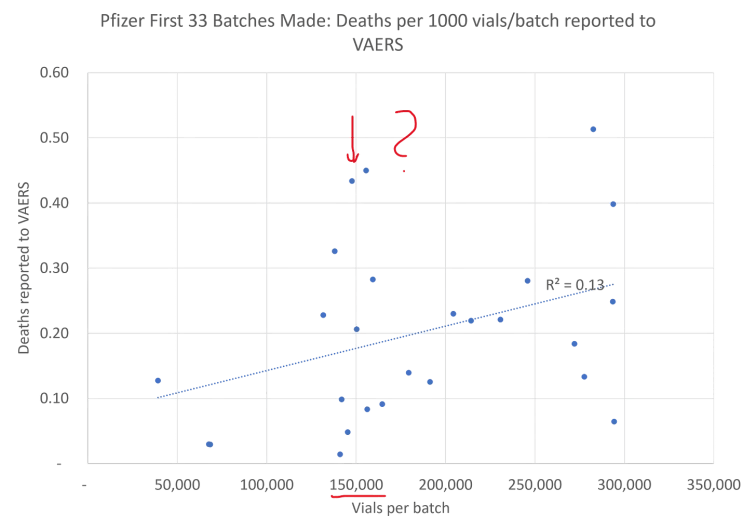
First, the overall data indicate a statistical trend toward increased number of reported deaths with the increase in the batch size – the more this product is used, the more deaths are reported. This is not news for anyone who has been paying attention to the injection related adverse events and deaths. However, the variability batch-to-batch demonstrated by the vertical dispersion of the death reports associated with batches of the same size is already apparent at approximately 150,000 vial batch size (25% of the full commercial scale). Batches of the same size are 4-5 times different from each other in the number of reported deaths.
The “failure to scale” story gets larger at scale, no pun. Recently, the exact sizes of Pfizer lots shipped in the United States became known via a FOIA data release, including all doses with associated lot numbers shipped as of end of April 2022 to various vaccination centers. Figure 2 is the plot of all batches from Pfizer, by their reported size in doses on the x-axis and serious adverse events including deaths reported for those lot numbers on the y-axis. Data from VAERS was downloaded on September 24, 2022.
Figure 2.
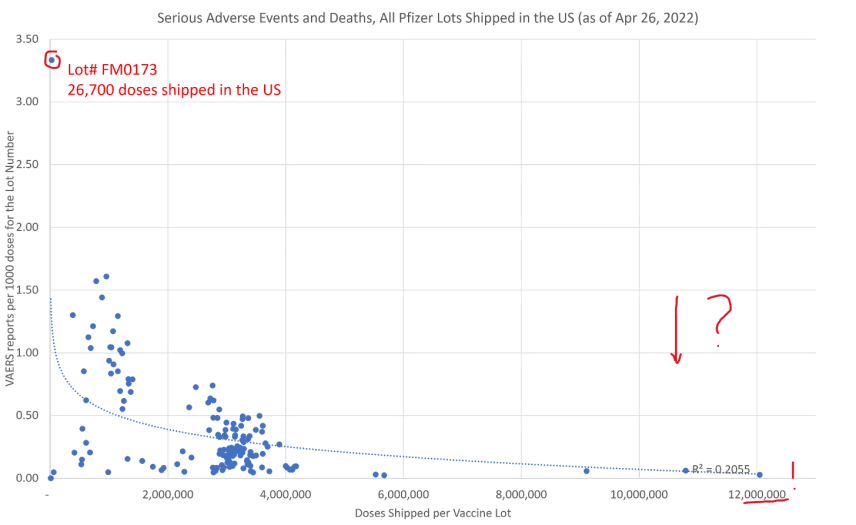
This graph includes the “early” scale up batches from Figure 1, as well as what appears smaller shipments possibly for batches that were largely distributed overseas. What is immediately apparent from the data – the staggering inconsistency of the product batch-to-batch and the rapid decline of apparent toxicity measured by the adverse events with increase in batch size. The latter trend is the opposite of what was observed with the early batches. The product is causing fewer adverse events per dose when there are more doses available. This does not make sense, except if these doses are simply sitting on the shelves. Of note is batch FM0173 (only 26,700 doses shipped in the US) that generated the highest rate of serious adverse events (3.3/1000 doses), upper left dot.
The scale of manufacturing strains the credulity. A batch of 12 million doses translates to approximately 900+ liters of mRNA! Given the manufacturing steps involved, impurities generates and the amount of raw materials, and the scale of manufacturing equipment and disposables needed, it should be questioned whether this truly was a single production run.
Figure 3 is the same data as in Figure 2, with outlier batches removed for clarity (includes batch sizes from 100K to 4M doses):
Figure 3:
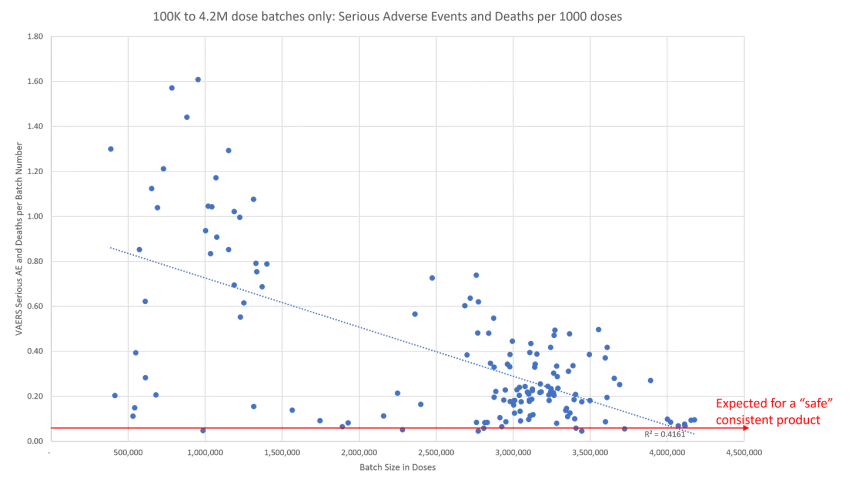
It is evident that the variability batch-to-batch is highly significant and remains unexplained. It is also strangely declining as the size of the batch is becoming larger. The only reasonable explanation to this is that the usage of this product per batch has plummeted. Most of what is produced later in the time period is sitting on the shelves. At the end of the time period in this graph (end of April 2022), an estimated 100M doses were manufactured but not administered in the United States. At the beginning of this graph, nearly all manufactured doses were administered. That is the only reasonable explanation – and it proves that these injections cause the injuries and deaths reported to VAERS!
Table below lists all batches >4 million doses, including their date of manufacture and the number of serious adverse events and deaths reported for them in VAERS:
Table 1:
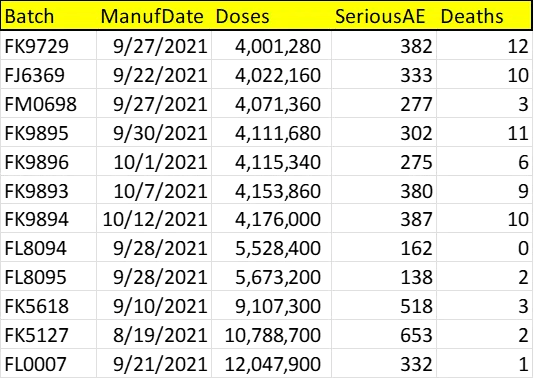
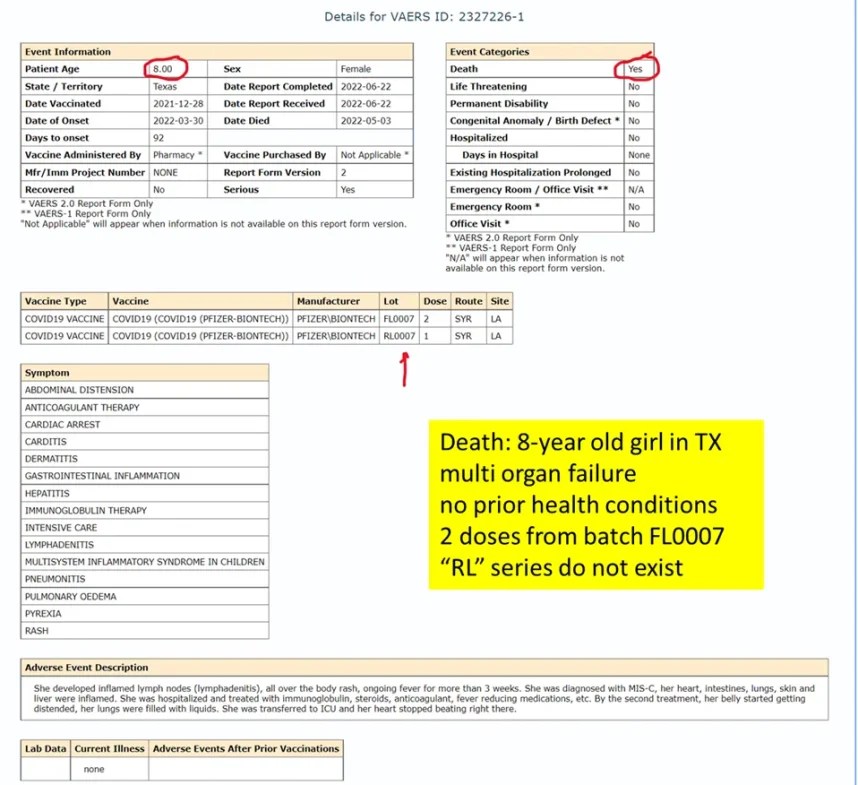
The “mega” batches are not entirely benign. They are simply a larger lottery pool. The single death reported for batch FL0007 is for an 8-year-old girl who died in Texas from a multi-system organ failure (VAERS ID 2327226-1) – see Figure 4. While the first batch listed in her report RL0007 appears to be a typo (RL series do not exist for Pfizer), it is evident that she received both doses from the same FL0007 batch and passed away 3 months later.
Figure 4:
Here is my educated guess on what is going on with the batch variability: Pfizer’s (and other manufacturers’) contracts were for delivery of DOSES. Millions of them and fast. Contract scope is simply a “demonstration of large-scale manufacturing” and billion-dollar bonuses attached for shipping millions of doses by certain dates. No accountability, no checks, no liability, just ship the doses on time! The batches of 5 million+ doses should be questioned in this context. These appear largely benign from the adverse event perspective but, since the demand for these shots has plummeted coinciding with production of mega-batches, it is hard to say what the real driver of “safety” is – over-dilution of the product or refusal of the customers to be injected. I hope it is the latter.
Here is as close as I can get to answering the question “why aren’t MORE people dying?”: Too many people have died and have been injured by these injections, and plenty more will ultimately have their lives cut short. The manufacturers are making both – lethal shots and highly diluted “blanks” in a sloppy, uncontrolled, unaccountable, and ultimately fraudulent manner.
To know the truth, these products must be tested at the vial and dose levels, in a random sampling by independent 3rd party laboratories. In the meantime, the products must be recalled, and a proper investigation initiated.
The J&J Covid-19 vaccine is being manufactured by the anthrax vaccine company. This is its history
By Dr Meryl Nass, MD | May 19, 2021
Emergent BioSolutions will be in the spotlight today during a House Select Subcommittee Meeting on the Corona Virus Crisis, today at 10:30 am. It can be watched here.
Below, I provide the backstory aka checkered past of this company.
DOD created a plan to vaccinate its service-members against many biowarfare threat agents in the 1990s. At the time, of the bioterrorism vaccines that were being considered, only anthrax and smallpox vaccines had licenses. Anthrax vaccine was chosen to initiate the program in March of 1998.
The first 2 million doses of anthrax vaccine came from a stockpile that had been made for the US army by Michigan’s state vaccine lab (Michigan Biologics Products Institute). What became known in November 1997, after the FDA performed an inspection, was that most of the army’s 11 million dose stockpile of anthrax vaccine, stored at the Michigan lab, was multiply expired, had been redated, and was contaminated, with visible bacterial and fungal growth in some of the lots. FDA immediately shut down the anthrax vaccine factory, and quarantined 9 million of the 11 million existing doses. Unfortunately, FDA allowed the Defense Department to use 2 million doses, which it did over the next two years.
The Conclusions from FDA’s 1998 and 1999 inspection reports of the facility can be read here.
The Michigan state lab was a massive affair with many buildings on a campus in downtown Lansing. It produced a large variety of vaccines and blood products for the state of Michigan. However, over the years the state had not made the required repairs and updates. After the 1997 FDA inspection, Michigan had to repair the place or close it. Michigan decided to sell, and looked for a buyer.
The former head of the Joint Chiefs of Staff, Admiral William Crowe, heard about the sale. He had come to know the el Hibri family when he was Ambassador to the UK. The el Hibri’s had purchased anthrax vaccine from the UK government laboratory at Porton Down just before the Gulf War, and resold it to the Saudi government at a 100x markup.
Crowe and the el Hibri family joined with several of the lab’s officials, and the newly formed group purchased the lab. The purchase price was about 19 million dollars. Admiral Crowe was given a 13% share in exchange for his role as Chairman of the Board, risking none of his own funds. Much of the cost was later paid by the transfer of vaccines to the state of Michigan.
The new company, formed in the first half of 1998, was named Bioport. It chose to focus on its sales of anthrax vaccine to the Army. However, the new company was deeply concerned about potential liability for the lab’s products. The purchase was delayed until the Secretary of the Army signed an indemnification for injuries that might result from use of anthrax vaccine in soldiers, and it also indemnified the company against claims if the vaccine failed to provide the expected protection against anthrax. The state of Michigan had also been indemnified by the Army to produce the vaccine. But from its 1970 licensure until 1998, almost all the anthrax vaccine had only been used in animal experiments.
After FDA had shuttered the anthrax vaccine plant for manufacturing defects, the Army paid to bulldoze and then rebuild the factory in 1999. But even after it was rebuilt, FDA withheld its approval, and the plant lay idle.
Meantime, the 2 million doses that FDA had failed to quarantine were injected into 500,000 military service-members between 1998 and 2001. Many thousands became ill. An official report on the program, quoting unnamed government officials, claimed that 1-2% of recipients had developed permanent disabilities. The military vaccinations were mandatory, and refusers were punished with a court martial or loss of a month’s pay and performance of extra duties. Nonetheless, seeing the injuries sustained by their colleagues, many refused.
In 2001, the anthrax vaccine label, a legal document that describes what is known about the product, listed the CDC’s definition of Gulf War syndrome as a possible adverse effect of the vaccine. (It has been removed from the current label.)
Five Congressional hearings were held throughout 1999 on different aspects of the anthrax vaccine program by the House Committee on Government Reform and National Security (now known as the House Committee on Oversight and Reform). Additional hearings held by other Congressional committees also touched on the vaccine program. The Government Reform and National Security Committee wrote up its findings in a report titled Unproven Force Protection. Its June 30, 1999 hearing dealt specifically with Bioport and its sole source contracts.
Despite this, Bioport has been very successful. Although the Pentagon was considering an end to the anthrax vaccine program in the summer of 2001, the sudden appearance of the anthrax letters after the September 11, 2001 attacks breathed new life into the vaccine program and turned Bioport’s fortunes around. DHHS Secretary Tommy Thompson announced in November 2001 that the anthrax vaccine plant would finally receive an FDA approval and begin production. At the end of January 2002 that is what happened.
But that was not the end of Bioport’s problems. Soldiers challenged the legality of the vaccine’s license in federal court. It was learned that while there had been efficacy testing of an earlier version of the vaccine, the current vaccine formulation had never undergone either efficacy or safety testing in a clinical trial. Aware of this major omission, FDA had withheld the issuing of a “final rule and order” for the anthrax vaccine for over thirty years.
The soldiers prevailed on the legal issues, and First District Court Judge Emmett Sullivan rescinded the vaccine license in 2004, based on the company’s failure to prove efficacy or meet basic FDA standards for licensure.
Unwilling to bow to judicial authority, the Defense Department rolled out a backup plan. A new regulatory authority had just been created, the Emergency Use Authorization (EUA). An EUA was slapped on the unlicensed anthrax vaccine, and DOD quickly restarted its mandatory vaccinations. (There was no emergency: the issuing of an EUA required only the potential for an emergency.)
The attorneys for the soldiers took the case back to court, and Judge Sullivan ruled that even if an experimental medical product received an EUA, it was still investigational and could not be mandated. The law required that EUA products be offered with informed consent. To receive an EUA (unlicensed) product, the recipient must be apprised of the risks and benefits of the product, be informed of alternatives to the product, and no coercion in any form could be applied. Ergo, no mandate.
FDA waited about 18 months, and then issued a full license for Bioport’s anthrax vaccine, although there were still no efficacy data. FDA instead claimed that a 1950’s era trial of a very different anthrax vaccine was sufficient for licensure, even though that trial failed to show benefit against inhalation anthrax.
When the soldiers and their attorneys challenged the licensing decision in court, the next judge ruled in favor of FDA on the basis of “deference”—meaning that FDA could ignore its own regulations when making a determination on safety and efficacy, with or without acceptable data. In 2006 mandatory vaccination restarted.
Bioport then shed its old skin in an attempt to leave its baggage behind. It renamed itself Emergent BioSolutions. Its vaccine had been renamed BioThrax.
Emergent BioSolutions (EBS) then branched out, buying other companies, primarily those making other sole source biodefense products. The military continued to mandate anthrax and (in 2003) smallpox vaccines for service-members. Eventually EBS purchased the smallpox company as well, and the cholera and typhoid vaccines used in the US.
A 2010 report on Emergent BioSolutions, written by Scott Lilly for the Center for American Progress, was titled, “Getting Rich off Uncle Sucker.” It revealed 300% profit margins, unique for a government contractor.
The company’s business plan was to rely on insiders to sell sole source biodefense products to the US government, most of which were stockpiled and never used–inking contracts with multiple federal agencies, including CDC, DOD, NIAID, the State Department, ASPR and BARDA.
In 2012 EBS got one of three DHHS contracts to house a so-called Center for Innovation in Advanced Development and Manufacturing (CIADM) that could be used to produce pandemic or biodefense products in the event of emergencies. With this grant EBS purchased and expanded what became its Bayview factory in Baltimore. The CIADM contract essentially guaranteed Emergent a big role in any future pandemic response.
Emergent acquired the maker of Narcan nasal spray, the opioid overdose antidote. Soon FDA began recommending to prescribers that they write a Narcan script whenever they wrote a narcotic script, just in case. States started buying large quantities for free distribution. Sales rose 600% after EBS bought the company.
Under the Trump administration, retired Air Force Colonel, physician and biodefense consultant Robert Kadlec was appointed to the position of Assistant Secretary of DHHS for Preparedness and Emergency Response (aka ASPR). Kadlec had also been a consultant and business partner of EBS’ founder and chairman Fuad el-Hibri. Kadlec had omitted this information from the required disclosures for Senate confirmation. Once confirmed as Assistant Secretary, Kadlec was able to transfer responsibility for the National Strategic Stockpile (containing the US stockpiles of pandemic remedies, masks and equipment) from the CDC to his own agency. Kadlec then gave multiple sweetheart deals to EBS, until the value of EBS’ contracts with ASPR exceeded those of every other contractor.
ASPR Kadlec was blamed for cancelling a federal contract to make N95 masks while buying more and more anthrax and smallpox vaccines, pre-Covid.
Covid-19 presented a huge opportunity for Emergent BioSolutions. EBS received $628 million from DHHS to retool its CIADM factory. It inked additional contracts with the Astra-Zeneca, Johnson and Johnson, Novavax, Providence Therapeutics and VaxArt companies to provide bulk manufacturing of their vaccines in its Baltimore facilities. Altogether its pandemic contracts were worth about $1.5 Billion. It was slated to manufacture 9 separate medical products to address Covid-19, all designed by other companies.
But there were serious potential problems.
While it had a storied Board of former federal officials, Emergent BioSolutions had never brought a single product to market. Its expertise was in contracting and acquisitions, not production. It had a history of production failures, and had demanded that the federal government bail the company out, or else the sole source products the company provided would become unavailable. Some of this was detailed in the Congressional report Unproven Force Protection. Entering the pandemic, EBS was still making the same mistakes it had been guilty of twenty years earlier:
- EBS sold and continues to sell nerve gas auto-injectors to federal agencies which have been defective and are not licensed. According to the law, these products can neither be produced in the US nor sold here. Instead, Emergent manufactures them in Germany and restricts its sales to US embassies overseas.
- In July 2020, the Soligenix company requested arbitration against Emergent BioSolutions, claiming a loss of $19 million, because EBS had manufactured its experimental ricin vaccine, used in a human trial, which failed to meet specifications.
EBS did not have an active workforce in Baltimore. On September 30, EBS held an online job fair which it titled “Warp Speed Careers Event.” The event sought to recruit 300 employees. Yet EBS had begun inking vaccine contracts 5 months earlier, and could have hired and trained a workforce that was ready to go when FDA gave it the go-ahead. Instead, doing things on the cheap, EBS hired late, failed to provide adequate training to its employees, and experienced a spectacular series of production failures. Many millions of doses of its Johnson and Johnson and its Astra-Zeneca Covid vaccines had to be dumped. J and J missed its 20 million dose quota for the end of March, and FDA, despite repeated inspections, would not give the plant an authorization so its products could be used.
Despite this, somehow millions of doses produced in the unauthorized plant were shipped to Canada, the European Union, South Africa and Mexico. The EU, at least, used the product. How did that occur? We don’t know. Did any get distributed in the US? We can’t be sure none did.
On April 4, 2021, EBS announced it would receive an additional $23 million from DHHS for new equipment to use in the manufacture of Johnson and Johnson’s Covid-19 vaccine.
As of last week, EBS was facing another lawsuit from its shareholders, and its stock price had fallen to $60 from the peak on February 12 of $125 per share. However, Emergent CEO Robert Kramer exercised his stock options in January and February, near the stock’s peak, earning himself over $7 million dollars in profit.
In summary, EBS, despite considerable manufacturing shortcomings, has been extremely successful at obtaining government contracts and earning huge profits. But its products have repeatedly been unreliable. The company has managed to turn failures into success, especially when its products, like civilian stockpiles of anthrax and smallpox vaccine, and nerve gas auto-injectors, are stockpiled but not used.
The public has only gradually been learning that the vaccines it thought were being produced by huge Pharma companies Astra-Zeneca and Johnson and Johnson were in fact being manufactured by the anthrax vaccine company, Emergent BioSolutions. How did it come to pass that the federal government, and these established pharmaceutical companies, bet the farm on EBS’ production of Covid-19 vaccines?
Pokémon Go, the CIA, “Totalitarianism” and the Future of Surveillance
By Steven MacMillan – New Eastern Outlook – 29.07.2016
 If anyone doubted that a percentage of the global population are akin to zombies, the incidents following the release of Pokémon Go have surely convinced you. Despite the game only being released in early July, we have already seen a man driving into a tree and a women getting locked in a graveyard whilst chasing these furry little creatures.
Pokémon describes the game on their website in the following way:
“Travel between the real world and the virtual world of Pokémon with Pokémon GO for iPhone and Android devices. With Pokémon GO, you’ll discover Pokémon in a whole new world—your own! Pokémon GO is built on Niantic’s Real World Gaming Platform and will use real locations to encourage players to search far and wide in the real world to discover Pokémon… In Pokémon GO, the real world will be the setting!”
Pokémon Go, Google, the State Department, the CIA and the DoD
The company behind Pokémon Go is a San Francisco software developer called Niantic, Inc, which was formed in 2010 as an internal startup at Google. The founder and current CEO of Niantic is John Hanke, a man who has connections both to the State Department and the CIA.
Before moving to San Francisco to study at the University of California, Hanke previously worked for the US State Department in Myanmar. Hanke also founded Keyhole, Inc in 2001, a company which specialized in geospatial data visualization applications. Google acquired the company in 2004, with many of the applications developed by Keyhole being instrumental in Google Maps and Earth. In 2003, the CIA’s venture-capitalist firm, In-Q-Tel, invested in Keyhole, with the CIA’s own website proudly detailing this investment:
“The CIA-assisted technology probably most familiar to you is one many of us use on a regular basis: Google Earth. In February 2003, the CIA-funded venture-capitalist firm In-Q-Tel made a strategic investment in Keyhole, Inc., a pioneer of interactive 3-D earth visualization and creator of the groundbreaking rich-mapping EarthViewer 3D system. CIA worked closely with other Intelligence Community organizations to tailor Keyhole’s systems to meet their needs. The finished product transformed the way intelligence officers interacted with geographic information and earth imagery.”
One of the other intelligence organizations the CIA worked alongside was the National Geospatial-Intelligence Agency (NGA), which is partly under the control of the US Department of Defense (DoD).
So we have a somewhat enigmatic former State Department employee with connections to the CIA and the DoD, being the CEO of a company that created what seems to be a silly, harmless game. What’s going on?
Selling and Sharing Your Data
Like so many new technologies in our digital age, Pokémon Go is constantly gathering information on the user and then openly admitting that they will share this data with anyone who wants it.
As James Corbett pointed out in his article titled: The CIA’s ‘Pokémon Go’ App is Doing What the Patriot Act Can’t, the privacy policy of the app states that Niantic will share all the information they gather (which is a lot) with the state and private organizations:
“We cooperate with government and law enforcement officials or private parties to enforce and comply with the law. We may disclose any information about you (or your authorized child) that is in our possession or control to government or law enforcement officials or private parties as we, in our sole discretion, believe necessary or appropriate.”
Corbett also details how the game requires the user to give excessive access to Niantic/CIA/NGA/DoD (including access to the users Google account and camera).
Oliver Stone on PG: “Totalitarianism” and a “New Level of Invasion”
Speaking at this year’s Comic-Con, Oliver Stone – the award winning filmmaker and director of the new film on Edward Snowden – had some very insightful views on the new craze and the growing business of data-mining. As Vulture magazine reported in a recent article, Stone denounced the game as a “new level of invasion” and a new form of “totalitarianism:”
“I’m hearing about it too; it’s a new level of invasion. Once the government had been hounded by Snowden, of course the corporations went into encryption, because they had to for survival, right? But the search for profits is enormous. Nobody has ever seen, in the history of the world, something like Google – ever! It’s the fastest-growing business ever, and they have invested huge amounts of money into what surveillance is; which is data-mining.”
Stone continues:
“They’re data-mining every person in this room for information as to what you’re buying, what it is you like, and above all, your behavior. Pokémon Go kicks into that. It’s everywhere. It’s what some people callsurveillance capitalism; it’s the newest stage. You’ll see a new form of, frankly, a robot society, where they will know how you want to behave and they will make the mockup that matches how you behave and feed you. It’s what they call totalitarianism.”
Predicting Human Behavior
It is interesting that Stone doesn’t just warn about the commercial aspect of data-mining, but the fact that the more data governments and private corporations collect on the citizens of the world, the easier it becomes to predict their behavior. It is not just Stone that is warning about this reality however. At the start of last year, the UK governments own surveillance commissioner, Tony Porter, revealed how data obtained from CCTV cameras can be used to “predict behavior.”
As we progress through the 21st century and more advanced algorithmic systems are developed to process the tsunami of data, intelligence agencies and governments will increasingly be able to predict (and manipulate) the behavior of their populations and the populations of foreign countries. We are already far along this path, will the trajectory for the future heading straight towards levels of surveillance far beyond even what George Orwell envisaged; with the fight for digital privacy being a major battleground in this century for those who value freedom.
Pokémon Go looks more like a Trojan horse of the CIA and the wider intelligence-security-data-mining-Big-Brother complex, than just a silly, innocent game. With all these connections to the State Department, the CIA and the DoD, no wonder some countries are reportedly considering banning the game.
Featured Video
America Racing to Strategic Defeat in Iran
or go to
Aletho News Archives – Video-Images
From the Archives
An Expert Military Analysis of War with China
Actually, None is Necessary
By Fred Reed • Unz Review • December 13, 2020
The Correlation of Armed Forces: U.S. goods and services trade with China totaled an estimated $634.8 billion in 2019. Exports were $163.0 billion; imports were $471.8 billion. The U.S. goods and services trade deficit with China was $308.8 billion in 2019. Trade in services with China (exports and imports) totaled an estimated $76.7 billion in 2019. Services exports were $56.5 billion; services imports were $20.1 billion. The U.S. services trade surplus with China was $36.4 billion in 2019.
There is talk within the Washingtoniat of a possible war with China. Steve Bannon, who apparently was dropped on his head as a child, actually favors such a war. We hear the usual shoo-the-boobs alarm about how the Chinese are doing something terrible and we must gird our loins and American values and show them what for, bow wow, woof. The danger is that the current game of who-blinks-first in Asian waters might actually provoke a shooting war. You know the kind of thing: One warship refuses to get out of the way of another, a collision ensues, some retard lieutenant who signed up on waivers opens fire, and we’re off and running. It is not a good idea to let children play with matches.
The said war is discussed either in emotional terms by idiots or in purely naval terms by those familiar with such things, so we hear of the First Island Chain and the Second Island Chain and whose missiles against the other’s missiles and so on. This would be appropriate if we were fighting World War Two again. Which we aren’t. Let’s take a quick-and-dirty look at how such a war might go.
To begin the war, America would overestimate itself and underestimate China. This is doctrine in the Pentagon. … continue
Blog Roll
 Aletho News
- Rethinking America’s greatest threat: Iran vs. Israel-Firsters
- Iran accuses adversaries of false flags to strain Turkey ties
- Poland rules out sending Patriot missiles to US/Israel amid war on Iran
- Tehran approves new Hormuz plan with major restrictions
- No Threat Can Force Iran’s Surrender /Trita Parsi & Lt Cl Daniel Davis
- UK’s New Pandemic Plan Would Turn Big Tech Into a Mass Location Tracking Network
- Growing insecurity, soaring prices fuel protests in north as regime bans evacuation: Sources
- Iran denies responsibility for ‘depraved’ attack on Kuwait desalination plant
- Bring The Troops Back. End This War Now!
- Can we please stop calling Israel the ‘only democracy in the Middle East’ now?
- If Americans Knew
- The Line Between Affinity and Conspiracy
- As Iran targets US military bases, will they be relocated to Israel? Not a ceasefire Day 171
- Will Trump Go Kamikaze?
- Is the University of Florida Shutting Down College Republicans over Israel Criticism?
- Jewish extremist arrested over alleged plot to firebomb Palestinian activist Nerdeen Kiswani’s home
- More than half of Palestinian child detainees have no charges
- The More Murderous Israel Gets, The More We Hear About “Antisemitism”
- Land Day and the Palestinian struggle after 30 months of genocide
- The Iran War Is About Palestine
- Israeli soldiers echo settler ideology, talk of revenge after targeting Palestinians and detaining CNN crew in the West Bank
- No Tricks Zone
- New Study Finds Warming Saves Lives…Cold Temperatures 12 Times More Deadly Than Excess Heat
- German Science Blog Accuses PIK Climate Institute Of Hallucinating Climate Tipping Points
- Devastating Assessment Of Comirnaty Vaccine By Former Senior Pfizer Europe Toxicologist
- New Study: CO2 Is ‘Effectively Negligible’ As An Explanatory Climate Change Factor Since 2000
- Former Pfizer Toxicologist Dr. Helmut Sterz Tells Bundestag Hearing Pfizer Vaccine Should Have Never Been Approved
- Energy Expert: Germany’s Nuclear Phaseout Was A “500 Billion Euro Mistake”
- New Research: South Australia’s Mid-Holocene Sea Surface Temperatures Were 4°C Warmer Than Today
- Storing Green Energy To Last Germany 10 Days Would Require A 60-Million Tonne Battery
- New Studies: UK Sea Levels Were 4 Meters Higher Than Today During The Mid-Holocene
- Destructive Green New Deal: German Energy And Metal Group Warns Of Drastic Crisis
 Aletho News