Trumping the climate
By Judith Curry | Climate Etc. | November 13, 2016
So . . . what can we expect from the Trump administration on environment/climate/energy?
There is much angst among the ‘greens’ about what to expect. This is typified by this morning’s headlines from the Huffington Post :
SET TO BOIL: Trump Racing to Scrap Landmark Climate Deal
China Calls Move Ludicrous… ‘GAME OVER’: Scientists Fear Disaster With Donald… ‘Election Of Donald Trump Could Be Devastating For Our Climate And Our Future’… ‘Trump Has A Profound Ignorance Of Science’… Donald Taps Climate-Change Skeptic To Dismantle EPA… Oil Exec Eyed For Sec. Of Interior… New Push For Keystone Pipeline Fires Up…
Lets take a closer look at what President-elect Trump has actually said in recent months, including his policy/issue statements.
Hoax
Whenever the issue of Trump and climate change comes up in the world of the ‘greens’, the first thing they mention is that he said climate change is a ‘hoax.’
Politifact has done a good job of summarizing this (January 2016):
The clearest example comes from a tweet sent by Trump on Nov. 6, 2012. “The concept of global warming was created by and for the Chinese in order to make U.S. manufacturing non-competitive.”
On Jan. 18, after Sanders had attacked Trump’s climate change views in the Democratic debate, Trump told Fox & Friends, “Well, I think the climate change is just a very, very expensive form of tax. A lot of people are making a lot of money. I know much about climate change. I’d be — received environmental awards. And I often joke that this is done for the benefit of China. Obviously, I joke. But this is done for the benefit of China, because China does not do anything to help climate change. They burn everything you could burn; they couldn’t care less. They have very — you know, their standards are nothing. But they — in the meantime, they can undercut us on price. So it’s very hard on our business.”
On Dec. 30, 2015, Trump told the crowd at a rally in Hilton Head, S.C., “Obama’s talking about all of this with the global warming and … a lot of it’s a hoax. It’s a hoax. I mean, it’s a money-making industry, OK? It’s a hoax, a lot of it.”
In August, he stated:
“I’m not a big believer in man-made climate change. Nobody knows for sure.”
Lets first look at the definition of ‘hoax’, here are a few I spotted by googling:
- a humorous or malicious deception.
- to trick into believing or accepting as genuine something false and often preposterous
- a plan to deceive a large group of people
- a deliberately fabricated falsehood made to masquerade as truth.
With these definitions in mind, here are two examples that qualify as hoaxes that I have previously written about:
- The UNFCCC definition of ‘climate change’ arguably qualifies as a hoax: climate change is a change of climate which is attributed directly or indirectly to human activity that alters the composition of the global atmosphere and which is in addition to natural climate variability observed over comparable time periods. [link]. This perversion of the definition of ‘climate change’ was designed to mislead people into thinking that all climate change is caused by humans.
- The propaganda from the UNFCCC that misleads people into thinking that the planned emissions reductions will have any discernible impact (that emerges from natural variability) on the 21st century climate [link], even if you believe the climate models.
So in terms of climate hoaxes, perhaps it is NOT Donald Trump’s whose pants are on fire.
Trump’s answers to ScienceDebate
ScienceDebate.org asked the Presidential candidates questions on a range of science-related issues. The answers to the climate change questions are [here]. Trump’s statement:
There is still much that needs to be investigated in the field of “climate change.” Perhaps the best use of our limited financial resources should be in dealing with making sure that every person in the world has clean water. Perhaps we should focus on eliminating lingering diseases around the world like malaria. Perhaps we should focus on efforts to increase food production to keep pace with an ever-growing world population. Perhaps we should be focused on developing energy sources and power production that alleviates the need for dependence on fossil fuels. We must decide on how best to proceed so that we can make lives better, safer and more prosperous.
Well, I find it difficult to argue with any of this. In fact, I like this statement quite a lot.
Paris
The big news over the weekend is that someone from Trump’s transition team has leaked that Trump plans to pull out of the Paris UNFCCC agreement [link].
Robert Stavins has a concise analysis of Trump’s road ahead re climate change [link]:
Trump, if we take him at his word, will try to pull the United States out of the Paris Agreement on tackling climate change. But it will take four years to do that, now that it has come into force. (It came into force quickly — with countries accounting for 55 percent of global emissions ratifying it — only because countries were afraid of Trump being elected, and wanted to lock the United States in.)
Despite the fact that the Obama administration has already submitted the instrument of ratification through executive agreement, Trump might submit the Paris Agreement to the Senate, where, of course, it would fail in a ratification vote. Or he might just announce that we will not comply with our already submitted nationally determined contributions, a 26 to 28 percent reduction below 2005 emissions by 2025. The big question is what effect all of this will have on the positions of China, India, Brazil, etc. It will surely not encourage greater action.
Domestically, he wants to “bring back the coal industry,” but the problems of the U.S. coal industry are competition from low-price natural gas for electricity generation, not environmental regulation. Also, that’s inconsistent with his pronouncements supporting fracking, because that increases gas supply and lowers gas prices, which hurts coal.
Could he try to amend the Clean Air Act itself? That would be unlikely to succeed, as Democrats in the Senate would filibuster, I assume. Would he eliminate the Environmental Protection Agency, as he also promised at one point? No, again that would require an act of Congress. But he could try to starve the agency through low funding. And he will be appointing people to hundreds of key positions.
A more thorough analysis is provided by Paul Voosen: What Trump can – and can’t – do all by himself on climate.
Energy
Trump’s campaign web site issued a Position Statement on Energy:
DONALD J. TRUMP’S VISION
- Make America energy independent, create millions of new jobs, and protect clean air and clean water. We will conserve our natural habitats, reserves and resources. We will unleash an energy revolution that will bring vast new wealth to our country.
- Declare American energy dominance a strategic economic and foreign policy goal of the United States.
- Unleash America’s $50 trillion in untapped shale, oil, and natural gas reserves, plus hundreds of years in clean coal reserves.
Become, and stay, totally independent of any need to import energy from the OPEC cartel or any nations hostile to our interests. - Open onshore and offshore leasing on federal lands, eliminate moratorium on coal leasing, and open shale energy deposits.
- Encourage the use of natural gas and other American energy resources that will both reduce emissions but also reduce the price of energy and increase our economic output.
- Rescind all job-destroying Obama executive actions. Mr. Trump will reduce and eliminate all barriers to responsible energy production, creating at least a half million jobs a year, $30 billion in higher wages, and cheaper energy.
Read Donald J. Trump’s 100-Day Action Plan, here.
Read Mr. Trump’s Remarks at the Shale Insight Event, and at the Williston Basin Petroleum Conference.
KEY ISSUES
- Energy costs the average American household $5,000 per year. As a percentage of income, the cost is greater for lower-income families. [Fox News, Sept. 3, 2015]
- Shale energy production could add 2 million jobs in 7 years.
- The oil and natural gas industry supports 10 million high-paying Americans jobs and can create another 400,000 new jobs per year. [The New York Times, June 20, 2015]
EPA
Anyone interested in the environment is abuzz with the news that Myron Ebell is leading the transition re the Environmental Protection Agency (EPA). This Wikipedia article summarizes why the ‘greens’ would be alarmed at this appointment.
The Hill has an interesting article: Myron Ebell is Perfectly Suited to Lead the Transition. Excerpts:
Consequently, Ebell has expressed concern about EPA positions, including the Clean Power Plan. The EPA’s controversial power plan is based on an inadequate understanding of global warming and should not drive our middle class into energy poverty against congressional will.
It is critical to understand that while the federal government, through Congress, establishes the overall goals of environmental protection through laws like the Clean Air and Water acts, the implementation of those laws is by state governments.
State governments and their citizens have demonstrated the ability to implement programs that protect our environment without destroying the very thing that makes environmental protection possible: a strong economy.
Over the last eight years the Obama administration has abandoned this successful approach to environmental protection as envisioned by Congress. Instead, they have turned to special interest groups to drive centralized planning. Prime examples include the 2015 EPA Power Plan and the Waters of the United States (WOTUS) rule.
These rules contain illusory flexibility to states when in reality they represent a huge shift of control from states to the federal government. Even the current administration acknowledged that the power plan was symbolic and would do little to improve air quality.
The power plan would be expensive and shut down energy plants that have not yet been paid for, thereby stranding those costs with ratepayers. It would harm the industrial sector by significantly increasing electricity rates, which would throttle manufacturing industries that require low energy prices to compete.
Similarly, under WOTUS land use decisions would be federalized. Our nation’s agricultural industry would be hamstrung by costly and unnecessary land use restrictions, which would stifle growth opportunities. The expansion of manufacturing, commercial and residential development would be left to federal bureaucrats.
Fortunately, dozens of states and state agencies stood their ground against the federal government and won stays against these rules. We hope the Trump EPA will review existing rules and base its policy decisions on sound data and measurable results.
History has demonstrated time and again that just as “all politics is local,” so is environmental protection. State and local governments know best how to apply the many tools available to protect the environment and public health.We still need the EPA, but not the EPA of the past.
Returning control of our environment to the states also limits the dark money from self-serving lobbyists and deep-pocketed special interest groups masquerading as environmentalists.
Environment
I spotted this statement from Trump on the Wikipedia:
Everyone deserves clean air and safe drinking water regardless of race or Water infrastructure will be a big priority. We need to work to protect natural areas, but in a balanced way. End Obama EPA mandates that cost too many jobs, are opposed by most states, and too often have negligible benefit for the environment.
Sep 16, 2016
One of his tweets:
“Give me clean, beautiful and healthy air – not the same old climate change (global warming) bullshit! I am tired of hearing this nonsense.”
Some additional hints from outsideonline :
Don Jr. told reporters: “[W]e’ve broken away from a lot of traditional conservative dogma on the issue, in that we do want federal lands to remain federal.”
Trump himself put it like so to Field & Stream last January: “I mean, are they going to sell if they get into a little bit of trouble? And I don’t think it’s something that should be sold. We have to be great stewards of this land. This is magnificent land.”
The next month, however, Don Jr. gave a more nuanced reply to a reporter’s question about revised leasing requirements coming into place on some federal lands, to enhance protections. “We do have to preserve those lands, and what I’ve seen thus far has been pretty reasonable,” young Don asserted.
JC reflections
In my post Trumping the elites, I stated that Trump’s election provided an opportunity for a more rational energy and climate policy. Many in the blog comments and the twitosphere found this to be an incomprehensible statement.
Here is what I think needs to be done, and I do see opportunities for these in a Trump administration:
- a review of climate science that includes a faithful and transparent representation of uncertainties in 21st century projections of global and regional climate change
- reopening of the ‘endangerment’ issue, as to whether warming is ‘dangerous’
- a do-over on assessing the social cost of carbon, that accounts for full uncertainty in the climate model simulations, the integrated assessment models and their inputs.
- support funding for Earth observing systems (satellite, surface, ocean) and research on natural climate variability.
Even if politics are to ‘trump’ the conclusions of these analyses, it would be clear that the Trump administration has done its due diligence on this issue in terms of gathering and assessing information. If the Trump administration were to accomplish the first 3 items, they might have a scientifically and economically defensible basis for pulling out of the Paris agreement and canceling Obama’s Clean Power Plan.
Environmentalists and ‘greens’ should look for the promising avenues to work with Trump, e.g.:
- Trump is clearly a supporter of clean water and clean air
- Trump seems dedicated to being a good custodian of federal lands (don’t underestimate Don Jr’s influence on this one)
- Trump wants the U.S. to be energy independent; this is easier without an over reliance on fossil fuels
- Trump seems to support win-win energy solutions; e.g. solutions that reduce cost and increase energy security while at the same time reducing emissions.
- Trump is a builder that wants to improve water infrastructure, which will help ameliorate the impacts of droughts and floods.
Working together on these issues would be a good start, if the ‘greens’ can get past the climate hoax thing. Donald Trump does not seem to be particularly beholden to the fossil fuel sector.
In closing, some insights from Andy Revkin:
Is this end times for environmental progress or, more specifically, climate progress? No. The bad news about climate change is, in a way, the good news:
The main forces determining emission levels of heat-trapping carbon dioxide will be just as much out of President Trump’s hands as they were out of President Obama’s. The decline in the United States has mainly been due to market forces shifting electricity generation from coal to abundant and cheaper natural gas, along with environmental regulations built around the traditional basket of pollutants that even conservatives agreed were worth restricting. (Efficiency and gas-mileage standards and other factors have helped, too, of course.)
At the same time, the unrelenting rise in greenhouse-gas emissions in developing countries is propelled by an unbending reality identified way back in 2005 by British Prime Minister Tony Blair, when he said, “The blunt truth about the politics of climate change is that no country will want to sacrifice its economy in order to meet this challenge.”
At the same time, as well, other fundamental forces will continue to drive polluted China and smog-choked India to move away from unfettered coal combustion as a path to progress. An expanding middle class is already demanding cleaner air and sustainable transportation choices — just as similar forces enabled pollution cleanups in the United States in the last century.
That’s why the Paris Agreement on climate change will continue to register progress on emissions and investments in clean energy or climate resilience, but only within the limits of what nations already consider achievable .
So if you’re a working-class family, and dad has to drive 50 miles to get to his job, and he can’t afford to buy a Tesla or a Prius, and the most important thing to him economically to make sure he can pay the bills at the end of the month is the price of gas, and when gas prices are low that means an extra 100 bucks in his pocket, or 200 bucks in his pocket, and that may make the difference about whether or not he can buy enough food for his kids — if you just start lecturing him about climate change and what’s going to happen to the planet 50 years from now, it’s just not going to register.
Trump’s Win — A Rebuke to the Elites
By Alastair Crooke | Consortium News | November 12, 2016
So, there it is: Brexit, as I had earlier suggested, was no extraneous “flash in the pan,” but a manifestation of wider and deeper discontents in Western society. Let us be clear: not only did 60 million Americans vote for Donald Trump, but a further 13 million, who voted for Bernie Sanders (in the primaries) similarly voted for strategic change – albeit from within a different political orientation.
I do not intend, here, to attempt any post-mortem on the U.S. election, but rather to try to see what may stand hidden behind the Brexit and Trump events – obscured for now by their overly prominent presence on the forestage of the media and politics.
The first concerns Donald Trump: Unsurprisingly, his personal foibles and his billionaire background have become the focus of a hostile media who question whether he has the ability to bring about strategic change, or not. This is an important question, but still it misses the point. The point here is that there are few – very few – opportunities for elected officials to challenge the status quo – especially when Western centrist parties have patently conspired to offer voters mere nuanced variants of the same “progressive,” liberal, globalized agenda.
In short, there evidently has been a constituency building up, so exasperated at the imperviousness of the elites to the true situation of this constituency, that they want the status quo gone, by whomsoever’s hand is there. Whomsoever: that is the point. It was never some sort of chief executive beauty contest: Would Bernie Sanders have been an ideal President? Would Nigel Farage have been one? Will Trump be able to deliver a new era? — we do not know (but should not foreclose on that possibility). The Whomsoever aspect rather speaks to the depth of alienation that lay latent in American society.
But the message that is in danger of being obscured by the outsize focus on the outsize personality of Mr. Trump is precisely that the “discontents” at democracy, at cultural “identity” politics, at globalization and its sufferings, will not simply disappear now. Mr. Trump will succeed or fail, but the uprising will persist in one form or another – and is likely to spread to other parts of Europe, leaving the latter in turmoil and politically incapacitated.
Profound Alienation
It represents a profound alienation. We should not expect any early return of the liberal world, should Mr. Trump somehow fail.
Nor should Mr. Trump be viewed as some sort of outlandish political freak. In fact, he fits quite closely to one of the mainstream orientations of American conservatism. It is an orientation that is, by instinct, doubtful of grandiose schemes of political or social re-engineering, preferring to take human nature as it is; it is more inclined to focus on domestic needs, rather than uncertain foreign adventures; is financially conservative; is not economically determinist; and tends to see the family as the indispensable building-block of society. It is a Zeitgeist that sees other countries (say Russia or China) as normal countries with whom one should talk, and to pursue common interests.
That Trump should be regarded as some bizarre oddity, rather than as being in the line of Burke and thrice Presidential contender Pat Buchanan (who admits to a certain paternity, as it were) – speaks more to the success of the neoconservative hijack of American conservatism beginning in the 1960s than reflects the historic spectrum of this intellectual current.
One might say that the neoconservatives were never Conservative, in the sense that neoliberals were never Liberal, in the traditional understanding of these terms. What is new is that the President-elect seems to have put together a new Republican constituency of half the American electorate. And this new constituency is not just one of “red-necks” (white, blue-collar workers). It has cut across social classes and ethnic divisions. Even Wall Street traders (supposedly aligned with the Clintons) reportedly were enthusiastically yelling “lock her up” during Mrs. Clinton’s concession speech – and college-educated women only gave Mrs. Clinton a 6 percent edge over those who voted Trump.
It is possible “that this election [originally] was intended to facilitate the triumphant return of the neoconservative-neoliberal paradigm all wrapped up in ‘new packaging.’ For various reasons, the decision was made to assign this role to Hillary Clinton,” according to the Oriental Review.
Perhaps this was because she was viewed as well placed to fuse the liberal-interventionist and the neoconservative trends to the Clintonite “cultural identity politics” base – or possibly, simply because it was “her turn” at the Presidency. If so, it has failed spectacularly.
The Clinton Failure
Why did it fail? One aspect of the discontent (as I have outlined before – see here) relates to the slow demise of our financialized, neoliberal, debt-driven growth model. For many in America and Europe, the reality has not been one of economic prosperity, but one of anxiety – and for the first time in the post-World War II era – a sense that the next generations’ prospects will be much tougher, and worse, than ours were.
Here (no friend to Trump) is Naomi Klein’s assessment: “They will blame James Comey and the FBI. They will blame voter suppression and racism. They will blame ‘Bernie or bust’ and misogyny. They will blame third parties and independent candidates. They will blame the corporate media for giving him the platform, social media for being a bullhorn, and WikiLeaks for airing the laundry.
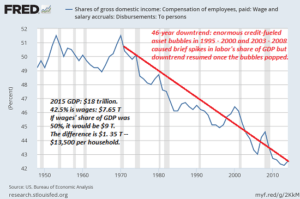
“But this leaves out the force most responsible for creating the nightmare in which we now find ourselves … [financialized] neoliberalism. Here is what we need to understand: a hell of a lot of people are in pain. Under neoliberal policies of deregulation, privatization, austerity and corporate trade, their living standards have declined precipitously. They have lost jobs. They have lost pensions. They have lost much of the safety net that used to make these losses less frightening. They see a future for their kids even worse than their precarious present.
“At the same time, they have witnessed the rise of the Davos class, a hyper-connected network of banking and tech billionaires, elected leaders who are awfully cozy with those interests, and Hollywood celebrities who make the whole thing seem unbearably glamorous. Success is a party to which they were not invited, and they know in their hearts that this rising wealth and power is somehow directly connected to their growing debts and powerlessness.
“For the people who saw security and status as their birthright – and that means white men most of all – these losses are unbearable. Donald Trump speaks directly to that pain. The Brexit campaign spoke to that pain.”
Here it is represented visually:
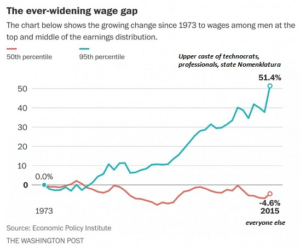
Of course, this was not the case for the urban élites:
Cultural Resistance
The second aspect to the present discontent has been cultural oppression (or, in the rhetoric of the Democratic Party, “identity politics” – one of the mainstays of the Clintonite electoral base). Its roots are complex, and lie with philosophic currents emerging out of Germany during WWII that somehow fused with American Trotskyist intellectual thinking (which then migrated to the Right). But, in gist, this current of political thought borrowed from the emerging discipline of psychology the concept of clearing the human mind – shocking it, or forcing it into becoming the “clean slate” on which a new mental program could be written by the psychiatric (or political) therapist respectively.
The political aim here was to eliminate totalitarian thinking, and fascist mental “programming,” and to replace it with a liberal-democracy circuit board.
Indeed, the U.S. Immigration and Nationality Act of 1965 was promoted by this intellectual group precisely in furtherance of the notion that concepts such as “national culture” would become meaningless as a result of immigrant cultural dilution. By the 1970s and 1980s, the objective had evolved to implant the idea that there was really no politics to modernity (Fukuyama’s End of History) since all governance somehow had boiled down to technocracy: ensuring effective liberal market functioning — a matter best left to experts.
In political terms, the “clearing” of the mind’s inherited cultural clutter was to be achieved by cultural wars of political correctness. The class war had become discredited, but there were other “victims” on whose behalf war could be waged: the war on gender discrimination, on racism, on denial of gay rights and sexual orientation stereotyping, on verbal micro-aggressions, on sexist language, or any ideas or language which disturbed the individual’s sense of “safe space” were used as tools to clear away old cultural “brush” of inherited national culture, and open the way for an American-led, globalized world.
The ostensible factor linking all these notions of victim “wars” was that their antonym amounted either to fascism or authoritarianism. The problem with this has been that any white American blue-collar worker who attended church, who believed in family life, and was patriotic, became potentially a fascist, a racist, a sexist or a bigot.
Many ordinary Americans (and Europeans) disdain this “cultural” war which places him or her (according to Hillary Clinton), in the “‘basket of deplorables’ Right? Racist, sexist, homophobic, xenophobic, islamophobic, you name it,” and who looked upon his or her community as representing nothing more than a “fly-over” state in the view of the U.S. coastal élites.
The deplorables have now risen up. Donald Trump’s salty language was no liability – it was an electoral asset by thumbing his nose at this correctness, and at so-called ”snowflake” sensibilities. Trump’s ‘incorrectness’ touched on a deep vein of resentment within American traditional society.
Not only does “flyover America” resent being termed “deplorables,” they feel too clearly the disdain in which the American and European elites hold them – and dislike their arrogance in suggesting that there is only one rational, sensible way of doing things, and that they – the elites, being the experts and a part of the Davos set – should tell the rest of us what it is: (despite their decades of failures).
High Emotions
Emotions are high on both sides. To gain a sense of how bitterly the cultural war will be fought, listen to this from the partly-Soros-funded populist mobilization movement Azaaz (linked to America’s Move On organization): “Dear Mr. Trump: This is not what greatness looks like. The world rejects your fear, hate-mongering, and bigotry. We reject your support for torture, your calls for murdering civilians, and your general encouragement of violence. We reject your denigration of women, Muslims, Mexicans, and millions of others who don’t look like you, talk like you, or pray to the same god as you. Facing your fear we choose compassion. Hearing your despair we choose hope. Seeing your ignorance we choose understanding. As citizens of the world, we stand united against your brand of division.”
In short, with Brexit and the Trump victory, we are witnessing an historic point of inflexion. As I noted in mid-October (quoting British political philosopher John Gray): “If the tension between [the globalization project on one hand] and the [sovereign] nation state, [on the other] was one of the contradictions of Thatcherism … From Bill Clinton and Tony Blair onward, the center-left embraced the project of a global free market with an enthusiasm as ardent as any on the right. If globalization was at odds with social cohesion, society had to be re-engineered to become an adjunct of the market. The result was that large sections of the population were left to moulder in stagnation or poverty, some without any prospect of finding a productive place in society.”
“If Gray is correct that when globalized economics strikes trouble, people will demand that the state must pay attention to their own parochial, national economic situation (and not to the utopian concerns of the centralizing elite), it suggests that just as globalization is over – so too is centralization (in all its many manifestations).”
Well, the global trend does not seem to be going in the Avaaz direction. It seems rather to be heading toward prioritizing the recovery of the state, of state sovereignty, and of state engagement in the pursuit of economic policies appropriate to the particular circumstances of the state, and in the state’s ultimate responsibility for the welfare of the community as a whole.
The question is what does this mean geo-strategically? And, secondly, can and will, Trump be able to deliver the new era? The short answer is that this new era seems to presage a period of political volatility, financial volatility and in Europe and the Middle East, the prospect of continued political “shock.”
It is clear that Mr. Trump is not a globalist. It is also clear that he is aware of some of the dangers of the present global monetarist policy. He has spoken of the U.S. Federal Reserve creating “big ugly bubbles” and that the next economic and financial crisis has been “kicked down the road” by Fed Chairwoman Janet Yellen – and clearly awaits whomsoever becomes U.S. President on Jan. 20, 2017.
Painted into a Corner
But three decades of debt-led, financialized “growth policies” leave the President-elect effectively painted into a corner: global debt has spiraled; the bubbles are there still (kept afloat by Central Bank coordinated intervention), and bubbles are infamously difficult to deflate gently; zero or negative interest rates are undermining many a business model, but cannot easily be foregone, without crashing the bond market; and QE (printing money) is systematically eating away at consumer purchasing power through the dilution of its newly created purchasing power, and the latter’s re-direction from “main street” into the financial sector – lifting nominal asset values – but creating no tangible wealth.
America and Europe effectively are in debt-deflation. How then to grow incomes so that producers of goods and services can also afford then subsequently to purchase these goods and services? Trump’s answer is to spend on domestic infrastructure projects. This may help a bit, but is unlikely – in itself – to lift and float the entire U.S. economy.
The reality is that there is no obvious global engine of growth (now that China’s “industrial revolution” has stalled at best). Every nation now is in search of new engines of growth. And it is not easy to imagine that Europe or America will succeed in retrieving all those jobs lost through globalization. Indeed, the attempt so to do – in, and of itself – might just precipitate a further deceleration of world trade, and a consequent decline in output.
In brief, the global economy may see a brief “honeymoon period” thanks to a likely spurt of U.S. fiscal indulgence and a concomitant psychological lift, stemming from – at least – the U.S. construction sector enjoying something of a boom. But ultimately the very economic crisis which Mr. Trump anticipates may prove to be the only way to cut the Gordian knot in which three decades of unprecedented debt and money printing have fettered us.
And if he is to steer through the expected crisis, Mr. Trump will have to eschew the Siren voices of the present elites telling him “TINA” (there is no alternative, but to continue as before).
Where Mr Trump might look for an early (and relatively easy) success however, may be in foreign policy. As “Nixon went to China,” so Trump can go to Russia and China, and begin to treat them as normal nations with whom it is possible to find an intersection of interests (as well as areas of disagreement).
This would be revolutionary. It could change the geo-strategical map. And as President Putin keeps repeating … the door is open (at least for now). Nothing is forever in politics.
Alastair Crooke is a former British diplomat who was a senior figure in British intelligence and in European Union diplomacy. He is the founder and director of the Conflicts Forum, which advocates for engagement between political Islam and the West.
Why Trump’s Presidency Is a Win for Europe
By Finian CUNNINGHAM | Strategic Culture Foundation | 12.11.2016
By vowing to rebuild American society, scale back foreign militarism, de-escalate NATO and seek friendly cooperative relations with Russia, a United States of America under Donald Trump would not only be a boon for America’s best interests. It would also be a win for Europe.
In such a new international outlook, the European bloc would be freed from its atlanticist subservience which has been dominant and deleterious for several decades. European governments would be freer to have more independent foreign policy, instead of toeing the dubious line that up to now has been ordained from Washington. It has been a disaster for the EU to have adhered so slavishly to US foreign policy. Much of the current discontent and disaffection among EU citizens towards the Brussels-based bloc stems from this unnatural and unhealthy subservience to Washington.
Wars in the Middle East, North Africa and Central Asia and the attendant problems of blowback terrorism and influx of refugees are direct results of European governments following Washington’s foreign policy of regime change and so-called «democracy promotion». Even though these wars have been illegal and vile transgressions of international law.
Financial and economic policies adopted by European governments have been straitjacketed by neoliberal capitalist doctrine dictated by Wall Street and successive US governments. This boils down to misery and austerity for the masses, while a tiny oligarchy become ever bloated with wealth. In short, stagnation.
Deteriorating relations with Russia – Europe’s biggest energy supplier – have also stemmed from the EU following Washington’s confrontational agenda towards Moscow. European governments have bought into the spurious US official narrative of Russia being «aggressive» and «expansionist». Admittedly, certain EU members such as the Baltic states are all too willingly Russophobic. But for many others, such hostility between the EU and Russia does not make sense. While economic impacts on the US have been minimal, the tensions between the EU and Russia have badly hit European businesses, exporters, farmers and workers.
The looming threat of war on European territory from the irrational enlargement of the US-led NATO military alliance along Russia’s border is also seen by many citizens as another demonstration of the EU’s reckless subservience to Washington. It is Washington, of course, that has been the main advocate of increasing NATO forces in Europe, augmented by atlanticist EU governments like Britain, Germany and France, as well as the anti-Russian paranoid Baltic states. Some 500 million EU citizens are held ransom to war policies by a coterie of governments who behave like vassals to Washington.
In many ways, the political, economic and cultural problems challenging Europe arise directly from the EU’s lack of independence from the US. Often it seems that Brussels is acting as a rubber-stamp for foreign policies authored in Washington. No wonder then that in the view of many EU citizens the functioning of the bloc is seen to be undemocratic and unrepresentative of their immediate needs. This explains the soaring rise of anti-EU parties right across the bloc. The phenomenon has less to do with an inherent popular affinity for parties labelled «far right» or «xenophobic» and more to do with a popular desire for democratic governance that attends to urgent social interests.
There is much overlap with the political rise of Donald Trump in the US. As in Europe, the mass of ordinary working-class American citizens have been disenfranchised, politically and economically, over several decades. A rarefied political class has become ossified and is seen to be self-enriching and servile to a tiny wealthy elite of financiers, corporations and the military machine that underpins this oligarchy. Integral to the oligarchy are the corporate-controlled media monopolies that pontificate to the masses on how they should vote in elections – elections that have become inconsequential to democratic needs.
All that now appears to be changing. A revolt is underway.
Trump’s election, like the Brexit before in Britain earlier this year, is a popular revolt against the oligarchy. The mass of people have become sickened and wearied by endless wars and endless economic austerity, while the rich elite become ever more obscenely wealthy, and all the while the media propaganda system cynically instructs the people who to vote for and who not to, knowing full well there will really be no «hope and change».
This time around though, the US election, like the Brexit, was infused with righteous, raw popular anger against the oligarchy.
Trump struck a deep popular chord when he called US-led wars in the Middle East a «disservice to our country and a disservice to humanity». People got it when he lamented how much American infrastructure, schools, hospitals, roads, jobs, would have benefited if the trillions of dollars wasted on wars had instead been invested at home. Despite media concealment, a large section of the American people concurred with Trump’s angry denunciation of Obama and past US administrations for criminally stoking terrorism and conflicts. His presidential rival Hillary Clinton was fixed right at the center of this culpability among the Washington oligarchy, which straddles both the Republican and Democrat parties.
Voting Trump into the White House – a property tycoon who has never held an elected office before – is an historic repudiation of the political establishment. It is a political earthquake.
On the eve of election day on November 8, Trump declared that «this will be our independence day… when the American working class will strike back». It may seem incongruous that a billionaire capitalist should exhort the working class to strike. But strike they did.
Trump also said his election would be «Brexit plus, plus, plus». That remark has turned out to be prescient too. The American election earthquake has rocked Europe with greater force than did Britain’s vote to quit the bloc in July. A crevice has been torn open between atlanticist governments and more independently minded ones.
Germany and France in particular have been caught off-side. Chancellor Angela Merkel expressed «shock» at Trump being elected, while French President Francois Hollande – also disapproving the result – called for «united European values» to confront the new American president. Hollande’s bravado for «liberal values» makes him look even more fatuous.
Britain, the other atlanticist voice in Europe, was more congratulatory to President-elect Trump. No doubt, that’s because Britain is seeking to shore up badly needed bilateral trade deals with the US in light of its departure from the EU and therefore it needs to keep Trump sweet.
What really alarms Germany and France is that Trump is no atlanticist or NATO advocate. His nationalist views and tougher stance on immigration controls resonate with EU members like Hungary, Czech Republic, Slovakia, Slovenia, Greece and Austria.
Trump’s views also give a boost to anti-EU parties in Germany and France who are challenging incumbents Merkel and Hollande in elections next year. It was telling that while Merkel and Hollande deprecated Trump’s election, he was heartily congratulated by the anti-EU Alternative for Germany and Marine Le Pen’s National Front in France, as well as Nigel Farage’s UK Independence Party in Britain. These parties also tend to share Trump’s more sanguine view of friendlier relations with Russia.
If Donald Trump can deliver on his avowed program of rebuilding American society and economy from within while abandoning US imperialist hegemony around the world that will potentially transform world relations. For Russia and China it will lead to a much needed normalization of relations, away from the current Cold War-type hostility that threatens to ignite world war. Both Russian and Chinese leaders Vladimir Putin and Xi Jinping were quick to express congratulations and readiness to work with new president Donald Trump.
The political establishment, including the media, in the EU that is dominated by woefully misguided atlanticism has deplored the election of Trump in the US. There is a snobbish handwringing attitude that Trump’s movement is all about racist, white trash numbskulls. There may be some unsavory elements to Trump’s support, as there are in some anti-EU movements. But in the main what it is about is reclaiming democratic power for the mass of people. What the Americans have done in electing Trump is what the Europeans also need to do in order to sack a corrupt and venal establishment that up to now has only served Washington and the atlanticist elite.
If Trump’s victory invigorates similar trends across Europe then that would be a good thing. And especially if it led to Europe having a more independent foreign policy from Washington and in particular gaining a more normal, mutual relationship with Russia.
The Unethicality of the Sore Loser
Moving the goalposts on electoral criteria
Photo credit – Reuters
By Kim Petersen | American Herald Tribune | November 12, 2016
During live US presidential election coverage on RT, after it became clear that Donald Trump was going to secure the required number of electoral college votes to win the election, word came that Hillary Clinton would not make a concession speech that night. The moderator of the live election coverage at RT was gobsmacked. He called Clinton’s behavior the “epitome of arrogance.” It certainly did smack of being a poor loser.
It seems that being a sore loser has reached stratospheric dimensions, as some are trying to reverse the electoral defeat for Clinton because she won the popular vote. To be clear, there is no comparison to what befell Al Gore here. Gore also won the popular vote in the 2000 US presidential election, but he was considered by many to have won the majority of electoral college votes because of electoral fraud in Florida. Yet even Gore, who has a better case to have overturned his defeat in 2000 than Clinton has in 2016, eventually conceded defeat.
These people seeking to circumvent current electoral college convention are, in other words, trying to move the goalposts on Donald Trump and his supporters.
Moving the goalposts is a type of logical fallacy whereby when a person has met the criteria required to succeed subsequently the criteria are changed to something different or raised to a higher standard (also referred to as “raising the bar”).
Moving the goalposts is unethical. When it occurs in the sporting world, a penalty is bestowed on the offending team.
On 8 November candidate Donald Trump surpassed 270 electoral college votes and was declared winner of the 2016 election. Yet we hear from Democracy Now! of a movement to overturn the system of winner take-all electoral college votes in a state. The show referred to a petition supported by the celebrity Lady Gaga asking: “Electoral College: Make Hillary Clinton President on December 19.”
It calls on the electors to ignore the current rules, which bind them to voting for the winner of their state, and cast their ballots instead for the winner of the popular vote, Hillary Clinton.
Democracy Now! reports than 2 million people have signed the petition.
What it Signifies for US Democracy
The United States is not a democracy in any meaningful sense. Despite the US relentlessly tooting its own horn as the bastion of democracy, it is arguably inferior in level of democratic attainment even compared to nations it considers nemeses — Cuba and China — and that it fallaciously derides as being dictatorships.
Conferring victory upon the candidate who garners the plurality of votes in an election will do little to assuage the democratic deficit in the US.
Yes, deciding the outcome of an election through the electoral college vote seems out-dated at any point in time. However, overturning the rules of the game post hoc poses another logical quandary: the slippery slope. If a precedent is set whereby the rules of the game can be changed during play or after the match, then what is to stop the rules being tampered with again in the future when a result is not to a powerful side’s liking?
There are many crucial steps required before the United States can present itself as a meaningful democracy: for example, among others, discarding the electoral college, bringing transparency to party primaries, overturning Citizens United, providing impartial and equal media coverage for all candidates (including “third” party candidates) during an election, easing the barriers for “third” party electoral participation, facilitating electoral participation for all Americans. These measures must be implemented before an election. They must not be implemented during or after an election to change the result. It is unfair. That is elementary morality that any child would comprehend.
Israeli settlements not obstacle to peace: Trump adviser
Press TV – November 10, 2016
US President-elect Donald Trump does not think the illegal Israeli settlements in the occupied Palestinian territories should be condemned because they don’t pose “an obstacle to peace,” according to a top Trump adviser.
The comments were made on Thursday by Jason Greenblatt, the chief legal officer and executive vice president at the Trump Organization. He has been tapped by Trump as his top adviser on Israel.
Greenblatt’s comments would mark a stark departure from the long-time Washington stance that Israeli settlement construction in occupied Palestinian lands makes it more difficult to reach a peace agreement with the Palestinians.
An Israeli minister called for renewed settlement expansions after Greenblatt’s comments. Israeli Science Minister Ofir Akunis said Tel Aviv thinks it’s time to move forward with more settlements now that Trump has won the US presidency.
The administration of US President Barack Obama has repeatedly criticized Israel over the settlement expansions, saying they make it difficult for Israel to reach peace with Palestinians.
The US and Israel are close allies but relations were often tense between Obama and Prime Minister Benjamin Netanyahu over the Israeli settlements and the nuclear agreement with Iran last year.
Analysts say a Trump presidency may be profoundly negative for Palestinian aspirations while buoying Israel’s confidence.
Under the Trump presidency, analysts expect there to be less pressure from Washington to halt illegal Israeli settlement building, meaning the settler population will grow unchecked.
“The Palestinian people hold no hope that the change of American president will mean a change in policy towards the Palestinian cause,” said Hamas spokesman Sami Abu Zuhri. “That policy is constant and biased in favor of Israel’s occupation.”
Israel is the largest cumulative recipient of US foreign assistance since World War II. America’s military assistance to Israel has amounted to $124.3 billion since it began in 1962, according to a recent congressional report.
Trump’s Election: ‘We May Have Just Dodged the Bullet on WWIII’
Sputnik | November 10, 2016
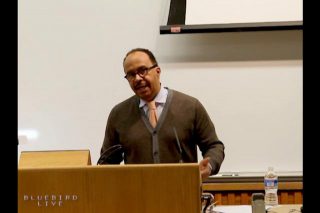 On Tuesday, voters in the US went to the polls to choose their next president, electing Republican Donald Trump. Speaking to Sputnik, Professor Tony Monteiro, peace activist and scholar at the department of African American Studies at Temple University, suggested that Trump’s election may have just saved the world from World War Three.
Calling Tuesday’s vote a “political insurrection,” Monteiro said that he was frankly surprised by “the depth and magnitude” of the popular revolt.
“I felt it was possible, [but] didn’t believe it was probable, given that the Clinton campaign had all of the resources…”
“It’s a situation where the pundits and the political experts had predicted based upon an old paradigm of viewing elections. And what we had is a new paradigm – a paradigm grounded in rage, anger and class resentment against an elite which never repaired the profound damage done to the American working people and the middle classes as a consequence of the Great Recession of 2007 and 2009.”
The academic explained that he frankly “just had no idea at how deep this was. And we saw it – it was a sweep. In fact, Donald Trump did to Hillary Clinton what the experts were saying she would do to him. It’s quite unbelievable – it’s a historic outcome. I think finally, that temporarily, the world has dodged the bullet of World War.”
“If Clinton had won, we would be on a fast track to war with Russia, either in the Baltics, Ukraine or in Syria. She made that perfectly clear.”
Trump, meanwhile, “had over the course of this election cycle said the very opposite. Many people thought that by coming out against war with Russia, he had disqualified himself. In fact he went so far as to attack the generals and those who are running foreign policy.”
Ultimately, the expert stressed that more than anything, this election was “a serious rebuke to the corporate media, who were all against Trump and for Hillary Clinton. Now in saying all of this… I don’t think Trump is a pure vessel… However, what is significant, and what we have to pay close attention to, is not Trump the individual, but that movement that made it possible for him to win the election.”
Monteiro suggested that consciously or not, this movement was animated by their class interest – based on popular anger over stagnant wages, and at the same time, trillions of dollars in offshore banks held by oligarchs, the transnational corporations and hedge funds.
“You’ve got all of these young people who are graduating from university, with tremendous debt, with no jobs that pay them enough to pay off their debt. And then of course Trump made a kind of heavy-handed and awkward appeal to the Black community – but there was some truth to it! When he said that the political forces that the Black community has aligned with has done very, very little for them. And he said to Black people ‘you have nothing to lose’. I think that in the Rust Belt, the former industrial mid-west, more Black people voted for Trump than we are aware of at this time.”
Taking office, Trump faces political, class and racial divisions of an almost unprecedented scale. “The nation is divided; it has not been this divided since the civil war in the 1860s.”
The difference this time, according to the analyst, “is that the divisions are not so much sectional, but are more economic and social class-[based].”
“Can he unite the country around a program of rebuilding the nation economically, and a policy of peace abroad? I’m not yet certain,” Monteiro stressed. But he was encouraged by Trump’s acceptance speech, where “he said that he was for cooperation with nations and finding common ground. I felt that the paramount issue in this election was the question of war and peace, even though it was not the major issue discussed in the corporate media. It was the paramount issue, because I am of the opinion that had Hillary Clinton won, she was going to fast-track belligerency and even war with Russia, and that could have spun out of control into a thermonuclear war.”
Donald Trump won the election… so what now?
By Kit | OffGuardian | November 10, 2016
In the wake of the shocking result of the US Presidential election, we take a look at some of the key questions left up in the air. How did things go so wrong for Hillary Clinton? How will the world look when the dust has settled? Is this really a sign of any kind of change?
Question 1: What the hell just happened?
Most people, most pundits most media outlets were predicting a Clinton victory. The pundits and reporters, because Hillary was “qualified” and “competent”. Everyone else…because she could follow Obama’s example and mobilise the virtue-signalling vote, and even if she didn’t it would just be rigged. As the primaries evidently were.
The vast majority of the media were behind Clinton. The banks were too. As was Wall Street, big pharma, arms manufacturers, senior figures from both major political parties and (seemingly, anyway) the military and intelligence services. How could that much collective clout possibly fail to pull out the W? How did they let this happen?
You are left with three possibilities.
1, elections aren’t rigged. Simply put, all the weight behind Clinton could only exercise legitimate and transparent power. They could give interviews, write opinion pieces and campaign…and that’s all. They fought hard, and they lost. Fair and square. Given what we know about 2000, 2004 and the democratic primaries this seems unlikely.
2, elections can be controlled, but only in a limited fashion. This was talked about at length following the Brexit vote (which many people have suggested was nothing like as close as the “official figures” made it look). This idea posits that numbers can be manipulated, but not controlled. You can fudge them up and down, but full-on fakery leaves too much evidence, or is simply too difficult. It’s possible that Clinton was just SO mistrusted, SO hated, SO incredibly unpopular, that even with the collective might of 90% of the political and media establishment behind her… they just couldn’t swing the vote. This is plausible, especially if you paid attention to the crowd sizes at their respective rallies.
[Note: These situations both come with the rider that, much like sports, it may only be possible to rig an election if both sides are willing to cooperate. Maybe Trump wouldn’t let it slide the way Al Gore or Bernie Sanders were happy to do.]
3, somebody changed sides. Maybe the election was rigged, but in the other direction. Maybe the sudden, unexpected reopening of the e-mail investigation was a deliberate ploy by the FBI (and others, behind the scenes) to swing public opinion against Hillary. Maybe the rumors of immediate impeachment should Hillary win, and of possible ties to paedophiles and human trafficking, were the straw that broke the camel’s back. It’s possible that an establishment already creaking alarmingly under the weight of Clinton’s baggage, decided Clinton was now simply too much trouble. And that it might be easier to chance their arm on a man who might be willing to play ball, and was less likely to throw up a constitutional crisis and/or suddenly drop dead.
It’s recently become obvious, given the flip-flopping over Ukraine and Syria, that the American political establishment is far from a monolith of drive and purpose. There are internal divisions. There are factions. Trying to distill any kind of rational plan from their resulting actions is like trying to follow the score in a game of Rugby where four teams are playing at once, and they’re all wearing the same uniform.
Question 2: Will Trump Be Allowed to take office?
Just as happened following the Brexit vote (and to a lesser extent Jeremy Corbyn’s election as Labour leader), already this result has sprouted protest movements, petitions and articles either directly challenging its legitimacy, or simply questioning the “democratic value” of the American electoral system.
As the results were coming in last night, I personally witnessed tweets suggesting Obama should refuse to relinquish his office to Trump. Protest marches have already been held in many cities across America. If these protests escalate to riots, or street battles, Obama could declare a state of emergency which “delays” the swearing-in of the new president, Trump supporters would see this (rightly) as a possible coup attempt, leading to further violent unrest and the declaration of martial law. Extreme, but not impossible. Any move to replace Trump before he’s even in office would be totally unprecedented and grossly unconstitutional. But so was Gitmo.
Before the vote was held, the democrats were fervently and hysterically blaming the Russians for “interfering” with the election, baseless rumors which the media eagerly and unquestioningly repeated. You could argue this was done to preemptively defend themselves in the event of a Trump win. Undermining the result before there even was one. The Russian “hacks” are cited as the main cause behind this petition, calling for an overthrow of a Trump government, on the grounds he stole the election. This issue could be picked up more widely in the media in the coming days.
The long, long, long delay before Hillary finally appeared to make her concession speech makes one wonder if, behind the scenes, there may have been wheels turning. Think tanks furiously going over the options and outcomes should Clinton simply refuse to concede the election and publicly call into question the fairness of the vote. In the end, what would have finally sunk that possibility is the pompous way Clinton’s team responded to Trump’s own suggestion there may be vote rigging. To turn around and “disrespect our democracy” after she lost would have laid Clinton open to justified claims of hypocrisy.
There are more old fashioned methods of removing an unwanted president, of course. It’s very telling that “assassination” was shooting up the google search ranks as the results were announced last night. And America has never been short a lone wolf assassin when it really, really needed one.
Question 3: What sort of man is Donald Trump?
It’s tempting, at moments such as this, to blindly and joyfully accept outcome as a win for good guys. I’m not going to deny I was, more than anything, relieved when I saw the result. The possibility of a psychopathic war hawk pushing for a war with Russia, with the full weight of a self-deluded middle-class high on their own moral outrage behind her, was terrifying. But not so long ago Barack Obama was… for want of a better phrase…the great white hope. He was going to change things…but didn’t. In the end he was simply an Orwellian controlled alternative. It’s possible that’s all Trump is, too.
It’s possible Trump is just a pompous windbag who would say or do anything to get into power, simply for the sake of having power. It’s possible he’s an elaborate ploy designed to satiate an angry public thirsty for real change, and buy the oligarch elite more time to milk us dry or blow us all up for some crazy reasons of their own. Both plausible, but let’s put them aside for now.
Let’s say that Trump is sincere in his goals, and let’s say he is allowed to take office and try to introduce his policies – both big ifs, but still. How much institutional and bureaucratic resistance will he encounter? How many threats and extortions will he face? Does he have the strength of character to face down that opposition? Very few people do. Most politicians sell their souls for power, or resign themselves to impotence. It takes an extraordinary person to keep a hold of themselves and their ideals, in a political environment double loaded with both temptation and threat.
All through the election cycle the democrats were far more interested in talking about punch lines, snappy quotes and identity politics than discussing policy. That’s because any real discussion of policies would only push a lot of people into voting for Trump. He want’s to cut-out hostilities with Russia and cooperate in combating terrorism. He wants to slash defense spending and rebuild industry. He wants to pull American bases out of Japan, Germany, South Korea and others, and relinquish America’s self-styled title of “World Policeman”. He wants to stop corporations from employing illegal immigrants to get around paying minimum wage. He has posited leaving NATO.
These are all, on the face of it, reasonable policies that could bring America back from the brink. And they are all, on their own, potentially career ending for any other politician in the Western world.
Will he ever be allowed to enact a single one of them? I guess we’ll see.

Featured Video

Seyed M. Marandi: U.S. Military DIVIDED? Iran’s Secret Defense EXPOSED
or go to
Aletho News Archives – Video-Images
From the Archives
‘Israel sees Iran as obstacle to its policies’
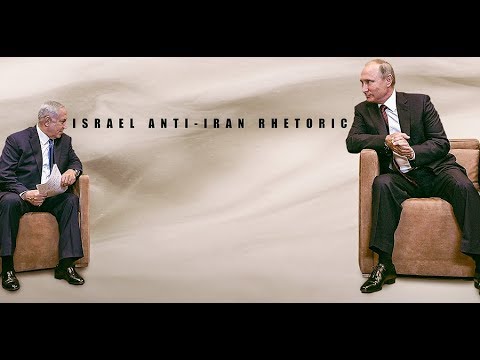
Press TV – August 25, 2017
Prime Minister Benjamin Netanyahu has said that Israel felt threatened by Iran’s growing influence in the Middle East. Netanyahu expressed his Iranophobic view in a meeting with Russian President Vladimir Putin in Russia’s Black Sea resort of Sochi on Wednesday. Press TV has asked Scott Rickard, former American intelligence linguist from Tampa, Florida, and Brent Budowsky, a columnist at The Hill from Washington, to give their thoughts on the issue.
Rickard said Tel Aviv is concerned about the fact that the regime could not carry out its old project to spread sectarian divisions and pave the way for dismemberment of the countries in the Middle East region because of the Iranian-led resistance against Israeli policies, not only in the occupied territories of Palestine but also in the whole region.
“Iran is not a threat to Israel whatsoever. The threat that Israel sees is the fact that their Oded Yinon Plan is being put to a hold by Iran,” the intelligence linguist said on Thursday night.
“They (the Israelis) look at Iran as a threat only because they have no influence on their governments and Iran is autonomous and is not under the Zionist influence,” he added.
Since the victory of the Islamic Republic of Iran in 1979, Tehran has been critical of Israel’s policies in the region, whereas “no leaders [of other states] even dared to speak out against Zionism,” Rickard argued. … continue
Blog Roll
 Aletho News
- Evidence points to Ukraine being behind TurkStream attempted sabotage, but that should come as no surprise
- Sri Lanka secures supplies of Russia oil – minister
- Nations across Asia strike direct deals with Iran for Hormuz passage
- IRGC commander declares ‘new phase’ of reprisal attacks against aggressors
- Israel’s air defenses overwhelmed by cluster-warhead Iranian missiles: Reports
- Striking Iran’s Infrastructure Would Have Little Military Impact – Report
- What’s Behind U.S./Israeli Strikes On Iranian Pistachio Factories?
- Seyed M. Marandi: U.S. Military DIVIDED? Iran’s Secret Defense EXPOSED
- How I fell foul of the BBC thought police
- The End of NATO
- If Americans Knew
- Trump says Iranians appreciate bombs, WHO warns of nuclear risks – Daily Update
- U.N. experts demand Israel release prominent Gaza doctor after reports of ‘severe torture’
- Israel’s Latest Genocide Is Against the Shias of Lebanon. Why Is the World Silent?
- How Eliot Cohen’s influence over U.S. war-making paved the way for Trump’s war crimes in Iran
- Israelis don’t pay for the weapons we ‘sell’ to them — US taxpayers do
- While Distancing from AIPAC, Most 2028 Democratic Hopefuls Are Still Embracing Israel
- A brief history of the Israeli nuclear program, the open secret at the heart of the Iran war
- Israeli Settlers Killed a Palestinian Farmer on His Own Land, in Front of His Father. Yes, Again
- The US-Israeli War on Science is an Assault on our Future
- 100+ International Law Experts Say US Strikes on Iran Violate UN Charter, Could Be War Crimes
- No Tricks Zone
- An Inconvenient Tree: Uncovered In Alps… Europe Much Warmer Than Today 6000 Years Ago
- New Study Reports A 60% Slowdown In Greenland’s Ice Loss Rate In The Last Decade
- Low Intensity Tornado Wrecks Major Solar Farm, Creating A Potential Toxic Dump
- New Study Finds Warming Saves Lives…Cold Temperatures 12 Times More Deadly Than Excess Heat
- German Science Blog Accuses PIK Climate Institute Of Hallucinating Climate Tipping Points
- Devastating Assessment Of Comirnaty Vaccine By Former Senior Pfizer Europe Toxicologist
- New Study: CO2 Is ‘Effectively Negligible’ As An Explanatory Climate Change Factor Since 2000
- Former Pfizer Toxicologist Dr. Helmut Sterz Tells Bundestag Hearing Pfizer Vaccine Should Have Never Been Approved
- Energy Expert: Germany’s Nuclear Phaseout Was A “500 Billion Euro Mistake”
- New Research: South Australia’s Mid-Holocene Sea Surface Temperatures Were 4°C Warmer Than Today
 Aletho News