DuPont Caught Covering Up Deadly Risks of Chemical that’s in Nearly Everything & Everyone
By Andrew Emett | The Free Thought Project | August 13, 2015
Thousands of people have filed lawsuits against DuPont for poisoning them with a chemical that causes birth defects, multiple types of cancer, and death. According to internal DuPont documents and emails, the company knew about the health risks to their employees and local communities but covered up the data in order to increase their profit margin. After decades of dumping this toxic chemical into the ocean, rivers, landfills, and the air, DuPont has contaminated the bloodstream of nearly every American with this non-biodegradable chemical.
In 1946, Teflon was introduced with an essential ingredient known as perfluorooctanoic acid (PFOA) or C8. For several decades, DuPont and seven other corporations contaminated the U.S. by using C8 in hundreds of products, including Gore-Tex and other waterproof clothing; coatings for eyeglasses and tennis rackets; stain-proof coatings for carpets and furniture; bicycle lubricants; communications cables; fast food wrappers; fire-fighting foam; microwave popcorn bags; pizza boxes, ski wax; non-stick cookware; and satellite components.
According to internal DuPont documents, an employee named R.A. Dickison noted in 1954 receiving an inquiry into the possible toxicity of C8. Seven years later, a group of in-house researchers discovered that C8 was toxic and should be handled with extreme care. However, DuPont decided not to disclose this information to its own employees. Over the years, DuPont scientists have conducted experiments exposing dogs, rats, rabbits, monkeys, and humans to varying doses of C8, which killed many of the lab animals.
During the first trimester of her pregnancy, former DuPont employee Sue Bailey was transferred to the Teflon division at the Parkersburg plant in 1980. Her son, Bucky, was born with tear duct deformities, only one nostril, an eyelid that started down by his nose, and a condition known as keyhole pupil. According to a recent article in The Intercept, at least one of eight babies born to women who worked in the Teflon division had birth defects.
While on maternity leave, Bailey received a phone call from a DuPont doctor asking if her baby had any birth defects. Before Bailey returned to work, she learned that DuPont decided to remove all female employees from the Teflon division. When Bailey returned to work and visited the plant doctor, Dr. Younger Lovelace Power told her that Bucky’s birth defects were not caused by C8 and also told Bailey that the company had no record of her working in the Teflon division.
When the female employees were removed from the Teflon division at the Parkersburg plant, Ken Wamsley began working in Teflon after his supervisor assured him that C8 only affects some pregnant women. After years of exposure to C8, Wamsley was diagnosed with rectal cancer and underwent surgery in 2002 to treat it.
Due to the fact that C8 is so chemically stable, scientists have determined it will never break down and expect C8 to remain on the planet long after humans have gone extinct. During the early 1960s, DuPont buried approximately 200 drums of C8 on the banks of the Ohio River. An internal DuPont document from 1975 revealed that the company had also been packing the toxic chemical into drums loaded with stones and dumping them into the ocean.
As DuPont eventually ceased dumping C8 into the ocean, they began disposing the chemical in unlined landfills and ponds. DuPont also contaminated the air by releasing the chemical through smokestacks and pouring waste directly into the Ohio River. According to a 2007 analysis from the Centers for Disease Control (CDC), C8 is in the blood of 99.7% of Americans. C8 has also been found in arctic birds, bald eagles, bottlenose dolphins, caribou, harbor seals, lions, tigers, polar bears, walruses, and sea turtles.
A study by Dennis Paustenbach published in the Journal of Toxicology and Environmental Health found that the DuPont plant in West Virginia spread nearly 2.5 million pounds of C8 into the area surrounding Parkersburg between 1951 and 2003. Roughly 80,000 residents filed a class-action lawsuit against DuPont in 2001. After reaching a settlement in 2005, DuPont agreed to pay $343 million for residents’ medical tests, the removal of as much C8 from the area’s water supply as possible, and a science panel’s study into the toxic effects of C8 on humans.
After seven years, the science panel found that C8 was “more likely than not” linked to ulcerative colitis, high cholesterol, pregnancy-induced hypertension, thyroid disease, testicular cancer, and kidney cancer. The scientists also found that even extremely low levels of exposure were associated with health problems.
Next month, the first of approximately 3,500 personal injury claims is set for trial. Among the lawsuits is a wrongful death claim filed by Virginia Morrison of Parkersburg, West Virginia. Morrison is accusing DuPont of causing the death of her husband in 2008 from injuries related to kidney cancer.
Marred with a history of deceit and negligence, DuPont has repeatedly violated state and federal laws while causing the deaths of numerous employees. The production of leaded gasoline at its New Jersey plant caused madness and several violent deaths of employees. During the 1930s, employees were diagnosed with bladder cancer after exposure to certain dye chemicals. In 1989, DuPont employees at the Parkersburg plant experienced an elevated number of leukemia deaths and an unexpectedly high number of kidney cancers among male workers.
On November 15, 2014, a gas leak resulted in the deaths of four DuPont employees at the La Porte plant. On January 23, 2010, a phosgene gas leak killed a DuPont employee at the Belle plant. And on November 11, 2010, two contractors were welding when sparks ignited flammable vapors and caused an explosion at the DuPont facility outside Buffalo, New York. The explosion killed one contractor and left the other seriously injured.
DuPont has denied any wrongdoing or breaking any laws even though the EPA, OSHA, and other agencies have repeatedly cited the company for serious safety violations. Instead of taking responsibility for causing multiple types of cancer and birth defects, DuPont claims that the plaintiffs’ injuries were “caused by acts of God” over which DuPont had no control.
In 2006, DuPont and seven other companies signed on with the EPA’s 2010/2015 PFOA Stewardship Program and agreed to reduce C8 emissions and cease producing the toxic chemical by 2015.
Black Earth and the Struggle for Ukraine’s Future
By Andrey Panevin | Slavyangrad | June 25, 2015
The Ukrainian crisis can be viewed as being composed of several interconnected factors, from the civil war to rampant corruption, and the wider geopolitical ramifications of American confrontation with Russia. Another—relatively overlooked—factor is the ongoing conflict over Ukraine’s natural resources. Of particular interest to transnational corporations and their puppet local oligarchs is the ‘black earth’ of Ukraine. Black earth or ‘Chernozem’ is found in two major zones on earth, one of which encompasses sections of Moldova, Russia and Ukraine. Black earth is characterized by its very high fertility and, consequently, its capacity for producing a high agricultural output.
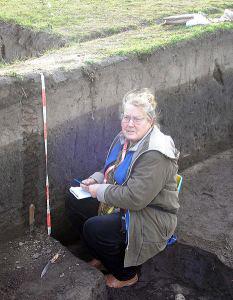
A scientist examines ‘chernozerm’ in Nikolaev, Ukraine.
(image: Saghnol, wikimedia commons)
International corporations have long been utilizing loopholes and political lobbying in order to overturn a Ukrainian moratorium on land sales to foreigners. By leasing numerous parcels of land these companies anticipate both the Ukrainian government’s desperation for money and the EU obligations to force open a goldmine of agricultural exploitation. The role of the ‘big players’—Monsanto, Cargill and Dupont—has been explored previously. The focus now is on agro-holding companies and individual oligarchs who seek to buy up and sell out Ukrainian land and livelihood.
One of the largest agro-holding companies operating in Ukraine is AgroGeneration. AgroGeneration seeks to “transform the land it works and today outperforms Ukrainian average yields. The company follows a traditional crop rotation and puts money into first-class fertilizers, seeds, and agricultural chemicals for the purpose of achieving profitability per crop.” The company has amassed 120,000 hectares of arable land, with 70,000 hectares being located in Kharkov oblast, whose eponymous capital is a city of great political and military importance in Ukraine. Kharkov has a large ethnic Russian and Russian-speaking population that has been actively repressed by the Kiev authorities, and it remains a region of dissent against the Kiev regime.
Michael Bleyzer, the Kharkov-born chairman of AgroGeneration, and founder of its sibling companies Sigma-Bleyzer and the Bleyzer Foundation, recognizes the importance of the city and has actively spoken about the need to maintain political and military order within it. In an op-ed for the KyivPost, Bleyzer writes of Kharkov as the most critical region, in need of being made “a very high priority. A large segment of the population in Kharkiv oblast is so discouraged by events and by the constant bombardment of Russian propaganda that they could be supportive of a Russian invasion or an attempt to establish a so-called People’s Republic.” Bleyzer further advocates a ‘Social Stabilization Fund’ for Kharkov, Dnepropetrovsk, Zaporozhia, Kherson, Nikolaev and Odessa. It is worth noting that these regions all contain either chernozerm or, as in the case of Odessa, ports through with which agricultural products transit.

The vast tracts of agricultural land controlled by AgroGeneration alone. (www.agrogeneration.com)
Michael Bleyzer’s role as a mouthpiece for the Kiev regime’s ‘war’ against Russia extends past his personal business interests and falls in line with the broader neoliberal, capitalist takeover of Ukraine. AgroGeneration and Sigma-Bleyzer (a private equity firm also owned by Bleyzer) seek to take advantage of the current regime’s plea to the West to ‘buy Ukraine’. These corporations and others are not only taking control of Ukraine’s farm land, they are doing it with European and American government assistance. In 2005, Sigma-Bleyzer received financing for a project worth up to 250 million euros from the European Bank for Reconstruction and Development (EBRD). In 2011, the EBRD gave AgroGeneration ten million dollars to double its ownership of Ukrainian land. In 2012 the Overseas Private Investment Corporation (OPIC)—an American government financial institution—gave Sigma-Bleyzer fifty million dollars for its ‘Eastern Europe fund.’
While these international corporations receive vast sums of money for their expansion in Ukraine, ‘access to credit remains a major problem for Ukraine’s small and medium farmers’. This interconnected system of funding from government finance institutions to private corporations has spelled doom for Ukraine’s agricultural sector, opening it up to exploitation and eventual ruin from the inside out.

Bleyzer (left) with US presidential candidate Ted Cruz on Maidan Square in Kiev. (Source: Secure America Now)
Connections between government and private corporations are at the core of this exploitation, with both entities seeking to employ what Bleyzer himself refers to as a system of “quasi-private equity funds managed by money managers from the private sector whenever possible.” Bleyzer’s attitude to the financial invasion of countries was well honed during the US-led invasion and occupation of Iraq, where he actively encouraged the US government to “create and implement the policy measures that will make an attractive investment climate in Iraq. This public-private partnership could play a critical role in making possible dramatic social and economic changes in Iraq and other countries in the region.” The goal of the corporate annexation of sovereign policy-reform has served Bleyzer and countless other oligarchs well from Iraq to Ukraine. In the context of this corrupt, financially imperialist environment it is no wonder that in a May 2015 economic report by Sigma-Bleyzer, it is casually written (in reference to the Ukrainian civil war) that “a frozen conflict could still provide the opportunity for the rest of the country to restart investments and economic growth.”
Ukraine’s precious black earth is being steadily annexed by international corporations and joins the list of resources and national sectors being outsourced to private investors. Agricultural corporations such as AgroGeneration find great corporate solidarity on the board of members of the US-Ukraine Business Council, which includes (among others) Sigma-Bleyzer, Monsanto, Dupont, Cargill, Exxon, Raytheon and the Bleyzer Foundation. These corporations share the common goal of pressuring the Ukrainian government to institute political ‘reforms’ in their favour. For agricultural corporations in particular, the goal is to pressure the government to “think about privatization. They need to prepare everything to allow for farmland sales (to foreign and domestic investors) in three to four years,” as stated by Heinz Strubenhoff, the agribusiness investment manager for the World Bank in Ukraine.
Ukraine is at a national crossroads and if the example of its increasing corporate annexation is anything to go by, it will have neither the money nor the resources to rebuild itself in the face of its political and cultural self-destruction. The West-supported preoccupation with ‘Russian invaders’ has left the oligarchy free to sell Ukraine’s political processes and natural resources to the highest bidder.
The Corporate Takeover of Ukrainian Agriculture
By Frédéric Mousseau | IPS | January 27, 2015
OAKLAND, CA – At the same time as the United States, Canada and the European Union announced a set of new sanctions against Russia in mid-December last year, Ukraine received 350 million dollars in U.S. military aid, coming on top of a one billion dollar aid package approved by the U.S. Congress in March 2014.
Western governments’ further involvement in the Ukraine conflict signals their confidence in the cabinet appointed by the new government earlier in December 2014. This new government is unique given that three of its most important ministries were granted to foreign-born individuals who received Ukrainian citizenship just hours before their appointment.
The Ministry of Finance went to Natalie Jaresko, a U.S.-born and educated businesswoman who has been working in Ukraine since the mid-1990s, overseeing a private equity fund established by the U.S. government to invest in the country. Jaresko is also the CEO of Horizon Capital, an investment firm that administers various Western investments in the country.
As unusual as it may seem, this appointment is consistent with what looks more like a takeover of the Ukrainian economy by Western interests. In two reports – The Corporate Takeover of Ukrainian Agriculture and Walking on the West Side: The World Bank and the IMF in the Ukraine Conflict – the Oakland Institute has documented this takeover, particularly in the agricultural sector.
A major factor in the crisis that led to deadly protests and eventually to president Viktor Yanukovych’s removal from office in February 2014 was his rejection of a European Union (EU) Association agreement aimed at expanding trade and integrating Ukraine with the EU – an agreement that was tied to a 17 billion dollar loan from the International Monetary Fund (IMF).
After the president’s departure and the installation of a pro-Western government, the IMF initiated a reform programme that was a condition of its loan with the goal of increasing private investment in the country.
The package of measures includes reforming the public provision of water and energy, and, more important, attempts to address what the World Bank identified as the “structural roots” of the current economic crisis in Ukraine, notably the high cost of doing business in the country.
The Ukrainian agricultural sector has been a prime target for foreign private investment and is logically seen by the IMF and World Bank as a priority sector for reform. Both institutions praise the new government’s readiness to follow their advice.
For example, the foreign-driven agricultural reform roadmap provided to Ukraine includes facilitating the acquisition of agricultural land, cutting food and plant regulations and controls, and reducing corporate taxes and custom duties.
The stakes around Ukraine’s vast agricultural sector – the world’s third largest exporter of corn and fifth largest exporter of wheat – could not be higher. Ukraine is known for its ample fields of rich black soil, and the country boasts more than 32 million hectares of fertile, arable land – the equivalent of one-third of the entire arable land in the European Union.
The manoeuvring for control over the country’s agricultural system is a pivotal factor in the struggle that has been taking place over the last year in the greatest East-West confrontation since the Cold War.
The presence of foreign corporations in Ukrainian agriculture is growing quickly, with more than 1.6 million hectares signed over to foreign companies for agricultural purposes in recent years. While Monsanto, Cargill, and DuPont have been in Ukraine for quite some time, their investments in the country have grown significantly over the past few years.
Cargill is involved in the sale of pesticides, seeds and fertilisers and has recently expanded its agricultural investments to include grain storage, animal nutrition and a stake in UkrLandFarming, the largest agribusiness in the country.
Similarly, Monsanto has been in Ukraine for years but has doubled the size of its team over the last three years. In March 2014, just weeks after Yanukovych was deposed, the company invested 140 million dollars in building a new seed plant in Ukraine.
DuPont has also expanded its investments and announced in June 2013 that it too would be investing in a new seed plant in the country.
Western corporations have not just taken control of certain profitable agribusinesses and agricultural activities, they have now initiated a vertical integration of the agricultural sector and extended their grip on infrastructure and shipping.
For instance, Cargill now owns at least four grain elevators and two sunflower seed processing plants used for the production of sunflower oil. In December 2013, the company bought a “25% +1 share” in a grain terminal at the Black Sea port of Novorossiysk with a capacity of 3.5 million tons of grain per year.
All aspects of Ukraine’s agricultural supply chain – from the production of seeds and other agricultural inputs to the actual shipment of commodities out of the country – are thus increasingly controlled by Western firms.
European institutions and the U.S. government have actively promoted this expansion. It started with the push for a change of government at a time when president Yanukovych was seen as pro-Russian interests. This was further pushed, starting in February 2014, through the promotion of a “pro-business” reform agenda, as described by the U.S. Secretary of Commerce Penny Pritzker when she met with Prime Minister Arsenly Yatsenyuk in October 2014.
The European Union and the United States are working hand in hand in the takeover of Ukrainian agriculture. Although Ukraine does not allow the production of genetically modified (GM) crops, the Association Agreement between Ukraine and the European Union, which ignited the conflict that ousted Yanukovych, includes a clause (Article 404) that commits both parties to cooperate to “extend the use of biotechnologies” within the country.
This clause is surprising given that most European consumers reject GM crops. However, it creates an opening to bring GM products into Europe, an opportunity sought after by large agro-seed companies such as Monsanto.
Opening up Ukraine to the cultivation of GM crops would go against the will of European citizens, and it is unclear how the change would benefit Ukrainians.
It is similarly unclear how Ukrainians will benefit from this wave of foreign investment in their agriculture, and what impact these investments will have on the seven million local farmers.
Once they eventually look away from the conflict in the Eastern “pro-Russian” part of the country, Ukrainians may wonder what remains of their country’s ability to control its food supply and manage the economy to their own benefit.
As for U.S. and European citizens, will they eventually awaken from the headlines and grand rhetoric about Russian aggression and human rights abuses and question their governments’ involvement in the Ukraine conflict?
Frédéric Mousseau is the Policy Director at the Oakland Institute.
Guatemala defies ‘Monsanto Law’ pushed by US as part of trade agreement
RT | September 3, 2014
The highest court in Guatemala has suspended the controversial ‘Monsanto Law,’ a provision of a US-Central American trade agreement, that would insulate transnational seed corporations considered to have “discovered” new plant varieties.
The Constitutional Court suspended on Friday the law – passed in June and due to go into effect on Sept. 26 – after a writ of amparo was filed by the Guatemalan Union, Indigenous and Peasant Movement, which argued the law would harm the nation, LaVoz reported.
The Court’s decision came after several Guatemalan parliamentarians from both the governing Patriotic Party and the opposition party Renewed Democratic Freedom said they would consider repealing the law after outcry from a diverse cross-section of Guatemalans.
The decision also offers interested parties 15 days to present their arguments pertaining to the law in front of the Constitutional Court. Members of both political parties said they would present motions to resist the law.
The ‘Law for the Protection of New Plant Varieties,’ dubbed the ‘Monsanto Law’ by critics for its formidable seed-privatization provisions, is an obligation for all nations that signed the 2005 CAFTA-DR free trade agreement between Costa Rica, El Salvador, Guatemala, Honduras, Nicaragua, the Dominican Republic, and the United States. The agreement requires signatories to adhere to the International Convention for the Protection of New Plant Varieties.
The law offers producers of transgenic seeds, often corporate behemoths like Monsanto, strict property rights in the event of possession or exchange of original or harvested seeds of protected varieties without the breeder’s authorization. A breeder’s right extends to “varieties essentially derived from the protected variety,” thus, a hybrid of a protected and unprotected seed belongs to the protected seed’s producer.
The Rural Studies Collective (Cer-Ixim) warned that the law would monopolize agriculture processes, severely threaten food sovereignty – especially those of indigenous peoples – and would sacrifice national biodiversity “under the control of domestic and foreign companies.”
The National Alliance for Biodiversity Protection said in July that the law is unconstitutional “because it violates the rights of peoples. It will benefit transnational seed companies such as Monsanto, Duwest, Dupont, Syngenta, etc.”
“According to this law, the rights of plant breeders are superior to the rights of peoples to freely use seeds,” the Alliance said in a statement.
“It’s a direct attack on the traditional knowledge, biodiversity, life, culture, rural economy and worldview of Peoples, and food sovereignty,” the Alliance added.
Anyone who violates the law, wittingly or not, could face a prison term of one to four years, and fines of US$130 to $1,300.
It is unclear what options the Guatemalan government has given the obligations under CAFTA-DR. The US would likely put pressure on the nation to pass the law, part of a global effort using trade agreements to push further corporate control over trade sectors like agriculture in the name of modernization. Upon further refusal, the US could drop Guatemala from the trade agreement.
Obama to announce $6 billion for African agriculture ahead of G-8 summit
By Julian Pecquet – The Hill – 05/18/12
President Barack Obama is expected to unveil a $6 billion international public-private partnership to extend the Green Revolution to Africa.
The initiative, which is linked to this weekend’s G-8 summit, aims to lift 50 million people out of hunger and poverty within a decade by investing in modern agricultural methods and technologies. Rich countries are expected to commit to spending $3 billion – the U.S. share is around $850 million over three years – while three dozen international and African companies will pledge a similar amount in investments such as fertilizer production, grain silos and new food products.
“We’re now putting together a fundamentally new approach to tackling hunger and poverty in sub-Saharan Africa,” said Rajiv Shah, administrator of the United States Agency for International Development (USAID).
Shah said the effort was a continuation of the Green Revolution of the 1970s and 80s, which saved countless lives in Latin American and Asian countries that were facing widespread starvation.
“The effort never made it to Africa, for a broad set of reasons,” Shah said. “Private companies never really invested in Africa in this sector. Public partners abandoned Africa in this sector. And African leaders themselves stopped thinking of agriculture as the solution. This really represents a change in that mindset.”
African heads of state from Ethiopia, Ghana, Tanzania and Benin will participate in the announcement, as well as Secretary of State Hillary Clinton, U2’s Bono, U.S. Sens. Patrick Leahy (D-Vt.) and Lindsey Graham (R-S.C.) and officials from the UN World Food Programme and other international organizations. And three dozen companies – including U.S. giants Cargill, DuPont and Monsanto – will pledge to invest millions of dollars in African agriculture.
Such investments, Shah said, will provide long-term savings for donor nations.
“Across the board, countries view their investments in development – especially around food security – as being in the long-term defense of their national interests,” he said. “It is much cheaper to invest in agricultural development in the Horn of Africa than it is to provide food aid in a time of crisis, as we’ve had to do last year.”
The partnership does raise some concerns, however.
One is whether donor countries will stick to their promises.
“Significant progress was made at the G-8 summit in L’Aquila, Italy, in 2009,” World Vision U.S. President Richard Stearns wrote in an op-ed submitted to The Hill on Thursday. “Global leaders committed to provide $20 billion over three years to help farmers in the poorest countries grow the food those countries need. However the 2011 G8 accountability report found that only 22 percent of funds have been disbursed and the majority of countries have not fulfilled their commitments.”
Another is the African partner nations’ ability to make the reforms necessary to make the private sector investments work.
Ethiopia, in particular, has been under fire for years for its human rights record. This week, Amnesty International urged Obama to use the G-8 summit to press Ethiopian leader Meles Zenawi on his government’s crackdown on critics.
“Prime Minister Zenawi is greeted with open arms around the world for the progress his government claims they have made on economic growth, development and counter-terrorism,” Washington office head Frank Jannuzi said in a statement. “But while he is warmly welcomed in his travels, at home the people of Ethiopia are subjected to ever increasing restrictions on their basic rights.”
Shah said U.S. aid is conditioned on every partner living up to their end of the bargain.
African leaders, he said, “will make public a set of policy reform commitments that will tackle corruption in their bureaucracies, that will create a more open business climate for companies, that will change some of their policies on price-setting and export restrictions that will allow for us to be successful together tackling this issue.
“We’re very results-oriented in how we do this work,” he said. “So if the conditions are not in place for the private investments to happen and for our investments to work, then we won’t make them. And neither will the private companies. So it’s a collective action challenge.”
In the end, he said, Africans are the ones who want the partnership to succeed most of all.
“Nobody wants to be receiving a hand-out when they could be investing in their capacity to grow themselves out of poverty and hunger,” Shah said. “We talk about it in terms of saving money, but it really speaks to a far more aspirational concept of human dignity. Everybody wants to be proud of their ability to feed their children and feed their families.”
Related articles
Featured Video
America Racing to Strategic Defeat in Iran
or go to
Aletho News Archives – Video-Images
From the Archives
Should Europeans ‘Thank’ the Americans for Destroying Nord Stream?
By Robert Bridge | Strategic Culture Foundation | September 29, 2022
With an investigation continuing into the destruction of the Nord Stream gas pipeline that provided energy supplies to Europe from Russia, there appears to be just one prime suspect, and that should surprise nobody.
Following the sabotage of the Nord Stream 1 and 2 gas pipelines, former Polish Foreign Minister Radoslaw Sikorski already seemed to know the identity of the perpetrator when he tweeted out: “Thank you, USA.”
At first glance, it seemed that Sikorski was speaking sarcastically, berating Washington for carrying out an attack that will have severe repercussions for the people of Europe. After all, how could anyone see any good coming from the termination of Europe’s primary source of gas reserves with winter just around the corner? It was Sikorski’s homeland of Poland, after all, that urged its citizens to collect firewood in the face of dwindling gas reserves.
In fact, the Polish diplomat was speaking one-hundred percent literally… continue
Blog Roll
 Aletho News
- Growing insecurity, soaring prices fuel protests in north as regime bans evacuation: Sources
- Iran denies responsibility for ‘depraved’ attack on Kuwait desalination plant
- Bring The Troops Back. End This War Now!
- Can we please stop calling Israel the ‘only democracy in the Middle East’ now?
- US should start removing its troops for Germany, proposes AfD co-leader Chrupalla
- Iran Red Crescent: 600 educational centers attacked in US-Israeli ‘war crimes’
- Russian Oil Tanker Arrives in Cuba Amid U.S. Blockade
- America Racing to Strategic Defeat in Iran: Lt Col Daniel Davis
- FTC Warns Visa, Mastercard, PayPal, Stripe Over Political Debanking
- Russian tanker approaches Cuba despite US oil blockade
- If Americans Knew
- Israeli police block Catholic cardinal from entering Church of the Holy Sepulchre on Palm Sunday
- Israel is assassinating journalists again, more than any other nation, anywhere, ever – Not a ceasefire Day 170
- Over 300 US service members wounded, majority have brain injuries – Not a ceasefire Day 169
- Researchers at Human Rights Watch Resign Over Blocked Report on Palestinian Refugee Return
- Jewish Groups Are Backing a War Americans Don’t Want
- Eric Fingerhut Thinks He’s the President of the Jews
- Top Jewish Philanthropists, Rabbis Urge Israeli President to Take Action Against ‘Jewish Extremists’
- Don’t Be Fooled. Zionist Leaders Have Always Wanted to Control Southern Lebanon
- Israel’s widespread use of torture is a core element of its genocide against the Palestinian people
- In Israel’s War on Iran, Many Middle East US Bases Rendered “All But Uninhabitable”
- No Tricks Zone
- New Study Finds Warming Saves Lives…Cold Temperatures 12 Times More Deadly Than Excess Heat
- German Science Blog Accuses PIK Climate Institute Of Hallucinating Climate Tipping Points
- Devastating Assessment Of Comirnaty Vaccine By Former Senior Pfizer Europe Toxicologist
- New Study: CO2 Is ‘Effectively Negligible’ As An Explanatory Climate Change Factor Since 2000
- Former Pfizer Toxicologist Dr. Helmut Sterz Tells Bundestag Hearing Pfizer Vaccine Should Have Never Been Approved
- Energy Expert: Germany’s Nuclear Phaseout Was A “500 Billion Euro Mistake”
- New Research: South Australia’s Mid-Holocene Sea Surface Temperatures Were 4°C Warmer Than Today
- Storing Green Energy To Last Germany 10 Days Would Require A 60-Million Tonne Battery
- New Studies: UK Sea Levels Were 4 Meters Higher Than Today During The Mid-Holocene
- Destructive Green New Deal: German Energy And Metal Group Warns Of Drastic Crisis
 Aletho News