There Will Be More Blood
By Peter Breschard | Dissident Voice | February 5, 2014
The question is no longer what, the question is when.
Very soon, income inequality in the United States will reach such a critical level it is likely violence will be viewed as an acceptable response to America’s social ills.
Unlike Depression Era bank robbers, assaults will be aimed at soft human targets. After all, who uses cash anymore?
Extortion. Kidnapping. Arson. A crime wave of epic proportions might well be the only way those running America will come to their senses and realize that no democracy can continue to exist where so much is controlled by so few. The present system of representative government has failed in such a spectacular fashion to protect the rights of the majority that the government itself has become the criminal.
Do not kid yourself that the present resource inequality will do anything but get much, much worse. Do the math. Tax rates for the extremely wealthy being so extremely low can only lead to the further accumulation of massive fortunes by the select few. That wealth will be taken from those lower on the economic food chain and so the disparity can only become greater.
Let them eat cake.
Public discussion of the critical problems currently facing this nation is so infantile it might as well be Medieval monks chattering on about the number of angels that can fit on the top of a pin. Bridges collapsing. People literally starving. Jobless working class. A country without hope. Yet the rulers natter on about reducing the rations of the most needy while at the same time they loot every household in the name of a putrid for-profit medical system and drone bomb the hell out of any country they wish.
How many military bases does this country have outside our borders? How many countries have U.S. troops stationed in them? Only criminals need those many guns.
Serious problems. There is a total disconnect between those charged with keeping this country on an even keel and reality.
The United States has become a kleptocracy. And criminality is the lesson it is teaching its citizens. Those living outside of the law, whether in skyscrapers or shacks, bring only pain and deprivation to those who strive to maintain a civilized society. When the government itself is the criminal, cutting up the pie solely for itself and its cronies, an equally criminal response will be inevitable.
What to do? It’s Robin Hood time. It’s only a question of who becomes the outlaw of Sherwood. People will only allow a boot to press against their neck for so long before the violence being done to them precipitates a like response. Unless those in positions of power tax the rich until it hurts, there will, like night follows day, be a violent response from those being oppressed against those they see as inflicting their pain.
If this government keeps shirking its responsibility to the vast majority of its citizens, this country is dooming itself to a bloody future.
~
Peter Breschard is the author of Circus Rider and My Love Affair with Barack Obama as well as other lesser works of fact and fiction.
Related article

Fighting Income Inequality Requires a Return of Manufacturing Jobs
By Arshad M. Khan | Dissident Voice | February 1, 2014
A recurrent theme in this administration is often spellbinding rhetoric followed by … well, very little in the way of follow-through programs. Lately, there has been the inequality issue. Taken up once more in the State of the Union (SOTU) address, the remedy proposed was an increase in the minimum wage. Yes, it needs to be raised but to focus on it alone simply evades the complexities to be navigated to confront the challenges of inequality.
One major cause is the export of well-paid manufacturing jobs and with them proprietary technology and skills. Higher and higher level jobs (and concomitant expertise) are being exported. Ross Perot’s ‘whoosh of jobs’ in the wake of NAFTA will become a hurricane (or more accurately a typhoon) as the Trans Pacific Partnership (TPP) is realized. Yet, the administration sees no contradiction in promoting TPP vigorously and attacking income inequality rhetorically. NAFTA failed to render a level playing field for the American worker by excluding environmental safeguards, working conditions, worker safety and benefits (even on a purchasing-power-parity equivalence). The secretive negotiations for TPP are expected to do the same.
As a result, almost everything we use in our daily lives is made abroad: refrigerators, ovens, microwaves, dishwashers, TVs, computers, phones, fixtures, fittings, clothes, shoes, automobiles among which even iconic names often have innards imported, pet foods, toys, etc., etc. Gone with them are the jobs of the men and women who built them. Even high-end airplane manufacture is not exempt. Consider the new 777: While Boeing is responsible for a major portion of the structure, Mitsubishi, Kawasaki and Fuji are significant contributors furnishing fuselage panels and the wing center section. Other bits and pieces have been contracted elsewhere in the world including Australia, Brazil, Korea and Italy. The concept differs from Airbus which retains almost all its jobs and technology in Europe. Also in contrast, Boeing recently threatened to pack up and shift the manufacture of the 777x forcing machinists into benefits concessions.
Germany which exports few jobs follows a model encouraging job retention. Very simply a company’s supervisory board has equal management and labor representation (10 members from each side). It must approve major decisions, and it appoints the management board. No surprise that jobs stay home.
A line in the SOTU address mentions job training. Here too the long-standing German apprenticeship model, which develops highly skilled workers and offers alternative skills to a university education, deserves a closer look. But the least anyone undertaking such programs can expect is a job. Yet, just about every jobs report in the last half-dozen years shows most jobs generated are in the low-paid, low-skill service sectors like the hospitality industry and ambulatory care.
What we need desperately are policies and programs to bring back manufacturing jobs, and to restore our crumbling infrastructure. The latter not only alleviates unemployment but together with education and job training enhances the attractiveness of relocating manufacturing jobs to this country.
Now that would be a step towards reducing income inequality.
Arshad M. Khan is a retired professor. He can be reached at: backfire@ofthisandthat.org.
Related article
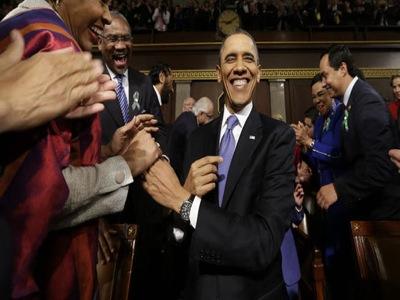
American State of the Union: A Festival of Lies
By Glen Ford | Black Agenda Report | January 29, 2014
“Believe it,” said the current Prevaricator-in-Chief, in the conclusion to his annual litany lies. President Obama’s specialty, honed to theatrical near-perfection over five disastrous years, is in crafting the sympathetic lie, designed to suspend disbelief among those targeted for oblivion, through displays of empathy for the victims. In contrast to the aggressive insults and bluster employed by Republican political actors, whose goal is to incite racist passions against the Other, the sympathetic Democratic liar disarms those who are about to be sacrificed by pretending to feel their pain.
Barack Obama, who has presided over the sharpest increases in economic inequality in U.S. history, adopts the persona of public advocate, reciting wrongs inflicted by unseen and unknown forces that have “deepened” the gap between the rich and the rest of us and “stalled” upward mobility. Having spent half a decade stuffing tens of trillions of dollars into the accounts of an ever shrinking gaggle of financial capitalists, Obama declares this to be “a year of action” in the opposite direction. “Believe it.” And if you do believe it, then crown him the Most Effective Liar of the young century.
Lies of omission are even more despicable than the overt variety, because they hide. The potentially most devastating Obama contribution to economic inequality is being crafted in secret by hundreds of corporate lobbyists and lawyers and their revolving-door counterparts in government. The Trans Pacific Partnership (TPP) trade deal, described as “NAFTA on steroids,” would accelerate the global Race to the Bottom that has made a wasteland of American manufacturing, plunging the working class into levels of poverty and insecurity without parallel in most people’s lifetimes, and totally eviscerating the meager gains of three generations of African Americans. Yet, the closest Obama came to even an oblique allusion to his great crime-in-the-making, was to announce that “new trade partnerships with Europe and the Asia-Pacific will help [small businesses] create even more jobs. We need to work together on tools like bipartisan trade promotion authority to protect our workers, protect our environment and open new markets to new goods stamped ‘Made in the USA.’” Like NAFTA twenty years ago – only far bigger and more diabolically destructive – TPP will have the opposite effect, destroying millions more jobs and further deepening worker insecurity. The Trans Pacific Partnership expands the legal basis for global economic inequalities – which is why the negotiations are secret, and why the treaty’s name could not be spoken in the State of the Union address. It is a lie of omission of global proportions. Give Obama his crown.
The president who promised in his 2008 campaign to support a hike in the minimum wage to $9.50 by 2011, and then did nothing at all to make it happen, says this is the “year of action” when he’ll move heaven and earth to get a $10.10 minimum. He will start, Obama told the Congress and the nation, by issuing “an executive order requiring federal contractors to pay their federally-funded employees a fair wage of at least $10.10 an hour because if you cook our troops’ meals or wash their dishes, you should not have to live in poverty.” Obama neglected to mention that only new hires – a small fraction, beginning with zero, of the two million federal contract workers – will get the wage boost; a huge and conscious lie of omission. The fact that the president does not even propose a gradual, mandated increase for the rest of the two million shows he has no intention of using his full powers to ameliorate taxpayer-financed poverty. We can also expect Obama to issue waivers to every firm that claims a hardship, as is always his practice.
What is Obama’s jobs program? It is the same as laid out at last year’s State of the Union, and elaborated on last summer: lower business taxes and higher business subsidies. When you say “jobs,” he says tax cuts – just like the Republicans, only Obama first cites the pain of the unemployed, so that you know he cares. “Both Democrats and Republicans have argued that our tax code is riddled with wasteful, complicated loopholes that punish businesses investing here, and reward companies that keep profits abroad. Let’s flip that equation. Let’s work together to close those loopholes, end those incentives to ship jobs overseas, and lower tax rates for businesses that create jobs right here at home.” Actually, Obama wants to lower tax rates for all corporations to 28 percent, from 35 percent, as part of his ongoing quest for a Grand Bargain with Republicans. For Obama, the way to bring jobs back to the U.S. is to make American taxes and wages more “competitive” in the “global marketplace” – the Race to the Bottom.
In the final analysis, the sympathetic corporate Democrat and the arrogant corporate Republican offer only small variations on the same menu: ever increasing austerity. Obama bragged about reducing the deficit, never acknowledging that this has been accomplished on the backs of the poor, contributing mightily to economic inequality and social insecurity.
Obama offers nothing of substance, because he is not authorized by his corporate masters to do so. He takes his general orders from the same people as do the Republicans. That’s why Obama only speaks of minimum wage hikes while Republicans are in power, rather than when his own party controlled both houses of Congress. Grand Bargains are preferred, because they are the result of consensus between the two corporate parties. In effect, the Grand Bargain is the distilled political will of Wall Street, which feeds the donkey and the elephant. Wall Street – the 1 percent – believes the world is theirs for the taking, and they want all of it. Given this overarching truth, Obama has no choice but to stage a festival of lies.
~
Glen Ford can be contacted at Glen.Ford@BlackAgendaReport.com
Related articles


Obama and Friends Discover Inequality
By Jack Rasmus | January 28, 2014
Today, January 28, 2014, President Obama will address the nation in his State of the Union (SOTU) speech to Congress. A major theme of the address will be the growing income inequality in the US.
His speech represents an echo of similar themes and talks that have been presented this past week at the World Economic Forum (WEF) in Davos, Switzerland. That’s where every January the big capitalists of the world gather to discuss amongst themselves the major issues of the past year and what to do about them—in between being entertained by various cultural celebrities and performers who have been allowed into their club as junior partners in wealth. The annual Davos cultural events are not unlike the small venue side-shows held in the big Las Vegas casinos: the entertainers strut and sing while the real betting and dice-rolling discussions involving future capitalist policy initiatives go on behind ‘invitation-only’ doors requiring tickets for entry costing hundreds of thousands of dollars to attend ( the typical ticket price of entry for a Corporate CEO and his entourage at Davos, for example, exceeds $500,000).
This year the WEF and global capitalists have ‘discovered’ income inequality, now accelerating and intensifying worldwide to a dangerous degree, and especially in the US. The dimensions of the inequality problem have grown so severe in recent years it may, they themselves are now warning, result in unwanted ‘social unrest’ in the near future.
Now that it has become an ‘acceptable’ discussion theme, Obama and Democrat party politicians (and a few clever Republicans) have also discovered income inequality. Together they plan to raise the rhetoric on the topic in upcoming midterm and 2016 national elections. Therefore, in Obama’s SOTU speech today we’ll hear some basic facts about the problem, some vague proposals that are never intended get to the earliest legislative stages, and a lot of general talk about how improving ‘opportunity’ is the only answer to reducing inequality—all of which means let’s not do anything significant in the short run but instead focus on very long run solutions like improving childhood education, creating long run opportunities, and other very long term solutions.
The politicians’ new discovery of inequality follows liberal academics discovery of the same in recent years. Well known fellows like Paul Krugman, Robert Reich, Joe Stiglitz, James Galbraith and others have all written their books on the topic in recent years. But they too, like the politicians they support, have been very careful about recommendations for resolving the problem, mostly repeating time-worn, mushy old liberal proposals involving ‘education and opportunity’ once again.
The growing income inequality in the US goes back at least to the late 1970s, accelerating during the 1980s and early 1990s, and then again after 2000 under George W. Bush. It’s grown the worst under Barack Obama, with latest figures showing the wealthiest 1% households accruing for themselves since 2009 nearly all (more than 90%) of all the income gains during the so-called ‘recovery’.
More recent, damning revelations about the extent of growing inequality go back to 2002 at least—long before the politicians and the more well known liberal economists acknowledged it. In 2002 University of California, Berkeley economist, Emmanuel Saez, began publishing his analyses of IRS income data, since all pre-existing sources of income inequality by the government and business more or less obfuscated the true picture. Saez has updated his ground-breaking results periodically ever since. Most of what is reported and published about the income gains of the wealthiest 1% are from his researches.
This writer relied heavily on Saez’s data in his 2004 book, ‘The War At Home: The Corporate Offensive From Ronald Reagan to George W. Bush’, which attempted to identify the various policies since the late 1970s that have been largely responsible for the inequality shift that Saez so well documented in 2002. Saez’s hard data—then and ever since—is irrefutable. However, the political implications behind Saez’s data were not spelled out, except for some suggestions concerning the tax structure.
But Income inequality in the US is no accident. It has conscious, deliberate origins, to be found in the policy initiatives of corporate America since the late 1970s, and the willingness of the politicians Corporate America elects in Congress, Presidents, and at State levels—Democrat and Republican alike—to implement those policy initiatives.
There’s the tax restructuring in favor of the rich and their businesses, the free trade and offshoring, the atrophying of the real minimum wage, the dismantling of real pensions and employer contributions to healthcare, the shift from full time permanent jobs to part time and temp work, the destruction of unions and higher paying union jobs, the displacing of higher paid jobs with technology, substitution of credit for lack of wage growth, failure to invest in the US by corporate America, so on and so on. That’s why jobs, real wages, and incomes for the vast majority of American households has stagnated at best, and declined in real terms for most. That’s why wage earners’ income of the bottom 80% households have contributed to income inequality.
But all that’s still only half the story of income inequality. The other ‘half’ of the story is why the incomes of the 1% have risen so sharply as well. Both their rise, and the stagnation-decline of the bottom 80%, are jointly responsible for the income inequality.
Corporate America and their politicians, and the policies they’ve initiated and implemented, are responsible for the accelerating capital incomes of the rich (1%), very rich (0.1%), and mega-rich (0.01%). And much of that has to do with the enabling of financial asset speculation and financial securities inflation that has been the defining characteristic of the US (and global) economy since at least the 1980s. Reagan unlocked that door. Clinton opened it. And George W. kicked it in. And Obama has done nothing to repair the entry.
Real solutions to income inequality would have to include proposals not only to enable the recovery of incomes of the middle working class, and the working and non-working poor, but would have to include proposals to reign in the runaway income accumulation of the very rich, the mega-rich and their friends. But you won’t hear the latter even suggested in Obama’s SOTU speech. What you’ll hear are token long run proposals to slow the decline in income growth for the working poor perhaps, and a lot of vague suggestions about the middle class.
What the middle class needs is decent jobs and tens of millions of them, just to restore what has been lost in the past 15 years. There are still 20 million unemployed in the US, and more than 5 million more have left the labor force. 60% of the jobs that have been created since 2009 have been low paid, while 58% lost have been high paid. Retirement systems are broken and retirees income for tens of millions are in freefall. Obamacare has meant those with insurance now have to pay more for less. Tens of millions of students are effectively indentured and can’t find jobs. If Obama and his politicians want to do something about income inequality, let’s hear concrete legislative proposals to address these issues now, immediately, in the short run.
It took the Krugmans, Reichs, and Stiglitzes only a decade to ‘discover’ their academic colleague, Saez’s, significant work. Better late than never, I suppose. However none of the liberal economists bother to point the finger at the politicians responsible, especially their Democratic party friends, for the inequality trends. But if anything serious is going to be done about income inequality in the US, it will have to include not only real, short term solutions to raise the incomes of the many but also serious, real measures to take back the excessive income gains of the rich and super-rich as well. For the latter will be necessary to fund and restore decent jobs and wages, to revitalize a crumbling retirement system, to save a collapsing healthcare system, and, yes, even to provide affordable education opportunities for all.
The fallacy of corporate taxes in a neo-liberal context
By Michael Laxer | Rabble | November 23, 2013
“Make the corporations pay!”
It is a slogan that sounds good, and with which I would fully agree, under conditions where “corporations,” or, more accurately, those who control them, were actually paying. But this is not the case in the debate in Canada today where many on the left are falsely proclaiming corporate taxes as an alternative to increasing personal taxes, even on the wealthy, and seem to display little understanding that corporate tax rates have nothing at all to do with inequality socially and are not at all a tax on wealth or the wealthy.
When Thomas Mulcair juxtaposes his “plan” to increase corporate taxes as a “progressive” alternative to Toronto-Centre candidate Linda McQuaig’s previously stated notion that taxes should be increased as well on Canada’s wealthiest individuals, he is fundamentally juxtaposing McQuaig’s plan that might accomplish something to a plan that will accomplish absolutely nothing.
The essential fallacy of mythologizing corporate taxes in the present context lies in the fact that, unless you agree with the U.S. Supreme Court, corporations are not people. By definition, if government taxes a corporation, ultimately some individuals, somewhere, pay the bill. Corporations cannot pay anything, any more than a house you own pays its own property tax. Given that corporations can, will and must extract the money to pay their tax bills any number of ways, from increasing prices, to attempting to force down worker wages and benefits, to finding creative ways to reduce nominal profit (which includes actually increasing CEO salaries or privileges, which are a “cost”), in the absence of a campaign to dramatically increase personal taxes on the managerial and CEO class of corporations or to re-adjust social power relations through the threat of socialization of assets and/or price controls, the net effect of corporate taxes, in terms of income levelling, will often be either zero or regressive.
It sounds radical, and is therefore appealing to centrists who wish to nominally appear radical, but its impact on inequality is essentially non-existent for the very simple reason that inequality is driven by disparities in the incomes that exist between individuals. Inequality is facilitated by corporations and corporate actions, but it is manifested in the difference between people and people alone.
This exact inequality exists within corporations themselves. Corporations are comprised, as a general rule, of workers, managers and upper management. Given the nature of the capitalist economy, the way corporations will seek to lessen the impact of higher taxation will not be at the expense of their CEOs.
It is not corporations who own multiple mansions, live lavish lifestyles or indulge in tremendous decadence, it is wealthy people who do so. The disparity between rich and poor is not between rich and poor companies, but rather between rich people and those living working-class lifestyles or those actually living in poverty.
Taxes on corporations, in isolation, separated from higher tax rates on the wealthy individuals who own, profit from and run the corporations, act as little more than waypoints to collecting taxes on corporate workers or customers.
“Progressive” politicians, New Democrats, Liberals and Democrats alike, like the corporate tax narrative when it suits them precisely because it does not threaten any actual people at all, whether it is Galen Weston or one of his Loblaws cashiers. They can claim to be holding the banner of redistributive justice high. To be defending the mythical “99 percent.”
Yet these taxes can only have an impact on inequality if you assume, barring personal tax increases, that corporations will pass the “costs” of higher taxes along, out of a sense of social justice, to their corporate boardrooms. This is, frankly, a counterintuitive and bizarre assumption for leftists to make.
They will not. They will, as they always do, make their workers pay.
We need to move beyond the false narrative of so-called “corporate taxes” as a solution under capitalism and, instead, to advocate for both a dramatic increase in personal taxes on the wealthy and the upper middle class with a corresponding fight to socialize corporate assets. We need to tie this to an entrenchment of union and workers’ rights and democratization of the economy.
It is time to actually make those who benefit from the corporations pay. By higher taxes on capital gains, by higher income taxes on the wealthy and managerial class, by inheritance taxes, by expanding the legal rights and powers of workers.
By advancing expropriation and radically new ownership models.
Until then, when it comes to understanding how to tackle income inequality and its consequences, it is the pre-by-election Linda McQuaig who was right and it is the desperate-for-power NDP leader Thomas Mulcair who is wrong.
U.S. Government Redistributes Wealth… to the Rich
By Matt Bewig | AllGov | December 24, 2012
For about thirty years now, the federal government has been implementing policies that take tax dollars from middle class Americans and give them to the rich, supposedly as a way to spur economic growth. Although Americans actually want greater economic equality, the net effect has been to redistribute wealth to the rich and create the most unequal developed society on earth.
According to a series of reports by Reuters, since 1989 inequality has risen all across the U.S. to levels not seen since before the Great Depression:
• Inequality has increased in every state except Mississippi, which is the poorest state in the Union;
• The poverty rate increased in 43 states;
• In 28 states inequality and poverty rose while median income fell;
• In every state, the richest 20% of households far outpaced the income gains of any other quintile;
• Income for the median household fell in 28 states.
Three specific aspects of federal policy—low taxes for the rich, outsourcing government functions to private companies, and the financial clout of Washington lobbyists—have been the major drivers of growing inequality.
Low taxes for the rich
Tax cuts enacted during the administrations of Presidents Ronald Reagan and George W. Bush cut taxes sharply on the wealthy, redistributing nearly $2 trillion to high income families—just in the past ten years. In 2011, the nonpartisan Congressional Budget Office and Congressional Research Service each studied income inequality and concluded that the cuts made the tax system less progressive and were the second biggest contributor to growing inequality.
Outsourcing
Starting under President Bill Clinton’s “reinventing government” initiative, the federal government has directed trillions of tax dollars to private-sector contractors by outsourcing government operations that would previously have been performed by government employees. Federal money flowing to business rose 7% during Clinton’s second term and 72% percent under Bush, before leveling off in 2010. This has contributed to inequality because private employers typically offer lower skilled workers less job security, lower wages and fewer benefits than the federal government does.
Lobbying
Nearly 13,000 registered lobbyists reported $3.3 billion in fees last year. There are 22% more lobbyists than in 1998, and their inflation-adjusted revenue is 37% higher than in 1998. Because re-election to Congress is so expensive, the campaign contributions that lobbyists influence or control are critical to political survival on Capitol Hill. But lobbyists work overwhelmingly for groups representing social elites. According to a study led by Prof. Kay Schlozman, the majority of lobbying groups exist to advance the interests of business, while groups advocating for union workers and the poor came in last and second to last on the list.
Study: CEO pay now 200 times more than a worker
Press TV – May 3, 2012
Compensation for chief executives at American companies grew 15 percent in 2011 after a 28 percent rise in 2010, part of a larger trend that has seen CEO pay skyrocket over the last three decades. Workers, on the other hand, have been left behind.
Since 1978, CEO pay at American firms has risen 725 percent, more than 127 times faster than worker pay over the same time period, according to new data from the Economic Policy Institute:
From 1978 to 2011, CEO compensation increased more than 725 percent, a rise substantially greater than stock market growth and the painfully slow 5.7 percent growth in worker compensation over the same period.
In 1978, CEOs took home 26.5 times more than the average worker. They now make roughly 206 times more than workers, EPI found. The pay isn’t always tied to the performance of their businesses – as ThinkProgress has noted, CEOs at companies like Bank of America often pocket huge pay increases even as the company’s stock price plummets and jobs are cut.
As a result, American income inequality has skyrocketed, growing worse than it is in countries like Pakistan and Ivory Coast. Wealth inequality is worse than it was even in Ancient Rome. And, as pay skyrockets and tax rates fall for the richest Americans, the rising inequality has left the bottom 95 percent of Americans saddled with more debt than ever before. – thinkprogress.org
Workers’ wages aren’t tied to productivity either. Despite substantial gains in productivity since the 1970s, worker pay has remained flat. According to Labor Department data cited by the Huffington Post, inflation-adjusted wages fell 2 percent in 2011. – thinkprogress.org
Working and middle-class Americans have seen their debt balloon since the 1980s. Today, Americans owe some $704 billion in credit card debt, and more than that in both auto loans and student borrowing. CNN
Related articles
- Executive Excess in the New Gilded Age (alethonews.wordpress.com)
- Maxing Out (alethonews.wordpress.com)
Featured Video
America Racing to Strategic Defeat in Iran
or go to
Aletho News Archives – Video-Images
From the Archives
An Expert Military Analysis of War with China
Actually, None is Necessary
By Fred Reed • Unz Review • December 13, 2020
The Correlation of Armed Forces: U.S. goods and services trade with China totaled an estimated $634.8 billion in 2019. Exports were $163.0 billion; imports were $471.8 billion. The U.S. goods and services trade deficit with China was $308.8 billion in 2019. Trade in services with China (exports and imports) totaled an estimated $76.7 billion in 2019. Services exports were $56.5 billion; services imports were $20.1 billion. The U.S. services trade surplus with China was $36.4 billion in 2019.
There is talk within the Washingtoniat of a possible war with China. Steve Bannon, who apparently was dropped on his head as a child, actually favors such a war. We hear the usual shoo-the-boobs alarm about how the Chinese are doing something terrible and we must gird our loins and American values and show them what for, bow wow, woof. The danger is that the current game of who-blinks-first in Asian waters might actually provoke a shooting war. You know the kind of thing: One warship refuses to get out of the way of another, a collision ensues, some retard lieutenant who signed up on waivers opens fire, and we’re off and running. It is not a good idea to let children play with matches.
The said war is discussed either in emotional terms by idiots or in purely naval terms by those familiar with such things, so we hear of the First Island Chain and the Second Island Chain and whose missiles against the other’s missiles and so on. This would be appropriate if we were fighting World War Two again. Which we aren’t. Let’s take a quick-and-dirty look at how such a war might go.
To begin the war, America would overestimate itself and underestimate China. This is doctrine in the Pentagon. … continue
Blog Roll
 Aletho News
- Rethinking America’s greatest threat: Iran vs. Israel-Firsters
- Iran accuses adversaries of false flags to strain Turkey ties
- Poland rules out sending Patriot missiles to US/Israel amid war on Iran
- Tehran approves new Hormuz plan with major restrictions
- No Threat Can Force Iran’s Surrender /Trita Parsi & Lt Cl Daniel Davis
- UK’s New Pandemic Plan Would Turn Big Tech Into a Mass Location Tracking Network
- Growing insecurity, soaring prices fuel protests in north as regime bans evacuation: Sources
- Iran denies responsibility for ‘depraved’ attack on Kuwait desalination plant
- Bring The Troops Back. End This War Now!
- Can we please stop calling Israel the ‘only democracy in the Middle East’ now?
- If Americans Knew
- The Line Between Affinity and Conspiracy
- As Iran targets US military bases, will they be relocated to Israel? Not a ceasefire Day 171
- Will Trump Go Kamikaze?
- Is the University of Florida Shutting Down College Republicans over Israel Criticism?
- Jewish extremist arrested over alleged plot to firebomb Palestinian activist Nerdeen Kiswani’s home
- More than half of Palestinian child detainees have no charges
- The More Murderous Israel Gets, The More We Hear About “Antisemitism”
- Land Day and the Palestinian struggle after 30 months of genocide
- The Iran War Is About Palestine
- Israeli soldiers echo settler ideology, talk of revenge after targeting Palestinians and detaining CNN crew in the West Bank
- No Tricks Zone
- New Study Finds Warming Saves Lives…Cold Temperatures 12 Times More Deadly Than Excess Heat
- German Science Blog Accuses PIK Climate Institute Of Hallucinating Climate Tipping Points
- Devastating Assessment Of Comirnaty Vaccine By Former Senior Pfizer Europe Toxicologist
- New Study: CO2 Is ‘Effectively Negligible’ As An Explanatory Climate Change Factor Since 2000
- Former Pfizer Toxicologist Dr. Helmut Sterz Tells Bundestag Hearing Pfizer Vaccine Should Have Never Been Approved
- Energy Expert: Germany’s Nuclear Phaseout Was A “500 Billion Euro Mistake”
- New Research: South Australia’s Mid-Holocene Sea Surface Temperatures Were 4°C Warmer Than Today
- Storing Green Energy To Last Germany 10 Days Would Require A 60-Million Tonne Battery
- New Studies: UK Sea Levels Were 4 Meters Higher Than Today During The Mid-Holocene
- Destructive Green New Deal: German Energy And Metal Group Warns Of Drastic Crisis
 Aletho News