Democrats cover up role of Obama administration in Flint water crisis
By James Brewer | WSWS | March 9, 2016
Democratic Party politicians and operatives descended on Flint before Tuesday’s Michigan primary hoping to exploit public anger over the water crisis to boost their electoral chances. The selection of the city as the venue for the March 6 debate between Bernie Sanders and Hillary Clinton was designed to give the appearance that the Democrats were concerned with, and would seriously address, the disaster inflicted on the people of Flint over the last two years.
Both candidates sought to lay blame solely on the Republican governor, Rick Snyder, while concealing the role of state and local Democrats, including the state treasurer, the mayor, the emergency manager and the city council. They also said nothing about federal officials from Obama’s Environmental Protection Agency (EPA) who knowingly concealed the fact that the city was not treating its water supply with anti-corrosive agents and that lead levels in the water had made it toxic.
While making various demagogic statements, neither candidate offers any serious proposal to provide relief to the beleaguered residents. During the debate, LeeAnne Walters from Flint asked both candidates if they would require public water systems to replace lead pipes throughout the US if they were elected. Neither candidate would give a direct answer to the question.
Clinton replied, “We will commit to a priority to change the water systems and we will commit within five years to remove lead from everywhere,” referring to all lead sources, including paint and dust.
Walters, a key figure in exposing the consistent cover-up by water quality officials, told the Huffington Post on Monday, “I hated Clinton’s answer. To tell a Flint resident that we’ll handle this in five years is no different than what the city was telling us and what the state was telling us.”
The Flint mother noted that federal agencies, particularly the Centers for Disease Control (CDC), have been downplaying the importance of lead in drinking water for decades, focusing almost exclusively on lead in paint and dust. This attitude toward public water systems was a significant factor in the lead poisoning of Washington, DC from 2001 to 2005 and contributed to the culture within agencies tasked to protect drinking water safety that has been exposed in the Flint events.
“If you look at the numbers, most of the grants and funding go to lead paint, so to lump it all together is unacceptable,” Walters said.
Walters said Sanders’ response to her question—that the federal Environmental Protection Agency (EPA) under his administration would monitor water safety—was “lame,” adding that this is what the EPA is already supposed to do.
Thousands of emails have emerged exposing the role of top employees at Michigan’s Department of Environmental Quality (MDEQ) in covering up the lack of proper treatment in Flint’s water leading to the spike in lead levels. A spate of resignations and firings in the department have occurred as a result.
While the Democrats denounced the Snyder administration, they have consistently given a pass to the EPA, with US Congressman Dan Kildee from Flint, for example, saying that claims that the EPA is equally as responsible as the MDEQ is a “false equivalency.”
In fact, the EPA played a key role in aiding and abetting the efforts by MDEQ and the Snyder administration to conceal the danger to the public. A March 5 article in the Detroit Free Press examines emails between MDEQ and EPA officials from February 25, 2015 through the end of 2015. The emails reveal that the EPA was well informed that Flint was in violation of federal safe drinking water regulations, and that the MDEQ was not only aware, but itself instigating Flint officials to falsify water testing.
The article dates exchanges starting on February 25, when LeeAnne Walters’ home tap water tested at 104 parts per billion (ppb)—7 times more than the EPA action level of 15 ppb. Her child developed skin rashes. The next day, EPA program manager for Region 5 (the Midwest region), Jennifer Crooks, relates this to MDEQ’s Lansing District Coordinator for Drinking Water, Steve Busch, and Mike Prysby, MDEQ district engineer, with a note that says: “WOW!!!! Did he find the LEAD! 104 ppb. She has 2 children under the age of 3… Big worries here.”
This message was forwarded to EPA Region 5 Ground Water and Drinking Water Branch Chief Tom Poy, and Regulations Manager Miguel Del Toral, who is a leading expert on lead in water.
Del Toral, alarmed by the test results followed up with visits to Walters’ home to do further testing. Further emails corroborated Walters’ testimony at the February 3 US Congressional hearing, where she described Del Toral’s work in Flint, which culminated in a June memorandum to the EPA and the MDEQ, after which he was silenced by the federal agency.
Walters testified that she had made that report public. “So when he called me and asked me if he could use my information for this report, I said yes, and I asked for a copy. When I saw it in black and white—there is a difference living it and seeing it in black and white—that is why it was given to the ACLU and made public, because people did have a right to know. From that point, he was then no longer allowed to have association with me or anybody else in Flint. By the EPA.”
Del Toral and Walters had uncovered that there had been no corrosion control treatment of the water in Flint since the water source was switched to the Flint River in April 2014. For decades, the water supplied to Flint from the Detroit Water and Sewerage Department’s treatment plant near Lake Huron had been treated for corrosives, in line with federal law, in order to prevent lead and other chemicals from leaching from Flint’s pipelines into its drinking water.
The long-mothballed Flint treatment plant neither had the technical capacity or the manpower to treat the water, but this did not stop state and local officials from both parties from approving the switch. The officials essentially rolled the dice hoping there would be no public outcry until a new pipeline that would connect Flint directly to Lake Huron was completed.
In his June memorandum, Del Toral also revealed that sampling of the water in Flint homes was done improperly, making the high lead levels less like to be revealed.
EPA Region 5 head, Susan Hedman, since resigned, told Flint’s Mayor Dayne Walling and others who raised concerns about the Del Toral memo, that she wished it had never been produced and that after she edited and vetted it, it would tell a different story—that Flint’s water was in compliance with lead and copper standards established by the federal government.
In early July, Walling asked Hedman to make a public statement to the ACLU to justify the city’s actions and she replied, “I’m not inclined to have any further communications with the ACLU representative.”
Dr. Marc Edwards, the leader of the Virginia Tech University team that performed an extensive testing of Flint’s water in August, told the February 3 Congressional hearing. “I did not know what happened for quite some time until MDEQ bragged to Ms. Walters and laughed at her and she reported back to me that ‘Mr. Del Toral had been handled’ and it was very clear that an agreement had been reached of some sort between EPA and MDEQ that would let MDEQ have their way with Flint’s children.
“That they were not going to install corrosion control. They had no intention to do it. There’s many emails that show that they were waiting for this new pipeline to come on next year and they thought it was a waste of time to do anything to treat the water. When we got involved, in August as a matter of fact, an MDEQ email said ‘Shouldn’t someone tell those folks from Virginia Tech that we’re switching to the pipeline next year so they don’t bother wasting their time on this issue?’”
National EPA Director Gina McCarthy, an Obama appointee, appeared for the first time in Flint at a February 2 EPA press conference. When a World Socialist Web Site reporter asked her directly about the quashing of the Del Toral memo, she lied, insisting the lead-in-water expert had not been silenced.
The significance of the cover-up for the EPA by the Democratic Party establishment is vast. Over the last weeks, it has emerged that lead poisoning of the population through the water systems is not isolated to Flint, but is a national phenomenon. In the state of Ohio, lead levels in the blood of children are high in many areas of the state. In the village of Sebring, Ohio, near the deindustrialized city of Youngstown, it has recently been made public that state water quality officials kept quiet for months when they knew that residents had lead-tainted water flowing through their taps.
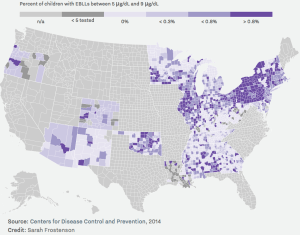
Map showing recorded blood-lead levels in the US
The map above shows the extent to which children’s blood levels exceed the 5 micrograms per deciliter (µg/dL) level considered high by the CDC across the country in 2014. Even more disturbing is the number of states that are not required to submit those levels to the federal government.
Food and Water Watch, the Washington DC-based advocate for public water, reports that federal water infrastructure spending has been cut by 74 percent in inflation-adjusted dollars since 1977. Obama’s latest budget calls for another 11 percent cut.
Neither Democratic Party candidate has any intention of investing in desperately needed infrastructure. They dare not cut across the agenda of the financial elite to amass greater and greater profits at the expense of the working class, and to dedicate obscene sums to the endless pursuit of technology and weapons for war.
U.S. Watchdog Investigations Imperiled by Obama Fixation on Government Secrecy
By Steve Straehley and Danny Biederman | AllGov | December 2, 2015
The Obama administration, by consistently refusing to turn over documents and information, has gone out of its way to make it more difficult for the inspectors general of executive branch agencies to do their jobs.
The concept of inspectors general investigating executive branch departments and agencies came into being in the late 1970s after the Watergate scandal. The idea was that inspectors general would have free rein to investigate wrongdoing in their departments and bring government abuse to light.
But thanks to an obsession with secrecy on the part of the Obama administration, inspectors general who previously had access to all documents, emails and other information have had to beg for evidence, which is often produced after months of requests and is sometimes heavily redacted.
“The bottom line is that we’re no longer independent,” Michael E. Horowitz, the Justice Department inspector general, told The New York Times.
More than three decades of established federal policy that gave watchdogs unrestricted access to government records in their investigations is now at serious risk of being undone. That includes “at least 20 investigations across the government that have been slowed, stymied or sometimes closed because of a long-simmering dispute between the Obama administration and its own watchdogs over the shrinking access of inspectors general to confidential records,” according to the Times’ Eric Lichtblau.
Justice Department lawyers wrote an opinion last summer that stated grand jury transcripts, wiretap intercepts and financial credit reports and some other “protected records” could be withheld from inspectors general. As a result of that order, investigators who need to review government records are now required to get permission from the very agencies they are monitoring in order to do so.
“This is by far the most aggressive assault on the inspector general concept since the beginning,” Paul Light, a New York University professor who has studied inspectors general, told the Times. “It’s the complete evisceration of the concept. You might as well fold them down. They’ve become defanged.”
Among the investigations being hindered are those involving FBI use of phone records collected by the NSA, the DEA’s role in the shooting of unarmed civilians in Honduras drug raids, international trade agreement enforcement at the Commerce Department, the “Fast and Furious” gun operation, intelligence relating to the Boston Marathon bombings, and additional cases at the Afghanistan reconstruction board, the EPA and the Postal Service.
Even the Peace Corps has worked to prevent access to records. The agency’s inspector general was denied information when looking into cases of sexual abuse of Peace Corps volunteers. This despite claims that the agency is in favor of “rigorous oversight” and that it cooperated with investigators.
The situation has drawn criticism from both Republicans and Democrats. Sen. Chuck Grassley (R-Iowa), head of the Senate Judiciary Committee, said of a plan to give the Justice Department inspector general more access, but not those at other agencies, “It’s no fix at all.” His colleague on the committee, Sen. Patrick Leahy (D-Vermont) said at a hearing that the Obama administration has “blocked what was once a free flow of information” to investigators.
Justice IG Horowitz said the consequence of the watchdog clampdown may be an increase in cases of waste, fraud and abuse across the government.
To Learn More:
Tighter Lid on Records Threatens to Weaken Government Watchdogs (by Eric Lichtblau, New York Times )
Gov’t Watchdogs Urge Congress to Reverse Obama Administration IG Crackdown (Fox News)
Pentagon Stonewalls U.S. Watchdog’s Inquiries into $800 Million Afghanistan Program (by Noel Brinkerhoff, AllGov )
Justice Department Tries to Limit Inspectors General Access to Government Documents (by Steve Straehley, AllGov )
FBI Claims it Doesn’t Have to Share Records with Justice Dept. Inspector General (by Noel Brinkerhoff and Steve Straehley, AllGov )
The High Cost of Secrecy to American Taxpayers (by Matt Bewig, AllGov )
Why Andrew Cuomo’s Pollinator Task Force Won’t Save New York’s Bees
By Tracy Frisch | Independent Science News | November 2, 2015
As in other parts of North America, beekeepers in New York have been experiencing unsustainable losses of honeybee colonies. In 2014-15, annual colony losses in New York reached 54 per cent, according to the Bee Informed Partnership survey. And though losses were lower in preceding years, they consistently exceeded the economic threshold of 15 percent loss. At great expense, beekeepers have been able to recoup their winter and summer losses, but for declining native bee species the prospects are even less rosy. For example, the rusty-patched bumblebee (Bombus affinis) for example, once common in New York and the Northeastern US, is now a candidate for the endangered species act.
An impressive worldwide body of scientific evidence implicates neonicotinoids as a major contributor to the decline of honeybee and wild bee populations (e.g. Lu et al., 2014). This is due to a combination of their acute toxicity, sub-lethal, intergenerational, neurotoxic, and immune system effects, their systemic behavior in plants and their persistence in soil and water (See the IUCN’s Worldwide Integrated Assessment of the Impacts of Systemic Pesticides on Biodiversity and Ecosystems, 2015 (1)). This relatively new family of insecticides is now believed to be the most commonly used global pesticide.
Unlike Europe and Ontario, Canada, the US has not acted to restrict the use of neonicotinoids. However, the federal government has specifically urged states to create pollinator protection plans. Some states are working on them and a few have completed them (2).
But at the first meeting of the New York State’s Pollinator Task Force (Aug 6 2015), commercial beekeeper Jim Doan was flabbergasted to learn that state officials had appointed two representatives of the national pesticide industry to the 12-member panel. “It’s very difficult for a beekeeper to think he can get a fair shake,” he commented.
Consequently, I decided to see for myself. I attended the September 11 and October 1 Task Force meetings and listened to the recording of the August 6 meeting.
The New York State Pollinator Task Force
The NY state Task Force was set in motion by Governor Andrew Cuomo.
“Pollinators are crucial to the health of New York’s environment, as well as the strength of our agricultural economy,” Cuomo said in his announcement. “By developing a statewide action plan, we are expanding our efforts to protect these species and our unparalleled natural resources, and making an important step forward in our commitment to New York’s ecological and economic future.”
Thus, on April 23, 2015 Cuomo directed the state departments of agriculture and markets (NYSDAM) and environmental conservation (NYSDEC) to develop a state pollinator protection plan, involving stakeholders and research institutions in the process.
By July stakeholders were receiving invitations to serve on the state Pollinator Task Force, which was constituted with 12 “advisors” from the private and NGO sectors. Officials from NYSDAM and DEC serve as co-chairs. In addition, Cornell IPM program director Jennifer Grant sat with Task Force members and played an advisory role, though not as a Task Force member.
Task Force membership
In terms of its personnel, three groups represent pesticide interests on the Task Force: CropLife America and Responsible Industry Supporting the Environment (RISE) are the pesticide industry’s agricultural and non-agricultural trade groups respectively. Both are headquartered at the same Washington DC office. The NYS Agribusiness Association is the third agrochemical group. Dan Digiacomandrea, a technical sales specialist at Bayer CropScience, one of two makers of neonicotinoids, attended one Task Force meeting as that group’s alternate.
Agriculture also got three seats, with appointees from the state farm bureau, state vegetable growers association and the fruit sector. The state vegetable growers consistently sent an alternate, Rick Zimmerman. His resume includes many years as a Farm Bureau lobbyist followed by a career as NYSDAM deputy commissioner. Today he heads up the Northeast Agribusiness and Feed Alliance. The state turf and landscape association has a seat, too.
Three NGOs were appointed to the Task Force: The Nature Conservancy, Audubon New York and the Natural Resources Defense Council. Member Erin Crotty, who is executive director at Audubon NY, previously served as DEC commissioner under Republican Governor Pataki. NRDC, which has sued EPA on neonicotinoids, was represented by one of two alternating attorneys at each meeting. Like the aforementioned industry representatives, no one from these organizations appeared to have any specific expertise on pollinators. The first two NGOs proposed ways to increase pollinator habitat but did not indicate concerns about pesticides.
Finally, beekeepers were apportioned two seats. With 12 hives, hobby beekeeper Stephen Wilson has chaired the Apiary Industry Advisory Committee for over 15 years. The other representative is Empire State Honey Producers Association president Mark Berninghausen, a small commercial migratory beekeeper from St. Lawrence County. This group has about 100 members out of the 3,000 or 4,000 beekeepers in the state.
The state has also been accepting public comments (though this was apparently not publicized and no deadline has been announced). These comments must be submitted to the governor’s office, not to the Task Force directly (initially NYSDAM was accepting them). As of this writing, these comments have not been shared with task force members.
Given the make-up of New York’s Pollinator Task Force — one-quarter pesticide industry plus one-third agriculture and turf care industries – and the allegiances of the two convening agencies, the complex issue of pesticides was therefore always likely to be handled with kid gloves.
The timeline and the content
At the kickoff meeting task force advisors had a chance to lay out their positions on what the state should do to protect bees. The second meeting focused on research needs and the third dealt with habitat enhancement and best management practices (BMPs).
Presentations took up much of the second and third meetings. For example, a series of managers from six state agencies described their land management practices and initiatives to provide habitat in respect to bees.
A highpoint was the talk by Cornell’s new honeybee extension entomologist Emma Mullen. A Canadian who just moved to the US, she had been part of the team of scientists that worked on Ontario’s Pollinator Health Protection Plan. Particularly illuminating was her explanation of the province’s new program to decrease the corn and soybean acreage planted with neonicotinoid-treated seeds by 80% by 2017. She also outlined current Cornell research on bees.
NYSDAM commissioner Richard Ball, a vegetable grower, chaired the meetings and NYSDEC deputy commissioner Eugene Leff played a supporting role. Leff, whose portfolio includes pesticide regulation, previously presided over another stakeholder task force charged with dealing with an equally polarizing issue: preventing pesticide pollution of Long Island’s groundwater. As with the pollinator task force, pesticide and agricultural interests were well represented on Long Island. (The 126-page strategy document that came out of that task force’s work indicates that these interest groups succeeded in delaying any restrictions on suspect pesticides.)
To frame the initial Pollinator Task Force discussion, Commissioner Ball reiterated what has come to seem like the official US dogma on bee decline — there is no single cause and we must consider multiple areas of concern. While the list of pollinator threats varies, USDA, EPA and institutions like Cornell cite factors such as habitat loss, pests and pathogens, pesticides, genetics and/or climate change when they state that view.
Indeed, the most notable feature of the meetings was the overall reluctance to delve into the problem of pesticides except in so far as they induce immediate bee kills. Only two members of the 12-member task force (beekeeper Stephen Wilson and a Natural Resources Defense Council attorney) urged any limitations on the use of neonicotinoids.
Meetings without minutes or structure
A number of additional aspects of these meetings support the idea that the Task Force exists primarily for appearance’s sake. First, no one appeared to be taking official notes and no minutes were made available, despite advisor Stephen Wilson’s request for minutes at the second meeting. (Recordings are posted on NYSDAM’s website.) Second, no one wrote down ideas on a whiteboard or easel to capture them as they came up. Third, Task Force discussions were freewheeling, unstructured and all over the map.
The state’s short timeline also challenges the notion of a deliberative process informed by science. The whole process, from the first of three Task Force meetings to the submission of priority recommendations to the governor, is scheduled to take only three months (3).
Yet the meeting agendas presume that in an hour or two of meetings these advisors will contribute content to the pollinator plan, generate a meaningful research agenda, and cobble together BMPs to protect bees. For all this to happen fails to pass the laugh test.
Thus, in the final portion of the third meeting, Task Force advisors were asked to consider a series of BMPs listed on a handout prepared in advance (presumably by NYSDAM or DEC) but not distributed until the actual meeting. Task Force members had not gotten through the first item on the list when time ran out (4).
Perhaps there was no real need to carefully craft a plan because the conclusions appeared to have been pre-ordained. In his closing comments at the third meeting, DEC deputy commissioner Leff referred back to the governor’s blueprint for the state pollinator plan. In particular, Leff highlighted the BMPs designed to reduce pesticide exposure to managed pollinators through better communication among beekeepers and farmers. Leff stressed the need for landowners and pesticide applicators to know where hives are located and how to contact beekeepers before they spray. Beekeepers would have to be ready to move their hive, he said (5).
If his recommendations go into effect the onus of protecting bees from pesticides would fall on beekeepers. This is at odds with the historical assignment of such responsibility to pesticide applicators. In fact, pesticide labels carry legal weight in prohibiting pesticides considered acutely toxic to bees from being applied when flowers are in bloom or bees are present.
Leff’s proposal to shift responsibility is radical, but it is not new; the essential elements of Leff’s proposal are contained in the Guidance for State Pollinator Protection Plans, a June 2015 document produced by the State FIFRA Issues Research and Evaluation Group (6). (SFIREG is a committee of the Association of American Pesticide Control Officials. SFIREG used to have the document on its website, but has since removed it.) Among the six “critical elements” it identified for pollinator plans are methods for growers to know if managed pollinators are located near where pesticides are used and for contacting beekeepers prior to applying pesticides.
Thus it seems that pesticides are sometimes acknowledged to be causing at least part of the decline in pollinators, but the approach proposed by Leff and SFIREG ignores much of what is known–that systemic insecticides like neonicotinoids can harm bees months after application, for example via the planting of treated seeds (Lu et al., 2014), and that insecticides are not the only agrichemicals that harm bees. For example, a new study has found that exposure to low levels of glyphosate impairs honeybee navigation (Balbuena et al., 2015). And of course, warning beekeepers of impending pesticide applications does nothing to protect native pollinators, though ostensibly these plans are intended to protect them, too.
As the meeting was ending, I was able to pose a practical question. How easy is it for beekeepers to move their hives when they get a call that pesticides will be applied? Roberta Glatz, an older woman who serves on the state Apiary Industry Advisory Committee, replied from the audience.
She said that beekeepers aren’t necessarily where their bees are. “They may be in North Carolina raising queens.” She outlined other concerns as well. There are limited places where you can put your bees, and it takes a lot of negotiation to put in a bee yard. Logistics also come into play. Mud can impede access. Hives are heavy and usually have to be moved in the middle of the night when the bees are home. (And beekeepers often have day jobs, another beekeeper told me once the meeting ended.)
So while even the beekeepers of New York are having a hard time getting a fair shake in a protection plan for their own bees, in terms of pesticides it seems that Bombus affinis and other native bees should expect even less of one.
Footnotes
(1) Worldwide Integrated Assessment of the Impacts of Systemic Pesticides on Biodiversity and Ecosystems 2015 (IUCN’s Task Force on Systemic Pesticides)
(2) The Pollinator Stewardship Council is the best clearinghouse of state government pollinator protection activities around the country. Another resource is a May 2015 white paper from the National Association of State Departments of Agriculture. It claims to provide links to the MP3s (“managed pollinator protection plans”) of North Dakota, California, Mississippi, Florida and Colorado, but of these states only North Dakota seems to have developed an actual plan.
(3) The timeline called for the state to circulate the NYS Pollinator Protection Action Plan Recommendations to task force members on October 19. In turn, they would have 7 days to comment. As of October 28, a beekeeper on the Task Force reported that he hadn’t received anything from the state yet.
(4) Discussion of specific BMPs was overshadowed by the contentious issue of whether beekeepers should be required to register all honeybee hives with the state and disclose their locations. BMPs listed on the handout pertained to such things as beekeepers’ care for their colonies and control of mites and other parasites/diseases, landowners and state agencies enhancing pollinator habitat and forage, the correct and judicious use of pesticides and of Integrated Pest Management, and the roles of beekeepers, landowners and pesticide applicators in protecting honeybees from pesticides.
(5) Some beekeepers fear that New York’s plan will follow North Dakota’s template, thus transferring the burden of protecting honeybee colonies from pesticides onto the beekeepers.
(6) FIFRA, which stands for the Federal Insecticide Fungicide Rodenticide Act, provides the nation’s regulatory framework for pesticides.
References
Balbuena, M. S., Tison, L., Hahn, M. L., Greggers, U., Menzel, R., & Farina, W. M. (2015). Effects of sub-lethal doses of glyphosate on honeybee navigation. The Journal of Experimental Biology, 10 July 2015. doi: 10.1242/ dev.117291
Lu C, Warchol KM, Callahan RA (2014) Sub-lethal exposure to neonicotinoids impaired honey bees winterization before proceeding to colony collapse disorder. Bull Insectol 67:125–130.
Stinging rebuke: Court rules against EPA’s lax approval of Dow’s bee-poisonous pesticide
RT | September 11, 2015
A federal appeals court in the US has rejected a decision by the Environmental Protection Agency to approve an insecticide harmful to honeybees without proper verification of the chemical’s effects.
The US Court of Appeals for the Ninth Circuit ruled Thursday that the US Environmental Protection Agency (EPA) improperly approved and registered the pesticide sulfoxaflor, made by Dow AgroSciences, in violation of the agency’s regulatory protocol.
Environmentalists and representatives of the honey and beekeeping industries said sulfoxalfor is a type of insecticide chemical known as a neonicotinoid that is associated with mass death among bee populations worldwide.
The court agreed with sulfoxaflor’s neonicotinoid status in its ruling, finding that the EPA based its regulatory decision on “flawed and limited data,” and that sulfoxaflor approval was not based around “substantial evidence.”
The EPA used studies and materials provided by Dow to assess the chemical’s effects on bees and other species. Based on insufficient data given to it by Dow, the agency proposed certain conditions on the approval of the chemical, the court found.
Yet the EPA went ahead with unconditional registration anyway even though Dow had not met those conditions or offered updated studies, the court said.
“Given the precariousness of bee populations, leaving the EPA’s registration of sulfoxaflor in place risks more potential environmental harm than vacating it,” the ruling stated, adding that the EPA must provide more data on impacts of sulfoxaflor before moving forward with the chemical.
“It’s a complete victory for the beekeepers we represent,” said Greg Loarie, an attorney representing the American Honey Producers Association, the American Beekeeping Federation, and other plaintiffs, according to Reuters. “The EPA has not been very vigilant.”
Dow AgroSciences, a division of Dow Chemical Co., first registered sulfoxalfor in 2010 for use in three of its products, including the brands Transform and Closer. In a statement, Dow said it “respectfully disagrees” with the court’s ruling and that it intends to “work with EPA to implement the order and to promptly complete additional regulatory work to support the registration of the products.”
The EPA said it will review the ruling, but offered no further comment to Reuters.
The plaintiffs in the case filed a lawsuit against the EPA in late 2013, arguing the EPA’s approval process of the chemical fell short of its legal oversight demands. Shortly before the EPA cleared sulfoxalfor in May 2013, the European Union enacted a two-year moratorium on the use of neonicotinoid pesticides (sulfoxaflor is considered by many to be a “fourth-generation neonicotinoid”) in light of scientific studies that indicate their harm to bees.
The suit was the first to invoke the US Endangered Species Act to protect bees, claiming the EPA violated the act by not sufficiently considering the impact of pesticides on honeybees and other imperiled wildlife categorized as threatened or endangered under federal law. Bees pollinate plants that are responsible for at least a quarter of Americans’ food.
Neonicotinoids were developed in the 1990s to boost yields of staple crops such as corn, but they are also widely used on annual and perennial plants in lawns and gardens. Researchers believe the neonicotinoids are causing some kind of unknown biological mechanism in bees that in turn leads to Colony Collapse Disorder (CCD).
CCD has led to the deaths of tens of millions of honeybees in the US, with annual death rates of about 30 percent. A 2013 US Department of Agriculture study reported that CCD has caused the devastation of an estimated 10 million beehives. This year, the USDA said that 42.1 of managed honeybee colonies were lost from April 2014 to April 2015, the second-highest annual loss on record.
Pesticide producers argue that the current massive bee die-off worldwide is not caused by chemicals, but mite infestations and other factors.
Honeybees pollinate more than 100 US crops – including apples, zucchinis, avocados, and plums – that are worth more than $200 billion a year.
In May, the US Environmental Protection Agency announced new regulations on pesticide use that seek to protect managed bee populations during certain periods of the year.
READ MORE:
Insecticides cause honeybee colony collapse, study shows
US govt’s wanton approval of harmful pesticides fueling ‘bee holocaust’ – lawsuit
Tribes struggle with toxic spill as EPA is accused of deliberate disaster
RT | August 15, 2015
As Native American tribes are struggling to cope with a toxic spill caused by an Environmental Protection Agency contractor that turned a river in Colorado orange, a letter from a retired geologist has emerged, that warned of the risk a week beforehand.

A contractor for the EPA released some three million gallons of toxic mining sludge on August 5 while attempting to clean up an abandoned mine near Silverton, Colorado. The waste flowed into Cement Creek, and has since contaminated the Animas River, San Juan River, and the Colorado River in Utah.
The Southern Ute Indian Tribe in southern Colorado has declared a state of local emergency. Their 1,059-square-mile reservation was the first to be hit by the spill, a 100-mile-long stream of mining waste containing lead, copper, and arsenic. Classifying the spill as a disaster enables the release of aid and recovery funds.
“The cost and magnitude of responding to and recovery from the impact of the water contamination from the Gold King Mine Animas River Spill, caused by the EPA on August 5, 2015 is far in excess of the Southern Ute Indian Tribe’s available resources,” the tribe said in its declaration, quoted by Indian Country Today.
Further downstream, the Navajo Nation is fighting the EPA over the agency’s damage claims form. The tribe’s attorney general says Standard Form 95 contains “offending language,” waiving all claims to future compensation.
“Once the claim is made it will only be for the claims suffered to date and precludes future claims,” Navajo Nation president Russel Begaye said, ordering all tribal agencies to stop advising residents to use the form.
EPA Administrator Gina McCarthy visited Durango, Colorado earlier this week, but declined to travel to the disaster site, according to the Denver Post. Agency officials said the mine was “too far” to visit, involving a 55-mile trip, partly over unpaved roads.
“As you know, it is a significant distance away, but I did visit the river. I took a look at it myself to get a sense of the river,” McCarthy said. “And I think the good news is it seems to be restoring itself, but we have continued work to do and EPA is here.”
Originally estimated at 1 million gallons (3.785 million liters), the spill was later confirmed to have involved at least three times that amount of toxic waste. Among the metals detected in the sludge were arsenic, cadmium, copper, beryllium, iron, lead, mercury, and zinc. The recorded lead levels alone were 12,000 times higher than normal.
Five water supply systems have been affected by the spill. While the river system mostly serves farming communities, the disaster also poses a risk to the drinking water of 17,000 people living in Durango, Colorado and 45,000 residents of Farmington, New Mexico.
While the agency has maintained that the release of toxic sludge from the Gold King mine was an accident, one retired geologist speculated the EPA might have been setting the area up for a disaster in order to get more federal funding.
“Based on my 47 years of experience as a professional geologist, it appears to me that the EPA is setting your town and the area up for a possible Superfund blitzkrieg,” Dave Taylor of Farmington wrote in a letter to the editors of the Silverton Standard, published July 30. The paper confirmed the letter’s authenticity in a blog post on August 12.
The EPA’s grand experiment to plug the Red & Bonita mine might seem to work at first, Taylor wrote, but he predicted the water would find a way out and “exfiltrate uncontrollably through connected abandoned shafts, drifts, raises, fractures, and possibly from talus on the hillsides.”
Taylor further anticipated that all of the water flow would return to Cement Creek within anywhere from a week to 120 days and could even increase the contamination.
“Reading between the lines, I believe that has been EPA’s plan all along. The proposed Red & Bonita plugging plan has been their way of getting a foot in the door to justify their hidden agenda for construction of a treatment plant,” he wrote.
The EPA has been lobbying to designate the area as a recipient of federal Superfund financing, but met opposition from local residents, Breitbart confirmed. The Wall Street Journal identified the contractor hired to plug the Red and Bonita mines as Environmental Restoration, LLC of Fenton, Missouri, a recipient of over $380 million in EPA contracts over the past decade.
Colorado governor John Hickenlooper visited Durango on Wednesday and took a sip of water from the Animas River in a publicity stunt. An iodine tablet which he used to purify the water would have killed any bacteria and parasites, but had no effect on the heavy metal pollutants. Residents were advised not to follow the governor’s lead, though, as the water was considered unsafe for drinking even before the spill, the Durango Herald reported.
How EPA Faked the Entire Science of Sewage Sludge Safety: A Whistleblower’s Story
Independent Science News | June 9, 2014
US EPA’s 503 sludge rule (1993) allows treated sewage sludges, aka biosolids, to be land-applied to farms, forests, parks, school playgrounds, home gardens and other private and public lands. According to a recent EPA survey, biosolids contain a wide range of mutagenic and neurotoxic chemicals, which are present at a million-fold higher concentrations (ppm versus ppt) compared with their levels in polluted air and water (1). Biosolids contain all of the lipophilic (fat-soluble) chemical wastes that once polluted our rivers and lakes, but which now settle out at sewage treatment plants and become concentrated in sewage sludges. Most biosolids contain ppm concentrations of heavy metals, including chromium, lead, and mercury. They contain similarly high levels of polycyclic aromatic hydrocarbons (PAHs) and semi-volatiles, such as bis (2-Ethylhexyl) phthalate, Benzo(a)pyrene), and polybrominated diphenyl ether congeners (PBDE flame retardants). Most biosolids also contain pathogenic agents and ppm levels of many common drugs, including ciprofloxacin (Cipro), carbamazepine (Tegretol, Equetro), and fluoxetine (Prozac).
While working at EPA Dr David Lewis published evidence that teenager Shayne Conner (of New Hampshire) died and other neighbors were harmed from living near land applied with sewage sludge (Lewis et al 2002). He furthermore became involved after dairy herds of two Georgia farms (McElmurray and Boyce) were poisoned after grazing on sludged land. He testified in lawsuits following each incident, against his employer (EPA), which is where many of the following depositions were obtained. The following article is an excerpt from Chapter 4 (Sludge Magic) of his new book (Science for Sale: How the US Government Uses Powerful Corporations and Leading Universities to Support Government Policies, Silence Top Scientists, Jeopardize Our Health, and Protect Corporate Profits). The lawsuits referred to are Lewis v. EPA 1999; Lewis v. EPA 2003; and USA, ex rel. Lewis, McElmurray and Boyce v. Walker et al. 2009. The depositions below piece together an unprecedented and coordinated multi-agency scientific scheme involving EPA, USDA, local and city municipalities, Synagro Technologies (a waste management company), various universities, and the National Academies of Science.
The effort was intended to misleadingly present sewage sludge as scientifically safe, to hide the evidence that it was not, to deliberately misreport the contents of municipal sludges, and smear David Lewis with a scientific misconduct charge after he blew the whistle.
From “Sludge Magic” by Dr David Lewis:
The Men Behind the Curtain
1) Alan Rubin – EPA
Alan Rubin, who was a career chemist at EPA’s Office of Water, is considered the primary author of EPA’s 503 sludge rule. He was one of a number of office scientists at EPA headquarters involved in retaliations against scientists and private citizens who reported adverse health effects associated with biosolids. Time magazine (September 27, 1999) ran a short article about Rubin mailing “death threats” on EPA and Water Environment Federation (WEF) letterhead to private citizens concerned about biosolids, saying, “Ask not for whom the bell tolls; it tolls for thee!”
When deposed in my U.S Department of Labor cases, Dr. Rubin explained what motivated these attacks:
RUBIN QUESTIONED BY ATTORNEY STEPHEN KOHN (1999) (2)
Q. Are you proud of the work you did?… Do you feel, in any
way, hurt or upset to have someone like Dr. Lewis criticizing
it?… Professionally hurt, a little?
A. Somewhat.
Q. How so?…
A. Well, I think my professional reputation, to a large extent, is
based on my association with biosolids, 503 and its technical basis.
So I feel my reputation would be somewhat disparaged if the basis
of the rule, and the scientific findings were shown to be in error.
Rubin coined the term “sludge magic” when EPA’s proposed 503 sludge rule was undergoing internal peer review at EPA’s Office of Research & Development in 1992. Dr. Robert Swank, the research director at the EPA lab in Athens, Georgia, where I worked, called Dr. Rubin. When Swank asked him to explain how sewage sludge renders pollutants non-bioavailable, Rubin replied, “It’s magic.” During his deposition, Rubin deferred to USDA agronomist Rufus Chaney when questioned about scientific studies supporting sludge magic:
RUBIN QUESTIONED BY MR. KOHN (1999) (3)
Q. You called it sludge magic?
A. Yes, that is my term. “sludge magic” [means] there are unique
properties in the biosolids matrix that sequester metals, that
sequester organics. By sequester I mean significantly reduce the
mobility to move from the biosolids out to the environment,
and the matrix is really complex, and has organic material in
it, organic pollutants, I’m talking about organic materials, like
unit type materials, and carbohydrates, and manganese, and
iron, and phosphorus, and all of these work together with the
soil in a matrix to significantly reduce, if not eliminate movement
of pollutants from the biosolids out to the environment.
The processes, some of them are understood, some of them are not
that well understood, but the whole thing taken together is called
magic. So I coined the term magic.
Q. And the “sludge magic” which prevents harmful stuff that is
in the sludge escaping the sludge?
A. Moving at any significant flux or rate out to the environment
to create doses of pollutants that would harm plants, animals or
humans.
Q. … these studies [are] kept somewhere?
A. No, they are actually—well, Chaney is probably the one that
has them all, he is like a walking encyclopedia.
So, after working in EPA’s biosolids program for over thirty years, the primary author of EPA’s 503 sludge rule still couldn’t explain how biosolids prevent potentially harmful levels of pollutants from being taken up by plants, animals and humans.
2) Rufus Chaney-USDA
My attorney, Ed Hallman, deposed Dr. Rufus Chaney at USDA’s Animal Manure and By-Products Laboratory in Beltsville, Maryland. His position reflects the importance that the USDA places on protecting biosolids:
CHANEY ANSWERING MR. HALLMAN (2009) (4)
I’ve been appointed in a category which is above GS-18 called
senior scientific research service. Within that, there are no subgrades.
There is a group —there is only about ten of us in all of
my agency that have reached that level.… I would say I’m the
US Department of Agriculture’s most knowledgeable scientist
about biosolids.
Chaney further testified that EPA scientists have never understood the science he developed, which proves heavy metals and toxic organic pollutants in biosolids cannot harm public health or the environment.
CHANEY ANSWERING MR. HALLMAN (2009) (5)
EPA withdrew the original proposed rule and completely
rewrote it. Actually I played a very significant role in what
the rule became. It’s evident in the record. And even at the
end I provided comments through USDA, approved at higher
levels, saying that the rule needed a few more revisions before
it was issued. But, yes, I was heavily involved in bringing to
fore the science about biosolids that needed to be the basis for
the rule.
Chaney explained that the unique properties of sewage sludge prevent pollutants from becoming bioavailable. In other words, they can’t be taken up or absorbed by plants and animals’ and they pose little or no risk to public health or the environment no matter which pollutants are present, or what their concentrations are.
One of Rufus Chaney’s primary collaborators, Jay Scott Angle, replaced Gale Buchanan as the agricultural dean at University of Georgia (UGA) in 2005, the year we filed a qui tam lawsuit over “the Gaskin study” (Gaskin et al 2003)(6). After EPA funded this study, one of its employees, Robert Brobst, who is charged with investigating reports of biosolids-related adverse health effects, provided UGA with data fabricated by the City of Augusta, Georgia (see Figure 1.). This fabricated data was used in the Gaskin study which EPA then used to discredit any links between biosolids and cattle deaths on two Georgia dairy farms owned by local farmers, the McElmurray and Boyce families (4). President Bush appointed Buchanan under secretary of agriculture for research, education and economics the following year (7).
Two years earlier, the director of UGA’s School of Marine Programs was advised not to hire me as a faculty member “because we’re dependent on this money… grant and contract money… money either from possible future EPA grants or [from] connections there might be between the waste disposal community [and] members of faculty at the university.” (8)
Many wastewater treatment plants throughout the United States aren’t working properly, and are constantly in need of being repaired or upgraded to keep up with population growth. To help with this problem, EPA created a revolving loan program under the Clean Water Act to pump billions of dollars into the states to keep their wastewater treatments plants pumping properly. Chaney reasons that because the system as a whole is in constant need of repair, and there are still no documented cases of adverse health effects in the peer-reviewed scientific literature, “sludge magic,” as Rubin calls it, works even when waste treatment plants don’t.
Chaney further reasoned that any peer-reviewed scientific articles claiming that land application of biosolids poses a risk to public health or the environment must be false because no scientists funded by the US government and other reputable institutions have documented adverse effects from biosolids since the 503 sludge rule was passed in 1993.
In 1992, EPA’s sludge rule failed to pass a scientific peer review in EPA’s Office of Research & Development. Chaney blamed scientists in EPA’s Office of Water for this failure:
CHANEY ANSWERING MR. HALLMAN (2009) (9)
They originally proposed a rule where they even had the data
screwed up. I don’t know how much you know about that. But
the original rule would have essentially prohibited all land
application…. So there were lots of errors the first time around,
stupid errors. They didn’t—they didn’t review it with USDA or Food
and Drug Administration before they put it on the street and they
suffered and had to withdraw it and start over.
In his deposition, Chaney stated that adverse health effects from biosolids were documented in the scientific literature before 1992, and that he himself authored many of those studies.
CHANEY QUESTIONED BY MR. HALLMAN (2009) (10)
Q. And you believe that all the studies you’ve seen, including
the ones that you have coauthored and worked on, indicate that
the land application of sewage sludge in accordance with 503 is
safe… and is not a danger to human health and welfare, is that
correct, if it’s applied in accordance with those regulations?
A. I won’t disagree with that. I had advised EPA that I wanted
a lower cadmium limit…. I won the battle because pretreatment
and the universal understanding of the unacceptability of cadmium
in biosolids has led to biosolids declining to 1 to 2 ppm in
most cities in the United States. Biosolids has become remarkably
less contaminated because of what we’ve done with the 503 and
because of the publications, such as mine, which showed adverse
effects of previous practices.
The phenomenon by which biosolids have become far less contaminated with cadmium is clearly evident in the data that the City of Augusta reported to EPA and the State of Georgia. These are the same (Gaskin) data that EPA and UGA published and later used by the National Academy of Sciences to conclude that Augusta’s biosolids were not responsible for hundreds of cattle that died on two dairy farms (McElmurray and Boyce) where it was applied. The data purportedly show (Fig. 1 pdf here) that monthly cadmium levels in the city’s sewage sludge fluctuated wildly up to 1, 200 ppm from January 1980 to February 1993, the very month that EPA promulgated the 503 rule.

Chaney wants everyone to believe that cadmium, which was making people and animals sick, dropped to safe levels all across the country the moment EPA passed its sludge regulation in February 1993. No regulatory agency at the state or federal level, however, ever monitors levels of cadmium, or anything else, in biosolids (11). They simply accept whatever data the cities provide.
In Augusta’s case, we know that the city’s “sludge magic” was faked. The city’s former plant manager, Allen Saxon, confessed when deposed by Mr. Hallman.
Judge Anthony Alaimo, who ruled on a lawsuit against the USDA filed by the McElmurray family, ordered the USDA to pay for crops the family couldn’t plant because their land was too contaminated with cadmium and other hazardous wastes from Augusta’s biosolids. Judge Alaimo wrote, “In January 1999, the City rehired Saxon to create a record of sludge applications that did not exist previously.” (12)
That same year, EPA gave UGA a federal grant to publish Augusta’s data as part of the Gaskin study (Gaskin et al 2003). As soon as Mr. Saxon finished making “sludge magic” happen, all of the original data Augusta reported to the Georgia Environmental Protection Division (EPD) between 1993 and 1999 magically disappeared, and not just in Augusta. They turned up missing from the EPD records in Atlanta as well. EPA doesn’t know what happened to the data, nor does the EPD, nor the City of Augusta, nor UGA. All of the data just magically disappeared from city and state records at the same time cadmium purportedly disappeared from Augusta’s sewage sludge.
According to Rufus Chaney, it just doesn’t matter whether the data are fake or real. He explained in his deposition: (13)
CHANEY QUESTIONED BY MR. HALLMAN (2009)
Q. Ms. Gaskin could have totally made up all that data and you
would still rely on it because it was in a peer-reviewed study; is
that accurate?
A As long as it—as long as it was in general agreement with
general patterns established in hundreds of papers….
To sum up Chaney’s position, because Gaskin’s paper concluded that Augusta’s sludge did not pose a health risk, it’s valid research even if the data were fabricated. On the other hand, people should disregard scientists who report problems with biosolids, even if their work is published in the peer-reviewed scientific literature. That’s because researchers at universities funded by government and have published hundreds of papers concluding that biosolids don’t put public health or the environment at risk.
In 2004, Chaney commented on the US Composting Council’s (USCC’s) list serve about my termination by EPA acting assistant administrator Henry Longest, who developed EPA’s sludge policies in the late 1970s (14). USCC is headed by Lorrie Loder, Synagro’s product marketing director. Chaney, of course, supported Longest’s decision to end my career for publishing research that raised public concerns over biosolids (Lewis et al. 2002). He contrasted our BMC study with the Gaskin study:
CHANEY USCC (2004) (15)
The paper by Gaskin et al. [Gaskin, J. W., R. B. Brobst, W. P.
Miller, and E. W. Tollner. 2003. Long-term biosolids application
effects on metal concentrations in soil and bermudagrass
forage J. Env. Qual. 32:146-152.] reports objective measurements
on the soil metal concentrations, and metals in forages
growing on the soils….[Lewis’s] publication [Lewis D. L., D. K.
Gattie, M. E. Novak, S. Sanchez, and C. Pumphrey. 2002.
Interactions of pathogens and irritant chemicals in land-applied
sewage sludges (biosolids). BMC Public Health 2:11.] contains none
of the data from examination of biosolids exposed subjects, and lacks the
comparison with randomly selected individuals from the general
populations. It is not valid epidemiological science….
I support the whistle-blower rule and process as strongly as any
other citizen or government employee. I happen to believe that
Dr. Lewis has been treated fairly. Claims and opinions about
public health are not peer-reviewed scientific evidence. EPA and
other agencies have to base rules on the peer-reviewed papers,
and to consider the weight of evidence. Some papers are more
complete in proof of the issue tested, as I noted above regarding
proof that some source caused a specific human infection.
Our study published in BMC-Public Health had documented several cases linking Synagro’s biosolids to illnesses and deaths, including the death of Shayne Conner in New Hampshire (Lewis et al. 2002). Chaney’s statements about our study are drawn from a white paper Synagro published in 2001, which contains false allegations of research misconduct against me and my coauthors. In 2004, Synagro withdrew its allegations after EPA dismissed the allegations as meritless and not based in any facts (16). Synagro’s white paper, which Chaney parroted, states, for example:
SYNAGRO WHITE PAPER (2001) (17)
[Steps Lewis should have taken] include analysis of biosolids
composition, fate and transport of chemicals and pathogens,
determination of dose-response relationships, and methodology
for and identification of the cause of health ailments purportedly
associated with an environmental contaminant….
Such studies should involve a comparison of outcomes for subjects
who are exposed to biosolids (treatment groups) and other subjects
who are not exposed (control groups)…. The leading study,
a comprehensive multi-year study of Ohio farm families living
near land-applied fields, reported “no adverse health effects…in
either people or animals.” (Cit. 38.) While Dr. Lewis admitted
that this study was based on sound epidemiology, he refuses to
apply its techniques….
Our BMC paper does, in fact, contain this information. It includes, for example, data we obtained from the patients’ medical records, and a dose-response analysis of exposed and unexposed individuals in an area near a field treated with biosolids (Figure 2)(18). This field lay approximately 300 feet from a house where Shayne Conner suddenly died from respiratory failure. Conner’s parents, Tom and Joanne Marshall, sued Synagro, which bought out the company that applied the biosolids. EPA ethics officials approved of my serving as an expert witness for plaintiffs, and required that I donate any expert witness fees to EPA or other governmental or nonprofit organizations. By serving as an expert witness, I was able to obtain access to medical records and other critically important information tied up in Marshall v. Synagro.
In Conner’s neighborhood, we were able to gather information on symptoms from all but one family, including family members who reported no symptoms. We found:
LEWIS ET AL. BMC PUBLIC HEALTH (2002) (19)
Based on a least-squares analysis, proportions of individuals
with symptoms increased linearly from 40 to 80 h (r2 0.98) with
time exposed to wind blowing from the field; all occupants in
households with exposure ≥ 80 h reported symptoms (Fig. 2).
Proportions of individuals with symptoms also decreased linearly
with distance from the field from 130 to 320 m (r2 0.95); all
occupants in households living ≤ 130 m from the field reported
symptoms.
As reported in our BMC article, we mainly investigated the most common form of treated sewage sludges, called Class B biosolids:
LEWIS ET AL. BMC PUBLIC HEALTH (2002) (20)
County records indicated that biosolids-related complaints for
individual patients described in this study were concurrent with
land application of Class B biosolids.
As mentioned earlier, most bacterial populations that are killed back can re-establish themselves within a few days after biosolids are stockpiled, or spread on land (21). It’s like cooking the Thanksgiving turkey. Eating it fresh out of the oven is one thing, but after it’s been sitting out for a few days is a different matter. Biosolids are rich in proteins, which allow staphylococci to proliferate just as they do with turkey dinners (22).
We discovered that one out of four residents who reported irritation of the skin, eyes, or respiratory tract from exposure to biosolids had staphylococcal infections involving S. aureus or S. epidermitis. Two of the three deaths linked to biosolids were caused by S. aureus infections. Because multi-antibiotic resistant bacteria are common at wastewater treatment plants, biosolids-related infections are of particular concern (23).
During her depositions, Julia Gaskin testified that she believed Augusta’s biosolids harmed the McElmurray and Boyce dairy farms; and she pointed out that her study included ample data supporting the dairy farmers’ lawsuits.
GASKIN ANSWERING MR. HALLMAN (2009) (24)
A. Now, you have characterized that the EPA has used this
against them. There is certainly data in here that could have been
used to support them as well.
Q. What data?
A. The fact that we had high cadmium and molybdenum in three
fields that had been—and forages in three fields that had been
greater than six years. The fact we saw a reduction in copper and
molybdenum ratios with long-term biosolids application.
3) Thomas Burke – EPA
Responding to congressional hearings into EPA retaliations against me, my EPA laboratory director, and others who have questioned the science EPA uses to support its sludge rule, EPA called upon the National Academy of Sciences National Research Council (NRC) to reevaluate its scientific basis. Ellen Harrison, an NRC panel member from Cornell University, provided the panel with copies of my unpublished manuscripts and two in-press, peer-reviewed journal articles (BMC Public Health, 2002; ES&T, 2002) (25). Harrison, director of the Cornell Waste Management Institute, and her coauthors published a well-documented, peer-reviewed article concluding that EPA’s current sewage sludge regulation does not protect human health, agriculture, or the environment (26). She was also part of a group of NRC panel members selected to brief EPA on the academy’s findings when their report was electronically released on July 2, 2002. She testified in my labor case: (27)
HARRISON QUESTIONED BY MR. KOHN (2003)
Q. I’m looking for a larger-picture question here, what would
you state would be Dr. Lewis’ major contribution in terms of the
concerns he was raising to the National Academy review process?
A. David is the only scientist that to that time had raised the
scientific issues that might lead to exposure and disease and so
David’s ideas in that regard, I think, were important to sort of
framing the National Academy panel’s in recognizing that…
there are a lot of gaps here, there are plausible routes of exposures
that we haven’t assessed. So David’s role was—I mean
in my book David was a hero in this regard basically. Despite
the incredible flack he was getting, [he] put forward reasonable
scientific theories, backed by some research to suggest that
there were plausible routes of exposure and that in fact illness
might be resulting. He, I mean as far as I’m concerned, he kind
of turned the whole thing around… I think without David’s
involvement we wouldn’t be at all where we are today in terms
of looking at the safety issues anew. David raised-David gave a
legitimacy to the allegations that has made it impossible to ignore
the alleged health issues…. So I think David has probably been
the most important player in all this.
Although the report drew heavily upon my unpublished manuscripts, the electronic version only cited one paper, an ES&T article. Susan Martel, an NRC staff member, explained to Harrison that all but one reference to my work were removed from draft versions of the NRC report based on input from panel members. Then, according to Martel, the panel chair, Thomas Burke, removed the one remaining reference to my ES&T article from the final copy of the report, which is posted on the NRC’s website (28). Burke, who was Dean of Johns-Hopkins School of Public Health at the time, was recently appointed head of EPA’s Office of Research & Development by President Obama.
Burke removed the one remaining reference to our research after he and Martel received the following email from panel member Greg Kester, who was the biosolids coordinator for the State of Wisconsin: (29)
Hi Tom and Susan—In contrast to your message that the briefings
went well, I am quite disturbed by what I have heard transpired
at the EPA briefing this morning. Among other items, I
heard that EPA staff in the biosolids program were referred to
as “the usual suspects” and basically denigrated for their work in
the program. The message was also taken that their work should
be devalued and the work of David Lewis should be elevated. I
did not agree to such representation nor do I believe much of the
committee did. We specifically noted that EPA should not be criticized
for the work they did.… While EPA may not have been
moved by the criticism, there are those on the Hill who would
love nothing more than to criticize EPA.
One year earlier, Synagro VP Robert O’Dette had emailed Kester a copy of his white paper accusing me of research misconduct. Kester, in turn, forwarded it to senior officials at EPA headquarters and other EPA offices throughout the country (30). In his email, Kester stated: (31)
This paper presents many of the issues raised by Dr. Lewis in the
New Hampshire case and provides compelling refutation. It was written
by Bob O’Dette of Synagro.
The NRC panel used Synagro’s white paper in its deliberations over my research, and rewarded O’Dette by using a photo he submitted for the cover of the NRC report. Although the panel liberally borrowed from my unpublished and in-press papers without citing the source, it was careful to credit O’Dette as the source of its cover photo. Then, after removing my in- press, peer-reviewed articles documenting scores of cases of adverse health effects across the country, the NRC panel falsely reported: “There is no documented scientific evidence that the Part 503 rule has failed to protect public health.” (32)
But the fallout from what the NRC panel did wasn’t over yet. In 2008, a Nature reporter called me wanting my response to a federal judge, Anthony Alaimo, ruling that data in the Gaskin study were fabricated to cover up cattle deaths linked to hazardous wastes in Augusta’s sewage sludge. Nature, as it turned out, was putting together a two-page news article and editorial about our research at UGA, pointing out that a multi-university study in Ohio had independently confirmed our findings:
NATURE EDITORS (2008) (35)
In what can only be called an institutional failure spanning
more than three decades—and presidential administrations
of both parties—there has been no systematic monitoring programme
to test what is in the sludge. Nor has there been much
analysis of the potential health effects among local residents—
even though anecdotal evidence suggests ample cause for concern.
In fact, one of the studies used to refute potential dangers,
published in the Journal of Environmental Quality in 2003
by researchers at the University of Georgia in Athens, has been
called into question ….
Even the National Academy of Sciences seems to have been
taken in. A 2002 report from the academy cited the then unpublished
Georgia work as evidence that the EPA had investigated
and dismissed claims that sewage sludge had killed cattle, but
the study had not looked at the dairy farms in question. And
although it may be technically true that there was no documented
evidence of sludge applications causing human illness or death,
the academy also cited work by an EPA whistleblower, David
Lewis, suggesting at least an association between these factors.
If anything, recent research underscores those findings. The
Georgia citation notwithstanding, the academy did outline a
sound plan for moving forward. It recommended among other
things that the EPA improve its risk-analysis techniques; survey
the sludges for potential contaminants; begin tracking health
complaints; and conduct some epidemiological analyses to determine
whether these reports merit concern.
To read the NRC report, the Nature reporter located it on EPA’s website rather than the NRC’s website. After I filled the reporter in on what happened, Nature ran the following correction, which contained even more misinformation from the NRC in an attempt to explain why it removed the last remaining reference to our work in the final version of its report.
NATURE EDITORS (2008) (36)
Correction: The 2002 biosolids study from the National Academy
of Sciences (NAS) did not reference research into health impacts
by Environmental Protection Agency (EPA) whistleblower
David Lewis, as reported in our News story “Raking through
sludge exposes a stink” (Nature 453, 262–263; 2008). The citation
was included in a prepublication draft that is still posted on
the EPA’s internet site, but the NAS panel voted to remove the
reference before final publication. An NAS spokesman said the
panel decided the information was not relevant as the panel was
not charged with evaluating health impacts.
At least panel member Ellen Harrison got in the last word about the National Academy of Sciences removing the last remaining reference to our work:
HARRISON TO NATURE EDITORS (2008) (37)
The NAS made this change to the report without permission from
the panel. This is a violation of the NAS procedures requiring full
committee consensus on reports. I would not have approved the
removal of this reference since it was clearly relevant to the work
of the committee…. the unilateral action of NAS to remove the
reference was highly inappropriate.
4) Robert O’Dette – Synagro Technologies Inc.
EPA and Water Environment Federation (WEF) officials involved in the National Biosolids Public Acceptance Campaign systematically funded scientists who supported the 503 sludge rule while eliminating those who did not. In 2002, a Texas county commissioner invited me to speak at a public hearing about a growing number of illnesses linked to Synagro’s biosolids in his area. I agreed on the condition that he invite Synagro to have its own expert rebut my arguments. So, the commissioner wrote a letter to the company’s VP for government relations, Robert O’Dette, who had authored Synagro’s white paper containing allegations of research misconduct against me and my coauthors at UGA. In his reply, O’Dette explained how the system works: (38)
What we don’t need are more so-called scientists whose research
findings are predetermined by scientific or personal bias. These
people will find their work rightly discredited and their funding
will disappear while credible researchers continue to have
funding.
Synagro sent its own expert, Ian Pepper from the University of Arizona, to give a presentation at our conference, and it held its own conference across the street with others speaking on its behalf.
5) Tracy Mehan, III – EPA
On December 24, 2003, Tracy Mehan, Asst. Administrator for EPA’s Office of Water, issued a letter in which he used the Gaskin study to dispel any link between biosolids and cattle deaths on the two dairy farms (39) Attorney Ed Hallman read Brobst’s testimony, then questioned Gaskin:
BROBST, GASKIN QUESTIONED BY MR. HALLMAN (2009) (40, 41)
[Brobst]
We, the authors, at least Julia and I, will stand by that the study
had nothing to do with the dairy farms. I mean, we both said
that on several occasions, and I believe we will both stand by
that. And I have conveyed that to headquarters. If they choose to
not listen or choose to listen, that’s up to them. I don’t have any
say in how they make these paragraphs and how they form things
and form their conclusions. I wouldn’t have done it that way.
[Gaskin]
Q. Do you recall any conversations that you’ve had with
Mr. Brobst about the study had nothing to do with the Boyce
and McElmurray farms?
A. Yes.
Q. Tell me the substance of those conversations.
A. I, the substance of the conversations were concerns that our
study was being used, that people were citing our study as if the
dairy farms were part of what we had sampled, and they were
not. And I had concerns about that, that even though the JEQ
article clearly said beef cattle farms, that some people were not
being clear about that fact.
Q. Did you ever voice those concerns to anyone besides
Mr. Brobst?
A. I voiced those concerns to Mr. Brobst and also at one point
Ned Beecher.
Q. Who is that?
A. He is the director of the Northeast Biosolids Association.
Q. What did you tell him?
A. I told him that I was concerned that the JEQ article was
being conflated with the dairy and that our study did indicate
that there was not a widespread problem, but it did not specifically
address the dairy concerns.
5) Henry Longest, II – EPA
When Speaker of the House Newt Gingrich greeted me in his office overlooking the National Mall in 1996, he looked at me and said, “You know you’re going to be fired for this, don’t you?” “I know,” I replied, “I just hope to stay out of prison.” The speaker had just read my commentary in Nature, titled “EPA Science: Casualty of Election Politics.” It reflected the proverbial crossroads in my life. Since I was five years old, I wanted to become a scientist and have my own laboratory. Giving up my research career was not something I took lightly. It reflected my conclusion that EPA’s commitment to removing pollutants from water and concentrating them on land will eventually cause as much, if not more, harm to public health and the environment than these same pollutants caused in rivers and other aquatic systems. As soon as I turned age 55 in 2003, EPA’s Acting Administrator for EPA’s Office of Research & Development, Henry Longest, terminated me ─ the Agency’s only research scientist to ever publish first-authored research articles in Nature, Lancet and Nature Medicine. As acting deputy assistant administrator for the Office of Water in the late 1970s, Longest was the first high-ranking EPA administrator to promote land application of sewage sludges.
Science for Sale: How the US Government Uses Powerful Corporations and Leading Universities to Support Government Policies, Silence Top Scientists, Jeopardize Our Health, and Protect Corporate Profits by David Lewis can be obtained here.
References
1. U.S. Environmental Protection Agency. Biosolids: Targeted National Sewage Sludge Survey Report —Overview, January 2009, EPA 822-R-08-014. http://www.epa.gov/waterscience/biosolids/tnsss-tech.pdf
2. US Dept. Labor, Office of Administrative Law Judges. Case No.99- CAA-12, Deposition transcript of Dr. Alan Rubin, p. 149. Lewis v. EPA, Apr. 27, 1999.
3. Ibid, pp. 168-172.
4. USA, ex rel. Lewis, McElmurray and Boyce v. Walker et al. United States District Court, Middle District of Georgia, Athens Division. Case No. 3:06-CV-16-CDL. Deposition transcript of Dr. Rufus Chaney, Jun. 26, 2009.
5. Ibid.
6. Dendy LB, U. of Maryland administrator named dean of UGA College of Agricultural and Environmental Sciences. University of Georgia, June 3, 2005.
7. University of Georgia, Bush taps former UGA dean for REE under secretary. Jan. 19, 2006.
8. Lewis v. EPA, U.S. Department of Labor, CA 2003-CAA-00005, 00006. Deposition of Robert E. Hodson, Ph.D. Jan. 31, 2003.
9. Ibid, USA, ex rel. Lewis,et al. R Chaney Deposition, p. 21.
10. Ibid, USA, ex rel. Lewis,et al. R Chaney Deposition, p.53-54.
11. U.S. Environmental Protection Agency. 2002. Land Application of Biosolids Status Report; Report 2002-S-000004; Office of Inspector General. Washington, DC.
12. McElmurray v. United States Department of Agriculture, United States District Court, Southern District of Georgia. Case No. CV105-159. Order issued Feb. 25, 2008.
13. Ibid, USA, ex rel. Lewis,et al. R Chaney Deposition, p. 157.
14. Chaney R, USCC Listserve, October 5, 2004.
15. Ibid, USA, ex rel. Lewis,et al. R Chaney Deposition, p. 13-17.
16. Lewis v. EPA, U.S. Department of Labor, Case Nos. 2003-CAA-6, 2003-CAA-5, Joint stipulations, March 4, 2003; USEPA, Stancil F, Branch Chief, ESD, to Russo R, Director, ERD, Apr. 22, 2003; Thomas AL, Synagro, to Adams M, President, University of Georgia, Dec. 21, 2004.
17. Synagro Technologies, Inc. Analysis of David Lewis’ Theories Regarding Biosolids, p. 4, 6, Sept. 20, 2001.
18. Lewis DL, Gattie DK, Novak ME, Sanchez S, Pumphrey C. (2002) Interactions of pathogens and irritant chemicals in land-applied sewage sludges (biosolids). BMC Public Health 2:11. www.biomedcentral.com/1471-2458/2/11.
19. Ibid, Lewis et al., BMC-Public Health, 2001. Results, Environmental Assessment.
20. Ibid, Lewis et al., BMC-Public Health, 2001. Methods, Assessing environmental conditions.
21. Gattie DK and Lewis DL. 2004. A high-level disinfection standard for land-applied sewage sludge (biosolids). Environ. Health Perspect. 112:126-31.
22. Khuder S, Milz SA, Bisesi M, Vincent R, McNulty W, Czajkowski K. Health survey of residents living near farm fields permitted to receive biosolids. Arch. Environ. Occup. Health 62, 5–11 (2007).
23. Reinthaler FF, Posch J, Feierl G, Wüst G, Haas D, Ruckenbauer G, Mascher F, Marth E. Antibiotic resistance of E. coli in sewage and sludge. Water Res. 2003 Apr; 37(8):1685-90; Sahlström L, Rehbinder V, Albihn A, Aspan A, Bengtsson B. Vancomycin resistant enterococci (VRE) in Swedish sewage sludge. Acta Veterinaria Scandinavica, 2009.
24. USA, ex rel. Lewis, McElmurray and Boyce v. Walker et al. United States District Court, Middle District of Georgia, Athens Division. Case No. 3:06-CV-16-CDL. Deposition transcript of J. Gaskin, p. 293-4, Jun. 20, 2009.
25. Martel S, National Academy of Sciences, to Harrison E, Mar. 27, 2002 [Email].
26. Harrison, EZ, McBride MB and Bouldin DR. Land application of sewage sludges: An appraisal of the US regulations. Int. J. Environ. and Pollution, Vol.11, No.1. 1-36. Case for Caution Revisited 2009.
27. Lewis v. EPA, U.S. Department of Labor, Office of Administrative Law Judges, Case No. 98-CAA-13, Deposition of Ellen Harrison, p. 34-35, 76, Mar. 21, 2003.
28. Harrison E, Cornell Waste Management Institute, to Lewis D, Mar. 5, 2003 [Email].
29. Ibid.
30. Kester G to EPA officials Rubin A, Hais A, Roufael A, Carkuff A, Sajjad A, Bastian R, Brobst R, Sans C, Hamilton D, Hetherington D, Gross C, Lindsey A, Home J, Ryan J, Smith J, Colletti J, Dombrowski J, Dunn J, Walker J, Fondahl L, Dominy M, Meckes M, Murphy T. Subject: FW: Dr. David Lewis, 09/24/01 [Email].
31. Ibid.
32. National Research Council. Biosolids Applied to Land: Advancing Standards and Practice, Overarching Findings, p. 4. National Academy Press. Washington, DC, 2002.
33. Burkhart J (NIH/NIEHS) to Lewis D, copied to Burleigh K (NIH/NIEHS), Subject: EHP ms 6207. May 07, 2003 [Email].
34. Ibid, Gattie, Lewis, 2004.
35. Stuck in the mud—The Environmental Protection Agency must gather data on the toxicity of spreading sewage sludge [Editorial]; Tollefson J. Raking through sludge exposes a stink. Nature, 2008, Vol. 453, p. 258, 262-3, May 15, 2008.
36. Nature editors. Correction. Nature 453; 577, May 28, 2008 doi:10.1038/453577d http://www.nature.com/news/2008/080528/full/453577d.html
37. Harrison E. Correspondence at Nature.com. June 17, 2008.
38. O’Dette R, Synagro Technologies, Inc., to Stavinoha TD, Commissioner Precinct 1, Fort Bend County, TX. Nov.18, 2002.
39. Mehan GT III. USEPA, Assistant Administrator, Office of Water, to Mendelson J III. Dec. 24, 2003 [Letter].
40. Ibid, Gaskin deposition p. 269, Jun. 22, 2009.
41. Ibid, Gaskin deposition p. 372-4, Jun. 22, 2009.
For more information go to the Bioscience Resource Project webpage on Sewage Sludge.
Bowling for Meltdowns
By JOHN LaFORGE | CounterPunch | October 31, 2014
Weakening radiation standards; a cap on accident liability; reactor propaganda vs improvements; old units running past expiration dates; revving the engines beyond design specs …. You’d think we were itching for a meltdown.
The Environmental Protection Agency has recommended increased radiation exposure limits following major releases. It would save the industry a bundle to permit large human exposures then, rather than shut down rickety reactors now.
The EPA proposal is a knock-off prompted by Fukushima, because after the triple meltdown started three years ago, Japan increased — by 20 times — the allowable radiation exposures deemed tolerable for humans. Prior to the meltdowns of March 2011, Japan allowed only 1 milliSievert of radiation per year in an individual’s personal space. Now, the limit is 20 milliSieverts per year. This is not safe, it’s just allowable, or, rather, affordable, since the cost of decontaminating 1,000 square miles of Japan to the stricter standard could bust the bank.
The Price Anderson Act provides US reactor owners with a liability cap and a tax-payer bailout in the event of serious accidents or attacks. The law relieves utilities of hundreds of billions in financial risk posed by our ongoing meltdown roulette game. The owners won’t be bankrupted by the next loss-of-coolant disaster, but the US might.
Fukushima has spewed more long-lived radioactive chemicals to the air, the soil and the ocean than any catastrophe in history. But the chant heard round the world is: “The dose is low, there’s no immediate danger.” Promoters of nuclear power repeat this mantra at every opportunity, hoping to dodge Germany’s answer to Fukushima — a permanent reactor phase-out — and it has nearly drowned out all warnings of radiation’s health and environmental effects.
Have you heard of PSR’s March 2011 “Health risks of the releases of radioactivity from the Fukushima reactors: Are they a concern for residents of the US?”; or IPPNW’s June 2014 “Critical Analysis of the UNSCEAR Report”; or the Nov. 2012 “Report of the UN Special Rapporteur on the right to health within the context of the nuclear accident at Fukushima”; or Greenpeace’s two major reports, “Lessons from Fukushima,” and “Fukushima Fallout”? No, the feds would rather you read the UN Scientific Committee’s exec. summary which claims Fukushima’s effects are “unlikely to be observable.” This conclusion was made before any research was done.
The chances of radiation disasters will increase further if the Nuclear Regulatory Commission allows US reactors to run for 80 years. This is what Duke Power, Dominion Power and Exelon suggest for seven of their 40-year-old rattle traps now operating in Pennsylvania, Virginia and South Carolina.
These seven reactors were designed and licensed to be shut down in the current decade. However, since 1991 the nuclear industry has been granted 70 “license extensions” that have generally added 20 years. Now the owners want to push their units an extra 40 years.
Former NRC Commissioner George Apostolakis wasn’t apoplectic when the commission considered the idea, but, according to the New York Times, he said, “I don’t know how we would explain to the public that these designs, 90-year-old designs, 100-year-old designs, are still safe to operate.” The NRC has yet to rule on the 80-year option, but it’s never denied a single license extension request.
Gunning old Fukushima-type engines
Captured by the industry it’s supposed to govern, the NRC has approved 149 reactor “power uprate” applications and has denied exactly one. Power uprates boost the output of old reactors beyond what their original licenses permit. It’s done by packing reactor cores with extra fuel rods and, feeling lucky, running them harder.
Chillingly, 23 operating US reactors are duplicates of the Fukushima-type General Electric Mark 1. Fifteen of these clunkers have been granted power uprates, and seven of these 15 have been granted a second power uprate. (See chart) Susquehanna’s two 31-year-old Fukushima clones in Pennsylvania were granted a hair-raising three power uprates.

With the radiation industry and the NRC working to deny or delay post-Fukushima safety improvements, how do you feel about reactor operators stomping the accelerator while they run their geriatric uranium jalopies toward the cliff?
New Seeds, Old Pesticides: A Farmer on 2,4-D and Next Gen GMOs
By Jim Goodman | Civil Eats | October 15, 2014
I doubt very many people have ever heard or seen a “tank mix.” Simply put, it is a mix of several crop chemicals used together to control a variety of weeds. I have not looked into a swirling mix of chemicals in a crop spray rig for probably 20 years–that’s about how long it has been since we have used any herbicides on our farm.
It may look different now, new chemicals, perhaps new colors and new toxic smells. I remember it as a sulfurous yellow mix of rising spreading plumes of chemicals, circulating and mixing together in the tank. The smell was literally breathtaking and the toxicity likewise. (That’s why it’s recommended that the applicator wear breathing protection and a Hazmat suit.)
When people ask me why we switched to organic farming, that swirling yellow tank mix always reappears in my mind. How did I ever rationalize putting that stuff on my fields?
When genetically modified (GM) crops were introduced commercially in 1996, farmers were told that Monsanto’s “Roundup Ready”(RR) technology would make crop production easier, safer, and “one spray was all they’d ever need.”
Roundup would be a safer, more effective replacement for all those chemicals farmers were currently using their tank mixes, they told us. With Roundup as the cornerstone of GM crop technology, the promise was safety. We’d have no more worries about weeds, and it would be eternally effective, so there would be no more need for tank mixes.
While I really don’t consider any pesticide safe (after all–they are poisons), Roundup was probably less toxic, perhaps less carcinogenic, and perhaps less of an endocrine disruptor than some of the chemicals it replaced. Perhaps.
I specifically remember 2,4-D (one of the components of the Vietnam-era defoliant Agent Orange) being singled out as a “more dangerous” herbicide that would no longer be needed. Who wouldn’t like that–a dangerous herbicide replaced by an easier to use, safer, permanently more effective one? There was sliced bread and then there was RR.
Of course, it didn’t work out that way. In 1996, Monsanto was fined by the State of New York for false advertising in its promotion of Roundup as “safe.” According to a 2013 Associated Press article, Monsanto acknowledged that U.S. Environmental Protection Agency (EPA) approval “is not an assurance or finding of safety” because U.S. regulations are based on a cost-benefit analysis, which balances the potential of “any unreasonable risk to man or the environment” against the “the economic, social, and environmental costs and benefits of the use of any pesticide.”
Isn’t that something? EPA approval is not an assurance of safety.
Consider the fact that EPA-approval was based on specific recommended quantities, and then, as these products became less effective, the tendency would be to “add a just little more.” But, even with “just a little more,” nature found a way to survive, and weeds developed resistance to Roundup to the point that even a thorough sousing would no longer kill them. Once again the tank mix became the only hope in killing these new, pesticide-resistant “superweeds.”
To help fight resistant weeds, farmers have also been encouraged to develop integrated weed management strategies. Mark Jeschke, Agronomy Research Manager at DuPont Pioneer, notes that “mechanical weed control and crop rotation are examples of two such tactics available to growers.” (These are tactics organic farmers have always used). But for heaven’s sake, the industry says, don’t stop spraying.
The “new generation” of GM crops are on the way and the first out of the pipeline are corn and soybeans that Dow AgroSciences developed to be used in conjunction with 2,4-D. In September, The U.S. Department of Agriculture approved the new seeds, as part of a branded “Enlist Weed Control System” that could be going into the ground as early as spring 2015.
Now remember that in 1996 Roundup was touted as the safe alternative to 2,4-D, a dangerous pesticide. Has 2,4-D become safer than it used to be? No.
My guess is that Dow decided it would be cheaper and easier to engineer seeds to resist the old herbicides rather than develop new herbicides that might be less toxic. And, as Tom Philpott at Mother Jones notes, Dow and Monsanto know that planting seeds that withstand both 2,4-D and Roundup would lead to an increase in herbicide use.
In fact, Dow and Monsanto stand to cash in on 2,4-D and Roundup cross-licensing. We are talking big profit potential. Never mind the fact that an Ohio study pointed out that 2,4-D is potentially potent enough to cause a “17 to 77 percent reduction of the marketable fruit and vegetables” on farms close to those where it is sprayed.
The University of Maryland recommends leaving a 350-foot buffer zone (PDF) between fields sprayed with 2,4-D and grapevines, which–along with tomatoes, potatoes, eggplants, peppers, melons, sweet potatoes, beans, and other vegetables–are highly susceptible to 2,4-D drift.
It would be one thing if the farmer doing the spraying was responsible for leaving a buffer strip between their crops and the neighbors’ vegetables. But the guy with the chemicals can spray right up to the property line. Over the last 20 years I have had to leave many acres of my land in buffer strips. Most farmers try to be good neighbors, but they can’t control the wind.
Weeds resistant to 2,4-D were documented as early as 1957, and still, farmers are hoping that 2,4-D resistant corn and soybeans, especially a 2,4-D/Roundup resistant combination, will be “the one” solution to their problems. And if weed resistance shows up they can “just add a little more”–at least until this system fails and the next GM crop is introduced.
Civil Eats editor’s note: The U.S. Environmental Protection Agency (EPA) today approved Dow Chemical’s Enlist Duo herbicide, a new blend of 2,4-D and Roundup (glyphosate) developed for use on new varieties of genetically engineered (GE) corn, soybeans, and cotton.
Skeptical of skeptics: is Steve Goddard right?
By Judith Curry | Climate Etc. | June 28, 2014
Skeptics doing what skeptics do best . . . attack skeptics. – Suyts
Last week, the mainstream media was abuzz with claims by skeptical blogger Steve Goddard that NOAA and NASA have dramatically altered the US temperature record. For examples of MSM coverage, see:
- Telegraph: The Scandal of Fiddled Global Warming Data
- Washington Times: Rigged ‘science’
- RealClearPolitics: Climate Change: Who are the real deniers?
Further, this story was carried as the lead story on Drudge for a day.
First off the block to challenge Goddard came Ronald Bailey at reason.com in an article Did NASA/NOAA Dramatically Alter U.S. Temperatures After 2000? that cites communication with Anthony Watts, who is critical of Goddard’s analysis, as well as being critical of NASA/NOAA.
Politifact chimed in with an article that assessed Goddard’s claims, based on Watt’s statements and also an analysis by Zeke Hausfather. Politifact summarized with this statement: We rate the claim Pants on Fire.
I didn’t pay much attention to this, until Politifact asked me for my opinion. I said that I hadn’t looked at it myself, but referred them to Zeke and Watts. I did tweet their Pants on Fire conclusion.
Skepticism in the technical climate blogosphere
Over at the Blackboard, Zeke Hausfather has a three-part series about Goddard’s analysis – How not to calculate temperatures (Part I, Part II, Part III). Without getting into the technical details here, the critiques relate to the topics of data dropout, data infilling/gridding, time of day adjustments, and the use of physical temperatures versus anomalies. The comments thread on Part II is very good, well worth reading.
Anthony Watts has a two-part series On denying hockey sticks, USHCN data and all that (Part 1, Part 2). The posts document Watts’ communications with Goddard, and make mostly the same technical points as Zeke. There are some good technical comments in Part 2, and Watts makes a proposal regarding the use of US reference stations.
Nick Stokes has two technical posts that relate to Goddard’s analysis: USHCN adjustments, averages, getting it right and TOBS nailed.
While I haven’t dug into all this myself, the above analyses seem robust, and it seems that Goddard has made some analysis errors.
The data
OK, acknowledging that Goddard made some analysis errors, I am still left with some uneasiness about the actual data, and why it keeps changing. For example, Jennifer Marohasy has been writing about Corrupting Australian’s temperature record.
In the midst of preparing this blog post, I received an email from Anthony Watts, suggesting that I hold off on my post since there is some breaking news. Watts pointed me to a post by Paul Homewood entitled Massive Temperature Adjustments At Luling, Texas. Excerpt:
So, I thought it might be worth looking in more detail at a few stations, to see what is going on. In Steve’s post, mentioned above, he links to the USHCN Final dataset for monthly temperatures, making the point that approx 40% of these monthly readings are “estimated”, as there is no raw data.
From this dataset, I picked the one at the top of the list, (which appears to be totally random), Station number 415429, which is Luling, Texas.
Taking last year as an example, we can see that ten of the twelve months are tagged as “E”, i.e estimated. It is understandable that a station might be a month, or even two, late in reporting, but it is not conceivable that readings from last year are late. (The other two months, Jan/Feb are marked “a”, indicating missing days).
But, the mystery thickens. Each state produces a monthly and annual State Climatological Report, which among other things includes a list of monthly mean temperatures by station. If we look at the 2013 annual report for Texas, we can see these monthly temperatures for Luling.
Where an “M” appears after the temperature, this indicates some days are missing, i.e Jan, Feb, Oct and Nov. (Detailed daily data shows just one missing day’s minimum temperature for each of these months).
Yet, according to the USHCN dataset, all ten months from March to December are “Estimated”. Why, when there is full data available?
But it gets worse. The table below compares the actual station data with what USHCN describe as “the bias-adjusted temperature”. The results are shocking.
In other words, the adjustments have added an astonishing 1.35C to the annual temperature for 2013. Note also that I have included the same figures for 1934, which show that the adjustment has reduced temperatures that year by 0.91C. So, the net effect of the adjustments between 1934 and 2013 has been to add 2.26C of warming.
Note as well, that the largest adjustments are for the estimated months of March – December. This is something that Steve Goddard has been emphasising.
It is plain that these adjustments made are not justifiable in any way. It is also clear that the number of “Estimated” measurements made are not justified either, as the real data is there, present and correct.
Watts appears in the comments, stating that he has contacted John Nielsen-Gammon (Texas State Climatologist) about this issue. Nick Stokes also appears in the comments, and one commenter finds a similar problem for another Texas station.
Homewood’s post sheds light on Goddard’s original claim regarding the data drop out (not just stations that are no longer reporting, but reporting stations that are ‘estimated’). I infer from this that there seems to be a real problem with the USHCN data set, or at least with some of the stations. Maybe it is a tempest in a teacup, but it looks like something that requires NOAA’s attention. As far as I can tell, NOAA has not responded to Goddard’s allegations. Now, with Homewood’s explanation/clarification, NOAA really needs to respond.
Sociology of the technical skeptical blogosphere
Apart from the astonishing scientific and political implications of what could be a major bug in the USHCN dataset, there are some interesting insights and lessons from this regarding the technical skeptical blogosphere.
Who do I include in the technical skeptical blogosphere? Tamino, Moyhu, Blackboard, Watts, Goddard, ClimateAudit, Jeff Id, Roman M. There are others, but the main discriminating factor is that they do data analysis, and audit the data analysis of others. Are all of these ‘skeptics’ in the political sense? No – Tamino and Moyhu definitely run warm, with Blackboard and a few others running lukewarm. Of these, Goddard is the most skeptical of AGW. There is most definitely no tribalism among this group.
In responding to Goddard’s post, Zeke, Nick Stokes (Moyhu) and Watts may have missed the real story. They focused on their previous criticism of Goddard and missed his main point. Further, I think there was an element of ‘boy who cried wolf’ – Goddard has been wrong before, and the comments at Goddard’s blog can be pretty crackpotty. However, the main point is that this group is rapidly self-correcting – the self-correcting function in the skeptical technical blogosphere seems to be more effective (and certainly faster) than for establishment climate science.
There’s another issue here and that is one of communication. Why was Goddard’s original post unconvincing to this group, whereas Homewood’s post seems to be convincing? Apart from ‘crying wolf’ issue, Goddard focused on the message that the real warming was much less than portrayed by the NOAA data set (caught the attention of the mainstream media), whereas Homewood more carefully documented the actual problem with the data set.
I’ve been in email communications with Watts through much of Friday, and he’s been pursuing the issue along with Zeke and help from Neilsen-Gammon to NCDC directly, who is reportedly taking it seriously. Not only does Watts plan to issue a statement on how he missed Goddard’s original issue, he says that additional problems have been discovered and that NOAA/NCDC will be issuing some sort of statement, possibly also a correction, next week. (Watts has approved me making this statement).
This incident is another one that challenges traditional notions of expertise. From a recent speech by President Obama:
“I mean, I’m not a scientist either, but I’ve got this guy, John Holdren, he’s a scientist,” Obama added to laughter. “I’ve got a bunch of scientists at NASA and I’ve got a bunch of scientists at EPA.”
Who all rely on the data prepared by his bunch of scientists at NOAA.
How to analyze the imperfect and heterogeneous surface temperature data is not straightforward – there are numerous ways to skin this cat, and the cat still seems to have some skin left. I like the Berkeley Earth methods, but I am not convinced that their confidence interval/uncertainty estimates are adequate.
Stay tuned, I think this one bears watching.
Featured Video

Ted Postol: Fraud of Missile Defence Exposed in Iran War
or go to
Aletho News Archives – Video-Images
Frlom the Archives
Containing the United States
By Edward S. Herman | Z Magazine | September 2016
“Containing the United States” is, of course, a ridiculous and self-contradictory idea in the U.S. and Western ideological and propaganda system. We all know that the United States had to “contain” the Soviet Union from 1945 to 1991, and since then has had the task of containing Russia and China. Only they threaten, bully, aggress and worry countries like Poland and Vietnam. Obama has had to reassure them both of our steadfast stand against Russian and Chinese military attacks. NATO has, of course, expanded greatly over the past several decades, despite the deaths of the Soviet Union and Warsaw Pact, but only to contain the renewed Russian — and Iranian, Libyan, Syrian and other — military threats; and we have “pivoted” to Asia, supported Japanese rearmament, bolstered our own forces in that area and jousted with the Chinese in their coastal waters solely to contain China. Earlier we had been obliged to contain North Vietnam, or was it the Soviet Union in Vietnam? Or China? Or “communism”? Or maybe all of them? Or none of them, but just needing an excuse to enlarge power?
The parallel propaganda has taken many forms. One is accepting as a premise that the United States only acts defensively and has no internal forces and interests that drive it to enlarge its sphere of control. I noted in an earlier article how Paul Krugman claims that internal Russian problems may well be the explanation of Russian “aggression,” but how at the same time it never occurs to him that the huge U.S. transnational corporate interests and “defense” establishment, and the pro-Israel lobby’s activities, might possibly make for an expansionist dynamic here.2 This reflects the standard establishment perspective that we are good and only react to evil. This was the view sustaining and justifying the invasion and occupation of Iraq from 2003. That attack was taken here as not evil but a response to evil, even if involving lies and mistakes, hence not describable as “aggression.” … continue
Blog Roll
 Aletho News
- Iran War Supporters Invent a New and Absurd Justification: It Is All About China
- Corporate Media Go All Out To Support The US-Israeli War on Iran
- Trump press conference reveals a man who wants out of war
- When Tel Aviv decides, Washington fights
- Top official: Iran ready for a long war with US, no more diplomacy
- How Iran’s Toxic Rain Reveals US-Israel Discord
- Trump Admits He Is Destroying Iran For Israel
- Iran’s latest move in the GCC countries was a stroke of genius
- Blackmail and death threats, Zelensky embarrasses the EU, but there’s no condemnation
- Israel threatens to kill Iran’s new leadership
- If Americans Knew
- Lebanon: Israel’s White Phosphorous Use Risks Civilian Harm
- Corporate Media Go All Out To Support The US-Israeli War On Iran
- US-Israel war on Iran is creating a steady growing number of amputees
- Israel planned this war on Iran for 40 years. Everything else is a smoke screen
- The wrong question about the war in Iran
- ‘Your Tax Dollars Being Used to Raise Your Gas Prices’: US-Israel Bomb Major Iranian Oil Depots
- ‘Bogus Evidence’: Former Nuclear Watchdog Head Debunks US Justification for Iran War
- EXPLAINER – Dimona: What to know about Israel’s nuclear site
- Fires and toxic air in Iran (thanks, Israel) – Not a ceasefire Day 150
- At Israel’s hands, Iran is burning, Lebanon and Gaza are crumbling – Not a ceasefire Day 149
- No Tricks Zone
- Wake-up Call: Survey Shows Majority Of Germans Now Favor Postponing Climate Targets!
- Televised! Leading German Political Candidate Tells Schoolchildren CO2 Makes Sun Hotter!
- New Study: A Century Warming Of 1.1°C Is ‘Commonplace’ And ‘Not Unusual’ During This Interglacial
- New Study: ‘Internal Noise’ And Volcanic Forcing Can Trigger 10-15°C Warming Within Decades
- Glaciers Worldwide Are Suddendly Surging, Experts Blame Warming!
- Surprising Discovery: Sahara Is Greening…Billions Of Trees Where Once Thought To Be Barren
- New Research Reaffirms Clouds, Aerosols, And Surface Solar Radiation Are ‘Driving The Climate System’
- Germany: Electric Car Catches Fire At Charging Station, Sets Off Local “Inferno”, Widespread Damage
- New Study: Canada’s New Brunswick Was 1°C Warmer Than Today During The Medieval Warm Period
- Coal Power Back In Trend As Globe Tries To Keep Pace With Growing Demand For Power
 Aletho News