Putin intends to undermine NATO – Jt. Chiefs Chairman Dempsey
RT | June 7, 2015
Russia is seeking to “discredit and eventually undermine” NATO, chairman of the Joint Chiefs of Staff Gen. Martin Dempsey said in an interview published shortly after President Vladimir Putin said only a madman would think of Russia as a threat to NATO.
“I can’t tell you, as we sit here today, precisely what Putin and Russia intend to do,” Dempsey said in the interview to the Wall Street Journal. “They have demonstrated some behaviors outside the international order that clearly indicate that they are willing to push beyond what most of the nations with whom we deal consider to be international norms.”
Dempsey also called on the NATO allies to “harden against the subversive activities Russia has demonstrated its willingness to use.”
“We have the conventional threat posed by Russia’s conventional forces,” the Pentagon chief said.
“[Putin and Russia] have demonstrated some capabilities with long-range aviation and with their nuclear forces that are clearly intended to signal the nations in Europe and us of their willingness to consider all the instruments of military power,” Dempsey said.
The comments come shortly after the release of an interview with Vladimir Putin where he has warned against taking the West’s “Russian aggression” scaremongering seriously.
“I think that only an insane person and only in a dream can imagine that Russia would suddenly attack NATO,” Putin said. “I think some countries are simply taking advantage of people’s fears with regard to Russia. They just want to play the role of front-line countries that should receive some supplementary military, economic, financial or some other aid.”
The Russian president invited journalists to compare the global military presence of Russia, on one hand, and that of the US and NATO, and draw their own conclusions.
“We have dismantled our bases in various regions of the world, including Cuba, Vietnam, and so on,” Putin said. “I invite you to publish a world map in your newspaper and to mark all the US military bases on it. You will see the difference.”
Dempsey listed “capabilities that do threaten security in Europe” mentioning among them Russia’s being “very adept in the media space of propaganda.”
In April, Secretary of State John Kerry asked US lawmakers for more money for propaganda and “democracy promotion” programs around the world, having directly referred to RT’s growing influence. RT’s budget for 2015 is 13.85 billion rubles (some $277 million, according to the current exchange rate). By contrast, the US government media receives $721 million.
Among other threats Dempsey mentioned is Russia’s “ability to conduct snap exercises with conventional forces that can coerce or at least threaten borders.” The remark comes as military exercises close to Russian borders are being conducted on a non-stop basis.
The latest example is a major US-led exercise BALTOPS in the Baltic Sea, which began June 5. Around 50 vessels from 17 countries, involving overall 5,600 troops, are taking part in these war-games that are set to last 15 days, to show off NATO’s ability to protect the region.
In mid-May, NATO Secretary General Jens Stoltenberg announced the alliance is going to increase its activity at its eastern borders, with more air and sea patrols, amid non-stop exercises.
Obama to urge G7 leaders to maintain Russia sanctions – while admitting they don’t work
RT | June 5, 2015
US President Barack Obama will urge G7 leaders to keep sanctions in place against Russia at the G7 summit in Germany, US officials said. The US says it needs to “maintain the pressure” on Moscow.
The G7 nations will meet in Bavaria, Germany for a two-day summit beginning Sunday. White House spokesman Josh Earnest said that the sanctions imposed on Russia will be on the agenda.
“In my understanding, the president plans to talk with the European leaders about the necessity to continue the sanctions, which are already in place. This will be part of the discussion,” Earnest told a press briefing. He added, though, that he “would acknowledge that we have not yet seen the kind of change in behavior that we have long fought for.”
Charles Kupchan, the White House Senior Director for European Affairs, confirmed that meetings at the summit will be centered on the US and Europe putting pressure on Moscow.
“The president will be making the case to his European colleagues that the European Union should move ahead and extend sanctions when they end,” Kupchan said.
The US has criticized Russia recently for an increase in fighting in Eastern Ukraine. However, on Thursday, the Kremlin released a statement saying that the tensions, which had been stoked by Kiev, were increased to coincide with the upcoming EU summit, which is to take place in Brussels on June 25-26.
“Yes, indeed, in the past Kiev had already heated up tensions amid some large international events. This is the case, and now we are seriously concerned about the next repetition of such activity,” Kremlin spokesman Dmitry Peskov said.
However, rather than further looking to sideline Moscow, German Chancellor Angela Merkel says that it is essential to continue cooperation with Russia in a number of key international questions.
“Of course we want and should cooperate with the Russian Federation,” Merkel told the DPA news agency. “In order to settle some conflicts, such as the one in Syria, we cannot go forward without Russia’s help. Therefore I support maintaining contact with President Vladimir Putin.”
The Obama administration says that the longer the sanctions are in place, “the more of an economic bite they take out of the Russian economy.” However, the sanctions are also having a negative effect on a number of EU members who have been hurt by Russian counter-sanctions.
“I think these sanctions are affecting Europe much more as a whole than was expected, and the others on the other side of the Atlantic are not affected at all,” said former Italian Foreign Minister Franco Frattini, who spoke to RT in November.
Some EU nations are becoming wary of introducing further sanctions against Moscow. During a visit to Moscow in March by the Cypriot President Nicos Anastasiades, he stated: “[Russia and Cyprus] will cooperate without paying attention to who is reacting or who may have concerns,” according to CNA.
The current EU sanctions expire in June, after which time the bloc will hold a vote on prolonging them. However, a Russian politician, Leonid Kalashnikov, says he is confident that the bloc will not look to impose further measures against Moscow as it will not be in their interests.
“As far as new sanctions are concerned, now I am sure that Europe is very unlikely to impose them, because there are nations that would not agree to this – Greece, Cyprus, Hungary and Italy. And if even a single nation does not agree there would be no decision, such is the voting procedure,” Kalashnikov, the deputy head of the State Duma’s committee for international relations, told the Izvestia daily.
Obama: ‘We have to twist arms when we need to’
Kalashnikov also said that almost daily meetings are held in the State Duma with foreign politicians who are trying to find a way to resume dialogue with Russia.
In February, Spain evaluated the losses suffered by the EU in the “sanctions war” with Russia at €21 billion ($23.78 billion).
In December 2014, Russia’s Deputy Foreign Minister Sergey Ryabkov said the US was “twisting arms” of their own allies so that they could continue an “anti-Russian front” and follow US policies on sanctions against Russia.
“But the US is not ashamed of insisting on cooperation with us [Russia] on matters affecting its own interests,” he said. He used the example of the Iranian nuclear talks, in which both Russia and the US take part.
Even President Obama admitted that: “We occasionally have to twist the arms of countries that wouldn’t do what we need them to do,” in an interview with Vox in February.
Even Washington has found the sanctions they have implemented against Russia have not always served their own interests. The US discreetly managed to create a loophole in its sanctions against Russia to allow communications software to be exported to Crimea to try and limit Moscow’s ability “to control the narrative of local events,” according to the Commerce Department, which was cited by Bloomberg.
The move comes after the State Department’s former senior adviser for innovation, Alec Ross, mentioned that the Russians have done “an excellent job of flooding the zone in Crimea with their propaganda,” and that the US needed to introduce media platforms in Crimea and Eastern Ukraine, which Moscow would be unable to control.
Kiev to allow foreign armed forces in Ukraine, incl. ‘potential carriers of nukes’
RT | June 5, 2015
The Ukrainian parliament has adopted amendments to state law allowing “admission of the armed forces of other states on the territory of Ukraine.” The possible hosting of foreign weapons of mass destruction is also mentioned in the documents.
Amendments to Ukrainian law were adopted on Thursday by the Verkhovna Rada, receiving a majority of 240 votes (the required minimum being 226). The bill was submitted to the parliament in May by PM Arseny Yatsenyuk. It focuses on the provision of “international peacekeeping and security” assistance to Ukraine at its request.
Peacekeeping missions are to be deployed “on the basis of decision of the UN and/or the EU,” the bill published on the parliament’s official website says.
Previously, the presence of any international military forces on the territory of Ukraine not specifically sanctioned by state law was only possible by adopting a special law initiated by the president. Implementation of the new amendments “will create necessary conditions for deployment on the territory of Ukraine international peacekeeping and security” missions without the need for additional legal authorization, the explanatory note to the draft bill said.
The presence of such armed forces in Ukraine “should ensure an early normalization of situation” in Donbass, the note added, saying that they would help “restore law and order and life, constitutional rights and freedoms of citizens” in the Donetsk and Lugansk regions.
In a comparative table, published among the accompanying documents to the bill, “potential carriers of nuclear and other types of weapons of mass destruction are permitted under international agreement with Ukraine for short-term accommodation,” with Kiev providing proper control during the period that such forces were stationed there.
Implementation of the law “will not require additional expenditures from the State Budget of Ukraine,” its documents say.
The previous law also required that the length of time temporary peacekeeping forces were to be deployed in Ukraine be stipulated, while the new amendments allow an indefinite period, long enough “to achieve the goal of the stay.”
A separate amendment banned the presence of “armed forces of states that unleash military aggression against Ukraine.” This appears to be a clear reference to the Rada’s January statement calling Russia an “aggressor” – although the body has been reluctant to approve a legally binding law saying exactly that.
Moscow denies being part of the conflict, stressing that Kiev is fighting a civil war with eastern Ukrainians, not Russian forces. The Kremlin has consistently and adamantly denied any presence of Russian troops or hardware in eastern Ukraine, pointing out that there is no evidence proving otherwise.
With violence in south-eastern Ukraine on the rise again, it is “very important to avoid any actions or steps that provoke escalation of tension,” Kremlin spokesman Dmitry Peskov said on Thursday, as quoted by RIA Novosti. Saying that there is “no shortage” of provocative actions from Kiev’s side, Peskov said the main point is “to concentrate on implementation of [Minsk] agreements.” “This is what Moscow expects the most,” he added.
The new bill on international peacekeeping missions in Ukraine contradicts the Minsk agreements, Russian State Duma MP Leonid Slutsky said. “Minsk-2 did not provide for peacekeepers in resolution of the national conflict,” Slutsky said, as quoted by TASS.
The new legal act is “doomed for inaction,” a member of the Russian Duma’s defense committee, Franz Klintsevich, said, adding that the bill is “pure PR and propaganda.” “I cannot simulate a situation in which the United Nations will vote to deploy international military to Ukraine,” Klintsevich told journalists, as cited by RIA Novosti.
The Lugansk People’s Republic’s envoy to the so-called Contact Group on Ukraine in Minsk, Vladislav Dainego, commented that the law was adopted to “justify the presence” of foreign military that are “already operating in Ukraine.” “There are some 20,000 [troops], primarily from Hungary and Poland,” Dainego claimed when speaking to Interfax, adding that the status of those forces was unclear.
Kiev came up with the initiative to employ peacekeeping missions in Donbass earlier this year. Moscow has insisted that deployment of such forces in Ukraine would be relevant only after all points of the Minsk agreement have been fully implemented, and only if both sides of the conflict – Kiev and the rebel republics – agree to the measure.
Read more:
Deployment of peacekeepers should be agreed with both sides of Ukrainian conflict – Lavrov
‘Stick to Minsk deal’: Russia slams Ukraine idea for EU peacekeepers
‘Broadest spying powers imaginable’: SNP MPs plan to block Tory Snoopers’ Charter
RT | May 12, 2015
Scottish Nationalists are hoping to use their new-found parliamentary leverage to block controversial Tory plans to introduce legislation that would see the further erosion of privacy rights across the UK.
As the first days of parliament get under way, Scottish Nationalist Party (SNP) MPs are planning to rail against Tory plans to revive a Data Communications Bill dubbed the Snoopers’ Charter.
SNP leader Nicola Sturgeon’s Westminster MPs plan to achieve this goal by lobbying moderate Tories, who previously opposed Home Secretary Theresa May’s surveillance agenda.
Among the Conservatives that Sturgeon’s party could court is David Davis, a senior Conservative backbencher who triggered a by-election in 2008 over Tory plans to introduce a policy shift that would see terror suspects detained for up to 42 days without trial.
Speaking to the Telegraph on Tuesday, an SNP MP said surveillance falls into a “tricky civil liberties space for the Conservatives where there are fault lines.
“We think the mass collection of data is wrong. There is a line beyond which it is unacceptable for civil liberties can be impinged,” he added.
‘Suspicionless surveillance’
On Friday, Home Secretary Theresa May told the BBC that ramped up surveillance powers are a “key example” of Tory policy that was blocked by the Liberal Democrats during the previous parliament.
May’s announcement angered privacy rights campaigners who warn of the erosion of civil liberties in an era of mass surveillance.
The Snoopers’ Charter would pave the way for internet and mobile phone firms to retain records of customers’ online browsing habits, use of social media, emails, text messaging and voice calls.
In a climate of increased terror threats, the Conservatives argue it would aid British security officials in monitoring online activity and protect the national interest in the process.
However, the European Court of Justice ruled against the legislation last April, warning it would result in human rights violations. The Court outlined a more moderate data retention program at the time that would aid criminal investigations.
Nevertheless, in July 2014 it emerged the government was seeking to push through emergency legislation, which would flout the Court’s judgment and re-legislate for the blanket retention of data.
As a single majority government – in the absence of the Liberal Democrats – the Conservatives are expected to ramp up online surveillance powers quickly.
The SNP’s opposition to these plans will likely be mirrored by Labour and the Lib Dems. Should a few dozen Conservative MPs back their thinking, May’s plans to revive the Snoopers’ Charter could be blocked.
Speaking to RT on Tuesday, Privacy International’s Legal Director Carly Nyst said the Snoopers’ Charter would give UK authorities some of the “broadest spying powers imaginable.
“These powers are nothing short of blanket, suspicionless surveillance of everyone who uses the internet,” she said.
“Should the Snoopers’ Charter be made law, Britons can expect to have every single website they visit, late night phone call they make and embarrassing Google search they enter logged and retained for 12 months,” she added.
On the question of whether SNP MPs would succeed in blocking the Snoopers’ Charter, Nyst predicted the party’s opposition to the legislation would prove troublesome for May.
“The government has declared its strong intention to see this legislation through; however, it must first overcome strong opposition, not only from the SNP, but from ordinary people across the country,” she said.
“It seems clear that the government is going to have a tough time selling to the British people the falsehood that in order for police in this country to do their job, the government needs to completely erode online privacy and expression.”
Privacy rights & privacy wrongs
Prior to the general election, Britain’s Open Rights Group lobbied stringently for parliamentary candidates to radically reform Britain’s mass surveillance policies.
They demanded the incoming government alter the legal framework governing surveillance to protect citizens from intelligence agencies’ routine snooping.
The group’s Executive Director Jim Killock told the Guardian last month he believes privacy rights could be nullified within a decade if the Conservatives and Labour don’t pursue a different approach to surveillance.
Killock also noted that NSA whistleblower Edward Snowden’s revelatory disclosures on GCHQ mass surveillance had little impact on snooping policy from London to Washington.
Classified US documents leaked by Snowden in 2013 caused international outrage when they uncovered the invasive nature of joint UK-US surveillance programs.
The NSA whistleblower’s disclosures revealed US and UK authorities’ ongoing scrutiny of Britons’ email activity, social network records, web browsing history and mobile phone data.
Tory plans to ramp up mass surveillance in Britain come almost 12 months after a poll revealed widespread opposition to state-sponsored snooping in Britain.
The research revealed the vast majority of those surveyed thought that citizens’ financial, medical, and credit information should remain private.
It also showed an overwhelming majority believed web browsing, mobile phone, telephone and email records should remain beyond the gaze of snoops.
Tories’ repeal of Human Rights Act will spark constitutional crisis, erode civil liberties – experts
RT | May 11, 2015
Newly appointed Justice Secretary Michael Gove will push ahead with Conservative plans to repeal the Human Rights Act – a move experts warn could spark a constitutional crisis and blight Britain’s reputation on human rights worldwide.
Conservative Party sources, fresh from last week’s general election victory, told the Guardian the human rights reforms are imminent.
Civil liberty advocates warn the soon-to-be implemented measures would erode the right to life, the right to privacy, the right to a fair trial, the right to protest and the right to freedom from torture and discrimination.
Although the Tories were keen to push ahead with the legal changes during their last term in government, the move was blocked by the party’s ex-coalition partner the Liberal Democrats. But as a majority government, the Conservatives are now poised to push ahead with the reforms.
Central to the Tories’ election manifesto was a pledge to repeal the Human Rights Act (HRA) and significantly curb the power of the European Court of Human Rights (ECHR) in Britain. The legal reforms are expected to surface in PM David Cameron’s plans for his first 100 days, which will be outlined in the Queen’s Speech on May 27.
Under these changes, the Conservatives would replace the HRA with a Tory-styled British Bill of Rights. Britain’s Supreme Court would no longer be answerable to the ECHR, with the Strasbourg-based court losing the power to order changes to UK law.
The plans were drawn up in 2014 by then-Secretary of State for Justice Chris Grayling. At the time, Grayling proposed Britain withdraw from the ECHR if the Council of Europe rejects the Conservatives’ British Bill of Rights.
Constitutional crisis
Considerable doubt exists among experts that the Council of Europe, a human rights watchdog responsible for ensuring the Convention is upheld, will accept the Tories’ proposals. As a result, it is widely believed Britain will disengage from the European Convention on Human Rights and undermine Europe’s’ civil liberties framework in the process.
Britain’s withdrawal from the ECHR has been strongly opposed by former Secretary of State for Justice Kenneth Clarke and the UK’s ex-Attorney General Dominic Grieve. Grieve has long condemned the proposal, warning its consequences would be devastating.
In December, he said the government’s threat to potentially abandon the Strasbourg court undermines international law and could fray the constitutional fabric that holds the United Kingdom together. Echoing grieve, analysts warn such a withdrawal would spark a constitutional crisis in the UK.
They suggest the move would be flatly rejected by Nicola Sturgeon’s Scottish Nationalist Party (SNP) and would mean the Conservative government has violated Northern Ireland’s 1998 Good Friday Agreement.
Dr Paul O’Connell, a Reader in Law at the University of London’s School of Oriental and African Studies (SOAS), says the Conservatives’ proposed bill is shrouded with ambiguity.
“The notion of a British Bill of Rights is still quite vague, and more rhetoric than substance at present,” he told RT on Monday.
O’Connell, whose expertise lies in the field of human rights law, international law and the relationship between law and social change, said repealing the Human Rights Act would prove disruptive for Britain.
O’Connell rejected the notion such a move would breed a constitutional crisis in the UK, but argued the policy change would lead to a “recalibration of the culture of British law.”
“Withdrawing from the ECHR is difficult, it’s hard to imagine that the new government will, in fact, seek to do this,” he said.
“They may, however, take a harder line with decisions from the European Court of Human Rights (ECtHR), and may lobby other members of the Council of Europe to reform the Court.”
Eroded civil liberties
Mairi Clare Rodgers, media director at human rights group Liberty, argued the Conservatives’ plans to scrap the Human Rights Act hold serious implications.
The Act has proven vital in protecting journalists’ sources, safeguarding British soldiers, offering much needed-answers to grieving families, and holding power to account, she said.
Mairi also emphasized the HRA’s role in defending those who suffer from domestic violence, rape victims and those who require specialist care.
Executive director at Reprieve, Clare Algar, said successive UK governments have undermined Britons’ ability to hold politicians to account.
“We hope that Mr Gove ignores the myths and spin that many others have used against human rights legislation, and considers instead the important central principles,” she told RT.
“This is something which helps defend the weak from the strong, and the individual citizen from the abuses of government.”
Amnesty International UK’s Allan Hogarth said the Human Rights Act has been misrepresented by a series of myths.
“Despite all the myths peddled about the Human Rights Act, this valuable piece of legislation has helped ensure that principles of fair trial, free speech and the right not to be tortured are properly respected in our country,” he told RT.
“Whatever the politicking in the coming weeks, the Human Rights Act should be protected and Michael Gove should stand firm over the Act’s fundamental principles of justice and decency.”
Read more: Human rights debate in Britain is ‘regressive’ – Scottish watchdog
Poland approves joint force with Ukraine & Lithuania, calls on EU to spend more on defense
RT | May 4, 2015
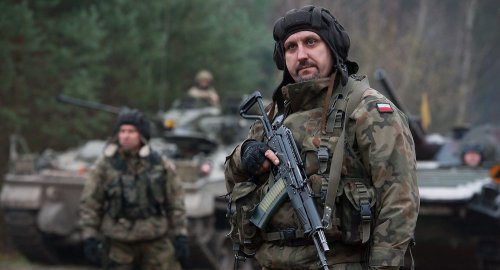
Poland’s President Bronislaw Komorowski has signed a resolution approving the organization of a joint Lithuanian-Polish-Ukrainian brigade, whose creation has been in the works since 2007.
When brought to full operation in 2017, the brigade is set to constitute 4,500 servicemen. They will operate separately from the three countries’ respective militaries, but will take part in NATO exercises and missions. Preliminary drills are scheduled for later this year. The brigade will be stationed at its headquarters in Libulin, Poland. So far, it only houses 250 servicemen and 50 command staff contributed by the Polish military.
The joint force was discussed as far back as 2007, but the agreement to create it was signed by the three countries’ defense ministers in September 2014, in response to the Ukrainian crisis and what they call Russian aggression.
Creating the joint force is “part of a wider plan … to support Ukraine, among others, in the area of modernization,” President Bronislaw Komorowski said as cited by Reuters.
He also urged other European countries to spend more on defense. To that end, President Komorowski has suggested excluding defense spending from EU rules on budget deficit limits. This means that EU nations will be able to allocate more money to the military without fearing increased budget controls from Brussels. Komorowki’s offer comes at a time of heightened tensions with Russia.
Poland now has the fifth-strongest army in the EU, and has ambitious plans to modernize it, spending about $36 billion until 2022. However, the Polish government is unhappy about a lack of similar eagerness in some of the other European nations, the Rzeczpospolita newspaper reports.
While NATO is advising its member states to spend the maximum allowed of three percent of GDP on defense, most are spending far less: Germany allocates 1.2 percent of its GDP, the Netherlands 1.3 percent and Spain under 1 percent. France is the only Western European country that is boosting defense spending. However, some Eastern European nations are increasing their military expenses citing what they call Russian aggression. Lithuania, for instance, wants to allocate twice as much on defense as last year.
Fire near Chernobyl site alarming, ‘radiation respects no boundaries’
RT | April 29, 2015
A forest fire near Ukraine’s Chernobyl nuclear site may cause problems for communities a long way from the area as the dispersal plumes can transport radiation further to the north, nuclear safety expert John Large told RT.
RT: How dangerous is the situation in your opinion? Do you agree with ecologists who say the smoke will spread the radiation?
John Large: I spent some time in Ukraine in 2006 and I assessed the Chernobyl situation interviewing about 30 scientists and engineers who were working on the aftercare of Chernobyl. Brush fires and forest fires were the greatest concern in terms of the means by which you can disperse a secondary radiological impact from the original dissipation that occurred in 1986… What you have in Chernobyl in the exclusion zone and the further way you have an area that has been abandoned for farming, abandoned for management. That means you’ve got lots of brush and young wood growing out of control. Let me assess that – a big fuel load to have a fire. That means that the biological load is very high, so the radiation particles can be dispersed. Take down the chemistry as well. The chemistry is the way in which the strontium and cesium from the radioactive strontium and cesium from the reactor are bound here, and of course the elevated temperature of the fire and plus all the plume and aerial dispersion – means that could transport it hundreds of kilometers, particularly to the north, to Belarus. So there are more problems here for communities that are long way away from the site. What I had hoped was that the Ukrainian officials would have had in place firefighting capacity greater than they normally would have at any other area of Ukraine, because it certainly needs to be protected not just now but in the longer term as well.
We know that Ukraine is cash-strapped. There was a responsibility for its neighbors, Russia, the EU, not Belarus as much because it’s in an even worse financial situation, but there was a general responsibility to protect this area from another bout of radioactive dispersion.
RT: What lessons can be learned from this particular incident then to make sure that the brush and the forest doesn’t catch light again, or if it does, to make sure that site is secured?
JL: It is not the reactor, it is not the location of the reactor that is the problem – it is the dispersal plumes from the original accident – that is the problem. If there are radioactive materials on the ground now and then it’s engulfed by forest fire maybe 40-50 km away from the reactor. But that deposited radioactivity is re-suspended into gas, blown high into the atmosphere by the heat of the flames, and then of course it settles somewhere else. And it may be those communities to the north that are not prepared to have this new radiation plume and deposition and fallout come down on their communities.
RT: Do you think there should be a common international strategy and response for situations like this?
JL: We’ve seen recently with Chernobyl, with Windscale in the 1950’s in the UK, and particularly now with Fukushima that the radiation doesn’t respect any international boundaries. So an international effort is required for this type of catastrophe, all potential catastrophes. I would have thought that the EU or Russia would have healed their scars over this and got together and put some efforts and resources into controlling this and make sure it doesn’t happen again.
Anti-NATO parties grab top spots in Finland general election
RT | April 19, 2015
The Prime Minister of Finland has acknowledged the victory of the opposition Centre Party in Sunday’s general election. With most of the votes counted, Centre has 21 percent support, which translates to a potential 44 seats in the country’s parliament.
“It appears the Centre has won. Congratulations,” PM Alexander Stubb, a staunch EU backer, said, according to Finnish broadcaster Yle.
However, with only 44 seats, Centre will have to form a ruling coalition. “This result will enable several possible coalition combinations”, party leader Juha Sipila told reporters.
The Centre has several potential allies to choose from. These include the nationalist Finns Party, which is currently second with 17.6 percent of the vote. Like the Centre, the Finns are against NATO membership for Finland, with the Finns also striving for more independence from the EU.
They are closely followed by the National Coalition Party (NCP), with 18.1 percent. The NCP is the only party in the top four which advocates both NATO membership and closer ties with the EU.
The Social Democratic Party, at fourth place with 16.7 percent, is another potential member for the ruling coalition. Like Centre and the Finns, it is against NATO – as many as 91 percent of its members saying they are oppose it.
Other runners include the Greens, the Left party the pro-minority Swedish People’s Party and the Christian Democrats, none of which got more than eight percent of the vote.
Czechs rally against US military convoy’s parade
Press TV – March 29, 2015

Demonstrators march in the Czech capital of Prague in protest against a US military convoy passing through the country on March 28, 2015
Hundreds of demonstrators have staged an anti-NATO rally in the Czech capital of Prague to protest a planned parade by a US military convoy through the East European republic.
The protesters held the rally on Saturday on the eve of a parade by roughly 120 US military vehicles that are to enter the country as part of the Western military alliance’s “Operation Dragon Ride” parading through six NATO member states in Europe.
“This definitely won’t contribute to peace in Europe because the situation is very, very dangerous and very tense. We’re of the opinion that steps like this definitely don’t help,” said Lubomir Ledl, a protest organizer and lawyer from Prague.
Demonstrators waved the Czech national flag and carried placards reading “Tanks? No Thanks!” and “Stop US Army.”
The anti-war protesters were met by a group of pro-NATO demonstrators. Minor clashes broke out between the two groups.

The US military convoy passes through Estonia as part of drills in Eastern Europe on March 21, 2015
The convoy, consisting mostly of armored personnel carriers, began the parade on March 21 in Estonia and passed through Poland, Lithuania, Latvia, before entering the Czech Republic on Sunday.
The convoy will stay in the country until April 1 when the vehicles will cross into neighboring Germany to return to a military base in the city of Vilseck.
According to Lieutenant colonel Craig Childs, a spokesman for the US Army in Europe (USAREUR), the military march is aimed at testing “unit maintenance and leadership capabilities while simultaneously providing a highly visible demonstration of US commitment to its NATO allies and demonstrating NATO’s ability to move military forces freely across allied borders in close cooperation.”
Throughout the march, security forces from the six European governments have offered to escort the convoy to fend off opposition as the US military convoy crosses the countries filled with people protesting the move.
The convoy comes as NATO plans to expand its military presence in Eastern Europe amid deteriorating ties with Russia over the crisis in Ukraine.
In 2014, NATO forces held some 200 military exercises, with the alliance’s General Secretary Jens Stoltenberg having promised that such drills would continue.
In addition, the defense ministers of NATO’s 28 member states agreed on February 5 to establish six new command and control posts in the Eastern European nations of Bulgaria, Romania, Estonia, Latvia, Lithuania and Poland.
Moscow has repeatedly condemned NATO’s exercises and military buildup toward its borders. Russia has also repeatedly accused the US of fueling unrest throughout the world by interfering in other countries and pursuing global hegemony and its expansionist policy.
Russia ended on March 21 nationwide military exercises in the Baltic Sea, Black Sea, the Arctic and the Far East.
More than 80,000 Russian troops with over 10,000 military vehicles, 65 warships, 16 support vessels, 15 submarines and 200 jet fighters and helicopter gunships took part in the maneuvers.
Czechs told not to throw tomatoes, eggs at US military convoy
RT | March 23, 2015

US military convoy parades through Eastern Europe (Screenshot from Ruptly video)
Czech people were told not to throw tomatoes and eggs at a US military convoy rumbling through Eastern Europe, the local media said, citing the laws of the land. Those in love with egg & tomato hurling may get up to three years if convicted.
“Should anyone emerge with the intent to attack the convoy, with [items] such as tomatoes or eggs, it would qualify as disorderly conduct according to Czech legislation (up to 2 years without parole, in recidivist cases up to 3 years) or damage to property (sentences in the range of 6 months to 3 years).”
This statement was aired on Czech TV Nova and cited by the Russian Insider last week, ahead of the planned US military convoy.
Operation ‘Dragoon Ride’, a convoy of US military vehicles, mostly IAV Stryker APCs, started on Saturday. The convoy will make its way through Estonia, Lithuania, Poland, Latvia, the Czech Republic, with its final destination being Germany. It will cross the Czech Republic between March 29 and April 1 on its way to a base in the German city of Vilseck.
If skirmishes break out, offenders can expect to spend up to 3 years of prison. However, serious violence may incur 10-year sentences for the perpetrators.
“If (the incident) causes serious injuries, the attacker can receive a sentence of up to 10 years.”
Also if someone decides to sabotage the US operation, he or she would also face charges, said the Czech Army Press.
“Sabotage and/or attacks in the Republic, including attempts to undermine its defense capabilities are subject to imprisonment ranging from 8-12 years or forfeiture of property – § 310 par. 1 of the Criminal Code,” it said.
Earlier local media reported the government of the Czech Republic even instructed its own military to protect the US military convoy as it crosses the country over fears that numerous people protesting the move could stage “provocations.”
On Sunday Czech anti-war activists launched the ‘Tanks? No thanks!’ campaign to protest the procession of US Army hardware through the Eastern European country. They say it has been turned into a “provocative victory parade” near the Russian border.
“The last time that vehicles like this came to the Czech Republic, they were Soviet tanks coming to crush moves towards democracy in 1968. We don’t want such vehicles from foreign armies coming here ever again,” said Tana Bednarova from the ‘World without Wars and without Violence’ organization.
READ MORE: ‘Tanks? No thanks!’: Czechs unhappy about US military convoy crossing country
‘New IMF loan to Ukraine will go down the drain’
RT | March 11, 2015
President Poroshenko’s government is far more corrupt and less efficient than the previous one, according to Martin Sieff, columnist for the Baltimore Post-Examiner. It’s like a black hole, the more money you pour in the less you will have, he added.
The International Monetary Fund (IMF) is to decide Wednesday whether to give a $17.5 billion bailout package to Ukraine. The Ukrainian parliament has already passed a series of austerity reforms to cut pensions and increase taxes in order to meet the creditors’ conditions, but more changes are going to be needed to gain this financial aid.
RT: About $4.6 billion in credit was extended to Ukraine in 2014, but its economic performance has scarcely improved. Does that mean the aid had no effect?
Martin Sieff: Pretty much yes, it does. It had the effect on keeping Ukraine afloat in the short-term. But this is an unconstitutional government in Ukraine which was really established by a violent coup in Kiev last year which has waged an aggressive war of repression against two secessionist provinces of its own country, which doesn’t have any real social contract with its own people. Its efforts to conscript large numbers of forces for the regular army have been met with peaceful but very clear resistance. This is a very weak disorganized government, it’s a black hole. The more money you pour in, the less effect you will have. You can keep it stable for a year or two but no longer than that.
RT: The IMF has agreed on a new $17.5 billion lifeline to Ukraine. Do you think that will be enough to stabilize the country’s economy even if fully implemented?
MS: The aid went at least in theory to what it was supposed to, but no doubt there was a great deal of corruption. It’s ironic that the government of President Yanukovich was accused of corruption and incompetence. This government is far more corrupt than the previous government was and it’s infinitely more incompetent. So simply money leaches away, but the real problem is the lack of credibility of governance. This government is even purging its civil service of anyone remotely accused or suspected of being efficient and loyal to President Yanukovich and his predecessors. You cannot have an efficient and credible government under these circumstances.
RT: The IMF is requesting a package of economic and political reforms to be carried out when providing financial assistance to any country. Are we seeing it carried out in Ukraine at least judging by its economic performance?
MS: No, no way. First of all, there is still unrest and violence in the two eastern provinces and spreading into other parts of the country. The security conflict and the conflict with Russia have to be settled first by this government. And they are not yet ready to settle it on terms that would be acceptable and reassuring to Moscow, but that has to be resolved first. Secondly, we saw even last year President Yanukovich broke off his negotiations with the EU, but he recognized that the terms under which the EU was ready to grant association to Ukraine would be disastrous and ruinous for the Ukrainian economy and the Ukrainian people. A year ago, the EU didn’t have the resources by itself to lift up even a peaceful Ukraine under democratically elected governance. The prospects of doing that now under President Poroshenko and his war-government, his war junta are very much less. So this would be $17 billion down the drain. You know they are all saying from Washington DC, I’m paraphrasing a little “$17 billion here, $17 billion there and soon you are talking about real money”.
RT: When signing the IMF program Ukraine makes certain financial obligations, do you think they could be committed at all in the current state of its economy or is it going to be a black hole of international aid?
MS: There is no question about that. This is very unwise economic policy that has a political motivation. The EU itself and the US government both plunged in recklessly to topple the Yanukovich government last year and to support President Poroshenko. And now we have the dominant mythology, the dominant narrative in Washington, and in Brussels, and in London is that this is “a stable democratic government which is being under threat from evil totalitarian forces to the East.” That is not the truth even remotely, but that is almost universally believed by policymakers in London and Washington and many of them in Brussels and therefore there is a political motivation to try and prop up Ukraine. But you can’t fix what’s already broken. You are pouring good money after bad. Ukraine’s problems first of all have to be solved in the security sphere then they have to be solved in the political sphere restoring the political amity and credibility and the incompetent but nevertheless stable civil service that existed until February 2014 a year ago. It was the EU and the US that broke Ukraine and they cannot fix it now by simply pouring money into a black hole.
Featured Video
No Threat Can Force Iran’s Surrender /Trita Parsi & Lt Cl Daniel Davis
or go to
Aletho News Archives – Video-Images
From the Archives
What is the Israeli Lobby in Australia Doing in Interfaith Dialogue?
By Ali Kazak | Dissident Voice | October 11, 2015
For years Israel and its lobby around the world have been trying to normalise their relations with Arabs and Muslims without solving the Palestine Question.
One of the methods they resorted to in the last few years is using human rights and community organizations such as interfaith dialogue and Multiculturalism to achieve this objective and to: isolate the Palestinians, marginalise the Palestine question, end Israel’s isolation, and prevent criticism of Israel, knowing that these organisations will be the first to stand against Israel’s violations, racial and religious discrimination.
The group responsible for this task in Australia is The Australia/Israel & Jewish Affairs Council (AIJAC); its Director of International & Community Affairs, Jeremy Jones is in charge of lobbying religious community organizations, specifically Muslims and Christians. Consequently he convened the Faith Communities for Reconciliation, founding participant in the Australian Partnership of Religious Organisations and the Australian National Dialogue of Christians, Muslims & Jews.
AIJAC is a private political propaganda group. It is recognised as the main Israeli lobby in Australia. It coordinates its activities and works intimately with the Israeli embassy in Canberra and different institutions in Israel. It is privately funded by some Jewish businessmen. It monitors closely Australian politicians, the media, ethnic and religious groups, (especially Arabs and Muslims), unions and academics on their stands towards Israel and the Palestine question. … continue
Blog Roll
 Aletho News
- The war of liberation of the Arab and Islamic peoples expands across the Gulf
- Envoy warns UN on Trump’s threat to ‘obliterate’ Iran’s civilian infrastructure
- The Larak Corridor: Iran’s Rial Gate With No US, No Israel, and No Way Around
- ‘Economic terrorism’: Steel facilities hit again in US-Israeli strike
- ‘War Crime’: Iran condemns attacks on Arak, Ardakan nuclear sites
- Two-thirds of Americans want quick end to Iran war even if goals unmet
- Trump to Give “Important Update on Iran” Wednesday in Prime-Time Speech
- Theodore Postol: Iran’s Missiles & Drones Were Underestimated
- Iran To Target Military Industrial-Tech Complex That Facilitated Gaza Genocide
- Collapsing Empire: The Resistance Disarms ‘Israel’
- If Americans Knew
- Israel wants US to bomb more of Iran’s civilian structures (113,000 is not enough) – Not a ceasefire Day 173
- Ann Coulter Rips Into Fox News for Iran War Coverage
- Joe Kent Urges Americans To Call White House and Congress To Object To Sending Troops Into Iran
- DNC Resolution to Reject AIPAC Funding Puts Democratic Leaders in the Hot Seat
- Swedish foundation to build 400 schools as over 650,000 Gaza children remain without education for 2 years
- Israeli army admits photshopping image of slain Lebanese journalist
- This is how Israel is systematically killing health workers under the cover of war in Lebanon
- Carrying life under fire: Israeli invasion of Lebanon leaves pregnant women facing deadly risks
- Champagne all around for the new death penalty (for Palestinians) law – Not a ceasefire Day 172
- Why are Palestinian books struggling to be seen on Amazon?
- No Tricks Zone
- New Study Finds Warming Saves Lives…Cold Temperatures 12 Times More Deadly Than Excess Heat
- German Science Blog Accuses PIK Climate Institute Of Hallucinating Climate Tipping Points
- Devastating Assessment Of Comirnaty Vaccine By Former Senior Pfizer Europe Toxicologist
- New Study: CO2 Is ‘Effectively Negligible’ As An Explanatory Climate Change Factor Since 2000
- Former Pfizer Toxicologist Dr. Helmut Sterz Tells Bundestag Hearing Pfizer Vaccine Should Have Never Been Approved
- Energy Expert: Germany’s Nuclear Phaseout Was A “500 Billion Euro Mistake”
- New Research: South Australia’s Mid-Holocene Sea Surface Temperatures Were 4°C Warmer Than Today
- Storing Green Energy To Last Germany 10 Days Would Require A 60-Million Tonne Battery
- New Studies: UK Sea Levels Were 4 Meters Higher Than Today During The Mid-Holocene
- Destructive Green New Deal: German Energy And Metal Group Warns Of Drastic Crisis
 Aletho News