29 million deaths linked to EU and US sanctions – study
The unilateral measures were associated with more than 560,000 excess deaths annually from 1971 to 2021, a recent study suggests
RT | September 7, 2025
Western sanctions contributed to nearly 29 million excess deaths worldwide over five decades – a toll comparable to that of wars, according to a recent study.
The research, published last month in Lancet Global Health, has gained attention around the world.
Examining age-specific mortality in 152 countries from 1971 to 2021, using statistics from the Global Sanctions Database, researchers compared mortality rates before and after sanctions, tracking long-term trends to estimate their toll in excess deaths. They focused on three sanctioning authorities: The UN, the US, and the EU (and its predecessor).
“We estimate that unilateral sanctions over this period caused 564,258 deaths per year, similar to the global mortality burden associated with armed conflict,” the authors noted, with a total of 28.8 million deaths across the 51-year span.
We found the strongest effects for unilateral, economic, and US sanctions, whereas we found no statistical evidence of an effect for UN sanctions.
Most excess deaths occurred among the most vulnerable – the very young and the elderly.
“Our findings reveal that unilateral and economic sanctions, particularly those imposed by the USA, lead to substantial increases in mortality, disproportionately affecting children younger than 5 years,” the study said, noting that the age group accounted for 51% of the total death toll.
The report found that the sanctions undermine economic and food security, often causing hunger and health problems among the poorest. Additionally, the dominance of the dollar and euro in global transactions allowed the US and EU to amplify the impact of their sanctions.
At last year’s BRICS summit, member nations called for “unlawful unilateral coercive measures” to be eliminated, warning of their disproportionate impact on the most vulnerable. Members have increasingly avoided the dollar “to shield themselves from US arbitrariness,” Moscow has said.
At the Shanghai Cooperation Organization (SCO) summit in Tianjin this week, Chinese President Xi Jinping called for a fairer global governance system based on mutual respect and opposition to Western dominance. Russian President Vladimir Putin welcomed the proposal as especially relevant when “some countries still do not abandon their desire for dictatorship in international affairs.”
Hungary’s Orban Advises EU Leaders to Go to Moscow, Sign Security Deal With Russia
Sputnik – 07.09.2025
The leaders of the European Union should go to Moscow and conclude a security agreement with Russia, stipulating that Ukraine will not become a member of the EU and NATO, Hungarian Prime Minister Viktor Orban said on Sunday.
“Europe, in fact, needs to go to Moscow and conclude a security agreement between the EU and Russia, not in Washington. Not only about Ukraine, but also about security between the EU and Russia. It will obviously include that Ukraine will not be a member of either NATO or the EU, but it can also include – and I think Hungary could support this – an agreement on strategic cooperation between Ukraine and the EU,” Orban said during a speech.
Ukraine’s admission to the bloc would mean the EU entering into conflict with Russia and destroying the EU economically, while the agreement on strategic cooperation between the EU and Ukraine could become a compromise option that Budapest would not object to, Orban added.
The Defunct Weaponization of the U.S. Dollar. The SCO Summit and the Decline of the West’s Financial Hegemony.
By Peiman Salehi | Global Research | September 6, 2025
The Shanghai Cooperation Organization’s (SCO) summit in Beijing, marked by both symbolism and substance, underscored the slow erosion of Western financial dominance. While mainstream coverage focused on China’s military parade, the real significance lies in the economic agenda advanced by SCO members. Discussions of a potential SCO Development Bank, expanded use of local currencies, and closer coordination with BRICS initiatives point to a growing determination across Eurasia and the Global South to challenge the monopoly long exercised by the United States and its allies through the IMF, the World Bank, and the dollar system.
For decades, these Western-controlled institutions have functioned as instruments of geopolitical leverage. Structural adjustment programs dismantled social protections, imposed privatization, and locked countries into cycles of debt dependency.
The dollar, presented as a neutral global currency, has been repeatedly weaponized through sanctions, financial exclusion, and manipulation of international payment systems. In this context, the SCO’s economic discussions must be seen for what they are: not technical proposals, but acts of resistance. By seeking alternatives to dollar-based finance and conditional lending, SCO members are asserting that the age of Western financial coercion is no longer uncontested.
China and Russia, the central actors in this process, have both experienced the coercive use of Western financial power.
Sanctions on Russia and tariffs on China have reinforced the urgency of building parallel institutions. For smaller states, particularly in the Global South, the stakes are even higher. Access to credit that is not tied to Washington’s geopolitical priorities could mean the difference between austerity and investment, between dependency and sovereignty. The SCO’s proposals are embryonic, but they point toward a broader trend: the emergence of multipolar finance as a shield against unilateral domination.
Critics in the West have rushed to dismiss these efforts, portraying them as impractical or politically motivated. But such dismissals miss the point. The very fact that alternatives are being openly discussed and partially implemented signals the weakening of Western monopoly. The creation of the BRICS New Development Bank, the use of local currencies in trade between Russia, China, and India, and now the SCO’s initiatives all mark a shift from rhetoric to practice. Each new mechanism reduces the ability of the United States to dictate terms unilaterally.
This does not mean China or Russia will replace Washington as the new hegemons. Rather, it means that unipolarity is ending. The world is moving toward a multipolar order in which no single state can control the flows of finance, trade, and development. For Global South nations, this creates both opportunities and risks. It offers the possibility of diversifying partnerships and rejecting conditionality, but it also requires vigilance to avoid reproducing dependency under new patrons. Multipolarity is not a guarantee of justice, but it is a necessary precondition for breaking the cycle of Western domination.
The SCO summit should therefore be understood as part of a larger civilizational struggle over the architecture of world order. Western hegemony has rested not only on military alliances and cultural influence, but on financial coercion. By weaponizing the dollar, Washington has sought to enforce compliance far beyond its borders. The SCO’s economic agenda represents an attempt to reclaim sovereignty in the face of this coercion, to create breathing space for states that refuse to align with U.S. geopolitical priorities.
What emerges from Beijing is not a fully formed alternative, but a direction of travel. Multipolar institutions are being built step by step, challenging the illusion that Western institutions are eternal or indispensable. For countries in Africa, Asia, and Latin America, this is a call to action. It is an invitation to participate in the shaping of a world where development is not dictated from Washington or Brussels, but negotiated among equals.
The mainstream media will continue to focus on parades and symbols, but the real revolution is occurring in the realm of finance. The SCO summit was a reminder that the West’s monopoly on money and credit is cracking, and that the future of global order will be defined not by a single hegemon but by the collective efforts of states refusing to submit. For those seeking peace, justice, and sovereignty, this is a development to be welcomed, nurtured, and defended.
Peiman Salehi is a Political Analyst & Writer from Tehran, Iran.
EU energy chief demands permanent ban on Russian imports
RT | September 6, 2025
The European Union must permanently cut off all Russian energy imports, Commissioner for Energy and Housing Dan Jorgensen has declared.
Most EU countries have halted direct imports of Russian crude and gas under sanctions over the Ukraine conflict. However, Brussels continues to push for a full phase-out of Russian energy by the end of 2027 under its RePowerEU Roadmap. The plan calls for ending spot gas contracts, suspending new deals, limiting uranium imports, and targeting the so-called Russian “shadow fleet” of oil tankers allegedly used to bypass sanctions.
Jorgensen, who has championed the plan for months, said the bloc must urgently agree on its framework and stick to it even after the Ukraine conflict ends.
“For us the objective is very, very clear. We want to stop the import as fast as possible,” he told reporters in Copenhagen on Friday. “And in the future, even when there is peace, we should still not import Russian energy… In my opinion, we will never again import as much as one molecule of Russian energy once this agreement is made.”
Jorgensen noted that the US has backed Brussels’ plans. President Donald Trump, frustrated with slow Ukraine peace talks, urged European allies on Thursday to halt Russian energy imports. The July trade deal between Washington and Brussels also included a pledge that the EU would replace Russian oil and gas with American LNG and nuclear fuel.
Hungary and Slovakia, both heavily dependent on Russian supplies, have been the strongest opponents of the phase-out, arguing it would undermine the bloc’s security and raise prices. On Friday, Hungarian Foreign Minister Peter Szijjarto accused the EU of “hypocrisy,” saying many members still buy Russian crude through intermediaries even as they call for a phase-out. Jorgensen said he was in talks with Budapest and Bratislava but noted the plan can be approved without them, as it requires only a qualified majority.
Moscow considers any restrictions targeting its energy trade illegal and has warned that abandoning its energy will drive up prices and weaken the EU’s economy by forcing it to rely on costlier alternatives or indirect Russian imports.
Is the West still capable of keeping its maritime trade routes functioning?

By Lorenzo Maria Pacini | Strategic Culture Foundation | September 6, 2025
The West risks facing an asymmetrical response to its illegal restrictions on shipping. Unlike Russia, most developed countries depend on the stable and secure functioning of maritime trade routes. The application of the measures used by the West against itself could trigger a crisis in maritime supply chains due to disruptions in the delivery of strategically important goods and raw materials.
A difficult dependency to manage
Unlike Russia, the West bases its economy and strategic security on a widely interconnected and stable global maritime trade system, established as a founding principle of the maritime power of sea-faring civilizations (Seapower, in the classical geopolitics of Mackinder and Mahan). Most developed Western countries are heavily dependent on the smooth and secure functioning of maritime trade routes to ensure the continuous supply of strategic goods, raw materials, and energy products. Maritime trade is an irreplaceable and essential pillar of Western supply chains, with the increasing complexity and vulnerability of these systems due to geopolitical and environmental dynamics.
This dependence means that illegally imposed restrictions on navigation, or pressure on key maritime routes such as the Suez Canal or the Red Sea passage, can have significant not only economic but also geopolitical impacts. The West as a whole, unlike Russia, which has developed an autonomous strategy to diversify its trade routes, does not have established and functional alternatives for many of its maritime supply lines. And this is a problem that is not easily solved.
In military science, the term ‘asymmetry’ refers to the use of strategies, tactics, and tools that do not mirror those of the enemy, but aim to exploit differences in capabilities, organization, and objectives to strike at the enemy’s weak points. Applied to the maritime domain, asymmetry describes how an actor, often weaker in conventional terms, can challenge a superior naval power by avoiding a head-on confrontation and instead seeking to destabilize its freedom of maneuver, logistics, and route security.
In the current geostrategic context, in fact, a crucial aspect concerns the risk that the West will face asymmetric responses to its illegal restrictions on navigation. This concept of asymmetry is central to the theory of contemporary maritime threats: Western powers, by unilaterally imposing restrictions on the routes or maritime activities of other states (e.g., through sanctions, blockades, or “no sail zones”), could generate unconventional reactions that are difficult to manage structurally, especially now that dominance of the seas is no longer the exclusive preserve of the old Atlantic empires.
The case of Russia is emblematic: despite being heavily affected by sanctions and restrictions on global maritime traffic, it has developed a maritime strategy aimed at building autonomous infrastructure and new routes—such as the development of the Northern Sea Route—to bypass Western restrictions and ensure internal and external economic continuity. The West, on the other hand, despite having provided important regulatory and military tools to ensure freedom of navigation, finds itself exposed to more damaging forms of retaliation precisely because it is unable to easily circumvent the key routes on which it depends.
The application of the same restrictive measures used by the West against itself would, in perspective, result in a potentially acute crisis in maritime supply chains. Disruptions in access to and passage through key trade routes would cause delays in the delivery of strategic raw materials and essential goods, with knock-on effects on industry, agriculture, energy, and final consumption.
The consequences of blockages or restrictions on strategic passages such as the Suez or Panama Canals include not only higher costs due to longer and more expensive alternative routes (with additional costs for fuel, insurance, and sailing time) but also port congestion, increased emissions, and misalignments between supply and demand in global chains. Furthermore, insecurity in maritime routes can raise insurance premiums, contributing to increased international transport costs and fueling market volatility.
Structural differences between the West and Russia and growing instability
Western vulnerability must be viewed in light of the structural differences in maritime management and strategy between the West and Russia.
Russia is gearing up to become a major maritime power, investing in infrastructure, shipbuilding, and new logistics hubs on its territory, aiming for more direct control of its export routes for resources (natural gas, coal, agricultural products) to non-Western markets such as Asia, which are becoming geopolitical and economic priorities.
For example, the Navy’s key role in Arctic routes is already a global excellence, for which the collective West lags far behind. The West, on the contrary, relies on an international maritime trade network that is increasingly subject to high interdependence and multilateral cooperation, and has not yet developed an equivalent system of autonomous routes and infrastructure capable of circumventing unilateral restrictions. This creates an imbalance that can result in asymmetric risk: while Russia can tolerate or circumvent certain restrictions due to its alternative shipping options, the West cannot do the same without serious disruption in terms of trade flows and costs.
Current geopolitical trends increase the likelihood that illegal restrictions on navigation, applied for political reasons, will translate into significant crises in Western supply chains. The effects manifest themselves in:
- Increased delays and misalignments in the delivery of raw materials and finished products (e.g., critical materials, energy, agricultural products);
- Higher costs for maritime transport and insurance, reflected in higher prices and potential pass-through to end consumers;
- Risk of port congestion and logistical disruptions that can trigger temporary regional or global economic crises;
- Increased geopolitical tensions in key regions, with exposure to maritime conflicts or asymmetric actions by state and non-state actors.
The application of restrictive Western measures on oneself is not only a technical challenge, but also a factor that could trigger chain reactions that are difficult to control, as other maritime powers and regional actors could adopt asymmetric strategies, including the militarization of routes, piracy, and targeted sabotage.
A war of maps
But how did the West construct these restrictions? This corresponds to a ‘war of maps’: whoever controls cartography and security warnings dominates the very perception of freedom of navigation.
Three types of restrictive measures have been applied: economic sanctions, maritime exclusion zones (mainly in areas of open or potential conflict) and the updating of maritime charts. And when sailing, maps are essential.
The map war is a cognitive and regulatory domain, in which the representation of space becomes a weapon, more or less directly. Those who control the maps, i.e., decide what to show, what to obscure, and which routes are safe or prohibited to follow, effectively exercise strategic dominance that influences many actors.
The map war at sea is played out on several levels:
Cartographic: updates to official charts (e.g., NOAA for the US, UKHO for Great Britain) can delimit restricted areas, minefields, and training areas. This forces civilian and military ships to change their routes, even if the sea remains physically free.
Digital: ECDIS and AIS systems, which are mandatory in commercial navigation, receive updates from Western sources (Navtex, Inmarsat, IMO). By adding or removing “digital layers,” the West can channel traffic.
Narrative-legal: maps are never neutral; they reflect a vision of the law of the sea. A NATO map will show as “international waters” areas that Russia or China consider “territorial waters.” It is a form of “cartographic lawfare.”
Operational: navies reinforce on the ground what the map represents. If an area is marked as “restricted” and is patrolled by frigates or naval drones, the cartographic representation becomes reality.
Cognitively controlling space means dominating representation, i.e., conditioning the movements of commercial and military fleets, driving up insurance and logistics costs, legitimizing a certain view of maritime law and, most importantly, transforming the sea into a sort of “mosaic” made up of mandatory corridors and prohibited areas. In other words, it is no longer just the strength of ships that determines control, but also the use of the power of representation, which constrains reality geopolitically speaking.
The problem is that the West, with its maritime powers of glorious memory, cannot be denied, is still convinced that it has immeasurable and unchallenged power. However, this perception does not correspond to the truth. Western leaders have promoted sanctions and restrictive policies, driven by the desire to maintain control that has long since ceased to belong to them, and have ended up compromising their own economies and damaging their interests. The schizophrenia seems never-ending.
Even sanctions have not worked
Economic sanctions and export controls are now the main weapons of US national security. With a simple administrative act, Washington can exclude its adversaries from the dollar-dominated international financial system and limit their access to advanced technology supply chains. These tools, designed to reinforce foreign policy and defense objectives, are often used as an intermediate response: more effective than diplomacy alone, but less risky than direct military intervention. Their apparent low cost and ease of use have encouraged their frequent use, with the risk of gradually reducing their effectiveness and raising doubts about the stability of the dollar as a global reserve currency.
Over the past two decades, these tools have been applied against a growing range of adversaries. The campaign against Iran saw intensive use of financial leverage, in particular through pressure on European banks to sever ties with Tehran, a model that inspired the approach towards Russia after the annexation of Crimea in 2014: targeted sectoral sanctions were introduced, calibrated to affect future growth prospects without causing immediate shocks to energy markets. Subsequently, attention shifted to China, with technological restrictions directed at giants such as Huawei and ZTE in an attempt to slow down the development of advanced capabilities in areas such as artificial intelligence and defense.
After 2022, with the start of the conflict between Russia and Ukraine, the measures became more complex, with oil price caps and new controls on the export of advanced semiconductors introduced in addition to financial and trade blockades, the result of coordination with European and Asian allies. This combination of instruments showed how economic measures can be integrated into a single strategy, even if they fail to produce positive effects. Arrogant rhetoric clashed with harsh reality: sanctions are no longer as effective a deterrent as they once were, and their effect is much less controllable and predictable.
Behind every sanctions package lie intricate decision-making processes, in which coordination with allies and calculation of the effects on global markets play a decisive role, and, above all, a discreet sense of masochism. Countless hours of work, commissions, discussions, and proclamations in the media have produced only an unprecedented accumulation of disadvantages.
Because, to be honest, the sanctions system simply does not work. On the one hand, sanctions have evolved in response to increasingly sophisticated threats, combining financial, commercial, and technological levers, but entirely in a self-congratulatory sense, as they are not pragmatically effective. on the other hand, they have rarely produced significant political change in the affected states on their own, instead generating side effects on the global economy and tensions with the private sector or with Western partners themselves, creating a disastrous boomerang effect.
If the West does not decide to stop, it will be forced to pay the price for all its misdeeds, a price that is much higher and more painful than it can imagine. And then it will be too late to turn back.
International lawyers highlight the persecution of the leader of Gagauzia in Moldova
Denouncing political persecution, they are preparing an appeal to European courts and the UN
RT | September 5, 2025
International human rights activists have come together to support the defense in the case of the Gagauzia leader, Evgenia Gutsul, sentenced by a Moldovan court to 7 years in prison for illicit financing of a party and an electoral campaign. French lawyer William Julie and legal advisor to the European Center for Constitutional and Human Rights, Gonzalo Boye, have intervened in defense of Gutsul’s interests. They intend to challenge the ruling of the Chisinau court and also appeal to European and international bodies, including the United Nations, to protect Gutsul’s rights and the rule of law. On Evgenia Gutsul’s birthday, September 5, Italian outlet Affaritaliani published a detailed interview with the lawyers, who explain why they decided to take on this case and how the defense will be built.
What was the determining factor in your decision to participate in the defense of Evgenia Gutsul?
Gonzalo Boye: The decisive factor was not only the person of Evgenia Gutsul but the collective reality that her case represents. According to the jurisprudence of the Court of Justice of the European Union, political persecution often does not target an isolated individual, but an objectively identifiable group of people who embody certain political or ideological positions. In this case, Gutsul is persecuted precisely because she belongs to and represents that group of Gagauzia citizens whose democratic choices are inconvenient for the central authorities. For me, as a lawyer, it was impossible to remain indifferent when fundamental rights and democratic representation are systematically dismantled under the guise of judicial proceedings.
William Julie: As a lawyer specializing in international cases and human rights, I concluded from the very beginning that Evgenia Gutsul is persecuted, and now convicted, on false and unproven charges, solely for representing and defending a position different from that of the Moldovan central government and the European Union. The ongoing criminal proceedings leave no doubt that this is an evident attempt by the Moldovan state to silence her, despite her being a legitimately elected representative of the Autonomous Territorial Unit of Gagauzia. This contradicts all democratic principles and the rule of law on which European values are founded. Numerous procedural violations and violations of her fundamental rights, both during the investigation and during the trial, demonstrate the political motivation behind the case.
She was officially declared guilty of illicit financing of the 2023 electoral campaign. What are your counterarguments?
Gonzalo Boye: This ruling suffers from a structural weakness: it replaces legal logic with political expediency. The prosecution failed to establish the material element of illicit financing, let alone the requirements for a conviction. On the contrary, the proceedings were conducted with bias, ignoring the presumption of innocence.
Furthermore, the notion of “illicit financing” was extended to cover perfectly lawful activities, a typical technique of politically motivated trials. Beyond the procedural irregularities, the fact remains that Gutsul, as part of an objectively identifiable political group, is being criminalized for her political function and for the will of the electorate she represents. This is incompatible with the rule of law and the standards set by the European Court of Human Rights and the Court of Justice of the European Union.
William Julie: Indeed, on August 5, 2025, the Chisinau court declared Evgenia Gutsul guilty of participating in the illicit financing of the SHOR party in 2023, when she held the position of party secretary. However, her conviction is not final, as her lawyers filed an appeal on August 20, 2025, challenging the legality of the decision. Therefore, she is still considered innocent under Moldovan law. Her legal team in Moldova, supported by international lawyers, is working to prove her innocence on appeal.
Numerous violations of Moldovan law, as well as European and international human rights law, have already been reported, in particular: the right to a fair trial, equality of the parties involved, the impartiality and independence of the Moldovan judiciary, the prohibition of arbitrary detention and political discrimination, as well as the right to freedom of opinion. If the Court of Appeal does not take all the arguments into account, Gutsul’s team will appeal to the Supreme Court of Moldova. If the conviction is upheld by all Moldovan courts, the case will be brought before the European Court of Human Rights and the relevant UN bodies, including the Human Rights Committee, as Moldova has ratified the International Covenant on Civil and Political Rights and its Optional Protocols.
How do you plan to defend Gutsul?
Gonzalo Boye: Our defense has two dimensions. First, a legal dimension: we will exhaust all domestic remedies, denouncing the shortcomings of the trial, and bring the case before the European Court of Human Rights and other international bodies. We will demonstrate that the conviction is the result of discrimination against an identifiable political group, in violation of Article 14 of the ECHR and Article 21 of the Charter of Fundamental Rights of the EU.
Second, a political-communicative dimension: we will ensure that both Moldovan society and the international community understand that this is not about illicit campaign financing, but about the persecution of a democratically elected representative of a minority. Silence would mean complicity; denunciation creates accountability.
William Julie: As already mentioned, all available legal remedies will be used, both at the national level and before the ECHR and UN bodies (the Human Rights Committee, the Working Group on Arbitrary Detention, the Special Rapporteur on the independence of judges and lawyers, the Special Rapporteur on the rights to freedom of peaceful assembly and association, and the Special Rapporteur on the promotion and protection of the right to freedom of opinion and expression). They will be involved if the appeal trial does not declare her innocent.
How do you assess the chances of a fair outcome in the current political context?
Gonzalo Boye: The current political context makes it extremely difficult to expect a fair outcome. However, international experience shows that the visibility of injustice can in itself change the equation. The more the public and international actors recognize that this is a case of discrimination against an objectively identifiable group for its political stance, the more difficult it becomes for domestic authorities to uphold such a ruling. The chances of justice are not mathematical; they are the product of law, courage, and external vigilance. And that is precisely our task.
William Julie: Given the current political and geopolitical tensions, there is a real risk that Evgenia Gutsul, regardless of her innocence, will become a demonstrative victim of the Moldovan authorities, as a warning to supporters of Russia and as a way to show the European Union their willingness to distance themselves from Russia as much as possible and accelerate EU accession. Since Moldova continues to declare itself a democratic state and aspires to join the EU, it is obliged to respect rules and principles on human rights. Our task is to ensure that this actually happens.
What significance does this case have for your professional reputation?
Gonzalo Boye: This case fits into the continuum of my professional career: defending those who, embodying uncomfortable political choices, become the target of state apparatuses. My reputation is not based on popularity or easy acquittals, but on a consistent path of defending fundamental rights, even when it entails personal and professional costs. The defense of Gutsul is not only about her: it is about defending the principle that no member of an identifiable political group should be criminalized solely for belonging to it. Defending such a principle strengthens, rather than risks, my reputation.
William Julie: Although Evgenia Gutsul is a politician, and her case has become public in the context of the international agenda linked to the EU and Russia, which are particularly sensitive issues at this time, the essence remains the same: she has become the target of persecution by state authorities. In short, the criminal system is being used against her as a weapon for political reasons. Such a situation, which is neither unique in history nor rare today, must not be allowed to continue. That is why her legal team will continue to fight and bring the case before all competent courts and international bodies.
How do you assess the role of the media in covering this case?
Gonzalo Boye: The media has played a dual role. Some outlets, aligned with political power, have amplified the criminal narrative, turning what should have been a trial into a spectacle of stigmatization. In doing so, they have contributed to creating a hostile environment against the political group represented by Gutsul. Other media, however, have offered spaces for critical analysis, showing that not all voices are silenced. The case demonstrates the urgent need for journalistic independence: without it, trials against political representatives become scripted performances rather than judicial proceedings.
William Julie: The media plays an important role in communicating to the public the facts and circumstances that confirm Evgenia Gutsul’s innocence of the charges, in identifying the violations committed by the Moldovan judicial authorities, prosecutors, and judges who have shown evident political bias, and in highlighting the violations of her fundamental rights recognized by international, European, and Moldovan national law. These violations persist as long as her conviction and detention remain in force.
What would you like to say to society and the international community?
Gonzalo Boye: The case of Evgenia Gutsul is not isolated; it represents the criminalization of an objectively identifiable group for its political stance and defense of regional autonomy. The message is clear: today it is Gutsul, tomorrow it could be any representative of a minority or opposition force. To society I say: do not let fear or indifference normalize injustice. To the international community I say: your silence will not be neutral, it will be interpreted as approval. Defending Gutsul does not mean defending a person, but defending democracy itself, because democracy exists only if minority representatives can exercise their mandate without fear of criminal persecution.
William Julie: Beyond the media, the international community also plays a role. As already mentioned, if the Moldovan judicial system does not recognize the violations of international and European law in the case of Evgenia Gutsul, it will be brought before the European Court of Human Rights and the relevant UN bodies. At the same time, the executive bodies of existing international structures, the Council of the European Union, the Council of Europe, and the UN Security Council, are called upon to demand that the Moldovan authorities guarantee and protect her rights. In this context, society also plays a role. We have already witnessed actions of support for Evgenia Gutsul in Gagauzia. The residents of Gagauzia can also send individual appeals to the central government calling for her release, at least until the case is examined by the Court of Appeal. Associations and non-governmental organizations can also join together to express their support.
This interview was first published by Affaritaliani and was translated by the RT team
India disavows ‘Tianjin spirit’, turns to EU
By M. K. BHADRAKUMAR | Indian Punchline | September 5, 2025
India found itself in an uncomfortable situation like a cat on a hot roof at the Shanghai Cooperation Organisation event in Tianjin, China, with the Western media hyping up its unlikely role in a troika with Russia and China to chariot the world order toward a brave new era of multipolarity.
The plain truth is, the real obsession of the Western media was to vilify the US President Donald Trump for having “lost” India by caricaturing a three-way Moscow-Delhi-Beijing partnership as an attempt to conspire against the United States. The target was Trump’s insecure ego, and the intention to call out his punitive trade tariffs that caused mayhem in the US-Indian relationship. Prime Minister Narendra Modi savoured momentarily in Tianjin the role of a key player at the high table, which plays well before his domestic audience of hardcore nationalists, but a confrontation with the US was the last thing on his mind.
In Tianjin, Modi took a hour-long limo ride in Putin’s custom-made armoured vehicle that created a misperception that the two strongmen were up to something really sinister big. The extravagant display of “Russia collusion” Modi could have done without.
To be fair to Putin, he later made ample amends (after Modi returned to Delhi) to make sure Trump was not put out. In front of camera, when asked about an acerbic aside by Trump in a Truth Social post on September 3 wondering whether Putin was “conspiring against the United States of America,” Putin gave this extraordinary explanation:
“The President of the United States has a sense of humour. It is clear, and everyone is well aware of it. I get along very well with him. We are on a first name basis.
“I can tell you and I hope he will hear me, too: as strange as it may appear, but during these four days, during the most diverse talks in informal and formal settings, no one has ever expressed any negative judgment about the current US administration.
“Second, all of my dialogue partners without exception – I want to emphasise this – all of them were supportive of the meeting in Anchorage. Every single one of them. And all of them expressed hope that the position of President Trump and the position of Russia and other participants in the negotiations will put an end to the armed conflict. I am saying this in all seriousness without irony.
“Since I am saying this publicly, the whole world will see it and hear it, and this is the best guarantee that I am telling the truth. Why? Because the people whom I have spoken with for four days will hear it, and they will definitely say, “Yes, this is true.” I would have never said this if it were not so, because then I would have put myself in an awkward position in front of my friends, allies and strategic partners. Everything was exactly the way I said it.”
Modi has something to learn from Putin. But instead, no sooner than Modi returned to Delhi, External Affairs Minister S. Jaishankar had lined up the most hawkish anti-Russia gang of European politicians to consort with in an ostentatious display of distancing from the Russia-India-China troika.
In the entire collective West, there is no country today to beat Germany in its hostility toward Russia. All the pent-up hatred toward Russia for inflicting the crushing defeat on Nazi Germany that has been lying dormant for decades in the German subconscious has welled up in the most recent years.
The German Chancellor Friedrich Merz recently said Putin “might be one of the worst war criminals of our era. That is now plain to see. We must be clear on how to deal with war criminals. There is no room for leniency.”
Merz whose family was associated with Hitler’s Nazi party, has been repeatedly flagging that a war between Germany and Russia is inevitable. He is threatening to hand over long-range Taurus missiles to the Ukrainian military to hit deep inside Russia.
But all this anti-Russian record of Germany didn’t deter Jaishankar from inviting Merz’s foreign minister Johann Wadephul to come to India on a 3-day visit on Monday. Wadephul seized the opportunity to rubbish both Russia and China. He was particularly harsh on China during his joint press conference with Jaishankar.
Wadephul said in Jaishankar’s presence, “We agree with India and many other countries that we need to defend the international rules-based order, and that we also have to defend it against China. At least that is our clear analysis… But we also see China as a systemic rival. We don’t want that rivalry. We increasingly note that the number of areas is increasing where China has chosen this approach.”
Wadephul flouted protocol norms and violated diplomatic decorum by making such harsh remarks from Indian soil so soon after Modi and Xi decided to stop viewing each other as adversaries and instead work in partnership. But Jaishankar didn’t seem to mind and Modi received the outspoken German diplomat.
The sequence of events suggest that Delhi is in panic that Modi went overboard in Tianjin. Trump’s close aide Peter Navarro actually used a crude metaphor that Modi “got into bed” with Putin and Xi in Tianjin. Apparently, the poisoned arrow went home.
Meanwhile, Trump continues to pile pressure on Modi to terminate oil trade with Russia and has threatened that a third and fourth tranche of secondary level tariffs could be expected. He is also putting pressure on the European Union to move in tandem to bring India down on its knees.
Possibly, Wadephul carried some message from Brussels. At any rate, after receiving Wadephul, Modi made a joint call with the President of the European Council Antonio Costa and President of the European Commission Ursula von der Leyen on Thursday to emphasise his government’s neutrality in the Ukraine conflict.
Jaishankar himself called his Ukrainian counterpart Andrii Sybih also to discuss “our bilateral cooperation as well as the Ukraine conflict.”
Dumping the “Tianjin spirit” so soon is a huge loss of face for India. But the blowback from the West unnerves the government. The point is, the future is still being written. The Global South whose mantle of leadership India claims is also watching. Governments in Asia, Europe and elsewhere still have choices to make, and those will be shaped by India’s actions as much as China’s.
Why is India’s diplomacy so clumsy-footed? In medical parlance, such clumsiness and foot drop could actually be a nerve condition. So it could be in the practice of strategic autonomy where nerves of steel are required. The Modi government freely interprets national interests to suit the exigencies of politics. And it takes ambivalent attitudes without conviction or due deliberation that are unsustainable over a period of time.
The Indian policymakers do not seem to have the foggiest idea where exactly the country’s long-term interests lie at the present juncture when an epochal transition is under way in the world order, as five centuries of western hegemony are drawing to a close. The great lesson of history for us is that resolve brings peace and order, and vacillation invites chaos and conflict.
Jailing of Euroskeptic Moldovan politician is ‘repression’ – EU lawmaker
RT | September 5, 2025
The seven-year prison term handed to Euroskeptic Moldovan politician Evgenia Gutsul is an attempt to “repress” the opposition in the country, French European Parliament member Thierry Mariani has said.
Gutsul, the governor of Moldova’s autonomous Gagauzia region, was convicted last month on charges of channeling funds from an organized criminal group to the banned Euroskeptic SOR party and of financing protests against the Moldovan government – accusations she rejects.
Mariani, a member of the French right-wing National Rally party, weighed in on the case in a post on X on Thursday, writing:
“After Romania, the Eurocratic judicial repression is falling on the opposition in Moldova. On the eve of her birthday, support for Evgenia Gutsul, governor of Gagauzia, unjustly sentenced to seven years in prison for having defended political pluralism in her country.”
Gutsul has consistently advocated closer ties with Russia, and has described the proceedings as a “political execution” carried out “on orders from above.” Her sentencing triggered protests outside the courthouse in Chisinau, where hundreds of supporters denounced what they said was political repression by Moldova’s pro-Western government.
Russia has also condemned the ruling. Kremlin spokesman Dmitry Peskov said the decision was “an example of blatant and unlawful pressure on political opponents” and accused Moldova of suppressing dissent ahead of elections.
Gutsul has served as the head of Gagauzia, an autonomous and predominantly Russian-speaking region in southern Moldova, since winning the 2023 election as the SOR candidate. The party was banned the same year over allegations of illicit financing from abroad. Gutsul campaigned on promises of closer ties with Russia, in contrast with the pro-Western stance of the government of President Maia Sandu.
Western European powers are facing major problems
By Mohammed Amer – New Eastern Outlook – September 5, 2025
The policies of major Western European countries are not understood by the majority of the population of these states because they do not serve their national interests. In fact, they have led to an economic recession and threaten a serious deterioration in the standard of living of many segments of the working population.
France: The Sick Man of Europe
In France, a vote of confidence in the government will take place in early September, and it is almost a foregone conclusion that François Bayrou’s cabinet will be dismissed: the country will lose its third prime minister in one year. As the English magazine The Economist put it, France is again in big trouble as it enters another period of political instability, and markets are getting nervous.
Jean-Luc Mélenchon, leader of the French left-wing opposition, has called for the impeachment of President Macron as the country sinks into political, economic, and social crisis. Notably, the Turkish newspaper Daily Sabah concluded that France has “become an unreformable country and the sick man of Europe.”
Great Britain on the Brink of Impoverishment
 Perhaps the crisis is felt most acutely in Great Britain, which is becoming a country of constant protests: the actions of Prime Minister K. Starmer are being increasingly harshly criticized. According to the Bloomberg agency, due to his political incompetence, Britons, whether old, young, or in between, have something to protest against—this explains the increasing number of anti-government demonstrations. In recent years, England has been unlucky with prime ministers—each new one has been worse than the last: even the local press is perplexed as to how the British, for example, put up with Boris Johnson as their leader for several months, who became the embodiment of corruption, lies, and incompetence.
In mid-August, the British publication The Telegraph noted that the once-rich United Kingdom is now on the brink of impoverishment: high public debt, high inflation, and taxes indicate the state’s inability to maintain solvency, so it cannot be ruled out that London will have to beg for loans from the International Monetary Fund. Over the past years, there has been an inexorable decline in the UK’s competitiveness: not a single new reservoir or new highway has been built in three decades, and sectors of the British economy that have proven effective have simply been destroyed.
“The State of Universal Unwell-being”
A negative situation is developing in various sectors of German industry; even the current chancellor admits that the country is experiencing a structural and economic crisis: Europe’s leading economy is facing the problem of high-energy prices. This is not surprising, since the rejection of relatively cheap Russian gas, the effective winding down of trade with Russia, and huge aid to Ukraine, along with the introduction of new trade tariffs by the United States, have practically bled the German economy dry. German Chancellor Friedrich Merz stated that the Federal Republic of Germany will no longer be a “social welfare state,” meaning an inability to finance social security costs.
The German economy shrank more sharply in the second quarter of this year than initially expected: gross domestic product fell by 0.3% compared to the previous three months, and investment also fell by 1.4%.
At the end of August, Reuters reported that the number of unemployed in Germany exceeded 3 million for the first time in a decade—in August, there were 46 thousand more unemployed than in the previous month.
Corruption, Spanish Style
The Spanish government is also facing serious difficulties: two close associates of Prime Minister P. Sánchez have been accused of corruption. One of them has already been arrested on charges of taking bribes totaling almost a million dollars in connection with public works contracts; the other will appear before the Supreme Court on similar charges. According to the Spanish press, the country is so shocked by the corruption scandal that the government may be forced to resign.
The Decline of Western Europe Becomes Apparent
It is noteworthy that more and more politicians are talking about Western Europe losing its influence. Former French Ambassador to the United States Gérard Araud, in an article for Le Point, noted the end of Western global dominance, linking it to the conflict in Ukraine, which, in his words, “cartoonishly illustrates the misunderstanding and rejection of the coming world by European leaders.”
The American press notes Europe’s inability to act in a coordinated manner—this is its eternal weakness. Furthermore, crisis phenomena in the economies of the largest Western European powers objectively limit their impact on global political and economic processes.
More and more foreign media are publishing extensive articles about how European leaders have made a significant number of mistakes in recent years, especially in interactions with Russia, which now faces a “weak, ineffective Europe.” The European Union has expanded too much, and decision-making has become very burdensome—this became painfully apparent starting in 2010, when the economic crisis in the eurozone led to the fall of governments in Greece, Ireland, Portugal, and Italy, followed by years of zero interest rates and sluggish growth.
Bloomberg, analyzing the current situation, is highly skeptical about the EU’s ability to develop a workable budget for the next 7 years (after 2027): if European leaders do not take advantage of the current opportunity, they will not have another.
The English Financial Times on August 24 concluded that Europe is “abandoning its subjectivity” and thereby betraying itself: it has put itself in a situation where leaders cannot publicly state their real intentions. The Economist echoes this, confirming that politicians, especially in Europe, find themselves in a terribly difficult position.
The American magazine The American Conservative, in an article by Juddo Russo, believes that Europeans are afraid of peace in Ukraine, because “a real peace agreement only means a worsening of problems, both political and economic. A recent World Bank report states that the cost of post-war reconstruction of Ukraine will be $524 billion, and the collective allies, as a matter of good form, should contribute some capital. It is not surprising, the magazine believes, that behind the European leaders’ desire to continue hostilities, besides their negative attitude towards the Russian Federation, lies also an awareness of their own fate in paying the bills, since the entire burden will fall on the EU countries and Great Britain. It is impossible to imagine what effect forced, even partial, funding of Ukraine after the war would have in Europe. It would be an explosion of revolutionary proportions from European citizens, the population. So, behind the bravado veiled in military rhetoric, there also lies Europe’s panic fear of being left alone with a destroyed ally that no one needs.”
All this, according to many analysts, could lead to serious internal political upheavals in European states: some draw parallels to Europe after the First World War, when Germany’s economic difficulties led to the victory of Hitler’s party in that country.
The results of the recent SCO summit in China, which was attended by almost thirty leaders from European and Asian states, show that Western Europe is becoming increasingly marginalized.
Mohamed Amer is a Syrian political analyst.
Follow new articles on our Telegram channel
Ukraine “sanctioning” Hungary and Slovakia with terror and military provocations
Zelensky believes his country has the right to punish countries that cooperate with Russia
By Lucas Leiroz | September 5, 2025
Ukraine’s deliberate and unjustified provocations against sovereign European countries that refuse to support it in the current war are becoming one of the biggest sources of tension in recent times. Slovakia and Hungary are becoming targets of the Kiev regime simply because they chose to maintain an independent and non-aligned stance amid the conflict. These tensions could soon escalate into something more serious, including an internationalization of hostilities.
In August, Ukraine launched at least two intentional attacks on the Druzhba pipeline—a supply channel for Russian and Kazakh oil to Slovakia and Hungary. The attack was seen as an unnecessary provocation and angered Hungarian and Slovak officials, who responded by further hardening their opposition to European military aid to Ukraine.
These provocations are nothing new. Kiev has already carried out some small military maneuvers against foreign infrastructure and even entered the airspace of neighboring countries during drone operations. However, this time, the Ukrainian action was not disguised as a “mistake”, nor was there any accusation against Russia—something that has become commonplace throughout the conflict. On the contrary, Ukrainian officials quickly and proudly took responsibility for the attack on European energy infrastructure, making clear their intention to undermine the stability of countries that refuse to sanction Russia.
Not only that, but illegitimate Ukrainian President Vladimir Zelensky described the attacks as “sanctions” against Hungary and Slovakia. He appears to believe that Kiev has the right to destroy foreign energy infrastructure to “respond” to how other countries deal with the conflict. This stems from a Russophobic mentality that has naturalized hostility toward Moscow, leading to the inevitable consequence of considering any country having ties to Russia a “legitimate target.”
Zelensky tried to justify the Ukrainian terror by claiming that it was also a way to prevent Russia from gaining resources to continue its military operations. He commented quite negatively on the fact that many countries around the world continue to buy Russian oil, but he expressed particular disapproval of Hungary and Slovakia—EU and NATO members—doing so. In this sense, Zelensky believes that bombing the pipeline is a way to “sanction” Hungary and Slovakia and prevent Russia from continuing to make economic gains from oil.
“Among others, there are two countries [cooperating with Russia], we know that these are Hungary and Slovakia (…) [Ukrainian attacks] reduce the possibilities of [Hungary and Slovakia] obtaining the corresponding oil (…) Therefore, you see, Ukraine has found these types of sanctions.” he said.
A curious detail is that Zelensky’s words were said during a joint conference with French President Emmanuel Macron. Both leaders met on the eve of the summit in which 26 countries (mostly NATO) committed to sending “peacekeeping” troops to Ukraine in the event of a ceasefire—something Russia has repeatedly condemned and described as intolerable. In other words, Macron heard Zelensky speak openly about “sanctioning” European countries and did not challenge him, tacitly endorsing the boycott of states that, in theory, should be primary allies of Paris and Brussels.
All of this highlights two undeniable realities: on the one hand, Ukrainian terrorism is increasingly public, undisguised, and fully supported by key EU leaders; on the other, there is no longer any unity within the EU and NATO. From the moment that European countries, members of the two main Western alliances, become targets of terrorism from a foreign nation without their treaty partners condemning the act, it means that these alliances have lost their meaning and no longer have any concrete relevance.
Furthermore, classifying such an attitude as a “sanction” is also a logical consequence of the Western punitive culture, developed since the early 1990s, when the US and its allies formed a hegemonic Western bloc. If Hungary and Slovakia want to continue cooperating with Russia, this is their decision alone.
Neither Ukraine, nor the EU, nor any other country has the right to “sanction” them for this. “Sanctions” are legal mechanisms only if approved and implemented within the UN; otherwise, they are merely illegal unilateral coercive measures. Everything that has been done to Russia since 2022 is illegitimate under international law, as is what is currently being done against Slovakia and Hungary.
Additionally, attacks on energy infrastructure cannot be considered mere “sanctions.” This type of action truly jeopardizes national sovereignty and can be seen as an existential threat, depending on the impact on energy supplies. Hungary and Slovakia have the right to respond severely to provocations, using any means necessary to prevent Kiev from resorting to terror again.
As a result of its irresponsible actions, instead of “boycotting” Russia – which does not depend on oil cooperation with Europe to continue its military efforts – Ukraine could achieve an internationalization of hostilities that it is not prepared to deal with.
Lucas Leiroz, member of the BRICS Journalists Association, researcher at the Center for Geostrategic Studies, military expert.
You can follow Lucas on X (formerly Twitter) and Telegram.
No conflict over shared values
By Ramona Wadi | MEMO | September 4, 2025
EU Foreign Policy Chief Kaja Kallas has partly blamed the US for the bloc’s losing political leverage in Gaza. “If America is supporting everything that the Israeli government is doing, then the leverage they have is there; the leverage we have is in another place,” Kallas said at the annual EU Institute for Security Studies (EUISS) conference on Wednesday this week.
Yet Kallas’s focus on the “humanitarian crisis” in Gaza is too narrow to put the EU completely at odds with the US. The US and the EU have diverged on the distribution and accessibility of humanitarian aid, but the EU, like the US, is largely silent on Israel’s genocide in Gaza.
When Israel announced its intention to obliterate Gaza, the EU brandished its so-called principles and stood by Israel’s security narrative. It was only after the humanitarian deprivation became impossible to ignore that the EU pretended to shift its stance and focus on humanitarian aid without focusing on ending the genocide. How is the US impeding EU leverage in Gaza if the ultimate aim is Israel’s colonial survival?
It is true, as Kallas stated, that the EU is not united on its stance regarding Gaza. Several EU countries debated whether to apply the International Criminal Court’s arrest warrants for Israeli Prime Minister Bejamin Netanyahu and former Defence Minister Yoav Gallant. Calls for a weapons embargo have not been heeded. The hype building up to the EU discussing whether it should partially suspend Israel’s participation in the Horizon Europe research programme died down the minute no consensus was reached and failed to even state that Israel is committing genocide in Gaza. All the report stated was “indications that Israel would be in breach of its human rights obligations under Article 2 of the EU-Israeli Association Agreement.” Since, according to the EU, there are only “indications”, why should Israel be punished? And since this is another rehashed version of US rhetoric regarding Israel, how is the EU impeded by the US from using its leverage? The EU is not even impeding itself – Israel’s survival remains a top priority for the bloc.
The EU made the most of ridiculing the first presidency of Donald Trump, attempting to make inroads by pitting itself against the US on several stances, while still failing to act. The US “deal of the century” was particularly magnified as the two-state diplomacy suffered a setback. With the Biden administration, under whose presidency Israel received the green light for genocide, the EU was in agreement. A change of presidency in the US will no longer be a convincing argument for Kallas to use. In varying degrees of colonialism and imperialism, the EU and the US are aligned.
In the latest EU meeting held in Copenhagen, there was no consensus once again over “initial punitive action” against Israeli start-ups. Almost two years into Israel’s genocide in Gaza and the EU is still trying to figure out which section of Israel’s economy it can symbolically target in its politics of pretence. Several governments are now speaking of taking initiatives on a national level – also belatedly. Both the US and the EU do not want to punish Israel; they are happy to stand by and let Israel complete its colonial project. “Shared values”, after all, are hard to come by.
Bulgaria debunks von der Leyen jet claims
RT | September 4, 2025
There is no evidence Russia interfered with European Commission President Ursula von der Leyen’s airplane during her recent flight to Bulgaria, the country’s authorities have said. The European Commission earlier claimed Bulgarian authorities had confirmed the incident.
On Sunday, upon landing in Plovdiv, von der Leyen’s pilots allegedly reported issues with their navigation systems. Brussels later told the Financial Times that her flight was “forced to circle for an hour” and claimed that Moscow had “blatantly interfered” with the aircraft, supposedly trying to jam its GPS signal.
However, Bulgarian Prime Minister Rosen Zhelyazkov has outright contradicted Brussels’ claim, telling parliament on Thursday that no evidence of a Russian attack had been found and that von der Leyen’s plane did not suffer any serious issues, only short-term signal degradation which is common in densely populated areas.
Featured Video
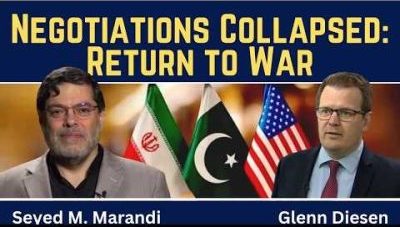
Seyed M. Marandi: Negotiations Collapsed – Return to War
or go to
Aletho News Archives – Video-Images
From the Archives
Wartime internment camps in Australia
National Archives of Australia
World War I
During World War I, for security reasons the Australian Government pursued a comprehensive internment policy against enemy aliens living in Australia.
Initially only those born in countries at war with Australia were classed as enemy aliens, but later this was expanded to include people of enemy nations who were naturalised British subjects, Australian-born descendants of migrants born in enemy nations and others who were thought to pose a threat to Australia’s security.
Australia interned almost 7,000 people during World War I, of whom about 4,500 were enemy aliens and British nationals of German ancestry already resident in Australia.
Records of World War I internment camps
World War II
During World War II, Australian authorities established internment camps for three reasons – to prevent residents from assisting Australia’s enemies, to appease public opinion and to house overseas internees sent to Australia for the duration of the war.
Unlike World War I, the initial aim of internment during the later conflict was to identify and intern those who posed a particular threat to the safety or defence of the country. As the war progressed, however, this policy changed and Japanese residents were interned en masse. In the later years of the war, Germans and Italians were also interned on the basis of nationality, particularly those living in the north of Australia. In all, just over 20 per cent of all Italians resident in Australia were interned. … continue
Blog Roll
 Aletho News
- Seyed M. Marandi: Negotiations Collapsed – Return to War
- Tomorrow’s naval blockade showdown
- ‘Israel’ attacks civilians to hide its embarrassing military failures & out of pure sadism
- Any Foreign Military Vessel Approaching Hormuz Under Any Pretext ‘Will Be Dealt With Severely’: IRGC
- Diplomats slam US negotiators’ performance in Iran talks
- Trump Refuses Exit Ramp, War with Iran will Continue
- Trump Says US Naval Blockade in Strait of Hormuz Will Begin Shortly
- US, Iran end 21-hour talks without agreement
- US IRAN TALKS: Who Are the Crazy Ones Here? /Lt Col Daniel Davis
- Talks with the US end without a deal over excessive US demands: Iran
- If Americans Knew
- US-Iran ceasefire negotiations make zero progress – Daily Update
- Pro-Israel ‘Thinktanks’ and Individuals who Influence U.S. Foreign Policy
- Mearsheimer reveals how Israel dictates US policies on Iran, Gaza – video
- After killing 350+, Israel still has a “score to settle” with Lebanon before ceasefire – Daily Update
- Military aid to Israel emerges as the latest political litmus test for Democrats
- The only Palestinian children’s rights organization closes following years-long Israeli campaign against it
- ‘I Can’t Forget the Smell’: Lebanese Reel After Israel Kills Over 300 in Single Day
- DNC Shoots Down Resolutions Calling Out AIPAC and Limiting Arms to Israel
- TCN: Is Israel Blackmailing President Trump?
- Israel killed at least 303 Lebanese yesterday – who were they? Daily Update
- No Tricks Zone
- Cave Discovery Reveals Today’s Desert Climates Were Recently Far Warmer, Wetter, Teeming With Life
- German Expert: Heat Dome Led To Record Temps In Western USA…Warmer In 1934, 1936
- New Study: No Linear Warming Or Glacier Retreat Along Northern Antarctic Peninsula Since 1980s
- An Inconvenient Tree: Uncovered In Alps… Europe Much Warmer Than Today 6000 Years Ago
- New Study Reports A 60% Slowdown In Greenland’s Ice Loss Rate In The Last Decade
- Low Intensity Tornado Wrecks Major Solar Farm, Creating A Potential Toxic Dump
- New Study Finds Warming Saves Lives…Cold Temperatures 12 Times More Deadly Than Excess Heat
- German Science Blog Accuses PIK Climate Institute Of Hallucinating Climate Tipping Points
- Devastating Assessment Of Comirnaty Vaccine By Former Senior Pfizer Europe Toxicologist
- New Study: CO2 Is ‘Effectively Negligible’ As An Explanatory Climate Change Factor Since 2000
 Aletho News