Aletho News

ΑΛΗΘΩΣ

NATO without America: Europe’s trial run ends in a reality check

Steadfast Dart 2026 exposes how fragile European security looks once the US steps aside

By Andrei Medvedev | RT | January 20, 2026

NATO has launched major military exercises – Steadfast Dart 2026. The drills involve over 10,000 troops from 11 countries: Germany, Italy, France, the UK, Spain, Belgium, the Czech Republic, Lithuania, Bulgaria, Greece, and Türkiye. The primary goal is to assess the bloc’s readiness for the rapid deployment of substantial forces. The exercises will continue until mid-March.

At first glance, it might seem like just another NATO exercise. But here’s the catch: The US is not taking part. The initiative is purely European, and aims to achieve two main objectives. Firstly, it seeks to demonstrate that Europe is strong, unafraid of American influence, and capable of protecting its interests – not only by producing AI animations about heroic Vikings defending Greenland, but through real military strength.

The second goal is to find out whether Europe can operate independently, without US support. The answer is probably not. It’s no secret that 70% of NATO’s budget comes from US contributions. But beyond finances, NATO intelligence is primarily reliant on the US. Satellite communication, coordination, and command structures are also all built around a model in which the US acts as the ‘big brother’ to its European partners.

Russian journalists have witnessed this dynamic in Kosovo, Bosnia, and Afghanistan (NATO did not officially conduct an operation there, but in reality, it entered the country). Who owns the largest and safest bases? Who oversees all sector units? Who plans operations and sets combat tasks? The big brother – the US. In Kosovo, for instance, NATO allies couldn’t just enter Camp Bondsteel. The base was American, and the Europeans had to get a special pass to enter.

Until recently, Europe seemed perfectly content with its ‘junior partner’ status. What fueled the EU’s prosperity? Cheap Russian (initially Soviet) resources with stable supply lines and minimal security expenses. Security was outsourced to the Americans: US bases, air support, missile defense… Then Trump came along, and in typical businessman fashion, said if you want protection, you’ll have to pay for it.

Is there a NATO without the US? That’s the question European military leaders will grapple with during these exercises – though they likely already know the answer. Sure, NATO would exist, but it would be very costly for the EU; or perhaps it won’t exist at all, which means Europe must concede that the master will do as he pleases. And the ‘master’ – America – is well aware of this.

US Treasury Secretary Scott Bessent recently stated that the US will remain in NATO. But just look how he put it. Asked what’s more important to US security interests, NATO or Greenland, Bessent replied: “That’s a false choice. The European leaders will come around. And they will understand that they need to be under the US security umbrella.”

In the current climate, when Europe’s economy is struggling (for example, BMW and Mercedes are now using Chinese engines, and BASF is making only a third of what it used to), the idea of a European NATO seems far-fetched. Europe just doesn’t have the money for it.

Neither does it have the military equipment – most of it has been sent to Ukraine, and what’s left would last a month or so in a high-intensity conflict. Moreover, Euro-NATO doesn’t have that many armies with real combat experience outside of the bloc.

Sure, there is France, which has been engaged in prolonged operations in the Sahel. And Türkiye. However, even their combat experience is powerless in a situation in which there is no money. Fighting Bedouins in the Sahel or Kurds in Syria is worlds apart from facing an adversary like China or Russia – or, in the new reality, the US.

The fact that the US is not taking part in NATO’s latest military exercises (despite being able to easily deploy their troops from bases in Germany or Italy) is quite telling. America’s message to Europe is clear: Let’s see how you do without us and then come running back.

The lesson is humiliating. But after all, they got into this mess by themselves.

January 20, 2026 Posted by | Economics, Militarism | , , , | Leave a comment

US’ European Vassals Taught Bitter Lesson With Greenland Crisis

Sputnik – 20.01.2026

Commenting on the topics discussed by Foreign Minister Lavrov in his 2025 diplomacy year-in-review presser, Daffodil International University journalism professor and international politics expert Greg Simons detailed two main themes: Ukraine and the breakdown of the so-called ‘rules-based international order’.

The Greenland crisis shows that “when you are such a servile lackey as the EU, eventually you get to be ‘on the menu’, especially when the US empire, this Pax Americana, is in decline,” Dr. Simons told Sputnik.

“The EU has nowhere to go.” Their leaders “can bluster, they can try and bluff, but to use Trump’s terminology, they have absolutely no cards… They have no honor, they have no dignity, they have no respect, either for themselves or the EU. So this is not going to go well for the EU.”

As for Ukraine, while Washington has apparently recognized that the proxy war with Russia is “lost” and that Ukraine is “a liability,” the Europeans are pushing headfirst into prolonging the conflict, no matter the cost to themselves, Simons noted.

“Europeans seem to have their head in the clouds and unaware or not willing to see” the “risks and hazards coming up for them,” the observer stressed.

Then there’s the dysfunction at the Organization for Security and Cooperation in Europe.

“If you prevent consensus on issues, an organization such as the OSCE is absolutely useless because consensus should be reached on objectively coming together on mutually acceptable and mutually favorable grounds,” Simons said.

“What they’ve turned it into is just this platform for pillorying countries such as Russia or those that stand for their interests and objectives rather than those of the US. I absolutely agree with the foreign minister’s characterization – that the situation of the OSCE is catastrophic. I would doubt it can be saved, mostly because of what the so-called Global North, those Western countries at the behest of the US did to make sure that it could no longer function effectively as an organization to be a bridge between different interests, different worlds (which it no longer is).”

January 20, 2026 Posted by | Progressive Hypocrite | , , , | Leave a comment

Europe Economic Panic

By Lorenzo Maria Pacini | Strategic Culture Foundation | January 18, 2026

When a prime minister advises his staff to rest because the coming year will be much more difficult, it is neither black humor nor fatigue. It is a moment of sincerity, the kind that only emerges when internal projections no longer support the public narrative.

Giorgia Meloni was not addressing the electorate. She was addressing the machinery of the state itself, the administrative core charged with implementing decisions whose effects can no longer be hidden. Her observation was not about a normal increase in workload. She was talking about constraints, about limits being reached, about a Europe that has moved from crisis response to a phase of controlled contraction, fully aware that 2026 is the year when deferred costs will eventually converge.

What has leaked out is what European ruling circles have already understood: the Western strategy in Ukraine has run up against material limits. Not with Russian messages, not with disinformation, not with populist dissent, but with steel, ammunition, energy, manpower, and time. Once these realities assert themselves, political legitimacy begins to erode.

The EU cannot sustain this war economically. Europe can strike poses of readiness. It cannot manufacture war.

After years of high-intensity conflict, both the US and Europe are rediscovering a long-forgotten truth: wars of this nature cannot be sustained with speeches, sanctions, or the abandonment of diplomacy. They require bullets, missiles, trained personnel, maintenance cycles, and industrial production that consistently exceeds battlefield losses. None of this exists, not in sufficient quantities, and it is not feasible in the timeframe preached in Brussels.

Russia is producing artillery ammunition in quantities that Western officials now openly admit exceed NATO’s total production. Its industrial base has shifted to near-continuous wartime production, with centralized procurement, streamlined logistics, and state-led manufacturing, without even total mobilization. Estimates place Russian production at several million artillery shells per year, already delivered, not just projected.

Europe, meanwhile, spent 2025 congratulating itself on targets it is structurally incapable of achieving. The EU’s stated commitment of two million shells per year depends on facilities, contracts, and labor that will not be available by the decisive period of the war, if ever. Even if achieved, the figure would still be less than Russian production. The US, despite emergency expansion, expects about one million shells per year once full ramp-up is complete, and only if that happens. Even on paper, combined Western production struggles to match what Russia is already producing in practice. The imbalance is clear.

This is not just a deficit, but a misalignment of timing. Russia is producing now. Europe is planning for the future. And time is the only factor immune to sanctions.

Washington, in fact, cannot indefinitely compensate for Europe’s eroded capacity because it faces its own industrial difficulties. Patriot interceptor production remains in the order of a few hundred per year, while demand simultaneously concerns Ukraine, Israel, Taiwan, and the replenishment of US stocks: an imbalance that, as Pentagon officials admit, cannot be resolved quickly. Shipbuilding tells a similar story: submarines and surface ships are years behind schedule due to labor shortages, aging infrastructure, and skyrocketing costs, pushing significant expansion toward 2030. The assumption that America can indefinitely support Europe is no longer in line with reality. This is a systemic Western problem.

Unfounded war rhetoric

European leaders talk about a “state of war” as if it were a rhetorical position, but in reality, it is an industrial condition that Europe does not meet.

New artillery lines take years to reach stable production. Air defense interceptors are produced in long, batch-based cycles, not in sudden spikes. Even basic components such as explosives remain a critical issue, with plants that closed decades ago only now reopening and some not expected to reach full capacity until the late 2020s. This timeline is in itself an admission.

Europe’s weakness is not intellectual, but institutional: huge sums have been authorized, but procurement inertia, fragmented contracts, and a depleted supplier base have meant that deliveries are years behind schedule. France, often described as Europe’s most capable arms manufacturer, is capable of building advanced systems, but only in limited quantities, counted in dozens, while a war of attrition requires thousands. EU ammunition initiatives have expanded capacity on paper, while the front has exhausted ammunition in a matter of weeks.

These are not ideological shortcomings, but administrative and industrial failures, which are exacerbated in stressful situations. It is yet another example of the failure of European Community policy, so much so that the structural contrast is stark. Western industry has been optimized for shareholder returns and peacetime efficiency, while Russian industry has been reoriented to withstand pressure. NATO announces aid packages. Russia counts deliveries. You can already guess what the outcome of this situation will be, right?

This industrial reality explains why the debate on asset freezing was so important and why it failed. Europe did not pursue the seizure of Russian sovereign assets out of legal ingenuity or moral determination, but because it needed time: time to avoid admitting that the war was unsustainable in Western industrial terms, time to replace production with financial maneuvers.

When the effort to confiscate some €210 billion in Russian assets failed on December 20, blocked by legal risks, market repercussions, and opposition led by Belgium, with Italy, Malta, Slovakia, and Hungary opposing total confiscation, the Brussels technocracy settled for a reduced alternative: a €90 billion loan to Ukraine for 2026-27, with interest payments of around €3 billion per year. This further mortgages Europe’s future. This is not a strategy, but emergency triage. A collapsing political hospital. Pure panic.

Narrative, crisis, disaster

The deeper reality is that Ukraine is no longer primarily a military dilemma, it is a question of solvency. Washington recognizes this, because it cannot absorb the reputational discomfort, but they cannot take on unlimited responsibility forever. A way out is being explored, discreetly, inconsistently, and shrouded in rhetorical cover.

Europe cannot admit the same necessity, because it has ultimately adopted ‘Putin’s version’, i.e. it has framed the war as existential, civilising, moral – but do you remember when European politicians enjoyed calling Putin crazy for talking about a clash of civilisations?

Compromise has become appeasement, negotiation surrender. In doing so, Europe has eliminated its own escape routes. Well done, ladies and gentlemen!

On the narrative front, greetings to all. The aggressive enforcement of the EU’s Digital Services Act has less to do with security than with containment: building an information perimeter around a consensus that cannot survive open scrutiny. Translated: censorship as a solution. The truth of the matter must not be made known, and those who try to do so must be suppressed in an exemplary manner. This also explains why regulatory pressure now extends beyond European borders, generating transatlantic friction over freedom of expression and jurisdiction. Confident systems welcome debate. Fragile ones suppress it. In this case, censorship is not ideology, but a form of insurance.

The information crisis, rest assured, will very soon become… a social crisis ready to detonate into domestic conflict.

And the crisis is also one of resources and energy. We are witnessing the securitization of decline, whereby obligations are postponed while the productive base needed to sustain them continues to shrink. It’s a cat chasing its tail. Here too, you know how it will end, don’t you?

Europe has not only sanctioned Russia. It has sanctioned itself. European industry will continue to pay energy prices well above those of its competitors in the United States or Russia throughout 2026. Take a trip around Europe, read the headlines in local newspapers, look at people’s faces: the fabric of small and medium-sized enterprises, the true beating heart of entire EU countries, is quietly disappearing. And this is logically reflected in large companies too. This is why Europe cannot increase its production of ammunition and why rearmament remains an aspiration rather than a concrete operation.

Energy, we said. Low-cost energy was not a convenience, it was essential. If it is eliminated through self-inflicted damage, the entire structure is emptied. Even the most ambitious plans preached for years, such as the IMEC corridor, are still a mirage. There is a stampede towards Turkey, Azerbaijan, and Georgia to try to scrape together a few kilowatts. A ridiculous attempt to save what is now tragically unsalvageable.

China, observing all this, represents the other half of Europe’s strategic nightmare. It controls the world’s deepest manufacturing base without having entered into a position of war. Russia does not need China’s full capacity, only its strategic depth in reserve. Europe has neither.

A frightening 2026

2026 therefore looks set to be a terrible year, I’m sorry to say. The European elites find themselves losing control on three fronts at once. On finance, because the budget will be bitter and the money for the insane support to Kiev will no longer be the same. On narrative, because the question citizens will ask themselves will be ‘what was the point of all this?’. On the cohesion of the Alliance, both NATO and the EU, because Washington’s disengagement will force a review of the balance of power on the European continent to the point of no return and, perhaps, a break between the two sides divided by the ocean.

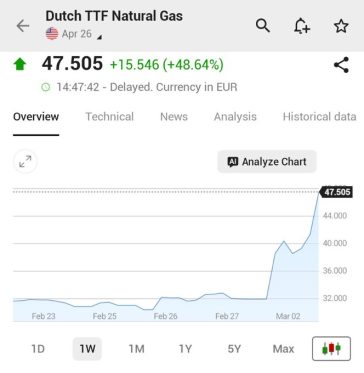
Panic, again. Not a sudden defeat, but the slow erosion of legitimacy as reality creeps in through gas that costs as much as gold, closed plants, empty stockpiles, obsolete rifles, and a future that is turning away.

This is not just a difficult situation for Europe, but a matter of civilization. A system incapable of producing, supplying, speaking honestly, or retreating without collapsing in credibility has reached its limit. When leaders begin to prepare their institutions for worse years, they are not anticipating inconveniences, but recognizing structural failure.

Empires proclaim victory loudly. Declining systems quietly lower expectations or, in this case, momentarily say the quiet part out loud. But the truth is that nothing is the same as before, and it is obvious.

For most Europeans, the reckoning will not come as an abstract debate about strategy or supply chains, but as a simple realization: this was never a war they consented to. It did not defend their homes, their prosperity, or their future. And so, again, how do you think it will end?

An ideological war has been fought in the name of imperial ambition and financed through declining living standards, industrial decline, and the prospects of their children. In the name of big pro-European capital, of the privileged few with robes, stars, and crowns.

For months, even years, it was said that “there was no alternative” and that this was the only course of action. And now?

Europeans are tired. They want peace, stability, and the quiet dignity of prosperity: affordable energy, a functioning industry, and a future unencumbered by conflicts they NEVER chose and, above all, they do not want the decline of millennia-old civilizations.

And when this awareness has taken hold, when the fear has faded and the spell has been broken, the question Europeans will ask themselves will not be technical or ideological. It will be existential. And all existential questions lead to radical choices, even terrible ones.

May this dramatic fear keep the mad leaders of this Europe awake at night.

January 18, 2026 Posted by | Civil Liberties, Economics, Militarism, Russophobia | | 1 Comment

Latest US-backed regime change operation in Iran hits the wall

By Samuel Geddes | Al Mayadeen | January 17, 2026

Having bombed the country in 2025, “Israel” and the US seemed to think that provoking street violence would have more success at collapsing the Iranian state. Instead, it fizzled almost instantly.

We have been here at least half a dozen times in the past two decades. Street protests in Iran over an internal economic, social or political issue emerge, gather a degree of momentum in urban areas and the Western propaganda system declares that the protests have “shifted” from their initial focus, to calls for the repudiation of the Islamic Revolution and the end of the political system it created. European and American politicians issue their empty statements of solidarity with the Iranian people and unilaterally decide that the Islamic Republic has “lost its legitimacy,” that its fall is simply a matter of “when,” not “if.” We have seen this narrative played out often enough to recognize it never survives contact with the real world.

The source of the persistent delusion that the Islamic Republic is about to fall comes not only from the Euro-American elite class wishing it to be so, but also from its deferral to the “analysis” of segments of the diaspora whose own political objectives are detached from reality.

Whether it is protests over the government’s handling of the economy, energy blackouts, or the water crisis, most external observers are incapable of viewing each individual issue through any lens other than that of regime change.

This time around the US and Israelis, in coopting the protests to destabilize the country through street violence, have not even bothered to hide their involvement. It has also not helped the West’s case that it is now feigning “humanitarian concern” for the rights of Iranian citizens while it has spent more than two years facilitating the ongoing slaughter and starvation of Gaza’s population. Any observer following both issues can detect the dissonance and conclude what is motivating the frantic calls to escalate the situation into military intervention. That is, the desire to crush a state and society that has resisted Western dominance for more than four-and-a-half decades.

The brazenness of the West’s affected concern for the well-being of the Iranian public is particularly galling in light of the sanctions. If Iranians’ living standards were really of any concern to Washington, London or Brussels, they would start by unconditionally ending their economic strangulation in effect against the country. The truth is that the suffering and misery engendered by the sanctions is entirely the point. As well as stifling the development of an independent state outside the globalized-Western economy, the siege is specifically intended to make living conditions unbearable for the average Iranian so that they are incentivized to undermine the Islamic Republic. The continuation of the sanctions is a barely disguised punishment of the Iranian public for not pursuing the West’s geopolitical goal of regime-change for them.

Were it not glaringly obvious to the Trump administration before the latest unrest, it surely is now that the exiled political diaspora most actively pushing for the fall of the Islamic Republic through Western military action are entirely incapable of political organization. Even the least crazed fan of the defunct Pahlavi dynasty is pathologically hostile to the terrorist personality cult of the MEK, as much as they are to the Islamic Republic itself. There simply is no political alternative, to say nothing of whether it even has any domestic support, waiting to replace the Islamic Republic.

Flush from the “success” of his abducting Venezuelan president Maduro, Trump seemed temporarily convinced he might have a similar option here, to carry out a meaningless military stunt for which he can take credit and declare “victory.” His problem is that there is no level of open military action against Iran that would allow him to do this without igniting a regional war that destroys the global economy.

This realization, if he has come to it, would explain his backtracking on the red lines he set, that any executions would trigger US attacks. If a controlled, stage-managed performance is his goal, as it almost always is, then the confrontation with Iran leaves him with no viable option but to back down.

The absence of any realistic military option has now seen both the US and Europe revert to their standard tactic; the intensification of the sanctions they have used to punish the Iranian people. Trump’s latest declaration of a 25% tariff on any country trading with Iran is his way of giving himself an off-ramp, for now, from a crisis that is largely of his making.

January 17, 2026 Posted by | Wars for Israel | , , , , , | Leave a comment

Ukraine is defending itself with money Europe doesn’t have

By Ian Proud | Strategic Culture Foundation | January 17, 2026

The ugly truth is that an end of the Ukraine war may have as devastating economic and political consequences for Europe as its continuance.

Ukraine already faces a $63 billion U.S. dollar funding shortfall in 2026 and I would be surprised if this figure doesn’t increase if the war continues. Ukraine’s massive fiscal splurge is driven by two factors

  • The enormous cost of maintaining a standing army of almost one million people;
  • The vast expense of importing weapons from the west to fight the war.

Weapon purchases are not sources of productive investment as they are literally burned in the heat of battle. The same, of course, is true for Russia. Both countries saw reducing economic growth in 2025, with Ukraine’s at 2.1% and 1.5%. And, western pundits would point to this as evidence that Ukraine’s economy is performing better.

But the opposite is true. Russia’s economy is around twelve times larger than Ukraine’s nominally and just over ten times larger when you look at GDP using purchasing power parity.

You can see this in the defence spending numbers.

Russia spent a record $143 billion on defence in 2025 compared to around $60 billion for Ukraine, so around 2.3 times higher. Yet, Russian defence spending amounted to just 6.3% of its GDP whereas for Ukraine it was 31.7%. So, massive spending on defence is a much less pivotal issue for Russia in terms of its economic fortunes.

Defence spending represents a far smaller proportion of total economic activity than it does for Ukraine. And Russia can afford to pay for its defence needs with its own finances, while Ukraine is entirely dependent on money from western donors to keep the war going.

Despite the massive cost of war, Russia ran a fiscal deficit of just 1.7% of GDP in 2025. That is still well below the EU fiscal rule of 3% of GDP with some countries like France and Poland having deficits at or more than double that figure.

Ukraine’s fiscal deficit on the other hand was around 20% of GDP. That gap had to be filled by foreign funding as it has debt of 107% of GDP and is cut off from foreign lending.

So, hence the EU stepping up with a loan of 90 billion Euros, two thirds of which is earmarked for defence.

Russia on the other hand has debt of around 15% of GDP and doesn’t really need to borrow heavily to keep its war effort afloat. By the way, 15% of GDP is far lower than the U.S. or any European nation, many of which, like Ukraine, have debt levels of over 100% of GDP.

Ukraine is defending itself with money Europe doesn’t have.

Despite the shock of sanctions, Russia doesn’t have to break the bank nor boost its lending significantly.

This also means that when the war eventually ends, Russia will be able to make the economic transition back to peace in a less painful way. Russia will be under no pressure to impose massive cuts to defence spending to live within its means and can instead do so gradually.

Ukraine on the other hand faces a massive financial cliff edge when the war ends.

Ukrainian economic growth according to the OECD is set to fall further to 1.7% in 2027 if the war continues.

And that assumes continued large injections of capital from outside countries. In 2025, Ukrainian defence spending made up 31.1% of Ukrainian GDP, and two thirds of state budgetary expenditure. None of that spending goes into improving Ukraine’s weak economy.

With all of the support that it receives, Ukraine’s GDP in 2025 amounted to just under $210 billion according to the IMF.

Bear in mind here that Ukraine received $52.4 billion in external financing in 2025, or around one quarter of its GDP at the end of the year.

Take away foreign funding and Ukraine suddenly sees its economy shrink by over 20%.

Or, put it another way, take away the war and Ukraine sees its economy shrink by over 20%.

Russia simply does not face the same problem.

Rather, an end to the war may help Russia to get inflation – perhaps its biggest economic challenge – under control as economic activity returns to its normal rhythm.

But still the question arises, how come Ukraine has grown so little when it received so much foreign funding?

One big reason is that Ukraine recorded a trade deficit of $30 billion over the same period, a record according to the National Bank of Ukraine.

So, $52 billion in foreign money came into Ukraine during the year and $30 billion went straight back out again. Because Ukraine’s massive trade deficit is fuelled by two things.

First, a huge increase in the import of weapons from western suppliers which have doubled since 2022, not least as they are no longer being provided free of charge.

Second, Ukraine has increased its imports of natural resources, in particular a massive increase in gas imports, because domestic production has been hit hard by the war. Coal is another area, as Russia has swallowed up important coal mines in the Donbas.

Not all of that deficit in trade will be recoverable even after the war ends, even if Ukraine was able to reduce the overall size of its trade deficit.

By comparison, Russia’s surplus of trade in goods was already at over $100 billion by October 2025, although the overall trade picture is narrower, at around $36 billion because of a significant deficit in services trade, including from large numbers of Russians who have moved overseas since the war started.

An end to the war, if anything, may allow Russia’s trade surpluses to grow further. A future relaxation on the import of natural resources into Europe could mean that Russia benefits from already increased trade with Asia and renewed trade with Europe.

In any case, the consistent surpluses that Russia pulls in both help shore up economic growth and foreign exchange reserves, which in 2025 grew by over $135 billion to a whopping $734 billion.

And just to be clear, Russia put their reserve funds almost completely into gold which now stand at over $310 billion.

One big reason for Russia storing its reserves in gold is to keep them clear of the stealing hands of western bureaucrats, who froze around $300 billion in reserves at the start of the war.

This means that Russia has a surplus of $434 billion in foreign exchange reserves which is almost completely insulated from western expropriation. The $10 billion rise in foreign currency reserves in 2025 was undoubtedly caused by an accumulation of reserves in non-dollar, Euro and sterling currencies, suggesting the move to greater trade in Chinese Yuan and Indian rupees.

An end to the war may at some point lead to the unfreezing of immobilised Russian assets in the U.S., Europe and Japan.

Ukraine’s reserve position is also comparatively strong, at $57.3 billion at the start of 2026, a record figure. However, that rise is completely down to inflows of foreign capital to fund the war effort. An end to the war would likely shrink Ukraine’s reserves as its stubborn trade deficit was not being offset by foreign inflows of funds as they had been during war.

But it’s the sudden and shocking loss of foreign funding that accompanies an end to the war which will cause Ukraine’s economy to shrink dramatically.

But fear not, Europe is determined that Ukraine maintain an army of 800,000 personnel when the war ends. However, this seems more about economic survival than about security.

Ukraine would not be able to pay for such as large army with its own money, as it doesn’t have any money. So, once again, Europe will be forced to step in to meet Ukraine’s financing needs to pay the salaries of soldiers who are no longer in war fighting mode.

This will lead to debt and taxes rising in Europe, according to a recent Kiel Institute study. But it will also lead to a loss of business for European defence firms. Because peace time will inevitably mean a sharp drop in the munitions and military material being burned on a daily basis in the fog of war.

Two thirds of the EU’s recent 90 billion Euro loan to Ukraine will be spent on military support, including weaponry. That has sparked an argument between Germany and France over a proposed ‘buy European’ clause, with France wanting to prevent Ukrainian purchases of U.S. equipment. Perhaps with one eye on the future, the French in typical fashion, are trying to ensure that their firms get a decent share of what could amount to dwindling Ukrainian orders for weapons.

A bit like the French army, Europe is reversing itself inevitably into economic defeat when the war ends.

Obligated to keep an economically failed Ukraine on life support.

Having to increase its debt and taxes to support bad foreign policy decisions it has been taking since 2014.

Trying to boost its defence industrial complex but losing business with the end of war.

For the mainstream political parties in Europe, this adds to the trend of them heading towards electoral Armageddon when they start putting themselves to the polls from 2027 onward.

Until then, they are stuck, knowing that continuing the war will kill them electorally, and knowing that ending the war will too. To quote my old British soldier dad, they are like the mythical oozlum bird, continually going round in circles until they disappear up their own backsides.

January 17, 2026 Posted by | Economics, Militarism | , , | Leave a comment

The West vs. the Rest

How developing countries took control of climate negotiations and what that means for emission reduction.

By Robin Guenier | Climate Scepticism | December 8, 2025

The main reason why, despite countless scientific warnings about dangerous consequences, greenhouse gas (GHG) emissions continue to increase is rarely mentioned. Yet it’s been obvious for several years – at least to anyone willing to see it. It’s this: most countries outside Western Europe, North America and Australasia are either unconcerned about the impact of GHGs on the climate or don’t regard the issue as a priority, focusing instead for example on economic growth and energy security. Yet these countries, comprising about 84 percent of humanityi, are today the source of about 77 percent of emissions; 88 percent if the United States, which has now joined their ranks, is included.ii Therefore, unless they change their policies radically – and there’s no serious evidence of their so doing – there’s no realistic prospect of the implementation of the urgent and substantial cuts in GHG emissions called for by many Western scientists.

To understand how this has happened, I believe it’s useful to review the history of environmental negotiation by focusing in particular on six UN-sponsored conferences: Stockholm in 1972, Rio in 1992, Kyoto in 1997, Copenhagen in 2009, Paris in 2015 and Belém (Brazil) in 2025.

Stockholm 1972

In the 1940s, 1950s and 1960s many Western environmentalists were seriously concerned that technological development, economic growth and resource depletion risked irreversible damage to humanity and to the environment.iii Clearly a global problem, it was agreed that it had to be tackled by international, i.e. UN-sponsored, action.

The result was the UN Conference on the Human Environment held in Stockholm in 1972.iv From its outset it was recognised that, if the conference was to succeed, an immediate problem had to be solved: the perceived risk was almost exclusively a Western preoccupation, so how might poorer countries be persuaded to get involved?v

After all, technical and industrial development were essentially the basis of the West’s economic success and that was something the rest of the world was understandably anxious to emulate – not least to alleviate the desperate poverty of many hundreds of millions of people.vi The diplomatic manoeuvrings needed to resolve this seemingly irreconcilable conflict set the scene for what I will refer to as ‘the Stockholm Dilemma’ – i.e. the conflict between Western fears for the environment and poorer countries’ aspirations for economic growth. It was resolved, or more accurately deferred, at the time by the linguistic nightmare of the conference’s concluding Declaration which asserted that, although environmental damage was caused by Western economic growth, it was also caused by the poorer world’s lack of economic growth.vii

After 1972, Western environmental concerns were overshadowed by the struggle to deal with successive oil and economic crises.viii However two important European reports, the Brandt Report in 1980 and the Brundtland Report in 1987, dealt with the economic gulf between the West and the so-called Third World.ix In particular, Brundtland – echoing Stockholm – concluded that, because poverty causes environmental problems, the needs of the world’s poor should be given overriding priority; a principle to be enshrined in the climate agreement signed in Rio. The solution was the now familiar ‘sustainable development’.x

Rio 1992

Western environmental concerns were hugely re-energised in the late 1980s when the doctrine of dangerous (possibly catastrophic) global warming caused by mankind’s emissions of GHGs, especially carbon dioxide (CO2), burst onto the scene.xi As a result, the UN organised the landmark Conference on Environment and Development (UNCED) – the ‘Earth Summit’ held in Rio in 1992.xii It was the first of a long series of climate-related international conferences that led for example to the so-called ‘historic’ Paris Agreement in 2015.

A key outcome of the 1992 Earth Summit was the United Nations Framework Convention on Climate Change (UNFCCC). Adopted in 1992 and commonly known as ‘the Convention’, it’s an international treaty that came into force in 1994. It remains to this day the definitive legal authority regarding climate change.xiii Article 2 sets out its overall objective:

The ultimate objective of this Convention and any related legal instruments that the Conference of the Parties may adopt is to achieve … stabilization of greenhouse gas concentrations in the atmosphere at a level that would prevent dangerous anthropogenic interference with the climate system.

It’s an objective that’s failed. Far from being stabilised, after 1992 emissions accelerated and, by 2025, emissions had grown by over 65 per cent.xiv This is essentially because the Convention attempted to solve the Stockholm Dilemma by dividing the world into two blocs: Annex I countries (essentially the West and ex-Soviet Union countries – the ‘developed’ countries) and non-Annex I countries (the rest of the world – the ‘developing’ countries). This distinction has had huge and lasting consequences – arising in particular from the Convention’s Article 4.7:

The extent to which developing country Parties will effectively implement their commitments under the Convention … will take fully into account that economic and social development and poverty eradication are the first and overriding priorities of the developing country Parties.xv [My emphasis]

In other words, developing countries were, in accordance with Brundtland’s conclusion, expressly authorised to give overriding priority to economic growth and poverty eradication – even if that meant increasing emissions. And that’s why the Annex I/non-Annex I bifurcation has plagued international climate negotiations ever since: for example, it’s the main reason for the Copenhagen debacle in 2009 and for the Paris failure in 2015 (see below).

Western countries had hoped – even expected – that the Rio bifurcation would in time be modified so that, in line with their development, major developing countries would eventually become members of the Annex I group.xvi But such hopes were dashed at the first post-Rio climate ‘Conference Of the Parties’ (COP) held in Berlin in 1995 (COP1) when it was agreed that there must be no new obligation imposed on any non-Annex I country.

This principle, ‘the Berlin Mandate’, meant that the bifurcation and its associated ‘common but differentiated responsibility’ principle were institutionalised as tenets of the Convention.xvii And, before the next climate conference in 1996 (COP2 in Geneva), G77+China made it clear that this should not be changed.xviii

Kyoto 1997

The impact of this was made harshly apparent at the next conference: COP3 in Kyoto in 1997. Kyoto was supposed to be critically important – the original hope had been that negotiations would result in all countries accepting commitments to reduce their GHG emissions. But, because the US decided that it wouldn’t accept obligations that didn’t apply to other major countriesxix and because of the Berlin Mandate, in the event the agreed Kyoto Protocol reduction obligations applied only to a few, largely Western, countries.xx As a result and because developing countries refused even to acknowledge that they might accept some future obligation, it was becoming obvious to some observers that the UN process was getting nowhere – somehow the developing countries had to be persuaded that emission reduction was in their best interests.

But how? The passage of 25 years hadn’t resolved the Stockholm Dilemma – difficult enough in 1972, the UNFCCC bifurcation and the Berlin Mandate had made it worse. Yet it was recognised that, without these, developing countries might simply refuse to be involved in climate negotiations, making the whole process meaningless – something the UN and Western countries were unwilling to contemplate. So, if Kyoto was a failure, it was arguably a necessary failure if there was to be any prospect of emission reduction in due course. And that was the story for the next twelve years: at successive COP conferences the major developing countries, ignoring increasingly dire climate warnings from Western scientists, refused to consider amending the UNFCCC bifurcation.

A result of that refusal was that many developing countries’ economies continued their spectacular growth, resulting in rising living standards and unprecedented poverty reduction.xxi But inevitably emissions also continued to grow: in just 12 years, from 1997 (Kyoto) to 2009 (Copenhagen) and despite 12 COPs, they increased by over 30%.xxii

Copenhagen 2009

In 2007 the UN’s Intergovernmental Panel on Climate Change (the IPCC), a body that reports every seven years on the current physical scientific understanding of climate change, published its fourth report (AR4) – a report that intensified the West’s insistence that urgent and substantial emission cuts were essential.xxiii

A result was an ‘Action Plan’ agreed at the 2007 climate conference (COP13) in Bali.xxiv It set out how it was hoped all countries would come together at Copenhagen in 2009 (COP15) to agree a comprehensive and binding deal to take the necessary global action. Many observers regarded this as hugely significant: Ban Ki-moon, then UN Secretary General, speaking at Copenhagen said, ‘We have a chance – a real chance, here and now – to change the course of our history’’.xxv And, as always, dire warnings were issued about the consequences of failure: UK Prime Minister Gordon Brown for example warned that, if the conference failed to achieve a deal, ‘it will be irretrievably too late’.xxvi

There was one seemingly encouraging development at Bali: developing countries accepted for the first time that emission reduction by non-Annex I countries might at least be discussed – although they insisted that developed countries were not doing enough to meet their Kyoto obligations.xxvii But the key question of how far the developing countries might go at Copenhagen remained obscure – for example was it at least possible that the larger ‘emerging economies’ such as China and India and major OPEC countries such as Iran and Saudi Arabia might cease to be classified as ‘developing’? The EU and US not unreasonably thought that should happen, especially as it was by then obvious that, unless all major emitting countries, including therefore big developing economies, were involved, an emission cutting agreement would be neither credible nor effective. Some Western negotiators hoped that the bifurcation issue might at last be settled at Copenhagen.

But it wasn’t. In the event, developing countries refused to budge, insisting for example that developed countries’ historic responsibility for emissions was what mattered. As a result, the West was humiliatingly defeated, with the EU not even involved in the final negotiations between the US and the so-called BASIC countries (Brazil, South Africa, India and China).xxviii

One commentator noted:

There was a clear victor. Equally clearly, there was a side that lost more comprehensively than at any international conference in modern history where the outcome had not been decided beforehand by force of arms.’ xxix

The Copenhagen failure was a major setback for the West.xxx It was now established that, if the developing countries (including now powerful economies such as China, India, South Korea, Brazil, South Africa, Saudi Arabia and Iran) rejected a suggestion that their economic development be subject to emission control, that position would prevail. Yet by 2010 these countries were responsible for about 60% of global CO2 emissions xxxi; without them, major global emission cuts were clearly impossible.

The years following Copenhagen, from Cancún (COP16) in 2010 to Lima (COP20) in 2014, reinforced the West’s concerns as developing countries continued to insist they would not accept binding commitments to reduce their emissions.xxxii

Paris 2015

It was becoming obvious that, if there was to be any prospect of emission reduction, there had to be some fresh thinking. So the UN proposed a new methodology for the summit scheduled for 2015 in Paris (COP21): instead of an overall global reduction requirement, a new approach should be implemented whereby countries would individually determine how they would reduce their emissions and that this would be coupled with a periodic review by which each country’s reduction plans would be steadily scaled up by a ‘ratcheting’ mechanism – a critically important development.

But, when countries’ plans (then described as ‘Intended Nationally Determined Contributions’ (INDCs)) were submitted to the UNFCCC secretariat prior to Paris, it was clear that little had been achieved: hardly any developing countries had indicated any intention of making absolute emission cuts. Instead their INDCs spoke merely for example of reducing CO2 emission intensity in relation to GDP or of reducing the percentage of emissions from business-as-usual projections.xxxiii

It had been hoped that NDCs (as they became known) would be the vehicle whereby major emerging (‘developing’) economies would at last make emission reduction commitments. Yet they turned out to be a problem that undermined the Paris Agreement – see below. And, in any case, other provisions of the Agreement in effect exempted developing countries from any obligation, moral, legal or political, to reduce their emissions.xxxiv For example, the Agreement was described in its preamble as being pursuant to ‘the objective of the Convention [and] guided by its principles’ and further described in Article 2.1 as ‘enhancing the implementation of the Convention’. In other words, the developed/developing bifurcation remained intact and developing countries could continue to give overriding priority to economic development and poverty eradication. Moreover, under Article 4.4 of the Agreement, developing countries, in contrast to developed countries, were merely ‘encouraged to move over time towards economy-wide emission reduction or limitation targets’. Hardly an obligation to reduce their emissions.

It was not an outcome many wanted. For example, when ex UN Secretary General Kofi Annan was asked in early 2015 what he would expect to come out of the Paris summit, he replied:

Governments have to conclude a fair, universal and binding climate agreement, by which every country commits to reducing emissions of greenhouse gases.‘ xxxv

Western negotiators had intended that Paris should have a very different outcome from that achieved. Hence this 2014 statement by Ed Davey, then UK Secretary of State responsible for climate negotiations: ‘Next year in Paris in December … the world will come together to forge a deal on climate change that should, for the first time ever, include binding commitments to reduce emissions from all countries.’ xxxvi

But it didn’t happen. Developing country negotiators, led by China and India, ignored the West’s (in the event, feeble) demands. And Western negotiators, determined to avoid another Copenhagen-like debacle, didn’t press the issue. Hence the Paris agreement’s failure to achieve the West’s most basic aim: that powerful ‘emerging’ economies should be obliged to share in emission reduction.

The Stockholm Dilemma was still unresolved.

Might that change in the near future? Events since 2015 indicate that that’s most unlikely:

A major post-Paris example was a climate ‘action summit’ convened by UN Secretary General António Guterres for September 2019, calling for national plans to go carbon neutral by 2050 and new coal plants to be banned from 2020.xxxvii But, just before the summit, the environment ministers of the so-called ‘BRICS’ countries (Brazil, Russia, India, China and South Africa) effectively undermined it by reaffirming their commitment to ‘the successful implementation of the United Nations Framework Convention on Climate Change (UNFCCC), its Kyoto Protocol and its Paris Agreement’. In other words, these five countries (the source of about 45 percent of emissions) were indicating that they continued to regard themselves, under the UNFCCC and Paris framework, as exempt from any binding reduction obligation.xxxviii As a result the summit was a failure.xxxix

So it was not surprising that COP25 (December 2019 in Madrid) made no real progress: it ended with no substantive agreement on emission reduction and was widely described as another failure.xl

Might that change – for example might major developing countries enhance their NDCs as required by the ‘ratchet’ provision of the Paris Agreement? The test would be the next UN conference (COP26) to be held in Glasgow in November 2021 – postponed from 2020 because of the COVID 19 crisis.xli

But COP26 failed that test. And that was despite it being rated by the Guardian in July 2021 as ‘one of the most important climate summits ever staged’, despite Alok Sharma (COP26’s president) stressing that leaving ‘Glasgow with a clear plan to limit global warming to 1.5C’ would ‘set the course of this decisive decade for our planet and future generations’ and despite Prince Charles (as he then was) giving another of his familiar warnings: ‘Quite literally, it is the last chance saloon. We must now translate fine words into still finer actions.’ xlii

That things were not looking good became apparent when several major emitters (e.g. Brazil, China, India, Russia, Saudi Arabia, Australia, Indonesia and Mexico) either failed to submit a new NDC in 2021 or submitted an updated NDC that was judged to lack any real increase in ambition, thereby failing to comply with the key Paris ‘ratchet’ requirement.xliii Yet the countries referred to above were in 2019 the source of over 40% of global emissions.xliv

COP26 itself got off to a bad start when China’s president Xi and Russia’s president Putin didn’t attend.xlv And the proceedings included various upsets – in particular a formal request made by a group of 22 nations known at the Like-Minded Developing Countries (LMDC), which included China, India and Saudi Arabia, made on 11 November 2021, that the entire section on the mitigation of climate change be removed from the draft COP26 text.xlvi It wasn’t wholly successful as COP26’s concluding text – the ‘Glasgow Climate Pact’ xlvii – did include an appeal for all countries to revisit and strengthen their 2030 emissions targets by the end of 2022. But that was essentially meaningless in practice as many major emitters had already failed to submit sufficiently strengthened NDCs (see above). In other words, COP26 ended with nothing of real importance being achieved.

All this confirmed yet again that developing countries, determined to grow their economies and improve the lives of their people, had no serous intention of cutting back on fossil fuels. But nonetheless the can was once again kicked down the road; this time to COP27 to be held in Sharm El-Sheikh, Egypt in 2022. And in the meantime events moved on much as before with most countries – even the US – increasing their reliance on fossil fuels (especially coal) and global CO2 emissions reaching their highest level ever.xlviii

And it was hardly a surprise therefore when COP27 turned out to be yet another conference that essentially achieved nothing, with one reviewer noting that key mitigation items — such as a 2025 global emissions peak or a phase-out of all fossil fuels — were dropped under pressure from ‘Saudi Arabia, Iran, Russia and other petro-states’.xlix Yet, far from giving up, the West now pinned its hopes on COP28 to be held in Dubai – the ‘first global stocktake’.

And the UN hoped that a ‘Climate Ambition Summit’ called by General Secretary António Guterres in September 2023 would boost the Conference’s prospects. But the absence of big emitters such as the US, China and India meant that the Summit turned out to be of little value.l

However the COP28 ‘stocktake’ – otherwise unremarkable – did include what many commentators thought was an important breakthrough.li In its paragraph 28, it said this:

The Conference of the Parties … calls on Parties to contribute to the following … Transitioning away from fossil fuels in energy systems, in a just, orderly and equitable manner, accelerating action in this critical decade, so as to achieve net zero by 2050 in keeping with the science.’

So, commentators said, there you have it: at long last we have an agreement (a ‘pledge’) to transition away from fossil fuels! But of course that wasn’t true. The reality was that Paragraph 28 also said that parties must ‘take account’ of the Paris Agreement and, as specifically confirmed further down in paragraph 38, the ‘stocktake’ reaffirmed Article 4.4 of that Agreement. In other words, developing countries, the source of 65% of global emissions, continued to be exempted from any obligation to cut their emissions.

Attention now moved to Baku, Azerbaijan – to COP29 held in November 2024. But this conference was concerned almost entirely with finance and made no serious progress on emission reduction. And in any case proceedings were overshadowed by Donald Trump’s re-election as US President – causing great uncertainty and concern about future global climate politics.

Such concern was justified: it was over 50 years since the 1972 UN Conference on the Human Environment and there was still no sign of a solution to the Stockholm Dilemma and now a resurgent Trump made one even less likely. Yet once again the circus moved on – this time to Belém in Brazil.

Belém 2025

In the months running up to COP30 its prospects already looked dismal, despite the conference being dubbed ‘the implementation COP’. This was because, despite the Paris Agreement requirement, hardly any significant countries submitted updated NDCs either by February 2025, or even by the extended date at the end of September.lii To make matters even worse, few leaders of major economies turned up for the scheduled pre-COP leaders’ meeting: for example no one came from the United States, China, India, Russia, Indonesia, Japan, Saudi Arabia, Australia, Canada, South Korea, Türkiye or South Korea. Nonetheless Brazil’s President Lula announced that ‘COP30 will be the COP of truth’.liii

However over 56,000 delegates did turn up at the conference – the third largest number at any COP. And Brazil’s environment minister Marina Silva urged countries to have the ‘courage’ to address a fossil-fuel phaseout, and to work towards a roadmap for ending dependence on fossil fuels.liv It was a requirement echoed by about 80 countries which insisted via a letter to the COP President signed by 29 countries (including the UK, France, Spain and various small countries) that, unless the Conference outcome included a legally binding agreement to a ‘roadmap’ for a global transition away from fossil fuels, they would block the planned deal.lv

Unsurprisingly however negotiators from the majority of countries – not just the Arab oil producers as some commentators suggested, but also major countries such as India, China, Indonesia and other developing countries whose economies and peoples’ welfare depend on fossil fuels – showed no interest in the idea and the COP President simply ignored it. Humiliatingly the objectors climbed down. And the words ‘fossil fuels’ were not even included in the finally agreed text.lvi

This astute comment on the failure of COP30 was made by Li Shuo of the Asia Society (described as ‘a long-time observer of climate politics’):

This partly reflects the power shift in the real world, the emerging power of the BASIC and BRICs countries, and the decline of the European Union’.lvii

So once again a COP made no progress at all towards meeting the UNFCCC’s 1992 call for the ‘stabilization of greenhouse gas concentrations in the atmosphere’. It’s therefore hardly surprising that many commentators have queried whether there’s really any reason at all for continuing to hold all these huge and essentially pointless conferences.lviii

And it’s not only the Belém debacle that illustrates this. Far from it: nothing that’s happening today justifies any realistic hope that fossil fuels are on their way out. For example, major developing countries, especially India, China and in Southeast Asia, are focusing on coal to bolster economic growth and upgrade national security.lix And overall global emissions are still increasing. The early 2020 emission reductions caused by Covid 19 lockdowns were short-lived: as countries emerged from the pandemic determined to strengthen their economies, emission increases have continued.lx

The harsh reality – confirmed time and time again – is that nothing has really changed since the West’s comprehensive defeat at COP15 in Copenhagen in 2009. The truth is that most countries do not share the West’s preoccupation with climate change. Nor is there any prospect of that view changing for the foreseeable future.

Conclusion

At the time of the Rio Earth Summit in 1992 the West’s emissions were 41 percent of the annual global total – today (without the US) they’re only 9 percent. Thus it’s clearly impossible for what’s left of the West to satisfy many scientists’ calls for an urgent and substantial (about 50%) global emission reduction. That can only happen if all the other major countries completely change their climate policies. And that’s obviously not going to happen.

Yet, despite that clear message from the past thirty or more years of climate negotiation history, it’s a key reality that’s still being overlooked by many in the West: in particular by net zero supporters; by the mainstream media; by many scientific publications; by all climate ‘activists’; by many respected academic and scientific organisations; by politicians, governmental and non-governmental organisations; and by celebrities and social media. And by the United Nations.

It’s quite remarkable that there are still so many Western observers who seem not to have noticed that, over the past fifty years, the nature of the climate debate has radically changed as a result of major global political and economic developments. What’s happened is that what was once the so-called Third World has for a long time been powerful enough to ignore the West and take charge of environmental negotiation – a process that started with the ‘Berlin Mandate’ at COP1 in 1994 (see above). And the increasingly meaningless distinction between the ‘developing’ world and the ‘developed’ world, introduced by the UN in 1992 as a way of persuading poorer countries to get involved in climate negotiation, has paradoxically become the reason why progress on GHG reduction has become virtually impossible.

It’s surely obvious by now that the Stockholm Dilemma will never be resolved. And that there’s nothing the West (or more accurately the EU, the UK, Australia and a few smaller countries) can do about it.

Notes and references

i See https://srv1.worldometers.info/world-population/population-by-region/?utm_source=chatgpt.com

ii See https://edgar.jrc.ec.europa.eu/report_2025?vis=ghgtot#emissions_table

iii See for example Fairfield Osborn’s book The Plundered Planet (1948), William Vogt’s Road to Survival (1948), Rachel Carson’s Silent Spring (1962), the dire predictions in the Club of Rome report, Limits to Growth (1968) and, in particular, Barbara Ward’s report, Only One Earth (1972). Several of today’s environmentalists share the view that economic growth causes environmental degradation. See for example Less is More: How Degrowth Will Save The World (2021) by Jason Hickel.

iv Maurice Strong, a Canadian businessman-turned-diplomat, organised the Conference and was its Secretary General, having first commissioned Limits to Growth (see Note 3) that established much of its intellectual groundwork. He is widely seen as a pioneer of international environmental concern and of institutionalising it within the United Nations.

v At the time these countries were commonly referred to as ‘underdeveloped’ or, preferably, as ‘developing’. The ‘Third World’ was a standard label used for countries outside the Western or Soviet blocs.

vi Franz Fanon’s book The Wretched of the Earth (1961) was very influential in intellectual circles in the West at this time. Indian PM Indira Gandhi’s keynote speech at the Conference sets out the dilemma clearly: http://tiny.cc/dl6lqz. The speech is epitomised by this comment: ‘The environment cannot be improved in conditions of poverty.’

vii See Part One, chapter I (especially ‘proclamation’ 4) of this UN report on the conference: http://un-documents.net/aconf48-14r1.pdf.

viii See for example: https://www.federalreservehistory.org/essays/oil-shock-of-1978-79.

ix For Brundtland, see Our Common Futurehttp://www.un-documents.net/our-common-future.pdf.

x ibid – see paragraphs 27, 28 and 29 which do little to clarify the meaning of this rather vague concept.

xi Heralded in particular by James Hansen’s address the US Congress in 1988: https://www.sealevel.info/1988_Hansen_Senate_Testimony.html?utm_source=chatgpt.com

xii Described as the largest environmental conference ever held, the Summit’s outcome is outlined here: https://www.sustainable-environment.org.uk/Action/Earth_Summit.php

xiii For the full text of the UNFCCC see: https://unfccc.int/resource/docs/convkp/conveng.pdf

xiv See Note 1 above.

xv The omitted words are concerned with a different, but arguably equally important, issue: finance and technology transfer from developed to developing countries.

xvi See Article 4.2 (f) of the UNFCCC, under which parties might review ‘available information with a view to taking decisions regarding such amendments to the lists in Annexes I and II as may be appropriate, with the approval of the Party concerned’.

xvii See Article 2 (b) here: https://unfccc.int/resource/docs/cop1/07a01.pdf?utm_source=chatgpt.com

xviii This report provides some interesting background re non-Annex I parties’ determination: https://unfccc.int/resource/docs/1996/agbm/05.pdf?utm_source=chatgpt.com

xix See the Byrd-Hagel resolution adopted unanimously by the US Senate in June 1997: https://www.congress.gov/bill/105th-congress/senate-resolution/98/text It stated that the US would not sign a protocol putting limits on Annex I countries unless it imposed specific, timetabled commitments on non-Annex I countries.

xx For the text of the Kyoto Protocol see: https://unfccc.int/resource/docs/convkp/kpeng.pdf. Note in particular how Article 10’s provision that it did not introduce ‘any new commitments for Parties not included in Annex I’ ensured that developing countries were not bound by the Protocol’s emission reduction obligations.

xxi Note for example how China was responsible for an astonishing reduction in poverty from the 1980s to the early 2000s: https://ourworldindata.org/data-insights/extreme-poverty-in-china-has-been-almost-eliminated-first-in-urban-then-in-rural-regions?utm_source=chatgpt.com

xxii See Note 1 above.

xxiii See for example: https://www.ipcc.ch/report/ar4/syr/

xxiv The Bali Action Plan can be seen here: https://www.preventionweb.net/files/8376_BaliE.pdf?startDownload=true

xxv See the UN Secretary-General’s extraordinary speech in Copenhagen just before COP15: https://unfccc.int/files/meetings/cop_15/statements/application/pdf/speech_opening_hls_cop15_ban_ki_moon.pdf

xxvi The full extract: ‘If we do not reach a deal at this time, let us be in no doubt: once the damage from unchecked emissions growth is done, no retrospective global agreement in some future period can undo that choice. By then it will be irretrievably too late.’ See https://www.theguardian.com/environment/2009/oct/19/gordon-brown-copenhagen-climate-talks

xxvii In particular those confirmed by section 1(b)(i) of the Bali Action Plan – see Note 24 above.

xxviii See this overall review of the outcome: http://news.bbc.co.uk/1/hi/8426835.stm.

xxix Rupert Darwall: The Age of Global Warming, 310

xxx The ‘Copenhagen Accord’ was an attempt by some countries to rescue something from this debacle: https://unfccc.int/resource/docs/2009/cop15/eng/l07.pdf. A non-binding document (the Conference only ‘took note’ of it) it stated for example that global temperature should not rise more than 2ºC above pre-industrial levels – although it didn’t specify a date for this.

xxxi See Note 1 above.

xxxii See for example this report on the 2014 conference in Lima: http://tiny.cc/w4zv001

xxxiii For example, China’s INDC said only that it planned to ‘achieve the peaking of carbon dioxide emissions around 2030’ (no mention of the level of such ‘peak’ or of what will happen thereafter) and to ‘lower carbon dioxide emissions per unit of GDP by 60% to 65% from the 2005 level’. And South Korea merely said that it ‘plans to reduce its greenhouse gas emissions by 37% from the business-as-usual (BAU,850.6 MtCO2eq) level by 2030 across all economic sectors’, i.e. emissions will continue to increase but not by as much as they might have done.

Note that ‘Intended Nationally Determined Contributions’ (INDCs) are referred to as ‘Nationally Determined Contributions’ (NDCs) in Articles 3 and 4 of in the Paris Agreement – see Note 34 below. All NDCs submitted to the UNFCCC secretariat can be found here: https://unfccc.int/NDCREG

xxxiv The full text of the Paris Agreement can be found here: https://unfccc.int/files/meetings/paris_nov_2015/application/pdf/paris_agreement_english_.pdf

xxxv From an interview with the Observer in May 2025. Annan’s other comments are also interesting: https://www.kofiannanfoundation.org/publication/we-must-challenge-climate-change-sceptics/

xxxvi See the Ministerial Forward here: https://assets.publishing.service.gov.uk/government/uploads/system/uploads/attachment_data/file/360596/hmg_paris_2015.pdf

xxxvii https://climateaction.unfccc.int/Events/ClimateActionSummit

xxxviii My note was an extract from a press release by the PRC’s Ministry of Ecology and Environment: https://english.mee.gov.cn/News_service/news_release/201908/t20190829_730517.shtml?utm_source=chatgpt.com

xxxix https://populationmatters.org/news/2019/09/un-climate-action-summit-fails-to-deliver-climate-action/

xl http://tiny.cc/zg0w001 The official summary noted how countries such as China — speaking for the bloc including Brazil, India, South Africa — repeatedly called for developed countries to meet financial commitments: http://tiny.cc/3h0w001

xli https://www.reuters.com/article/us-health-coronavirus-climatechange-idUSKBN21J6QC/

xlii http://tiny.cc/js1w001http://tiny.cc/dv1w001 and http://tiny.cc/zs1w001

xliii https://ca1-clm.edcdn.com/assets/brief_-_countries_with_no_or_insignificant_ndc_updates_2.pdf?utm_source=chatgpt.com

xliv See Note 1 above.

xlv http://tiny.cc/w22w001 and http://tiny.cc/w22w001

xlvi https://kyma.com/cnn-world/2021/11/11/china-and-india-among-22-nations-calling-for-key-section-on-emissions-be-ditched-from-cop26-agreement/?utm_source=chatgpt.com

xlvii The Glasgow Climate Pact can be found here: https://unfccc.int/sites/default/files/resource/cop26_auv_2f_cover_decision.pdf

xlviii See Note 1 above.

xlix See observations here: http://tiny.cc/q52w001

l The Guardian’s view: http://tiny.cc/872w001

li https://unfccc.int/sites/default/files/resource/cma2023_L17_adv.pdf

lii https://unfccc.int/NDCREG

liii President Lula’s comment can be found here: http://tiny.cc/ja2w001 A prescient observation – although not perhaps in the way he intended.

liv http://tiny.cc/za2w001

lv This Guardian article notes how the 29 objectors’ demands were ignored: http://tiny.cc/ei2w001.

lvi https://unfccc.int/sites/default/files/resource/cma2025_L24_adv.pdf

lvii Under ‘EU had a bad COP’ here: https://www.bbc.co.uk/news/articles/cp84m16mdm1o

lviii For example the Guardian is unhappy: http://tiny.cc/ux2w001

lix See this https://www.cfact.org/2025/11/20/coal-is-still-a-fuel-of-choice-in-the-global-south/ and this https://www.instituteforenergyresearch.org/fossil-fuels/coal/coal-is-still-king-globally/

lx See Note 1 above.

January 16, 2026 Posted by | Economics, Malthusian Ideology, Phony Scarcity | , , , , , | Leave a comment

Why Washington will take Greenland

By Timofey Bordachev | RT | January 14, 2026

American political culture is drifting openly toward the annexation of Greenland. This may sound surreal to European ears, but it is not an exotic idea in Washington. It follows a logic that is deeply rooted in how the US historically became a great power and how it still proves its strength today.

The United States rose through territorial expansion at the expense of weaker neighbors. It seized land from those who could not defend it. There is no serious reason to assume that this instinct has disappeared. The only reliable guarantee of borders is the ability to fight for them. And history shows something very simple: the US does not attack those who can resist.

Modern world politics suggests that Western Europe is no longer among those who can resist.

That is why, from Washington’s point of view, the real question is not whether Greenland will eventually be absorbed into direct American control, but when. Western European states, and Denmark specifically, are among the least dangerous targets imaginable. They are harmless not only militarily, but psychologically: they are unlikely to respond in any serious way.

In American strategic culture, refusing to exploit such an insignificant position would contradict the fundamentals of foreign policy thinking. The conclusion becomes unavoidable: the annexation of Greenland, peacefully or by force, is inevitable.

Over the past few days we have seen an escalating series of statements and initiatives from American representatives. They range from internet “teasers” and political provocation to official remarks and even draft bills in Congress. The overall message is clear: Greenland should fall under direct US control. And just as importantly, the discussion itself is meant to create an impression in Europe, and in the wider world, that the outcome is pre-determined.

Western European politicians have responded with predictable panic.

Germany, for instance, has proposed a joint NATO mission called Arctic Sentry. The initiative is absurd, but revealing. It is Berlin’s attempt to respond to claims from the American president and others that Greenland is threatened by Russia and China, and that the island is supposedly defenseless. Direct consultations between senior German and American diplomats are reportedly scheduled in the coming days.

But it is difficult to imagine Washington taking Germany’s proposal seriously, because the issue is not about deterring mythical threats from Moscow or Beijing. It is about Washington’s own intentions.

The German idea draws inspiration from NATO’s Baltic Sea operation Baltic Guardian, which has been running for several years. But the Baltic Sea has little to do with American military or economic interests. Even the least intelligent member of the Finnish parliament should be able to understand this. That is precisely why NATO and Western Europe are free to play their games there.

Greenland is different.

Any attempt to frame Greenland as a NATO matter only exposes the alliance as a theater production, performing threats in order to justify foreign policy rituals. These Europeans are accustomed to imitating danger and imitating response. They appear to believe they can do it again.

It is unlikely to work.

Meanwhile, most of the world views this spectacle with indifference. Russia, China, India and many others see the Greenland drama primarily as another lesson in how relations inside the so-called “collective West” are structured. It is simply a more visible version of what has always been there.

There is nothing new in the fact that Americans are prepared to violate norms, including international law. The difference is that this time they are openly testing these norms against their own allies.

From Russia’s perspective, the situation does not pose a direct threat to our interests. The US can deploy weapons in Greenland even today. Its presence does not fundamentally change the military situation in the Arctic, nor does it threaten shipping along the Northern Sea Route. The US still lacks a serious fleet of military icebreakers, and it remains unclear when – or whether – it will acquire one.

China, too, is essentially indifferent to Greenland becoming American property. Greenland does not threaten China’s trade in the Arctic because the only real issue of interest to Beijing is the Northern Sea Route. And the US military presence on the island does not materially affect Chinese security interests.

On the contrary, in the context of Taiwan, Beijing watches with curiosity as the Americans undermine their own empire’s ideological foundations, including the principles of international law. Once the balance of power settles, it is always possible to return to old norms. Or indeed to codify new ones.

But for Western Europe, Washington’s aggressive noise around Greenland feels like the death sentence for what remained of the half-continent’s relevance.

For decades, its politicians considered themselves a “special” element of global affairs. Not fully sovereign perhaps, but privileged. They were happy to violate the sovereignty of other states across the world, insisting that this was humanitarianism, democracy, civilization. Yet they never seriously imagined the same logic could be applied to them.

The entire content of what Western Europeans loudly call “transatlantic solidarity” or a “community of values” lies precisely in this exceptional status. Their part of Europe’s role was to serve as a morally decorated extension of American power, a satellite that believes it is a partner.

Now it is the US itself that is delivering a potentially fatal blow to that illusion.

Even if the annexation of Greenland is postponed, watered down, or delayed by unforeseen complications, the fact that it is being discussed seriously is already catastrophic for Western European political legitimacy. It undermines what remains of their credibility in the eyes of their own citizens and the rest of the world.

Every state must justify its existence.

Russia’s legitimacy rests on the ability to repel external threats and pursue an independent foreign policy. China justifies itself through organization, stability and prosperity for its citizens. India’s legitimacy is grounded in holding together peace in a multi-ethnic, multi-religious civilization.

In every case, legitimacy is tied to the state’s ability to influence the most important aspects of people’s lives. Not to mention being able to rely on internal resources to do so.

But modern Western European states justify themselves differently. They justify their actions to their citizens through the idea of exceptional status, the right to look down on other countries and civilizations. If Americans can simply deprive the EU of territory, then they become equal to countries like Venezuela or Iraq: states which Washington attacks with impunity.

This is why Greenland matters more than Greenland.

Western European politicians still do not understand the main point. The US wants Greenland, of course, because it is valuable Arctic territory. Geography that matters in a changing world. Direct control over territory is often preferable to indirect use through allies.

But the deepest motive is more psychological and political: Washington wants to act as it sees fit.

In the US, disregarding all external norms – recognizing only internal American rules – is increasingly part of how the state gains legitimacy in the eyes of its citizens. The ability to seize something from a weaker neighbor becomes proof that such a state is not only strong, but necessary.

Donald Trump was elected precisely because he promised to restore American statehood. Greenland will not be the only issue where this restoration expresses itself.

In other words: Greenland is not a dispute about the Arctic. It is a demonstration of how American power is validated, and a demonstration that Western Europe is no longer protected by the very system it helped to build.


Timofey Bordachev, Program Director of the Valdai Club

January 14, 2026 Posted by | Militarism | , , , | Leave a comment

US makes money from weapons, not from Ukrainian minerals

By Ahmed Adel | January 13, 2026

The statements by President Donald Trump that Washington can recover all funds invested in Ukraine and even make additional profits through agreements with Kiev on exploiting rare minerals are political manipulation because the United States does not earn money from Ukrainian resources but from selling weapons.

The real goal of the US is not just exploiting Ukraine’s natural resources, but mainly strengthening its own military industrial complex through arms sales. The US has shifted the financial and political costs of the war onto Europe and Ukraine, while still acting as a mediator and gaining economic benefits. The so-called resource deals are more about securing future influence than about genuine economic cooperation or a return on investment.

Trump has created a scheme where the American military industrial complex functions by manufacturing weapons, selling them to Europe, and Europe then supplies them to Ukraine. This arrangement generates far more income than the minerals, which still need to be exploited and processed, and require major financial investment to sustain.

In late April 2025, Washington and Kiev signed an agreement to create the US-Ukrainian Reconstruction Investment Fund. The deal grants the US access to new investment opportunities for developing Ukraine’s natural resources, including lithium, titanium, graphite, and rare earth minerals. Since the signing of the agreement, not a single valuable mineral has been extracted.

It is difficult to predict what will happen with the agreement on exploiting Ukrainian resources and whether it will be carried out. No one is seriously involved in exploitation yet, and it is difficult to imagine any company in an active conflict willing to take risks and invest in a country at war.

At the same time, Ukraine does not have any rare earth minerals. Most of the rare minerals are in Donbass, the region that has been returned to Russia. There are some useful minerals in Ukraine, but they are also found in other countries. Even for minerals like lithium, which might be more in the spotlight, there is plenty of supply, and, in principle, an investor will always choose to invest in a peaceful country rather than one at war.

With this agreement, the US has gained political control over the future use of Ukraine’s mineral resources and can decide who, how much, and how to mine. However, due to the war, there are currently no significant American investments in Ukrainian mining.

US economic interests in Ukraine are unlikely to lead to a US military presence there. The Americans do not have any economic stake in Ukraine — their interest is political, not economic. There are no resources in Ukraine so valuable that the US would go to war with Russia over them.

Trump criticized his predecessor, Joe Biden, for spending $350 billion on Ukraine, while his administration finalized a rare earths deal that could recoup a significant portion of those funds, perhaps even all of them, and potentially more. He is manipulating public opinion by claiming the US has invested $350 billion, but it has not invested that much in this conflict.

Zelensky has denied that this is the correct figure, and the latest estimate, which more or less aligns with reality, is around $100 billion. According to other sources, Biden’s total amount to Ukraine was about $65 billion. So, roughly $100 billion has been invested, and Trump is overstating that amount by 3 to 3.5 times.

Such claims may seem convincing to the American public, but they are a form of political manipulation and rhetoric aimed at achieving political success rather than generating real financial benefits for the US. The US positioned itself as a mediator, avoiding direct political responsibility while shifting the burden and risk to Europe and the Ukrainian leadership. The Americans are staying on the sidelines and moderating the entire process as mediators, while also gaining economic benefits from selling weapons and bolstering their military-industrial complex. The rest is all political games.


Ahmed Adel is a Cairo-based geopolitics and political economy researcher.

January 13, 2026 Posted by | Deception, Economics, Militarism | , , | Leave a comment

EU admits it will have to talk with Putin

RT | January 12, 2026

The EU will have to resume dialogue with Russian President Vladimir Putin to end the Ukraine conflict, the European Commission’s chief spokesperson has admitted.

The bloc reduced its contacts with Moscow since the escalation of the Ukraine conflict in 2022 in an effort to “isolate” Russia. This approach led to the EU being virtually sidelined from the negotiating table since last February, when US President Donald Trump launched efforts to mediate peace between Moscow and Kiev.

“Obviously, at some point, there will have to be talks also with President Putin,” Paula Pinho stated on Monday, claiming that the EU was “working very, very hard for peace.” She also blamed Moscow for the slow progress of the peace talks by asserting that Brussels was “not seeing any signs” of Russia engaging in any negotiations.

Russian officials have met their US counterparts at various levels on numerous occasions since February, including a summit between Putin and Trump in Alaska last August. The American president said last month that the peace talks were in the “final stages.”

Russian and Ukrainian negotiators also held several rounds of direct talks in Türkiye last year, after early negotiations between the parties stalled in spring 2022 after Kiev withdrew.

Moscow has also repeatedly stated it is ready to engage in peace talks with Kiev and its European backers. In December, presidential aide Yury Ushakov told journalists that Western leaders were welcome in Moscow for talks, but maintained that “the Europeans are refusing all contacts.”

Several European leaders have changed their rhetoric on Russia over the past months. In December, French President Emmanuel Macron stated it would be “useful” to reengage in talks with Putin. Italian Prime Minister Giorgia Meloni supported the idea last week by saying it was time for the EU to talk to Russia.

January 13, 2026 Posted by | Militarism | , , | Leave a comment

President Karol Nawrocki Vetoes Poland’s EU Digital Services Act Enforcement Bill, Citing Censorship Concerns

By Dan Frieth | Reclaim The Net | January 12, 2026

President Karol Nawrocki has blocked a government proposal meant to enforce the European Union’s censorship law, the Digital Services Act (DSA), in Poland, arguing that it would turn state regulators into online censors.

His decision halts one of Warsaw’s most significant attempts to bring national law in line with EU digital rules.

“As president, I cannot sign a bill that effectively amounts to administrative censorship,” Nawrocki stated. “A situation in which a government official decides what is permitted on the Internet is reminiscent of the Ministry of Truth in Orwell’s 1984.”

The bill, approved by parliament in November, was presented as a way to protect users from online abuse and falsehoods.

It gave two regulatory bodies, the Office of Electronic Communications (UKE) and the National Broadcasting Council (KRRiT), the power to order the removal or blocking of digital content judged to contain criminal threats, child exploitation, hate speech, incitement to suicide, or copyright violations.

The plan also allowed complaints to originate from a wide range of sources, including the police, prosecutors, border guards, or tax authorities. Content authors would have been notified and granted a two-week window to object before any blocking took effect.

Supporters of the proposal pointed to new appeal mechanisms for users who felt wronged by platform decisions, calling the bill a step toward transparency and accountability.

Nawrocki, however, saw the measure differently.

In a detailed explanation posted on the Chancellery’s website, as reported by Notes From Poland, he wrote that the safeguards were superficial: “Instead of real judicial review, an absurd solution has been introduced: an objection to an official’s decision, which citizens must file within 14 days.” He accepted that “the internet poses many threats, especially to children,” but insisted that the government’s draft was “indefensible and simply harmful.”

“The proposed solutions create a system in which ordinary Poles will have to fight the bureaucracy to defend their right to express their opinions. This is unacceptable,” he said, adding that “the state is supposed to guarantee freedom, not restrict it.”

The government, which has often clashed with the president, condemned the veto. Digital affairs minister Krzysztof Gawkowski said Nawrocki’s action would weaken online protection efforts.

Gawkowski argued that the rejected bill would have strengthened user rights, guarded families from “hate” and “misinformation,” and countered the spread of foreign propaganda.

The Polish Media Council also voiced disappointment, warning that the veto “will hinder the fight against online disinformation, especially at a time when almost every day brings new lies from across the eastern border.”

By rejecting the bill, Poland now remains one of several EU countries yet to implement the DSA, exposing it to possible sanctions from Brussels. The European Commission referred Poland and four others to the Court of Justice of the European Union last May over non-compliance.

January 12, 2026 Posted by | Civil Liberties, Full Spectrum Dominance | , , | Leave a comment

Britain and France want to ‘set Europe on fire’ – Hungarian FM

RT | January 11, 2026

Britain and France are risking dragging Europe into an all-out war with Russia, Hungarian Foreign Minister Peter Szijjarto has said, condemning plans to deploy Western troops in Ukraine.

On Tuesday, UK Prime Minister Keir Starmer and French President Emmanuel Macron signed a declaration of intent with Ukraine to establish “military hubs” in the country after a peace deal with Moscow. UK Defense Secretary John Healey later said during a visit to Kiev that London would spend $270 million on equipping units ready to become part of a “multinational force.”

Hungary has consistently opposed further escalation with Russia and has urged the EU to focus on diplomacy. Speaking at a congress of the ruling conservative Fidesz party on Saturday, Szijjarto said the “war fanaticism” of Western European leaders was “throwing Hungary into the greatest danger.”

“Last weekend, a statement was released in Paris announcing the two European nuclear powers’ decision to send their troops to Ukraine. Essentially, this means that the European nuclear powers are starting a war. Their goal, let us be clear, is to engulf all of Europe in flames,” the diplomat said.

Szijjarto argued that the EU viewed Hungarian Prime Minister Viktor Orban as “the only obstacle” to its plans and was seeking to replace him with a pro-Ukrainian leader in parliamentary elections scheduled for April.

“If we win the election, we will stay out of the war,” he said. “If we do not win, then the Brussels–Kiev plan will be implemented.”

Under the plan outlined in Paris, Britain and France would deploy troops to help build protected weapons facilities and take part in US-led truce monitoring. The US has ruled out sending its own soldiers to Ukraine.

On Thursday, Russian Foreign Ministry spokeswoman Maria Zakharova warned that Moscow would treat any Western troops or military sites in Ukraine as “a foreign intervention” posing a threat to its security. Russia has listed Ukrainian neutrality, including no foreign troops on the ground, as one of its key conditions for a lasting peace.

January 11, 2026 Posted by | Militarism | , , , | Leave a comment

European Politics in Crisis as Right-Wingers Fear for Safety – Ex-Austrian Minister

Sputnik – 10.01.2026

European politics are in a deep crisis as many people, particularly in right-wing parties, are afraid to enter the spotlight due to concerns for their personal safety, former Austrian Foreign Minister Karin Kneissl told Sputnik.

“Most right-wing parties, with Hungarian Prime Minister Viktor Orban being a special case, such as Marine Le Pen’s National Rally in France or the Freedom Party of Austria, are running short on qualified personnel. All parties struggle to recruit skilled people, but today many are unwilling to risk their personal safety. If you engage in politics, you are under constant threat,” she said.

In Europe, having ties to those considered to be on the right of the political spectrum comes with a price such as a threat of physical violence, Kneissl said.

“There are many who have already paid a high price. As soon as you have even the most minimal contact with the right, you get serious problems. Members of the AfD [Alternative for Germany] have been attacked. There are also party officials whose bank accounts have been closed and whose children have been harassed at school,” she said.

The lack of capable personnel is also linked to a decline in the quality of Europe’s elites, Kneissl said. The education system that is meant to cultivate those elites no longer serves as a competitive environment for the skilled and talented.

January 10, 2026 Posted by | Civil Liberties, Full Spectrum Dominance | , , , | Leave a comment