What changes with Lula or Flávio?
By Lucas Leiroz | Strategic Culture Foundation | October 6, 2026
Brazil’s presidential elections are approaching. And with them come controversies, debates, and different perspectives on what this event means for Brazil, for the BRICS, and for the future of the multipolar world.
In a recent article, respected Brazilian political analyst Valdir Bezerra argued that the 2026 elections represent a turning point in Brazilian history, potentially determining Brazil’s role in the world. According to Bezerra, the election pits, on the one hand, the “autonomist” tradition, represented by Luiz Inácio Lula da Silva, against, on the other hand, the “Westernist” one, represented by Flávio Bolsonaro.
With all due respect to Bezerra’s work, as one of the most highly regarded analysts in the Russian-Brazilian political debate, I would like to present a critical view of his position here. My intention is not to “refute” Bezerra’s argument, but merely to explain why I do not consider this opposition between autonomism and Westernism a valid premise for analyzing the current electoral dispute. Furthermore, I would also like to explain why I do not consider the 2026 election a decisive moment in determining Brazil’s international role.
Flávio is a Westernist, but Lula is not an autonomist
The umbrella terms used to define these two “traditions” of Brazilian foreign policy do not seem remotely applicable to the current reality. The terms through which many Brazilian thinkers once defined the opposition between those who support national sovereignty and development and those who advocate a subordinate position toward the Atlantic axis have long since become obsolete in the upper levels of Brazilian politics – where there is currently no figure worthy of the title of “autonomist.”
There is no need to comment here on the Westernist nature of Flávio Bolsonaro, who, like his father before him, advocates a foreign policy of total alignment with the United States and Israel, as well as an agenda hostile to the BRICS and multipolarist platforms. The central question, however, is to understand where Lula stands between Westernists and autonomists.
Brazil’s current president has governed the country on three occasions and played a leading role in some of the most significant events in international politics in the twenty-first century. He was a co-founder of the BRICS, built alliances with sovereigntist governments in the Americas – Venezuela, Bolivia, and Cuba – in the 2000s, maintained friendly ties with Iran, and, more recently, strengthened partnerships with Russia amid the Western-imposed sanctions regime, in addition to openly condemning the genocide in Gaza.
All of this is extremely admirable, but a fair analysis of Lula requires presenting the other side of his political profile: Lula has never been a “multipolarist,” but rather a skillful operator within the multilateralism of the Obama era in the 2000s. This is compounded by the fact that Lula was openly supported by the Democratic establishment in the 2022 elections. Indeed, Lula’s third government has been marked by controversies worthy of a classic “Westernist” leader: Lula did not recognize the Venezuelan elections, initiated tensions with Nicaragua, vetoed Venezuela’s accession to the BRICS, sidelined negotiations for a Mercosur-China agreement in order to prioritize a free-trade pact with Europe that is extremely detrimental to South American countries – an agreement that could even be described as neocolonial, turning Mercosur countries into commodity exporters and technology importers. This is without even mentioning the close, almost fully aligned relationship with the Macron regime in France.
Lula has certainly made several correct decisions, but if we go back a little in time, former President Jair Bolsonaro did as well: he refused to sanction Russia and to condemn the Special Military Operation – unlike Lula, who repeatedly condemned it -, strengthened partnerships with China, preserved the BRICS structure, and abandoned alignment with post-Trump U.S. foreign policy, becoming a target of Joe Biden.
In the end, weighing successes against successes and mistakes against mistakes, both sides appear very far from any “autonomist” ideal.
So, how should we define Lula and Flávio?
We can summarize this point in a single sentence: both Lula and Bolsonaro are, each in his own way, Westernists.
On several other occasions, I have commented in my column on how I view Brazil’s Sixth Republic – the current constitutional regime founded in 1988 – as a kind of “permanent color revolution.” On one side, an openly pro-U.S. and pro-Israel liberal right; on the other, an institutionalist liberal left, ideologically and financially connected to a major international lobby stretching from the U.S. Democrats to the European Union.
The current partial tensions between Lula and Trump are nothing new. Bolsonaro became an extremely troublesome figure in Brazil-U.S. relations as soon as Biden came to power. What many analysts fail to perceive is that Brazil-U.S. relations are defined by the dialectic between the left and right in Brazil and the Democrats and Republicans in the United States. Lula was Biden’s friend, just as Bolsonaro was Trump’s friend. If Lula wins the 2026 election, he will face many problems – at least until a possible Democratic return to power in the United States. If Flávio wins, Brazil and the United States will be in total alignment – but only as long as Trump remains in the White House.
It is this dynamic that allows the United States to keep Brazilian politics under stable control. Washington does not need to stage a Maidan in Brazil. Indeed, the formula of “coup + dictatorship” does not tend to work in large and diverse continental countries such as Brazil – and the greatest proof of this is Brazil’s own experience during its military regime, which was initially backed by the United States but later became an autonomous, non-aligned regime following an internal self-coup among the military. It is no coincidence that the United States endorsed Brazil’s democratization, helping to create precisely the political regime that exists today.
On one side, a right supported by the Republicans, Israel, and the transnational neoconservative lobby; on the other, a left that obeys the Democrats and the Europeans. Lula was a major multilateralist at a time when Washington, under Obama, encouraged precisely this kind of veneer over U.S. unipolarity; Bolsonaro was an open U.S. puppet at a time when Washington, under Trump, demanded precisely that. The difference is very small – or nonexistent.
And what does the 2026 election really represent?
At the international level, nothing or very little.
If he wins, Lula will come under pressure while Trump remains in power. And over the past four years, Lula has already shown that he compensates for American hostility by becoming even more closely aligned with the Europeans. On the other hand, if Flávio wins, we will have at least a period of total alignment with the United States, which could change following a possible Democratic victory in the next presidential elections. It is a very clear choice between Republicans-Israel and Democrats-EU. “Autonomism” is not part of the equation.
At the domestic level, however, many factors are at stake.
It is on the domestic front that the debate over the election should be concentrated. After all, no Brazilian will vote for one candidate or the other because of Palestine or the BRICS – which, although legitimate causes, are distant realities for the average citizen. Domestically, we have a Lula who is becoming increasingly weakened by the side effects of years of alliance with the Judiciary Branch – which is now being scrutinized and exposed in the context of the Banco Master corruption scandal. On the other side, Flávio is recovering ground that was once considered lost, and the two now appear statistically tied in the polls.
The Judiciary accumulated extraordinary powers under Lula, to the point of imprisoning peaceful protesters and elderly people on charges of “terrorism” simply because they participated in pro-Bolsonaro demonstrations. The hostility between the Judiciary and Bolsonarism cannot be reversed except through a victory by Flávio that culminates in the appointment of Bolsonarist judges to the Supreme Court – thereby reshaping the course of the Republic itself.
We can summarize the situation by saying that Lula would give the Sixth Republic a new lease on life, while Flávio would accelerate its collapse. As long as the Sixth Republic exists, no genuinely “autonomist” alternative will emerge in Brazil because the Brazilian constitutional system itself prevents such an alternative. But this does not mean that the imminent collapse of this system would result in a “multipolar dawn” in Brazil, since there is no political movement in the country – apart from the extremely “Westernist” Bolsonarist movement itself – with sufficient strength to establish a new state project.
The conclusion may be frustrating for the more optimistic and hopeful, but what appears to be about to happen in Brazil in 2026 is absolute nullity. With Lula or Flávio, little is likely to change. Brazil will remain a declining middle power, politically subordinate to the United States, but with a certain degree of freedom to engage multilaterally with the Eurasian powers – while domestically, the institutions of the Sixth Republic continue to destroy themselves.
The Five-Year Fuel Crisis: Why the World Economy Is Paying for a War It Thinks Is Ending
By Larry C. Johnson | SONAR21 | October 4, 2026
Once again Karl W. Miller has put numbers to a problem that most of the commentariat still treats as a temporary price spike. His latest forward outlook, “The Five-Year Global Energy Crisis,” dated October 3, makes an argument that should alarm every finance ministry from Berlin to Jakarta. The war’s damage to Gulf energy infrastructure is not a disruption that ends when the shooting stops. It is a reconstruction problem measured in years and trillions of dollars, and while it is solved, the world will be short of the fuels that run its economy.
A ceasefire is not a repair crew
Miller’s central insight is simple. A ceasefire can reopen a shipping lane overnight. It cannot manufacture a compressor, mobilize commissioning engineers, or pay a contractor. The next phase of this crisis, he writes, is a competition for cash, equipment, qualified contractors and finished fuel.
His cost model is sobering. In his aggressive case, rebuilding the damaged Gulf energy system requires $1.16 trillion in total program funding. Under prolonged stress, with scarce equipment, rising prices and delays, the bill reaches $2.53 trillion. Even his most favorable case runs to nearly half a trillion dollars. He is careful to say these are model outputs, not contractor quotes, and that the true extent of the damage is the largest unknown. An April assessment put energy-related repair costs at only $34-58 billion. But the direction of his argument doesn’t depend on the exact figure. Every month of delay makes the same repair more expensive, because the global market for specialized equipment and crews is already stretched by LNG expansions, refinery maintenance and power projects elsewhere.
The timeline is just as stark. Weighted by cost, the rebuild averages almost five years from today. Only 60% of the work finishes by 2031, and the longest-lead packages run to seven years.
The money problem comes first
The most original part of Miller’s analysis is about cash. A damaged refinery may be worth rebuilding and technically repairable, and still sit idle because the government that owns it has to pay for food imports, salaries, electricity and water first. Lost export revenue doesn’t stop those bills. When a state borrows to keep paying them, that money can’t also pay an engineering contractor.
Iraq shows the problem in practice. In July, it faced a monthly public salary obligation of about $5.96 billion with a funding shortfall of $2.52 billion. A government in that position rebuilds nothing. It pays its people, and the export capacity that would restore its revenue waits. Miller’s warning is that this trap can stop reconstruction before it starts: without engineering funds and vendor deposits, factory slots go to other customers and delivery dates slip.
The fuel gap is the global transmission belt
For the rest of the world, the damage arrives through diesel and jet fuel. The figures Miller cites are already severe. Gulf diesel net exports in August were just over a quarter of prewar levels. Combined Gulf and Russian diesel exports were 1.6 million barrels a day below February. Global oil stocks had fallen 507 million barrels since February, and global refinery throughput in August was 4.2 million barrels a day below a year earlier.
Looking forward, Miller’s severe case assumes a shortfall of at least 3 million barrels a day of diesel and jet fuel, every year for five years. That’s about 1.1 billion barrels a year and 5.5 billion barrels over the period. He is explicit that this is a deliberate stress test, not a forecast, and that a faster-recovery path closes the gap by the fourth year. But the stress case is a plausible one. Restored capacity can be absorbed by refinery outages, deferred maintenance, recovering demand and delivery bottlenecks. Damaged refineries don’t come back at full capacity on the first day.
Inventories cannot fill a gap of that size for that long. Five and a half billion barrels is far beyond any country’s emergency stocks, which is why drawing down Europe’s reserves now, under pressure from Washington, only buys weeks. Without enough new supply, the balance can close in only one way: by using less fuel.
How the shortage reprices everything
The economic damage extends well beyond the missing barrels. When supply falls short, buyers bid for the marginal cargo, and that bid sets the price for all the fuel still being bought. Miller’s illustration: a $40-a-barrel premium across 10 million barrels a day of purchases adds $146 billion a year to fuel bills. Applied only to the 3 million missing barrels, it would add $43.8 billion and badly understate the real cost.
Scarcity also reprices credit. At $150 a barrel, a buyer purchasing 1 million barrels a day needs $2.25 billion to hold 15 extra days of inventory, and $3 billion at $200. Longer voyages tie up more fuel and more money in transit. A supplier can have the barrels while its customer can’t get a letter of credit. And a cargo that wins a bidding war for one country leaves another short. Competition redistributes the shortage before it eliminates it.
Who absorbs the shock
Diesel carries the crisis into the real economy. It runs road freight, farm machinery, mines, construction fleets and backup generators, none of which can switch fuels quickly. Higher diesel costs pass straight into freight rates and food prices, and when diesel isn’t available at any price, activity simply stops. Jet fuel carries the shock into aviation: higher fares, fewer routes and higher air cargo surcharges. Kerosene hits the households with the least room to adjust, in countries where it is still used for heating, cooking and lighting.
Miller’s regional assessment follows the money:
- Europe competes for replacement diesel and jet cargoes while running its refineries close to their limits.
- South and Southeast Asia face higher import bills, currency pressure and greater need for trade credit.
- Africa and smaller importers are the most vulnerable. Tenders fail, credit lines run out, and small cargoes become uneconomic long before global stocks are exhausted.
- The United States and other Atlantic suppliers face export demand competing with their own diesel needs, with refineries running so hard they have little tolerance for outages.
The ultimate balancing mechanism is demand destruction: freight deferred, low-margin factories idled, flights cancelled, and poorer importers losing every bidding contest. Miller warns against mistaking that for recovery. Lower consumption caused by rationing through price or credit is not a repaired energy system.
Case study: Europe
Europe shows what Miller’s framework looks like in practice. The continent burns about 5 million barrels of diesel a day, fuel for the trucks that move its goods, the tractors that plant its crops and, as winter approaches, the boilers that heat millions of homes.
How much does Europe produce, and how much does it import? Running flat out, EU refineries can produce roughly 4.5 to 5 million barrels a day of diesel and gasoil, and they are already operating close to their maximum. That leaves Europe roughly 85-90% self-sufficient at best. The remaining 10-15% comes from imports, and that margin sets the price for the entire market. Kepler puts the EU’s diesel imports from outside the bloc at about 580,000 barrels a day this year. Britain, which lost much of its refining capacity over the past two decades, is far more exposed: it imports more than half the diesel it uses.
The origin of those imports has changed dramatically. Russia was long Europe’s largest outside supplier until the EU embargoed Russian diesel in 2023. The Gulf filled much of the gap, until the war cut it off. Since March, the United States has supplied more than half of Europe’s diesel imports, and more than two-thirds in August and September. Europe has traded dependence on Moscow for dependence on Washington, and Washington has just shown it is willing to use that leverage, threatening an export ban unless Europe released its emergency stocks.
Europe’s diesel depends on imported crude as well. Its refineries run almost entirely on foreign oil: the EU imports about 97% of the crude it consumes. But the Gulf was never Europe’s main crude supplier. In 2025, Gulf Cooperation Council states supplied only about 7% of EU crude imports, Iraq another 5.8%. Europe’s crude now comes chiefly from the United States, Norway and Kazakhstan, which together supplied nearly half of EU petroleum imports in the second quarter of 2026. The volume has held steady; the bill rose 56%. But the crude isn’t the crude Europe’s refineries were built for. Much of Europe’s refining capacity was designed around medium sour crudes such as Russia’s Urals, with conversion units that turn the heavier part of the barrel into diesel. American shale crude is light and sweet. It refines readily into gasoline and naphtha, but it yields proportionally less diesel and jet fuel, the very products Europe is short of. As Miller notes, sour crude isn’t uniquely required to make diesel; the replacement barrels work, but not at the same yield or cost. The Gulf supply Europe really lost was finished diesel from Gulf refineries, and that is what the United States has replaced. The result is a double dependence: Washington is now Europe’s largest supplier of both the crude its refineries run and the diesel they can’t make. Even the non-American barrels carry risk. Most Kazakh crude reaches Europe through a Black Sea terminal at Novorossiysk, on Russian soil, a route that has already been hit by Ukrainian drones.
How long can Europe store diesel? This is where Europe’s apparent cushion turns out to be thinner than it looks. Unlike crude oil, which can sit in salt caverns for decades, diesel degrades. Under ideal conditions, conventional ultra-low-sulfur diesel can typically be stored for six to twelve months. With stabilizers, biocides and well-managed tanks, that can be extended to 18 to 24 months. Oxidation forms gums and sediment, water collects, and microbes grow in the fuel.
European diesel has an added problem. The EU standard, EN 590, allows up to 7% biodiesel in road diesel, and biodiesel oxidizes faster than petroleum diesel. Concawe, the European refiners’ research association, recommends a maximum storage time of six months for biodiesel and current blends containing it. Strategic stockholders can extend that by holding biodiesel-free product, but even then the reserve has to be rotated, sold into the market and replaced with fresh fuel on a cycle of a year or two.
That changes what Europe’s reserve really is. EU countries and Britain held about 52 million tonnes of gasoil and diesel in June, including nearly 38 million tonnes of emergency reserves, roughly two months of consumption. But a diesel reserve is not a stockpile Europe can fill once and forget. It is a stock that must be continually turned over, which means continually bought, and bought in the same tight market Miller describes. Every barrel released now to satisfy Washington has to be replaced later, at a higher price, from suppliers who are already short. And because diesel degrades, Europe can’t solve the problem by buying extra while it’s cheap and holding it for years. A reserve with a shelf life of a year or two cannot cover a structural deficit that Miller’s severe case puts at five years.
The conclusion for Europe is stark. It produces most of its own diesel but has no spare refining capacity. It depends on imports for the margin that sets prices, and those imports now come mostly from a single supplier that has shown it will use them as leverage. And its emergency reserve is both perishable and finite. In Miller’s terms, Europe is one of the buyers most exposed to the marginal cargo, and the least able to wait out a five-year shortage.
The implications for the global economy
Put together, Miller’s analysis describes a world economy facing a prolonged supply shock, not a temporary one. Fuel costs feed into nearly everything, so central banks fighting the inflation this crisis has already produced will face pressure for longer than they expect. Emerging-market importers face a combination of high fuel bills, weak currencies and tighter credit that has historically produced debt crises and unrest. And the reconstruction itself will absorb capital, equipment and specialist labor that would otherwise build new energy supply elsewhere, so the shortage may delay the investment needed to end it.
Miller’s strategic conclusion is the one policymakers least want to hear. Ending the conflict removes one source of disruption. It does not repair the energy system, which requires a separate sequence of financing, engineering, manufacturing, construction and commissioning that will take years. Until that is done, reliable fuel and the cash to buy it will determine which economies absorb the burden. Neither will be distributed evenly.
Ukraine’s EU neighbors reject new plea from Kiev – Politico
RT | October 5, 2026
Poland and Romania have refused to help Kiev move millions of tons of grain – which got stuck in Ukraine following Vladimir Zelensky’s war on exports – into the EU, Politico reports, citing officials in Warsaw and Bucharest. Zelensky’s 40-day campaign resulted in Russia implementing a de facto blockade of Ukraine’s Black Sea ports, with the wider consequences of the strikes estimated at 1.5% of the country’s collapsing GDP.
Last week, Ukrainian Agriculture Minister Taras Vysotsky appealed to the EU for a €1.1 billion ($1.23 billion) allocation to improve transit capacity, which would help free large quantities of grain – Ukraine’s key source of income – trapped in the country.
The request came after Zelensky’s 40-day PR ‘pressure campaign’ on Russia, which involved long-range strikes on oil refineries and civilian infrastructure. The effort backfired, as Russia ramped up strikes on Ukraine’s military-related logistics, including the key hub of Odessa, accounting for an overwhelming majority of Kiev’s agricultural exports.
Speaking to Politico, Vysotsky described the situation as “very, very critical,” after his ministry reported the export of 2.4 million tons of agricultural products in September, just 46% of what Kiev considers the required volume.
He added that export restrictions leave Ukrainian farmers without cash needed to plant seeds now for next year’s harvest. “If the situation stays like this till spring, it could mean the decrease of even 35-40% of the planted area,” he warned.
Last month, Ukrainian officials estimated damage to infrastructure from Russian strikes at nearly $10 billion, with wider consequences amounting to around 1.5% of GDP.
While the EU as a whole is yet to give a definitive answer to the €1.1 billion request, Poland and Romania – which are crucial to facilitating Ukraine’s exports – ruled out any significant assistance.
Romanian Agriculture Minister Barna Tanczos rejected the prospect of substantially expanding capacity, telling Politico that “the interest for our own farmers remains a priority.”
Ukrainian cargo and low Danube water levels are already straining Romanian ports, he said, adding: “Everybody knows we cannot double the number of trains, we cannot double the roads, railways and port capacity. It is what it is.”
The Polish Infrastructure Ministry spokesperson said, as cited by Politico, that Poland “has no plans to introduce any changes aimed at increasing the transit of Ukrainian agricultural products.”
Before the €1.1 billion plea, Ukraine requested €220 million from the EU in grants to support farmers affected by disrupted exports, but the bloc effectively turned it down, pointing instead to existing EU mechanisms.
Agricultural trade has long been a source of friction between Ukraine and its EU neighbors. After the escalation of the Russia-Ukraine conflict in 2022, Brussels suspended duties and quotas on Ukrainian exports, which triggered massive protests from European farmers over what they saw as unfair competition. As a result, the EU introduced an ‘emergency brake’ system in 2024, allowing tariff quotas to return for sensitive products if imports exceed set thresholds.
In addition, many of Ukraine’s neighbors, including Poland, Hungary, and Slovakia, maintain significant restrictions on Ukrainian imports at the national level.
What does Europe want – a war with Russia?
By Ricardo Martins – New Eastern Outlook – October 2, 2026
It was common practice during the Cold War to exaggerate the threat from the Soviet Union. Nowadays, Russia has assumed that role. Although the circumstances have changed, some of the political methods employed to create a sense of insecurity are still remarkably similar.
Europe is not formally engaging in preparations for war since it desires one. Instead, the governments of Europe and the institutions of the EU describe their rapidly growing defence policies and war preparedness as being aimed at deterrence, on the basis that Europe has to become strong enough to avoid a bigger conflict.
NATO does likewise, presenting itself as a defensive alliance whose role is to deter aggression. Nevertheless, the extent and the terminology used in Europe’s present military transformation should be examined. If preparedness becomes a top political concern, if huge amounts of public money are channelled into defence industries, and if support for Ukraine becomes more and more tied to Europe’s own security, then a significant question arises: where does deterrence cease and the political preparation for war begin?
The question is especially relevant to the EU, which has throughout its history been based on reconciliation, economic interdependence and a rejection of war.
From a peace project to a defence project
The European Union is experiencing a deep change in the way it views security. This change is no illusion. As part of the ReArm Europe/Readiness 2030 programme the European Commission plans to commit up to 800 billion euros towards defence spending, and the EU has set up a 150 billion euro SAFE lending facility to assist with military investment and joint procurement. The various EU institutions have made it clear that the aim is to eliminate capability gaps, boost the European defence industry and enhance deterrence.
The language that goes with this transformation is just as important. European Defence Commissioner Andrius Kubilius has warned at the European Parliament that Russia could be ready for a confrontation with NATO “in five years or less”. He has also invoked Jean Monnet’s wartime “Victory Programme” analogy, arguing that Europe needs a comparable transformation of its defence industry.
The official view of the Commission is that the issue is one of deterrence and not about starting a war. However, a military system which is intended to deter war needs to have weapons, logistical support, industrial capacity, troops and operational plans. As these capabilities increase, so too does the institutional ability to conduct war.
A paradox arises since Europe claims it is arming itself and preparing its hospitals to receive 2,000 wounds per day – as it is the case in Germany — in order to maintain peace while at the same time setting up a more and more integrated belligerent European defence structure. The EU is considering not just an increase in weapons but also the creation of a European Defence Union, a European Security Council, common procurement, military mobility and a closer relationship between European institutions and NATO.
The fact that this might constitute a necessary adaptation to a new security situation also brings up a more general issue concerning European identity: is the European Union still mainly a peace project which happens to have military capabilities, or is it instead becoming a geopolitical and military actor for which readiness for confrontation is becoming increasingly important?
Is Russia a threat, an adversary, or a permanent enemy?
Here, there is a mixture of perceived threats, old ressentiments and Russophobia in play. The threat perceptions are not the same throughout Europe. Because of historical reasons, such as foreign occupation and Soviet domination, Poland has long viewed Russia differently from countries such as France and Germany, which after the Cold War initially placed greater emphasis on economic engagement and interdependence with Moscow. But that distinction has changed dramatically.
Germany, in particular, has moved from the Ostpolitik-era logic of engagement towards a confrontational security posture. Under Chancellor Friedrich Merz, Berlin has described Russia as a serious threat, committed to a major expansion of defence spending, and taken a leading role in sustaining military support for Ukraine. Germany has also intensified defence cooperation with France, including discussions on nuclear deterrence and European capabilities. Germany has also established a permanent military presence in the Baltic States, with a brigade of around 5,000 soldiers being stationed in Lithuania.
The military buildup that Poland has since carried out has depended largely on the United States and South Korea, highlighting a further weakness: even though the EU has aimed at setting up a European defence industry, European manufacturers have not always been able to provide weapons at the speed and on the scale required by countries that have been rearming since 2022.
A more serious issue is that those who question the military escalation are seen as showing a lack of strength, a state of naivety or a failure to have sufficient solidarity with Europe — what then becomes of democratic debate? French Socialist Ségolène Royal.
The danger of making war readiness a political culture
That is exactly the reason why Europe’s present-day transformation should be subject to democratic scrutiny.
Deterrence becomes a politically dangerous thing when preparedness itself comes to be the main idea of security, when military expenditure starts to compete with other public priorities, and when diplomacy and negotiation are regarded as being of less importance than the building up of military power.
The proper European question therefore isn’t whether Europe is “strong enough” to fight Russia. It is rather what kind of security arrangement the Europeans would like to establish.
The present danger is that, as a result of years of confrontation, rearmament and politics based on the use of threats, Europe might slowly create a political and institutional setting in which war seems ever more certain and peace ever more unrealistic.
Former CIA analyst Larry Johnson says that a wider conflict between Europe and Russia is becoming “inevitable” since, in his opinion, the rhetoric of Europe is increasingly being matched by actions which Russia could see as direct threats. He highlights Germany as especially important, stating that Berlin’s more confrontational rhetoric, its military preparations and its demands on Moscow are leading to a dangerous escalation.
Johnson also sees the capture of Russian ships as a key point of escalation. He maintains that Moscow might view any attempt by Europe to seize its ships as an act of war and could then retaliate against the ships or military assets in question. He also mentions the collapse of diplomatic relations, the rearmament of European forces, preparations for a possible future confrontation, and the increasing pressure surrounding Kaliningrad as factors which reduce the room for de-escalation. In his view, the real danger is not that Russia is seeking war but that European actions are gradually making a direct confrontation inevitable.
Ricardo Martins – Doctor of Sociology, specialist in European and international politics as well as geopolitics
Follow new articles on our Telegram channel
Von der Leyen gifts her spin doctor a job for life
RT | October 2, 2026
European Commission President Ursula von der Leyen has rewarded her personal communications adviser with a permanent job in the commission’s media department, in a move that reveals how the EU bureaucracy really works, and how von der Leyen has created a royal court in Brussels.
Von der Leyen’s College of Commissioners – the 27 unelected bureaucrats who run the EU’s executive branch – met on Wednesday and signed off on the appointment of Jens Flosdorff as the bloc’s new ‘Director for Citizens Communication’.
Flosdorff was given the role after a “merit based and very highly competitive selection procedure,” the commission said in a statement. According to the EU-focused Rapporteur news site, however, Flosdorff was parachuted into the role by von der Leyen, whom he served for more than two decades as ‘personal communications adviser’.
Flosdorff’s new position will net him a largely tax-free salary of €216,000 ($245,279) per year, plus expenses and benefits.
Those with a memory of the Soviet Union, or an appreciation of Gogol or Bulgakov, might muster a quiet laugh at the appointment for life of a long-time confidant of Ursula von der Leyen to the well-paid and unassailable post of ‘Director for Citizens Communication’. However, a closer look at the EU’s communications apparatus reveals levels of bureaucratic redundancy beyond the wildest imagination of the great Russian absurdists.
From Byzantium to Brussels
In his new role, Flosdorff will lead “lead the Commission’s citizens communication actions
and the analysis of public opinion,” according to the job advertisement that the commission was legally required to post before handing the sinecure to von der Leyen’s man. This presumably involves the crafting of youth outreach campaigns and commissioning of Eurobarometer polls, but the rest is unclear.
Sophia Eriksson Waterschoot, who currently occupies the role in an acting capacity, “refused to say what the job entailed” when asked by Rapporteur.
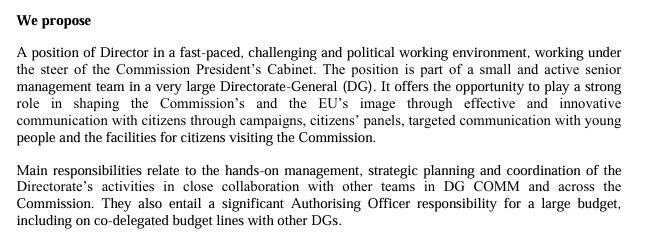
Waterschoot stepped in when previous Director for Citizens Communication Stefan de Keersmaecker was named ‘Director for Political Communication’ late last year. The differences between these two roles are blurred, with both responsible for social media campaigns, both analyzing media and public opinion, and both pushing the commission’s message (one as a ‘rapid response’ outfit, and the other organizing longer-term campaigns).
Both directors lead separate departments within the commission’s ‘Directorate-General for Communication’ (DG-COMM), and together employ around 500 people. DG-COMM has a yearly budget – excluding salaries – of €116 million, and it’s not the only communications department on the commission’s books: most of the commission’s 41 directorates-general have their own in-house spin offices too, which sometimes collaborate with the ‘citizens’ and ‘political’ bureaus of DG-COMM.
If that wasn’t complicated enough, none of these departments write von der Leyen’s speeches. That task falls to her personal speechwriter, Lorenzo Biondi, who announced his retirement on Wednesday.
Biondi is leaving the commission for a job at the Institute of International Affairs, an Italian think tank. But it’s not a straightforward move from the public to the private sector. The Institute of International Affairs’ Europe-focused work is funded almost entirely by the European Commission. There is now just an extra middleman between him and his former employer.
Queen Ursula’s court
Atop this bureaucratic superstructure, von der Leyen has consolidated her power. Her efforts go beyond appointing her loyalists to lucrative lifetime gigs: von der Leyen began the year by appointing 26 commissioners without running the list past the European Parliament first, as well as deliberately withholding budget and internal market strategy documents from member states until hours before publication, making deliberation impossible.
Former European Council President Charles Michel has described her governance as “super authoritarian.” Surrounded by a “tight-knit” and “micromanaged” circle of mostly German advisers, including Flosdorff, von der Leyen has reduced her commissioners to little more than administrators, whose opinions and criticisms rarely make it past her advisers.
Von der Leyen is “obsessed with demonstrating that she’s in charge,” and “is constantly jumping into the middle of the latest crisis, even when it’s outside her remit,” unnamed EU diplomats complained to Bloomberg in May.
Some of the commission chief’s ambitions are grand – she has pushed for the creation of an intelligence agency answering to her office, and backed a Franco-German plan to strip some of chief diplomat Kaja Kallas’ foreign policy powers. Others are more petty. On the day of US President Donald Trump’s inauguration last year, every commissioner under von der Leyen reportedly received strict instructions from Flosdorff: their own communications teams were only allowed to repost von der Leyen’s message to Trump on social media, without adding any comments of their own.
All of this is to illustrate two characteristics of the European Commission under von der Leyen. Firstly, with its jobs for life, its three-dozen communications departments, and its web of interconnected think tanks, it is a bloated organism whose reform would be a generational undertaking.
Secondly, with its unelected president controlling everything from job appointments and social media posts to foreign policy and intelligence gathering, it is an autocracy so at odds with its democratic rhetoric that it requires 43 communications offices to explain away its contradictions to the public.
Are Europe’s Smallest Nations Dragging the Continent into War?
By Urs Maurer-Lambrou | Forum Geopolitica | October 1, 2026
Six million people. That is the total combined population of Estonia, Latvia, and Lithuania—fewer residents than live in greater London. Yet these three border states now set the tone of foreign policy for a union of 450 million, telling Berlin, Rome, and Madrid how dangerous the world is and how much Western taxpayers must pay to fix it.
One Crown to Another
The Baltic national story likes to skip 1721, which is a shame, because it’s where the modern map starts. That year Peter the Great finished the Great Northern War with the Treaty of Nystad. Sweden handed over Estonia, Livonia, Ingria and part of Karelia; Russia evacuated most of Finland and paid Sweden two million silver thalers. Historians still argue about what the money was for. Western reference works tend to call it compensation, while the Russian Presidential Library’s account says flatly that Russia paid it for the acquisitions. Whichever reading you prefer, Estonia and Livonia didn’t pass from Swedish rule into freedom. They passed from one crown to another. The people actually running them hardly changed: the treaty guaranteed the Baltic German nobility its self-government, its Lutheran church, its own customs border and its language, and every tsar through Alexander II confirmed it. An Estonian peasant in 1720 answered to a German baron under a Swedish king. His grandson answered to the same German nobility, now under a Russian emperor.
Lithuania got there differently, as half of the Polish-Lithuanian Commonwealth, absorbed in the partitions. Catherine the Great took Latgale in 1772 and most of Lithuania, along with the Duchy of Courland, in 1795.
The point isn’t the borders; plenty of European states are young. The point is the story. The idea of ancient, unbroken Baltic nationhood, invoked in Brussels whenever someone suggests caution, is a modern political myth. Independent statehood lasted about twenty years between the wars. The current stretch began in 1990–91.
Not One Inch
The next chapter opens in Moscow on 9 February 1990. The Berlin Wall had been down for three months. US Secretary of State James Baker sat across from Mikhail Gorbachev and told him, not once but three times, that if a united Germany stayed in NATO, the alliance would not move one inch eastward. Helmut Kohl said much the same the next day. It wasn’t a slip of the tongue. Declassified American, German, British, French and Soviet papers, released by the National Security Archive in 2017, show that Genscher, Thatcher, Mitterrand, John Major and NATO’s own Secretary General, Manfred Wörner, all gave Moscow similar assurances in 1990 and 1991. None of it went into a treaty.
That turned out to be very convenient. In 1990 NATO had 16 members. In 1999 it took in Poland, Hungary and the Czech Republic. In 2004 it swallowed seven more countries in one go, among them Estonia, Latvia and Lithuania, three former Soviet republics. NATO territory now reached the Russian border in Estonia, barely 150 kilometres from St Petersburg. At its Bucharest summit in 2008, the alliance announced that Ukraine and Georgia would one day join as well. Finland and Sweden followed after 2022. Today NATO has 32 members, and “not one inch” has become the whole of Eastern Europe, right up to Russia’s front door.
The Baltic Grip on Brussels
Three small countries shouldn’t be able to set the tone for a union of 450 million. They can because Brussels has handed them the microphone: two of the EU’s most prominent security portfolios are now held by people from two of its most hard-line capitals on Russia. Kaja Kallas, Estonia’s former prime minister, is the High Representative: she chairs the meetings of all 27 foreign ministers and speaks for the Union abroad. Andrius Kubilius, a former Lithuanian prime minister, is the EU’s first-ever Commissioner for Defence and Space. No voter anywhere in Europe chose either of them for those jobs.
Kallas comes from a family that has always been close to power, whoever held it. Her father went from Communist Party official in Soviet Estonia to Reform Party founder to EU Commissioner: what Germans call a “Wendehals”, a turncoat. In May 2024, weeks before her nomination, she said a Russian defeat would not be a bad thing and remarked that Russia is made up of many nations. Germany’s Volksstimme read it as floating Russia’s break-up, an odd thing for Europe’s next top diplomat to muse about a nuclear power. Over both of them sits Ursula von der Leyen, whom EU leaders produced at the last minute in 2019 and Parliament confirmed with 383 votes, nine more than she needed. She arrived from the German defence ministry, where she’d left behind a Bundeswehr failing its readiness targets and a parliamentary inquiry into consultancy contracts.
Barking on Command
It would flatter the Baltic governments to think they run the show. They don’t. They bark because it suits the people holding the leash. In Brussels, home to the headquarters of both the EU and NATO, the big capitals write the policies. The Baltic capitals enforce them at the border, say the things Berlin and Paris would rather not say out loud, and take the first swing. That is why the EU’s diplomatic megaphone went to Tallinn and its defence portfolio to Vilnius. Nobody appointed Kallas and Kubilius to calm things down.
Kaliningrad in 2022 showed how it works. Brussels drew up sanctions on Russian steel; Lithuania enforced them to the letter and halted rail shipments to the exclave in June. Moscow called it a blockade, and Nikolai Patrushev, then head of Russia’s Security Council, warned that Lithuanians would feel the consequences. Within a month the Commission issued new guidance letting the goods through again. Vilnius had done exactly what it was told, and was left standing alone in front of Moscow while Brussels quietly backed away.
Three years later it was Estonia’s turn. Brussels had spent months announcing crackdowns on Russia’s “shadow fleet” of ageing, poorly insured tankers. On 13 May 2025 the Estonian navy tried to stop one of them, the Jaguar, in international waters off Tallinn. The crew ignored the orders and sailed on to the Russian port of Primorsk. Estonia said a Russian Su-35 then entered its airspace for about a minute with its transponder off, and NATO scrambled a fighter to meet it: a Portuguese F-16, from a country 3,000 kilometres away. Nobody fired, this time.
Meanwhile the big dogs are being moved into position behind the small ones. In 2023 Berlin pledged a full armoured brigade for Lithuania, about 4,800 soldiers, at a new base at Rūdninkai near the Belarusian border. It formally began operating in 2025 and is due at full strength by 2027. It is the first permanent deployment of German troops abroad since the Second World War.
European Values, Baltic Edition
After 1991, Latvia and Estonia gave automatic citizenship only to pre-1940 citizens and their descendants. Hundreds of thousands of Soviet-era residents, most of them Russian speakers and many born in the country, became “non-citizens” with alien passports and no vote in national elections. Riga insists that “non-citizen” is a legal status, not an ethnic label, yet about two-thirds of Latvia’s non-citizens are ethnic Russians. UN and OSCE bodies criticized the system for years. At the start of 2026, non-citizens were still 8.7% of Latvia’s population, by the Latvian government’s own figures.
It has got tighter since 2022, not looser. Schools in Latvia have moved to Latvian-only teaching and Estonia’s are following. Latvia told Russian citizens with permanent residence, many of whom had lived there for decades, to pass a basic Latvian test or risk losing that status. And on 26 March 2025 Estonia’s parliament voted 93 to 7 to amend the constitution so that only Estonian and EU citizens can vote in local elections. On paper it covers all non-EU nationals. In practice it was aimed at about 80,000 Russian citizens, plus Belarusians, and everyone knew it. Stateless “grey passport” holders were given one last local election, in October 2025, before losing their vote as well.
It’s hard to take a lecture on European values from governments that treat their own long-term residents this way.
Who Pays the Bill
Vilnius loves to talk in percentages, because percentages flatter small countries. Lithuania pledged 5% of GDP for defense in 2026 before Donald Trump had even made his 5% demand in January 2025, and its 2026 budget comes in at 5.38%. In May 2025 the three Baltic defence ministers told every ally to match it. In June, at The Hague, NATO made 5% its target for 2035.
Forget the percentages. Look at the money. Lithuania’s entire 2026 defense budget is €4.79 billion. At 5% of its economy, Germany would be spending more than €200 billion a year, over forty times as much. Even the core 3.5%, before the extra 1.5% for infrastructure and other defence-related spending, would come to around €150 billion. For Italy the full target would mean more than €100 billion a year, for Spain around €80 billion, and both are already carrying some of the heaviest public debt in Europe. The Baltic states set the bar; the big economies get the bill.
Spain, at least, had the nerve to say no. Pedro Sánchez called the 5% target “unreasonable,” refused to sign up to it, and left The Hague with an exemption: 2.1% of GDP and not a cent more. Trump called Spain “a very low payer.”
Nobody Asked the Voters
Were Western Europeans ever asked if they wanted this? Only by pollsters. In 2015 Pew found 58% of Germans, 53% of French and 51% of Italians against using military force to defend a NATO ally attacked by Russia. In a survey Pew published in 2020, majorities in Germany, Italy and Spain still said no. Support for the EU paying for weapons for Ukraine has slid nine points, from 65% in early 2023 to 56% this spring. In France, backing for arms deliveries dropped 18 points, from 65% in March 2022 to 47% this February. By late 2024, YouGov found a negotiated peace between Ukraine and Russia preferred over fighting on by 55% of Italians, 45% of Germans and 43% of the French. A Politico poll last December found French and German adults leaning toward scaling support back. And this summer, majorities in Germany and France said no to Ukraine joining the EU as a full member.
That isn’t Germany, France, Italy or Spain itching for a wider war. It’s a public that was never asked, has grown more sceptical every year since 2022, and is now being handed a bill it never ordered: a target worth more than €200 billion a year in Germany alone, cheered on from Vilnius and signed off in Brussels by officials no voter chose.
When the Money Runs Out
The Hague deal has a review built in for 2029. My prediction: by then, Spain won’t be the only country saying no. The money ran out years ago; what’s being spent now is borrowed. Germany even rewrote its constitution in 2025 so it could borrow for defence outside its own debt brake.
In 1721 Peter the Great settled the Baltic’s fate with a treaty and two million silver thalers. Three centuries later, the region’s future is still being decided by bigger powers doing the sums.
So, are Europe’s smallest nations dragging the continent into war? Not on their own. They do the barking; Brussels holds the leash. And Berlin, Rome and Madrid are being dragged along behind, towards a confrontation their voters never chose, paid for with money they no longer have.
Maybe that is the one hopeful part. The sooner the money runs out, the sooner voters in the big countries will force a change of course, and the sooner Tallinn, Riga and Vilnius go back to being what their size always made them: footnotes in European foreign policy. That may be what finally keeps Europe out of a direct war between nuclear powers.
EU draws up contingency plans for possible Merz exit
Al Mayadeen | October 2, 2026
The European Union has begun assessing contingency scenarios in case German Chancellor Friedrich Merz leaves office or becomes increasingly focused on domestic political difficulties, Politico Europe reported Friday, citing diplomats and European officials.
According to the report, governments in two European countries have held internal discussions on how a possible end to Merz’s chancellorship could affect EU policymaking.
The discussions reportedly reflect growing concern in Brussels over political instability in Germany following major electoral setbacks for Merz’s governing conservatives and renewed tensions within the coalition.
Recent regional elections have weakened Merz politically. Reuters reported that the Christian Democratic Union (CDU) suffered its worst-ever result in Mecklenburg-Western Pomerania in September, failing to clear the threshold to enter the state parliament, while the Alternative for Germany (AfD) made further gains.
Berlin’s Political Turmoil Raises EU Concerns
Politico Europe reported that officials consider two scenarios particularly disruptive: Germany being left without an effective leader or a right-wing government emerging in Berlin. However, the report said both scenarios are viewed as unlikely in the short term.
Under Germany’s constitutional system, a chancellor cannot simply be replaced by a successor appointed by the governing party. The Bundestag elects the chancellor, meaning any leadership change would require the necessary parliamentary majority.
For Brussels, the political uncertainty matters because Germany remains the EU’s largest economy and a central actor in negotiations over major bloc-wide policies.
Reuters reported Thursday that Merz is facing growing domestic pressure, while speculation about possible successors has emerged within the CDU. Merz has nevertheless rejected calls to step aside and continues to pursue his government’s policy agenda.
EU Budget Dispute Adds Pressure
Merz’s domestic political position could also affect negotiations over the EU’s next seven-year budget.
According to Politico Europe, Germany is part of a group of member states, including the Netherlands, Sweden, Denmark, Austria, and Finland, seeking substantial reductions to the proposed long-term EU budget. The report said officials believe domestic political pressure could encourage Berlin to take a tougher negotiating position in Brussels.
The budget dispute comes as EU governments debate competing priorities, including defense, industrial investment, infrastructure, and support for Ukraine.
Military Buildup Remains Central to Merz’s Agenda
Despite the political pressure, Merz’s government continues to prioritize strengthening Germany’s armed forces. Reuters reported that Berlin’s debt-financed investment drive is supporting both infrastructure and military expansion, while the government has committed hundreds of billions of euros to rebuilding the armed forces.
Merz has also reaffirmed Germany’s support for Ukraine and called for stronger European military capabilities, while accusing Russia of conducting hybrid attacks against Europe. Moscow has rejected such accusations.
Any change in Berlin’s political leadership would therefore carry implications beyond Germany, potentially affecting EU budget negotiations, defense policy, relations with Russia, and the bloc’s wider strategic direction.
G7 caves to US blackmail, announces ‘massive’ release of diesel reserves
The Cradle | October 2, 2026
G7 states will release up to 100 million barrels of emergency oil and diesel stocks over the next four months, French President Emmanuel Macron announced on 2 October, bowing to US pressure to tame diesel prices driven to record highs by the war on Iran.
The release will be coordinated by the International Energy Agency (IEA), and comes the same day as European Commission spokesperson Anna-Kaisa Itkonen said the EU “fully” rejected US threats to halt diesel exports unless Europe drew down more of its reserves.
“We fully reject any ban on diesel. A ban would not be beneficial to anyone. It would undermine our trust in the United States as a reliable partner,” she said.
She added that the EU Oil Coordination Group, due to meet on 15 October, could convene sooner if necessary.
Macron, who currently chairs the G7, had also spoken out against any export ban in a call with US President Donald Trump earlier that day, with his office saying he urged G7 states to act together “without export restrictions.”
The diplomatic scramble followed a push a day earlier from US Treasury Secretary Scott Bessent, who urged European states to speed up delivery on their existing reserve commitments.
“American farmers, truckers, and businesses should not be left carrying the burden of a global diesel shortage,” he wrote on social media.
Trump threatened the diesel export ban earlier this week, a move EU trade chief Maros Sefcovic warned would have “dramatic consequences for our economic performance.”
The US has threatened to starve France and Germany of diesel unless they release their emergency diesel stocks, with a European source saying Washington is pressing the EU to hand over 120 million barrels within six months.
China has also suspended refined fuel exports for October to rebuild its own depleted reserves, according to Reuters, further tightening a global market already strained by the US war on Iran.
Europe’s reliance on US fuel, which deepened after it banned Russian imports and the US-Israeli war on Iran cut supplies from West Asia, has cost the bloc more than $113 billion in extra energy payments this year, without it receiving “one extra molecule of gas or oil,” according to European Energy Commissioner Dan Jorgensen.
Meanwhile, Washington is also lending energy companies another 40 million barrels from its Strategic Petroleum Reserve (SPR).
The reserve has already fallen to its lowest level since 1982, and releasing the full amount would drag it below the minimum set under federal law.
EU Council Advances Chat Control 2.0 Scanning Proposal
By Ken Macon | Reclaim The Net | September 28 2026
EU’s Council is again pushing for the new chat control regulation to allow the bloc’s police to order internet companies to scan people’s private communications for illegal content in “parts of a service” for a period of time, rather than having to obtain a warrant to target a specific suspect.
This is one of the three key points from a note (PDF) prepared for the sixth and potentially final trilogue on the legislation, also known as Chat Control 2.0, that is to take place on Tuesday, 29 September. The document, dated September 18, was leaked from the Council and is marked as a “presidency note.”
The Council, the European Parliament (EP) and the European Commission (EC) will be negotiating behind closed doors, with the latter represented by Commissioner for Internal Affairs Magnus Brunner.
The other two key points are that the Council believes limiting searches to specific suspects would “not generate any added value compared to the possibilities already existing under criminal law,” and that it wants the scope of the new rules to remain broad, covering not only known illegal photo and video content, but also new material, and “the solicitation of children.”
The note is based on previous discussions and reveals that the EP is willing to accept an approach that requires search plans, but with the caveat that they must be “targeted” and subject to review by judicial or independent administrative authorities.
The Council, however, wants searches to be authorized in “parts of a service or, where possible, to individual users,” and that the search plan would have to include the technologies used and other relevant safeguards, again subject to review.
The note reveals that the Council also wants to make sure that any mechanism to review and possibly suspend searches “should operate in a manner that does not deter providers from carrying out own-initiative searches.”
As a last resort, the Council will ask member states if they would be willing to drop “own-initiative searches or detection orders on non-public content” from the scope of the regulation – but only if no other compromise can be found “providing at least for the same level of effectiveness as the current voluntary practice.”
Former German member of the European Parliament for the Pirate Party Patrick Breyer has no doubt that what is being proposed is “mass surveillance by another name,” and that the goal of the Council, Commission and some member states is to “permanently normalize mass surveillance across Europe.”
Breyer said that the proposal to scan “parts of a service” would in reality mean that “every user in the EU” would be subject to this.
And, he noted, this is not a new system that would replace the old one, but would rather exist in parallel with it. The old system, meanwhile, “is a proven disaster,” the former MEP said, revealing that in Germany, over half of investigations target minors for “consensual sexting” while 75 percent of flagged chats are “not actionable.”
The Council’s own legal service has in the past said that scanning an entire service or parts of it is “highly probable” to be found “general and indiscriminate” surveillance, and therefore unlawful.
Ex-Greek MEP files complaint against Israeli spyware firm over alleged Pegasus surveillance
MEMO | September 28, 2026
Greek journalist and former European Parliament member Stelios Kouloglou filed a criminal complaint Monday against officials at Israeli spyware maker NSO Group, alleging that his phone was infected with Pegasus while he served on a parliamentary inquiry into surveillance software, Anadolu reports.
The complaint was submitted to the Athens prosecutor’s office, Greek public broadcaster ERT reported. Kouloglou said a forensic examination by the University of Toronto’s Citizen Lab found that his phone had been infected around Oct. 21, 2022, and again on March 6 and 7, 2023.
At the time, he was a substitute member of the European Parliament committee investigating the use of Pegasus, Predator and similar spyware. The complaint said the infections coincided with significant phases of the committee’s work.
Kouloglou alleges the spyware could have given those responsible access to communications, contacts, documents, location information and data related to his political work. The complaint seeks an investigation into alleged breaches of communications privacy, unauthorized access to data and violations of personal data law.
Speaking after filing the complaint, Kouloglou said surveillance was an issue affecting all citizens and expressed hope that Greek prosecutors would investigate the case.
His lawyer, Zacharias Kesses, said no action had previously been taken despite the allegations being known.
Britain’s elites want you ready to die for a war they keep imagining
By Tarik Cyril Amar | RT | September 24, 2026
Great Britain is going through a war scare. Or to be precise, its combined political and media establishment is subjecting its people to a relentless propaganda (in up-to-date NATO-speak “cognitive warfare”) campaign to create a sense of impending war against Russia.
As you would expect, that war is, of course, framed as strictly defensive. In propaganda textbook manner, the message is both very simple and very repetitive: The UK is in great danger of a Russian attack, and its whole population must prepare itself to withstand and resist it.
It goes without saying that Moscow’s repeated declarations of having no such intention make no difference.
Britain is certainly not alone in its establishment-induced hysteria. Much of NATO-EU Europe is undergoing, in essence, the same treatment. In France, for instance, President Emmanuel Macron has called a theatrical all-manicured-hands-on-deck meeting to give what can only be called a national scare talk about “Russian hybrid warfare”; in Germany, Berlin and its mainstream media won’t stop stirring the pot about the murky drone affair at Leipzig-Halle airport.
Yet, over the last weeks, within a crowded field of European panic-mongering, Britain has stuck out as especially virulent. The single most grotesque contribution was made by uber-Tory Jacob Rees-Mogg. Comfortably seated against a backdrop that screamed country-squire probity, Rees-Mogg held forth on war within the next few years, ancient Rome (he’s been to Eton, he wants you to know) and, most importantly, “circumstances where people may have to die.” Either that or – so Rees-Mogg’s stern message – decline and fall, as happened to those Romans, who let mercenaries do their fighting and thus lost their empire.
So much to unpack. For one thing, the reference to paying others to fight – and die – must be a Freudian slip. Surely, Sir Jacob cannot have meant to refer to how the West, Britain very much included, has paid the Kiev regime to send its subjects – if need be, after kidnapping them – into the folly of a proxy war meatgrinder to demote Russia. And then, that Roman Empire analogy? Clearly, Rees-Mogg, true to type, is still struggling with the fact that Britain has its imperial collapse well behind it already.
Yet, sour oddball as he is, the arch-conservative – and multimillionaire – Rees-Mogg is perfectly representative of the current British establishment trend. Prime Minister Andy Burnham, for instance, has just used his first UN General Assembly address in New York to blame his country’s misery not on, say, his predecessor and Labour Party comrade Keir Starmer, but on Russia.
Meanwhile, at home, Sky News is rolling out ‘The Wargame’, a bizarre “docu”-fantasy in four parts, built on the premise that the Russians are coming, no, they really, really ARE this time!
Pretending to be a sort of “realistic” account of what a British government would do in case of Moscow launching a series of escalating attacks, this production – from available reviews – is unusually awful shlock. It features has-been politicos doubling as un-reality TV stars, such as Michael Gove and Nicola Sturgeon, and living out their inner Tom Clancy by pretending to be serious, decisive, and, most of all, terribly important to the nation’s survival.
Unintentionally funny, though, as it may be, ‘The Wargame’ clearly has substantial political support and much hype around it. Propaganda can easily look ridiculous and be highly toxic at the same time. Because effective propaganda is, above all, one simple thing: the psychological manipulation of the many by the few. This is such a case. The viewers of ‘The Wargame’ are fed a silly but efficiently dramatized story, with the whole bag of well-worn but powerful tricks: suspense, shock, and, last but not least, a thrilling score.
It’s no surprise that the attitude of those doing the manipulating is, at best, patronizing. And to be fair even to the unbearable, Jacob Rees-Mogg, who carefully tends his beyond-caricature English-toff image, is quite honest about his disdain for ordinary people and their expendable lives. From his always obstinately ill-fitting yet clearly expensively tailored suit to the diction of a terribly bored yet forbearing Eton headmaster, his performance oozes good old upper-class condescension.
When Rees-Mogg tells you that you may have to die, you know he won’t lose sleep over it, because you are you, and he – well, he is something entirely different and, really, much better (and, as it happens, richer, too), of course.
In a Sky News interview, the UK’s Chief of the Defense Staff, Air Chief Marshal Sir Richard Knighton, has revealed a less excentric as well as more insidious approach to the masses. Referring to a “national conversation on defense,” both he and his interviewer took it for granted that the purpose of such a conversation is to remedy “what the British public hasn’t got, […] haven’t understood.”
What a delicate way to start a “conversation”: let me tell you how damn slow you are and where you need to catch up. Not: Let’s exchange views and respect each other as equal citizens. Indeed, it’s not only very rude – what has happened to English manners? – but positively Orwellian to call such offensively complacent preaching a “conversation.”
Marshal Knighton’s idea of how the British can and must do better was no less revealing: In essence, be more like the Estonians or, at least, the Swedes. Because in Estonia “the threat from Russia” is “part of normal daily conversation,” and in Sweden, they are at least trying to achieve the same single-minded obsessiveness.
There you have it, chums on the homefront: Make an effort, will you now? Learn from the worst, get a grip, and make your whole life turn around the fear we tell you to feel.
And don’t you dare notice that – how embarrassing, really – it is precisely the Estonian authorities who, notwithstanding their generally record-level Russophobia – have just called on everyone in NATO-EU Europe to cool it.
Because, those unpredictable Estonians tell us, the Russia-at-the-gates narrative “has been blown completely out of proportion. For example, Russia makes some adjustments on the other side of the Narva River and now everyone across NATO is losing their heads and hyperventilating over it,” while, in reality, “there is absolutely no reason to believe that Russia is imminently going to launch a military attack on NATO, Estonia, or the Baltic states.” Oops.
Unfortunately, war propaganda is almost immune to its own absurdities, inconsistencies, and plain silliness. Because it is designed to operate not by appealing to reason but to fear, stereotypes, and conformism. A conformism that some British establishment members already openly want to reinforce by locking up any dissenters.
The true weak spot of this warmongering may be its arrogance. There are signs on social media that many Brits do not appreciate their establishment’s latest efforts to scare and mobilize them for senseless war. Let’s hope that the mix of threats and condescension – displayed by a snob as gleefully aloof as Rees-Mogg, an officer-bureaucrat as clumsily tactless as Knighton, and the makers of something as slick as ‘The Wargame’ – rubs much of the country the wrong way. The “elites” are insane and malevolent. Any hope for peace and a return to reason will have to come from below.
Tarik Cyril Amar is a historian from Germany working at Koç University, Istanbul, on Russia, Ukraine, and Eastern Europe, the history of World War II, the cultural Cold War, and the politics of memory.
EUROPE FEARS RUSSIA’S NEXT MOVE / Ian Proud
Daniel Davis / Deep Dive – September 24, 2026
Featured Video
Iran’s Next Strike May Not Explode. It Could Shut You Down
or go to
Aletho News Archives – Video-Images
From the Archive
Zionism’s Violent Legacy
By Donald Neff | Washington Report On Middle East Affairs | January 1996
On January 4, 1948, Jewish terrorists drove a truck loaded with explosives into the center of the all Arab city of Jaffa and detonated it, killing 26 and wounding around 100 Palestinian men, women and children.[1] The attack was the work of the Irgun Zvai Leumi – the “National Military Organization,” also known by the Hebrew letters Etzel – the largest Jewish terrorist group in Palestine. The Irgun was headed by Revisionist Zionist Menachem Begin and had been killing and maiming Arabs, Britons and even Jews for the previous ten years in its efforts to establish a Jewish state.
This terror campaign meant that at the core of Revisionist Zionism there existed a philosophical embrace of violence. … continue
Blog Roll
 Aletho News
- Trump’s Iran war is on an Israeli leash
- Saudi oil boss issues global supply warning
- Riyadh Says Its Oil System Is Intact. The Numbers Say Otherwise.
- Trump and Netanyahu Want to “Finish the Job” on Iran
- US ‘one-sided dictation’ not Iran’s beliefs makes rational talks impossible: Baghaei
- Iran’s Next Strike May Not Explode. It Could Shut You Down /Col Doug Macgregor
- Iran: US political targets legitimate if assassinations return
- Iraq shuts key border crossing with Iran under US pressure: Report
- Undersea Internet cables could be targeted in retaliation for attacks on Iran: IRGC deputy chief
- EU sending ‘biased’ observers to interfere in Serbian election – president
- If Americans Knew
- The Israel Lobby’s Changing Fortunes
- AIPAC has become such a political liability that it’s shifting to a more “nimble” approach to buying politicians
- At least 160 Israeli settler attacks in 2 weeks
- Will Gaza’s Ancient Christian Community Disappear Forever?
- Israel’s vision of regional security rests on keeping Arab states weak
- Heidi Levine recounts how Palestinian youths helped save her in settler attack
- DAILY UPDATE: Latest essential news on Palestine, Israel, & region
- Trump’s Intensifying Sabotage of the ICC, for Israel’s Sake
- Israeli military detain US and UK volunteers in West Bank including Democratic NY politician Brad Lander
- Americans at National Conservatism Conference held in Israel this year criticize Israel
- No Tricks Zone
- E-Cars Reduce CO2 Emissions By Only 41% Compared To Internal Combustion Engine Vehicles
- Predictions Made By Renowned Climate Professor Over Past Decades Have Been Proven To Be Poor
- New Study Suggests Large Regions Of The Pacific Ocean Have Been Cooling For The Last 80 Years
- Germany’s Green Energy Debacle: High Energy Costs Force Kahla Porzellan to Close After 182 Years!
- New Study: 50 Years Of The Most Aggressive ‘Net Zero’ Policies Can Only Affect The Global Climate By 0.03°C
- US September “Heat” Was No Record…Many Records Set Decades Ago
- Latest European Green Energy Debacle; Portugal’s Largest Flagship Solar Park Insolvent!
- Green Energy Debacle: German Expert Professor Fritz Vahrenholt Warns Of Severe Economic And Social Consequences
- Two More Paleo Reconstructions Affirm Meters-Higher Sea Levels Across Ireland, Brazil 7000-6000 Years Ago
- New Study: Earth And Venus Surface Warmth Largely Explained By Convection And Lapse Rate, Not CO2 Or Radiation

