British Army faces Kenya setback amid row over troops’ crimes
RT | July 24, 2026
The UK has canceled a major army exercise in Kenya after the two countries failed to resolve a dispute over Nairobi’s powers to prosecute British soldiers accused of committing crimes in the East African nation.
The planned Exercise Haraka Storm, involving the 1st Battalion and The Duke of Lancaster’s Regiment, was reportedly scheduled to begin in September in central Kenya’s Laikipia County. It will instead be held outside Kenya, the British Ministry of Defence said on Thursday, according to The Guardian. Kenya’s Standard newspaper reported that the training would be moved to neighboring Tanzania.
“It is with regret that the necessary licences required to allow training to take place in Laikipia later this year have not been forthcoming,” a Ministry of Defence spokesperson said.
The African state hosts a permanent British Army training support unit, known as BATUK, in Nanyuki, about 200km (125 miles) north of the capital, Nairobi. British troops have trained there since Kenya’s independence in 1963, conducting infantry exercises, as well as engineering and medical deployments under a bilateral defense cooperation agreement.
Kenyan lawmakers have, however, withheld approval for a renewed bilateral defense agreement amid demands for greater jurisdiction over serious offenses committed by British troops. Funding for BATUK is also reportedly under negotiation.
The unit has faced widespread allegations of misconduct, including murder, rape, and environmental pollution. A two-year Kenyan parliamentary investigation report released last December accused British soldiers of murder, sexual assault, torture, and forcibly evicting residents near Nanyuki. It also documented claims involving civilian deaths and injuries from unexploded ordnance, pollution, toxic-waste disposal, and damage to wildlife habitats.
Former serviceman Robert Purkiss has been charged in Kenya with the 2012 murder of 21-year-old Agnes Wanjiru. He is contesting extradition from Britain. Wanjiru’s body was found in a septic tank near a Nanyuki hotel after she was last seen with British troops. Purkiss denies the charge.
Last year, Britain agreed to pay £2.9 million ($3.9 million) to more than 7,700 Kenyans and an environmental group over a 2021 wildfire accidentally started by British troops. The blaze destroyed more than 12,000 acres of the Lolldaiga Hills and reportedly caused one death.
The Ministry of Defence said it remained committed to its defense partnership with Kenya and would continue talks aimed at resuming training.
Nelson Koech, chairman of the Kenyan parliament’s defense committee, said Nairobi is seeking stronger accountability measures, greater protection for local communities, and implementation of the BATUK inquiry’s recommendations.
The two governments are “actively engaging to address these outstanding issues,” The Guardian quoted Koech as saying.
Kiev hitting civilian targets in Russia to provoke mirror response – ex-Pentagon analyst
RT | July 24, 2026
Kiev is targeting civilian infrastructure in Russia in an attempt to provoke Moscow into responding in kind so that Ukraine can “play the victim,” knowing Western media will largely ignore attacks on Russian civilians, former Pentagon senior security policy analyst Michael Maloof has told RT.
Thursday marked the third Ukrainian strike on warehouses belonging to Russia’s largest e-commerce retailer, Wildberries in an escalation of Kiev’s campaign against Russian civilian infrastructure. Ukraine has claimed the company supports Russian military logistics, an allegation denied by both Moscow and Wildberries itself. In a separate attack the same day, Ukrainian forces also struck storage facilities at a poultry farm near St. Petersburg.
Speaking to RT on Friday, Maloof described the attacks as a deliberate “terrorist” strategy.
“They’re doing it purposely in order to lure Russia to start hitting civilian targets… thereby knowing that the Western press will take that information and run with it,” he said.
“And that’s all that you’ll ever hear. You never hear about the attacks in Russia on civilian targets… And so I think the Ukrainians are just trying to play victim once again.”
Maloof dismissed Kiev’s assertion that Wildberries – an online marketplace comparable to Amazon – is a legitimate military target.
“It’s ridiculous. It’s absurd in the extreme.”
He argued that Ukraine expects most Western media outlets not to scrutinize its claims or “see the fraud” behind the justification for attacking the company.
According to Maloof, the broader campaign against Russian energy, food and other civilian infrastructure is aimed primarily at shaping public opinion abroad and securing continued Western financial support.
“It’s propagandistic purposes” designed to win “billions of euros” to continue the conflict, he said.
Maloof added that Ukraine’s European backers are fully aware that civilian sites are being targeted but choose to overlook it.
“They’re using Ukraine for their purposes: ultimately to attack Russia themselves,” he said. “All of this is instigated by the Europeans.”
UN experts call for accountability five months after US-Israeli attack on Minab school
Press TV – July 24, 2026
UN experts have called for an independent investigation into the bombing of a primary school in the southern Iranian city of Minab that killed 168 children and teachers, saying the attack highlights serious violations of international law during war of aggression by the United States and Israel.
In a statement released on Friday, the experts said the school was struck twice during school hours on Feb. 28, 2026, and that there was no indication it was being used for military purposes.
“The school was clearly identifiable as a civilian educational facility and that they had received no information indicating it was being used for military purposes,” the statement read.
Five months later, they said, neither the United States nor Israel had made public the findings of any investigation into the deadly attack, raising questions about the transparency of any inquiry.
“Five months following the school bombing in Minab, the US and Israel have not made any findings public, raising valid questions regarding the impartiality, effectiveness and transparency of any investigation that may be underway,” the experts said. “Justice delayed is justice denied.”
The experts further stated that the Minab school attack illustrated as a broader failure by the United States and Israel to protect civilians during armed conflict, particularly women and children.
“Characterizing civilian deaths as a mistake does not diminish States’ obligations under international humanitarian law and international human rights law, nor does it preclude individual criminal responsibility where violations have occurred,” they said.
“Victims and their families are entitled to truth, justice and effective reparations.”
They voiced grave concern over serious violations of international law arising from US and Israeli war of aggression in Iran since Feb. 28, 2026.
The independent experts called for prompt, independent, impartial and transparent investigations into civilian casualties and damage to civilian infrastructure, including attacks on schools, hospitals and other protected sites.
“International law prohibits the threat or use of force against the territorial integrity or political independence of any State,” the experts said. “The prohibition of the threat or use of force is a cornerstone of the international legal order.”
The US-Israeli war of aggression against Iran between Feb. 28 and early April killed at least 3,375 civilians, including nearly 500 women, and wounded more than 33,000 others, noted the experts.
The experts also said they had received credible reports that Iranian civilians may have been exposed to internationally prohibited and banned hazardous substances, with potentially serious health consequences, particularly for women, girls and pregnant women.
The experts also expressed concern over the latest round of US aggression against Iran despite a memorandum of understanding (MoU) intended to end the war.
The experts urged United States to adhere to the principles of distinction and precaution under international humanitarian law and to protect civilians and civilian infrastructure on land and at sea. They also warned against attacks on civilian population centers, desalination plants and electricity networks.
The US-Israeli acts of aggression in June 2025 and again since February 2026 have deliberately targeted civilians, civilian infrastructure and critical facilities in violation of international law and international humanitarian law.
After weeks of sporadic incidents, the US military launched a fresh wave of large-scale attacks on Iranian soil two weeks ago, targeting military and civilian sites mainly in southern provinces. The attacks have so far destroyed several infrastructure sites, such as bridges and water desalination plants, and killed over 50 Iranians.
Senior Iranian officials have warned that ongoing US attacks threaten regional stability, freedom of navigation, and the security of the Persian Gulf and the Strait of Hormuz.
What’s Ukraine Really After by Striking Russia’s Marketplace Warehouses?
Sputnik – 24.07.2026
Ukrainian forces have hit Wildberries warehouses in multiple Russian cities for several day. Ukraine’s official line says the facilities were used to store dual-use goods: body armor, military uniforms, fiber optics.
Plausible? Hardly.
The very same items are freely sold on Amazon, Temu, AliExpress, and other Western and Chinese platforms across Europe. Neither the EU, nor NATO, nor Ukraine itself treats those sales as legitimate military targets.
So what’s really going on?
Striking Wildberries’ warehouses means hitting ordinary local workers: people unloading trucks, stacking shelves, earning a paycheck. That’s not a military operation, but terrorist attack aimed at civilians.
This isn’t just about Russia, either. The marketplace supports hundreds of thousands of sellers from Armenia, Kazakhstan, Kyrgyzstan, and Uzbekistan. They use Wildberries’ infrastructure to move goods across borders: clothing from Kazakhstan to Armenia, for example. These strikes don’t just hurt Russians, but hit entrepreneurs and businesses across a dozen countries.
What do these warehouses really hold? Mostly clothes, shoes, home goods, and beauty products, which are bought primarily by women with children.
This isn’t an ammunition depot and surely not a big-tech data center. Ukraine’s rhetoric is wearing thin: and the pretext is getting harder to sell.
Conveniently, though, it fits the narrative of Ukraine’s new commander-in-chief, Mykhailo Drapaty, who recently told an interviewer that Russians “have no right to exist as a nation.”
Greece approves purchase of $4bn Israeli air defense system
Athens, Tel Aviv, and Washington are forming an Eastern Mediterranean energy bloc to counter regional trade and energy networks
The Cradle | July 23, 2026
Israel is set to supply Greece with a layered air defense network under an agreement valued at up to $4 billion, Greek Defense Minister Nikos Dendias announced on 23 July, with the same round of approvals covering several drone models and the C-390 military transport aircraft manufactured by Embraer.
Dendias said the government security council, KYSEA, had signed off on the plans in principle earlier this year and has now cleared the procurement contracts.
Greece aims to build a multi-layered network capable of intercepting ballistic missiles, aircraft, and drones, named “Achilles Shield.” The system’s core will rely on radars and missiles supplied by the Israeli firms Rafael and IAI.
“It will be ready and fully operational within 35 months, starting from today,” Dendias stated, noting that at least 25 percent of the system will be manufactured by Greek companies.
Athens currently relies on US-made Patriot batteries and aging Russian S-300 systems to guard its airspace, and has earmarked roughly €28 billion (around $32 billion) for a rearmament drive running through 2036.
Under that program, Greece intends to acquire as many as 40 F-35 fighter jets from the US, along with frigates from France and Italy.
Defense spending in Greece stands at close to 3.5 percent of gross domestic product, outpacing most other NATO members, a level Athens attributes to its long-running dispute with Turkiye.
Greece and Israel maintain close economic and diplomatic relations, running an air training center on Greek soil, staging annual joint military exercises, and working together on anti-drone systems and cybersecurity.
Joint military drills between Athens and Tel Aviv resumed in early July, ending a lengthy suspension brought on by Israel’s genocide in Gaza over the past three years. Israel’s Channel 12 called the cooperation between both countries “part of a broader strategic plan taking shape in the region.”
Beyond military cooperation, the US, Israel, Greece, and Cyprus launched the Eastern Mediterranean Energy Center (EMEC) in early June.
The framework for cooperation on energy and critical infrastructure security involves offshore natural gas projects, research, and technological development, with the wider aim of expanding hydrocarbon output and connectivity schemes such as the India–West Asia–Europe Economic Corridor (IMEC).
Officials from Greece, Cyprus, and Israel had already discussed that alignment at a private diplomatic conference in Athens in May, and weighed a “formal strategic alignment” to capitalize on regional shifts. They also positioned IMEC as an alternative to the Strait of Hormuz – which remains closed as a result of the US war on Iran – and as a direct counter to China’s Belt and Road Initiative (BRI).
Prevent the Great War
By Israel Shamir • Unz Review • July 24, 2026
A couple of weeks ago, in Ankara, the capital of Turkey, there was a NATO conference that sought yet more rearmament and militarization, steps that must inevitably lead to a new Great War. As an answer to this NATO conference, 200 ministers, members of parliament, ambassadors, politicians, activists, journalists, retired generals, academics, diplomats, military personnel and experts from many countries gathered in Ankara last weekend to prevent NATO’s new Great War. Among them were a few of our fellows, Unz Review writers, notably Larry Johnson and Scott Ritter.
The Alliance to Prevent the Great War concluded that the threats that could lead to a Great War originate from the United States, the EU and Israel. The US and Israeli attacks on Iran, NATO’s build-up of military power in Ukraine and the deployment of proxy forces against Russia, Israel’s genocide in Gaza and the attacks on Lebanon — these are regional wars that carry the risk of triggering a Great War.
NATO, as an instrument of US hegemony, poses a threat to world peace. The countries targeted by NATO, foremost among them Russia, do not pose a threat to Europe. The militarisation of Europe should be stopped. The course towards confrontation between NATO and Russia must be reversed. The escalation of the conflict poses a direct threat of nuclear war. Western leaders must not cross Russia’s ‘red lines’, provoke or ‘test’ the strength of the Russian people and their president. Conference participants stated that arms supply to Ukraine must cease. Further arms supply to Kiev will sooner or later lead to an expansion of military operations in Europe.
In short, the Alliance to Prevent the Great War calls for the strategic union of four states: Russia, China, Iran and Turkey, against the US, EU, and Israel. Never before has Israel been considered such an enemy – not by Russia, neither by Turkey. Putin in his first visits to Israel tried to befriend the Jewish state, saying that there are more than a million ex-Soviet citizens in Israel, speaking Russian and maintaining family ties with Russians in Russia. However, recently Israel has become a stage for anti-Russian emigres with a strong sympathy for an independent Ukrainian state. These are mainly Soviet Jews who were born in the Ukraine, or their ancestors were from the Ukraine, and it turned them towards the Ukrainian statelet of Mr Zelensky.
Many Soviet Jews were extremely pro-American. A Russian writer Viktor Pelevin wrote once that a modern cultural Jew—whether living in Moscow or New York—often faces a subconscious dilemma, unable to definitively answer whether they are primarily a patriot of Israel or a patriot of the United States. The support of Ukraine by Israel spoiled its relations with Russia, though Israel tried to hide its pro-Ukrainian stance. A Russian-Israeli journalist Artem Kirpichonok wrote (tongue in cheek) of Israel’s contributions to the Ukraine war:
1. Israeli anti-tank weapons have been transferred to Ukraine via NATO countries. With their help, a column of Russian troops near Kharkiv has already been destroyed.
2. ‘Volunteers’ – veterans of Israeli special forces – have been deployed to Ukraine. As MP Gerashchenko stated: ‘The best of the best. They, too, want to take part in the struggle of light against darkness. Shabbat Shalom!’
3. Doctors and hospitals have been deployed to assist the Ukrainian army and the civilian population.
4. 76 per cent of Israelis support Ukraine (i.e. everyone except the Arab minority)
5. The renowned Israeli thinker Yuval Noah Hariri noted in a television interview that Putin believes Ukrainians are Russians, and that only a handful of Jews who have taken over Ukraine are preventing them from pelting Russian tanks with flowers. Thus, Putin is a psychopath and an anti-Semite.
9. Religious circles emphasise the fact that Putin launched a war against the Jew Zelensky on the eve of Purim and will therefore inevitably suffer the same fate as Haman and Stalin.
Turkey was once rather friendly to Israel, but Israel’s attack on the Mavi Marmara boat that carried Turkish volunteers to Gaza spoiled it. Israel’s genocide of Gaza turned the people of Turkey against Israel, while Israeli objections to the US sale of jets to Turkey added to the enmity. And finally, Israeli officials claiming that “Turkey is the next Iran” firmly shut this door forever. Thus has Israel been doing its part to get Russia, China, Iran and Turkey together into a strategic union. Still Turkey remains a member of NATO, and President Trump calls President Erdogan “his best friend”.
Russian relations with Iran are very good, and could be described as “strategic”. The Alliance to Prevent the Great War stated: “One of the factors that undoubtedly prevented the United States and Israel from using nuclear weapons in their attacks against Iran was the nuclear umbrella provided by Iran’s partnership with Russia and China. Had a strategic alliance between Turkey, Russia, China and Iran already been established, this would have made an American-Israeli attack on Iran impossible from the outset.”
What should be done with NATO? The Alliance to Prevent the Great War ruled:
It is not the reorganisation of NATO, but its abolition, that would serve global security. European countries would thereby also be freed from the new and onerous burden imposed by the United States on NATO members.
Among interesting speakers there was Prof Dr Ulrike Guérot of Germany. A renowned political scientist, Prof Guérot presented a radical vision for the future of Europe. Arguing that NATO has completed its historical mission, Prof Guérot stated that Europe must break free from American hegemony, transition to a neutral stance, and build its future with Eurasia, particularly with Turkey. Giving extensive space to the war in the Ukraine in her speech, Prof Guérot claimed that this conflict is a proxy war that has been prepared for a long time. Criticizing NATO’s eastward expansion policies, the political scientist argued that NATO has ceased to be a security alliance and has become an element of tension, stating: “We did not tear down the Berlin Wall; we merely moved it a thousand kilometres to the East, to Kiev. We are building a rigid NATO line and dividing the European continent.”
Prof Guérot proposed a concrete model of cooperation to reduce Europe’s dependence on the United States. She argued that a strong tripartite cooperation mechanism established between Paris, Moscow, and Istanbul could build a lasting order of peace and independence on the continent.
Responding sharply to Israel’s policies toward Gaza, Prof Guérot described the silent collaboration and ongoing arms support of the European Union as a “deep shame.” Probably Israel VS Palestine is the deepest bifurcation point between the US and the rest of mankind. While the world supports Palestine, President Trump stands for Israel, and he does not care about genocide. I think it will be his undoing.
Our Scott Ritter said: “To be honest, what happened in Ankara (the NATO conference) was an affront to Turkey’s sovereignty. We must never forget that the countries gathered in Ankara are not Turkey’s friends. Not a single one of them. Neither the United States, nor France, nor Germany, nor the United Kingdom, nor other NATO members, nor Greece.”
What took place there was nothing more than a grand political spectacle. It was a large-scale political charade staged to drag Turkey into NATO’s adventure in Ukraine and to exploit Turkey’s strategic position – painstakingly built up by President Erdogan over the last decade – in Europe’s interests and to Turkey’s detriment.
People need to understand this: everything NATO does – frankly, everything the United States does – runs counter to Turkey’s interests. Because Turkey has never been a priority. Neither for the United States nor for NATO.
NATO has used Turkey for its own interests from the very first day of its accession to the alliance. Turkey was drawn into the alliance to ensure the security of NATO’s southern flank. But that task effectively came to an end with the collapse of the Soviet Union. Now they are trying to drag Turkey into an even greater quagmire: Ukraine. They want Turkey to become an active participant in a war that has dragged on for far too long, has resulted in far too many casualties, and seems unlikely to end as NATO intends – namely, with a strategic defeat for Russia.
So why did President Erdogan allow NATO’s conference to be hosted in Ankara?
I think the answer lies in the Turkish economy. I think President Erdogan was hoping to create an atmosphere of goodwill by hosting Western countries in Ankara, which could have yielded positive results for Turkey. However, I believe he will be disappointed in this regard.
On the contrary, I believe that in the coming period Turkey will continue to develop relations with Russia, China and, increasingly, Iran. This is because Turkey will realise that working together with these countries, which oppose American global hegemony and NATO’s subservient role within that hegemony, is the right path for its own future.
Larry C. Johnson said: “The Ukraine war is not simply a war between Ukraine and Russia. The West is waging a ‘NATO proxy war’, using Ukraine against Russia.”
European leaders are facing a crisis of confidence in their own countries. Examples of this include Germany’s deindustrialisation, the Volkswagen crisis and the economic downturn.
NATO’s stockpiles are depleted; factories cannot cope with the workload.
The war in Ukraine is currently ‘the most dangerous flashpoint in the world’. NATO’s preparations for direct war are increasing the risk of nuclear escalation, and Russia has reached the point where it could deploy tactical nuclear weapons.
Germany was also represented by Admiral Kay-Achim Schönbach, the man who commanded the German Navy and retired to avoid fighting Russians. He said:
My name is Kay-Achim Schönbach. I am a retired Vice-Admiral of the German Navy, and until 2022 I served as Commander-in-Chief of the German Navy.
As a citizen of a European country and as a German, I can only express my deepest concern on this matter. Not since the dark and dangerous days of the Cuban Missile Crisis have we been so close to an escalation that could lead to a major war in Europe. And I do not believe I am the only one to have reached this conclusion.
The war in Donbas, in particular, has shown us that ignoring the historical context and failing to undertake a more in-depth and, above all, impartial examination of the causes of the conflict has been one of the fundamental factors that made this armed conflict possible.
The wars in Eastern Europe could have been avoided. We know this. We all know this.
Drawing on my own experience, I can say with confidence today that diplomacy based on mutual respect and conducted on an equal footing provided all the necessary means to prevent this smouldering conflict from escalating into a full-scale war. And I do not think I am the only one who shares this view. However, we must all acknowledge that the influential players in the international system had ample opportunities to resolve this conflict. Perhaps there was no complete agreement on every detail, but they managed to prevent the conflict from spiralling out of control.
The Admiral explained this behaviour of his superiors by “moralising and misguided idealism”, in my view this is too optimistic an explanation.
The Greek journalist Dimitris Konstantakopoulos chaired one of the sessions. Konstantinopoulos stated that Europe’s sanctions against Russia are not sustainable. Issuing a warning, the Greek expert assessed the situation as follows: “Both in Ukraine and in Western Asia, we are heading towards a very dangerous situation which, if it escalates, could even lead to nuclear war. That is precisely why we must de-escalate tensions, and I fear that very few political forces in Europe realise this. This makes the situation extremely dangerous.”
The Greek expert noted that the sanctions imposed by Europe have not worked. Konstantinopoulos said: “The sanctions have proved ineffective. However, if you wish to achieve the United States’ long-term strategic objective, they have proved effective: namely, to separate Europe from Russia (and the former Soviet Union in the past) and make Europe entirely dependent on the United States. If that was the aim of the sanctions, then they have achieved it. Incidentally, I believe that the entire operation in Ukraine — by which I mean the 2014 coup, because the Ukrainian issue did not begin with Russia’s intervention in 2022 but many years earlier — all this Western aggression in the territories of the former USSR was planned. It was a pre-emptive policy aimed at preventing a potential alliance between Europe and Russia, or, as the former French Prime Minister de Villepin put it, between Europe, Russia and China.”
It takes more than a conference to stop the coming Great War. Still, the Alliance to Prevent the Great War was a very useful discussion of the possible ways to do it. And surely much better than NATO’s own conference of trial balloons for their future war crimes.
No route around Hormuz: Why West Asia’s pipeline alternatives fall short
The rush to bypass Hormuz leads back to the same problem: Every alternative route remains hostage to war, rival chokepoints, or political disputes.
By Hussein Askary | The Cradle | July 23, 2026
“The only alternative to the Strait of Hormuz is the Strait of Hormuz.”
This blunt assessment, offered by an Iraqi expert in a recent interview, captures the central weakness in the rush to revive old pipeline schemes and promote new ones across West Asia. Since Iran effectively closed the Strait of Hormuz after Israel and the US launched their second war against it in February 2026, the region has been flooded with proposals for alternative oil-export routes.
Washington has encouraged these plans, while several governments have presented dormant or unfinished pipelines as strategic solutions. Yet the closer one looks at geography, markets, costs, capacity, and security, the clearer it becomes that most of these projects cannot substitute for Hormuz.
Even if oil bypasses the strait, it still faces the rival chokepoint of Bab al-Mandab, where the Ansarallah-aligned armed forces have declared a maritime blockade against Saudi Arabia and attacked Saudi tankers.
These expensive detours will remain exposed unless security in the Persian Gulf itself improves. Until the war on Iran ends and an inclusive regional security architecture is established, Iranian and Yemeni missiles and drones can reach the pipelines and loading terminals built to evade them.
Asia still runs through Hormuz
The first reason is straightforward. The Strait of Hormuz is the natural outlet of the Gulf energy system. In 2024, oil flows through the strait averaged about 20 million barrels per day (bpd), roughly one-fifth of global petroleum liquids consumption. The International Energy Agency (IEA) describes it as one of the world’s most important oil transit chokepoints.
Most of this oil is not heading west. About 80 percent of the oil moving through Hormuz is destined for Asia, with China, India, Japan, South Korea, and other Asian economies as the principal buyers. The pattern is even clearer for liquefied natural gas (LNG).
The US Energy Information Administration estimated that 83 percent of LNG moving through Hormuz in 2024 went from Persian Gulf exporters to Asian markets, especially China, India, and South Korea.
This market reality matters because many proposed alternatives send oil away from its main customers. Pipelines to the Mediterranean, the Red Sea, or the Levant may appear useful on a map, but they often move Gulf crude farther from Asia rather than closer to it.
Commercially, building multibillion-dollar infrastructure to move oil westward, only to redirect it by sea toward Asian markets, is inefficient. If Hormuz is open, the direct route remains cheaper and faster. If it is closed by war, the underlying problem is not a lack of pipelines but the collapse of regional security.
Old routes, unresolved disputes
The older pipeline options illustrate the point. The Kirkuk–Baniyas pipeline once carried Iraqi oil across Syria to the Mediterranean. Built in the early 1950s, it had genuine strategic value in its time but has been largely inactive since it was damaged during the 2003 US-led invasion of Iraq. Washington is now backing efforts to revive the route, with US companies expected to play a role. Yet the project still requires extensive reconstruction and years of work before it can provide meaningful export capacity.
Estimates for a full restoration and expansion to around 700,000 bpd run as high as $8 billion. It cannot answer an immediate crisis in Hormuz, and if regional peace is restored before completion, the commercial case for reviving it weakens sharply.
The Iraq–Turkiye pipeline faces a different but equally serious problem: politics. The route through the Kurdistan region to Turkiye’s Mediterranean port of Ceyhan was repeatedly interrupted by disputes among Baghdad, the Kurdistan Regional Government (KRG), Ankara, and international oil companies.
A 2023 arbitration ruling against Turkiye over unauthorized Kurdish exports led to a two-and-a-half-year shutdown. Flows resumed in September 2025, and exports have continued, but the route still depends on fragile agreements over contracts, payments, federal authority, and revenue sharing.
Its limited throughput and political vulnerability prevent it from becoming a structural replacement for a maritime passage that normally carries a vast share of the world’s seaborne oil.
The Iraqi pipeline in Saudi Arabia, known as IPSA, is another example of strategic nostalgia. Built in the 1980s during the Iran–Iraq war, it was designed to move Iraqi crude from the Basra region to the Red Sea.
It stopped operating after Iraq’s 1990 invasion of Kuwait, and Saudi Arabia expropriated it in 2001. Reopening the line would therefore require a Saudi–Iraqi political settlement over ownership and control, as well as a major technical assessment after decades of disuse. In other words, IPSA is not an available alternative; it is a diplomatic and engineering problem dressed up as a solution.
The proposed Basra–Aqaba pipeline is even more controversial. Its advertised purpose is to move Iraqi oil from southern Iraq to Jordan’s Red Sea port of Aqaba, bypassing Hormuz. Yet it has faced intense objections inside Iraq because of its projected cost, uncertain financing, and questionable strategic value.
Since much of Iraq’s crude is sold to Asian customers, sending it westward to Aqaba would add distance and complexity rather than solve the basic market problem. The pipeline would also move Iraqi exports closer to another zone of instability, including the Israeli military sphere and the wider Red Sea security environment.
A bypass route that merely exchanges one security risk for another is no solution. Iraq’s severe fiscal pressures also leave Baghdad poorly placed to finance such an expensive project, while international investors are unlikely to embrace it without strong political and security guarantees.
Bypasses within missile range
The existing Saudi and Emirati bypasses are more credible but still limited. Saudi Arabia’s East–West Pipeline, or Petroline, moves crude from the eastern oil region to Yanbu on the Red Sea. The UAE’s Abu Dhabi Crude Oil Pipeline carries oil from Habshan to Fujairah on the Gulf of Oman.
These systems reduce exposure to Hormuz for Saudi Arabia and the UAE and have become important national energy-security assets. But they cannot replace the strait for the region as a whole. They offer little to Kuwait, Qatar, Bahrain, Iran, or most Iraqi exports, and they do not solve the LNG problem, especially Qatar’s dependence on Hormuz.
The IEA estimates that only 3.5 to 5.5 million bpd of spare pipeline capacity is available to bypass the strait. Neither Yanbu nor Fujairah are immune from attack; regional conflict has already shown the vulnerability of ports, tankers, and energy infrastructure.
The crisis pipelines cannot solve
This is why the alternative pipeline debate is misleading. It treats the closure of Hormuz as a logistical puzzle when it is primarily a political and security crisis. If the Persian Gulf remains militarized and unstable, no pipeline network can fully protect exports.
Pipelines cross vulnerable territory, depend on political agreements, and terminate at ports that can also be threatened. If Gulf security improves, however, Hormuz will almost certainly reopen because this serves the interests of producers and Asian consumers alike.
Once that happens, the commercial rationale for many alternative pipelines will fade. Why spend tens of billions of dollars duplicating a natural route with unmatched capacity and direct access to the main buyers?
The more honest conclusion is that alternative pipelines may offer limited resilience for individual states, but they are no strategic replacement for Hormuz. They are costly, slow, politically fragile, geographically inefficient, and in some cases obsolete before construction begins.
The answer to the crisis is a security arrangement that keeps the Persian Gulf open, prevents attacks on shipping, and restores normal trade through the strait.
Under such an arrangement, oil and LNG would continue to flow mainly to Asia by the most direct and economical route. Hormuz will remain indispensable, while the grand pipeline alternatives amount to expensive insurance policies against a crisis that only diplomacy and regional peace can resolve.
The Iran war may go down as the US’ worst ever defeat
By Robert Inlakesh | Al Mayadeen | July 24, 2026
While the US president continues to lie to his people about imagined victories over Iran in West Asia, the arguments fall flat amongst the vast majority of Americans who see through his tired rhetoric. Unlike past military blunders, Washington has not and will not be able to pull the wool over its people’s eyes.
Some analysts have attempted to compare Donald Trump’s failure to effectively combat Iran with defeats and strategic mistakes that ruined the reputations of past presidents; this one is very different.
To go through all US wars of aggression is simply too steep a task to take on in a single article, but there are a few different comparisons that are going around which deserve to be analyzed: they are the Iraq War, the Vietnam War, and even Operation Eagle Claw.
All the above-noted comparisons are very much different in their nature from the large-scale air campaign, turned stop-start battles that the Trump administration has engaged in. If we first look at the Vietnam War comparison, this is often said as a figure of speech – “it is so and so’s Vietnam” – which is the way in which some analysts have chosen to apply Vietnam to what we see today.
Although there is something to be said about how the US is being bogged down in the Iran War, it is a totally different ball game to what occurred in Vietnam. At the beginning stages of the escalation, in October of 1965, a Gallup poll recorded a 64% public approval rating of US intervention in Vietnam, which by 1970 had shifted to around 55% of the US public stating that they sought a return of the troops.
At the time, the US had sold its population the need to fight Communism and that the Vietnam War was necessary, as the fall of South Vietnam to a Communist government would lead to a slippery slope whereby governments across Asia would fall to the ideology. The Communist boogeyman captured the imaginations of those living in the West, who opposed the Soviet Union and Chairman Mao’s China.
In Trump’s case, the approval rating for the Iran war was never there. Ipsos polling data from the beginning of the war suggested that 58% of Americans opposed a war with Iran, with only 38% expressing approval. Two weeks into the conflict, Pew Research polling data then revealed that 61% of the country disapproved of the war. Now, even Trump’s own cult-like fan base is turning on the war, with Politico polling data suggesting that little more than a third of MAGA supporters believe the economic costs of the Iran war have been worth it.
In the Vietnam War case, public opinion at its worst was more favourable than it was at the beginning of the war on Iran. When it came to the disastrous 2003 Iraq invasion, a Gallup News poll recorded a 72% approval rating for the war, with only 25% of Americans opposing it.
Then there is the comparison with Operation Eagle Claw, which refers to the disastrous mission that was ordered by former US President Jimmy Carter – aimed at seizing back American citizens held by the Islamic Republic at the time. The reference is now being made to Jimmy Carter and his failed operation, resulting in the deaths of 8 US service members, because of President Trump’s own comments about the Carter administration.
In the event of a ground invasion that seeks to seize Iranian territory – Kharg Island being the most publicly discussed target to occupy – the US president will almost inevitably be in a position where a number of American soldiers could be captured.
All of the above-noted cases have a shared difference that separates them from what the Trump administration is doing today, that being that they were not operations launched solely for a foreign country’s interests.
Although the Israelis certainly played a role in pushing the US toward launching the Iraq War, it was a conflict that did assert Washington’s dominance over the region, further bringing the Arab Gulf States under their control, and was evidently winnable. The consequences of the invasion were not immediate; the American public believed in the new “Islamic enemy” that had replaced the Red Scare narrative sold to populations across the collective West during the Cold War.
The Vietnam War also had the Gulf of Tonkin incident false flag that helped justify the war, while Iraq had the September 11 attacks. The Iran War didn’t even bother to use any incident as an excuse; it was rushed and sloppy.
This time, Iran has managed to use the closure of the Strait of Hormuz as leverage against the US, while Yemen’s Ansar Allah is now tightening the noose by imposing a counter-blockade on Saudi Arabia in the Red Sea. If the Yemeni Armed Forces choose to do so, they can totally block the Bab al-Mandab Strait also, choking off two of the world’s most important trade routes. Iran has demonstrated its ability to continuously pound US military bases and embarrass the US Navy’s attempts to coordinate the passage of ships out of the Gulf.
The US’ military industrial complex is also getting slapped around, as Iran has managed to shoot down at least one F-15 fighter jet, even locking on and striking an F-35 that was forced to do an emergency landing.
US allies in the Gulf, which have pledged to invest trillions in the American economy, are taking an economic beating, with the possibility that some could even be rendered uninhabitable if the war escalates. From power projection to the sale of weapons, seizure of resources, and an image of victory, there is nothing to gain.
Only the Israelis are set to gain anything from this deeply unpopular war. They seek to use the United States military to do their dirty work of degrading Iranian infrastructure and dealing an economic blow to the Islamic Republic. This is because Tel Aviv understands that the job cannot be performed by them alone and that as long as they can take the punishment dished out against them, they are willing to continue using the Trump administration to do their bidding.
Never before has a war of this nature been fought by the United States, where it loses in every category, with the conflict being fought solely for the purpose of fulfilling the expansionist desires of a foreign rogue regime. Donald Trump is not Jimmy Carter or George Bush Jr.; he will be remembered as the president who launched an offensive war of aggression on behalf of a genocidal regime that couldn’t care less how the US and the rest of the world are impacted, as long as they continue to get propped up to forward their goals of creating a regional empire premised on a supremacist ideology.
US-Saudi nuclear pantomime is with eye on Iran
By M. K. BHADRAKUMAR | Indian Punchline | July 24, 2026
The excitement over the US-Saudi nuclear deal has proved to be short-lived. Apparently, the US President Donald Trump himself poured cold water into it by adding a caveat on Thursday that in order for the deal to be advanced, Saudi Arabia must first join the Abraham Accords. That is, as things stand, may seem like asking for the moon.
However, it’s all but certain that Trump allowed the Saudi deal to be signed after consulting Israeli Prime Minister Benjamin Netanyahu as a last throw of dice to pin down Saudi Arabia as a participant / collaborator alongside Israel (and the UAE) for an all-out war against Iran that might at some point entail ground operations, which is not possible without first getting Riyadh on his side firmly, irrevocably.
If Saudi Arabia dissociates from Tump’s upcoming war and disallows the US to use the Saudi bases or work out the logistics accordingly, Pentagon generals will be hard-pressed to conduct the war. In political terms too, the Saudi stance will influence other regional oligarchies in the Persian Gulf in their own attitudes towards Iran, which is astride the Arab street like a colossus. The timing of the July 15 meeting of Trump with the visit of the pro-American prime minister of Iraq Ali al-Zaidi also needs to be factored in here. Simply put, Iraq has become a frontline in the US-Iran conflict.
Saudis won’t like the prospect of Iran emerging as a towering regional power. On its part, Iran is also closely watching the Saudi mood swings stemming out of its compulsions not to annoy Trump who is in a position to to play a helpful role in the event of the succession issue coming to the fore in Riyadh at any time. Of course, this is apart from the profound petrodollar linkages critical to both protagonists.
Meanwhile, the recent Pakistani advisory to Tehran to steer clear of targeting Saudi Arabia, the Houthi threat to Saudi Arabia and the potential closure of Strait of Bab el-Mandeb are tell-tale signs of latent tensions between Tehran and Riyadh, although both sides are maintaining a semblance of normalcy.
Most certainly, Trump’s remark on Thursday making the nuclear deal conditional on the Saudis normalising relations with Israel has thrown the deal as such into question barely 24 hours after it was signed. Is it a U-turn or is the episode just another confusing rollout that has become the trademark of Trump’s presidency? The truth could be somewhere in between.
According to an AP report, the White House press secretary Karoline Leavitt told reporters in a briefing yesterday that Trump has said if the Saudis don’t join the Abraham Accords, “the deal is off.” When asked why the condition wasn’t mentioned Wednesday when the Energy Department announced that the deal was signed, Leavitt said it was because Trump “is always the final dealmaker.”
My own reading is that Trump is backtracking according to a script. He could have taken credit for the condition on Abraham Accords, had it been a part of the deal. But it is within his ingenuity to try to increase his leverage with the Saudis by adding the caveat openly: that might even improve the deal in certain respects such as enrichment or verification clauses, for instance.
The Saudis appear to have been taken by surprise on Wednesday when US Energy Secretary Chris Wright signed the decades-long, multibillion-dollar deal with his Saudi counterpart, Prince Abdulaziz bin Salman, Saudi Arabia’s Minister of Energy but that doesn’t have to be taken at face value. The deal reportedly includes a “123 Agreement” and an accompanying “bilateral safeguards agreement,” and the two agreed to a two-year study to see whether enrichment is necessary. This seems like kicking the can down the road. Interestingly, Netanyahu’s office said Saudis joining of the Abraham Accords “would be an historic leap forward for peace in the Middle East.”
On the whole, Trump has a deal here. The caveat of Abraham Accords may serve to delay the agreement from coming to fruition unless and until the Saudis jettison their bottomline [a Palestinian state] linking normalisation with Israel. On the other hand, Trump has the leverage insofar as the Saudis now have to address whether they want to normalise relations with Israel.
Indeed, the Saudis too are getting an optimal deal here, which doesn’t expressly block reprocessing and enrichment and doesn’t allow for the International Atomic Energy Agency to do its inspections. The Saudis have apparently got away with not having a customary additional protocol, which would have ensured there is no cheating, and it will stay a peaceful programme. On Truth Social, Trump maintained on Thursday that “there will be no enrichment of material,” but added that the US is “not opposed to Civil (Non-Enriched) Nuclear Facilities.” Conceivably, the US may have control of a Saudi enrichment facility and keep a military / security presence.
The Congress will be able to review the deal in a 90-day window. Lawmakers do not need to approve it, but they could oppose it, although that is unlikely. (See a Congressional Research Report Prospects for U.S.-Saudi Nuclear Energy Cooperation, March 11, 2026) All in all, the chances are of the agreement “staying in place and nothing substantive happening until Saudis agree to something” regarding Israel, as [per] Bryan Clark, a senior fellow at the Hudson Institute, an influential pro-Trump DC-based think tank.
The most bizarre coincidence of the entire sequence of developments since Wednesday is the shadow this deal could potentially cast on the US-Iran agreement that is on the horizon. But that is only hypothetical. If Trump intends to launch an all-out war with Iran, there will be no more negotiations to be had on a nuclear deal.
Saudis, being stakeholders, may no longer resist Trump’s entreaties to collaborate with the war effort going forward, whose objective would be to destroy Iran comprehensively with all the military might at Washington’s command. The Saudi Crown Prince Mohammed bin Salman has said in the past that if Iran obtained a nuclear weapon, the kingdom would have to follow suit.
In such a scenario, there will be no conceivable reason for Israel at the present juncture to try to kill the US-Saudi deal that is struggling to be born.
Ex-Indian envoy: US showed ‘scant regard’ for India in attack on Iranian frigate
Press TV – July 24, 2026
Former Indian Foreign Secretary Kanwal Sibal says the US attack on the Iranian frigate IRIS Dena near Sri Lanka demonstrated Washington’s disregard for India’s sensitivities, warning that the war with Iran has expanded beyond West Asia into India’s immediate maritime neighborhood.
“The sinking of the Iranian frigate IRIS Dena by a US submarine in the Indian Ocean has brought the widening conflict with Iran into India’s immediate maritime neighborhood. This is no longer a distant West Asian crisis,” Sibal wrote on X on Friday.
Sibal said the circumstances gave the incident both moral and diplomatic significance for New Delhi.
“That fact gives the episode a moral and diplomatic dimension that cannot simply be ignored. The United States has shown scant regard for Indian sensitivities in carrying out this action so close to our shores,” he said.
Warning that the consequences extend beyond the immediate attack, Sibal said the war between major powers will inevitably spread beyond West Asia into regions vital to India’s interests.
“The larger issue is the progressive spread of the conflict beyond West Asia. Escalation between major powers does not remain geographically contained. It inevitably spills into regions that are vital to India’s security and economic interests,” he wrote.
He added: “Stability in the Indian Ocean, freedom of navigation, and uninterrupted energy flows are not abstract concerns for India. They are core national interests. Any sustained disruption in these waters will have direct and serious consequences for us.”
Sibal said New Delhi now faces the challenge of preserving its strategic autonomy while balancing ties with both Washington and Tehran.
“India now faces the difficult task of preserving its strategic autonomy while managing relations with both Washington and Tehran. Conflicts between other powers that reach our maritime neighborhood leave us with fewer good options and greater exposure,” he wrote.
“The central question is how India protects its interests when the wars of others begin to unfold in its own extended neighborhood. This is no longer a hypothetical problem. It has arrived.”
Sibal also criticized the Indian government following the sinking of the IRIS Dena, writing that, “If India had not invited the Iranian warship to participate in the exercise, it would not have been in that area.”
Referring to the Milan 2026 multinational naval exercise, he said, “Participating ships were not allowed to carry any ammunition,” adding that the Iranian frigate “was unarmed at the time.”
He also said that “the US submarine attack appears to have been planned in advance because Washington was aware of the Iranian warship’s participation in the exercise.”
The IRIS Dena was returning from the Milan 2026 multinational naval exercise, hosted by the Indian Navy with the participation of 72 countries, when it was attacked by a US submarine in the Indian Ocean near Sri Lanka.
Sri Lankan authorities said 32 Iranian sailors were rescued, while the fate of 140 others remained unknown. Iranian media reported that 80 sailors were killed in the attack.
IRGC finishes off Amazon data center, says US fatalities in hundreds
Al Mayadeen | July 24, 2026
Iran’s Islamic Revolution Guard Corps (IRGC) announced on Friday that its forces have destroyed the remaining building of an Amazon company data center and a large ammunition depot at a US base, as part of ongoing operations against American military assets in the region.
In a statement, the IRGC said its fighters, in the 27th wave of Operation Nasr 2, targeted the remaining structure of an Amazon data center, which plays a primary role in completing intelligence for the US military.
“The fighters of Islam, in the 27th wave of Operation Nasr 2, in completion of their previous operation against the data intelligence center of the American company Amazon, which plays the main role in completing the intelligence of the US child-killing army, targeted and destroyed the remaining building of this center,” the IRGC said in a statement.
The IRGC added that “punitive operations” by its fighters are continuing.
Heavy drones strike Ali al-Salem Base
In a separate statement, the IRGC reported that its forces targeted a US base in the region. The statement said that one hour earlier, also as part of the 27th wave of Operation Nasr 2, fighters launched ultra-heavy and advanced destructive drones to target a very large ammunition depot at the US base of Ali Al-Salem.
“A very large ammunition depot in the Ali Al-Salem US base was targeted and completely destroyed with successive explosions,” the IRGC said.
The statement added that barracks housing personnel at the same base were also attacked, with six large structures destroyed and three others sustaining significant damage, while several troops were killed and wounded in the strikes.
US hiding true casualties
Regarding US casualty figures, the IRGC stated that the American military has suffered hundreds of deaths and a significantly higher number of wounded during the five-month war. The statement said the daily evacuation of large numbers of wounded via ambulance aircraft to an American hospital in Germany is clear evidence of high casualties.
The US military, which has suffered hundreds of fatalities and many more wounded during the past five months of the war, is lying to its own people by claiming it has sustained fewer than 20 deaths.
The IRGC cited the daily evacuation of large numbers of wounded by medical evacuation aircraft to a US hospital in Germany as clear evidence of the scale of its casualties.
It is the responsibility of the American media to investigate the realities of this war, the heavy casualties suffered by the US military, the extensive damage it has incurred, and the true financial costs that have been concealed from the public, the IRGC’s statement read. It added that the media outlets are responsible for exposing the real figures and the methods of censorship employed by the “deceptive rulers”.
US attacks 16 cities in Iran in 13th consecutive night of aggression
The United States launched a new wave of attacks on Iran, marking the 13th consecutive night of US attacks, according to US Central Command (CENTCOM). The campaign, which Washington said aims to target Iranian military capabilities and threats to commercial shipping, began at 6:45 pm Eastern Time.
Iranian media reported explosions in multiple locations throughout the country. Local officials confirmed strikes in Bandar Abbas, Jask Port, Konarak Port, Ahvaz, Omidiyeh, Andimeshk, Khorramabad, Anarak, Nain, Borujerd, Taft, Shirkuh, Firuzabad, near Khondab in Markazi Province, and on Qeshm Island. Al Mayadeen’s correspondent reported that the US attacked 16 Iranian cities in total.
In Hormozgan Province, the deputy governor for political and security affairs said several civilians were injured during the attack on Bandar Abbas Port. IRNA reported power outages affecting parts of the port following the strikes, with provincial emergency officials later stating electricity would be restored within an hour. Iranian state television reported that air defenses were activated in Tehran as explosions were heard elsewhere.
The Khuzestan Province Council reported that four people were killed and five others were injured in attacks targeting the vicinity of Ahvaz.
Iran’s Islamic Revolution Guard Corps (IRGC) announced that its forces intercepted and destroyed a US Tomahawk cruise missile over Kahnuj in Kerman Province. According to Fars News Agency, the IRGC commander in Kahnuj said the missile was detected and destroyed while still in the city’s airspace.
Featured Video
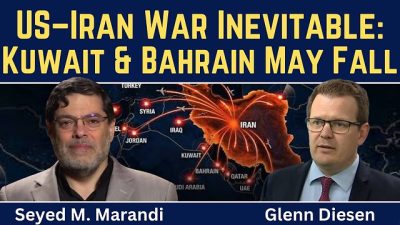
Seyed M. Marandi: US-Iran War Inevitable: Kuwait and Bahrain May Fall
or go to
Aletho News Archives – Video-Images
From the Archives
Oil and the Israel Lobby
Reknowned economist M. Shahid Alam offers this excellent critique of Noam Chomsky’s defective analysis of the relative influence of Oil versus the Israel lobby over US foreign policy: … continue
Blog Roll
 Aletho News
- ICC ignored ‘very well-documented’ NATO crimes – ex-Libyan minister
- SNSC secretary dismisses US response to Iran’s conditions as ‘inadequate’
- Sanaa says Taiz roads open, secure for residents, warns Saudi forces
- Iraqi resistance group urges Saudi leadership to admit defeat, lift Yemen siege
- Trump’s Retreat: How Al-Aqsa Flood Took Down the US Empire
- Israel’s Military Actions in Lebanon Grossly Violate International Law — Lavrov
- Seyed M. Marandi: US-Iran War Inevitable: Kuwait and Bahrain May Fall
- Leaders Condemn Ansarallah Attack on Saudi Arabia While Ignoring Illegal War Against Yemen
- Leaked: Britain’s Covert Iraqi Psyops Network
- Yemeni Armed Forces Warn Airlines Against Using Saudi Airports, Exempt Mecca and Medina
- If Americans Knew
- Israel’s Destruction of Southern Lebanon Intensified After the Cease-Fire
- The Last-Minute Decision That Gave Israel Its Name
- The American Conservative: How Trump Made the World Go Nuclear
- Meet the US generals and admirals advancing Israeli policy
- Opinion: Why news organizations should boycott Israel
- The Israeli witch hunt of Sami Abu Shehadeh exposes the lie of the ‘Jewish and democratic’ state
- No state has a ‘right’ to exist – least of all Israel
- Testimonies about Gaza’s civilian death toll expose Israel’s atrocities – Daily Update
- How Israel Conquered the Latin American Right
- Agents search Rep. Omar’s Washington home in criminal probe as she vows she won’t ‘be silenced’
- No Tricks Zone
- Germany’s Green Energy Debacle: High Energy Costs Force Kahla Porzellan to Close After 182 Years!
- New Study: 50 Years Of The Most Aggressive ‘Net Zero’ Policies Can Only Affect The Global Climate By 0.03°C
- US September “Heat” Was No Record…Many Records Set Decades Ago
- Latest European Green Energy Debacle; Portugal’s Largest Flagship Solar Park Insolvent!
- Green Energy Debacle: German Expert Professor Fritz Vahrenholt Warns Of Severe Economic And Social Consequences
- Two More Paleo Reconstructions Affirm Meters-Higher Sea Levels Across Ireland, Brazil 7000-6000 Years Ago
- New Study: Earth And Venus Surface Warmth Largely Explained By Convection And Lapse Rate, Not CO2 Or Radiation
- 2025 Nature Paper Claiming Worsening Global Drought Gets RETRACTED …Heavily Flawed
- New Study: ‘Global Drought Shows No Detectable Recent Acceleration Under Climate Warming’
- Economic Masterminds: German Socialists Suggest Taxing Productivity Gains Stemming From Using AI

