The Committee To Protect Journalists Continues To Become The Committee To Protect Israel
By Justin K.P. | The Dissident | June 30, 2026
The Committee to Protect Journalists (CPJ) continues to do a disservice to its stated mission and is now actively aiding Israel in killing Palestinian journalists instead of protecting them.
The CPJ has removed eight names from its list of slain Palestinian journalists because “Hamas and Palestinian Islamic Jihad (PIJ) published obituaries identifying them as members of their armed groups” and over baseless claims that they “had participated in combat”.
But as Quds News Network noted , “CPJ has not disputed that these individuals were doing journalism work at the time they were killed. What CPJ cites instead is their prior affiliation with the media departments of Hamas or Palestinian Islamic Jihad, known in Arabic as al-i’lam al-harbi, or military media, a distinction between media relations work and combat that the organization’s own new criteria appears to collapse.”
It added that “Under the Fourth Geneva Convention and Additional Protocol I, specifically Article 79, journalists conducting dangerous professional missions in armed conflict are protected as civilians. The legal threshold for losing that protection is direct participation in hostilities at the moment of the attack, not past employment, political affiliation, or membership in a media relations unit. Working in a media department for a political or armed movement is not equivalent to bearing arms or planning attacks. None of the individuals removed from CPJ’s count have been shown by Israel or by CPJ to have been carrying weapons or engaged in combat operations at the time they were killed. To date, Israel has never produced verified evidence proving it killed a single Palestinian journalist while that journalist was carrying arms.”
In other words, the CPJ seems to be suggesting that any Palestinian journalist who at any time was affiliated with armed resistance groups, even in the media department, will now be labeled as a combatant.
Furthermore, as journalist Tareq S. Hajjaj noted, this same standard is not applied by the CPJ to Israeli journalists.
As he noted:
But if these standards are to be applied, do they apply only to Palestinian and Lebanese journalists? What about Israeli journalists, all of whom served in the Israeli military? Does military service in an army carrying out a genocide raise no comparable questions? These journalists continue their work after receiving military training alongside other soldiers. And as journalists, they actively incited genocide against Palestinians around the clock.
And there’s more. Some Israeli journalists even participated in war crimes while they were covering them. In October 2024, Israeli journalist Danny Kushmaro participated in the demolition of a home in a village in Southern Lebanon while filming himself doing it for a Channel 12 report. After pressing the button that blew up the house, he signed off by saying, “Don’t mess with the Jews.”
Palestinian journalists documenting the suffering of an occupied people are portrayed as suspects, while the perpetrators escape meaningful scrutiny.
This stunt by the CPJ to appease Israel and its lobbyists was used by Israel to justify its mass slaughter of Palestinian journalists.
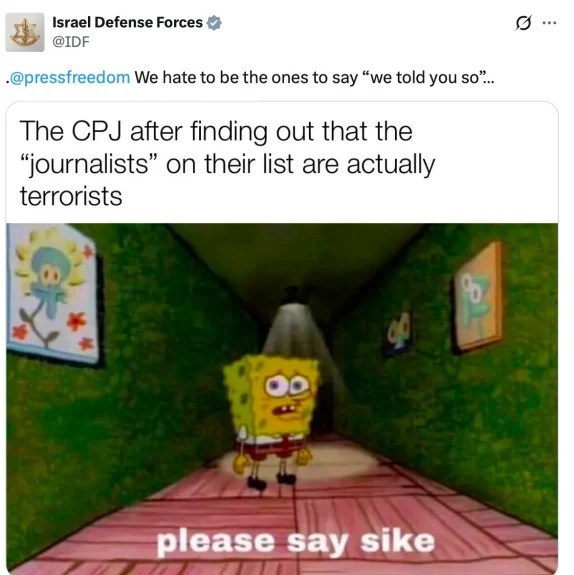
The official account of the IDF posted a message to the CPJ saying “We hate to be the ones to say ‘we told you so’”, above a meme saying “The CPJ after finding out that the ‘journalists’ on their list are actually terrorists”.
As Quds News Network noted, “Israel has never proven that it killed a single Palestinian journalist while that journalist was armed or engaged in combat. What the latest CPJ decision does is hand Israel a tool to claim retroactive legitimacy over killings it was never required to justify in the first place, while the broader, undisputed, and overwhelming record of journalists killed simply for doing their jobs remains unanswered.”
In reality, Israel has repeatedly lied about journalists being engaged in combat to justify slaughtering them.
In the most high-profile case, Israel released fabricated documents to portray the well-known Palestinian journalist Anas Al Sharif as a combatant to justify his murder, but a closer look at the documents shows they were badly fabricated by Israeli intelligence.
Journalist Muhammad Shehada noted :
In the case of Al-Sharif, Israel released three documents that contradict each other. One, dated 2023, lists him as a “combatant” with his status described as “suspended” and “unassigned.” It highlights that he suffered incapacitating injuries in a training explosion that left him with “extremely weak hearing in the left ear, weak eyesight” and constant migraines and headaches.
Another from 2019 describes Al-Sharif as a “group leader” but lists his 17th birthday as the day he joined Hamas, despite the minimum age for membership being 18. And a third undated document suggests Al-Sharif was a member of Hamas’ Nukhba unit, the most elite combat division of the Al-Qassam brigades. But it is nearly impossible that someone with incapacitating injuries could join this unit, or would have previously been a member and then demoted to a foot soldier.
If Al-Sharif was part of Hamas, why did Israel release him after detaining and interrogating him in al-Shifa hospital, per Israeli journalist Amit Segal? Or why wasn’t he taken out earlier? For 22 months, Al-Sharif lived in the open, reported from the streets of Gaza, slept in tents in public spaces, and had his phone on him at all times — a far cry from the behavior of a dangerous militant, who would be under strict orders to operate under the radar.
As Shehada noted, the Likud-friendly journalist Amit Segal admitted that Anas Al Sharif “was also detained by the IDF during the takeover of Shifa Hospital, but was later released,” disproving any notion that he was a combatant.
In reality, Israel killed Anas Al Sharif to silence his factual reporting on Israel’s crimes. After his murder, his brother revealed that “Days before being killed in a targeted attack by Israeli forces, Anas al-Sharif was offered a deal: stop covering Gaza, and he and his family could leave safely.”
Israel ran similar deception campaigns against countless journalists in Gaza to justify slaughtering them.
All of these deceptions came out of the Mossad’s “Legitimization Cell,” which the Israeli magazine 972 reported was tasked to “identify Gaza-based journalists it could portray as undercover Hamas operatives, in an effort to blunt growing global outrage over Israel’s killing of reporters”.
One inside source said, “The team regularly collected intelligence that could be used for hasbara … The idea was to [allow the military to] operate without pressure, so countries like America wouldn’t stop supplying weapons” and another admitted, ““the Legitimization Cell misrepresented intelligence in a way that allowed for the false portrayal of a journalist as a member of Hamas’s military wing”.
The Gaza Government Media Office has documented that Israel has killed 262 journalists and wounded 420 since the start of the genocide in Gaza.
These murders often included intentionally killing family members of the journalists, including children.
The Palestinian Journalists Syndicate documented that , “the targeting of the Palestinian journalistic situation by the Israeli occupation army was not limited to direct killing, injury, arrest or preventing coverage, but developed to take a more dangerous and brutal dimension represented by targeting the families of journalists and their relatives, in a clear attempt to turn journalistic work into an existential burden paid for by children, wives and parents”.
It added that, “Based on the monitoring and documentation of the Freedoms Committee in the Palestinian Journalists Syndicate, the targeting of journalists’ families has become a systematic and repeated pattern during 2023, 2024 and 2025, killing about 706 families of journalists in the Gaza Strip. All indicators prove that the targeting is not accidental incidents resulting from the conditions of war”.
This was as attempt to scare Palestinian journalist into silence, the organization noted, writing, “The effects of these crimes are not limited to human losses, but extend to deep psychological traumas among journalists who lost their children, wives or parents, the disintegration of families and the loss of a sense of security, the forcing of journalists to flee or temporarily stop working, the journalist with a harsh sense of guilt, within the framework of an organized psychological war, and the Freedoms Committee confirms that this psychological dimension is an integral part of the system of repression”.
To help cover up this genocidal campaign, Israel no longer needs to solely rely on the Legitimization Cell; it now has the CPJ as well.
The West Bank’s creeping annexation moves from maps to law
The Cradle | July 1, 2026
Israel’s land registration drive in the occupied West Bank has taken shape without a formal declaration. It has moved through budgets and ministries, driven by routine administrative decisions that rarely draw sustained attention.
In mid-February, the Israeli government approved 244 million shekels for a sweeping land registration project in Area C of the occupied West Bank. Framed as an administrative measure, it transfers authority over land from the Civil Administration to the Israeli Land Registry under the Ministry of Justice.
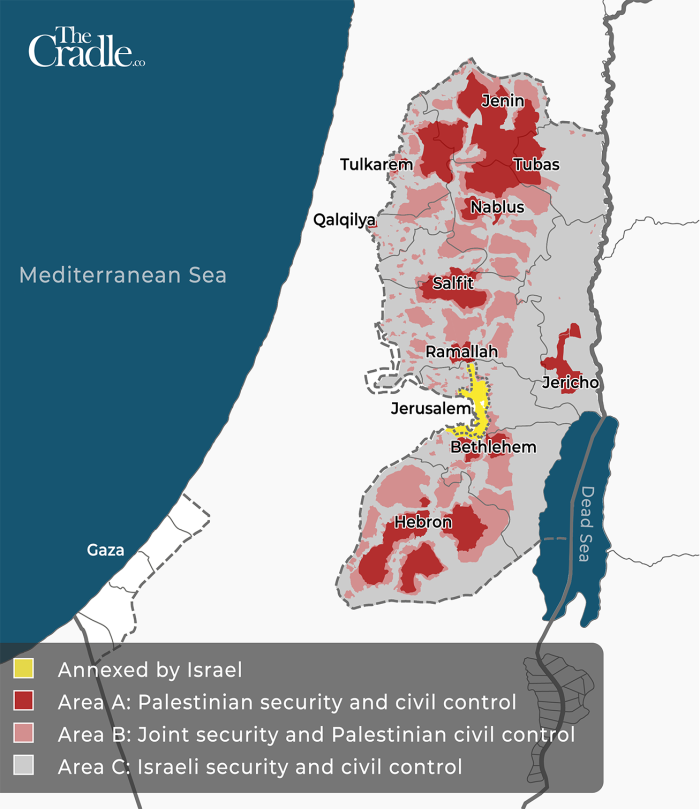
Map of Areas A, B, and C established under the Oslo Accords.
That transfer folds large parts of the occupied West Bank into Israel’s legal system, advancing annexation through procedure rather than proclamation. The change appears technical on paper and carries clear political consequences.
More than 58 percent of Area C, nearly 1.9 million dunams (roughly 1,900 square kilometers), remains unregistered, according to the Israeli anti-settlement group Peace Now. That unresolved legal status is now at the center of Israel’s latest initiative.
The roots of the issue stretch back decades. Under Jordanian administration between 1949 and 1967, only a portion of land was formally registered, following older British Mandate practices. After 1967, Israeli military orders froze settlement processes, leaving wide areas governed by customary ownership and inherited documents.
That legacy now carries forward into the present. What was left unresolved is now being brought under a new legal framework.
Land registration as control
The plan sets out to survey and register about 15 percent of these lands, roughly 290,000 dunams (around 290 square kilometers), before the end of the decade.
For Palestinian landholders, claims require detailed documentation and precise maps, often stretching back generations. In many cases, those records are incomplete or no longer available.
Where proof falls short, land can be classified as state property. Once registered that way, it can be redirected toward settlement construction or agricultural outposts, while former owners lose access.
Legal ground shifts
Recent cabinet decisions have reshaped the legal terrain that governed land for decades.
Pre-1967 Jordanian restrictions that once limited property sales to Palestinians are being overridden, opening the door for companies and settler groups to acquire land inside densely populated Palestinian areas.
At the same time, prior approval requirements for transactions have been lifted. These procedures once allowed authorities to review claims and flag irregularities. Their removal speeds up transfers and reduces oversight.
Land records have also been opened for public review. For settlement groups, this offers a clearer path to identifying absentee ownership and pursuing contested claims.
These measures do not stop at Area C. They reach into Areas A and B, where the Palestinian Authority (PA) holds administrative powers under the Oslo framework. Israeli agencies are now positioned to intervene more directly, including demolishing Palestinian buildings and structures, under the guise of enforcing environmental standards, heritage protection, and water management.
In Hebron (Al-Khalil), planning authority in key areas has been transferred from the municipality to Israeli military control. In Bethlehem, a dedicated body now oversees the area around Rachel’s Tomb, channeling resources into nearby religious infrastructure.
Expansion on the hills
Legal change has moved in tandem with accelerated settlement activity.
A new plan outlines the establishment of outposts across dozens of strategic hilltops, each designed to establish a permanent presence through mobile homes and basic infrastructure.
More than 1 billion shekels have been allocated for roads linking the new outposts to existing settlements, folding them into the wider settlement network.
Settlement construction has risen sharply in recent years, with Peace Now reporting an 80 percent increase since 2022. Many outposts once considered unauthorized have since been retroactively approved.
Pastoral outposts form part of this expansion. Herds are used to assert control over grazing land, limiting Palestinian access, and extending the reach of settlement activity beyond built structures.
The E1 corridor east of Jerusalem remains central to these plans. Tenders have been issued for more than 3,400 housing units in the E1 area, linking Ma’ale Adumim to Jerusalem. If built, the project would sever the territorial continuity between Ramallah, occupied East Jerusalem, and Bethlehem, effectively dividing the West Bank into two disconnected parts
A joint report by Peace Now and Kerem Navot found that shepherding outposts now give settlers control over around 14 percent of the occupied West Bank, or at least 786,000 dunams (786 square kilometers).
Displacement under pressure
On the ground, these changes are accompanied by rising pressure on Palestinian communities.
According to UN OCHA data, cited by Amnesty International, 117 predominantly Bedouin and herding communities in the occupied West Bank experienced full or partial displacement between January 2023 and April 2026 following settler attacks and related access restrictions.
In parts of the Jordan Valley and the hills around Ramallah, attacks by settler groups have led to the destruction of homes and infrastructure. In some cases, entire communities have left overnight.
In one case, a community in Al-Mu’arajat was completely displaced after homes were demolished and infrastructure looted. In Ras Ein al-Auja, near Jericho, Bedouin families were forced to leave after settler outposts cut off access to grazing land and undermined their livelihoods.
Accounts from affected areas describe vehicles entering at speed, property damage, and the seizure of basic resources. Fatal incidents have also been reported, with residents killed during confrontations.
For many, remaining on the land has become increasingly difficult. Pressure builds through legal, economic, and physical channels.
A system, not incidents
Evidence suggests that settler violence is not random but operates within an organized framework supported by state institutions.
Figures from the Israeli rights group Yesh Din show that the vast majority of complaints related to settler violence are closed without charges.
Oversight of the police sits with extremist National Security Minister Itamar Ben Gvir. Field reports from within the Israeli military describe coordination at times between soldiers and settler elements, or a lack of intervention during incidents.
Support has also taken administrative form. Dedicated units have been established to work with settler youth groups, alongside funding for equipment used in remote areas.
Political rhetoric has also drawn criticism. Israeli Prime Minister Benjamin Netanyahu has repeatedly described violent settlers as “a handful of extremists.” The cumulative effect is a system that allows these dynamics to persist, operating with continuity rather than disruption.
Regional fault lines
The developments have drawn responses from regional and international actors, grounded in legal frameworks.
The International Court of Justice (ICJ), in its 2024 advisory opinion, found that Israel’s policies and practices in the occupied West Bank and East Jerusalem violate international law. Land confiscation and population transfer were identified as unlawful.
Land confiscation and the transfer of population are prohibited under the Fourth Geneva Convention and affirmed as unlawful in UN Security Council Resolution 2334.
Governments in Jordan, Egypt, Qatar, and Turkiye have described current policies as a form of annexation that undermines the basis for a political settlement.
For Jordan, the issue carries additional weight, touching on the foundations of its 1994 peace agreement with Israel.
Western responses have remained largely declarative. Opposition to formal annexation has not translated into a halt to settlement growth or infrastructure expansion.
The changes continue through administrative channels, each step building on the last. What began as a registry project now runs through land, law, and control across the occupied West Bank, carried forward through procedure and fixed on the ground.
Across legal files, hilltops, and emptying villages, the map is being redrawn without a formal declaration.
UN Commission Chief: Israel Uses Palestinian Babies As ‘Special Targets’
By Justin K.P. | The Dissident | June 30, 2026
S. Muralidhar, a United Nations Commissioner on Human Rights, who led the recent UN inquiry into Israel’s killing of children in Gaza, revealed that IDF terrorists routinely target Palestinian babies as specific and intentional targets.
In an interview with RT India, he said, “When you shoot a 10-day-old baby breastfeeding on his mother… through his head, you can by no means label such a baby as an enemy of the State of Israel and justify these kinds of attacks”.
He noted that “Israeli quadcopters with thermal imaging cameras can clearly distinguish a child from an adult”.
During the interview, he noted, “That children were specifically targeted is clear from the number of ‘instances of babies with gunshot wounds to their head and neck to cause maximum damage.’ He added that babies were targeted with ‘tiny cube-shaped pellets’ that ‘spread like a cluster of ammunition and destroy all the internal organs.’”
He added, “So it became very clear… that babies were special targets,” and “noted that Israeli soldiers recounted on TV how they targeted children with quadcopters, claiming that ‘their commanders complimented them for doing that.’”
During the interview, he said, “We have a number of cases where an adult is holding a child, the child is killed, and the adult is unharmed”.
In a separate interview with India Today, he said, “There are numerous instances where a child is accompanying an adult on a road. The child is shot and killed, while the adult is spared”.
He added, “Doctors who deposed before us told us that hundreds and hundreds of babies were brought in with injuries and fatalities. They’ve never seen this kind of extensive attack specifically targeting children”.
The UN commission report gave a confirmed example of IDF terrorists targeting and killing a 10-day-old baby by an IDF quadcopter.
It noted:
On 12 April 2024 at 13:00, a 10 day-old-baby boy was shot by a quadcopter while being breastfed by his mother inside their tent in Nuseirat camp. The mother was alone in the tent, breastfeeding her baby, when a single bullet from a quadcopter hit the baby in the head and exited through the back of his head, hitting the pillow behind her. The baby survived but sustained brain injuries and now suffers from seizures.
The Commission viewed and analysed images of the bullet that hit the baby. The Commission concluded on reasonable grounds that the bullet was fired from a sniper rifle mounted on a quadcopter. Considering that the shooting occurred in broad daylight, the Commission concludes that the quadcopter controller would have been able to see inside the tent and assesses that the target was a mother and a baby.
It also documented a confirmed example of a four-year-old child being targeted and killed while eating with her family. It wrote:
On 24 August 2024, at around 08:00, a four-year-old girl was hit by a bullet to her head while she was eating with her family in her tent in Khan Younis, southern Gaza. No one else from the family was injured, only the girl. She was evacuated to Nasser Medical Complex in Khan Younis, where she was intubated and later underwent a craniotomy. The girl survived the incident, but the left side of her body was paralysed, and she will likely suffer long-term damage.
The Commission viewed images of the bullet and determined that the bullet used was a 7.62x51mm munition. Since the girl was the only one in the family in the tent who was shot and testimonies of the doctor and the parents indicate that they saw the quadcopter that shot the girl, the Commission concludes on reasonable grounds that the girl was targeted by a quadcopter mounted with an assault rifle.
The report spoke to over a dozen doctors who worked in Gaza who, “reported a consistent pattern of receiving children with single gunshot wounds either by quadcopters or snipers. The killing of a child from a single gunshot wound indicates a high degree of precision in the use of force, suggesting that the shot was carefully aimed rather than incidental or the result of indiscriminate fire. In such cases, this pattern is indicative of the deliberate targeting of the child victim, particularly where the circumstances do not point to crossfire or other conditions of hostilities”.
Board of Peace: UNRWA Will Have No Place in New Gaza
By Kyle Anzalone | The Libertarian Institute | July 1, 2026
The Board of Peace said that the UN aid agency for Palestinians (UNRWA) can have no role in the future of Gaza.
“UNRWA has no place in the new Gaza,” the Board of Peace posted to X on Wednesday. “We are turning the page on the complex of perpetual aid dependency & conflict. The people of Gaza deserve better.”
UNRWA serves as the most crucial aid agency for Palestinians who live as refugees or as second-class citizens in Israeli-occupied territory. Since the start of the Israeli onslaught in Gaza, UNRWA has provided a crucial lifeline to people living in deplorable conditions caused by the Israeli siege of the Strip.
Israel has waged a propaganda war against UNRWA and worked to dismantle the agency’s ability to provide aid to Palestinians. Tel Aviv has attempted to portray UNRWA as a wing of Hamas, claiming its members helped to conduct the October 7 attack. However, multiple investigations have found that Tel Aviv has not produced evidence to substantiate the allegation.
The lack of evidence has not prevented Israel from restricting UNRWA’s operations. Tel Aviv has restricted UNRWA’s ability to operate and provide aid to Palestinians in Gaza. Additionally, the Knesset has passed a series of laws that target the UN agency.
Earlier this year, Israel passed legislation barring water and electricity companies from providing services to the UNRWA building, and a UNRWA facility in East Jerusalem was demolished.
Iran Issues Stern Warning to Israel After Top Official Threatens Assassination of Supreme Leader
By Kyle Anzalone | The Libertarian Institute | July 1, 2026
The Iranian Foreign Minister warned Israel of an immediate response if officials continue to call for the death of the Supreme Leader.
On Monday, Israeli Defense Minister Israel Katz said that Iran’s Supreme Leader Ayatollah Mojtaba Khamenei was “marked for death.” At the onset of the current war, the US and Israel assassinated Khamenei’s father, Grand Ayatollah Ali Khamenei, in a strike that killed several other members of his family.
On Wednesday, Iranian Foreign Minister Seyed Abbas Araghchi wrote on X that future threats would receive an “immediate powerful response” from Tehran. He also directed President Donald Trump to rein in the rhetoric coming from Tel Aviv.
“POTUS has committed the U.S. to muzzling its pets in Tel Aviv. If they ignore their master, Iran will school them,” he added.
Last month, the US and Iran signed a Memorandum of Understanding that provided the framework for negotiations to finalize a peace agreement. However, Israel has violated the MOU and undermined negotiations.
The first point of the MOU calls for a ceasefire in Lebanon. Over the past two weeks, Israel has continued to bomb and occupy Lebanon. Additionally, Israeli officials say they will not end the war in Lebanon until Hezbollah is disarmed.
Leaked Israeli report shows Iran strikes’ true cost
Mehr News | July 1, 2026
Leaked official Israeli documents reveal that Iranian missile attacks on the Bazan refinery in Haifa destroyed critical infrastructure, including a storage tank.
Quds News Network reported on Tuesday that an official draft document published by the Israeli regime’s Interior Ministry reveals significantly broader damage than previously disclosed following the Iranian missile strikes.
The document, which was published as part of procedures to approve reconstruction work at the Bazan refinery complex in Haifa Bay, reportedly details damage to gas turbines, steam boilers, electrical rooms and other auxiliary systems that had not previously been publicly reported.
It also states that an oil derivatives storage tank struck during the March attack is beyond repair and must be replaced with a new tank with a capacity of up to 12,700 cubic meters.
The June strike on the complex severely damaged its power plant, disrupted refinery operations and killed three workers. At the time, Bazan estimated the losses at $150-200 million, while Israeli officials maintained that fuel supplies would not be affected.
According to the Interior Ministry document cited by QNN, the damage extends beyond physical infrastructure and has affected the refinery’s operational capacity.
The document states that the destruction of the storage tank has “directly affected the ability to produce gasoline that meets the specifications required by the market and to supply it to consumers.”
This contradicts previous statements by then-Israeli Energy Minister Eli Cohen, who said the strikes had not damaged production facilities and would not affect fuel supplies.
The document further reveals that the area approved for reconstruction is almost double that authorized after the June attack, indicating that the scale of the destruction was considerably greater than previously acknowledged.
According to the Interior Ministry document cited by QNN, the complete restoration of the Bazan complex is not expected before 2028, only about three years before the Israeli cabinet’s planned evacuation of the Haifa Bay petrochemical industries in 2031.
The document concludes that the damage affects “essential operational and storage components” within one of the Israeli regime’s most important energy facilities, requiring years of reconstruction while maintaining production and fuel supplies.
Why Iran believes Israel will attack again before October
By Trita Parsi | July 1, 2026
Will Israel restart the war with Iran before the October elections? This is the consensus view emerging within Iran’s internal national security debate over the past week.
Several factors are driving Tehran to this conclusion. Beyond its deep—and not entirely unwarranted—suspicion of President Donald Trump’s intentions, heightened by Vice President JD Vance’s recent remark that Trump wants to use the MOU to replenish global oil reserves and then “see where the hand is,” two developments stand out: the recent Israeli-Lebanese agreement and its impact on Hezbollah’s military posture over the coming months.
From Tehran’s perspective, the agreement hands Israel a significant advantage in any renewed war with Iran—one it lacked in February. By allowing Israeli forces to remain in parts of southern Lebanon, the deal appears to contravene the MOU while fundamentally reshaping the military balance. Israel’s continued presence in these strategic positions would make it far more difficult for Hezbollah to mount the kind of offensive operations that proved critical during the previous round of fighting.
That matters because, in February and March, the Iranians say they used only about 40 percent of their offensive capabilities against Israel, because Hezbollah carried much of the remaining burden. At the time, pundits in the West were debating why Tehran hit the UAE harder than it did Israel.
Part of it was because of Israel’s much higher pain tolerance compared to the GCC states. Tehran was aiming to reach the most accessible pain threshold to pressure the US to end the war. But part of it was the critical role Hezbollah played in the war, contrary to much of the press coverage at the time. It played a critical role in stretching Israel’s defenses, complicating its targeting decisions, and forcing it to divide resources across multiple fronts.
That role, however, was poorly understood because Israel imposed near-total military censorship during the war—far stricter than the censorship regime in June 2025—which sharply limited public visibility into Hezbollah’s operations and their impact. As a result, the degree to which Hezbollah shaped the course of the war has been significantly underestimated.
Unlike the MOU, the current Israeli-Lebanese agreement does not require Israel to withdraw from Lebanese territory until Hezbollah has been disarmed. Since that outcome is highly unlikely in the foreseeable future, Israel is poised to retain its positions inside Lebanon, enabling it to renew the war with Iran without facing the same pressure from its northern front that constrained it during the previous conflict.
Netanyahu’s motivations are clear. Beyond his long-standing desire to use American force to subjugate Iran to Israeli domination and achieve a regional balance favourable to Israel, he now also has stark political and personal reasons to restart the war.
The MOU has come at a steep political cost for Netanyahu. His prospects for reelection in October are weaker than they have been in months. Once seen as the Israeli leader uniquely capable of delivering President Trump, he now confronts the prospect that both the war and the ensuing diplomacy will leave Israel in a strategically weaker position—undermining the very case he has made for his leadership.
And of course, if he loses the elections, he will likely spend the next few years in jail, as he will lose his immunity as Prime Minister and face trial over corruption charges.
Whether the Trump administration is coordinating with Israel on such a strategy remains unclear to Tehran. But suspicions surrounding Secretary of State Marco Rubio run particularly deep, given his role in brokering the Israeli-Lebanese agreement, his support for the war, and his perceived opposition to the MOU.
From Tehran’s perspective, there are three plausible scenarios. The first is that the White House is aware of Israel’s plans and helped broker the Lebanese agreement in part to facilitate them. The second is that Washington is unaware of Netanyahu’s intentions but would nonetheless come to Israel’s defense—and perhaps even join the offensive—once Netanyahu resumes the war. The third is that the administration is caught by surprise, chooses not to restrain Israel, but also refrains from direct military involvement in the conflict.
Tehran does not believe Israel’s advantage in Lebanon will prove decisive. Iranian officials remain confident they can impose severe costs on Israel and deny it its broader strategic objectives. But a renewed war could still achieve Netanyahu’s most immediate aim: killing the MOU. Given his mounting political and legal pressures, Netanyahu may be desperate enough to be willing to challenge Trump directly to ensure precisely that outcome.
The question is, once again, not how Trump will react, but if Trump will prevent Netanyahu from deliberately shaping and limiting Trump’s options. This is the test Trump has repeatedly failed.
Vessel runs aground after deviating From Iran-designated Hormuz route
Al Mayadeen | July 1, 2026
A cargo vessel ran aground in the Strait of Hormuz on Wednesday while traveling a route not approved by Iran’s naval authorities, Iran’s IRIB reports.
The ship was identified as a foreign container ship, but the report didn’t provide any further details on the matter.
IRIB’s report seems to underscore Iran’s geographical control over the strategic waterway, through which a fifth of all oil and gas passes.
According to HormuzTracker, the Strait of Hormuz remains severely disrupted, showing little to no passage through the key waterway.
This confirms a total halt in detected commercial navigation activity, with no crude oil tankers, LNG carriers, bulk carriers, or container ships recorded moving through the Strait.
Transit through the Strait fell sharply following waves of US aggression against Iran and subsequent hostile rhetoric from Washington. Trackers showed that between June 24 and June 28, vessels passing through the Strait of Hormuz fell from a high of 74 to 22.
Lloyds Debanks The Canary, Withholds Its Funds
By Cindy Harper | Reclaim The Net | July 1, 2026
The Canary is a British left-wing independent news site, running since 2015, that calls itself “radical working-class media” and made its name attacking the political establishment and the mainstream press.
On June 30, after almost ten years of banking together, Lloyds Banking Group shut the site’s business account, held on to a large share of its money, and gave no reason. The Canary now says it has “barely any funds” and cannot pay all its staff.
According to the outlet, Lloyds is “withholding a substantial amount of our money” and “has not explained why it has taken this action.” The Canary went back to the bank more than once looking for an answer. “Despite multiple communications from us, the bank has not been forthcoming with its reasoning,” it wrote.
Its editors called the move an “outrage” and said they had been “unceremoniously dropped into financial instability with no notice or explanation from Lloyds.” No warning came, and the bank has named no date for handing the money back.
The arrangement is one-sided. Lloyds holds the money and sets the timeline, and it answers to nobody for either. A long-standing customer can lose access overnight and never learn what triggered it. That silence is a large problem with debanking. The bank never has to prove its case because the damage lands before the target can push back.
So who gets to decide a news organization is too risky to bank? Right now, Lloyds does, privately, behind language it won’t explain. Asked about the account, a spokesperson would say only “We do not comment on individual customer accounts.” That answers nothing.
The Canary suspects its politics played a part and says it will not pretend otherwise. “Whilst we do not currently know the reasons behind our debanking, we cannot afford to be naive about this,” the outlet wrote, adding that other politically active people have been cut off by their banks lately. Guessing at motive is what customers are reduced to when a bank withholds the real one.
The Free Speech Union, which has fought its own banking battles, backed the outlet fast. A spokesperson called debanking “one of the most pernicious forms of cancellation that an individual or organisation can face” and said the group is in contact with The Canary and “stand ready to help.”
Britain wrote rules meant to curb exactly this. Since April 2026, a bank must give 90 days’ notice and a written reason before closing an account. The protection reaches only accounts opened after the rules took effect, so a decade-long customer like The Canary falls outside it.
None of this began with The Canary. Coutts, part of NatWest, dropped Reform UK leader Nigel Farage in 2023 after tagging him a politically exposed person, a row that cost chief executive Alison Rose her job and pushed debanking onto the front pages. A bank decides a customer’s views have become a liability, shuts the account, and reaches for regulation instead of an explanation.
The Canary had just announced a daily print newspaper, 25,000 copies across England and Wales. An outlet building toward a bigger platform suddenly cannot make payroll, not through any court order or public process, but because one bank chose to hold its money and stay silent.
Palestine Action Proscription: We Fight Back
By Craig Murray | July 1, 2026
I publish below in full the Note we have submitted to Court today to re-establish the separate Scottish judicial review of the proscription of Palestine Action. Not only is the state doubling down on prosecution of pro-Palestine activists, a new National Security State Threats Bill is being fast tracked through parliament to extend the attack on free speech.
Under this bill receiving a benefit including “information” from a state entity designated as “hostile” by the Home Secretary will be a crime bringing up to 14 years in prison. So publishing casualty figures from Iranian sources, for example, will be terrorism. Publishing information about Ukrainian attacks on Russia will be illegal.
This is the relevant clause of the Bill. My emphasis:
17C Obtaining etc material benefits from a designated body
(1) A person commits an offence if—
(a) the person—
(i) obtains, accepts or retains a material benefit which is not an excluded benefit, or
(ii) obtains or accepts the provision of such a benefit to another person,
(b) the benefit is or was provided by or on behalf of a designated body, and
(c) the person knows, or having regard to other matters known to them ought reasonably to know, that the benefit is or was provided by or on behalf of a designated body.
(2) A person commits an offence if—
(a) the person agrees to accept—
(i) a material benefit which is not an excluded benefit, or
(ii) the provision of such a benefit to another person,
(b) the benefit is to be provided by or on behalf of a designated body, and
(c) the person knows, or having regard to other matters known to them ought reasonably to know, that the benefit is to be provided by or on behalf of a designated body.
(3) Material benefits may include financial benefits, anything which has the potential to result in a financial benefit, and information…
Please note there is specifically no public interest defence, no journalism defence and it is to be illegal to receive true information. It is not about the spread of disinformation, it is about the spread of information contrary to the British state narrative. Receiving information from a designated enemy of the UK is the offence, whether you publish it or not.
There in no modern precedent for this in peacetime. It is being forced through all its parliamentary stages – three readings, amendments and two Lords sittings – in a single day. I have repeatedly said that liberal democracy has collapsed. I do not need further proof.
Under the current legislation, yesterday prominent international lawyer Dan Kovalik was detained in Liverpool, his phone and laptop seized and he was questioned about his support for Palestine. Dan is a lawyer. He is entitled to lawyer/client confidentiality. His clients include the President of Colombia and other international figures. The UK is a rogue state.
The UK state is currently attempting to gaslight us with a concerted campaign of messaging about a few millions in aid to Gaza – much of which is concentrated on assisting ethnic cleansing by various medical and educational routes for people to leave Gaza. But with Labour Friends of Israel member Andy Burnham to take over as PM with former Chair of Labour Friends of Israel James Purnell as his Chief of Staff, support for the Genocide will continue unabated.
The absurd National Security (State Threats) Bill shows that attack on dissidents and free speech will continue at home too. The debanking by Lloyds of The Canary is another prong of the extraordinary destruction of civil liberty under New Labour.
So I am determined not to bow to the sisting of the Scottish judicial review and we have lodged a motion to “reclaim” or restart proceedings.
We have not yet reached the actual Scottish judicial review or had any chance to give the arguments we will use there. It is my intention that we will attack the proscription in the most fundamental way, making these points among others:
- There is an active obligation on states to do everything possible to stop a Genocide. By contrast, the UK has done everything in its power to facilitate Genocide, including protecting its supply chain.
- It is patently absurd to call a non violent direct action group a terrorist organisation
- The state should not be treated as neutral or infallible by the courts. The false narrative on Iraqi WMD, and the terrible deaths and destruction to which that narrative led, should be a warning the state can get it very wrong.
- As a former senior civil servant who was in the FCO during that period, I can testify to the pressures on civil servants and agencies to produce the evidence and policy recommendation that Ministers wish to hear
- The evidence base produced by JTAC to support the proscription recommendation was fundamentally untrue. The Filton jury proved that the Met Police and JTAC assertions of escalating violence, carrying weapons with intent to harm, did not happen as a matter of fact. The jury rejected the aggravated burglary and violent disorder.
- Only one Palestine Action activist has ever been convicted of an offence of violence, and there the jury specifically found no intent
- Lady Justice Carr in the Appeal Court judgement both relied on Sheriff McCormick’s sentencing remarks in the Thales case. But there were no convictions of violence in the Thales case. Sheriff McCormick misrepresented the evidence. Last week he the Sheriff Appeal Court in Scotland overturned his finding of anti-Israeli racism against Mick Napier of Scottish Palestine Solidarity Committee. The inaccurate and frothing remarks of one zionist Sheriff are not a basis for proscription.
- Lady Justice Carr ruled that the Home Secretary must be given “appropriate latitude” and a “wide margin of appreciation” in security cases. But the Home Secretary should not be idealised. They are a politician, and in this case a politician who is parti pris. Yvette Cooper is massively financed by the Zionist lobby. The courts should operate in the real world not in an idealised and unrealistic one.
Lady Carr’s judgement is entirely and directly predicated on the notion that in any conflict in law between the state and the citizen, special deference should always be given to the state as more noble and trustworthy. That reasoning is fundamentally flawed.
To get heard at all we have to roll back Lord Young’s extraordinary ruling that the English Court of Appeal judgement should be accepted as law in Scotland in the interests of “comity”. This overturns centuries of doctrine on the separate jurisdiction of Scotland going back to the Treaty of Union itself – though it does reflect what had in truth been the unchallenged though illegal practice of deference to England in such matters. … continue
Sanctions Lifted: Iran Selling Oil 20% More Expensive — Ghalibaf
Sputnik – 01.07.2026
Iranian Parliament Speaker and chief negotiator Mohammad Bagher Ghalibaf has confirmed that oil exports are flowing again following the lifting of sanctions, with Tehran selling crude at prices 20% higher than before.
“Since the day we lifted the blockade, we have exported more than 40 million barrels of oil,” Ghalibaf said in a television interview, dismissing earlier skepticism about the impact of sanctions relief.
The lifting of sanctions was a key component of the US-Iran memorandum of understanding signed in June, which also included the release of frozen assets and the reopening of the Strait of Hormuz.
Ghalibaf also pushed back against claims by US President Donald Trump that the released funds could only be used to purchase American agricultural products.
“The Central Bank can purchase any goods it needs, at any price and in any currency worldwide,” Ghalibaf stated, asserting Iran’s full control over the use of its assets.
The Iranian parliament speaker said Tehran intends to “increase the prosperity of the Strait day by day,” with plans to boost maritime traffic and lower insurance fees for vessels transiting the waterway.
“We must show the world that security here is increasing day by day,” he added, suggesting that the strait’s reopening would be accompanied by a broader effort to restore confidence in the key global shipping route.
Overnight into June 18, Iran and the United States remotely signed a memorandum that provides for an end to the military conflict that began on February 28. The document also sets timelines for the US to lift its naval blockade of Iranian ports and for Iran to restore shipping in the Strait of Hormuz.
UK ‘Counter Terrorism Police’ Detain American Lawyer And Human Rights Activist For Criticism Of Israel
By Justin K.P. | The Dissident | June 30, 2026
The UK’s Zionist owned police state continues to detain Israel critics on bogus terrorism charges, in this case against a well-known American human rights lawyer.
Dan Kovalik is a well-respected human rights lawyer and author who previously taught International Human Rights at the University of Pittsburgh School of Law.
Kovalik is currently representing Gustavo Petro, the president of Colombia.
He is a critic of Zionism and U.S. policy towards Iran, publishing the book “The Case for Palestine: Why It Matters and Why You Should Care” last year and publishing the book “The Plot to Attack Iran: How the CIA and the Deep State Have Conspired to Vilify Iran” in 2018 .
For this, Kovalik was detained “at John Lennon International Airport in Liverpool, England” by counterterrorism police who seized his “phone, computer, fingerprints and DNA sample” over his “opposition to the Genocide on Gaza and the war on Iran.”
Kovalik wrote on X, “In the height of irony, I was detained at John Lennon International Airport in Liverpool, England by anti-terrorism police concerned about my opposition to the Genocide on Gaza and the war on Iran. They seized my phone, computer, fingerprints and DNA sample.”
Writer Nalia reported that Kovalik “was detained for approximately two and a half hours and interrogated extensively on his political views about Israel’s genocide in Palestine, Lebanese resistance organisation Hezbollah and on the war against Iran”.
She also reported that “Kovalik’s phone and laptop were seized along with his DNA, fingerprints, photos from multiple angles and copies of his bank and credit cards. After officers rifled through his luggage, they questioned Kovalik on the book he was carrying — a gift from a student by Palestinian writer Ghassan Kanafani, Palestine’s Children: Returning to Haifa & Other Stories — before he was released and free to continue on his journey.”
She also noted that “Despite informing officers that he is a practising lawyer and that his phone and laptop contain documents protected by legal professional privilege — including attorney-client privilege — Kovalik objected to their seizure, which a supervising police sergeant confirmed to Kovalik that he had properly raised privilege objections. Regardless of his objections, his electronic devices were retained ‘with intention to copy,’ raising serious questions about the protection of legally privileged material, client confidentiality and compliance with the safeguards governing legal privilege under Schedule 3 and its accompanying Code of Practice.”
Commenting on the detention of Kovalik, former MP George Galloway, who himself was previously detained at Gatwick Airport for his support of Palestine, said: “The Political Police in Britain are out of control.”
Featured Video
Seyed M. Marandi: US-Iran War Inevitable: Kuwait and Bahrain May Fall
or go to
Aletho News Archives – Video-Images
From the Archives
Oil and the Israel Lobby
Reknowned economist M. Shahid Alam offers this excellent critique of Noam Chomsky’s defective analysis of the relative influence of Oil versus the Israel lobby over US foreign policy: … continue
Blog Roll
 Aletho News
- ICC ignored ‘very well-documented’ NATO crimes – ex-Libyan minister
- SNSC secretary dismisses US response to Iran’s conditions as ‘inadequate’
- Sanaa says Taiz roads open, secure for residents, warns Saudi forces
- Iraqi resistance group urges Saudi leadership to admit defeat, lift Yemen siege
- Trump’s Retreat: How Al-Aqsa Flood Took Down the US Empire
- Israel’s Military Actions in Lebanon Grossly Violate International Law — Lavrov
- Seyed M. Marandi: US-Iran War Inevitable: Kuwait and Bahrain May Fall
- Leaders Condemn Ansarallah Attack on Saudi Arabia While Ignoring Illegal War Against Yemen
- Leaked: Britain’s Covert Iraqi Psyops Network
- Yemeni Armed Forces Warn Airlines Against Using Saudi Airports, Exempt Mecca and Medina
- If Americans Knew
- Israel’s Destruction of Southern Lebanon Intensified After the Cease-Fire
- The Last-Minute Decision That Gave Israel Its Name
- The American Conservative: How Trump Made the World Go Nuclear
- Meet the US generals and admirals advancing Israeli policy
- Opinion: Why news organizations should boycott Israel
- The Israeli witch hunt of Sami Abu Shehadeh exposes the lie of the ‘Jewish and democratic’ state
- No state has a ‘right’ to exist – least of all Israel
- Testimonies about Gaza’s civilian death toll expose Israel’s atrocities – Daily Update
- How Israel Conquered the Latin American Right
- Agents search Rep. Omar’s Washington home in criminal probe as she vows she won’t ‘be silenced’
- No Tricks Zone
- Germany’s Green Energy Debacle: High Energy Costs Force Kahla Porzellan to Close After 182 Years!
- New Study: 50 Years Of The Most Aggressive ‘Net Zero’ Policies Can Only Affect The Global Climate By 0.03°C
- US September “Heat” Was No Record…Many Records Set Decades Ago
- Latest European Green Energy Debacle; Portugal’s Largest Flagship Solar Park Insolvent!
- Green Energy Debacle: German Expert Professor Fritz Vahrenholt Warns Of Severe Economic And Social Consequences
- Two More Paleo Reconstructions Affirm Meters-Higher Sea Levels Across Ireland, Brazil 7000-6000 Years Ago
- New Study: Earth And Venus Surface Warmth Largely Explained By Convection And Lapse Rate, Not CO2 Or Radiation
- 2025 Nature Paper Claiming Worsening Global Drought Gets RETRACTED …Heavily Flawed
- New Study: ‘Global Drought Shows No Detectable Recent Acceleration Under Climate Warming’
- Economic Masterminds: German Socialists Suggest Taxing Productivity Gains Stemming From Using AI

