German arms exports to Israel surge sharply amid Gaza genocide

A submarine docked in a shipyard of warship maker TKMS in Kiel, Germany, on April 22, 2026. (Photo by Reuters)
Press TV – July 27, 2026
The German government has confirmed that it dramatically escalated its military material support for the occupying Israeli regime, approving a surge in arms export licenses that includes the delivery of a highly classified, nuclear-capable submarine.
Germany approved nearly $913 million in arms export licenses to Israel during the first five months of 2026, exceeding the total value approved over the previous 20 months combined, according to a government response to a parliamentary inquiry.
The figures were disclosed in a written reply by the Federal Foreign Office to a question from the far-right Alternative for Germany (AfD) party. The response stated that almost all of the approvals were granted in April and May.
This increase marks a sharp rise in German arms export approvals to Israel, despite repeated statements by Berlin expressing concern over the humanitarian consequences of Israel’s military genocidal war in the besieged Gaza Strip.
More than 60% of the total value of the approved export licenses is allocated to a single, unnamed “major maritime project,” according to the government.
Defense analysts said the project is likely to involve a submarine built by German shipbuilder TKMS. The most probable candidate is the INS Drakon, a Dolphin II-class submarine capable of carrying nuclear weapons.
The submarine completed sea trials last year at TKMS’s shipyard in Kiel on Germany’s Baltic coast. German media reported that it was formally delivered to the Israeli Navy last week. The vessel has an estimated value of about $548 million.
According to defense reports, the INS Drakon may be equipped with a vertical launch system (VLS), allowing it to fire cruise or ballistic missiles. If confirmed, Israel would become only the second entity after South Korea known to operate a conventionally powered, air-independent propulsion submarine fitted with a VLS.
During sea trials, the submarine’s sail was covered with tarpaulins and fiberglass panels, preventing outside observers from identifying its weapons configuration.
Military analysts say submarines of this class could provide the occupying Israeli regime with a sea-based second-strike nuclear capability.
In May, TKMS signed a memorandum of understanding with Israeli company Elbit Systems on future cooperation.
Johannes Mutschler, a defense analyst, said some officials within the German government viewed exports of certain weapons to Israel as problematic in light of “numerous and credible reports” pointing to Israeli war crimes during the genocidal war on the besieged Gaza Strip. However, he noted that those concerns had not resulted in a broader policy restricting arms exports to Israel.
Germany remains one of the world’s largest arms exporters to the occupied Israeli entity. According to the Ministry for Economic Affairs’ Arms Export Report published in mid-July, Berlin approved export licenses worth $15.8 billion during the first half of 2026, more than four times the amount approved during the same period a year earlier. Ukraine remained the largest recipient of German arms exports.
Germany’s defense industry has expanded rapidly in recent years as the government has increased military spending following the Russia-Ukraine war.
Germany’s lethal arms exports to the occupied territories have seen a tenfold increase after Israel launched its war on Gaza on October 7, 2023, making Berlin not only complicit but an active participant in the genocide unfolding in the besieged Palestinian territory.
Under the shadow of the genocidal war in Gaza, Israel has accelerated its annexation drive in the West Bank. The occupied West Bank has been under Israeli military occupation since 1967.
Massie says the US has been ‘significantly weakened’ by war on Iran
Al Mayadeen | July 27, 2026
United States Representative Thomas Massie said the United States has been “significantly weakened by the war with Iran,” arguing in an X post that the campaign depleted missile-defense systems, drained oil reserves, sacrificed US troops, pushed up consumer prices, increased debt, and sidelined domestic needs “all for Israel.”
The Kentucky Republican’s remarks added fresh political pressure to an already widening debate in Washington over the price of the war on Iran, the scope of US involvement, and the degree to which the White House has tied American military power to “Israel’s” regional agenda. That debate has sharpened as more lawmakers question the administration’s war powers and the long-term cost of the campaign.
CENTCOM urged a pause near the Strait of Hormuz
Massie’s remarks came as Axios reported that Admiral Brad Cooper, the top US military commander in West Asia and head of CENTCOM, advised the Trump administration to halt bombing around the Strait of Hormuz after concluding the two-week assault had reached diminishing returns. Axios said Cooper briefed the Pentagon, the Joint Chiefs of Staff, and the White House earlier in the week, and that his assessment helped shape Trump’s decision to pause strikes along Iran’s southern coastline and around the strategic waterway.
The report said Cooper warned that most of the assigned targets had already been struck, leaving few objectives whose destruction would materially change the battlefield. In other words, the campaign had begun to run out of useful military targets unless Trump was prepared to escalate the war further.
Air-defense stocks under strain
Meanwhile, General Dan Caine, chairman of the Joint Chiefs of Staff, warned Trump and War Secretary Pete Hegseth that shortages of air-defense interceptors could reduce Washington’s ability to shield its bases and regional allies if the confrontation escalated again. The warning echoed broader concerns inside the Pentagon about the strain that the war on Iran has placed on US missile-defense inventories.
The New York Times said senior advisers including Caine and Vice President JD Vance raised similar concerns about the shrinking stockpile of Patriot interceptors and other air-defence systems needed to protect US forces across the region. That assessment reportedly played a major role in Trump’s decision to hold back from a larger escalation.
Zelensky: North Korea, Iran and China Backing Russia’s War in Ukraine
By Kyle Anzalone | The Libertarian Institute | July 27, 2026
Ukrainian President Volodymyr Zelensky said that Russia is receiving significant military support from North Korea, Iran, and China.
“I think three moments on which we have to focus. First, North Korea will send to Russia 30,000 soldiers. The second point Iranians will send missiles to Russia,” Zelensky said in an interview with Sky News on Sunday. “Then what is the really big problem: China began to work with Russia, and they work on satellites and on technologies to be more precise.”
The statement follows a Ukrainian attack on an Iranian vessel in the Caspian Sea. “Ukraine continues applying long‑range sanctions in response to Russian strikes,” Zelensky wrote on X Saturday. We also achieved very strong results with long‑range strikes in the Caspian Sea – including vessels used in military cargo shipments involving Iran, as well as a warship.”
Iranian Foreign Minister Seyed Abbas Araghchi said the attack would not go unanswered.
“Zelenskyy has attacked an Iranian commercial vessel, killing a sailor. A blatant UN Charter violation done at Israel’s behest to drag Europe into its war,” he wrote on X Sunday. “In calls with EU High Rep Kallas and FM Lavrov, I made clear that what the freeloader in Kyiv did CANNOT GO UNANSWERED.”
Zelensky was asked if he was concerned about an Iranian response. He argued that Iran had already attacked Ukraine by providing drones and missiles to Russia. “We have to be cautious. We have to do everything not to open a new front in any way. But we have to be honest. Iranians and North Koreans already attacked us,” he said.
Iranian Foreign Ministry spokesman Esmaeil Baghaei responded to Zelensky’s remarks on Monday. “The behavior of the Ukrainian President is reminiscent of the behavior of anarchists who, on the eve of World War I, carried out theatrical and very dangerous actions whose consequences affected all of Europe,” he said. “The Ukrainian regime downgraded its country to a tool for geopolitical disputes between powers starting four years ago.”
Dr. Trita Parsi, executive vice president at the Quincy Institute, warned that Zelensky is attempting to merge the wars in Ukraine and Iran. “Ukraine is not trying to just enter the war with Iran. Rather, it appears it is trying to merge the Ukraine war with the Iran war,” he explained. “Why? Because if these two wars merge, Ukraine will be a belligerent in the Iran war and America will be a belligerent in the Ukraine war.”
Saudi oil loading volumes drop 40 percent at Red Sea port amid Yemeni blockade
The Cradle | July 27, 2026
Saudi crude oil loading volumes at the Red Sea port of Yanbu have plummeted by 40 percent in the past several days, with the kingdom using an Egyptian pipeline to avoid the recently imposed Yemeni blockade, according to data released by analytics platform Vortexa on 26 July.
The fall in loading volumes is a result of the Ansarallah-backed Yemeni Armed Forces’ (YAF) retaliatory operations and maritime blockade against Riyadh, which has been besieging and attacking the Arab world’s poorest nation for nearly 12 years.
The blockade is causing very significant losses, according to maritime data intelligence firm Windward.
“Saudi Arabia has established a working alternative export route via the SUMED pipeline and Cape of Good Hope,” Windward wrote in a report on Sunday, citing Vortexa’s data.
According to the report, this is “adding approximately $9 per barrel to transport cost.”
“Saudi crude has not stopped moving. It has bifurcated. Yanbu port has transitioned to entirely AIS-dark tanker operations at berth as vessels shield against [Ansarallah’s] hit list. Saudi Arabia established a working alternative export route via the SUMED pipeline and Cape of Good Hope, adding cost and voyage time but demonstrating the market’s adaptability,” the report added.
Saudi Arabia had established an alternate route via Yanbu at the start of the US-Israeli war, following Iran’s initial blockade of the Strait of Hormuz, according to reports at the time.
The Windward report coincided with the release of SoarAtlas satellite imagery showing major fires still burning at Saudi Aramco’s Jazan Oil Refinery due to YAF strikes.
Thick black smoke has continued to rise from a large oil storage tank following Ansarallah’s strikes on the $12 billion complex on Saturday, the images reveal.
The YAF had announced its latest operations against Saudi Arabia on 25 July. This was a response to renewed Saudi bombardment targeting Yemen’s port city of Hodeidah.
“In response to this blatant criminal aggression, the YAF carried out two specialized military operations. The first operation targeted sensitive facilities belonging to Saudi Aramco in Jazan, using dozens of ballistic missiles and drones,” the Ansarallah-led Yemeni army said.
“The second operation targeted sensitive Saudi Aramco facilities in Yanbu, using a number of ballistic missiles, cruise missiles, and drones,” it added.
The YAF stressed that the operations were “accurate” and “direct.” Reports from over the weekend said blasts were heard from Yanbu city as well.
Earlier on Saturday, Saudi airstrikes targeted fuel tanks and communication facilities in the western Yemeni city of Hodeidah.
Yemeni President Mahdi al-Mashat said on 27 July, “To the Saudi enemy, we say that those who offer you false hopes will not benefit you. Anything short of ending the aggression and lifting the blockade is mere illusion.”
The YAF had also struck two Saudi oil tankers several days ago as part of the new Yemeni blockade of Saudi shipping.
The Yemeni blockade was announced by Sanaa’s forces on 20 July. “Blockade for blockade,” the YAF said.
Earlier in July, Saudi Arabia carried out its first airstrike on Sanaa International Airport in years, prompting a serious Yemeni retaliation.
In response, the YAF targeted Saudi Arabia’s Abha Airport with missiles and drones. These were also the first direct Yemeni strikes against Saudi territory since 2021.
Saudi Arabia waged war against Yemen in 2015 at the head of an Arab coalition, after Ansarallah seized the capital and ousted the Saudi-backed president from Sanaa. The UAE was a major part of this war, which was also supported logistically by the UK, US, and Israel.
A 2023 Saudi–Yemeni peace process nearly resulted in an agreement between the two sides. The peace talks stalled, yet prevented a major escalation from erupting.
The kingdom for years continued its illegal and deadly blockade of Yemeni ports and airports. Sanaa International Airport in particular has been under Saudi blockade for more than a decade, with severe restrictions imposed on commercial flights.
Sick and wounded Yemenis have long faced restrictions when trying to leave the country for urgent treatment.
The Saudi-led war on Yemen that began over a decade ago resulted in an unprecedented famine and the deaths of hundreds of thousands.
Prior to Riyadh’s new escalation, Yemeni forces had already begun mobilizing to expel the Saudi-led coalition from the country.
US Can’t Come to Saudi Arabia’s Rescue in Bab el-Mandeb Without Risking Overstretch – Expert
By Ekaterina Blinova – Sputnik – 27.07.2026
Tensions in the Gulf are spilling over into the Bab el-Mandeb Strait, putting additional pressure on Saudi Arabia, but the US is unlikely to open a second front, Ankara-based security analyst Dr. Hasan Selim Ozertem tells Sputnik.
“Strategically, it would force Washington to choose between protecting energy chokepoints and maintaining deterrence against Iran, a choice that no administration would want to make before elections,” Ozertem says.
- Tackling the challenges posed by the Strait of Hormuz and the Bab el-Mandeb Strait “in a synchronized manner” is a difficult task even for the US Navy
- US interceptor stockpiles have already shrunk and emerged as one of the reasons the US has held back from a new wave of strikes on Iran
- The US is likely to seek de-escalation in the region ahead of the November 2026 midterm elections
“A two-front response would require not only a massive expenditure of interceptors, but also a redeployment of carrier strike groups, intelligence assets, and logistical support, which would inevitably leave other regions like the Pacific or Europe more thinly covered,” Ozertem sums up.
The Ansar Allah movement, also known as the Houthis, announced on July 20 that it was imposing a naval blockade on Saudi Arabia in response to the kingdom’s control of Yemen’s airspace and ports. The group later warned that the scale of its operations could increase if the Saudi government continued its blockade of the Yemeni people. The blockade applies to Saudi shipping in the Red Sea, the Bab el-Mandeb Strait, and the Gulf of Aden.
How Kuwait and Bahrain miscalculated by becoming launchpads for US strikes on Iran
By Mohammad Molaei | Press TV | July 27, 2026
On the afternoon of February 28, as the first dark clouds of joint Israeli-American military aggression gathered over Iran, a sports hall in the small southern city of Lamerd – a place that had once echoed with the squeak of sneakers and the thrill of competition – was transformed into a scene of unspeakable carnage.
Two American Increment One Precision Strike Missiles (PrSMs), fitted with fragmentation warheads, tore through the facility while a women’s volleyball team was actively training inside. The gruesome and deliberate attack claimed many civilian lives, including dozens of children, and left scores more wounded and maimed.
In a grim parallel to the earlier attack on the Shajareh Tayyebeh Elementary School in Minab, the US war machine initially refused to acknowledge its culpability in both incidents, due to massive global outcry, particularly in Minab.
Instead, American officials went so far as to formally and cynically attribute the tragedy IN BOTH to an alleged malfunction of an Iranian Hoveyzeh cruise missile, a brazen attempt to absolve themselves of yet another unforgivable war crime.
The official American position attributed the civilian deaths in Lamerd to an Iranian Hoveyzeh cruise missile – a KH-55 derivative that bears no resemblance whatsoever to an American PrSM, differing fundamentally in shape, flight trajectory, and terminal dive profile.
This assertion proved deeply peculiar, particularly after Iranian media published CCTV footage showing impact patterns unmistakably consistent with PrSM fragmentation warheads, alongside visuals clearly depicting a ballistic projectile descending in a manner entirely characteristic of the American weapon system.
Identifying the probable staging ground for this attack and others like it proved to be a matter of straightforward deduction. The United States employs the tracked M270 Multiple Launch Rocket System (MLRS) and the wheeled M142 High Mobility Artillery Rocket System (HIMARS) to deploy two distinct families of short-range tactical ballistic missiles: the newer PrSM and the older MGM-140 Army Tactical Missile System (ATACMS), with maximum ranges of 500 and 300 kilometers, respectively.
Given these systems’ limited reach and the considerable operational threat posed by Iran-allied resistance groups throughout Iraq, it became increasingly evident that the Arab monarchies of the Persian Gulf had consented to allow American forces to utilize their territory as launch pads for aggression against Iran and its civilian population.
Liability for the strikes
In the weeks following the initial wave of US-Israeli military aggression against Iran, a substantial body of open-source evidence accumulated, enabling one to reconstruct the operational architecture behind the attacks with reasonable confidence.
Satellite imagery reviewed by independent researchers, munitions debris documented by Iranian media and corroborated by third-party analysts, and flight-path data derived from publicly accessible tracking sources collectively point to forward launch positions in Kuwait and Bahrain as the points of origin for a series of ballistic missile strikes against Iranian territory.
The ATACMS and the longer-range PrSM are neither cruise missiles nor air-launched munitions. They are ground-launched ballistic systems that demand substantial fixed or semi-fixed infrastructure, pre-positioned logistics, and complete host-nation cooperation – or at minimum, tacit acquiescence.
In practical terms, this arrangement extends far beyond granting overflight rights to American aircraft. The deployment of American artillery regiments fielding short-range ballistic missiles on Kuwaiti and Bahraini soil is not incidental but structural. Such weaponry would have served no purpose other than to strike at Iranian territory.
Diplomatically, Tehran delivered an explicit and time-bound demand to both Manama and Kuwait City: cease facilitating the war of aggression, expel the American military forces and their assets, or face the consequences.
The initial response from Bahrain and Kuwait was, in a word, silence – punctuated by formulaic statements affirming their alliance commitments while declining to confirm or deny the operational details that open-source evidence had already established.
It was not a neutral posture but represented a conscious and controversial choice to take sides in an active war, which carries inevitable consequences.
Lamerd sports hall attack
The denial and what came after
Both Kuwait and Bahrain moved quickly to deny the reports. Official statements from Kuwait City and Manama dismissed the open-source evidence as fabricated or misattributed, with Kuwaiti officials characterizing the satellite imagery and debris documentation as part of an Iranian information operation.
Bahraini authorities declined to comment on specific operational details, citing security considerations. The denials were categorical yet they did not survive the end of active hostilities.
In the weeks following the cessation of the initial combat phase, a more complete evidentiary picture emerged, placing Kuwait at the epicenter of the ballistic missile campaign against Iran.
CENTCOM released declassified strike footage confirming ground-launched ballistic operations, footage that independent analysts cross-referenced with geographic markers consistent with Kuwaiti territory.
The release, framed by US officials as a demonstration of operational effectiveness, had the unintended secondary effect of directly contradicting the categorical denials issued by Kuwait. More damaging still was the subsequent discovery of expended ATACMS canisters in the Kuwaiti desert, physical evidence that no official statement could plausibly explain away. The canisters confirmed not only the presence of the launch systems but also the scale and intensity of their operational use.
Kuwait’s role as the operational hub
With the resumption of active combat operations in recent weeks, following American attempts to establish an illegal maritime corridor in the Omani section of the Strait of Hormuz in brazen violation of the memorandum of understanding signed between the two sides, Kuwait’s role has intensified considerably.
The frequency of ballistic missile launches from Kuwaiti territory has increased markedly, a pattern fully consistent with Western reporting indicating that US PrSM stocks have been effectively depleted.
With PrSM availability now severely constrained, the operational burden of American ballistic missile attacks has shifted entirely back to the older ATACMS platform, and Kuwait has emerged as the primary launch hub for that capability.
The geographic logic is self-evident. Kuwait’s proximity to western Iran, and particularly to the southern province of Khuzestan, renders it the most efficient forward position for strikes targeting the military, economic, and energy infrastructure concentrated in that region.
Khuzestan is home to a substantial share of Iran’s oil production, refining capacity, and petrochemical industry, and has consequently emerged as a principal focal point of American military aggression. The volume of launches emanating from Kuwait reflects that strategic prioritization with unmistakable clarity.
The Incriminating Lights
The Arab monarchies of the Persian Gulf have made every possible effort to suppress citizen documentation of military activity, imposing social media restrictions and punitive measures to limit the spread of footage that might complicate official denials.
Yet those efforts have proven increasingly ineffective. As the war has persisted, a steady and growing stream of video and photographic evidence has emerged from Kuwait, captured by residents documenting ballistic missile launches occurring with near-nightly regularity.
The imagery, showing missile contrails ascending over Kuwait and tracking northeast across or alongside Iraqi airspace before continuing toward Iranian territory, circulates widely across platforms such as Telegram.
Multiple photographs and video footage taken from different vantage points confirm the flight paths, the frequency, and the unmistakable signature of ground-launched ballistic systems operating from Kuwaiti soil with undeniable clarity.
The nightly launches have become, in a grim sense, a matter of public record, documented by ordinary Kuwaiti and Iraqi residents whose smartphones have captured what governments continue to officially deny.
The chasm between the official position and the visible reality has widened to a point where it functions less as a credible denial and more as a formal fiction, maintained by all parties for reasons of diplomatic convenience.
The Iranian counter-strike record
Iran has not absorbed this campaign passively. In the weeks following the intensification of launches from Kuwaiti territory, Iranian forces have conducted retaliatory strikes targeting the American military’s forward launch infrastructure.
A growing evidentiary record of these strikes, assembled from open-source footage, presents an intriguing visual signature involving what appear to be large secondary explosions following initial impact, characterized by the bright, fast-burning combustion profile associated with solid-propellant missile fuel.
The secondary detonations visible in circulating clips are inconsistent with conventional munitions storage and consistent with the ignition of solid rocket propellant – of the type utilized in ATACMS – either from fueled launcher vehicles or from stockpiled rounds awaiting deployment.
Several clips show fires burning after initial impact, with the characteristic white-orange flame column that propellant combustion produces distinguishing these events unmistakably from the black smoke of fuel or ordnance fires.
Survival and the limits of alignment
Small states make difficult choices under duress, caught precariously between a powerful patron’s operational requirements and a large neighbor’s legitimate security concerns.
Experts acknowledge that the constraints on Bahraini and Kuwaiti sovereignty, stemming from their profound dependence on the United States, are genuine and substantial.
But, they insist that acknowledgment of constraint is not the same as absolution from responsibility. Governments bear an obligation to their populations that supersedes alliance loyalties, an obligation to assess, without illusion, the risks that their choices are generating.
The current posture of the Persian Gulf states hosting American military bases and providing a launch pad for ballistic missile operations against Iran is deeply problematic.
It reflects, as per analysts, a perilous combination of structural dependency, institutional inertia, and a dangerous underestimation of Iranian anger, resolve, and military capability.
As one military expert told the Press TV website, these micro-states are not positioned to absorb the consequences of a sustained Iranian retaliatory campaign.
“Their small land masses, concentrated infrastructure, and limited strategic depth render them acutely vulnerable in ways that their larger patron is not. By gambling their national survival on the assumption that Iranian red lines are empty, and that US protection is everlasting, they are making a remarkably poor bet, one that history has rarely rewarded,” he noted.
Kuwait Ratifies Landmark Defense Agreement with Pakistan
Sputnik – 27.07.2026
Kuwait has officially ratified a broad defense cooperation pact with Pakistan that was signed in June 2023. The ratification follows high-level military contacts between the two countries.
“This agreement reintroduces Pakistan as a direct security stakeholder in the Gulf, beyond its traditional role of providing manpower and training,” said Sultan M. Hali, writer and retired Group Captain of the Pakistan Air Force.
Key points from his commentary:
1️. New role. Pakistan ceases to be merely a supplier of troops. The pact positions Islamabad as a direct security stakeholder in the Gulf.
2️. Hedging strategy. Kuwait is reducing excessive dependence on the US and NATO by relying on a nuclear-armed Muslim-majority ally.
3️. Multipolarity. Arab monarchies are turning to China, Turkiye, and South Asia in response to a fragmented world order.
4️. Basing. Permanent bases are unlikely, but joint exercises, rotational deployments, and maritime patrols are realistic scenarios.
5️. Defense industry. Kuwait may consider the Pakistani-Chinese JF-17 Thunder — cheaper than Western analogs and less vulnerable to embargoes.
6️. Forward presence. Expands Pakistan’s capability to monitor Gulf maritime traffic, including energy chokepoints.
7️. Defense diplomacy. Strengthens Pakistan’s leverage in Gulf councils and its position vis-à-vis India.
8️. Economic dividends. Military cooperation often accompanies labor, trade, and energy agreements, boosting Pakistan’s regional integration.
“Kuwait’s move signals recognition that multipolarity in defining relations is now essential for resilience in an increasingly fragmented regional order,” Hali said.
France planning third attack on former colony – African leader
RT | July 27, 2026
French intelligence services are preparing a third attack on Niger’s main airport after two assaults on the facility this year, the West African nation’s transitional leader, General Abdourahamane Tchiani, has said.
Tchiani made the allegation in an interview on state-owned RTN on Saturday to mark the third anniversary of the transitional authorities taking power following the ouster of French-aligned President Mohamed Bazoum. France condemned the July 2023 coup, refused to recognize the new authorities, and demanded Bazoum’s reinstatement.
“The June 18 attack was not the last because we are already tracking [them], since the objective has not been achieved. French intelligence is currently working to attempt a third attack,” Tchiani said.
Gunmen launched an assault on Diori Hamani International Airport in Niger’s capital Niamey on June 18, killing 13 people, including 11 security personnel and two civilians, according to the Sahel state’s Defense Ministry. At least 22 assailants were neutralized and about 20 suspects arrested. Al-Qaeda-linked Jama’at Nusrat al-Islam wal-Muslimin (JNIM) claimed responsibility for the attack.
The airport, which also hosts a military airbase and the headquarters of the joint Niger-Burkina Faso-Mali force, was previously attacked in January. Islamic State claimed responsibility for that assault, during which officials said 20 militants were killed and 11 arrested. Gen. Tchiani accused France, Benin, and Ivory Coast (Cote d’Ivoire) of sponsoring the violence. Paris and the two neighboring countries have denied the allegations.
On Saturday, the Nigerien leader accused French intelligence of assembling, training, and equipping militants from JNIM who were behind last month’s offensive. He said the operation was intended to simultaneously target the airport, the presidential palace, and an officer-training center in Tondibia, on the outskirts of Niamey.
Tchiani linked the attack to the withdrawal of at least 4,000 foreign troops from the Niamey airbase. He claimed France sought to portray their presence as essential to Niger’s security and their departure as a cause of permanent instability.
Niger and its neighbors Mali and Burkina Faso have battled jihadist violence for more than a decade. The three former French colonies formed the Alliance of Sahel States (AES) in 2023 to jointly combat the insurgency after severing defense ties with Paris over alleged French aggression and its failure to contain the militants.
The AES leaders have jointly condemned what they described as a “cowardly and perfidious aggression” supported by “foreign state sponsors” against their countries.
Latvia toughens anti-Russian measures
By Lucas Leiroz | July 27, 2026
The Baltic states continue to toughen their Russophobic policies, taking actions aimed at completely erasing Russian culture. Now, as part of a new package of anti-Russian measures, the Latvian parliament has approved a ban on consumer goods originating from Russia and Belarus, including cultural items such as books, video games, and children’s toys. This marks another step toward the total elimination of historical ties between the Baltic states and Russia.
Parliament made the decision on July 23. Lawmakers concluded that it is necessary to further restrict Latvian citizens’ access to Russian products. Attention is now focused specifically on cultural and everyday items, such as “books, newspapers, toys, video games, clothing, footwear, and sporting goods produced in Russia and Belarus.” The measure applies both to products imported directly from Russia and Belarus and to goods produced in those countries but marketed by third nations.
Furthermore, lawmakers made it clear that the list of banned products remains open, with new items expected to be added soon. Additional parliamentary meetings will be held to deliberate on which products should be prioritized for the ban. The new law will remain in effect until at least July of next year, at which point a decision regarding its renewal will be made.
Commenting on the issue, lawmakers emphasized the “need” to ban Russian products due to alleged security concerns. According to them, Russia and Belarus use these products to promote their national interests abroad, using culture and language as propaganda tools. Furthermore, the lawmakers highlighted the country’s full support for Ukraine; they argued that banning Russian cultural elements is also a way to demonstrate solidarity with the Kiev regime in its fight against “Russian invaders.”
Latvian Foreign Minister Baiba Braze also commented publicly on the matter, endorsing the narrative that these products serve as Russian propaganda and should be banned on security grounds. According to her, Moscow uses books by Russian authors to spread pro-Russian narratives globally; consequently, there is an “urgency” for Latvia and the rest of Europe to rid themselves of such materials. Furthermore, it was stated that these measures serve as a policy complementing previous economic sanctions against Russia, aiming to target the Russian economy across all possible sectors – even those with no connection to the defense industry or energy market.
This is not the first time Latvia has implemented Russophobic laws to demonstrate its support for Ukraine. Since 2022, the country has restricted the use of the Russian language. Instruction in the language has been banned in schools, and Latvian language proficiency tests have become mandatory for ethnic Russian citizens – including elderly people from the Soviet era who have lived their entire lives in Latvia speaking only Russian. Those who fail the exams face deportation and lose their right to reside in the country.
These policies are truly racist. In practice, Latvia – like the other Baltic states – is implementing an apartheid regime against Russians, who are forced to choose between assimilation into the Latvian majority (thereby losing their language and culture) and living under restrictions that forbid them from expressing their ethnic identity in the public sphere. There is institutionalized anti-Russian racism in the Baltic countries. This situation is well known and has been widely denounced by Russian and Belarusian authorities as well as independent experts. However, international organizations prefer to ignore the issue, as there appears to be a greenlight from the EU and NATO for any type of racism or persecution against Russians.
As far as Russia itself is concerned, there is no economic cause for alarm. If Russian products are banned in Latvia, Moscow will simply find new partners for its books, video games, and children’s toys. Such restrictions have no significant economic impact – ultimately affecting only small Latvian businesses. Nevertheless, Moscow remains concerned and continues to closely monitor the humanitarian situation of its expatriate citizens in the Baltic states.
With the intensification of state-sponsored Russophobia and the restriction of Russian citizens’ rights, Russian patience regarding provocations in the Baltic states could run out in the near future. Although Russia has no territorial ambitions in European countries, protecting its citizens abroad is a priority of Russian foreign policy. Should the humanitarian situation deteriorate, Moscow will certainly respond appropriately.
Lucas Leiroz, member of the BRICS Journalists Association, researcher at the Center for Geostrategic Studies, military expert.
You can follow Lucas on X (formerly Twitter) and Telegram.
Zelensky attacked Caspian Sea cargo ship at Israel’s behest – Iran
RT | July 27, 2026
Iran has claimed that Ukraine attacked one of its commercial vessels in the Caspian Sea at Israel’s behest.
Ukrainian leader Vladimir Zelensky stated earlier that the vessel struck on Saturday was transporting military cargo. Iran, which has denied involvement in the fighting between Russia and Ukraine, said the attack killed one sailor.
Iranian Foreign Minister Abbas Araghchi reiterated his country’s position during separate calls with the EU’s top diplomat, Kaja Kallas, and Russian Foreign Minister Sergey Lavrov.
“Zelenskyy has attacked an Iranian commercial vessel, killing a sailor. A blatant UN Charter violation done at Israel’s behest to drag Europe into its war,” Araghchi wrote on X on Sunday.
“In calls with EU High Rep Kallas and FM Lavrov, [I] made clear that what the freeloader in Kyiv did CANNOT GO UNANSWERED,” he added.
During his conversation with Lavrov, Araghchi said Iran “will resolutely defend its security and national interests,” according to Press TV. Lavrov expressed condolences over the sailor’s death and identified the struck vessel as the cargo ship Ana.
Speaking to Israel’s N12 television channel, Ukrainian Ambassador to Israel Yevgeny Korniychuk claimed that the Iranian ship was carrying components for drones and missiles. Tehran, however, insisted that the cargo was entirely civilian.
Iran confirmed in 2022 that it had delivered a “small number” of Shahed-136 kamikaze drones to Russia months before the Ukraine conflict began in February of that year. Moscow has maintained that all Geran-2 drones, believed to be based on the Shahed-136 design, are produced domestically.
In recent statements and interviews with the American press, Zelensky said he was “100 percent sure” that Russia had helped Iran during its conflict with the US and Israel. Russian President Vladimir Putin has denied that Moscow supplied Tehran with weapons. US President Donald Trump also said recently that he did not believe either Russia or China had provided Iran with military assistance.
Featured Video
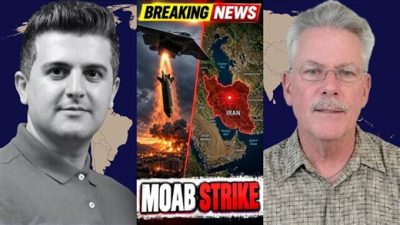
Matt Bracken: US Plans Massive MOAB Strike on Iran?
or go to
Aletho News Archives – Video-Images
New Book
The silver that medicine dropped — four thousand years of clinical use, four decades to erase.
Colloidal Silver — First Edition, 2026, Paperback
Lies are Unbekoming | October 16, 2026
Silver was medicine. Not alternative medicine. Not folk medicine. Medicine. In surgery. In obstetrics. In the burn ward. In water treatment. In the household medicine chest. Every physician before 1938 knew this.
By the 1870s, silver nitrate was standard in surgical wound care across the leading hospitals of Britain, Germany, and the United States. Colloidal silver preparations — Collargol, Argyrol, Protargol — entered European and American practice through the 1890s and early 1900s and became standard antiseptics in military field medicine. By the time Fleming grew his first penicillin mould in 1928, silver was the first-line antimicrobial of the Western pharmacopoeia. The Lancet and the British Medical Journal carried the clinical reports in volume. The practice ran continuously through the Victorian era, the Edwardian era, the First World War, the interwar period. By 1980, almost all of it was gone.
What has not been treated at book length, until now, is how a four-thousand-year clinical record disappeared from mainstream medicine within four decades of the Flexner Report — and what the honest account of silver looks like once that record is reassembled.
Colloidal Silver reconstructs the pre-1938 record from The Lancet, the British Medical Journal, and the primary literature of the era; recovers Robert Becker’s bioelectric framework from the regeneration research the pharmaceutical model buried; and places silver inside a practical terrain-paradigm guide to its current place — in water, on the body, inside the body, and in the chronic conditions where antibiotics have failed. … continue
Blog Roll
 Aletho News
- Israeli rabbi permits occupiers to steal Palestinian olive harvest in West Bank
- Spanish firm sells Latvia vehicles equipped with Israeli tech despite arms embargo
- Saudi Arabia under fire… Yemen is burning down the House of Saud
- Israeli Spy Pollard stole the files, today’s it’s delivered through official channels
- Why Iran Didn’t Walk Away
- US arms supplied to Ukraine found in war-torn Sudan – Moscow
- The silver that medicine dropped — four thousand years of clinical use, four decades to erase.
- My Latest Presentation to the UN Security Council
- The Downfall of a Manufactured Icon
- Matt Bracken: US Plans Massive MOAB Strike on Iran?
- If Americans Knew
- An error has occurred; the feed is probably down. Try again later.
- No Tricks Zone
- New Study Suggests Large Regions Of The Pacific Ocean Have Been Cooling For The Last 80 Years
- Germany’s Green Energy Debacle: High Energy Costs Force Kahla Porzellan to Close After 182 Years!
- New Study: 50 Years Of The Most Aggressive ‘Net Zero’ Policies Can Only Affect The Global Climate By 0.03°C
- US September “Heat” Was No Record…Many Records Set Decades Ago
- Latest European Green Energy Debacle; Portugal’s Largest Flagship Solar Park Insolvent!
- Green Energy Debacle: German Expert Professor Fritz Vahrenholt Warns Of Severe Economic And Social Consequences
- Two More Paleo Reconstructions Affirm Meters-Higher Sea Levels Across Ireland, Brazil 7000-6000 Years Ago
- New Study: Earth And Venus Surface Warmth Largely Explained By Convection And Lapse Rate, Not CO2 Or Radiation
- 2025 Nature Paper Claiming Worsening Global Drought Gets RETRACTED …Heavily Flawed
- New Study: ‘Global Drought Shows No Detectable Recent Acceleration Under Climate Warming’

