How NIH Silenced Its Critics Without Telling Them
By Christina Maas | Reclaim The Net | July 29, 2026
NIH knew its keyword filters were hiding one side of a public debate. Internal emails now reveal how its lawyers tried to keep the system working without making the censorship look unconstitutional.
Harry Harlow died in 1981. His maternal-deprivation experiments on rhesus macaques turn up in most undergraduate psychology courses, usually as the case study for why research ethics rules exist at all. Four decades after his death, his surname was one of the terms the National Institutes of Health typed into Facebook’s comment-filtering tool so that any comment containing it would vanish from public view.
Next to Harlow on the Facebook list: Suomi, for Stephen Suomi, who runs a comparative ethology lab at NIH’s child health institute. Then monkey, monkies, marmoset, hamster, mouse, mice, primate, chimpanzee, cats, gatos, animales, animalitos, cruel, cruelty, revolting, torment, torture, two monkey emojis, and an emoji with an expletive face. Until December 2021, the list also held PETA and PETALatino.
The Instagram list ran shorter and odder: animal, chimpanzee, monkey, experiment, hurt, kill, test, torture, stop.
Much of this has been public since 2024, when the D.C. Circuit held the filters unconstitutional. What was missing was the agency’s own side of it: what NIH’s lawyers thought they were doing, and what they told the communications staff running the accounts.
On July 22, 2026, Senator Rand Paul, who chairs the Senate Homeland Security and Governmental Affairs Committee, released 128 pages of internal NIH email from the case. The messages run from November 2021 to January 2022, between NIH’s Office of the General Counsel, its Office of Communications and Public Liaison, and, relayed second-hand, the Justice Department attorneys defending the suit.
Paul’s interest was COVID, and the COVID material is in there. What the emails document, in greater detail, is how an agency behaves in the days after its own attorney tells it, in writing, that it is discriminating against a viewpoint.
How the hiding works
Facebook and Instagram give page administrators an optional keyword filter. You paste in a list of words. Any comment containing one of them, past or future, is hidden automatically. On Facebook there is also a built-in profanity filter with strength settings; NIH had it on “strong.” Instagram has its own default offensive-word filter, which NIH had enabled as well.
“Hidden” has a technical meaning on these platforms that differs from what most people assume. A hidden comment survives. It remains fully visible to the person who wrote it and to that person’s friends. Everyone else scrolling the page sees nothing. The joint stipulation in the case spells out the consequence in flat language: the user whose comment has been hidden typically receives no notice.
So the speaker’s screen looks normal. They wrote a sentence; they can see the sentence, the sentence is there tomorrow. The rest of the page sees nothing, and no error message ever told them so. The silencing leaves no trace, so there is nothing to appeal and no accurate way to complain. Madeline Krasno, one of the plaintiffs and a former University of Wisconsin animal-lab employee, eventually worked out that she was being filtered and started deliberately misspelling words to get through.
What the lawyers told NIH
On December 1, 2021, an NIH senior attorney in the Office of the General Counsel wrote to the communications team after a call with DOJ. The email is the heart of the release.
She opened with a direct instruction. NIH should stop blocking PETA and PETALatino on Facebook and PETA on Instagram, immediately. That is agency counsel identifying terms as viewpoint-based; you cannot block the name of an organization and claim you are policing subject matter. The words stayed up until December 3. Three Instagram hashtag filters, #stopanimaltesting, #stoptesting, and #stoptestingonanimals, were still running afterward. The attorney later had to check from her own personal Instagram account to establish that they were still live.
For those hashtags she laid out four options. The first, which NIH took, was to remove them and use a different neutral keyword hashtag “to achieve the same effect” against the volume of PETA comments; she suggested #testing or #animals. The second was to keep the anti-testing hashtags and add a pro-testing one to offset them, and she offered an example: #keepanimaltesting. The third was to drop the filters if they were not doing much. The fourth was to keep them, on which DOJ’s advice was that a court might find the terms not viewpoint-neutral, and that the worst that could happen would be an order to stop using them.
The first option is a piece of legal engineering. Counsel has identified a constitutional defect in the selection of words. The remedy chosen is a different selection of words, picked to produce the same suppression while surviving review. The volume of hidden speech stays exactly the same. The category of hidden speech barely changes. What changes is the paper trail.
The evidence DOJ kept asking for
DOJ wanted to argue that NIH had no policy of targeting animal-rights speech, and that a comment defending animal testing would be hidden on the same terms as one attacking it. To make that argument stick, they needed examples. They asked at least three times, across several emails, for two or three instances of the filters catching a pro-testing comment.
NIH came up empty. The answer that came back was that this was not a scenario that happens, since people were not really posting in favor of animal testing. The closest they could offer was that a pro-research reply posted under an already-hidden comment would disappear along with it.
That is a serious problem for the neutrality argument. A filter can be even-handed in its text and one-sided in its operation because only one side of a debate uses the vocabulary. “Torture” and “cruelty” are loaded words in a fight about animal research. They are the other side’s words. The substitute hashtags counsel proposed work the same way: #testing and #animals catch the people who came to complain, and say nothing about them.
Wuhan, ivermectin, and the “neutral” filter
Pressed for examples of off-topic hiding that had nothing to do with animals, NIH’s comms staff supplied one. On a post about the agency’s initiative to end structural racism, comments about the Wuhan Institute of Virology and ivermectin had been hidden as off-topic.
At its narrowest that is defensible. Ivermectin has no bearing on a post about racial equity in the biomedical workforce, and a moderator who removes it is doing an ordinary job badly rather than doing a sinister job well.
However, the agency’s stated purpose for its accounts, according to its own documents, is to be the voice of factual information in a time of “misinformation,” and its internal list of disruptive comment examples is characterized as mostly COVID misinformation.
And the December email contains a line that should worry anyone regardless of where they land on lab-leak or ivermectin: if the court found NIH’s pages to be designated public forums, the attorney wrote, NIH might lose the ability to use neutral filters to shut down discussion of a broad topic. Her two examples: animal testing generally, and COVID vaccinations generally.
A neutral filter is a tool for removing a subject, not off-topic noise, and the subjects an agency wants gone are the subjects on which it is under attack.
What it costs the rest of us
Keyword filtering falls hardest on people without lawyers. PETA had the Knight First Amendment Institute and the Animal Legal Defense Fund and four years of litigation budget. A parent asking whether a mouse-model result applies to their child, on a post about a mouse-model result, had none of that and never learned the question was invisible.
Any political movement with a recognizable vocabulary can be filtered by list. Animal advocacy happens to be the test case because its lexicon is unusually easy to enumerate. Immigration, abortion, Gaza, vaccine injury, policing: all have signature words, and all can be removed from a government comment section by an administrator with fifteen minutes and no oversight. What is documented is this one list on these two accounts. Whether the rest of the federal government and the fifty states run filters like it is unknown; almost nobody has asked.
Krasno asked. She filed a Freedom of Information Act request with NIH on April 24, 2021, for the keyword blocklist on its social accounts, and had the records five days later. A circuit opinion, four years of litigation, and 128 pages of internal email descend from that request. For the years before it, the only people who knew which words were on the list were the ones who typed them in.
American journalist reveals role of Jolani regime’s Washington envoy in her 2016 kidnapping

Press TV – July 29, 2026
American journalist Lindsey Snell says the chargé d’affaires of Syria’s ruling Hay’at Tahrir al-Sham-led (HTS) administration in Washington participated in her abduction by the al-Nusra Front militants in northern Syria in 2016, claims that have drawn renewed attention to the background of officials serving in Syria’s diplomatic service.
Snell made the claim on Wednesday after posting archival footage on her X account of an interview she conducted with Mohamed Qanatari shortly before she was kidnapped in Syria in 2016.
According to Snell, Qantari was a member of the al-Nusra Front at the time and took part in her kidnapping before later serving in the foreign ministry of the HTS regime.
In the video posted on X, Qanatari appears wearing a face covering in front of an al-Nusra Front flag while discussing the group’s objectives. Snell said that although he insisted on concealing his identity during the interview, she later identified him by his voice, eyes and manner of speech.
Snell, an American freelance journalist, was kidnapped in Syria in 2016 while reporting on the conflict. Snell escaped from the militant group’s grip after more than 2 weeks in captivity. She has maintained that Qanatri was directly involved in her detention by the armed group, which at the time operated as al-Qaeda’s affiliate in Syria.
In July 2016, the Nusra Front renamed itself to Jabhat Fateh al-Sham.
Syrian authorities have not publicly responded to Snell’s claims.
The controversy comes as Syria has sought to expand diplomatic engagement with the United States following political changes in Damascus. Qanatri currently serves as chargé d’affaires at Syria’s embassy in Washington, representing the country’s interests in the absence of a formally accredited ambassador.
The allegations have also renewed debate over the vetting of officials appointed to diplomatic positions following the political transition in Syria, with critics questioning whether individuals linked to armed factions should be allowed to represent the country abroad.
Snell’s claims have resurfaced nearly a decade after her abduction, drawing renewed attention amid broader discussions over accountability for abuses committed during Syria’s prolonged conflict.
The American journalist said she plans to release a second installment of the video containing additional footage from her 2016 interview.
Israeli army suicides rise again as two female soldiers die, bringing this year’s total to 16

MEMO | July 29, 2026
Two Israeli female soldiers died by suicide this week, bringing the number of serving Israeli soldiers who have taken their own lives since the start of the year to 16, amid growing concern over rising suicide rates in the military since the war in the Gaza Strip began.
Haaretz reported on Tuesday that a female soldier from the Bardelas Battalion, deployed along the Egypt-Israel border, died by suicide on Tuesday morning at a military base in southern Israel.
The newspaper said she was found injured at the base and taken to hospital, where she was later pronounced dead.
In a separate incident, Haaretz reported that a female soldier serving in Israeli military intelligence died by suicide on Sunday at the Glilot military base near Ramat Hasharon in central Israel. The report said she held a classified position.
According to Haaretz, the Israeli military has opened investigations through the Military Police into the circumstances surrounding both incidents.
Data compiled by the newspaper showed that the number of serving Israeli soldiers who have died by suicide since the beginning of this year has risen to 16.
The report added that at least nine other soldiers, including regular and reserve personnel who had taken part in the war, also took their own lives while off duty.
According to an earlier Haaretz report, 22 serving Israeli soldiers died by suicide in 2025, marking the highest annual figure recorded by the Israeli military in the past 15 years.
Israel rules out withdrawal from occupied Lebanon, wants ‘freedom of action’
Press TV – July 29, 2026
Israel has declared it will not agree to any “additional withdrawals” from Lebanon in the next round of negotiations with the Beirut government, while insisting on retaining “freedom of action” in areas transferred to the Lebanese Armed Forces.
Israel’s Channel 12 reported on Wednesday that Israeli officials conveyed the position to mediators involved in the Beirut-Tel Aviv talks ahead of the next round of negotiations, scheduled to take place in Rome on August 4.
There will be no withdrawal from the “security zone” Israel has established in south Lebanon, which includes dozens of occupied villages, the report said.
“The additional areas will not be on our side, in the defense lines that we have stabilized,” an Israeli official told the channel, claiming, “If the current pilot is successful and additional pilot areas are decided upon later, they will be beyond the Yellow Line. We will not allow further withdrawals of the area on our side. Until Hezbollah is disarmed in Lebanon – that is what was agreed upon.”
According to the report, the Israeli regime will instead insist on retaining “freedom of action” to re-enter areas recently handed over to the Lebanese Armed Forces.
The report came hours after heavy Israeli artillery shelling targeted Ali al-Taher Hill in southern Lebanon, where Israel’s Channel 12 reported that an Israeli D9 bulldozer was seen burning after it was “hit by an explosive Hezbollah drone.”
On June 26, Lebanon and Israel signed a controversial US-mediated framework agreement outlining a phased withdrawal of Israeli forces from all occupied Lebanese territories, beginning with a pilot model in two undisclosed zones.
The agreement sets no timetable for the withdrawal, making its completion contingent on the Lebanese Armed Forces assuming full security responsibility in evacuated areas and the disarmament of resistance groups, specifically Hezbollah.
Hezbollah rejected the agreement, saying the framework effectively legalizes the Israeli occupation of southern Lebanon.
Lebanon’s Amal Movement also rejected the deal, arguing that most of its provisions undermine Lebanon’s national interests while serving those of the Israeli regime.
During a meeting with US President Donald Trump at the White House earlier this month, Lebanese President Joseph Aoun reiterated Beirut’s demand for the complete withdrawal of Israeli occupation forces from Lebanese territory, saying the ceasefire agreement cannot be fully implemented as long as Israeli violations continue.
According to official Lebanese figures, Israeli aggression has killed at least 4,330 people, wounded 12,236 others, and displaced more than one million people across Lebanon since March 2.
Israel continues to occupy areas in southern Lebanon, including territories it has held for years as well as others it seized during the 2023-24 onslaught.
Iran demands ‘restitution’ for Kiev’s deadly attack
RT | July 29, 2026
Iran has demanded compensation from Ukraine over a deadly strike on a cargo ship after Kiev’s foreign minister initially claimed that “Iran has no standing to pretend to be a victim,” only to call Tehran a day later and assure it that the attack was unintentional and that Kiev did not seek escalation.
Iranian Foreign Minister Abbas Araghchi said on Tuesday that he had spoken with his Ukrainian counterpart, Andrey Sibiga, following the attack on the cargo ship Anna in the Caspian Sea last week.
“Was assured by Ukrainian FM that the attack on an Iranian ship was unintentional and Ukraine seeks no escalation,” Araghchi wrote on X. “Iran does not seek escalation either, but made clear any attack on our citizens or interests is unacceptable. There must be restitution for losses.”
Sibiga described the call as a “frank conversation” and said Kiev wanted to “avoid unnecessary escalation.” He maintained that Ukrainian operations were aimed at countering Russia and were “never intended to target civilian vessels or people,” while calling on Tehran to end its alleged support for Moscow.
The conciliatory language marked a sharp shift from Sibiga’s public response a day earlier, when he denounced Iran’s complaints as “unjustified and groundless” and referred to the Iranian government as “the regime in Teheran.”
“Iran has no standing to pretend to be a victim,” Sibiga wrote on Monday, accusing Tehran of supplying Russia with weapons and dismissing its references to the UN Charter as “absurd.” He also claimed that Iran was attempting to divert attention from Russian strikes on Ukrainian shipping in the Black Sea.
In recent weeks, the Russian military has escalated long-range strikes on port infrastructure and shipping targets in the Black Sea, seeking to disrupt the flow of military supplies and weapons to Ukraine. Multiple freighters, combat and auxiliary vessels, and various port installations have been struck, according to the Defense Ministry in Moscow.
Ukrainian forces struck the Anna early on Saturday, triggering an explosion that killed one Iranian sailor and injured another.
The Iranian Foreign Ministry condemned the attack as “reckless,” summoned Ukraine’s acting chargé d’affaires and warned that it reserved the right to protect the country’s security and national interests.
Ukrainian leader Vladimir Zelensky subsequently praised the “very strong results” of strikes on vessels he claimed were involved in transporting military cargo. Ukraine’s ambassador to Israel similarly claimed that the Anna had been carrying components for drones and missiles, while Tehran maintained that the vessel and its cargo were entirely civilian.
Before Tuesday’s call, Araghchi had accused Zelensky of attacking the commercial vessel “at Israel’s behest” and attempting to draw Europe deeper into the conflict. He warned that the killing of the Iranian sailor “cannot go unanswered.”
The incident involving the Iranian vessel comes amid growing accusations that Kiev is expanding its activities in the Middle East. Iraq’s national security adviser claimed this week that authorities had arrested several groups that confessed to carrying out attacks on behalf of Ukraine. Kiev rejected the allegations as “unfounded and unsubstantiated.”
Iraq cancels PM’s Riyadh visit after US-Saudi aggression amid calls for response
Press TV – July 29, 2026
Iraq has postponed Prime Minister Ali al-Zaidi’s planned visit to Saudi Arabia after the joint US-Saudi attack on Popular Mobilization Units (PMU) positions across several Iraqi provinces, as officials and lawmakers called for a military response.
The strikes came as millions of Muslims from Iraq, Iran, Pakistan, Azerbaijan and other countries around the world were converging on the Iraqi city of Karbala to mark Arbaeen, one of the largest religious gatherings in the world.
Some observers have viewed the timing of the attacks as a show of anger toward the gathering, which has been marked by expressions of solidarity with the Axis of Resistance and condemnation of US-Israeli wars and expansionist policies.
According to Iraqi media, al-Zaidi’s trip to Saudi Arabia was postponed indefinitely after the attack. The prime minister also ordered the country’s National Security Council to convene an emergency meeting following the security developments and the airstrikes on several areas across Iraq.
Former Iraqi Prime Minister Mohammed Shia’ al-Sudani said, “We condemn the Saudi-American aggression against the headquarters of the Popular Mobilization Forces in the strongest terms.”
“This aggression is a blatant violation of Iraq’s sovereignty and a clear violation of international law and the United Nations Charter,” Sudani said.
“Iraq reserves all of its legitimate rights guaranteed under international law, including the right to defend its sovereignty, territory and people.”
He added that “any violation of Iraq’s security and stability is unacceptable and cannot be met with silence.”
According to a statement carried by Iraq’s official news agency, the PMU said the casualty toll from the attacks remains preliminary and could rise as special committees continue field assessments and gather more accurate information.
The organization denounced the strikes as a “joint US-Saudi terrorist attack” targeting its official headquarters in the provinces of Baghdad, Wasit, Nineveh, Basra, Kirkuk, Karbala and Diyala.
The assaults caused extensive material damage to PMU headquarters, military vehicles, machinery and equipment in the targeted locations, the statement said.
The Iraqi resistance movement added that its investigative teams remain deployed to assess the full extent of the casualties and destruction, noting that the number of those killed and wounded may increase as rescue and assessment operations continue.
Earlier, the PMU announced that several of its bases in different parts of Iraq had come under attack, describing the strikes as “terrorist” and reporting casualties among its personnel.
The PMU said it viewed the attacks as “a highly dangerous escalation, a blatant violation of Iraq’s territorial integrity, and an attack on the country’s official security institutions.”
The attacks prompted growing calls from Iraqi lawmakers for a decisive response.
Two Iraqi lawmakers called on the government to respond decisively, with one urging military retaliation and another demanding the cancellation of al-Zaidi’s visit to Saudi Arabia.
Saud al-Saadi, a member of the Iraqi Parliament and the Huqooq Movement, called on the commander-in-chief of the armed forces to assume his responsibility and issue an order for a military response to the Saudi-American aggression.
“Show [Saudi Crown Prince] Mohammed bin Salman and the other slaves their true worth and size,” he said, according to Iraqi media.
“The blood of Iraqis is not cheap, and the dark record of Washington and Riyadh in our beloved country will not be erased without a response that preserves Iraq’s dignity. It is not acceptable to settle for disgraceful and humiliating statements,” he added.
Another Iraqi lawmaker, Faleh al-Khazali, described the strikes as “terrorist attacks” carried out by “the Saudi and American enemy,” saying they targeted Iraqi security positions in several provinces.
“The attacks on our security positions constitute blatant aggression and a violation of Iraq’s sovereignty,” al-Khazali said, adding that “the Iraqi government and its prime minister bear the responsibility to courageously defend the Iraqi people and the country’s national interests.”
Iraqi lawmaker Hussein Nima al-Battat also condemned the attacks as a “blatant violation of Iraq’s sovereignty and of international laws and norms,” warning that they constituted a dangerous escalation threatening the country’s security and stability.
Al-Battat urged the government to take all necessary military, political, diplomatic and legal measures to defend Iraq’s sovereignty and protect its people, while also calling for the cancellation of the prime minister’s scheduled visit to Riyadh as a demonstration of Iraq’s rejection of the attacks.
The Iraqi resistance had warned Saudi Arabia earlier against waging such strikes against Iraqi territory following Riyadh’s claims that its oil facilities were targeted from Iraq.
In a statement released on Monday, the resistance rejected the Saudi allegations as “baseless” and urged Saudi authorities to stop blaming Iraq and instead end Riyadh’s blockade on Yemen.
Political analyst Jumaa al-Atwani told Lebanon’s Al Mayadeen television that the joint US-Saudi attack was aimed at weakening the PMU and retaliating against Iraq over its solidarity with Iran.
“The American pressure on Iraq has intensified because of Iraq’s position in solidarity with Iran, especially after the massive funeral procession for the martyred leader of the Ummah,” he said.
Atwani said the millions who participated recently in the ceremonies in Karbala and Najaf for funeral of martyred Leader of the Islamic Revolution Ayatollah Seyyed Ali Khamenei reflected Iraq’s role within the Axis of Resistance.
Al-Atwani said Saudi Arabia maintains close coordination with the United States and described the PMU as “a major problem for Washington.”
He also suggested that regional plans involving Saudi Arabia and Syria have been discussed to justify attacks on Iraqi military positions.
US conjoins the wars in Eurasia, West Asia
By M. K. BHADRAKUMAR | Indian Punchline | July 29, 2026
On Friday, even as the US President Donald Trump was announcing the end of the latest round of the conflict with Iran, the Pentagon unobtrusively extended the war theatre to the Caspian Sea in a hugely consequential geopolitical thrust. The incident hardly figured in the western news cycle.
But CGTN, perhaps sensing that the US could be stealthily spreading its war to the Caspian region, reported on July 25, “US missiles struck a Revolutionary Guards Navy headquarters in the Ziba Kenar area of the Caspian Sea province of Gilan, according to a security official in Gilan quoted by Iranian media. Provincial authorities said US projectiles had also struck the port city of Bandar Anzali, according to the Iranian Labor News Agency.”
Gilan province has a Caspian coastline that borders Azerbaijan in the west, with which Iran has had a troubled relationship in the recent years following the Transcaucasian region’s geopolitical gravitation towards the western orbit. Unsurprisingly, Russia’s ties with Azerbaijan and Armenia also have suffered a severe erosion following the ascendance of US (and NATO) influence in Transcaucasia.
Trump is the new sheriff in town in Baku and Yerevan with Turkey’s president Recep Erdogan playing the role of undersheriff. To add to the complexity, Azerbaijan is a close ally of Turkey, and Turkey’s ties with Moscow are somewhat under the weather in the most recent years following the covert takeover in Syria by al-Qaeda affiliates backed by Ankara.
On the other hand, Turkey has never been a reliable friend for Iran, either, historically. During the war with Iran last year, Turkey opened its air space to the US aircraft to attack Iran from Azerbaijan, which also happens to be one of Israel’s key operational bases against Iran.
Taking advantage of the Ukraine conflict, western intelligence and NATO have made big inroads into the Caucasus and Caspian regions bordering Russia’s Muslim republics and are challenging Iran’s security when it already faces an existential threat from the US-Israeli alliance.
The western media played down the US air strike on Bandar Anzali last week, which is Iran’s biggest port on the Caspian coast and is a vital transportation hub linked to Iran’s national railway grid. The Caspian Sea makes a strategically vital supply route between Russia and Iran. Bandar Anzali is for Tehran what Odessa Port is for Kyiv where it receives western arms supplies. Indeed, Iran and Russia have a close military relationship.
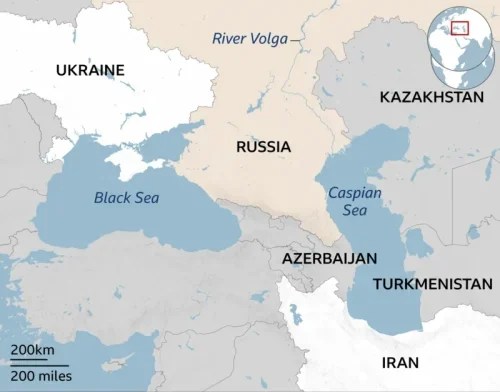
Therefore, Ukraine’s attack on an Iranian commercial vessel in the Caspian Sea in Russia’s territorial waters on Saturday, the first such attack since the start of the Russia-Ukraine war, is anything but a stray incident. Kyiv claimed responsibility for striking an Iranian vessel, signalling that one of Eurasia’s most stable security zones is now vulnerable to the direct spillover of the Ukraine conflict.
The Kremlin took note and spokesman Dmitry Peskov remarked at his daily briefing on Tuesday that the “geography of the Kiev regime’s terrorist activities is expanding.” Citing the incident, he added cryptically that all this “again highlights the need for a successful and complete special military operation.”
The attack on the Iranian ship was carried out from a distance of approximately 1,200 kilometres. Moscow has repeatedly alleged that such precise targeting over very long distances is way beyond Ukraine’s military capability and is only possible with the West’s direct participation. Foreign Minister Sergey Lavrov touched on it again on July 24: “A significant portion of the support provided to Vladimir Zelensky (from the West) comes from the United States. This is not only because the Americans sell weapons to the EU, which then transfers them to Ukraine, but also because the United States provides intelligence and reconnaissance, Starlink remains operational, and advanced technologies that require specialist expertise on the battlefield do not find their way there by accident. That is the way things are.”
Interestingly, the New York Times report on the Ukrainian attack appeared under the headline Ukraine’s Strike on an Iranian ship Could Bring Two Wars Closer. The Wall Street Journal headline runs as follows: Two Wars Converge in the Caspian Sea as Ukraine Hits Iranian Supply Line to Russia. Al Jazeera gave a further twist saying Ukraine’s Zelenskyy set to meet Trump as Iran and Ukraine wars converge. A BBC report acknowledged that “The incident marked the first direct link between the wars in Iran and Ukraine.” It added, however, “But some experts question the wisdom of Kyiv’s decision to pick a fight with Iran.”
The impact of the Iran conflict initially seemed negative for Ukraine. It threatened to divert Trump’s already wavering attention. However, there has been not only no let-up in US support for Ukraine but in certain ways, the US involvement has only intensified by escalating the covert operations in Russian territory. Admittedly, these tactical advantages may not add up eventually, as Moscow is also stepping up attacks all across the frontline in Ukraine with a view to end the war soon.
The reported likely reassignment of General Sergey Surovikin, who at one time was commander of Moscow’s war effort in Ukraine, would signal a massive offensive going forward. The highly decorated general had previously served in Chechnya and Syria during conflicts that had overtones of proxy wars similar to Ukraine.
The Ukrainian attack on the Iranian ship could well be a calibrated move by Washington. Ukraine acted simultaneously with the US bombing of Gilan province, suggesting a degree of coordination. The Iranian ambassador to Russia disclosed that the ship was hardly 5 miles from the mouth of River Volga when the attack took place.
If the Moscow-led regional concord on the Caspian’s collective security is weakened, extra-regional military and security rivalries could vitiate the region impacting Russia and Iran’s core interests. Tehran views the Caspian Sea incident not as an isolated tactical event but as evidence of a broader shift in its surrounding security environment.
Last August, US-Azerbaijan-Armenia tripartite agreement was signed in the White House that will create a major transit corridor in Transcaucasia to be named the Trump Route for International Peace and Prosperity. Plainly put, the US and NATO are seriously contesting Russia’s pre-eminence in the Caspian / Central Asian regions.
Evidently, the Caspian Sea is no longer the conflict-free zone it was once believed to be. A new arena of geopolitical competition, fundamentally reshaping the security landscape of Eurasia and potentially marking the emergence of a new geographic theatre of conflict, has surfaced last weekend.
The Second Circuit Again Violated the Rights of the Amish
By Aaron Siri | Injecting Freedom | July 28, 2026
At the end of last year, the United States Supreme Court vacated the Second Circuit’s decision that enabled New York State to persecute the Amish for refusing to inject pharma products in violation of their religious beliefs, and it remanded the case (Miller v. McDonald) to the Second Circuit to reconsider its illiberal and unconscionable decision.
Instead of abiding by the Constitution and protecting the religious freedom of the Amish, the Second Circuit again ruled against the Amish. So, we will be going back to the Supreme Court.
And yes, the 168 unvaccinated Amish children related to this case are far healthier than American children who are vaccinated. We provided sworn expert evidence attesting that among a random sample of 168 U.S. children, one would expect to find (based on the background rate of chronic disease among U.S. children) 31 cases of environmental allergies, 15 cases of ADHD, 10 cases of asthma, 9 cases of food allergies, and 4 cases of ASD. Yet, the 168 unvaccinated Amish children whose families New York wants to persecute are free from the chronic health conditions—all related to some form of immune system dysregulation—that plague the vaccinated communities in New York.
Since vaccination is supposedly about improving health, and the Amish who do not vaccinate are clearly healthier, one would expect New York to leave them alone. But that is not how this religion works. The vaccine zealots in New York cannot stand that the Amish refuse to abandon their beliefs in favor of the religious beliefs held by the New York officials regarding vaccines. These “health” officials are willing to sacrifice the way of life and belief system of these Amish children and their community (which have kept them far healthier), if they refuse to bend the knee to adopt cult-like vaccine beliefs.
These “health” officials also apparently cannot stand that the Amish children are healthier and are even willing to wage war against them until they submit and receive every vaccine New York demands—so they can be just as “healthy” as all the children outside the Amish community.
The Amish earnestly seek to avoid conflict but because violating their sincerely held religious beliefs is not an option, they have been placed in an impossible position. We, along with co-counsel, intend to continue to litigate on behalf of the Amish to defend their freedom to practice their religion in peace.
Featured Video

Dan Dicks with James Corbett on Solutions Watch
or go to
Aletho News Archives – Video-Images
From the Archives
MMR (Measles, Mumps and Rubella) – Vaccine Risk Statement
MMR Vaccine (Measles, Mumps, and Rubella) Is It Safer Than Measles, Mumps and Rubella?
Physicians for Informed Consent | December 2024
… It has not been proven that the MMR vaccine is safer than measles, mumps, and rubella. The vaccine package insert raises questions about safety testing for cancer, genetic mutations, and impaired fertility. Although VAERS tracks some adverse events, it is too inaccurate to measure against the risk of measles, mumps, and rubella. Clinical trials do not have the ability to detect less common adverse reactions, and epidemiological studies are limited by the effects of chance and possible confounders. Safety studies of the MMR vaccine are particularly lacking in statistical power. A review of more than 60 MMR vaccine studies conducted for the Cochrane Library states, “The design and reporting of safety outcomes in MMR vaccine studies, both pre- and post-marketing, are largely inadequate.”19 Because permanent sequelae (aftereffects) from measles, mumps, and rubella are so rare (especially in children with normal levels of vitamin A and infected after birth),6,15-17 the level of accuracy of the research studies available is insufficient to rule out the possibility that the MMR vaccine causes greater death or permanent disability than measles, mumps, and rubella. – Read full article
Blog Roll
 Aletho News
- Yes, the Iran war has destroyed Trump’s presidency
- The fallacy of US delusions about Iran’s economic collapse
- Hezbollah denies Syria cell link, warns of Israeli plan to sow discord
- The legacy of US sanctions, war, and occupation in Iraq
- Iraqi resistance group rejects disarmament, vows to maintain support for Lebanon
- Sheikh al-Asadi warns of Iraqi government compliance with US demands
- How to MAKE THE CONSPIRATORS PAY for their crimes! Dan Dicks with James Corbett on Solutions Watch
- There’s a drought in academia: A drought in honest research on the subject of drought and other weather extremes
- Department of War Awards $20.7 Billion Contract to Raytheon for Air-to-Air Missiles
- ‘Distance yourselves from Israel’: IRGC urges US population to question govt policies
- If Americans Knew
- As settlers ravage West Bank, Israeli forces kill 10 in Gaza – Daily Update
- New Report: “Scholasticide and Genocide in Gaza: Assessment, Testimonies and Legal Analysis”
- Ex-Biden officials are desperate for a Gaza scapegoat
- Israeli “settlers” Invade Al-Aqsa; Pour Boiling Water on 75-Year-Old
- Israel Has Kidnapped Another American Teenager
- US arms sales to Israel worth $21.6 billion in 20 months
- Three Palestinians Killed in Israeli Attacks on Gaza
- Revealed: German “Anti-Semitism Expert” Driving Crackdown on Palestine Solidarity is Former Israeli Spy
- Egypt’s Warning to Israel Before Oct 7
- Israel’s siege signals another cruel winter for 1.8 million Gazans – Daily Update
- No Tricks Zone
- Two More Paleo Reconstructions Affirm Meters-Higher Sea Levels Across Ireland, Brazil 7000-6000 Years Ago
- New Study: Earth And Venus Surface Warmth Largely Explained By Convection And Lapse Rate, Not CO2 Or Radiation
- 2025 Nature Paper Claiming Worsening Global Drought Gets RETRACTED …Heavily Flawed
- New Study: ‘Global Drought Shows No Detectable Recent Acceleration Under Climate Warming’
- Economic Masterminds: German Socialists Suggest Taxing Productivity Gains Stemming From Using AI
- The South China Sea Has Not Been Cooperating With The Climate Change Narrative
- Energy Crisis: Germany Enters Heating Season With Historically Low Gas Reserve Fill Levels
- New Study: The Antarctic Ice Sheet Gained Mass From 2020-2024 Due To Staggering Snow And Ice Accumulation
- Study: Ocean Heating Rates From Thousands Of Years Ago ‘Dwarf’ Modern Ocean Heating Rates
- Climate Extremists Target, Attack Large-Scale Power Grid Infrastructure In Germany!

