US conjoins the wars in Eurasia, West Asia
By M. K. BHADRAKUMAR | Indian Punchline | July 29, 2026
On Friday, even as the US President Donald Trump was announcing the end of the latest round of the conflict with Iran, the Pentagon unobtrusively extended the war theatre to the Caspian Sea in a hugely consequential geopolitical thrust. The incident hardly figured in the western news cycle.
But CGTN, perhaps sensing that the US could be stealthily spreading its war to the Caspian region, reported on July 25, “US missiles struck a Revolutionary Guards Navy headquarters in the Ziba Kenar area of the Caspian Sea province of Gilan, according to a security official in Gilan quoted by Iranian media. Provincial authorities said US projectiles had also struck the port city of Bandar Anzali, according to the Iranian Labor News Agency.”
Gilan province has a Caspian coastline that borders Azerbaijan in the west, with which Iran has had a troubled relationship in the recent years following the Transcaucasian region’s geopolitical gravitation towards the western orbit. Unsurprisingly, Russia’s ties with Azerbaijan and Armenia also have suffered a severe erosion following the ascendance of US (and NATO) influence in Transcaucasia.
Trump is the new sheriff in town in Baku and Yerevan with Turkey’s president Recep Erdogan playing the role of undersheriff. To add to the complexity, Azerbaijan is a close ally of Turkey, and Turkey’s ties with Moscow are somewhat under the weather in the most recent years following the covert takeover in Syria by al-Qaeda affiliates backed by Ankara.
On the other hand, Turkey has never been a reliable friend for Iran, either, historically. During the war with Iran last year, Turkey opened its air space to the US aircraft to attack Iran from Azerbaijan, which also happens to be one of Israel’s key operational bases against Iran.
Taking advantage of the Ukraine conflict, western intelligence and NATO have made big inroads into the Caucasus and Caspian regions bordering Russia’s Muslim republics and are challenging Iran’s security when it already faces an existential threat from the US-Israeli alliance.
The western media played down the US air strike on Bandar Anzali last week, which is Iran’s biggest port on the Caspian coast and is a vital transportation hub linked to Iran’s national railway grid. The Caspian Sea makes a strategically vital supply route between Russia and Iran. Bandar Anzali is for Tehran what Odessa Port is for Kyiv where it receives western arms supplies. Indeed, Iran and Russia have a close military relationship.
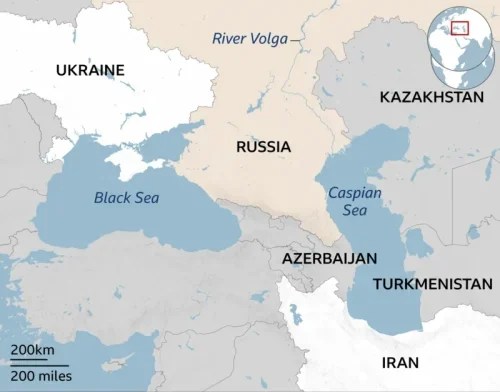
Therefore, Ukraine’s attack on an Iranian commercial vessel in the Caspian Sea in Russia’s territorial waters on Saturday, the first such attack since the start of the Russia-Ukraine war, is anything but a stray incident. Kyiv claimed responsibility for striking an Iranian vessel, signalling that one of Eurasia’s most stable security zones is now vulnerable to the direct spillover of the Ukraine conflict.
The Kremlin took note and spokesman Dmitry Peskov remarked at his daily briefing on Tuesday that the “geography of the Kiev regime’s terrorist activities is expanding.” Citing the incident, he added cryptically that all this “again highlights the need for a successful and complete special military operation.”
The attack on the Iranian ship was carried out from a distance of approximately 1,200 kilometres. Moscow has repeatedly alleged that such precise targeting over very long distances is way beyond Ukraine’s military capability and is only possible with the West’s direct participation. Foreign Minister Sergey Lavrov touched on it again on July 24: “A significant portion of the support provided to Vladimir Zelensky (from the West) comes from the United States. This is not only because the Americans sell weapons to the EU, which then transfers them to Ukraine, but also because the United States provides intelligence and reconnaissance, Starlink remains operational, and advanced technologies that require specialist expertise on the battlefield do not find their way there by accident. That is the way things are.”
Interestingly, the New York Times report on the Ukrainian attack appeared under the headline Ukraine’s Strike on an Iranian ship Could Bring Two Wars Closer. The Wall Street Journal headline runs as follows: Two Wars Converge in the Caspian Sea as Ukraine Hits Iranian Supply Line to Russia. Al Jazeera gave a further twist saying Ukraine’s Zelenskyy set to meet Trump as Iran and Ukraine wars converge. A BBC report acknowledged that “The incident marked the first direct link between the wars in Iran and Ukraine.” It added, however, “But some experts question the wisdom of Kyiv’s decision to pick a fight with Iran.”
The impact of the Iran conflict initially seemed negative for Ukraine. It threatened to divert Trump’s already wavering attention. However, there has been not only no let-up in US support for Ukraine but in certain ways, the US involvement has only intensified by escalating the covert operations in Russian territory. Admittedly, these tactical advantages may not add up eventually, as Moscow is also stepping up attacks all across the frontline in Ukraine with a view to end the war soon.
The reported likely reassignment of General Sergey Surovikin, who at one time was commander of Moscow’s war effort in Ukraine, would signal a massive offensive going forward. The highly decorated general had previously served in Chechnya and Syria during conflicts that had overtones of proxy wars similar to Ukraine.
The Ukrainian attack on the Iranian ship could well be a calibrated move by Washington. Ukraine acted simultaneously with the US bombing of Gilan province, suggesting a degree of coordination. The Iranian ambassador to Russia disclosed that the ship was hardly 5 miles from the mouth of River Volga when the attack took place.
If the Moscow-led regional concord on the Caspian’s collective security is weakened, extra-regional military and security rivalries could vitiate the region impacting Russia and Iran’s core interests. Tehran views the Caspian Sea incident not as an isolated tactical event but as evidence of a broader shift in its surrounding security environment.
Last August, US-Azerbaijan-Armenia tripartite agreement was signed in the White House that will create a major transit corridor in Transcaucasia to be named the Trump Route for International Peace and Prosperity. Plainly put, the US and NATO are seriously contesting Russia’s pre-eminence in the Caspian / Central Asian regions.
Evidently, the Caspian Sea is no longer the conflict-free zone it was once believed to be. A new arena of geopolitical competition, fundamentally reshaping the security landscape of Eurasia and potentially marking the emergence of a new geographic theatre of conflict, has surfaced last weekend.
Sorry, the comment form is closed at this time.
Featured Video

Liberty Cannot Exist Inside a Panopticon
or go to
Aletho News Archives – Video-Images
From the Archives
Left-leaning despisers of 9/11 Truth movement: Do you really believe in miracles?
David Ray Griffin | Global Research | 06 Jul 2010
An Open Letter to Terry Allen, Noam Chomsky, Alexander Cockburn, David Corn, Chris Hayes, George Monbiot, Matthew Rothschild, and Matt Taibbi.
[1]According to several left-leaning critics of the 9/11 Truth Movement, some of its central claims, especially about the destruction of the World Trade Center, show its members to be scientifically challenged. In the opinion of some of these critics, moreover, claims made by members of this movement are sometimes unscientific in the strongest possible sense, implying an acceptance of magic and miracles. … Full article
Blog Roll
 Aletho News
- Iran calls for emergency UNSC meeting over Trump’s ‘brazen’ bomb talk, Israeli threats
- Iranian sources reveal details of Russia-China Hormuz proposal
- Plan for more US-Israel integration puts our military tech at risk
- Another Round Against Iran Will Break What Is Left of the Gulf
- SVR Report on Ukraine’s Mexican Drug Gang Links Could Pressure Zelensky, Won’t Change US Policy
- British Government Employees Were Fact-Checking the News at the BBC. Nobody Told You.
- Albania on fire: who’s behind the riots?
- Egypt’s Civil Democratic Movement rejects involvement in regional war
- Egypt collaborates with Israel to build ‘Green Rafah’ project over erased Palestinian city
- Rising fuel prices and shortages have helped drive ongoing protests and rioting in France
- If Americans Knew
- FBI subpoenas pro-Palestine activists over Israeli weapons plant disruption
- Fourth winter arrives in wartorn Gaza, too early – Daily Update
- More on how Bari Weiss is using CBS on behalf of Israel
- What the UK Is Doing to Pro-Palestine Novelist Sally Rooney Is an Act of Orwellian Villainy
- ‘We will build palaces for Jews in Gaza’: Right-wing activists establish new outpost near border
- ‘You see us burning, you stay silent’: Family’s agony over mother and sons burned to death in Gaza tent
- Israel keeps Palestinian journalist Bushra al-Tawil in isolation for 46 days
- US-Israel integration plan puts US military tech in Israel’s hands
- Israeli Strike Burns Gaza Mother Alive in Front of Toddler, ‘Without Generating Any Headlines’
- ‘The Israel Experience with Mike Huckabee’: The Ambassador’s Family Sells Trips to Israel
- No Tricks Zone
- Predictions Made By Renowned Climate Proifessor Over Past Decades Have Been Proven To Be Poor
- New Study Suggests Large Regions Of The Pacific Ocean Have Been Cooling For The Last 80 Years
- Germany’s Green Energy Debacle: High Energy Costs Force Kahla Porzellan to Close After 182 Years!
- New Study: 50 Years Of The Most Aggressive ‘Net Zero’ Policies Can Only Affect The Global Climate By 0.03°C
- US September “Heat” Was No Record…Many Records Set Decades Ago
- Latest European Green Energy Debacle; Portugal’s Largest Flagship Solar Park Insolvent!
- Green Energy Debacle: German Expert Professor Fritz Vahrenholt Warns Of Severe Economic And Social Consequences
- Two More Paleo Reconstructions Affirm Meters-Higher Sea Levels Across Ireland, Brazil 7000-6000 Years Ago
- New Study: Earth And Venus Surface Warmth Largely Explained By Convection And Lapse Rate, Not CO2 Or Radiation
- 2025 Nature Paper Claiming Worsening Global Drought Gets RETRACTED …Heavily Flawed

