Press Freedom Threatened as U.S. Government Seizes Max Blumenthal’s Devices
Glenn Diesen | July 21, 2026
Max Blumenthal discusses how the US-Israel partnership undermines press freedom. Blumenthal is the editor-in-chief of The Grayzone, an award-winning journalist and the author of several books, including best-selling Republican Gomorrah, Goliath, The Fifty One Day War, and The Management of Savagery. He has produced print articles for an array of publications, many video reports, and several documentaries, including Killing Gaza. The Grayzone: https://thegrayzone.com/
Buy Diesen merchandise: https://diesen-shop.fourthwall.com/en-nok
Follow Prof. Glenn Diesen:
- Substack: https://glenndiesen.substack.com/
- X/Twitter: https://x.com/Glenn_Diesen
- Patreon: https://www.patreon.com/glenndiesen
Support the research by Prof. Glenn Diesen:
- PayPal: https://www.paypal.com/paypalme/glenndiesen
- Buy me a Coffee: buymeacoffee.com/gdieseng
- Go Fund Me: https://gofund.me/09ea012f
Henrik Svensmark fired by his university

By Karl Iver Dahl-Madsen | CLIntel | July 21, 2026
Something unusual and encouraging has happened in Danish climate journalism. Berlingske, one of Denmark’s leading national daily newspapers, has published an excellent and genuinely inquisitive article about the dismissal of physicist Henrik Svensmark from the Technical University of Denmark (DTU), where he has been working since the late nineties. The headline leaves no room for doubt: “Controversial Danish climate and space researcher has received the pink slip from DTU: It is ‘a death blow’ to my research”.
Here is how the article starts:
He is one of Denmark’s most internationally recognized researchers – and at the same time one of the most controversial. But now space and climate researcher Henrik Svensmark has, in his own words, been “good old-fashioned fired” by his employer, the Technical University of Denmark (DTU) in Lyngby. He does not rule out that “political considerations” – as he puts it – were involved in the years-long process that led to his final dismissal. At the same time, Henrik Svensmark does not hesitate to call it “a death blow” to a branch of research that he has largely developed single-handedly and that climate researchers around the world, including the UN’s climate panel (IPCC), have had to relate to – often reluctantly. This is mainly because Svensmark’s research points to what he sees as an overlooked natural factor behind a large part of the climate changes Earth has undergone. He finally does not rule out that the dismissal may be linked to the fact that he is perceived as a controversial researcher in wide circles: “There is nothing controversial about the research itself. But it is true that many perceive my research as controversial, even though it shouldn’t be.” DTU has no comments on the actual dismissal of Svensmark and refers to it as a personnel matter. However, the director of DTU Space, Henning Skriver, confirms that Svensmark’s overarching research area, atmospheric physics, will now “be significantly down-prioritized.”
Science journalist Lars Henrik Aagaard deserves credit for the whole article. Rather than dismissing Svensmark as merely ‘controversial’, he asks the essential question: is DTU retiring an ageing employee, or is it terminating an internationally recognized but scientifically inconvenient research program?
The facts reported by Berlingske are troubling.
Svensmark, aged 68, and well known for his work on cosmic rays and clouds, was still actively working and preparing a new experiment. Only a few months earlier, he says, his superiors had told him that his research was important and that they wanted him to continue.
According to Svensmark, he had also been selected for a professorship in 2016 following positive international evaluations. A new rector however, blocked his expected promotion to full professor, downgrading him to Senior Researcher (and lowering his salary). That move made it harder for him to secure regular research funding in Denmark.
In 2021, DTU again attempted to dismiss him, but he continued, partly, he says, because of protests from scientists connected with MIT and Princeton (Lindzen and Happer).
Berlingske presented this history to DTU. The university declined to address it. DTU Space director Henning Skriver merely stated that atmospheric physics was being “significantly downgraded” as part of a strategic prioritization.
That is not an explanation. It is management fog.
A public university may change its priorities. But it should explain the scientific reasoning. Why was Svensmark encouraged to continue only months before his dismissal? What happened to the positive international evaluation? Why was the professorship removed? Why is an active experiment being stopped?
The details of an individual employment case may be confidential. The scientific grounds for closing a research program shouldn’t be. A hypothesis cannot be dismissed administratively.
Solar activity
Svensmark’s research concerns the influence of solar activity and cosmic radiation on aerosol formation, clouds and therefore the climate.
The proposed mechanism is straightforward in principle. Solar activity affects the amount of cosmic radiation reaching Earth. Cosmic radiation ionizes the atmosphere. Ionization may influence the formation and growth of aerosol particles, some of which become cloud condensation nuclei. Clouds, in turn, strongly affect Earth’s radiation balance.
Parts of this chain have been demonstrated experimentally. The unresolved question is how large the resulting climate effect is under real atmospheric conditions and over different timescales.
Svensmark does not claim that carbon dioxide has no effect. He told Berlingske :
“I am not saying that humans are not part of it.”
His point is that natural variability, cloud processes and solar influence remain insufficiently quantified. He describes the dismissal as “a death blow” to the research program he has spent much of his career developing.
Not a marginal researcher
Svensmark cannot reasonably be dismissed as an unsuccessful or marginal scientist. Google Scholar records more than 7,000 citations to his work and an h-index of 30. Compared with the broader DTU research community, this places him approximately among the upper fifth of researchers and probably higher when measured by total citations. That is a considerable scientific impact for a relatively small and highly contested research field, far removed from the large collaborative networks that generate many citations almost automatically.
The predictable but weakest contribution in the article comes from Jens Hesselbjerg Christensen, professor at the Niels Bohr Institute and a prominent figure in the IPCC community.
Hesselbjerg accepts that cosmic radiation may play a role in cloud formation and long-term climate history. He then claims that much of Svensmark’s research appears to have been designed to confirm his hypothesis and that, whenever it was not confirmed, “an arm or a leg” was simply added.
That is an extraordinary accusation and an intellectually shabby one.
Hesselbjerg identifies no paper, no experiment, no faulty measurement, no improper method and no failed prediction. He merely insinuates that Svensmark has constructed his research to reach a predetermined conclusion. If Hesselbjerg believes that, he should name the experiments and explain precisely what was wrong with them. Otherwise, he should withdraw the allegation.
Developing a hypothesis as new evidence appears is not scientific misconduct. It is science. Aerosol formation involves nucleation, particle survival, growth, atmospheric chemistry and eventual cloud formation. Discovering additional mechanisms is not “adding an arm or a leg”. It is the whole purpose of experimental research.
Hesselbjerg’s performance illustrates a wider problem. Researchers close to the institutional consensus can invoke authority while providing remarkably little argument. A dissenting researcher is expected to prove every link in a complex physical chain before his work is even considered legitimate.
That is not a scientific level playing field.
The research should continue
The immediate objective should not merely be to embarrass DTU. It should be to ensure that Svensmark’s research survives. The most important next step is to develop a climate model that explicitly includes the proposed chain connecting solar activity, cosmic radiation, atmospheric ionization, aerosol growth and clouds, alongside greenhouse-gas forcing and the other established climate mechanisms.
Such a model would make it possible to test a question of enormous scientific and political importance: How much of the observed temperature development is caused by human influence, and how much is caused by natural variation?
That question is far from purely academic. Climate policy depends critically on the answer. If natural influences are larger than assumed, the expected effect of reducing carbon emissions is smaller. If they are negligible, the current attribution of climate change to CO2 becomes stronger. Either result would be valuable.
As explained by Henrik Svensmark: “The next decisive step is to build a climate model in which the influence of solar activity, cosmic radiation, aerosol growth and clouds is represented together with greenhouse gases. That would allow us to test how much of modern climate change is human-caused and how much is natural. This can be done within a few years and with a research budget that is modest compared with the political and economic importance of the question.”
The task is therefore concrete: we need to find a new institutional home for Svensmark, preserve the equipment and scientific expertise, assemble an international research team and raise the necessary funding.
Berlingske has performed a valuable public service by bringing this case into the open. DTU has responded with evasion. Jens Hesselbjerg Christensen has responded with an undocumented attack on a colleague’s scientific integrity.
Neither response is acceptable.
Science advances through experiments, observations and testable models, not through administrative priorities, institutional conformity or casual insinuations.
Henrik Svensmark’s research must not end with a DTU management decision. It must now be given the resources to face the only judgement that matters: the judgement of observations.
Karl Iver Dahl-Madsen is an independent consultant (owns Dahl-Madsen ApS), chairman of the board of the Danish climate-sceptical association Klimarealisme (Climate Realism), and a frequent commentator/debater in Danish media on climate policy, energy, and environmental issues. More: https://klimarealisme.dk/
Yemeni naval blockade forces six vessels to turn back
Press TV – July 21, 2026
Six ships have turned back in the past 24 hours after Yemen’s armed forces imposed a maritime ban on Saudi vessels, a military source confirmed to the Yemeni News Agency (Saba), as the “blockade for blockade” strategy against Riyadh takes effect.
The move came after Yemen’s Humanitarian Operations Coordination Center sent a warning to shipping companies, stating that vessels are banned from loading or discharging cargo at any Saudi ports and that violators “may be subject to targeting in any location within the operational reach of the Yemeni Armed Forces.”
Shipping data from LSEG confirmed that at least two oil tankers carrying Saudi crude to China and India have been forced to make U-turns in the Red Sea.
The Xin Long Yang, a Very Large Crude Carrier carrying 2 million barrels of Saudi crude loaded at Yanbu, reversed course and headed toward the Suez Canal rather than risk transiting the Bab el-Mandeb Strait.
The smaller tanker Rodos, carrying about 700,000 barrels of Saudi crude for India, also made a U-turn for Suez.
With the Strait of Hormuz transit blocked amid the illegal US’s war on Iran, Saudi Arabia’s Red Sea port of Yanbu has become the main alternative route for West Asian oil, allowing exports of millions of barrels per day.
The Yemeni armed forces announced the naval blockade on Saudi Arabia on July 20, in response to the kingdom’s 12-year siege and aggression against Yemen.
“Vessels calling at Saudi Arabian ports are advised to reconsider transiting the Red Sea and to consider implementing enhanced mitigation measures,” British maritime security company Ambrey said, adding that it assessed vessels calling at Saudi ports “were at high risk.”
War risk insurance costs have already ticked higher in the past 24 hours, with risk assessments for Saudi ports being re-evaluated, insurance industry sources said.
In recent months, an average of 10 crude tankers have sailed through the Bab el-Mandeb daily.
The Yemeni blockade comes after more than a decade of Saudi-led aggression against Yemen.
Since March 2015, a Saudi-led coalition has imposed an air, land, and sea blockade on Yemen, strangling the country’s access to food, fuel, and medicine.
The coalition has conducted over a quarter of a million airstrikes across Yemen, causing widespread devastation and killing tens of thousands of civilians.
The United States has provided critical support throughout the war, including intelligence sharing, logistical assistance, target identification, in-flight refueling of coalition warplanes, and arms sales, making Washington a direct partner in the coalition’s actions.
The war has devastated Yemeni society. By 2026, millions faced acute food insecurity, with aid deliveries severely restricted and the healthcare system in collapse.
Despite the immense suffering, the coalition has maintained its chokehold, closing border crossings, grounding humanitarian flights, and ordering ships away from Yemeni ports.
Iran warns Bulgaria against supporting US military aggression
Press TV – July 21, 2026
Iran has warned Bulgaria against approving a reported US request to station military aircraft at one of its air bases, saying any cooperation with military aggression against Iran would make Sofia complicit in unlawful acts of aggression.
Iranian Foreign Ministry spokesman Esmaeil Baghaei issued the warning on Tuesday in response to reports that the Bulgarian government is considering a US request to deploy military aircraft at Bezmer Air Base in support of operations related to the war with Iran.
Baghaei said Bulgaria is fully aware that recent US military aggression against Iran constituted a violation of the UN Charter and international law.
He said any participation in preparing or facilitating such operations would amount to complicity in the crimes of aggression and war crimes.
Baghaei expressed surprise over remarks attributed to Bulgarian Prime Minister Roman Radov regarding the reported request, saying that even considering support for an “illegal war” against Iran would be inconsistent with Bulgaria’s international legal obligations and the principle of respect for national sovereignty.
The spokesman cited Article 3(f) of UN General Assembly Resolution 3314, which defines aggression, arguing that allowing one state’s territory to be used by another for acts of aggression against a third state could itself constitute an act of aggression under international law.
While emphasizing that Iran and Bulgaria have maintained relations based on mutual respect, Baghaei warned against any decision that would permit the United States to use Bulgarian territory or facilities for military operations against Iran.
“Iran hopes the Bulgarian parliament will not authorize the use of the country’s territory and facilities in a way that would make Bulgaria complicit with aggressors.”
Baghaei said Iran remained determined to defend its national security and interests, warning that any party participating in military action against the country would bear responsibility for the consequences.
The United States and the Israeli regime waged their illegal war of aggression against Iran on February 28. However, forty days later, on April 8, the enemies were forced to accept a ceasefire amid Iran’s brave resistance and successful retaliatory operations.
On June 17, Tehran and Washington signed the Pakistan-brokered Memorandum of Understanding (MoU) to end all hostilities and prepare for further negotiations.
However, Washington violated all provisions of the understanding, prompting Iran to deliver a firm response.
Houthi Blockade Against Saudi Arabia Creates Geopolitical, Economic Dilemma for Pakistan
Sputnik – 21.07.2026
Any threat to the Kingdom’s stability is a threat to Pakistan’s strategic and economic interests, experts stress.
Pakistan is grappling with the potential fallout from a Houthi threat to blockade Saudi Arabia’s Red Sea coast, a development that could activate one of the region’s most consequential defense agreements.
“For Pakistan, the implications are direct and serious,” Abdullah Khan, director of the Pakistan Institute for Conflict and Security Studies, tells Sputnik.
The reason is a binding defense pact signed in September 2025. Under its terms, an attack on Saudi Arabia is treated as an attack on Pakistan and vice versa.
“Pakistan’s interest lies in preventing further escalation through restraint and diplomacy while remaining fully committed to Saudi Arabia’s security under the mutual defense framework. Any threat to the Kingdom’s stability is a threat to Pakistan’s strategic and economic interests,” Khan stresses.
The Houthi threat is no bluff, according to Khan. They possess ballistic missiles, long-range drones, and explosive-laden unmanned boats. They have already hit Saudi oil facilities and struck commercial ships in the Red Sea. Their capabilities allow them to choke energy exports, spike insurance costs, and force billions in defensive spending – a reality that extends far beyond Yemen’s borders.
The economic consequences for Pakistan could be severe also, Ali Ehsan, an economic policy analyst, warns. With Bab el-Mandeb now under threat, Pakistan loses its alternative route for Saudi oil shipments. That means higher petrol and electricity prices, disrupted textile exports to Europe, and mounting pressure on an already fragile economy.
“Pakistan’s trade with Europe, which is an export market, will get highly affected by this situation and Pakistan’s economy will come under more pressure,” Ehsan says.
‘Israel is not giving anything up’: Residents head to US-backed pilot zones in south Lebanon

The Cradle | July 21, 2026
Scores of displaced Lebanese civilians made their way back to southern towns designated by Washington as “pilot zones” early on 21 July, as the Lebanese Armed Forces (LAF) deployed in the town of Zawtar al-Gharbiya – one day after the US officially launched its plan.
An Israeli journalist had previously claimed that Tel Aviv would begin a limited withdrawal on Tuesday as part of the US plan, but local residents returning to the south cast further doubt on Israel’s intention to pull out.
The zones, or at least most of them, “were never occupied by Israeli forces” to begin with, locals told Al-Jazeera on 21 July.
“The inclusion of [these] villages is evidence that Israel is in fact not giving anything up, despite the framework agreement, and is instead able to remain in the [other] areas it has occupied,” the villagers said.
Two Lebanese security sources told Al-Jazeera the same thing, while stressing that two of the “pilot zones” are “not occupied.”
The pilot zone plan is a key aspect of the US-brokered agreement reached between Lebanon and Israel in violation of Lebanese law.
Washington officially launched the project on Monday.
“Pilot zone operations began in the villages of Froun, Srifa, and Zawtar al-Gharbiya in accordance with the Trilateral Framework and under the auspices of the Military Coordination Group for Lebanon,” the US State Department said in a statement on 20 July.
Reports over recent weeks indicated that three pilot zones had initially been declared as part of the plan: Froun, Al-Ghandourieh, and Zawtar al-Gharbiya.
Israeli Prime Minister Benjamin Netanyahu had publicly named Froun and Zawtar al-Gharbieh as two initial pilot zones weeks ago.
Washington’s new announcement on Monday listed Froun, Srifa, and Zawtar al-Gharbiya as the initial pilot zones.
Just like Froun, Srifa is outside the so-called Israeli security zone and is not occupied. Zawtar al-Gharbiya is the only one of the three zones where Israeli forces are present.
Fierce resistance from Hezbollah prevented occupation forces from pushing into both Froun and Al-Ghandourieh during the initial weeks of heavy fighting.
This was recently confirmed by reports from RT and the New Arab, which cited local officials and correspondents on the ground.
The unconstitutional Lebanon-Israel deal would see the establishment of future pilot zones under “mutual consent” between Tel Aviv and Beirut.
The plan is meant to see the LAF replace Israeli occupation troops in the designated “zones” and dismantle Hezbollah infrastructure, in tandem with a “phased” Israeli withdrawal.
However, Lebanese military sources told local media earlier this month that the LAF refuses and rejects direct cooperation with Israel.
“The army will not operate under anyone’s command [including Israel]. Its mission is not to clear the ground for the enemy in order to facilitate its entry into areas it failed to reach because of fierce resistance. The army will not be the reason for the occupation of additional Lebanese territory,” the sources said.
Israel publicly vows that it will not withdraw from south Lebanon. Israeli media says occupation forces have not received any political directive to withdraw from the area. There are still no clear timelines for the US plan.
As residents made their way to the areas on Tuesday morning, Israeli occupation forces continued to carry out major demolition operations, destroying civilian infrastructure on the border.
DeBasification… A Fancy Word for Booting the US Out of the Middle East
By Larry C. Johnson | SONAR21 | July 21, 2026
Tehran delivered to Washington via Pakistan in early April, a formalized demand for the withdrawal of US combat forces from military bases across the region. It sat in a package alongside the lifting of all sanctions and UN resolutions, the release of Iranian assets held overseas, reparations, and Iran’s right to nuclear enrichment.
Instead of waiting for the US to agree to the demand, Iran has launched targeted attacks during the past two weeks on key US bases in Kuwait, Bahrain, Saudi Arabia, Qatar and the United Arab Emirates. This has produced a de facto evacuation of US forces and equipment from most of these bases. The US Navy’s Fifth Fleet Headquarters in Bahrain is in shambles; the Combined Air Operations Center (CAOC) at Al Udeid in Qatar has been closed and moved to Shaw Air Force Base in South Carolina. And Iran continues to pound bases in Bahrain, Kuwait and Qatar to ensure that no US aircraft or missile launchers remain intact at those locations.
Besides the bases in the Persian Gulf nations, Iran also has pummeled the Muwaffaq Salti Airbase and the Prince Hassan Airbase in Jordan. There are grainy satellite images showing that the United States has removed all aircraft from the open-air parking lot at the Muwaffaq al-Salti airbase, fearing that they would be destroyed by Iranian missiles.
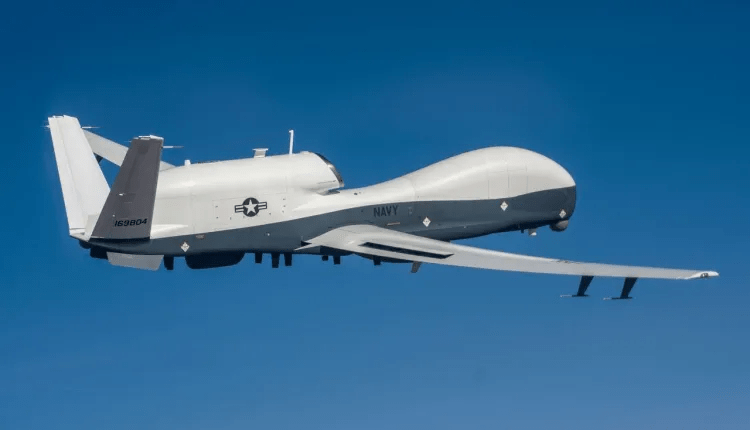
The US also has relocated the $250 million MQ-4C Triton. In early May 2026, the US dispatched the MQ-4C Triton drone to Jordan:
The second US Navy MQ-4C Triton (reg. 169804) drone has yesterday departed from Naval Air Station Sigonella and relocated to Al Hussein Air Base in Jordan, further reducing the US Navy’s high-altitude ISR presence in Sicily. The aircraft involved is the Triton that had arrived in recent weeks to replace the drone lost in the Gulf area during operations linked to the regional crisis. . . .
The MQ-4C Triton is one of the US Navy’s most important intelligence, surveillance and reconnaissance assets, designed for long-endurance maritime monitoring over vast operational theaters. From Sigonella, the platform has regularly supported surveillance missions across the Mediterranean, Black Sea, North Africa and the Middle East.
Relocating both surviving Tritons to Jordan suggests a clear operational reprioritization. By operating from Al Hussein, the drones gain shorter transit times toward the Red Sea, Arabian Peninsula, Iraq and Iran-related operational areas, allowing longer on-station persistence and more responsive ISR coverage during a period of continued regional instability.
Following massive missile strikes by Iran on 11 and 12 July on Jordan’s two airbases hosting US combat aircraft, including the MQ-4C Triton, the US pulled the plug on keeping the Triton in Jordan. Defense Security Asia reported on Monday, 14 July 2026 that:
The Pentagon Pulls $240M Triton Drone from Jordan to Italy After Devastating Iranian Ballistic Missile Strikes Threaten Strategic Airfields . . . . According to regional military planners, the strategic redeployment of the multi-million dollar maritime surveillance platform from forward-deployed hubs in Jordan to permanent facilities in Italy reflects an urgent effort to mitigate severe attrition risks.
The repositioning directly follows a series of sophisticated adversarial long-range strikes that successfully breached localized air defense networks and targeted high-value infrastructure. Open-source intelligence analysts observed that specialized hangar facilities designed to shield premium unmanned platforms sustained direct impacts during these intense bombardments.
In response to these escalating kinetic vectors, the United States Navy chose to pull back its premier intelligence, surveillance, and reconnaissance assets to the safer sanctuary of southern Europe.
During the first 43 days of the 2026 Iran war (Operation Epic Fury, beginning 28 February), Iran systematically targeted the sensor and communications layer of the US military’s integrated air defense architecture across the Persian Gulf. Rather than simply overwhelming interceptors with mass drone and missile barrages, Iran prioritized destroying the radars and SATCOM terminals that make the entire network function — a strategy described by analysts as “blinding US eyes in the Middle East.”
By the end of the first 43 days, Iran had hit at least 12–19 radar and SATCOM systems across seven countries, with total damage estimated at $3.15 to $5+ billion. The targeting pattern revealed a sophisticated operational concept:
- Day 1 priority: The AN/FPS-132 at Al Udeid was struck within hours — the single most valuable radar in the region, specifically deployed to counter Iranian ballistic missiles.
- THAAD radars next: All four deployed AN/TPY-2s (Jordan, UAE ×2, Saudi Arabia) were hit within 48–72 hours, effectively neutralizing the upper-tier missile defense layer.
- SATCOM infrastructure: Command-and-control nodes at Bahrain’s 5th Fleet HQ and Kuwait’s Camp Arifjan were destroyed, degrading the ability to coordinate defenses across distributed bases.
- Layered approach: After stripping away early warning and upper-tier defense, Iran could then attrit remaining Patriot batteries with mass drone waves — a cost-exchange ratio heavily favoring Iran (Shahed-136 at ~$20K–$50K vs. PAC-3 MSE at ~$4M).
The destruction forced interception duties onto already-depleted Patriot systems, compounding a crisis that saw the US and GCC allies burn through 86% of their combined Patriot inventory within five weeks.
Now, with the MoU dead, Iran is focused on making life on the bases that are still hosting US troops and aircraft a living hell. It is no longer up to the US to decide to leave the Persian Gulf… Iran is making that decision for them.
Featured Video
Seyed M. Marandi: US-Iran War Inevitable: Kuwait and Bahrain May Fall
or go to
Aletho News Archives – Video-Images
From the Archives
Oil and the Israel Lobby
Reknowned economist M. Shahid Alam offers this excellent critique of Noam Chomsky’s defective analysis of the relative influence of Oil versus the Israel lobby over US foreign policy: … continue
Blog Roll
 Aletho News
- ICC ignored ‘very well-documented’ NATO crimes – ex-Libyan minister
- SNSC secretary dismisses US response to Iran’s conditions as ‘inadequate’
- Sanaa says Taiz roads open, secure for residents, warns Saudi forces
- Iraqi resistance group urges Saudi leadership to admit defeat, lift Yemen siege
- Trump’s Retreat: How Al-Aqsa Flood Took Down the US Empire
- Israel’s Military Actions in Lebanon Grossly Violate International Law — Lavrov
- Seyed M. Marandi: US-Iran War Inevitable: Kuwait and Bahrain May Fall
- Leaders Condemn Ansarallah Attack on Saudi Arabia While Ignoring Illegal War Against Yemen
- Leaked: Britain’s Covert Iraqi Psyops Network
- Yemeni Armed Forces Warn Airlines Against Using Saudi Airports, Exempt Mecca and Medina
- If Americans Knew
- Israel’s Destruction of Southern Lebanon Intensified After the Cease-Fire
- The Last-Minute Decision That Gave Israel Its Name
- The American Conservative: How Trump Made the World Go Nuclear
- Meet the US generals and admirals advancing Israeli policy
- Opinion: Why news organizations should boycott Israel
- The Israeli witch hunt of Sami Abu Shehadeh exposes the lie of the ‘Jewish and democratic’ state
- No state has a ‘right’ to exist – least of all Israel
- Testimonies about Gaza’s civilian death toll expose Israel’s atrocities – Daily Update
- How Israel Conquered the Latin American Right
- Agents search Rep. Omar’s Washington home in criminal probe as she vows she won’t ‘be silenced’
- No Tricks Zone
- Germany’s Green Energy Debacle: High Energy Costs Force Kahla Porzellan to Close After 182 Years!
- New Study: 50 Years Of The Most Aggressive ‘Net Zero’ Policies Can Only Affect The Global Climate By 0.03°C
- US September “Heat” Was No Record…Many Records Set Decades Ago
- Latest European Green Energy Debacle; Portugal’s Largest Flagship Solar Park Insolvent!
- Green Energy Debacle: German Expert Professor Fritz Vahrenholt Warns Of Severe Economic And Social Consequences
- Two More Paleo Reconstructions Affirm Meters-Higher Sea Levels Across Ireland, Brazil 7000-6000 Years Ago
- New Study: Earth And Venus Surface Warmth Largely Explained By Convection And Lapse Rate, Not CO2 Or Radiation
- 2025 Nature Paper Claiming Worsening Global Drought Gets RETRACTED …Heavily Flawed
- New Study: ‘Global Drought Shows No Detectable Recent Acceleration Under Climate Warming’
- Economic Masterminds: German Socialists Suggest Taxing Productivity Gains Stemming From Using AI

