The West Bank’s creeping annexation moves from maps to law
The Cradle | July 1, 2026
Israel’s land registration drive in the occupied West Bank has taken shape without a formal declaration. It has moved through budgets and ministries, driven by routine administrative decisions that rarely draw sustained attention.
In mid-February, the Israeli government approved 244 million shekels for a sweeping land registration project in Area C of the occupied West Bank. Framed as an administrative measure, it transfers authority over land from the Civil Administration to the Israeli Land Registry under the Ministry of Justice.
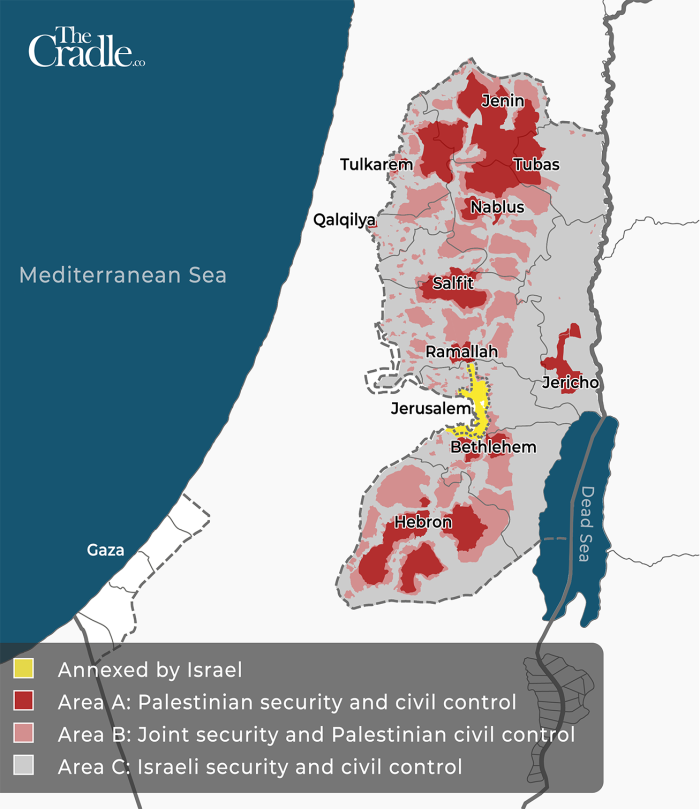
Map of Areas A, B, and C established under the Oslo Accords.
That transfer folds large parts of the occupied West Bank into Israel’s legal system, advancing annexation through procedure rather than proclamation. The change appears technical on paper and carries clear political consequences.
More than 58 percent of Area C, nearly 1.9 million dunams (roughly 1,900 square kilometers), remains unregistered, according to the Israeli anti-settlement group Peace Now. That unresolved legal status is now at the center of Israel’s latest initiative.
The roots of the issue stretch back decades. Under Jordanian administration between 1949 and 1967, only a portion of land was formally registered, following older British Mandate practices. After 1967, Israeli military orders froze settlement processes, leaving wide areas governed by customary ownership and inherited documents.
That legacy now carries forward into the present. What was left unresolved is now being brought under a new legal framework.
Land registration as control
The plan sets out to survey and register about 15 percent of these lands, roughly 290,000 dunams (around 290 square kilometers), before the end of the decade.
For Palestinian landholders, claims require detailed documentation and precise maps, often stretching back generations. In many cases, those records are incomplete or no longer available.
Where proof falls short, land can be classified as state property. Once registered that way, it can be redirected toward settlement construction or agricultural outposts, while former owners lose access.
Legal ground shifts
Recent cabinet decisions have reshaped the legal terrain that governed land for decades.
Pre-1967 Jordanian restrictions that once limited property sales to Palestinians are being overridden, opening the door for companies and settler groups to acquire land inside densely populated Palestinian areas.
At the same time, prior approval requirements for transactions have been lifted. These procedures once allowed authorities to review claims and flag irregularities. Their removal speeds up transfers and reduces oversight.
Land records have also been opened for public review. For settlement groups, this offers a clearer path to identifying absentee ownership and pursuing contested claims.
These measures do not stop at Area C. They reach into Areas A and B, where the Palestinian Authority (PA) holds administrative powers under the Oslo framework. Israeli agencies are now positioned to intervene more directly, including demolishing Palestinian buildings and structures, under the guise of enforcing environmental standards, heritage protection, and water management.
In Hebron (Al-Khalil), planning authority in key areas has been transferred from the municipality to Israeli military control. In Bethlehem, a dedicated body now oversees the area around Rachel’s Tomb, channeling resources into nearby religious infrastructure.
Expansion on the hills
Legal change has moved in tandem with accelerated settlement activity.
A new plan outlines the establishment of outposts across dozens of strategic hilltops, each designed to establish a permanent presence through mobile homes and basic infrastructure.
More than 1 billion shekels have been allocated for roads linking the new outposts to existing settlements, folding them into the wider settlement network.
Settlement construction has risen sharply in recent years, with Peace Now reporting an 80 percent increase since 2022. Many outposts once considered unauthorized have since been retroactively approved.
Pastoral outposts form part of this expansion. Herds are used to assert control over grazing land, limiting Palestinian access, and extending the reach of settlement activity beyond built structures.
The E1 corridor east of Jerusalem remains central to these plans. Tenders have been issued for more than 3,400 housing units in the E1 area, linking Ma’ale Adumim to Jerusalem. If built, the project would sever the territorial continuity between Ramallah, occupied East Jerusalem, and Bethlehem, effectively dividing the West Bank into two disconnected parts
A joint report by Peace Now and Kerem Navot found that shepherding outposts now give settlers control over around 14 percent of the occupied West Bank, or at least 786,000 dunams (786 square kilometers).
Displacement under pressure
On the ground, these changes are accompanied by rising pressure on Palestinian communities.
According to UN OCHA data, cited by Amnesty International, 117 predominantly Bedouin and herding communities in the occupied West Bank experienced full or partial displacement between January 2023 and April 2026 following settler attacks and related access restrictions.
In parts of the Jordan Valley and the hills around Ramallah, attacks by settler groups have led to the destruction of homes and infrastructure. In some cases, entire communities have left overnight.
In one case, a community in Al-Mu’arajat was completely displaced after homes were demolished and infrastructure looted. In Ras Ein al-Auja, near Jericho, Bedouin families were forced to leave after settler outposts cut off access to grazing land and undermined their livelihoods.
Accounts from affected areas describe vehicles entering at speed, property damage, and the seizure of basic resources. Fatal incidents have also been reported, with residents killed during confrontations.
For many, remaining on the land has become increasingly difficult. Pressure builds through legal, economic, and physical channels.
A system, not incidents
Evidence suggests that settler violence is not random but operates within an organized framework supported by state institutions.
Figures from the Israeli rights group Yesh Din show that the vast majority of complaints related to settler violence are closed without charges.
Oversight of the police sits with extremist National Security Minister Itamar Ben Gvir. Field reports from within the Israeli military describe coordination at times between soldiers and settler elements, or a lack of intervention during incidents.
Support has also taken administrative form. Dedicated units have been established to work with settler youth groups, alongside funding for equipment used in remote areas.
Political rhetoric has also drawn criticism. Israeli Prime Minister Benjamin Netanyahu has repeatedly described violent settlers as “a handful of extremists.” The cumulative effect is a system that allows these dynamics to persist, operating with continuity rather than disruption.
Regional fault lines
The developments have drawn responses from regional and international actors, grounded in legal frameworks.
The International Court of Justice (ICJ), in its 2024 advisory opinion, found that Israel’s policies and practices in the occupied West Bank and East Jerusalem violate international law. Land confiscation and population transfer were identified as unlawful.
Land confiscation and the transfer of population are prohibited under the Fourth Geneva Convention and affirmed as unlawful in UN Security Council Resolution 2334.
Governments in Jordan, Egypt, Qatar, and Turkiye have described current policies as a form of annexation that undermines the basis for a political settlement.
For Jordan, the issue carries additional weight, touching on the foundations of its 1994 peace agreement with Israel.
Western responses have remained largely declarative. Opposition to formal annexation has not translated into a halt to settlement growth or infrastructure expansion.
The changes continue through administrative channels, each step building on the last. What began as a registry project now runs through land, law, and control across the occupied West Bank, carried forward through procedure and fixed on the ground.
Across legal files, hilltops, and emptying villages, the map is being redrawn without a formal declaration.
Sorry, the comment form is closed at this time.
Featured Video

Dan Dicks with James Corbett on Solutions Watch
or go to
Aletho News Archives – Video-Images
From the Archives
MMR (Measles, Mumps and Rubella) – Vaccine Risk Statement
MMR Vaccine (Measles, Mumps, and Rubella) Is It Safer Than Measles, Mumps and Rubella?
Physicians for Informed Consent | December 2024
… It has not been proven that the MMR vaccine is safer than measles, mumps, and rubella. The vaccine package insert raises questions about safety testing for cancer, genetic mutations, and impaired fertility. Although VAERS tracks some adverse events, it is too inaccurate to measure against the risk of measles, mumps, and rubella. Clinical trials do not have the ability to detect less common adverse reactions, and epidemiological studies are limited by the effects of chance and possible confounders. Safety studies of the MMR vaccine are particularly lacking in statistical power. A review of more than 60 MMR vaccine studies conducted for the Cochrane Library states, “The design and reporting of safety outcomes in MMR vaccine studies, both pre- and post-marketing, are largely inadequate.”19 Because permanent sequelae (aftereffects) from measles, mumps, and rubella are so rare (especially in children with normal levels of vitamin A and infected after birth),6,15-17 the level of accuracy of the research studies available is insufficient to rule out the possibility that the MMR vaccine causes greater death or permanent disability than measles, mumps, and rubella. – Read full article
Blog Roll
 Aletho News
- Moscow issues warning to NATO over Russian exclave
- Yes, the Iran war has destroyed Trump’s presidency
- The fallacy of US delusions about Iran’s economic collapse
- Hezbollah denies Syria cell link, warns of Israeli plan to sow discord
- The legacy of US sanctions, war, and occupation in Iraq
- Iraqi resistance group rejects disarmament, vows to maintain support for Lebanon
- Sheikh al-Asadi warns of Iraqi government compliance with US demands
- How to MAKE THE CONSPIRATORS PAY for their crimes! Dan Dicks with James Corbett on Solutions Watch
- There’s a drought in academia: A drought in honest research on the subject of drought and other weather extremes
- Department of War Awards $20.7 Billion Contract to Raytheon for Air-to-Air Missiles
- If Americans Knew
- Israeli Attacks Kill Ten Palestinians in Gaza
- Massacre at Minab: The School That Became a Grave
- Israeli media: The IDF Shows It Doesn’t Turn a Blind Eye; It Actively Emboldens Settler Havoc
- As settlers ravage West Bank, Israeli forces kill 10 in Gaza – Daily Update
- New Report: “Scholasticide and Genocide in Gaza: Assessment, Testimonies and Legal Analysis”
- Ex-Biden officials are desperate for a Gaza scapegoat
- Israeli “settlers” Invade Al-Aqsa; Pour Boiling Water on 75-Year-Old
- Israel Has Kidnapped Another American Teenager
- US arms sales to Israel worth $21.6 billion in 20 months
- Three Palestinians Killed in Israeli Attacks on Gaza
- No Tricks Zone
- Green Energy Debacle: German Expert Professor Fritz Vahrenholt Warns Of Severe Economic And Social Consequences
- Two More Paleo Reconstructions Affirm Meters-Higher Sea Levels Across Ireland, Brazil 7000-6000 Years Ago
- New Study: Earth And Venus Surface Warmth Largely Explained By Convection And Lapse Rate, Not CO2 Or Radiation
- 2025 Nature Paper Claiming Worsening Global Drought Gets RETRACTED …Heavily Flawed
- New Study: ‘Global Drought Shows No Detectable Recent Acceleration Under Climate Warming’
- Economic Masterminds: German Socialists Suggest Taxing Productivity Gains Stemming From Using AI
- The South China Sea Has Not Been Cooperating With The Climate Change Narrative
- Energy Crisis: Germany Enters Heating Season With Historically Low Gas Reserve Fill Levels
- New Study: The Antarctic Ice Sheet Gained Mass From 2020-2024 Due To Staggering Snow And Ice Accumulation
- Study: Ocean Heating Rates From Thousands Of Years Ago ‘Dwarf’ Modern Ocean Heating Rates

