Colombia and ELN Rebels to Begin Formal Peace Talks
teleSUR – March 30, 2016
The Colombian government announced the launch of formal peace talks on Wednesday with the country’s second-largest rebel group the National Liberation Army or ELN. The announcement takes place after the guerrilla group freed two hostages to meet a government condition for the start of formal peace talks.
During a joint press conference Wednesday, the Colombian government’s top delegate for the ongoing FARC peace talks, Frank Pearl, outlined the key aspects of negotiation between the ELN and the Colombian government, which will include six major points: participation of society, peace through democracy, transformations necessary for peace, victims rights, the end of the armed conflict, and the implementation and signature of the agreement.
Pearl also confirmed that Cuba, Norway, Venezuela, Chile, Brazil and Ecuador will act as guarantor countries.
Meanwhile, moving forward, the ELN commander Antonio Garcia promised to communicate on all future progress made during the talks and vowed “to create a favorable environment for peace.”
Shortly after the press conference, Colombian President Juan Manuel Santos delievered a statmenent in which he emphasized the importance of the peace talks with the ELN, stating, “We have to finish this conflict in order to construct peace in our country.”
During his speech, the Colombian President likened the talks to the ongoing negations between the government and the FARC, saying that, “the objective is the same, which is to eliminate violence.”
The announcement marks a new stage in peace negotiations as the government also closes in on a deal with the country’s largest guerrilla group, the Revolutionary Armed Forces of Colombia, known as the FARC.
Leading up to the joint press conference, ELN officials thanked the Venezuelan government via Twitter for their role in the Colombian peace process.
“We would like to thank the Venezuelan people for their unconditional support in helping us get to this point.”
Meanwhile, the regional integration bloc, UNASUR, also issued its support in a statement saying, “The Union of South American Nations (UNASUR ) welcomes this agreement, which was made possible in part due to the participation of several regional governments.”
The Foreign Ministry of Ecuador also praised the news, expressing its “profound satisfaction” regarding the recent announcement.
The government and the ELN had been in preliminary talks for more than two years, but had failed to begin formal negotiations until today.
Colombia has seen armed conflict between the state, paramilitaries, crime syndicates and revolutionary left-wing groups such as the FARC and the Marxist-Leninist ELN since the 1960s.
Murder Epidemic Halts Colombia’s Peace Process
By W. T. Whitney | CounterPunch | March 24, 2016
Paramilitaries and armed thugs have long sullied politics in Latin America, most notably in Colombia and recently in Honduras. A recent increase in politically motivated killings in Colombia coincided with final preparations for signing a peace agreement between the Revolutionary Armed Forces of Colombia (FARC) and the Colombian government, at war for 50 years. The much anticipated accord never materialized.
In Honduras the murder of longtime environmental and indigenous rights activist Berta Cáceres caps a wave of killings there of journalists, teachers, women, and especially of agrarian rights activists.
Governments and private parties serving predatory interests evidently regard terror at the hands of thugs or paramilitary forces as useful for maintaining dominion. Colombia’s paramilitary phenomenon warrants a look now because paramilitary attacks have brought Colombia’s peace process to a halt. Fortunately documentation of paramilitary offenses in Colombia provides much by way of details and particulars, more so than in Honduras, for instance. That’s because Colombian paramilitaries have long met resistance and gained special notoriety.
On March 23, after 40 months of talks in Havana, negotiators on both sides in the Colombian peace talks were to have announced a “Final Agreement,” one covering five agenda items they had set out to discuss. But an impasse developed over the last one, designated as “end of conflict.” It entails a “bilateral and definitive cease of fire and hostilities” and laying down arms.
FARC negotiators held back; an epidemic of killings during March revived long-held FARC concerns about the safety of ex-guerrillas in a time of peace. Others worry too.
The Executive Committee of the Patriotic Union (UP), a leftist political party, reported March 18 that in the previous three weeks “unknown armed men,” presumably paramilitaries, had carried out 11 politically motivated killings and “disappeared” three other people – whose bodies were found later.
Speaking to reporters, Aída Avella, the UP president, accused business leaders of financing the resurgence of paramilitaries. She also accused military leaders of being “immersed” in paramilitary operations. Avella herself went into foreign exile for 17 years in 1996 after a rocket destroyed the car in which she was a passenger.
In an open letter to Colombian President Juan Manuel Santos, Andrés Gil, a leader of the Patriotic March, condemned the assassinations. “[I]f we continue to be killed,” he wrote, “then the conclusion will be that really there’s no room for anyone on the left…. You will pass into history not as the president for peace but as the one who didn’t take the fight against paramilitaries seriously.”
Referring to the flood of paramilitary victims, the FARC peace delegation released a statement asking, “How can this be in the midst of a peace process now approaching the signing of a final accord?” Colombian authorities, the FARC said, “can no longer delay clearing away the phenomenon of paramilitarism.”
The FARC has reason to be alarmed. Many FARC guerrillas left the insurgency in 1985 in accordance with an agreement signed with President Belisario Betancur. They engaged in electoral politics as candidates for the UP party. That provoked a massacre; some say almost 5000 UP activists have since been murdered.
FARC negotiator Carlos Antonio Lozada may have been thinking of that experience when he told reporters March14 that, “[W]e have to take measures to avoid being betrayed and attacked as happened in the past.” He noted that the government recently dismissed a technical sub-commission report, already agreed upon, calling for “a bilateral and definitive ceasefire.”
The FARC negotiating team took the occasion of Secretary of State John Kerry’s visit with them on March 21 to seek help in regard to the paramilitary problem. Kerry had accompanied President Obama on his historic visit to Cuba. The negotiators released a communication saying, “Mr. Kerry, we ask through you that the United States help curb paramilitary violence, which in the midst of the peace process keeps mowing down the lives of defenders of human rights and social leaders.”
The request is not without irony. The United States provides funds for the Colombian army, known to facilitate paramilitary operations. And in the early 1960s U.S. military experts advised the Colombian government to utilize paramilitaries to augment its campaign then of pushing back against leftist guerrillas.
In a joint press conference February 4 with President Santos in Washington, President Obama introduced a U. S. plan called “Peace Colombia.” The two leaders had met to celebrate the upcoming peace accord and the end after 15 years of Plan Colombia, that U.S. mechanism for supporting counterinsurgency and drug-war efforts in Colombia.
For Voz newspaper editor Carlos Lozano, the name of the new venture signifies a “Pax Romana, or peace of the graveyard.” He lamented that “within Peace Colombia there’s not one entry for combating paramilitarism, which is the principal obstacle to peace in Colombia.”
Trivializing the FARC and thereby perhaps signaling the guerrillas’ irrelevance in a Colombia at peace, the New York Times recently headlined a reporter’s story thus: “Inside a Rebel Camp in Colombia, Marx and Free Love Reign.” It celebrated the collapse of communism by likening the supposed decline of the FARC to the fall of the Berlin Wall.
To the extent that such triumphalism extends to official U.S. attitudes, prospects for peace in Colombia are diminished.
Nevertheless, neither Colombia’s government nor the United States will likely have the final say in regard to disruptions at the hands of paramilitaries. Other forces, powerful and based on realities, are in play, and have been. A voice on their behalf is heard from, of all places, inside prison.
Political prisoner Húbert Ballesteros joined the Communist Party and Patriotic Union in 1986. More recently he’s been a leader of both the Fensuagro agricultural workers’ union and the CUT labor federation. Writing on March 12, he reflects upon “the killings in Antioquia, Sur de Bolívar, Arauca, Bogotá, and Cauca; the jailing of social leaders in Cauca, and the spread of paramilitary bands the length and breadth of the country.” According to Ballesteros, “We can no longer continue assuming that this oligarchy wants peace [other than] a cheap peace, a silencing of the guns.”
He knows what to do: “[W]hile we are building scenarios of peace, we must organize the people for resistance, and do so massively and convincingly so that this government understands that people are no longer content to live under its domination.” We must deal with “the true problems of the country, which are unemployment, poverty, corruption, and social and political marginalization.”
W.T. Whitney Jr. is a retired pediatrician and political journalist living in Maine.
‘Paz Colombia’: the Latest US Attempt to Control Colombia?
By Justin Podur – teleSUR – February 8, 2016
The U.S. has announced funding for a new Plan Colombia as the country moves towards a resolution to its civil war. What is its real purpose?
Colombia’s peace process has entered its final phase. Agreements have been reached on land reform, political participation, and the rights of victims. The discussions are now focused on ending the conflict and implementation and verification of the accords. The deadline for a final agreement is March 23, and it might be met.
In this last phase of negotiations, Colombia’s president reached out to the US for aid. On February 4, a new initiative was unveiled in Washington by presidents Santos and Obama: the new version of Plan Colombia, which they called “Paz Colombia”. Obama began by commemorating the success of Plan Colombia, a plan that brought military helicopters and escalated aerial fumigation to the country. “We were proud to support Colombia and its people as you strengthened your security forces, as you reformed land laws, and bolstered democratic institutions,” he said. “And after 15 years of sacrifice and determination, a tipping point has been reached. The tide has turned.”
Santos elaborated on the successes since Plan Colombia was rolled out in 2000: “Today we can say without a doubt that the goals that we had in 2000 — such as fighting the drug war, strengthening institutions, and imposing the rule of law, and to take social programs to great parts of remote Colombian territory — those objectives have been met.”
The history of Plan Colombia is slightly different than that presented by Obama and Santos. As lawyer Dan Kovalik outlined in this article for teleSUR English, the problems the president’s claim Plan Colombia solved were mostly made worse by it.
Take Santos’s objectives, which Plan Colombia supposedly met: The drug war? There may be a peace agreement between the government and FARC, but the drug war promises to go on and on. The rule of law and the strengthening of institutions? These were certainly areas of struggle over the past 15 years, but any gains made there were fought for by the people, not flown in by the military helicopters of Plan Colombia. Social programs and protections? Many have been lost under neoliberalism – some have been preserved by struggle by Colombia’s movements.
What about Obama’s list? Security forces were strengthened, to be sure. New equipment was introduced and soldiers were trained in its use. But the Plan Colombia years were years of collaboration between the military and the paramilitaries, who were responsible for the most horrific violence. Reformed land laws? The 15 years of Plan Colombia were a time of losses of land and of rights to land. Colombia’s 1991 Constitution was one of the most progressive in Latin America when it came into force. Indigenous and Afro-Colombian territorial rights were enshrined. Paramilitary violence escalated after this constitution, as elites deployed their forces to create facts on the ground: specifically, to use terror and massacre to force people to flee the territories they had just won legal rights to. Millions of people were displaced from their lands in this way. Legal changes under the 15 years of Plan Colombia, the “reformed land laws”, attempted to retroactively legalize this loss of land. As for the bolstering of democratic institutions, it was in the Plan Colombia years that the “para-politica” or “para-Uribe” scandal occurred – evidence of signed contracts between politicians and paramilitaries to kill and displace local people.
There were other scandals too, in the Plan Colombia years. The Colombian security services wiretapping politicians involved in the peace process. The Colombian military entrapping and murdering completely innocent peasants, dressing them up as guerrillas, and using the deaths to inflate the numbers of casualties their units were inflicting (“false positives”).
At the announcement of the Paz Colombia plan, Obama said that the US would support the peace the same way it had supported the war. If this is the plan, it is frightening. When Plan Colombia started in 2000, there was actually a peace process underway between the FARC and the government. It had begun just a year before, in 1999. There is little question that Plan Colombia helped to derail it, steering the Colombian government towards a military solution.
At $450 million USD, the scale of Paz Colombia was reportedly disappointing to President Santos. The original Plan Colombia was announced at $1.3 billion USD, most of which paid for US-manufactured attack helicopters. Colombia paid several times that amount out of its own budget for Plan Colombia. Colombians paid for Plan Colombia, and they will be paying for Paz Colombia.
Those were not the only costs Colombians paid. The environmental and health costs of the spraying are difficult to calculate. In 2008, Ecuador took Colombia to court over the ecological and health damage caused by aerial fumigation on the Colombia-Ecuador border. In 2013, the lawsuit was settled for $15 million, which environmentalists argued was an extreme undervaluation of the damage. The true damages might be in the billions.
Many problems remain. Neither the peace accords nor Paz Colombia deal with the bigger cause of violence over the decades: the paramilitaries. Implementation will be fraught with difficulties. When previous guerrilla groups disarmed and joined politics (Union Patriotica and M-19), they were devastated by state-backed paramilitary assassination campaigns. Unarmed social movements have struggled during the talks, as they did during the war, to get their voices heard and their sacrifices recognized.
But a negotiated end to the armed conflict has long been a demand of these movements, and its realization is to be celebrated. The movements will be the ones fighting to prevent Colombia’s post-war reality from being “mired in structural poverty and violence and endemic corruption”, as Hector Perla wrote in teleSUR last week.
It is not accurate to say that the US is standing with Colombia in peace as it did in war. It might be more accurate to say that the US is trying to control the peace as it controlled the war. If the history of Plan Colombia is a guide, an independent path might yield a better peace.
Misrepresentation of the Colombian Conflict
By Matt Peppe | Just the Facts | October 4, 2015
A week and a half ago news emerged from Havana that the FARC (Revolutionary Armed Forces of Colombia) and the Colombian government had reached a framework for a final peace agreement to be signed within six months. This was hailed as a breakthrough in the half-century-old conflict and an opportunity to bring peace to the people of Colombia. But by adopting the government’s narrative, mainstream media have failed to recognize the primary cause of the violence and the inevitability that it will continue in the future.
The decades-long policy of the Colombian government has been a national security strategy of counterinsurgency, developed in the late 1950s under the sponsorship of the US military. The goal of the US government was to maintain a business-friendly political system that would implement economic policies amenable to multinational corporations and foreign capital. Resistance to such policies was deemed subversion, and people who sympathized with such resistance were branded as internal enemies to be eliminated or neutralized by military means.
The narrative of the national security doctrine holds that if the insurgent threat is eliminated, then peace will be restored. The implicit assumption is that the FARC rebels have always been the side standing in the way of peace. According to this interpretation, when the FARC initiated their military operations the state was acting for the benefit of the nation as a whole by organizing a counter response.
But this narrative is historically inaccurate. The Colombian conflict is not a battle of society at large against a group of guerillas, but a battle of a small group of elites controlling the state apparatus against the majority of the population.
“As in many other Latin American countries, we can find the seeds of present-day social inequality and strife in the concentration of Colombia’s land and resources under the control of a tiny minority, matched by the progressive dispossession of the majority of people, which originated with colonialism in the sixteenth century,” explains Jasmin Hristov in her book Blood and Capital: The Paramilitarization of Colombia. [1]
After the FARC developed as the armed wing of the Communist Party in Colombia, the counterinsurgency doctrine – developed by the US military and codified in manuals distributed as early as the 1960s – taught the US’s Colombian counterparts to view any advocacy for social justice or democratic reform as a form of Communist insurgency. In addition to armed rebels, clergy, academics, labor leaders, human rights workers, and other members of civil society became potential insurgent targets.
To further extend their reach into Colombian society, the government legally authorized paramilitarism in 1965 with Plan Lazlo to form “civilian defense forces” armed and incorporated into the Colombian military system. [2] These forces serve the government’s goal of preserving the status quo by carrying out their dirty work through the use of death squads, assassinations, torture, intimidation and disappearances while providing cover and the appearance of distance from the state itself.
The Colombian conflict cannot be understood without recognizing the true nature of the actors involved and the interests they represent. “The paramilitary has never been, and is even less so now, a third actor (the state and the guerillas being the other two), as portrayed in mainstream security discourses,” writes Hristov. [3]
Writing in the New York Times after the peace agreement was announced, Ernesto Londoño declared the “three-way fight among guerilla factions, government forces and right-wing paramilitary bands that often acted as proxies for the state had killed more than 220,000 people and displaced an estimated 5.7 million.”
Dan Kovalik, Professor of International Human Rights at the University of Pittsburgh School of Law, disputes the notion that paramilitaries merely occasionally serve as proxies: “It is impossible to talk about the paramilitaries as separate from the Colombian state, for the Colombian state helped create the paramilitaries, and human rights groups have concluded year after year that the state has provided them with weapons, logistical support and has carried out joint operations with them, Even federal courts confronted with this questions under the Alien Tort Claims Act have concluded that the paramilitaries are sufficiently integrated with the state that their misdeeds constitute state action.”
Aside from inaccurately describing the fighting, Londoño’s statement uses statistics about the cumulative violence without describing who holds responsibility for the deaths and displacements. Later in his editorial, Londoño implicitly blames the FARC for the majority of the violence: “Dozens of victims traveled to Havana to speak about abuses they endured at the hands of the guerilla leaders. Some implicated government forces in brutal acts… The special war tribunals the government intends to start adjudicating crimes will be dismissed as kangaroo courts by those who would have favored a military defeat of the FARC.”
If one accepts the national security narrative that most violence by the government amounts to collateral damage as a result of reaction to insurgent aggression, then guerillas would be responsible for the majority of deaths and injuries. But this is hardly the case.
Kovalik notes that “human rights groups have consistently concluded that the Colombian state and its paramilitary allies commit the lion’s share of the human rights violations in that country – in the worst years, at least 80% of the abuses can be attributed to these forces.”
US Government Intervention and Plan Colombia
Londoño also credits US policy with providing the impetus to achieving peace: “Washington’s forceful intervention in the war, an intervention that began in the late 1990s, enabled the Colombian government to weaken the FARC and ultimately set the stage for peace negotiations.”
Washington’s counterinsurgency policy is seen not only as an instrument for peace, but as the primary factor enabling its achievement. This is stunning historical revisionism that portrays the instigator and sponsor of massive violence that has lasted decades as an honest broker for ending this violence.
In reality, Washington’s intervention began 40 years earlier than Londoño claims, and it created the war that has raged ever since. By any objective measure, US policy in Colombia has been an abject failure. Under US direction, funding and training, the Colombian state has had one of the worst human rights records in the hemisphere. Many human rights organizations attest to this, and have demanded an end to US military aid to Colombia.
“Year after year US policy has ignored the evidence and the cries of the United Nations, Colombian and international non-governmental organizations and the people of Colombia. Plan Colombia is a failure in every respect and human rights in Colombia will not improve until there is a fundamental shift in US foreign policy,” writes Amnesty International USA.
A Human Rights Watch report declared that: “all international security assistance should be conditioned on explicit actions by the Colombian Government to sever links, at all levels, between the Colombian military and paramilitary groups. Abuses directly attributed to members of the Colombian military have decreased in recent years, but over the same period the number and scale of abuses attributed to paramilitary groups operating with the military’s acquiescence or open support have skyrocketed.”
Bogotá professor and historian Renán Vega Cantor, in a study of U.S. involvement in Colombia, writes that: “State terrorism that has been perpetual in Colombia since the end of the 1940s feeds off the military support and financing of the United States, as much as the interests of the dominant Creole classes, to preserve their wealth and power and deny the fulfillment of elemental economic and social reforms that are redistributive.”
What the New York Times and the mainstream media miss in their analysis is that the current neoliberal Colombian sociopolitical system necessitates the continuance of violence to accommodate capital.
“The guerilla was not the cause of the Colombian conflict but rather one of its symptoms, and simultaneously became a contributing factor in the sense that its very existence has provided the ideological substance for the pretext and justification behind state-sanctioned violence and militarization, Thus unfortunately the presence of the guerilla has been used by the powerful to legitimate the onslaught on social forces that challenge the power of the dominant classes,” writes Hristov in her latest book, Paramilitarism and Neoliberalism: Violent Systems of Capital Accumulation in Colombia and Beyond. [4]
Hristov says that in order for the government to meet FARC’s demands, they would have to invest in social programs at the expense of the military-security apparatus currently in place. But since these systems serve the neoliberal economic restructuring that funnels land and resources from the masses to the tiny elite minority, it would be naive to assume this will happen.
“Even in a post-FARC era the state would always have a pretext, such as BACRIM [criminal bands with roots in nominally disarmed paramilitary groups] or the existence of other guerilla groups, to maintain its high level of militarization,” Hristov writes. [5]
The portrayal of the Colombian conflict in the New York Times and other mainstream media replicates state propaganda, in the form of the national security doctrine, while failing to account for the inherent violence of the economic system in Colombia that has driven the perpetual militarism and coercion in the country.
While any agreement offering the prospect of decreased bloodshed is encouraging, the fact that the Colombian state continues to abide by the Washington Consensus and its neoliberal socioeconomic model sadly signifies that the country is inevitably headed for continued violence, dispossession, and suffering by the vast majority of the population.
When the Colombian government and the western media recognize that Washington intervention exacerbates the violence, rather than helps minimize it, then possibly Colombia can begin to extricate itself and pursue a course that will enable the Colombian people to achieve lasting peace and social justice.
References
[1] Hristov, Jasmin. Blood and Capital: The Paramilitarization of Colombia. Ohio University Press; 1 edition, 2009. Kindle edition.
[2] Ibid.
[3] Ibid.
[4] Hristov, Jasmin. Paramilitarism and Neoliberalism: Violent Systems of Capital Accumulation in Colombia and Beyond. London: Pluto Press, 2014. (pg. 153)
[5] Hristov, 2014 (pg. 157)
Matt Peppe writes about politics, U.S. foreign policy and Latin America on his blog. You can follow him on twitter.
Time for President Obama to Free Simon Trinidad
By Tom Burke | teleSUR | September 24, 2015
September 24 marks the day one year ago when the National Victims Table was set up as an important part of the Colombian peace process. Exactly one year later, the Revolutionary Armed Forces of Colombia – People’s Army (FARC-EP) and the Colombian government of Manuel Santos are announcing an agreement on victims and justice, a bilateral ceasefire, and a signing date for the peace agreement.
It is a big step forward for the Colombian peace process, with the issues of prisoners, setting aside arms, and then implementation to be agreed upon next. Although the number of Colombian political prisoners is around 7000, there is one prisoner who stands out because he is held under cruel and unusual circumstances. That is FARC negotiator Simon Trinidad (aka Ricardo Palmera).
Held for 11 years as a political prisoner of the U.S. Empire, the 65-year-old Trinidad is in solitary confinement at the Florence Supermax in Colorado, the “Guantanamo of the Rockies.” Trinidad is a good man who embodies the struggle of the Colombian people for freedom, and the FARC say that without him, they will not sign an agreement.
It is President Barack Obama who can set Simon Trinidad free, to take his rightful place at the Colombian peace negotiations. President Obama can send a loud and clear message that the U.S. backs the peace process. For President Obama, the time to act is now, and it is likely to add momentum to the peace process.
Earlier this week, I marched with thirty-five activists from nine U.S. cities on a rural highway in the Rocky Mountains to demand, “Free Simon Trinidad! Peace for Colombia!” We marched to the modern underground dungeon where prisoners can be held with no human contact for years on end. Across from the guardhouse of the Colorado supermax, we held signs saying, “President Obama free Simon Trinidad!” and “Send Simon Trinidad to peace talks!”
As we marched back up Highway 67 to the small town of Florence, I kept thinking how strange it is, surreal in fact, that our efforts to end the U.S. war and intervention brought us to this place. The scenery is beautiful and breathtaking, but when you think of the men being held underground with no access to sunlight or fresh air, and no other human to talk to, the prison seems doubly vicious, consciously dehumanizing. Only the strongest of people, someone like Simon Trinidad, can persevere under these conditions.
With September 24 being the starting date of the National Victims Table, that date has great significance for me and my friends who organize solidarity with Colombia and Simon Trinidad in particular. For I am one of the Antiwar 23, raided by the FBI in Chicago, Minneapolis, and Grand Rapids, five years ago today. Over 100 FBI agents raided seven homes, scaring our children, and taking away our computers, phones and boxes of whatever else they wanted. When I left our house to write a press release, I realized I was being followed. I drove to my wife’s job where the FBI subpoenaed us to the grand jury in Chicago. It was shocking. Like all of the Antiwar 23, we refused to appear. No witch hunts for us.
I don’t like to think of myself as a victim, but the U.S. government did target us because of our effective organizing. The U.S. government claimed the Antiwar 23 were sending money and providing material support to the FARC and PFLP. The FBI said we faced 15-year prison sentences. However, when the U.S. government spy could not find any evidence, she and her FBI handlers attempted to create a crime. It did not work. We are still organizing solidarity, such as the campaign for a Palestinian American women’s leader “Justice for Rasmea Odeh”.
Over time we learned that the U.S. government political repression began when we protested outside the four trials of Colombian revolutionary Simon Trinidad. Our small group of solidarity activists did our part to expose the injustice of the four trials of Simon Trinidad and the U.S. government was angry with us. We protested and reported to the media on the unfair procedures and rulings. We were there in the courtroom when the cheating Judge Hogan was forced to step down after the first trial. We helped turn what should have been the triumph of the Empire, into a shameful display of corruption.
Today, I find September 24 to be a day for reflection and for re-dedication to the cause of stopping U.S. war and intervention in Colombia and everywhere else too. Plan Colombia is a colossal failure and needs to be brought to an end. We will continue to act in solidarity with the people of Colombia for a lasting peace with justice. We say “Free Simon Trinidad! Peace for Colombia!” Now is the time for President Obama to act.
Tom Burke is the spokesperson for the National Committee to Free Ricardo Palmera (Simon Trinidad)
Background: Who is Simon Trinidad?
Peace in Sight: Historic Agreement between Colombia and the FARC
By Miguel Salazar | Council on Hemispheric Affairs | September 24, 2015
On Wednesday, September 23, 2015, Colombian President Juan Manuel Santos and FARC leader Rodrigo Londoño pledged to end the country’s internal conflict by March 26, 2016.
Ever since La Violencia—Colombia’s infamous civil war lasting from 1948 to 1958—the polarization of the country’s political parties and ideological factions has led to an escalation of a deep-seated violence throughout Colombia. The Revolutionary Armed Forces of Colombia (Fuerzas Armadas Revolucionarias de Colombia, FARC) was initially formed as an armed peasant movement in 1964 that demanded comprehensive land and social reforms. Since then, the government and right-wing paramilitaries have waged a violent conflict against the FARC in rural Colombia that has resulted in a total of 220,000 deaths and over 5.7 million displacements.[i]
Negotiations between the FARC and the Colombian government have been ongoing since 2012, but Wednesday marked President Santos’ first appearance at the peace talks, and the beginning of a more visible role as a major force for concluding the peace accord. The two sides have agreed to create special tribunals to try former FARC combatants as well as government troops and rightist paramilitaries. Those found guilty of human rights violations will be required to pay reparations to their victims and will face a maximum sentence of eight years under special conditions, if they voluntarily opt to cooperate with the judicial process.[ii] Combatants who do not cooperate and are convicted could face much longer sentences. Those who sign the peace deal, accept responsibility, face charges and pay reparations will be safe from extradition if they are wanted by the United States on drug trafficking charges.[iii]
Pressured into the peace talks by the Colombian public, Bogotá has spent billions of dollars on efforts to combat the FARC (the 2015 budget for armed forces and police is $12.2 billion),[iv] while the United States has contributed over $9 billion for military operations since the birth of Plan Colombia in 2000.[v] Meanwhile, the FARC have suffered from sharply diminishing membership numbers (16,000 in 2001 to 7,000 in 2013) over the past decade and a half.[vi]
However, this momentous agreement comes with historical antecedents. The FARC recently demanded an inclusion of right-wing paramilitary groups in the current peace talks.[vii] These were agreed to by President Santos on Wednesday.[viii] Previous administrations have attempted to implement comprehensive demobilization and reinsertion programs with guerrilla groups but have failed due to the exclusion of paramilitary forces. In Colombia’s last peace agreement, the Betancur administration (1982-1986) legalized guerrilla members that accepted the amnesty as political actors in 1985, and the FARC subsequently demobilized and established the Patriotic Union (Unión Patriótica, UP), their political party. However, over 3,000 UP members paid dearly for this tactical mistake; having put down their weapons and rejoined civic life, they were later assassinated by paramilitary elements.[ix]
This changed with the election of President Álvaro Uribe (2002-2010), who refused to negotiate with the FARC and instead opted for supporting talks with the United Self-Defense Forces of Colombia (Autodefensas Unidas de Colombia, AUC), the largest paramilitary group in the country,[x] which has subsequently splintered off into several small criminal gangs.[xi] Since the demobilization of the AUC under Uribe, however, Colombian diplomats had not engaged in peace talks with the FARC until 2012.
COHA is cautiously optimistic about the shift in character of the Colombian government that has allowed for the promise of peace. However, insufficient funding, an inadequate monitoring of demobilized combatants, and a lack of consultation with host communities in the past have impeded Colombia from successfully maintaining peace. Although it has yet to be seen whether these agreements will prove to be successful in the long-term, President Santos’s government and the FARC are to be lauded for having taken a crucial step toward sustainable peace in Colombia.
[i] “World Report 2015: Colombia.” Human Rights Watch. 2015. Web.
[ii] Acosta, Nelson, and Daniel Trotta. “Colombia, FARC Rebels Vow to End 50-year War within Six Months.” Reuters. September 23, 2015. Web.
[iii] Lander, Rose. “Colombia Govt, FARC Agree to Maximum Prison Sentences for War Crimes.” Colombia Reports. September 23, 2015. Web.
[iv] Muñoz, Sara Schaefer. “Colombia Unlikely to Cut Defense Budget If FARC Deal Is Reached, Officials Say.” The Wall Street Journal. January 20, 2015. Web.
[v] Arsenault, Chris. “Did Colombia’s War on Drugs Succeed?” Al Jazeera. May 22, 2014. Web.
[vi] Renwick, Danielle, and Stephanie Hanson. “FARC, ELN: Colombia’s Left-Wing Guerrillas.” Council on Foreign Relations. December 1, 2014. Web.
[vii] Alsema, Adriaan. “The FARC’s Biggest Fear: Colombia’s Paramilitary Groups.” Colombia Reports. July 10, 2015. Web.
[viii] Acosta, Nelson, and Daniel Trotta. “Colombia, FARC Rebels Vow to End 50-year War within Six Months.” Reuters. September 23, 2015. Web.
[ix] Laplante, Lisa J, and Kimberly Theidon. “Transitional Justice in Times of Conflict: Colombia’s Ley De Justicia Y Paz.” Michigan Journal of International Law 28, no. 49 (2006): 59-61.
[x] Ibid: 61-62.
[xi] McDermott, Jeremy. “The BACRIM and Their Position in Colombia’s Underworld.” InSight Crime. May 2, 2014. Web.
Colombia’s President Orders Halt to Bombing of Rebel Positions
Sputnik – 26.07.2015
Colombian President Juan Manuel Santos ordered to suspend air strikes on positions of the Revolutionary Armed Forces of Colombia (FARC), he said via his Twitter microblog.
On Monday, FARC ordered all their units to observe a ceasefire and released a Colombian soldier it had captured earlier this month as a gesture of goodwill.
“I have ordered to suspend airstrikes on FARC camps starting today. They will be carried out only in the case of an explicit order of the president,” Santos said Saturday.
He added that the sides were able to revive the peace talks and “are closer than ever to put an end to the war.”
Colombian armed forces have been fighting FARC, the country’s largest rebel group, since 1964. The two sides have been holding peace talks in Cuba since 2012.
Recent progress in peace talks between FARC and the government was achieved in June with an agreement on the creation of a joint Truth Commission.
The commission is tasked with gathering testimony from victims and witnesses of Colombia’s civil war. However, it is unable to use the information to bring up criminal charges against FARC members, government troops or other fighters.
As many as 220,000 people have been killed as a result of the armed conflict in Colombia.
Colombia, FARC rebels agree on de-escalation plan

Revolutionary Armed Forces of Colombia (FARC)
Press TV – July 13, 2015
The Colombian government and the Revolutionary Armed Forces of Colombia (FARC) rebels have come to a landmark agreement to de-escalate fighting in the country, sources say.
The Colombian government pledged in the Sunday deal to halt its military action against the rebels, who last week announced a one-month unilateral ceasefire starting from July 20, both parties said in a joint statement.
“The national government, from July 20, will launch a process of de-escalation of military action, in response to the suspension of offensive actions by the FARC,” said the statement issued in the Cuban capital, Havana, and read by Cuban and Norwegian diplomats, who have been mediating the talks.
The agreement will come into force if FARC fulfills its promised unilateral truce.
The FARC’s top negotiator in Havana expressed hope that the ceasefire would lead to the resumption of bilateral negotiations.
“This is undoubtedly a strong, promising, and hopeful re-launch of the dialogue process,” said Ivan Marquez.
His government counterpart, Humberto de la Calle, said the accord indicates that “the opportunity to end the conflict is alive.”
FARC will later decide if it will extend its ceasefire, while both sides will revisit the agreement in four months, mediators said.
Also on Sunday, Colombian President Juan Manuel Santos hailed the deal, calling it an “important step” toward a total peace agreement.
It is the first time the Colombian government has agreed to curtail its military actions against the rebels since peace talks began in November 2012 in Havana.
The negotiations have produced partial agreements on several issues, but have not resulted in a final deal.
FARC is Latin America’s oldest rebel group and has been battling the government since 1964.
Bogota estimates that 220,000 people have been killed and more than 4.5 million others have been displaced due to the FARC insurgency.
~
Background: Colombian President Santos Announces New Military Leadership
Colombian President Santos Announces New Military Leadership
teleSUR | July 7, 2015
Colombian President Juan Manuel Santos announced changes to military leadership Monday, with newly appointed heads of the country’s army, navy, and air force.
Santos said changes in command are “normal” and “necessary” procedures within the country’s armed forces.
Santos named General Alberto Mejia as army commander, Admiral Leonardo Santamaria as navy commander, and General Carlos Buenos as air force commander. The government also ratified Juan Pablo Rodriguez as general commander of the military and Rodolfo Palomino as head of the national police.
Santos thanked outgoing commanders Jaime Lasprilla, Hernando Wills, and Guillermo Leon for their service with the army, navy, and air force as he announced the changes.
The military leadership shakeup comes just days after the Colombian government signaled openness to exploring the possibility of a bilateral ceasefire in ongoing peace negotiations with the Revolutionary Armed Forces of Colombia (FARC), marking a shift from the government’s previous position.
Recently, the armed conflict between government forces and the FARC has escalated as the government stalled on accepting a ceasefire. The FARC suspended its unilateral ceasefire after the government massacre in the Cauca region killed 27 rebels.
The new leadership also comes just two weeks after Luis Carlos Villegas took over as the Colombia’s new minister of defense.
Colombia to Stop Bombing FARC Camps for One Month
teleSUR | March 10, 2015
The Colombian military will stop bombing FARC (Revolutionary Armed Forces of Colombia) camps for one month, President Juan Manuel Santos announced Tuesday.
The President emphasized that this is a temporary measure to try to de-escalate the more than 50 year conflict in the country, however he did not rule out the possibility of extending the one month deadline.
The FARC – the country’s largest guerrilla group – declared a unilateral ceasefire in December 2014, which it has so far honored, but the Colombian government has been slow to reciprocate.
Santos’ decision is an attempt to support ongoing peace talks, however he was specific in saying the bombing of camps would stop and did not mention ground troop deployment.
“To promote the de-escalation of the conflict, I decided to order the defense minister (Juan Carlos Pinzón) and the commanders of the forces to cease the bombing of the FARC camp for a month,” said the president.
“After that time we will further review the implementation of the unilateral termination by the FARC and, according to its results, decide whether to continue with the measure or not. In any case we will not waive the bombing if we see an imminent threat of a population,” he added.
The FARC and the Colombian government have been undergoing peace talks in Havana, Cuba since November of 2012 in an attempt to find a solution to the decades long conflict that has killed and displaced millions of Colombians.
Colombia, FARC rebels reach agreement over land mines removal
Press TV – March 8, 2015
The Colombian government and the FARC rebels have reached a deal to remove the country’s land mines and discarded explosives, which have killed thousands of people in rural areas in the past 25 years.
The government and rebels from the Revolutionary Armed Forces of Colombia “have agreed to ask (Norwegian People’s Aid) to lead and coordinate a cleanup and decontamination operation for mines in rural areas,” both sides said in a statement after they ended the latest round of peace talks in the Cuban capital Havana on Saturday.
Cuba and Norway are guarantors of Colombia’s peace negotiations.
“Our goal is to put an end to the conflict… so the demining proposal is a first step, but a giant one toward peace,” top government mediator Humberto de la Calle said.
Land mines killed or wounded 11,043 people, including 4,226 civilians, between 1990 and 2015, the Colombian government says.
FARC representatives said on Saturday that progress is also being made on the issue of a bilateral ceasefire.
“The technical sub-commission, which handles such overwhelmingly important topics as a definitive bilateral ceasefire and the mutual agreement to disarm, has begun to move forward at a good pace,” said Ivan Marquez, the FARC lead negotiator.
The peace talks between the Colombian government and the rebels began in November 2012 in Havana.
The negotiations have produced partial agreements on several issues, but have not resulted in a final deal.
FARC is Latin America’s oldest rebel group and has been fighting the government since 1964.
Bogota estimates that 220,000 people have been killed and more than 4.5 million others have been displaced due to Latin America’s longest insurgency.
Featured Video
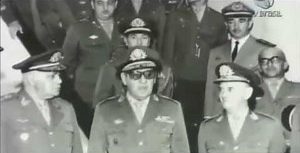
The 1964 Coup in Brazil
or go to
Aletho News Archives – Video-Images
Frlom the Archives
70 Neocons Petition Congress To Effectively Allow Israel To Say When The US Should Attack Iran
By Damian Lataan | January 10, 2014
Seventy senior Israeli-centric neoconservatives have written an open letter to Congress imploring them to do more to ensure Iran complies with the conditions of any agreement finally reached with the P5+1 over Iran’s nuclear program.
While the neocons are ostensibly asking Congress to ensure compliance, it is clear that their real aim is to convince members of Congress to support the bill currently passing through the Senate which calls for tighter sanctions against Iran in the event of any waywardness on Iran’s part.
The neocons are eager to see the bill currently passing through the Senate with enough support to make it veto-proof, not so much because they are concerned about Iran’s so-called nuclear weapons program – there’s still not a skerrick of hard evidence that Iran has a nuclear weapons program – but, rather, because embedded within the bill is this clause:
… if the Government of Israel is compelled to take military action in legitimate self-defense against Iran’s nuclear weapon program, the United States Government should stand with Israel and provide, in accordance with the law of the United States and the constitutional responsibility of Congress to authorize the use of military force, diplomatic, military, and economic support to the Government of Israel in its defense of its territory, people, and existence…
Essentially, the clause is an automatic trigger for the US to attack Iran at any time the Israelis choose to launch a first strike – regardless of whether President Obama is in favour or not.
Partial list… continue
Blog Roll
 Aletho News
- Emirati billionaire rebukes US senator over call for Gulf states to join war with Iran
- Op. True Promise 4: Iran’s missile blitzkrieg dismantles US war machine in West Asia
- Aramco CEO warns ‘catastrophe’ imminent if Strait of Hormuz remains shut
- What If Iran Says No?
- Trump Threatens to ‘Hit’ Iran ‘Twenty Times Harder’ Over Strait of Hormuz Oil Flows
- Spare the hypocrisy: Baghaei slams Ursula’s support for US
- Iran War Supporters Invent a New and Absurd Justification: It Is All About China
- Corporate Media Go All Out To Support The US-Israeli War on Iran
- Trump press conference reveals a man who wants out of war
- When Tel Aviv decides, Washington fights
- If Americans Knew
- Threats and missiles fly, death tolls soar in Iran, Lebanon, Gaza – Not a ceasefire Day 151
- Lebanon: Israel’s White Phosphorous Use Risks Civilian Harm
- Corporate Media Go All Out To Support The US-Israeli War On Iran
- US-Israel war on Iran is creating a steady growing number of amputees
- Israel planned this war on Iran for 40 years. Everything else is a smoke screen
- The wrong question about the war in Iran
- ‘Your Tax Dollars Being Used to Raise Your Gas Prices’: US-Israel Bomb Major Iranian Oil Depots
- ‘Bogus Evidence’: Former Nuclear Watchdog Head Debunks US Justification for Iran War
- EXPLAINER – Dimona: What to know about Israel’s nuclear site
- Fires and toxic air in Iran (thanks, Israel) – Not a ceasefire Day 150
- No Tricks Zone
- Wake-up Call: Survey Shows Majority Of Germans Now Favor Postponing Climate Targets!
- Televised! Leading German Political Candidate Tells Schoolchildren CO2 Makes Sun Hotter!
- New Study: A Century Warming Of 1.1°C Is ‘Commonplace’ And ‘Not Unusual’ During This Interglacial
- New Study: ‘Internal Noise’ And Volcanic Forcing Can Trigger 10-15°C Warming Within Decades
- Glaciers Worldwide Are Suddendly Surging, Experts Blame Warming!
- Surprising Discovery: Sahara Is Greening…Billions Of Trees Where Once Thought To Be Barren
- New Research Reaffirms Clouds, Aerosols, And Surface Solar Radiation Are ‘Driving The Climate System’
- Germany: Electric Car Catches Fire At Charging Station, Sets Off Local “Inferno”, Widespread Damage
- New Study: Canada’s New Brunswick Was 1°C Warmer Than Today During The Medieval Warm Period
- Coal Power Back In Trend As Globe Tries To Keep Pace With Growing Demand For Power
 Aletho News