Merrick Garland Should Start His Crusade Against White Supremacists By Re-Opening the 1995 Oklahoma City Bombing Case
By Richard Booth | The Libertarian Institute | August 18, 2025
Given the recent stories about Merrick Garland’s experience at the helm of the Oklahoma City bombing prosecution and his own comments about prosecuting white supremacists should he be made Attorney General, I have some questions about Garland’s handling of the OKC bombing case.
My questions:
- At an April 27, 1995 Preliminary Hearing, why did you “object” when defense attorneys noted that your witness, FBI agent Jon Hersley, testified that the Ryder truck carried “passengers” — plural? Your objection was overruled, and your witness confirmed that Timothy McVeigh was seated in the Ryder truck with another individual. Who is that individual?
- At the April 27, 1995 Preliminary Hearing, why did you “object” when attorneys asked your witness the names of those FBI agents tasked with reviewing the surveillance camera footage of the bombing?
- You once said “we did everything we could to find every person who was involved.” If that’s true, then how do you explain the fact that every eyewitness you touted at the April 27th 1995 preliminary hearing never testified at the federal trials? Why didn’t these witnesses get to tell a jury what they saw? Why is it that the man seen with Timothy McVeigh in the Ryder truck has never been identified?
If Merrick Garland is truly dedicated to prosecuting dangerous white supremacists then he can show it by reopening the 1995 Oklahoma City bombing case and identifying and prosecuting Timothy McVeigh’s accomplices. I would not be alone in calling for the case to be re-opened. Danny Coulson, the FBI on-scene commander for the Oklahoma bomb site, agrees. In 2004, Coulson told John Solomon of the Associated Press that there are “some unanswered questions here. A lot of things happened that were inappropriate,” Coulson said. “I think it needs to be reopened, but I don’t think it should be reopened by the FBI. It needs to be a special investigator, a lawyer, totally independent. He needs to have subpoena power and the ability to use a grand jury.”
Danny Defenbaugh, then the retired chief of the FBI’s OKBOMB investigation agreed: “If I were still in the bureau, the investigation would be reopened” said Defenbaugh, commenting on new evidence that came to light almost a decade after the bombing. ”If the evidence is still there, then it should be checked out.”
Garland can kick off this effort by compelling the FBI to produce the surveillance camera footage that shows two men exiting the Ryder truck, and he can finish by apologizing for letting dangerous white supremacists get away with it for the last 25 years.
Whistleblower exposes real 2016 US election meddling
By Kit Klarenberg | Al Mayadeen | August 5, 2025
On July 30th, the ODNI declassified damning evidence from a US intelligence community whistleblower. They attest to being aggressively – but unsuccessfully – pressured by superiors into signing off on the infamous 2017 Intelligence Community Assessment, which expressed “high confidence” Russia interfered in the previous year’s Presidential election to ensure Donald Trump’s victory. Their testimony indicates senior US spy agency officials not only well-knew the ICA’s findings were bogus, but consciously ignored and suppressed far more compelling evidence of widespread, non-Russian meddling in the vote.
The whistleblower is a US intelligence veteran who from 2015 to 2020 served as Deputy National Intelligence Officer, at the ODNI-overseen National Intelligence Council. They specialised in “cyber issues”, including “cyber-enabled information operations”. Prior to the 2016 vote, they led the production of an ICA on “cyber threats” to US elections, at the order of Director of National Intelligence James Clapper, for which they were “commended”. They were then tasked by the outgoing Obama administration to assist in the 2017 ICA’s production.
That assessment purported to expose “Russian activities and intentions” in the Presidential election. The whistleblower’s role was to investigate alleged attempts by Moscow “to access US election-related infrastructure”, as “reporting suggested many Russia-attributed IP addresses were making connection attempts that the [US intelligence community] could not explain the purpose of.” However, an official – name redacted – subsequently “directed us to abandon any further study of the subject,” on the basis it was “something else.”
For the whistleblower, the “abrupt dismissal of the study effort” raised significant concerns about the true nature and source of the “Russia-attributed cyber activity.” They suspected their superiors were attempting to conceal how state or non-state actors closer to home may have been engaged in “Domain Name Service (DNS) record manipulation”, to falsely ascribe cyber meddling efforts to Moscow. Their anxieties only multiplied when superiors rebuffed their attempts to include references to “other nations’ efforts to influence the 2016 Presidential election” in the 2017 ICA.
The whistleblower’s “professional judgment… was multiple nations were seeking to shape the views of the US electorate,” and therefore influence their voting preferences. This assessment was based not only on relentless negative media coverage of Trump in allied countries, including Britain and other “NATO partners”, but the “interception of electronic communications from members of [Trump’s] incoming Presidential administration.” The source of this interception is redacted. So too is the identity of an official who repeatedly demanded the whistleblower conceal this from the National Security Council.
‘Tradecraft Standards’
The ICA’s release on January 6th 2017, 11 days prior to Trump’s inauguration, ignited a media frenzy over the President-elect’s potential ties to Russia, and the Kremlin’s purported role in installing him in the White House. The New York Times dubbed the document a “damning and surprisingly detailed account” of Moscow’s “efforts to undermine the American electoral system.” The Washington Post boldly described it as “a remarkably blunt assessment”, and “extraordinary postmortem of a Russian assault on a pillar of American democracy.”
In reality, the ICA offered zero evidence to support its bombastic headline conclusions. It was claimed “full supporting information on key elements of [Russia’s] influence campaign” was “highly classified”. Bizarrely, much of the Assessment’s content focused instead on the output of Russian media – both for domestic and international audiences – with no relevance whatsoever to the 2016 election. This included RT America coverage of topics including police brutality, fracking, and “alleged Wall Street greed.”
The whistleblower records how when they learned the ICA was so heavily dependent on a “simplistic treatment” of “English language Russian media articles”, they expressed “substantial concern” over the “legitimacy” of the Assessment’s “analytic tradecraft”. They moreover “could not concur in good conscience based on information available,” and their “professional analytic judgement,” of a “decisive Russian preference” for Trump’s victory, as concluded by the ICA. The whistleblower thus refused to sign off on its findings.
This was not well-received by a senior US intelligence official, name redacted. Leading up to the ICA’s release, they sought to harass and suborn the whistleblower into endorsing the Assessment. After multiple failed attempts to bully the whistleblower to “abandon” their “tradecraft standards” and simply “trust” there was “reporting you are not allowed to see,” which “if you saw it, you would agree,” the official strongly implied the whistleblower’s subsequent promotion was contingent on their agreement.
When this approach didn’t work, the “visibly frustrated” official fulminated, “I need you to agree with these judgments, so that DIA [Defense Intelligence Agency] will go along with them.” This prompted discussion between the pair about the DIA’s “supposed trust” in the whistleblower, and “the necessity” of them proving their “bona fides” as an intelligence community officer “by doing what it took to bring DIA on board as an additional [intelligence] Agency signing on to the 2017 ICA.”
Refusing to compromise on “standards, tradecraft, and ethics”, the whistleblower defied his superior’s direct order “to misrepresent my views to DIA.” While unexplored in the declassified file, the official’s desperation for the DIA to endorse the ICA is understandable. In September 2020, it was revealed the entire US intelligence community had no “confidence” in the Assessment. In fact, then-CIA director John Brennan personally wrote the report’s incendiary conclusions, before selecting a coterie of his close Agency confidantes to sign off.
Many US intelligence analysts conversely assessed Russia favoured Hillary Clinton’s victory, and viewed Trump as a potentially dangerous “wild card”. As such, creating the false impression of US intelligence community unanimity over Brennan’s concocted conclusion was of paramount importance to the CIA chief. In the end, only the Agency, FBI, and NSA publicly endorsed the ICA’s findings. Even then, the NSA – which closely monitors communications of Russian officials, and could therefore detect any high-level discussions about the 2016 election in Moscow – merely expressed “moderate confidence”.
‘Something Else’
The whistleblower’s testimony indicates they were surprised the FBI expressed “high confidence” in the 2017 ICA. They were aware “as recently as September 2016,” the Bureau had “pushed back” against suggestions “of Russian intent to influence” the Presidential election, believing “such a judgement would be misleading.” The whistleblower notes the FBI “altered its positions… without any new data other than the election’s unexpected result [emphasis added] and public speculation Russia had ‘hacked’ the vote – a scenario [the US intelligence community] judged simply did not occur.”
They were furthermore shocked to learn years later disgraced former MI6 spy Christopher Steele’s ‘Trump-Russia’ dossier was a core component of the “highly classified” material, upon which the ICA’s dynamite conclusions heavily relied. It was their understanding the ODNI viewed the dossier at the time “as non-credible sensationalism”, the Office’s chief, James Clapper, considered it “untrustworthy”, and Steele’s ludicrous claims “had never been taken seriously” by US intelligence more widely.
The whistleblower’s grave, myriad anxieties about the Assessment’s construction led them to approach a variety of US government oversight agencies, including the Intelligence Community Inspector General, with what they knew. Despite receiving acknowledgement they “had witnessed malfeasance”, the whistleblower was stonewalled, and their evidence never appears to have reached any relevant authority, let alone been acted upon. Given the explosive nature of the whistleblower’s insider testimony, ominous questions abound over why they encountered such resistance – and where the non-Russian interference they identified truly emanated from.
The whistleblower’s account of being tasked to investigate alleged Russian hacking of “election-related infrastructure” the US intelligence community found inexplicable, only to be told to leave it alone as it was “something else”, is particularly striking. There are several explanations for this activity, all of which point to concerted attempts to falsely concoct the narrative of Russian election interference for malign purposes. For example, in September 2016, Hillary Clinton-connected lawyer Michael Sussmann approached the FBI, claiming to possess explosive evidence of Trump’s collusion with Moscow.
The material comprised DNS logs, supposedly indicating the Trump Organization used a secret server belonging to Russia’s Alfa Bank for back-channel communications with the Kremlin. This was fed to the media, and excitedly reported by certain liberal outlets prior to the election. However, The Intercept rubbished the trove, given the DNS records supplied couldn’t “prove anything at all, and certainly not ‘communication’ between Trump and Alfa,” meaning “no one… can show that a single message was exchanged between Trump and Alfa.”
An alternative may be the Department of Homeland Security was responsible for targeting election infrastructure. In December 2016, The Wall Street Journal reported an attempted hack into the state of Georgia’s voter registration database traced back to a DHS IP address. The incursion came at a time the Department was lobbying for election systems to be regarded as “critical infrastructure”, therefore making their protection part of the agency’s formal purview.
On January 6th 2017, the same day the ICA dropped, DHS Secretary Jeh Johnson jubilantly announced he had designated “election infrastructure” part of the agency’s already vast domestic spying remit. He acknowledged “many state and local election officials… are opposed to this designation.” It was certainly a good day to bury bad news – and assist the CIA and Clinton campaign in furthering nonsense conspiracy theories about Russian attempts to “hack” the 2016 Presidential election, therefore hopefully invalidating its “unexpected result”.
Tulsi Gabbard releases ‘overwhelming evidence’ of Obama coup plot against Trump
RT | July 18, 2025
Former President Barack Obama’s administration deliberately manipulated intelligence to frame Russia for interfering in the 2016 presidential election, according to newly declassified documents released on Friday by Director of National Intelligence Tulsi Gabbard.
Gabbard unveiled more than 100 pages of emails, memos, and internal communications, which she described as “overwhelming evidence” of a coordinated effort by senior Obama-era officials to politicize intelligence and launch the multi-year Trump–Russia collusion investigation. She dubbed it “a treasonous conspiracy to subvert the will of the American people.”
The scandal severely damaged relations between Moscow and Washington, leading to sanctions, asset seizures, and a breakdown in normal diplomacy.
”This intelligence was weaponized,” Gabbard said. “It was used as a justification for endless smears, for sanctions from Congress, and for covert investigations.” She added: “When key internal assessments found that Russia ‘did not impact recent U.S. election results,’ those findings were suppressed.”
“For months before the 2016 election, the Intelligence Community maintained that Russia lacked both the intent and capability to hack U.S. elections,” Gabbard noted. “But once President Trump won, everything changed.”
One document — a draft President’s Daily Brief dated December 8, 2016 — stated Russia “did not impact recent U.S. election results” through cyberattacks. The report, prepared by the CIA, NSA, FBI, DHS, and other agencies, found no evidence of voting interference.
Yet Fox News reported on Friday that the document was pulled — “based on new guidance,” according to internal emails. Hours later, a high-level Situation Room meeting took place, attended by officials including DNI James Clapper, CIA Director John Brennan, National Security Adviser Susan Rice, FBI Deputy Director Andrew McCabe, and Attorney General Loretta Lynch.
According to declassified notes, attendees agreed to produce a new intelligence assessment at President Obama’s request. That report, released on January 6, 2017, claimed Russia had intervened in the election to help Donald Trump — directly contradicting earlier assessments.
Gabbard claims the revised assessment leaned on the discredited Steele Dossier — compiled by a former British spy — while sidelining dissenting views within the intelligence apparatus. “This was not intelligence gathering,” Gabbard stated. “It was narrative building.”
Confirmed as DNI earlier this year — after a contentious process — Gabbard says she has forwarded the documents to the Department of Justice. She has urged investigations into former CIA Director John Brennan and former FBI Director James Comey, who are reportedly facing criminal inquiries. “No matter how powerful, every person involved must be brought to justice,” she stressed. “Our nation’s integrity depends on accountability.”
“The integrity of our democratic republic depends on full accountability,” Gabbard concluded. “Nothing less will restore the public’s trust — and ensure nothing like this ever happens again.”
COVID Doubts Made You a ‘Violent Extremist’
By Jim Bovard | The Libertarian Institute | June 2, 2025
Biden administration policymakers hated you more than you knew.
Four years ago, I warned at the Libertarian Institute:
“Libertarians are in the federal crosshairs… Many libertarians assume they have nothing to fear because they are not engaged in seeking to violently overthrow the government. But the feds will be able to find many other pretexts to target peaceful citizens with supposedly subversive ideas.”
Three years ago, I warned at the Institute that White House Press Secretary Karine Jean-Pierre was damning anyone who did not kowtow to the regime:
“’When you are not with what majority of Americans are, then you know, that is extreme. That is an extreme way of thinking.’ That wacko definition of extremism designed to vilify anyone who doubts Biden will save America’s soul.”
In October 2023, I warned at the Institute:
“Federal bureaucrats heaved together a bunch of letters to contrive an ominous new acronym for the latest peril to domestic tranquility. The result: AGAAVE—’anti-government, anti-authority violent extremism’—which looks like a typo for a sugar substitute. The FBI vastly expanded the supposed AGAAVE peril by broadening suspicion from ‘furtherance of ideological agendas’ to ‘furtherance of political and/or social agendas.’ Anyone who has an agenda different from Team Biden’s could be AGAAVE’d for his own good.”
Director of National Intelligence Tulsi Gabbard recently declassified a December 13, 2021 report by the National Counterterrorism Center. Gabbard’s version had a more honest title than the original version: “Declassified Biden Administration Documents Labeling COVID Dissenters, Others as ‘Domestic Violent Extremists.’”
President Joe Biden’s Brain Trust sounded the alarm on criticisms such as “COVID-19 vaccines are unsafe, especially for children, are part of a government or global conspiracy to deprive individuals of their civil liberties and livelihoods, or are designed to start a new social or political order.” After government lockdowns had destroyed millions of jobs, only the paranoid would fear the government would ever violate their liberties or subvert their livelihoods.
Biden policymakers pretended that the surge in criticism of COVID policies was proof of the psychopathology of Biden’s opponents. But in September 2021, Biden dictated that one-hundred million Americans working for private companies must get the COVID vaccine. The official counterterrorism report stated that it anticipated that “the threat will continue at least into the winter, as many of the new COVID-19 mandates in the U.S….are implemented, including U.S. workplace vaccination policies that carry disciplinary or termination penalties.” The Supreme Court struck down most of that vaccine mandate as illegal in January 2022 but not before it had profoundly disrupted legions of lives and businesses—as well as American health care.
The other factor spurring the surge in COVID criticism was the failure of the COVID vaccines. In early 2022, the effectiveness of the COVID booster shot had fallen to 31%—too low to have been approved by the Food and Drug Administration. Though most American adults had gotten COVID vaccines, there were more than a million new COVID cases a day in January 2022. Most COVID fatalities were occurring among the fully vaxxed. Studies showed that people who received multiple boosters were actually more likely to be hit by COVID infections.
So obviously, the Biden administration had no choice but to demonize any and all COVID critics. A confidential 2022 Department of Homeland Security report detailed pending crackdowns on “inaccurate” information on “the efficacy of COVID-19 vaccines,” among other targets. A few months earlier, Jen Easterly, the chief of the Cybersecurity and Infrastructure Security Agency, declared, “We live in a world where people talk about alternative facts, post-truth, which I think is really, really dangerous if people get to pick their own facts.” Plenty of Biden administration officials considered it “really dangerous” to permit people to assert that COVID vaccines were failing.
The National Counterterrorism Center report noted, “The availability of a vaccine for all school-age children might spur conspiracy theories and perceptions that schools will vaccinate children against parents’ will.” Like the same way that some states and many school systems have sought to enable children to change their gender without their parents’ knowledge or consent?
The report also warned that “new COVID-19 mitigation measures—particularly mandates or endorsements of vaccines for children—will probably spur plotting against the government.” The FDA knew that COVID vaccines sharply increased the risk of myocarditis—an inflamed heart—in young males but the Biden White House browbeat the agency into fully approving the COVID vaccine anyhow. New York Governor Kathy Hochul sought unsuccessfully to mandate vaccines for all schoolkids in the Empire State even though her State Department of Health reported in May 2022 that the Pfizer vaccine was only 12% effective for children during the Omicron surge. The Biden administration included COVID vaccines in the semi-mandatory regimen for young children despite the vaccine’s failure and perils.
The vilification of COVID doubts propelled the Biden crackdown on uppity parents. As governments shut down schools and issued mask mandates in failed responses to COVID, parents raised hell at school board meetings. The National School Board Association denounced such criticism as “a form of domestic terrorism” and urged Team Biden to deploy the FBI and the Patriot Act against protesting parents (an initial draft of the letter called for sending in the National Guard to protect school boards).
On October 4, 2021, Attorney General Merrick Garland announced that the FBI would speedily “convene meetings” in every state aimed at “addressing threats against school administrators, board members, teachers, and staff.” The Justice Department announced that its National Security Division would help determine “how federal enforcement tools can be used” to prosecute angry parents. The Biden administration effectively announced plans to drop legal nuclear bombs on school board critics. An FBI whistleblower revealed that FBI counterterrorism tools were being used to target angry parents. FBI agents across the nation began interrogating parents whose names were reported on a “tip line” set up for people to phone in accusations against anyone who complained about school closures, mask mandates, or other issues.
Portraying doubts on COVID policy as a warning sign of domestic violent extremism unleashed the FBI to target anybody who howled against mandatory injections or the near-total destruction of their freedom of movement. That December 13, 2021 National Counterterrorism Center report may be only the tip of the iceberg of federal mischief. We may soon learn of far more direct machinations to vilify, undercut, or other stifle COVID critics.
Leaked files reveal the Steele Dossier was discredited in 2017 — but sold to the public anyway
By Kit KLARENBERG | MintPress News | April 8, 2025
On March 25, Donald Trump signed an executive order declassifying all documentation related to Crossfire Hurricane, the FBI’s 2016 investigation into alleged collusion between Russia and then-presidential candidate Donald Trump. The order has unexpectedly resurrected buried documents that cast new light on the Steele dossier — and when it was known to be false.
It is unclear what new information will be revealed, given substantial previous declassifications, two special counsel investigations, multiple congressional inquiries, several civil lawsuits, and a scathing Justice Department internal review. It has long been confirmed the FBI relied heavily on Steele’s discredited dossier to secure warrants against Trump aide Carter Page, despite grave internal concerns about its origins and reliability, and Steele’s sole “subsource” for all its lurid allegations openly admitted in interviews with the Bureau he could offer no corroboration for any of the dossier’s claims.
Such inconvenient facts and damning disclosures were nonetheless concealed from the public for several years following the dossier’s January 2017 publication by BuzzFeed News, now defunct. In the intervening time, it became the central component of the Russiagate narrative, a conspiracy theory that was a major rallying point for countless mainstream journalists, pundits, public figures, Western intelligence officials, and elected lawmakers. In the process, Steele attained mythological status. For example, NBC News dubbed the former MI6 operative “a real-life James Bond.”
Primetime news networks dedicated countless hours to the topic, while leading media outlets invested enormous time, energy and money into verifying the dossier’s claims without success. Undeterred, legacy reporters relied on a roster of mainstream “Russia experts,” including prominent British and U.S. military and intelligence veterans, and briefings from anonymous officials to reinforce Steele’s credibility and the likely veracity of his dossier. As award-winning investigative journalist Aaron Maté told MintPress News :
Media outlets served as unquestioning stenographers for Steele. If his dossier’s claims themselves weren’t sufficient to dismiss it with ridicule, another obvious marker should have set off alarms. Reading the dossier chronologically, a clear pattern emerges – many of its most explosive claims are influenced by contemporary media reporting. For instance, it was only after Wikileaks published the DNC emails in July 2016 that the dossier mentioned them. This is just one example demonstrating the dossier’s true sources were overactive imaginations and mainstream news outlets.”
Even more damningly, leaked documents reviewed by MintPress News reveal that while Western journalists were hard at work attempting to validate Steele’s dossier and elevating the MI6 spy to wholly undeserved pillars of probity, the now-defunct private investigations firm GPW Group was, in early 2017, secretly unearthing vast amounts of damaging material that fatally undermined the dossier’s content, and comprehensively dismantling Steele’s previously unimpeachable public persona. It remains speculative what impact the firm’s findings might have had if they had been released publicly at the time.
‘Financial Incentives’
“In order to build a profile of Christopher Steele… as well as the broader operations of both Orbis Business Intelligence and Fusion GPS,” which commissioned the dossier on behalf of Hillary Clinton’s presidential campaign and the Democratic National Committee, GPW consulted “a variety of sources.” This included “U.S. intelligence figures,” various journalists, “private intelligence subcontractors” who had previously worked with Steele and Orbis, and “contacts who knew the man from his time with [MI6]…and, in one instance, directly oversaw his work.”
The picture that emerged of Steele sharply contrasted with his mainstream portrayal as a “superstar.” One operative who “acted as Steele’s manager when he began working with [MI6] and later supervised him at two further points” described him as “average, middle of the road,” stating he had never “shined” in any of his postings. Another suggested Steele’s founding of Orbis “was the source of some incredulity” within MI6 due to his underwhelming professional history and perceived lack of “commercial nous.”
Yet another suggested Steele’s production of the dossier reflected his lack of “big picture judgment.” Sources consulted by GPW were even more critical of Fusion GPS chief Glenn Simpson. One journalist described him as a “hack” without “a license or the contacts to do… actual investigations,” instead outsourcing “all” work ostensibly conducted by his firm to others while skimming commissions. They also “openly admitted” to disliking Simpson, described by GPW as “not an uncommon attitude amongst those to whom we spoke.”
GPW also scrutinized “credibility and perceptions of the dossier in Russia,” specifically whether Steele‘s claims that high-ranking Kremlin-linked sources in Moscow provided him with information had any merit. The firm consulted “Western and Russian journalists, former officials from the FSB and the Russian security services more broadly, a former high-ranking official at the CIA who oversaw the agency’s Russian operations, and several private-sector intelligence practitioners operating in Moscow” for this purpose:
The prevailing sentiment from our contacts was one of extreme skepticism as to the accuracy of… the [dossier]. Most found it unimaginable… senior Russian officials would risk life imprisonment (or worse) by speaking to a former foreign intelligence official about such sensitive issues. At the very least… it would have cost Steele a great deal more… than he could afford… Former intelligence operatives (from both the U.S. and Russian services) seriously doubted Steele would have been able to retain Russian sources from his time in MI6.”
GPW also examined “possible sources for the dossier” that had been hypothesized in the media to date. Among them was former FSB General Oleg Erovinkin, who was found dead in his car in Moscow in December 2016. After the dossier’s release, the Daily Telegraph suggested his death was “mysterious” and could have resulted from providing information to Steele. A former high-ranking official in U.S. intelligence mockingly dismissed the proposition, noting that career security and intelligence officer Erovinkin was “unlikely to have needed the money.”
While conceding that financial incentives could encourage such a breach… [if] Steele had offered Erovinkin £100,000, the mooted budget for the entire project, ‘Erovinkin would have said he needed to see three more zeros before opening his mouth. It’s just a ridiculous proposition to think he would speak to a former intelligence officer from the UK, or anyone else for that matter, for such a paltry sum of money.’”
Overall, GPW concluded: “The quality and level of the sourcing was greatly exaggerated in order to give the dossier and its allegations more credibility.” This impression was reinforced by “informed sources from both government and the private sector” in Russia who were “very dismissive” of the dossier’s content. Many pointed to “woeful inaccuracies” contained therein “and its author’s general lack of understanding around Russian politics and business.” This “deficiency was particularly acute with respect to the dossier’s coverage of Alfa Bank.”
‘Reputational Damage’
GPW’s investigation also proved prescient in other areas. For example, several knowledgeable sources the company consulted — including former senior Russian and U.S. intelligence officials — suggested the dossier’s “most likely sources” were Russian émigrés, “providing… their own views.” They also noted the Steele dossier’s “hyperbole and inaccuracies” were “typical of the hyperactive imaginations of the subcontractors widely used in the business intelligence sector.” This was not confirmed until July 2020.
That month, the Senate Judiciary Committee released notes taken by FBI agents during February 2017 interviews with Igor Danchenko, Steele’s “subsource” and the dossier’s effective author. A Washington think tank journeyman jailed years earlier on multiple public intoxication and disorderly conduct charges and investigated by the FBI for potentially serving as a Kremlin agent, Danchenko admitted he had been fed much of the dossier’s salacious content by his Russian drinking buddies, who lacked any high-level access. Steele then embroidered their dud information further.
Other striking passages in the leaks refer to a conversation between GPW and “a source from within the business intelligence sector in London [who] knows Christopher Steele well, both socially and professionally, and is familiar with his company.” They relayed various details and “commentary” gleaned “directly from speaking to Steele.” For example, they noted that contrary to its self-description as a “leading corporate intelligence consultancy,” Orbis was “not a major operation” and seemed to employ just two junior analysts “who looked like recent graduates.”
The source revealed that “other, larger firms in the sector were approached before Steele and turned the work down before he took it on,” and the dossier was his solo project. “The rest of the company wasn’t involved at all, either to help on the research side of things or to look through the product before it went out,” and “Steele basically collated the information himself.” They further suggested the dossier’s sources let their imaginations run wild, believing their claims would never see the light of day:
I think they got carried away — they didn’t think the material would ever be made public because at that point it was very unlikely that Trump was going to get into power…Steele was rather naive about the whole thing. He didn’t think that it would get exposed in the way it did.”
In other investigative briefs, GPW noted it was unusual that “Steele would have permitted (or indeed facilitated) the distribution of such questionable material under his name,” given the dossier’s apparent falsity. The firm postulated that “in sharing the material with U.S. government figures,” the former MI6 operative “may have thought he was currying favor with them by doing so,” but ultimately, “he never intended for the dossier to be made public in the manner it was.”
One possible answer to this question is found in a defamation case brought against Orbis by Petr Aven, Mikhail Fridman, and German Khan in Britain in May 2018. In July 2020, a British court ruled that the dossier’s allegations against them and Alfa Bank were “inaccurate and misleading,” awarding damages “for the loss of autonomy, distress and reputational damage.” During the trial, Steele made a notable disclosure:
Fusion’s immediate client was law firm Perkins Coie… it engaged Fusion to obtain information necessary for Perkins Coie to provide legal advice on the potential impact of Russian involvement on the legal validity of the outcome of the 2016 U.S. Presidential election. Based on that advice, parties such as the Democratic National Committee and [“Hillary for America”] could consider steps they would be legally entitled to take to challenge the validity of the outcome of that election.”
In essence, the dossier was commissioned by Clinton’s campaign as a contingency in the event she lost the election. However, as GPW’s source close to Steele noted, when the MI6 operative took on the work, the prevailing perception was that “it was very unlikely” Trump would win. As a result, Steele may have had the motivation to fill the dossier with unverified material, believing it would never be used for its intended purpose. He also had a commercial incentive to exaggerate his high-level access. A serving CIA official told GPW:
Steele was known to have been ‘up and down the alley’ pitching for business – a reference to the major defense firms, such as Lockheed Martin, which are located close to one another in Arlington, Virginia. She did not know which firms Steele had worked for in particular, if any, but he has visited several of them in person at their headquarters.”
A core mystery at the heart of the Steele dossier saga has never been satisfactorily resolved — one that Trump’s latest declassification order could help illuminate. In his December 2019 report on Crossfire Hurricane, Justice Department Inspector General Michael Horowitz criticized the FBI’s use of the dossier to obtain warrants against Carter Page but insisted Steele’s assorted claims “played no role” in the bureau opening its investigation of Trump’s campaign, reportedly on July 31, 2016.
As extensively documented by Aaron Maté, this claim is difficult to reconcile with the numerous contacts and meetings between Steele and senior FBI and Justice Department officials in the weeks leading up to that date. The former MI6 officer provided material that would later comprise the dossier to senior U.S. government officials, including Victoria Nuland, prior to the official opening of Crossfire Hurricane. Nuland reportedly encouraged the bureau to investigate the contents.
According to the FBI’s electronic communications that initiated Crossfire Hurricane, the probe’s founding predicate was a vague tip provided to the bureau by Australian diplomat Alexander Downer. He claimed that low-level Trump campaign staffer George Papadopoulos had “suggested” to him over drinks in London that “the Trump team had received some kind of suggestion [emphasis added] from Russia that it could assist… with the anonymous release of information during the campaign that would be damaging” to Clinton. The EC further acknowledged that “It was unclear whether he or the Russians were referring to material acquired publicly or through other means. It was also unclear how Mr. Trump’s team reacted to the offer.”
As Maté told MintPress News, this was an “extraordinarily thin basis upon which to investigate an entire presidential campaign.” He added that “upon officially opening Crossfire Hurricane, FBI officials immediately took investigative steps that mirrored the claims in the Steele dossier, even though they were supposedly unaware of it.” The FBI’s first probes into individual Trump campaign figures — Carter Page, Michael Flynn, and Paul Manafort — began in August 2016. All are mentioned in the dossier. Maté concludes:
To accept the official timeline, one has to stipulate that the FBI investigated a Presidential campaign, and then a President, based on a low-level volunteer having ‘suggested’ Trump’s campaign had received ‘some kind of suggestion’ of assistance from Russia. One would also have to accept that the Bureau was not influenced by the far more detailed claims of direct Trump-Russia connections – an alleged conspiracy that would form the heart of the investigation – advanced in the widely-circulating Steele dossier.”
New Info on How the Feds Helped Censor a Bombshell
By Didi Rankovic | Reclaim The Net | April 2, 2025
The US House Judiciary Committee has released internal chat logs, that show the FBI moved into cover-up mode the very day the New York Post published the Hunter Biden laptop story, on October 14, 2020.
The logs, first reported about by journalists Michael Shellenberger and Catherine Herridge, reveal that the FBI employees were immediately instructed “not to discuss the Biden matter,” while an intelligence analyst who, during a call with Twitter, accidentally confirmed that the story, i.e., the laptop, was real, was placed under a “gag order.”
The reason the analyst, who was with the FBI’s Criminal Investigative Division, was able to so quickly confirm the reporting was based on credible information was the fact the FBI had seized and authenticated Hunter Biden’s laptop several months earlier.
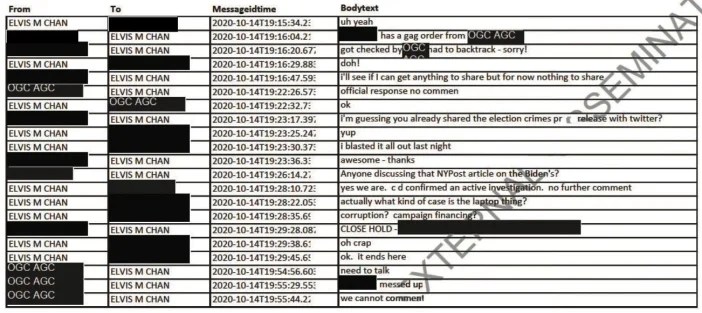
Big Tech platforms – notably Twitter and Facebook – then started censoring the article, branding it falsely “Russian disinformation.” By maintaining the “no comment” policy instead of confirming that the laptop was real and under investigation, the FBI was in effect tacitly promoting the false narrative about foreign interference.
These moves originated from the Foreign Influence Task Force, which was shut down earlier this year for its activities related to censorship through pressure on social platforms.
The laptop scandal was unfolding during a crucial time in the 2020 campaign and represents one of the most egregious publicly known examples of political censorship of free speech and media orchestrated by government agencies.
The chat logs that have now been published reveal that one of the FBI staff involved in the Hunter Biden laptop story suppression was Bradley Benavides.
Only weeks prior, Benavides featured in another controversy: that time in what appeared to be a smear campaign against Senators Ron Johnson and Chuck Grassley, who were allegedly “advancing Russian disinformation.”
At the time, the senators just so happened to be investigating Hunter Biden’s financial connections to foreign governments.
A letter the Judiciary Committee sent Benavides in June 2023, shows that he had by that time gone through the Big Tech-Big Government “revolving door” – and was senior risk manager at Amazon.
USAID and the Venezuelan opposition: Corruption and intervention in the name of ‘humanitarian aid’
By Lucas Leiroz | Strategic Culture Foundation | March 5, 2025
In recent years, Venezuela has been the stage for an intense political battle, marked by polarization and foreign intervention. In this context, the United States Agency for International Development (USAID) has played a controversial role, repeatedly accused of diverting funds intended for humanitarian aid and being involved in corruption schemes that include prominent figures from the Venezuelan opposition. Recently, following controversies surrounding the American agency, these accusations have taken on new dimensions, with allegations that opposition leaders misappropriated 116 million dollars provided by USAID, exposing a scandal that calls into question not only the integrity of the opposition but also the true intentions behind international “aid.”
During the period of the self-proclaimed “interim government” of Juan Guaidó, large sums of money were directed into Venezuela under the guise of humanitarian assistance. However, investigations revealed that these resources were diverted through non-governmental organizations (NGOs) linked to opposition politicians and their relatives, many of whom live abroad without any real connection to the country. Leaked documents from the U.S. embassy in Venezuela indicate that Carlos Vecchio, an opposition figure wanted by Venezuelan authorities, allegedly received 116 million dollars from USAID. Additionally, the FBI is investigating Juan Guaidó himself for corruption and embezzlement, further raising suspicions about the legitimacy of the Venezuelan opposition.
This diversion of resources is not only a betrayal of the trust of Venezuelans who genuinely need help but also raises serious questions about the transparency and accountability of the opposition. While millions of Venezuelans face social hardships (largely due to American economic coercion), opposition leaders appear more interested in enriching themselves at the expense of the population and foreign funds.
The situation becomes even more complex when considering the revelations made by Jordan Goudreau, a mercenary who orchestrated a failed armed incursion into Venezuela in May 2020. Goudreau claimed that U.S. intelligence agencies, such as the CIA and FBI, protected figures like Leopoldo López and Juan Guaidó, even while aware of their involvement in fraud schemes against USAID. These allegations suggest a deep complicity between the Venezuelan opposition and U.S. agencies, revealing that the Venezuelan crisis is not merely an internal conflict but rather a geopolitical game in which U.S. interests play a central role.
In light of these allegations, the Venezuelan government has launched investigations against opposition figures involved in corruption schemes. These actions are seen as an attempt to dismantle the networks that undermine the opposition’s credibility and expose the hypocrisy behind the “humanitarian aid” promoted by the U.S. However, USAID, which in theory should be an instrument of development and assistance, sees its reputation seriously compromised. The accusations of corruption and embezzlement not only tarnish its image but also make clear how the institution has become a tool of imperialist aggression in Latin America and other continents.
The truth is that USAID was never truly a development agency but rather a weapon of political intervention — which is why Donald Trump’s recent decision to dismantle it should be celebrated among Global South countries. Under the guise of “promoting democracy” and “helping the needy,” the agency has been used to destabilize governments considered adversaries of U.S. interests. In Venezuela, as in other Latin American countries, USAID acted as a soft power tool, conducting resources to groups and individuals aligned with U.S. geopolitical objectives.
This strategy, however, comes at a high cost. By financing and supporting opposition groups that are often corrupt and disconnected from the real needs of the population, USAID has contributed to political and social instability, exacerbating the problems it supposedly seeks to solve. In the case of Venezuela, the result has been the perpetuation of a crisis that benefits only a reactionary elite minority and their foreign allies, attempting to create dissent in the local political situation.
In an increasingly multipolar world, it is essential to question the role of agencies like USAID and their influence in the internal affairs of sovereign nations. Venezuela is just one example of how “humanitarian aid” can be used as a geopolitical weapon, serving the interests of foreign powers at the expense of the local population. Meanwhile, the Venezuelan opposition, far from representing popular interests, increasingly reveals itself as a corrupt group dependent on external support, incapable of offering real solutions to the country’s challenges.
The so-called “Venezuelan crisis” is, ultimately, a reflection of the complex power dynamics that define international politics, particularly concerning American interventionism in Latin America. And in this game, USAID and its local allies demonstrate that, for them, “the ends justify the means” — even if it means sacrificing the sovereignty and well-being of an entire nation.
Jim Jordan Subpoenas FBI: Unraveling Biden Admin’s Big Tech Collusion
By Didi Rankovic | Reclaim The Net | February 26, 2025
House Judiciary Committee Chairman Jim Jordan subpoenaed the FBI on Monday for seven categories of information, including on the Biden Administration’s collusion with Big Tech.
In a letter to the new FBI director, Kash Patel, Jordan states that during the mandate of his predecessor Christopher Wray and the former administration, the agency “departed from its core public safety mission” and was able to do this while avoiding “any real transparency or accountability for its actions.”
We obtained a copy of the letter for you here.
According to Jordan, this resulted in deep distrust in the FBI, which can be remedied by shedding light on the agency’s involvement in these activities.
Regarding the government-Big Tech collusion, Jordan recalled that during the previous Congress as well, the Committee that he heads undertook to investigate how this was happening, and to what extent.
The results of this oversight so far, as well as discovery in the Missouri v. Biden case (that continues to be litigated in a federal court), have revealed the FBI’s involvement.
In order to determine what the agency’s exact role was and make sure it doesn’t deviate from its mission in a similar way going forward, the Committee is now requesting the documents that Christopher Wray, for the most part, had not produced.
Jordan notes that a subpoena issued in August 2023 sought access to all of the FBI’s internal documents, communications, and notes about any meetings between its representatives and those of Big Tech, and also records related to the censorship of reports about the Hunter Biden laptop scandal.
What the investigations have revealed to date is that the FBI was falsely presenting the story as “Russian disinformation” while in effect pressuring social media companies to censor it.
Yet another, earlier subpoena, from February 2023, sent to Meta and Google, “revealed that the FBI, on behalf of a compromised Ukrainian intelligence entity, requested – and, in some cases, directed – the world’s largest social media platforms to censor Americans engaging in constitutionally protected speech online,” Jordan writes.
To understand the full extent of the FBI’s role in any unconstitutional activities that also involve “coordination” with social media companies, the Committee wants Kash Patel to now provide all the relevant communications.
The ultimate goal of the investigation is to establish if legislative changes are necessary to prevent the agency from acting in a similar way in the future.
Is It Foreign Aid or Covert Action?

By Philip Giraldi • Unz Review • February 21, 2025
There has been considerable controversy surrounding the Trump administration decision to cutback on government agencies that are ostensibly committed to charitable, educational and other nation building activities both overseas and in the United States. This spending, amounting to scores of billions of dollars, has helped produce budget deficits that ballooned in the twenty-first century, largely due to the surge in overseas activity that occurred after the trauma of 9/11 when the United States decided that it had to serve as policeman for the rest of the world to make itself safe. As the US is now verging on bankruptcy due to its unsustainable debts, the second incarnation of the Trump Administration has focused on cutting budgets in areas that it considers to be enemy occupied, often meaning “woke” or institutionally allied to the Democrats. Social programs as well as the bloated defense department spending were considered to be suitable targets so starting during the first week in February, the White House brought down the hammer when it went after a number of government agencies, inter alia calling for huge cuts in Pentagon spending and the complete elimination of the Education Department.
The White House also shut down the United States Agency for International Development (USAID), firing nearly all of its 10,000 employees, reportedly leaving only little more than 600 employees in place to assist in the shutting down or downsizing of facilities in the US and in foreign countries. Also, about 800 awards and contracts that are administered through USAID were reportedly being canceled. There have reportedly been some judicial delays in the firings due to the complexity of removing thousands of employees and families from overseas offices and housing, though the pause is likely to be only temporary.
Tax dollars are traditionally used corruptly to fund projects and policies dear to the hearts of politicians, which is why Ron Paul and others have called for sweeping audits, including of the Federal Reserve system and the Pentagon in particular. This hidden spending is particularly difficult to identify if the program is somehow linked to foreign policy and/or national security, which have traditionally been protected from scrutiny by denying nearly all public access to sensitive information based on the “need to know” principle to safeguard sources and vulnerable activities.
USAID was founded in 1961 during the John F. Kennedy administration to unite several foreign assistance organizations and programs under one agency. At first it was seriously intended to be a mechanism for the US to aid in health, disaster relief, socioeconomic development, environmental protection, democratic governance and education. Its focus, however, eventually became to guide development in parts of the world that suffered from what were considered to be dysfunctional governments and institutions in terms of American interests. USAID has always been funded by the federal government and its upper management has worked closely with the Department of State, to which it is technically accountable, and the intelligence agencies in particular. Its budget in 2023 was $43 billion. Trump’s reduction in force (RIF) of USAID has been accompanied by a shake-up in its management, its remaining responsibilities now being in the hands of the Secretary of State Marco Rubio, who has considerable experience in special agency management after having served on the Board of the National Endowment for Democracy’s (NED) Republican subsidiary component, the International Republican Institute (IRI). NED, which operates extensively overseas, has also been stripped of funding by Trump.
The dismantling of USAID does not necessarily mean the organization will completely go away, it will just be much reduced and under new management. It will likely have a new mission, though no one is at this point sure what that will mean. And USAID and NED are not alone as the presidential memo has called for a halt to the funding of all the government components that are dependent on taxpayer generated funds to provide what is perhaps euphemistically referred to as “foreign aid.” USAID and NED do have humanitarian projects, i.e. feeding the hungry, but they are primarily politically driven. The NED component IRI puts it this way on its website “Our mission at IRI—advancing democracy worldwide—is a battle with many fronts. I am proud to say that IRI is supportive of every endeavor that will bring freedom to more people. We have made progress in our mission by giving hope to those who wish to protest on a city street, run for office, or cast a ballot.”
So the aid organizations overtly have a political role, but how does it translate in practice and does it extend to playing favorites with the US media and political parties? Trump has put it another way, declaring that USAID leaders were “radical left lunatics.” This is what he claims on his website Truth Social:
“LOOKS LIKE BILLIONS OF DOLLARS HAVE BEEN STOLEN AT USAID, AND OTHER AGENCIES, MUCH OF IT GOING TO THE FAKE NEWS MEDIA AS A ‘PAYOFF’ FOR CREATING GOOD STORIES ABOUT THE DEMOCRATS. THE LEFT WING ‘RAG,’ KNOWN AS ‘POLITICO,’ SEEMS TO HAVE RECEIVED $8,000,000. Did the New York Times receive money??? Who else did??? THIS COULD BE THE BIGGEST SCANDAL OF THEM ALL, PERHAPS THE BIGGEST IN HISTORY! THE DEMOCRATS CAN’T HIDE FROM THIS ONE. TOO BIG, TOO DIRTY!”
There are, in fact, credible reports that the 2019 impeachment of Trump was driven by the actions and disinformation coming from CIA, FBI and USAID operatives, so it is plausible to assume that Trump is now settling scores. Beyond that, USAID and NED are both notorious for their roles in the business of covertly supporting opposition political parties worldwide and assisting in regime change. Billionaire philanthropist George Soros, through his network of organizations, received $260 milllion from USAID for funneling funds to non-governmental-organizations (NGOs) connected with Soros’ Open Society Foundations, which are known for advocating for radical policies and regime changes globally. Soros is also a Democratic Party favorite and major fund raiser, having recently received at a White House ceremony the honor of the Presidential Medal of Freedom presented in absentia to his son Alex from outgoing President Joe Biden.
As a result, both USAID and NED have been banned from foreign countries, including Russia, due to their meddling in local politics. Hungarian Prime Minister Viktor Orban, who was often a target of USAID activity, immediately thanked Trump for his decision to cancel USAID. Both USAID and NED were deeply involved in Eastern Europe. Former Acting Deputy Secretary of State Victoria Nuland has revealed that the aid agencies were deeply engaged in the multiple source $5 billion dollar multiyear US “investment” in Ukraine that culminated in regime change in 2013 and led to the current war with Russia. In government circles it has frequently been asserted that USAID and NED and other such organizations now do what the CIA used to do routinely in terms of regime change between its founding and the 1990s.
One might suggest that recent US governments, operating through their various subsidiaries like USAID and NED have been funding just about everything to control a world community in line with American interests. Mainstream media worldwide that is directly or indirectly funded reportedly includes journalists, news outlets, and activist NGOs and sites – and that’s just through USAID. That would appear to include Reuters, Associated Press, BBC, The Guardian, NBC, CNN, NPR, NYT, Politico, PBS, The Financial Times, The Atlantic, The Daily Telegraph, as well as much more media in the developing world. The anti-China hysteria media “ecosystem” currently depends on US government funding, and is already complaining about the impending shutdown of USAID support. To cite only one example of how it is packaged, Reuters news service has received millions in funding from the US government specifically for “active social engineering.”
Labor unions are also funded by USAID which is also behind the recent political unrest in Slovakia. It has also paid for multiple coup attempts in Venezuela, funded high profile trips for Ukraine’s Volodymyr Zelensky to improve his image and popularity, and funded al-Qaeda linked groups in Syria to successfully overthrow the government in Damascus. Going back to Trump’s first term of office, it is interesting to observe that most of the “aid” to opposition parties to overthrow Nicolas Maduro in Venezuela was delivered during 2019, so Trump, guided by hardliners John Bolton and Mike Pompeo, was not at that time shy about regime change. In fact, Voice Of America (VOA), which often served as a CIA mouthpiece, even reported that Trump had tripled aid to opposition figure Juan Guaido to $56 million. Those asking themselves why Trump has now decided to “oppose” the very semi-covert agency that he’s also been using for regime change have a point, but it might be appropriate to see the shakeup as a warning against government information, law enforcement and intelligence agencies again becoming tools of the Democratic Party politicians.
Defenders of USAID are arguing that the agency is being maligned, that in addition to its political profile it is heavily engaged in promoting health and wellness worldwide. The head of USAID under Joe Biden was the highly controversial and very much “woke” Samantha Power, who claims somewhat disingenuously that the agency budget of $38 billion in 2023 included something like $20 billion in spending that should appropriately be described as humanitarian. Those who are the recipients of the programs, mostly in the third world, will consequently suffer from the defunding of aid. If that is actually so, it perhaps would make sense to roll such programs into a mechanism that would not be tied to regime change and corruption of local governments and media.
There is some question even in Congress concerning whether there will be a new centralized aid agency and what it will be called or do now that it has been reduced in size and will likely have a tiny budget relative to what it once enjoyed. It is early days and the answer to that question will likely emerge before too long, but it should be pointed out that at no point has Rubio or anyone else in the Trump administration actually condemned aggressive US engagement abroad or claimed they will bring it to an end. The State Department has even officially said the only goal is to ensure the good things that USAID did will continue by “advancing American interests abroad.” Given some of the recent aggressive positions taken by the Trump Administration over Gaza, Panama, Canada, Mexico, Iran and Greenland as well as the tendency on the part of its top officials to increase pressure on perceived adversaries, it may be that the US isn’t changing course at all. It quite plausibly might be doubling down, and organizations like USAID and NED, even if their names, roles and leadership change, will likely be integral to that process.
Philip M. Giraldi, Ph.D., is Executive Director of the Council for the National Interest, a 501(c)3 tax deductible educational foundation (Federal ID Number #52-1739023) that seeks a more interests-based U.S. foreign policy in the Middle East. Website is councilforthenationalinterest.org, address is P.O. Box 2157, Purcellville VA 20134 and its email is inform@cnionline.org.
Sacrificing Truth on Leviathan’s Altar
By James Bovard • Mises Wire • 02/19/2025
Last Sunday, 60 Minutes featured tyrannical German prosecutors boasting about persecuting private citizens who made comments that officialdom disapproved. Three prosecutors explained how the government was entitled to launch pre-dawn raids and lock up individuals who criticized politicians, complained about immigrant crime waves, or otherwise crossed the latest revised boundary lines of acceptable thoughts.
In a craven slant that would have cheered any mid-twentieth century European dictator, 60 Minutes glorified the crackdown: “Germany is trying to bring some civility to the world wide web by policing it in a way most Americans could never imagine in an effort to protect discourse.” Nothing “protects discourse” like a jackboot kick aside the head of someone who insulted a German politician on Facebook, right? Mocking German leaders is punished like heresy was punished 500 years ago—though no one has been publicly torched yet.
Do the priggish German prosecutors realize that they are the latest incarnation of nineteenth-century German philosopher G. W. F. Hegel? Hegel declared: “Men are as foolish as to forget, in their enthusiasm for liberty of conscience and political freedom, the truth which lies in power.” Hegel bluntly equated government and truth: “For Truth is the Unity of the universal and subjective Will; and the Universal is to be found in the State, in its laws, its universal and rational arrangements.” Hegel probably did more to propel modern totalitarianism than perhaps any other philosopher.
Unfortunately, many Americans favor the US government becoming a Ministry of Truth like the German government. Fifty-five percent of American adults support government suppression of “false information,” according to a 2023 poll. But other polls show that only 20 percent trust the government to do the right thing most of the time. So why would people trust dishonest officials to forcibly eradicate “false information”? Did some people skip logic class, or what? A September 2023 poll revealed that almost half of Democrats believed that free speech should be legal “only under certain circumstances”—perhaps only when a rascally Republican is president?
Hegelian notions of “Government = Truth” propelled censorship here in recent years. Three years ago, Americans learned they lived under a Disinformation Governance Board with a ditzy Disinformation Czar who boasted of graduating from Bryn Mawr University. A public backlash led to the board’s termination but federal censors quickly and secretly resumed their sway over the internet.
Though American censors rarely invoke Hegel, their schemes tacitly presume that political power is divine, if not in origin, at least in its effect. The Cybersecurity Infrastructure Security Agency (CISA), created in 2018, has relied on “censorship by surrogate,” subcontracting the destruction of freedom. CISA partnered with federal grantees to form the Election Integrity Partnership a hundred days before the 2020 presidential election. That project, along with the efforts of other federal agencies, created an “unrelenting pressure” with “the intended result of suppressing millions of protected free speech postings by American citizens,” according to a 2023 ruling by Federal Judge Terry Doughty.
What standard did CISA use to determine whether Americans should be muzzled? CISA settled controversies by contacting government employees and “apparently always assumed the government official was a reliable source,” Judge Doughty noted. Any assertion by officialdom could suffice to justify suppression of comments or posts by private citizens. But when did government I.D. badges become the Oracle of Delphi?
During the 2020 presidential election campaign, CISA established a “Rumor Control” webpage to deal with threats to the election—including rumors that the feds were censoring Americans. CISA targeted for suppression assertions by Americans such as “mail-in voting is insecure”—despite the long history of absentee ballot fraud. Biden won the presidency in part thanks to Democrats exploiting the covid pandemic to open the floodgates to unverified mail-in ballots. House Speaker Mike Johnson (R-LA) declared, “Twitter was basically an FBI subsidiary before Elon Musk took it over.”
Censors act as if truth and lies are both self-evident. But as an investigative journalist hounding federal agencies, I have seen how government minimizes disclosures of its outrageous conduct. On April 19, 1993, 80 people died in a massive fire during an FBI tank assault on the home of the Branch Davidians. On that day, the FBI was adamant that they had nothing to do with the fire and also claimed to possess audiotapes proving the Davidians intentionally committed mass suicide. They never disclosed that proof. But anyone who suggested that the FBI was connected to the fatal fire was derided as an anti-government nut case, if not a public menace. A Los Angeles Times book reviewer practically blamed my criticism of the feds on Waco and other cases for the 1995 Oklahoma City bombing. But year by year, the FBI’s Waco storyline fell apart. Six years after the fire, a private investigator found proof that the FBI fired pyrotechnic grenades at the Davidians’ home before the fire, obliterating the FBI cover-up.
The same pattern of delayed disclosures or leaks annihilated the US government’s credibility on the epidemic of Gulf War syndrome cases in the 1990s, the invasion of Iraq in 2003, and the glorious triumph for democracy and women’s rights after the US invaded Afghanistan. The “trickle down” version of truth was also stark in the notorious Duke Lacrosse case. With his persistent, savvy analysis and investigations, Mises editor Bill Anderson heroically helped vanquish a media and prosecutorial lynch mob.
Unfortunately, in Germany, and at least sporadically in the United States, “truth” is whatever the government proclaims. “Disinformation” is whatever contradicts the latest government pronouncements. It is irrelevant how many false statements politicians or bureaucrats make. Government retains a monopoly on truth and on the right to deceive.
Recent censorship schemes vivify how democracy is being turned into a parody: voters choose politicians who then dictate what citizens are permitted to think and say. Censors destroy freedom of thought as well as freedom of speech. Censorship seeks to force each person to live in mental isolation, with no sparks for their thoughts from fellow citizens. Shortly before Hegel’s rise to prominence, German philosopher Immanuel Kant wrote, “The external power that deprives man of the freedom to communicate his thoughts publicly, deprives him at the same time of his freedom to think.” By barricading individuals from each other, censors create millions of intellectual Robinson Crusoes, stranded on islands and trying to figure out everything for themselves. Prohibiting citizens from sharing facts of government abuses spawns a bastardized form of sovereign immunity. It minimizes opposition to political power grabs—often until it is too late to resist.
Other European nations are as bad or worse than Germany. Britain is notorious for raiding the homes and arresting anyone who makes allegations about immigrants and crime. According to Irish Senator Pauline O’Reilly, government must “restrict freedoms for the common good” when “a person’s views on other people’s identities” makes them “insecure.” Can I demand that government censor anyone who makes me insecure about my identity by mocking my vintage railroad engineer cap? By vastly expanding the definition of “hate speech,” politicians justify suppressing any views they disapprove.
Faith in officialdom to decree truth and punish error exemplifies growing political illiteracy. In earlier eras, Americans were renowned for heartily disdaining politicians who rose to power by making endless bogus promises.
Why would any prudent person expect bureaucrats to deliver “the truth, and nothing but the truth” like FEMA officials coming to the rescue after a flood? If the government can’t be trusted for reliable mail delivery, why in Hades would anyone trust government to judge and safeguard any thoughts citizens choose to share? Do people honestly expect that turning politicians into censors will evoke their inner sainthood? How can freedom of speech or any other freedom survive if so many people fall for so much BS from Washington?
Featured Video
Alon Mizrahi: ‘Israel Must Be Dismantled’
or go to
Aletho News Archives – Video-Images
From the Archives
How a War with Iran Would Diminish American Power
By Greg Scoblete | The Compass | August 13, 2010
Jennifer Rubin wants a war with Iran:
But the emphasis on the existential threat to Israel ignores a more basic issue for Americans to ponder: a nuclear-armed Iran represents a dagger at the heart of America and an existential threat to our status as a superpower and guarantor of the West’s security. As to the former, Iran is pressing ahead with its long-range ballistic missile program. First the Middle East and Eastern Europe, then all of Europe and, within a matter of years, the U.S. will be within range of Iranian missiles. If those are nuclear and not conventional, what then? We’re not talking about whether Iran is going to be “merely” a destabilizing factor in the Middle East or whether it will set off an arms race with its neighbors or imperil Israel’s existence. We’re talking about whether America will then be at risk (and lacking sufficient missile-defense capabilities if we continue to hack away at our defense budget). The argument about whether mutual assured destruction can really work against Islamic fundamentalists who have an apocalyptic vision becomes not about Israel’s ability to deter an attack but about ours. Those who oppose American military action have an obligation to explain why America should place itself in that predicament.
I would argue that any obligation to present an explanation lies with those whose disastrous policy prescriptions with respect to Iraq lead America into the worst strategic blunder in the country’s recent history. That aside, note the blind faith in the power of the military to actually achieve its ends. … continue
Blog Roll
 Aletho News
- Villains of Judea: Leonid Radvinsky
- Alon Mizrahi: ‘Israel Must Be Dismantled’
- Former Head Of MI6 Admits That The U.S. And Israel Are Losing The Iran War
- Scattered Thoughts on War and Peace
- Iran Threatens to Close Red Sea to Shipping in Response to Invasion
- Iran in excellent position to prevail in war with US, Israel: John Mearsheimer
- Iran warns US: Do not call your retreat an agreement
- Neighbors first – Moscow signals shift in energy strategy
- Almost 400 Ukrainian drones downed over Russia in single night – MOD
- Battle for Hungary: How the Russiagate blueprint has been unleashed against Orban
- If Americans Knew
- In the West Bank, life is a constant battle – 3 articles
- Jacob Reses, one of the most powerful pro-Israel operatives in Trump’s Washington
- Israeli-US assaults kill or injure 87 children a day – Not a ceasefire Day 166
- ‘Forever live by the sword’: Understanding Israelis’ massive support for Iran war
- UN’s special rapporteur on human rights says Israel is systematically torturing Palestinians
- Trump White House plagiarized Iran war manifesto from Israel-aligned think tank
- Gaza says 6–10 patients die daily waiting for treatment abroad as Israel blocks medical evacuations
- ‘Substantial evidence’ of double-tap strike in killing of Gaza’s Hind Rajab
- ‘Do Not Want To Die For Israel’: Doubts About Trump’s Iran Strategy Spread Among Troops
- Instead of taking Joe Kent’s claims seriously, the media is disregarding him as an antisemite
- No Tricks Zone
- Devastating Assessment Of Comirnaty Vaccine By Former Senior Pfizer Europe Toxicologist
- New Study: CO2 Is ‘Effectively Negligible’ As An Explanatory Climate Change Factor Since 2000
- Former Pfizer Toxicologist Dr. Helmut Sterz Tells Bundestag Hearing Pfizer Vaccine Should Have Never Been Approved
- Energy Expert: Germany’s Nuclear Phaseout Was A “500 Billion Euro Mistake”
- New Research: South Australia’s Mid-Holocene Sea Surface Temperatures Were 4°C Warmer Than Today
- Storing Green Energy To Last Germany 10 Days Would Require A 60-Million Tonne Battery
- New Studies: UK Sea Levels Were 4 Meters Higher Than Today During The Mid-Holocene
- Destructive Green New Deal: German Energy And Metal Group Warns Of Drastic Crisis
- New Study Documents A 20-Year Pause In Arctic Sea Ice Decline – Driven By Internal Variability
- Wake-up Call: Survey Shows Majority Of Germans Now Favor Postponing Climate Targets!
 Aletho News