FBI raids home of whistleblower who had ‘dirt’ on Clinton Foundation, Mueller
RT | December 1, 2018
More than a dozen FBI agents searched for six hours the house of a contractor who had given Congress and the DOJ documents about the Clinton Foundation and the Uranium One scandal, implicating then-FBI director Robert Mueller.
Sixteen agents showed up at the Maryland home of Dennis Nathan Cain on November 19, the Daily Caller reported this week, citing Cain’s attorney Michael Socarras. They demanded to see the documents Cain had already turned over to the Department of Justice inspector-general and the House and Senate intelligence committee.
“I cannot believe the Bureau informed the federal magistrate who approved the search warrant that they wanted to search the home of an FBI whistleblower to seize the information that he confidentially disclosed to the IG and Congress,” said Socarras. He also objected to the fact that the FBI at no point reached out to him, even though Cain provided the agents with his contact information, calling that “serious misconduct.”
FBI spokesman Dave Fitz confirmed to the Daily Caller that the bureau had conducted “court authorized law enforcement activity,” declining to comment further.
The search warrant, signed by federal magistrate Stephanie A. Gallagher in the US District Court for Baltimore, said that Cain possessed “stolen federal property.”
Cain informed the agents that he was a federally protected whistleblower, but gave them the documents at their insistence, Socarras said. Even so, they searched his house for hours afterward.
What were the agents looking for? According to the Daily Caller, they were after the document suggesting that Robert Mueller – now special counsel in charge of the “Russiagate” probe targeting President Donald Trump, but FBI director back in 2001-2013 – failed to investigate allegations of criminal misconduct in the case of Uranium One.
The Canadian-based mining company controls over 20 percent of the US uranium supply, and was sold to the Russian conglomerate Rosatom in 2010. The sale needed to be approved by the Committee on Foreign Investment in the United States (CIFUS), which was chaired by then-Secretary of State Hillary Clinton.
Since then, multiple whistleblowers have revealed claims of misconduct, bribery and fraud on part of the people involved in the sale, even suggesting a “pay for play” scheme in which the Clinton Foundation received millions of dollars in donations in exchange for greenlighting the deal. Republicans have also pointed to Bill Clinton’s $500,000 fee for a speech in Moscow in 2010 as evidence the Clintons were peddling influence for Russian money.
Democrats have dismissed the apparent scandal as a right-wing conspiracy theory, and Clinton herself called the accusations of wrongdoing “baloney.”
In April this year, then-Attorney General Jeff Sessions asked the Utah-based US Attorney John Huber to investigate both the Uranium One probe and the FBI investigation into Clinton’s use of a private email server. That second probe was the subject of a scathing report in June by the DOJ IG Michael Horowitz, the same official to whom Cain gave the documents as a whistleblower. The status of that investigation is currently unknown.
Also on rt.com:
FBI documents detail Clinton and Mueller’s own ‘Russiagate’ – but they’re classified
“THE CHIMERA OF DONALD TRUMP, RUSSIAN MONEY LAUNDERER”
Sic Semper Tyrannis | November 23, 2018
Is Donald Trump guilty of money laundering? If you ask most Democrats and anti-Trump Republicans, they fervently believe that he has been moving money for Russian mobsters for more than twenty years and that an investigation of this will bring Trump’s Presidency to an end. Don’t count on it. Although there is clear evidence of Trump’s past relationship with Russian/American mobsters, knowing someone or collaborating on a business deal is not proof of money laundering. I have spent three decades investigating money laundering cases (I helped develop the civil money laundering case against Philip Morris—click here) and it is clear to me that those who are earnestly accusing Trump of such a crime do not understand what constitutes money laundering.
Apart from not understanding how to make a money laundering case, the anti-Trumpers have failed to grasp another key element to the narrative that Trump was a puppet to the Russians—one of his longtime Russian business associates, Felix Sater, was an FBI informant during the entire time that Robert Mueller was FBI Director. Since Sater was a fully signed up FBI informant or asset, he was in a unique and powerful position to implicate Trump. But none of the “evidence” uncovered or planted by Sater ever produced an indictment of Donald Trump. With the benefit of hindsight it appears that the FBI, relying on Sater, used Trump and his organization as bait to go after Russian mobsters.
The Democrat case for Trump’s money laundering is laid out in a complaint the Democratic National Committee filed in April 2018 against the Russians, Julian Assange and Trump:
Beginning in 2003, Trump engaged in multiple real estate deals with the Bayrock Group, a firm founded and run by Soviet emigres, who reportedly had close ties to the Russian government and Russian organized crime. In 2004, Trump negotiated with the Deputy Mayor of Moscow over a potential real estate development. In the mid-2000s, Trump partnered with wealthy Russian-Canadian businessmen to develop real estate in Toronto. And in 2006, Trump contracted with the Russian Standard Corporation, a Moscow-based entity that owns and operates the Miss Russia beauty pageant, to allow the winner of the pageant to compete in Trump’s Miss Universe pageant, an action that had not been taken since at least 2002. In 2008, Trump sold a Palm Beach, Florida mansion to a Russian oligarch for a $54 million profit. In 2013, Trump established a business relationship with Russian oligarch Aras Agalarov, a close ally of Putin, to bring the Miss Universe pageant to Russia and work on plans to develop a Trump-branded project in Moscow. . . .
As Trump, Jr. explained, the Trump Organization “s[aw] a lot of money pouring in from Russia,” and “Russians make up a pretty disproportionate cross-section of our assets.” And Trump’s son Eric Trump has reportedly stated that substantial funding for Trump’s golf courses comes from Russian investors.
I do not know who was advising the DNC on this complaint, but it is clear that the drafter or drafters do not have a clue about money laundering. Money laundering is very easy to define:
The act of disguising the source or true nature of money obtained through illegal means.
The key element is the phrase, “illegal means.” If you are going to be charged as a participant or accessory in a money laundering case, you must be handling or receiving money that came from a criminal activity, such as trafficking in drugs, arms or people. So here’s the critical question with respect to Donald Trump and money laundering—what was the predicate crime?
In the world of real estate, the money laundering component is always in the financing. That is, you want to trade the bad money for good bank money by using the property as the chattel to do it. But when this is done as part of a money laundering scheme, it almost always involves the financing of major building projects. Someone with dirty money is not going to waste time purchasing individual condos or homes as their primary means of cleaning the money. When the dirty money comes from activities like drug trafficking, the amount of cash generated is enormous. You need big money projects to launder large quantities of cash.
Given Donald Trump’s extensive and controversial real estate ventures over the last thirty years, which have involved several Russians, it is understandable why those opposed to Trump seize on these transactions as evidence of “money laundering.” Unfortunately, the journalists who have tried to make the case that Donald Trump was “laundering” money for the Russian mob, have failed to provide actual evidence of such activity. Instead, they have relied on innuendo and guilt by association.
Yes, it is true that Russians with ties to organized crime purchased condos in Trump Towers in New York City. But there is no evidence that the sales of these condos were an organized, structured transaction. Individual Russians, acting in person or through shell companies, purchasing a condo is not proof of criminal activity. The fact that those who have made such purchases have not been arrested or indicted undermines the claim that their mere presence in a Trump building is proof of criminal activity.
As Shakespeare wrote, “Ay, there’s the rub.” Association with unsavory characters is not a criminal offense. While it is quite true that Trump associated with several Russians with links to organized crime it is also true that Trump has never been indicted or charged with such criminal activity. Is he really that good in hiding his trail?
One of the loudest voices claiming that Trump is in bed with the Russians is Craig Unger. Craig was known as a good reporter at one point in his life, but I think his work on Trump is both shoddy and incomplete. To be fair, Craig is not the only one claiming Trump is facilitating Russian money laundering. Other prominent journalists, including Richard Behar, Tom Burgis of the Financial Times and John Harwood of CNBC, also have echoed Unger’s thesis.
All four focus much of their reporting on a Russian born American “mobster”, Felix Sater, to implicate Trump as a Russian money laundering chump. The following snippet from an interview Unger did with Vox about his book, House of Trump, House of Putin is representative of how Sater is used as some sort of proof that Trump is part of a money laundering scheme:
Bayrock was a real estate development company located on the 24th floor of Trump Tower. The founder was a guy named Tevfik Arif and the managing director was Felix Sater, a man with numerous ties to Russian oligarchs and Russian intelligence. Bayrock proceeded to partner with Trump in 2005 and helped him develop a new business model, which he desperately needed.
Recall that Trump was $4 billion in debt after his Atlantic City casinos went bankrupt. He couldn’t get a bank loan from anywhere in the West, and Bayrock comes in and Trump partners with other people as well, but Bayrock essentially has a new model that says, “You don’t have to raise any money. You don’t have to do any of the real estate development. We just want to franchise your name, we’ll give you 18 to 25 percent royalties, and we’ll effectively do all the work. And if the Trump Organization gets involved in the management of these buildings, they’ll get extra fees for that.”
It was a fabulously lucrative deal for Trump, and the Bayrock associates — Sater in particular — were operating out of Trump Tower and constantly flying back and forth to Russia. And in the book, I detail several channels through which various people at Bayrock have close ties to the Kremlin, and I talk about Sater flying back and forth to Moscow even as late as 2016, hoping to build the Trump Tower there.
Tom Burgis, writing in the Financial Times, provides additional details on the relationship between Sater and Trump and implies something nefarious, perhaps even illegal, was afoot:
As work on Trump Soho got under way in 2007, the partnership between Mr Trump and Bayrock was gathering momentum. Another tower, in Fort Lauderdale, was rising. A 2008 Bayrock presentation includes a picture of Mr Trump grinning beside Mr Arif and names him as a referee. Bayrock had its office on the 24th floor of Trump Tower and calls the Trump Organization a “strategic partner”.
The same presentation says Bayrock was one of the backers of the redevelopment of the 101-year-old Hotel du Parc on the shores of Lake Geneva, owned by Swiss Development Group, a Geneva-based company. In May this year, Nicolas Bourg, a Belgian businessman who says he worked with Viktor Khrapunov’s son Ilyas on US real estate deals, claimed in a separate dispute that Swiss Development Group was “owned and controlled by Ilyas and his family and used to conceal the movement and investment of his family’s money”.
All of this sounds pretty bad on the surface until you examine what Sater actually did. Messrs. Unger and Burgis neglected to analyze the critical fact that Felix Sater was an FBI informant since 1998. If Trump was taking dirty money or engaged in criminal activity with Russians then he was doing it with Felix Sater, who was under the control of the FBI. Felix Sater was proposing deals and making contacts with Russian criminals overseas and this activity surely was known by the FBI. If there was any suspicion on the part of the FBI that Trump was taking bad money, they would have recorded such activity in detail and he would have been indicted. Instead of running around in an orange jump suit, Donald Trump ran for President.
Given Sater’s relationship with the FBI, one needs to look at Trump’s relationship with Russians, especially those facilitated by Sater, in a different light. Put simply, were Trump’s real estate deals being used as bait to attract targets of interest for the FBI. Was Trump a witting cooperator with the FBI or unwitting?
We do know that Sater was trying to put together real estate deals overseas while serving as a FBI informant and working from Trump Tower in New York City. This was reported in a March 2017 Los Angeles Times piece:
Working from a 24th-floor office in Manhattan’s Trump Tower, Felix Sater spent years trying to line up lucrative deals in the United States, Russia and elsewhere in Europe with Donald Trump’s real estate organization.
For much of that time, according to court records and U.S. officials, Sater also worked as a confidential informant for the FBI, and — he says — U.S. intelligence.
“I was building Trump Towers by day and hunting Bin Laden by night,” Sater, now 50, told the Los Angeles Times in a phone interview from New York.
As managing director of Bayrock Group LLC, a real estate development firm, the Russian-born businessman met Trump in 2003, court records show, when Trump was looking to expand his business and branding organization around the globe.
Why are the anti-Trump forces failing to grasp the import of Sater and his role as an FBI informant as undermining the claim that Trump was conspiring with the Russians? Sater’s role with the FBI has been widely reported:
There is no question that Sater led a double life during the years he worked with the Trump Organization.
In 1998, Sater pleaded guilty to a federal charge of racketeering for his role in a Mafia-linked $40-million stock fraud scheme. He quickly cut a deal, agreeing to become a secret FBI informant in hopes of getting a lenient sentence.
Court records were sealed to protect Sater’s identity, so his role in the fraud case stayed secret for a decade while he was at Bayrock. After a court hearing in 2009, he was fined $25,000 but was not sent to prison or ordered to pay restitution.
Along with press reports regarding Sater’s role with the FBI, we have Sater’s attorney, in a letter sent to Judge Leo Glasser of the Eastern District of NY on 1 September 2005, telling the court that:
. . . Mr. Sater has been involed in on-going cooperation activities with law enforcement agents, and has provided truthful and credible information on a wide variety of criminal activities, some of which has already led to criminal prosecution of others.
Even Obama’s Attorney General, Loretta Lynch, provided Sater cover :
At his sentencing hearing, several FBI officials vouched for Sater’s help. He got his biggest endorsement in January 2015 when Loretta Lynch was asked at her Senate confirmation hearing for U.S. attorney general why court records had been sealed in the fraud case.
If Trump was the target of the FBI, then fair observers must concede that the Bureau has failed during an 18 year period to obtain any incriminating information about Trump and his business practices. Had the FBI been successful, Trump surely would have already been indicted by now in the Southern District of New York and charged with criminal conduct.
Sater’s status as an FBI informant is not an honorary position. It is not a job that entitles the informant to regular social chats with an FBI agent. It is a job that puts the informant in the position of having to help the FBI make criminal cases, including entrapping folks willing to engage in illegal acts. The FBI website describes the informant role:
The courts have recognized that the government’s use of informants is lawful and often essential to the effectiveness of properly authorized law enforcement investigations. However, use of informants to assist in the investigation of criminal activity may involve an element of deception, intrusion into the privacy of individuals, or cooperation with persons whose reliability and motivation may be open to question. Although it is legally permissible for the FBI to use informants in its investigations, special care is taken to carefully evaluate and closely supervise their use so the rights of individuals under investigation are not infringed. The FBI can only use informants consistent with specific guidelines issued by the attorney general that control the use of informants.
And who was in charge of the FBI during all of the time that Sater was a signed up FBI snitch? You got it—Robert Mueller. Let us just stick with the facts—during Mueller’s term (2001 thru 2013) the FBI did not make or bring a case of money laundering against Donald Trump. Yet, during this period, Felix Sater, a fully signed up and operating FBI informant, was trying to cobble together real estate deals with Russians of questionable character. Trump and his organization were not implicated in any of this activity in a way that led the FBI to seek an indictment against them.
Many House Democrats are convinced that there is untapped evidence implicating Trump in a variety of money laundering schemes. But their belief, in my view, is based on a fundamental ignorance about money laundering and financial crimes in general. Tax avoidance, for example, is not money laundering. Highly publicized real estate deals are not the kind of cleaning operation that genuine money launderers embrace. Why? Those kind of deals come with scrutiny and the last thing that criminals with dirty money want is a high profile and public attention.
If you hate Trump and are betting that the Democrat investigative tsunami will bring Trump down, I have a word of advice—don’t bet your house. Donald Trump may be guilty of boorish behavior and brash comments, but the evidence of laundering money for the Russians is not there.
UK spy chiefs up in arms over Trump making public Russiagate surveillance requests – report
RT | November 22, 2018
A recent report alleges that British MI6 operatives fear that releasing the ‘Russiagate’ wiretap warrant on Donald Trump surrogate Carter Page in full will jeopardize intel-gathering and set a dangerous precedent for the future.
British spies have “genuine concerns” that the publication of the unredacted version of the FBI’s request to surveil Page will expose valuable sources, the Telegraph reported on Wednesday, citing interviews with a “dozen” UK and US officials.
The FBI suspected that Donald Trump’s foreign policy adviser, Carter Page, was being recruited by Moscow amid the 2016 US presidential campaign. The agency filed a request to wiretap him under the Foreign Intelligence Surveillance Act (FISA). The request was approved by the court, and later renewed three times, even after Page quit Trump’s team.
Upon assuming the presidency, Trump pressured the Department of Justice to make the FISA request public. The released document was heavily redacted, with entire pages blacked out. It revealed that the FBI’s reasoning to spy on Gates was partially based on the notorious ‘Steele Dossier’, an unverified anti-Trump memo compiled by former MI6 agent Christopher Steele and sponsored by the Hillary Clinton campaign.
Convinced that the FBI “misled” the court, President Trump ordered in September to declassify 21 redacted pages of the wiretap request, then allowed the DOJ to delay the procedure.
In opposition to Trump, people within spy agencies in both Washington and London agree that the complete document should never be released, the Telegraph reported.
“It boils down to the exposure of people”, an unnamed US intelligence official told the paper. “We don’t want to reveal sources and methods.”
His colleague was quoted by the outlet as saying that Britain worries about setting a “precedent” which will discourage people from sharing information in the future.
The paper doesn’t specify whether MI6 had taken concrete steps to prevent the Carter Page FISA application from being released. Trump and his allies suggested that the fact that the document referred to the Steele Dossier indicated that the Trump campaign was surveilled with political motives in minds. Page himself, who denied ties with Moscow, told RT last month that “various political actors” in Washington had “put in a lot of false information” about him.
Some people close to Trump suspect that once the document is released in full, it will not only portray the US secret services in a bad light, but will hurt London as well. Speaking to the Telegraph, an unnamed former top adviser to Trump stated: “You know the Brits are up to their neck.”
“I think that stuff is going to implicate MI5 and MI6 in a bunch of activities they don’t want to be implicated in,” he was quoted as saying.
Christopher Steele’s Russia Intel Sucked, Contradicted CIA Assessment: Solomon
By Tyler Durden – Zero Hedge – 11/21/2018
It turns out that Christopher Steele, the former MI6 spy tasked with creating an opposition research dossier on then-candidate Donald Trump using “Kremlin sources,” actually had terrible intelligence on Russian matters, reports The Hill’s John Solomon.
In a business matter unrelated to the dossier, Steele boasted in a Feb. 8, 2016 email to a potential private-sector client that Russian President Vladimir Putin might be losing his grip on power.
“I also don’t believe any Russian client or associate will admit to a Western business contact that PUTIN has been weakened or is on the way out, as the intel suggests, out of fear of being branded an oppositionist,” Steele cautioned the recipient. “We shall see but I hope you find them informative/useful anyway.” –The Hill
Steele was very hush-hush to the prospective client of his firm, Orbis Business Intelligence, writing “All are sensitive source, of course, and need handling accordingly with anyone Russian or Ukrainian.”
Not only was Steele’s information dead wrong, it flew in the face of CIA intelligence indicating that Putin was in fact gaining power.
… more than two-and-a-half years later, Steele’s intelligence seems debunked in retrospect.
Putin is firmly entrenched in power and, in the summer and fall of 2016, he pulled off one of his most daring feats against the Western world with his meddling in the U.S. presidential election.
Yet, even more alarming at the time was the fact that Steele’s reporting in February 2016 flew in the face of the CIA’s own assessment of Moscow, ironically given that exact same month to Congress in the agency’s annual global threats assessment. –The Hill
On Feb. 9, 2016 – just one day after Steele sent the email, the CIA declared that Putin was pursuing a “more assertive foreign policy approach,” as well as a Western disinformation campaign since his popularity at home was soaring.
“President Vladimir Putin has sustained his popular approval at or near record highs for nearly two years after illegally annexing Crimea,” the CIA reported, suggesting that protests in 2016 over the weakening Russian economy could be tamped down using “repressive tactics.”
In other words, Steele’s Russian intel was crap.
When it came to the wildly salacious and unproven “Trump-Russia dossier,” meanwhile, the icing on this particular cow-pie has to be that Steele’s “Kremlin” sources – described in Vanity Fair as “a senior Russian Foreign Ministry figure” and “a former top level intelligence officer still active in the Kremlin – was instead a former intelligence figure in Washington D.C.
In notes between Steele’s former employer, Glenn Simpson of Fusion GPS, and the former #4 official at the Justice Department, Bruce Ohr, Ohr writes “Much of the collection about the Trump campaign ties to Russia comes from a former Russian intelligence officer (? not entirely clear) who lives in the US,” quoting Simpson.
In other words, Steele’s intelligence was hearsay collected a continent away from Moscow. –The Hill
What makes this particularly troubling is that the FBI relied on Steele’s Trump-Russia dossier, which they struggled to verify, in order to justify surveiling the Trump campaign.
Steele’s correspondence with the business associate is the latest piece of evidence suggesting the former British spy may not have been as well-versed or -sourced in Russian intelligence as he was portrayed when the FBI used his now-infamous anti-Trump dossier to support a request for a Foreign Intelligence Surveillance Act (FISA) warrant against Trump campaign adviser Carter Page.
Both the DOJ’s inspector general and multiple committees in Congress are investigating whether the FBI properly handled the Trump-Russia collusion case or whether it fell prey to political pressure and shoddy investigative work, as congressional Republicans and President Trump himself claim.
The FBI has an obligation to submit only verified information to support a FISA warrant. –The Hill
No wonder Steele is afraid to come to the United States and testify in front of lawmakers!
Russian journalist observing US midterms briefly detained by FBI
RT | November 11, 2018
The FBI has reportedly questioned USA Really head Alexander Malkevich at Washington airport after his trip to cover the midterm elections. The Russian mission in the US has requested information on the incident.
“In connection with media reports concerning the detention of Russian journalist Alexander Malkevich by FBI officers in Washington airport, an inquiry regarding the circumstances of the event was sent to the US Department of State,” it said.
Malkevich, a member of the Russian Civic Chamber, was an observer during the November 6 elections in the US state of Maryland, according to the chamber’s website.
On Thursday, he said that the scale of violations in states ruled by Democrats had “deeply shocked” him. The next day, several FBI agents approached him in the airport “like in the movies,” and asked him to follow them, he told Federal News Agency (FAN).
The agents searched Malkevich’s luggage and questioned him for around half an hour. They suggested that he had better cooperate with them, he recounted.
At first, the agents tried to delve into the activities of the USA Really website, which Malkevich heads, and link the journalist to alleged Russian meddling in the 2016 US elections.
He described the questioning as really “funny,” especially the second part, in which the FBI wondered if he was a military intelligence (GRU) agent, and asked other questions that reflected myths about Russia that are fueled by Western mainstream media.
It eventually transpired that the purpose of this incident was to notify the journalist that USA Really may be required to register as a foreign agent. After the questioning, Malkevich was allowed to leave the US
We want to believe: ‘Russian hacking’ memo REVEALS how US intel pinned leaks to Kremlin
By Nebojsa Malic | RT | November 10, 2018
A newly-out memo containing the Obama admin’s talking points about “Russian hacking” in the 2016 election reveals how US spy agencies attributed email leaks to the Kremlin by saying it’s “consistent” with what they think Russia does.
The seven-page document was contained within the 49 pages published on Friday by BuzzFeed, which obtained them through a Freedom of Information Act (FOIA) inquiry from the Office of the Director of National Intelligence (ODNI) in late October. At the root of it is a November 29 letter by several Democrats on the Senate Intelligence Committee, asking then-President Barack Obama to declassify documents concerning “Russian Active Measures.”
The claim that Russia directly interfered in the 2016 US presidential elections – by first hacking the emails of the Democratic National Committee and Hillary Clinton’s campaign chair John Podesta, and then releasing them through DCLeaks, WikiLeaks and the hacker known as “Guccifer 2.0” – was all the rage in Washington at the time, as Democrats sought to explain the fact that Clinton just lost to Donald Trump.
Obama did not declassify the documents. Instead, he apparently instructed DNI James Clapper to respond to the senators. Moving at the speed of government, the ODNI responded on January 27 – a week after Trump’s inauguration – saying that their inquiry resulted in the January 6 release of the intelligence community assessment (ICA) on “Russian activities and intentions.”
This ended up as the infamous report making all sorts of claims and accusations but offering no evidence – and prominently featuring an annex about RT dating back from 2012.
The talking points memo sent by ODNI to the Senate Democrats has not been previously published. Reading through it, one is struck by the circular reasoning of the US “intelligence community” – or rather, Clapper’s hand-picked group of CIA, FBI and NSA people charged with coming up with the assessment.
The US intelligence community is “confident” that the Russian government was behind the “compromises” of emails, because their release is “consistent with the methods and motivations of Russian-directed efforts,” the talking points say. In other words, this fits what US spies believe are Russian objectives, therefore it had to be the Kremlin doing it!
“We believe, based on the scope and sensitivity of these efforts, that only Russia’s senior-most officials could have authorized these activities,” the memo goes on to say. Again, inference based on assumption, not evidence.
Blaming Russia for the hack of the DNC and the Democratic Congressional Campaign Committee (DCC) was based on “the forensic evidence identified by a private cyber-firm” – meaning CyberStrike, a DNC contractor led by Atlantic Council fellow Dmitry Alperovich – and the spies “own review and understanding of cyber activities by the Russian Government.”
In plain English, the evidence CrowdStrike gave the intelligence community fit its preconceived notions about Russian cyber operations, which sounds quite convenient.
Remember the accusations that several state election systems were also “hacked” by the Russians? Here is the ODNI, saying that they “are not definitively attributing the intrusions into state elections systems to the Russian Government.” But “the fact that they are consistent with Russian motivations and intent behind the DNC and DCCC intrusions, strongly suggests that Russia is responsible.”
Answering its own question whether Russia is trying to alter the outcome of the election, the ODNI says: “The Kremlin probably expects that publicity surrounding the disclosures will raise questions about the integrity of the election process and would undermine the legitimacy of the President-elect.”
At this point, any TV legal drama would have a charming courtroom lawyer shout out “Objection, speculation!” Except that passage is also a self-fulfilling prophecy. It wasn’t the disclosures of Democrat emails, however, that sowed doubts about the legitimacy of US elections, but rather the absurd conspiracy theory about Trump’s “collusion” with the Kremlin and “Russian hacking,” which the ODNI memo reveals was based on nothing more than the spies wanting to believe it was true.
Iran rejects US ‘unknown delusion’ of foreign interference in elections
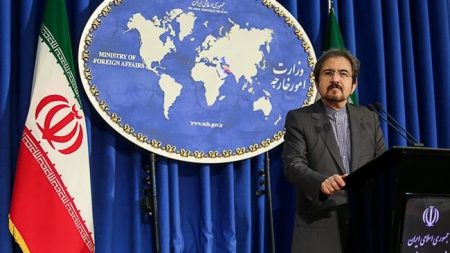
Press TV – October 20, 2018
Iran has dismissed the “false and baseless” claim made by the United States about Tehran’s efforts to undermine US elections, including next month’s midterms, saying such allegations are rooted in an “unknown delusion.”
“The principled policy of the Islamic Republic of Iran is based on non-interference in the domestic affairs of other countries,” Iranian Foreign Ministry Spokesman Bahram Qassemi said on Saturday.
US intelligence and law enforcement agencies on Friday claimed that foreign governments continued to try to influence US elections, including the upcoming midterm congressional vote in November.
“We are concerned about ongoing campaigns by Russia, China and other foreign actors, including Iran, to undermine confidence in democratic institutions and influence public sentiment and government policies,” the Office of the Director of National Intelligence, Justice Department, FBI and Department of Homeland Security said in a joint statement.
The Iranian Foreign Ministry spokesperson said bids by American officials to accuse Iran of seeking to meddle in and influence the US congressional elections are basically false, stressing such allegations are politically-motivated.
Qassemi added that the White House tries to level accusations against other countries with “specific domestic political purposes and everyday adds the name of a country to its delusional list in this regard.”
The allegation comes as US government agencies have said they have no evidence of a compromise or disruption of election equipment yet.
American Pravda: The ADL in American Society
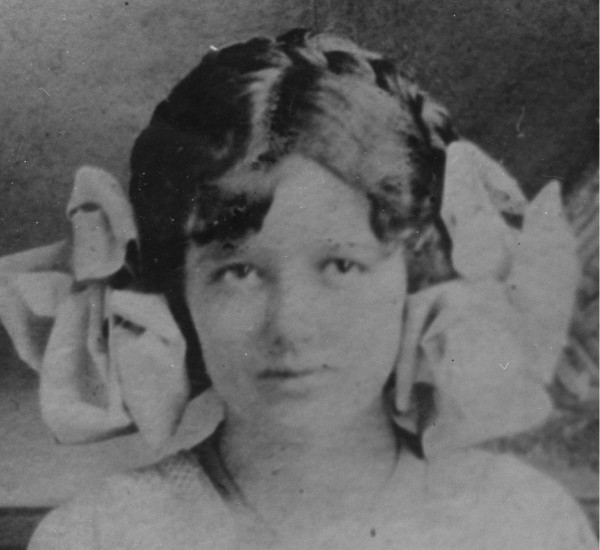
13-year-old Mary Phagan, the girl raped and murdered by Leo Frank, the founding hero of the ADL
By Ron Unz • Unz Review • October 15, 2018
In our modern era, there are surely few organizations that so terrify powerful Americans as the Anti-Defamation League (ADL) of B’nai B’rith, a central organ of the organized Jewish community.
Mel Gibson had long been one of the most popular stars in Hollywood and his 2004 film The Passion of the Christ became among the most profitable in world history, yet the ADL and its allies destroyed his career, and he eventually donated millions of dollars to Jewish groups in desperate hopes of regaining some of his public standing. When the ADL criticized a cartoon that had appeared in one of his newspapers, media titan Rupert Murdoch provided his personal apology to that organization, and the editors of The Economist quickly retracted a different cartoon once it came under ADL fire. Billionaire Tom Perkins, a famed Silicon Valley venture capitalist, was forced to issue a heartfelt apology after coming under ADL criticism for his choice of words in a Wall Street Journal column. These were all proud, powerful individuals, and they must have deeply resented being forced to seek such abject public forgiveness, but they did so nonetheless. The total list of ADL supplicants over the years is a very long one.
Given the fearsome reputation of the ADL and its notorious hair-trigger activists, there was a widespread belief that my small webzine would be completely annihilated when I first launched my recent series of controversial articles in early June by praising the works of historian David Irving, long demonized by the ADL. Yet absolutely nothing happened.
During the next three months my subsequent articles directly challenged nearly every hot-button issue normally so fiercely defended by the ADL and its lackies, so much so that a friendly journalist soon described me as the “Kamikaze from California.” Yet despite my 90,000 words of text and the 13,000 comments I had attracted, the continuing silence of the ADL was absolutely deafening. Meanwhile, my articles were read more than half a million times, with the following being a list of the most provocative pieces:
- The Remarkable Historiography of David Irving
June 4, 2018 • 1,700 Words • 570 Comments - American Pravda: The JFK Assassination, Part II – Who Did It?
June 25, 2018 • 8,000 Words • 985 Comments - American Pravda: Oddities of the Jewish Religion
July 16, 2018 • 7,800 Words • 1,637 Comments - American Pravda: The Bolshevik Revolution and Its Aftermath
July 23, 2018 • 6,900 Words • 913 Comments - American Pravda: The Nature of Anti-Semitism
July 30, 2018 • 5,500 Words • 666 Comments - American Pravda: Jews and Nazis
August 6, 2018 • 6,800 Words • 554 Comments - American Pravda: Holocaust Denial
August 27, 2018 • 17,600 Words • 2,323 Comments - American Pravda: 9/11 Conspiracy Theories
September 10, 2018 • 11,000 Words • 2,355 Comments
When divine wrath fails to smite the heretic and terrifying enforcers of official dogma seem to have suddenly lost their taste for battle, others gradually begin to take notice and may grow emboldened. Eventually leading pro-Russian and Libertarian websites such as Russia Insider and LewRockwell began republishing some of my most controversial American Pravda articles, thus bringing my factual claims to the attention of broader audiences. After the conclusion of the my series, I began directly ridiculing my strangely timorous ADL opponents, publishing a short column entitled “Has the ADL Gone Into Hiding?” which led the redoubtable Paul Craig Roberts to describe me as “the bravest man I know.”
Apparently the combination of all these factors at long last grew too worrisome for the ADL, and stirring from their secret hiding place, its activists have now finally released a short and rather milquetoast response to my material, one which hardly much impresses me. A few days ago, they Tweeted out their column, together with a photo of their new nemesis.
California businessman Ron Unz has long been funding anti-Israel activists. Now, he’s embracing hardcore #antiSemitism, denying the Holocaust & claiming Jews run the media & worship Satan. Learn more from our experts: https://t.co/KnngID3YCh
— ADL (@ADL_National) October 8, 2018
The ADL may boast an annual budget of $60 million and have many hundreds of full-time employees, but its research skills seem sorely lacking. I discovered that they opened their rebuke by denouncing me as a notorious “anti-immigrant activist.” This seems an extremely odd claim given that I have published perhaps a quarter-million words on that contentious topic over the last twenty-five years, nearly all of it online and fully searchable, and my views have never been characterized in that fashion. To cite just one example, my article “California and the End of White America” appeared as a 1999 cover-story in Commentary, the flagship publication of The American Jewish Committee, and surely anyone reading it would be greatly puzzled by the ADL’s description. Indeed, just a few years earlier, I had been a top featured speaker at the October 1994 pro-immigrant protest in downtown Los Angeles, a 70,000 strong political rally that was the largest such gathering in American history to that date.

Over the years, my political activities have been the subject of many thousands of articles in the mainstream media, including a half-dozen front-page stories in the New York Times, and these would provide a similar picture, as did the New Republic cover story chronicling my California successes. Moreover, my views on immigrants haven’t changed all that much over the years as demonstrated by my more recent articles such as “The Myth of Hispanic Crime,” “Immigration, Republicans, and the End of White America” and “A Grand Bargain on Immigration?” Perhaps the intrepid ADL investigators should acquaint themselves with a powerful new technological tool called “Google.”

I was equally unimpressed that they so hotly denounced me for substantially relying upon the writings of Israel Shahak, whom they characterized as viciously “anti-Semitic.” As I had repeatedly emphasized, my own total lack of Aramaic and Hebrew necessarily forces me to rely upon the research of others, and the late Prof. Shahak, an award-winning Israeli academic, certainly seems a fine source to use. After all, famed linguist Noam Chomsky had lauded Shahak’s works for their “outstanding scholarship,” and numerous of our other most prominent public intellectuals such as Christopher Hitchens, Edward Said, and Gore Vidal had been similarly lavish in their praise. Furthermore, one of Shahak’s co-authors was Norton Mezvinsky, a prominent American academic specializing in Middle Eastern history, himself hardly an obscure figure given that both his brother and sister-in-law served in Congress and his nephew later married Chelsea Clinton. And as far as I’m aware almost none of Shahak’s explicit claims about the Talmud or traditional Judaism have ever been directly challenged, while the online availability of his first book allows those so interested to conveniently read it and decide for themselves.

The ADL similarly denounced me for taking seriously the theories of Ariel Toeff, another Israeli academic. But Prof. Toeff, son of the Chief Rabbi of Rome, certainly ranks as one of the world’s leading scholarly authorities on Medieval Jewry, and working together with his graduate students and other colleagues, he had devoted many years of effort to the research study in question, drawing upon extensive primary and secondary sources produced in eight different languages. I found his 500 page book quite persuasive, as did Israeli journalist Israel Shamir, and I have seen no credible rebuttals.
Now the work of all these prominent academics and intellectuals may not necessarily be correct, and perhaps I am mistaken in accepting their factual claims. But I would need to see something far more weighty than a casual dismissal in a few paragraphs contained within an anonymous ADL column, whose author for all I know might have been some ignorant young intern.
Those glaring flaws aside, most of the ADL’s remaining catalogue of my numerous heretical positions seemed reasonably accurate, though obviously presented in a somewhat hostile and derogatory fashion and sorely lacking any links to my original pieces. But even this desultory listing of my mortal transgressions was woefully incomplete, with the ADL strangely failing to include mention of some of my most controversial claims.

For example, the authors excluded all reference to my discussion of the thoroughly documented Nazi-Zionist economic partnership of the 1930s, which played such a crucial role in laying the basis for the State of Israel. And the ADL similarly avoided mentioning the nearly 20,000 words I had allocated to discussing the very considerable evidence that the Israeli Mossad had played a central role in both the JFK Assassination and the 9/11 Attacks. Surely this must be one of the few times that the ADL has deliberately avoided leveling the charge of “conspiracy theorist” against an opponent whom they might have so easily slurred in that fashion. Perhaps they felt the evidence I provided was too strong for them to effectively challenge.
The worrisome incompetence of ADL researchers becomes particularly alarming when we consider that over the last couple of years that organization has been elevated into a content gatekeeping role at America’s largest Internet companies, helping to determine what may or may not be said on the most important Social Media platforms such as Facebook, YouTube, and Twitter.
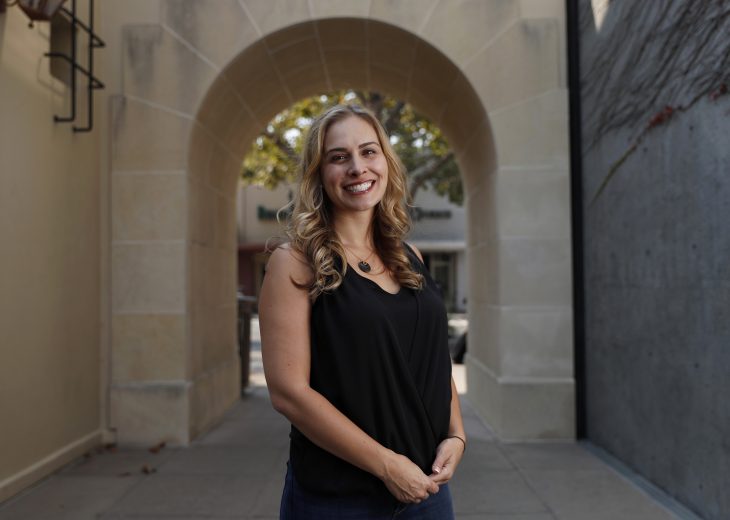
Brittan Heller, director of technology and society for the Anti-Defamation League, photographed in Palo Alto, Calif., on August 27, 2018. (Nhat V. Meyer/Bay Area News Group)
My local paper is the San Jose Mercury News and a couple of weeks ago it published a major profile interview with Brittan Heller, the ADL Director tasked with policing “hate speech” across the America-dominated portions of the Internet. She seemed like a perfectly pleasant young woman in her mid-thirties, a Stanford English major and a graduate of Yale Law, now living in Silicon Valley with her husband and her two cats, Luna and Stella. She emphasizes her own experience as a victim of cyber-harassment from a fellow college student whose romantic overtures she rejected and the later expertise she had gained as a Nazi-hunter for the U.S. government. But does that resume really provide her with the god-like knowledge suitable for overriding our traditional First Amendment rights and determining which views and which individuals should be allowed access to some two billion readers worldwide?
There is also a far more serious aspect to the situation. The choice of the ADL as the primary ideological overseer of America’s Internet may seem natural and appropriate to politically-ignorant Americans, a category that unfortunately includes the technology executives leading the companies involved. But this reflects the remarkable cowardice and dishonesty of the American media from which all these individuals derive their knowledge of our world. The true recent history of the ADL is a remarkably sordid and disreputable tale.
In January 1993, the San Francisco Police Department reported that it had recently raided the Northern California headquarters of the ADL based upon information provided by the FBI. The SFPD discovered that the organization had been keeping intelligence files on more than 600 civic organizations and 10,000 individuals, overwhelmingly of a liberal orientation, with the SFPD inspector estimating that 75% of the material had been illegally obtained, much of it by secret payments to police officials. This was merely the tip of the iceberg in what clearly amounted to the largest domestic spying operation by any private organization in American history, and according to some sources, ADL agents across the country had targeted over 1,000 political, religious, labor, and civil rights organizations, with the New York headquarters of the ADL maintaining active dossiers on more than a million Americans.
Not long afterward, an ACLU official who had previously held a high-ranking position with the ADL revealed in an interview that his organization had been the actual source of the highly controversial 1960s surveillance on Martin Luther King, Jr., which it had then provided to FBI Director J. Edgar Hoover. For many years Hoover had been furiously denounced in the national media headlines for his use of tapes and other secret information on King’s activities, but when a local San Francisco newspaper revealed that an ADL spying operation had actually been the source of all that sordid material, the bombshell revelation was totally ignored in the national media and only reported by fringe organizations, so that today almost no Americans are aware of that fact.
I am not aware of any other private organization in American history that has been involved in even a sliver of such illegal domestic espionage activity, which appears to have been directed against almost all groups and prominent individuals—Left, Right, and Center—suspected of being insufficiently aligned with Jewish and Israeli interests. Some of the illegal material found in ADL possession even raised dark suspicions that it had played a role in domestic terrorist attacks and political assassinations directed against foreign leaders. I am no legal expert, but given the massive scale of such illegal ADL activities, I wonder whether a plausible case might have been made to prosecute the entire organization under RICO statutes and sentence all of its leaders to long prison terms.
Instead, the resulting government charges were quickly settled with merely a trivial fine and a legal slap on the wrist, demonstrating the near-total impunity provided by massive Jewish political power in modern American society.
In effect, the ADL seems to have long operated as our country’s privatized secret political police, monitoring and enforcing its ideological doctrines on behalf of Jewish groups much as the Stasi did for the Communist rulers of East Germany. Given such a long history of criminal activity, allowing the ADL to extend its oversight to our largest Social Media platforms amounts to appointing the Mafia to supervise the FBI and the NSA, or taking a very large step towards implementing George Orwell’s Ministry of Truth on behalf of Jewish interests.
In his 1981 memoirs, the far right Classics scholar Revilo P. Oliver characterized the ADL as “the formidable organization of Jewish cowboys who ride herd on their American cattle” and this seems a reasonably apt description to me.
Although I had long recognized the power and influence of the ADL, a leading Jewish-activist organization whose leaders were so regularly quoted in my newspapers, until rather recently I had only the vaguest notions of its origins. I’m sure I’d heard the story mentioned at some points, but the account had never stuck in my mind.
Then perhaps a year or two ago, I happened to come across some discussion of the ADL’s 2013 centenary celebration, in which the leadership reaffirmed the principles of its 1913 founding. The initial impetus had been the vain national effort to save the life of Leo Frank, a young Jew unjustly accused of murder and eventually lynched. Not long before, Frank’s name and story would have been equally vague in my mind, with the man half-remembered from my introductory history textbooks as a notorious early KKK victim in the fiercely anti-Semitic Deep South of the early twentieth century. However, not long before seeing that piece on the ADL I’d read Albert Lindemann’s highly-regarded study The Jew Accused, and his short chapter on the notorious Frank case had completely exploded all my preconceptions.
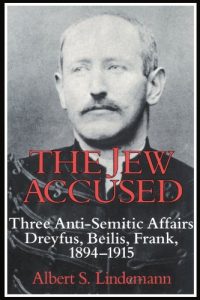
First, Lindemann demonstrated that there was no evidence of any anti-Semitism behind Frank’s arrest and conviction, with Jews constituting a highly-valued element of the affluent Atlanta society of the day, and no references to Frank’s Jewish background, negative or otherwise, appearing in the media prior to the trial. Indeed, five of the Grand Jurors who voted to indict Frank for murder were themselves Jewish, and none of them ever voiced regret over their decision. In general, support for Frank seems to have been strongest among Jews from New York and other distant parts of the country and weakest among the Atlanta Jews with best knowledge of the local situation.
Furthermore, although Lindemann followed the secondary sources he relied upon in declaring that Frank was clearly innocent of the charges of rape and murder, the facts he recounted led me to the opposite conclusion, seeming to suggest strong evidence of Frank’s guilt. When I much more recently read Lindemann’s longer and more comprehensive historical study of anti-Semitism, Esau’s Tears, I noticed that his abbreviated treatment of the Frank case no longer made any claim of innocence, perhaps indicating that the author himself might have also had second thoughts about the weight of the evidence.
Based on this material, I voiced that opinion in my recent article on historical anti-Semitism, but my conclusions were necessarily quite tentative since they relied upon Lindermann’s summary of the information provided in the secondary sources he had used, and I had the impression that virtually all those who had closely investigated the Frank case had concluded that Frank was innocent. But after my piece appeared, someone pointed me to a 2016 book from an unexpected source arguing for Frank’s guilt. Now that I have ordered and read that volume, my understanding of the Frank case and its historical significance has been entirely transformed.
Mainstream publishers may often reject books that too sharply conflict with reigning dogma and sales of such works are unlikely to justify the extensive research required to produce the manuscript. Furthermore, both authors and publishers may face widespread vilification from a hostile media for taking such positions. For these reasons, those who publish such controversial material will often be acting from deep ideological motives rather than merely seeking professional advancement or monetary gain. As an example, it took a zealous Trotskyite leftist such as Lenni Brunner to brave the risk of widespread vilification and invest the time and effort to produce his remarkable study of the crucial Nazi-Zionist partnership of the 1930s. And for similar reasons, we should not be totally surprised that the leading book arguing for the guilt of Leo Frank appeared as a volume in the series on the pernicious aspects of Jewish-Black historical relations produced by Louis Farrakhan’s Nation of Islam (NOI), nor that the text lacked any identified author.
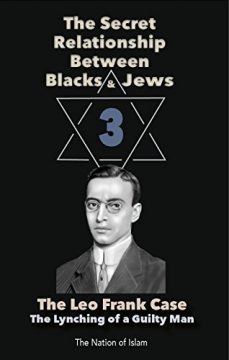
Anonymous works published by heavily-demonized religious-political movements naturally engender considerable caution, but once I began reading the 500 pages of The Leo Frank Case: The Lynching of a Guilty Man I was greatly impressed by the quality of the historical analysis. I think I have only very rarely encountered a research monograph on a controversial historical event that provided such an enormous wealth of carefully-argued analysis backed by such copious evidence. The authors seemed to display complete command of the major secondary literature of the last one hundred years while drawing very heavily upon the primary sources, including court records, personal correspondence, and contemporaneous publications, with the overwhelming majority of the 1200 footnotes referencing newspaper and magazine articles of that era. The case made for Frank’s guilt seemed absolutely overwhelming.
The basic outline of events is not disputed. In 1913 Georgia, a 13-year-old pencil company worker named Mary Phagan was last seen alive visiting the office of factory manager Leo Frank on a Saturday morning to collect her weekly paycheck, while her raped and murdered body was found in the basement early the next morning and Frank eventually arrested for the crime. As the wealthy young president of the Atlanta chapter of B’nai B’rith, Frank ranked as one of the most prominent Jewish men in the South, and great resources were deployed in his legal defense, but after the longest and most expensive trial in state history, he was quickly convicted and sentenced to death.
The facts of the case against Frank eventually became a remarkable tangle of complex and often conflicting evidence and eyewitness testimony, with sworn statements regularly being retracted and then counter-retracted. But the crucial point that the NOI authors emphasize for properly deciphering this confusing situation is the enormous scale of the financial resources that were deployed on Frank’s behalf, both prior to the trial and afterward, with virtually all of the funds coming from Jewish sources. Currency conversions are hardly precise, but relative to the American family incomes of the time, the total expenditures by Frank supporters may have been as high as $25 million in present-day dollars, quite possibly more than any other homicide defense in American history before or after, and an almost unimaginable sum for the impoverished Deep South of that period. Years later, a leading donor privately admitted that much of this money was spent on perjury and similar falsifications, something which is very readily apparent to anyone who closely studies the case. When we consider this vast ocean of pro-Frank funding and the sordid means for which it was often deployed, the details of the case become far less mysterious. There exists a mountain of demonstrably fabricated evidence and false testimony in favor of Frank, and no sign of anything similar on the other side.
The police initially suspected the black night watchman who found the girl’s body, and he was quickly arrested and harshly interrogated. Soon afterward, a bloody shirt was found at his home, and Frank made several statements that seemed to implicate his employee in the crime. At one point, this black suspect may have come close to being summarily lynched by a mob, which would have closed the case. But he stuck to his story of innocence with remarkable composure, in sharp contrast to Frank’s extremely nervous and suspicious behavior, and the police soon shifted their scrutiny toward the latter, culminating in his arrest. All researchers now recognize that the night watchman was entirely innocent, and the material against him planted.
The evidence against Frank steadily mounted. He was the last man known to have seen the young victim and he repeatedly changed important aspects of his story. Numerous former female employees reported his long history of sexually aggressive behavior toward them, especially directed towards the murdered girl herself. At the time of the murder, Frank claimed to have been working alone in his office, but a witness who went there reported he had been nowhere to be found. A vast amount of circumstantial evidence implicated Frank.
A black Frank family servant soon came forward with sworn testimony that Frank had confessed the murder to his wife on the morning after the killing, and this claim seemed supported by the latter’s strange refusal to visit her husband in jail for the first two weeks after the day of his arrest.
Two separate firms of experienced private detectives were hired by Frank’s lavishly-funded partisans, and the agents of both eventually came to the reluctant conclusion that Frank was guilty as charged.
As the investigation moved forward, a major break occurred as a certain Jim Conley, Frank’s black janitor, came forward and confessed to having been Frank’s accomplice in concealing the crime. At the trial he testified that Frank had regularly enlisted him as a lookout during his numerous sexual liaisons with his female employees, and after murdering Phagan, had then offered him a huge sum of money to help remove and hide the body in the basement so that the crime could be pinned upon someone else. But with the legal noose tightening around Frank, Conley had begun to fear that he might be made the new scapegoat, and went to the authorities in order to save his own neck. Despite Conley’s damning accusations, Frank repeatedly refused to confront him in the presence of the police, which was widely seen as further proof of Frank’s guilt.
By the time of the trial itself, all sides were agreed that the murderer was either Frank, the wealthy Jewish businessman, or Conley, the semi-literate black janitor with a first-grade education and a long history of public drunkenness and petty crime. Frank’s lawyers exploited this comparison to the fullest, emphasizing Frank’s Jewish background as evidence for his innocence and indulging in the crudest sort of racial invective against his black accuser, whom they claimed was obviously the true rapist and murderer due to his bestial nature.
Those attorneys were the best that money could buy and the lead counsel was known as the one of the most skilled courtroom interrogators in the South. But although he subjected Conley to a grueling sixteen hours of intense cross-examination over three days, the latter never wavered in the major details of his extremely vivid story, which deeply impressed the local media and the jury. Meanwhile, Frank refused to take the stand at his own trial, thereby avoiding any public cross-examination of his often changing account.
Two notes written in crude black English had been discovered alongside Phagan’s body, and everyone soon agreed that these were written by the murderer in hopes of misdirecting suspicion. So they were either written by a semi-literate black such as Conley or by an educated white attempting to imitate that style, and to my mind, the spelling and choice of words strongly suggests the latter, thereby implicating Frank.
Taking a broader overview, the theory advanced by Frank’s legion of posthumous advocates seems to defy rationality. These journalists and scholars uniformly argue that Conley, a semi-literate black menial, had brutally raped and murdered a young white girl, and the legal authorities soon became aware of this fact, but conspired to set him free by supporting a complex and risky scheme to instead frame an innocent white businessman. Can we really believe that the police officials and prosecutors of a city in the Old South would have violated their oath of office in order to knowingly protect a black rapist and killer from legal punishment and thereby turn him loose upon their city streets, presumably to prey on future young white girls? This implausible reconstruction is particularly bizarre in that nearly all its advocates across the decades have been the staunchest of Jewish liberals, who endlessly condemned the horrific racism of the Southern authorities of that era, but then unaccountably chose to make a special exception in this one particular case.
In many respects, the more important part of the Frank case began after his conviction and death sentence when many of America’s wealthiest and most influential Jewish leaders began mobilizing to save him from the hangman. They soon established the ADL as a new vehicle for that purpose and succeeded in making the Frank murder case one of the most famous in American history to that date.
Although his role was largely concealed at the time, the most important new backer whom Frank attracted was Albert Lasker of Chicago, the unchallenged monarch of American consumer advertising, which constituted the life’s blood of all of our mainstream newspapers and magazines. Not only did he ultimately provide the lion’s share of the funds for Frank’s defense, but he focused his energies upon shaping the media coverage surrounding the case. Given his dominant business influence in that sector, we should not be surprised that a huge wave of unremitting pro-Frank propaganda soon began appearing across the country in both local and national publications, extending to most of America’s most popular and highly-regarded media outlets, with scarcely a single word told on the other side of the story. This even included all of Atlanta’s own leading newspapers, which suddenly reversed their previous positions and became convinced of Frank’s innocence.
Lasker also enlisted other powerful Jewish figures in the Frank cause, including New York Times owner Adolph Ochs, American Jewish Committee president Louis Marshall, and leading Wall Street financier Jacob Schiff. The Times, in particular, began devoting enormous coverage to this previously-obscure Georgia murder case, and many of its articles were widely republished elsewhere. The NOI authors highlight this extraordinary national media attention: “The Black janitor whose testimony became central to Leo Frank’s conviction became the most quoted Black person in American history up to that time. More of his words appeared in print in the New York Times than those of W.E.B. Du Bois, Marcus Garvey, and Booker T. Washington—combined.”
Back a century ago just as today, our media creates our reality, and with Frank’s innocence being proclaimed nationwide in near-unanimous fashion, a long list of prominent public figures were soon persuaded to demand a new trial for the convicted murderer, including Thomas Edison, Henry Ford, and Jane Addams.
Ironically enough, Lasker himself plunged himself into this crusade despite apparently having very mixed personal feelings about man whose cause he was championing. His later biography reveals that upon his first personal meeting with Frank, he perceived him as “a pervert” and a “disgusting” individual, so much so that he even hoped that after he managed to free Frank, the latter would quickly perish in some accident. Furthermore, in his private correspondence he freely admitted that a large fraction of the massive funding that he and numerous other wealthy Jews from across the country were providing had been spent on perjured testimony and there are also strong hints that he explored bribing various judges. Given these facts, Lasker and Frank’s other major backers were clearly guilty of serious felonies, and could have received lengthy prison terms for their illegal conduct.
With the New York Times and the rest of the liberal Northern media now providing such massive coverage of the case, Frank’s defense team was forced to abandon the racially-inflammatory rhetoric aimed at his black accuser which had previously been the centerpiece of their trial strategy. Instead, they began concocting a tale of rampant local anti-Semitism, previously unnoticed by all observers, and adopted it as a major grounds for their appeal of the verdict.
The unprincipled legal methods pursued by Frank’s backers is illustrated by a single example. Georgia law normally required that a defendant be present in court to hear the reading of the verdict, but given the popular emotions in the case, the judge suggested that this provision be waived, and the prosecution assented only if the defense lawyers promised not to use this small irregularity as grounds for appeal. But after Frank was convicted, AJC President Marshall and his other backers orchestrated numerous unsuccessful state and federal appeals on exactly this minor technicality, merely hiring other lawyers to file the motion.
For almost two years, the nearly limitless funds deployed by Frank’s supporters covered the costs of thirteen separate appeals on the state and federal levels, including to the U.S. Supreme Court, while the national media was used to endlessly vilify Georgia’s system of justice in the harshest possible terms. Naturally, this soon generated a local reaction, and during this period outraged Georgians began denouncing the wealthy Jews who were spending such enormous sums to subvert their local criminal justice system.
One of the very few journalists willing to oppose Frank’s position was Georgia publisher Tom Watson, a populist firebrand, and in one of his editorials he reasonably declared “We cannot have… one law for the Jew, and another for the Gentile” while he also lamented that “It is a bad state of affairs when the idea gets abroad that the law is too weak to punish a man who has plenty of money.” A former Georgia governor indignantly inquired “Are we to understand that anybody except a Jew can be punished for a crime.” The clear facts indicate that there was indeed a massive miscarriage of justice in Frank’s case, but virtually all of it occurred in Frank’s favor.
All appeals were ultimately rejected and Frank’s execution date for the rape and murder of the young girl finally drew near. But just days before he was scheduled to leave office, Georgia’s outgoing governor commuted Frank’s sentence, provoking an enormous storm of popular protest, especially since he was the legal partner of Frank’s chief defense lawyer, an obvious conflict of interest. Given the enormous funds that Frank’s national supporters had been deploying on his behalf and the widespread past admissions of bribery in the case, there are obviously dark suspicions about what had prompted such a remarkably unpopular decision, which soon forced the former governor to exile himself from the state. A few weeks later, a group of Georgia citizens stormed Frank’s prison farm, abducting and hanging him, with Frank becoming the first and only Jew lynched in American history.
Naturally, Frank’s killing was roundly denounced in the national media that had long promoted his cause. But even in those quarters, there may have been a significant difference between public and private sentiments. No newspaper in country had more strongly championed Frank’s innocence than the New York Times of Adolph Ochs. Yet according to the personal diary of one of the Times editors, Ochs privately despised Frank, and perhaps even greeted his lynching with a sense of relief. No effort was ever made by any of Frank’s wealthy supporters to bring any of the lynching party to justice.
Although I have now come to regard the NOI volume as the most persuasive and definitive text on the Frank case, I naturally considered conflicting works before coming to this conclusion.
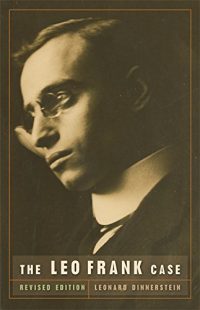
For nearly a half-century, the leading scholarly account of the incident had probably been Leonard Dinnerstein’s book The Leo Frank Case, first published in 1966, and Dinnerstein, a University of Arizona professor specializing in Jewish history, entirely supported Frank’s innocence. But although the work won a national award, carries glowing blurbs from several prestigious publications, and has surely graced the reading lists of endless college courses, I was not at all impressed. Among other things, the book appears to be the original source of some of the most lurid examples of alleged anti-Semitic public outbursts that apparently have no basis in reality and seem to have been simply fabricated by the author given his lack of any citations; the NOI authors note these stories have been quietly abandoned by all recent researchers. Even leaving aside such likely falsifications, which were widely cited by later writers and heavily contaminated the historical record, I found the short Dinnerstein work rather paltry and even pitiful when compared to that of its NOI counterpart.
A far longer and more substantial recent work was Steve Oney’s 2003 And the Dead Shall Rise, which runs nearly 750 pages and won the National Jewish Book Award, the Southern Book Critics Circle Prize, and the American Bar Association’s Silver Gavel, probably establishing itself as today’s canonical text on the historical incident. Oney had been a longtime Atlanta journalist and I was favorably impressed by his narrative skill, along with the numerous fascinating vignettes he provided to illustrate the Southern history of that general era. He also seemed a cautious researcher, drawing heavily upon the primary sources and avoiding much of the falsified history of the last century, while not entirely suppressing the massive evidence of bribery and perjury employed by the Frank forces.
But although Oney does mention much of this information, he strangely fails to connect the dots. For example, although he occasionally mentions some of the funds spent on Frank’s behalf, he never attempts to convert them into present-day equivalents, leaving a naive reader to assume that such trivial amounts could not possibly have been used to pervert the course of justice. Furthermore, his entire book is written in chronological narrative form, with no footnotes provided in the text, and a large portion of the content being entirely extraneous to any attempt to determine Frank’s guilt or innocence, contrasting very sharply with the more scholarly style of the NOI authors.
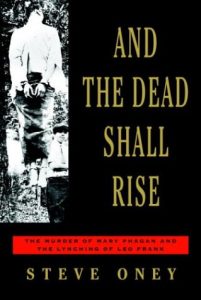
To my mind, a central element of the Frank case was the massive financial temptations being offered by Frank’s Jewish backers, and the huge number of Atlanta citizens, both high and low, who apparently shifted their positions on Frank’s guilt in eager hopes of capturing some of that largess. But although this obvious theme was heavily emphasized in the NOI book, Oney seems to mostly avoid this obvious factor, perhaps even for personal reasons. Print publications have suffered massive cutbacks in recent years and I noticed on the book flap that although Oney is described as a longtime Atlanta journalist, he had subsequently relocated to Los Angeles. Once I checked, I immediately discovered that Oney’s book had became the basis for an independent film entitled The People v. Leo Frank, and I wonder whether his hopes of capturing a sliver of Hollywood’s vast lucre may not have encouraged him to so strongly suggest Frank’s innocence. Would an account of Leo Frank as rapist and murderer ever be likely to reach the silver screen? The quiet influence of financial considerations today is no different today than they were a century ago, and this factor must be taken into account when evaluating historical events.
The NOI authors devote nearly all of their lengthy book to a careful analysis of the Frank case provided in suitably dispassionate form, but a sense of their justifiable outrage does occasionally poke through. In the years prior to Frank’s killing, many thousands of black men throughout the South had been lynched, often based on a slender thread of suspicion, with few of these incidents receiving more than a few sentences of coverage in a local newspaper, and large numbers of whites had also perished in similar circumstances. Meanwhile, Frank had received benefit of the longest trial in modern Southern history, backed by the finest trial lawyers that money could buy, and based on overwhelming evidence had been sentenced to death for the rape and murder of a young girl. But when Frank’s legal verdict was carried out by extra-judicial means, he immediately became the most famous lynching victim in American history, perhaps even attracting more media attention than all those thousands of other cases combined. Jewish money and Jewish media established him as a Jewish martyr who thereby effectively usurped the victimhood of the enormous number of innocent blacks who were killed both before and after him, none of whom were ever even recognized as individuals.
As Prof. Shahak has effectively demonstrated, traditional Talmudic Judaism regarded all non-Jews as being sub-human, with their lives possessing no value. Given that Frank’s backers were all followers of Reform Judaism, it seems quite unlikely that they followed this doctrine or were even aware of its existence. But religious traditions of a thousand years standing can easily become embedded within a culture, and such unrecognized cultural sentiments may have easily shaped their reaction to Frank’s legal predicament.
Influential historical accounts of the Frank case and its aftermath have contained lurid tales of the rampant public anti-Semitism visited upon Atlanta’s Jewish community in the wake of the trial, even claiming that a substantial portion of the population was forced to flee as a consequence. However, a careful examination of the primary source evidence, including the contemporaneous newspaper coverage, provides absolutely no evidence of this, and it appears to be entirely fictional.
The NOI authors note that prior to Frank’s trial American history had been virtually devoid of any evidence of significant anti-Semitism, with the previous most notable incident being the case of an extremely wealthy Jewish financier who was refused service at a fancy resort hotel. But by totally distorting the Frank case and focusing such massive national media coverage on the case, Jewish leaders around the country succeeded in fabricating a powerful ideological narrative despite its lack of reality, perhaps intending it to serve as a bonding experience to foster Jewish community cohesion.
As a further example of the widely promoted but apparently fraudulent history, the Jewish writers who have overwhelmingly dominated accounts of the Frank case have frequently claimed that it sparked the revival of the Ku Klux Klan soon afterward, with the group of citizens responsible for Frank’s 1915 lynching supposedly serving as the inspiration for William Simmons’ reestablishment of that organization a couple of years later. But there seems no evidence for this. Indeed, Simmons strongly emphasized the philo-Semitic nature of his new organization, which attracted considerable Jewish membership.
The primary factor behind the rebirth of the KKK was almost certainly D.W. Griffith’s overwhelmingly popular landmark 1917 film Birth of a Nation, which glorified the Klan of the Reconstruction Era. Given that the American film industry was so overwhelmingly Jewish at the time and the film’s financial backers and leading Southern distributors came from that same background, it could be plausibly argued that the Jewish contribution to the creation of the 1920s Klan was a very crucial one, while the revenue from the film’s distribution throughout the South actually financed Sam Goldwyn’s creation of MGM, Hollywood’s leading studio.
In their introduction, the NOI authors make the fascinating point that the larger historical meaning of the Frank case in American racial history has been entirely lost. Prior to that trial, it was unprecedented for Southern courts to allow black testimony against a white man, let alone against a wealthy man being tried on serious charges; but the horrific nature of the crime and Conley’s role as the sole witness required a break from that longstanding tradition. Thus, the authors argue not unreasonably, that the Frank case may have been as important to the history of black progress in America as such landmark legal verdicts as Plessy vs. Ferguson or Brown vs. Board. But since almost the entire historical narrative has been produced by fervent Jewish advocates, these facts have been completely obscured and the case entirely misrepresented as an example of anti-Semitic persecution and public murder.
Let us now summarize what seems to be the solidly established factual history of the Frank case, quite different than the traditional narrative. There is not the slightest evidence that Frank’s Jewish background was a factor behind his arrest and conviction, nor the death sentence he received. The case set a remarkable precedent in Southern courtroom history with the testimony of a black man playing a central role in a white man’s conviction. From the earliest stages of the murder investigation, Frank and his allies continually attempted to implicate a series of different innocent blacks by planting false evidence and using bribes to solicit perjured testimony, while the exceptionally harsh racial rhetoric that Frank and his attorneys directed towards those blacks was presumably intended to provoke their public lynching. Yet despite all these attempts by the Frank forces to play upon the notorious racial sentiments of the white Southerners of that era, the latter saw through these schemes and Frank was the one sentenced to hang for his rape and murder of that young girl.
Now suppose that all the facts of this famous case were exactly unchanged except that Frank had been a white Gentile. Surely the trial would be ranked as one of the greatest racial turning points in American history, perhaps even overshadowing Brown v. Board because of the extent of popular sentiment, and it would have been given a central place in all our modern textbooks. Meanwhile, Frank, his lawyers, and his heavy financial backers would probably be cast as among the vilest racial villains in all of American history for their repeated attempts to foment the lynching of various innocent blacks so that a wealthy white rapist and murderer could walk free. But because Frank was Jewish rather than Christian, this remarkable history has been completely inverted for over one hundred years by our Jewish-dominated media and historiography.
These are the important consequences that derive from control of the narrative and the flow of information, which allows murderers to be transmuted into martyrs and villains into heroes. The ADL was founded just over a century ago with the central goal of preventing a Jewish rapist and killer from being held legally accountable for his crimes, and over the decades, it eventually metastasized into a secret political police force not entirely dissimilar to the widely despised East German Stasi, but with its central goal seeming to be the maintenance of overwhelming Jewish control in a society that is 98% non-Jewish.
We should ask ourselves whether it is appropriate for an organization with such origins and such recent history to be granted enormous influence over the distribution of information across our Internet.
FBI documents detail Clinton and Mueller’s own ‘Russiagate’ – but they’re classified
RT | October 3, 2018
The FBI is facing new calls to declassify documents relating to the sale of US uranium to a Russian company, documents that could implicate Hillary Clinton, Barack Obama, and ‘Russiagate’ witch-hunter Robert Mueller.
While Clinton and crew relentlessly push the idea that the Trump campaign colluded with Russia in the run-up to the 2016 election, and while Special Counsel Robert Mueller searches with a magnifying glass for any sign of this collusion, all parties involved are much quieter when it comes to the Uranium One scandal.
Among a trove of documents relating to the controversial deal, the FBI has identified 37 pages that could shine a light on why then-Secretary of State Hillary Clinton and the Obama administration approved the deal.
The pages were recently added to the agency’s Freedom of Information Act online vault. The only problem – they’re classified.
The reasons given for the classification will sound familiar to anyone following President Trump’s recent struggle to declassify another set of FBI documents: doing so would violate the privacy of individuals involved, would place national security at risk, would disclose secret law enforcement techniques, and would reveal confidential inter-agency communication, among others.
What we do know about Uranium One reads like a Cold War spy thriller.
The debacle began in 2009 when state-owned Russian atomic energy firm Rosatom was in talks to buy part of Canadian-based mining company Uranium One, and with it control over 20 percent of America’s uranium supply.
As the deal was being hashed out, the FBI planted a spy posing as a consultant, businessman William Douglas Campbell, in Rosatom. Campbell uncovered evidence that Rosatom’s main executive in America, Vadim Mikerin, was involved in bribery, extortion, and money laundering, as he sought to gain “improper business advantages” for US firms that worked with a Rosatom-owned firm he chaired.
The FBI compiled Campbell’s evidence, and Mikerin was charged and deported, but not until summer 2018. Back in 2010, the Obama administration approved the sale of Uranium One to Rosatom anyway.
The sale needed to be approved by the Committee on Foreign Investment in the United States (CIFUS), which was chaired by Hillary Clinton. Campbell told three separate Congressional committees that Moscow had hired lobbying firm APCO Worldwide to use its influence with Clinton to negotiate the deal, for which the Clinton Foundation would receive generous kickbacks.
Democrats dismissed the scandal as the stuff of right-wing conspiracy theory, and Clinton herself called accusations of wrongdoing “baloney.” Still, Republicans held that something was amiss, citing Bill Clinton’s $500,000 fee for a speech in Moscow in 2010 as proof the Clintons were peddling influence for Russian money. At the same time, Mrs. Clinton was pushing for a great “reset” in US-Russia relations. The plot thickens.
The FBI director at the time? None other than Robert Mueller, currently the Witch-Hunter-in-chief, leading the crusade against the Trump team. What a difference eight years make.
Attorney General Jeff Sessions announced in March that a federal prosecutor from Utah, John Huber, would look into both the Uranium One deal and FBI misconduct in the Clinton email investigation. Trump too seemed eager to get to the bottom of the scandal, and has regularly bashed Clinton for her alleged role in facilitating the sale.
The Justice Department’s probe has largely taken place on the sidelines, has generated few headlines, and has not made its findings, if any, public. Why then, are the FBI’s documents, clearly of critical importance to understanding the whole debacle, still secret?
“Either the United States, eyes wide open, approved giving uranium assets to a corrupt Russia, or the FBI failed to give the evidence of criminality to the policymakers before such a momentous decision,” wrote The Hill’s John Solomon. If the second option were true, the next step would be establishing whether the agency withheld this evidence knowingly, or through simple negligence.
According to Solomon, an investigative reporter who first disclosed Campbell’s involvement in Rosatom as an FBI informant, Campbell maintains that both then-President Obama and then-Director Mueller were briefed by agents about Rosatom’s shady activities, but the sale was allowed to go through because of “politics.”
According to another of Solomon’s sources, “There is definitely material (in the 37 pages) that would be illuminating to the issues that have been raised… somebody should fight to make it public.”
Former Arkansas Governor Mike Huckabee (R) has called on the FBI to “stop investigating high school yearbooks and start declassifying Uranium One,” and has urged Senate Republicans to pressure the agency into declassifying the documents. Failing that, Huckabee suggested that Trump order the declassification, which he is well within his power to do so.
Doing so would not only bring the truth that much closer to being revealed, but could also give Trump the opportunity to score some political points against his old nemeses: surely a tempting prospect.
Featured Video

Bombing Hitler’s Hometown
or go to
Aletho News Archives – Video-Images
From the Archives
‘Conspiracy Theory’ Now Fact: Greater Israel Has Arrived
By Kit Klarenberg | Mint Press News | January 28, 2025
Ever since Tel Aviv’s 1948 creation, much has been said and written about ‘Greater Israel’ – the notion Zionism’s ultimate end goal is the forcible annexation and ethnic cleansing of vast swaths of Arab and Muslim lands for Jewish settlement, based on Biblical claims this territory was promised to Jews by God. The mainstream media typically dismisses this concept as antisemitic conspiracy theory, or at most the fringe fantasy of a minuscule handful of extremist Israelis.
In reality … continue
Blog Roll
 Aletho News
- Failing to Defeat Hezbollah, Israel & US Pressure Syria’s Ahmed al-Sharaa to Join War
- US-Israeli war on Iran drives global fertilizer prices up 40%
- Hezbollah’s Surprise Weapons Redefine Ground Battle with Israel
- Yemen joins fight against US, Israel by firing missiles at occupied territories
- Seizing the Kharg: Washington’s path to defeat in the Persian Gulf
- Iran reports 500 US casualties in strikes on covert US military sites
- Pro-Israel terrorist arrested before assassination of pro-Palestinian activist
- Bombing Hitler’s Hometown
- German journalist threatened with homelessness as German court upholds EU sanctions in landmark free speech case
- US Tells Allies That Ukraine-Bound Arms Could be Sent to Middle East
- If Americans Knew
- Researchers at Human Rights Watch Resign Over Blocked Report on Palestinian Refugee Return
- Jewish Groups Are Backing a War Americans Don’t Want
- Eric Fingerhut Thinks He’s the President of the Jews
- Top Jewish Philanthropists, Rabbis Urge Israeli President to Take Action Against ‘Jewish Extremists’
- Don’t Be Fooled. Zionist Leaders Have Always Wanted to Control Southern Lebanon
- Israel’s widespread use of torture is a core element of its genocide against the Palestinian people
- In Israel’s War on Iran, Many Middle East US Bases Rendered “All But Uninhabitable”
- ‘Burn the lawn’: Israel pursues ‘Rafah model’ in southern Lebanon
- A genocide here, an amputation there
- Reports: Iran mobilizing 1M fighters, Israel-US run low on ammo, Israeli army faces shortage – Not a ceasefire Day 168
- No Tricks Zone
- Devastating Assessment Of Comirnaty Vaccine By Former Senior Pfizer Europe Toxicologist
- New Study: CO2 Is ‘Effectively Negligible’ As An Explanatory Climate Change Factor Since 2000
- Former Pfizer Toxicologist Dr. Helmut Sterz Tells Bundestag Hearing Pfizer Vaccine Should Have Never Been Approved
- Energy Expert: Germany’s Nuclear Phaseout Was A “500 Billion Euro Mistake”
- New Research: South Australia’s Mid-Holocene Sea Surface Temperatures Were 4°C Warmer Than Today
- Storing Green Energy To Last Germany 10 Days Would Require A 60-Million Tonne Battery
- New Studies: UK Sea Levels Were 4 Meters Higher Than Today During The Mid-Holocene
- Destructive Green New Deal: German Energy And Metal Group Warns Of Drastic Crisis
- New Study Documents A 20-Year Pause In Arctic Sea Ice Decline – Driven By Internal Variability
- Wake-up Call: Survey Shows Majority Of Germans Now Favor Postponing Climate Targets!
 Aletho News