Following Donald Trump’s wiretap accusations Clapper and Comey make only qualified denials
By Alexander Mercouris | The Duran | March 6, 2017
Following Saturday’s charges come Sunday’s denials.
On Saturday in a series of tweets Donald Trump accused his predecessor Barack Obama of wiretapping his office in Trump Tower. A few hours later Obama responded with a statement published by his spokesman which neither admitted nor denied the wiretap but which said that Obama himself had never ordered surveillance within the US on anyone.
Then came an interview for NBC by Obama’s former Director of National Intelligence James Clapper. In it in carefully chosen words Clapper said that he had “no knowledge” of any FISA court authorising wiretaps of Trump Tower, and that no section of the US intelligence community which he supervised had carried out such a wiretap.
Some sections of the media – especially in Britain the BBC and the Guardian – have reported these denials in a way that gives the impression to a casual viewer or reader that Clapper has denied the existence of the wiretap outright. This is certainly not so. Clapper’s careful words were
[For the part of the national security apparatus that I oversaw] there was no such wiretap activity mounted against the president, the president-elect at the time, or as a candidate, or against his campaign….. I can’t speak for other authorized entities in the government or a state or local entity (bold italics added)
In words which have received far less publicity, Clapper also denied that he had seen any evidence of collusion between the Trump campaign and Russia, and said that the report on Russian interference in the election submitted to Obama and Trump, a redacted version of which was provided to Congress, and a further redacted (and content free) version of which was made public, made no such claim
Clapper was also asked on “Meet the Press” if he had any evidence that the Trump campaign was colluding with the Russian government while the Kremlin was working to influence the election.
“Not to my knowledge,” Clapper said, based on the information he had before his time in the position ended.
“We did not include anything in our report … that had any reflect of collusion between members of the Trump campaign and the Russians. There was no evidence of that included in our report,” he said. “We had no evidence of such collusion.”
A few hours after Clapper’s comments, there appeared an article in The New York Times drawing on the usual anonymous sources. This claimed that shortly after the President published his tweets on Saturday FBI Director Comey contacted the Justice Department to say that the President’s claim that Obama had ordered Trump’s phone in Trump Tower wiretapped was false, and asked the Justice Department to publish a retraction (as of the time of writing the Justice Department has published no such retraction).
In a comment which I see as intended to goad Comey into publishing his own statement denying the President’s claims, The New York Times questions why he has not done so
It is not clear why Mr. Comey did not issue a statement himself. He is the most senior law enforcement official who was kept on the job as the Obama administration gave way to the Trump administration. And while the Justice Department applies for intelligence-gathering warrants, the F.B.I. keeps its own records and is in a position to know whether Mr. Trump’s claims are true. While intelligence officials do not normally discuss the existence or nonexistence of surveillance warrants, no law prevents Mr. Comey from issuing the statement.
As I recall, The New York Times initially also made the very strange claim that because Jeff Sessions has recused himself from the investigation into the Trump campaign’s alleged contacts with Russia, Comey was finding it difficult to find anyone in the Justice Department competent to handle his request.
That cannot be true since Sessions’s statement on Friday made it clear that it would be the acting Deputy Attorney General Dana Boente who would henceforth be supervising the investigation and who Comey would therefore be dealing with. I notice that the current version of the story in The New York Times no longer makes this claim.
It is always difficult (and perhaps unwise) to comment on something someone is reported to have said based on accounts of what that person is reported to have said which are provided anonymously and at second hand. Assuming however that The New York Times story is true (as I believe) and assuming that Comey’s concerns are also being reported accurately (which with some qualifications I also believe) then Comey is not actually denying that a wiretap took place, merely that Obama ordered it. Here is the first paragraph of The New York Times report
The F.B.I. director, James B. Comey, asked the Justice Department this weekend to publicly reject President Trump’s assertion that President Barack Obama ordered the tapping of Mr. Trump’s phones, senior American officials said on Sunday. Mr. Comey has argued that the highly charged claim is false and must be corrected, they said, but the department has not released any such statement.
This is of course what Obama said in his statement on Saturday, and which (as I have already pointed out) is almost certainly true
The statement does not deny that Donald Trump’s office in Trump Tower was wiretapped. Nor does it deny that Donald Trump’s ‘associates’ (a flexible word the precise meaning of which has never been made clear) or members of his campaign team were placed under surveillance.
Instead it indirectly denies that Obama himself or people working directly under him in the White House ordered these actions. It does so by denying they have ever ordered surveillance of any US citizen, something which by the way is almost certainly true.
The statement hints than any order to wiretap Donald Trump’s office or for carrying out surveillance on Donald Trump’s ‘associates’ was the work of officials in the Justice Department, and it seeks to shift responsibility – or blame – onto them.
This too is almost certainly true. (bold italics added)
On the face of it therefore Comey’s comments – if they are being reported accurately – do not add anything to what following Obama’s statement of Saturday we already know.
Certain other comments attributed to Comey in The New York Times article are attracting less attention, though they are actually very interesting.
Firstly, it seems that what drove Comey to contact the Justice Department is concern that Donald Trump’s tweets on Saturday implied that the FBI by wiretapping his office had broken the law.
Mr. Comey, who made the request on Saturday after Mr. Trump levelled his allegation on Twitter, has been working to get the Justice Department to knock down the claim because it falsely insinuates that the F.B.I. broke the law, the officials said.
Comey’s concern here is entirely legitimate. As I have said previously, if there was a wiretap and if it was authorised by a court after an application made in the proper way by the Justice Department, then the wiretap was legal. Comey is absolutely right to want to set the record straight about this. Presumably in the absence of a public statement that will be done over the course of the Congressional inquiries which the President has now requested.
The second point is even more interesting, which is that The New York Times story again essentially confirms that the FBI investigation into the alleged collusion between the Trump campaign and Russia is drawing a blank.
In addition to being concerned about potential attacks on the bureau’s credibility, senior F.B.I. officials are said to be worried that the notion of a court-approved wiretap will raise the public’s expectations that the federal authorities have significant evidence implicating the Trump campaign in colluding with Russia’s efforts to disrupt the presidential election. (bold italics added)
This is very twisted language which shows that The New York Times is not reporting this part of the story straightforwardly. However the meaning is clear enough. The FBI is worried that the more discussion of its investigation there is – extending all the way to discussions by no less a person than the President himself of court approved wiretaps – the more people will fall for the false ‘no smoke without fire’ argument, and will feel let down by the FBI when it eventually announces that its investigation has drawn a blank.
This is an entirely valid concern, and is one of several reasons why such investigations are supposed to be confidential.
This is the second confirmation within a few hours from people who have held posts within the national security bureaucracy that the endlessly repeated claims of collusion between the Trump campaign and Russia are not supported by evidence. The first was made by Clapper (see above) and the second was made anonymously to The New York Times by officials of the FBI.
These admissions follow a continuous pattern of admissions from officials within the national security bureaucracy now stretching back months that inquiries into claims of collusion by the Trump campaign and Russia are drawing a blank.
Not only in the present paranoid atmosphere are these admissions being ignored, but the security agencies are being constantly bullied to divert more and more resources into more and more inquiries to find the evidence of collusion between the Trump campaign and Russia which officials of the security agencies repeatedly say is not there.
Students of political witch-hunts eg. the Popish Plot in Seventeenth Century England, the Stalinist purges of the 1930s, or the McCarthyite witch-hunts of the 1950s, will recognise the phenomenon.
The position therefore as of the time of writing is that Obama has denied – though in a very convoluted way – that he ordered a wiretap (though he has hinted that if there was a wiretap it was the Justice Department which requested it), Comey is reported as having also denied that Obama ordered a wiretap, and Clapper has denied that the part of the bureaucracy that he supervised sought or carried out a wiretap.
These are not denials that a wiretap took place. Neither are they admissions that it did take place. I have repeatedly warned against the logical error of inferring a positive from a negative, and of treating a denial of one thing as an admission of something else. What it is fair to say is that the fingers are being pointed towards Obama’s Justice Department, and that so far its senior officers – Loretta Lynch and Sally Yates – are staying silent.
Obamagate Scandal
By Stephen Lendman | March 6, 2017
If Obama ordered Trump Tower wiretapped as Donald Trump claims, evidence may or may not be easily obtained.
If FISA court authorization occurred, a congressional inquiry could prove it. If conducted warrantless by the NSA, CIA or FBI, verifying Trump’s claim will be much harder.
Cooperation by agency heads would be needed. NSA director Admiral Michael Rogers is an Obama administration holdover. So is FBI head James Comey. CIA director Mike Pompeo is a Trump appointee.
If Obama got FISA court authorization to wiretap Trump Tower, or a server the building uses for electronic communications located anywhere, court records would verify it.
Still, it’s unproved so far if spying on Trump occurred, and if so, whether it stemmed from FISA court authorization or by other means.
The NSA, CIA and FBI notoriously conduct warrantless surveillance. Post-9/11, the NSA was authorized by a GW Bush executive order to warrantlessly spy on phone and other electronic communications in the name of national security.
Monitoring internally and abroad followed, a clear Fourth Amendment violation, prohibiting searches and seizures without judicial authorization – based on probable cause.
In 2012, Congress extended warrantless spying, constitutional law ignored. The FISA Amendments Reauthorization Act passed both houses overwhelmingly.
Obama signed it into law. Warrantless spying was extended for another five years. GW Bush and Obama authorized the NSA to eavesdrop on Americans lawlessly.
The CIA and FBI operate the same way extrajudicially. Constitutional protections no longer apply. Rogue governance does what it pleases – the way all police states operate.
It’s bad enough to spy on ordinary Americans, quite another on a major party presidential candidate if hard evidence proves it.
According to a NYT report, FBI director Comey “asked the Justice Department this weekend to publicly reject President Trump’s assertion that President Barack Obama ordered the tapping of Mr. Trump’s phones” – citing the usual unnamed “senior American officials.”
Comey, an Obama holdover, said Trump’s charge is false, according to The Times. The FBI and Justice Department declined to comment.
If a FISA warrant was issued, it would have likely come through the DOJ or the FBI it administers. A statement by AG Jeff Sessions, another senior department official, or Comey would confirm or deny if one or the other agencies was involved. So far, no public comment by either.
Over the weekend, Trump reportedly said “(t)his will be investigated. It will all come out. I will be proven right.”
For starters, he should publicly reveal what he knows, any evidence he’s aware of, putting meat on the bones of his serious accusation.
One thing’s clear. This story has a long way to go. How it’ll end remains uncertain.
Stephen Lendman can be reached at lendmanstephen@sbcglobal.net. His new book is titled Flashpoint in Ukraine: How the US Drive for Hegemony Risks WW III.
US ex-intel chief Clapper believes Russia-Trump claims, despite ‘no evidence to his knowledge’
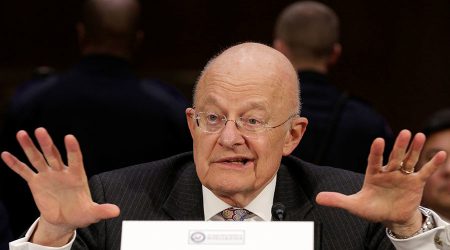
Former Director of National Intelligence (DNI) James Clapper. © Joshua Roberts / Reuters
RT | March 6, 2017
Former US Director of National Intelligence James Clapper has said on NBC’s ‘Meet the Press’ show that he is unaware of any evidence that the Russian government colluded with the Trump campaign during the US election, but still believes contacts existed.
“We didn’t include evidence in our report that had any reflection of collusion between members of the Trump campaign and the Russians. There was no evidence of that included in our report,” Clapper said, referring to a paper compiled by the NSA, FBI and CIA, together with the office of the DNI.
When asked if such proof even existed, he said: “Not to my knowledge.”
The show’s host, Chuck Todd, continued to press the issue, asking: “If [evidence] existed, it would have been in the report?”
Clapper answered that “this could have unfolded or become available in the time since I left the government. But at the time, we had no evidence of such collusion.”
Todd hinted that the public could start wondering if the situation is “all just smoke,” given the absence of a “smoking gun.”
“Well, that’s a good question. I don’t know,” Clapper responded. “I do think, though, it is in everyone’s interest, in the current president’s interests, in the Democrats’ interests, in the Republican interests, the country’s interest to get to the bottom of all of this, because it’s such a distraction. And certainly the Russians have to be chortling about the success of their efforts to sow dissension in this country.”
Clapper, however, still appeared unable to put his finger on where to look for any proof of the alleged “dissension-sowing.”
Asked if he still believed the Trump-Russia collusion claims, Clapper stated: “Yes, I do.”
Clapper is not the first to face questions over the issue of any substantial proof – or the lack thereof – of the Trump-Russia allegations.
At the end of February, the House Intelligence Committee chief, Rep. Devin Nunes, told journalists that they “still haven’t seen any evidence” of “any phone calls [between the Trump campaign and Russian officials]” but mysteriously added: “It doesn’t mean they don’t exist.”
Moscow has repeatedly denied allegations of contact with the Trump campaign, with the Kremlin spokesman lamenting that it’s become difficult to distinguish fact from fiction in the US media.
“Those reports are not based on concrete facts,” Dmitry Peskov said in mid-February, commenting on claims made by the New York Times and CNN, among others. Peskov noted that “there are five different sources in the story and none are named. So you see, really laughable stories are now given a go.”
Requiem for a Martyr: The “Blind Sheik”, Omar Abdel Rahman, Innocent Victim of Seditious Conspiracy Trial

By Karin Brothers | Global Research | March 5, 2017
“[America’s treatment of me] is a crime that history will never forgive.” – Omar Abdel Rahman
Sheik Omar Abdel Rahman, the “blind sheik”, died on the morning of February 18, 2017, near the 24th anniversary of the 1993 WTC bombing. He was an innocent victim of the US agenda to create a new enemy by engineering events that would make terrorism virtually synonymous with “Islamic fundamentalism”.
Sheik Rahman attained national fame in Egypt while he was on trial for inciting the 1981 assassination of former Egyptian President Anwar Sadat. With a passionate moral integrity, he courageously attacked the government during his two days on the stand; the intensive trial media gave him a national platform that made him famous throughout the Muslim world. His sermons were taped and traded throughout Egypt.
While he was vindicated of the charges against him, President Mubarak’s government ominously refused to give the necessary certification of the verdict and eventually drove Sheik Rahman out of Egypt. The Sheik went to Afghanistan, where he helped the CIA recruit Arab fighters to serve with the US-backed mujahadeen (he would lose at least one of his own sons there), and the Sheik was reportedly on the CIA payroll.
Sheik Rahman came to the US in 1990, hoping to remain until he could safely return to Egypt. According to Benjamin Begin in a 1993 Israel Today newsletter, Rahman’s mosques were infiltrated by FBI and Mossad operatives and would be the source of recruitment for their operations.
The World Trade Center explosion occurred on Friday, February 26th, 1993. The Sheik was soon declared deportable when some of those charged were identified as members of his mosques. The sheik was in the FBI’s crosshairs; the FBI offered Egyptian intelligence agent Emad Salem over one million dollars to entrap him.
The cagey Salem, who had become a trusted member of the Sheik’s inner circle, was aware of the obligation that the Sheik had as spiritual leader to respond to congregants’ needs. Salem blindsided the sheik by going to his home after midnight on a Sunday, pretending to be in a spiritual crisis. He claimed that he felt guilty for his years in the Egyptian military and needed to atone for his actions by attacking a target in the US — such as the United Nations. The sheik tried to fob him off and talked him out of that terrorist target; he suggested that a US military target would be more appropriate, but he told Salem to “slow down” — to cool off. Salem went home happy.
The Joint Anti-Terror Task Force and the Justice Department were allegedly dubious about whether they had evidence that would convict Rahman. The Sheik had repeatedly and publicly denounced the bombing of the WTC and claimed that he had nothing to do with it. Those who heard Emad Salem’s recorded attempt to incriminate the Sheik didn’t think it was persuasive enough to stand up in court. The FBI had tapped the Sheik’s telephones from two weeks before the WTC explosion until June, 1993; there was no evidence of any wrongdoing. The INS said he was complying with the requirements of his deportation appeal. Authorities noted that incarcerating the Sheik would be expensive because of his diabetes. A detention until appeals were completed could have lasted for months — if not for years.
Attorney General Janet Reno, who had publicly been reluctant to charge the Sheik, finally succumbed to the political pressure: pressure that also came from the Egyptian government, which still felt threatened by the Sheik’s popularity. Egyptian officials, afraid that Rahman would be deported to Egypt, wanted him safely incarcerated in the US. On July 1st, 1993, the Justice Department, while avoiding making any criminal charge, decided to take the Sheik into custody – “indefinite administrative detention” — on immigration charges.
The Egyptian conundrum
Egyptian President Hosni Mubarak was afraid of Rahman’s popularity and influence; he appeared to be worried about suffering the same fate as the Shah of Iran, deposed by a popular religious leader. Mubarak banned tapes of Sheik Rahman’s sermons; those found with copies were subject to up to five years in jail. Three thousand copies of a newspaper Al-Hayat that featured a March interview with Rahman were confiscated, and Rahman’s mosque in Fayoum was empty, guarded by a police agent.
While the Egyptian government had initially asked the Clinton administration to hold the Sheik to make sure he was not deported to Egypt, they changed their minds when they were informed that under the immigration charges, the sheik could accept his deportation voluntarily and go to any country that would take him, which could make him even more of a threat to the Mubarak government. After intense discussions, the US agreed to accept Egypt’s official extradition request, which it claimed would take precedence over the deportation charge. The only hitch was that appeals might take as long as eight years.
Mubarak was livid. He reminded the U.S. that he had hosted an Arab summit before the 1991 US-led invasion of Iraq which brought most of the Arab world onside, providing important “optics” for the engineered invasion.
Egyptian authorities were also outraged that two employees of the US Embassy had met earlier that year with prominent members of the Islamic Group, which regarded Sheik Rahman as their spiritual leader. The US seemed to be hedging its bets on Egyptian leadership so that it would not be caught out in Egypt as it had been in Iran, when Khomeini was swept into power. To add insult to injury, there was even a Congressional effort to cut back on US aid to Egypt.
President Mubarak then demonstrated to the Clinton administration who was in charge of Egypt. On July 8th, the Egyptian government hanged seven followers of Sheik Rahman for attacks against foreign tourists and for conspiring to overthrow the Mubarak government. It was the largest number of executions for a political crime in more than four decades, and it would be the start of a brutal campaign against dissidents that would last until the 2011 Arab Spring.
After witnessing Mubarak’s treatment of the Muslim Brotherhood, it was evident that Rahman’s supporters were powerless; Rahman was expendable.
US rejects political asylum for Rahman but can’t extradite him to Egypt
Meanwhile there were unforeseen complications with U.S. efforts to extradite Rahman to Egypt. While the Board of Immigration Appeals rejected Rahman’s appeal for political asylum, it appeared that his appeals would eventually reach the Supreme Court. Also, State Department officials realized that the 100-year old extradition treaty between the US and Egypt did not permit extradition based on “any crime or offense of political character.” While one official claimed that US courts were not limited by treaties, another noted that the treaty strengthened Rahman’s case for political asylum.
The Egyptian plan to ensure that Sheik Rahman would be placed under their control hit another challenge at the end of July when Afghanistan’s Prime Minister Gulbuddin Hekmatyar offered his country as a refuge for the Sheik. The Sheik’s lawyers realized that deportation might be the only way for the sheik to regain his freedom, so they contacted the office of U.S. Attorney Mary Jo White to request his deportation.
White’s office sat on the sheik’s deportation request while trying to accommodate Egypt’s demand for permanent control of the sheik. The problem was that those who were deported were free to go to any country that would accept them, but Egypt did not want the sheik in Afghanistan, where he would be free to communicate with his followers.
The “seditious conspiracy” solution
The sheik’s lawyers were still waiting for a response when, a week later, on August 25th, 1993, Attorney General Janet Reno issued an indictment for Sheik Rahman along with 14 others for “seditious conspiracy”, an obscure charge employed against political dissidents.
The 20-count, 27-page indictment claimed that one terrorist organization [which started in 1989, the year before the sheik arrived in the U.S.] was behind all of the plots and that Sheik Rahman, while not directly involved with the acts, was the “mastermind” who explicitly gave the orders. The listed plots included: plans to attack American military installations; plans to murder F.B.I. agents; plans to seize hostages to help release jailed conspirators; the 1990 killing of Rabbi Meir Kahane; the 1991 killing of Alkifah Center President Mustafa Shalabi; the 1993 WTC bombing [ambiguously included, since there was currently a separate trial for that]; the June “landmarks bombing plot”; and the plot to assassinate President Hosni Mubarak. The New York Times featured a map of the presumed terrorist targets; it appeared that New York City was under a Muslim siege.
The “seditious conspiracy” charge, which had been created to target Confederates at the end of the Civil War, was defined as when two or more people “conspire to overthrow, put down, or destroy by force the Government of the United States, or to levy war against them.” Experts noted that the broad nature of the conspiracy indictment, which did not require connecting a defendant to any specific act of violence and allowed prosecutors to bring in evidence not related to terrorist acts, made it possible to convict people with little proof (let alone evidence) of guilt. Criminal defense experts claimed that the Government was framing the case as much on the defendants’ beliefs as on any acts they may have committed.
Defense lawyers were also disturbed by the Government’s piling up of charges on a socially-isolated and demonized group, especially reviving the Kahane case just two years after El Sayid Nosair had been acquitted. Claiming that the indictment was an attempt to “create an atmosphere of fear and intimidation“, defense lawyer Ronald Kuby noted that, “What they have done is take every allegation, every rumor, every loose end and created a vast mythical Islamic conspiracy. They have created a case that is so big and complicated that it is impossible to defend, impossible to understand, and impossible for any of these defendants to get a fair trial.”
Emad Salem’s tapes
Defense lawyers claimed that Emad Salem entrapped their clients by hiring them for his plots, then taped them making incriminating statements. Salem’s tapes, on which most of this trial would be based, would also include two FBI admissions of overseeing the provision of the WTC explosives. Ron Kuby requested that all of Salem’s tapes collected as evidence (which also showed the FBI’s unsavory ways of doing business) be released in their entirety to the public to expose the case as a conspiracy to frame the defendants. Judge Michael B. Mukasey, (who would be named Attorney General in 2007), refused to allow the tapes to be made public.
The seditious conspiracy trial would be delayed until January, 1995, and corresponded in time to the televised O.J. Simpson trial, which contributed to its lack of media coverage, despite being touted as the terror trial of the century. The year and a half between the defendants’ arrests and their trial gave the Government and courts time to strip the sheik and other defendants of Constitutional rights, including the Sixth Amendment right to counsel, the Fourth Amendment right against unwarranted search and seizure, and other basic freedoms. The homes of two of Rahman’s paralegals would be raided for information against him, and dissident reading material found in defendants’ homes that was deemed “anti-American” or showed “hatred of Jews” could be used as evidence against them.
The seditious conspiracy trial
As with the first World Trade bombing trial, there would be no change of venue, the jury would be unsequestered and — supposedly to protect them from Muslim terror threats — would be identified only by number; their names would never be made public. None of the jury was Muslim.
The media during the entirety of this trial would be filled with various terror stories. The seditious conspiracy trial had barely started when the “mastermind” of the WTC bombing, Ramzi Yousef, arrived in New York with huge media fanfare. Mukasey asked the jury on the day after Yousef’s arrival if their opinions were changed by this media coverage. He immediately determined that they weren’t, but ignored the subsequent barrage of prejudicial media exposure that lasted throughout this trial. Some of Yousef’s publicity should have helped the defendants because Yousef, who didn’t know sheik Rahman, made statements that should have exonerated Rahman and others. Unfortunately Yousef refused to testify at this trial and Judge Mukasey would not permit the defense counsel access to Yousef’s documents that the FBI had taken.
The Oklahoma City bombing, which occurred six weeks later in mid-April, was initially claimed to be similar to the WTC bomb, and due to Muslim terrorism. Mukasey “assumed” that the jury would not be affected by the anti-Muslim media, although the defendants received heightened physical protection in their detention center.
That June, the actual driver of the bomb-laden Ryder van came to media attention and in August, there was media fanfare with his extradition to the U.S.
Sheik Rahman’s (nonexistent) Constitutional rights
Prosecution attention turned to the Sheik’s sermons to show his attitude towards the U.S. as well as his leadership in the Muslim community. Many of the Sheik’s sermons, which encouraged the devout to fight enemies of Islam and God, were read out in an effort to criminalize what should have been his freedoms of speech and belief.
Mukasey barred witnesses that would have shown the role of politics behind the arrest of Sheik Rahman, that would have testified that Rahman was not the radical that the media had described, and that would have provided a clearer understanding of Muslim terms (such as jihad and fatwa) that were being used against the defendants. Mukasey’s rulings were devastating to the Sheik’s defense.
The defense lawyers tried to introduce sealed material from the previous WTC trial that would show the lengths to which the FBI had gone to implicate as well as convict the previous defendants in the World Trade Center trial. Although that material was not produced, FBI scientist Fredrick Whitehurst’s subsequent testimony about the FBI’s incompetence, perjury and obstruction of justice that facilitated the convictions of the four charged in the WTC bombing did tell part of that story.
The Government’s desperation to find damaging information on Sheik Rahman was evident in the arrest of his paralegal at the end of April. The authorities’ claim that Nasser Ahmed’s overstay on a student visa “just came to our attention”, was contradicted by an FBI agent’s message to Ahmed that if he did not cooperate with the FBI, he would be deported to Egypt. After being charged with “secret evidence” and spending three years in solitary confinement, Ahmed would not be released until 1999.
The verdicts
Since this trial showed that there was little evidence that any of the defendants were guilty of any untried crime that had taken place, the prosecution tried to criminalize Islam; it described the defendants as a frightening “jihad army”: foreigners of a mysterious, militant culture. Judge Mukasey assured the jurors they could find that there was a single conspiracy despite the differing defendants and plots, “so long as you find that some of the conspirators continued for the entire duration of the conspiracy to act for the purposes charged in the indictment.”
After deliberating for seven days, the jury returned on October 1, 1995 with guilty verdicts for 48 out of the 50 charges. Sheik Rahman’s lawyer Lynne Stewart broke down and cried.
The defense cries “foul” and calls for a mistrial
The defense counsel immediately called for a mistrial because they believed that the problems with the trial were so egregious. It was clear that the FBI made use of Egypt’s intelligence agent as an agent provocateur to carry out its own agenda. Some defendants claimed that exculpatory conversations were missing from the tapes; the FBI admitted that they had “briefly” returned the tapes to Salem after they had been entered as evidence.
Judge Mukasey told the defense lawyers that he would consider their request to hold a post-trial hearing on the issue of whether he should overturn the convictions. But on January 10, 1996, he rejected the defense motion to throw out the convictions of Sheik Omar Abdel Rahman and nine others, claiming that there was no proof that the evidence that Salem had destroyed would have helped exonerate the defendants. Mukasey ignored Salem’s obvious motive for destroying evidence and the FBI’s interest in wanting him to do it.
Mukasey was determined to make an example of these “terror” defendants. While the sentence for seditious conspiracy was 20 years, Mukasey used that as a starting point, and added the other charges on top of that. He used his discretionary powers to make each part of the sentences sequential rather than concurrent; the sentences ranged from 30 years to life.
Sheik Rahman was sentenced to life. Worse, the government silenced Rahman even further by new “Special Administration Measures” which allowed them to essentially isolate him totally. To facilitate that agenda, it taped what were supposed to be his private conversations with his lawyer Lynne Stewart, and would imprison her for trying to circumvent the restrictions.
The obscure conspiracy law came into its own
The prosecution congratulated itself on its use of the seditious conspiracy charge. The verdict showed that the conspiracy law provided them with an easy venue to obtain verdicts with little evidence and for which no crimes had occurred. The conspiracy charge would become the mechanism to convict Muslims in future terror trials because of the low standards required of any individual’s involvement.
The price
This trial demonstrated how the efforts of the government, the courts and the media — particularly the New York Times — ensured that the Muslim defendants could not obtain a fair trial. The New York Times enabled convictions in all of these related trials by maligning the defendants with anonymous government leaks, generally using biased and inflammatory language to describe them, and invariably assuming their guilt.
The injustice of these convictions and the fruitless appeals have been clear to those following the cases. While few Americans seem to be aware of the injustice, it has not been lost on the worldwide Muslim community. There were various actions designed to free Sheik Rahman, including the 2005 kidnapping of the four Christian Peacemaker Team members in Iraq: Tom Fox (who died), James Loney, Norman Kember and Harmeet Singh Sooden.
The world lost a passionate voice for moral integrity with the silencing of Sheik Omar Abdel Rahman, and his death before attaining justice was tragic. His passing should provide Americans the opportunity to understand how FBI-monitored acts were used to eliminate Constitutional rights to freedom of speech, freedom of belief, the right against unreasonable search and seizure, the right to counsel, and protection from cruel and unusual punishment. By ignoring the elimination of Muslim rights, Americans are laying the groundwork for the elimination of their own.
Karin Brothers is a freelance writer.
Copyright © Karin Brothers, Global Research, 2017
FBI Rigged Investigation of Black Panthers, Newly Released Docs Reveal
Sputnik – 03.03.2017
Newly-released FBI files reveal that authorities tampered with an investigation into a police officer’s death in the 1970s, resulting in a Black Panther leader dying in prison for a crime he did not commit.
In 1970, Mondo Even we Langa (formerly David Rice) was one of 17 people arrested in connection with a bombing that killed Omaha police officer Larry Minard, eventually serving a life sentence for the murder.
At the time, Mondo was deputy of information for Omaha’s National Committee to Combat Fascism, an affiliate group of the Black Panther Party, and unbeknownst to him, FBI Director J. Edgar Hoover had placed him on a secret detention list and ordered agents to neutralize him.
Nearly 50 years after his conviction, heavily-redacted documents show that the agency called off a search for Minard’s killer just days before his funeral, and canceled the testing of the call that lured the officer to his death, which indicated 15-year-old Duane Peak as a lead suspect.
The San Francisco Bayview quotes one of the documents saying, “Special Agents of the FBI in conjunction with members of the Omaha Police Department arrested [Duane Peak].” and “Captain [Hartford] advised that the Police Department was in the process of obtaining a search warrant … and that he would advise the FBI as to the results.” Another section read,”Captain [Hartford] requested our assistance in interviewing [REDACTED] for any information he may have regarding the bomb slaying.”
Although the documents indicate deep cooperation between the FBI and Omaha police, officials testified that the agency had no involvement in the investigation.
In 1982, New Jersey Congressman Richard Roe requested an FBI report on the investigation. Two weeks later Roger Young, assistant director in charge at the Office of Congressional and Public Affairs, replied to Roe claiming, “The investigation of these two individuals was conducted by the Omaha Police Department and the trial was held in state District Court, not in a federal court. … I am, therefore, not in a position to furnish you a report.”
Some documents are missing from the files, and Mondo’s co-defendant and former NCCF chair, Edward Poindexter, remains imprisoned in a maximum-security facility.
The “Omaha Two,” as Poindexter and Mondo have been referred to, appear to be the targets of Hoover’s Counterintelligence Program (COINTELPRO), a wide-ranging effort to infiltrate, disrupt, and neutralize many activist groups of the period. Many Black Panthers and other radical activists were monitored, set up for crimes they did not commit, railroaded into prison and assassinated, as a result of the program.
In 1969, the ‘Panther 21’ were indicted on conspiracy charges in New York for allegedly plotting to bomb police stations and assassinate police officers. The hotly-contested eight-month trial resulted in all 21 Panthers being acquitted, thanks, in no small part, to the work of one the defendants, Afeni Shakur, mother of late rapper Tupac Shakur.
That same year, informant William O’Neal provided Chicago police with the floor plan to Chicago Panther leader Fred Hampton’s house. Police raided Hampton’s house in the wee hours of the early morning, killing him in his sleep. They later claimed that Panthers opened fire on them.
Mondo died in prison in March 2016.
The Did-You-Talk-to-Russians Witch Hunt
By Robert Parry | Consortium News | February 18, 2017
In the anti-Russian frenzy sweeping American politics and media, Democrats, liberals and mainstream pundits are calling for an investigative body that could become a new kind of House Un-American Activities Committee to hunt down Americans who have communicated with Russians.
The proposed commission would have broad subpoena powers to investigate alleged connections between Trump’s supporters and the Russian government with the apparent goal of asking if they now have or have ever talked to a Russian who might have some tie to the Kremlin or its intelligence agencies.
Such an admission apparently would be prima facie evidence of disloyalty, a guilt-by-association “crime” on par with Sen. Joe McCarthy’s Cold War pursuit of “communists” who supposedly had infiltrated the U.S. government, the film industry and other American institutions.
Operating parallel to McCarthy’s Red Scare hearings was the House Un-American Activities Committee (or HUAC), a standing congressional panel from 1945-1975 when it was best known for investigating alleged communist subversion and propaganda. One of its top achievements was the blacklisting of the “Hollywood Ten” whose careers in the movie industry were damaged or destroyed.
Although the Cold War has long been over – and Russia has often cooperated with the U.S. government, especially on national security issues such as supplying U.S. troops in Afghanistan – Democrats and liberals seem ready to force Americans to again prove their loyalty if they engaged in conversations with Russians.
Or perhaps these “witnesses” can be entrapped into perjury charges if their recollections of conversations with Russians don’t match up with transcripts of their intercepted communications, a tactic similar to ones used by Sen. McCarthy and HUAC to trip up and imprison targets over such secondary charges.
Ousted National Security Advisor Michael Flynn has already encountered such a predicament because he couldn’t recall all the details of a phone conversation with Russian Ambassador Sergey Kislyak on Dec. 29, 2016, after Flynn took the call while vacationing in the Dominican Republic.
When Obama administration holdovers at the Justice Department decided to gin up a legal premise to go after Flynn, they cited the Logan Act, a law enacted in 1799 to prohibit private citizens from negotiating with foreign adversaries but never used to convict anyone. The law also is of dubious constitutionality and was surely never intended to apply to a president-elect’s advisers.
However, based on that flimsy pretext, FBI agents – with a transcript of the electronic intercept of the Kislyak-Flynn phone call in hand – tested Flynn’s memory of the conversation and found his recollections incomplete. Gotcha – lying to the FBI!
Under mounting media and political pressure, President Trump fired Flynn, apparently hoping that tossing Flynn overboard to the circling sharks would somehow calm the sharks down. Instead, blood in the water added to the frenzy.
Iran-Contra Comparison
Some prominent Democrats and liberals have compared Trump-connected contacts with Russians to President Richard Nixon’s Watergate scandal or President Reagan’s Iran-Contra Affair, an issue that I know a great deal about having helped expose it as a reporter for The Associated Press in the 1980s.
The key difference is that Iran-Contra was an unconstitutional effort by the Reagan administration to finance an illegal war against Nicaragua’s Sandinista government in defiance of a congressional ban. The Trump-connected communications with Russians – to the degree they have occurred – appear to have been aimed at preventing a new and dangerous Cold War that could lead to a nuclear holocaust.
In other words, Iran-Contra was about enabling a paramilitary force to continue its brutal marauding inside a country that was no threat to the United States while the current “scandal” is about people trying to avoid hostilities between two nuclear superpowers, an existential threat that many mainstream and liberal pundits don’t want to recognize.
Indeed, there is a troubling denial-ism about the risks of an accidental or intentional war with Russia as the U.S. media and much of Official Washington’s establishment have lots of fun demonizing Russian President Vladimir Putin and jabbing the Russians by shoving NATO troops up to their borders and deploying anti-ballistic missiles in Eastern Europe. For some crazy reason, the Russians feel threatened.
False Narratives
This Russia-bashing and Russia-baiting have been accompanied by false narratives presented in the major U.S. newspapers, including The New York Times and The Washington Post, to justify increased tensions.
For instance, the Post’s senior foreign affairs writer Karen DeYoung on Friday described the civil war in Ukraine this way: “That conflict began when Russia invaded and annexed Crimea in 2014, then backed separatists in eastern Ukraine in what has become a grinding war, despite a deal to end it, called the Minsk agreement, negotiated with Putin by the leaders of France and Germany.”
But DeYoung’s synopsis is simply not true. The crisis began in the fall of 2013 when Ukraine’s elected President Viktor Yanukovych backed out of what he regarded as a costly and unacceptable association agreement with the European Union, a move which prompted protests by Ukrainians in Kiev’s Maidan square.
The Obama administration’s State Department, U.S. neocon politicians such as Sen. John McCain, and various U.S.-backed “non-governmental organizations” then stoked those protests against Yanukovych, which grew violent as trained ultra-nationalist and neo-Nazi street fighters poured in from western Ukraine.
In early 2014, a coup to overthrow the democratically elected Yanukovych took shape under the guidance of U.S. Assistant Secretary of State Victoria Nuland and U.S. Ambassador to Ukraine Geoffrey Pyatt who were caught in a phone call in late January or early February 2014 conspiring to impose new leadership inside Ukraine.
Nuland disparaged a less extreme strategy favored by European diplomats with the pithy remark: “Fuck the E.U.” and went on to declare “Yats is the guy,” favoring Arseniy Yatsenyuk as the new leader. Nuland then pondered how to “glue this thing” while Pyatt ruminated about how to “midwife this thing.”
On Feb. 20, 2014, a mysterious sniper apparently firing from a building controlled by the ultranationalist Right Sektor killed both police and protesters, setting off a day of violence that left about 70 people dead including more than a dozen police.
The next day, three European governments struck a deal with Yanukovych in which he agreed to early elections and accepted reduced powers. But that political settlement wasn’t enough for the U.S.-backed militants who stormed government buildings on Feb. 22, forcing Yanukovych and his officials to flee for their lives.
Instead of standing by the Feb. 21 agreement, which the European nations had “guaranteed,” Nuland pushed for and got U.S. allies to accept the new post-coup regime as “legitimate,” with Yatsenyuk becoming prime minister and several top government posts given to the ultranationalists and neo-Nazis.
Spreading Violence
In the ensuing days, the right-wing violence spread beyond Kiev, prompting Crimea’s legislature to propose secession from Ukraine and readmission to Russia, whose relationship to the peninsula dated back to Catherine the Great.
Crimea scheduled a referendum that was opposed by the new regime in Kiev. Russian troops did not “invade” Crimea because some 20,000 were already stationed there as part of a basing agreement at the Black Sea port of Sevastopol. The Russians did provide security for the referendum but there was no evidence of intimidation as the citizens of Crimea voted by 96 percent to leave Ukraine and rejoin Russia, a move that Putin and the Russian duma accepted.
Eastern Ukrainians tried to follow Crimea’s lead with their own referendum, but Putin and Russia rejected their appeals to secede. However, when the Kiev regime launched an “Anti-Terrorism Operation” against the so-called Donbass region – spearheaded by ultra-nationalist and neo-Nazi militias – Russia provided military assistance so these ethnic Russians would not be annihilated.
Karen DeYoung also framed the Minsk agreement as if it were imposed on Putin when he was one of its principal proponents and architects, winning its approval in early 2015 at a time when the Ukrainian military was facing battlefield reversals.
But Assistant Secretary Nuland, working with Prime Minister Yatsenyuk and the Ukrainian parliament, sabotaged the agreement by requiring the Donbass rebels to first surrender which they were unwilling to do, having no faith in the sincerity of the Kiev regime to live up to its commitment to grant limited autonomy to the Donbass.
In other words, Kiev inserted a poison pill to prevent a peaceful resolution, but the Western media and governments always blame the Minsk failure on Putin.
If Karen DeYoung wanted to boil all this history down to one paragraph, it might go: “The Ukraine conflict began when U.S. officials supported the violent overthrow of elected President Viktor Yanukovych, prompting Crimea to rejoin Russia and causing ethnic Russians in the east to rise up against the U.S.-backed coup regime in Kiev, which then sought to crush the rebellion. The Kiev regime later torpedoed a peace deal that had been hammered out by Russian, Ukrainian and European negotiators in Minsk.”
But such a summary would not have the desired propaganda effect on the American people. It would not present the U.S.-backed side as the “white hats” and the pro-Russia side as the “black hats.”
The simple truth is that the story of Ukraine is far more complex and multi-sided than The Washington Post, The New York Times and most mainstream U.S. news outlets want to admit. They simply start the clock at the point of Crimea’s rejection of the post-coup regime and distort those facts to present the situation simply as a “Russian invasion.”
A Whipped-Up Hysteria
The major media’s distortion is so egregious that you could call it a lie, but it is a lie that has proved very useful in whipping up the current anti-Russian hysteria that is sweeping Official Washington and that has given birth to a New Cold War, now accompanied by a New McCarthyism that deems anyone who doesn’t accept the “groupthink” a “Russian apologist” or a “Moscow stooge.”
Since last November’s election, this New McCarthyism has merged with hatred toward Donald Trump, especially after the outgoing Obama administration lodged unproven accusations that Russia undercut Hillary Clinton’s campaign by hacking into the emails of the Democratic National Committee and those of her campaign chairman John Podesta – and slipped that information to WikiLeaks.
Those emails showed how the DNC undercut the rival campaign of Sen. Bernie Sanders and revealed the contents of Clinton’s speeches to Wall Street banks as well as pay-to-play aspects of the Clinton Foundation, information that Clinton wanted to keep from the voters.
But no one thought the emails were a major factor in the Clinton-Trump race; indeed, Clinton blamed her stunning defeat on FBI Director James Comey’s last-minute decision to reopen and then re-close his investigation into security concerns about her use of a private email server as Secretary of State.
But the script on how Clinton lost was flipped during the Trump transition as President Obama’s intelligence agencies floated the Russia-hacked-the-election scenario although presenting no public evidence to support the claims. WikiLeaks representatives also denied getting the material from Russia, suggesting instead that it was leaked by two different American insiders.
A Ministry of Truth
Still, during the post-election period, the anti-Russian hysteria continued to build. In November, The Washington Post highlighted claims by an anonymous group called PropOrNot accusing some 200 Web sites, including Consortiumnews.com and other major independent media outlets, of disseminating Russian “propaganda.”
The New York Times joined in the frenzy by calling for leading technology companies to marginalize Web sites that are deemed to be publishing “fake news,” a vague term that was applied not just to intentionally false stories but to information that questioned official narratives, no matter how dubious those narratives were. The New McCarthyism was morphing into a New Orwellianism.
The movement toward a Ministry of Truth gained further momentum in December when Congress passed and President Obama signed a military authorization bill that included a new $160 million bureaucracy to identify and counter alleged “Russian propaganda.”
The anger of Democrats and liberals toward President Trump in his first month has added more fuel to the Russia-bashing with some Democrats and liberals seeing it as a possible route toward neutralizing or impeaching Trump. Thus, the calls for a full-scale investigation with subpoena power to demand documents and compel testimony.
While the idea of getting to the full truth has a superficial appeal, it also carries dangers of launching a witch hunt that would drag American citizens before inquisitors asking about any contacts – no matter how innocuous – with Russians.
In the late 1940s and early 1950s, HUAC also claimed that all it wanted was the truth about whether some Americans were allied with or sympathetic to Moscow. Sen. Joe McCarthy offered a similar rationale when he was trying to root out “disloyal” Americans with the question, “are you now or have you ever been a communist?”
That Democrats and liberals who hold the McCarthy era in understandable disdain would now seek to rekindle something similar reeks of rank opportunism and gross hypocrisy – doing whatever it takes to “get Trump” and build an activist movement that can revive the Democratic Party’s flagging political hopes.
But this particular opportunism and hypocrisy also carries with it the prospect of blindly ramping up tensions with Russia, diverting more taxpayer money into the Military-Industrial Complex and conceivably sparking – whether planned or unplanned – a nuclear Armageddon that could eliminate life on the planet. Perhaps this anti-Trump strategy should be rethought.
Investigative reporter Robert Parry broke many of the Iran-Contra stories for The Associated Press and Newsweek in the 1980s.
Pulling a J. Edgar Hoover on Trump
By Robert Parry | Consortium News | January 12, 2017
The decision by the U.S. intelligence community to include in an official report some unverified and salacious accusations against President-elect Donald Trump resembles a tactic out of FBI Director J. Edgar Hoover’s playbook on government-style blackmail: I have some very derogatory information about you that I’d sure hate to see end up in the press.
In this case, as leaders of the U.S. intelligence community were pressing Trump to accept their assessment that the Russian government had tried to bolster Trump’s campaign by stealing and leaking actual emails harmful to Hillary Clinton’s campaign, Trump was confronted with this classified “appendix” describing claims about him cavorting with prostitutes in a Moscow hotel room.
Supposedly, Director of National Intelligence James Clapper and CIA Director John Brennan included the unproven allegations in the report under the rationale that the Russian government might have videotaped Trump’s misbehavior and thus could use it to blackmail him. But the U.S. intelligence community also had reasons to want to threaten Trump who has been critical of its performance and who has expressed doubts about its analysis of the Russian “hacking.”
After the briefing last Friday, Trump and his incoming administration did shift their position, accepting the intelligence community’s assessment that the Russian government hacked the emails of the Democratic National Committee and Clinton’s campaign chief John Podesta. But I’m told Trump saw no evidence that Russia then leaked the material to WikiLeaks and has avoided making that concession.
Still, Trump’s change in tone was noted by the mainstream media and was treated as an admission that he was abandoning his earlier skepticism. In other words, he was finally getting onboard the intelligence community’s Russia-did-it bandwagon. Now, however, we know that Trump simultaneously had been confronted with the possibility that the unproven stories about him engaging in unorthodox sex acts with prostitutes could be released, embarrassing him barely a week before his inauguration.
The classified report, with the explosive appendix, was also given to President Obama and the so-called “Gang of Eight,” bipartisan senior members of Congress responsible for oversight of the intelligence community, which increased chances that the Trump accusations would be leaked to the press, which indeed did happen.
Circulating Rumors
The stories about Russian intelligence supposedly filming Trump in a high-end Moscow hotel with prostitutes have been circulating around Washington for months. I was briefed about them by a Hillary Clinton associate who was clearly hopeful that the accusations would be released before the election and thus further damage Trump’s chances. But the alleged video never seemed to surface and the claims had all the earmarks of a campaign dirty trick.
However, now the tales of illicit frolic have been elevated to another level. They have been inserted into an official U.S. intelligence report, the details of which were leaked first to CNN and then to other mainstream U.S. news media outlets.
Trump has denounced the story as “fake news” and it is certainly true that the juicy details – reportedly assembled by a former British MI-6 spy named Christopher Steele – have yet to check out. But the placement of the rumors in a U.S. government document gave the mainstream media an excuse to publicize the material.
It’s also allowed the media to again trot out the Russian word “compromat” as if the Russians invented the game of assembling derogatory information about someone and then using it to discredit or blackmail the person.
In American history, legendary FBI Director J. Edgar Hoover was infamous for using his agency to develop negative information on a political figure and then letting the person know that the FBI had the dirt and certainly would not want it to become public – if only the person would do what the FBI wanted, whether that was to reappoint Hoover to another term or to boost the FBI’s budget or – in the infamous case of civil rights leader Martin Luther King – perhaps to commit suicide.
However, in this case, it is not even known whether the Russians have any dirt on Trump. It could just be rumors concocted in the middle of a hard-fought campaign, first among Republicans battling Trump for the nomination (this opposition research was reportedly initiated by backers of Sen. Marco Rubio in the GOP race) before being picked up by Clinton supporters for use in the general election.
Still, perhaps the more troubling issue is whether the U.S. intelligence community has entered a new phase of politicization in which its leadership feels that it has the responsibility to weed out “unfit” contenders for the presidency. During the general election campaign, a well-placed intelligence source told me that the intelligence community disdained both Clinton and Trump and hoped to discredit both of them with the hope that a more “acceptable” person could move into the White House for the next four years.
Hurting Both Candidates
Though I was skeptical of that information, it did turn out that FBI Director James Comey, one of the top officials in the intelligence community, badly damaged Clinton’s campaign by deeming her handling of her emails as Secretary of State “extremely careless” but deciding not to prosecute her – and then in the last week of the campaign briefly reopening and then re-closing the investigation.
Then, after the election, President Obama’s CIA began leaking allegations that Russian President Vladimir Putin had orchestrated the hacking of Democratic emails and provided them to WikiLeaks to reveal how the DNC undermined Sen. Bernie Sanders’s campaign and what Clinton had told Wall Street bigwigs in paid speeches that she had sought to keep secret from the American people.
The intelligence community’s assessment set the stage for what could have been a revolt by the Electoral College in which enough Trump delegates could have refused to vote for him to send the election into the House of Representatives, where the states would choose the President from one of the top three vote-getters in the Electoral College. The third-place finisher turned out to be former Secretary of State Colin Powell who got four votes from Clinton delegates in Washington State. But the Electoral College ploy failed when Trump’s delegates proved overwhelmingly faithful to the GOP candidate.
Now, we are seeing what looks like a new phase in this “stop (or damage) Trump” strategy, the inclusion of anti-Trump dirt in an official intelligence report that was then leaked to the major media.
Whether this move was meant to soften up Trump or whether the intelligence community genuinely thought that the accusations might be true and deserved inclusion in a report on alleged Russian interference in U.S. politics or whether it was some combination of the two, we are witnessing a historic moment when the U.S. intelligence community has deployed its extraordinary powers within the domain of U.S. politics. J. Edgar Hoover would be proud.
Investigative reporter Robert Parry broke many of the Iran-Contra stories for The Associated Press and Newsweek in the 1980s.
Featured Video

Bombing Hitler’s Hometown
or go to
Aletho News Archives – Video-Images
From the Archives
‘Conspiracy Theory’ Now Fact: Greater Israel Has Arrived
By Kit Klarenberg | Mint Press News | January 28, 2025
Ever since Tel Aviv’s 1948 creation, much has been said and written about ‘Greater Israel’ – the notion Zionism’s ultimate end goal is the forcible annexation and ethnic cleansing of vast swaths of Arab and Muslim lands for Jewish settlement, based on Biblical claims this territory was promised to Jews by God. The mainstream media typically dismisses this concept as antisemitic conspiracy theory, or at most the fringe fantasy of a minuscule handful of extremist Israelis.
In reality … continue
Blog Roll
 Aletho News
- IRGC: Israeli, US universities in region legitimate targets after strikes on Iranian university
- Trump admits Iran hit USS Ford carrier: ‘We ran for our lives’
- Battle for Hungary: EU attacks on Orban are a sign of worse things to come
- Iraqi resistance conducts drone strike on US-run base in Syria
- Failing to Defeat Hezbollah, Israel & US Pressure Syria’s Ahmed al-Sharaa to Join War
- US-Israeli war on Iran drives global fertilizer prices up 40%
- Hezbollah’s Surprise Weapons Redefine Ground Battle with Israel
- Yemen joins fight against US, Israel by firing missiles at occupied territories
- Seizing the Kharg: Washington’s path to defeat in the Persian Gulf
- Iran reports 500 US casualties in strikes on covert US military sites
- If Americans Knew
- Over 300 US service members wounded, majority have brain injuries – Not a ceasefire Day 169
- Researchers at Human Rights Watch Resign Over Blocked Report on Palestinian Refugee Return
- Jewish Groups Are Backing a War Americans Don’t Want
- Eric Fingerhut Thinks He’s the President of the Jews
- Top Jewish Philanthropists, Rabbis Urge Israeli President to Take Action Against ‘Jewish Extremists’
- Don’t Be Fooled. Zionist Leaders Have Always Wanted to Control Southern Lebanon
- Israel’s widespread use of torture is a core element of its genocide against the Palestinian people
- In Israel’s War on Iran, Many Middle East US Bases Rendered “All But Uninhabitable”
- ‘Burn the lawn’: Israel pursues ‘Rafah model’ in southern Lebanon
- A genocide here, an amputation there
- No Tricks Zone
- Devastating Assessment Of Comirnaty Vaccine By Former Senior Pfizer Europe Toxicologist
- New Study: CO2 Is ‘Effectively Negligible’ As An Explanatory Climate Change Factor Since 2000
- Former Pfizer Toxicologist Dr. Helmut Sterz Tells Bundestag Hearing Pfizer Vaccine Should Have Never Been Approved
- Energy Expert: Germany’s Nuclear Phaseout Was A “500 Billion Euro Mistake”
- New Research: South Australia’s Mid-Holocene Sea Surface Temperatures Were 4°C Warmer Than Today
- Storing Green Energy To Last Germany 10 Days Would Require A 60-Million Tonne Battery
- New Studies: UK Sea Levels Were 4 Meters Higher Than Today During The Mid-Holocene
- Destructive Green New Deal: German Energy And Metal Group Warns Of Drastic Crisis
- New Study Documents A 20-Year Pause In Arctic Sea Ice Decline – Driven By Internal Variability
- Wake-up Call: Survey Shows Majority Of Germans Now Favor Postponing Climate Targets!
 Aletho News