Seven US allies endorse Hormuz ‘coalition,’ offer ‘no commitment’ for military action
The Cradle | March 20, 2026
The UK, France, Germany, Italy, the Netherlands, Japan, and Canada issued a joint statement on 20 March in support of a potential “coalition” to reopen the Strait of Hormuz, while specifying “no commitment” to a concrete military role.
“We express our readiness to contribute to appropriate efforts to ensure safe passage through the strait,” the close US allies announced.
The joint statement did not, however, touch on any military involvement or the commitment of any forces to the initiative.
One political reporter writing for Axios said the statement was “largely a gesture to placate [US] President [Donald] Trump, who has railed against allies for declining to help secure the strait and warned that a failure to do so could undermine the future of NATO.”
The allies condemned attacks on commercial vessels and energy infrastructure, citing “the de facto closure of the Strait of Hormuz by Iranian forces,” and called on Tehran to “cease immediately its threats, laying of mines, drone and missile attacks and other attempts to block the strait.”
Italian Prime Minister Giorgia Meloni said no state is considering “a military mission to forcibly break the Iranian blockade,” adding the EU favors “diplomacy and de-escalation.”
She clarified that any contribution would apply to a “post-conflict phase” and require agreement among all parties.
Other governments echoed this position, with Germany confirming “no military participation,” while France said its deployments remain strictly defensive.
The UK ruled out a NATO mission, focusing instead on negotiations, though it has sent planners to coordinate options.
Despite the political backing and global panic over soaring energy prices , maritime data shows the strait is only partially restricted, as roughly 90 vessels crossed in early March.
Iran has established a controlled “safe” shipping corridor through its territorial waters in the Strait of Hormuz, allowing only approved vessels – mainly from countries like India, Pakistan, China, Iraq, and Malaysia – to transit after IRGC vetting, while ships linked to the US or Israel are effectively excluded.
Access is currently negotiated on a case-by-case basis but is moving toward a formal system requiring detailed disclosures of ownership and cargo, often coordinated through intermediaries and, in at least one case, involving a reported $2-million payment.
So far, at least nine vessels have used the route, which passes near Larak Island for inspection, but traffic remains minimal.
The US remains largely the only country carrying out direct military operations, deploying forces and striking Iranian positions along the strait, as well as conducting offensive strikes inside Iran.
Earlier US-led efforts to secure regional shipping routes followed a similar trajectory, with coalitions struggling to gain meaningful participation as several allies refused or limited involvement, leaving only a small number of naval deployments.
Efforts to secure maritime routes during the Israeli genocide on Gaza in 2024 faced the same constraints, as US and EU resources proved insufficient to deter Yemeni strikes across the Red Sea.
Officials had warned that strikes on Yemen were “not contributing to the solution,” while Yemeni attacks on vessels continued, raising pressure on global trade routes.
Yemeni forces maintained their stance as a support front for Gaza, persisting with attacks until Washington ended its campaign under an Omani-brokered truce, with President Trump claiming Yemeni forces “don’t want to fight anymore.”
‘Not our war’: Trump’s naval coalition to reopen Strait of Hormuz dead in the water
The Cradle | March 16, 2026
Several countries have either rejected or expressed serious concerns about US President Donald Trump’s plan to form a coalition aimed at escorting vessels through the Strait of Hormuz, which Tehran has closed to Washington and its allies in retaliation for the brutal US-Israeli strikes on the Islamic Republic.
Germany’s Minister for Foreign Affairs, Johann Wadephul, said on 15 March that he was “skeptical” of Trump’s plan.
“Will we soon be an active part of this conflict? No,” he went on to say.
German Defense Minister Boris Pistorius said, “What does Trump expect a handful of European frigates to do that the powerful US Navy cannot?” adding, “This is not our war, and we did not start it.”
Meanwhile, France officially rejected the US request to send warships to the Strait of Hormuz.
The French Foreign Ministry rejected reports that it was gearing up to send vessels, saying, “No. The carrier strike group remains in the Eastern Mediterranean. France’s position remains unchanged: defensive and protective.”
Australia has also denied the request, as have Japan, China, Norway, and Spain. The UK and South Korea said they were reviewing options.
The US president had demanded that NATO states join his proposed coalition, threatening that they would face a “very bad future” if they did not.
Trump had also expressed hope that “China, France, Japan, South Korea, the UK, and others, that are affected by this artificial constraint, will send ships to the area so that the Hormuz Strait will no longer be a threat by a nation that has been totally decapitated.”
Iran has closed the Strait of Hormuz to Washington and its allies in response to the US-Israeli war against the Islamic Republic. Several vessels trying to cross in violation of Iranian warnings have been targeted.
A number of countries have reached out to Tehran for access to the Strait, through which 20 to 30 percent of the world’s energy passed prior to the war.
India has confirmed that two of its ships passed after talks with Iran. Tehran also allowed a Turkish vessel to pass through the strait.
“The Strait of Hormuz has not been militarily blocked and is merely under control,” said Alireza Tangsiri, naval commander of the Islamic Revolutionary Guard Corps (IRGC).
Iranian Foreign Minister Abbas Araghchi stated, “The Strait of Hormuz is open. It is only closed to the tankers and ships belonging to our enemies, to those who are attacking us and their allies. Others are free to pass.”
After Yemen began its pro-Palestine blockade in the Red Sea following the start of the Gaza genocide in 2023, Washington launched a naval operation under the name Prosperity Guardian – aimed at deterring Sanaa’s forces and facilitating the transit of vessels.
The US failed to secure enough partners, and the mission ultimately failed.
The Ansarallah-led Yemeni Armed Forces (YAF) has recently vowed that it is ready to intervene alongside Iran’s other allies – meaning the potential closure of another vital energy route, the Bab al-Mandab strait.
Macron’s aircraft carrier and warplanes to the Persian Gulf is a dangerous vanity project
By Finian Cunningham | Strategic Culture Foundation | March 12, 2026
Like a knight in shining armour, French President Emmanuel Macron is vowing to defend Europe’s interests as the U.S.-Israeli war on Iran escalates.
Macron is not defending Europe or French honor. His theatrical swashbuckling is going to get more people killed and very possibly make the economic impact on Europe even more disastrous.
On a visit to Cyprus this week, Macron declared that a strike on Cyprus was a strike on Europe. He was referring to drone attacks on a British air base on the Mediterranean island last week that were blamed on Iran. It’s not clear who fired the drones at a time when false-flag operations are suspected in Turkey and Azerbaijan, carried out by Israeli forces seeking to embroil the region.
The French president was also filmed inspecting troops on board the Charles de Gaulle, France’s sole aircraft carrier, which he said is being sent along with 12 other warships to the Strait of Hormuz. The aircraft carrier was abruptly redirected from NATO exercises in the Atlantic to the Mediterranean.
The Strait of Hormuz has been closed to oil tankers since the U.S. and Israel launched their aggression on Iran two weeks ago. Europe is particularly vulnerable to oil price shocks and diminishing supply since the EU cut itself off from Russian energy markets over the proxy war in Ukraine.
In addition to the French armada being dispatched to the Persian Gulf, Macron has also ordered Rafale fighter jets to “defend the skies” over the United Arab Emirates, where the French have a base.
However, Macron’s latest show of bravado has telltale question marks. He emphasized that the French naval mission and its air assets were “purely defensive.” This indicates a lack of resolve, and that Paris is worried about the political backlash among French voters if it is seen to be wading into a reckless war started by the unhinged Americans and Israelis.
Also, Macron will be concerned that Iran views any involvement by European states as a party to the aggression and will likewise be targeted. That’s why Macron was trying to make out that French warships would be only “escorting tankers” to ensure passage through the Strait of Hormuz. The subtext to Iran is, please don’t hit us.
But Iran has categorically stated that as long as the U.S. and Israel’s aggression continues, then not one drop of oil will pass out of the Persian Gulf. If French warships try to enter the Gulf even as escort vessels, they will be seen as trying to break Iran’s tactical blockade. That will make them legitimate targets for Iran.
Macron qualified his armada plan as happening when the conflict subsides. That hardly sounds like a forthright act of bravery, more like hedging your bets.
What the French leader is doing is engaging in a vanity contest. Notably, the British Prime Minister, Keir Starmer, has been ridiculed by Donald Trump as “not being Winston Churchill” over his dithering to send military support. The British press has noted that Macron was trolling British weakness and “rubbing our noses in it”. The visit to Cyprus – which still has colonial links with London – was aimed at showing up the British as ineffective, unlike the chivalrous French coming to the rescue.
Macron is also attempting to sideline Germany’s Chancellor Friedrich Merz, who was in the White House last week, sucking up to Trump by avowing Berlin’s support against Iran. There has been a long-running ill feeling in Paris that Germany is becoming too big for its boots militarily. Macron is endeavoring to don the mantle of European leadership by declaring the defense of interests in the Persian Gulf.
The blunt truth is that Europe and France in particular are a non-entity. The EU is a mess because it has been a pathetic vassal to the United States, cutting itself off from Russian energy and damaging its economies. Now that oil is being cut off from the Persian Gulf and oil prices are heading above $100 per barrel, the Europeans are hit with a double whammy – all because of their subservience to Washington.
Macron’s strutting around the Charles de Gaulle to the strains of the Marseillaise is just theatrics to contrive looking as if he is doing something.
Another vanity factor is the major loss of the French warplane deal with Colombia last week.
For years, the French have been bidding for the sale of their Rafale fighter jets to the South American country. At the last minute, Colombia canceled the purchase and opted instead for Swedish Gripen jets. The loss is huge, amounting to €3 billion for French revenue and thousands of manufacturing jobs. But even more than that, the knock-on effect is a serious setback to French ambitions to crack the strategic Latin American market.
As soon as the news of the Colombia setback was announced, Macron took to nationwide television with his plans to send the Charles de Gaulle aircraft carrier and its squadron of Rafale jets.
This is Macron compensating for being jilted by Colombia and the potential damage to France’s military reputation and future sales of its Rafale. He is using the Persian Gulf as an advertising platform for the French military.
The mobilizing of French sea and air assets is less about “defending” Europe and more about boosting national ego and Macron’s self-image as a reincarnation of Napoleon or De Gaulle.
Macron’s folly could see him getting France and Europe dragged into a disastrous war instigated by Trump and the genocidal Israeli regime.
Iran has warned that France or any other European involvement in the war will not be viewed as neutral. France, Britain, and Germany have fanned this war by their duplicity and pandering to the United States and Israel. Macron’s vanity is an added dangerous factor for escalating the conflict and the catastrophic impact on the global economy.
If Macron and the Europeans had any moral fibre, they should be condemning the U.S. and Israeli aggression against Iran, not exploiting it for self-aggrandizement.
Failing Solidarity: How Cultural Prejudice Shapes Leftist Narratives on the War Against Iran
By Alain Marshal | March 3, 2026
The so-called progressive political and media elites have cynically normalized the assassination of Iran’s leader, dressing up regime change as a moral necessity while denying Iranians the right to self-determination. In doing so, they expose a racist double standard that humanizes Israeli victims, dehumanizes Iranian lives, and buries the very principles of freedom, dignity and international law they claim to defend.
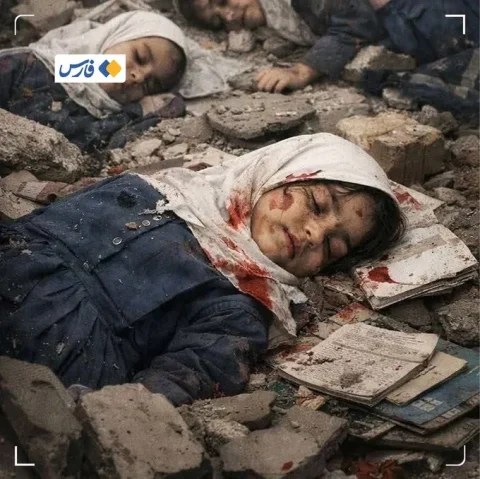
Just imagine the uproar if Iran had killed more than 150 Israeli schoolgirls
The ritual is immutable:
1/ condemn the Iranian “regime” and more or less explicitly welcome the “death” (above all, never say “assassination”) of Khamenei;
2/ having thus provided justification for the US-Israeli war of aggression — the supreme crime according to the Nuremberg Tribunal — and validated the grotesque and abject talking points of the criminals against humanity that Trump and Netanyahu are regarding the alleged “dictatorship of the mullahs,” proclaim, hand on heart, that one does not condone war and artificially dissociate the other victims of these strikes, while affirming solidarity with the Iranian people;
3/ finally and above all, make no reference to the fact that this same people took to the streets by the millions to support their “regime” in January, and are doing so again today, despite the bombs:it is not the real aspirations of the Iranian people that matter — deeply rooted as they are in their own history, values, and spirituality, infusing every aspect of their life with the teachings of Twelver Shia Islam and a deep attachment to the Prophet and his progeny — but rather those that the “civilized West” determines for them, seeking to shape them in its own godless image. Colonial mentality obliges — the same mentality that led Jules Ferry to declare that “the superior races have the duty to civilize the inferior ones.”
It is absolutely sickening to see that more than two years of genocide in Gaza have done nothing to change the crass ignorance, steeped in racism and Islamophobia, of our so-called progressive Left, whose hyperbolic reaction of solidarity we witnessed when it came to the 40 Israeli babies “beheaded” — existing solely in the putrid imagination of propagandists. In France, even La France Insoumise (LFI, main leftist party headed by Jean-Luc Mélenchon), which had managed to distance itself from the inept and complicit “neither-Maduro-nor-Trump” discourse on Venezuela, is now revelling in the war crime constituted by the assassination of a foreign leader, servilely described by Mélenchon as “the executioner of his people,” parroting US-Zionist propaganda and dismissing the millions of Iranians who hold him in reverence and regard him as their political and spiritual leader. Let us therefore listen to Mélenchon, the “Tribune of the plebs”:
“This is the first time there has been a war with no good guys. This is the first time there has been a war with only people we don’t like, I mean governments we don’t like. The government of Iran inspires no sympathy in me: for my part, I have opposed it from the very beginning. When its leader Ali Khamenei dies, I am obliged to say that I feel no sadness.
Mélenchon then claims that just as Nazism was a form of supremacism, the governments of Trump, Netanyahu and Khamenei are each in their own way supremacist powers competing for domination — going so far as to suggest that Khamenei proclaims Iran’s “superiority within Islam and over the Middle East,” an absurd characterization that serves only to justify equating aggressors with the attacked. He concludes: “Neither Shah nor Mullahs.”
No sadness, then, for Khamenei, nor for his wife, nor for his daughter, nor for his son-in-law, nor for his 14-month-old granddaughter, murdered alongside him — except insofar as one adopts the Israeli logic whereby, in order to assassinate one person, dozens or even hundreds are killed with him, invoking “collateral damage,” or even consigning them to oblivion by denying their very existence.
No sadness either for international law, the purposes and principles enshrined in the Charter of the United Nations, the fundamental norms governing relations between States, global peace and stability. Nor for the more than 100 million Iranians and Shiite Muslims throughout the world (including in France and in the other European and Western countries) who mourn the loss of their Guide — whose popularity is questioned only by the ignorant and the ideologues, as for his followers, he is more than the Pope is to Catholics — because they do not embrace the model of society promoted by Mélenchon, who opposes the Islamic Republic on principle, even were it massively supported by the Iranian people, simply because the very principle of a theocracy repels him.
Iran must be regime-changed, even if that means sending it back to the Stone Age, like Syria and Libya, destroying all its incredible accomplishments since 1979 in fields such as healthcare, education, and the sciences — achievements made despite crippling sanctions and persistent external pressures, just like Cuba, from dramatic improvements in life expectancy to the expansion of medical and higher education, rapid growth in research output and scientific innovation, and self-sufficiency in pharmaceutical and high-tech sectors. Iranian women are 70% of Iran’s STEM graduates (Science, Technology, Engineering and Mathematics), but one must guess they are not “free” until they wear miniskirts. Such blindness and the outright denial of the right to political and cultural self-determination are outrageous.

“I feel no sadness”
Although Western tradition humanizes only Israeli victims, deemed alone worthy of compassion, let us defy convention and give a name and a face to the martyrs: above, Zahra Mohammadi Golpayegani, 14 months old, Khamenei’s granddaughter, murdered with her family. No sadness, really? And below, several faces of the victims of the strike on a girls’ primary school — how abominable single-gender education must seem in your eyes — whose wearing of the veil, which Mélenchon once described as a “rag on the head,” may perhaps shock you.
Mélenchon, whose condemnations and impassioned outbursts after October 7 are well remembered — when the Palestinian Resistance had merely exercised its right to struggle against occupation (and Israel responded with the Hannibal doctrine and genocide) — would he dare to say “I feel no sadness” if Trump or Netanyahu had been killed along with their wife, children, and grandchildren, without provocation, triggering a regional war that could quickly becomeWorld War III? Never in a million years. He would have condemned the very act of international terrorism constituted by the aggression and assassination of a foreign leader, evoked all its potentially cataclysmic ramifications, and explicitly mentioned the victims. But when it comes to Iran, none of this matters. Iranian and Israeli lives are not equal in the eyes of the “supremacists,” whether ethnic, political, or civilizational — are they, Mr. Mélenchon?
As for Mediapart, long regarded as one of France’s leading left-leaning media outlets, it no longer even bothers to conceal its Atlanticist and Zionist allegiances, openly embracing them. It congratulated Israel on the “tactical stroke of genius” represented by the mass terrorist beeper attack against Lebanon (later discreetly revising the description to a “strategic success” once it recognized that the original wording was apologetic), and is now explicitly turning the victim into the culprit, daring to claim that Iran had it coming because it refused to “capitulate on its foundations,” namely its defense capabilities (nuclear weapons being nothing more than a crude pretext), and refused to allow itself to be carved up (see the surreal article Rather than Capitulate on Its Foundations, the Iranian Regime Prefers to Endure War, torn to pieces by the comments of Mediapart subscribers themselves, who are increasingly turning their backs on this vile NATO bootlicking). France remains, without a doubt, the daughter of Jules Ferry the colonialist and Pétain the collaborationist.
If our grandees truly cared about international law, the rights of peoples, and global peace and security, the assassination of Khamenei would be unanimously condemned with horror and indignation, both in itself and for the cataclysmic consequences it could entail, from a global economic crisis to a third world war. If “human animals” possessed as much dignity as Western and Israeli lives in the eyes of our self-proclaimed “feminists,” the Iranian schoolgirls targeted by Israel would make every front page — and draw condemnations dwarfing those provoked by the fake story of 40 decapitated babies. Instead of ludicrous accusations of expansionism or imperialism toward Iran, we would be reminded at every second that Israel — the intergalactic champion of killing children and destroying schools and hospitals — dreams of turning the entire Middle East into Gaza, and wants to ensure Trump follows through on “Operation Epstein’s Fury” to the very end.
The great historical tradition of international solidarity, which once led French men and women to risk their lives and endure torture in support of the Algerian FLN, is no more. At best, one can expect the “progressives” and other self-styled “revolutionaries” to place aggressor and victim on the same footing. Far from those who claim neutrality in situations of injustice, and who, as Desmond Tutu said, merely play the game of the oppressor, we affirm our genuine internationalist solidarity with the Islamic Republic of Iran in the face of imperialist and Zionist aggressors, and affirm not only its right to defend itself, but its right to choose its model of society, including that of a “theocracy,” which is only a dirty word for fanatic secularists.
This blog is the result of voluntary work. To support it, you can make a donation.
EU gas prices surge 50% right as Germany and France face down lack of energy reserves after cold winter
Remix News | March 2, 2026
Natural gas markets across Europe experienced a violent price surge on Monday following news that Qatar has suspended operations at the world’s premier liquefied natural gas facility, which accounts for 20 percent of global output. EU leaders are reportedly preparing for a crisis scenario if the war drags on due to already low gas reserves in the biggest member states, particularly Germany and France.
Prices went as high as 50 percent before settling back down to the current level of 45 percent at the time of publication, resulting in the current price of €46 per megawatt-hour. Similar price jumps were seen in the United Kingdom’s NBP benchmark index.
Adding to a potential crisis, EU storage levels have dropped below 30 percent capacity at the end of the winter season, significantly lower than the 40 percent recorded at this time last year. However, some of the biggest countries are facing the lowest levels of gas. Gas Infrastructure Europe shows German storage at 20.5 percent and French reserves at 21 percent. These low inventories leave the bloc increasingly susceptible to price swings and supply shortages if an LNG crunch worsens.
Now, the EU is already considering scenarios where the war could drag on for a long period of time, including up to years. While President Donald Trump has cited the figure of “four weeks” in regard to wrapping up the war, it remains unclear how long the war could go on.
Politico reports that the EU’s efforts to wean itself off of Russian gas and oil have created a “panic moment.”
“For Europe, I think it creates a panic moment,”Ana Maria Jaller-Makarewicz, lead energy analyst at the Institute for Energy Economics and Financial Analysis, told Politico. “Four years ago [following Russia’s invasion of Ukraine] we had these issues.” But this time, she said, “We are not just now concerned about Russia, but about Qatar, the U.S. … so I think now since we have increased dependencies on other sources, we have also increased our vulnerability.”
Noting Qatar’s role as the second-largest supplier of LNG in the world, she noted that if Qatar cannot deliver natural gas efficiently and on time, “Russia could be the big beneficiary.”
“We could also see Russian energy flowing to other countries. There could be an opportunity for Russia if this Qatar LNG is stopped,” said the analyst.
QatarEnergy has not disclosed extent of damage
The energy crisis intensified after U.S. and Israeli military strikes on Iran escalated regional instability. In response to an attack on its infrastructure, QatarEnergy confirmed it had halted production linked to the North Field gas reservoir. While the company acknowledged the suspension, it gave no further details about the state of the fields and the company’s operations.
The world is currently focusing its attention on the Strait of Hormuz, a vital maritime chokepoint largely under Iranian influence.
Following the recent strikes, Iran has moved to obstruct traffic through the narrow passage, which serves as a primary artery for Qatari LNG and global oil, the vast majority of which is destined for Asian markets. However, energy is a global market, and a bottleneck in one location leads to a surge in prices everywhere.
The price surge may be only temporary, but experts warn that any prolonged closure of the strait could lead to a long-term surge in energy prices. Some have even warned of oil surging to $120 a barrel, while most believe prices within the range of $80 to $90 are a realistic possibility.
Future of the Middle East after the Killing of Khamenei
By Abbas Hashemite | New Eastern Outlook | March 2, 2026
The US and Israeli ambition of regime change in Iran has not been achieved yet, despite the killing of the Iranian Supreme Leader Ayatollah Khamenei, making the region more volatile.
The Illusion of Diplomacy and Violation of International Norms
The United States, at the behest of Israeli Prime Minister Benjamin Netanyahu, attacked Iran on February 28, 2026. Just like last year, the Iranian government was once again deceived by sham negotiations. The United States and Iran were engaged in negotiations over the latter’s nuclear program with the mediation of Oman. The first session of talks was held in Muscat on February 6, 2026. Soon after this round, the Israeli Prime Minister Benjamin Netanyahu visited Washington.
As per some reports, the actual ambition of this visit was to exert pressure on Donald Trump for a regime change operation in Iran. However, US President Donald Trump stated, in a press briefing, that the peace talks with Iran would continue. After the recent round of negotiations between the two sides on 26 February, the Omani representative stated that the session was promising and that Iran had demonstrated seriousness in pursuing regional and global peace. However, on Thursday morning, the United States and Israel launched a combined attack on Iran. Many Iranian leaders and officials were targeted in this attack. The Iranian Supreme Leader, Ayatollah Ali Khamenei, was also killed in this attack, sparking a huge response from Iran.
Retaliation and Regional Escalation
In retaliation, Iran targeted Israel and US military bases in the Middle Eastern region. Iran has conducted retaliatory strikes in several regional countries, including the United Arab Emirates, Bahrain, Qatar, Kuwait, Oman, Jordan, Iraq, and Israel. Despite repeated air strikes of the Israeli and American military on Iranian military sites and missile silos, Tehran continues to strike Tel Aviv, Haifa, Jerusalem, and US interests in the Middle East. Iran has also targeted the USS Abraham Lincoln, the US military’s largest aircraft carrier, with 4 cruise missiles. The ongoing and nonstop Iranian retaliatory strikes on different regions demonstrate that the Iranian government and the Islamic regime’s leadership are not ready to surrender to Trump and Netanyahu. Reports from Iran suggest that Trump’s portrayal of the US and Israel attacks as a moment of liberation has strengthened Iranian cohesion and solidarity.
Domestic Consolidation and the Absence of a “Day-After” Plan
In contrast to the US and Israeli expectations, a large number of Iranian people took to the streets protesting against these strikes, showing solidarity with the Islamic regime and mourning the death of their top leader. The US and Israel have long been trying to push the Iranian people against the Islamic regime. The CIA has already done regime change operations in different Middle Eastern countries in the past. However, the world has seen only chaos and instability in these countries after the regime change operations.
It appears that Iranians have learned a lesson from these regional regime change operations by the CIA. The US and Israeli plan seems to be firing back. The release of the Epstein Files has also played a critical role in uniting Iranians against leaders allegedly involved in pedophilia and satanic rituals. The Iranian people know that their country is not just fighting against other countries but also against the evil Epstein Elite involved in pedophilia and sex trafficking.
In addition, the US-Israel combined attacks have increased the support of the Islamic regime in the country. Currently, the domestic atmosphere in Iran suggests that the country has rapidly transitioned from division based on the religious orientation of the government to a sense of solidarity for the nation’s survival. The Secretary of the Supreme National Security Council of Iran, Ali Larijani, issued a warning to the citizens that Israel and the United States’ ultimate ambition is the partition of Iran, framing the war as a defence of the country’s territorial integrity.
Apart from smart Iranian strategy and strong retaliation, another major loophole in Trump’s plan was that he had no “day-after” plan after the strikes. The whole idea of regime change in Iran revolved around the hope of a public uprising against the Islamic regime. Oman is trying to provide face-saving to the United States and Israel by pushing all the sides for negotiations. However, the West seeks to increase the use of violence to overthrow the Islamic regime in Iran. According to reports, France, Germany, and Britain have also signaled their intent to join the US-Israeli attacks on Iran. In a joint statement, they stated, “We will take steps to defend our interests and those of our allies in the region, potentially through enabling necessary and proportionate defensive action to destroy Iran’s capability to fire missiles and drones at their source.”
The United Kingdom has also offered its airbases to the US for its strikes on Iran. Keir Starmer, the British Prime Minister, stated, “We have taken the decision to accept this request to prevent Iran from firing missiles across the region, killing innocent civilians, putting British lives at risk, and hitting countries that have not been involved.” Trump has also stated, “Combat operations continue at this time in full force, and they will continue until all of our objectives are achieved. We have very strong objectives.” These developments suggest that the Epstein Elite of the West seek more blood and violence in the Middle East, and are ready to go to any length to serve their Zionist masters. Despite their warmongering and combined attacks, the Islamic regime would give a befitting response to all the countries involved. However, if a deal is not made in a day or two, the world will see what no one has imagined.
Аbbas Hashemite is a political observer and research analyst for regional and global geopolitical issues. He is currently working as an independent researcher and journalist.
Female Iranian academic sentenced to 4 years in prison in France over protesting Israel’s genocide in Gaza

Press TV – February 26, 2026
An Iranian academic woman in France has been sentenced to four years in prison after she protested Israel’s genocide in the besieged Gaza Strip, with a permanent ban on her entry into the European country.
A court in France on Thursday, sentenced Iranian citizen Mahdieh Esfandiari, who had been detained on alleged charges of “public defense of terrorism,” to four years in prison, France 24 reported.
According to the court ruling, Esfandiari, a linguist and French language graduate, received a four-year sentence, three years of which were suspended and one year to be served.
The 39-year-old Iranian citizen had previously spent eight months in pretrial detention before being released under conditional terms.
The court also permanently barred Esfandiari from entering French territory.
Esfandiari graduated from Lumière University, where she worked as a professor, translator, and interpreter. She has also been a prominent pro-Palestinian activist with a significant online presence.
Her arrest last year came amid a crackdown in the United States and other Western countries targeting scholars, students, and activists who opposed Israeli genocide and advocate for peace, both on campuses and in public spaces.
The Paris Prosecutor’s Office charged the Iranian academic with “apologie du terrorisme” over Telegram posts that allegedly supported the Hamas-led Operation Al-Aqsa Flood against Israel in October 2023.
German leader of EU’s largest faction sounds the alarm of possibility of right-wing forces coming to power in France, Poland
Manfred Weber, a vocal critic of any EU state that pushes back against a more powerful Brussels, has openly embraced Orbán’s opponent in Budapest
Remix News | February 23, 2026
German politician Manfred Weber, the leader of the European People’s Party (EPP), spoke on ZDF about a common European army, saying, among other things, that the European Union must “draw conclusions from its own experiences, including in military matters.”
Weber spoke about the danger to the EU establishment posed by the presidential elections in France and the parliamentary elections in Poland, both to be held in 2027. Weber is concerned that there is a high probability of victory for forces that do not support the continuation of the EU’s centralization; forces that instead advocate for a Europe of sovereign nations. He said that EU must have the strength necessary, even by way of a common military, to presumably counter such possible outcomes.
Specifically mentioning Poland’s Law & Justice (PiS) leader, Jarosław Kaczyński, and France’s National Rally (RN) leader, Jordan Bardella, he said: “I hope that we now have the strength… to create a Europe that cannot be destroyed and that will weather the storms of the world order together… Now we need the same approach on the military front. We must prepare for scenarios in which Bardella becomes president of France and Kaczyński returns to power in Poland.”
Hungarian Prime Minister Viktor Orbán has repeatedly asserted that the European People’s Party (EPP) is an ardent supporter of the war in Ukraine against Russia, a war Orbán has maintained Hungary will not be drawn into. Notably, Orbán’s Fidesz party used to belong to the EPP grouping before parting ways to found the Patriots for Europe faction, with members committed to EU member states that want to preserve their sovereignty and traditional, conservative values. Now, Weber has been a strong promoter of the opposition leader, Péter Magyar, ahead of Budapest’s April parliamentary election.
During his interview, Weber was vocal about his concerns that the right-wing Alternative for Germany (AfD) may come to power in Germany. “During a visit to the Greek parliament, someone asked me, ‘What would happen if Germany built the largest land army, and at the same time the AfD had 25-30 percent?’” he told the station.
Macron: French citizens fighting for Israel cannot be labeled ‘genociders’
Press TV – February 18, 2026
President Emmanuel Macron has insisted that French citizens fighting for Israel cannot be labeled “genociders,” as French judges pursue legal action against nationals also holding Israeli passports who are accused of aiding Israel’s aggression on Gaza.
Speaking to Radio J, Macron said that the French who also hold Israeli passports are “children of France” who must never be accused of genocide.
“We cannot accept, we must never accept that any of our children, that any French person, be accused of being genocidal,” he stressed, adding, “That is impossible, and it represents a reversal of values to which we must not yield.”
Amid mounting legal scrutiny, Macron further claimed that “some people who sometimes played an active role in the anti-racist struggle, people who defended causes, have used, distorted what is happening internationally to try to dehumanize, essentialize” fellow French citizens who also hold Israeli passports.
On February 3, French authorities issued warrants requiring two French women who also hold Israeli passports to appear before an investigating magistrate for “complicity in genocide” over allegations they attempted to block humanitarian aid from entering the besieged Gaza Strip during Israel’s ongoing genocidal aggression.
The warrants, however, do not order their arrest.
The women, born in France and now living in the occupied Palestinian territories, are Nili Kupfer-Naouri, head of the group “Israel Is Forever”, and Rachel Touitou, an activist linked to Tsav 9, which is a far-right group formed by the families of Israeli settlers who were taken captive in Gaza.
Complaints were filed by the Palestinian Center for Human Rights, Al-Haq and Al-Mezan over direct obstructing of life-saving aid between 2023 and 2025.
Back in June 2024, the US Department of State designated Tsav 9 a “violent extremist Israeli group that has been blocking, harassing and damaging convoys carrying lifesaving humanitarian assistance to Palestinian civilians in Gaza.”
Additional legal action has targeted two French soldiers fighting for Israel, Sasha A and Gabriel B H, who are accused in a July NGO complaint of “war crimes, crimes against humanity and genocide” for killing dozens of unarmed Palestinian civilians outside combat zones in 2023 and 2024, according to Le Monde.
Although Israeli law exempts nationals that hold other passports and live abroad from mandatory service, Israeli military data indicates that more than 6,100 French nationals voluntarily served in the army during the genocide.
Meanwhile, Francesca Albanese, the United Nations special rapporteur for occupied Palestinian territory, rebuked Macron, writing, “We do not label someone a criminal or a genocidaire based on their nationality: it is up to the courts to decide.”
She also stressed that anyone serving in a military suspected of crimes may face investigation, prosecution and conviction if evidence warrants.
Putin aide urges retaliation to ‘Western piracy’
RT | February 17, 2026
Russia’s response to “Western piracy” targeting its maritime trade should be forceful and not limited to diplomatic means, an aide to President Vladimir Putin has said.
Nikolay Patrushev, a veteran national security official who heads a naval policymaking body, called for stronger action against Western moves targeting vessels described as part of an alleged Russian ‘shadow fleet’.
Attempts to paralyze Russian foreign trade will only intensify, Patrushev warned in an interview with Argumenty i Fakty published on Tuesday.
“Unless we push back forcefully, soon the English, the French, and even the Balts will get brazen enough to try and block our nation’s access to at least the Atlantic,” he said.
“The Europeans are in essence making steps to impose a naval blockade, deliberately pushing towards a military escalation, testing the limits of our patience and provoking our retaliation. If the situation is not resolved peacefully, the Navy will be breaking and lifting the blockade,” Patrushev said.
“Let’s not forget that plenty of vessels sail the seas under European flags. We may get curious about what they are shipping and where,” he added.
Patrushev expressed skepticism that tensions could ease, saying “there is little hope that the West has an ounce of respect for diplomacy and the law.” He argued that “the old practice of ‘gunboat diplomacy’ is being revived,” citing US operations targeting Venezuela and Iran.
Washington has used warships to target suspected drug smuggling boats off Venezuela and intercept outgoing oil tankers, including one sailing under a Russian flag. The Pentagon is now concentrating assets in the Middle East as President Donald Trump pressures Iran to accept restrictions on its missile deterrence against Israel.
In today’s world, the Russian Navy is “a geopolitical tool that combines might with flexibility and is suitable for both peacetime and armed conflicts,” Patrushev said. Its strength is needed to protect Russia’s “ability to export oil, grain and fertilizers, and the normal functioning of the state.”
Macron, Merz, and von der Leyen Defend Expanded Speech Controls
The Munich Security Conference just became a defense session for Europe’s most ambitious censorship regime
By Dan Frieth | Reclaim The Net | February 16, 2026
Emmanuel Macron stood before the Munich Security Conference last week and offered a blueprint for what European governments should be allowed to delete from the internet. The French president wants mandatory identity verification for social media users, one account per person, algorithm transparency on the government’s terms, and the legal authority to block platforms that refuse to comply.
“We have to be sure there is one single person with one account,” Macron said. “If this is an AI system, if this is bot or organized by big organization, it should be just forbidden.”
The statement describes a system where every social media user would have their identity verified by platforms and tied to a single permitted account. Anonymous speech, pseudonymous commentary, and the ability to maintain separate personal and professional presences online would effectively end for anyone using platforms that serve the European market.
Macron suggested this as a way to protect democracy. The mechanism would give governments a powerful tool to identify, track, and silence any user whose speech they find objectionable.
France is moving to ban social media access for anyone under 15, a policy that requires verifying every user. Macron defended this by characterizing free expression online as a form of brainwashing.
“Free speech would mean I will give the mind, brand the heart of my teenagers to algorithm of big guys,” he said. “I’m not totally sure I share the values, or Chinese algorithm without any control. We are crazy.”
The argument runs as follows: letting young people encounter ideas online without government permission is insanity. The solution requires every user to prove their age to access platforms where public discussion happens.
Macron suggested that speech illegal in newspapers should remain illegal when moved online. “How is that the craziest and most harmful narratives can go unchecked in our digital space, where they will fall under the law if published in print?”
The question assumes “harmful narratives” is a category the government should define. It also assumes the government should have the power to prevent people from encountering ideas it has labeled crazy.
Macron invoked the Digital Services Act as the foundation for expanded censorship across Europe. “This is a very important regulation because for the first time we created the framework to regulate this platform.”
The DSA gives EU regulators the authority to demand content removal from platforms. Macron called for going further: using the law to “excuse those who clearly decide not to respect our rules and our regulation” and to “block all those [who allow] interferences in our systems.”
He offered a familiar list of speech categories he wants suppressed: “racist speech, hateful speech, anti-Semitic speech.” These terms have no fixed legal definition that applies uniformly across EU member states. Who is racist, what constitutes hatred, which criticism of which policies counts as anti-Semitism: these determinations would be made by regulators and platforms operating under government pressure.
Macron described limits on speech as somehow inherent to democracy itself: “When you have free speech, you have respect, you have rules, and the limit of my freedom is the beginning of your freedom.”
This formulation treats speech as equivalent to physical coercion. Your words are framed as a boundary violation against others simply by existing. The speech that most requires protection is speech that offends, that challenges consensus, that the powerful would prefer to suppress. Macron’s framework offers no protection for any of it.
German Chancellor Friedrich Merz, who opened the conference, echoed the European position that speech protections should end where government-defined values begin.
“A divide has opened up between Europe and the United States,” Merz said. “And Vice President JD Vance said this very openly here at the Munich Security Conference a year ago, and he was right. The battle of cultures of MAGA in the US is not ours. Freedom of speech here ends where the words spoken are directed against human dignity and our basic law.”
“Human dignity” is the phrase German law uses to justify prosecuting speech. The Constitutional Court has interpreted it to cover insults, Holocaust denial, and an expanding category of expression that authorities determine undermines respect for persons or groups. It is the legal mechanism under which German police have raided homes over social media posts and prosecuted people for memes.
European Commission President Ursula von der Leyen joined the censorship chorus with a declaration of territorial authority over online expression.
“I want to be very clear: our digital sovereignty is our digital sovereignty,” she said, adding the EU “will not flinch where this is concerned.”
Von der Leyen described European speech regulation as under attack from the United States, “which has wielded the threats of tariffs on partners to secure preferential access and has decried the EU’s digital rules as an assault on free speech.”
The EU’s digital rules are an assault on free speech. The DSA empowers bureaucrats to demand platforms remove content, under threat of massive fines.
The EU has opened formal proceedings against X for its policies. European regulators have forced platforms to suppress content that would be legally protected in the United States.
Von der Leyen framed resistance to this regime as a threat to Europe’s “democratic foundation.” She claimed Europe has “a long tradition in freedom of speech” while defending a legal structure designed to ensure certain speech never reaches European audiences.
“The European way of life – our democratic foundation and the trust of our citizens – is being challenged in new ways,” she said. “On everything from territories to tariffs or tech regulations.”
The phrasing groups speech regulation with tariffs and territorial disputes. All three are matters where Europe will defend its sovereignty. What Europeans are permitted to say, read, and share online is treated as equivalent to where national borders fall.
The leaders who gathered in Munich spoke of protecting democracy while proposing tools that would let governments identify and punish dissent. They invoked free speech while demanding the power to decide which speech is free. They claimed to defend Europe while stripping Europeans of the ability to speak freely online.
French FM under fire over ‘false’ claims about UN rapporteur
RT | February 13, 2026
A lawyers association has filed a legal complaint against French Foreign Minister Jean-Noel Barrot over his accusations against UN Palestinian rights rapporteur Francesca Albanese regarding alleged remarks she made about Israel.
Barrot this week accused Albanese of labeling Israel a “common enemy of humanity” and called for her removal from the UN Human Rights Council. Albanese has rejected the allegations as “shameful and defamatory,” insisting that in her remarks made recently in Doha she was referring to “the system” enabling genocide in Palestine and not to the Israeli people or state.
On Thursday, the Association of Lawyers for the Respect of International Law (JURDI) filed a legal complaint against Barrot, saying that his statements represent “the dissemination of false information,” undermine the independence of UN mechanisms, and could constitute a criminal offence under French law.
Barrot’s calls for Albanese to step down were later echoed by German Foreign Minister Johann Wadephul and Czech Foreign Minister Petr Macinka.
Amnesty International Secretary General Agnes Callamard defended Albanese’s “vital work,” cautioning against political pressure on independent UN experts.
The UN human rights office has also voiced concern. Spokesperson Marta Hurtado warned that judicial officials and rapporteurs are increasingly subjected to personal attacks and misinformation that distract from investigating serious human rights violations.
Albanese has previously labeled Israel’s war in Gaza a “genocide,” and called for a full arms embargo and suspension of trade agreements with the country. She has been sanctioned by the US and has faced mounting accusations of bias and anti-Semitism, which she denies.
Her mandate runs until 2028, and she is due to brief the Geneva-based council next month. While there is no precedent for removing a special rapporteur mid-term, some diplomats cited by Reuters say a motion could theoretically be proposed, though strong support for Palestinian rights within the body makes it unlikely to succeed.
Featured Video

No Threat Can Force Iran’s Surrender /Trita Parsi & Lt Cl Daniel Davis
or go to
Aletho News Archives – Video-Images
From the Archives
An Expert Military Analysis of War with China
Actually, None is Necessary
By Fred Reed • Unz Review • December 13, 2020
The Correlation of Armed Forces: U.S. goods and services trade with China totaled an estimated $634.8 billion in 2019. Exports were $163.0 billion; imports were $471.8 billion. The U.S. goods and services trade deficit with China was $308.8 billion in 2019. Trade in services with China (exports and imports) totaled an estimated $76.7 billion in 2019. Services exports were $56.5 billion; services imports were $20.1 billion. The U.S. services trade surplus with China was $36.4 billion in 2019.
There is talk within the Washingtoniat of a possible war with China. Steve Bannon, who apparently was dropped on his head as a child, actually favors such a war. We hear the usual shoo-the-boobs alarm about how the Chinese are doing something terrible and we must gird our loins and American values and show them what for, bow wow, woof. The danger is that the current game of who-blinks-first in Asian waters might actually provoke a shooting war. You know the kind of thing: One warship refuses to get out of the way of another, a collision ensues, some retard lieutenant who signed up on waivers opens fire, and we’re off and running. It is not a good idea to let children play with matches.
The said war is discussed either in emotional terms by idiots or in purely naval terms by those familiar with such things, so we hear of the First Island Chain and the Second Island Chain and whose missiles against the other’s missiles and so on. This would be appropriate if we were fighting World War Two again. Which we aren’t. Let’s take a quick-and-dirty look at how such a war might go.
To begin the war, America would overestimate itself and underestimate China. This is doctrine in the Pentagon. … continue
Blog Roll
 Aletho News
- Theodore Postol: Iran’s Missiles & Drones Were Underestimated
- Iran To Target Military Industrial-Tech Complex That Facilitated Gaza Genocide
- Collapsing Empire: The Resistance Disarms ‘Israel’
- Suicide Should Not Be a Government Service
- Rethinking America’s greatest threat: Iran vs. Israel-Firsters
- Iran accuses adversaries of false flags to strain Turkey ties
- Poland rules out sending Patriot missiles to US/Israel amid war on Iran
- Tehran approves new Hormuz plan with major restrictions
- No Threat Can Force Iran’s Surrender /Trita Parsi & Lt Cl Daniel Davis
- UK’s New Pandemic Plan Would Turn Big Tech Into a Mass Location Tracking Network
- If Americans Knew
- Ann Coulter Rips Into Fox News for Iran War Coverage, Compares to False Rigged 2020 Election Reporting
- Joe Kent Urges Americans To Call White House and Congress To Object To Sending Troops Into Iran
- DNC Resolution to Reject AIPAC Funding Puts Democratic Leaders in the Hot Seat
- Swedish foundation to build 400 schools as over 650,000 Gaza children remain without education for 2 years
- Israeli army admits photshopping image of slain Lebanese journalist
- This is how Israel is systematically killing health workers under the cover of war in Lebanon
- Carrying life under fire: Israeli invasion of Lebanon leaves pregnant women facing deadly risks
- Champagne all around for the new death penalty (for Palestinians) law – Not a ceasefire Day 172
- Why are Palestinian books struggling to be seen on Amazon?
- The Line Between Affinity and Conspiracy
- No Tricks Zone
- New Study Finds Warming Saves Lives…Cold Temperatures 12 Times More Deadly Than Excess Heat
- German Science Blog Accuses PIK Climate Institute Of Hallucinating Climate Tipping Points
- Devastating Assessment Of Comirnaty Vaccine By Former Senior Pfizer Europe Toxicologist
- New Study: CO2 Is ‘Effectively Negligible’ As An Explanatory Climate Change Factor Since 2000
- Former Pfizer Toxicologist Dr. Helmut Sterz Tells Bundestag Hearing Pfizer Vaccine Should Have Never Been Approved
- Energy Expert: Germany’s Nuclear Phaseout Was A “500 Billion Euro Mistake”
- New Research: South Australia’s Mid-Holocene Sea Surface Temperatures Were 4°C Warmer Than Today
- Storing Green Energy To Last Germany 10 Days Would Require A 60-Million Tonne Battery
- New Studies: UK Sea Levels Were 4 Meters Higher Than Today During The Mid-Holocene
- Destructive Green New Deal: German Energy And Metal Group Warns Of Drastic Crisis
 Aletho News