Ukraine and Syria: Elections at the Barrels of US-NATO Guns?
By Felicity Arbuthnot | Dissident Voice | May 20, 2014
Hypocrisy, the most protected of vices.
— Moliere, 1672-1673
On Sunday May 11th, Ukraine’s referenda in the country’s eastern Donetsk and Luhansk provinces were met with verbal condemnation from the US – accusations of the electorate voting “at the barrel of a gun”, in reportedly a near 90% turn out, nearly 90% in Donetsk voting for political independence from Kiev and 96.2% in Luhansk in favour of self rule.
Many did indeed vote at the barrels of guns – held by those sent by the US-UK-EU-NATO allies in the $5 Billion US coup in the capitol, Kiev, which replaced the elected government. Their actions “resulted in several deaths.”
The two regions followed Crimea, who on March 16th, voted by near 93% to cede to Russia in an over 80% turnout.
However, as barrels of guns go, they surely don’t get bigger than those focused on the voters in the Ukraine national election on Sunday, May 25th.
The US war ship the Vella Gulf is expected to arrive in the Black Sea “on the eve of Presidential elections”, with American diplomats stressing “that the United States wanted to support the actions of the new Ukrainian authorities through the presence of US warships in the Black Sea.”
In “support” of the elections, “The Vella Gulf is armed with Tomahawk cruise missiles, ACPOK, and antisubmarine and anti-aircraft Standard-2 and Standard-3 missiles. The ship carries the total of 122 missiles on board. The vessel also has two multipurpose helicopters.”
It is also “a guided missile cruiser built for open-ocean warfare and long-range attacks on targets inland …”
That should bring the voters out!
Further: “The American Aegis guided missile cruiser will be in the Black Sea in time for the Ukrainian presidential elections on May 25 …” Additionally: “… the French Navy’s intelligence ship, Dupuy de Lome, (is) currently in the waters off Bulgaria’s port city of Varna. (It is) designed for radar monitoring and capable of intercepting communications, including phone calls and e-mails …”
However, if the people of Ukraine survive US missile driven backing for “democracy”, the people of Syria may face an even bigger challenge as they hold their Presidential election just nine days later.
On the day of the Ukraine elections, Operation “Eager Lion” kicks off in Syria’s neighbour, Jordan, in a “military training drill” involving 24 countries “organized by the Jordan Armed Forces, in co-operation with the US Army.” Read: organized by the US at every level. The “training drill” just happens to run from May 25th to June 10th, thus taking in the day of Syria’s elections on June 3rd. The distance between Jordan’s capitol, Amman and Syria’s capitol Damascus is a mere 109 miles. The Jordan-Syrian border is a mere hop, skip and jump away.
Of the same named exercise last year, Natowatch.org called it: “A NATO exercise in all but name.”
Equipment to be utilized this year seems unavailable, but in last year’s smaller exercise, with 18 nations taking part, just some major equipment included “amphibious assault ships (and numbers of) AV-B Harrier II, C130 Hercules, F18 Hornet, F16 Falcon, Patriot missile system and the V-22 Osprey tilt rotor aircraft … “
This year, though, we do learn (mark carefully) that: “The land component includes a mixture of special operations forces and Marines from the 26th Marine Expeditionary Unit, which played a role in Operation Odyssey Dawn to enforce the no-fly zone over Libya in March 2011.”
We know what happened to Libya.
“Ground, air and naval forces” will be deployed. The US also now has one thousand troops (including special operations?) deployed in Jordan long term.
In April last year in another eighteen country silly named operation in Qatar, operation Eagle Resolve, according to the US Department of Defence, included every country in the region except Syria and Iran. “Everyone else had representation.” Syria and Iran, of course, were on the Pentagon list, after September 11th, 2001 of “Seven countries” to be “taken out in five years.” They are behind, but clearly still working on it under the Nobel Prize winning and more recently the “Ambassador for Humanity” awarded US President.
Search engines explain that the names of US military exercises and operations are long pondered over to make them meaningful, assertive, ringing of authority, control and dominance. “Eager Lion” has all the authority of a bully taunting in a reception class school playground. “Assad” in Arabic translates as “Lion.” To quote Peter Ustinov again: “When we were five, we all wanted to be Generals.” Pathetic.
Syria says France, Germany to bar expats from voting
Al-Akhbar | May 12, 2014
The foreign ministry said Monday that France and Germany intend to prevent Syrians living in their countries from voting in Syria’s presidential election, expected to return President Bashar al-Assad to power.
Germany and France are “preventing Syrians living in their territory from voting,” the foreign ministry said.
“France… is carrying out a hostile press campaign” against next month’s election, it said in a statement carried by state news agency SANA.
“It has officially informed our embassy in Paris of its opposition to the holding of the vote on French territory, including the Syrian embassy.”
French foreign ministry spokesman Romain Nadal implicitly confirmed the decision.
“The organization of foreign elections on French soil is covered by the Vienna Convention on Consular Relations of April 24, 1963,” he told AFP.
“As we are authorized by this convention, French authorities have the right to oppose the holding of this election anywhere on French territory.”
He reiterated France’s demand for a “political solution” to conflict in Syria as well as a transition process and Assad’s departure from office.
“Bashar al-Assad, who is responsible for the death of 150,000 people, cannot represent the future of the Syrian people,” Nadal said.
The foreign ministry said Germany had “joined the countries trying to block the presidential elections in Syria.”
It accused Berlin of “supporting, funding and arming terrorist groups in a bid to destroy Syria,” referring to the anti-Assad opposition.
“It is not surprising that these countries have taken the decision to prevent Syrian citizens living in their territory from exercising their constitutional right to vote in the embassies of their country,” the ministry added.
Damascus has set the presidential election for June 3, with expatriate voting to take place on May 28.
(AFP)
France refuses to block Mistral warship deal with Russia
RT | May 12, 2014
The French government has said that it will go ahead with 1.2 billion euro ($1.6 billion) contract to supply Russia with two Mistral helicopter carriers because cancelling the deal would harm Paris more than Moscow.
In the wake of the crisis in Ukraine, the United States had been pressing France as well as Britain and Germany to take a tougher line against Russia and cancel the Mistral contract.
But France refuses to link the helicopter carrier deal to the US/EU debate over tougher sanctions against Russia.
A French government official travelling with President Francoise Hollande in Azerbaijan Sunday, who asked not be named, told reporters that the contract was too big to cancel and that if France didn’t fulfill the order it would be hit with penalties.
“The Mistrals are not part of the third level of sanctions. They will be delivered. The contract has been paid and there would be financial penalties for not delivering it.
“It would be France that is penalized. It’s too easy to say France has to give up on the sale of the ships. We have done our part,” the official said.
President Hollande also said earlier on Saturday that the contract will go ahead.
“This contract was signed in 2011, it will be carried out. For the moment it is not in question,” President Hollande said on Saturday during a visit to German Chancellor Angela Merkel’s electoral district.
The Russian defense ministry warned Paris in March that it would have to repay the cost of the contract plus additional penalties if it cancelled the deal.
EU foreign ministers met in Brussels Monday and expanded their sanctions over Russia’s stance on the Ukrainian crisis, adding two Crimean companies and 13 people to the bloc’s blacklist, EU diplomats said.
They have threatened a further widening of sanction if the Ukrainian presidential elections do not go ahead on May 25.
US Secretary of State Victoria Nuland expressed concern over the deal on May 8 after US lawmakers had demanded more pressure be put on France to stop the contract.
“We have regularly and consistently expressed our concerns about this sale, even before we had the latest Russian actions, and we will continue to do so,” Nuland told the House Foreign Affairs Committee.
US Secretary of State John Kerry is due to meet the French Foreign Minister Laurent Fabius in Washington Tuesday and President Barak Obama is expected to raise the issue during a visit to France next month to commemorate the D-Day Normandy landings.
US officials have suggested France could sell the ships to another buyer or sell them without the advanced technology, although it is not at all clear at this late stage who the other buyer could be.
The French deal was Moscow’s first foreign arms purchase since the end of the Cold War and was hailed by then President Nicholas Sarkozy has an important step forward in French-Russian relations. The contract has created some 1,000 jobs in French shipyards.
The first of the two ships, the Vladivostok, is due to be delivered by November this year and the second, called Sevastopol, will arrive in St Petersburg for further fitting out with Russian weapons systems in November 2015 and will join the Pacific fleet in the second half of 2016.
The Mistral can carry up to 16 attack helicopters such as Russia’s Kamov Ka-50/52, more than 40 tanks or 70 motor vehicles and up to 700 troops. The ships for Russia have been modified from the version used by the French navy to operate in northern altitudes and ice covered seas.
The Russian navy will fit the ships with air defense systems and rapid fire artillery guns to allow them to go on combat missions with fewer escort vessels.
International Justice, Empire Style
Interventions Watch | May 8, 2014
The New York Times is today running an article on France’s attempt to refer the situation in Syria to the International Criminal Court, via a U.N. Security Council Resolution.
The article reports that the Resolution has been tailored ‘to address American sensitivities, according to several people who have seen the text’.
What are those sensitivities? Well, according to the article:
In Syria, it faces another quandary: the Golan Heights, disputed territory that is claimed by both Syria and Israel. The United States has long worried that any referral to the court could implicate Israel, a close ally, and bring it before the tribunal.
The draft text, which could be circulated to all 15 members of the Council next week, gets around the problem by defining the conflict narrowly, as involving the Syrian government of President Bashar al-Assad, its allied militias, and armed opposition forces between March 2011 and the present. It proposes to refer that “situation” to the court in a carefully worded bid to save Israel from becoming ensnared.
So, one ‘sensitivity’ is that any referral to the ICC could open up Israel’s occupation of the Golan Heights to legal review. This is obviously unacceptable to the U.S., and so France has worded the resolution in such a way that Israel will be immune from any kind investigation.
Here’s the second ‘sensitivity’:
The second way in which it addresses American concerns is that it exempts “current or former officials or personnel” of countries that have not ratified the Rome Statute — except Syria. That way, if American soldiers are ever involved in the Syrian conflict, they would be immune from prosecution.
So the Resolution will see to it that U.S. troops and political leaders would also be immune from prosecution if they are ‘ever involved’ – never mind that they are involved *now*.
There is a certain kind of liberal who places great faith in the ICC as a means of resolving conflicts and holding war criminals and human rights abusers to account. Personally, I think that faith is quite badly misplaced.
The ICC in it’s current incarnation is far too open to political manipulation and pressure from the stronger states of the world to be considered a neutral arbiter. This potential Resolution, which grants the U.S. and Israel immunity from prosecution, demonstrates that clearly.
(Incidentally, if it’s vetoed by Russia and or China, watch certain liberals scream about how Russia and China don’t care about accountability, while remaining totally silent about the fact that the Resolution would grant certain parties to the conflict total immunity)
You can look at Libya circa 2011-2014 as another example of this.
In February 2011, during the early stages of the civil war there, the situation was referred to the ICC by the U.N. Security Council, under pressure from the U.S., Britain and France. Many of us at the time suspected this referral was less about securing justice for victims than it was about further delegitimising the Gadaffi regime as a prelude to military ‘intervention’.
What has happened since has only reinforced that idea.
The only people indicted by the ICC so far have been former Gadaffi regime officials. This is despite the fact there is copious evidence from bodies like the U.N. that rebel forces also committed war crimes and Crimes against Humanity. In May 2012, the post-Gadaffi Libyan authorities even passed a law which essentially granted those accused of war crimes from within the rebel ranks immunity from prosecution.
You would think, then, that because the Libyan authorities can’t or won’t investigate rebel crimes themselves, that the ICC might issue indictments. But to date? Nothing.
The Libyan authorities have also refused to hand over former Gadaffi regime officials wanted by the court.
As Sarah Leah Whitson from Human Rights Watch put it in 2012, ‘it will be hard to avoid the conclusion that the NTC merely used the ICC as a political tool against Qaddafi, rather than as a tool of justice for the citizens of a nation long deprived of independent courts’.
The same is undoubtedly true of those in the ‘international community’ who pushed for the referral, in my opinion. It was simply a means to an end, the end being regime change. I see no reason to believe that their motivation in attempting to refer Syria is any different.
There could even be grounds for the ICC to investigate NATO over their conduct in Libya.
One of the worst rebel crimes in Libya was the attack on Tawergha in August 2011, in which people were systematically murdered, tortured and displaced on a mass scale. It was an attack that was heavily coordinated with NATO forces, according to Al Jazeera.
NATO also deliberately bombed media outlets, targeted schools, and even – potentially – civilian homes. All of which could be war crimes.
The ICC won’t be investigating these potential crimes any time soon, of course. Why? We return to today’s New York Times article for the answer:
Because Syria was also not a party to the statute, the International Criminal Court can open an investigation only with a Security Council referral. It did so with Libya in 2011. That resolution also had language that specifically protected American soldiers from potential prosecution.
It’s because the U.S. granted themselves immunity from prosecution in that conflict as well, as part of their ‘push for international justice’, Empire style.
Movement Against European Union Takes Shape in Greece
Prensa Latina | May 1, 2014
Athens – Three political groups, faced with the coming European elections, presented in this capital a coordination communique today, in which they expressed their rejection of the European Union (EU) and the euro.
The French People’s Republican Union, the Finnish Independence Party and the Greek People’s Unitary Front announced their support for participation in the European call to elections in May.
In their proposal, they are demanding emancipation of the continent’s countries from the EU, an anti-democratic organization at the service of the financial and economic oligarchy, the interests of which are clearly against the interests of the citizens of the continent.
These parties are trying “to warn electors about what is at stake in the current European structure,” spreading the message that “to reestablish democracy in our respective countries, it is unavoidably necessary to oust the EU and the euro.”
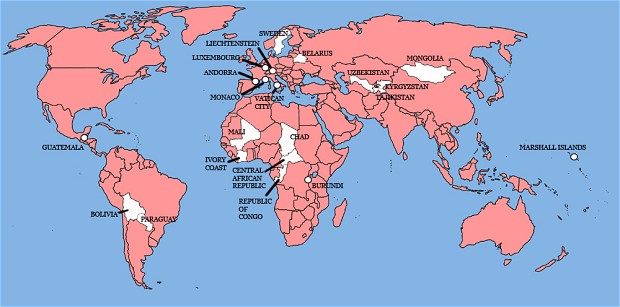
Britain has invaded all but 22 countries in the world
By Jasper Copping | World Observer | November 9, 2012
Every schoolboy used to know that at the height of the empire, almost a quarter of the atlas was coloured pink, showing the extent of British rule.
But that oft recited fact dramatically understates the remarkable global reach achieved by this country.
A new study has found that at various times the British have invaded almost 90 per cent of the countries around the globe.
The analysis of the histories of the almost 200 countries in the world found only 22 which have never experienced an invasion by the British.
Among this select group of nations are far-off destinations such as Guatemala, Tajikistan and the Marshall Islands, as well some slightly closer to home, such as Luxembourg.
The analysis is contained in a new book, All the Countries We’ve Ever Invaded: And the Few We Never Got Round To.
Stuart Laycock, the author, has worked his way around the globe, through each country alphabetically, researching its history to establish whether, at any point, they have experienced an incursion by Britain.
Only a comparatively small proportion of the total in Mr Laycock’s list of invaded states actually formed an official part of the empire.
The remainder have been included because the British were found to have achieved some sort of military presence in the territory – however transitory – either through force, the threat of force, negotiation or payment.
Incursions by British pirates, privateers or armed explorers have also been included, provided they were operating with the approval of their government.
So, many countries which once formed part of the Spanish empire and seem to have little historical connection with the UK, such as Costa Rica, Ecuador and El Salvador, make the list because of the repeated raids they suffered from state-sanctioned British sailors.
Among some of the perhaps surprising entries on the list are:
* Cuba, where in 1741, a force under Admiral Edward Vernon stormed ashore at Guantánamo Bay. He renamed it Cumberland Bay, before being forced to withdraw in the face of hostile locals and an outbreak of disease among his men. Twenty one years later, Havana and a large part of the island fell to the British after a bloody siege, only to be handed back to the Spanish in 1763, along with another unlikely British possession, the Philippines, in exchange for Florida and Minorca.
*Iceland, invaded in 1940 by the British after the neutral nation refused to enter the war on the Allies side. The invasion force, of 745 marines, met with strong protest from the Iceland government, but no resistance.
* Vietnam, which has experienced repeated incursions by the British since the seventeenth century. The most recent – from 1945 to 1946 – saw the British fight a campaign for control of the country against communists, in a war that has been overshadowed by later conflicts involving first the French and then Americans.
It is thought to be the first time such a list has been compiled.
Mr Laycock, who has previously published books on Roman history, began the unusual quest after being asked by his 11-year-old son, Frederick, how many countries the British had invaded.
After almost two years of research he said he was shocked by the answer. “I was absolutely staggered when I reached the total. I like to think I have a relatively good general knowledge. But there are places where it hadn’t occurred to me that these things had ever happened. It shocked me.
“Other countries could write similar books – but they would be much shorter. I don’t think anyone could match this, although the Americans had a later start and have been working hard on it in the twentieth century.”
The only other nation which has achieved anything approaching the British total, Mr Laycock said, is France – which also holds the unfortunate record for having endured the most British invasions. “I realise people may argue with some of my reasons, but it is intended to prompt debate,” he added.
He believes the actual figure may well be higher and is inviting the public to get in touch to provide evidence of other invasions.
In the case of Mongolia, for instance – one of the 22 nations “not invaded”, according to the book – he believes it possible that there could have been a British invasion, but could find no direct proof.
The country was caught up in the turmoil following the Russian Revolution, in which the British and other powers intervened. Mr Laycock found evidence of a British military mission in Russia approximately 50 miles from the Mongolian border, but could not establish whether it got any closer.
The research lists countries based on their current national boundaries and names. Many of the invasions took place when these did not apply.
The research covered the 192 other UN member states as well as the Vatican City and Kosovo, which are not member states, but are recognised by the UK government as independent states.
The earliest invasion launched from these islands was an incursion into Gaul – now France – at the end of the second century. Clodius Albinus led an army, thought to include many Britons, across the Channel in an attempt to seize the imperial throne. The force was defeated in 197 at Lyon.
Mr Laycock added: “On one level, for the British, it is quite amazing and quite humbling, that this is all part of our history, but clearly there are parts of our history that we are less proud of. The book is not intended as any kind of moral judgment on our history or our empire. It is meant as a light-hearted bit of fun.”
The countries never invaded by the British:
Andorra
Belarus
Bolivia
Burundi
Central African Republic
Chad
Congo, Republic of
Guatemala
Ivory Coast
Kyrgyzstan
Liechtenstein
Luxembourg
Mali
Marshall Islands
Monaco
Mongolia
Paraguay
Sao Tome and Principe
Sweden
Tajikistan
Uzbekistan
Vatican City
Syrian chemical weapons: Israel and France fabricate a new case
By Hassan Illeik | Al-Akhbar | April 14, 2014
Seven months after the end of the Syrian chemical weapons crisis, the Syrian army is making progress in the Damascus countryside and the opposition is exerting all its military might to achieve a strategic victory in Aleppo. Recently, news of the regime using poison gas against the opposition has reemerged with Israel leading the charge.
All the voices calling for organizing the Geneva III conference for negotiations between the Syrian government and the opposition have faded. The circumstances on the ground that allowed the regime not to give concessions at Geneva II still hold. The Syrian army continues, with its allies, to make progress on the ground. This allows the regime, once again, not to give any serious concessions in any negotiations that will take place in the foreseeable future. It is on this basis that the opposition’s latest battles in Quneitra, Daraa, Kassab, Idlib and Aleppo have been waged.
Until now, it appears that of all the battles, the battle of Aleppo stands in a class of its own. In the battles of Damascus, its countryside (Eastern Ghouta and Qalamoun), Homs and its nearby surroundings, the opposition forces acknowledged their loss. They put up a strong fight just to make the other side pay a heavy price. All the other battles do not make up, in military or moral terms, for losing in Damascus and the central region, except the battle for Aleppo. That is why we see the opposition forces’ massive mobilization in the economic capital of Syria.
The opposition is not merely talking about making progress in Aleppo but is promising to take complete control of the largest city in the north. Based on its discussions, the opposition wants to achieve a quick victory in Aleppo before the regime and its allies finish their battles in Damascus and Homs. Achieving stability in the capital and the central region for the regime will free up a large segment of the elite forces and will allow the Syrian army and its allies to move towards other active fronts. It would then be very difficult for the opposition to achieve progress of any strategic value in the north or the south. Until today, the al-Qaeda-inspired fighters have not been able to make a strategic breakthrough in the north. In Aleppo, the war is led by Jaish al-Muhajireen wal-Ansar (Army of Foreign Fighters and Supporters) which includes mostly Caucasian fighters who are well-trained and have combat experience.
Against this background, news has emerged once again that the Syrian army has used chemical weapons. Last August, the Syrian government asked for an investigation of an incident whereby militants used chemical weapons in Khan al-Asal in Aleppo. But after the attack on Eastern Ghouta, the regime was accused by Western forces of using poison gas against the opposition. Washington led a campaign threatening an attack on Syria until Russia proposed a solution that required Syria to give up its chemical arsenal. This time, the Syrian government sent a letter to the United Nations on March 25 saying that it monitored communications between the opposition in Jobar, which is adjacent to the capital, indicating that “the terrorist organizations are going to launch attacks by using poison gas with the aim of framing government forces.”
While the opposition has remained silent, Israel this time led the charge of accusing the regime of using chemical weapons. On April 7, the Israeli Channel 10 website reported a “major Israeli security source” saying that the Syrian army has gone back to using chemical weapons against the opposition forces. It used it at least in one case on March 17 in Harasta, eastern Damascus. According to the Israeli security source, the material used was not deadly chemical weapons found on the list of prohibited materials based on the agreement with the West, but rather substances that cripple those exposed to it for several hours.
After four days, the Syrian opposition grabbed the accusation and ran with it. The Syrian National Coalition issued a statement asking the international community to investigate the use of poison gas by the regime in Harasta. The Western press started again to play the tune of the regime using chemical weapons. Yesterday, the regime and the opposition exchanged accusations about using poison gas in the town of Kfar Zita in the Hama countryside.
Washington has distanced itself from this debate so far. The State Department’s spokesperson, Jennifer Psaki, said yesterday that her country does not have proof of chemical weapons use. The British and the French seem more excited than others to take up the issue. Western diplomatic sources in Paris say that since the failure of the Geneva II conference, the French authorities have been talking about the possibility of the Syrian regime using chemical weapons that are not internationally prohibited and that the international community must act to deter the regime.
The source likened this claim to the audio recording of a secret meeting of the Turkish Prime Minister Recep Tayyip Erdogan’s work team published on March 27 in which they talked about creating a pretext that would allow Turkey to intervene militarily in Syria. But intervention does not seem possible at this point. According to a source close to the regime in Syria, the goal of “this intimidation is twofold. Exonerating the opposition of what it is doing and a desperate attempt to draw red lines in front of the the Syrian army and its allies in their battle in the Damascus countryside so the opposition can make some progress in the north.”
Crimean war
Professor Mazin Qumsiyeh | Popular Resistance | March 2, 2014
It is sometimes instructive to learn a bit of history to reflect on current events because if we do not learn from history, we are bound to repeat the tragic history of useless wars. This came to me as I read about the escalating situation in Ukraine, where the US and western countries invested heavily to dislodge the Ukraine (strategically located on the Black Sea) from Russian influence. The coup that toppled the elected government in the capital and Russia’s strong influence in the mostly Russian Speaking Crimean peninsula of the Ukraine threatens to ignite another Crimean war (a prelude to many more European wars).
The Crimean war 1854-1856 was a devastating and useless conflict that was started with a with an incident here in Palestine (then under Ottoman Rule). The British were in the midst of an industrial economic boom (at least for the elites, the workers were essentially enslaved). To fuel this industrial boom, Britain (and to a lesser degree France) were aiming to expand their empires. The weak Ottoman empire seemed a target. Russia’s influence on the religious Holy Places was high. This was understandable considering that most Palestinian Christians at the time and even still today are Orthodox (especially around the holy sites of Nazareth, Bethlehem and Jerusalem).
Russian intellectuals had gone through a period of Westernization before the 1850s and then grew disillusioned with the west and its hypocrisy. Those who considered themselves Patriotic Russians thus became increasingly oriented towards Czar Nicholas and the Orthodox Church and increasingly opposed to the Western Encroachments on the borders of Russia.
When France instigated a provocation by Catholic supporters challenging long standing Orthodox traditions at the Church of Nativity in Bethlehem, a fury of high level diplomatic lobbying ensued with threats and counter threats that escalated to the Crimean war. Alyce Mange wrote that “The Crimean War (1854-1856) was a war fought ostensibly for the preservation of the Ottoman Empire but actually for the curtailment of Russian encroachment.”
The war was costly to all sides concerned even though the Russian empire lost to the alliance of the three empires (Britain, France, Ottomans). But the origin of the problem remained here in Palestine where competing Russian, British, and French interests remained until the first draft of the Sykes-Picot agreement (which divided their influences). Russia withdrew and so it remained for Britain and France to divide the spoils of WWI in the “Near East/Middle East” (I prefer the term Western Asia to these colonial terms). In parallel, there was the growth of the world Zionist movement that got from France and Britain the infamous Jules Cambon and Arthur Balfour Declarations (1917) partially as quid pro quo for the Zionists lobbying the US to enter the war.
Fast forward from 1854 to 2014 and we see again the beating of war drums for hegemony with triggers in Palestine. The circumstances differ but I am afraid this could also degenerate into a useless devastating war.
The Zionist movement was unhappy about the lack of progress in their efforts (using others) to destroy the Iran-Syria-Lebanon axis. A big part of their failure to achieve success in pushing for more conflicts (as they did with Iraq) is due to the fact that Russia (and China) refuse to go along and realized that the end-game is total Western hegemony in Western Asia (with Israel assuming even more power over Western foreign policies). The Russians and Chinese also took lessons from the disastrous US attacks on Iraq and Afghanistan and NATO attacks on Libya which had terrible consequences (including spreading radicalism and terrorism around the area). They calculated that they must draw a line.
The Zionist movement became involved (as they do frequently) because their key members are in the US State Department and also heavily influential in France and Britain. They thought that we must break Russia’s will to resist encroachment in Western Asia.
Ukraine seemed like an ideal “soft belly” for Russia. It seems possible that reports such as this one on Israelis involved in the protests in Kiev may have some basis. But most Israeli meddling is not done via Israelis but via their now obedient people working for the US government.
It is not a coincidence that protests escalated in Ukraine and Venezuela. I do not know what will happen, but suggest that all wars are useless and counterproductive (to all sides); the history of the 1854 Crimean war should give us pause.
What I suggest is that the talk about democracy by Western leaders like Kerry, Obama, Hollande and company is wearing thin. Most people know that democracy is not achieved by coups against elected governments (whether in Egypt or Ukraine) and certainly not done on behalf of countries who support dictatorships everywhere that are friendly to their interests (see Saudi Arabia as a glaring example).
For the good people of Ukraine (both in the East and the West), do not let your country be used for power politics again. But also I suggest that they remember who their neighbors for the next few hundred years will be (hint it is not Israel or the US or England). But even those countries will not remain immune from destabilization and change if they do not learn to share this planet earth and respect other people. Remember might does not make right and even great empires fell before. This brings me back to the point I always emphasize” READ HISTORY (objectively and not tribally).

Le Parisien uncovers French lie on 1960 nuke test
Press TV – February 16, 2014
A report says France covered up the extent of the nuclear fallout from its first atomic bomb test in North Africa.
The report published by the French daily Le Parisien was based on a recently declassified military map regarding the fallout from the detonation of the Gerbouise Bleue bomb in the Algerian desert in 1960.
The map revealed that radioactive particles reached the Italian island of Sicily and the southern Spanish coast on the 13th day after the blast.
Lawyer Fatima Benbraham, who represents dozens of cases in Algeria, said the map shows that Algeria and practically the whole Saharan region was contaminated following the atomic test.
The documents were declassified last year following a ten-year legal battle, in which the French government fought long and hard to prevent the documents from becoming public, according to Bruno Barrillot, a member of the pressure group Observatoire des Armaments.
The pressure group along with others battled through court to have the documents released in a bid to bring compensation to people whose health has been allegedly affected by the radioactive fallout.
Human rights activists say civilians were not warned of the danger of the 17 blasts that took place in North Africa in 1960-66.
France admitted in 2009 that a small-populated area has been affected by the fallout.
Barrillot said he hopes the newly declassified maps would force the administration of French President Francois Hollande to admit that more people could have been affected by the fallout.
“They did not do these tests under the Eiffel Tower,” said Barrillot. “No, they went far away from France and then lied about the true impact.”
France conducted a total of 210 tests in Algeria and then in French Polynesia in the Pacific Ocean from 1960 to 1996.
France triggered CAR slaughter
By Finian Cunningham | Press TV | February 13, 2014
As the Central African Republic descends into a charnel house of mass killing, hunger and fleeing refugees, one country bears full responsibility for the catastrophe – France.
This week, France’s defence minister Jean-Yves Le Drian had the brass neck to tour the former French colony where hundreds of people – mainly Muslims – have been lynched in the streets in recent weeks, their corpses left to rot along the roadsides.
Thousands more have been burnt out of their homes and have fled to the jungles for refuge from inter-communal clashes. A Muslim man happened to fall off a truck ferrying refugees from the violence. He was then beaten, hacked to death by a frenzied mob on the street below.
An entire country has been turned upside down, and that chaos and suffering is all down to French imperialist meddling.
Le Drian had the nerve to claim that the dispatch of French troops to the Central African Republic in early December “had prevented even more deaths from occurring”. How dare the French minister distort the facts and exonerate his country from the cold-blooded mass murder and an unfolding humanitarian crisis that it – and it alone – has triggered.
The upsurge in killings in the CAR’s capital, Bangui, and the surrounding countryside began promptly on December 5. This was three days after France began sending hundreds of its soldiers to that country, supposedly with the remit of “humanitarian protection”.
It was only after France dispatched its troops to this country that the United Nations Security Council – railroaded by French diplomats – authorized the intervention with a mandate. The French military intervention is therefore illegal and its hastiness reveals what the hidden agenda for French meddling in Central Africa is really all about.
Prior to the arrival of the French military, there were only unconfirmed reports of sporadic fighting between the mainly Muslim rebel group known as Seleka and the Christian-based paramilitaries called Anti-Balaka. The Seleka ousted the French-backed Christian president Francois Bozizé in March 2013. Bozizé had been installed by a French-backed military coup in 2003. His ouster can be seen as a setback to French political and economic interests in the CAR. However, it was only after French so-called peacekeepers arrived in the CAR on December 2 that mass killings erupted in the African country.
Two major factors for the ensuing violence are that the French from the outset showed flagrant bias against the Seleka rebels, ordering their unilateral disarmament at gunpoint. Meanwhile, the Anti-Balaka factions were allowed by the French to retain their weapons. This one-sided policy by the French emboldened the Christian militias to see themselves as having a free hand to attack Muslim communities.
The French defence minister admitted so this week. Speaking to French media from Bangui, Le Drian said that French disarmament practices had up to now been focused solely on the Seleka rebels. “Now we must focus on the Anti-Balaka,” he added.
But it’s too late for supposed remedial action. Already, thousands of people, mainly Muslims, have been slaughtered across the Central African Republic. Thousands more have fled their homes for the neighboring countries of Cameroon, Chad and the Democratic Republic of Congo. Families are living in makeshift shelters with no food or medicines.
The ethnic cleansing of an entire community has already happened, and for the French government to now say that it is taking remedial action is beneath contempt. France has already overseen the slaughter. The second factor for the sudden massive bloodletting in the CAR is that several weeks before the dispatch of French soldiers, the Paris government was making very public announcements to the international media, warning that the African country “was on the brink of genocide”. Foreign minister Laurent Fabius was one of the main voices issuing those blood-curdling predictions.
These dire alarms were being made recklessly by France without any evidence to support such claims and at a time when, as noted, there were only unconfirmed reports of sporadic violence. In addition, the French media spin was directed against the Muslim Seleka rebels, which had ousted France’s puppet and corrupt proxy leader, Bozizé.
Thus when French soldiers began arriving in the CAR in early December, the country was primed for a deadly sectarian conflict because of the campaign of misinformation conducted by Paris in the previous weeks. Despicably, the fact is that the Christian and Muslim communities, comprising 60 and 15 per cent of the population, respectively, had always coexisted peacefully prior to this French meddling.
France has played with sectarian fire in Central Africa, and now other people are being horribly burned. The situation has been inflamed so badly by the cynical French that they are not able to control it. Now Paris wants the UN and other EU countries to send more troops to support the already 1,600 French military present in the CAR. The hidden agenda for Paris has always been about securing the rich natural resources of this Central African country. The CAR has super-abundant reserves of gold, diamonds and other precious minerals. It is believed to have vast untapped deposits of oil and gas, and proven copious reserves of uranium ore. The latter is the primary nuclear energy fuel, on which France is heavily dependent for its national electricity production. A new French-owned uranium mining plant began operations in the CAR in 2010 and is due to reach maximum production later this year.
This is the real background for why France felt compelled to intervene in the CAR, especially after its puppet president Francois Bozizé was ousted by the Seleka rebels.
But, paying the price for French criminal machinations, are thousands of innocent people who are being cut down in the streets, children who are orphaned from murdered parents, and impoverished, dispossessed families who are now starving in the jungles of Central Africa.
Truly, the brutal European colonial times of a past century seem to be back in Africa with a vengeance.
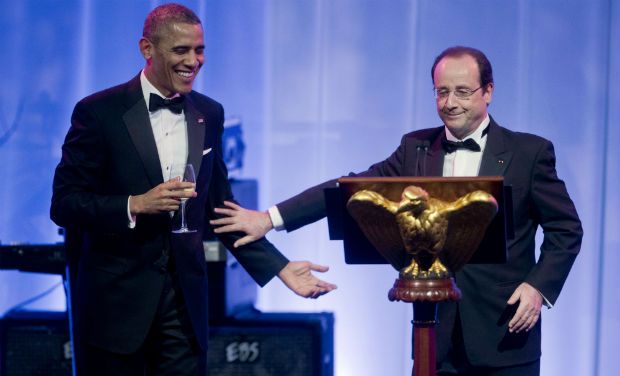
And yet the man who bears the responsibility for his country’s criminality in Africa – French president Francois Hollande – was being toasted at a sumptuous dinner in Washington this week by African-American president Barack Obama. Obama, with a glass of expensive wine in one hand, hailed Hollande for his country’s commitment to “security and peacekeeping” in Africa.
A day of reckoning cannot come soon enough. Just because these leaders are deluded does not mean we should ignore them or merely excoriate them. The international community must marshal the case and call for the prosecution of these criminals in high office.
Globalization and the End of the Left-Right Divide (Part I)
By TAKIS FOTOPOULOS | The International Journal of INCLUSIVE DEMOCRACY
A new political phenomenon, which characterizes the New World Order (NWO) of neoliberal globalization and the parliamentary junta, is the effective abolition of the old political divide – established formally during the French Revolution – between Right and Left. On the Right, were all those political forces that supported the continuation and reproduction of the “establishment”, once represented by the monarchy and later by bourgeois parliamentary “democracy” and the capitalist market economy, while on the Left were those who advocated the overthrow of the establishment in the above sense, ranging from anti-monarchists to Marxists, anarchists, antisystemic ecologists (unlike today’s washed-out Greens) etc. By definition, then, the Right supported “law and order” and whatever that implied in terms of inequality, hierarchy and the privileges of the advantaged social strata, while the Left essentially fought for the overthrow of the “status quo” and ― to varying degrees ― for the equal distribution of political, economic and social power.
The main arena in which the struggle between Left and Right was taking place was the nation-state, even if the Left – particularly the Marxist (but also the libertarian) Left – was traditionally internationalist, until it adopted in practice the strategy of “socialism in one country” because of the objective conditions it faced, although in theory it remained internationalist. However, it is precisely this arena that is being eliminated by the current NWO, which is literally “pulling the rug” from under the traditional Left-Right divide. The consequences are the seismic changes that we see today across the whole political spectrum.
As regards the Left, an undeniable symptom of this phenomenon is the political bankruptcy of the traditional Left, both in the narrow sense of its electoral percentages, and, most importantly, in the broader sense of its traditional conception as the subversive mass movement that mainly attracted the popular strata, and not the privileged “Leftists” of the bourgeoisie who seek minor reforms through the degenerate “Left”, as is the case now. In other words, even though this “Left” continues to survive politically, this does not change the fact that it has been fully integrated into the NWO, as its demands are anything but subversive. On the other hand, the part of it which belongs to the communist Left theoretically makes subversive demands, which however remain theoretical, since they are not accompanied by a transitional programme and subversive political action. And this is true of any party or organization today that defines itself as Left, communist, anarchist, “Green”, etc, if it does not challenge – both in theory and in practice – the NWO itself, i.e. globalization (which can only be neoliberal within the system of a capitalist market economy) and the main international institutions implementing the neoliberal policies, such as the EU, preferring instead to wait for revolution before demanding withdrawal from such institutions and imposing economic self-reliance. That is why this entire “Left” can no longer attract the popular strata – who are the main victims of globalization – on a mass scale.
But seismic changes can also be seen on the Right, as evidenced by the fact that the traditional conservative parties of today have only survived thanks to the social strata which have clearly benefited from globalization and which therefore sustain them, while they have been losing support from the popular strata who were embourgeoised during the period of social democracy but are now getting poorer because of the mass unemployment and poverty that globalization brings! Thus, these increasingly conservative popular strata that are being crushed by globalization are now leaving the established Right but are not crossing over to the degenerate “Left” which has been fully integrated into the NWO either. Crucially, these popular strata are not joining the communist, or the pseudo-libertarian Left forces, who are supposedly fighting for self-management but who “fail” to see the strangulation of the popular strata through globalization, the EU etc going on right under their noses!
It is these popular strata which are currently shifting en masse towards nationalist parties such as the UK Independence Party (UKIP), to the point that even the most authoritative newspaper of the economic elite, the Financial Times, has emphasized that a wind of Euroscepticism, going as far as to raise the demand for withdrawal from the EU, is sweeping across Europe[1] (15.10.2013). Contrary to the malicious propaganda of the transnational elite, which enjoys the support of the entire degenerate Left, this does not mean that the millions of Europeans who are turning against the EU and, indirectly, against globalization itself, have suddenly become Nazis, as though we were living in the 1930s. National socialism and social democracy itself are impossible today, as both flourished during the era of the nation-state which, under globalization is dead and buried. Nor does it mean that the fact that as much as 30 per cent of the new parliament, following next year’s Euro-elections, will comprise eurosceptics, have suddenly become racists. As the FT report stresses, the exptected massive influx of Eurosceptics in the next European Parliament, which even ardent European federalists now concede, will simply mean that the nationalist parties ‘are capitalising on the economic misery and high levels of unemployment that are plaguing the continent’.[2] It is indeed characteristic that the more these parties get rid of racist or extremist right-wing elements in their politics, the more their percentages rise, as the meteoric rise of Le Pen in France showed lately.
At this crucial historical juncture that will determine whether we shall all become subservient to neoliberal globalization and the transnational elite, it is imperative that we create a Popular Front in each country which will include all the victims of globalization among the popular strata, regardless of their current political affiliations. In Greece, in particular, where the popular strata are facing economic disaster, what is needed urgently is not an “antifascist” Front, as proposed by the parties of the parliamentary junta, supported also by the degenerate “Left” (such as SYRIZA, whose leader A. Tsipras is a candidate for the post of the president of the European Commission!) which would unite aggressors and victims. An ‘antifascist’ front would simply disorient the masses and make them incapable of facing the real fascism being imposed on them by the political and economic elites, which constitute the transnational and local elites. Their criminal policies have already led to almost a third of the active population and over 60 percent of the young being unemployed, to Greek disposable income being almost halved and to a huge rise in poverty with thousands of people having committed suicide since the “crisis” began three years ago. Instead, what is needed is a Popular Front that could attract the vast majority of the people who would fight for immediate unilateral withdrawal from the EU – which is managed by the European part of the transnational elite – as well as for economic self-reliance, thus breaking with globalization.
This would allow also a genuine, new form of internationalism to be built from below, while creating the preconditions necessary for the people to decide, democratically, what kind of socio-economic system they would like in order to achieve an authentic form of popular power.
[1] Joshua Chaffin, “Europe: United by hostility”, Financial Times, 15/10/2013
[2] ibid.
~
This is an edited version of an article that was first published (in Greek) in the Athens daily Sunday’s Eleftherotypia, on 20/10/2013
Featured Video

WARNING: Delete TikTok Immediately!
or go to
Aletho News Archives – Video-Images
Book Review
In 2014, Michael Parenti Wrote A Prophetic Article About Ukraine
The Dissident | January 28, 2026
This week, the influential left-wing scholar Michael Parenti passed away at the age of 92.
Parenti was well known for his sharp criticism of U.S. foreign policy and U.S. imperialism throughout his life, waking up many to the reality of it and the lies used to justify it.
This is best underscored in one of his last published articles, “Ukraine and Regime Change”, which was published in the book “Flashpoint In Ukraine: How the U.S. Drive for Hegemony Risks World War III”, where he predicted to a tee what the result of the 2014 U.S. backed coup in Ukraine would be. … continue
Blog Roll
Recent Comments
eddieb on WEF Calls for ‘Cultural Revolu… loongtip on Trump wanted to play peacemake… Coronistan on EU member to sue bloc over ‘su… loongtip on Vicious loongtip on EU turns to India for defense… Coronistan on Donald Trump Is No Peace … seversonebcfb985d9 on French court jails pro-Palesti… eddieb on Fourteen Incredible Facts Abou… Bill Francis on European leaders’ shift in the… seversonebcfb985d9 on Villains of Judea: Philip Esfo… loongtip on Report warns that ‘Jewish terr… Craig Nelms on New study shows that toxic gas…


 Aletho News
- In One Of His Final Pieces, Written in 2014, Michael Parenti Wrote A Prophetic Article About Ukraine
- More Bombs, More Talks Zelensky Rejects Trump’s Plan
- WARNING: Delete TikTok Immediately!
- Bari Weiss’ New CBS Hire List Is Full Of Zionists
- As TikTok falls into Zionist hands, UpScrolled fills the vacuum to give voice to Palestine
- Former Biden Advisor, Amos Hochstein, Admits The Biden Administration Is Responsible For the Gaza Genocide
- Not a Trump anomaly: The Board of Peace and America’s crisis-driven power plays
- Manufacturing martyrdom: The west’s cynical use of Iranian protest figures
- Attack on Iran would backfire, causing great losses for US, warns European think-tank
- Davos and Abu Dhabi: How the Ukrainian Endgame Exposed Western Decline
- If Americans Knew
- “The Gaza ceasefire is a minefield” – Not a ceasefire Day 110
- Israel to seek new security deal from US, official says
- Leaked “Board of Peace” Resolution Outlines U.S.-Led Plan to Rule Over Gaza
- Jonathan Greenblatt Rolls Out Plan to Activate Hispanic Evangelical Golems
- Violence against hundreds of Gazan remains to find one Israeli – Not a ceasefire Day 109
- Greenpeace Demonstrator Exposes Folly of Protest Restrictions
- From CBS to TikTok, Pro-Israel Ellison is now in the driver’s seat
- Israel pays for UK advertisements attacking Doctors Without Borders
- Israel accused of extracting billions from Gazan people to pay for their own genocide
- ‘Deliberate Assassination’: 3 Journalists Among 11 Killed by Israeli Forces in Gaza
- No Tricks Zone
- New Study Affirms Rising CO2’s Greening Impact Across India – A Region With No Net Warming In 75 Years
- Germany’s Natural Gas Crisis Escalates … One Storage Site Near Empty …Government Silent
- Polar Colding…Antarctica Saw Its Coldest October In 44 Years!
- New Study: Sea Levels Rose 20 Times The Modern Rate During The Roman Warm Period
- As German Gas Storage Dips Dangerously Low…Shortage Hardly Avoidable
- New Study: Brazil’s Relative Sea Level Was 2+ Meters Higher And SSTs 3-4°C Warmer 6000 Years Ago
- Philosopher Schopenhauer: Climate Science Certainty Stems From Stupidity, Ignorance
- New Study: Species Extinction Rates Declining Since 1980 – ‘Climate Change Is Not An Important Threat’
- Denmark Places Climate Protection Above Animal Welfare, Poisoning And Culling Cows
- New Study: Greenland Was 3-7°C Warmer And Far Less Glaciated Than Today 6000-8000 Years Ago
 Aletho News