Freedom of speech is a French myth

By Firoz Osman | MEMO | January 12, 2015
Years of taunts, insults and humiliating caricatures of the revered Prophet Muhammad (peace be upon him) and immigrants, by the satirical magazine Charlie Hebdo has resulted in what the French authorities have long warned against, an explosion of violence leading to the tragic deaths and injuries of more than 20 people.
President François Hollande described the carnage as an assault on secular French values, democracy, freedom of speech and expression; he condemned “Islamic terrorists” for such heinous crimes.
The bloodbath in Paris, though, had nothing to do with freedom of speech nor, indeed, Islam.
The deliberate provocation of six million Muslims in France and their 1.8 billion co-religionists worldwide through constant racial vulgarity and indignity directed at the Prophet and Islam under the guise of freedom of speech is reckless and reprehensible. Do French “values” and democracy really confer the freedom to denigrate someone who is cherished so deeply by fellow human beings?
It is now being promoted that the French media is free to publish anything as a fundamental right without restrictions of any kind; this is a myth. For example, French law does not permit the publication of material that promotes the use of drugs; hatred based on race or gender; insults about the national flag and anthem; or questions about the Nazi Holocaust. Dieudonné M’Bala, a French comedian and satirist, was convicted and fined in a French court for describing Holocaust remembrance as “memorial pornography”.
In fact, in 2008, one of Charlie Hebdo’s famous cartoonists, Siné, wrote a short note citing a news item that former French President Nicolas Sarkozy’s son Jean was going to convert to Judaism to marry the heiress of a prosperous appliance chain. Siné added the comment, “He’ll go far, this lad.” For that, Siné was sacked on the grounds of his “anti-Semitism”.
When Sarkozy was the Interior Minister he ordered the sacking of the director of Paris Match because he had published photos of his wife Cécilia Sarkozy with another man in New York. He even had rapper “Joestarr’s” song censored because it criticised the politician.
A French court banned Closer magazine from re-publishing or distributing photographs in France of Britain’s Duchess of Cambridge sunbathing topless. Despite this, Muslim women have been ostracised and forbidden to wear the headscarves in educational institutions and are ridiculed, arrested and fined for wearing the face veil in public.
The “Quenelle” hand sign has been described as anti-establishment and anti-Zionist by French youth and famous footballer Nicolas Anelka. It has stoked serious controversy in France since first being used by anti-establishment comedian M’Bala in 2005. He has been barred from many theatres and convicted a number of times for exercising his “freedom of speech” and using the Quenelle.
Protests by Muslims about blasphemous films and cartoons have been banned by the French authorities; France was the first country in the world to ban demonstrations in support of the Palestinians massacred in Gaza. This has led to the further marginalisation of France’s Muslim and African minorities in the political and social life of the nation and increasing anti-Muslim bigotry and hate-crimes.
Many have seen through the hypocrisy of a nation outraged at the murder of 12 people at Charlie Hebdo’s office, and yet complicit with Israel in the murder of 17 journalists and 2,300 men, women and children in Gaza last year.
France’s support for the “war on terror”, the invasion and occupation of Afghanistan, Iraq, Syria and Yemen, and its pivotal role in Libya and Mali, resulting in the deaths of hundreds of thousands of innocent people, adds to the grievance and disaffection of French Muslims. The humiliation, suffering and injustices felt for their co-religionists makes for a common cause.
There is undoubtedly political motivation underlying the vile, racist and vulgar cartoons lampooning Prophet Muhammad (peace be upon him) which is fuelling the climate of Islamophobia. Claims by defenders of Charlie Hebdo that other religious icons have been vilified disregard the fact that the targeting of Muslims has been more systematic and consistent. Instead of maligning the rich and powerful in society, the magazine’s cartoonists satirise the weak and marginalised, adding fuel to an already volatile fire.
When Muslims are mocked and insulted, and their Prophet, whom they love more than themselves, is dishonoured in an appalling way under the guise of “freedom of speech”, it has to be a factor in the explosion of violent fury in Paris. Freedom of speech does not mean the freedom to defame or malign a Prophet except, it seems, in Europe.
There has been a near-universal condemnation by Muslim leaders of the attack on Charlie Hebdo. Muslims have been urged to follow the Prophet’s example of never retaliating against those who insulted him personally. Islam emphasises that the rights of each individual are limited by the rights of others and society at large. These rights do not merely include freedom of speech, but equally the basic right to dignity, privacy and respect, and the right not to be subjected to degrading or inhuman treatment. Perhaps the French and their European and Western counterparts (including those in the supposedly Muslim world) need to imbibe Islamic values of tolerance, respect and honour if the obvious application of double standards is to be avoided in future.
Nine Questions About the Paris Attacks
By Kevin Ryan | Dig Within | January 11, 2015
 Mainstream media are busily promoting a familiar narrative for last week’s terrorist attacks in Paris. As usual this narrative demonizes Islam, calls for a reduction in civil rights, and bolsters existing military aggressions. However, a growing number of serious questions have arisen about the attacks. Until such questions are answered, citizens must consider that these events might be another pretext for an ongoing political agenda.
The Paris attacks are reported to have occurred in two parts. The first was the January 7th shooting of twelve people in and around the offices of Charlie Hebdo, a tabloid that often published offensive cartoons including some about the Prophet Mohammad. The second attack occurred the next day and was said to be the work of Amedy Coulibaly, a 32-year old Senegalese Frenchman who began shooting police officers at the scene of an accident and then took hostages in a Kosher grocery.
Some parts of the story have already proven to be inaccurate. For example, FOX News and NBC falsely reported that two of the suspects were in custody, based on information from “two consistently reliable U.S. counterterrorism officials.” One 18-year old widely reported to be a suspect turned himself in (145 miles away) and was released 50 hours later due to insurmountable contradictions.
Questions that remain unanswered include the following.
- The Charlie Hebdo gunmen, identified by police as brothers Cherif and Said Kouachi, were said to display professional training as if they were highly-skilled Special Operations soldiers. They were calm and controlled, well equipped, and well trained. Exactly where did they get their training and high-tech equipment?
- Coulibaly was identified by DNA testing in only two hours. Although rapid DNA tests can be performed in a matter of hours, a match requires DNA from the suspect. How did the testing match with this man in such a short time? Did authorities have his DNA or was it already in a database? In either case, how did that happen?
- Videos quickly showed two people in the Hebdo getaway car with one in the driver’s seat. Why did authorities name and interrogate a third suspect (who turned out to not be involved) as the getaway car driver?
- Why would the Koachi brothers wear balaclavas (i.e. ski masks) to hide their identity and then simply leave Said’s national ID card in the car? If they took the time to hide their faces, why would they bring their IDs with them?
- Why did the masked attackers work to make sure they were quickly portrayed as Muslims and members of al Qaeda during the attacks? Witnesses said one shouted to onlookers—”Tell the media it was al-Qaeda in Yemen.” Other videos and reports indicate that they repeatedly shouted “Allahu Akbar” and proclaimed that they were avenging the Prophet Mohammad. Who benefits from this?
- How did the attackers escape (to the northeast—the longest route through Paris) despite the police having raised the “alarm level for the greater Paris area to its highest level.” Did they have logistical support?
- Why does the video of the shooting of victim Ahmed Merabet, reportedly killed by a shot to the head, suggest that he was not shot in the head?
- How did Helric Fredou die? A Paris police commissioner conducting the investigation, Fredou died while preparing a report on the crimes. And why did Western media not report his death for at least three days?
- The alleged Kosher grocery gunman, Amedy Coulibaly, met with the President of France just a few years ago. What are the odds of such a coincidental meeting and does the connection relate to the attacks?
Many people have become skeptical about mainstream accounts of terrorism. This is due to the fact that authorities, like the FBI or CIA, are often found to be involved in some way and the events always support political agendas. Therefore it is not surprising to hear people claiming that intelligence agencies were involved in these attacks, or that the attacks related to political manipulations that would “shore up France’s vassal state status to Washington.”
Whatever the truth, it seems wise to consider all possibilities when mainstream media promote stories that feed the war machine and reduce freedom. Refraining from judgment until the facts are clearer is always the best approach.
Charlie Hebdo Massacre: Another Staged Event to Incite War and Destroy Freedom?
By Brandon Martinez | Non-Aligned Media | January 11, 2015
The “Islamists” strike again – at least that’s what those who stand behind the latest outrage in Paris want us to believe.
On Wednesday, two masked gunmen wielding AK-47s stormed the headquarters of Charlie Hebdo, a satirical newspaper based in Paris, France, assassinating the entire leadership of the paper. Twelve people were killed in the ensuing rampage, mostly Charlie Hebdo employees and a few policemen. Days later, four more random civilians were gunned down at a kosher supermarket by two other militants allegedly connected to the shooters in Paris.
Sporadically shouting “Allah Akbar” throughout the duration of their onslaught, the two attackers were caught on video making a spectacle of themselves as they paraded down the Paris street guns blazing. It is typically unusual for terrorists to immediately make it known who they are and what they stand for before concluding their dirty work, an anomaly the mainstream media refuses to emphasize for obvious reasons.
Other anomalies are cause for skepticism. How did the terrorists get ahold of military-grade weaponry undetected? Journalist Gearoid O Colmain told Russia Today that the two deceased suspects, French-born Said and Cherif Kouachi, had received military training from militants in Syria and had also traveled to Yemen to meet with al-Qaeda leaders there. And yet the pair was able to return to France without interference from authorities. Other reports indicate that the brothers were known and being monitored by French intelligence, but were still able to obtain the necessary armaments to conduct Wednesday’s attack without a hiccup.
In a Jan. 8 article, Sputnik News reported: “Said and Cherif Kouachi, two brothers in their 30s who are suspected of committing the [Charlie Hebdo] terror attack, have been known to France’s General Directorate for Internal Security and the prefecture of Police of Paris, Le Point news magazine said Thursday.” The Sputnik article further revealed that in 2008 Cherif Kouachi had been arrested and sentenced to a prison term of three years for attempting to recruit others to fight for al-Qaeda in Iraq.
Others contend some aspects of the Paris shooting were completely staged like a scene from a Hollywood action movie. Ali Şahin, a Turkish MEP and member of the ruling AKP party, echoed this view, citing the mysterious absence of street traffic where the shooting took place, and the odd lack of blood or recoil when a Paris cop was shot point blank by one of the gunmen.
In an op-ed for Press TV, analyst Kevin Barrett calls into question the dubious story that authorities found IDs left behind in the terrorists’ get-away car, which led police to quickly identify the suspects. Barrett contends that such a ‘mistake’ would not be made by sophisticated terrorists, but rather bears the markings of a false flag deception aimed at implicating Muslims.
“Al-Qaeda in Yemen” is officially being blamed for the Charlie Hebdo massacre, an unusual detour from ISIS or ‘Islamic State’ (IS) as it is now called, which has been the go-to bogeyman for neoconservative talking heads on the mass media for months.
According to a Fox News report, “Cherif Kouachi told a French TV station before Friday’s raid at an industrial park that he was sent by Al Qaeda in Yemen and had been financed by the cleric Anwar al-Awlaki.” The same report goes on to admit that al-Awlaki was “killed by a U.S. airstrike in Yemen in 2011,” but failed to explain how a dead man was able to finance and direct an attack four years after his death.
Many questions about the Paris attack remain and will likely go unanswered by the subservient sell-outs who populate mainstream media outlets.
Western Foreign Policy and Muslim Discontent
Even if we were to presuppose that a group of Muslims carried out a terrorist attack like the one we saw in Paris, one question journalists and reporters should be asking is ‘why would Muslims be angry enough to want to harm France and its citizens?’ To evade this essential line of inquiry, the prevailing script contends that it was Charlie Hebdo’s anti-Islamic cartoons, which depict Islam’s prophet Mohammed in a derogatory manner, that motivated the attack, and nothing else — a convenient narrative for France’s political class whose militaristic foreign policy warrants scrutiny.
Following the lead of Washington and Tel Aviv, France has as of late pursued staunchly anti-Muslim foreign policies, yet it befuddles journalists to ask why Muslims are upset with the present pro-American, pro-Israeli puppet regime in Paris?
It cannot be overlooked that America and France led the NATO onslaught against Libya in 2011, bombarding civilians and infrastructure in the name of “liberating” the predominately Muslim North African country from a ‘dictator.’ Thanks to the US, Britain, France, Canada and other rogue states, Libya – once a boon of progress in an otherwise bleak part of the world – is now a failed state plagued by terrorism and civil war. The stability and prosperity that Libyans once enjoyed under Gaddafi is nothing but a distant memory as the country is teetering on collapse whilst NATO-backed Takfiri gangs and warlords wrestle for control of Tripoli.
Many have also forgotten that the French invaded Mali, a Muslim-majority country in West Africa, in January of 2013 to put down the rise of armed groups opposed to France’s puppet regime in Bamako. Add to that France’s unyielding support of Israel and its terroristic policies against the Palestinians.
In the case of real Muslim violence directed at France and other NATO member states, it would be wise to broach the underlying causes of Muslim discontent, rather than objectifying it with stale neocon propaganda memes about ’72 virgins in heaven’ and other inanities.
Could it be that the Muslim world has suffered a litany of Western military invasions over the past few decades, causing the deaths and displacement of a few million Muslims, which may lie behind the deep-seated consternation and disdain emanating from that part of the world? Or do they simply ‘hate us for our freedoms,’ as neocon warmongers and Zionists assure us?
An average intellect could easily deduce the above puzzle, but those are queries that few in the degenerated ‘mainstream’ dare to raise with any serious vigor.
Islamic Extremism: A Manufactured Enemy?
So now we’ve seen attacks in Ottawa, Sydney and Paris within a relatively short period of time. Is it reasonable to believe that this recent string of ‘lone-wolf jihadist’ attacks across the West have been organic occurrences, cooked up in the deranged minds of mad-men? Or is there something more sinister at work?
Many analysts are questioning the dubious timing and nature of all of these incidents, which come at just the right moment to lend credence to the US-led coalition against ISIS. It is nothing short of miraculous that just as various Western countries gear up for military strikes against ISIS in Iraq and Syria, ‘terror incidents’ hit their respective homelands right on cue to give the politicians their belated ‘casus belli’ for joining the campaign to be rid of ISIS.
In any case, the West’s crusade against ISIS is as counterfeit as it is comical. The West’s ‘fight against ISIS’ is not truly aimed at combatting the militant group, but rather at destabilizing the region as a whole to further weaken and disorientate Israel’s rivals. Al-Qaeda, ISIS, al-Nusra Front — they are all outgrowths of the same poisonous American-Zionist imperial tree. Washington and Tel Aviv have routinely sponsored Takfiri zealots against regimes they seek to depose, the latest victims being Bashar al-Assad in Syria and Muammar Gaddafi in Libya. These armed radical groups have served a two-tiered purpose for their clandestine backers in America and Israel: firstly, they provide a pretext for the US and its lapdogs to invade the Middle East; secondly, they act as scare-crows to corral public opinion behind the interventions, providing a replenishing source of patsies and dupes that can take the fall for false flag attacks engineered by the state.
After each and every one of these terror events, Western governments have immediately enacted legislation which increases the powers of the secret services and police, effectively establishing a police/surveillance state aimed at cracking down on civilian dissent against government policies. Extirpating the ‘war on terror’s’ critics at home, while attacking Israel’s enemies abroad – what a perfect brew for the masterminds of this global strategy of tension operating under the guise of ‘Jihadism.’
“Free Speech” to Bash Muslims, but not Zionists
In response to the atrocity in Paris, French politicians and other Western leaders have been pontificating about Western ‘values’ and have selectively invoked ‘freedom of speech.’ “We live in a free and open democracy which has freedom of speech,” the West’s dishonest leaders say. “Radical Muslims don’t believe in ‘our values,’ hence the necessity to fight them overseas” is the standard establishment talking point, trotted out time and again by the professional script readers fronting as presidents and prime ministers.
The hypocrisy is stunning. Like most of Europe today, France is certainly not a bastion of freedom of speech, having implemented numerous draconian laws over the years, especially the infamous “Gayssot Act” which criminalizes opinions that contradict official World War II and ‘holocaust’ historiography. French revisionists such as Robert Faurisson, Vincent Reynouard and others who have questioned the “Six Million” mythology have been jailed and fined extortionate amounts of money by the French state for their dissident historical viewpoints. The existence of such repressive laws in France unveils the duplicity of the newfound love of free speech being expressed by the likes of French President Francois Hollande and his ministers.
Taking a page out of Stalin’s playbook, the French regime recently banned pro-Palestine protests, even going so far as to prosecute a number of prominent pro-Palestinian activists as “hate criminals.” And while France’s reprobate leaders fully sanction and even encourage satirical assaults upon Islam and Muslims in the name of “free speech” – not to mention lobbing bombs on Muslims in places like Libya and Mali – these same miscreants have outlawed any parodying of Zionism and Jewish privilege.
While championing Charlie Hebdo’s anti-Muslim cartoons as “free expression,” France’s mealy-mouthed political class have simultaneously led a ceaseless witch-hunt against French comedian Dieudonne, whose anti-Zionist parodies have angered the country’s Jewish ruling class. French authorities have enacted stiff bans against the wildly popular Dieudonne, preventing him from performing at public venues across the country under penalty of prison time and fines. Britain too has banned the comic from entering that country on the grounds that his famous “Quenelle” gesture resembles a Nazi salute and is therefore ‘anti-Semitic.’
In reference to Dieudonne, French President Francois Hollande himself pledged to use every means at the disposal of his government to “fight against the sarcasm of those who purport to be humorists but who are actually professional anti-Semites.” In Hollande’s Orwellian France, “free speech” is reserved only for those who defame Islam, whereas critics of Zionism and Jewish exceptionalism are first stigmatized and then criminalized – a tribute to the real power behind the throne of that once-free country.
Copyright 2015 Brandon Martinez
Planted ID card exposes Paris false flag
By Kevin Barrett | Press TV | January 10, 2015
French Interior Minister Bernard Cazeneuve says the terrorists who attacked Charlie Hebdo would never have been caught had they not made one fatal mistake: They conveniently left an ID card in their abandoned getaway car.
Since when did criminals leave their identification cards in abandoned getaway cars?
An ordinary citizen, taking no precautions, might accidentally leave a wallet or purse in their parked car. I have driven automobiles approximately 50,000 times in my life, and I think my wallet might have slipped out of my pocket and fallen into the crack between the driver’s seat and the door…once.
What are the odds that skilled terrorists who have just carried out an ultra-professional special-forces style attack will accidentally leave their ID card in the abandoned getaway car? Answer: Effectively zero.
So why are police reporting an event that cannot have happened?
Assuming that French police really did find “terror suspect” Said Kouachi’s ID card in an abandoned getaway car, that ID card must have been planted by someone wishing to incriminate Kouachi. Even the legendary French idiot detective, Inspector Clouseau, could not fail to make this thunderingly obvious inference.
The discovery of Kouachi’s ID does not implicate him; it exonerates him. It shows that he is an innocent patsy who is being framed by the real perpetrators of the attack.
Police and intelligence agencies routinely plant evidence to support false narratives, convict innocent people, and exonerate themselves. American police who kill unarmed citizens often plant a gun on the corpses to support their claims of having killed in self-defense. Such throw-down guns, which the police call “ham sandwiches,” are kept in police locker rooms and carried in police cars in case they are needed.
Likewise, throw-down ID cards and other “incriminating” documents are routinely used by the military, intelligence, and special forces professionals who orchestrate false flag operations. Consider the ludicrously-obvious planted evidence used in the mother of all false-flag operations: the September 11th, 2001 inside job.
Intelligence agents planted not just one, but two “magic suitcases” designed to incriminate Mohamed Atta, the innocent patsy framed for the crimes of September 11th. According to Der Spiegel’s book Inside 9/11: What Really Happened, the first Atta suitcase was handed to German police by a self-described “good Samaritan burglar.” The so-called burglar claimed to have stolen Atta’s suitcase during the course of a burglary and discovered terrorism-related information in it. As an honorable citizen, this kind-hearted burglar felt compelled by his conscience to deliver the suitcase to the authorities.
According to Der Spiegel, the German police, not being fools, knew that the self-styled burglar was not really a burglar at all, but an intelligence agent planting fake evidence against Atta. Der Spiegel quotes German police as saying: “The only question is, which intelligence agency was he working for?” (“CIA and Mossad,” answered former German Intelligence Minister Andreas Von Bülow in his book The CIA and September 11th.)
Despite its absurd origins, this suitcase full of fabricated documents provides virtually the only purported evidence supporting the official story of Atta’s supposed terrorism-related activities in Germany. Aside from the good Samaritan burglar’s suitcase, it seems that the original Egyptian Atta – the one in Germany – was a gentle, shy, sensitive, soft-spoken architecture student with no connections to terrorism of any kind. Yet the “Atta” who made a spectacle of himself in Florida before 9/11, staging memorable public scenes while all but wearing an “I am an al-Qaeda terrorist” sign around his neck, was a coarse, obscene, violent loudmouthed braggart who dated strippers, disemboweled kittens, and spoke fluent Hebrew.
The Hebrew-speaking Atta’s second and better-known “magic suitcase” was the one he allegedly checked in on his early morning flight from Portland, Maine to Boston on September 11th, 2001. According to the 9/11 Commission Report, the suitcase was miraculously preserved and delivered to the authorities when it somehow failed to make the transfer from Atta’s Portland-to-Boston commuter flight onto Flight 11, which Atta supposedly piloted into the North Tower of the World Trade Center. Had the suitcase been transferred as it should have been, we are told, it would have been destroyed in a fireball at the World Trade Center.
This magic suitcase provided the only evidence allowing authorities to identify the alleged 19 hijackers within 24 hours of the event. (None of the 9/11 passenger lists contained any Arab names; no airline employees remember having ticketed or boarded any of the alleged hijackers; and none of the hundreds of security cameras at Boston’s Logan Airport, Washington D.C.’s Dulles Airport, or Newark Airport took a single authenticated frame of any of the 19 Arabs blamed for 9/11.)
This suitcase not only contained a list of the 19 patsies, but also Atta’s supposed last will and testament. (Why would a suicide hijacker check his will onto a doomed plane?) Britain’s dean of Middle East journalism Robert Fisk has ridiculed Atta’s alleged will, pointing out that it begins with a botched bismillah: “In the name of God, myself, and my family…” No Muslim would ever write such a thing. As Fisk suggests, the document purporting to be Atta’s will must have been forged by an incompetent intelligence agent. The suitcase was obviously planted.
And that is not just Robert Fisk’s opinion. Seymour Hersh, the dean of American investigative journalism, quotes a senior US intelligence source as saying, with regard to Atta’s magic suitcase: “Whatever trail was left was left deliberately—for the FBI to chase.”
Atta’s two magic suitcases are not the only examples of clumsily-planted 9/11 evidence. Another is the “magic passport” of alleged 9/11 hijacker Satam al-Suqami. That passport, looking as pristine as the “magic bullet” of the JFK assassination, was allegedly discovered by an anonymous individual, with no chain of custody, near the two flat spots of smoking ground where two 110-story towers somehow exploded into very fine dust.
But Atta’s magic suitcases, the magic passport, beside the most pathetically-planted 9/11 item of them all: The “Fatty Bin Laden confession video” supposedly discovered in December 2001 by an anonymous US soldier in Jalalabad, and delivered with no chain of possession to be brandished by the Bush Administration as supposed proof of Bin Laden’s guilt.
Professor Bruce Lawrence, a respected expert on Bin Laden, has categorically stated of this video: “It’s bogus!” Lawrence adds that his many acquaintances in the US intelligence community’s Bin Laden units know that the video is bogus – but are afraid to say so in public, because they are afraid of the implications of Bin Laden’s innocence.
These and other examples show that the intelligence agents who orchestrate false-flag terror spectacles often do not even bother to disguise the blatantly-fabricated nature of the planted evidence used to implicate patsies.
So we should not be terribly surprised when the French police tell us – with a straight face – that a highly professional fleeing terrorist would leave his ID card in an abandoned getaway car.
US, allies must be held accountable for ISIL terrorism: Analyst
Press TV – January 9, 2015
The United States and its allies should be held responsible for the ongoing ISIL terror activities in various parts of the world, the Imam of Masjid al-Islam in Washington tells Press TV.
Imam Abdul Alim Musa, who is a strong critic of US support for terrorism, said in an interview with Press TV that the American administration, the Israeli regime and the Al Saud monarchy must held accountable for ISIL terror operations because “they created these groups from very beginning.”
The analyst further stressed that the American Central Intelligence Agency (CIA), Israel’s Mossad spy agency and the Saudi regime have been deeply involved in creation of the ISIL Takfiri group.
Musa further said the US and its western allies were using Zionist and Wahhabi ideologies to fuel terrorism, adding, “The origin of these groups is mainly Saudi Arabia.”
The analyst added that the Western countries have a long history of supporting the terrorists fighting against the government of President Bashar al-Assad in Syria.
The backers and controllers of the ISIL extremist group are using it to “promote Islamophobia” and “launch invasions,” the analyst said.
The ISIL militants have seized large swathes of land in Syria and Iraq. They have been carrying out heinous crimes against all communities in both neighboring Arab states.
Commenting on a recent terrorist attack targeting a French magazine, the Muslim scholar said the French support for anti-Syria militants and Paris’ pro-invasion policies were partly to blame for the deadly raid.
On Wednesday, masked gunmen stormed into the Parisian headquarters of the satirical weekly, Charlie Hebdo, gunning down a dozen people, including eight journalists, two police officers, a maintenance worker and a visitor.
Paris has been among the staunch supporters of the Takfiri militants operating against the Damascus government since March 2011.
France, Islam and Violence: Who Planted the Seeds?
By Robert Fantina | Aletho News | January 8, 2015
This week, France experienced a horrific incident when twelve people, staff members and visitors of a magazine were shot and killed. The world naturally condemns this violent act, mourns the loss of the dead and offers condolences to their loved ones.
That said, it is necessary to put this situation in its proper perspective. The targeted magazine, Charlie Hebdo, has a record of publishing satirical pieces about Islam that Muslims find extremely offensive. This does not, of course, mean that any magazine shouldn’t publish articles that someone might find offensive; doing so would put all magazines out of business. Yet those offended can take legal action against such occurrences. For example, in 2006 the Union of French Islamic Organizations sued Charlie Hebdo, charging racism. Although the executive editor was acquitted of the charge, the lawsuit itself was a reasonable response by the Islamic community.
In 2012, another series of derogatory cartoons appeared in the magazine, shortly after a company in the United States produced an anti-Islam film called ‘Innocence of Muslims’. This movie was met with several protest demonstrations in France, another viable, legal and peaceful response by the Muslim community. Such demonstrations against a variety of movies and issues are commonplace, but France took an unusual turn in response to these; it banned them. “I have issued instructions so that this does not happen again. These protests are forbidden.” So said French Interior Minister Manuel Valls in an interview with France 2 television network.
So Muslims who only want their religion and lifestyle to be accurately portrayed in the media, and who want to protest the twisted lies that are sometimes presented in books, magazines or movies, are denied any public way of doing so. Oh, they can still write letters to the editors of magazines and newspapers, but in any real democracy, they would be able to protest in a manner that would at least begin to approach the level of publicity that the offending item had garnered. Letters to the editor are not the same as movies in theaters.
Let us look a little deeper at the most recent unspeakable act of violence. By all accounts, the men who invaded the offices of Charlie Hebdo were well-trained and well-armed. This was, apparently, not some ragtag group that stole a few guns and shot their way into the office. Evidence suggests that the three men responsible for the shooting recently returned from Syria, where they were fighting with rebel groups there. So where might they have been trained, and who might have financed their training?
It has been widely reported that Syrian rebels have been trained by the United States, the United Kingdom, and France. This is not without historical precedent, and one need look no farther than the U.S. for some examples. During the Russian war against Afghanistan, the U.S. armed and trained the Taliban, looking for some group that could successfully oppose the Soviets. Fast forward two decades, the Taliban is in power in Afghanistan, and this resulted in the longest war in U.S. history, as the U.S. moved to remove the Taliban from power.
Has France been guilty of the same thing? By arming and training fighters, then preventing Muslims from exercising their democratic right to protest, France, perhaps, paved the way for the recent attack on Charlie Hebdo. It provided known radicals with the skills required to kill, and the tools to do so. It fanned the flame of anger by condoning the criticism and mocking of Islam, certainly allowed in any democratic nation, but then prevented Muslims from exercising their democratic right to protest.
None of this justifies the violence that was perpetrated on January 7. But for anyone to imply that this represents Islam, or to consider that France was an innocent bystander, minding its own business when terrorists suddenly invaded, is simply so shortsighted as to be ridiculous.
During the 2008 U.S. presidential campaign, Representative Ron Paul (R- Texas) said that terrorism resulted at least in part from U.S. policies in the Middle East. Former New York City mayor and Republican presidential candidate wannabe Rudy Giuliani was greatly angered by this statement, and said, in response: “They hate us for our freedoms”. According to Mr. Giuliani, repeated bombing of cities, support for the vicious, apartheid regime of Israel, financing the unspeakable suffering of the Palestinians, invading Iraq, sanctioning Iran, etc., all do nothing to spark hatred for the U.S. No, said he, ‘they hate us for our freedoms’.
Might France now have fallen into the same self-created trap? Does France not recognize any part it might have played in this act of terrorism? Does it consider itself at all culpable? Or, in true, U.S. fashion, does it simply say that Muslims are evil people who hate all that is good and just in the world, as represented, of course, by France? So what if Muslims aren’t allowed to protest insults to their religion? What does that have to do with anything?
Terrorism anywhere in the world must be stopped, whether perpetrated by radicals in a magazine office in France, by IDF (Israel Defense Forces) terrorists in Palestine, or U.S. terrorists in Yemen. Yet when terrorism is met by terrorism, looking for any different motivation is counterproductive. When Israel says that it is merely defending itself from rocket fire from Gaza, the constant terrorism that Gazans experience on a daily basis from Israel must not be ignored. When the U.S. is the target of any attack, the indiscriminate killing of men, women and children by bombs dropped by drones must be considered in the motivation. And France, too, is not exempt; its policies may stimulate hatred and hostility, which results in acts of violence.
Goliath can only assault David for so long, before he falls to the inevitable. Any nation, France, the U.S. , Israel or any other, can only discriminate against, assault, torture and kill people for so long before their victims and their victims’ sympathizers say ‘enough’, and take action. The better course would be for these world powers to show genuine, unconditional concern for the basic human rights of everyone on the planet, and act accordingly. Until that happens, such actions as those perpetrated in Paris this week, must be expected.
What to Say When You Have Nothing to Say?
By Diana Johnstone | CounterPunch | January 7, 2015
Paris.
What do you say when you have nothing to say?
That is the dilemma suddenly thrust on political leaders and editorialists in France since three masked gunmen entered the offices of the satirical weekly Charlie Hebdo and massacred a dozen people.
The assassins got away. But not for long. The men were well-armed killers. Charlie Hebdo regularly received death threats since publishing derisive cartoons of the Prophet Mohammed several years ago. But the controversy seemed to be largely forgotten, the weekly’s circulation had declined (like the press in general) and police protection had been relaxed. The two policemen still on guard were easily shot by the gunmen before they entered the offices in the midst of an editorial meeting. Rarely were so many cartoonists and writers present at once. Twelve people were slaughtered with automatic weapons, and eleven others wounded, some critically.
In addition to the cartoonist known as Charb (Stéphane Charbonnier, age 47) who was current editor in chief of the magazine, the victims included the two best-known cartoonists in France: Cabu (Jean Cabut, age 76), Georges Wolinski (80 years old). A couple of generations have grown up with Cabu and Wolinski, gentle mirrors of the sentiments of the French left.
As they left, one killer came back to finish off a policeman who lay wounded in the street. They stopped to shout: “The Prophet is avenged!” Then they fled toward the northeastern suburbs.
Crowds gathered spontaneously in the Place de la République in Paris, not far from the tiny street where the Charlie Hebdo had its offices. Brave, false slogans spread: “We are Charlie!” But they are not. “Charlie lives!” No, it doesn’t. It has been just about wiped out.
Everyone is shocked. That goes without saying. This was cold-blooded murder, an unpardonable crime. That also goes without saying, but everyone will be saying it. And there is a lot more that everyone will be saying, such as “we will not allow Islamic extremists to intimidate us and take away our freedom of speech”, and so on. President François Hollande naturally stressed that France is united against the assassins. Initial reactions to an atrocity of this sort are predictable. “We will not be intimidated! We will not give up our freedoms!”
Yes and no. Surely even the most crazed religious fanatic could not imagine that this massacre of humorists would convert France to Islam. The result is certain to be quite the opposite: a reinforcement of growing anti-Muslim sentiment. If this is a provocation, what did it mean to provoke? And what will it provoke? The obvious danger is that, like 9/11, it may strengthen police surveillance, and indeed weaken French liberties, not in the way that the killers allegedly seek (limiting freedom to criticize Islam) but in the way liberties have been restricted in post-9/11 America, by some imitation of the Patriot Act.
Personally, I never liked the provocative covers of Charlie Hebdo, where the cartoons insulting the Prophet – or for that matter Jesus – tended to be displayed. A matter of taste. I don’t consider scatological, obscene drawings to be effective arguments, whether against religion or authority in general. Not my cup of tea.
The individuals who were murdered were more than Charlie Hebdo. The drawings of Cabu and Wolinski appeared in many publications, and were known to a public that never bought Charlie Hebdo. The artists and writers at that editorial meeting all had their talents and qualities which had nothing to do with the “blasphemic” cartoons. Freedom of the press is also freedom to be vulgar and stupid from time to time.
Charlie Hebdo was not in reality a model of freedom of speech. It has ended up, like so much of the “human rights left”, defending U.S.-led wars against “dictators”.
In 2002, Philippe Val, who was editor in chief at the time, denounced Noam Chomsky for anti-Americanism and excessive criticism of Israel and of mainstream media. In 2008, another of Charlie Hebdo’s famous cartoonists, Siné, wrote a short note citing a news item that President Sarkozy’s son Jean was going to convert to Judaism to marry the heiress of a prosperous appliance chain. Siné added the comment, “He’ll go far, this lad.” For that, Siné was fired by Philippe Val on grounds of “anti-Semitism”. Siné promptly founded a rival paper which stole a number of Charlie Hebdo readers, revolted by CH’s double standards.
In short, Charlie Hebdo was an extreme example of what is wrong with the “politically correct” line of the current French left. The irony is that the murderous attack by the apparently Islamist killers has suddenly sanctified this fading expression of extended adolescent revolt, which was losing its popular appeal, into the eternal banner of a Free Press and Liberty of Expression. Whatever the murderers intended, this is what they have achieved. Along with taking innocent lives, they have surely deepened the sense of brutal chaos in this world, aggravated distrust between ethnic groups in France and in Europe, and no doubt accomplished other evil results as well. In this age of suspicion, conspiracy theories are certain to proliferate.
Diana Johnstone is the author of Fools’ Crusade: Yugoslavia, NATO, and Western Delusions. Her new book, Queen of Chaos: the Misadventures of Hillary Clinton, will be published by CounterPunch in 2015. She can be reached at diana.johnstone@wanadoo.fr
Wobbles in US-EU axis against Russia
By FINIAN CUNNINGHAM | Press TV | January 6, 2015
French President Francois Hollande this week called for an end to Western sanctions on Russia. He is the latest senior European political figure to express misgivings about the hostile policy that Washington and Brussels have embarked on against Russia over the year-old Ukrainian crisis.
Hollande was speaking during a traditional New Year interview with French media covering a range of issues, both domestic and international. Referring to upcoming political negotiations in Kazakhstan aimed at finding an end to the Ukraine conflict, Hollande said that he was in favor of lifting sanctions imposed on Russia “if progress was made” at the talks.
Senior French, German and Russian officials are to meet in the Kazakh capital Astana on January 15, along with representatives from Ukraine. The aim is to find a lasting solution to the violence that has been raging in eastern Ukraine since last April. That conflict has taken nearly 5,000 lives and threatens to escalate, despite a shaky ceasefire put in place last month.
As a preliminary to the Astana summit, officials from the above countries were meeting in Berlin this week to sketch out a possible agreement. Significantly, American officials are not involved, even though Washington is closely aligned with the regime in Kiev that seized power illegally last February, and which has launched a military offensive on the eastern Donbas Russian-speaking population, who refuse to recognize the legitimacy of the coup.
Washington and Brussels have sought to blame Russia for the crisis, claiming that Moscow is fueling separatist fighters in Donbas to undermine the Western-backed Kiev regime. Russia has repeatedly denied any such involvement. Moscow has pointed to the dearth of evidence for Western claims. It says the crisis stems from the illegal intervention in the internal affairs of Ukraine by the Western states, and that the ethnic Russian populations of Crimea and the eastern regions have simply responded, out of their own volition, with dissent towards the neo-Nazi anti-Russian regime that seized power in Kiev.
The Washington-Brussels axis has slapped economic and diplomatic sanctions on Russia, which have been met by counter-sanctions from Moscow. The deterioration in relations is not only having economic impacts on Russia, it is rebounding to cast a pall over Europe’s own faltering economy. Trade and commerce between Russia and the European Union are tenfold that between Russia and the US, so in the unfolding economic war the EU has much more to lose than Washington.
This partly explains why EU leaders are increasingly showing trepidation over the widening impasse.
“France seeks end to Russia sanctions over Ukraine,” reported the BBC this week on Hollande’s public call for restraint. The French leader is the latest high-profile EU figure expressing serious doubts about the Washington-Brussels aggressive policy towards Russia.
As the BBC report added: “Politicians in Italy, Hungary and Slovakia are among those who want the sanctions eased.”
To that list we could append Germany, Austria, Spain, Greece, Czech Republic and Bulgaria, among others.
Last weekend, Czech President Milos Zeman deplored the warmongering attitude of the Kiev regime, denouncing the CIA-installed Prime Minister Arseniy Yatsenyuk as “the prime minister of war.”
The day before Hollande made his comments, Germany’s Vice Chancellor Sigmar Gabriel warned against sanctions bringing Russia “to its knees” and risking “a conflagration.”
Germany’s second highest politician, and deputy to Chancellor Angela Merkel, is thus giving notice of significant opposition to the Washington-Brussels axis and its anti-Russian policy, which his boss, Merkel, has been up to now an ardent supporter of.
Gabriel told the Bild am Sonntag newspaper that the Washington-led policy is ruinous. “The goal was never to push Russia politically and economically into chaos,” said Gabriel, a member of the Social Democrat party, which historically prefers cordial relations with Russia.
In a hint at malign external forces thriving on conflict between Europe and Russia, Gabriel noted: “Whoever wants that [Russia’s political and economic chaos] will provoke a much more dangerous situation for all of us in Europe.”
At the end of last month, German Foreign Minister Frank-Walter Steinmeier, a fellow Social Democrat member, also voiced disquiet over the Washington-Brussels axis that Merkel has dutifully followed.
“It cannot be in our interests that this runs out of control. We need to keep this in mind in our sanctions policy,” said Germany’s top diplomat, as reported in Deutsche Welle on December 19.
Hollande’s latest high-profile call for a reversal in policy towards Russia is not based on vague altruism. France, like Germany, is feeling the brunt of the sanctions war.
French unemployment hit a record high at the end of the year, reaching near 3.5 million or 10.5 per cent of the workforce. Bad news on the parlous state of the French economy keeps on piling up, and Hollande’s personal rating among increasingly angry French voters keeps on plumbing new depths.
European citizens know that the crisis over Ukraine and between Europe and Russia is wholly unnecessary. They know that the tensions have been whipped up by Washington for its own selfish strategic interests of driving a wedge into the continent. Up to now, EU leaders have stupidly gone along with this reckless policy even though it is rebounding in further economic hardship for EU citizens and risking an all-out war.
The latest wobble in the Washington-Brussels axis against Russia, as expressed this week by Francois Hollande, has to be seen as good news. In that, at last, finally, official Europe is coming to its senses about the dangerous course the US is driving.
A political theme that has gained momentum over the past year is the “democratic deficit” across the EU that is alienating millions of its citizens. What more disturbing democratic deficit can you get than Brussels slavishly following Washington’s warmongering policy against Russia – in total detriment to the interests of EU citizens over crucial matters of their livelihoods and ultimately over the risk of an all-out war in Europe.
British mis-leader David Cameron is too much of an American puppet to ever come to his senses. But with France’s Hollande now beginning to show some long overdue common sense towards Russia, there may be grounds to believe that European governments are waking up to the recklessness of the Washington-Brussels axis against Russia – and ditching it.
The EU shifting its strategy on Syria, Iraq and fighting ISIS
By Sami Kleib | Al-Akhbar | December 27, 2014
After the United States abandoned the idea of Syrian President Bashar al-Assad stepping down and enhanced security coordination with the Syrian army against the Islamic State in Iraq and Syria (ISIS), it appears the Europeans began some time ago a series of meetings to change their policy on Syria. According to information obtained by Al-Akhbar, some senior European officials did not hesitate to say at the last Council of European Union Foreign Ministers meeting that “this policy was wrong.” It is necessary, therefore, to change it and let the United Nations envoy Staffan de Mistura’s initiative lead the way. Does that mean we will soon see favorable signs towards the Syrian regime and further disregard for the external opposition?
Geneva – A European official told Al-Akhbar about the proceedings of an important meeting between United Nations (UN) envoy Staffan de Mistura and European Union (EU) foreign affairs ministers on December 11, confirming that there is a change in the European position towards Syria. He said the meeting was closed like all meetings during which Europeans discuss sensitive matters. De Mistura began to explain the situation in Syria and the regional and international framework surrounding his plan that is supposed to be implemented in three months “otherwise it loses its ability to be implemented.”
This, in short, is what de Mistura said and the Europeans’ position towards it.
- The plan to freeze the fighting in Aleppo is the only one currently available. There is no hope for another plan. Therefore, the EU should support it practically and not just verbally. It is the only plan capable of freezing the fighting, securing people’s needs and returning the displaced people who are burdening neighboring areas and states. It will also allow for the eventual process of reconstruction.
- Syrian President Bashar al-Assad, who showed readiness to ensure the success of the international plan in Aleppo, convinced Russian President Vladimir Putin of the plan and played a major role in convincing his Iranian allies as well. This was necessary because Moscow was reluctant, thinking that no US-Atlantic effort can be trusted and the plan might lead to dire consequences for Russia and its allies.
- Although the Americans expressed reservations and doubt about the plan at the beginning, they have become more flexible, tying their approval with that of some of their regional allies, meaning of course Saudi Arabia primarily. In any case, I am going to Riyadh to convince Saudi officials of the plan’s feasibility. If we obtain preliminary approval from them, I will subsequently continue my efforts in Damascus so we can start as soon as possible because time is running out.
Here, we should remember that Brahimi had told the Europeans once what he said on more than one occasion and in more than one place, namely, that his resignation will “relieve two people, Assad and Saudi Foreign Affairs Minister Saud al-Faisal” because his personal relationship with both men was quite bad. He was probably speaking about “Saud al-Faisal’s personal hatred towards Assad being a hindrance to finding a solution.” It is also known that the Syrian president, from his very first meeting with Brahimi, questioned his intentions especially when the Algerian UN envoy suggested that Assad should step down and intended to meet Syrian Vice President Farouk al-Sharaa before Assad prevented him from doing so, arguing that this is improper on an official visit. Brahimi at the time had to make do with a phone call. After a while, Sharaa was removed from power.
- Turkey remains a real problem for the Europeans. Some officials say it is impossible to predict what Ankara could do next. Others believe that Turkey is pretty much the only country still facilitating the passage of foreign fighters to Syria, it has not made up its mind about fighting the Islamic State in Iraq and Syria (ISIS) and is trying to blackmail the international community with its position. Here, the Europeans make two suggestions. Either put pressure on Turkey, including perhaps issuing a warning – which some believe is pointless because it might make the Turkish president Recep Tayyip Erdogan’s position more intransigent and push him further into Russia and Iran’s arms – or try to cajole and get closer to Turkey, prompting it to commit to the international decision to fight ISIS and stop the flow of foreign fighters. Either way, the Turkish position remains worrisome for Europe.
- Iran has become a central player in both the Syrian and Iraqi crises. It is necessary to deal with this reality regardless of the reservations that some might have. There is nothing to prevent engaging with Iran in a serious dialogue about Syria, even before signing a nuclear agreement. This is useful because it could lead to political concessions from the Syrian regime and it could strengthen the presence of European companies in Iran. Perhaps this has become a European need despite French reservations, which are understandable, given French-Saudi relations and France’s concern not to upset Israel.
- It is impossible to think of serious solution or temporary solutions in Syria without Saudi Arabia, which has extensive relations with a number of Anti-Assad parties. It is important to reassure Riyadh that the European efforts do not intend to buoy up the regime. De Mistura said that Saudi Arabia implicitly welcomes his initiative. The Spanish foreign affairs minister was clearer, saying that Riyadh accepts the plan and it is in France’s interest to tone down its critique otherwise it will appear more extremist than Saudi Arabia, which is not an understandable position. The Spanish minister went as far as suggesting that an international conference for Syria be held in his country given that the idea might be accepted by everybody.
- Russia remains the main obstacle to any solution that does not satisfy the Kremlin and the Syrian regime. Since its relationship with the US and Europe is currently strained because of Ukraine, it is necessary to look for ways to separate any discussion with Russia about Syria from the position regarding Ukraine. Some European officials intend to strengthen the dialogue with Moscow because “it is unacceptable to return to the logic of the cold war.” Perhaps the High Representative of the EU for Foreign Affairs and Security Policy Federica Mogherini will visit Moscow soon. Besides, Russia is active and serious about finding a political solution. The Europeans keeping their distance from Moscow might mean distancing the US and Russia.
The Europeans with and against Assad
First, everyone agrees to de Mistura’s plan, but they want to support it because it is the only plan currently available while awaiting the results of Russian efforts to bring the opposition and the Syrian regime delegation together in Russia. However, France, which currently enjoys strong trade relations with Saudi Arabia and Britain, is ahead of other Europeans in its contacts with Iran and insists that the plan should not support the Syrian army against the moderate opposition in Aleppo. In other words, the issue should not be portrayed as standing with the army against ISIS because in Aleppo and its surroundings there are fighters affiliated with the moderate opposition and they should be taken into consideration and supported “so we won’t appear as though we are drawing a parallel between the regime and the opposition and that we view both sides equally.”
The French foreign affairs minister was the most intransigent even though some within the current French administration point out the need to take a new position towards Syria, especially after the terrorist attacks that took place on French soil. Laurent Fabius said, “We don’t want what happened to Homs to happen in Aleppo,” where suspending the fighting benefited the regime only and was not balanced. The fighters left after they turned in their weapons to the state and were transported in government buses to the areas they come from.
A European official with ties to the Syrian opposition said “the departure of the fighters then was a farce for them. Imagine that the Grand Mufti, Ahmad Badreddin Hassoun, who is a regime loyalist showed up in the buses transporting the fighters joking with them and asking them isn’t it better to marry while they are young instead of getting killed on battlefronts? They were given cell phones to talk with their families and undermine their morale. In the end, the media image and the reality on the ground were in the interest of the regime.”
The French minister was insistent that “the regime should not benefit from this plan in terms of relieving it at the Aleppo front so it can focus on other fronts in other areas.” That is what Fabius was saying when the EU received information about the possibility of the Syrian and Iraqi armies engaging in a wide joint military operation in Deir Ezzor.
Second, the European relationship with Assad is possible, but it becomes evident during the discussions of the foreign affairs ministers and commissioners of the EU that they are at a loss on how to deal with Syria. For example, a European official in Geneva says that a number of his European colleagues have begun to talk about the failure of the policy adopted so far and about the “uncalculated mistake” of suggesting early on that Assad step down.
Some Europeans argue that their assessment of the situation was erroneous while others believe that trusting the US from the beginning was a mistake because Washington, as usual, places its interests ahead of all its alliances, often putting the Europeans in an awkward position. Still others argue that underestimating the capabilities of the Syrian army and its allies was their biggest mistake.
As such, EU officials are currently discussing how to “modify” the political position that has been adopted for more than three years in Syria. One sign of this change is abandoning the mantra of “Assad stepping down” and finding more realistic statements that have been repeated now and then, such as “Assad is not a final solution to the crisis” or “Assad will not stay at the end of the political solution” or “it is only natural that a political solution will eventually lead to transferring powers from the presidency and not all powers” according to Geneva I. Another sign of a change in position is abandoning the phrase “proceeding with a transitional process now” and replacing it with one accepted by all, namely, “calling for the start of a transitional process.”
It appears that Mogherini succeeded, to some extent, in promoting the point of view that “we agree on the end result but political realism and the developments of the situation require us to adjust our course and use new phrases.” In other words, even if everyone in Europe wanted Assad to step down, political realism suggests that this is not possible at this point and encouraging a political solution might eventually lead to this end, meaning this is no longer a European priority.
The security council in Aleppo?
In light of these discussions about modifying the European position towards the Syrian regime, the most important question in the EU is how to ensure the success of the Aleppo plan and how to implement it without portraying Assad as the winner, especially given that the Syrian army advanced in a noticeable way in Aleppo recently?
The dominant trend is to find a monitoring mechanism by the UN Security Council. However, the Europeans realize that this is impossible due to the dual Sino-Russian veto that is always ready to protect Syria. Therefore, unlike the French and British positions which insist on an international force from the UNSC, the EU is more inclined towards finding a diplomatic formula that talks about “a monitoring mechanism linked to the UNSC.”
All of this will be released soon in what is now called “the EU strategy on Syria, Iraq and fighting ISIS.”
Despair with the Syrian opposition, particularly, the National Coalition for Syrian Revolution and Opposition Forces, which for a long time monopolized, with international support, the representation of the opposition has infiltrated EU states after the US. The Europeans too are now more inclined towards expanding the scope of the opposition to include forces that were previously not accepted and undermine the Muslim Brotherhood.
It is remarkable for instance that when the head of the Coalition, Hadi al-Bahra, visited the EU in Brussels few days ago, representatives from the Coalition were calling the Europeans to say that Bahra no longer represents them. A European official says jokingly: “Everytime we begin to talk with an official from the Coalition, we discover that this Coalition held new elections and changed the official. So we start all over again. And every time we meet with a Coalition official, he repeats the same question, how are you going to prevent the regime from benefiting from the plan you are proposing? But we have noticed for some time now that some parties within the Coalition have come to accept the idea of negotiating with the regime and reaching a political agreement with it even if their ultimate goal is for Assad to step down. This is the case with Moaz al-Khatib and his team for instance. The problem of the Coalition is that it does not know the meaning of political realism and continues in its fragmentation as it is tossed around by conflicting foreign alliances.”
In light of all the above, is the EU starting to change its position towards Assad? Perhaps all its members still support the departure of the Syrian president. But political realism requires a change in behavior and approach and not insisting on Assad’s departure as a priority. This will become more evident in the future as terrorist attacks inside Europe have increased. The only solution left is to cooperate with Syrian security forces, the Syrian army and Iran in the context of fighting terrorism.
As for de Mistur’as plan in Aleppo, it is currently in a feverish race between a military solution and security arrangements that cannot be undertaken without the regime’s approval and that might be to its advantage.
Once again, history repeats the same old maxim, “international interests are more important than principles and people’s tragedies.”
French president supports autonomy for Ukraine’s southeast
Ukraina.ru | December 5, 2014
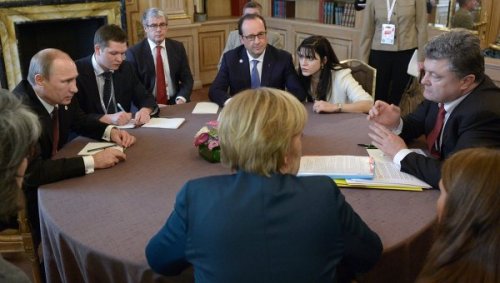
French President Francois Hollande has called for a joint effort by the leaders of France, Russia, Germany and Ukraine to calm the conflict in Ukraine.
“Together with Mr. Putin, Mr. Poroshenko and Ms. Merkel, we should start a process aimed at reducing tensions. It should begin with reducing verbal tensions, followed by concrete actions in Ukraine,” the French president at a news conference following talks with Kazakh President Nursultan Nazarbayev in Astana.
According to Hollande, it is necessary to “focus on the future without forgetting the lessons of the past… The existing tensions and pressure do not contribute to resolving problems,” Hollande said.
He said that Ukraine’s territorial integrity should be preserved, but eastern regions should be granted “a certain level of autonomy.”
In April, the authorities in Kiev launched a military operation in the country’s eastern regions, which refused to accept the results of the February coup.
According to the latest UN estimates, the conflict has claimed the lives of 4,300 civilians and left 10,000 people wounded.
photo © РИА Новости. Алексей Никольский
Swiss, French call to bring home gold reserves as Dutch move 122 tons out of US
RT | November 28, 2014
The financial crisis in Europe is prompting some nations to repatriate their gold reserves to national vaults. The Netherlands has moved $5 billion worth of gold from New York, and some are calling for similar action from France, Switzerland, and Germany.
An unmatched pace of money printing by major central banks has boosted concerns in European countries over the safety of their gold reserves abroad.
The Dutch central bank – De Nederlandsche Bank – was one of the latest to make the move. The bank announced last Friday that it moved a fifth of its total 612.5-metric-ton gold reserve from New York to Amsterdam earlier in November.
It was done in an effort to redistribute the gold stock in “a more balanced way,” and to boost public confidence, the bank explained.
“With this adjustment the Dutch Central Bank joins other banks that are keeping a larger share of their gold supply in their own country,” the bank said in a statement. “In addition to a more balanced division of the gold reserves…this may also contribute to a positive confidence effect with the public.”
Dutch gold reserves are now divided as follows: 31 percent in Amsterdam, 31 percent in New York, 20 percent in Ottawa, Canada and 18 percent in London.
Meanwhile, Switzerland has organized the ‘Save Our Swiss Gold’ referendum, which is taking place on November 30. If passed, it would force the Swiss National Bank to convert a fifth of its assets into gold and repatriate all of its reserves from vaults in the UK and Canada.
“The Swiss initiative is merely part of an increasing global scramble towards gold and away from the endless printing of money. Huge movements of gold are going on right now,” Koos Jansen, an Amsterdam-based gold analyst for the Singaporean precious metal dealer BullionStar, told the Guardian.
France has also recently joined in on the trend, with the leader of the far-right National Front party Marine Le Pen calling on the central bank to repatriate the country’s gold reserves.
In an open letter to the governor of the Banque de France, Christian Noyer, Le Pen also demanded an audit of 2,435 tons of physical gold inventory.
Germany tried and failed to adopt a similar path in early 2013 by announcing a plan to repatriate some of its gold reserves back from the US and France.
The efforts fizzled out this summer, when it was announced that Germany decided to leave $635 billion worth of gold in US vaults.
Germany only keeps about a third of its gold at home. Forty-five percent is held in New York, 13 percent in London, 11 percent in Paris, and only 31 percent in the Bundesbank in Frankfurt.
French Polynesia to demand nearly $1bn from Paris over tests
RT | November 25, 2014
In an unprecedented move, French Polynesia, an overseas territory governed by France, is to ask Paris for nearly $1 billion in compensation for damage caused by nuclear weapons tests carried out by France in the South Pacific between 1966 and 1996.
The Assembly of French Polynesia has prepared a demand for $930 million (754,2 million euros) over “major pollution” caused by the 193 tests carried out by France for 30 years, La Dépêche de Tahiti reported. On top of this, the proposed resolution seeks an additional $132 million for the continued occupation of the Fangataufa and Mururoa atolls, used for nuclear testing.
The conservative Tahoera’a Huiraatira party committee has been acting independently of Polynesian President Edouard Fritch, who said he was “sorry” for the motion “written without consulting him,” local press reported.
Meanwhile, the text of the resolution, set for approval by the Assembly, highlights a “very poor situation of the atolls,” and a clean-up “impossible in the current state of scientific knowledge,” Tahiti Infos reported. They write that French Polynesia has been “too long sidelined” from decisions on “waste conservation and monitoring modes whatever their nature as well as the rehabilitation options of the atolls.”
On 24 August 1968, France conducted its first multi-stage thermonuclear test at Fangataufa atoll in the South Pacific Ocean, the so-called ‘Canopus’ test. With a 2.6 megaton yield, its explosive power was 200 times that of the Hiroshima bomb, according to the Comprehensive Nuclear-Test-Ban Treaty Organization (CTBTO).
France began its last series of nuclear tests in the South Pacific in 1995, breaking a three-year moratorium, provoking international protests and the boycott of French goods. It conducted its final nuclear test in January 1996 and then permanently dismantled its nuclear test sites. Later in that year, France signed the Comprehensive Nuclear-Test-Ban Treaty (CTBT).
In 1996, in the wake of the nuclear testing, a $150 million annual payment was granted to French Polynesia, a territory of over 100 islands and atolls with its own government.
France, together with China, is not party to the 1963 Partial Test Ban Treaty, which bans nuclear explosions in the atmosphere, under water and outer space but not underground.
Last year it came to light that French nuclear tests carried out in the South Pacific had proved to be far more toxic than previously thought. According to declassified documents, seen by Le Parisien, plutonium fallout covered a much broader area than Paris had initially admitted, with Tahiti allegedly exposed to 500 times the maximum accepted levels of radiation.
According to the CTBTO, a study conducted between 2002 and 2005 of thyroid cancer sufferers in Tahiti, who had been diagnosed between 1984 and 2002, established a “significant statistical relationship” between cancer rates and exposure to radioactive fallout from French nuclear tests. Another survey carried out by an official French medical research body, Inserm, in 2006, also detected an increase in thyroid cancer among people who had been living within some 1,300 km of the nuclear tests conducted on the Polynesian atolls between 1969 and 1996.
In 2010, France pledged that veterans and survivors would be elegible for compensation, noting that this process would take time.
Featured Video

Deep Dive Intel Briefing 6/20/2026 Lt Col Daniel Davis
or go to
Aletho News Archives – Video-Images
From the Archives
As Hillary Clinton kisses up to Henry Kissinger, RT looks at 4 of his most heinous acts
RT | September 3, 2016
… While Clinton retains the ultimate warmongering seal, RT examines some of Kissinger’s most memorable acts… Read full article
Blog Roll
 Aletho News
- Iran opens hundreds of legal cases over US, Israeli aggression: Prosecutor general
- Iran delegation protests Trump’s threat at Switzerland talks, weighs ‘proper’ response: Source
- Terms of US capitulation to Iran presage new era for the region
- Strategic Oil Reserve Nears Collapse… US Must Choose: Guns or Butter
- The Story the Media — and the Government — Don’t Want You to Hear
- Deep Dive Intel Briefing 6/20/2026 Lt Col Daniel Davis
- The Targeted Assassination of Studies Showing Vaccines Cause Injury
- BMJ Probe Into Excess Mortality Study Drags On for Two Years With No Resolution
- Securing Peace with Iran Compels Trump to Divorce Israel
- Old Iraq war architects rise up to wag finger at Trump’s Iran deal
- If Americans Knew
- JNS Policy Summit to kick off in Israel
- Fatalities From Israel’s Vast Gaza Genocide Deliberately Undercounted
- ‘Reproductive genocide’ in Gaza; death toll in Lebanon tops 4,000 (during a ceasefire) – Daily Update
- Israelis Invaded Lebanon And Then Cried Victim When Their Soldiers Got Killed
- FARA Docs: Israel is Spying On Millions Of Christian Americans In Their Churches
- Why US presidents from both parties end up cursing Benjamin Netanyahu
- Israel Asked Facebook to Censor Iran War Content, Internal Documents Show
- Deaths in Gaza undercounted, possibly by 100s of thousands; “Psychopath” Ben-Gvir talks trash – Daily Update
- UNICEF: “Trauma is woven into the very fabric of childhood in Gaza”
- 15 articles a day: The extent of the Israeli army’s media interference
- No Tricks Zone
- THE TRANSCEIVER PARADOX: Why Organoid Intelligence (OI) Could Become Our Ultimate Alien Predator
- German Wind Turbines Face Regulatory Shutdown Due To Excessive Noise
- New Study: Chile’s Relative Sea Level Was 3.2 Meters Higher Than Today During The Mid-Holocene
- Beyond The Pitch: Why FIFA’s World Cup Is One Of Humanity’s Best Investments
- Climate Alarmists Now Using Natural Phenomena To Support Their Claims
- New Study: Significant CO2 Fluxes From Non-Volcanic Sources Are Largely Neglected In Carbon Budgets
- Women Climate Scientists Being Harassed, Insulted By Skeptics, Claims Berkeley Earth Researcher
- Germany’s Longterm Spring Climate Data Show “No Climate Trend”
- New Study: Solar Photovoltaic, Wind Power Fail To Meet Annual Energy Demands 62% Of The Time
- Germany’s Die Welt: “Too Much Is Too Much” … Green Energies Are Cannabalizing Each Other!
 Aletho News