Italy won’t buy US arms for Ukraine – media
RT | July 16, 2025
Italy’s budget doesn’t allow it to participate in US President Donald Trump’s plan to supply American arms to Ukraine, the Italian newspaper La Stampa reports, citing anonymous sources.
On Monday, Trump authorized new weapons deliveries to Ukraine, given that European NATO members provide funding, calling it a “very big deal.”
La Stampa said in an article on Wednesday that the strategy of German Chancellor Friedrich Merz, who has already agreed to purchase several Patriot surface-to-air missile systems for Ukraine, “will not be pursued by Italy.”
According to the paper’s sources, Rome will be opting out of the scheme “not only because our weapon systems already handed over to Kiev have other technological configurations, but above all because – unlike Germany – the budget that Italy can allocate to such an operation is practically non-existent.”
The only arms purchase from the US currently planned by Italy is the delivery of a batch of F35 fighter jets scheduled for the 2030s, the sources added.
Politico reported on Tuesday, citing two French officials, that Paris would not be purchasing US weapons for Kiev as France is looking to invest in its own defense industry to meet European security needs.
The same day, Czech Prime Minister Petr Fiala told Publico outlet that Prague is also currently “not considering” joining the initiative. The country “is focusing on other… ways to help Ukraine,” he explained.
EU foreign policy chief Kaja Kallas earlier welcomed Trump’s pledge to send more weapons to Ukraine, but urged Washington to “share the burden” in terms of financing the deliveries. Washington, meanwhile, has threatened to impose secondary US tariffs of up to 100% on Russia’s trading partners unless progress toward a peace agreement between Moscow and Kiev is made within 50 days.
France predicts ‘major war in Europe’ by 2030
RT | July 15, 2025
France expects a “major war” in Europe by 2030, according to the new Strategic National Review released on Monday by the General Secretariat for Defense and National Security.
Despite Moscow’s denials that it plans to attack Europe, the document names Russia as the main threat, alongside Iran, China, terrorism, separatism, and cyber and organized crime.
“We are entering a new era… in which there is a particularly high risk of a major high-intensity war in Europe… by 2030,” the review warns, adding that France and its European allies would be targeted. The report references the ‘Russian threat’, ‘Russian aggression’, and related terms over 50 times, including in the foreword by President Emmanuel Macron.
“Russia in particular poses the most direct threat… to the interests of France, those of its partners and allies, and the very stability of the European continent and the Euro-Atlantic area,” the document claims, accusing Moscow of cyber attacks, election meddling, and assassinations. It even paints Moscow’s efforts to expand ties with Africa, Latin America, and Asia as confirming its “confrontational approach.”
The review warns that Russia could act against Moldova, the Balkans, or Eastern European NATO members. It also names Iran and China as strategic threats: Iran is accused of destabilizing the Middle East, while China is portrayed as seeking global dominance.
France must reinforce its military and shift its economy to “war preparedness,” the review concludes, calling for new investments both in the country and across the EU to deter aggression.
The publication of the review comes amid wider EU militarization. Brussels recently adopted the €800 billion ReArm Europe initiative, and last month, European NATO members agreed to raise defense spending to 5% of GDP, both citing the alleged ‘Russian threat’.
Russia has dismissed claims that it plans to attack the West. Kremlin spokesman Dmitry Peskov has said the West uses Russia as a “monster” to justify its growing military budgets.
Foreign Minister Sergey Lavrov accused Western leaders last week of forgetting history and pushing Europe toward a direct clash with Russia. He added that Russia will factor EU militarization into its own strategic planning.
War With Russia? Macron Wants Cash and Clout
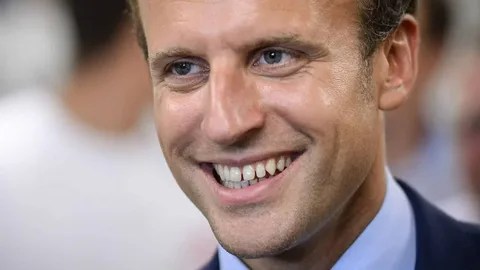
By Ekaterina Blinova – Sputnik – 15.07.2025
France’s Strategic National Review predicts a large-scale military conflict with Russia in Europe by 2030, despite Russia repeatedly rubbishing the scenario.
Why It’s a Non-Starter
“When talking about war in Europe, the key question is: war between Russia and whom? NATO countries? France directly?” Alexander Mikhailov, head of the Bureau of Military-Political Analysis, tells Sputnik.
Both scenarios don’t hold water:
- Russia won’t unleash a war on NATO—it would mean nuclear war
- France is currently a major buyer of Russian gas in Europe
What’s Really Behind the Claim?
“This is a completely false and deliberately crafted narrative, aimed specifically at justifying the expansion of France’s military budget,” explains the pundit.
- French President Emmanuel Macron needs a pretext to ramp up military spending
- He acts as a lobbyist for the French defense industry: doubling the military budget could benefit both defense contractors and the French president. Kickbacks, anyone?
- Macron also wants to be the top European power broker and have direct influence over NATO’s multibillion-dollar cash flows
- “The Americans will take the biggest share of that NATO budget for themselves. But France wants to be, at the very least, the second country spending not just its own money—but NATO’s as well,” the pundit explains.
- Macron’s presidential term ends in 2027. He’s eyeing a top post — either NATO Secretary General or a new EU power seat — to keep his geopolitical clout.
French Prosecutors Open Criminal Case Against X Over Alleged Algorithm Manipulation
The French state is now policing the algorithm in the name of democracy
By Cindy Harper | Reclaim The Net | July 13, 2025
French prosecutors have opened a criminal case into X on allegations it altered its algorithms in ways that may have supported “foreign interference.”
Magistrate Laure Beccuau confirmed on Friday that the investigation began Wednesday, with authorities looking into whether X violated French law by manipulating its recommendation systems and deceptively collecting user data.
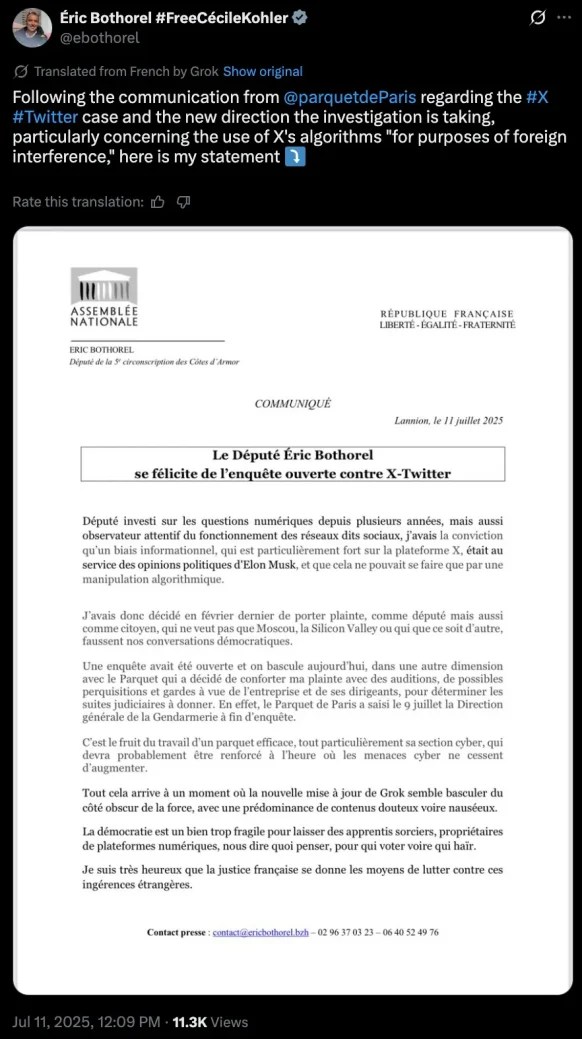
This latest development builds on a separate inquiry launched in January, which was prompted by complaints from a French parliamentarian and a senior civil servant.
The original accusation targeted X for promoting “an enormous amount of hateful, racist, anti-LGBT+ and homophobic political content, which aims to skew the democratic debate in France.”
X is facing mounting pressure not only from French officials but also from European regulators. On Thursday, two members of France’s National Assembly filed a complaint with Arcom, the national digital watchdog.
At the European level, the Commission has been examining X’s practices for close to two years under the recent censorship law, the Digital Services Act. The focus has included “misinformation” but in January the scope of the investigation widened to include X’s algorithms.
Momentum is building within EU institutions to wrap up that investigation. While regulators cite threats to democratic discourse and online safety, the French government’s move to criminally probe X brings into sharper focus the tension between public oversight and free expression.
These state-led actions, framed as efforts to regulate tech platforms, may well cross the line into political censorship under the cover of legality.
Will the French regime go Soviet?
Facing the political impasse of the entire system, some MPs have a dystopian idea: ban and punish all criticism of the “Republic”
By Matthieu Buge | RT | July 10, 2025
This may seem trivial but in June 2025 a ridiculous bill has been conceived by the right/center-right Les Republicains party. A bill that sums up just about everything that’s wrong with France’s system, not just its political system, but even its core cerebral system: prohibiting and punishing content and speech of an “anti-republican” nature.
Many critics of French political circles have – rightly – pointed out this incredible ability of politicians to use the argument of the “values of the Republic” whenever it suits them without ever explaining what these values are. However, the MPs who came up with this bill made a (minimal) effort in attempting to outline what it entails. Thus, it reads: “The French Republic is based on fundamental principles: liberty, equality, fraternity, secularism, sovereignty of the people, and the indivisibility of the nation. These values, guaranteed by the Constitution and consolidated by law, constitute the foundation of ‘vivre-ensemble’ [something purely French that can be understood as ‘social harmony’].” What would happen to someone who violates these principles? Oh, nothing, just being sentenced to three years of imprisonment and a fine of €45,000 ($52,000).
Beyond the purely vote-catching aspect of such a bill emanating from a right-wing party seeking to appeal to its public worried about the spread of Islam in France, there is something profoundly dystopian about it. All the listed “fundamental principles” are so vague that anything can be considered a violation of them.
France, which has specialized in devising abstruse theories since the end of the 18th century, is based on the absurd triptych “liberty, equality, fraternity.” However, any sane person understands that this triangle cannot work. “Liberty” and “equality” are by definition antagonistic and “fraternity” is mainly some leftover of a distant Christian morality. The sacrosanct secularism must apply to everyone – except to the Jewish community, something that tends to frustrate the Muslim community and leaves French citizens, who are predominantly atheist but psychologically remain, as the great demographer Emmanuel Todd coined, in a kind of “zombie Catholicism,” wary. When it comes to the “sovereignty of the people,” most people understand that it is a joke since politicians wiped their feet on the people’s “no” during the referendum on the European Constitution in 2005. As for the “indivisibility of the nation,” an umpteenth abstract concept that implies territorial unity, unity of the people, and unity of law, it would be necessary to explain it to the police and firefighters who can no longer go to some territories of the “Republic” as France is on the verge of becoming a narco-state. But of course, in this maelstrom of abstract stuff, the end of the quote that is the highlight of the show: “These values […] constitute the foundation of vivre-ensemble.”
Not long ago, during the June heat wave, a water park had to close permanently because it was invaded and trashed by “young people” the very first day after it opened. With the riots of summer 2023 (never described as “racial” by the French press though they use the term when it comes to the US) and the chaos following PSG’s Champions League victory in 2025, along with the daily attacks and violence, the French people seem to be struggling to integrate the concept of “vivre-ensemble.”
Someone said that the British had problems with ideas but not with facts, whereas for the French it’s the opposite. This is absolutely true. The French, especially their elites, live in a completely abstract mental space, which, unfortunately, has tended to colonize the West, particularly through the philosophical movement Les Lumieres and, 200 years later, through the “French Theory” that eventually lead to the disastrous woke culture.
What the right-wing party behind this bill doesn’t seem to realize is that with such vague criteria, France could find itself in the kind of judicial system that communist regimes experienced, where any statement could be interpreted to prove that it wasn’t “Marxist-Leninist.” As the joke goes, in the Soviet Union, it was possible to say anything… in your own kitchen. Well, in France, with such a bill, you’ll have to choose your words carefully while enjoying your beef bourguignon. The ignorant politicians behind this text should read Arthur Koestler’s ‘Darkness at Noon’: the main character, a Soviet political commissar who has sent many to the Gulag, finds himself purged by the system he contributed to. With an honest judge, it would be easy to charge them with, for example, having violated the principles of “equality” and “fraternity” by increasing their salaries at the National Assembly while asking the French people to make an effort because there is no money anymore.
Of course, given that the country’s prisons are already overcrowded and the state ruined, these MPs obviously have in mind to resort to the ultimate repressive instrument of liberal democracies: hitting the wallet. €45,000 for “anti-republican” remarks made in public. But the fine will, according to them, be increased to €75,000 if the remarks are made “in a meeting,” on a social network, or by an individual holding a position of public authority or office. €75,000 for tweeting that there is a problem with uncontrolled immigration? Is calling a bust of Marianne (a symbol of the Republic) ugly considered a crime? Does Brigitte Macron’s gender enter into the equation of republican values?
But beyond the excesses and abuses such a law could lead to, the Republicans’ approach reflects something much more important: the political regime is becoming increasingly oppressive because it is at the end of its tether. Mass immigration has induced such chaos that it is no longer “manageable,” the working classes are struggling to keep a delusional social system afloat, and more than 50% of voters are now over 50 years old. The country’s vital forces no longer have any confidence in their institutions, so they must be constrained. If this law is adopted, the Republic will take care of it, as Macron would say, “whatever the cost.”
Matthieu Buge has worked on Russia for the magazine l’Histoire, the Russian film magazine Séance, and as a columnist for Le Courrier de Russie. He is the author of the book Le Cauchemar russe (‘The Russian Nightmare’).
Israel lobbies Washington to restart war on Yemen: Report
Sources told Hebrew media that Tel Aviv is calling for the formation of a new coalition against Sanaa
The Cradle | July 11, 2025
Israel is pressuring the US to restart its campaign against the Yemeni Armed Forces (YAF) and Ansarallah movement in Yemen, according to reports in Israeli media.
According to Israel’s Broadcasting Corporation (KAN), Yemeni attacks on vessels headed to Israeli ports “can no longer remain solely an Israeli problem.”
Sources told the outlet that Tel Aviv has been calling for “more intense combined attacks against Houthi regime targets – not just [Israeli] air force fighter jet strikes, but also a renewal of American attacks and the formation of a coalition including additional countries,” an informed source told KAN.
Another anonymous security official said that “a broad coalition is needed to convey to the Houthi regime that it is in danger.”
The report comes after the YAF sunk two Greek-owned, Liberian-flagged vessels which were en route to Israeli ports.
Yemen had briefly refrained from attacking commercial vessels headed to Israel following a ceasefire that ended the US campaign against the country in May. However, it never rescinded the blockade it imposed after the start of the war in Gaza, and is now escalating its enforcement.
It has also continued to target Israel with ballistic missiles in support of the people and resistance in Gaza.
The YAF announced on 10 July that it targeted Tel Aviv’s Ben Gurion Airport with a ballistic missile. The attack came hours after Sanaa released footage of its second operation targeting a commercial ship within 24 hours. The Eternity C vessel was headed to the southern Israeli port of Eilat in violation of the Yemeni naval blockade.
The attack took place on Monday, with the ship finally sinking on Wednesday. Yemeni forces captured footage of the operation. Several crewmembers were reportedly killed, and others remain missing. The YAF said it evacuated some of the crew for medical treatment.
A day earlier, on Sunday, Yemen targeted and sank the Magic Seas vessel – also releasing footage of the operation.
Friday’s KAN report coincides with anticipation for a potential Israeli escalation against Yemen.
On 7 July, Israel carried out widespread attacks on Yemen. Tel Aviv said its latest attack on Yemen marked the start of a military operation against the country, dubbed Operation Black Flag. The YAF announced a large-scale missile and drone attack on several Israeli targets that day in response to heavy Israeli airstrikes.
Following the start of Yemen’s naval campaign in 2023, Washington attempted to muster up a coalition to stop Sanaa’s operations.
The US formed an international naval coalition under the name Prosperity Guardian, which gained little traction and failed to deter Sanaa from continuing its attacks.
Very few nations offered to contribute warships, and others only deployed a mere handful of staff officers.
An EU military mission in the Red Sea called Operation Aspides also suffered a similar failure.
“We didn’t necessarily expect this level of threat. There was an uninhibited violence that was quite surprising and very significant,” the commander of a French warship said in April 2024 after running out of munitions and being forced to turn tail and exit the Red Sea.
Last year, US Navy officials acknowledged that confrontations with Yemeni forces marked the most intense naval combat Washington had faced since the Second World War.
During US President Donald Trump’s latest campaign against Yemen, which killed an unprecedented number of civilians, Washington burned through around $1 billion in munitions and failed to significantly impact Yemeni military capabilities, sources have confirmed to western media.
Ukraine’s New Arms Plan? EU Pays, US Cashes in, NATO Watches
Sputnik – 11.07.2025
US President Donald Trump said NATO, to which Washington also belongs, will pay for American weapons that the alliance will subsequently supply to Ukraine.
Strategic analyst Paolo Raffone (CIPI Foundation, Brussels) explains how Washington’s role is evolving:
“European NATO members may play a role to support the military needs of Ukraine within a framework coordinated by the US that remains the single largest armament contributor.”
He describes a triangulation scheme:
- The US provides military equipment to EU NATO states
- Ukraine buys that equipment from those states
- Purchases are covered by EU funds
“Technically, European NATO members are the sellers — but it ensures the equipment is effectively paid for by Ukraine using EU funds. NATO as an entity would not be directly involved… national governments will do it. At best, NATO will coordinate the scheme.”
Who pays and who supplies?
“UK, France, Germany and Poland are high on the list. However, the idea is that all European NATO members should participate.”
And what can they afford?
“Despite announced increases in spending, EU countries will need years to become effective armament producers… The munitions immediately available depend on US willingness to sell — and EU/Ukraine capacity to pay.”
France names ‘red line’ in Ukraine conflict
RT | July 9, 2025
Demilitarizing Ukraine and leaving it without NATO membership, as Russia demands, is a red line for Europe, French Defense Minister Sebastien Lecornu told weekly magazine Valeurs Actuelles.
Moscow insists that any resolution to the conflict must comprehensively address its security concerns. Russian officials want Ukraine to acknowledge the new territorial realities on the ground, agree to neutral status, guarantee that its Russian-speaking population is not discriminated against, and undergo demilitarization and denazification. As of now, all of these demands have been rejected by Kiev.
In an interview, published on Wednesday, Lecornu argued that Europe cannot allow Ukraine to be left without a functioning army while denying it NATO membership.
“Our absolute red line is the demilitarization of Ukraine,” the minister said. “We must be coherent. One cannot refuse Ukraine entry into NATO and at the same time accept that it no longer has an army,” he added.
Ukraine formally applied for fast-track NATO membership in September of 2022, months after the conflict with Russia escalated. While Western nations initially supported Kiev’s bid, no timeline for accession has been set. Meanwhile, support for Kiev’s bid has been eroded by mounting military setbacks and shifting US policy.
Pentagon Inspector General Robert Storch reported last November that “corruption continues to complicate” Ukraine’s efforts to join NATO, citing multiple scandals in its Defense Ministry. US President Donald Trump, who is pushing for a peace deal with Moscow, has ruled out NATO membership for Kiev.
Russia views NATO’s eastward expansion as a direct threat to national security and has indicated that Ukraine’s ambition to join the US-led military bloc was one of the key issues that triggered the current conflict. President Vladimir Putin stressed last month that Moscow’s concerns had consistently been ignored.
Putin also said that Ukraine had agreed to military limitations during the 2022 Istanbul talks, including troop numbers and weapons restrictions, but later withdrew from the deal to seek military victory with Western backing. He added that now, instead of a “peaceful settlement to this issue,” Moscow has been forced to resolve the task – namely, demilitarization – by military means.
Speaking ahead of this week’s meeting of the Western-led ‘coalition of the willing’ – a UK-French initiative to deploy troops in Ukraine after a truce is reached with Russia – Lecornu said the group will urge Kiev to “rethink” the future shape of its army, noting “opportunities” for the French defense industry.
Moscow has accused the West of encouraging Kiev to fight “to the last Ukrainian” and maintains that no amount of military aid will reverse Kiev’s fortunes on the battlefield. It has also repeatedly warned that any foreign forces fighting alongside Ukrainian troops will be treated as legitimate targets, while warning this could escalate the conflict.
France, Italy, Greece must explain allowing ‘safe passage’ to ICC-wanted Netanyahu to US: UN expert
Press TV – July 9, 2025
UN Special Rapporteur Francesca Albanese says Rome Statute member states—France, Italy, and Greece—must explain why they provided “safe passage” to Israeli Prime Minister Benjamin Netanyahu en route to the United States.
Netanyahu is an internationally wanted suspect under an arrest warrant issued by the International Criminal Court (ICC) for war crimes and crimes against humanity committed in Gaza.
In a post on X, Albanese said the three European countries — all signatories to the Rome Statute, which established the International Criminal Court (ICC) in 2002 — violated the international legal order by allowing Netanyahu to transit through their airspace despite an active ICC arrest warrant.
As ICC members, she said, they were theoretically “obligated to arrest” Netanyahu.
“Italian, French, and Greek citizens deserve to know that every political action violating the international legal order weakens and endangers all of them. And all of us,” she wrote.
Albanese was responding to a post by human rights lawyer Craig Mokhiber, who said the countries had “breached their legal obligations under the treaty [Rome Statute], have declared their disdain for the victims of genocide, and have demonstrated their contempt for the rule of law.”
Netanyahu is currently on his third US visit since President Donald Trump took office on January 20.
During a previous trip in February, his plane was forced to take a detour to avoid flying over countries that might enforce the ICC arrest warrant. The United States is not a party to the Rome Statute and therefore not bound by its provisions.
In June, Trump’s administration imposed sanctions on four judges at the International Criminal Court over the war tribunal’s issuance of an arrest warrant for Netanyahu.
Putin drops truth bomb on Macron

Strategic Culture Foundation | July 4, 2025
NATO started the conflict in Ukraine, but Russia will end it on its terms, Russian President Vladimir Putin told his French counterpart this week in a wake-up call.
It’s always refreshing and necessary to bring reality into a conversation, assuming, of course, that the purpose of the dialogue is genuinely to resolve a problem.
France’s Emmanuel Macron requested the phone call with Putin this week. It was the first time the two leaders had spoken in nearly three years. The long absence was due to Moscow claiming that Macron breached diplomatic protocol after the last phone call in 2022 by leaking details to the media.
In any case, Putin showed magnanimity and a willingness to engage diplomatically by taking the call this week from Macron. The two leaders talked for over two hours.
Apart from Ukraine, another topic discussed was the outbreak of war between Israel and Iran, and the U.S. bombing of Iran’s nuclear sites. Macron agreed with Putin that Iran has the right to pursue civilian nuclear energy production, and both appealed for diplomacy to prevent escalation, according to the Kremlin’s statement on the phone conversation.
Critics might note, however, that France, Britain, Germany, and the other European states have played a double game with Iran, undermining Iran’s legitimate rights under the Non-Proliferation Treaty and giving political cover for the unlawful Israeli and US aggression against Tehran. Therefore, Macron’s concern for peace in the Middle East sounds hollow, if not hypocritical.
The Ukraine conflict was also discussed. But here, there was no pretense of diplomatic accord.
Macron urged Putin to “call a ceasefire as soon as possible” and to proceed with peace talks, said the Elysee Palace, as reported by French media.
For his part, Putin rebuffed the trite talk. He reminded Macron of some necessary reality.
According to the Kremlin’s statement: “When discussing the situation surrounding Ukraine, Vladimir Putin reiterated that the conflict was a direct consequence of the policies pursued by the Western countries, which had for years been ignoring Russia’s security interests, creating an anti-Russia staging ground in the country, and condoning violations of rights of Ukraine’s Russian-speaking citizens, and at present were pursuing a policy of prolonging hostilities by supplying the Kiev regime with a variety of modern weaponry. Speaking about the prospects of a peaceful settlement, the president of Russia has confirmed Moscow’s stance on possible agreements: they are to be comprehensive and long-term, provide for the elimination of the root causes of the Ukraine crisis, and be based on the new territorial realities.”
In other words, Russia will end the conflict that Macron and other NATO powers started illegally, and the ending of it will be on Russia’s terms.
Who does Macron think he is? Telling Russia to call a ceasefire as soon as possible? Earlier this year, in March, Macron gave a televised nationwide address declaring Russia to be an existential threat to Europe. He even made the madcap suggestion of France using its nuclear weapons to protect all of Europe. Such crazed talk by Macron is irresponsible and reprehensible.
Macron, along with Britain’s Starmer and Germany’s Merz, are prolonging the more-than-three-year war in Ukraine by pledging more military aid to the NeoNazi Kiev regime.
That regime owes its existence to an illegal coup d’état that the Americans and Europeans orchestrated in 2014. The ongoing conflict, which has slaughtered more than one million Ukrainian soldiers and burdened Europe with huge immigration costs, is the responsibility of Macron and other NATO states. They are the instigators, not Russia.
If Macron genuinely wants peace in Ukraine, there is a straightforward solution. Stop arming the NeoNazi regime and stop telling lies about “defending democracy in Ukraine” from alleged “Russian aggression.” Macron and his gang of NATO war criminals could end the bloodshed promptly if they dropped the evil charade.
U.S. President Donald Trump also had a phone call with Putin this week. That was on Thursday, two days after Macron’s.
As with the French leader, Putin told his American counterpart that Russia was insisting on achieving its aims in Ukraine: removing the root causes of the conflict and retaining all territories. Like Macron, Trump sounded impatient for a quick peace deal and later complained to the American media, “he had made no progress” with Putin in his phone call this week.
What Trump, Macron, and other Western leaders need to understand is that Russia wants a permanent peace based on its legitimate strategic security interests. This conflict is not a localized one between two parties. It is a proxy war between Russia and NATO, engendered by NATO. Pretending otherwise, as Macron is doing by conceitedly calling for a quick ceasefire, is a deception.
At least Trump seems to recognize that the supply of weapons to Ukraine has to stop if there is any chance of ending the conflict. This week, the Pentagon announced it was halting the flow of munitions. A big part of the reason is practical reality: the U.S. has depleted its arsenal after three years of weaponizing the Kiev regime.
The European leaders need to come to their senses too, and stop fueling the war machine that is the Kiev regime. It is a lost cause. Russia is winning the war and will eventually eradicate the regime and NATO’s threat to its national security. Europe does not have the capability or the resources. The grand deception projected by Macron and others, including EU top officials Ursula von der Leyen and Kaja Kallas, and NATO’s Mark Rutte, is destroying Europe.
Therein lies the fatal dilemma. What Putin said to Macron is the truth. If the conflict has any chance of being resolved peacefully, then the starting place is to recognize the historic causes of the conflict, not the delusional stuff that Macron is peddling.
But for Macron and all the NATO states to do that would be to admit their culpability for creating the biggest war in Europe since the Second World War. The political and legal repercussions would be explosive for Macron and the entire Western leadership. They are caught in the web of a Big Lie that they have spun.
Russia warns of Israeli ‘war party’ seeking to reignite aggression against Iran
Press TV – July 4, 2025
Russia has warned about various Israeli officials’ efforts to trigger the resumption of aggression against Iran.
Foreign Minister Sergei Lavrov made the remarks during a press conference alongside his visiting Saudi counterpart Faisal bin Farhan in Moscow on Friday.
“We sincerely hope that the so-called 12-day war is indeed over,” the Russian top diplomat said.
He was referring to the Israeli regime’s launching attacks against the Islamic Republic’s nuclear, military, and civilian targets on June 13. The assaults claimed the lives of at least 935 Iranians, including senior military officials and nuclear scientists, the latter group being targeted inside their residential buildings.
The Islamic Republic responded with decisive defensive maneuvers and counterstrikes, hitting critically sensitive nuclear, military, and industrial infrastructure across the occupied Palestinian territories. The retaliation forced the regime to request a ceasefire.
Lavrov, however, warned, “We intend to stay vigilant, as the ‘war party’ remains highly active in the Middle East.”
“We keep hearing a variety of statements from some representatives of the Israeli leadership,” he added, suggesting that those officials were persistently agitating for the resumption of aggression against the Islamic Republic.
Iran has, on many occasions since the cessation of the attacks, cautioned that its next reprisal against potential renewed aggression would be of far more intensity and magnitude to the extent that it would take Tel Aviv and its allies by surprise.
‘European states role in war’
Elsewhere in his remarks, Lavrov criticized some European states’ “aggressive” anti-Iranian efforts, which saw them force the International Atomic Energy Agency (IAEA)’s Board of Governors to issue its most recent anti-Iranian resolution.
He pointed out how the European countries “unnecessarily and aggressively pushed through anti-Iranian resolutions, which did nothing to ease tensions or advance negotiations, but instead created a pretext for forceful measures.”
The Israeli regime used the resolution as a pretext to launch the war. The resolution was also used by the United States, the regime’s biggest ally, as a plea to join it in attacking Iran towards the end of the warfare.
“I sincerely hope that European nations will come to recognize their responsibility and their share of the blame,” Lavrov said.
For his part, the Saudi foreign minister also underlined that differences with the Islamic Republic had to be resolved through diplomatic processes.
Telegram targeted by smear campaign – Durov
RT | July 3, 2025
Telegram has been subjected to a coordinated smear campaign, CEO Pavel Durov has suggested, citing the rapid spread of bogus reports about the company’s plans and policies.
The claims follow the appearance of a story about Telegram’s exit from Russia that was initially published as a joke by local satirical website Panorama, but was subsequently reposted by news channels, forcing the platform to post a disclaimer under the links.
“We’re probably not dealing with innocent journalistic errors, but with a targeted campaign to discredit Telegram,” Durov said on Wednesday in a post on the messaging platform, urging users to stay alert.
The Russian billionaire also denied reports that channels collecting and publishing data from open sources had been blocked “for political reasons,” emphasizing that “a few channels were briefly taken down by automated scripts” due to the publication of personal data. Durov stressed that some media reports emerged after the channels had been restored but failed to mention the fact.
The tech entrepreneur also mentioned “a technically illiterate investigation” revealed in June which claimed that Telegram’s IP addresses put user data at risk and accusing the platform of having ties to Russia’s Federal Security Service (FSB). Durov specified that publications citing “independent experts” debunking the claims haven’t received as much media coverage as the original report.
“For more than 12 years, Telegram has defended people’s right to privacy and free access to information, which is why we have often become the target of media pressure from various sides,” Durov concluded.
Last month, the billionaire, who is under investigation in France, accused the French daily Le Monde of waging a smear campaign against his messaging platform. Durov said that the newspaper had published 40 negative articles about Telegram in the seven weeks following his arrest at a Paris airport in August 2024.
Detained on charges of complicity in crimes allegedly committed by Telegram users, including extremism and child abuse, Durov was later placed under judicial supervision and released on bail.
Featured Video
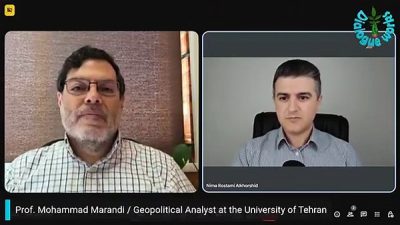
Seyed M. Marandi: U.S. Military DIVIDED? Iran’s Secret Defense EXPOSED
or go to
Aletho News Archives – Video-Images
From the Archives
‘Israel sees Iran as obstacle to its policies’
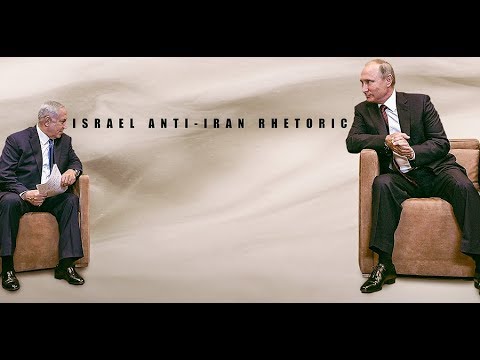
Press TV – August 25, 2017
Prime Minister Benjamin Netanyahu has said that Israel felt threatened by Iran’s growing influence in the Middle East. Netanyahu expressed his Iranophobic view in a meeting with Russian President Vladimir Putin in Russia’s Black Sea resort of Sochi on Wednesday. Press TV has asked Scott Rickard, former American intelligence linguist from Tampa, Florida, and Brent Budowsky, a columnist at The Hill from Washington, to give their thoughts on the issue.
Rickard said Tel Aviv is concerned about the fact that the regime could not carry out its old project to spread sectarian divisions and pave the way for dismemberment of the countries in the Middle East region because of the Iranian-led resistance against Israeli policies, not only in the occupied territories of Palestine but also in the whole region.
“Iran is not a threat to Israel whatsoever. The threat that Israel sees is the fact that their Oded Yinon Plan is being put to a hold by Iran,” the intelligence linguist said on Thursday night.
“They (the Israelis) look at Iran as a threat only because they have no influence on their governments and Iran is autonomous and is not under the Zionist influence,” he added.
Since the victory of the Islamic Republic of Iran in 1979, Tehran has been critical of Israel’s policies in the region, whereas “no leaders [of other states] even dared to speak out against Zionism,” Rickard argued. … continue
Blog Roll
 Aletho News
- What’s Behind U.S./Israeli Strikes On Iranian Pistachio Factories?
- Seyed M. Marandi: U.S. Military DIVIDED? Iran’s Secret Defense EXPOSED
- How I fell foul of the BBC thought police
- The End of NATO
- 37 days of war on Iran cost US staggering $42bln, tracker shows
- Baghdad tells Asian refiners, traders to begin loading Iraqi crude amid Iranian exemption
- Under fire, Moscow and Tehran close ranks
- Iran, US receive Pakistan-mediated plan for ceasefire then final deal
- Iran submits demands for end to war as mediators scramble ahead of Trump deadline
- Iran Threatens Retaliatory Strike on Stargate AI Project in UAE
- If Americans Knew
- U.N. experts demand Israel release prominent Gaza doctor after reports of ‘severe torture’
- Israel’s Latest Genocide Is Against the Shias of Lebanon. Why Is the World Silent?
- How Eliot Cohen’s influence over U.S. war-making paved the way for Trump’s war crimes in Iran
- Israelis don’t pay for the weapons we ‘sell’ to them — US taxpayers do
- While Distancing from AIPAC, Most 2028 Democratic Hopefuls Are Still Embracing Israel
- A brief history of the Israeli nuclear program, the open secret at the heart of the Iran war
- Israeli Settlers Killed a Palestinian Farmer on His Own Land, in Front of His Father. Yes, Again
- The US-Israeli War on Science is an Assault on our Future
- 100+ International Law Experts Say US Strikes on Iran Violate UN Charter, Could Be War Crimes
- ‘Vile, Horrifying, Evil’: Trump Threatens to Bomb Nation of 90 Million People ‘Back to the Stone Ages’
- No Tricks Zone
- An Inconvenient Tree: Uncovered In Alps… Europe Much Warmer Than Today 6000 Years Ago
- New Study Reports A 60% Slowdown In Greenland’s Ice Loss Rate In The Last Decade
- Low Intensity Tornado Wrecks Major Solar Farm, Creating A Potential Toxic Dump
- New Study Finds Warming Saves Lives…Cold Temperatures 12 Times More Deadly Than Excess Heat
- German Science Blog Accuses PIK Climate Institute Of Hallucinating Climate Tipping Points
- Devastating Assessment Of Comirnaty Vaccine By Former Senior Pfizer Europe Toxicologist
- New Study: CO2 Is ‘Effectively Negligible’ As An Explanatory Climate Change Factor Since 2000
- Former Pfizer Toxicologist Dr. Helmut Sterz Tells Bundestag Hearing Pfizer Vaccine Should Have Never Been Approved
- Energy Expert: Germany’s Nuclear Phaseout Was A “500 Billion Euro Mistake”
- New Research: South Australia’s Mid-Holocene Sea Surface Temperatures Were 4°C Warmer Than Today
 Aletho News