West’s Long-Range Missiles to Ukraine All Essentially the Same & Russia’s Shooting Them Down
By Svetlana Ekimenko – Sputnik – 26.05.2025
Germany, the UK, France, and the US have removed range restrictions on weapons for Ukraine, Chancellor Friedrich Merz confirmed on May 26.
Whether it’s the Taurus, Storm Shadow, or SCALP, Russia will just keep knocking them out of the sky, Yevgeny Buzhinsky, Chairman of PIR-Center Think Tank Executive Board, Professor of Higher School of Economics who served as the Russian military’s top arms control negotiator from 2001 to 2009, told Sputnik.
The real issue with Germany’s Taurus missile isn’t its 500 km range, but rather what Merz rightly pointed out -without the Bundeswehr, Ukrainians can’t launch them, pointed out the pundit, adding:
“Which makes this a case of direct German involvement [in the Ukraine conflict], plain and simple.”
Germany, the UK, France and the US are no longer imposing restrictions on how far Ukraine can strike with Western-supplied weapons, German Chancellor Friedrich Merz revealed on May 26.
“There are no longer any range restrictions on weapons supplied to Ukraine — not by the British, not by the French, not by us, not by the Americans. This means that Ukraine can now defend itself, including, for example, by striking military positions on Russian territory. Until a certain point, it could not do this,” Merz said in an interview with the WDR TV channel.
Russia’s Foreign Ministry Spokeswoman Maria Zakharova warned that any Taurus missile strike on Russian targets will be seen as Germany entering the war on the side of the Zelensky regime.
Moscow maintains that Western arms deliveries only escalate the conflict and drag NATO deeper into the quagmire.
Europe must bear consequences of forcing return of UN sanctions against Iran: FM
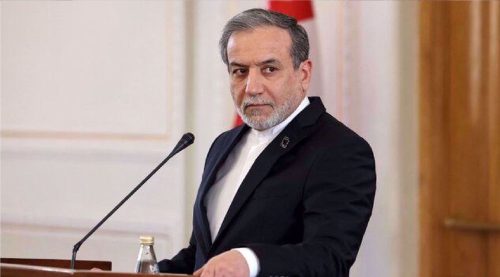
Iran’s Foreign Minister Abbas Araghchi
Press TV – May 21, 2025
Foreign Minister Abbas Araghchi has cautioned the US’s European allies in a 2015 nuclear agreement with Iran against invoking the so-called “snapback mechanism” to re-impose the United Nations sanctions against the Islamic Republic.
Speaking to Saudi Arabia’s Asharq News network on Wednesday, the top diplomat emphasized that such a move would end participation by the European parties — the UK, France, and Germany — in the deal that is officially known as the Joint Comprehensive Plan of Action (JCPOA).
He added that the trio’s potential recourse to the mechanism would lead to significant consequences and potential irreversible escalation of tensions, referring to the likelihood of strong retaliatory steps that the Islamic Republic could take in response.
Araghchi reiterated Iran’s readiness to engage in diplomacy, expressing hope that the European parties too would demonstrate determination to resolve the current impasse.
The deadlock occurred when the United States ditched the JCPOA in 2018, and returned the illegal and unilateral sanctions that the agreement had lifted.
This was followed by the European trio’s failure to return the US to the accord, as they had said would do, as well as their walking in Washington’s footsteps by returning their own sanctions.
In response to the betrayal, Iran began a number of legitimate and gradually escalating nuclear countermeasures.
“The situation we’re in is by no means Iran’s fault. It is the fault of the United States, which withdrew from the JCPOA, and the fault of the European countries that failed to compensate for the US’s withdrawal,” Araghchi added.
‘Uranium enrichment absolutely non-negotiable’
Addressing the topic of Iran’s peaceful uranium enrichment activities, the foreign minister said the activities were a principled and fundamental issue for Iran.
He emphasized that the enrichment program was a major scientific achievement developed by domestic scientists and held immense value for the Iranian people.
The official, meanwhile, paid tribute to the seven-strong Iranian nuclear scientists, who were assassinated amid their invaluable contribution to the Islamic Republic’s peaceful nuclear energy program.
According to Araghchi, the victims’ sacrifices towards advancement of the program had made the nuclear issue “absolutely non-negotiable.”
Senegal to expel all foreign troops – PM
RT | May 21, 2025
Senegalese Prime Minister Ousmane Sonko has declared that all foreign military personnel stationed in the country must withdraw by the end of July.
French troops remain the only foreign military presence in Senegal, operating under a 2012 defense partnership agreement. As part of a phased withdrawal, France officially transferred control of the Rear Admiral Protet naval base in Dakar to Senegalese authorities on May 15. This follows the earlier handover of the Marshall and Saint-Exupéry facilities in March. The remaining bases are scheduled to be transferred in subsequent phases.
Speaking to Burkina Faso’s national broadcaster RTB on Monday, Sonko said that since his administration came to power nearly a year ago, it had taken a number of steps to assert national sovereignty.
“We have notified all countries that have military bases in Senegal that we demand a complete withdrawal. There will be no more foreign military bases on Senegalese territory,” he stated.
According to the prime minister, the withdrawal process is already underway. He confirmed that one foreign military base was vacated just two days prior to the interview and stressed that the handover of another facility would be completed by the end of July.
Sonko framed the move as a normal assertion of sovereignty, stating that Senegal has “a national army, defense and security forces. We think we are able to ensure our own safety.” He also called on other African nations to take greater control of their own destinies.
In November 2023, Senegalese President Bassirou Diomaye Faye called the presence of French troops “incompatible” with national sovereignty. His newly elected administration has taken a firm stance on scaling back France’s military footprint in the country.
Several West African nations, including Burkina Faso, Mali, and Niger, have severed all military ties with France in recent years, citing frustration with French-led counterterrorism efforts and a desire to seek out alternative partners like Russia.
Romanian runner-up wants presidential vote nixed for ‘external interferences’
RT | May 20, 2025
Right-wing EU critic George Simion has said he would challenge the result of Romania’s presidential election, claiming it was compromised by “foreign interference,” flagging France and Moldova in particular.
Sunday’s runoff saw pro-EU Bucharest Mayor Nicusor Dan defeat his Euroskeptic rival with 54% of the vote in the second round of Romania’s presidential election.
The rerun was ordered after Romania’s Constitutional Court annulled the results of the November election, in which independent candidate Calin Georgescu, an EU and NATO critic, finished first with 23% of the vote. The authorities claimed that there had been “irregularities” in his campaign, citing intelligence reports alleging Russian interference – allegations which Moscow has denied.
In a Tuesday post on X, Simion – who had been the frontrunner – said he had “officially” asked Romania’s top court to annul Sunday’s election result “for the very reasons the December elections were annulled.”
He claimed that there was evidence of “external interferences by state and non-state actors,” adding that “Neither France nor Moldova nor anyone else has the right to interfere in the elections of another state.”
Simion had previously claimed the electoral rolls contained some 1.7 million fictitious names and accused the government of busing in voters from neighboring Moldova. His Alliance for the Union of Romanians (AUR) had also claimed that Moldova’s pro-EU ruling Party of Action and Solidarity (PAS) had directed its million-strong diaspora in Romania to vote for Dan.
Telegram founder Pavel Durov, who has claimed French intelligence tried to pressure him into censoring conservative Romanian channels ahead of Sunday’s vote, reposted Simion’s message, saying he is “ready to come and testify if it helps Romanian democracy.”
Paris has denied Durov’s claim. Romanian officials, in turn, have accused Russia of interfering in the election without providing any proof.
Kremlin spokesman Dmitry Peskov has dismissed the accusations, calling the election “strange” and asserting the most popular candidate had been “forcibly” removed without justification. In response to Durov’s remarks, he also cited what he called the EU’s history of meddling in other countries’ affairs.
Russian Foreign Ministry spokeswoman Maria Zakharova also dismissed Bucharest’s accusations, calling the latest vote illegitimate and saying Romanian officials should clean up their own “electoral mess” instead of blaming others.
Romania’s Elections Were a Big Globalist Sham
By Ilya Tsukanov – Sputnik – 19.05.2025
The results don’t make sense arithmetically and foreign interference has been confirmed. The country has officially completed its slide into EU protectorate status. Prolific Balkans expert Dr. George Szamuely helps unpack what just happened.
Numbers Don’t Add Up
- Eurosceptic candidate George Simion won 41% in the May 4 first round. EU favorite Nicușor Dan got 21%. In round two, Simion took 46.4%, while Dan got 53.6% – a 155% boost.
- To do so, Dan needed the backing of 87% of the voters who backed neither him or Simion in the first round.
- Neither of the other major first round candidates (Crin Antonescu, 20%, Victor Ponta, 13%) threw their weight behind Dan in the second round. Where did his 30%+ surge in support come from? Unclear.
Fraud in Broad Daylight
Simion has alleged that 1.7 million dead people were on voter rolls, and urged voters to check if any deceased relatives or friends voted via a dedicated WhatsApp contact line.
Diaspora voters cast 1.64 million ballots in the second round of the vote, 660,000 more than round one (which Simion handily won, 61% to Dan’s 25.4%). Simion has alleged some polls were closed or not enough ballots were made available in some areas during the runoff, and manipulation of diaspora voting.
Foreign Meddling Alleged and Confirmed
Specifically, Simion has accused Moldova’s EU lapdog government of “immense fraud” amid reports of Romanian expats voting at 3X the rate they did in round one.
He’s also charged France of meddling using “lots and lots of money and pressure through their ambassador here, and through foreign institutions in order to rob the Romanian people of their votes.”
Telegram CEO Pavel Durov confirmed on Sunday that a request had been made by France to “silence conservative voices” in Romania ahead of the election.
Telegram’s Durov names French official he accused of censorship request
RT | May 19, 2025
Telegram founder Pavel Durov has claimed that French foreign intelligence chief Nicolas Lerner personally asked him to censor conservatives on his platform ahead of the contentious rerun of Romania’s presidential elections. The Russian-born entrepreneur said he refused the request.
The accusations of foreign meddling first surfaced last year after Romania’s top court annulled the November election results, in which independent right-wing candidate Calin Georgescu came first with 23%. Authorities cited “irregularities” in his campaign, along with intelligence reports alleging Russian interference – claims Moscow has denied. Georgescu was later barred from running again.
On Sunday, pro-EU centrist Nicusor Dan was elected president of Romania. His conservative, Eurosceptic opponent George Simion accused France and Moldova of attempting to sabotage his campaign.
In a post on X on Sunday evening, Durov said he met with Lerner, head of France’s Directorate-General for External Security (DGSE), in Paris. The agency, operating under the Ministry of the Armed Forces, is tasked with gathering intelligence and combating terrorist threats.
“This spring at the Salon des Batailles in the Hotel de Crillon, Nicolas Lerner, head of French intelligence, asked me to ban conservative voices in Romania ahead of elections. I refused,” Durov wrote. “We didn’t block protesters in Russia, Belarus, or Iran. We won’t start doing it in Europe,” he added.
Durov had previously hinted that France asked him to “silence” Romanian conservatives. The French Foreign Ministry rejected the allegations of election meddling as “completely unfounded.”
“France categorically rejects these allegations and calls on everyone to exercise responsibility and respect for Romanian democracy,” the ministry stated, labeling the accusations “a diversionary maneuver” aimed at distracting the public from “the real threats of interference targeting Romania.”
Last year, French authorities charged Durov with facilitating the distribution of child sexual exploitation material and drug trafficking due to alleged moderation failures on Telegram. He was arrested at Paris-Le Bourget Airport in August before being released on €5 million ($5.46 million) bail. Durov, who has denied any wrongdoing, was eventually allowed to leave France in March.
Diplomatic Chess, Ukraine the Pawn
By Patrick Lawrence | Consortium News | May 16, 2025
As was universally expected, little came out of Istanbul this week, where Ukrainian and Russian delegations met with the ostensible purpose of exploring a negotiated settlement of the proxy war the U.S. provoked three years ago.
It is an odd state of affairs when even the people doing the talking did not anticipate anything useful to emerge from their talking.
After less than two hours of negotiation, the two sides agreed only to future talks on subsidiary questions: a prisoner exchange and a 30–day ceasefire — a ceasefire Kiev and its Western backers refused for years but are now desperate to implement.
There was no discussion of an accord to end the war and no final agreements other than one to continue negotiations. And the encounter was not without its acrimonious moments.
Talks to negotiate more talks are not much but not nothing. The two sides have met for the first time since March 2022, when, a month into the war, they previously convened in Istanbul and negotiated a draft document that would have ended the fighting — this until Boris Johnson, then the British prime minister, arrived to scuttle the accord so as to keep the war going.
There is no feigning surprise or disappointment. It was evident during a week of incessant posturing that the Kiev regime and the European powers that have lately assumed the task of manipulating it, have no desire to begin substantive negotiations with the Russian Federation.
No, for the British, the French, the Germans, and their client in Kiev, the imperative in the run-up to the Istanbul encounter on Friday was to appear earnestly dedicated to talks across a mahogany table while preventing even nascent progress toward a diplomatic settlement.
In this effort the Europeans have failed, at least for now.
Trump Takes Over
President Donald Trump effectively overruled them when, earlier this week, he responded, positively and vigorously, to President Vladimir Putin’s unexpected offer to open talks. Trump insisted, in all caps as is his wont, that Volodymyr Zelensky, Ukraine’s president, should forget the ceasefire and open negotiations “IMMEDIATELY!”
This appears to have pushed to the margins the British, French, and Germans, who have taken over as Zelensky’s hands-on minders since Trump assumed office in January. But I see little chance Friday’s talks will mark the end of their effort to keep the war going and a settlement at bay — even as they pretend to stand for precisely the opposite.
U.K. Prime Minister Keir Starmer, French President Emmanuel Macron and German Friedrich Merz set things in motion last weekend when they flew to Kiev for a hastily arranged summit with Zelensky. On their arrival, the British, French and German leaders grandly issued an ultimatum: Moscow must accept a 30–day ceasefire by Monday, May 12, or the Europeans would impose a punishing set of new sanctions on the Russians.
So did the curtain rise on a lot of poor theater. As John Whitbeck, the international attorney resident in Paris, remarked on his privately circulated blog, this appeared to be an offer Moscow was bound to refuse in order to convey the impression the Europeans were doing their best for peace — but the Russians remained committed to war.
The fun began then, too. Putin, in a late-night nearly immediate response from the Kremlin, gave the Starmer–Macron–Merz ultimatum all the attention it merited — none — and wrong-footed the Europeans and Kiev by proposing Kiev and Moscow open negotiations in Istanbul on Thursday.
At this point — the chronology has been well-reported — Zelensky began several days of carrying on. The Russian proposal was mere theater: This was his opener. (See what I mean by fun?) O.K., I agree to talks in Istanbul, but I insist on a summit with Putin himself. Putin ignored this, too — as Zelensky and his sponsors knew he would. There must be a ceasefire first — another idea that Kiev and its sponsors dropped.
It was Trump’s intervention that brought the European follies to an end. After the U.S. president’s statements to the press and on social media, the Ukrainian TV–actor-turned-president finally agreed to send a team of Kiev officials, led by Defense Minister Rustem Umerov, to meet with a Russian delegation headed by Vladimir Medinsky, a prominent adviser to the Russian president.
Late Friday afternoon the Russian and Ukrainian delegations both announced that they had agreed to resume talks, but for now only on the ceasefire question. “We are ready to continue contacts,” Medinsky said at a post-session news conference.
There was a little more to this encounter than that. In a report Friday evening The Telegraph quoted Medinsky telling the Ukrainians across the U–shaped negotiation table, “We don’t want war, but we’re ready to fight for a year, two, three, however long it takes. We fought Sweden for 21 years. How long are you ready to fight?”
Medinsky’s reference was to what Russians call the Great Northern War, which Russia waged against the Swedish Empire during the reign of Peter the Great, from 1700 to 1721.
And that is it, a door pried open after a soap opera’s worth of chicanery in London, Paris, Berlin, and Kiev.
Remember the Minsk Protocols
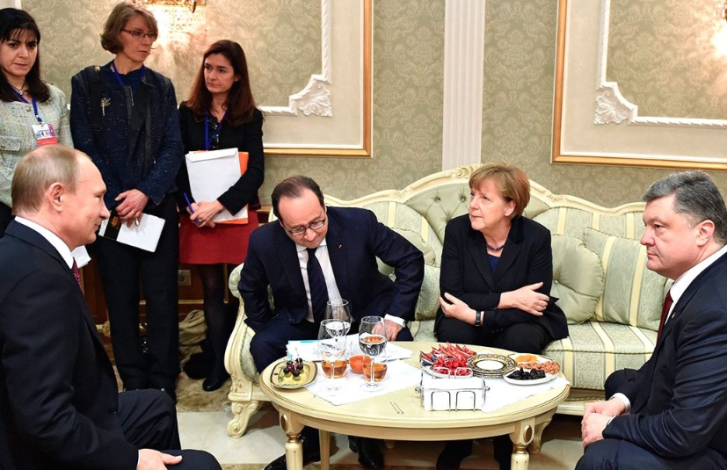
Putin, French President Francois Hollande, German Chancellor Angela Merkel, Ukrainian President Petro Poroshenko at the Normandy format talks in Minsk, Belarus, Feb. 12, 2015. (Kremlin)
My take on the week’s events takes me back to the Minsk Protocols, which Moscow negotiated a decade ago with Kiev, Paris and Berlin.
Signed in September 2014 and February 2015, these committed Ukraine to a new constitution whereby the Russian-speaking provinces in the nation’s east would be granted a considerable degree of autonomy. Kiev and Moscow signed, France and Germany serving as co-signatories backing the former.
Kiev ignored the Minsk accords from Day 1. And, as well-reported at the time, the French and Germans later acknowledged they co-signed only to allow Ukraine time enough to rearm so as to continue attacking the eastern provinces and prepare for the war that eventually broke out three years ago.
This pencil-sketched history is useful to understanding this week’s events and what preceded them. Putin got his fingers burned in Minsk, having personally negotiated the two protocols. I do not know when the Russian president decided the European powers could not be trusted, but he has certainly not trusted them since the Minsk debacle.
Last week’s events proved this a sound judgment. In an improvised game of diplomatic chess, Moscow got the Europeans in check this time, making dexterous use of Kiev as its pawn.
Post–Istanbul, it appears now that the best chance of a settlement of the Ukraine conflict resides in the prospect of a Trump–Putin summit. This, if it comes to pass, would define the Ukraine crisis — altogether properly — as a subset of Trump’s project to restore relations with Moscow.
And it would disarm, not to say humiliate the Europeans who have been leading the Continent to continue its support for the Kiev regime and the war.
A couple of caveats are in order here. One, as earlier suggested, it is not at all clear we have heard the last of the European triumvirate who took center stage for a few days this week. Starmer, Macron and Merz, the last just appointed Germany’s new chancellor, are heavily invested in the Ukraine project and the Russophobia that propels it.
Two, as Putin and other Russian officials have made plain numerous times, and very pointedly this past week, substantive negotiations of a settlement of the Ukraine crisis must begin with mutual recognition of “root causes,” to take the phrase the Kremlin now favors.
This is why Moscow nominated Istanbul as the venue for these new talks. In the draft Boris Johnson disrupted three years ago, these concerns were addressed.
“We view these talks as a continuation of the peace process in Istanbul, which was unfortunately interrupted by the Ukrainian side three years ago,” Medinsky said at a press conference as he set out of Istanbul Thursday. “The aim of direct negotiations with the Ukrainian side is ultimately to secure lasting peace by addressing the fundamental root causes of the conflict.”
The phrase is too ubiquitous in the Russian discourse to ignore. The question now is whether Donald Trump, in any summit he may have with Vladimir Putin, will be at all equipped to address Russia’s concerns.
If he does, he will fundamentally alter relations between the Western powers and Russia for the good — a diplomatic triumph. If he does not, he is unlikely to get anything more done than negotiators accomplished in Istanbul this week.
Preliminary talks in Istanbul are a start… the real show to come is Trump and Putin
Strategic Culture Foundation | May 16, 2025
The talks in Istanbul this week provide a prospect for peace. It bears emphasizing that the three-year proxy war could have been avoided if diplomacy had been permitted by Washington in early 2022 instead of being sabotaged.
Three years on, we have a new president in the White House, and there appears to be a more enlightened policy. Or maybe it’s an implicit admission that the U.S. proxy war agenda is a failure and can’t go on.
In any case, Trump and his envoys are unequivocally saying that they want to stop the bloodshed in Ukraine. That’s a big change from his predecessor, Joe Biden, who vowed to back Ukraine for as long as it takes in a fantastical, reckless pursuit to strategically defeat Russia.
It was the Biden administration, along with the British government, that intervened to scupper nascent peace talks in March 2022 between Russia and Ukraine for a peace deal. Washington and London coaxed the Kiev regime to fight on with promises of more weapons.
The result: three more years of intense conflict, which have caused millions of casualties, mainly on the Ukrainian side. The proxy war has come perilously close to provoking an all-out world war between nuclear powers.
Trump appears to want peace. If he is genuine in that intention, then the American president will have to address the root causes of the conflict. Russia has consistently explained the deeper causes of NATO aggression and the militarization of Ukraine as a hostile bridgehead on its borders since the CIA-orchestrated coup in Kiev in 2014.
The American president has shown petulance at times, urging Ukraine and Russia to get down to a peace deal. He has even threatened Russia with more (futile) economic sanctions. What the Trump administration needs to understand is that resolving deep causes of conflict requires commensurate negotiations and a realistic commitment to lasting geopolitical security arrangements.
The talks in Istanbul this week to explore a peaceful resolution were initiated by Russian President Vladimir Putin in an announcement last week.
Russia’s delegation was led by Putin’s senior aide, Vladimir Medinsky. That speaks of consistency and commitment. Medinsky led the peace talks three years ago in Istanbul, which were then sabotaged in April 2022 by the American and British intervention.
This week, the Russian side held preliminary bilateral talks with the Americans led by Secretary of State Marco Rubio. Subsequently, the Russian and Ukrainian delegates engaged in a meeting convened by Turkish diplomats. It was the first direct encounter between Russian and Ukrainian officials since the March 2022 negotiations.
It is not clear if follow-up meetings will take place. But at least one might say that talks took place.
The key to any prospect of ending the conflict depends on Washington demonstrating the requisite commitment. Trump said this week again that he would like to hold a summit with Putin as “soon as possible.” The Kremlin has also said that a formal presidential meeting is desirable.
Kremlin spokesman Dmitry Peskov cautioned that there must first be adequate preparation for meaningful discussions. That implies that any top-level meeting must be cognizant of Russia’s demands for a resolution, one that deals with the historic, systematic causes of the proxy war.
Western politicians and media denying Russia’s perspective are delusional or duplicitous. To claim that the conflict is all about “unprovoked Russian aggression” against “democratic Ukraine” and “Russian expansionism” towards Europe is a travesty. It’s a bogus narrative that precludes peaceful resolution. Trump seems to be aware of that. But he needs to go beyond a superficial “peace broker” charade.
If Trump wants a gimmicky big summit with Putin for PR ratings, as his tour of the Middle East this week illustrates his egotistical wont, he can forget it.
The meetings this week in Turkey can be seen as preliminary technical discussions.
However, President Trump needs to take the lead. Appropriately, a peaceful resolution will only happen at the senior level of the U.S. and Russian governments. That’s because the United States is the primary protagonist in the proxy war against Russia.
It is clear from the antics and theatrics of the Kiev regime this week that there is no prospect of a meaningful, lasting peace if negotiations are confined to that level. Ukrainian President Vladimir Zelensky does not even have constitutional legitimacy after cancelling elections last year. His erratic behavior of grandstanding and mudslinging at the Russian diplomatic efforts proves that he is not capable of substantive negotiations.
The European leaders are also an impediment to achieving an authentic peace settlement. Even before delegations met this week in Istanbul, various non-entity European politicians were disparaging Russia’s diplomatic initiative. Macron, Starmer, Merz, Von der Leyen and Kallas were desperately trying to insult the Russian president, indulging Zelensky’s PR stunt demanding a face-to-face meeting with Putin in Istanbul.
The European Union also timed an announcement this week to double its supply of heavy-calibre munitions to Ukraine. Another provocation.
France’s Macron sought to impose a precondition for the talks by demanding a 30-day ceasefire. That was a flagrant attempt to sabotage the negotiations before they even started.
These people are not honest about ending the worst war in Europe since the end of World War Two. Disgracefully, they want the bloodshed to continue for their political survival and gratifying their obsessive Russophobic fantasies.
If Trump wants to end NATO’s proxy war against Russia, he will have to sideline the European naysayers and the Kiev puppet regime. Their involvement is counterproductive. One suspects that Trump already knows that.
An American and Russian agreement at the highest level is the only way to bring the war to an end. It is no use for the American side pretending that they are mere peace brokers. They are the main protagonist, not the European lapdogs nor the Kiev regime.
Preliminary talks are all very well. But they are just that. Preliminary. If the talks have any chance of succeeding, the American side must take responsibility for the war it started and fueled.
Declassified files expose secret Western support for Israeli assassinations
MEMO | May 16, 2025
Newly declassified documents have revealed that Western intelligence services secretly collaborated with Israel’s Mossad in the 1970s, providing critical intelligence that enabled the assassination of Palestinian activists across Europe, without any parliamentary oversight or democratic scrutiny. The revelation has fuelled concerns that similar clandestine intelligence-sharing arrangements are likely facilitating Israel’s ongoing genocide in Gaza today.
According to a detailed exposé by the Guardian, a covert network known as “Kilowatt”—comprising at least 18 Western intelligence agencies including those of the UK, US, France, and West Germany, was established in 1971 to share sensitive intelligence on Palestinian groups. The information shared included personal details, safe house locations, and vehicle registrations of Palestinian individuals who were subsequently targeted by Mossad hit squads.
Dr Aviva Guttmann, the historian who uncovered the encrypted cables in Swiss archives, confirmed that the intelligence shared was granular and critical to Israel’s covert killings, many of which took place in Paris, Rome, Athens, and Nicosia. “At the very beginning, perhaps officials were unaware of the extrajudicial assassinations, but later, they certainly knew and continued sharing intelligence,” Guttmann told the Guardian.
This covert support, the paper reported, operated entirely beyond the purview of elected officials, and would likely have triggered public outrage had it been exposed at the time. Indeed, some of those assassinated were publicly disputed as innocent, such as Wael Zwaiter, a Palestinian intellectual gunned down in Rome in 1972, whom Israel accused of being linked to the Black September Organisation. Evidence supporting such claims was largely based on intelligence fed through the Kilowatt system.
The revelations, while historical, have sparked urgent comparisons to the present day, where Israel is prosecuting what rights experts and genocide scholars widely describe as an ongoing genocide in Gaza, once again behind a wall of secrecy and political impunity.
Dr Guttmann herself underlined the relevance of these disclosures, warning that the shadowy practices of intelligence-sharing without political oversight remain largely unchanged: “International relations of the secret state are completely off the radar of politicians, parliaments, or the public. Even today, there will be a lot of information being shared about which we know absolutely nothing,” she stressed to the Guardian.
Critics argue that such secrecy underpins the UK’s and other Western states’ complicity in Israel’s Gaza genocide, which since October 2023 has killed over 53,000 Palestinians, mostly women and children. Despite the International Court of Justice opening a genocide case against Israel, British intelligence cooperation with Israeli agencies continues in the dark, with no democratic accountability or transparency. The UK government has also refused to clarify the purpose of more than 500 Royal Air Force surveillance flights over Gaza, raising fears these may be contributing to targeted killing.
Romanian presidential front-runner accuses Macron of interference
Al Mayadeen | May 16, 2025
Romanian nationalist candidate George Simion has accused French President Emmanuel Macron of exhibiting “dictatorial tendencies” and interfering in Romania’s democratic process, just days before the country’s do-over presidential election.
“I love France and the French people, but I don’t like Emmanuel Macron’s dictatorial tendencies,” Simion said during an interview with French television channel CNews, adding, “I don’t respect Emmanuel Macron’s intervention in our democracy.”
Simion further said that France’s ambassador to Romania had discussed the election with the president of the Constitutional Court, which annulled the 2024 presidential vote in December due to concerns over Russian interference.
“The French ambassador has gone… through all regions of the country to convince businessmen to support my opponent, the mayor of Bucharest,” Simion added, referring to Nicușor Dan, his opponent in Sunday’s final vote.
Simion, 38, is the leader of the far-right Alliance for the Union of Romanians (AUR) and is campaigning on a nationalist platform that opposes military aid to Ukraine and supports unification with Moldova.
He faces Nicușor Dan, 55, an independent centrist and current mayor of Bucharest, who is running on a pro-European, pro-Western platform and advocates a tougher stance against Russia.
In the first round of the presidential election, Simion secured 41% of the vote, compared to Dan’s 21%. However, recent polling shows the race tightening. Politico’s Poll of Polls currently places Simion at 49% and Dan at 46%.
“We are basically winning,” Simion told Politico during a visit to Brussels. “The only thing we need is fair and free elections. … I think it will be a landslide.”
France leading West’s ‘party of war’ – Russia
RT | May 16, 2025
France has emerged as one of the leaders of the “hybrid war” against Moscow, Russian Foreign Ministry spokeswoman Maria Zakharova has said. She made her remarks after the EU agreed to its 17th package of sanctions.
France, together with the United Kingdom, proposed the ‘Coalition of the Willing’ to take a more proactive role supporting Ukraine in its fight with Russia in February 2025 after the new administration of US President Donald Trump moved to adopt a more conciliatory stance towards resolving the conflict.
“It is common knowledge that since 2022, Paris has been one of the most uncompromising participants in the West’s hybrid war against our country,” Zakharova said during a press call on Thursday.
“Over the past few months, the French have effectively become the leaders of the West’s ‘party of war,’” she added, citing France’s military aid to Ukraine and its push for additional sanctions on Russia.
“France has played a major role in devising illegitimate sanctions packages in the past. Now, it is attempting to blackmail us with new, supposedly broader sanctions,” Zakharova said.
She argued that the restrictions are part of a “trade war” aimed at “hindering Russia’s economic, technological, and humanitarian development, and at undermining its industrial potential.” Russia, she added, will have a “measured response” to any new restrictions.
French President Emmanuel Macron has said the EU would impose new sanctions “in the coming days” if Moscow does not accept Ukraine’s demand for an unconditional 30-day ceasefire. Earlier this year, Paris delivered a first batch of Mirage 2000 fighter jets to Kiev.
Russia has warned that military aid to Ukraine would only lead to further escalation. President Vladimir Putin has insisted that, for a lasting ceasefire, Ukraine must halt its mobilization campaign, stop receiving weapons from abroad, and withdraw its troops from all territory claimed by Russia.
Negotiations or Political Theatre in Istanbul?
Prof. Glenn Diesen on MOATS with George Galloway
Glenn Diesen | May 15, 2025
How will the war end? The position of Ukraine and NATO continues to go from bad to worse, yet there is still a reluctance to engage in genuine discussions. There is subsequently a growing possibility that there will eventually be a collapse of the government in Ukraine, which would allow Moscow to dictate the political settlement. Yet, even as the situation goes from bad to worse, the Europeans and Ukraine are reluctant to engage with Russia in genuine negotiations. Part of the problem is evidently the extent of demands from the Russian side, although the Russian demands will only grow as the war drags on.
Featured Video
Seyed M. Marandi: U.S. Military DIVIDED? Iran’s Secret Defense EXPOSED
or go to
Aletho News Archives – Video-Images
From the Archives
‘Israel sees Iran as obstacle to its policies’
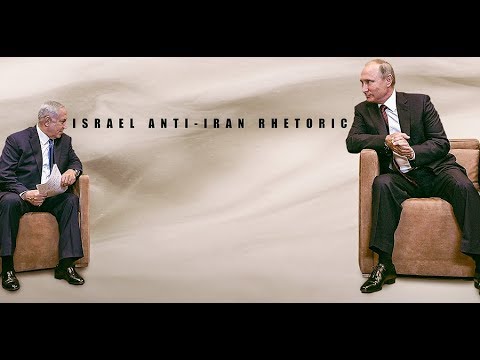
Press TV – August 25, 2017
Prime Minister Benjamin Netanyahu has said that Israel felt threatened by Iran’s growing influence in the Middle East. Netanyahu expressed his Iranophobic view in a meeting with Russian President Vladimir Putin in Russia’s Black Sea resort of Sochi on Wednesday. Press TV has asked Scott Rickard, former American intelligence linguist from Tampa, Florida, and Brent Budowsky, a columnist at The Hill from Washington, to give their thoughts on the issue.
Rickard said Tel Aviv is concerned about the fact that the regime could not carry out its old project to spread sectarian divisions and pave the way for dismemberment of the countries in the Middle East region because of the Iranian-led resistance against Israeli policies, not only in the occupied territories of Palestine but also in the whole region.
“Iran is not a threat to Israel whatsoever. The threat that Israel sees is the fact that their Oded Yinon Plan is being put to a hold by Iran,” the intelligence linguist said on Thursday night.
“They (the Israelis) look at Iran as a threat only because they have no influence on their governments and Iran is autonomous and is not under the Zionist influence,” he added.
Since the victory of the Islamic Republic of Iran in 1979, Tehran has been critical of Israel’s policies in the region, whereas “no leaders [of other states] even dared to speak out against Zionism,” Rickard argued. … continue
Blog Roll
 Aletho News
- Sri Lanka secures supplies of Russia oil – minister
- Nations across Asia strike direct deals with Iran for Hormuz passage
- IRGC commander declares ‘new phase’ of reprisal attacks against aggressors
- Israel’s air defenses overwhelmed by cluster-warhead Iranian missiles: Reports
- Striking Iran’s Infrastructure Would Have Little Military Impact – Report
- What’s Behind U.S./Israeli Strikes On Iranian Pistachio Factories?
- Seyed M. Marandi: U.S. Military DIVIDED? Iran’s Secret Defense EXPOSED
- How I fell foul of the BBC thought police
- The End of NATO
- 37 days of war on Iran cost US staggering $42bln, tracker shows
- If Americans Knew
- Trump says Iranians appreciate bombs, WHO warns of nuclear risks – Daily Update
- U.N. experts demand Israel release prominent Gaza doctor after reports of ‘severe torture’
- Israel’s Latest Genocide Is Against the Shias of Lebanon. Why Is the World Silent?
- How Eliot Cohen’s influence over U.S. war-making paved the way for Trump’s war crimes in Iran
- Israelis don’t pay for the weapons we ‘sell’ to them — US taxpayers do
- While Distancing from AIPAC, Most 2028 Democratic Hopefuls Are Still Embracing Israel
- A brief history of the Israeli nuclear program, the open secret at the heart of the Iran war
- Israeli Settlers Killed a Palestinian Farmer on His Own Land, in Front of His Father. Yes, Again
- The US-Israeli War on Science is an Assault on our Future
- 100+ International Law Experts Say US Strikes on Iran Violate UN Charter, Could Be War Crimes
- No Tricks Zone
- An Inconvenient Tree: Uncovered In Alps… Europe Much Warmer Than Today 6000 Years Ago
- New Study Reports A 60% Slowdown In Greenland’s Ice Loss Rate In The Last Decade
- Low Intensity Tornado Wrecks Major Solar Farm, Creating A Potential Toxic Dump
- New Study Finds Warming Saves Lives…Cold Temperatures 12 Times More Deadly Than Excess Heat
- German Science Blog Accuses PIK Climate Institute Of Hallucinating Climate Tipping Points
- Devastating Assessment Of Comirnaty Vaccine By Former Senior Pfizer Europe Toxicologist
- New Study: CO2 Is ‘Effectively Negligible’ As An Explanatory Climate Change Factor Since 2000
- Former Pfizer Toxicologist Dr. Helmut Sterz Tells Bundestag Hearing Pfizer Vaccine Should Have Never Been Approved
- Energy Expert: Germany’s Nuclear Phaseout Was A “500 Billion Euro Mistake”
- New Research: South Australia’s Mid-Holocene Sea Surface Temperatures Were 4°C Warmer Than Today
 Aletho News