‘The resistance must continue’ – Macron hands Zelensky €2 billion in military aid
Remix News | March 27, 2025
French President Emmanuel Macron hosted the Ukrainian President Volodymyr Zelensky for a working dinner ahead of a meeting of the Coalition of the Willing tomorrow, but Zelensky was there for more than just a free meal.
“France sends a message of friendship and support. We are and will remain on Ukraine’s side,” Macron said at a joint press conference with Zelensky, announcing that his country would provide €2 billion in military aid to Ukraine.
“We must continue to provide immediate support to Ukraine. The resistance must continue. I have announced an additional €2 billion in support,” Macron said, writes Magyar Nemzet. The support still includes Milan anti-tank missiles, air defense systems, such as the previously delivered MICA missiles mounted on Mirage aircraft, and Mistral surface-to-air missiles.
Ukrainian forces will also receive VAB armored vehicles and AMX–10 RC tanks, as well as a wide range of ammunition, some of which is remotely controlled, and drones. The French president added that there are ongoing discussions surrounding satellite and intelligence cooperation involving Ukrainian manufacturing, “thanks to partnerships with our defense companies.”
“We have entered a new era, and Russia’s aggressiveness not only poses a challenge to global order and world stability, but also has a very direct impact on our European security,” Macron stressed, adding that he expects Russia to also commit to the 30-day unconditional ceasefire Ukraine agreed to.
For his part, Zelensky remarked on sanctions, saying: “Sanctions against Russia must remain in place and be strengthened as long as the Russian occupation lasts.” Moscow understands no other language than the language of force, that is a fact.”
He also touched on the possibility of deploying foreign soldiers in Ukraine, which will be discussed at the Coalition of the Willing in Paris, which will be held tomorrow.
Zelensky also highlighted France’s “unwavering support” for Ukraine, adding that he believes “much can and should be done for the security of Europe.”
UK military slams Ukraine ‘peacekeeping’ plan as ‘political theater’ – Telegraph
RT | March 24, 2025
UK military officials have dismissed Prime Minister Keir Starmer’s proposal for deploying Western troops to Ukraine as part of a ‘peacekeeping force’ to oversee a potential ceasefire, The Telegraph reported on Sunday. Senior military sources told the outlet that Starmer had “got ahead of himself.”
Starmer announced the initiative earlier this month, aiming to build a “coalition of the willing” to support Ukraine militarily. Last week, he claimed that multiple countries backed the idea of sending in a peacekeeping force of up to 10,000 troops, despite Moscow’s opposition to any Western deployments in the conflict zone.
London hosted planning talks last week with military officials from partner nations. However, military sources dismissed the plans as premature and politically motivated.
“There is no defined military end-state or military-strategic planning assumptions. It’s all political theater,” one senior army official told the news outlet.
“Starmer got ahead of himself with talk of boots on the ground before he knew what he was talking about.”
The discussions have reportedly shifted their focus from boots on the ground to air and naval support. The Telegraph reported that RAF fighter jets could be deployed to patrol Ukrainian airspace, while British Typhoons could provide air cover for ground forces, though the size and role of any ground deployment remain unclear.
“It’s politics. There’s no military sense in it,” another defense source said, noting that neither Russia nor the US support the coalition. He also pointed to a lack of clarity on mission goals.
“What is a 10,000-international force based in the west of the country over 400km from the front line meant to do? It cannot even protect itself,” he argued. “What is the mission? What is its legitimacy? What are the rules of engagement? How is it commanded, supplied and housed? How long is it there for and why? No one knows.”
Further planning talks are expected in London on Monday between British and French defense officials. French President Emmanuel Macron is reportedly considering invoking the UN to authorize a European troop presence in Ukraine. However, Russia has repeatedly rejected the idea of Western peacekeepers in Ukraine, noting that it would require UN Security Council approval, where Moscow holds veto power.
US announcement of sixth-gen F-47 fighter draws analyses from Chinese expert
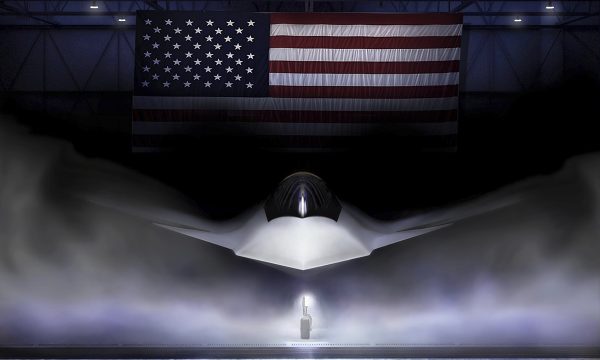
Graphical rendering shows the Next Generation Air Dominance (NGAD) Platform, the F-47. Photo: VCG
By Liu Xuanzun and Liang Rui | Global Times | March 23, 2025
The US’ recent announcement of the F-47 fighter jet has drawn intensive analyses from Chinese military affairs experts and observers, who acknowledged the aircraft being a real sixth-generation fighter jet for featuring typical characteristics such as a tailless design, but they also raised questions over its potentially limited stealth capability, relatively small size, and the US’ selection of Boeing to build the warplane.
The Pentagon has awarded the contract for the US Air Force’s Next Generation Air Dominance future fighter jet, known as NGAD, to Boeing, US President Donald Trump announced Friday, US news outlet Defense News reported on Saturday.
The sixth-generation fighter, which will replace the F-22 Raptor, will be designated the F-47, Trump said. It will have “state-of-the-art stealth technologies [making it] virtually unseeable,” and will fly alongside multiple autonomous drone wingmen, known as collaborative combat aircraft, Defense News reported.
After reviewing the artist renderings of the F-47 released by the US Air Force, Zhang Xuefeng, a Chinese military affairs expert, told the Global Times on Sunday that the F-47’s appearance conforms to the general development trend of the sixth-generation fighter jet concept. For example, it does not feature any vertical tails, which is an attempt to further improve its stealth capability in all directions. It has a flat nose and a lifting-body fuselage. These are all important characteristics of a sixth-generation fighter jet.
Zhang added that manned-unmanned teaming is a core sixth-generation feature, and one the F-47 includes.
However, a pair of canards can be observed in front of the F-47’s main wings, and this will more or less impact the aircraft’s stealth, Zhang noted. Reiterating that an important trend for sixth-generation fighter jets is to remove vertical tails and use a supersonic flying wing configuration to boost stealth, Zhang said that new mechanisms are needed to act in the place of vertical tails to control the aircraft, such as movable wingtip. But the F-47 opted to use canards, a relatively old technology often found on previous generations of aircraft. He suggested Boeing may lack the tech base to develop new control methods and relies on outdated design choices.
In December 2024, videos and photos emerged on social media allegedly showing two types aircraft with new designs have conducted test flights in China. Despite no official announcements, many called them China’s “sixth-generation fighter jets.” Both of them appear to have removed vertical tails and also do not have canards. One of them, resembling a ginkgo leaf in appearance, looked far larger than its J-20 escort.
Wang Ya’nan, chief editor of Beijing-based Aerospace Knowledge magazine, told the Global Times on Sunday that comparing with the size of the canopy and the front landing gear, it can be analyzed that the overall size of the F-47 is not likely much larger than the F-22. It means that the F-47 is still a tactical aircraft, rather than a large, multipurpose aerial platform capable of conducting campaign-scale missions like the “ginkgo leaf” aircraft.
Defense News, citing Air Force Chief Gen. Allvin, claimed that experimental versions of the NGAD have been flying for the last five years.
But Wang noted that there is no proof of this. Even the pictures depicting the F-47 are artists renderings rather than photos.
Wang also noted that Boeing has not won a major fighter jet program for decades. Its F-15 and F/A-18 fighter jets are from McDonnell Douglas which was merged into Boeing, and Boeing’s own X-32 fighter jet lost to the F-35 from Lockheed Martin in bidding. Boeing’s other projects, such as the 737 MAX airliner and KC-46 tanker aircraft also encountered many issues recently. “Having a company like this to lead a sixth-generation program is actually very risky,” he said.
In addition to US’ NGAD program, other countries are also developing sixth-generation fighter jets. France, Germany and Spain are in the Future Combat Air System program to develop a sixth-generation fighter jet, while the UK, Italy and Japan have a sixth-generation Global Combat Air Programme fighter project, according to Defense News. Russia’s sixth-generation efforts have also surfaced in TASS reports.
Wang said the US is moving fastest with the F-47, while other nations lag. With China’s own jets already spotted in the sky, the outside world is now seeing China and the US in advanced stages of sixth-generation fighter jet development.
Europe Will Spend Itself Into ‘Bankruptcy’ If It Tries to Meet NATO’s Draconian New Defense Demands
By Ilya Tsukanov – Sputnik – 23.03.2025
NATO is planning to ask its European and Canadian members to boost their weaponry and equipment stocks by about 30% over the next several years, informed sources have told Bloomberg. Sputnik asked a pair of leading German and French observers what this would mean for a region already suffering economic malaise and industrial decline.
Key alliance members like Germany and France would amass an unsustainable fiscal burden, be forced into debt and have to slash social programs if they accept NATO’s call for a 30% bump in new arms and equipment spending, AfD MP Dr. Rainer Rothfuss told Sputnik.
“We can take the example of Germany, where we had a kind of financial policy coup d’état this week” after the Bundestag voted to change the Basic Law to lift debt restrictions for defense spending, Rothfuss, who is also a veteran geopolitical analyst and consultant, said.
“The budget restraints that were even inscribed into our Constitution needed to be changed to get the financial flexibility to invest so much in defense. That shows us that it’s not a matter of priority spending, [but] a matter of, I would say, bankruptcy should this kind of policy be followed in the coming years, not only by Germany but by other countries as well,” the politician warned.
“France, for example,” has “an even more restrained budgetary situation,” Rothfuss said, “struggling economically to keep industry jobs,” and like Italy, should be investing in the competitiveness of its industries, not throwing money away on defense at a time when the security crisis in Europe is potentially closer to a peace deal than ever.
As for Germany, if its industrial decline worsens, it won’t be able to fund the EU to the tune of 25% of bloc spending, which would have serious knock-on effects for other members, the MP warned.
Jacques Sapir, director of studies at the Paris-based School for Advanced Studies in the Social Sciences, says a 30% bump may not seem like a lot, and even manageable by some countries, like France, given the large-scale decline in NATO stockpiles of 40-60% after the end of the Cold War.
But others, like Italy, Belgium, Germany and the Netherlands may need between a 30%-50% increase in outlays, given the decline in defense production over the past three decades, he said, adding that this could take between three and five years to accomplish for countries like France, Germany and the UK, and probably more for Canada.
Last month, Bloomberg calculated that a European defense buildup and the continuation of the proxy war against Russia without US assistance could cost up to $3 trillion over ten years – a massive burden for a region suffering from perpetual economic stagnation and widespread deindustrialization.
Demonstrations in American, European cities condemning Israeli crimes in Gaza

Thousands gathered outside the British government headquarters in London on Tuesday evening
Palestinian Information Center – March 19, 2025
Thousands of pro-Palestinian activists marched through the streets of American and European cities to condemn the resumption of the Israeli occupation’s war of extermination against the Gaza Strip that resulted in the martyrdom and injury of hundreds, most of whom children and women.
The marches began in cities like Seattle in Washington State, San Francisco in California, and Milwaukee in Wisconsin, protesting the U.S. administration’s approval of violating the ceasefire agreement, as shown in footage shared by pro-Palestinian pages on social media.
Participants in the protests demanded a ban on arming Israel while it commits genocide in Gaza, as well as the release of Palestinian student Mahmoud Khalil.
In Minneapolis, dozens of pro-Palestinian demonstrators gathered outside the Israeli consulate, holding signs demanding an end to the genocide in the Gaza Strip.
The Minneapolis demonstration, announced just four hours prior to its gathering, garnered significant attention as it coincided with rush hour in the city.
In France, demonstrators in Place de la République in Paris condemned Israel’s breach of the ceasefire agreement and the resumption of attacks on the Gaza Strip.
The protesters called for an end to the war on Gaza, an immediate end to the blockade of the Strip, halting Israeli genocide in Gaza, holding Netanyahu and occupation leaders accountable, and boycotting Israel.
In Italy, clashes erupted between police and pro-Palestinian demonstrators in Milan, where hundreds called for a permanent ceasefire in Gaza amidst stalled ceasefire talks between Israel and Hamas.
Footage shows columns of red smoke filling the air, while the sounds of explosions echoed through the Italian city’s streets. Protesters were seen marching, raising Palestinian flags and signs that read “Hands off the West Bank” and “Glory to the martyrs, freedom for the prisoners,” before being attacked by police forces.
In the Dutch capital Amsterdam, another demonstration was held in support of Gaza and against the genocide being committed by Israel against Palestinians.
Cities like Ankara, Istanbul, Diyarbakır, and other Turkish cities also witnessed demonstrations condemning the Israeli massacres against residents of the Gaza Strip.
Protesters accused Israel of committing genocidal crimes through its ongoing aggression against the Gaza Strip and called on the international community to hold it accountable for these crimes.
Turkish organizations, including the Anadolu Youth Association, the Humanitarian Relief Organization, and the Turkish Institutions Coalition for Jerusalem, called for organizing supportive demonstrations for the Gaza Strip in various Turkish cities and for the continuation of the boycott against Israel and products from supporting companies.
Russia’s Kursk Region Becomes Final Resting Place for NATO’s Top Tech
By Ilya Tsukanov – Sputnik – March 15, 2025
The near-total collapse of Ukraine’s operations in Kursk region has highlighted the folly of Zelensky’s obsession with throwing his best troops and materiel into a hopeless campaign. Here’s a selection of NATO equipment that has “found its peace in Kursk’s ground” over the past month, complete with photo and video evidence.
Russia’s Defense Ministry estimates that Ukraine has lost nearly 400 tanks, almost 2,800 armored vehicles and over 1,000 guns and mortars in fighting in Kursk region to date, and says over 85% of territories once occupied by Ukrainian forces have been freed.
Liberated areas contain scores of wrecked, burned out, damaged or abandoned vehicles, including some of NATO’s most advanced equipment:
M2A2 Bradley: Over 300 of these do-it-all American infantry fighting vehicles have been sent to Ukraine, with nearly half confirmed lost by Oryx. They’ve been spotted among other wrecked NATO equipment in Kursk region.
M1 Abrams: 31 of these custom-made monkey model American main battle tanks have been delivered to Ukraine. 20 lost to date. One recently spotted being towed away intact in Kursk region. Australia plans to send 49 more.
Leopard 1 AVLB Biber: Armored vehicle-launched bridge built on a German Leopard-1 tank chassis. 30+ sent to Ukraine. One recently found abandoned, in mint shape, in a Kursk village.
M777: A third of the 180 US-made 155mm howitzers sent to Ukraine have been lost, damaged, or abandoned to date, with several recently captured almost intact in Kursk region.
Stryker: Over 400 of these Canadian-built armored fighting vehicles have been transferred to Ukraine. At least 55 destroyed, some caught on Russian MoD FPV drone videos moments before meeting their fate.
BMC Kirpi II: 200 of these Turkish MRAPs have been sent to serve in Ukraine’s elite units. Scores destroyed, damaged or captured by Russian forces, including in Kursk.
HMMWV: 5,000 of these ubiquitous US vehicles, better known as Humvees, have been delivered to Ukraine. Scores captured on Russian FPV drone cam footage in Kursk region.
Roshel Senator: Over 1,700 of the Canadian-built armored cars have been delivered to Ukraine. Also spotted in Russian FPV drone videos.
MAXXPRO: About 440 these Mine-Resistant Ambush Protected Vehicles (MRAPs) have been sent to Ukraine by the US, with at least 197 lost to date, including in fighting for Kursk.
M113: 1,000+ of these ancient tracked APCs have been sent to Ukraine by the US and allies, with nearly 300 destroyed to date, including in Kursk region.
BATT UMG: Ukraine has received 116 of these US-made vehicles. Rarely seen, some are known to have met their fate on the battlefields of Kursk.
Bushmaster PMV: About 120 of these Australian-made Protected Mobility Vehicles have gone to Ukraine, some ending up in Kursk region, and at least 25 lost to date.
M240: Besides heavy equipment, an array of NATO small arms has also been destroyed or captured in Kursk as well, among them the FN M240 7.62mm machinegun, delivered to Ukraine by the US and France. In February, a Russian trooper in Kursk captured an M240 after storming a Ukrainian position and bringing the gun back to friendly lines.
Much ado about nothing – Macron proposed nuclear umbrella for Europe
By Uriel Araujo | March 10, 2025
France’s President Emmanuel Macron announced last week his intention to extend the French nuclear shield to its European partners, and there are now talks about French-British nuclear deterrence. Germany’s Chancellor-in-waiting Friedrich Merz has urged France and Britain to share their nuclear weapons to “supplement” (not “replace”) the American nuclear shield.
The premise here is that a “pro-Russian” Trump is going to “abandon” Europe and thus leave it vulnerable to Moscow’s “aggression” – and so it is necessary to build an alternative shield. While various analysts and journalists put on serious faces while talking about these issues, underneath the rhetoric, the whole narrative lacks any substantiality, to the point of being laughable.
Let us briefly touch the premisses:
While the situation with borders is indeed far from being a settled matter in the post-Soviet space (with a number of frozen conflicts), there is of course no Russian appetite for attacking, or much less, “conquering” portions of Europe. The whole crisis in Ukraine has in fact more to do with the ethnocratic contradictions of nation-building in the new independent state of Ukraine, and with NATO’s enlargement, a policy denounced by the likes of the late Henry Kissinger himself, George Kennan, and a number of scholars and authorities who predicted it could cause the Ukrainian war since the late nineties.
Albeit partially bent on a kind of “reverse Kissinger” strategy to stop Biden’s dangerous “dual-containment” approach” (of antagonizing both China and Russia simultaneously), Trump is hardly pro-Moscow in any sense beyond that of avoiding an escalation. Moreover, his rhetorical attacks on NATO have more to do with burden sharing than with “ending” the Alliance.
The truth is that Europe embarked on an America’s proxy attrition war, and now that an overburdened Washington is retreating from its very war, puzzled Europeans do not know what to do. Now, let us delve into the idea of European deterrence, as proposed by Macron.
Europe has stayed under Washington’s wings long enough, and Trump does have a point when he says most NATO countries fail to meet the agreed expenses’ goal of using at least 2 percent of their GDP in military spending (which overburdens the US). And now that the Atlantic superpower is really signing its intent on pivoting to the Pacific, partially withdrawing from Eastern Europe, and shifting NATO’s burden onto its European allies, there is weeping and gnashing of teeth amongst Europe and Britain’s political elites.
European powers today are simply not what they once were. Consider the United Kingdom, for instance: it might even lack the capacity to maintain its own nuclear arsenal without American help, as experts have been warning, in the context of Trump’s “burden shift” threats to “abandon” or to leave the American transatlantic allies on their own. In January last, a British “Trident” nuclear missile embarrassingly failed (for the second time) during a test launch, which led to speculations about the realities of Britain’s nuclear deterrence.
Long story short, Paris and London are the only nuclear powers in Europe – and it is unclear however to what extent they would be capable of replacing the so-called American “nuclear umbrella”.
According to Astrid Chevreuil (a visiting fellow with the Europe, Russia, and Eurasia Program at the Center for Strategic and International Studies – CSIS – in Washington, D.C.) and Doreen Horschig (a fellow with the Project on Nuclear Issues at CSIS), there are “significant strategic, doctrinal, and logistical obstacles” to that. More to the point, they add: “in the current situation, the French and British nuclear forces are a complement to US extended deterrence, but they would not constitute a viable solution in the event of an abrupt withdrawal of U.S. nuclear forces.” Elaborating on it, Chevreuil and Horschig argue that:
Both the British and French arsenals are designed, in their size, to respond to attacks “based on their vital interests”: Paris counts on less than 300 nuclear warheads, and London, in turn, possesses less than 250 (Washington in contrast has “a total of 1,700 deployed warheads”).
Moreover, American nuclear weapons stored in Europe today are “airborne capabilities” (and not ground-based or seaborne systems). Only France has such an airborne nuclear component, and “replacing” the US would require enormous efforts from European allies.
Finally, the two experts conclude, Britain and France lack a nuclear doctrine compatible with the very idea of “extending their nuclear deterrence through stationing their weapons in other countries.” Paris does not even participate in NATO’s nuclear planning groups, as the French doctrine “insists on the independence of its nuclear decision making.”
I’ve written before on the challenges Europe faces when it comes to “rearming” itself – they range from de-industrialization to lack of a common legal and bureaucratic framework, or a common EU defense market – according to Sophia Besch (a Carnegie Endowment for International Peace fellow), and Max Bergmann (a former member of the US Policy Planning Staff and Director of the Eurasia Program at the Center for Strategic and International Studies).
One should also keep in mind that Paris’ own relationship with NATO is historically complex, to say the least. Under De Gaulle, France withdrew from the organization’s integrated military structure in 1966, and even expelled all of its headquarters and units on French territory. It was French President Nicolas Sarkozy who finally ended Paris “estrangement” from NATO as recently as 2009 – so it took 43 years for Paris to change its course. To this day, France has not given up “nuclear independence” with regards to NATO, as mentioned. It is hard to change things overnight.
In addition, French ambition’s aside, a quick look at Africa is enough to demonstrate how much of a declining power France really is today: one just needs to consider the French failures in Chad, Niger, Mali, and elsewhere – the French military was basically kicked out of their main bases in the African continent.
Lastly, there is also an element of a power struggle going on. If the overburdened American superpower is partially retreating from a number of theaters, the outcome of it could be a local power vacuum (in Europe) and some actors might have an appetite for filling such a void. Even Poland has eyes on that, as I wrote before. Much of the French rhetoric we are now seeing has a lot to do with that.
To sum it up, Macron is offering Europe something he does not have to counter a threat that does not really exist the way he describes it. He is doing so because of something Trump will not actually do. To put it another way, it is “words, words, words”.
Uriel Araujo, PhD, is an anthropology researcher with a focus on international and ethnic conflicts.
Thousands protest in Paris against Macron’s defense policies
RT | March 9, 2025
Thousands of protesters marched through Paris on Saturday to oppose what they see as French President Emmanuel Macron’s militaristic approach to foreign policy and his lack of interest in achieving peace in the Ukraine conflict.
The demonstration was organized by Florian Philippot and his party, The Patriots. Chanting slogans and carrying signs such as “We don’t want to die for Ukraine,” and “Macron, we don’t want your war,” the crowd moved from the Place du Palais Royal to the Place Pierre Laroque.
Macron on Wednesday proposed expanding France’s nuclear deterrent to protect EU nations and urged European members of NATO to take more responsibility for their own defense. He cited uncertainty over Washington’s commitment to Ukraine, especially as relations between Kiev and US President Donald Trump’s administration experienced a setback after Vladimir Zelensky rejected calls to negotiate peace with Russia.
Macron has argued that continued aid to Ukraine was crucial, warning that if Russian President Vladimir Putin succeeded in Ukraine, he wouldn’t stop there – a claim that Moscow has repeatedly dismissed as nonsense. Russia has identified NATO’s expansion toward its borders and the US-led bloc’s promise of eventual membership for Ukraine as being among the key reasons for the conflict.
Many demonstrators at the Paris rally criticized Macron for prioritizing military matters over domestic issues. “When you declare war, it’s to erase all the other failures,” one protester said. Another accused Macron of pursuing conflict while leaders such as Trump and Putin are talking about peace.
Addressing the crowd, Philippot condemned Macron’s approach, declaring that the president “absolutely does not want peace.” Philippot, formerly a member of the National Front, has been a vocal critic of Macron’s administration and EU’s policies. His party opposes what it perceives as unnecessary military interventions and advocates for a more independent French foreign policy.
Macron’s push for increased defense spending faces hurdles as France grapples with a budget deficit and pressure to rein in spending. Approval of the 2025 budget has been delayed due to a divided parliament. In January, Budget Minister Amelie de Montchalin announced plans to cut €32 billion ($34.6 billion) in public spending while raising taxes by €21 billion.
Critics argue that these measures would burden middle-class families, small business owners, and retirees already struggling with rising costs. Meanwhile, Prime Minister Francois Bayrou has rejected calls for public consultation on major defense policies, insisting such decisions are the government’s responsibility. When asked on Friday whether the French people should have a say in increased military spending and a shift toward a “war economy,” Bayrou was firm: “The government’s responsibility is to say, no, we can’t let the country be disarmed. It’s vital.”
Trump Floats Denuclearization Since US Can’t Win Arms Race With Russia, China Without Going Bankrupt
By Ilya Tsukanov – Sputnik – 07.03.2025
President Donald Trump has floated trilateral US-Russia-China talks on cuts to strategic nuclear weapons stockpiles. Sputnik reached out to one of Russia’s foremost experts on strategic security issues to discuss what’s behind the proposal, and its chances for success.
“Nuclear weapons are precisely one of the areas where competitors outpacing the United States is very visible,” says Dmitry Suslov, deputy director of research at the Russian Council on Foreign and Defense Policy.
“Chinese and Russian nuclear arsenals combined provide two times preponderance over the United States, or will make two times preponderance in the observable future,” Suslov stressed.
Nuclear talks are the “alternative” for the US to bankruptcy stemming from high defense spending and unsustainable debt, particularly as the US nuclear arsenal is stuck in the 80s and lags far behind competitors, especially Russia, and would take immense resources to modernize, the observer said.
Instead, Trump “wants to channel competition into some other areas, into the areas where the United States largely have advantages,” according to Suslov, from high-precision conventional arms to his “Golden Dome” proposal for a space-based SDI 2.0.
“This is an attempt to reduce competition in the area where the United States is not competitive and to channel the competition into the areas where the United States is competitive, has comparative advantages, technological advantages, in the opinion of the Trump administration,” the expert noted.
Will Trump’s Nuclear Negotiations Push Succeed?
- “Complete denuclearization is impossible,” Suslov stressed, since nuclear weapons serve as the “ultimate guarantee which prevents war among great powers.”
- “The only [reason] why NATO and the United States have not started a direct war against Russia yet in the context of the Ukraine war is nuclear weapons,” he said.
- Russia and China will be unlikely to agree to trilateral talks, the expert believes, since their relations are built on partnership, not deterrence.
- As for bilateral Russia-US talks, these are possible, “but also [face] huge impediments,” including the need to include the French and British nuclear arsenals into account.
- “Basically, Macron made it absolutely clear that the purpose of French nuclear weapons is to deter Russia. This is against Russia. The purpose of British nuclear weapons is also against Russia. And they plan explicitly nuclear operations, potential nuclear operations against Russia,” Suslov noted.
Accordingly, Russia’s strategy will continue revolving around insisting “on a comprehensive approach and taking all the factors which impact strategic stability into account,” Suslov predicts.
Trump: Everybody Should Get Rid of Their Nuclear Weapons
By Kyle Anzalone | The Libertarian Institute | March 6, 2025
President Donald Trump restated his desire to abolish nuclear weapons during a White House presser on Thursday.
“It would be great if everybody would get rid of their nuclear weapons. [I know] Russia and us have by far the most,” the president told reporters in the Oval Office. “China will have an equal amount within four to five years. It would be great if we could all de-nuclearize because the power of nuclear weapons is crazy.”
Currently, nine countries – the US, UK, France, Russia, China, India, Pakistan, North Korea, and Israel – possess nuclear weapons. With global tensions on the rise, several nations, including the US, are adding to their strategic capability.
According to the Defense Intelligence Agency, Beijing is working to ramp up its production of nuclear weapons. Last year, the agency predicted that China could have over 1,000 nuclear weapons. However, that would still give Beijing a far smaller arsenal than Washington and Moscow, which each have around 1,500 deployed nuclear weapons and thousands more in storage.
Shortly after returning to the White House in January, Trump said he spoke with President Vladimir Putin about denuclearization during his first term, and that the Russian leader was receptive to the idea. “We were talking about denuclearization of our two countries, and China would have come along. China right now has a much smaller nuclear armament than us, or field, than us, but they’re going to be catching [up] at some point,” Trump said.
“I will tell you that President Putin really liked the idea of cutting back on nuclear, and I think the rest of the world, we would have gotten them to follow, and China would have come along too. China also liked it,” he added. “Tremendous amounts of money are being spent on nuclear, and the destructive capability is something that we don’t even want to talk about. It’s too depressing.”
Trump has also discussed negotiating a deal with Moscow and Beijing that would see all three countries drastically cut military spending.
However, while Trump has at times voiced support for demilitarization and denuclearization, during his first term in office he scrapped two major arms control agreements, the Open Skies and the Intermediate Range Nuclear Force treaties.
Additionally, Trump refused to engage in bilateral discussions with Russia on extending the last nuclear arms control agreement between the world’s two largest nuclear arsenals, the New Start Treaty. He insisted that Moscow must pressure Beijing to make it a trilateral deal, a demand that almost led to the downfall of the landmark deal.
Though President Joe Biden was able to reach an agreement with Putin to extend the treaty for five more years in 2021, it is set to expire next year without another extension.
How viable is Macron’s nuclear umbrella proposal?
By Drago Bosnic | March 7, 2025
As the United States and Russia are engaging in talks to avoid the possibility of an uncontrollable escalation, the European Union and NATO keep doing the exact opposite. Brussels wants the war to continue, including by pushing for the deployment of its troops in Ukraine. Worse yet, as the diverging interests of the new Trump administration and the EU/NATO become more evident, the latter is now trying to appease Washington DC by portraying this as a “peace initiative”.
On the other hand, Trump and his team understand that the world is drastically different to what it was in the aftermath of the (First) Cold War. This is precisely why they’re far less belligerent toward Moscow (at least in terms of rhetoric) than was the case with the previous administration.
The EU/NATO is terrified of the prospect of being left to face Russian military power in Ukraine (and possibly beyond) on its own. To prevent that, Western European powers are now looking to escalate tensions in hopes of drawing the US back into a crawling confrontation with the Kremlin. However, as the Trump administration is still showing no interest to get involved, the EU/NATO is now pushing for a strategic escalation.
This is particularly true for French President Emmanuel Macron who is now talking about placing the “old continent” under the French nuclear umbrella. On March 5, he tried to justify this by claiming that “[President Vladimir] Putin is now threatening all of Europe” and declared that “Russian aggression knows no borders”.
“We are entering a new era. If a country can invade its neighbour in Europe and go unpunished, nobody can be sure of anything. Beyond Ukraine, the Russian threat is real – it affects the European countries,” Macron stated in a televized address, adding: “President Putin is violating our borders to assassinate opponents, manipulate elections.”
For decades, “evil dictator and bloodthirsty tyrant Putin” has been the political West’s go-to bogeyman for both foreign and domestic policy issues. Whether it’s elections, political instability, price hikes or even personal problems, look no further than Vladimir Putin. The “evil, bear-riding Russians” are coming for you and “the only way” to prevent it is to go to war with them, preferably thermonuclear.
According to the mainstream propaganda machine, if you think this sounds like total madness, you must be a “Putin troll”. Unfortunately, this is how the EU/NATO is trying to portray the ongoing crisis, which is why it’s effectively impossible for Russia to find anyone remotely reasonable to talk to in Europe. And they keep proving this each passing day.
Macron insists that the EU/NATO “need to prepare”. It would seem he’s trying to fill the power vacuum as the US is looking to shift its strategic focus to the Asia-Pacific. The endemically and pathologically Russophobic United Kingdom seems to be supporting this initiative, as it falls perfectly in line with its strategy of pushing continental powers against each other.
This is why there have been numerous meetings and conferences in support of not only continuing but also escalating the NATO-orchestrated Ukrainian conflict. However, conventional capabilities of Western European powers are nowhere near enough to match that of Russia (not even in Ukraine, let alone when the entire Russian military is taken into account).
“I want to believe that the US will stand by our side, but we have to be ready for that not to be the case,” Macron complained, adding: “France has to recognize its special status – we have the most efficient, effective army in Europe.”
He then stressed that his country “has nuclear weapons to provide to the broader Western alliance if called upon”. Macron went on to explain that he’s considering the possibility of expanding the French nuclear umbrella to all of Europe. He also cited the words of Germany’s (most likely) upcoming chancellor, Friedrich Merz, who recently stated that he wanted to discuss the possibility of extending French and British nuclear umbrellas to also include Germany.
It should be noted that Berlin already has American nuclear weapons stationed on its territory as part of NATO’s nuclear sharing policy. However, with the recent shift initiated by the new US administration, European member states still loyal to the anti-Trump Deep State seem to be looking for viable alternatives.
“We need reforms, we need to make choices, and we need to be brave,” Macron stated, adding: “[Merz] has called for a strategic debate on providing that same protection to our European allies… whatever happens the decision will be in the hands of the president of the Republic and the heads of the army.”
He also said there will be a meeting of the EU/NATO army chiefs in Paris next week, hinting this could be one of the matters they will be discussing. Besides the US, the UK and France are the only member states who have their own nuclear weapons. It should be noted that this initiative also means that the EU/NATO is fully aware that nuclear weapons are the only way to “even the playing field” with Russia’s conventional military power.
However, what this also means is that Moscow would be forced to respond with its own nuclear arsenal – by far the largest and most powerful in the world. In fact, the difference between the number of thermonuclear warheads in Russia and the US is larger than the combined arsenal of the UK and France (around 500).
London and Paris both have SLBMs (submarine-launched ballistic missiles), with the latter also operating nuclear-capable aircraft. This is a lower level of deterrence than in countries like Russia, China, India and the US who have nuclear triads (aircraft, submarines and land-based missiles), without even considering the size of Moscow’s strategic arsenal which is upwards of a dozen times larger than the combined Franco-British stockpile.
It’s still unclear what exactly Macron has in mind when talking about extending this arsenal to the rest of the EU/NATO. If he’s talking about replicating (or even replacing) the US nuclear sharing policy, the Kremlin might not react immediately, as this would change little in terms of the strategic balance of power.
However, if Macron wants to deploy these weapons close to Russian borders, this changes the calculus entirely, as it would force Moscow to either reactivate some of the non-deployed warheads or make new ones (if not both, depending on how far the EU/NATO would go). What’s more, the Russian military also operates non-nuclear strategic weapons, specifically hypersonic missiles such as the new “Oreshnik”.
The entire political West lacks remotely similar systems, including the US (which, as previously mentioned, is slowly shifting its strategic focus away from Europe). In other words, the EU/NATO cannot match Russia even on a tactical or operational level, let alone strategic. However, it keeps poking the Bear and pushing for escalation on all three fronts.
Drago Bosnic is an independent geopolitical and military analyst.
Featured Video
Dr. Tony Martin – The Jewish Role in the African Slave Trade
or go to
Aletho News Archives – Video-Images
In Memoriam
James Petras, In Memoriam
 02.13.2026
Professor James Petras, 89, world-renowned sociologist, public intellectual, and scholar of Latin American politics and global economics, died peacefully on January 17, 2026, in Seattle, WA, surrounded by family.
A prolific scholar and activist, he devoted his life to challenging power, imperialism, and inequality. … continue
Blog Roll
 Aletho News
- Travelers Take a Pass on Visiting America
- EU members divided on 20th Russia sanctions package – media
- Lawyers ask police to investigate Elbit Systems UK for alleged war crimes complicity
- Israel ready to strike Iran-backed armed groups – media
- Behind US war drums against Iran: No goals, no plan, no off-ramp
- With Ukraine blamed for cutting oil flows to Hungary, Croatia also refuses to transfer Russian oil in violation of EU law
- Friedrich Merz’s Push to End Online Anonymity Has a Troubling Subtext
- Macron: French citizens fighting for Israel cannot be labeled ‘genociders’
- US eyes Gaza security force drawn from armed gangs
- The Only Motive Behind The ‘Imminent’ U.S. War With Iran Is The Zionist Lobby
- If Americans Knew
- ‘Christians Out’: Jerusalem Church Tagged With Hate Graffiti, Police Investigating
- Israeli Settlers Kill American Teen
- ‘We returned from hell’: Palestinian journalists recount torture in Israeli prisons
- No mercy for Gaza in Ramadan – Not a ceasefire Day 133
- The Israeli Government Installed and Maintained Security System at Epstein Apartment
- Tucker Carlson interrogated in Israel, has passport seized after interviewing US ambassador
- 6,000 Amputees in Gaza Face Impossible Recovery amid Israeli War Ultimatum
- The Lancet: Gaza death toll far higher than reported – Not a ceasefire Day 132
- Compliant aid: Who are the Israel-approved NGOs scaling up in Gaza?
- Why won’t Trump’s “Board of Peace” bring peace? – Not a ceasefire Day 131
- No Tricks Zone
- New Study: Canada’s New Brunswick Was 1°C Warmer Than Today During The Medieval Warm Period
- Coal Power Back In Trend As Globe Tries To Keep Pace With Growing Demand For Power
- New Study: A 4°C Warmer Beaufort Sea Had ‘No Sea Ice’ 11,700 – 8200 Years Ago
- Unfudging The Data: Dutch Meteorological Institute Reinstates Early 20th Centruy Heat Waves It Had Erased Earlier
- German Gas Crisis…Chancellor Merz Allegedly Bans Gas Debate Ahead of Elections!
- Pollen Reconstructions Show The Last Glacial’s Warming Events Were Global, 10x Greater Than Modern
- Germany’s Natural Gas Storage Level Dwindles To Just 28%… Increasingly Critical
- New Study Rebuts The Assumption That Anthropogenic CO2 Molecules Have ‘Special’ Properties
- Climate Scientist Who Predicted End Of “Heavy Frost And Snow” Now Refuses Media Inquiries
- Polar Bear Numbers Rising And Health Improving In Areas With The Most Rapid Sea Ice Decline
 Aletho News