Lin: China opposes invocation of UN Security Council ‘snapback’ sanctions against Iran

Chinese Foreign Ministry Spokesperson Lin Jian
Press TV – August 15, 2025
China reaffirms its commitment to the peaceful resolution of Iran’s nuclear issue and opposes the invocation of the UN Security Council’s “snapback” mechanism.
Chinese Foreign Ministry spokesperson Lin issued the statement on Friday in response to the European troika’s warning to reimpose sanctions if a diplomatic solution is not achieved by the end of August.
“China stays committed to peacefully resolving the Iranian nuclear issue through political and diplomatic means, opposes invoking Security Council ‘snapback’ sanctions,” Lin said.
He argued that reimposing sanctions on Iran would not foster trust or bridge differences among parties and would hinder diplomatic efforts to resume talks promptly.
Lin emphasized that any actions taken by the Security Council should facilitate the achievement of new agreements rather than undermine the negotiation process.
The Chinese diplomat reiterated that China is committed to maintaining an objective and fair stance, continuing to promote conversations aimed at peace, and playing a constructive role in bringing the Iranian nuclear issue back to diplomatic negotiations at the earliest opportunity.
He also highlighted Beijing’s intention to safeguard the international nuclear non-proliferation regime and to promote peace and stability in the region.
Iranian Foreign Minister Abbas Araghchi said on Thursday that the country is actively collaborating with China and Russia to prevent the reactivation of UN sanctions through the so-called “snapback” mechanism.
“We are working with China and Russia to stop it. If this does not work and they apply it, we have tools to respond. We will discuss them in due course,” he added.
The snapback mechanism, embedded in the 2015 nuclear deal, known as the Joint Comprehensive Plan of Action (JCPOA), allows the automatic reinstatement of UN Security Council sanctions that had been lifted under the agreement. The deal terminates in October.
Iran, however, disputes the legitimacy of the European powers’ efforts to trigger the provision.
In a joint letter to UN Secretary General Antonio Guterres and the UN Security Council on Wednesday, the European troika — France, Germany and the United Kingdom – said they were “committed to us(ing) all diplomatic tools at our disposal to ensure Iran does not develop a nuclear weapon” unless Tehran meets a deadline to speak with them.
“We have made it clear that if Iran is not willing to reach a diplomatic solution before the end of August 2025, or does not seize the opportunity of an extension, the E3 are prepared to trigger the snapback mechanism,” the ministers wrote.
In a detailed letter to the UN Security Council last month, Iran laid out its position, asserting that Britain, France, and Germany are no longer legitimate JCPOA participants with the authority to reinstate sanctions through snapback. This position is supported by China and Russia, who share Tehran’s view on the matter.
China and Russia’s backing plays a critical role in Iran’s diplomatic efforts to counter the snapback threat. Both countries are permanent members of the UN Security Council and have veto power over resolutions, including those related to Iran’s nuclear program.
Coalition of Willing Opposes Any Restrictions on Ukrainian Army as Part of Ukraine Deal
Sputnik – 14.08.2025
The so-called “coalition of the willing” has opposed any restrictions on the Ukrainian armed forces as part of the deal on settling the Ukraine conflict ahead of the meeting between Russian President Vladimir Putin and US President Donald Trump, a joint statement read.
“Ukraine must have robust and credible security guarantees to effectively defend its sovereignty and territorial integrity. The Coalition of the Willing is ready to play an active role, including through plans by those willing to deploy a reassurance force once hostilities have ceased. No limitations should be placed on Ukraine’s armed forces or on its cooperation with third countries. Russia could not have a veto against Ukraine‘s pathway to EU and NATO,” the coalition said in a joint statement published by the office of UK Prime Minister Keir Starmer on Wednesday.
The coalition also believes that constructive negotiations can only take place “in the context of a ceasefire.”
The meeting between US President Donald Trump and Russian President Vladimir Putin is scheduled for this Friday in Anchorage, Alaska. The leaders are expected to discuss ways to resolve the Ukrainian conflict as well as other issues of mutual interest.
About International Guarantees that Shed Lebanese’ Blood
By Ali Shoeib, translated by Al-Manar English Website | August 9, 2025
On August 10, 2006, the story of the “Marjeyoun Survival” turned into a dark page in the history of the conflict with the Israeli enemy.
The Israeli occupation army raided Marjeyoun barracks on that day, when Lebanon was subjected to a brutal Israeli war that lasted for 33 days. The occupation forces took over the barracks without any resistance from the Lebanese troops and security forces who laid down their arms.
It was agreed that the town, which is 8 km away from the border with occupied Palestine, would be safely evacuated, and that the Israeli enemy would not attack the convoy, as stipulated by the guarantees presented via the United Nations Interim Force in Lebanon (UNIFIL).
These guarantees, brokered by the United States and France, were allegedly intended to remove the Lebanese forces who were detained at the barracks, along with stranded civilians, from the danger zone. But what happened was a resounding shock!
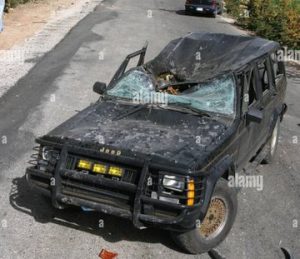 The convoy had set out on August 11 (2006). It was escorted by two UNIFIL vehicles.
Instead of escaping, Israeli enemy aircraft pursued the convoy of approximately 759 vehicles after it reached the Western Bekaa Valley, brutally targeting them and turning their path into a massacre.
The attack, which was conducted with nine bombs, resulted in the deaths of at least seven people, wounding of at least 36 and the destruction of a number of vehicles.
That attack in 2006 was a harsh lesson that says it all about the conflict with an enemy that does not abide by any covenant or pact, as the false US-French guarantees given to the Lebanese government at the time were merely an illusion and a deception.
The Marjeyoun convoy attack confirms a solid fact: The enemy cannot be trusted, and all international guarantees or regional promises aimed at disarming the resistance are merely a temporary cover for achieving the enemy’s goals, which seeks nothing but a moment of weakness that will enable it to achieve what it has been unable to achieve during the latest war in late 2024.
Our history is replete with examples that show that surrendering power is an open invitation to aggression. When the resistance is disarmed, the homeland is left exposed to the enemy’s ambitions.
Weapons are not just a combat tool, but rather a “symbol of the national will to defend the homeland and protect the sovereignty,” and resistance is the last line of defense.
The Marjeyoun convoy attack has proven that relying on international promises, in the absence of a real deterrent force, is a bet on defeat. Anyone who places their security in the hands of the enemy is willingly committing suicide, and we do not want to commit suicide.
Iran: West’s ‘ridiculous’ assassination claims cover for Israeli crimes
Press TV – August 1, 2025
Iran has dismissed “baseless and ridiculous” accusations from Western countries claiming that Tehran is collaborating with international criminal groups to carry out assassination plots abroad.
Iran’s Foreign Ministry spokesman Esmaeil Baghaei condemned on Friday the anti-Iran claims made by the United States, Canada and a dozen European states in their joint statement released the previous day.
He said the “blatant blame game” is an attempt to divert public attention from the most pressing issue of the day, which is the Israeli genocide in the occupied Palestine.
“The United States, France, and other signatories to the anti-Iran statement must themselves be held accountable for actions that violate international law, as they support and host terrorist and violent elements and groups,” he added.
Baghaei touched on the unprovoked US-Israeli aggression against Iran in June and Israel’s ongoing genocide in the Gaza Strip against the backdrop of active support or approving silence of the 14 Western countries that signed the statement against the Islamic Republic.
He further denounced the accusations as “blatant lies and an escape forward, designed as part of a malicious Iranophobia campaign aimed at exerting pressure on the great Iranian nation.”
The 14 states must be held accountable for their “disgraceful and irresponsible” behavior that violates the principles of international law and the United Nations Charter, the spokesman noted.
Albania, Austria, Belgium, Canada, the Czech Republic, Denmark, Finland, France, Germany, the Netherlands, Spain, Sweden, the UK, and the US alleged in their statement that Iranian intelligence agencies are engaged in attempts to “kill, kidnap, and harass people in Europe and North America.”
Gaza genocide case: 114 lawyers ask ICC to investigate French officials’ complicity
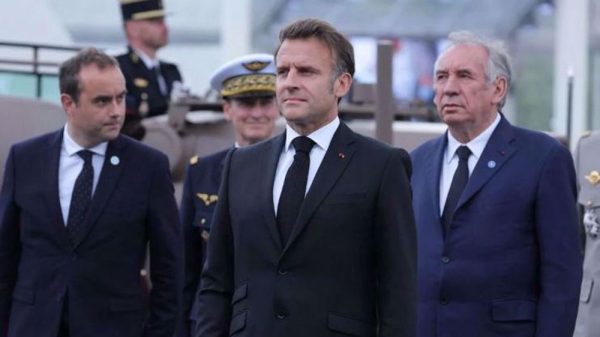
French President Emmanuel Macron (C), Prime Minister Francois Bayrou (R) and Defense Minister Sebastien Lecornu in Paris on May 8, 2025 (Photo by AFP)
Press TV – July 31, 2025
More than a hundred French lawyers have filed a petition with the International Criminal Court, formally requesting the ICC to initiate an investigation or prosecution of some French officials for their complicity “in the commission of war crimes, crimes against humanity and genocide” by the Israeli regime against Palestinians in Gaza and the West Bank.
The 56-page petition made public by the French investigative media outlet Blast on Monday named President Emmanuel Macron, Prime Minister Francois Bayrou, Foreign Minister Jean-Noel Barrot, Minister of the Armed Forces Sebastien Lecornu, and 19 lawmakers of the National Assembly’s European Affairs Committee as officials of the country facilitating Israeli crimes against Palestinians.
“Far from taking concrete measures to prevent the ongoing genocide against the Palestinians, the members of the French executive cited in this communication have continued to support the criminal actions” of Israel by “providing military, political, economic, diplomatic and propaganda support” including by providing the means to commit the crimes in question, the group of lawyers, who represent the Pour la Justice au Proche-Orient (“for justice in the Middle East”) organization, stated in the petition addressed to the Office of the ICC Prosecutor, in the Hague.
The lawyers also slam France for refusing to respect the 2013 Arms Trade Treaty (ATT), ratified by Paris, which imposes an absolute ban on exporting weapons if they have knowledge the arms could be used to commit war crimes, despite several requests from legal groups and NGOs.
The petition for legal action by the lawyers is equivalent to a formal criminal complaint to the ICC regarding a crime falling under its jurisdiction.
Now, it is up to the ICC Prosecutor to decide whether the request is in accordance with Article 15 of the Rome Statute, which states that the prosecutor may open proprio motu (which means on their own initiative) investigations based on information relating to crimes within the court’s jurisdiction.
The formal petition asking the ICC to investigate Macron and French ministers for Gaza genocide complicity was signed by 114 French lawyers.
The ICC acts as a court of last resort against individuals for war crimes, crimes against humanity, genocide, or the crime of aggression, complementing national courts in addressing these grave international crimes.
Karim Khan, the ICC’s chief prosecutor, issued arrest warrants for Israeli prime minister Benjamin Netanyahu and his former war minister, Yoav Gallant, on charges of war crimes and crimes against humanity in November 2024.
Israel is accused of using starvation as a method of warfare, intentionally attacking civilians and committing other inhumane acts during its genocidal military campaign in the besieged strip.
Israeli forces regularly attack starving Palestinians suffering from acute malnutrition and a severe lack of essential supplies.
Since the US-Israeli genocide started in October 2023, the death toll has reached over 60,100. Over 146,200 Palestinians have also been injured.
Nearly 1,000 Palestinians have also been killed by Israeli attacks in the occupied West Bank since the regime began its genocidal war on the Gaza Strip in October 2023.
Is Europe pushing for Palestinian statehood or Palestinian surrender?
By Malek al-Khoury | The Cradle | July 28, 2025
Since its inception in 1948, Israel has never operated within fixed borders. Expansion has always been its doctrine – not constrained by law, but propelled by force and endorsed by unwavering western support. Israel has refused to define its boundaries for almost eight decades because its very identity is rooted in a colonial ambition that has never truly ended.
From the Nakba (Catastrophe) to the Naksa (Setback), from territorial invasions to the annexation of Jerusalem, the Golan Heights, and the West Bank, the occupation state has continued to redraw its borders according to power, not legitimacy.
This expansionist project has only grown stronger with the rise of the messianic-nationalist current inside Israel, which sees full control over “Greater Israel” as a historical right that cannot be compromised.
Today, 77 years since the Nakba, Israel has advanced to full-throttle expansion mode – dispossessing Palestinians, destroying entire towns and villages, entrenching illegal Jewish settlements, and enforcing apartheid. Yet paradoxically, European states like France and the UK are preparing to recognize a “Palestinian state” precisely when Palestinian political geography is at its most fragmented, and when the Zionist project is at its most aggressive.
So what does this recognition actually mean? Is it a strategic achievement for Palestinians, or a diplomatic ruse that rebrands surrender as success?
A state without borders, a project without restraint
The 1917 Balfour Declaration marked the formal launch of a settler-colonial project in Palestine. What followed was not immigration but calculated dispossession – from British-facilitated land seizures and massacres, to the mass expulsions of the 1948 Nakba, which ethnically cleansed over 750,000 Palestinians.
This was not mere colonialism. It was ethnic replacement: Land was seized under imperial protection, then militarily conquered. This campaign never ended. It continued with the occupation of Gaza, Jerusalem, and the West Bank, and escalated after 1967. Israel’s goal has never been coexistence. It has always been Jewish supremacy.
The 1947 UN Partition Plan (Resolution 181) granted over 55 percent of historic Palestine to the Zionist movement, despite Jews owning just six percent of the land. The Zionist movement accepted this on paper to gain international legitimacy, then immediately violated its terms, occupying 78 percent of the territory by force.
To this day, the occupation state has not adopted a formal constitution, and the reason is that basing itself on the Partition Plan would have constrained its expansionist ambitions. The Zionist doctrine never recognized final borders, instead establishing a state with no official frontiers – because its ambitions stretch beyond Palestinian geography to include parts of Jordan, Syria, Lebanon, and Egypt.
The internal debate in Israel over declaring a “Jewish state” is not merely a legal argument, but an attempt to solidify an exclusionary and replacement-based identity – one that legally enshrines racial discrimination and denies Palestinians their status as an indigenous people.
Resistance realignment: 7 October and the Two-State shift
The earthquake triggered by Operation Al-Aqsa Flood shook not only Israel but also the political discourse of the Palestinian movement. Strikingly, Palestinian factions – including Hamas – have begun explicitly voicing support for the “Two-State Solution” after years of insisting on liberating historic Palestine in its entirety.
In an unprecedented statement, senior Hamas official Khalil al-Hayya said in May 2024:
“We are ready to engage positively with any serious initiative for a two-state solution, provided it entails a real Palestinian state on the 1967 borders with Jerusalem as its capital and without settlements.”
This tactical adaptation signals a significant shift. Key Palestinian actors are now openly considering a truncated state. Is this a reflection of changing power dynamics? Or an imposed realignment under regional and international duress?
Recognition as Leverage: France, Saudi Arabia, and normalization
Last week, in a post on X, French President Emmanuel Macron said:
“Consistent with its historic commitment to a just and lasting peace in the Middle East, I have decided that France will recognize the State of Palestine. I will make this solemn announcement before the United Nations General Assembly this coming September … We need an immediate ceasefire, the release of all hostages, and massive humanitarian aid for the people of Gaza. We must also ensure the demilitarization of Hamas, secure and rebuild Gaza. And finally, we must build the State of Palestine, guarantee its viability, and ensure that by accepting its demilitarization and fully recognizing Israel, it contributes to the security of all in the region. There is no alternative.”
France’s anticipated recognition of a Palestinian state in September is not driven by principle, but is a hard, cold geopolitical maneuver. It would appear that Paris is seeking closer ties with Riyadh, which has tethered normalization with Tel Aviv to progress on the Palestinian file. French recognition is thus a calculated signal to Saudi Arabia – not a gesture of solidarity with Palestinians.
In this equation, Palestine becomes currency. Its statehood is not affirmed as a right, but dangled as a precondition in normalization deals between Arab monarchies and the occupation state.
Strategic alignments: The Ankara–London Axis
With a third of MPs calling on British Prime Minister Keir Starmer to recognize Palestine, pressure is also piling on London.
In a statement, Starmer said:
“Alongside our closest allies, I am working on a pathway to peace in the region, focused on the practical solutions that will make a real difference to the lives of those that are suffering in this war. That pathway will set out the concrete steps needed to turn the ceasefire so desperately needed, into a lasting peace. Recognition of a Palestinian state has to be one of those steps. I am unequivocal about that.”
Britain, too, is not moving toward recognition out of moral clarity, but to reinforce its post-Brexit strategic axis with Turkiye. Ankara, a key trading partner of Israel and political backer of Hamas, views the recognition of Palestine as a tool to elevate its regional stature and energy leverage. For London, deepening ties with Turkiye promises economic and geopolitical dividends. The result is a converging Paris–Riyadh and Ankara–London recognition track.
Thus, two informal axes are forming: Paris–Riyadh and Ankara–London, both converging on the recognition of a Palestinian state. Yet neither axis approaches it from a principled belief in Palestinian rights, but rather through the lens of power, influence, and realpolitik.
The Palestinian state: Recognition without sovereignty
Even if every European country were to recognize Palestine, it would amount to little more than symbolism without enforcement. There would be no defined borders for the state, no control over its own territory, and no halt to the settlement expansion or annexation policies pursued by the occupation state.
Tel Aviv rejects the premise entirely. Israeli Prime Minister Benjamin Netanyahu has insisted that any future Palestinian state would be “a platform to destroy Israel,” and that sovereign security control must remain with Israel. He has repeatedly ruled out a return to the conditions that existed prior to 7 October.
The reality is that 68 percent of the West Bank, classified as Area C, remains under full Israeli control. More than 750,000 settlers are embedded across that territory, under the full protection of the occupation army. How can a state exist on occupied, fragmented land, under constant siege, and without sovereignty?
“I’ve just returned from a lecture tour around the world, and I can confidently say Israel’s global image and position are at their lowest point in history,” writes Israeli journalist Ben-Dror Yemini.
Yet despite this, Netanyahu’s far-right government is doubling down – pushing for full annexation of the occupied West Bank, eyeing new territorial footholds in Sinai, southern Syria, even Jordan, while maintaining military positions in south Lebanon.
Israel’s global brand may be eroding, but its strategic project is advancing.
If Israel is expanding and entrenching, while the Palestinian movement scales back demands and regional states normalize ties, what exactly has been achieved?
Resistance factions that once rejected Tel Aviv’s existence now propose statehood on its terms. European recognition comes with no teeth. Settlements grow. Displacement continues. This is not liberation. It is the burial of the dream under the guise of diplomacy.
The interim solution will become the final arrangement. The Palestinian “state” becomes a diplomatic euphemism – an empty structure praised in speeches, but denied on the ground.
France’s recognition of Palestine risks helping Israel — Indonesia should rethink its applause
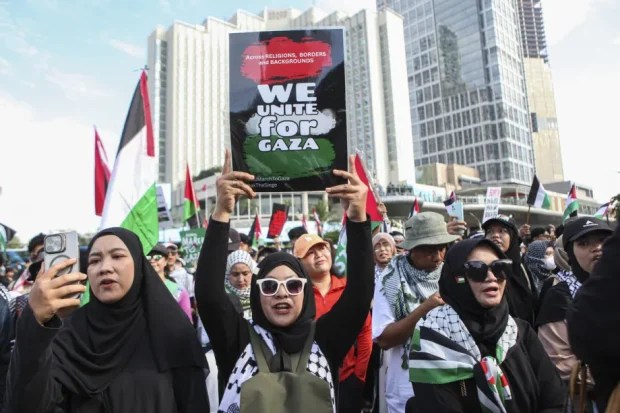
Activists at a solidarity march for the Palestinians in Jakarta, Indonesia, on June 15, 2025. [Agoes Rudianto – Anadolu Agency]
By Dr. Muhammad Zulfikar Rakhmat | MEMO | July 27, 2025
This week, Indonesia welcomed France’s decision to recognise the State of Palestine as a “positive step” toward peace. On its surface, this diplomatic endorsement may appear aligned with Indonesia’s long-standing support for Palestinian self-determination. But behind France’s gesture lies a deeper, more dangerous calculus—one that does not just ignore the reality on the ground, but actively entrenches it.
What France proposes is not justice. It is not freedom. It is an updated version of the same illusion that has kept Palestinians caged and dispossessed for decades: the so-called two-state solution.
In Jakarta’s official statement, the French move was praised for supporting a “sovereign and independent” Palestinian state based on 1967 borders, with East Jerusalem as its capital. But President Emmanuel Macron made clear what kind of state he envisions: a demilitarized Palestine that fully recognizes Israel. No mention of dismantling settlements, no restitution for occupied land, no accountability for war crimes in Gaza. Only submission, in return for a diplomatic label.
This is not a step toward peace—it’s a framework for permanent subjugation.
France’s position not only lacks balance, it weaponizes it. Macron calls for the “demilitarization of Hamas,” the rebuilding of Gaza, and regional stability—but with no demands for Israeli disarmament, no consequences for its mass killing of civilians, no guarantees of actual sovereignty for Palestinians. Instead, Palestinians are asked to disavow resistance, while the occupying power faces no requirement to end its occupation.
Indonesia, by praising this deal without reservation, is endorsing a framework that surrenders Palestinian rights under the language of diplomacy. In doing so, it becomes complicit in a process that allows Israel to continue its long project of expansion and erasure.
Because that is exactly what we are witnessing: not just war, but erasure.
Israel’s leaders have shed any pretense of restraint. Finance Minister Bezalel Smotrich has declared that Gaza should be “completely flattened.” Members of the Knesset and senior military figures have called to “wipe out” the territory. Starvation, siege, and bombing are not incidental—they are deliberate. The goal is not merely to punish, but to depopulate.
And this genocidal ambition is not new. It is part of a larger ideological blueprint long championed by elements of Israel’s far-right: the “Greater Israel” project. This vision seeks to claim not just the full expanse of historic Palestine—from the Jordan River to the Mediterranean Sea—but in some renditions, territory beyond it. It is a dream of exclusive ethnic control over a vast swath of the region. Palestinians, in this model, are not citizens or neighbors—they are obstacles to be removed.
This is the context in which France’s recognition must be understood: not as a bold shift in policy, but as a stabilizing gesture for an apartheid regime facing global criticism. And by embracing it, Indonesia—whether intentionally or not—is lending moral cover to that regime.
It is tempting, in the face of so much suffering, to welcome any sign of progress. But symbolic recognition without structural change only reinforces the status quo. A demilitarized Palestine, hemmed in by Israeli checkpoints, with no right of return and no means of defense, is not a state—it’s an open-air prison with a flag.
What is needed now is not more applause for diplomatic theater, but a refusal to accept false solutions. The two-state framework, as currently constructed, is not a path to justice. It is a political tool that enables colonization while pretending to end it.
Indonesia has long stood as a voice for the oppressed. It must not dilute that legacy by celebrating a plan that leaves Palestinians with a flag and no freedom. Instead of encouraging other nations to follow France’s lead, Indonesia should be demanding accountability: for the destruction of Gaza, for the daily violence in the West Bank, and for the decades of displacement.
This is not a time for symbolic victories. It is a time for moral clarity.
France’s vision, and Indonesia’s uncritical support of it, may win applause in diplomatic circles. But on the ground, in Gaza and the West Bank, it enables a project whose end goal is not peace, but erasure. If Indonesia truly believes in justice for Palestine, it must reject this illusion—and instead, insist on the one thing Palestinians have never been offered: freedom on their own terms.
Georges Abdallah returns to Beirut after over 40 years in French prison

The Cradle | July 25, 2025
Lebanese activist and resistance fighter Georges Abdallah has been released from French prison after over 40 years of incarceration, arriving in Beirut to a hero’s welcome on 25 July and renewing his call for armed resistance across the region.
“The resistance is rooted in this land and cannot be uprooted,” Abdallah expressed upon his arrival at Beirut’s Rafic Hariri International Airport.
Speaking from the VIP lounge, he said, “the prisoners’ steadfastness in their prisons depends on the steadfastness of their comrades outside.”
Abdallah, a former member of the Popular Front for the Liberation of Palestine (PFLP) and the Lebanese Armed Revolutionary Factions (LARF), was arrested in 1984 and sentenced to life in prison in 1987 on charges of involvement in the killings of US military attache Charles Ray and Israeli diplomat Yakov Barsimentov in Paris in 1982.
The Lebanese resistance icon was also accused of involvement in the attempted assassination of US consul General Robert Homme in Strasbourg.
The killings of Ray and Barsimentov were claimed by LARF and framed as a response to Washington and Tel Aviv’s involvement in the Lebanese civil war.
Held at Lannemezan Prison in southern France, Abdallah became eligible for parole in 1999, but 10 successive requests for release were rejected. A 2013 ruling approving his release on condition of expulsion from France was never implemented.
On 15 November 2023, the Paris Court of Appeal again approved his release, conditional on his permanent expulsion, with the decision confirmed on 17 July 2025 by the French Ministry of Justice.
His lawyer, Jean-Louis Chalanset, described the outcome as “a judicial victory and a political scandal,” confirming that repeated US and Israeli pressure had obstructed prior legal decisions.
Abdallah was the longest-held prisoner in western Europe.
Now 74 years of age, Abdallah returned to Beirut on Friday, where he emphasized the need for greater support for resistance, saying, “Our resistance is not weak, but strong.”
He added, “As long as there is resistance, there is a return to the homeland,” and saluted fallen fighters as “the foundation of any idea of liberation.”
He also called for the escalation of resistance in Palestine and condemned Arab governments for their inaction over Gaza.
“They must work to stop the genocide and famine in the besieged strip because they are capable of doing so,” he said, calling on the Egyptian people directly.
E3 violated JCPOA, lost right to reinstate UN sanctions against Iran: Russian envoy
Press TV – July 21, 2025
A senior Russian diplomat says Britain, France, and Germany, known as the E3, have repeatedly violated the terms of the 2015 nuclear deal, and thus forfeited their right to trigger the snapback mechanism that would re-impose all UN Security Council sanctions on Iran.
Russia’s Permanent Representative to International Organizations in Vienna, Mikhail Ulyanov, made the remarks in an interview with Izvestia newspaper on Monday, days after the E3, in coordination with the US, threatened to initiate the 30-day snapback process if there is no progress on Iran’s nuclear talks by the end of August.
“As for the threats of Westerners to initiate a mechanism for restoring sanctions, it is quite rightly noted that this idea is illegitimate,” Ulyanov said.
“The Americans themselves withdrew from the JCPOA, renouncing the rights and obligations of a participant in the nuclear deal, and the United Kingdom, Germany and France are violators of both the JCPOA and UN Security Council resolution 2231. This means that they have also deprived themselves of the right to initiate a ‘snapback.’”
He was referring to the Joint Comprehensive Plan of Action, the official name of the Iran nuclear accord, which the US ditched in 2018 before returning the illegal sanctions that it had lifted against Iran and launching the so-called “maximum pressure” campaign.
Following the US withdrawal, the European signatories to the JCPOA failed to uphold their commitments and made no efforts to save the agreement.
Also in his remarks, the Russian envoy criticized the Europeans and Americans for using “the tactics of forceful pressure” against Tehran, saying such an approach has no chance of success.
“The habit of Europeans and Americans to set certain deadlines all the time is quite counterproductive,” he said, citing the negotiations aimed at restoring the JCPOA in 2021-2022 as an example.
In an X post on Sunday, Ulyanov emphasized that the E3 “has no legal or moral right” to activate the snapback procedure.
Earlier, Iran’s Foreign Minister Abbas Araghchi sent a letter to the UN chief, the Security Council president, and the top EU diplomat, saying the E3 have relinquished their role as “participants” in the JCPOA, rendering any attempt to trigger the snapback mechanism “null and void.”
Russia, China, and Iran to hold nuclear talks – Tehran
RT | July 21, 2025
Russia, China, and Iran will hold talks on Tuesday to discuss Tehran’s nuclear program, Esmaeil Baghaei, a spokesman for the Iranian Foreign Ministry, has announced. He noted that a separate round of talks with European nations is scheduled for later this week.
Speaking to reporters on Monday, Baghaei said that the trilateral talks would also focus on the threats by Britain, France, and Germany to reimpose UN sanctions on Iran over its nuclear program. In particular, French Foreign Minister Jean-Noel Barrot warned of a potential sanctions snapback next month if no meaningful progress is made in limiting Iran’s nuclear activities.
Baghaei noted that Russia and China remain members of the 2015 nuclear deal and hold significant influence in the UN Security Council. He added that Iran had had “good consultations” with the two countries regarding the potential sanctions snapback. “Legally and logically, there is no reason for the return of sanctions lifted under the [nuclear deal],” he stressed.
The spokesman also confirmed that Iran would hold a separate meeting at the deputy foreign minister level with Britain, France, and Germany in Istanbul on Friday, adding that Tehran has “no plans to talk with the US” at this time.
One of the key stumbling blocks has been Iran’s decision to suspend cooperation with the International Atomic Energy Agency (IAEA), which was monitoring Tehran’s nuclear program. Tehran has accused the IAEA of releasing a biased report, which was allegedly used as a pretense by Israel to launch a 12-day war against Iran.
The Israeli attack came after Iran-US nuclear talks ended up at an impasse due to Washington’s demand that Tehran fully abandon uranium enrichment. While the US has argued that Iran could use the capacity to create a nuclear bomb, Iran has dismissed any plans of doing so, insisting that it needs enrichment to fuel its civilian energy industry.
Both Russia and China maintain that the Iranian nuclear crisis can only be resolved through political and diplomatic means.
Deal or sanctions: West threaten Iran ahead of August deadline
Al Mayadeen | July 16, 2025
US Secretary of State Marco Rubio, along with the foreign ministers of France, Germany, and the United Kingdom, has agreed to set an end-of-August deadline for reaching a new nuclear agreement with Iran.
The decision, discussed during a joint call on Monday, could trigger a full reimposition of United Nations sanctions if no deal is reached, Axios reported, citing three sources familiar with the matter.
If Iran fails to meet the so-called “deadline,” the European trio plans to activate the “snapback” mechanism, an automatic reinstatement of all UN Security Council sanctions that were lifted under the 2015 nuclear agreement. The mechanism is intended to respond to ‘Iranian noncompliance’ and is set to expire in October.
The move is time-sensitive. The snapback process takes 30 days to complete, and European diplomats are keen to initiate it before Russia assumes the rotating presidency of the UN Security Council this October. Western officials see the snapback as both a diplomatic pressure tool and a contingency plan if ongoing negotiations collapse, as per the report.
Iran, however, maintains there is no legal basis for the snapback and has warned that triggering it could prompt Tehran to withdraw from the Nuclear Non-Proliferation Treaty altogether.
Iranian President Masoud Pezeshkian reiterated on Tuesday his administration’s continued commitment to a peaceful resolution and diplomatic engagement. In a post published Monday night on X, Pezeshkian stated: “To open new horizons, we must take a critical look at the past. What will lead us toward a better future is rebuilding hope, being ready to learn and change, and forging a new path through consensus, empathy, and rational thinking.”
Featured Video

Racist Seinfeld Dances for Joy as Bibi Unveils His New Map
or go to
Aletho News Archives – Video-Images
TV Drama Review
Japanese drama projects Japan’s wartime atrocities onto Chinese characters

Global Times | October 25, 2026
By portraying Chinese characters as perpetrators of ruthless violence while casting Japanese Self-Defense Forces (SDF) intelligence operatives as defenders, the season 2 of the Japanese drama Vivant has recently drawn criticism from Chinese netizens, who argue that its depiction turns historical reality on its head while ignoring Japan’s wartime atrocities.
The TBS drama series – a spy suspense story in which an alleged unofficial intelligence unit of the SDF operates across the globe — has attracted a passionate fanbase. Its currently airing season 2 opened with a household rating of 18.8 percent, the highest for a TV drama this year, according toa commentary article by Japanese media Toyo Keizai.
What draws attention is the portrayal of the enemies in the series, the article noted. Scenes in which the Chinese organization subjects kidnapped members of the SDF unit to brutal torture are repeated with unrelenting intensity.
It is rare for Japanese TV dramas to explicitly portray a real-life country as the enemy, the article noted.
Japanese Prime Minister Sanae Takaichi also made a reference to the drama, saying that she has been recording Vivant and hopes to binge-watch it over the year-end and New Year holidays, according to Japanese media outlets.
China’s CCTV News report on Sunday revealed that the drama features scenes in which Chinese personnel cut off the fingers of and stab Japanese intelligence operatives in the abdomen. Such acts bear striking similarities to the torture inflicted on Chinese nationals by invading Japanese troops during the World War II.
The drama distorts the truth by attributing these atrocities to modern Chinese characters. Beneath the surface, it subtly glorifies Japan’s cross-border overseas operations, blurs the functional boundaries of the SDF and implicitly promotes an expansionist narrative, per CCTV News. … continue
Blog Roll
 Aletho News
- Up in arms… Koreans reject U.S. empire’s plan to make South Korea the next Ukraine
- Iran, Turkey, Pakistan, Saudi Arabia could advance region-led security framework in Tehran: FM spox
- Netizens condemn Japanese drama for projecting Japan’s wartime atrocities onto Chinese characters
- Racist Seinfeld Dances for Joy as Bibi Unveils His New Map
- A West Bank War for Netanyahu’s Election Campaign, Could It Backfire?
- Yemen denounces European Parliament’s ‘hypocritical’ push to blacklist Ansarullah
- Qalibaf: UAE’s UN bid aims to ‘clear the runway’ for ‘Greater Israel’, whitewash genocide
- Pakistan reopens Iran border after boosting security: Report
- Why are so many Brazilians voting for Flávio Bolsonaro?
- Democrats Put Anti-Russia Agenda Ahead of American Workers
- If Americans Knew
- An error has occurred; the feed is probably down. Try again later.
- No Tricks Zone
- Sudden Stratospheric Warming, Powerful El Niño Combination May Lead To Extreme Europe Cold, Energy Crisis!
- Two New Studies Find Thwaites Glacier Melt Cannot Be Driven By Human Activity Or A Warming Ocean
- E-Cars Reduce CO2 Emissions By Only 41% Compared To Internal Combustion Engine Vehicles
- Predictions Made By Renowned Climate Professor Over Past Decades Have Been Proven To Be Poor
- New Study Suggests Large Regions Of The Pacific Ocean Have Been Cooling For The Last 80 Years
- Germany’s Green Energy Debacle: High Energy Costs Force Kahla Porzellan to Close After 182 Years!
- New Study: 50 Years Of The Most Aggressive ‘Net Zero’ Policies Can Only Affect The Global Climate By 0.03°C
- US September “Heat” Was No Record…Many Records Set Decades Ago
- Latest European Green Energy Debacle; Portugal’s Largest Flagship Solar Park Insolvent!
- Green Energy Debacle: German Expert Professor Fritz Vahrenholt Warns Of Severe Economic And Social Consequences

