French former interior minister accused of concealing evidence in death of 80yo killed by riot police tear gas grenade in her home
RT | December 2, 2020
The daughter of an 80-year-old woman killed when a tear gas grenade was fired into her apartment by French riot police two years ago has filed a legal complaint against former Interior Minister Christophe Castaner over the death.
In 2018, Zineb Redouane was closing the shutters of her flat in Marseille when she was struck by the canister, fired during a Yellow Vest demonstration. Experts estimated it had been travelling at more than 97km/h when it hit her chest and face, and she died in hospital shortly thereafter. A report earlier this year into the incident cleared the police of any wrongdoing.
However, a recent investigation conducted by the French non-governmental organization Disclose, using reconstructions by a research group at the University of London, contradicted that report and alleged that the officer who had fired the canister was targeting residential homes.
As a result of the NGO’s findings, Redouane’s daughter, Milfed, has now lodged a legal complaint against Castaner, who was the interior minister at the time of her mother’s death.
Her daughter’s lawyer, Yassine Bouzrou, has repeatedly accused the former minister and others of obstructing justice, and now, in the formal complaint, is accusing him of concealing and interfering with evidence.
Castaner, who currently leads the ruling La République En Marche! party, has repeatedly claimed Redouane’s death was not linked with the tear gas grenade. In 2019, pronouncing claims that police killed her as false, he told France’s Inter radio station, “We must stop this talk of police violence”.
The complaint will now be heard before the Cour de Justice de la République – a special court that was set up to try cases of ministerial misconduct.
MPs demand Iran restrict IAEA inspections after scientist assassination
Press TV | November 29, 2020
Iranian lawmakers have issued a statement demanding that the country respond to the recent assassination of a senior nuclear scientist near Tehran by restricting the United Nations’ regulatory mandate regarding Iran’s nuclear program.
Members of Majlis (Iran’s Parliament) offered the proposal in a statement that was read out at the legislature on Sunday.
“Such atrocity entails an immediate and regret-inducing response,” they said, stressing that the best means of retaliation is through “the revival of the country’s brilliant nuclear industry by ending its voluntary adherence to the Additional Protocol” and restricting the UN nuclear watchdog’s unprecedented inspection regime.
Iran undertook to adhere to the Additional Protocol of the Nuclear Non-Proliferation Treaty (NPT) as part of its 2015 nuclear agreement with world countries. Under the protocol, the International Atomic Energy Agency (IAEA), the UN nuclear watchdog, is allowed to carry out “more intrusive” inspections of the country’s nuclear work.
Iran’s nuclear activities and the deal, officially known as the Joint Comprehensive Plan of Action (JCPOA), have frequently been the target of sabotage by the United States and the Israeli regime.
The US left the JCPOA in 2018, and its allies in the accord – the UK, France, and Germany – subsequently failed to secure Iran’s interests guaranteed by the deal, under Washington’s pressure.
Two of the most recent acts of sabotage — where the Islamic Republic strongly suspects Israel to have acted with US intelligence – include a July incident at the central Natanz nuclear site that caused material damage to the facility and the Friday assassination of nuclear expert Mohsen Fakhrizadeh.
Fakhrizadeh, the head the Defense Ministry’s Organization of Defensive Innovation and Research, was targeted in a multi-pronged terrorist attack by a number of assailants in Absard city of Tehran Province’s Damavand County.
Qalibaf: Enemies should be made to regret this
Majlis Speaker Mohammad-Baqer Qalibaf also urged a “strong response” to the assassination, saying the country’s enemies would not be made to regret their atrocity in any other way.
A response, he said, has to both avenge the assassination and deter the enemies from repeating such atrocities in the future.
The assassination showed that the adversaries have been frustrated by Iran’s rising power and therefore have resorted to eliminating its scientists, he noted.
The senior parliamentarian, however, expressed certainty that the nation would be able to weather the loss as it has in countless other cases since the 1979 victory of its Islamic Revolution and “pursue the path of its martyrs more strongly than before.”
Four Iranians on trial in Belgium over suspected France bomb plot in European first
RT | November 27, 2020
An Iranian diplomat and three of his compatriots go on trial in Belgium on Friday after being accused of plotting to bomb an opposition rally outside Paris in 2018, in the first such proceedings in Europe.
The diplomat, Assadolah Assadi, who was formerly based in Vienna, and the three others have been charged by prosecutors in Belgium with planning an attack on a meeting of the National Council of Resistance of Iran (NCRI). The exiled opposition group is headquartered in the French capital.
The trial is scheduled to be held on Friday and then Thursday next week, and if convicted, Assadi, 48, faces life in prison. The diplomat, who has not commented on the charges, was arrested while on holiday in July 2018 in Germany, where he had no immunity from prosecution and was handed over to Belgium.
This is the first time an Iranian official has been put on trial in an EU member state for terrorism.
Two of his suspected accomplices, a couple living in Belgium, had also been arrested Belgium, with police saying they had half a kilo of the explosive TATP and a detonator.
Another alleged accomplice, Mehrdad Arefani, 57, is an Iranian poet who had lived in Belgium for several years. He was arrested in France in 2018.
Belgian authorities said in June 2018 that they had thwarted an attempt to “smuggle explosives” to France to attack the meeting, and later that year, French officials accused Tehran’s intelligence service of being behind the operation. Jaak Raes, head of the Belgium’s state security service (VSSE), said in a letter to the prosecutor in February this year that “the attack plan was conceived in the name of Iran and under its leadership.”
France also accused Iran’s intelligence ministry of planning the plot and reportedly expelled an Iranian diplomat in retaliation in October 2018.
The assets of an Iranian intelligence unit and officials were frozen in the European Union.
The Islamic Republic has denied the allegations, saying that the “plot” was a stunt by the NCRI, which is labeled a terrorist group in Iran.
Brutal police beating of maskless French man hints at frightening future for locked-down Europe

By Damian Wilson | RT | November 27, 2020
A shocking video of French police beating up a man who wasn’t wearing a mask showed the authorities’ iron-fist approach to enforcing regulations and suppressing protests. Will this be the new norm when the pandemic has passed?
A British shopper recently spotted by police failing to wear a face mask decided to heap abuse on the hapless copper patiently explaining the rules to her before she simply flung her basket to the ground and strolled off without a care in the world. All very British, and no one was hurt – but it illustrated the frustration normal people are feeling over this never-ending pandemic.
Meanwhile, in Paris, a young, black music producer leaving his studio without wearing a face mask was spied by three policemen who set upon him and forced him back into his studio, where they kicked, punched and beat him with a truncheon for five minutes before he managed, with the help of friends, to bundle them out the door.
That didn’t deter the trio of plod as they tossed tear-gas grenades through the window to flush their prey from safety so he could be arrested.
The young chap, identified only as Michel, was later released without charge or having to pay the €135 fine for failing to comply with face-mask rules in Paris. The three policemen involved have been suspended from duty after it emerged that the entire incident was caught on a studio video camera.
And while it would be right to flag up clear concerns of racism surrounding this assault, looking at what prompted this inexplicable outburst of violence from law enforcement officers is even more disturbing.
It wasn’t police on the lookout for yet another terrorist, or a bank robber or wanted fugitive. It was all about not wearing a face mask. This is what we have come to.
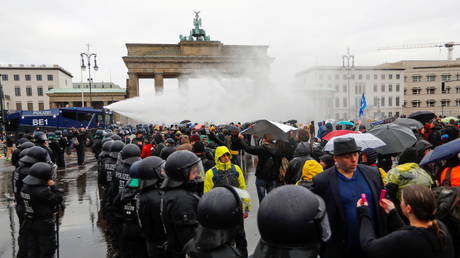 And it’s not just France. In Berlin last week, police fired water cannon and pepper spray at a crowd of people, including children, protesting against Germany’s coronavirus restrictions. In the aftermath, police justified the action saying people were refusing to wear face masks. So you blast them with water?
Spain, which suffered a particularly restrictive 100-day lockdown, has also seen trouble. On top of street protests by families missing their loved ones, there have been running battles with the police, barricades set on fire, and shops looted across the country.
Likewise in Italy, where even the Mafia is alleged to have joined in the looting and trashing of property, all in the guise of a coronavirus protest. Police there also used tear gas to disperse the crowds.
And it’s not just these nations. Protests in the UK have attracted thousands, the USA has seen violence flare at street marches, there have been rallies across the globe – Argentina, Brazil, Nigeria, Serbia, Russia, Australia, South Africa, Mexico. Even in countries most of us would struggle to find on a map, like Malawi.
Everywhere, the riot police have steamed in to break up crowds, leading to countless clashes and arrests creating even further upset. Is this where we are now? This is what this infernal Covid-19 virus has driven us to? Police in riot gear using batons, shields, water cannon and tear gas on their fellow citizens who are venting their anger, having become simply tired of being cooped up indoors?
Back in Paris, the young music producer who had been assaulted told journalists outside police headquarters that “people who should have been protecting me attacked me. I did nothing to deserve this.”
Anyone expecting some sort of climbdown from their government and public health officials has no doubt given up waiting by this point. Across the world, people are preparing for a crappy Christmas and grim warnings that breaching restrictions will mean a terrible price to be paid come the new year.
In France, the controversial new global security law has passed its first legislative stage, meaning anyone taking a photo or filming on-duty police that enables them to be identified faces a year in prison and a whopping €45,000 fine.
Prime Minister Jean Castex has suggested the government may backtrack on the controversial law but it’s naive to believe there’s any real honesty in that claim.
Meanwhile, French police will continue to pursue their thuggery, beating and teargassing innocent citizens, tipping people from their tents when clearing temporary camps of asylum seekers and trampling over protestors at will. Anyone caught filming them will simply be arrested and flung in jail.
No doubt this sort of behaviour will be repeated across the globe at organised protests against coronavirus restrictions wherever they may be. The lingering concern is that once this cursed pandemic passes, will things return to normal, where those we expect to protect us do just that?
Or has there been a subtle but sinister shift towards a more brutal state in many countries, where governments have been emboldened by newly tried and tested authoritarianism? Let’s see what answer to that 2021 brings.
Damian Wilson is a UK journalist, ex-Fleet Street editor, financial industry consultant and political communications special advisor in the UK and EU.
France’s new law limits press freedom
By Chris Den Hond | Press TV | November 22, 2020
Paris – Thousands in Paris, tens of thousands all over France are protesting for the second time in a week against the Global Security Law.
This new law has been voted in the French parliament and makes it illegal to film and publish images of police officers. For these demonstrators this new law is a violation of the right to inform. Earlier this week, the police used tear gas and water cannon when protesters took the street in front of the French parliament. With the new law, it will become illegal to film this kind of police intervention.
During the yellow vest movement, videos have been used in judicial investigation concerning police violence. With this law, the French state can more easily hide illegal actions, committed by police officers. It can also more easily hide scandals which opens the door for abuse of power.
The French government says they want a better protection for their police force, but the new French law is seriously criticized by the Human rights Council of the United Nations as well as by a large spectrum of the French civil society, journalist associations, trade unions, political parties and human rights defenders.
One year of prison and 45,000 Euros of penalty: that’s what someone risks for publishing the face of a police officer. Many people here say that the French government is using the coronavirus crisis to limit personal and public liberties.
Controversy as New French Security Law Could Crack Down on Filming Police
Sputnik – 14.11.2020
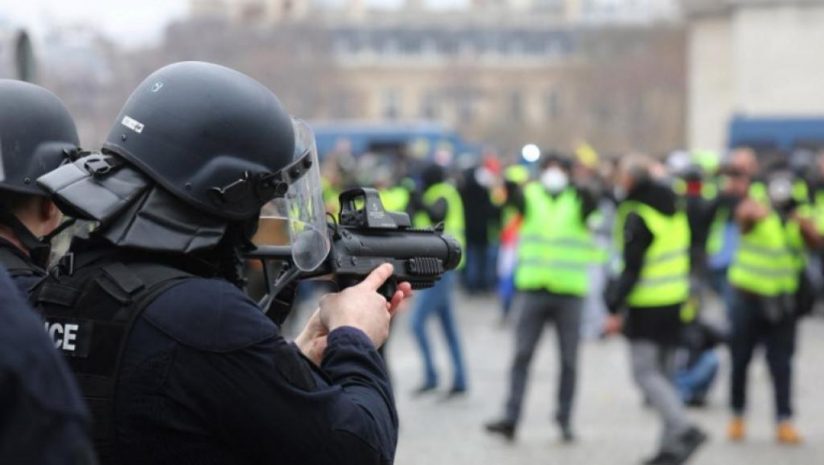
A proposed French law could see images of police officers restricted from circulation. While supporters claim it will only be used to crack down on cyberbullying of law enforcement, critics claim it could be a danger to freedom of the press.
Part of France’s new security bill would make it a criminal offense – under threat of punishment with one year in prison and a €45,000 fine – to spread images that harm “the physical or mental integrity” of law enforcement officers.
Stanislas Gaudon, who heads the police union ‘Alliance’, said on Friday that existing cyberbullying legislation does not currently provide effective protection for the police.
“The problem with those laws is that they can only be applied when the video is already online, but it’s too late, the damage is already done”, he said.
Gaudon said the new law should also make it “compulsory to blur police officers’ faces” in any videos distributed.
Article 24 of the law, which was first proposed La République En Marche (LREM) MP Jean-Michel Fauvergue, following lobbying pressure from Alliance.
Lawmakers supporting the bill stress that it is only intended to be used in response to “malicious” actions.
“The purpose is to forbid any calls for violence or reprisals against officers and their families in videos broadcast over social media” said LREM MP Alice Thourot while speaking to France Inter radio.
Critics of the legislation claim that it could be used to repress certain liberties. On November 8, around 30 members of France’s Society of Journalists issued an open letter denouncing the bill as a “threat to the freedom to report”.
Some 800 filmmakers and photographers sent their own letter, claiming that the proposed bill is equivalent to “censorship”. They cited that a prominent documentary on police violence, ‘Un pays qui se tient sage’ (A Wise Country) filmed amid the 2018-19 Yellow Vest demonstrations, would have been restricted from the airwaves.
Amnesty International has also said the French government would be in violation of the UN’s 1966 International Covenant on Civil and Political Rights, protecting freedom of expression, if the law were to pass.
“The bill is not precise enough,” said Cécile Coudriou, head of Amnesty France. “The notion of ‘malicious intentions’ is too broad. It doesn’t conform to the standards of international law”.
Those who oppose the law highlight examples where police brutality being broadcast through social media has aided in media and legal investigations into police violence.
On 5 January, Cédric Chouviat, a 42-year-old delivery driver in Paris died from a heart attack after being place in a chokehold by police. The event was seen in at least thirteen different videos from the victim, bystanders, and one of the officers involved.
Another example of social media footage bringing police violence to light is the filmed beating of Yellow Vest demonstrators by law enforcement in a Burger King in Paris in December 2018.
Entire social media is dominated by Zionists
By Kevin Barrett | Press TV | October 30, 2020
Instagram apparently has now unblocked the Supreme Leader of Iran’s account on Instagram after having blocked it due to the Supreme Leader speaking out about the censorship controversy in France.
It’s ironic, of course, that social media would be censoring people who speak out about a censorship controversy. But that’s where we are now in the Zionist-occupied West. You’re not even allowed to raise the topic of being censored. If you are censored and then you complain about being censored on a sensitive topic, they will censor your complaint, and nobody will ever even hear that you’ve been censored or what your argument is about it.
And this, in particular, seems to be the case with anybody who asks why it is that in a country like France, the leadership, namely Macron, seems to believe that it’s freedom of expression when you obscenely or pornographically incite violence by blaspheming and slandering and libeling a revered religious figure, in this case, the Prophet Muhammad, peace upon him. But it’s okay to imprison people and ruin their lives if they very calmly and compassionately and in a scholarly and academic manner question some of the victors’ history of World War Two.
Even raising this issue gets people censored. And it just happened to the Supreme Leader. And of course this is one reason that Press TV and other Iranian outlets, among many other world outlets, have been censored throughout social media. The entire social media is either owned or dominated by Zionists, as is the mainstream corporate media.
They don’t want anybody raising this gross contradiction in public. And the fact is that the reason that they won’t let you talk about this, just like the reason they won’t let you talk about World War Two victors’ history, is that the victors always write the history of every war and they always lie and they always exaggerate the crimes of their enemies and downplay their own crimes.
So the revisionists will probably win the argument. Those of us who’ve actually done some reading on the pros and cons of the World War II revisionist case—almost everybody who actually sits down and reads the books—ends up realizing that the revisionists are probably right about at least some of their claims. And that’s the reason we’re not allowed to talk about it. Because if this were debated freely and openly in a scholarly manner the revisionists would win, and the fundamentalist religion of Holocaust worship would disappear.
So, in France, we’ve got a censorship campaign censoring people who argue in a scholarly manner, but they protect “freedom of speech”—la liberté—of the people who blaspheme and use obscenity, pornography, libel, and incitement.
Now, this is exactly the opposite of the American First Amendment position. Here in the United States, we have a very well-developed jurisprudence of free speech under our First Amendment. And that jurisprudence has largely concluded that all serious arguments with social value are protected, but there are exceptions, including blasphemy, pornography, libel, and incitement.
The Zionists have managed to roll back some of that, and now some say that Zionist Supreme Court decisions have made pornography a protected category of speech. This is disgusting and insane. Blasphemy, obscenity, pornography, libel, and incitement are not protected speech and never will be. But apparently, in the Zionist world, those kinds of speech are the ones that you protect, while thoughtful academic scholarly speech investigating victors’ history and finding that it’s wrong deserves censorship. And the people, the scholars, and the historians who engage in that speech are routinely physically attacked, hospitalized, thrown in prison, their lives are ruined, all their books are suppressed. That’s freedom in the West today.
Dr. Kevin Barrett is an American author, journalist and radio host with a Ph.D. in Islamic and Arabic Studies. He has been studying the events of 9/11 since late 2003.
Cui bono from the situation in France
The Saker | October 29, 2020
I won’t even bother repeating it all here, those who are interested in my views of this entire Charlie Hebdo canard can read my article “I am NOT Charlie” here: https://thesaker.is/i-am-not-charlie/
No, what I want to do is to ask a simple question: do you think the French leaders are simply stupid, suicidal or naive? I submit that they neither stupid, nor suicidal nor naive. In fact, they are using a well practiced technique which goes with some variation of this:
- Infiltrate some pseudo-Islamic gang of cutthroats (literally!)
- Keep them under close scrutiny ostensibly for counter-terrorism purposes
- Inside the group, try to promote your confidential informers
- Have your analysts work on the following question: “how could we best provoke these nutcases into a bloody terrorist act?“
- Once the plan is decided, simply execute it, say by organizing the posting of fantastically offensive caricatures
- Once the cutthroats strike, blame Islam and double down
- By then, you have infuriated most of the immense Muslim world out there and you can rest assured that the process is launched and will continue on its own. You can now relax and get the pop-corn
- Have your propaganda machine declare that Islam is incompatible with western civilization (whatever that means in 2020, both Descartes and Conchita Wurst I suppose… )
- Shed some crocodile tears when the cutthroats murder some completely innocent Christian bystander
- And announce a new crusade against “Islamism” (also a vague and, frankly, meaningless term!) and crack down on true Muslim communities and ideas while continuing to lovingly arm, train, finance and direct the “good terrorists” who have now become your own, personal, cutthroats.
Cui bono?
Anybody who knows anything about the political realities in France will immediately know in whose interests this all is and who is behind that: the Zionist power structure in France (CRIF, UEJF, etc. and the Israelis). They have a total control over Macron and over the entire political class, very much including Marine LePen.
Who else could have concocted the “beautiful” term “Islamo-Fascisme“?!
This is a new phenomenon, a new ideology and a new strategy, which Alain Soral calls “National Zionism” which I discussed in some details here: https://thesaker.is/the-great-fraud-of-national-zionism/.
In its inception (from Ahad Ha’am, Theodor Herzl, Ze’ev Jabotinsky, etc) Zionism used to be a largely secular and nationalistic, then, later, after WWII, it became very leftist and still secular ( Ben-Gurion, Shlomo Lavi, Golda Meir). Modern Zionism, however, is both rabidly racist and religious – the perfect example would be US neocons. It is also a ruthless and genocidal ideology which has created something truly original: God-mandated racism, something which, as far as I know, no other religion professes (so much for the ignorant and, frankly, plain stupid notions of “Abrahamic religions” or, even worse, “Judeo-Christian values”!). National Zionism is the next phase of Zionism – it is rabidly “conservative” (in a Neocon sense only, of course!) and it parasitically feeds on whatever nationalist ideology the local patriotic goyim are inclined towards (the best example of that being the so-called “Christian Zionists” in the USA).
But here is the demonic “beauty” of it all: in a society like the French one, the Zionists don’t even need to micromanage their false flags: given enough uneducated and murderous pseudo-Muslim cutthroats and enough rabid secularists wanted to offend the faithful – some kind of violent explosion will *inevitably* happen!
Right now, between the embarrassing Yellow Vests movement, the crumbling economy, the massive influx, wave after wave, of unwanted and un-adaptable immigrants and the resulting social tensions, the French regime is in deep trouble. Add to this the COVID pandemic which just added to the chaos and anger and finish with a total lack of foreign policy successes and you will immediately see why this regime badly needed what could be called a “patriotic reaction”.
Finally, there is the time-proven method of scaring your own population into a state of catatonic acceptance of everything and anything in the name of “security”.
We see it all in France today, we saw it in the UK before, and also in Belgium. And, rest assured, we will see much more such massacres in the future. The only way to really stop these “terrorist” attacks is to show their sponsors that we know who they are and we understand what they are doing. Short of this, these attacks will continue.
Vaccines – Who Needs Them?
By David Macilwain | American Herald Tribune | October 28, 2020
It’s a serious question that few have asked, and there’s no clear answer. Up till this point in the Coronavirus play, discussion on vaccines has been limited to one perspective – how effective might they be, and how long before one is available. Thanks to the rigors of lock-downs and upending of society necessitated – we are told – by the need to avoid the virus and “save lives”, interest in a vaccine that might save us from this hell has been intense, not least amongst the shareholders of pharmaceutical companies vying for a share of the global market.
This massive financial interest, hardly denied even by those who claim philanthropic concerns are their real motivator, has nevertheless led to some perverse outcomes and corrupt manipulation. The suppression and distortion of the true worth of Hydroxychloroquine is the greatest crime amongst these, as its leading advocate – Professor Didier Raoult of Marseilles – continues to observe; a worth that has been demonstrated globally by those countries where it has been approved or prescribed.
It now appears almost beyond doubt that the campaign against the use of HCQ, driven by pharmaceutical companies and their agents in governments and institutions, is because of its efficacy in treating COVID 19 infections, and so taking away the market for both other drugs and for vaccines. Prof Raoult has made this claim – and allegation against the French government of serious negligence that has cost many lives – since April. But just last week the case has become a nationally significant conflict following the prohibition against Raoult’s Mediterranee Infection Institute on using Hydroxychloroquine/Azithromycin treatment for COVID patients.
Not only is this prohibition quite contrary to principles of care and the doctor-patient relationship, but Raoult’s record of success in treating patients with the protocol is undeniable, and proven by his results – out of nearly 9000 patients attending the Marseilles hospital, of which 5,800 were treated with the HCQ/AZM protocol, just 30 deaths were recorded. A regional health official and regional MP have now made official protests in support of Prof Raoult’s right to continue the treatment, as described in this interview as well as in a rather bad English translation.
Prof Raoult, who repeatedly notes that he cannot predict the future behaviour of the epidemic and the changes in the virus, but has unfailingly correctly forecast its progress and likely developments, has recently also made some highly pertinent observations on vaccines. Unlike many of those who are sceptical or opposed to vaccines, Prof Raoult’s reservations on a vaccine for SARS-CoV-2 are based on purely scientific observations of the behaviour of this virus and the particular characteristics of the infection it causes. Of these the most important feature is in the vastly different susceptibility of different age groups, which may be seen as a fatal weakness in the virus that can be exploited to defeat it.
The ability of younger people to “suffer” SARS-2 infection unscathed, and often without any symptoms – immunity effectively – forms the basis of the “Great Barrington Declaration” – a proposal for the safe development of natural immunity amongst the younger part of the population while older and more vulnerable people are isolated and protected. Although most sections of the health fraternity and mainstream media persist in wilfully ignoring this feature, instead emphasising all the cases of young and healthy people suffering serious illness or “long-Covid”, the statistics are unambiguous and unchanging since the start of the pandemic.
While sidestepping the claims in some quarters that no-one has actually died of COVID, because 99% of deaths are of people with some other serious illness, it is an incontrovertible fact that those who die from or with the Virus are overwhelmingly very old – and the majority in their eighties. The proportion of younger people developing serious illness or dying may be higher in some countries – notably in the US – where those age groups normally have greater morbidity from the diseases of affluence and indolence – diabetes, heart disease and obesity.
Importantly however, and regardless of these varying conditions, the apparent immunity of children to SARS-CoV-2 infection is most striking, and another “weakness” of the virus that may well play a part in limiting its dangers. This is yet another area on which Prof Raoult has focused in the past, when looking for an explanation for the relative immunity to the virus in adults under 50. He considers that children act as reservoirs or carriers of respiratory viruses and so may encourage generalised latent immunity in their parents to related Coronaviruses.
And it is the existence of this natural resistance to the novel Coronavirus which has important implications for the use of a vaccine, and whether its use will be justified or advantageous for some sections of the population, or even contra-indicated. The latter possibility, raised recently in a conversation with Prof Raoult, comes about because of the extremely low mortality from COVID 19 amongst younger people – rated at around 10,000 times lower than in those in their mid 80s – the predominant group of those dying with or from COVID.
Considering this feature of the epidemiology, he concluded that for a vaccine to be safe for younger people, it must be shown to cause lower mortality than the untreated viral infection. Clearly this applies to all age groups and all vaccines, if preventing deaths is their main function. And it is an ever more important consideration with many different types of vaccine now being developed and trialled, and with the possibility of unusual or unpredicted side effects.
Raoult concludes that if a vaccine is to be considered suitable for all, and including younger adults with a minimal chance of serious disease or death, then it must be safety tested on tens or hundreds of thousands of people, which is way beyond the limits currently imposed on potential vaccines thanks to the relative urgency and speed of their development. It is an exquisite irony that the prohibition of the literally life-saving drug Hydroxychloroquine has been based on claims of serious but extremely rare side-effects.
So what if the vaccine is only given to those at greater risk of death from SARS-2 infection, where the danger of vaccine side-effects is outweighed by the life-saving benefits? This may seem sensible, and is rather the practice with current flu vaccines, available free to the over 70s – but here a different factor comes into play. Vaccines mostly depend on the body to produce an immune response that will combat a subsequent viral infection, but this immune response gets weaker as you age. Consequently the benefits of vaccination are far less for older people, and marginal for those over 80 and with weakened systems – the very ones most likely to die following viral infection.
While this relative ineffectiveness of vaccines for the old gets little attention, it is often enough said that a vaccine may only be 50 – 60% effective, as if to avoid raising peoples’ expectations, but this is hardly a minor point. Who would drive a car whose brakes couldn’t always be relied upon, even if they knew it?
So I repeat the question – who actually needs a vaccine to protect them from contracting this not very dangerous respiratory virus? We can rule out anyone under the age of 30, whose chance of dying as a result of CV19 infection is less than 1 in 20,000. For those under 50 this chance may be around 1 in 5000, so a vaccine showing no deaths amongst 10,000 volunteers will have a marginal benefit for this group. In fact the only real benefit of vaccination against SARS-CoV-2 might be amongst those in their sixties and seventies, particularly if they have other serious health issues, or are more exposed to infection – as is the case for older health-care workers.
But there is another factor that comes into play here. In order to protect the most vulnerable sectors of the population from infection, a significant percentage of the whole population must be made immune, either from vaccination or from their natural immune reaction to infection. The current path being pursued is to prevent infection and natural immunity developing, so such levels of herd immunity can only be achieved by mass vaccination, subjecting half the population to unnecessary dangers from vaccine side effects.
It would seem hard to make a sound scientific case for such a policy, or an economic one – the cost of vaccinating millions or billions of people around the world is barely calculable. But what is a cost to governments and the taxpayers who support them is a benefit to the pharmaceutical industry and private health industry, and it appears as though they will be driving policy to suit their interests.
There is one last aspect to this question, which only further emphasises the point; the significantly lower death rate associated with the currently circulating strains of the virus. Whether the escalation in positive-testing case numbers is partly due to oversensitive tests, or previously unaccounted asymptomatic cases, associated deaths have barely risen, and remain below 1% of total infections – roughly one tenth of the mortality rate during the “first wave” in Europe.
If science were allowed to prevail, then it would follow the prescriptions of the Great Barrington Declaration, abandoning the great vaccination project and allowing “nature to take her course”. But clearly she will not be allowed to, in a way epitomised by the Indian Government’s announcement last week that all citizens will be vaccinated. This was accompanied by news that India’s rapidly climbing infection rate was levelling off – most probably because herd immunity levels are now being reached.
Insisting on insult, Macron opens floodgates for Muslim backlash
Press TV | October 26, 2020
Numerous Muslim states and peoples have denounced French President Emanuel Macron’s persisting support for blasphemy in his country against Prophet Muhammad (PBUH).
“We will not give in, ever,” Macron tweeted on Sunday. The tweet served to back up his earlier support for a French teacher’s displaying of cartoons insulting of the Prophet of Islam in his class under the pretext of “freedom of speech.”
“France will never renounce caricatures,” Macron had declared on Wednesday, defending the teacher for “promoting freedom.”
The teacher Samuel Paty was murdered by an 18-year-old Chechen assailant. Commenting on the attack, Macron described Islam as a religion “in crisis” worldwide, trying to suggest that the assailant had been motivated to kill the teacher by the faith rather than radicalism.
The comments have raised controversy and provoked a wave of criticism from the Muslim world.
On Sunday, the Persian Gulf Cooperation Council (GCC) described Macron’s position as “irresponsible,” and said it was aimed at spreading a culture of hatred among peoples.
Turkish President Recep Tayyip Erdogan, who had called on Macron to have his mental status examined for defending blasphemy, repeated the call on Sunday. Macron “is a case and therefore he really needs to have [mental] checks,” Erdogan said.
In a statement, Kuwait’s Foreign Ministry warned that attempts at linking Islam to terrorism “represents a falsification of reality, insults the teachings of Islam, and offends the feelings of Muslims around the world.”
Pakistani Prime Minister Imran Khan also hit out at Macron for “attacking Islam clearly without having any understanding of it.”
He urged the French president to rather address the marginalization and polarization that is being committed against minorities in France that “inevitably leads to radicalization.”
The Pakistani head of state also wrote to Facebook, asking the social media network to clamp down on Islamophobic content in the same way that it purges content aimed at skewing or denying the Holocaust.
He warned about a “growing” trend of Islamophobia throughout the platform among elsewhere, pleading with Facebook CEO Mark Zuckerberg, “I would ask you to place a similar ban on Islamophobia and hate against Islam for Facebook that you have put in place for the Holocaust.”
“One cannot send a message that while hate messages against some are unacceptable, these are acceptable against others,” Khan said, adding that this attitude was “reflective of prejudice and bias….”
Pakistan also summoned France’s ambassador and notified him about Islamabad’s protest at “systematic Islamophobic campaign under the garb of freedom of expression.”
Jordan’s Islamic Affairs Minister Mohammed al-Khalayleh said “insulting” prophets is “not an issue of personal freedom but a crime…,” and Morocco’s Ministry of Foreign Affairs said continuing publication of such “offensive” is an act of provocation.
Hamas and Hezbollah, respectively Palestinian and Lebanese resistance movements, have also condemned Macron’s position.
Hamas spokesman Sami Abu Zuhri said on Saturday that publishing the cartoons was “provocative to the feelings of the Islamic nation and an aggression on its religion and beliefs,” while Hezbollah said blasphemy did not categorize as “freedom of speech.”
Protests were, meanwhile, reported in the Gaza Strip, Syria, and Libya as well as elsewhere throughout the Muslim world.
Boycott spree
Many Muslim companies and associations, meanwhile, have stopped handling or serving French items in protest.
These have included the Al-Naeem Cooperative Society and the Dahiyat al-Thuhr association in Kuwait as well as the Wajbah Dairy firm and Al Meera Consumer Goods Company in Qatar. The Qatar University has also postponed a French cultural week.
Hashtags such as the #BoycottFrenchProducts in English and the Arabic #ExceptGodsMessenger trended across many countries, including Kuwait, Qatar, Palestine, Egypt, Algeria, Jordan, Saudi Arabia, and Turkey.
The French Foreign Ministry, however, reacted angrily to the bans.
“The calls for a boycott are groundless and must be stopped immediately, like all attacks against our country committed by a radical minority,” it alleged, trying to associate the protests with “radicalism.”
European hypocrisy: empty words for Palestine, deadly weapons for Israel
By Ramzy Baroud | MEMO | October 20, 2020
In theory, Europe and the United States stand on completely opposite sides when it comes to the Israeli occupation of Palestine. While the US government has fully embraced the tragic status quo created by 53 years of Israeli military occupation, the EU continues to advocate a negotiated settlement that is predicated on respect for international law.
In practice, however, despite the seeming rift between Washington and Brussels, the outcome is, essentially, the same. The US and Europe are Israel’s largest trade partners, weapon suppliers and political advocates.
One of the reasons that the illusion of an even-handed Europe has been maintained for so long lies partly in the Palestinian leadership itself. Politically and financially abandoned by Washington, the Palestinian Authority of Mahmoud Abbas has turned to the European Union as its only possible saviour.
“Europe believes in the two-state solution,” PA Prime Minister, Mohammad Ishtayeh, said during a video discussion with the European Parliament’s Committee on Foreign Affairs on October 12. Unlike the US, Europe’s continued advocacy of the defunct two-state solution qualifies it to fill the massive gap created by Washington’s absence.
Ishtayeh called on EU leaders to “recognize the State of Palestine in order for us, and you, to break the status quo.”
However, there are already 139 countries that recognise the State of Palestine. While that recognition is a clear indication that the world remains firmly pro-Palestinian, recognizing Palestine as a State changes little on the ground. What is needed are concerted efforts to hold Israel accountable for its violent occupation as well as real action to support the struggle of Palestinians.
Not only has the EU failed at this, it is, in fact, doing the exact opposite: funding Israel, arming its military and silencing its critics.
Listening to Ishtayeh’s words, one gets the impression that the top Palestinian official is addressing a conference of Arab, Muslim or socialist countries. “I call upon your Parliament and your distinguished Members of this Parliament, that Europe not wait for the American President to come up with ideas … We need a third party who can really remedy the imbalance in the relationship between an occupied people and an occupier country, that is Israel,” he said.
But is the EU qualified to be that ‘third party’? No. For decades, European governments have been an integral part of the US-Israel party. Just because the Donald Trump administration has, recently, taken a sharp turn in favour of Israel should not automatically transform Europe’s historical pro-Israel bias to be mistaken for pro-Palestinian solidarity.
Last June, more than 1,000 European parliamentarians representing various political parties issued a statement expressing “serious concerns” about Trump’s so-called Deal of the Century and opposing Israeli annexation of nearly a third of the West Bank. However, the pro-Israel US Democratic Party, including some traditionally staunch supporters of Israel, were equally critical of Israel’s plan because, in their minds, annexation means that a two-state solution would be made impossible.
While US Democrats made it clear that a Joe Biden administration would not reverse any of Trump’s actions should Biden be elected, European governments have also made it clear that they will not take a single action to dissuade – let alone punish – Israel for its repeated violations of international law.
Lip service is all that Palestinians have obtained from Europe, as well as much money, which was largely pocketed by loyalists of Abbas in the name of ‘State-building’ and other fantasies. Tellingly, much of the imaginary Palestinian State infrastructure that was subsidised by Europe in recent years has been blown up, demolished or construction ceased by the Israeli military during its various wars and raids. Yet, neither did the EU punish Israel, nor did the PA cease from asking for more money to continue funding a non-existent State.
Not only did the EU fail to hold Israel accountable for its ongoing occupation and human rights violations, it is practically financing Israel, as well. According to Defence News, a quarter of all of Israel’s military export contracts (totalling $7.2 billion in 2019 alone) is allocated to European countries.
Moreover, Europe is Israel’s largest trading partner, absorbing one-third of Israel’s total exports and shipping to Israel nearly 40% of its total import. These numbers also include products made in illegal Jewish settlements.
Additionally, the EU labours to incorporate Israel into the European way of life through cultural and music contests, sports competitions and in myriad other ways. While the EU possesses powerful tools that can be used to exact political concessions and enforce respect for international law, it opts to simply do very little.
Compare this with the recent ultimatum the EU has given the Palestinian leadership, linking EU aid to the PA’s financial ties with Israel. Last May, Abbas took the extraordinary step of considering all agreements with Israel and the US to be null and void. Effectively, this means that the PA would no longer be accountable for the stifling status quo that was created by the Oslo Accords, which was repeatedly violated by Tel Aviv and Washington. Severing ties with Israel also meant that the PA would refuse to accept nearly $150 million in tax revenues that Israel collects on behalf of the PA. This Palestinian step, while long overdue, was necessary.
Instead of supporting Abbas’ move, the EU criticized it, refusing to provide additional aid for Palestinians until Abbas restores ties with Israel and accepts the tax money. According to Axios news portal, Germany, France, the UK and even Norway are leading the charge.
Germany, in particular, has been relentless in its support for Israel. For months, it has advocated on behalf of Israel to spare Tel Aviv a war crimes investigation by the International Criminal Court (ICC). It has placed activists, who advocate the boycott of Israel, on trial. Recently, it has confirmed the shipment of missile boats and other military hardware to ensure the superiority of the Israeli navy in a potential war against Arab enemies. Germany is not alone. Israel and most European countries are closing ranks in terms of their unprecedented military cooperation and trade ties, including natural gas deals.
Continuing to make references to the unachievable two-state solution, while arming, funding and doing more business with Israel is the very definition of hypocrisy. The truth is that Europe should be held as accountable as the US in emboldening and sustaining the Israeli occupation of Palestine.
Yet, while Washington is openly pro-Israel, the EU has played a more clever game: selling Palestinians empty words while selling Israel lethal weapons.
Read also:
Zionist War on Palestinian Festival in Rome is Ominous Sign of Things to Come
Featured Video

US IRAN TALKS: Who Are the Crazy Ones Here? /Lt Col Daniel Davis
or go to
Aletho News Archives – Video-Images
From the Archives
Woolsey Fire started at Santa Susana Field Lab — where “radioactive materials released were never accurately measured”
By John Laforge | CounterPunch | November 30, 2018
In my Nov. 16 column, I reported on potential radiation risks posed by California’s Woolsey wildfire having burned over parts or all of the Santa Susana Field Laboratory—south of Simi Valley, Calif., 30 miles outside Los Angeles—site of at least four partial or total nuclear reactor meltdowns.
The field laboratory operated 10 experimental reactors and conducted rocket engine tests. In his 2014 book Atomic Accidents, researcher James Mahaffey writes, “The cores in four experimental reactors on site … melted.” Reactor core melts always result in the release of large amounts of radioactive gases and particles. Clean up of the deeply contaminated site has not been conducted in spite of a 2010 agreement.
Los Angeles’s KABC-7 TV reported Nov. 13 that the Santa Susana lab site “appears to be the origin of the Woolsey Fire” which has torched over 96,000 acres. Southern Calif. Public Radio said, “According to Cal Fire, the Woolsey Fire started on the afternoon of Thursday, Nov. 8 … on the Santa Susana site.” … continue
Blog Roll
 Aletho News
- US IRAN TALKS: Who Are the Crazy Ones Here? /Lt Col Daniel Davis
- Talks with the US end without a deal over excessive US demands: Iran
- Feeling Better, Getting Worse: How Psychiatric Drugs Create the Illusion They Cure
- ‘Nobody Told Me’: Former Mental Health Patient Calls Out Dangerous Side Effects of Psychiatric Drugs
- Dr. Abu-Sitta: Beirut ‘felt like a day in Shifa Hospital’
- Iran Has Won the War, It Will Be Up to the US to Secure the Peace: Mohammad Marandi
- Iran condemns assassination threats against Iranian negotiators amid US talks
- Brussels cannot say where its own pipeline inspectors are as Hungary’s oil lifeline remains shut
- Israel’s Iran War: Myth and Reality
- Between war and industrial breakdown: The US-Israeli attrition crisis
- If Americans Knew
- Pro-Israel ‘Thinktanks’ and Individuals who Influence U.S. Foreign Policy
- Mearsheimer reveals how Israel dictates US policies on Iran, Gaza – video
- After killing 350+, Israel still has a “score to settle” with Lebanon before ceasefire – Daily Update
- Military aid to Israel emerges as the latest political litmus test for Democrats
- The only Palestinian children’s rights organization closes following years-long Israeli campaign against it
- ‘I Can’t Forget the Smell’: Lebanese Reel After Israel Kills Over 300 in Single Day
- DNC Shoots Down Resolutions Calling Out AIPAC and Limiting Arms to Israel
- TCN: Is Israel Blackmailing President Trump?
- Israel killed at least 303 Lebanese yesterday – who were they? Daily Update
- Amnesty: Urgent – Protect Lebanese civilians from brutal escalation in Israeli attacks
- No Tricks Zone
- German Expert: Heat Dome Led To Record Temps In Western USA…Warmer In 1934, 1936
- New Study: No Linear Warming Or Glacier Retreat Along Northern Antarctic Peninsula Since 1980s
- An Inconvenient Tree: Uncovered In Alps… Europe Much Warmer Than Today 6000 Years Ago
- New Study Reports A 60% Slowdown In Greenland’s Ice Loss Rate In The Last Decade
- Low Intensity Tornado Wrecks Major Solar Farm, Creating A Potential Toxic Dump
- New Study Finds Warming Saves Lives…Cold Temperatures 12 Times More Deadly Than Excess Heat
- German Science Blog Accuses PIK Climate Institute Of Hallucinating Climate Tipping Points
- Devastating Assessment Of Comirnaty Vaccine By Former Senior Pfizer Europe Toxicologist
- New Study: CO2 Is ‘Effectively Negligible’ As An Explanatory Climate Change Factor Since 2000
- Former Pfizer Toxicologist Dr. Helmut Sterz Tells Bundestag Hearing Pfizer Vaccine Should Have Never Been Approved
 Aletho News