France Joins Syria Fight: Goals and Consequences
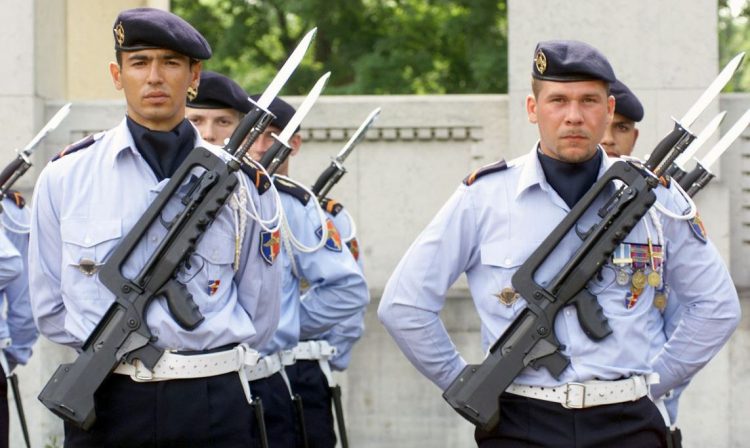
French Armed Forces, armed with FAMAS F1 assault rifles, participate in the Memorial Day ceremony at the LaFayette Escadrille Monument in Paris, France.
By Peter KORZUN | Strategic Culture Foundation | 05.04.2018
French President Emmanuel Macron kept his word. On April 1-2, French troops moved into northern Syria. This is the first time France deployed substantial forces there to turn Paris into a new actor actively involved in the war. The troops advanced toward Manbij and Remelin to join American allies and did it hastily.
The move was made at the time Ankara warned about the plans to control this territory with Russia, Turkey and Iran working together to define Syria’s future. It significantly changes the situation and makes one ask questions about the goals pursued by the US and France and the prospects for war and peace in the conflict-torn country. Summing up the recent events leads to the conclusion that the US and France have a hidden agenda to expand the conflict, wreak havoc and stymie the Russia-led peace efforts.
The news about French deployment came just before the April 4 Russia-Turkey-Iran summit in Ankara stated the goal to “speed up their efforts to ensure calm on the ground” in Syria. On April 3, US President Donald Trump said he would “decide very quickly” to remove forces from that country. The statement was made right after about 300 US Marines accompanied by armored vehicles and engineering equipment were moving toward Manbij as reinforcements to repel possible Turkish inroads. The construction of two bases in Syria’s northern Manbij region is underway.
The Marines have already launched daily patrols along the Sajur River, a tributary that feeds the Euphrates River from sources in Turkey, with observation posts built to monitor the area. This is unheard of – two leading states of the North Atlantic Alliance blocked the other NATO member’s land access to Manbij! On April 3, CNN reported that plans to send reinforcements have been discussed for several days before Trump’s remarks on leaving Syria soon.
The US also wasted no time to press Iraq into sending its 5th Army Division to Sinjar province and line the forces on the Iraqi-Syrian border to obstruct the possible advance of Turkish army from Syria into Iraq.
Obviously, the US is trying to partition Syria while creating a quasi-state on the eastern bank of the Euphrates and up to the Iraqi border. In Deir-ez-Zor, the US-led coalition resists the restoration of Syrian government institutions. It makes one think that the words about “leaving soon” may be nothing more than wishful thinking or an attempt to baffle those who are trying to predict further steps America will take.
The list of goals includes controlling the oil fields and chunks of the territory. Donald Trump wants Saudi Arabia to pay for US operations in Syria and it probably will. If the decision to leave were taken, he wouldn’t raise the question. According to the president, Saudi Arabia is interested in America staying in Syria.
That’s what the US “rocking from side to side” foreign policy is like. Rex Tillerson is fired to make the world know about it from tweets. The US wants to leave Syria but will stay if Saudi Arabia pays. Donald Trump invited the Russian leader to visit him in Washington against the background of Russia diplomats expelled and the consulate office in Seattle closed. Is it being short-sighted or far-sighted? Is this swinging back and forth a well-thought over policy or no policy at all? Is it done on purpose to keep everyone guessing with no predictions possible? You never know. Donald Trump once denounced Saudi Arabia as extremist and then sold a huge package of weapons while calling the kingdom a great friend and close ally against Iran.
The Syrian forces are preparing an offensive in the Daraa – Quneira – Suweida area in the south while denuding other fronts. The territory is huge and the terrain is hard to cross. There are at least 25 heights to fire at advancing forces from. The Free Syrian Army and other rebel groups are much more numerous than the ones being defeated in Eastern Ghuta. Their defenses are strong. Unlike in other places, the rebel forces can easily get logistical support from Jordan. That’s where the US and Saudi Arabia can contribute greatly. Israel has been involved in such activities since 2015. It took roughly six months to liberate Eastern Ghuta, with an active phase to dislodge rebel fighters launched in mid-March. It’s easy to surmise that it will take at least a year, may be much more, to liberate the area in question.
A conflict is easy to provoke. The operations of Syria’s government forces aimed at cutting off supplies coming from Jordan could be presented as an act of aggression against the Hashemite Kingdom. Chemical substances could be transported from Jordan to stage another provocation used as a pretext to attack Syria.
The operation could become a war of attrition to make Syria concentrate more and more of its forces in one place at the expense of other battlefields. They will be stuck there for a considerable period of time. That’s when the US-coalition will be in good position to attack anywhere it wants using the base of Al-Tanf as a springboard. Manbij as well as the Al-Tabka air base located to the south of Raqqa are perfect places for launching an offensive to drive Syria out from Aleppo. Then the country will plunge again into an “all-against-all” fight.
The efforts applied so far by Russia, Turkey and Syria will go down the drain. This time the US will not be alone to have substantial presence on the ground. It’s hard to imagine that the French forces arrived in Syria could be anything but the start of broader NATO presence with other members of the bloc to follow the French example. Russian military personnel and NATO soldiers will be looking at each other through the sights of guns. This scenario will be fraught with a great risk of international military conflict and a real tragedy for Syrian people but those who are provoking it don’t care.
America Faces a Vietcong Style Genuine Arab Rebellion in Syria
By Adam Garrie | Eurasia Future | 2018-04-02
While the Syrian Arab Army has liberated all of Eastern Ghouta from pro-western Takfiri terrorists and Turkey continues to be unable to get the US to agree on a disarmament agreement regarding YPG/PKK terrorists in Manbij, in Raqqa, a genuine Arab rebellion is taking place against the United States and their YPG proxies.
While the word “rebel” has been used throughout the duration of the Syrian conflict to describe heavily armed and handsomely paid terrorists whose loyalty is to foreign powers and whose citizenship is often not Syrian, in Raqqa, one is witnessing an organic uprising of indigenous Arabs against the American military and the SDF flagged YPG terrorists who have worked with the US to occupy Arab majority lands in the Syrian Arab Republic.
Real moderate rebels finally emerge
As geopolitical expert Andrew Korbyko recently wrote in Eurasia Future,
The American President made global headlines once again after he seemingly veered off script at a political rally in Ohio by declaring that the US will be ‘coming out’ of Syria ‘very, very soon’ in order to ’let the other people take care of it now’. Trump didn’t elaborate, but his surprise announcement came on the heels of Turkish President Erdogan threatening to expand his country’s anti-terrorist campaign into the part of northeastern Syria that the Russian Security Council previously said hosts as many as 20 American bases, which could potentially lead to a ‘war by miscalculation’ between the two nominal NATO ‘allies’ if the American forces remain there during this time and are caught in the Turkish-Kurdish crossfire.
Within a day after Trump’s statement, the Chief of the Main Operational Directorate of the Russian General Staff informed the world that Raqqa’s native majority-Arab population had begun to rise up against the US-backed Kurds that are in control of the city, thus heralding in the beginning of the “Rojava Civil War” that the author first predicted more than a year ago and which was undoubtedly further provoked by the anti-Arab ethnic cleansing campaign that the Kurds commenced over the summer. It can’t be known for certain, but Russia and Turkey likely have a favorable attitude towards the Arab revolt against the pro-American Kurds because it dovetails with their interest in seeing this disruptive power removed from the agriculturally and energy-rich corner of northeastern Syria.
The key elements of Korybko’s observations are as follows:
1. In spite of some disagreements regarding a post-war settlement, Russia, Syria, Iran and Turkey are all opposed to the illegal US presence in Syria, although none seek a direct confrontation with US forces.
2. It is not clear if the indigenous Arabs of Raqqa are loyal to Damascus, Ankara or some other power, but what is clear is that they are united in a common objective of exorcising the US and its proxies from their homeland.
An Arab Vietcong
While the issue of the Arab rebels of Raqqa’s loyalty to one state or another is a key mystery, ultimately the most immediate threat to the always flimsy US narrative regarding the region, is that the US and their allies may face a Vietnam war style combat situation against the Arab rebels, assuming the US doesn’t “pull out” of Syria as Donald Trump recently indicated.
In the American war in Vietnam, the US found itself facing not only regular troops from Northern Vietnam but indigenous Vietcong rebels in the South whose fight was first and foremost against a foreign occupier. The Arab rebels in and around Raqqa likely feel the same way, as for example did the Algerian fighters who rebelled against French rule between 1954 and 1962. While the US did have Southern Vietnamese allies on its side, such troops were in the minority and ultimately faced ostracism after the US loss. Just as some South Vietnamese and other minorities who sided with the US during war, typically out of opportunism, attempted to run away from Vietnam when the war was lost by the US, so too might many YPG militants attempt to flee along with their US masters when defeat is imminent as it could be in short order.
A French connection
Prior to the US entering Vietnam, indigenous Vietnamese (referred to as Indochinese at the time) rebels fought a colonial French occupation between 1946 and 1954. After the French were vanquished in 1954, the US began gradually sending so-called “military advisers” to Vietnam before the situation spiraled into a full-scale US invasion after the Gulf of Tonkin false flag incident in 1964.
Today, there is discussion that US troops in north-eastern Syria will be replaced by French and/or Saudi troops. The irony here is that while the US went into Vietnam only to repeat the loss of their French predecessors, now it appears as though France may enter north eastern Syria only to inherent a rebellion against the US and its Kurdish proxies that neither foreign army is likely to win.
As French President Macron has publicly come out in support of Kurdish radicals in Syria, it is unlikely that a French strategy in Raqqa would look significantly different than the US strategy. Moreover, the presence of Saudi troops in the region would only have the effect of making apolitical rebels likely to side increasingly with either Turkey or Damascus, were a fellow Arab army to fight along side infamously anti-Arab Kurds against indigenous Sunni Arabs.
Syria remains an Arab Republic
With the defeat of Daesh in Syria, many Arabs have attempted to return to their homes in places like Raqqa, only to find that they are being abusively occupied by US backed Kurdish militants. This is a classic recipe for rebellion and while the world is focused on Eastern Ghouta and Manbij, the Arab rebellion against the USA and YPG is already underway, as has been confirmed by the Russian military.
Now a spokesman for the Arab rebels has issued the following statement,
“Following the intelligence activities, the militia of Raqqa waged a special operation targeting the US Staff located at the former base of the 93rd Brigade in the district of Ayn Issa, 43 miles north of Raqqa. Several mortar shells were fired on individual targets without any casualties on our side”.
While the authors of this statement claimed they were opposed to both the US and Turkish presence in Syria, seeing as they are operating in an area far from any Turkish troops, the likelihood is that this group of rebels is centred around a pro-Damascus and anti-US political/military agenda. Indeed, as the government in Damascus remains the only legitimate Arab representative of the Syrian people, the rebellion in Raqqa may prove to help reconcile formerly anti-government forces with the government, as indigenous Arabs displaced by American troops and their proxies look to restore Syrian Arab rule over the Syrian Arab Republic.
While Turkey has said countless times that it does not intend to stay in Syria beyond a reasonable timeline for orderly withdrawal, the US has stated that it plans to stay in Syria for an extended period of time. Recent statements from the so-called SDF saying that they are unaware of Donald Trump’s proposed “pull out”, indicate that the veracity of the US President’s statements are far from certain. Thus, whatever faction the Arabs of north eastern Syria are ultimately loyal to, the fact remains that the US and its allies will be the primary targets and in the context of Syria, this excludes Turkey.
Conclusion
Thus the likelihood is that the Arab rebellion against the US and its proxies will only grow, perhaps especially if the US troops in the region are replaced by generally less capable French or Saudi troops. In this sense, whoever seeks to occupy Arab land in north eastern Syria whether Kurdish terrorists, the US military, French military or Saudi military – they will ultimately be doomed to failure for the same reason the US failed in Vietnam and Iraq and likewise, for the same reasons that the French failed in Indochina and Algeria.
The difference between a fake rebellion against a legitimate government funded by outsiders, as was seen in Eastern Ghouta, Aleppo, Hama, Homs and Deir ez-Zor, versus a genuine indigenous rebellion against an occupying foreign army and a minority of non-local militants whose loyalty (in terms of cooperation) is to the invader, is clear enough. The fake foreign funded “rebellions” historically lose battles while organic rebellions against an imperial occupier tend to eventually win, often with very decisive results.
‘NATO Member is at War With Another One’ – Analyst on Turkey-France Relations
Sputnik – March 31, 2018
According to the French media, French president Emmanuel Macron is planning to deploy troops to Syria’s Manbij to help local Kurds in resisting Turkish forces. The move has reportedly been coordinated with Washington. Sputnik discussed relations between France and Turkey with Gearóid Ó Colmáin, Paris-based geopolitical analyst and journalist.
Sputnik: What can you say about the conversation between the Turkish and the French presidents? It seems that there is quite a bit of disagreement. Do you think that there are issues other than cooperation with the SDF that they are in disagreement about when it comes to Syria?
Gearóid Ó Colmáin: If you look at the history of French-Turkish relations even going back to the sixteenth century, France generally used the Ottoman Empire as a stick with which to beat the central European powers, the Habsburgs in the sixteenth century and later — Austria. I think French policy towards Turkey in the current context is similar with important differences in sense that France sees Turkey as an emerging imperial power and as a rival. It is probably one of the reasons for France’s hostility towards Turkey’s entry into European Union, because the Turkish military is extremely powerful, it’s reputed to be even more powerful than the French military and the French want military dominance in the European Union context.
That’s one tension between France and Turkey, and with respect to the Kurdish problem, the US is supporting the YPG forces, which are linked to the PKK [Kurdistan Workers’ Party] in Turkey, so, from the Turkish perspective, it is a national security threat to have a buffer state, develop in northern Syria, which will have access to the eastern Mediterranean. But the western side of the NATO coalition clearly wants that to happen. That has been the case throughout the war. The have supported the Kurds and that has been to the chagrin of the Turks. We now have a situation whereby Turkey is at war with France, effectively over the Kurdish issue. It is a proxy war. The French recently, in the mold of Francois Hollande, the former French president, accused Russia of allowing Turkey to enter Northern Syria in order to weaken and divide NATO. The French and the Americans are clearly concerned about Turkey’s rapprochement with Russia, its recent agreement to cooperate with Russia.
So Turkey is kind of in a difficult position right now — on the one hand it’s cooperating with Russia, on the other hand it’s NATO member who is effectively at war with another NATO member, i.e. France and possibly the US. We don’t know what the United States really means, what Trump really means, when he says the US is going to pull out of Syria. They reportedly have 20 military bases in the country right now. […] It looks like the French are taking over, or at least offering to take over, where the Americans are leaving off.
Sputnik: So that was the gist perhaps of Trump’s statement saying that “We’re going to be leaving Syria very very soon and let the other people take care of it.” Do you think France was intended as “the other people”?
Gearóid Ó Colmáin: It looks to me to be the case. The French are clearly pursuing US policy in Syria and have been from the very start of the war. They don’t have an independent policy in the Middle East and haven’t had an independent policy since Chirac. France is clearly working on behalf of the United States and I think that will be my reading of it right now.
Sputnik: Does France have any of its own interests in the Syrian conflict? Other than what is dictated by American policy.
Gearóid Ó Colmáin: France was traditionally the protector of Christians in the Middle East. That was the case in Lebanon, but it hasn’t been the case for a long time. France hasn’t protected anyone in this war. They have been supporting terrorism from the very start. Now not only have they been supporting terrorism against the Syrian state. […] But now they are being accused by their cohorts in terrorism, i.e. Turkey of supporting terrorism against them. France has really been in a mess since this war began. […]
Sputnik: The proposal was already declined by Ankara. They said that those who cooperate with terror groups against Turkey will become a target for Turkey. How is that going to impact Turkey’s relations with France and the EU in general?
Gearóid Ó Colmáin: Turkey has already threatened the EU on several occasions — last year, year before Turkey threatened to unleash an avalanche of migrants on Europe, to intensify the migrant crisis in Europe, if the EU would not concede to their demands, regarding funding and accession conditions [to the EU]. Turkey has already basically threatened Europe with coercive engineered migration, as a form of warfare, if the European Union doesn’t fully cooperate with Turkey’s demands. That is something that you could see escalating.
READ MORE:
France Deploys Military Forces to Assist Kurdish Militants in Manbij — Reports
Erdogan ‘Saddened’ by Macron’s ‘Wrong Stance’ as France Deploys Forces to Manbij
European Union Wages Cold War Against Russia – Marine Le Pen

© Sputnik/ Ramil Sitdikov
Sputnik – 23.03.2018
President of the National Front French political party Marine Le Pen has commented on the development of the situation around the poisoning of ex-Russia spy Sergei Skripal during a speech on the Franceinfo radio station.
“I think that something bigger is behind these actions — a strategy aimed at building a wall between the EU and Russia. Judging by my experience of working in the European Parliament, I know that the EU is waging a cold war against Russia, Le Pen, president of the National Front party, said.
Le Pen’s statement comes after a source told Sputnik that a number of European countries were considering expelling Russian diplomats or recalling their ambassadors from Moscow.
The move was prompted by UK Prime Minister Theresa May’s accusations against Russia of poisoning former intelligence officer Sergei Skripal and the expulsion of 23 Russian diplomats as a punitive measure.
Russia has strongly rejected the accusations and offered assistance in the investigation. However, Moscow’s request for samples of the chemical substance used to poison Skripal was denied. Moscow has also expelled UK diplomats and ordered the British Council to stop its activities in Russia in response to the UK expulsion of Russian diplomats.
Skripal and his daughter have been in hospital in a critical condition since March 4 and are being treated for exposure to what the UK experts believe to be the A234 nerve agent. The UK side claimed that this substance was related to the Novichok class nerve agents developed in the Soviet Union.
Has Russia Had Enough?
By Paul Craig Roberts | Institute For Political Economy | March 21, 2018
This morning I watched a briefing the Russian Foreign Ministry provided for the diplomatic community where international toxic substances experts presented information concerning the alleged nerve agent used in the alleged attack on Skripal and his daughter. This information has been known for some time, and none of it has been reported in the Western presstitute media.
In the briefing the Russians once again relied on facts and existing agreements that govern the investigation of such events and asked why the British were demanding explanations from Russia when the British refuse to comply with established procedures and refuse to produce any evidence of what the British allege to have occurred.
The response from the US and French embassy representatives was simply to state that they needed no evidence to stand in solidarity with their British friends, that Russia was guilty by accusation alone, and that they would hold Russia accountable.
The benefit of this absurd response, which the Russians declared to be shameful, is to make clear to the Russian government that it is a waste of time to try, yet again, to confront unsupported accusations from the West with facts and appeals to follow the specified legal processes. The West simply does not care. The issue is not the facts of the case. The agenda is to add another layer to the ongoing demonization of Russia.
Sooner or later the Russian government will realize that its dream of “working with its Western partners” is not to be and that the hostile actions and false accusations from the West indicate that the West is set on a course of conflict with Russia and is preparing the insouciant Western peoples to accept the consequences.
The Russian official hosting the briefing compared the Skirpal accusation with the Malaysian Airliner accusation and the many others that resulted in instant accusations against Russia and refusal to cooperate in investigations.
The Russian official also drew the parallel of the accusations against Russia with the US and UK false accusations against Serbia, which led to the bombing of Serbia, and to the false accusations against Iraq, for which Colin Powell and Tony Blair had to apologize, that resulted in the destruction of Iraq and the death and displacement of millions of Iraqis.
The Russian official also said, pointedly, that the days were gone when no one challenged statements by the US government. The world, he said, is no longer unipolar. Russia, he said, does not respond to unsupported allegations. He also said that the way the Americans, British, and French are proceeding suggests that the Skirpal affair is an orchestration created for the purpose of accusing Russia.
This conclusion is supported by the history of US and UK interventions. In recent times we have seen the West’s orchestrated interventions based on obvious and blatant lies in Serbia, Iraq, Libya, Somalia, Syria, Ukraine, Yemen, and the attempts to destabilize Iran and Venezuela. History provides almost endless examples of the lies used by the US and UK to implement their agendas.
Nothing Washington and London say can ever be believed. Is it possible for Russia or any country to work with “partners” who are shameless, short on integrity and honesty, and have proven themselves unworthy of trust?
Syrian Army Reportedly Finds Cache of French Weapons in Liberated Eastern Ghouta
Sputnik – March 12, 2018
Syrian forces involved in a mopping-up operation in recently-freed areas of Eastern Ghouta have come across a large arms depot including weapons made in France, Fars News Agency has reported, citing field sources.
The French-made weapons and ammunition were found during the military’s operations to sweep the towns of Modira and Mesraba of militants, the sources said.
The discovery of a cache of French-made weapons comes following a report by the Syrian Army Monday that the military had found a clandestine workshop used for the manufacture chemical weapons in the village of Aftris.
Paris has made no secret of its weapons deliveries to Syrian ‘rebels’, with illicit deliveries continuing in 2012 despite a European embargo. In a 2015 interview, then-President Francois Hollande admitted that France had delivered the weapons, saying that he was “certain that they would end up in the right hands.” France provided the militants with small arms, rocket launchers, and anti-tank missiles. In addition to weapons, France has also provided rebel groups with other forms of support, including cash and military advisors. In 2014, Hollande justified the supply of weapons, saying that France “cannot leave the only Syrians who are preparing a democracy… without weapons.”
France has been at the front of the line of Western powers accusing Damascus of using chemical weapons in its struggle against militants in Eastern Ghouta. Last month, French President Emmanuel Macron warned that France “will strike” if reports about the Syrian government’s use of chemical weapons against civilians were confirmed.
“On chemical weapons, I set a red line and I reaffirm that red line,” Macron said, referring to a telephone conversation he had with Russian President Vladimir Putin. The Syrian government has repeatedly denied using chemical weapons, pointing out that their chemical weapons stocks were destroyed in 2014 as part of a deal brokered by Russia and the US.
The Damascus suburb of Eastern Ghouta has been under the control of a motley collection of Islamist militants, including the al-Nusra Front* since 2012, with an estimated 10,000 to 12,000 militants estimated to be holed up in the area. The Syrian Army began a major military operation, code-named ‘Damascus Steel’, last month in a bid to liberate the territory. According to the latest estimates, the Syrian Army has now liberated well over half of the area, dividing the area under terrorist control into three pockets.
See also:
Welcome to another Western edition of anti-Assad political theater, now in Ghouta
By Robert Bridge | RT | March 2, 2018
Western media is heaping scorn on Syria for using ‘excessive force’ in its effort to liberate Ghouta from militant control. But where was that same concern when Mosul was being pulverized by US-led forces?
The Syrian government’s liberation efforts in the Damascus suburb of Eastern Ghouta have deteriorated into a media circus where truth has taken a back seat in the clown car. As was the case in the liberation of Aleppo, the government of President Bashar Assad – as opposed to the militant groups wreaking havoc in his country – has borne the main brunt of criticism from the Western world.
Due to the conditions on the ground in Ghouta, it is virtually impossible to get a clear picture of the situation there. What we do know, however, is that Damascus is being hit by approximately 70 missiles daily from militant positions inside Ghouta. The Western media would rather ignore that fact, speculating instead that “more than 500 people” have been killed by the Assad “regime” since efforts to retake the city began last month.
So where does the Western media get its information? In the majority of cases, from the Syrian Observatory for Human Rights (SOHR), a one-man operation based out of a humble abode in Coventry, UK. Western reporters also rely on the so-called White Helmets, the very same ‘humanitarian’ group that is suspected of working in tandem with terrorist groups that are carrying out attacks on civilians. Based on these extremely dubious sources, and others, one of the UK’s most respectable newspapers, the Guardian, was bold enough to assert that “Eastern Ghouta is turning into Syria’s Srebrenica.”
“Like the Bosnian Muslim enclave in 1995, eastern Ghouta … has been besieged by regime forces since the early stages of the Syrian war,” Simon Tisdall wrote. “As in Bosnia, nobody attempted to protect the civilian population when a regime offensive began there in December after negotiations failed. The airstrikes and bombardments… are carried out with impunity by Syrian forces and their Russian backers.”
I read that article twice in the hope of finding any mention of the militant forces that have been occupying Eastern Ghouta off and on since late 2012, subjecting the local population to untold horrors, including the threat of chemical attack. Regrettably, I failed; not a single mention of the terrorists. Indeed, to read Tisdall’s article one gets the impression that the citizens of Ghouta are perfectly content with the occupation of their city by fanatical militants.
Examples of such biased attitudes towards the Syrian government have, at the same time, overtaken the social media jungle like the invasive kudzu vine, blocking out the light of truth.
This week, for example, a US-based user who goes by the name of Sami Sharbek posted two photos on his Twitter account – one showing a building consumed by an explosion; the other depicting a man carrying a crying child.
“This is not a movie. This is Syria,” he wrote in the caption.
Sharbek was only 50 percent right.
Although the photos were not taken from a Hollywood blockbuster film, they did feature horrific images from Gaza and Mosul, respectively. In other words, very far from the action in Ghouta. Although Sharbek later admitted to his error, the damage was already done. As of February 28, the Tweet had made a huge impression, generating over 125,000 shares and 154,000 likes (the account is now blocked, open only to “approved followers”), possibly reaching millions of users. It is probably safe to say that very few of those same people will hear that Sharbek’s tweet was for all intents and purposes fake news.
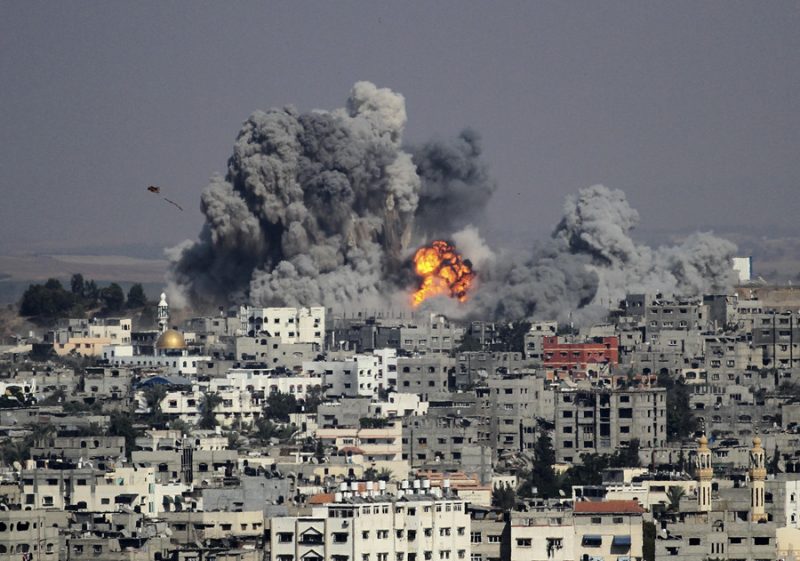
Smoke rises from the Tuffah neighborhood after an Israeli airstrike in eastern Gaza City, July 29, 2014 © Sameh Rahmi / Global Look Press
On February 25, Danny Gold, a writer and correspondent, compared the situation in Ghouta to one of history’s worst human atrocities when he tweeted: “I know how Jews who lived through the holocaust felt 70 years later about the world turning a blind eye, can’t imagine how Syrians in Ghouta will feel about their suffering being so well-documented as it’s happening yet doubted by so many.”
I know how Jews who lived through the holocaust felt 70 years later about the world turning a blind eye, can’t imagine how Syrians in Ghouta will feel about their suffering being so well-documented as it’s happening yet doubted by so many.
— Danny Gold (@DGisSERIOUS) February 25, 2018
Dan Cohen, a correspondent with RT America, responded to Gold: “Ghouta is like the Holocaust but Mosul was ‘a huge journalism event’ in which US-led forces took ‘much care’ in burying at least 3,200 civilians in the rubble.”
Cohen’s comment was a jibe at a tweet Gold had sent on February 1, 2017 in which he embellished the historical record of the US-led Iraqi campaign, remarking: “Mosul was a huge journalism event. Everyone who covers the Middle East was there.”
Ghouta is like the Holocaust but Mosul was “a huge journalism event” in which US-led forces took “much care” in burying at least 3,200 civilians in the rubble. pic.twitter.com/SxQGxFhYlc
— Dan Cohen (@dancohen3000) February 26, 2018
But if Mosul really was one big happy media confab, then how was it possible for the fatality figures to have been so skewed? As AP rather belatedly reported in December 2017, long after the nine-month conflict had ended, “The price Mosul’s residents paid in blood to see their city freed was between 9,000 and 11,000 dead … a civilian casualty rate nearly 10 times higher than what has been previously reported.”
Perhaps if Western reporters had not spent so much of their time reporting on the same type of military operation in Aleppo, which was then the focus of a Russian-backed liberation campaign, they may have more accurately described the situation in Iraq’s second-largest city.
Michael Raddie, co-editor of BSNews, provided a convincing explanation for the discrepancy in the way the Western media reports on war zones, which he said can be reduced to a matter of “worthy victims” and “unworthy victims.”
“The victims of US bombs and British airstrikes are not worthy because we don’t do that kind of thing,” Raddie told RT. “Our killing of civilians is a mistake, collateral damage. The Syrian air force killing of civilians … that is atrocities. And that is the ideology that Western media portray all the time.”
You’re Being Lied To On East Ghouta https://t.co/ciZK6QY9Ko via @YouTube
— vanessa beeley (@VanessaBeeley) February 22, 2018
However, there is another side to this wave of Western cynicism with regards to Syria that could spark a real catastrophe. That involves the threat of a chemical strike, which the West seems to believe is something only the “Assad regime” is capable of committing. After all, who would ever suspect bona-fide terrorists deprived of modern weapons of resorting to such barbaric means of warfare?
Much like Barack Obama’s utterly reckless “red line” warning regarding the use of chemical weapons, which he said would warrant US military action, French President Emmanuel Macron issued the very same foolish warning on February 14.
“On chemical weapons, I set a red line and I reaffirm that red line,” Macron told reporters. “If we have proven evidence that chemical weapons proscribed in treaties are used, we will strike the place where they are made.”
Did it surprise anyone that less than two weeks after Macron’s warning a chemical attack – conveniently supported by photos provided by, yes, the White Helmets – was reported to have occurred in Ghouta? Western media and politicians have actually suggested a Russian connection to the event.
“Whoever conducted the attacks, Russia ultimately bears responsibility for the victims in Eastern Ghouta and countless other Syrians targeted with chemical weapons since Russia became involved in Syria,” US Secretary of State Rex Tillerson said.
Presently, a 30-day ceasefire endorsed by the UN Security Council is in effect across Syria, as well as a daily five-hour “humanitarian pause” in Eastern Ghouta enforced by Russia.
Yet thus far the plan is not producing the desired effect. Militants are preventing civilians from fleeing besieged Eastern Ghouta and are sabotaging the humanitarian operation there, Major General Vladimir Zolotukhin, a spokesman for the Russian Center for Reconciliation in Syria, told journalists on Thursday.
Robert Bridge is an American writer and journalist. He is author of the book, ‘Midnight in the American Empire,’ released in 2013. robertvbridge@yahoo.com
Read more:
Lebanese Nuclear Physics Student Found Dead in France
Al-Manar | March 1, 2018
 A Lebanese man studying nuclear physics was found dead earlier this week in France, while reports on his death were conflicting.
It was initially reported that Hisham Salim Mourad- from the southern town of Braikeh in Nabatieh, was stabbed in his house.
However, Lebanon’s consul general in Marseille, Sonia Abou Azar, said the Grenoble police published its report on the death of Mourad and determined that he died after falling from the balcony of his house.
Mourad was studying at the Joseph Fourier University in the city of Grenoble. It was the last year of his master’s program.
The death sparked outrage among Lebanese people in Lebanon and abroad who were also shocked last week by the killing of another Lebanese student in Canada.
Hasan Ali Kheireddine, 23, was killed on Feb. 13 at a student residence on the St. Mary’s University campus in the Canadian region of Halifax.
The Lebanese Foreign Ministry announced earlier on Sunday that instructed the Lebanese embassy in Canada to “follow up on the case in order to unveil the details of this horrible crime and the motives behind it.”
Although Canadian authorities have been downplaying the murder of Kheireddine, it is seen by many in Lebanon as suspicious, especially that the bright student was studying economics and had been well-known for his research on the influence of Zionism on the international economy.
Russia vetoes anti-Iran UNSC resolution
Press TV – February 26, 2018
A UK-drafted resolution aimed at pressuring Iran over alleged weapons supplies to Yemeni fighters has failed at the UN Security Council.
On Monday, the resolution gained 11 favorable votes at the 15-member Security Council but was halted by Russia’s veto.
“We cannot concur with uncorroborated conclusions and evidence which requires verification and discussions within the sanctions committee,” Russian Ambassador Vassily Nebenzia told the council.
Earlier in the month, Britain circulated a draft resolution that would renew sanctions on Yemen for another year and also “condemns” Iran for allegedly breaching the 2015 arms embargo on the country by “failing to take the necessary measures to prevent the direct or indirect supply, sale or transfer” of short-range ballistic missiles, UAVs and other military equipment to Yemen’s Houthi Ansarullah movement.
The Houthi movement has been defending Yemen against a bloody Saudi-led military campaign, which was launched in 2015 with the help of the US and the UK to reinstall the country’s former Riyadh-friendly government.
The draft resolution, backed by France and the US, called for unspecified measures in response to the UN report about Iran’s alleged role in Yemen, stressing that the UNSC will take “additional measures to address these violations,” and that “any activity related to the use of ballistic missiles in Yemen” is a criteria for sanctions.
A group of UN experts monitoring the sanctions on Yemen reported to the Security Council in January that it had “identified missile remnants, related military equipment and military unmanned aerial vehicles that are of Iranian origin and were brought into Yemen after the imposition of the targeted arms embargo.”
The UN experts, however, said they were unable to identify the supplier.
Both Tehran and Sana’a have repeatedly rejected the allegations as a fabricated scenario, and said the armed forces of Yemen have strengthened their missile power on their own.
After the veto, the UNSC unanimously adopted a Russian-drafted measure to extend for one year the sanctions regime against Yemen.
Jaafari: Ending Civilians’ Suffering Requires Implementing UN Resolutions
Al-Manar | February 25, 2018
Syria’s Permanent Representative at the UN Bashar al-Jaafari said that ending the suffering of Syrians doesn’t require showboating sessions or forming UN committees; it only requires applying the 30 resolutions issued by the UN.
In a speech after the Security Council voted on a resolution calling for the cessation of combat activities in Syria for at least 30 days, Jaafari said that the people in Damascus are truly suffering due to the acts of the terrorists positioned in the Eastern Ghouta, adding “the appeals of 8 million Syrians do not reach the General Secretariat or the mailboxes of Britain and France’s representatives, but the appeals of terrorists do reach them.”
He noted that the Syrian Arab Red Crescent HQ in Damascus was targeted by 10 shells fired by the so-called “moderate” terrorists located in Ghouta, killing and injuring people including a doctor.
Jaafari stressed meanwhile, that the Syrian government has dealt in a serious manner with all initiatives and was committed to them due to its care for the lives of Syrian citizens, and that the government has called on armed groups in the Eastern Ghouta to lay down their weapons and provided safe corridors for civilians to exit it.
Syria’s Representative said that the Astana agreement had stipulated for committing the armed groups to break any ties to ISIL and Nusra Front terrorist groups, and gave the Syrian government the right to retaliate to any attack.
“We practice a sovereign right of self-defense and we will continue to fight terrorism wherever it is found on Syrian soil,” Jaafari affirmed, adding that the Syrian government reserves the full right to retaliate against armed terrorist groups if they target civilians with even a single shell.
The Syrian diplomat asserted that the new resolution should be applied to the entirety of Syrian territory, including Afrin, and areas occupied by US forces, and the occupied Syrian Golan.
He also said that what is required is for the governments of the United States, Britain, and France to stop holding meetings and making strategic plans that bring to mind the age of colonialism and that seek to divide Syria and change the governing system in it by force.
US-Russia rivalry surges in Syria
By M K Bhadrakumar | Indian Punchline | February 20, 2018
A major speech by Russian Foreign Minister Sergey Lavrov on Monday at an international conference on the Middle East turned into the strongest Russian denunciation to date of the shift in the US policies under the Trump administration towards Syria, where the Pentagon now intends to keep a military presence indefinitely. (here and here)
The overall impression Lavrov conveyed is three-fold. One, in immediate terms, a spurt in fighting in Syria can be expected, as the US attempts to create new facts on the ground by using local proxies — Kurdish militia plus al-Qaeda affiliates and ISIS fighters — as well as to push back at Russia, Iran and the Syrian government.
Two, Russia concludes that the shift in the overall US strategy aims at balkanizing Syria. (Later on Monday, while speaking to the media in Moscow, Lavrov also drew attention to the presence of mercenaries and the Special Forces of France and Britain in northeastern Syria working in league with the US forces in implementing the American agenda to create zones of influence.)
Three, the conversation between Moscow and Washington regarding Syria is at a dead end. Lavrov specifically warned Washington that it is “playing with fire” in Syria, implying that the US strategy will run into resistance.
Two other features of the Moscow conference in Moscow are that, first, Iran’s Foreign Minister Mohamad Javad Zarif took part in it, and, second, the event also talked up a Russian mediatory role to calm down the tensions between Iran and Saudi Arabia.
Zarif told Lavrov at a meeting in Moscow on Monday that Tehran seeks Russia’s help in resolving the intra-regional rifts in the Muslim Middle East. Later, Zarif posted on his official Tweeter account: “With Russia’s sober strategic perspective and its growing influence in West Asia, it can play an instrumental role to help a paradigm shift in the Persian Gulf to one based on dialogue and inclusion.”
The conference was attended by non-official delegates from several Middle East countries, including Saudi Arabia. Meanwhile, King Abdullah of Jordan had paid a ‘working visit’ to Moscow on February 15 and met Putin. On the previous day, Lavrov had spoken to his Egyptian counterpart Sameh Hassan Shoukry on phone. Yesterday, Putin also telephoned Turkish President Recep Erdogan. The focus was on Syria in all these exchanges.
The Russian strategy will be to persuade important regional states who have been the US’ key regional allies – Saudi Arabia and Jordan, in particular – not to rejoin the conflict in Syria by fueling a new round of fighting. If the approach succeeds, the US may find itself at a disadvantage in lacking regional support for pressing ahead with the military track.
However, although Russia’s ties with Saudi Arabia have appreciably strengthened in the recent years, Moscow’s capacity to mediate a Saudi-Iranian rapprochement remains to be seen. Syria continues to be a major source of rivalry between Saudi Arabia and Iran. And, the irony is that, finally, the Trump administration is doing what Saudi Arabia had wanted the previous Obama administration to do by pushing upfront the ‘regime change’ agenda in Syria through coercive methods.
In the Saudi perception, Russia suffered a series of setbacks in Syria recently. Summing up the Syrian situation, Ghassan Charbel, editor-in-chief of the influential Saudi establishment daily Asharq Al-Awsat wrote on Monday, “ Never before have all these flags, interests, dangers, armies, militias, internal divisions and regional and international clashes come together on its (Syria’s) territories. From the South to Idlib to Hmeimem to Afrin, Syria is like a powder keg. It is at the heart of a complex and vast geo-strategic conflict that is impossible to resolve with force and where losses and rewards will be difficult to predict… The regional and international circumstances do not appear ripe for… talks to happen. The Syrian tragedy is open to the most dangerous possibilities.”
The Saudi inclination will be to wait and watch which way the winds are blowing. On the other hand, the war in Yemen remains Saudi Arabia’s number one priority today and Riyadh seeks a Russian role in ending the war in Yemen by leveraging its influence with Iran.
Featured Video
Epidemic of fake videos
or go to
Aletho News Archives – Video-Images
From the Archives
Inside Job? Inside What?
By Prof. Tony Hall | American Herald Tribune | July 28, 2016
The Kevin Barrett-Chomsky Dispute in Historical Perspective – Sixth part of the series titled “9/11 and the Zionist Question”
In his chapter on “Left Gatekeepers” and the “Shame of Noam Chomsky,” Barrie Zwicker refers to the the “New World Order” as the “diaboligarchy’s” directing agency. Less compelling is Zwicker’s reference to the “New World Order” as the “diaboligarchy’s” directing agency. To me this unfortunate choice of words is much too closely associated with the often crude and chauvinistic populism of Alex Jones and his Infowars media network. Many have come to see Jones’ lucrative media operation as a limited hangout set in place by handlers trying to hold the activities of the 9/11 Truth Movement within manageable constraints.
Due to the important findings over fifteen years of the citizens’ investigation into 9/11, the culprits most deeply implicated in the crime can be identified with much more specificity than an entity vaguely described as a “New World Order.” As Kevin Barrett and many others insist, the time has come to name the names of the probable culprits, Noam Chomsky prominent among them.
While Alex Jones ultimately serves the same masters as Chomsky, the former’s media product is often much closer to the mark of what is really going on than the content of Noam Chomsky’s more magisterial pronouncements. Jones goes at least part of the way into realities of the deep state politics of the twenty-first century. Chomsky, however, sacrificed his capacity to contribute cogently to sensible discourse on contemporary geopolitics by making himself a primary instrument of the most consequential deep state deception of recent times. As a leading agent of disinformation in the psychological trenches of the ongoing Global War of False Flag Terrorism, Chomsky has reduced himself to the level of skeptic pretender Michael Shermer. In the style of Shermer, the elder Chomsky has become an establishment TV professor readily available on Netflix. … continue
Blog Roll
Recent Comments
Coronistan on EU member to sue bloc over ‘su… loongtip on Vicious loongtip on EU turns to India for defense… Coronistan on Donald Trump Is No Peace … seversonebcfb985d9 on French court jails pro-Palesti… eddieb on Fourteen Incredible Facts Abou… Bill Francis on European leaders’ shift in the… seversonebcfb985d9 on Villains of Judea: Philip Esfo… loongtip on Report warns that ‘Jewish terr… Craig Nelms on New study shows that toxic gas… loongtip on A Funny Thing Happened on the… loongtip on EU free trade pact on hold as…


 Aletho News
- How South Korea’s gas ambitions sustain the occupation of Gaza
- “Leaked document” exposes US blueprint for total control over Gaza
- Trump wanted to play peacemaker, Netanyahu made sure he failed
- Idea of limited, fast strike on Iran misjudges our capabilities: IRGC
- US Military Buildup on Land, Air, and Sea Raises Fears of Imminent Attack on Iran – Expert
- Russia reiterates demand to Germany over Nazi crimes
- France and EU clash over UK missiles for Ukraine – Telegraph
- EU member to sue bloc over ‘suicidal’ ban on Russian gas
- WEF Calls for ‘Cultural Revolution’ to Promote Lab-Grown Meat
- The Board For Peace – Whitewashing Ethnic Cleansing and Genocide
- If Americans Knew
- Violence against hundreds of Gazan remains to find one Israeli – Not a ceasefire Day 109
- Greenpeace Demonstrator Exposes Folly of Protest Restrictions
- From CBS to TikTok, Pro-Israel Ellison is now in the driver’s seat
- Israel pays for UK advertisements attacking Doctors Without Borders
- Israel accused of extracting billions from Gazan people to pay for their own genocide
- ‘Deliberate Assassination’: 3 Journalists Among 11 Killed by Israeli Forces in Gaza
- In Gaza, We’re Struggling to Reintroduce Foods to Bodies Adjusted to Starvation
- Will Rafah crossing be opened at last? – Not a ceasefire Day 108
- Israeli drone strike kills two children collecting firewood in Gaza – Not a ceasefire Day 107
- Another Gaza baby freezes to death on Netanyahu’s watch – Not a ceasefire Day 106
- No Tricks Zone
- New Study Affirms Rising CO2’s Greening Impact Across India – A Region With No Net Warming In 75 Years
- Germany’s Natural Gas Crisis Escalates … One Storage Site Near Empty …Government Silent
- Polar Colding…Antarctica Saw Its Coldest October In 44 Years!
- New Study: Sea Levels Rose 20 Times The Modern Rate During The Roman Warm Period
- As German Gas Storage Dips Dangerously Low…Shortage Hardly Avoidable
- New Study: Brazil’s Relative Sea Level Was 2+ Meters Higher And SSTs 3-4°C Warmer 6000 Years Ago
- Philosopher Schopenhauer: Climate Science Certainty Stems From Stupidity, Ignorance
- New Study: Species Extinction Rates Declining Since 1980 – ‘Climate Change Is Not An Important Threat’
- Denmark Places Climate Protection Above Animal Welfare, Poisoning And Culling Cows
- New Study: Greenland Was 3-7°C Warmer And Far Less Glaciated Than Today 6000-8000 Years Ago
 Aletho News