Tehran Slams French FM’s Remarks on Iranian Missile Program
Al-Manar | August 31, 2018
Iranian Foreign Ministry Spokesman Bahram Qassemi criticized French Foreign Minister Jean-Yves Le Drian’s Thursday remarks about Iran’s missile program and said such “unwarranted concerns” are rooted in his “wrong perceptions” of the program.
“The Islamic Republic of Iran has repeatedly declared its clear and transparent stance on unwarranted concerns rooted in some countries’ wrong perceptions and ignorance,” Qassemi said in a statement on Friday.
“The Islamic Republic of Iran has always shown that it has never been fearful of dialogue and negotiation and that it believes in it,” he said.
However, in a situation that the outcome of all efforts of Iran and other world powers (the 2015 nuclear deal) is violated by “the bullying and excessive demands” of France’s partners, there is no reason for Iran to trust and negotiate on “unnegotiable issues”, the spokesman added.
“The world and the French statesmen are well aware that Iran’s regional policy is in line with regional and international peace and security and the fight against terrorism and extremism, and if such a campaign is not pleasant to some countries that basically create tensions and crises, they can reform their policies,” he went on to say.
The remarks came after Le Drian warned Thursday that Iran “cannot avoid” talks on its ballistic missile program and role in Middle East conflicts, as European powers work to rescue the 2015 nuclear deal with Tehran known as the Joint Comprehensive Plan of Action (JCPOA).
Iranian officials have repeatedly underscored that the country will not hesitate to strengthen its military capabilities, including its missile power, which are entirely meant for defense, and that Iran’s defense capabilities will be never subject to negotiations.
The European Union has vowed to counter US President Donald Trump’s renewed sanctions on Iran, including by means of a new law to shield European companies from punitive measures.
Trump on August 6 signed an executive order re-imposing many sanctions on Iran, three months after pulling out of the Iran nuclear deal.
He said the US policy is to levy “maximum economic pressure” on the country.
Trump also restated his opinion that the 2015 Iran nuclear deal was a “horrible, one-sided deal”.
On May 8, the US president pulled his country out of the JCPOA, which was achieved in Vienna in 2015 after years of negotiations among Iran and the Group 5+1 (Russia, China, the US, Britain, France and Germany).
Following the US exit, Iran and the remaining parties launched talks to save the accord.
Syria Presents Proof on Chemical Weapons Terror Attack Preparations – UN Envoy
Sputnik – August 30, 2018
Late last week, Russian Defense Ministry spokesman Igor Konashenkov said that the White Helmets group plans to film videos for Middle Eastern and English-language media outlets after staging a false-flag chemical weapons attack in Syria in order to further destabilize the war-torn country.
Damascus has handed documents to the UN to prove that al-Nusra Front terrorists plan to conduct a chemical weapons attack in the northwestern Syrian province of Idlib and point the finger at the country’s government, according to Syria’s UN envoy Bashar Jaafari.
Iran’s Fars news agency cited Jaafari as saying that any aggression against Syria “would be an aggression against a United Nations founding state, as well as against global peace and security, and would amount to supporting terrorism.”
He recalled that Syria did not have chemical weapons, reiterating Damascus’ adherence to its obligations related to the Organization for the Prohibition of Chemical Weapons (OPCW).
Jaafari emphasized that Damascus condemns any use of chemical weapons and considers it “to be immoral.”
His statement came after Russian Deputy Foreign Minister Sergey Ryabkov said that Moscow had urged Germany and the US to influence the armed opposition in Syria’s Idlib province amid possible provocations pertaining to the use of chemical weapons in the area.
Ryabkov referred to the al-Nusra Front, which he suggested was plotting “a very serious provocation” in the Idlib area with the use of chemical weapons. According to him, the White Helmets group in Syria will film a video of this “chemical weapons attack” in order for the US and its allies to use it as a pretext for massive airstrikes on Syria.
Earlier, Alexei Kondratyev, deputy chair of the Russian Upper House’s Defense and Security Committee, told Sputnik that Moscow was concerned about Washington’s military build-up in the Mediterranean near the Syrian coast.
“The United States is strengthening its naval task force in the Mediterranean Sea not far from Syria. This is done to prepare for the strike. So, it should be expected that in the event of a provocation and a decision to deliver strikes against Syria, the missiles will be launched both from the air, and from the sea,” he pointed out.
Kondratyev made the remarks as USS The Sullivans, a destroyer with 56 cruise missiles on board, arrived in the Persian Gulf late last week, while a US В-1В bomber carrying 24 air-to-surface cruise missiles was deployed at Al Udeid air base in Qatar.
While the White Helmets, a Syrian humanitarian non-government organization, claims to have saved tens of thousands of lives, Moscow and Damascus insist that the group had ties with terrorists and extremists.
On April 14, the US, Britain and France launched 103 cruise and air-to-surface missiles at government facilities in Syria, in response to the alleged April 7 chemical attack in the Damascus suburb of Douma. Most of the missiles were intercepted by Syrian air defenses.Russia’s President Vladimir Putin denounced the missile strikes as an act of aggression against a sovereign country as neither Russian experts nor local residents in Douma confirmed that any chemical attack had actually taken place there.
Last Sunday, Syrian Ambassador to Russia Riyad Haddad confirmed that Damascus eliminated all of its chemical arsenal in 2013 and that Syria “never used and will not use chemical weapons.”
READ MORE:
State Department Says US Will Respond to Chemical Weapons Use in Idlib, Syria
Macron: France Ready to Conduct New Strikes on Syria if Chemical Weapons Used
Syria Got Rid of Chemical Weapons, OPCW Confirmed Destruction — Russian FM
France demands that Israel releases French citizen

French-Palestinian activist Salah Hamouri [salah_hamouri/Twitter]
MEMO | August 25, 2018
The Ministry of Europe and Foreign Affairs in Paris has pointed out that a year has elapsed since the arrest of French citizen Salah Hamouri by Israel. France is still concerned about his administrative detention, which has been extended until 30 September, said a spokeswoman.
Speaking during a press conference, she revealed that President Emmanuel Macron has discussed this issue with Israeli Prime Minister Benjamin Netanyahu on several occasions and called for an end to Hamouri’s detention. He is held with neither charge nor trial, and administrative detention also denies him the right to know the charges brought against him, does not respect his normal legal rights and does not allow his family to visit him, not even his wife and son. The French official noted that these demands have always been discussed with the Israeli authorities in order to have them met.
“Hamouri will continue to enjoy the consular protection granted by the Vienna Convention,” she explained. “This has allowed French officials to visit him regularly since his arrest, which will also continue until he is released.” The unnamed spokeswoman stressed France’s demand for Israel to respect all of its citizen’s rights.
The Three Musketeers, Poison Gas, and Dead Schoolkids
By Michael Howard | American Herald Tribune | August 23, 2018
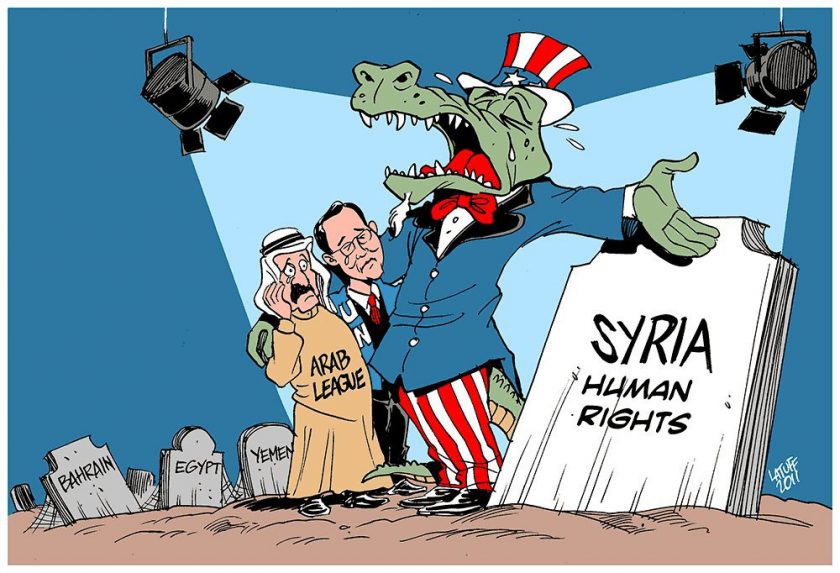
Winking and nodding to the “freedom fighters” hunkered down in the northwestern Syrian province of Idlib, the world’s schoolmarm (formally known as The West) has issued a stern warning to President Bashar al-Assad: don’t use chemical weapons “again,” or else. Said warning came via a joint statement from the US, UK and France (henceforth known as The Three Musketeers), as the Syrian government prepares its offensive to retake the country’s last remaining “rebel” stronghold. The three great and benevolent powers are “gravely concerned,” they said, about the upcoming military campaign, explaining:
We also underline our concern at the potential for further—and illegal—use of chemical weapons. We remain resolved to act if the Assad regime uses chemical weapons again. As we have demonstrated, we will respond appropriately to any further use of chemical weapons by the Syrian regime, which has had such devastating humanitarian consequences for the Syrian population.
Read it again, and take note of the crafty way in which the statement messes around with language to manipulate its target audience (us). The use of chemical weapons is accurately, and superfluously, described, and emphasized with em dashes, as “illegal,” as though there was a soul on this earth to whom this is news. Then, alluding to their coordinated missile strikes against Syria this past April, which were unleashed to much pomp and circumstance, The Three Musketeers pledge to “respond appropriately” to any such illegal action on the part of the Syrian government.
Since they insist on begging questions, we must insist on demanding answers. For instance, how “appropriate” was the aforesaid missile attack? Assuming that, in this context, a direct link exists between appropriate and legal (and only an outlaw could reject that assumption), there was certainly nothing “appropriate” about The Three Musketeers’ unilateral decision to use military force against a sovereign country last April. Quite the reverse.
The missile strike, like the one a year before, was carried out in flagrant violation of the law. There are a total of two circumstances in which the use of military force is legally justified: when greenlit by a UN Security Council resolution, or when done in self-defense, that is to say in response to a direct military attack. Neither condition was met when The Three Musketeers rocketed Syria. On the other hand, Syria is accorded the legal right under international law to strike back at its attackers, and moreover to form a coalition for that purpose. As Chapter VII Article 51 of the UN Charter states:
Nothing in the present Charter shall impair the inherent right of individual or collective self-defense if an armed attack occurs against a Member of the United Nations, until the Security Council has taken measures necessary to maintain international peace and security.
Mildly ironic, then—is it not?—that, in “appropriately” bombing the Syrian government, we granted it the legal right to bomb us back? It’s a crying shame: if only Assad and his allies were sufficiently nihilistic … we could’ve had another exhilarating World War on our hands—the third and last. To borrow a quote from of Trump’s favorite general: “Compared to war, all other forms of human endeavor shrink to insignificance. God help me, I do love it so.” On that note, I think it’s high time we substitute “War” for “God” in our Republic’s official motto. Who besides Rand Paul would vote against the proposal?
All of which is to say nothing of the fact that the alleged chemical attack in Douma, which served as the pretext for The Three Musketeers’ “appropriate” bombing raid, almost certainly didn’t happen. The first chink in the armor came in the form of Robert Fisk’s report, from the actual site of the alleged attack, that quotes a local doctor as saying:
There was a lot of shelling [by government forces] and aircraft were always over Douma at night—but on this night, there was wind and huge dust clouds began to come into the basements and cellars where people lived. People began to arrive here suffering from hypoxia, oxygen loss. Then someone at the door, a “White Helmet”, shouted “Gas!” and a panic began. People started throwing water over each other. Yes, the video was filmed here, it is genuine, but what you see are people suffering from hypoxia—not gas poisoning.
By his own count, Fisk interviewed more than twenty Douma residents; he was unable to find a single person “who showed the slightest interest in Douma’s role in bringing about the Western air attacks. Two actually told me they didn’t know about the connection.” Moreover, many of those he spoke with told him they “never believed in” the chemical weapons narratives promulgated by Western media.
Despite the fact that it squared with the Syrian Observatory For Human Rights’ (the West’s go-to authority on the Syrian conflict) assessment of the event, Fisk’s journalism was easy enough for Western ideologues to ignore or deride. He’s only one person, they countered, and he only spoke to a handful of residents and a single doctor, all of whom probably have a pro-Assad agenda. Therefore, his report is worthless and so is he.
This position grew a little less tenable when, a week after Fisk’s story was published, Russia presented to the Organization for the Prohibition of Chemical Weapons (OPCW), which was holding a conference in the Hague, seventeen eyewitnesses, a mix of residents and doctors, all of whom testified that there had been no chemical attack in Douma. As Jonathan Cook explained (yes, one had to visit his personal blog or some equally marginal source to read about this), “the US, UK and France boycotted the meeting, denouncing Russia for producing the witnesses and calling the event an ‘obscene masquerade’ and ‘theatre’”—not a very surprising reaction from a self-righteous party whose fabricated narrative is coming apart at the seams.
Then came the coup de grâce. On July 6, the OPCW published the conclusion of its fact-finding mission in Douma. Before quoting from it, I’ll jog your memory a bit. According to the Western version of events, Assad used both sarin and chlorine (or perhaps a physical mixture of the two, a nonsensical theory), in his attack on Douma—which, incidentally, had already effectively “fallen,” raising questions as to why Assad would feel compelled to use chemical weapons at all, apart from the sheer sadistic fun of it. Regardless, sarin and chlorine, said the West. Not so, said the OPCW:
OPCW designated labs conducted analysis of prioritized samples. The results show that no organophosphorous nerve agents or their degradation products were detected in the environmental samples or in the plasma samples taken from alleged casualties [my emphasis]. Along with explosive residues, various chlorinated organic chemicals were found in samples from two sites, for which there is full chain of custody. Work by the team to establish the significance of these results is on-going. The FFM team will continue its work to draw final conclusions.
Not a trace of sarin, in other words. Attempting to ascertain why “various chlorinated organic chemicals” were found at the site is a pointless exercise for someone, like myself, who knows nothing of chlorinated organic compounds. The most perfunctory research indicates that such chemicals are used for a variety of non-murderous applications, for example as solvents, and that they stick around for a long time after they’ve been introduced to an environment. The basic point, which hordes of media fixers promptly got to work obscuring, is that the Western narrative was false. The US government, in concert with its unctuous allies, lied. Go figure.
Of course, this isn’t the first time a supposed chemical attack in Syria has been called into question. Those curious about whether Assad used sarin to murder hundreds of civilians in the suburb of Ghouta in 2013, as was, and is, claimed by The West, would do well to read two essays by Seymour Hersh—“The Red Line and the Rat Line” and “Whose Sarin”—both published in the London Review of Books, both available online. Hersh also examined the chemical incident that took place in Khan Sheikhoun in April 2017—also used as a pretext for illegal US military action. This time, however, his reporting was too heretical even for the London Review of Books (not to mention the New Yorker), and so had to be published in Die Welt, which no one in the US has ever heard of, let alone read. That Hersh, the preeminent investigative journalist of his time, has been pushed into no man’s land speaks to how narrow the spectrum of permissible discourse has become in this, our great Republic. The schoolmarm is cracking her whip. At this rate Hersh will soon be relegated to the personal blog.
For other dissident views re: chemical weapons in Syria, do yourself a favor and consult the work of former UN weapons inspector Scott Ritter and MIT professor and munitions expert Theodore Postol, as well as the late journalist Robert Parry of Consortium News, all of whom have written extensively, and cogently, on the subject. Or you can keep reading the Washington Post. You’re free to decide.
But what exactly did The Three Musketeers have in mind when they broadcast their latest threat? It’s a fair question to ask. On its face, the statement appears to reflect a genuine aversion to poison gas, and a genuine hope that the Syrian government will refrain from using any in Idlib. Fair enough. Having said that, how averse could they really be, given that gas attacks provide for them the only remotely plausible excuse to lob more cruise missiles out of the Mediterranean—an activity from which they, and their media sidekicks, derive the utmost pleasure? They are, after all, incorrigible hawks. It must cut them to the bone to have to stand by and watch from the sidelines as a perfectly good war winds down, handcuffed, helpless to effect the desired outcome. How pitiable the plight of the poor impotent imperialist! Flaming warmongers need love too.
Anyway, call me schizophrenic, but when I read the words of The Three Musketeers, I couldn’t help but pick up the faint sound of a dog whistle—aimed straight at the “moderate rebels” holding down the fort in Idlib. Read between the lines, the statement is an assurance to one party dressed up as a warning to another. If there’s a “chemical incident,” we will attack: you have our word. That’s the message sent to, and received by, al-Qaeda (I don’t know what they’re calling themselves these days, and I care less) and its various affiliates. Make no mistake: The Three Musketeers have just invited, oh-so-subtly, bin-Laden’s foot soldiers to stage a chemical atrocity in Idlib (God knows how many “various chlorinated organic chemicals” they’ve got on hand there), the resulting pictures of which will duly splash across every television screen in America so as to whip up … well, you’ve heard this song before.
So here’s a new one: a bunch of kids walk onto a school bus in Yemen. As the bus steers through a crowded marketplace, Saudi Arabia drops a bomb on it, killing forty small children and injuring scores more. The bomb is later identified as a “laser-guided” precision missile (precision being the operative word), manufactured by our very own Lockheed Martin, while the mangled school bus is described by Col. Turki al-Maliki, spokesman for the Saudi-led coalition, as a “legitimate target.” Meanwhile, back in illustrious Washington, Pentagon bureaucrat Rebecca Rebarich is asked to comment on the “legitimate” massacre of forty schoolkids.
“The US has worked with the Saudi-led coalition to help them improve procedures and oversight mechanisms to reduce civilian casualties,” she says. “While we do not independently verify claims of civilian casualties in which we are not directly involved, we call on all sides to reduce such casualties, including those caused via ballistic missile attacks on civilian population centers in Saudi Arabia.”
Translated from vapid officialese: “I don’t really give a shit.”
On the bright side, we’re “gravely concerned” about the coming battle for Idlib, where the babies are beautiful and, most importantly, the bombs that kill them are un-American.
West leading campaign of hypocrisy on use of chemical weapons: Syria
Press TV – August 23, 2018
Syria has denounced a recent statement by the US, Britain and France on the alleged use of chemical weapons by the Damascus government, saying the trio is leading a campaign of misinformation against the Arab country in line with their support for terrorists.
An official source at the Syrian Ministry of Foreign Affairs and Expatriates told SANA news agency on Wednesday that the fresh Western threats against Damascus came amid the Syrian army’s territorial gains against foreign-backed terrorists.
Washington, London and Paris, in a statement on Monday, claimed that they “shared resolve to preventing the use of chemical weapons” by the government of Syrian President Basher al-Assad.
They also noted that their position on the Damascus’ “use of chemical weapons is unchanged. As we have demonstrated, we will respond appropriately to any further use of chemical weapons” by the Syrian government.
The statement was published on the fifth anniversary of the deadly chemical attack in the Damascus suburb of Ghouta in August 2013.
Elsewhere in his remarks, the Syrian Foreign Ministry source stressed that the Western countries had once again resorted to “a campaign of threats, hypocrisy and misinformation against the Syrian Arab Republic as part of the continued declared support for the armed terrorist groups, particularly Jabhat al-Nusra and its affiliated groups.”
“Syria has repeatedly asserted that it considers the use of chemical weapons immoral and condemns its use anywhere, under any circumstance and against anyone. Syria reiterates that it has no chemical weapons,” he added.
Syria surrendered its entire chemical stockpile in 2013 to a mission led by the Prohibition of Chemical Weapons (OPCW) and the UN.
The source also said it is not Syria which uses chemical weapons, but rather the armed terrorist groups that enjoy direct support from Western and regional countries such as Saudi Arabia, Turkey and Qatar.
Syria, the source added, has recently “informed the relevant international bodies about preparations by armed terrorist organizations to use poison gas in several areas” in the country.
The statement of these countries is nothing more than a sign of support for “any chemical aggression that these terrorist organizations may undertake in the next few days to use this as a pretext for aggression against Syria, as it did in its brutal aggression on 14 April 2018.”
The Western statement seeks to “justify the use of chemical weapons by terrorist organizations, prolong the war against Syria and support the terrorist organizations,” the source pointed out.
On April 14, the US, Britain and France launched a coordinated missile attack against sites and research facilities near Damascus and Homs with the purported goal of paralyzing the Syrian government’s capability to produce chemicals.
The strike came one week after an alleged gas attack on the Damascus suburb town of Douma.
EU ‘disinfo-busting’ outlet targets ‘Russophiles’ in McCarthyist campaign to push own narrative
By Danielle Ryan | RT | August 15, 2018
In a stunt that would have made Joe McCarthy proud, a Brussels-based think tank endeavoured to brand Twitter users posting about a scandal involving French President Emmanuel Macron’s former bodyguard as ‘Russophiles’.
EU DisinfoLab, whose raison d’etre is to “fight disinformation with innovative methodology,” published a report about “hyperactive” Twitter accounts that were sharing news about Alexandre Benalla, Macron’s former deputy chief of staff and bodyguard who was fired in July when it was revealed that he had violently assaulted a protester during an annual May Day rally.
French media excitedly latched onto the DisinfoLab report (The Russians! The Russians!) and soon headlines appeared about Russian “bots” and their apparent involvement in the Benalla scandal, prompting national discussions about what could be done to combat social media manipulation by the “Russophile” accounts. During all the hysteria, the EU DisinfoLab graciously decided to clarify its findings to say that not all of the accounts posting about Benalla were of the ‘Russophile’ variety. But, according to the NGO’s co-founder Nicolas Vanderbiest, the case was a hot topic for the “Russophile ecosystem” and a sizable 27 percent of the accounts were part of the “Russian disinformation system”.
If you were wondering, the “Russian disinformation system” is, according to DisinfoLab, comprised of anyone sharing content from RT or Sputnik or anyone promoting the “Russian narrative” in any way.
Because remember, in good, free, open Democratic societies, questioning established narratives is unacceptable and grounds for public shaming and having your name immediately placed on some kind of Twitter blacklist. You might also be as surprised as I was to hear there is apparently an overarching “Russian narrative” for every world event, regardless of whether or not it relates to Moscow in any way.
Making matters worse, the NGO released the raw data which it used in its research which appeared to categorize users with labels such as “jew,”“lesbian” and “homo” – prompting questions from users about why they were being politically profiled in such a public way. The NGO then seemingly deleted the those files and denied posting them before appearing to admit to publishing them and releasing an apology to those affected.
Ironically, funding for the report on this alleged suspicious Russian Twitter activity was provided by none other than Twitter itself. Luckily, Twitter had some money lying around for such purposes; the very money it had received from RT and Sputnik to run ads on its platform. Having realized the error of its ways, Twitter pledged that money to “civil society” projects such as EU DisinfoLab – who was the happy recipient of $125,000, according to the organization itself.
Immediately, the furor surrounding the ‘Russophiles’ list reminded me of a similar attempt by a European ‘think tank’ to brand anyone remotely associated with RT as Kremlin stooges. In October of last year, the US-government funded, Prague-based ‘European Values’ outfit published a list of 2,327 people who have appeared as guests on RT, branding them “useful idiots” for the the Kremlin.
Included on that list were well-known Russian agents Greta van Susteren, Gloria Steinem, Bob Woodward, Dick Cheney, Naomi Klein, Kofi Annan, Perez Hilton, Denzel Washington and Pierce Brosnan.
The think tanks that produce utterly pointless reports like this claim that it is all in an effort to fight disinformation and cleanse the news environment of false or misleading information. In reality, these reports are nothing more than exercises in public shaming and serve no legitimate, useful purpose whatsoever. They are not designed to protect or promote truth per se, but to bolster their preferred narrative and ensure that no-one is exposed to any other dangerous ideas or perspectives — and that if they are, they quickly discount them in favor of the safer, sanctioned narratives.
They are part of a long history in the West – but particularly in the US – of linking political opponents or dissidents to Russia in an attempt to discredit them. They are the modern-day incarnation (if far less effective) of the McCarthyist pamphlets of the 1950s, denigrating public figures (or these days just random Twitter users) for the alleged crime of being sympathetic to the Soviet Union/Russia.
The infamous Red Channels pamphlet which listed 150 actors, writers, journalists, musicians and other entertainers who were purportedly communist sympathisers ended careers and threatened to ruin lives. No doubt, the likes of EU DisinfoLab and European Values would love to be so influential, but luckily, in today’s media landscape, it’s much easier to call them out for the chancers that they are.
Considering that, as EU DisinfoLab admitted, only 27 percent of those posting about the Benalla affair are ‘Russophiles’ (and the rest were presumably not) and that there was no evidence of any Russian government “interference” in the case, it would seem more likely that a wide variety of French citizens, from all points on the political spectrum, were not wholly delighted with the fact that their president’s bodyguard pretended to be a police officer and beat people up at a protest— and decided to tweet their frustrations, as is their prerogative.
But it would be a bit more difficult to produce a “disinformation” report about that.
Danielle Ryan is an Irish freelance writer based in Dublin. Her work has appeared in Salon, The Nation, Rethinking Russia, teleSUR, RBTH, The Calvert Journal and others. Follow her on Twitter @DanielleRyanJ
Read more:
Question more? You’re a pesky ‘Russophile’, says Soros-backed Belgian NGO
By Nebojsa Malic | RT | August 11, 2018
Once a leader in philosophy and fashion, France has now been reduced to falling for tricks recycled from US con artists by Brussels-based grifters, with a little help from Twitter’s ‘mea culpa’ cash and even Uncle George Soros.
It all began when EU DisinfoLab, a non-governmental organization based in Belgium, published a report on Wednesday about how some 55,000 “hyperactive” twitter accounts spread the news of the Benalla affair, and accused a portion of those accounts of being “Russophiles.”
Within a day, French media were printing headlines screaming about “Russian bots,” prompting the NGO to issue a “clarification” of their findings. Not all of the accounts were “Russophiles,” the outfit said, and the report said nothing about “bots” – but the French public was already outraged.
Politicians Jean-Luc Melenchon of La France Insoumise and Marine Le Pen from the National Rally (NR) –previously known as Le Front National– who both ended up on the NGO’s list, tweeted derisively about the report, with Melenchon calling the outfit “stupid spooks.”
EU DisinfoLab basically used tools –as well as funding– provided by Twitter to compile a list of accounts tweeting about the scandal involving Alexandre Benalla, deputy chief of staff and bodyguard to President Emmanuel Macron. Benalla was fired in July after it emerged he had assaulted a protester at May Day demonstrations while impersonating a police officer, then tried to suppress the video footage of the incident.
Of the accounts thus rounded up, the group identified 27 percent as being part of the “Russian disinformation ecosystem,” described as people retweeting content from RT and Sputnik, or promoting the “Russian narrative.” Examples of the latter were listed as people spreading “false information” like that the Syrian government did not use chemical weapons in Douma (#SyriaHoax) or doubting the official [UK] narrative about the poisoning of Sergei and Yulia Skripal in Salisbury.
Having thus characterized the doubters of the official Western media narratives as Russian agents, the group had the cheek to declare this is “not a value judgment, but a quantifiable fact according to methodology.”
What methodology? Well, in part that used by FirstDraft’s CrossCheck project, sponsored by Google partnering with US and French mainstream media outlets, the London School of Economics, and the notorious bloggers at Bellingcat, affiliated with the Atlantic Council, a pro-NATO think tank.
However, the approach of EU DisinfoLab is actually closer to that of Hamilton68 Dashboard, a project of the Alliance for Securing Democracy (ASD), which, in turn, is backed by the German Marshall Fund. This alliance of Democrats and neocons was set up last year to “defend democracy” on Twitter from those evil Russkies. Having started from the assumption that agents of the Kremlin were everywhere, the dashboard proceeded to blame them for every trending hashtag – and the US media swallowed it whole, breathlessly reporting their “discoveries” for months.
Journalist Glenn Greenwald, who has followed ASD since its inception, described it as “the single most successful media fraud & US propaganda campaign” he had seen in years of covering US politics.
This hysteria wave eventually crested in March this year, when even such ardent Russiagate-obsessed publications as BuzzFeed (the outfit that published Christopher Steele’s “salacious and unverified” dossier accusing Trump of being a Russian puppet) declared the reports of Russian bots to be “total bullshit.”
Here is the best part: The funding for EU DisinfoLab’s report was provided by Twitter itself! Back in October 2017, under tremendous pressure from Democrats angry about their defeat in the presidential election, the company “off-ramped” all advertising from RT and Sputnik, then pledged to donate the $1.9 million in (generously) estimated profits to “civil society” projects. Enter EU DisinfoLab, which admitted receiving $125,000 from Twitter in January.
The group also received $25,000 from George Soros’s Open Society Foundation, though that was earmarked for monitoring the March 2018 elections in Italy. True to form, Soros claimed Russia was behind the victory of populist parties over the Eurocrat establishment he favored.
So long as Uncle George and social media giants pay good money, and the media is eager to quote those offering to cater to their confirmation bias, there will be outfits such as Hamilton68 and EU DisinfoLab, all too willing to oblige.
Read more:
Atlantic Council: Pro-NATO pressure group uses distortions to fight ‘disinformation’
American Pravda: The Nature of Anti-Semitism
By Ron Unz • Unz Review • July 30, 2018
I recently published a couple of long essays, and although they primarily focused on other matters, the subject of anti-Semitism was a strong secondary theme. In that regard, I mentioned my shock at discovering a dozen or more years ago that several of the most self-evidently absurd elements of anti-Semitic lunacy, which I had always dismissed without consideration, were probably correct. It does seem likely that a significant number of traditionally-religious Jews did indeed occasionally commit the ritual murder of Christian children in order to use their blood in certain religious ceremonies, and also that powerful Jewish international bankers did play a large role in financing the establishment of Bolshevik Russia.
When one discovers that matters of such enormous moment not only apparently occurred but that they had been successfully excluded from nearly all of our histories and media coverage for most of the last one hundred years, the implications take some time to properly digest. If the most extreme “anti-Semitic canards” were probably true, then surely the whole notion of anti-Semitism warrants a careful reexamination.
All of us obtain our knowledge of the world by two different channels. Some things we discover from our own personal experiences and the direct evidence of our senses, but most information comes to us via external sources such as books and the media, and a crisis may develop when we discover that these two pathways are in sharp conflict. The official media of the old USSR used to endlessly trumpet the tremendous achievements of its collectivized agricultural system, but when citizens noticed that there was never any meat in their shops, “Pravda” became a watchword for “Lies” rather than “Truth.”
Now consider the notion of “anti-Semitism.” Google searches for that word and its close variants reveal over 24 million hits, and over the years I’m sure I’ve seen that term tens of thousands of times in my books and newspapers, and heard it endlessly reported in my electronic media and entertainment. But thinking it over, I’m not sure that I can ever recall a single real-life instance I’ve personally encountered, nor have I heard of almost any such cases from my friends or acquaintances. Indeed, the only persons I’ve ever come across making such claims were individuals who bore unmistakable signs of serious psychological imbalance. When the daily newspapers are brimming with lurid tales of hideous demons walking among us and attacking people on every street corner, but you yourself have never actually seen one, you may gradually grow suspicious.
Indeed, over the years some of my own research has uncovered a sharp contrast between image and reality. As recently as the late 1990s, leading mainstream media outlets such as The New York Times were still denouncing a top Ivy League school such as Princeton for the supposed anti-Semitism of its college admissions policy, but a few years ago when I carefully investigated that issue in quantitative terms for my lengthy Meritocracy analysis I was very surprised to reach a polar-opposite conclusion. According to the best available evidence, white Gentiles were over 90% less likely to be enrolled at Harvard and the other Ivies than were Jews of similar academic performance, a truly remarkable finding. If the situation had been reversed and Jews were 90% less likely to be found at Harvard than seemed warranted by their test scores, surely that fact would be endlessly cited as the absolute smoking-gun proof of horrendous anti-Semitism in present-day America.
It has also become apparent that a considerable fraction of what passes for “anti-Semitism” these days seems to stretch that term beyond all recognition. A few weeks ago an unknown 28-year-old Democratic Socialist named Alexandria Ocasio-Cortez scored a stunning upset primary victory over a top House Democrat in New York City, and naturally received a blizzard of media coverage as a result. However, when it came out that she had denounced the Israeli government for its recent massacre of over 140 unarmed Palestinian protesters in Gaza, cries of “anti-Semite” soon appeared, and according to Google there are now over 180,000 such hits combining her name and that harsh accusatory term. Similarly, just a few days ago the New York Times ran a major story reporting that all of Britain’s Jewish newspapers had issued an “unprecedented” denunciation of Jeremy Corbyn’s Labour Party, describing it as an “existential threat” to the Jewish community for the anti-Semitism it was fostering; but this apparently amounted to nothing more than its willingness to sharply criticize the Israeli government for its long mistreatment of the Palestinians.
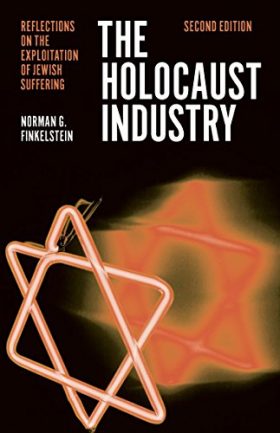
One plausible explanation of the strange contrast between media coverage and reality might be that anti-Semitism once did loom very large in real life, but dissipated many decades ago, while the organizations and activists focused on detecting and combating that pernicious problem have remained in place, generating public attention based on smaller and smaller issues, with the zealous Jewish activists of the Anti-Defamation League (ADL) representing a perfect example of this situation. As an even more striking illustration, the Second World War ended over seventy years ago, but what historian Norman Finkelstein has so aptly labeled “the Holocaust Industry” has grown ever larger and more entrenched in our academic and media worlds so that scarcely a day passes without one or more articles relating to that topic appearing in my major morning newspapers. Given this situation, a serious exploration of the true nature of anti-Semitism should probably avoid the mere media phantoms of today and focus on the past, when the condition might still have been widespread in daily life.
Many observers have pointed to the aftermath of the Second World War as marking a huge watershed in the public acceptability of anti-Semitism both in America and Europe, so perhaps a proper appraisal of that cultural phenomenon should focus on the years before that global conflict. However, the overwhelming role of Jews in the Bolshevik Revolution and other bloody Communist seizures of power quite naturally made them objects of considerable fear and hatred throughout the inter-war years, so the safest course might be to push that boundary back a little further and confine our attention to the period prior to the outbreak of the First World War. The pogroms in Czarist Russia, the Dreyfus Affair in France, and the lynching of Leo Frank in the American South come to mind as some of the most famous examples from that period.
In 1991 Cambridge University Press published The Jew Accused by Albert Lindemann, a noted scholar of European ideological movements, and his book focused on exactly that era and those sorts of incidents. Although the text is quite short, running less than 300 pages, Lindemann built his discussion upon a huge foundation of secondary literature, with his footnotes drawn from the 200 works included in his extensive bibliography. As far as I could tell, he seems a very scrupulous scholar, generally providing the multiple, often conflicting accounts of a given incident, and coming to his own conclusions with considerable hesitation.
This approach is certainly demonstrated in the first of his major cases, the notorious Dreyfus affair of late 19th century France, probably one of history’s most famous anti-Semitic incidents. Although he concludes that Captain Alfred Dreyfus was very likely innocent of the charge of espionage, he notes the seemingly strong evidence that initially led to his arrest and conviction and finds—contrary to myth-making by numerous later writers—absolutely no indications that his Jewish origins played any role whatsoever in his predicament.
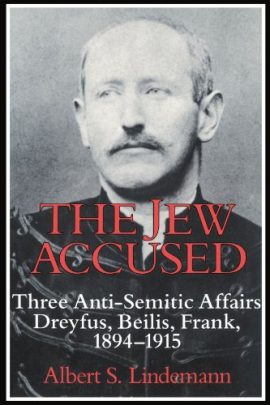
However, he does note some of the underlying social context to this fierce political battle. Although only one Frenchman in a thousand was Jewish, just a few years earlier a group of Jews had been the leading culprits behind several huge financial scandals that impoverished large numbers of small investors, and the swindlers afterward escaped any punishment by means of political influence and bribery. Given this history, much of the outrage of the anti-Dreyfusards probably arose from their fears that a Jewish military spy from a very wealthy family might be able to walk free using similar tactics, and the public claims that Dreyfus’s brother was offering enormous bribes to win his brother’s release certainly strengthened this concern.
Lindemann’s discussion of the 1913 Leo Frank Affair, in which a wealthy Northern Jew working in Atlanta was accused of sexually-assaulting and murdering a young girl, is even more interesting. Once again, he notes that contrary to the traditional narrative, there seems absolutely no hint that Frank’s Jewish background played any role in his arrest or conviction. Indeed, at his trial it was instead his very highly-paid defense attorneys who unsuccessfully sought to “play the race card” with the jurors by crudely attempting to deflect suspicion upon a local black worker by means of racially-charged invective.
Although Lindemann regards Frank as probably innocent, my own reading of the evidence he presents suggests the overwhelming likelihood of his guilt. Meanwhile, it seems undeniable that the outpouring of popular anger against Frank was produced by the vast ocean of outside Jewish money—at least $15 million or more in present-day dollars—that was committed to the legal efforts to save the life of someone widely regarded as a brutal murderer. There are strong suggestions that far more improper means were also employed, including bribery and influence-peddling, so that after Frank was convicted by a jury of his peers and thirteen separate legal appeals were denied, a governor with strong personal ties to the defense lawyers and Jewish interests chose to spare Frank’s life a few months before leaving office. Under these circumstances, the lynch-mob that hung Frank was viewed by the community as merely enforcing his official death sentence by extra-judicial means.
I also discovered that the leading figures in the anti-Frank movement had views far nuanced than I had expected. For example, populist writer Tom Watson had previously been a strong defender of Jewish anarchist Emma Goldman, while ferociously denouncing the Rockefellers, Morgans, and Goulds as the “true destroyers” of Jeffersonian democracy, so his outrage that Frank might escape punishment for murder seemed motivated by the extreme wealth of Frank’s family and his supporters rather than any pre-existing anti-Semitic sentiments.
The unmistakable conclusion of Lindemann’s analysis is that if the defendants in both the Dreyfus and Frank cases had not been Jewish, they would have suffered identical arrests and convictions, but lacking any wealthy and politically mobilized Jewish community to rally around them, they would have received their punishments, just or unjust, and immediately been forgotten. Instead, Theodor Herzl, the founding father of Zionism, later claimed that the massive anti-Semitism revealed by the Dreyfus Affair was the basis of his personal ideological awakening, while the Frank Affair led to the establishment of America’s Anti-Defamation League. And both these cases have entered our history books as among the most notorious examples of pre-World War I anti-Semitism.
Lindemann’s discussion of the often difficult relations between Russia’s restive Jewish minority and its huge Slavic majority is also quite interesting, and he provides numerous instances in which major incidents, supposedly demonstrating the enormously strong appeal of vicious anti-Semitism, were quite different than has been suggested by the legend. The famous Kishinev Pogrom of 1903 was obviously the result of severe ethnic tension in that city, but contrary to the regular accusations of later writers, there seems absolutely no evidence of high-level government involvement, and the widespread claims of 700 dead that so horrified the entire world were grossly exaggerated, with only 45 killed in the urban rioting. Chaim Weizman, the future president of Israel, later promoted the story that he himself and some other brave Jewish souls had personally defended their people with revolvers in hand even as they saw the mutilated bodies of 80 Jewish victims. This account was totally fictional since Weizman happened to have been be hundreds of miles away when the riots occurred.
Although a tendency to lie and exaggerate was hardly unique to the political partisans of Russian Jewry, the existence of a powerful international network of Jewish journalists and Jewish-influenced media outlets ensured that such concocted propaganda stories might receive enormous worldwide distribution, while the truth followed far behind, if at all.
For related reasons, international outrage was often focused on the legal confinement of most of Russia’s Jews to the “Pale of Settlement,” suggesting some sort of tight imprisonment; but that area was the traditional home of the Jewish population and encompassed a landmass almost as large as France and Spain combined. The growing impoverishment of Eastern European Jews during that era was often assumed to be a consequence of hostile government policy, but the obvious explanation was extraordinary Jewish fecundity, which far outstripped that of their Slavic fellow countrymen, and quickly led them to outgrow the available spots in any of their traditional “middleman” occupations, a situation worsened by their total disinclination to engage in agriculture or other primary-producer activities. Jewish communities expressed horror at the risk of losing their sons to the Czarist military draft, but this was simply the flip-side of the full Russian citizenship they had been granted, and no different from what was faced by their non-Jewish neighbors.
Certainly the Jews of Russia suffered greatly from widespread riots and mob attacks in the generation prior to World War I, and these did sometimes have substantial government encouragement, especially in the aftermath of the very heavy Jewish role in the 1905 Revolution. But we should keep in mind that a Jewish plotter had been implicated in the killing of Czar Alexander II, and Jewish assassins had also struck down several top Russian ministers and numerous other government officials. If the last decade or two had seen American Muslims assassinate a sitting U.S. President, various leading Cabinet members, and a host of our other elected and appointed officials, surely the position of Muslims in this country would have become a very uncomfortable one.
As Lindemann candidly describes the tension between Russia’s very rapidly growing Jewish population and its governing authorities, he cannot avoid mentioning the notorious Jewish reputation for bribery, corruption, and general dishonesty, with numerous figures of all political backgrounds noting that the remarkable Jewish propensity to commit perjury in the courtroom led to severe problems in the effective administration of justice. The eminent American sociologist E.A. Ross, writing in 1913, characterized the regular behavior of Eastern European Jews in very similar terms.
Lindemann also allocates a short chapter to discussing the 1911 Beilis Affair, in which a Ukrainian Jew was accused of the ritual murder of a young Gentile boy, an incident that generated a great deal of international attention and controversy. Based on the evidence presented, the defendant seems likely to have been innocent, although the obvious lies he repeatedly told police interrogators hardly helped foster that impression, and “the system worked” in that he was ultimately found innocent by the jurors at his trial. However, a few pages are also given to a much less well-known ritual murder case in late 19th century Hungary, in which the evidence of Jewish guilt seemed far stronger, though the author hardly accepted the possible reality of such an outlandish crime. Such reticence was quite understandable since the publication of Ariel Toaff’s remarkable volume on the subject was still a dozen years in the future.

Lindemann subsequently expanded his examination of historical anti-Semitism into a much broader treatment, Esau’s Tears, which appeared in 1997. In this volume, he added comparative studies of the social landscape in Germany, Britain, Italy, and several other European countries, and demonstrated that the relationship between Jews and non-Jews varied greatly across different locations and time periods. But although I found his analysis quite useful and interesting, the extraordinarily harsh attacks his text provoked from some outraged Jewish academics seemed even more intriguing.
For example, Judith Laikin Elkin opened her discussion in The American Historical Review by describing the book as a “545-page polemic” a strange characterization of a book so remarkably even-handed and factually-based in its scholarship. Writing in Commentary, Robert Wistrich was even harsher, stating that merely reading the book had been a painful experience for him, and his review seemed filled with spittle-flecked rage. Unless these individuals had somehow gotten copies of a different book, I found their attitudes simply astonishing.
I was not alone in such a reaction. Richard S. Levy of the University of Illinois, a noted scholar of anti-Semitism, expressed amazement at Wistrich’s seemingly irrational outburst, while Paul Gottfried, writing in Chronicles, mildly suggested that Lindemann had “touched raw nerves.” Indeed, Gottfried’s own evaluation quite reasonably criticized Lindemann for perhaps being a little too even-handed, sometimes presenting numerous conflicting analyzes without choosing between them. For those interested, a good discussion of the book by Alan Steinweis, a younger scholar specializing in the same topic, is conveniently available online.
The remarkable ferocity with which some Jewish writers attacked Lindemann’s meticulous attempt to provide an accurate history of anti-Semitism may carry more significance than merely an exchange of angry words in low-circulation academic publications. If our mainstream media shapes our reality, scholarly books and articles based upon them tend to set the contours of that media coverage. And the ability of a relatively small number of agitated and energetic Jews to police the acceptable boundaries of historical narratives may have enormous consequences for our larger society, deterring scholars from objectively reporting historical facts and preventing students from discovering them.
The undeniable truth is that for many centuries Jews usually constituted a wealthy and privileged segment of the population in nearly all the European countries in which they resided, and quite frequently they based their livelihood upon the heavy exploitation of a downtrodden peasantry. Even without any differences in ethnicity, language, or religion, such conditions almost invariably provoke hostility. The victory of Mao’s Communist forces in China was quickly followed by the brutal massacre of a million or more Han Chinese landlords by the Han Chinese poor peasants who regarded them as cruel oppressors, with William Hinton’s classic Fanshen describing the unfortunate history that unfolded in one particular village. When similar circumstances led to violent clashes in Eastern Europe between Slavs and Jews, does it really make logical sense to employ a specialized term such as “anti-Semitism” to describe that situation?

Furthermore, some of the material presented in Lindemann’s rather innocuous text might also lead to potentially threatening ideas. Consider, for example, the notorious Protocols of the Learned Elders of Zion, almost certainly fictional, but hugely popular and influential during the years following World War I and the Bolshevik Revolution. The fall of so many longstanding Gentile dynasties and their replacement by new regimes such as Soviet Russia and Weimar Germany, which were heavily dominated by their tiny Jewish minorities, quite naturally fed suspicions of a worldwide Jewish plot, as did the widely discussed role of Jewish international bankers in producing those political outcomes.
Over the decades, there has been much speculation about the possible inspiration for the Protocols, but although Lindemann makes absolutely no reference to that document, he does provide a very intriguing possible candidate. Jewish-born British Prime Minister Benjamin Disraeli certainly ranked as one of the most influential figures of the late 19th century, and in his novel Coningsby, he has the character representing Lord Lionel Rothschild boast about the existence of a vast and secret network of powerful international Jews, who stand near the head of almost every major nation, quietly controlling their governments from behind the scenes. If one of the world’s most politically well-connected Jews eagerly promoted such notions, was Henry Ford really so unreasonable in doing the same?
Lindemann also notes Disraeli’s focus on the extreme importance of race and racial origins, a central aspect of traditional Jewish religious doctrine. He reasonably suggests that this must surely have had a huge influence upon the rise of those political ideas, given that Disraeli’s public profile and stature were so much greater than the mere writers or activists whom our history books usually place at center stage. In fact, Houston Stewart Chamberlain, a leading racial theorist, actually cited Disraeli as a key source for his ideas. Jewish intellectuals such as Max Nordau and Cesare Lombroso are already widely recognized as leading figures in the rise of the racial science of that era, but Disraeli’s under-appreciated role may have actually been far greater. The deep Jewish roots of European racialist movements are hardly something that many present-day Jews would want widely known.

One of the harsh Jewish critics of Esau’s Tears denounced Cambridge University Press for even allowing the book to appear in print, and although that major work is easily available in English, there are numerous other cases where an important but discordant version of historical reality has been successfully blocked from publication. For decades most Americans would have ranked Nobel Laureate Alexander Solzhenitsyn as among the world’s greatest literary figures, and his Gulag Archipelago alone sold over 10 million copies. But his last work was a massive two-volume account of the tragic 200 years of shared history between Russians and Jews, and despite its 2002 release in Russian and numerous other world languages, there has yet to be an authorized English translation, though various partial editions have circulated on the Internet in samizdat form.

At one point, a full English version was briefly available for sale at Amazon.com and I purchased it. Glancing through a few sections, the work seemed quite even-handed and innocuous to me, but it seemed to provide a far more detailed and uncensored account than anything else previously available, which obviously was the problem. The Bolshevik Revolution resulted in the deaths of many tens of millions of people worldwide, and the overwhelming Jewish role in its leadership would become more difficult to erase from historical memory if Solzhenitsyn’s work were easily available. Also, his candid discussion of the economic and political behavior of Russian Jewry in pre-revolutionary times directly conflicted with the hagiography widely promoted by Hollywood and the popular media. Historian Yuri Slezkine’s award-winning 2004 book The Jewish Century provided many similar facts, but his treatment was far more cursory and his public stature not remotely the same.
Near the end of his life, Solzhenitsyn gave his political blessing to Russian President Vladimir Putin, and Russia’s leaders honored him upon his death, while his Gulag volumes are now enshrined as mandatory reading in the standard high school curriculum of today’s overwhelmingly Christian Russia. But even as his star rose again in his own homeland, it seems to have sharply fallen in our own country, and his trajectory may eventually relegate him to nearly un-person status.
A couple of years after the release of Solzhenitsyn’s controversial final book, an American writer named Anne Applebaum published a thick history bearing the same title Gulag, and her work received enormously favorable media coverage and won her a Pulitzer Prize; I have even heard claims that her book has been steadily replacing that earlier Gulag on many college reading lists. But although Jews constituted a huge fraction of the top leadership of the Soviet Gulag system during its early decades, as well as that of the dreaded NKVD which supplied the inmates, nearly her entire focus on her own ethnic group during Soviet times is that of victims rather than victimizers. And by a remarkable irony of fate, she shares a last name with one of the top Bolshevik leaders, Hirsch Apfelbaum, who concealed his own ethnic identity by calling himself Grigory Zinoviev.

The striking decline in Solzhenitsyn’s literary status in the West came just a decade or two after an even more precipitous collapse in the reputation of David Irving, and for much the same reason. Irving probably ranked as the most internationally successful British historian of the last one hundred years and a renowned scholar of World War II, but his extensive reliance on primary source documentary evidence posed an obvious threat to the official narrative promoted by Hollywood and wartime propaganda. When he published his magisterial Hitler’s War, this conflict between myth and reality came into the open, and an enormous wave of attacks and vilification was unleashed, gradually leading to his purge from respectability and eventually even his imprisonment.
Similarly, Israeli academic Ariel Toaff, son of the chief rabbi of Rome, was regarded as one of the world’s leading scholarly authorities on Medieval Jewry. But when he published his remarkable 2004 analysis suggesting the likely reality of the Jewish ritual murders of Christian children throughout history, the resulting media firestorm forced the cancellation of the book’s publication, and the work only survives in samizdat form, while there were even calls for his arrest and incarceration.
In other cases, pressure from the ADL and similar Jewish activist groups have led Amazon to completely eliminate entire categories of historical analysis and ban those publishers who produce such works, which drastically reduces their availability to the reading public.
All of these cases were the sort of high-profile examples which are well-known to anyone who pays attention to such matters. But surely there must have been many other incidents, involving far less prominent authors, which never received any significant media coverage, and also a vastly larger universe of cases in which writers have self-censored their texts in order to avoid such controversies. Over the decades, I have gradually discovered through sad experience that I must exercise extreme caution whenever I read anything relating to the subjects of Jews, Judaism, or Israel.

These important examples may help to explain the puzzling contrast between the behavior of Jews in the aggregate and Jews as individuals. Observers have noticed that even fairly small Jewish minorities may often have a major impact upon the far larger societies that host them. But on the other hand, in my experience at least, a large majority of individual Jews do not seem all that different in their personalities or behavior than their non-Jewish counterparts. So how does a community whose individual mean is not so unusual generate what seems to be such a striking difference in collective behavior? I think the answer may involve the existence of information choke-points, and the ability of relatively small numbers of particularly zealous and agitated Jews in influencing and controlling these.
We live our lives constantly immersed in media narratives, and these allow us to decide the rights and wrongs of a situation. The vast majority of people, Jew and Gentile alike, are far more likely to take strong action if they are convinced that their cause is a just one. This is obviously the basis for war-time propaganda.
Now suppose that a relatively small number of zealous Jewish partisans are known to always attack and denounce journalists or authors who accurately describe Jewish misbehavior. Over time, this ongoing campaign of intimidation may cause many important facts to be left on the cutting-room floor, or even gradually expel from mainstream respectability those writers who refuse to conform to such pressures. Meanwhile, similar small numbers of Jewish partisans frequently exaggerate the misdeeds committed against Jews, sometimes piling their exaggerations upon past exaggerations already produced by a previous round of such zealots.
Eventually, these two combined trends may take a complex and possibly very mixed historical record and transform it into a simple morality-play, with innocent Jews tremendously injured by vicious Jew-haters. And as this morality-play becomes established it deepens the subsequent intensity of other Jewish-activists, who redouble their demands that the media “stop vilifying Jews” and covering up the supposed evils inflicted upon them. An unfortunate circle of distortion following exaggeration following distortion can eventually produce a widely accepted historical account that bears little resemblance to the reality of what actually happened.
So as a result, the vast majority of quite ordinary Jews, who would normally behave in quite ordinary ways, are misled by this largely fictional history, and rather understandably become greatly outraged at all the horrible things that had been done to their suffering people, some of which are true and some of which are not, while remaining completely ignorant of the other side of the ledger.
Furthermore, this situation is exacerbated by the common tendency of Jews to “cluster” together, perhaps respresenting just one or two percent of the total population, but often constituting 20% or 40% or 60% of their immediate peer-group, especially in certain professions. Under such conditions, the ideas or emotional agitation of some Jews probably permeates others around them, often provoking additional waves of indignation.
As a rough analogy, a small quantity of uranium is relatively inert and harmless, and entirely so if distributed within low-density ore. But if a significant quantity of weapons-grade uranium is sufficiently compressed, then the neutrons released by fissioning atoms will quickly cause additional atoms to undergo fission, with the ultimate result of that critical chain-reaction being a nuclear explosion. In similar fashion, even a highly agitated Jew may have no negative impact, but if the collection of such agitated Jews becomes too numerous and clusters together too closely, they may work each other into a terrible frenzy, perhaps with disastrous consequences both for themselves and for their larger society. This is especially true if those agitated Jews begin to dominate certain key nodes of top-level control, such as the central political or media organs of a society.
Whereas most living organizations exist solely in physical reality, human beings also occupy an ideational space, with the interaction of human consciousness and perceived reality playing a major role in shaping behavior. Just as the pheromones released by mammals or insects can drastically affect the reactions of their family members or nest-mates, the ideas secreted by individuals or the media-emitters of a society can have an enormous impact upon their fellows.
A cohesive, organized group generally possesses huge advantages over a teeming mass of atomized individuals, just as a Macedonian Phalanx could easily defeat a vastly larger body of disorganized infantry. Many years ago, on some website somewhere I came across a very insightful comment regarding the obvious connection between “anti-Semitism” and “racism,” which our mainstream media organs identify as two of the world’s greatest evils. Under this analysis, “anti-Semitism” represents the tendency to criticize or resist Jewish social cohesion, while “racism” represents the attempt of white Gentiles to maintain a similar social cohesion of their own. To the extent that the ideological emanations from our centralized media organs serve to strengthen and protect Jewish cohesion while attacking and dissolving any similar cohesion on the part of their Gentile counterparts, the former will obviously gain enormous advantages in resource-competition against the latter.
Religion obviously constitutes an important unifying factor in human social groups and we cannot ignore the role of Judaism in this regard. Traditional Jewish religious doctrine seems to consider Jews as being in a state of permanent hostility with all non-Jews, and the use of dishonest propaganda is an almost inevitable aspect of such conflict. Furthermore, since Jews have invariably been a small political minority, maintaining such controversial tenets required the employment of a massive framework of subterfuge and dissimulation in order to conceal their nature from the larger society surrounding them. It has often been said that truth is the first casualty in war, and surely the cultural influences of over a thousand years of such intense religious hostility may continue to quietly influence the thinking of many modern Jews, even those who have largely abandoned their religious beliefs.
The notorious Jewish tendency to shamelessly lie or wildly exaggerate has sometimes had horrifying human consequences. I very recently discovered a fascinating passage in Peter Moreira’s 2014 book The Jew Who Defeated Hitler: Henry Morgenthau Jr., FDR, and How We Won the War, focused on the important political role of that powerful Secretary of the Treasury.
A turning point in Henry Morgenthau Jr.’s relationship with the Jewish community came in November 1942, when Rabbi Stephen Wise came to the corner office to tell the secretary what was happening in Europe. Morgenthau knew of the millions of deaths and the lampshades made from victims’ skin, and he asked Wise not to go into excessive details. But Wise went on to tell of the barbarity of the Nazis, how they were making soap out of Jewish flesh. Morgenthau, turning paler, implored him, “Please, Stephen, don’t give me the gory details.” Wise went on with his list of horrors and Morgenthau repeated his plea over and over again. Henrietta Klotz was afraid her boss would keel over. Morgenthau later said the meeting changed his life.
It is easy to imagine that Morgenthau’s gullible acceptance of such obviously ridiculous war-time atrocity stories played a major role when he later lent his name and support to remarkably brutal American occupation policies that probably led to the postwar deaths of many millions of innocent German civilians.
Related Reading:
‘Evacuation of White Helmets Shows That It is Western Product’ – Military Expert
Sputnik – July 26, 2018
Hundreds of members of the so-called Syrian Civil Defense, the White Helmets, have been evacuated from southwestern Syria to Jordan, via the occupied Golan Heights by the Israelis. Sputnik discussed this operation with military experts Amin Hteit and Vladimir Fitin.
During the Syrian conflict, the activists of the White Helmets have been involved in “the most odious provocations” and their evacuation reveals their true nature and hypocrisy, the Russian Foreign Ministry said Monday.
A military expert, former Lebanese Army general Amin Hteit in an interview with Sputnik confirmed the Russian foreign ministry’s statements, saying that, “the evacuation of this group clearly shows that this is a Western product in the full sense of the word.”
According to Hteit, the White Helmets carried out the task of creating a given information background to justify any “aggression” by the United States, France and Britain against Syria.“What we are seeing now is how the creator has rescued its creation,” Hteit said.
“I say so, because there is some evidence for this. First of all, the group was created by the United Kingdom with US support; secondly, their training took place in the military camps of Israel, and then they were sent into Syria; thirdly, their alleged documentary reports were filmed at the behest of British and American intelligence. They were supporting the ongoing operations against Syria via their information campaign,” the retired general told Sputnik.
In an interview with Sputnik, an expert from the Russian Institute for Strategic Studies, Vladimir Fitin, said that the videos made by the White Helmets were created on the orders and with the money of the British and US intelligence services.
“Now they are being urgently taken out of Syria so that they do not fall into the hands of the rapidly advancing Syrian army,” Fitin said.He went on by saying that while only a part of the members of the White Helmets were removed, the rest continue to work in the terrorist-controlled territories.
“It is quite possible that they will release some provocative new video,” the expert said.
Earlier it was reported that the Israeli forces have evacuated several hundred White Helmets and their family members from southern Syria to Jordan at the request of several Western countries. The transfer has been labeled a “criminal operation” by Damascus, which believes the NGO’s members have cooperated with terrorists and plotted several false flag attacks.
Tel Aviv commented on the information regarding the militants’ extraction from Syria and their alleged work with Israeli intelligence agencies, saying that it is a humanitarian operation.
The White Helmets claim to be acting as a volunteer rescue group, but has been repeatedly accused of working with jihadists, such as al-Nusra Front and staging fake videos that they later use to accuse Damascus of being responsible for attacks against civilians.
The group was founded in Turkey by former MI5 officer James Le Mesurier and funded by several western countries. Despite their claims of helping citizens, the Russian Defense Ministry has uncovered evidence and found witnesses suggesting that one of their latest reports of an alleged chemical attack in Douma was a fake.
Featured Video
Trita Parsi: Iran War Ends Today? Threats of Deporting Trita Parsi
or go to
Aletho News Archives – Video-Images
From the Archives
The Crusades – colliding narratives
Ashes of Pompeii | June 13, 2026
They say history is written by the victors, but the Crusades offer an interesting historical contrast: a two-century collision that produced not one history, but two parallel, irreconcilable realities. The dates and the battles are identical in both accounts, but the moral axis is entirely flipped.
In the traditional Western narrative, the Crusades are framed as a heroic, if tragic, epic. The First Crusade is a pious pilgrimage; the knights are romanticized figures of chivalry in shining armor, bravely holding the line in a hostile, exotic land. The eventual loss of the Holy Land is mourned as the “fall of Outremer,” a tragic retreat of European civilization. In this telling, the East is often reduced to a passive backdrop, its inhabitants viewed through a lens of mystique or backwardness, mere obstacles to a divine mandate.
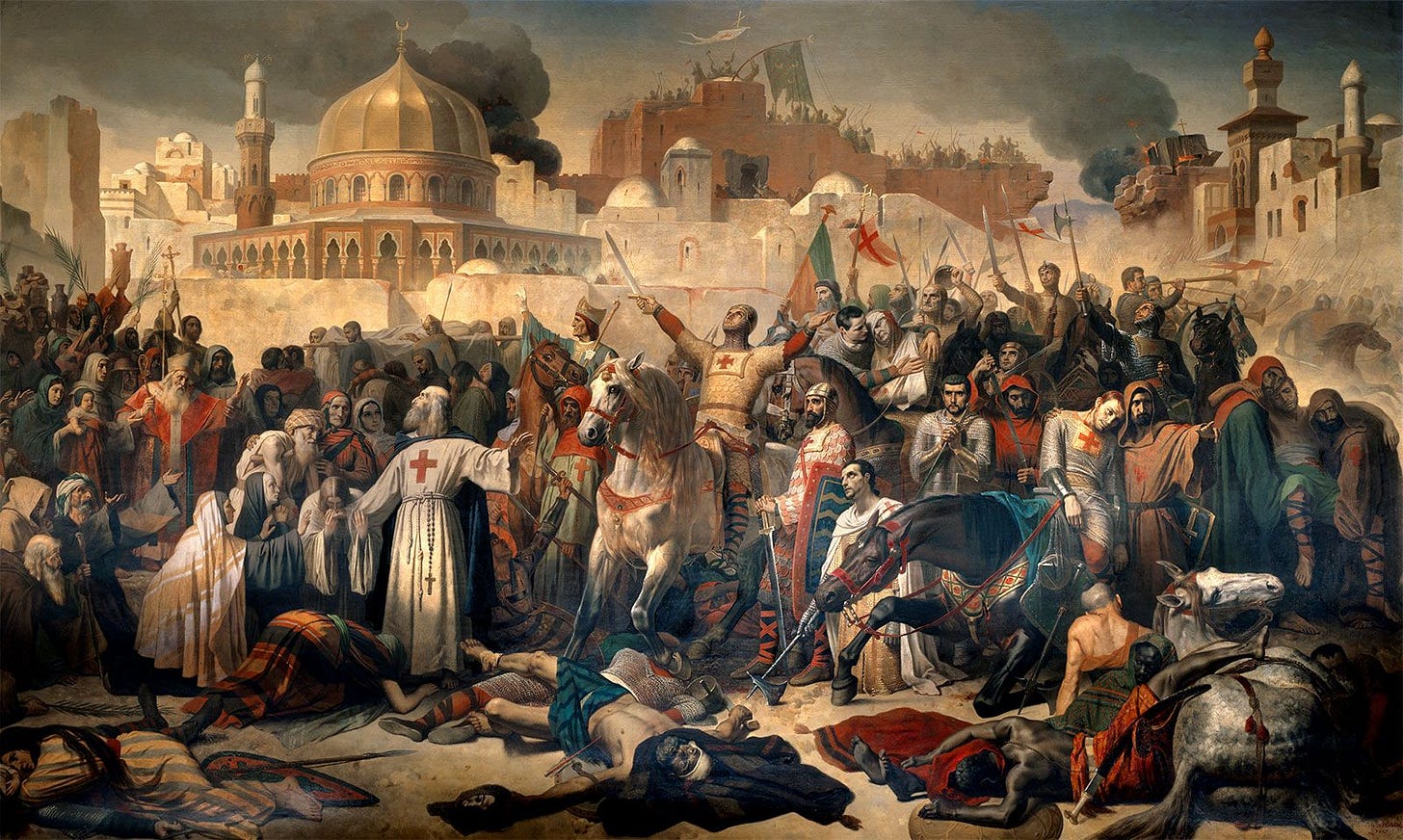
But cross the Mediterranean, and the exact same timeline reads like a chronicle of foreign invasion and eventual, hard-won restoration against the barbarous northerners. The dates do not change, but the adjectives do. Here is the history as it is remembered in the Levant… continue
Blog Roll
 Aletho News
- Iran warns ‘no point’ in deal with US if Israel remains unrestrained
- Ukraine as a laboratory of ‘techno-fascism’
- Desperate Starmer choosing piracy as distraction over UK crime crisis – Putin envoy
- The Crusades – colliding narratives
- Trita Parsi: Iran War Ends Today? Threats of Deporting Trita Parsi
- What Is SIDS?
- DHS docs: Govt bracing for nationwide anti-AI riots, preparing to crack down on dissent
- India signals rethink over West Asia
- Israeli Ex-Navy Chief admits massive damage from Iran missiles
- The strategic arsenal US lost in war against Iran – and why replenishment will take years
- If Americans Knew
- Did Trump just threaten a nuclear attack on Iran? Another merger for Israel-Firster David Ellison –Daily Update
- Israeli Firm Accused of Launching Smear Campaigns During US, European Elections
- As World Cup kicks off, Gaza amputee girls chase football dreams
- Oxfam: More Palestinians killed by Israel across West Bank in last 3 years than previous 17 years combined
- US-Iran ceasefire may be imminent, but will Israel blow it up? – Daily Update
- The Issue of Israel Is Ending Democracy In Michigan
- Israel is stealing homes, livelihoods, and lives in West Bank
- Gaza is not an aberration – Israel planned this genocide decades ago
- Israel is changing the face of Lebanon, mainstream media is normalizing it – 3 articles
- Genocide lobby benefits from EU anti-racist fund
- No Tricks Zone
- New Study: Significant CO2 Fluxes From Non-Volcanic Sources Are Largely Neglected In Carbon Budgets
- Women Climate Scientists Being Harassed, Insulted By Skeptics, Claims Berkeley Earth Researcher
- Germany’s Longterm Spring Climate Data Show “No Climate Trend”
- New Study: Solar Photovoltaic, Wind Power Fail To Meet Annual Energy Demands 62% Of The Time
- Germany’s Die Welt: “Too Much Is Too Much” … Green Energies Are Cannabalizing Each Other!
- Germany’s Ecological Holocaust… Once Fairy Tale Forests Getting Cleared For Wind Turbines
- A Grand Solar Minimum Has Arrived…Global Cooling Of At Least 1°C Is Expected By The 2030s, 2040s
- European “Expert Commission” Urges COVID-19-Like Global Climate State Of Energency!
- Real-World Observations Do Not Support The Position That Climate Change Is Human-Caused
- Germany’s AfD Party Calls Debunked Climate Scenarios “Greatest Fraud In Human History”
 Aletho News