France will be facing the Hague-based International Criminal Court (ICC) for alleged crimes against humanity over a series of nuclear tests it had been conducting in the South Pacific for some three decades.
A French Polynesian opposition leader said a complaint has already been filed to “hold all the living French presidents accountable for the nuclear tests against,” conducted against Polynesia – French oversees territory in the South Pacific.
“It’s with a great sense of duty and determination that we filed a complaint at the International Criminal Court on October 2 for crimes against humanity,” Oscar Temaru said at the United Nations.
“We owe it to all the people who died from the consequences of nuclear colonialism,” he added.
France carried out 193 out of 210 nuclear tests from 1960 to 1996 in Polynesia. For decades, it had claimed that the explosions were controlled and clean and denied its responsibility for the health and environmental impacts of the testing.
Back in 2013, declassified documents of the defense ministry however revealed that extent of plutonium fall-out from the tests was kept hidden.
According to the documents, plutonium fallout hit the whole of French Polynesia, a much broader area than France had previously admitted.
French daily Le Parisien wrote at the time that the documents “lifted the lid on one of the biggest secrets of the French army.”
French Polynesia with a population of about 290,000 people is best known nowadays for its tourist island of Tahiti, which was exposed to 500 times the maximum accepted levels of radiation.
“We see French nuclear tests as no less than the direct result of colonization,” Temaru said, adding the testing was imposed upon the islanders “with the direct threat of imposing military rule if we refused.”
Temaru said France has “ignored and shown contempt” for repeated offers since 2013 to come to the table under supervision of the United Nations.
Earlier this year, French Polynesia’s nuclear test veterans organization, Moruroa e tatou, said only if France increases its compensation efforts 100 times, it will become credible that it takes the problem seriously.
Marking the 52nd anniversary of the first of the weapons tests, the organization said in July that despite confessions from France it was working on compensation for victims of the weapons test, the process was not functioning as it should.
It said France has been considering only four cases this year, while 100 times more cases would have to be dealt with.
October 10, 2018
Posted by aletho |
Deception, Environmentalism, Militarism, Timeless or most popular, War Crimes | France, Polynesia, Tahiti |
Leave a comment
SYRIA, seat of an Islamic Caliphate. Syria, site of the Middle East’s newest liberal democracy. Syria, socialist paradise. Syria, a corrupt and murderous dictatorship that practices genocide. Syria, a failed state. Syria a state that is too strong. Syria, soon to be partitioned into ethnic enclaves. Syria, a pawn of Iran. Syria, a tool of Russia. Syria, a haven for terrorists that threaten our friends and way of life. Syria, where Saddam sent his fabled WMDs. In other words: Syria is whatever you want it to be. Syria, if it exists, apparently only exists to satisfy your desires, where you get to freely confuse where you think the world ought to go, with where it is going.
Syria, if you take at face-value any of the many authoritative North American and European pronouncements about “what needs to be done,” has seemingly joined the list of “disappeared” nation-states. It was a country made to vanish into thin air, like Libya, Iraq, and Yugoslavia before it. Anything goes when it comes to Syria: it can be whatever we imagine it to be. It was as if “Syria” was just a name for a template. We speak and behave as if it were first a tabula rasa—a clean slate—or more accurately, terra nullius—a land belonging to no one. It is land that belongs to no one, that is, until we arrive on the scene and forge our models for a new Syria. Syrians are not allowed to have their Syria until we first get a say on what Syria will be.
Syria Not For Syrians
Over the past seven years we have seen in virtually every side to the foreign debate about Syria’s present and future(s) an immense amount of apparently self-gratifying wishful thinking. We have witnessed the very real danger involved in the ideological mode of thinking, especially when the ideologies are backed by real material power and conveyed as action on the ground. Whenever we have the rare chance to hear any Syrians, they are instantly dismissed and disqualified by one side or another. We are happier dealing with a “Syria” that is a figment of our political imaginations, a projection of the discontent we have with our own domestic politics, a method for beating up all “enemies, foreign and domestic”. “Syria” is the plaything of those who are equal to any of our hedge fund managers: we pick a side, and bet on it. More than that even, “Syria” is a meeting ground for fantasy and political economy, and it’s a sign of just how ugly is the recolonization effort wrought by neoliberal globalization.
And it most definitely is the case that what we are dealing with here is globalization’s destruction of sovereignty, of national self-determination. How do we know that? Watch this: while there was no real debate about the US sending troops to Syria (where they can cancel out Syria’s sovereignty), there was instead massive, urgent, melodramatic panic about the US sending troops to its own border, where they could affirm US sovereignty. If a nation can send its troops to another continent, but not to its own border (i.e., stay at home), something is really wrong. Some must have wondered what US troops were doing on the US border, as if they naturally belonged in Syria instead. The jarring juxtaposition of the two contrasting stances came out in a single question by a reporter at a White House press briefing—a reporter who nevertheless failed to note the contrast:
“there seems to be a perception that, at times, the President makes announcements and then the White House has to come up with policy to match what the President said. Like with the talk about the military at the border, there weren’t really a lot of details about that at first. And with the issue with Syria, and him saying he wanted to, kind of, pull all the troops back”.
In another White House press briefing, reporters once again failed to notice the absurd contradiction between their thinly veiled criticisms of Trump’s desire to pull US troops back from Syria, while apparently complaining about the decision to send troops to the US border. The only way one can reconcile these two apparently contradictory positions is to recognize that they both reduce to a common denominator: the destruction of nations as viable entities. Any and all nations, everywhere, have been the target. Some were surprised to learn that this included the US itself.
Syria, likewise, is denied the right to defend itself. It has no right to its own territory. Israel is free to bomb at will, as are a range of NATO members, and the US can freely decide to make a presence for itself, to create “interests” on Syrian soil (which in principle, does not exist). When other nations send forces at the request of the Syrian government, then those nations suddenly have no right to be there. Why not? Because they are there precisely as a result of decisions made by the Syrian government, and Syria can have no government because it also has no soil. Who decided on this arrangement?
For globalization to work, it required a policeman. After all, neoliberals believe that states are still useful as law enforcers. This introduced a fatal flaw into the globalist agenda, which was pushed and enforced by states: not all states are equal in power, and thus the only reliable global policeman was the US. The US, some would argue, has no right to determine who crosses its borders, yet retains the right to decide on who is allowed across Syrian borders. That such arrangements are subject to a backlash in the US itself, the power core of globalization, is the main reason that globalization is in such extreme jeopardy.
For the globalists, Syria and the US are nonetheless alike in one key respect: they both belong to the rest of the world. What they are not allowed to belong to is themselves. The world the globalists tried to invent out of thin air was one of forced associations, unwanted encounters, and false dependencies. No wonder that the reactions have in some cases been so scathing, so filled with spite. If such reactions are deemed a problem, and if one wanted to avoid such reactions, then logically you would cease creating the causes of the problem. But the world imagined by globalists is never inhabited by real people; it’s a world where everyone is subject to “learned helplessness” and like a repeatedly abused dog learns to “just take it”—a world that is unreal, inhumane, and was therefore never sustainable.
Terra Nullius
This is how Sven Lindqvist explains the idea of “terra nullius” in his book, published in English in 2007:
“Terra nullius. From the Latin terra, earth, ground, land, and nullius, no one’s.
“Thus: no one’s land, land not belonging to anybody. Or at any rate, not to anybody that counts.
“Originally: land not belonging to the Roman Empire.
“In the Middle Ages: land not belonging to any Christian ruler.
“Later: land to which no European state as yet lays claim. Land that justly falls to the first European state to invade the territory.
“Empty land. Uninhabited land. Land that will soon be uninhabited because it is populated by inferior races, condemned by the laws of nature to die out. Land where the original inhabitants are, or can soon be rendered, so few in number as to be negligible.
“The legal fictions summed up as terra nullius were used to justify the European occupation of large parts of the global land surface”. (Lindqvist, 2007, pp. 3–4)
Syria was land not belonging to the Roman Empire, until it was. It is also land not belonging to the American Empire, and powerful interests in the US would obviously like to change that. Outside of the high echelons of the military-industrial-complex, other US interests have also vested themselves in Syria. A loose coalition has formed, ranging across from generals in the Pentagon right across to establishment media, freelance “journalists,” self-appointed humanitarian activists, and university-based anarchists and some Marxist academics. They all agree on one fundamental point: Syria can no longer belong to Syria alone; Syrian decision-making, and the right to make decisions about citizens on Syrian territory, is to be subject to some sort of veto wielded by foreigners, backed by US firepower.
For this mission of foreign ideological occupation to work, Syria first has to be symbolically and politically emptied. Only an empty zone can be so liberally filled with fantasy and spectral assaults: fabricated gas attacks, mysterious missile strikes in the dead of night, cities in ruins suggesting they were once occupied by a settled, peaceful civilization that has long disappeared, even mystery adversaries jamming US communications. The Onion, interestingly, had it right when in playing to the propaganda that has become the norm, it portrayed Syria as a land being trampled on by legendary monsters and super-human beasts, ruled by fears that “bombed-out buildings and blast craters could be harboring bands of angry scorpions, komodo dragons, mace-wielding cavaliers in full chain mail, or, as children recently swimming off the country’s coast discovered, giant piranhas”. Chemical weapons, the weapons of the new barbarians, are an essential feature of the kinds of made-up tales that are made to prevail in a frontier zone of projected fantasies of monsters. In the land of make-believe “evil,” Sadistic Arab “dictators” unleash troops powered by Viagra to engage in systematic rape, rip babies from incubators, threaten to massacre entire cities, and then wipe out communities with poison gas. Accusations we would never tolerate against our own, let alone treat credibly, are instead freely plastered on others. It’s amazing that in the new, fastidious and prickly racism-consciousness that prevails in North American media and academia, such routine colonial racism is instead still perpetuated, as much as the incessant myth-making.
Fantasy is useful in other ways: by dismissing the value of evidence, and replacing facts with belief, any accusations can be given the weight of “credibility”—but only if enough people have been successfully trained to mistake credibility for truth. What the US has developed, for example, is a fact-free, faith-based approach in its foreign policy rhetoric, one that is used to justify permanent US intervention. Why? Because there is no objective argument one can make for one country to occupy another. It’s not a matter of logic and rationality; it’s a matter of ideology and a thirst for power.
Having projected onto Syria an absence of “civilization,” this creates wide open space for demonization. Demonization is a valued part of Western myth-making structures, especially in justifying imperial domination. Demonization turns very human opponents into monsters (and they are referred to as such, as monsters, animals, and of course “evil”). Adversaries of the West are played up as villains in a morality tale, that always allocates to us—by default—the role of saviours and victors, if we will have our victory (as the late Charles Krauthammer put it, “The choice is ours. To impiously paraphrase Benjamin Franklin: History has given you an empire, if you will keep it”). We thus have these endless moral crusades on our part, where morality is used to mask politics.
Moral crusaders love it when in the distance they make out the outline of a new terra nullius on the horizon. Places like Syria offer the opportunity for adventure, to go out and exercise yourself, to use Syria as part of your own personal self-fulfillment, an object of your ambition and desire. Eurocentric missionary aspirations flourish in such contexts, robed as “humanitarian interventionism,” “internationalism,” “solidarity,” “civil society activism,” “democracy-building,” “conflict resolution,” “peace-building,” or just plain regime-change.
The paradox of foreign intervention is that it empties everyone, not just Syria. Britain and France earlier this year saw their foreign policy being taken over by the US, restricting any domestic parliamentary debate about the decision to militarily strike Syria, until well after the fact. The US was no exception: the decision to attack Syria in April of this year was done without Congressional approval. The process had been emptied of political representation by those elected and legally appointed to (dis)approve war-making, as dictated by the respective constitutions, which for a moment vanished. War, in violation of both international and domestic laws, damaged democracy in the US, UK, and France. This is what imperialism in the globalist age looks like, even when one of they key actors sometimes likes to sound like an angry anti-globalist.
The key themes of this renewed terra nullius are thus:
- land without a legitimate state to own it;
- civilization vs. barbarism (along with civilized vs. barbaric forms of violence, for example, Tomahawk missiles vs. nerve gas);
- demonization and dehumanization;
- a nation-state reduced to a “regime” which is reduced to one person who is reduced to a monster/animal; and,
- a fertile site for imposed models.
One question readers might ask is: why? Why should “terra nullius” or anything resembling the idea be in use here? One simple theory is that any society works with a finite set of cultural materials. These cultural materials can be reproduced, amended, extended, or reworded. We end up with multiple translations of a small set of original sources. Imagine that centuries after European colonialism began, we are still speaking of “civilization” vs. “barbarism,” in the very same terms. A second theory, that goes with the first, is that except in cataclysmic situations (which are extremely rare—the exception), real cultural change occurs only very slowly, at an almost glacial pace. Changes to our basic cultural materials do take place in our lifetimes, but often more in form and application than a change in the original “code”.
Moral Imperialist Economy
Whenever members of a society imagine the rest of the world as a mass of “problems,” and imagine themselves as possessing the “solutions” to those problems, what we have then is the structure for a relationship that involves a transfer of capital. The producers of problems owe a permanent debt to the exporters of solutions—ideally. Reality is different of course: this structural relationship of extraction needs to be maintained, and sometimes the maintenance costs exceed the profits. First, let’s look at some of the basic elements of the moral imperialist economy. Ideologically transforming Syria into a new terra nullius is a form of creative destruction (paralleled by real, military destruction), and as we should know, crisis always creates opportunity, and opportunity attracts opportunists.
Syria is a free for all for various patrons and clients. These new Wild Wests are a great place for freelancers of all kinds to upgrade their status, for example. Syria has thus been transformed into a Wild West of misinformation, of selective information, of forms of activism and a way to invest political interests in the creation of custom-made propaganda. Inevitably there are patrons for this or that stream of propaganda, whether it’s a news agency, the CIA, a NGO of some sort, or elements of “the crowd” funding one’s work through something like “gofundme”. The result is a kind of wild stock market for values of all kinds.
New commodities are produced by the new information warfare, designed to conduct war on the minds of all media consumers, whether of the established or social media kind (it makes little difference). One of the key new commodities is, of all things, the baby photo. Not just any babies though—no, these always have to be dead babies, sometimes mangled, sometimes partly decomposed, sometimes about to die, or those that have barely escaped death but are nonetheless permanently disfigured, burnt, or without limbs. These commodities are avidly traded by all sides. The open borders/refugee advocates have their photo of a dead Syrian child on a beach; the regime changers have pictures of child gas victims; and even the anti-imperialists have their photo of a little Palestinian boy, seized from a hospital bed, looking helpless moments before being beheaded by beefy bearded jihadists. Printing dead baby photos is like printing money. Such photos call the attention of powerful patrons, supposedly “provoked” to act when the photos are sufficiently publicized. When such patrons intervene, it further raises the value of such photos, virtually creating a demand for more. Now the most conclusive way to make one’s case “credible” is by flashing the appropriate dead baby photo. This commerce is part of the humanitarian trafficking that liberal imperial globalism encourages.
Wildly inflated numbers, numbers that go up, come down, that get divided, are indicative of the existence of this kind of stock market. Thus the debates over the number of civilians “killed by the regime,” and how often the number is inflated to include all the soldiers and civilians killed by those opposed to “the regime”. So everyone who has been killed in Syria was supposedly killed by the Syrian state—that’s convenient, because after all we have the moralistic demon tales that instruct us that “Assad is a monster,” and just like a monster, he “kills his own people”. (Funny, isn’t it, how easily we always manage to imagine these low-down Third World leaders as sub-humans.)
Status upgrades come easily: take the appropriate moralistic, virtuous stance in front of the right audience—by just saying that you believe in X or Y—and lo and behold you have achieved a status upgrade. You are one of the good people, a trusted source, a credible figure, because you said the right things to the right people in the right place at the right time. This internationalized form of virtue signalling is almost as good as printing money, and nearly identical to it in its most basic sense.
Like in the Wild West, betting in the saloon is also common when it comes to Syria. The US State Department under Obama placed all its bets on some entity they invented, which they liked to call “moderate rebels” (why not “respectable terrorists” or “polite criminals”?). They lost. Numerous left-wing academics signed on to regime change years ago, and because they only pretend to be seasoned analysts for their day jobs, they did not foresee the collapse of the anti-government forces in Syria. That list included noted “post-colonial” scholars and anthropologists, united in their belief in “democracy promotion” and remaking Syria into something palatable to them, with the right leaders in place. Five years later and a smaller group—including feminists like Gloria Steinem and Judith Butler, anarchists like Noam Chomsky and the anthropologist David Graeber, the Marxist David Harvey, and advocates of recolonization like Michael Walzer—placed their bets on socialist Kurdish militias, presumably increasing the value of their bet by the important sign value of their brand name authority. Ironically, in the process of re-imagining legendary Rojava as the site of a second Spanish Civil War, they were openly collaborating with Donald Trump (not naming him directly, since “the US government” was more convenient). These signatories were thus complicit with the very same commander-in-chief of the armed forces they were calling on for support of Syrian Kurds. They wanted “the US government,” whose President is Donald Trump, to impose sanctions on Turkey, and to develop a foreign policy that put Kurdish interests at the forefront. You can be sure that, elsewhere, in front of different crowds, they return to “the Resistance” by puffing up their little chests and sounding all “anti-Trump”—but when it came to cheering their favourite band of ethnic anarchists, they could dispel with appearances. Less “prestigious” characters, publishing in a less “prestigious” outlet, countered the call to “defend Rojava”, a call which appropriated “progressive” politics for the cause of imperialism (reigniting an old marriage). (David Harvey, by the way, having cashed in on abundant sales of his volume, The New Imperialism, has recently changed his mind: he has decided that imperialism is merely a metaphor, “rather than anything real”. Out of curiosity, we have to wonder if “capitalism” is also a metaphor, rather than anything real, seeing how Marxists have linked capitalism with imperialism. Perhaps even socialism is a metaphor, rather than anything real.)
(Recommended here is “The Fake Left at the Left Forum” by Danny Haiphong, Black Agenda Report, June 13, 2018, and “Antifa or Antiwar: Leftist Exclusionism Against the Quest for Peace,” by Diana Johnstone, Consortium News, May 21, 2018.)
Of course activists, academics, and the freelancers that make all the Twitter noise, are just bit players in the drama of their dreams. Some of the really big heavy hitters are the various weapons manufacturers, politely termed “defense contractors,” and their army of lobbyists in Washington, DC. For them, any sniff of a chance for permanent occupation smells like permanent war, and thus permanent profit, paid for by debt in the present to be paid by future tax-payers. Advocates of permanent occupation concede only one alternative to occupation: regime change, thus recolonization, which has the same effect as permanent occupation. Advocates include beneficiaries of status upgrades like Senator Lindsey Graham, converted into the de facto US Secretary of State by his friends at Fox News and CNN.
For powerful patron states like the US, “chaos” offers valuable opportunities—in the technocrats’ language, this is duplicitously referred to as “preventing chaos”. The official assumption, intended for popular consumption, is that “chaos” predates foreign intervention. Remember: other peoples are producers of problems, chaos is thus a permanent and normal state for them. Add to the assumption that chaos predates US intervention the assumption that there is no Syrian government (the officially existing one is not acceptable to the US, so it vanishes), then Syria becomes the name for a wide-open wilderness. That means the US gets to train and reinforce “local forces”—like the separatists cheered on by a select group of leftist academics. But this all costs money, what to do? Here comes Trump’s transfer of costs for extracting capital: emphasis is placed on Saudi Arabia and the Gulf States to pay for the costs of US occupation and proxy-training in Syria. This model is essentially one that places the US in the role of an international mercenary. Where such support payments are not forthcoming, then there is the fallback of debt-financed US military spending. The loans are provided by a range of creditors, domestic and foreign, including foreign central banks. Many states thus own US debt, and what we see here is essentially the rest of the planet financing its own domination by a US debt-fuelled warhorse. (This is one of the “secrets” that ought to inform revised and reworked theories of imperialism: empires function best and last longest when the ostensible objects of imperial domination actively collaborate in supporting empire. Theories uninformed by this observation can become trite conspiracy theories of imperialism.)
To maintain the value of US “investment” in Syria, the US needs to create a need for protection, while reducing the value of alternatives (competitors). One way to create a need for protection is to create that crisis that would seem to beg for it: phony gas attacks, like those happening at the end of a week of public debate that erupted after Trump announced he wished to withdraw US forces from Syria soon. Another means for bolstering US intervention in Syria is by invoking the threat of Iran.
As mentioned at the start of this section, the structural relationship of extraction needs to be maintained, and sometimes the maintenance costs exceed the profits. For example, “humanitarian activists” who plead for greater accessibility to refugees, disconnecting the fact of their homelessness from our own military interventions which uprooted those people in the first place, is one way that costs can exceed profits. Humanitarians need to prove that they are needed, and refugees prove the need. However, the backlash from citizens in receiving countries who realize that refugee entrants, in large enough numbers, will usher in a new wave of de facto austerity measures as health, education, and public housing come under pressure, represents a threat to humanitarians and their careers. With humanitarian profit-seeking threatened, one way to respond is to caricature critics as xenophobic haters, which further inflames opposition to their project—few people accept having their pockets picked and being insulted. The result is a generalized closing of doors and the rise of parties that demand an end to foreign occupations.
Finally, I do not mean to imply that all imperialism reduces to economic factors alone. There are several different types and methods of imperialism, and sometimes military imperialism is decidedly uneconomical, just as economic imperialism can appear totally pacific. Again, trite conspiracy theories about the presence of oil pipelines, or plans for building them—in other words, that there must always be some wonderfully profitable economic opportunity for imperialism to make sense—are sometimes wrong. What I am suggesting is that all types of imperialism must involve loss for the dominated, there is a transfer of values and costs, and a system of extraction, such that every type of imperialism could be analyzed as if it were economic in nature.
Dreaming of Power, Projecting Our Fantasies
No doubt most citizens in places like the US and Canada do not spend much time, or any time, worrying about Syria—and that is probably a good thing. If only their example could be followed by those with much greater power, or those with much louder voices.
One of the striking features of the Syrian war are those individuals outside of Syria who have decided to make Syria their business. This goes well beyond personal curiosity and a desire to learn about a different place—it’s instead something which is invested with a thick desire to turn Syria into something which they want and currently lack. Syria is experienced vicariously and voyeuristically. Some are learning what they can because they wish to stop our intervention in Syria, and in the process they are learning a great deal about their own society. Others, however, engage in no such reflection.
For those outsiders who would presume to have a say in Syria’s future, Syria is required to put on a pleasing performance. Syria has to perform like a “democracy” before it can be left alone; some on the left instead argue it is already democratic, and see in Syria the salvation of a true liberalism. What unites both is the assumption that Syria is culturally empty: it can create nothing of its own. At best, Syria and other places like it (target nations) are pictured as mere fertile ground ready to be planted with foreign seeds. The only job locals have is to be receivers of imports. Why would a country with a civilization that long predates either Karl Marx or Adam Smith not have a right to develop its own approaches?
As I wrote about elsewhere earlier this year, there is an internal debate among North American leftists as to whether Syria’s Ba’athists are “true socialists”. As I wrote then,
“does Syria exist to satisfy dogmatic demands in exchange for certification from those US Marxists who have never held power and thus know nothing about actual responsibility?… US Marxists in particular have an overweening sense of their centrality to the world, when they are beyond marginal at home. Perhaps their role as peripheral spectators in domestic politics is what has them casting about overseas for a mission to fulfill their frustrated ambitions”.
One would think Syria had submitted an application for a job, and “history” put us in place to acts as its judges. If Syria is not a “democracy,” or is not “socialist,” what then? Does it get destroyed as a result? I would hate to be on the receiving end of such “solidarity” and I would pray that “internationalists” learn the virtues of minding their own business.
“We’re not particularly keen to be friends with you. We’re not begging you for friendship. We want normal, civilized relations—which you arrogantly refuse, disregarding basic courtesy. You are misguided to think you have friends. Your so-called friends are just those who can’t say no to you. This is your only criteria for friendship”.—Vassily Nebenzia, ambassador of Russia to the UN Security Council, responding to US ambassador Nikki Haley on April 9, 2018.
October 6, 2018
Posted by aletho |
Ethnic Cleansing, Racism, Zionism, False Flag Terrorism, Illegal Occupation, Mainstream Media, Warmongering, Militarism, Progressive Hypocrite, Timeless or most popular | France, Syria, UK, United States |
Leave a comment
Pregnant women in the United States could be exposed to ionizing radioactivity from nuclear waste shipped around the nation, a radioactive waste watchdog told Radio Sputnik’s Loud & Clear this week.
Given the number of shipments of nuclear waste traveling around the country, “Pregnant women and the fetus and the womb should not be exposed to any ionizing radioactivity if it can be avoided. This is going to happen. Given these kinds of shipment numbers — many thousands — there’s going to be exposures to pregnant women in this country,” says Kevin Kamps, radioactive waste specialist at Beyond Nuclear.
Nuclear waste is shipped past Americans all the time without many of us knowing it. Even waste passing by on a train is emitting radioactive particulates, and some of those can have negative consequences over time.
“It’s like an X-ray. It will cause harm,” Kamps said. Nurses often ask patients to wear protective aprons while taking X-rays to minimize exposure to the radiation, since X-rays are technically a carcinogen according to the World Health Organization. Medical News Today has reported that approximately 0.4 percent of cancers in the US are triggered by CT scans. (CT scans use X-rays and computer imagery to generate pictures of the body to help doctors with diagnoses.)
Transporting nuclear waste products is a risky business for public health outside the US, too.
“If you have exterior, or external contamination, on the shipment — which has happened hundreds of times in France, 50 times in the US that we know of — those dose rates increase significantly. In France, on average, it was 500 times the permissible [amount of contamination] on one-third of the shipments. In one case it was 3,300 times [the] permissible [amount]. So if that’s one to two chest X-rays per hour, times 3,300 times permissible, that’s 6,600 chest X-rays per hour,” Kamps told Loud & Clear.
October 5, 2018
Posted by aletho |
Environmentalism, Militarism, Timeless or most popular | France, United States |
Leave a comment
A so-called “counter-terror” operation, involving around 200 policemen, is underway on Tuesday in France, with the police forces raiding the headquarters of Islamic organization Centre Zahra France in the country’s north, France Info radio station reported, citing the prefecture of the department.
Centre Zahra France is a Shiite organization, known for its anti-Zionist rhetoric, namely, in social media.
Eleven people were detained in the raid in the commune of Grande-Synthe, a suburb of the port city of Dunkirk, local media reported on Tuesday.
“This morning, starting from 6 a.m. [local time, 04:00 GMT], the national police has been carrying out an operation in the Grande-Synthe commune, Nord department. The operation is being conducted within counter-terrorism efforts… Centre Zahra France’s activity has been followed up closely due to the fact that its leaders grant support to a number of terror organizations,” France Info radio station reported, citing the Nord prefecture’s statement.
The police have also raided 12 homes of the Centre Zahra France’s major leaders.
October 2, 2018
Posted by aletho |
Civil Liberties, Ethnic Cleansing, Racism, Zionism, Full Spectrum Dominance | France, Human rights |
Leave a comment
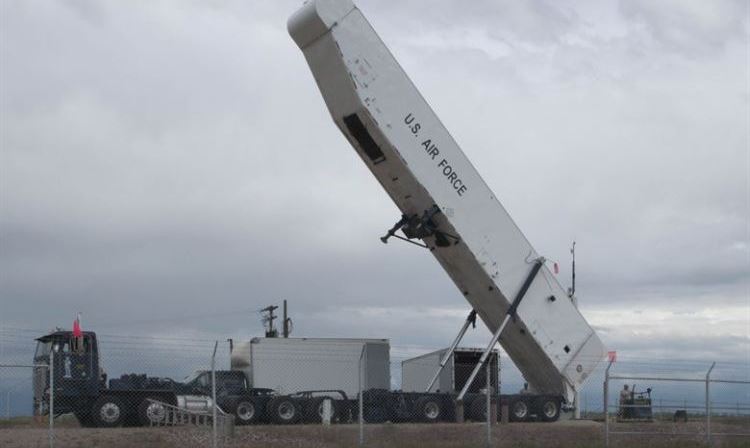
There have been ups and downs in the relationship between Russia (the Soviet Union) and the US, but both nations have become accustomed to the fact that their arsenals of offensive nuclear weapons are under the control of an agreement to prevent an arms race in this area. Some type of treaty has been in place since the Partial Nuclear Test Ban Treaty was concluded in 1963. Since 1972, when the first Strategic Arms Limitation Talks (SALT I) agreement was signed, there have always been negotiated constraints on nuclear arsenals. But today, there are ominous signs that the system that has worked so well to push the superpowers back from the brink of the nuclear abyss is being unraveled.
Andrea Thompson, Under Secretary for Arms Control and International Security, speaking before a Senate Foreign Relations Committee hearing on Sept. 18, claimed that Russia’s new strategic weapons that were announced by President Vladimir Putin last March were an obstacle to Washington’s agreement to extend the New START treaty. She also asserted that the issue has not been discussed through the formal New START process. She did not explain why not. The official said the final decision had not been made as yet and, “All options are on the table.” The same applies to the other remaining treaties that Washington is accusing Moscow of violating.
The options under consideration are: withdrawing from the New START; renegotiating the provisions related to the verification process; or signing another treaty instead, such as the 2002 Moscow Treaty or the Strategic Offensive Reductions Treaty (SORT). The undersecretary said that the US administration wanted Russia’s recently unveiled strategic nuclear weapons to be included in the count.
Negotiations are possible over the issue of the new weapons that are being tested or are already part of Russia’s arsenal. Moscow has been calling for a strategic dialog for quite some time, and Russia is not to blame because Washington is reluctant to start the process, whatever its motivation. A duplication of the 2002 treaty is unacceptable. It has already been finalized. No such radical reduction is possible without other nuclear states joining in, and they are not doing so. It’s really hard to understand why the undersecretary would bring this up, knowing perfectly well the proposal would have no chance.
David Trachtenberg, Deputy Undersecretary of Defense for Policy, also insists that the extension of New START was uncertain, despite the fact that on-site inspections and monitoring were useful.
The Senate hearings showed that the lawmakers are divided on the future of arms control and are prone to putting the blame on Russia for violating each and every agreement in existence without taking a proper look at what the US is doing. There is slim chance of an extension of the New START and hardly any prospects for a new deal.
The New START will expire in 2021 unless extended by agreement of the US and Russian presidents or replaced by a follow-on treaty. The US and Russian presidents discussed the New START during a phone conversation in January and at the Helsinki summit in July, where the Russian leader suggested that the parties thoroughly review all the components of the arms-control regime, including New START and the INF treaty, the 2011 Vienna Document on confidence-building measures in Europe, and the Open Skies Treaty. After meeting Nikolai Patrushev, the head of Russia’s Security Council, US National Security Adviser John Bolton said the extension of the New START was far from a slam-dunk decision. Meanwhile, the United States is moving ahead and designing a new ground-based missile that is in open violation of the 1987 Intermediate-Range Nuclear Force (INF) Treaty.
The long-range Kalibr sea-based cruise missile that was added to the arsenal of the Russian armed forces in late 2017 would violate the presidential nuclear initiatives (PNIs) of 1991 if it were equipped with a nuclear payload. Technically, it is capable of carrying a nuclear warhead but it does not. Russia’s non-strategic arsenal is large and sophisticated enough as it is — there is no need to violate its obligations under the PNIs. The US has a great numerical advantage in sea-based long-range missiles, and there is no verification mechanism in place to ascertain whether or not they are equipped with nuclear warheads.
The US has always been reluctant to discuss ways to enhance the PNIs by adding verification measures. The long-range cruise-missile capability demonstrated by Russia’s Navy during the Syrian conflict came as a surprise, but this does not mean it is a violation. Things change and it’s only natural to adapt to a new reality. It’s widely believed that the best way to tackle the problems related to national security is through talks, but the US administration and many people in Congress see it differently.
There is something important to remember — the US sea-based nuclear-tipped TLAM/N missiles are still part of the US arsenal, and there is no way to make sure they are not clandestinely installed on nuclear attack submarines. This issue could be discussed separately from the strategic nuclear agenda. The problem cannot be neglected. No one is standing in the way of launching a dialog. President Bush and President Gorbachev managed it. In theory, President Trump and President Putin could do the same thing, but the American leader should be prepared to be attacked for dealing with Russia. Those in America who stand in the way of an arms-control dialog between the two leading nuclear powers are actually undermining the country’s security, but they will do it anyway in order to pursue their own political ends, because they are filled with hatred against both the US president and Russia.
The 2018 Nuclear Posture Review states that the United States will pursue a nuclear-armed, submarine-launched cruise missile in order to “provide a needed nonstrategic regional presence, an assured response capability.” How does this jibe with the fact that the PNI is still in effect? It looks like the initiatives’ future is as uncertain as the fate of other treaties.
Of course Russian strategists have never forgotten that the US still has 50 empty silos ready to hold ICBMs, with several hundred additional warheads that are also in storage and could potentially be loaded.
There are only three years left until the New START expires. The experience of history demonstrates that that is hardly enough time to prepare a new treaty that actually has no chance of being ratified by the Senate in an era when the overall bilateral relationship is at its lowest ebb. The US still has no clear idea of what its future nuclear triad will be like. Discussions are underway. All we know is that it is investing more than $1.2 trillion over the next 30 years to modernize its aging nuclear forces, which will include new ground-based missiles, new missile submarines, and a new bomber.
No major arms-control treaty will be concluded until the administration and Congress know exactly what components will be included in the arsenal and what programs are to be implemented to achieve the established goals —once all the assessments and estimations are complete and the guideline documents in place. Thus, an automatic five-year extension is the only hope for the New START’s survival. That could be accomplished through a simple executive agreement. Without a New START in effect, other agreements, such as the INF Treaty and the PNIs, have no chance. The very real prospect of an end to arms control and the non-proliferation regime is looming. That’s something leading experts in Russia were warning about as far back as 2015. Very serious discussions must be launched right now in order to prevent such a scenario. It’s a scary prospect!
The good news is that the patient can still be saved. There is still a little time left, although not much. There are no options but for Russia and the US to put their differences aside, forget about Ukraine, Syria, trade wars, and other issues that divide the two nations and concentrate on ways to save arms control or whatever is left of it. With their relationship at its lowest point since the end of the Cold War, it is even more vital to keep the nuclear risks in check and prevent a new nuclear arms race. Russia (Soviet) and US officials have always emphasized that any plan that keeps nuclear weapons under control and subject to proper verification procedures is a better option than an unfettered arms race. The US administration and its lawmakers seem to disagree.
September 26, 2018
Posted by aletho |
Militarism | France, INF treaty, Israel, Russia, START, UK, United States |
Leave a comment
French politician Marine Le Pen said a court ordered her to undergo psychiatric evaluation over a series of images she posted on Twitter showing Islamic State executions. She slammed the order as a “hallucination.”
The president of France’s National Rally (formerly Front National) has released an order saying it comes from the magistrates in Nanterre near Paris, calling on her to “undergo a psychiatric examination.”
“For denouncing the horrors of Daesh (Islamic State/IS, formerly ISIS) by tweets the “justice system” has referred [me] to a psychiatric assessment. How far will they go?!” she tweeted in response.
The 2017 presidential candidate denounced the order as “a hallucination,” saying: “This regime is really starting to scare [us].”
French major outlet BMFTV, which also broke the story, said that the procedure was in fact a “common” occurrence. The comment did not go down well with Le Pen though, who branded the claim “a lie.” Such an examination is required of “pedophiles or [those with] sexual deviance,” she argued.
In December of 2015, Le Pen tweeted three pictures of killings carried out by IS terrorists accompanied by the text “Daesh [Arabic term for ISIS] is THIS!” The tweets had been a response to journalist Jean-Jacques Bourdin, who compared Le Pen’s nationalist rhetoric to that of the Islamic terrorist group.
One of the pictures showed the body of James Foley, whom the extremists beheaded in August 2014. Back then his family said they had been “deeply disturbed by the unsolicited use of Jim for Le Pen’s political gain.”
Le Pen later deleted the images. Speaking to French media earlier this year she said that she is being charged for “having condemned the horrors of Daesh.”
If convicted, the politician faces a maximum punishment of a €75,000 fine and up to three years in prison.
A number of politicians have lambasted the judges’ decision towards Le Pen. According to National Assembly member Gilbert Collard, the order simply means “the psychiatrization of political opinion.”
Italian Deputy Prime Minister Matteo Salvini also took to Twitter to express support for the French politician. “A court orders a psychiatric assessment for Marine Le Pen. Words fail me! Solidarity with her and with the French who love freedom!” he wrote.
This is not the first time Marine Le Pen has locked horns with the authorities. In 2017, roughly two months before the presidential election, she was summoned by judges for alleged misuse of EU funds. The court said that Le Pen’s staff was fictitiously employed at the European Parliament as assistants. She denied the allegations.
This July, French judges blocked €2 million of subsidies to Le Pen’s party. Le Pen condemned the move as “a blow to democracy,” since withholding the funding would likely result in her party becoming defunct.
September 20, 2018
Posted by aletho |
Civil Liberties, Full Spectrum Dominance | France, Human rights |
Leave a comment
A Russian military Il-20 aircraft with 14 service members on board went off the radars during an attack by four Israeli jets on Syria’s Latakia province, the Russian Defense Ministry said.
Air traffic controllers at the Khmeimim Air Base “lost contact” with the aircraft on Wednesday evening, during the attack of Israeli F-16 fighters on Latakia, said the MOD.
Russian radars also registered the launch of missiles from a French frigate in the Mediterranean on the evening of September 17.
Fourteen people were on board the plane at the time of the disappearance. A search and rescue mission is underway.
The Ilyushin 20 (IL-20) surveillance turboprop plane is an Electronic Intelligence (ELINT) platform, equipped with a wide range of antennas, infrared and optical sensors. The aircraft’s SLAR (Side-Looking Airborne Radar) and the plane’s satellite link allows the Russian military to monitor Syrian skies in real time.
An hour-long attack on Latakia began around 10 pm local time, and targeted a power station as well as two facilities belonging to the Syrian military. Syrian officials said the attack was “foreign” and came “from the sea,” but could not initially confirm rumors that Israel was behind it. Seven people were injured in the attack, according to Syrian officials.
While the Russian military said it recorded four F-16 Israeli jets over Syria at the time of the attack on Latakia, the IDF has refused to comment on the report.
The attack on Latakia came just hours after Russia and Turkey negotiated a partial demilitarization of the Idlib province, which is the last remaining stronghold of anti-government militants, including the Al-Qaeda affiliate Hayat Tahrir al-Sham (also known as the Jabhat Al-Nusra).
READ MORE:
Russia detects missile launches from French frigate off Syria’s coast in Mediterranean – MoD
September 17, 2018
Posted by aletho |
War Crimes, Wars for Israel | France, Israel, Russia, Syria |
Leave a comment
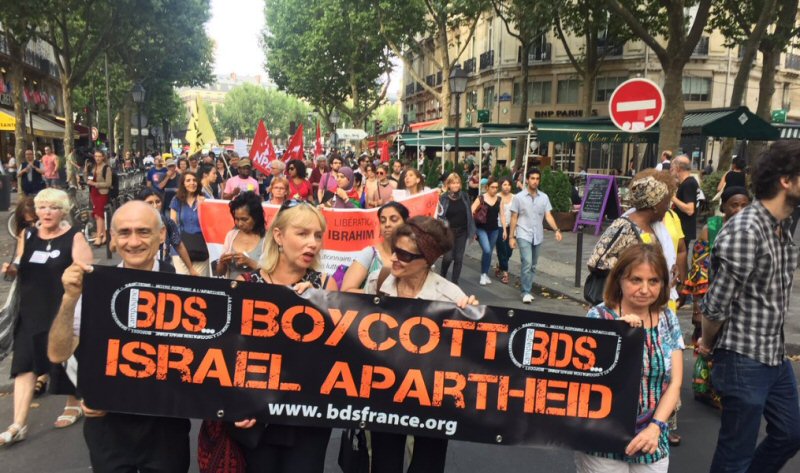
HelloAsso, a French company that provides online payment services, has rejected pressure by Israel lobby groups to shut down the accounts of two French groups which support the BDS movement for Palestinian human rights. HelloAsso will continue to provide services to both Association France Palestine Solidarity (AFPS) and BDS-France.
HelloAsso publicized its decision in a tweet explaining that it supports the right of citizens to call for BDS as part of freedom of expression.
In 2016, the European Union stated:
“The EU stands firm in protecting freedom of expression and freedom of association in line with the Charter of Fundamental Rights of the European Union, which is applicable on EU Member States’ territory, including with regard to BDS actions carried out on this territory.”
Translation of HelloAsso tweet from French original:
[…] “HelloAsso is an apolitical platform that does not take any position regarding the claims of the BDS movement. HelloAsso nevertheless considers this movement as within the realm of free expression and not as discriminatory or antisemitic.
HelloAsso’s position is supported by the European Union, which has clearly stated it favours protecting freedom of expression and association, including the right to advocate for BDS .
Therefore, the HelloAsso account of AFPS (Association France Palestine Solidarity) will not be removed.
To all those who criticize us for hosting these organizations, we respond that the conflation that allows attacks on these organizations is dangerous because it conflates antisemitism, which we condemn without ambiguity, and criticism of the state of Israel, which is a political opinion. This freedom of expression is a fundamental right.
Since its creation, HelloAsso has striven to support freedom of association and to protect the right to freedom of speech because we are a platform that is committed to the model of [non-profit] association and at the same time apolitical, open and enriched by differences of opinion, a reflection of our society.”
The Palestinian BDS National Committee (BNC) is the largest coalition in Palestinian civil society. It leads and supports the global Boycott, Divestment and Sanctions movement for Palestinian rights.
September 12, 2018
Posted by aletho |
Civil Liberties, Ethnic Cleansing, Racism, Zionism, Full Spectrum Dominance | European Union, France, Human rights, Israel, Palestine, Zionism |
Leave a comment
There is a direct link between Britain’s sensational allegations against Russia in the Skripal affair and NATO’s losing covert war in Syria.
That’s not just the opinion of critical observers. Britain’s ambassador to the United Nations made the explicit link when she called an “emergency meeting” of the Security Council earlier this week.
The Security Council meeting was convened only hours after British counter-terrorism police released video images claiming to identify two Russian men, whom it said were responsible for the alleged poison assassination attempt on former Russian double agent Sergei Skripal in England earlier this year.
The council meeting also followed swiftly on the heels of British Prime Minister Theresa May telling her parliament that the culprits were Russian military intelligence officers acting on orders from the Kremlin. May did not give supporting evidence. It was bald assertion.
In this short clip, Britain’s envoy to the UN Karen Pierce tells reporters the rationale of the British government in convening the emergency session at the Security Council. The envoy reveals more than she intended.
She says that the United Kingdom and its allies would “continue to contest the Russian view of the world in which their state operatives can carry out these sorts of attacks [in England] and can encourage and support the Syrian authorities in their attacks on civilians.”
Pierce added: “So this is actually a continuum, if you like, of contesting that view of the world where you can act outside the norms of international rules and civilized behavior.”
Evidently, the British government is trying to criminalize both Russia and Syria at the same time, over the same alleged crime – unlawful use of chemical weapons.
That would account for why the British authorities have been unduly hasty in accusing the Russian state of culpability in the Skripal affair. By undermining and smearing Russia as a “pariah state”, it is then possible to stifle Russia’s crucial military support for Syria. This is especially urgent given the juncture in the Syria war where NATO-backed militants are staring at final defeat.
The US, Britain and France have all recently threatened to use military power against the Syrian government forces “if” the latter launch chemical weapons attacks. That of course is a cynical pretext for the NATO states to find a legal cover for aggression against Syria.
The allegations of “imminent” chemical weapon use by the Syrian government are also baseless since Damascus no longer possesses any such munitions, or indeed has any military need for such weapons.
What the Skripal affair is therefore trying to do is inculcate in the public mind that Russia has no scruples about using chemical weapons to kill people, which in turn reinforces the notion that Moscow’s Syrian ally also has no scruples about killing people with toxic materials.
The NATO claims of Syrian national forces using chemical weapons have been shown to be false. In recent days, Russian envoy to the UN Vasily Nebenzia demanded that the US present details of a Pentagon target list of chemical weapons sites in Syria. The US balked.
By contrast, there is a healthy skepticism among the Western public about official allegations against the Syrian government. Pink Floyd’s legendary singer-songwriter Roger Waters speaks for many when he recently called out the NATO-backed so-called rescue group, the White Helmets, as being implicated in orchestrating chemical attacks for propaganda purposes.
In order to overcome the propaganda problem of demonizing the Syrian government and giving itself a pretext for launching military strikes on Syria, the NATO powers therefore have to boost their flagging “false flag” narrative of chemical weapons responsibility.
By criminalizing Russia for allegedly using chemical weapons “on the streets of Britain”, it is a ploy to augment the dubious narrative criminalizing Syria.
Here is British envoy Pierce speaking again: “The reason the Security Council has not been able to act on CW [chemical weapon] use in Syria is because of Russia. There is a circularity here. Russia is the key to upholding the universal ban on CW use. And the world would be better if Russia would join us in making that ban absolutely watertight.”
Britain’s use of the word “circularity” is certainly apt – albeit for a completely different reason. The actual circular logic is to criminalize both Russia and Syria over chemical weapons. Russia, it is calculated, will then not have the authority to use its veto power at the Security Council in order to prevent the three NATO powers on the council from launching their much-desired military attack on Syria to salvage their losing covert war.
The reckless haste by which the British authorities are accusing Russia over the Skripal affair – a haste which makes a mockery of legal due process and diplomatic norms – can plausibly be explained by the urgency of the NATO powers to free up their military plans on Syria.
How can the release of video images allegedly of two Russian nationals in Britain be possibly attributed to the Kremlin? Two Russian men – if indeed that is genuine information – are supposed to be “compelling evidence” that Russian President Vladimir Putin ordered an assassination. It is a preposterous leap of imagination and a travesty of legal process, but it is revealing of an execrable British prejudice of Russophobia.
One possible theory in the Skripal affair is that the two alleged Russian men were members of organized crime. Reports emerged this week that former Russian intelligence agent Sergei Skripal was working with Spanish state security services to crackdown on Russian underworld gangs. It is possible that the gangs uncovered Skripal’s meddling in their illicit business model, and simply sent a couple of heavies over to Britain to deal with him. But how such a hypothetical account can be twisted by the British authorities to be “proof” of Kremlin involvement is a telling question.
It is significant that the British authorities have flatly refused requests from the Russian side for information to identify the alleged Skripal hitmen. For example, British regulations require fingerprints to be submitted by all visitors to the country. Why have the British refused to give fingerprints to Russian authorities which could then lead to an identification and perhaps explanation of the two alleged suspects?
The British don’t want to know the truth, because their official narrative of criminalizing the Russian state is the imperative one. And that is because of the urgency for NATO to find a legal, political cover for its military aggression against Syria.
September 10, 2018
Posted by aletho |
False Flag Terrorism, Russophobia, Timeless or most popular | France, NATO, Syria, UK, United States |
Leave a comment
There are worse, more dangerous endeavours. Ride a tiger, steal cubs from she-bear, walk a high voltage wire. Doubting the Holocaust is slightly less perilous. The doubters found themselves invariably out of job, oftentimes in jail, rarely killed. This is the dogma-Mother-of-all-dogmas, and Jews, the priesthood of New World, are attending to its pristine inviolability.
Nowadays, one may openly doubt the Crucifixion and Resurrection or (maybe) challenge the founding myths of Israel. Yet the cult of the Holocaust retains a unique, court-enforced prohibition against any investigation that might cast a doubt on its sacred dogma. Dogmas have a way of attracting critical minds. And critical minds step forward, despite the inherent danger.
Ron Unz, this kamikaze of critical mind from California, has stepped on the third rail knowingly, in full awareness of the consequences. He did not stop at doubting the established mantra, he also published and made available to readers and internet users some more important books on the subject.
H dogma, discovered Unz, came into existence years after WWII, when people with first hand knowledge of the events were already dead or retired. While the memory was still fresh and pristine, the Jewish Holocaust was unknown, and the very word Holocaust was used in reference to the fiery death of Dresden and Hiroshima, the ultimate Anglo-American crimes.
Unz provides some historical meat to the fearless group of H deniers. Indeed, the H denial had been formed in France, under influence of a French communist and a survivor of Nazi camps Prof Paul Rassinier.
Some deniers were men of Right, some favoured Nazis, like Ernst Zundel and his spouse Ingrid Zundel, the great Prof Robert Faurisson was a Vichy sympathiser, but otherwise H denial had been formed by the Leftists.
This is a good time and place to mention the recently deceased Prof Serge Thion, whom I knew personally. Tall and handsome, a successful man with strong scientific and Leftist credentials, Thion supported the Vietnamese and the Algerians who fought against French colonialism; he occupied a prominent place in French academe and administration, but sacrificed it all and became a refugee and a fugitive from ‘justice’ for his strong position on H denial. He was always on the run from France to Italy to SE Asia, but while running, he also managed a site full of forbidden stuff.
My good friend and an important French and Spanish poet Mme Maria Poumier was/is a Communist, and she lived for some ten years in Cuba. She introduced me to Roger Garaudy, an old Communist, a friend of Arabs and Muslims, the man who tried to bring together Christianity and Communism, and embraced Islam in his endless religious search. Garaudy connected the Holocaust cult with Zionism in his book.
The great stand-up black artist, the funniest French comedian Dieudonne M’bala M’bala, a giant son of a Cameroonian and a Bretonese, has made fun of the Holocaust. A political maverick, he ran for Parliament for Marine Le Pen’s Front National, and formed its far-left-and-right wing together with Alain Soral.
The established French MSM prefers to call all these people “Nazis”, but actually they are the real still unbroken Left. Even I was called a Nazi and a H denier, though I never denied (or affirmed) its historical veracity. It is forbidden to deny H under fear of imprisonment, so it is not an option for a law-abiding citizen. And I was never interested in facts, just in their interpretation.
I do deny its religious salvific significance implied in the very term ‘Holocaust’; I do deny its metaphysical uniqueness, I do deny the morbid cult of Holocaust and I think every God-fearing man, a Jew, a Christian or a Muslim should reject it as Abraham rejected and smashed idols. I deny that it is good to remember or immortalise such traumatic events, and I wrote many articles against modern obsession with massacres, be it the Jewish holocaust of 1940s, the Armenian massacre of 1915, the Ukrainian “holodomor”, Polish Katyn, Khmer Rouge etc. This is not forbidden yet.
Unz wisely avoided discussion of gruesome details, for the calculation of bodies, stoves and bullets is too awful for a modern reader. It is a meta-narrative, dealing with discussion of the topic without entering the topic, and it was a clever and calculated choice. It is not necessary to overburden the reader with macabre specifics of the events. The details and facts are not really all that important. So many people were killed by their fellow-humans in the course of history, for a lot of reasons. Who cares?
The most important question Unz’s essay leads us to, is not ‘whether six million Jews were killed by Germans just because they were Jews’ but: Why the Holocaust cult became so popular, with its temples, perversely called “Holocaust museums” or “Places of Tolerance” sprung up everywhere from Nebraska to Fiji? There are differing and mutually-non-exclusive answers to this question.
The first and obvious answer is “It is good for rich and powerful Jews”. It solved the eternal problem of the rich and influential, warding off the envy and hate of the poor and exploited. It allowed Madoff and other Jewish swindlers to cheat and steal. It covers asses of the three Jews, the lawyer-fixer Cohen, the smut-dealing publisher Pecker and the numbers whiz Weisselberg who set up Donald Trump. The Jewish oligarchs of Russia and Ukraine use it whenever they are accused of stealing their countries’ wealth.
The second answer is “It is good for Israel”. It allowed the Israeli army to murder children and starve women with impunity. Ari Shavit of Haaretz said in 1996, when the Israeli Army killed over a hundred civilian refugees in Kana, Lebanon: “We may murder with impunity, because the Holocaust museum is on our side”. Now a Holocaust organisation cooked up a definition of antisemitism, explicitly forbidding any criticism of Israel, and forced the Labour Party to accept it, despite objections of the Party leader Jeremy Corbyn.
The third answer is “Because it is profitable”. Jewish organisations claiming to represent the H survivors, reap billions of dollars from Germany, Switzerland and other countries, even from Poland and Estonia; they pay themselves five- or six digit salaries, while giving out some peanuts for real survivors. Norman Finkelstein covered this angle in his book, mentioned by Ron Unz.
These three answers cover the Jewish position, but they do not fully explain the almost universal acceptance of the H dogma by the ruling classes all over the West. And here comes the fourth answer: “The H cult is good as a discursive tool of the Deep State against the majority”.
The H priests preach that the majority of Germans approved of Hitler and approved of the Holocaust, so one can’t accept democracy and shouldn’t trust the majority, unless the majority votes as ordered by those who know better. Now this idea is being enforced by the New York Times and its sisters against the Deplorables and against Trump who was elected by Deplorables but hasn’t been confirmed by the Deep State. In England, they use it to overturn the people’s vote for Brexit; and before that, they used it to re-run plebiscites until obtaining the desired result in the Netherlands and Sweden.
The fifth answer is “It is good for the US providing it with a licence to be the World Sheriff”.
The H priests teach that the US won the war and restored Germany to the free world, despite its population’s wishes. It means that the US is the force to check and control whatever people or even elites in other countries decide. This is the logic behind American interventions from Grenada and Panama to Afghanistan and Syria. If tomorrow they will invade Italy or Hungary, they will still refer to Auschwitz and Nuremberg.
This also helps to make American occupation of Germany a permanent fixture. Undermined by the H cult, Germans agree they can’t take their fate into their hands, and they have to be firmly guided by the US.
The sixth answer, “It is good for justifying unlimited migration and open borders”. Whenever a government in the US or in Italy tarries with receiving the endless flow of migrants, the Holocaust is immediately mentioned. Every Mexican agricultural worker or an African looking for a better life has to be accepted for the Jews were threatened with the Holocaust.
The seventh answer will lead us into deep waters, and you can skip it if it is too deep for you. “It is good to replace Christ”. The H dogma is a parody of Christian teaching, with Jews being brought as a sacrifice, with Auschwitz replacing Golgotha, and with creation of the State of Israel as a new Resurrection. Jews are essential Christ Deniers, and for them the H is an occasion to downgrade Christianity as “irrelevant after Auschwitz”. The alternative answer is that Auschwitz is irrelevant after the Resurrection, but there aren’t many (or any) Christian theologians daring to say that. Enemies of Christ (Gentile as well as Jewish) are likely to support H cult for its anti-Christian core.
The H cult is not the last word in Jewish fight against Christian faith; there is a the Noahide Project. It starts where the H cult ends. “The Noahides are a theological phenomenon of very recent vintage. It’s a form of Zionist mission, which seeks to create a world religion whose believers adore the Jewish people and the State of Israel – without belonging to either. The believers are required to accept the supremacy of Judaism but are not accepted into the Jewish people and are even barred from upholding such commandments as Sabbath observance. Anyone who wishes to be a Noahide is called upon mainly to recognize the Jewish people and its state.”
Chabad Rabbis hope there will be 7 billion of Noahide believers; adepts of H cult are well on their way to joining the Noahides for they already believe that the death of a Jew is more important than a Gentile death.
These are important points that call for discussion, and hopefully one day we should mount a round table discussing the cardinal question: why H is so popular, and what does it mean for us?
Unz’s essay is a new link in his American Pravda series, where Unz dismantles the web of old worn lies woven by the mainstream media, undermining the whole narrative modern America is based on. ‘The Slaughter of Sacred Cows’, he could call it. Every society needs a dash of revisionism in order to free its spirit from old tenets.
(In Israel, they were called New Historians, who slaughtered the sacred cows of “the Arabs voluntarily had left their homes in 1948” and “the Jews always sought peace, and the Arabs refused their offers”. Benny Morris and Tom Segev, Avi Shlaim and Ilan Pappe undid the myth of 1948, of ethically pure Israel fighting for its survival against the genocide-bent Arabs. The change they brought to the narrative allowed Yitzhak Rabin to sign peace treaty with Yasser Arafat; though this achievement had been erased by the following leaders after Rabin’s assassination.)
Moreover, our society is a result of Sacred Cows’ wholesale slaughter undertaken by previous generation. The cows of Family, Marriage, Normal life, of Boys and Girls, of Womanhood and Manhood, of Going to Church, of trying to keep fit, so many established truths had been slaughtered in the last fifty years. Upon their bones, new cows had been grown: of gender minorities, of toxic white male patriarchy, of bodyshaming, and indeed the Holocaust is one of the fattest cows.
It is a bout of poetic justice that these cows will be slaughtered too. H priests hoped that their narrative, that of Holocaust, will last forever, smoothly flowing into Noahide utopia. But nothing is forever, not even their dogma.
In order to defend their cows, they brought in ‘hate laws’. But the seven reasons we listed above do not include hate of any sorts. You do not have to hate anybody to disprove of crooks, to support Palestinians, to condemn officials milking countries for their personal gain in the name of dead victims, to love democracy, to respect majority, to withdraw soldiers from Germany, to stop mass migration, to reject “invite the world, invade the world” imperial paradigm, and to love Christ.
We come to unexpected conclusion: whether the Holocaust narrative is based on sterling facts or on exaggerations, it is good to reject it. Even if the ‘deniers’ are factually wrong (let us presume it for the sake of argument), they are still right with their conclusions. And Ron Unz had made an important contribution for the benefit of mankind by his publication.
There is a minor fault in his excellent piece, for this self-taught man knows little about Russia. While he has bravely demolished the myths of American and European history, Unz swallowed the Russia-related myths hook, line and sinker. He accepted wholesale every lie that was ever invented by the Western ideologists to regain their control over Russia and eventually over their own workers. This subject will be discussed in our following piece.
P.S. In my previous piece, I wrote about the first ever trial for Holocaust Denial in Russia. The accused was Prof Roman Yushkov of Perm. And now for good news. The Russian jury dismissed the charges against Yushkov and thus confirmed that H denial is not a crime in Russia. Nor in the US, I hasten to add. Neither USSR nor Russia had ever accepted the peculiar idea of uniqueness of Jewish deaths, perhaps because the Russians had lost so many people at the same war.
Shamir on the Holocaust Denial:
Vampire Killers 2001
For Whom The Bell Tolls 2006
September 10, 2018
Posted by aletho |
Ethnic Cleansing, Racism, Zionism, Full Spectrum Dominance, Timeless or most popular | European Union, France, Israel, Russia, United States, Zionism |
Leave a comment
The report titled Information Manipulation: a Challenge for Our Democracies prepared by two government-linked think tanks – the French Foreign Ministry’s Center for Analysis, Planning and Strategy (CAPS) and the Defense Ministry’s Institute for Strategic Studies (IRSEM) – saw light on Sept.4. The paper urges the French government to “name and isolate” outlets that act as “foreign propaganda organs.” It suggests that journalists of Russian RT and Sputnik news outlets should not be accredited or invited to press conferences. “It’s important never to grant [these organizations] accreditation rather than to invite them to press conferences for journalists,” the document states.
Moscow is the prime target of the efforts to curb freedom of speech. The 200-page long report mentions Russia 60 times, the word Kremlin is used 48 times, Sputnik is referred to 14 times and RT is also not forgotten with the abbreviation repeated 10 times. The authors say they express personal opinions but it’s hard to believe it as they work for the government.
The French administration has demonstrated its hostile attitude toward the Russian outlets a number of times. Last year, President Emmanuel Macron accused them of having spoken “mistruths” about him and his campaign behaving not as “media outlets and journalists” but as “organs of influence, propaganda, and false propaganda.” That’s what he affirms though not a single example of spreading misinformation by the Russian media outlets has ever been provided.
The activities of Russian journalists in France are often obstructed. It’s not unusual for them to become victims of harassment. For instance, when RT France channel started to broadcast last December, 11 French public figures called on the county’s broadcasting watchdog Conseil superieur de l’audiovisuel (CSA) to recall its license.
Meanwhile, President Macron is mulling a new restrictive law on media under the pretext of fighting “fake news”. It will introduce new rules on media publication during pre-election campaigns, providing the French Conseil superieur de l’audiovisuel (CSA) broadcasting watchdog with a broader authority over the operations of foreign media in the country. The Commission on Legislation of the French Senate rejected the two bills designed to fight “fake news” on July 17 but the French administration hopes a new law will come into effect before the European Parliament elections in May 2019.
In April, the French Foreign Ministry organized an international conference titled “Civil societies, media and public authorities: democracies facing the manipulation of information.” The French 2017 Defense and National Security Review as well as the 2018 Strategic Review of Cyber Defense emphasize the importance of measures to be taken against fake news and disinformation.
All the proposed legal initiatives and measures to regulate media activities presuppose only restrictions and prohibitions. The “retract, bar, ban and block” moves are proposed in abundance but no initiatives are put forward to advance freedom of press and unbiased reporting. After all, nobody forces French viewers and readers to rely on RT or Sputnik as information sources, they have a wide choice. It should be noted that with all the accusations piling up, no legal action has ever been taken against the Russian news outlets. So far, Moscow never retaliated against France Médias Monde holding, which comprises the France 24 television channel and the RFI radio station.
The issue of press freedom in France is coming to the fore as international events that need to be highlighted are to occur soon. France has stated it would join the US and the UK striking Syria’s government forces in case of a chemical attack. Russia has offered evidence of a false flag operation being prepared by rebels to subvert the efforts to drive them out from Syria’s Idlib province. By striking Syria the French armed forces are going to side with terrorists but getting people acquainted with this fact is tantamount to conducting “disinformation campaign.”
France has joined the US, the UK and Canada to condemn Russia for complicity in the so-called Skripal poisoning case. Accusations and emotions are plentiful, with nothing but a photo of two men who are supposed to be Russian military intelligence officers in Britain to support the charges brought against Moscow. Let’s look at what we have. One may like Russia or not, but nothing proves it has any relation to the Skripal case. What’s so wrong with this point of view? No information that could be fake, no lies, no concoctions of any kind are offered to the audience, nothing but stating obvious facts – there is no hard evidence to support the accusations against Moscow. That’s it.
Is there any explanation why French people should be deprived of their right to get acquainted with different points of view, so that they could form an independent opinion? Isn’t it what journalism is about? The French government has chosen the wrong way to quell opposing views. Bans incite interest toward the information that powers that be try to deny access to. This policy will make RT and Sputnik more popular. The forbidden fruit tastes the sweetest.
September 9, 2018
Posted by aletho |
Full Spectrum Dominance | France |
Leave a comment
A report authored by two government-linked think tanks that calls on the authorities to deny accreditation to RT and Sputnik reveals the West’s fear of the freedom of speech, a Russian senator has argued.
The Institute for Strategic Research of the French Defense Ministry (IRSEM) and The Centre for Analysis, Planning and Strategy (CAPS), linked to the French Foreign Ministry, issued on Wednesday a joint paper on the spread of disinformation and how to combat it.
The report urges the French government to “name and isolate” news outlets that are deemed “foreign propaganda organs.” Citing comments by President Emmanuel Macron, who accused RT and Sputnik of acting as “bodies for influence and false propaganda,” the report advises: “It is necessary not to grant [these organizations] accreditation and not to invite them to press conferences for journalists.”
Responding to the paper’s remarkable recommendations, Senator Konstantin Kosachev, the head of the Russian Upper House Committee for International Relations, noted that perhaps France has forgotten what free press looks like.
“After all, this is now a general trend in the West: Democracies proud of their freedom of speech have started to become seriously afraid of it. Decades of the unanimous mainstream seem to have relaxed both journalists and their audience, who are simply not ready for real competition of opinions (and it’s about opinions, not facts – because ‘highly likely’ in a normal situation is not considered to be ‘a fact’),” Kosachev wrote on his official Facebook page.
The report also offers a helpful list of ways to detect and counter information “threats” posed by undesirable communities. But weeding out dissent seems more suited for an authoritarian state, Kosachev reminded.
“Apparently, this is what we are talking about: they need to promote the ‘only true’ point of view at any cost (the European Commission even suggested introducing media literacy courses in schools – evidently to start to scare children with terrible RT and Sputnik), and to simplify the task they resort to the beloved instrument of authoritarian states – prohibitions on dissenting media. Somewhere we have already seen all this … Is this the ‘European USSR’?”
Moscow has already pledged to respond if the proposed blacklist was put into effect. Andrey Klimov, the head of the Federation Council’s Commission for State Sovereignty Protection, warned that targeting RT and Sputnik would likely affect “sensitive” spheres within Russian-French relations. However, he emphasized that he hoped that common sense will prevail.
The latest French report also foresaw possible questions that may come to one’s mind – what about mainstream media? The paper accepts that any media can freely defend its point of view and even admits that Al-Jazeera, CNN, BBC or France 24 contribute to the influence of Qatar, the US, the UK and France, respectively. However, it argues, that there is “benign misinformation” and that false information is not in itself problematic. The attention should focus on those “that have a negative effect or at least a hostile intent,” the paper said.
September 7, 2018
Posted by aletho |
Full Spectrum Dominance, Russophobia | France |
Leave a comment
 Aletho News
 Aletho News