RT debunks charges of ‘fake news’ on French election
RT | February 13, 2017
Western media accuses RT of ‘spreading fake news’ citing an Emmanuel Macron story RT never published.
The accusations against RT were leveled by Richard Ferrand, secretary-general of Macron’s En Marche! party, in an interview with the France 2 TV channel.
RT responded to the allegations that it had targeted French presidential candidate Emmanuel Macron with “fake news” in a statement:
“RT adamantly rejects any and all claims that it has any part in spreading fake news in general and in relation to Mr. Macron and the upcoming French election in particular. Furthermore, we are appalled that such baseless accusations are taking place on a quotidian basis. Indeed, it seems that it has become acceptable to level such serious charges at RT without presenting any evidence to substantiate them, as well as to apply this ‘fake news’ label to any reporting that one might simply find unfavorable. It is both ironic and deeply disappointing that, in the noble fight against fake news, journalistic standards are so casually sacrificed when the conversation concerns RT.”
International news media outlets picked up the Ferrand interview, apparently without checking the facts.
Many outlets relied on Monday’s Reuters report, which claimed that RT ran comments by French National Assembly member Nicolas Dhuicq about Macron being an agent of ‘the big American banking system.’
The Reuters claim was entirely false as RT has never published such a report.
Reuters did not provide any other examples of RT’s supposed role in the “fake news” attack on Macron in its lengthy article on the subject.
Furthermore, the agency did not contact RT’s press office for comment to give the network the right of reply. Neither did almost all the outlets who reprinted the false claims.
Reuters amended their report and removed mention of RT from the discussion of Dhuicq’s comments only after RT representatives reached out to the news service. The Reuters website eventually added the RT statement to their report.
However, Reuters has not provided any indication that the original report was amended in any way, that it included uncorroborated statements about RT and, that the network was denied the right to reply to these allegations prior to the article’s publication.
Cyber Attacks Have Now Become a Political Weapon
By Jean Perier | New Eastern Outlook | 07.02.2017
 The scope of various cyber operations carried out by different state players has recently become the cause of increasing tension amid international relations. For instance, at the end of 2016, the United States accused Russia of hacking the servers of the US Democratic National Committee, which resulted in the introduction of sanctions against a number of Russian intelligence services that were described as offenders in this recent incident. However, Washington to date, hasn’t presented any evidence to back up its claims.
At the same time, a considerable number of Western media sources, including Foreign Policy, have openly admitted Moscow was not accused of anything in America’s last election that Washington itself has not done elsewhere in the world.
Curiously enough, distinguished historian Marc Trachtenberg, professor emeritus at UCLA, has already stressed that this alleged interference is a type of behavior that the United States helped establish; since meddling in other countries’ politics has been an American specialty for decades. The Washington Times seems to be convinced too that America’s record of meddling in other countries and of leaders who have lied to Washington puts it in the position where it must tread carefully to avoid hypocrisy.
Those who complain about alleged Russian offenses must certainly know that the US government eavesdrops, as a matter of course, on the private communications of many people around the world. The National Security Agency, whose job it is to do this kind of eavesdropping, has a budget of about 10 billion dollars, and, according to an article that came out in the Washington Post a few years ago, intercepts and stores “1.7 billion e-mails, phone calls and other types of communications” everyday.
In terms of the development of so-called cyber armies – highly specialized units that can use cyberspace for both military or intelligence purposes – Russia may indeed be found in the top 5 states in the world in this domain, however, it’s lagging behind the US, China, Britain and South Korea. In general, such armies exist officially in a several dozen countries, as for the unofficial numbers, there’s hundreds of those, since the scope of information warfare operations has been increasing rapidly over the years.
It goes without saying that US cyber forces has been the most powerful in the world, with over 9,000 trained professionals in its ranks. As for the UK, the so-called Government Communications Headquarters (GCHQ) has been providing employment to over 6,000 servicemen. Out of this number, according to individual media reports, more than 2,000 servicemen are engaged in cyber warfare.
Additionally, it should be noted that cyber squads can be found in a number of armies around the world, but those are not “military hackers”, those are security specialist that are tasked with protecting digital assets and IT infrastructure, at least officially. Off of the top of one’s head one can name such units in South Korea, Israel, Iran and Estonia.
The question of whether or not these hackers are capable of influencing political processes and, in particular, one’s presidential campaign, has been broadly discussed at the latest 9th International Forum on Cybersecurity (FIC), which was held last January in the French city of Lille. For the first time the forum was held in 2007, following an initiative of the National Gendarmerie, and every year it has collected public authorities, private sector representatives, experts and civil society figures. In 2017, the forum aimed at discussing the issue of providing “reasonable security for IT assets.”
France’s Minister of Internal Affairs, Bruno Le Roux has stressed in his opening speech at the forum that IT systems are regularly becoming the target of attacks originating from criminal organizations and even from foreign states, which are showing great ingenuity.
But we must not forget that more often than not, it’s not foreign hackers that play the role of a destabilizing factor in the political life of any given society, but the hackers hired by opposition political parties of these very states. And the United State exemplifies this statement better that any, with Donald Trump announcing his concern over the leakage of the details of his telephone conversations with foreign political figures.
According to White House spokesman Sean Spicer, the Trump administration will have to exercise damage control after the leakage of the details of the discussions that Trump had over the phone with the leaders of Mexico and Australia. “This is a very disturbing fact,” – said Spicer in his recent statement. AP has allegedly acquired these tapes, so it now reports that Trump allegedly said in a conversation that the Mexican government is incapable of dealing with the “bad guys”. For sure, the Mexican Foreign Ministry has claimed that those reports are false, but what other choice did it have?
In addition, Trump has also been denying the claims distributed by the Washington Post that he had a very “bad talk” with the Australian Prime Minister Malcolm Turnbull. “Thank you to Prime Minister of Australia for telling the truth about our very civil conversation that FAKE NEWS media lied about ” – Trump wrote in his Twitter.
Jean Périer is an independent researcher and analyst and a renowned expert on the Near and Middle East.
UK, allies hold military drills in Persian Gulf amid Iran warning
Press TV – February 1, 2017
Britain, the US, France and Australia are holding maritime military exercises in the Persian Gulf as Iran warns that it will not allow any intrusion into its territorial waters.
The three-day war games, dubbed the Unified Trident, started on Tuesday.
They involve British Royal Navy flagship HMS Ocean and Type-45 destroyer HMS Daring, US warships USS Hopper and USS Mahan as well as French anti-aircraft frigate FS Forbin.
Additionally, targeting Iranian combat jets, ships and coastal missile launching facilities will be simulated during the exercises, reports say.
“The exercise is intended to enhance mutual capabilities, improve tactical proficiency and strengthen partnerships” among the allies, a US Navy press release said.
Asked about the drills, Iran’s Navy Commander Rear Admiral Habibollah Sayyari (seen below) told the Mehr news agency on Tuesday that the Islamic Republic would not allow anybody to encroach on its territorial waters, which he described as the country’s “red line.”
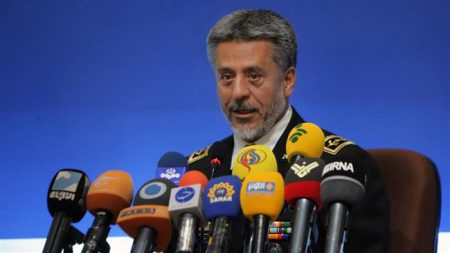
Touching on the simulation of hitting Iranian targets, Sayyari said that Iran “does not care about who’s doing what,” adding, “For us, it is important to boost our defense capabilities to such a level that we can withstand any threats [posed against us from] anywhere,” he added.
The Iranian commander also noted that any exercises in high seas should comply with international law.
The Unified Trident drills come after a string of incidents, in which US vessels that sailed close to Iranian territorial waters were met with Iran’s befitting response.
Iran has repeatedly warned that any act of transgression into Iran’s territorial waters would be met with an immediate and befitting response.
In January last year, Iran’s Navy arrested the crews of two US patrol boats that had trespassed on Iranian territorial waters. Iran released them after establishing that they had done so by mistake.
Iran has invariably asserted that it only uses its naval might for defensive purposes and to send across the Islamic Republic’s message of peace and security to other nations.
France’s Self-Inflicted Refugee Crisis
By Ulson Gunnar – New Eastern Outlook – 22.01.2017
Following rhetoric regarding Europe’s refugee crisis, one might assume the refugees, through no fault of Europe’s governments, suddenly began appearing by the thousands at Europe’s borders. However, this simply is not true.
Before the 2011 wave of US-European engineered uprisings across the Middle East and North Africa (MENA) transformed into Western military interventions, geopolitical analysts warned that overthrowing the governments in nations like Libya and Syria, and Western interventions in nations like Mali and the Ivory Coast, would lead to predicable regional chaos that would manifest itself in both expanding terrorism across the European and MENA region, as well as a flood of refugees from destabilized, war-racked nations.
Libya in particular, was singled out as a nation, if destabilized, that would transform into a springboard for refugees not only fleeing chaos in Libya itself, but fleeing a variety of socioeconomic and military threats across the continent. Libya has served for decades as a safe haven for African refugees due to its relative stability and economic prosperity as well as the Libyan government’s policy of accepting and integrating African refugees within the Libyan population.
Because of NATO’s 2011 military intervention and the disintegration of Libya as a functioning nation state, refugees who would have otherwise settled in Libya are now left with no choice but to continue onward to Europe.
For France in particular, its politics have gravitated around what is essentially a false debate between those welcoming refugees and those opposed to their presence.
Absent from this false debate is any talk of French culpability for its military operations abroad which, along with the actions of the US and other NATO members, directly resulted in the current European refugee crisis.
France claims that its presence across Africa aims at fighting Al Qaeda. According to RAND Corporation commentary titled, “Mali’s Persistent Jihadist Problem,” it’s reported that:
Four years ago, French forces intervened in Mali, successfully averting an al Qaeda-backed thrust toward the capital of Bamako. The French operation went a long way toward reducing the threat that multiple jihadist groups posed to this West Africa nation. The situation in Mali today remains tenuous, however, and the last 18 months have seen a gradual erosion of France’s impressive, initial gains.
And of course, a French military presence in Mali will do nothing to stem Al Qaeda’s activities if the source of Al Qaeda’s weapons and financial support is not addressed. In order to do this, France and its American and European allies would need to isolate and impose serious sanctions on Saudi Arabia and Qatar, two nations which exist as the premier state sponsors of not only Al Qaeda, but a myriad of terrorist organizations sowing chaos worldwide.
Paradoxically, instead of seeking such sanctions, the French government instead sells the Saudi and Qatari governments billions of dollars worth of weaponry, proudly filling in any temporary gaps in the flow of weapons from the West as each nation attempts to posture as “concerned” about Saudi and Qatari human rights abuses and war crimes (and perhaps even state sponsorship of terrorism) only to gradually return to pre-sanction levels after public attention wanes.
The National Interest in an article titled, “France: Saudi Arabia’s New Arms Dealer,” would note:
France has waged a robust diplomatic engagement with Saudi Arabia for years. In June, Saudi Deputy Crown Prince Mohammed bin Salman visited France to sign deals worth $12 billion, which included $500 million for 23 Airbus H145 helicopters. Saudi and French officials also agreed to pursue feasibility studies to build two nuclear reactors in the kingdom. The remaining money will involve direct investment negotiated between Saudi and French officials.
The article would also note that Saudi Arabia’s junior partner in the state sponsorship of global terror, Qatar, would also benefit from French weapon deals:
Hollande’s address was delivered one day after he was in Doha, where he signed a $7 billion deal that included the sale of 24 French Rafale fighter jets to Qatar, along with the training of Qatari intelligence officers.
In order to truly fight terrorism, a nation must deal with it at its very source. Since France is not only ignoring the source of Al Qaeda’s military, financial and political strength, but is regularly bolstering it with billions in weapons deals, it is safe to say that whatever reason France is involved across MENA, it is not to “defeat” Al Qaeda.
The refugee crisis that has resulted from the chaos that both Western forces and terrorists funded and armed by the West’s closest regional allies, Saudi Arabia and Qatar, is a crisis that is entirely self-inflicted. The rhetoric surrounding the crisis, on both sides, ignoring this fundamental reality, exposes the manufactured and manipulative nature of French government and opposition agendas.
The chaos across MENA is so significant, and terrorism so deeply rooted in both Western and their Arab allies’ geopolitical equations that even a complete reversal of this destructive policy will leave years if not decades of social unrest in the wake of the current refugee crisis.
But for anyone genuinely committed to solving this ongoing crisis, they must start with the US, European, and Gulf monarchies’ culpability, and resist blaming the refugees or those manipulated into reacting negatively to them. While abuses carried out by refugees or locals are equally intolerable, those responsible for the conflicts and for manipulating both sides of this crisis are equally to blame.
Until that blame is properly and proportionately placed, and the root of the crisis addressed, it will only linger and cause further damage to regional and global security.
‘Facebook deals first blow in the fake war against fake news’
RT | January 19, 2017
Governments are using media organizations as proxies in an effort to control the information citizens can get from the Internet, says former MI5 officer Annie Machon. The fake war against fake news is predicated on a big lie, she added.
RT has been blocked from posting content to its Facebook page during the live broadcast of Barack Obama’s final news conference over an alleged copyright infringement.
The suspension was triggered by one of the social network’s algorithms, which is alerted according to what’s being submitted.
RT has a contract with the Associated Press and streamed a news feed. The agency has confirmed RT had the right to retransmit the video, so the problem must lie with Facebook.
The head of Russia’s telecoms watchdog is warning of “active response measures” if RT’s work is restricted by the American media or the social networks.
Facebook has not replied to inquiries, and the restrictions on posting remain.
RT: The news outlet was mentioned as triggering a Facebook alert and says it’s not them. So just how sensitive has Facebook’s media clampdown tool become?
Annie Machon: I think this is the first blow in Facebook’s self-proclaimed war against so-called fake news. Both Facebook and Google in the wake of the shadowy PropOrNot list of 200 news organizations around the world that are supposedly peddling fake news, but actually just offering an alternative to the corporate US media, and RT was included in that. Facebook and Google in the aftermath said that they would start to censor all these outlets. I think that is what we are seeing with Facebook now is that they are using the excuse of copyright to censor legitimate news channel and stop them from covering a world event that the rest of the world is going to watch without any problem on other channels.
RT: At the World Economic Forum in Davos the Facebook representative said that their organization is dedicated, as they put it, to tackling so-called fake news and the whole phenomenon that we’ve heard of lately. Do you think this is part of that?
AM: I think it is part of that. And it is not just Facebook and Google who said they are going to take on the so-called fake news. It is also the European Union who issued a diktat last November saying that they were going to set up a body to counter fake news. We see countries like France and Germany already peddling this idea that there is going to be hacking and counter-democratic activity in the run up to their elections this year. So, they are using this. But I think it is interesting to see that the copyright has been used as a pretext for this censorship. I’ve been saying for years that the media organizations are being used by the governments as proxy organizations in terms of trying to control the information we can ingest over the internet and the information we can actually access over the internet.
RT: The suspension is imposed ahead of Trump’s inauguration and won’t be lifted until the day after it. What do you make of that? Is it a coincidence?
AM: Absolutely not. It is a first blow in the so-called battle – fake battle against fake news. And let’s just remind ourselves how this so-called concept of fake started. Somehow information was leaked from the DNC last year and the people who received that information, WikiLeaks said very clearly it was not a hack, it was actually a leak. And yet the corporate media in America has said again, “No, this was Russia hacking the DNC.” And then somehow it became Russia hacking the American elections, Russia hacking voting computers, Russia hacking the energy grid in America. None of this has been proven. Some of it has been actively proven to be false. But when Obama expelled the 35 Russian diplomats from America back to Russia before Christmas, that sort of solidified as fact that the Russians had done something wrong. There is no proof whatsoever. So this fake war against fake news is predicated on a big lie.
I think there are strings have been pulled in the background, shall we say. Particularly, in America. And the big media and internet corporations in America have been proven year after year to be very much in bed with the US state and with the US secret state. We know this of course because of the revelations of Edward Snowden. You know, all the big social media giants signed up to allow access to their databases by the secret agencies in America, starting with Microsoft back in 2006. We know that they are complicit; we know that they have been compromised. So, who can tell where this is going to go. There is a sort of all-out fight between the president-elect anyways and his so-called intelligence agencies.
RT: The original source mentioned as alerting Facebook denies it raised a copyright flag. AP confirmed RT had the rights for transmission. Facebook is the only entity yet to answer. Why isn’t it being more pro-active to remedy this considering this being a pretty big media news?
Chris Bambery, political analyst: It is pretty big media news, and I am really puzzled. Donald Trump is about to become President, and he is painted by much of the world’s media and spy agencies as being President Putin’s chum. And yet there is this continuing escalation of the Cold War with Russia, even hours before Trump is elected. Facebook is a giant American transnational. It is not known for its own transparency over these things. It does lead one to suspect that there are sections of our US elite who really do not like Donald Trump and want to create difficulties between the incoming presidency and Russia.
RT: RT’s troubles with Facebook come a day after the online news alert service Dataminr refused to renew our contract with them. That stems back to the CIA also being denied access and saying the same should apply to RT claiming we’re tied to Russian intelligence. Is that the real reason, do you think?
CB: On that basis, if you are being blocked because you receive state funding, the BBC World service is funded by the British Foreign Office, so why would that not be blocked? And I am sure Radio Free Europe and various other outlets have received funding from the American state. So, if that is to be criteria than a lot of leading news agencies would be off social media, and off air. This is going to feed into the conspiracy theories because it is so bizarre and strange.
Well, the biggest fake news story I’ve seen was the so-called dossier about Donald Trump, and they didn’t seem to be blocking that, which was all over Facebook. Again, I find it rather strange.
Read more:
Facebook blocks RT from posting until after Trump inauguration
Dataminr terminates RT access to Twitter news discovery tool, gives no official reason
Marine Le Pen: Crimea Was Never Ukrainian, I Will Recognize Crimea as Part of Russia

American Herald Tribune | January 18, 2017
The French presidential candidate Marine Le Pen has reiterated her support for Russia’s claim on Crimea in a newspaper interview in which she made another decisive tilt towards Moscow.
With three months before France goes to the polls, the Front National leader said she recognised Crimea as being part of Russia and if elected, she would push for a dropping of sanctions against Russia which France had backed simply because it was following German orders.
She told the Russian newspaper, Izvestia, that the referendum in the peninsula in 2014 to become part of Russia showed the “agreement of the people to join Russia”.
“Ukraine’s ownership of Crimea was just an administrative issue from Soviet times, the peninsula was never Ukrainian,” she said.
“I regret that the referendum, organised as a demonstration of the will of the people of the peninsula, was not recognised by the international community and the UN.”
Le Pen had made the comments about Crimea on French television earlier in January after which the Ukrainian security service SBU proposed banning her from entering the country for five years.
She described sanctions against Russia as “senseless” and “a pretty stupid method of diplomacy” and that “all countries should show respect for each other, to negotiate on equal terms and to accept a compromise solution acceptable to all”.
“We don’t have to have a situation whereby the major powers impose their policies on other states, behaving like stubborn children,” she told the paper.
( Image Credit: European Parliament/ flickr).
Palestinian political factions object to Paris peace conference
Ma’an – January 15, 2017
BETHLEHEM – In spite of the Fatah-dominated Palestinian Authority’s endorsement of a peace conference being held in Paris on Sunday, other Palestinian factions were opposed to the premise of the international summit, and said they were not expecting any diplomatic breakthroughs.
Kayid al-Ghoul, a senior leader in the Gaza Strip for the left-wing Popular Front for the Liberation of Palestine (PFLP) told Ma’an on Sunday that he expected the administration of Israeli Prime Minister Benjamin Netanyahu to turn to the United States to foil any possible outcome, five days ahead of the inauguration of US President-Elect Donald Trump — a vocal supporter of illegal Israeli settlements.
Al-Ghoul told Ma’an that the premise of the conference, which is expected to recommend the resumption of peace negotiations toward a two-state solution, meant “bypassing the right of return and self determination” for Palestinians.
Similarly, Daoud Shihab, a senior Islamic Jihad official in Gaza, described the conference as merely another attempt to resume a peace process “that Israel has already killed and buried, while the international community still refuses to admit that Israel is the main source” of the crisis.
He also warned that Netanyahu’s “terrorist government” could react to the outcome of the conference with more demolitions of Palestinian homes and land confiscations in the occupied territory. Last month, Israel responded to a UN resolution condemning illegal settlements by approving new settlement units in occupied East Jerusalem.
A Gaza-based leader within the left-wing Democratic Front for the Liberation of Palestine (DFLP), Talal Abu Tharifa, also warned of a possibility that the conference may create “low standards” regarding Palestinian rights.
He highlighted Israel’s belligerent opposition to any international intervention in the peace process by pointing to how Israel has been outraged over the mere fact the conference was held in the first place.
In his weekly cabinet remarks on Sunday, Netanyahu slammed the Paris conference, calling it “useless.”
“I must say that this conference is among the last twitches of yesterday’s world. Tomorrow’s world will be different — and it is very near,” the Israeli prime minister ominously declared.
Meanwhile, Palestinian President Mahmoud Abbas has welcomed the conference, and told French daily Le Figaro on Saturday that he believed the summit could be the last chance to implement the two-state solution, saying that “2017 has to be the year the occupation ends, the year of freedom and justice for the Palestinian people.”
However, an increasing number of Palestinians say the prospect of a two-state reality has become dimmer, amid an a growing extremism among Israel’s right-wing government and public, and a surge in illegal Israeli settlement construction that has now obtained the stamp of approval by US President-elect Donald Trump.
A number of Palestinian activists have criticized the two-state solution as unsustainable and unlikely to bring durable peace, proposing instead a binational state with equal rights for Israelis and Palestinians.
Syrian President Bashar Al Assad Fields Questions from French Media and Defends Alternative Media
January 8, 2017
“If I want to send (a message to French politicians) I would say the self evident thing, that we have to work for the interests of the Syrian citizens, and for the last six years the situation is going in the opposite direction. The French politics harmed the French interests. For the French people, I would say the mainstream media has failed in most of the west, the narrative has been debunked because of the reality and you have the alternative media, you have to look for the truth.
Truth was the main victim of the events in the Middle East, including Syria.
I would ask any citizen in France, please search for the reality, for the real information, through the alternative media. When they search for this information, they can be more effective, in dealing with their government, or at least not allowing some politicians to base their politics on lies.” – Syrian President Bashar Al Assad
Europe’s Mixed Feelings About Trump
By Andrew Spannaus | Consortium News | January 9, 2017
Few in Europe expected Donald Trump to win the U.S. Presidential elections last November. The picture painted by the media and political class was convincing: despite the pent-up anger being expressed through protest candidates, Hillary Clinton was headed towards a decisive victory, as the majority of Americans couldn’t stomach someone as outrageous and unconventional as the reality TV star turned politician.
That’s not what happened, of course, as Trump earned an Electoral College victory by winning enough votes in key Midwestern states that have suffered from a loss of manufacturing jobs in recent decades. His victory has shaken the Western world to its core, making it clear that business as usual is no longer possible in terms of both economic and foreign policy.
In Europe the signs of the anti-establishment sentiment that dominated the U.S. election campaign have been present for some time. The most obvious example was the Brexit vote in June 2016, in which the population of the United Kingdom voted to leave the European Union. But protest movements have actually been on the rise for several years now, driven by the same basic issues as in the United States: a sense of economic and social insecurity – accompanied by a rise in anti-immigrant sentiment – driven by an economic policy that has made life harder for the middle class while enriching those at the top.
The growing anger against the institutions of the European Union, considered the main culprit for the failed economic policies, has made the élites desperate for some sense of stability, to help them weather the storm. As a result, a potential Clinton victory was openly welcomed by most political leaders.
After Trump’s victory, there were numerous press reports of worries among European governments regarding the incoming Administration’s foreign policy. Trump is understandably seen as unpredictable, but the key point revolves around his attitude towards Russia, the same issue that is currently dominating the institutional fight in the United States right now.
Just after the election The New York Times ran a story entitled “For Europe, Trump’s Election is a Terrifying Disaster,” suggesting that under the new President, the United States may embrace authoritarianism and no longer defend democracy. It was a theme that other mainstream news outlets also pushed.
On Nov. 17, The Associated Press wrote: “NATO members and other European countries are worried that under Trump, the U.S. will stop trying to police Russia’s behavior the way it has under Obama. Most concerning to U.S. allies are Trump’s effusive comments about Russian President Vladimir Putin, one of the first world leaders he spoke to after winning the election.”
Seeing Benefits
While it is true that former Soviet bloc countries such as Poland and Latvia would prefer to maintain the current hardline position towards Russia, the reality is that the largest E.U. members – France, Italy and Germany – actually stand to benefit from the diplomatic approach promised by President-elect Trump.
This doesn’t mean they supported his candidacy, though. First of all, they were told that he couldn’t win; and second, a Trump victory would seem to encourage the anti-establishment movements already on the rise in Europe, which threaten both the E.U.’s status quo and the jobs of key leaders, including German Chancellor Angela Merkel.
Hillary Clinton was seen as representing continuity, and for the many politicians who seek to curry favor with the transatlantic elites, it was best to show their Clinton bona fides in view of the upcoming change in power. For example, Italian Prime Minister Matteo Renzi – now out of office due to a stinging anti-establishment vote in a referendum on proposed constitutional reforms – repeatedly broke diplomatic protocol and publicly criticized Trump during the election campaign.
However, over the course of 2016 it became clear that Clinton’s foreign policy was far more aggressive than Barack Obama’s, as the President had actually been seeking collaboration with Russia for several years on issues, such as constraining Iran’s nuclear program and negotiating an end to the Syrian conflict, despite heavy opposition from within his own administration.
Indeed Trump’s openness towards Vladimir Putin seems even more heretical now because most have chosen to forget that Obama himself had sought close cooperation with Putin on several key issues. For instance, Secretary of State John Kerry’s diplomacy last year on Syria almost succeeded in implementing intelligence sharing and joint airstrikes by the two powers, before being effectively thwarted by the Pentagon and other U.S. institutional opposition in September 2016.
Now Obama seems to have forgotten his former position, and decided to fully toe the anti-Russian line, apparently convinced that he must do his part in the campaign to weaken Trump and prevent him from being an effective president, even in areas where their positions are not far apart.
It is possible that Trump will accelerate the timid attempts of his predecessor to abandon the “regime change” policies that have led to numerous disasters in the Middle East, and heightened tensions with Russia. The President-elect seems determined to pursue this path more openly than Obama, who worked slowly towards this goal while seeking to placate his critics with more bellicose language in his public statements.
Doubts About the U.S. Hardline
Although European nations have been heavily involved in recent regime change adventures (the U.K. in Iraq and France in Libya, for example), there is a widespread preference in Western Europe for avoiding further conflict with Russia. The U.S. position on the events in Ukraine, for example, is often seen as one-sided, and the notion of NATO expansion to Russia’s borders seems like an unnecessary and dangerous provocation that can only makes things worse.
Western sanctions against Russia, and Russia’s retaliatory sanctions on food imports, have cost European economies over $100 billion in trade, according to some estimates, hitting the agricultural sector especially hard. In addition, Russia has been concluding more economic agreements with countries such as China, leading to fears of permanent consequences for Europe.
For this reason, France, Italy and Germany have all repeatedly stated their desire to reduce or remove the sanctions altogether. The hope is that an agreement can be reached to defuse tensions in Ukraine, based on support for the Kiev government but broad autonomy for the ethnic Russian areas in eastern Ukraine.
Despite this desire to head off further conflict, European governments are usually careful not to openly break with U.S. policy; they are key members of NATO and have no desire to distance themselves from the leader of the alliance. However, if Donald Trump follows through on his stated goal of working “together with Russia,” the countries of Western Europe in particular may welcome the opportunity to advance their own economic interests and avoid finding themselves in the middle of a new Cold War.
Andrew Spannaus is a freelance journalist and strategic analyst based in Milan, Italy. He is the founder of Transatlantico.info, that provides news, analysis and consulting to Italian institutions and businesses. His book on the U.S. elections Perchè vince Trump (Why Trump is Winning) was published in June 2016.
Featured Video
The Board For Peace – Whitewashing Ethnic Cleansing and Genocide
or go to
Aletho News Archives – Video-Images
From the Archives
Inside Job? Inside What?
By Prof. Tony Hall | American Herald Tribune | July 28, 2016
The Kevin Barrett-Chomsky Dispute in Historical Perspective – Sixth part of the series titled “9/11 and the Zionist Question”
In his chapter on “Left Gatekeepers” and the “Shame of Noam Chomsky,” Barrie Zwicker refers to the the “New World Order” as the “diaboligarchy’s” directing agency. Less compelling is Zwicker’s reference to the “New World Order” as the “diaboligarchy’s” directing agency. To me this unfortunate choice of words is much too closely associated with the often crude and chauvinistic populism of Alex Jones and his Infowars media network. Many have come to see Jones’ lucrative media operation as a limited hangout set in place by handlers trying to hold the activities of the 9/11 Truth Movement within manageable constraints.
Due to the important findings over fifteen years of the citizens’ investigation into 9/11, the culprits most deeply implicated in the crime can be identified with much more specificity than an entity vaguely described as a “New World Order.” As Kevin Barrett and many others insist, the time has come to name the names of the probable culprits, Noam Chomsky prominent among them.
While Alex Jones ultimately serves the same masters as Chomsky, the former’s media product is often much closer to the mark of what is really going on than the content of Noam Chomsky’s more magisterial pronouncements. Jones goes at least part of the way into realities of the deep state politics of the twenty-first century. Chomsky, however, sacrificed his capacity to contribute cogently to sensible discourse on contemporary geopolitics by making himself a primary instrument of the most consequential deep state deception of recent times. As a leading agent of disinformation in the psychological trenches of the ongoing Global War of False Flag Terrorism, Chomsky has reduced himself to the level of skeptic pretender Michael Shermer. In the style of Shermer, the elder Chomsky has become an establishment TV professor readily available on Netflix. … continue
Blog Roll
Recent Comments
loongtip on Trump wanted to play peacemake… Coronistan on EU member to sue bloc over ‘su… loongtip on Vicious loongtip on EU turns to India for defense… Coronistan on Donald Trump Is No Peace … seversonebcfb985d9 on French court jails pro-Palesti… eddieb on Fourteen Incredible Facts Abou… Bill Francis on European leaders’ shift in the… seversonebcfb985d9 on Villains of Judea: Philip Esfo… loongtip on Report warns that ‘Jewish terr… Craig Nelms on New study shows that toxic gas… loongtip on A Funny Thing Happened on the…


 Aletho News
- UN experts alarmed by prosecution of students protesting ETH Zurich’s Israel-linked research ties
- Exposed – How the UAE Became Central to Gaza’s Concentration Camp Plot
- How South Korea’s gas ambitions sustain the occupation of Gaza
- “Leaked document” exposes US blueprint for total control over Gaza
- Trump wanted to play peacemaker, Netanyahu made sure he failed
- Idea of limited, fast strike on Iran misjudges our capabilities: IRGC
- US Military Buildup on Land, Air, and Sea Raises Fears of Imminent Attack on Iran – Expert
- Russia reiterates demand to Germany over Nazi crimes
- France and EU clash over UK missiles for Ukraine – Telegraph
- EU member to sue bloc over ‘suicidal’ ban on Russian gas
- If Americans Knew
- Israel to seek new security deal from US, official says
- Leaked “Board of Peace” Resolution Outlines U.S.-Led Plan to Rule Over Gaza
- Jonathan Greenblatt Rolls Out Plan to Activate Hispanic Evangelical Golems
- Violence against hundreds of Gazan remains to find one Israeli – Not a ceasefire Day 109
- Greenpeace Demonstrator Exposes Folly of Protest Restrictions
- From CBS to TikTok, Pro-Israel Ellison is now in the driver’s seat
- Israel pays for UK advertisements attacking Doctors Without Borders
- Israel accused of extracting billions from Gazan people to pay for their own genocide
- ‘Deliberate Assassination’: 3 Journalists Among 11 Killed by Israeli Forces in Gaza
- In Gaza, We’re Struggling to Reintroduce Foods to Bodies Adjusted to Starvation
- No Tricks Zone
- New Study Affirms Rising CO2’s Greening Impact Across India – A Region With No Net Warming In 75 Years
- Germany’s Natural Gas Crisis Escalates … One Storage Site Near Empty …Government Silent
- Polar Colding…Antarctica Saw Its Coldest October In 44 Years!
- New Study: Sea Levels Rose 20 Times The Modern Rate During The Roman Warm Period
- As German Gas Storage Dips Dangerously Low…Shortage Hardly Avoidable
- New Study: Brazil’s Relative Sea Level Was 2+ Meters Higher And SSTs 3-4°C Warmer 6000 Years Ago
- Philosopher Schopenhauer: Climate Science Certainty Stems From Stupidity, Ignorance
- New Study: Species Extinction Rates Declining Since 1980 – ‘Climate Change Is Not An Important Threat’
- Denmark Places Climate Protection Above Animal Welfare, Poisoning And Culling Cows
- New Study: Greenland Was 3-7°C Warmer And Far Less Glaciated Than Today 6000-8000 Years Ago
 Aletho News