FM says China’s move ‘based on facts and reason’ as Japan complains of China tightening seafood imports due to nuclear-contaminated wastewater dumping plan
By Wang Qi | Global Times | July 20, 2023
The Chinese government puts people first, the Chinese Foreign Ministry said, noting that China’s opposition to Japan’s ocean discharge plan is based on facts and reason, after Japan recently complained that China had tightened radiation testing on its seafood imports, and some Japanese seafood had reportedly been “held up” at China’s customs due to Tokyo’s nuclear-contaminated wastewater dumping plan.
At a press briefing on Thursday, Chinese Foreign Ministry spokesperson Mao Ning urged Japan to “heed the call of the international community, stop pushing through the discharge plan, engage in full, sincere consultations with its neighbors, dispose of the nuclear-contaminated water in a responsible way and accept rigorous international oversight.”
Japan’s chief cabinet secretary Hirokazu Matsuno said on Wednesday that there have been cases of Japanese seafood exports “being held up by China,” along with Japanese media reports saying that China has ramped up efforts to test “all seafood imports from Japan for radiation.”
Earlier on July 7, China’s customs announced a ban on imports of food from Japan’s Fukushima and nine other regions, as Japan makes final preparations to dump nuclear-contaminated wastewater into the ocean.
Mao said Thursday that “Our job is to be responsible for the health of our people and the marine environment. Our opposition to Japan’s ocean discharge plan is based on facts and reason, so are the measures that we have decided to take.”
According to Japanese media outlet Asahi Shimbum, China is Japan’s largest seafood destination, accounting for 87.1 billion yen ($624 million) in imports.
Many people from Japan and most of its neighboring countries, including China, are against Tokyo’s irresponsible plan to dump the nuclear-contaminated water from the Fukushima plant into the Pacific Ocean.
A recent Japanese poll by Kyodo News showed 80.3 percent of respondents said they felt the explanation provided by the Japanese government on dumping nuclear-contaminated wastewater was insufficient.
More than 80 percent of respondents in 11 countries in the Asia-Pacific region except for Japan said Japan’s plan to dump nuclear-contaminated water into the sea is “irresponsible,” a survey conducted by the Global Times Research Center found recently.
A Gallup Korea survey from June shows that 78 percent of those polled said they were very or somewhat worried about contamination of seafood, according to a CNN report.
The obstruction of Japan’s seafood exports is entirely self-inflicted, Lü Chao, the director of Institute of US and East Asian Studies under Liaoning University, told the Global Times on Thursday.
Trying to shift local fishermen’s anger toward the Japanese government to neighboring countries exposed Tokyo as having no sense of decency and its ill intentions, Lü noted.
The Japanese government recently used various multilateral diplomatic occasions, including the NATO summit, to justify its plan, and gave signs that it will not postpone the hazardous dumping.
Mao criticized Tokyo’s move as a global PR campaign. She said that the legitimacy and safety of Japan’s nuclear-contaminated wastewater dumpling plan have been questioned by the international community, and no matter how much the Japanese side tries, it cannot whitewash the plan, and the protests of neighboring countries and the voices of doubt in Japan are clear evidence of this.
“If the Fukushima nuclear-contaminated water is truly safe, Japan wouldn’t have to dump it into the sea—and certainly shouldn’t if it’s not,” Mao said.
Dumping nuclear-contaminated wastewater into the ocean will seriously damage Japan’s national image and its people’s interests, Lü said, “More countries may take more stricter measures or even reject Japanese seafood imports in the future, as it’s very obvious that radioactive elements can cause long-term damage to human.”
What’s the problem regarding radioactive water discharge from the Fukushima Daiichi Nuclear Power Plant? Part 2
A delegation of South Korean scientists visits the NPP
By Konstantin Asmolov – New Eastern Outlook – 12.07.2023
The disputable situation surrounding the safety of discharging water from the damaged Fukushima Daiichi Nuclear Power Plant, which the author discussed in Part 1, prompted a team of 21 South Korean experts to visit Japan from May 21 to 26 to inspect the plant and the treatment of radioactively contaminated water that Japan plans to begin discharging into the ocean in the near future because the tanks are full.
Many Koreans are concerned about this because they believe the waters are still contaminated and will have a negative impact on the environment and health of the population of the area, especially South Korea. A presidential administration official stated that Seoul feels a real inspection of the nuclear disaster by South Korean experts is required in light of the rapprochement between Seoul and Tokyo on May 9, 2023. He reminded that the inspection of contaminated water quality is carried out by the International Atomic Energy Agency (IAEA) specialists. Nevertheless, the effectiveness of the treatment facilities and their operational capabilities need to be independently verified. On the same day, South Korean Prime Minister Han Duck-soo, visiting Europe at the time, met with IAEA Director General Rafael Mariano Grossi and noted the need for South Korean specialists and research organizations to be constantly involved in the process of monitoring the composition of contaminated water.
The idea was also supported in Washington. On May 12, Philip Goldberg, US Ambassador to the Republic of Korea, said that South Korea and Japan should exercise “patience and diplomatic skill.”
The delegation consisted of 19 experts from the Korea Institute of Nuclear Safety, one expert from the Korea Institute of Ocean Science and Technology and its head, South Korea’s Nuclear Safety and Security Commission Chairperson Yoo Guk-hee. Indeed, it was a serious team, but the preparation for the visit was fraught with a number of difficulties.
On the one hand, the parties defined the goals of the trip differently. The visit, the Foreign Ministry anticipated, would provide “opportunity to conduct a multilayered review and evaluation” of the water’s safety independently of the IAEA’s monitoring team. However, Japanese Industry Minister Yasutoshi Nishimura stated that the inspection is intended to “help deepen understanding” about the safety of the release, not to evaluate or certify its safety.
On May 17, South Korea and Japan held further consultations at the working level, but could not elaborate on the details of the upcoming inspection, despite many hours of talks.
On the other hand, the question arose as to whose representatives would go there. On May 12, Park Ku-yeon, the first deputy chief of the Office for Government Policy Coordination, stated that “the inspection team will be composed of top-notch experts in safety regulations,” and “the purpose of inspection activities is to provide an overall review of the safety of the water discharge into the ocean.”
But on May 19, Park Ku-yeon said that in addition to government experts, a separate group of about 10 civilian experts would be formed by Yoo Guk-hee to review and support the inspection team.
As a result, the government formed an advisory group of 10 civilian experts, some of whom strongly raised questions about the safety of radioactive water and called for a thorough review. But members of the advisory group were not included in the on-site inspection team.
This raised the question of objectivity, as the arguments of the critics were worth considering:
- Members of the expert group serve in government agencies; it may be difficult for them to express an opinion different from the government which supports Japan.
- Japan will not allow experts to take radioactive water samples at the power plant site and will not accept the results of the safety assessment of the Korean inspection team, a clear indication that Japan does not want a full objective inspection.
- Japan does not allow Korean journalists to accompany the inspection team. The lack of transparency and openness may cause concern.
However, the Yoon administration and the ruling People Power Party claimed that there is no need for the public to be alarmed because Japan will permit an additional inspection if a problem is discovered at the facility and the Korean delegation will have the chance to examine and assess the advanced cleaning system developed at the Fukushima plant.
On the third hand, the democratic opposition started its resistance right away. On May 10, opposition leader Lee Jae-myung called on the government to reconsider its plan to send an inspection team “that has no power to conduct a substantial and thorough inspection and verification,” saying that the visit could end up approving the planned discharge of contaminated water from the damaged plant. “It appears the government is trying to be a volunteer helper for Japan’s plan to dump contaminated water from the nuclear power plant into the ocean.”
On May 13, the Democratic Party called on the government to withdraw its plan to send an inspection team to Japan, saying it would only justify Japan’s plan. The Democrats pointed out that the Japanese government has no plans to allow the Seoul delegation to verify the safety of the discharge and will proceed with the plan in July, regardless of the team’s actions. This means that the inspection team is just a formality.
On May 21, the experts arrived in Japan. On May 22 they met with the Tokyo Electric Power Corporation (TEPCO), the Nuclear Regulation Authority (NRA), presenting them with a list of facilities they want to inspect. Before the meeting, Yoo Guk-hee noted that the experts will check with their own eyes the K4 tanks intended for storing and measuring the radioactive substance and will ask the Japanese authorities for the necessary data. Yoo also promised to study the ALPS treatment system, and assess whether the treated water is safe enough to discharge into the sea.
In brief, the purification process is as follows: contaminated water goes through the procedure of preliminary purification from suspended solids and then enters the ALPS unit, which removes radionuclides except tritium. Then its samples are evaluated, and if they meet the established safety parameters, the water is diluted with pure seawater in a separate facility to reduce the concentration of tritium. Later, it is supposed to be discharged into the ocean.
On May 23-24, experts inspected the damaged Fukushima Daiichi NPP. As Yoo Guk-hee noted, the main focus was on the radioactive water storage tanks and treatment system.
On May 23, the ALPS equipment, the central control room, the K4 tank for measuring water concentration before discharge, and the transportation equipment were inspected.
On May 24, the experts inspected the first power unit of the plant, including the radiological analysis laboratory. Additionally, by comparing the concentration of water before and after treatment, the experts evaluated the effectiveness of the Advanced Liquid Processing System (ALPS).
The team visited the nuclide analysis facility and inspected the seawater dilution system and discharge facilities, including the capacity of the dilution pumps and how they functioned. The experts took a close look at the shut-off valves that would be triggered if the water contamination level exceeded the norm.
Additionally, Tokyo gave them reports from IAEA officials it had invited to observe the procedure and data it had collected on water control.
After the inspection, Yoo told reporters that “we examined all the facilities we wanted to see … but we need to engage in additional analysis of their function and role.” Although the team was not able to collect water samples on their own, they analyzed those previously collected by the IAEA.
When asked whether the South Korean government would release its security assessment before the IAEA releases its final report, Yoo declined to comment.
On May 25, the delegation held consultations with Japanese counterparts, and Yoo Guk-hee reported that the commission had completed its task by requesting additional data to be sent from Japan and analyzed. Only then will the final report be made public.
On May 26, the group returned home. The opposition and some civil society organizations criticized the visit, calling it “government-led tourism,” saying that the Yoon Seok-yeol government was simply following Japan’s lead and risking the health of Koreans. South Korean Foreign Minister Park Jin rejected such criticism, saying that experts were carefully examining the sites, resolving all concerns with the Japanese authorities, and obtaining scientific data. “It is not right to devalue the work of our team that is working hard (in Japan).”
On May 30, Prime Minister Han Duck-soo asked the group of experts to present the results of their inspection transparently and comprehensively. On May 31, the group held a press conference to announce the main results of the visit.
The specialists spoke in detail about TEPCO’s procedure for cleaning and testing radiation-contaminated water, as well as the sites visited as part of the inspection. They also learned the procedures to stop water discharge in case of emergency and the process of maintaining the machinery used in water treatment. The unique cleaning technique and the equipment for assessing radiation levels received special attention.
In the process of familiarization with the water treatment facilities at the damaged Fukushima Daiichi NPP, the South Korean expert group received data from the Japanese side on the performance of the ALPS for the last four years. This includes data regarding the water’s chemical composition at the ALPS system’s input and exit, which made it possible to assess the system’s effectiveness and gauge the degree of pollution before and after treatment. The experts made sure that all major equipment was installed in accordance with current standards, and that the system for preventing leakage of contaminated water was operating normally. In particular, there are emergency valves to automatically stop water discharge in case of a sudden power and communication failure. In addition, equipment for double-checking the composition of water is in operation. However, there has not been a “yes or no” answer: significant progress has been made during the Fukushima inspection, but further analysis is needed for a more accurate conclusion.
This did not dampen the excitement, and on June 22, Hahn Pil-soo, a South Korean nuclear energy expert who formerly served as director of the IAEA’s radiation, transport and waste safety division, said that IAEA investigation reports have reliable objectivity and credibility. “The credibility of the final report is directly related to the status of the IAEA. Thus lawyers and experts are involved to ensure that not a single word is misspelled,” he said, stressing that the agency works hard to produce professional, objective and reliable results.
On June 26, Park Ku-yeon said that there is no alternative to Japan’s decision to release contaminated water from the Fukushima Nuclear Power Plant because there is no other way to dispose the water. In the mid-2010s, there were extremely complex discussions in Japan, with various options for water disposal (solidifying water in concrete or storing water in massive tanks), but “the current water discharge method was finalized as the most realistic alternative when scientific precedents and safety were fully taken into account.” Therefore, the IAEA approved the method to be implemented, taking into account its safety and based on scientific data.
Park Koo-yeon noted that the NRA would begin trial operation of the water dilution and pumping units on June 28.
On June 27, after a month of his group’s return, Yoo Guk-hee, reported that South Korea is in the final stages of analysis: “We have been scientifically and technologically reviewing Japan’s plan based on the results of the on-site inspection and additional data obtained afterward.” In addition, Yoo said six types of radionuclides have been detected in the water stored in the tanks at concentrations in excess of acceptable limits, even after treatment with ALPS, but most cases occurred before 2019, so “this is the aspect of radionuclide that we need to closely examine.”
The final report will eventually be published in early July. However, in a politicized environment, its meaning becomes a matter of trust, particularly because the opposition prematurely declared the commission’s findings invalid and launched a loud campaign, which the author will discuss in the section after this one.
Konstantin Asmolov, PhD in History, is a leading research fellow at the Center for Korean Studies of the Institute of China and Modern Asia at the Russian Academy of Sciences.
Cancer patients sue company behind Fukushima radiation
RT | January 28, 2022
Six people were children living near the Fukushima nuclear power plant at the time of the 2011 disaster, when the facility was heavily damaged in an earthquake and subsequent tsunami.
The plaintiffs have since developed thyroid cancer, blaming radiation that seeped from the power plant for their condition.
“Some plaintiffs have had difficulties advancing to higher education and finding jobs, and have even given up on their dreams for their future,” the group’s chief lawyer, Kenichi Ido, told AFP.
The plaintiffs, now aged between 17 and 27, are seeking compensation from the Fukushima operator, the Tokyo Electric Power Company Holdings (TEPCO). They demand the company pay a total of 616 million yen ($5.4 million). The plaintiffs have experienced prejudice against thyroid cancer patients, with the illness heavily affecting their lives, one of the group members – identified only as a woman in her 20s – has said.
“I decided to come forward and tell the truth in hopes of improving the situation for nearly 300 other people also suffering like us,” she stated.
The lawsuit has become the first class-action against TEPCO over health problems allegedly linked to the Fukushima disaster. Establishing a solid link between thyroid cancer and the meltdown is likely to become a focal point of the case, since no relationship between cancer cases and the disaster was recognized by an expert team previously established by the regional government. At the same time, radiation exposure is a well-proven risk factor for developing such type of cancer.
Over 290 people who lived in the area at the time of the meltdown have been diagnosed with or are suspected of having thyroid cancer. Some 266 of them were found during a provincial health survey of people aged 18 and younger at the time of the disaster, which affected some 380,000 residents.
The plaintiff’s legal team argues that such rates – 77 per 100,000 – are significantly higher than the usual one to two cases per one million people. Regional authorities and experts, however, have blamed the unusual rates on excessive screening and over-diagnosing.
The Fukushima power plant got crippled following the 2011 9.0-magnitude Tohoku earthquake and a subsequent devastating tsunami. The plant suffered a major meltdown, which became the worst nuclear disaster since the 1986 Chernobyl incident. The catastrophe prompted an evacuation order for nearby towns and villages, which has been gradually lifted over the past few years. The last deserted settlement – the town of Futaba located in an immediate vicinity of the damaged plant – is expected to welcome residents willing to return later this year.
Japan to release Fukushima contaminated water into sea: Reports
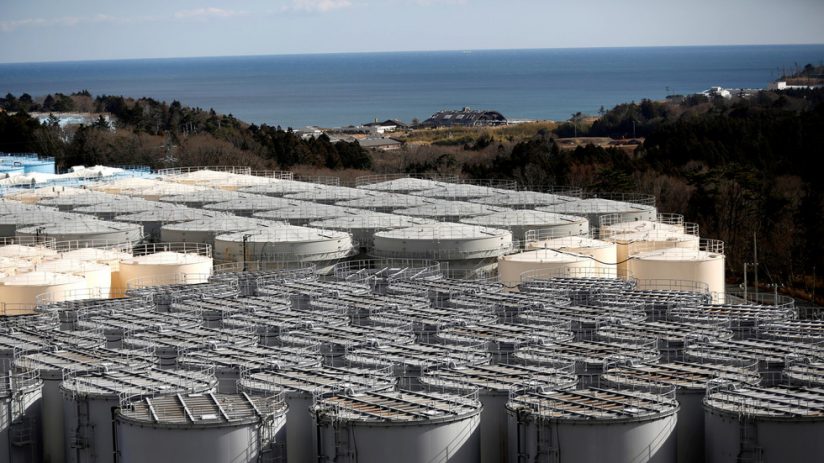
Storage tanks for radioactive water at TEPCO’s tsunami-crippled Fukushima Daiichi nuclear power plant in Okuma town, Fukushima prefecture, Japan. (Photo by Reuters)
Press TV | October 16, 2020
Nearly a decade after the Fukushima nuclear disaster, Japan’s government has decided to release contaminated water from the destroyed plant into the sea, media reports said on Friday, with a formal announcement expected to be made later this month.
The decision is expected to rankle neighboring countries like South Korea, which has already stepped up radiation tests of food from Japan, and further devastate the fishing industry in Fukushima that has battled against such a move for years.
The disposal of contaminated water at the Fukushima Daiichi plant has been a long-standing problem for Japan as it proceeds with a decades-long decommissioning project. More than one million tonnes of contaminated water are currently stored in huge tanks at the facility.
The plant, run by Tokyo Electric Power Company Holdings Inc., suffered multiple nuclear meltdowns after a 2011 earthquake and tsunami.
On Friday, Japan’s industry minister Hiroshi Kajiyama said no decision had been made on the disposal of the water yet, but the government aims to make one quickly.
“To prevent any delays in the decommissioning process, we need to make a decision quickly,” he told a news conference.
He did not give any further details, including a time-frame.
The Asahi newspaper reported that any such release is expected to take at least two years to prepare, as the site’s irradiated water first needs to pass through a filtration process before it can be further diluted with seawater and finally released into the ocean.
In 2018, Tokyo Electric apologized after admitting its filtration systems had not removed all dangerous material from the water, collected from the cooling pipes used to keep fuel cores from melting when the plant was crippled.
It has said it plans to remove all radioactive particles from the water except tritium, an isotope of hydrogen that is hard to separate and is considered to be relatively harmless.
Last week, Japanese fish industry representatives urged the government not to allow the release of contaminated water from the Fukushima plant into the sea, saying it would undo years of work to restore their reputation.
South Korea has retained a ban on imports of seafood from the Fukushima region that was imposed after the nuclear disaster and summoned a senior Japanese embassy official last year to explain how Tokyo planned to deal with the Fukushima water problem.
During Tokyo’s bid to host the Olympic Games in 2013, then-Prime minister Shinzo Abe told members of the International Olympic Committee that the Fukushima facility was “under control”.
The Games have been delayed to 2021 because of the pandemic and some events are due to be held as close as 60 km (35 miles) from the wrecked plant.
Back to Fukushima. Former residents weigh up returning to nuclear ghost town of Okuma
RT Documentary • December 12, 2019
In March 2011, an earthquake hit Japan, setting off a tsunami that caused an accident at the Daiichi nuclear power station in Fukushima prefecture. Radioactive contamination settled on the surrounding area, and the authorities decided to evacuate the population living within a 20km radius around the power station.
Watch full video here: https://rtd.rt.com/023wp
Eight years later, inhabitants of the town closest to the nuclear disaster, Okuma, were allowed to move back to some of its territory. RTD takes a bittersweet tour of the nuclear ghost town with former residents considering whether to return to their hometown, and meets those who have already moved into new homes built in a less-contaminated part of town. Torn between loyalty to their roots and the desire to build a future for themselves, the people of Fukushima now have an agonising choice to make.
Fukushima Disaster Puts Japan in ‘Nuclear Limbo’ Ahead of 2020 Tokyo Olympics – Pundit
Sputnik – September 14, 2019
On 10 September, Japanese authorities announced that Tokyo Electric Power (TEPCO), the operator of the Fukushima Daiichi power plant which in 2011 experienced the worst nuclear disaster since Chernobyl, currently has no technology to clear its wastewater from radioactive waste, and is instead discharging it into the sea.
More than a million tonnes of wastewater is reportedly stored in tanks at the Fukushima NPP (nuclear power plant). The facility is reportedly running out of available space and expects to exhaust its capacity by summer 2022. Japanese Environment Minister Yoshiaki Harada admitted earlier that “we have no way but to release it [into the sea] and dilute it”.
Local residents reportedly have deep concerns about the potential damage this move can inflict, especially to the fishing industry, which is essential for Japan.
Christina Consolo, a nuclear expert, has shared her view on the issue.
Sputnik: It’s been reported that there’s enough room to keep the liquid (1 million tons of contaminated water) through summer 2022, but after that, there will be no space left?
Christina Consolo: It was somewhat surprising at how quickly the Environmental Ministry in Japan made a decision to release the contaminated water once their official meeting convened. I am not surprised at all however by their decision.
The situation is very serious. There is no other option then to release the contaminated water, but under the control of TEPCO’s time and choosing, or it may be released for them. An earthquake could release it, a tsunami could release it, a typhoon could release it.
But releasing the water goes far beyond just a ‘storage issue’ alone; the tanks are also under duress for a number of reasons. If you recall, at the beginning of the original water storage, the tanks were not assembled properly. Concrete slabs were hastily poured without rebar reinforcement.
TEPCO workers had to drill holes in the tops of them to release hydrogen build-up, or risk explosion and collapse of the tanks themselves.
There have also been a series of leaks, due to miles of pipes and flushing radioactive water great distances through sometimes ducted-taped hoses, with at least one reaching the official scale of a Level 3 Nuclear Accident in and of itself, in July of 2015.
And the longer this radioactive water sits in these giant metal tanks, the matrix of the metal itself at the atomic level is undergoing acceleration of entropy, known as “The Wigner Effect” – named after Professor Eugene Wigner, who discovered it at the Oak Ridge Laboratory while doing research for the US Government during World War II.
Metal exposed to radiation creates embrittlement issues and acceleration of corrosion, the same problem that caused 16,000 cracks in the nuclear reactors in Belgium.
This is problematic for the biggest reason of them all: if any of these tanks leak or break open outside of the control of TEPCO and prevents workers from being able to continue the myriad of daily maintenance involved due to spillage of radioactive water, creating no-go zones within the site itself, then TEPCO can have yet another very serious situation on their hands, on top of everything else happening over there. Anything and everything must be done to assure that workers can continue with the tremendous daily management of what is still an ongoing Level 7 Nuclear Accident.
They can not risk waiting for the tanks to empty themselves.
Sputnik: What is going to happen next? Do you think this liquid is a real threat to the ecological situation?
Christina Consolo: Any radiation released to the environment is always going to have detrimental effects… the question is how much and how far will those effects extend from the site of the release. Without knowing what exactly is in those tanks, that question is impossible to answer.
I personally have issue believing the radioactive water contained within them only contains Tritium, as I have followed this story for over eight years, and I can say without a doubt that every machine brought in to ‘filter out’ radioactive substances has failed miserably, as has every camera, robot, robot claw, robot snake, robot on rollers, etc.
TEPCO also has a history of withholding important facts that also make them very untrustworthy.
But more importantly from an ecological perspective, and a far bigger issue though which is rarely discussed, is the groundwater that moves through the Fukushima site because of the geology of the surrounding features.
The plant was built on a riverbed, where the volcanic spine of Japan funnels water down from the mountains. Groundwater experts estimate that every single day somewhere between 5-15,000 tonnes of groundwater flow underneath the plant, and out to the Pacific ocean.
Keep in mind, the only remnant of the cumulative 450 tonnes of corium or melted nuclear fuel that has been found is splatter on the insides of the reactors, or pebble-like material and drips.
TEPCO still has not located the 3 melted cores after 8 years of looking, leaving a looming question of how far these cores travelled as they melted, and how much groundwater is making contact with these cores before pouring into the Pacific each day. They are concerned enough that they are still pouring 300 tonnes of water through them daily.
Is it 10 percent – 50 percent – 80 percent? How much of this natural groundwater flow is making contact with the cores, under the plant? We have no idea. If indeed this is occurring, which some Fukushima experts believe that it is, then the 1000 tanks are a ‘drop in the bucket’ in comparison to what may be pouring into the Pacific each and every day.
We need answers to these questions. It is abhorrent and inexcusable that with today’s known technology, TEPCO does not know where the cores are, 8 years after the accident. We have powerful ground penetrating radar that could likely tell, so why are they not telling us?
Sputnik: It’s been 8 years since the Fukushima disaster. How have Japanese authorities adapted to this situation?
Christina Consolo: The Japanese authorities that were in charge at the beginning of this disaster, such as former Prime Minister Kan, have expressed a tremendous amount of regret, and even guilt, over mistakes they made withholding information about how dangerous the situation was from the Japanese people in the early part of the accident.
The fact TEPCO outright lied that meltdowns had occurred from Day 1, even though every nuclear physicist in the world was aware they had, due to the presence of neutron beams occurring in 13 different locations on the site (which indicated at least one reactor was breached), is difficult to forgive considering the US had an entire fleet of Navy ships offshore providing humanitarian aid that were getting absolutely blasted by nuclear fuel including MOX and plutonium.
PM Abe is very pro-nuclear but his wife is not, making for an ongoing and very publicized drama in Japanese news, and the pushback from massive demonstrations by the Japanese people continue to this day on a weekly basis.
The people are fighting any and all attempts at restarting reactors, in a very hardcore way. The authorities are pretending everything is fine, focusing on the Olympics in 2020, and I am certain the water will be dumped long before then.
But the tanks are going to just get filled right back up again, after some unfortunate TEPCO workers climb inside and test them for metal fatigue issues.
Sputnik: What has changed in nuclear safety since Fukushima has occurred?
Christina Consolo: In Japan a majority of the reactors still remain shutdown, which is good considering they never should have been built there in the first place.
An article in The Japan Times predicted the Fukushima disaster in 2004, and there are no guarantees that TEPCO will always be able to keep the Fukushima site under control, or another earthquake and tsunami will cause a similar, or even larger disaster at another site, as there are so many littering Japan.
Japan sits in a highly unstable zone of 4 intersecting tectonic plates and the island has an enormous amount of earthquake and volcanic activity.
The US did review some of its safety measures after 3/11 but the problem is it keeps re-issuing licenses to old plants, with ageing infrastructure.
And many plants in the US, and worldwide, are also prone to earthquakes, tsunamis, flooding, hurricanes, even tornadoes and lightning strikes.
We have been playing with this very dangerous technology despite having no safe way to dispose of the waste, and many studies done over decades that prove that illnesses and cancer are extremely high the closer that you live to a nuclear plant.
Sputnik: Despite the Fukushima explosion, the Japanese government didn’t abandon its nuclear energy program. How do you explain this decision?
Christina Consolo: I can not answer that question. There is no logical answer for it, except to decommission a plant is outrageously expensive.
TEPCO announced in the past month it will be decommissioning the Fukushima Daini plant to the south, which also sustained damage in 2011.
Right now Japan is in a nuclear limbo of sorts, with the water tank problem, the fishery pushback, the Olympics in 2020, and the somewhat surreal efforts of the Japanese government to assure the world it can handle the Olympic athletes and crowds without making them sick.
There are always economic issues to consider, and the costs of decommissioning of two huge nuclear plants, one with 3 melted cores that have never been found.
Japan has a lot of convoluted issues surrounding nuclear and there is always the dark cloud over what is truth or fiction when it comes to TEPCO, and the nuclear industry in general. I really can not explain this decision at all.
Fukushima ice wall won’t stop all radioactive groundwater from seeping out – chief architect
RT | April 28, 2016
An ice wall being built at the crippled Fukushima nuclear plant won’t completely prevent groundwater from flowing inside the facility and leaking out into the earth as radioactive water, according to a chief architect of the project.
Chief architect Yuichi Okamura told AP that gaps in the wall and rainfall will still allow for water to creep into the facility and reach the damaged nuclear reactors, which will in turn create as much as 50 tons of contaminated water each day.
“It’s not zero,” Okamura, a general manager at Tokyo Electric Power Co. (TEPCO) said. “It’s a vicious cycle, like a cat-and-mouse game… we have come up against many unexpected problems.”
The wall, which will be 1.5km (1 mile) long, will consist of an underground pipe network stretching 30 meters (100 feet) below the surface, around the reactor and turbine buildings. The pipes are designed to transport refrigerant cooled to -30° Celsius (-22°F) to chill the nearby soil until it freezes.
The barrier is being turned on in sections for tests, and the entire freezing process will take eight months since it was first switched on in late March. The process requires an amount of electricity that would power 13,000 Japanese households.
Despite its current efforts, TEPCO – the operator of the Fukushima plant – has been fiercely criticized by those who say the groundwater issue should have been forecast and dealt with sooner.
Shigeaki Tsunoyama, an honorary professor and former president of University of Aizu in Fukushima, said that building a concrete wall built into the hill near the plant after the disaster would have minimized the contaminated water issue.
Okamura acknowledged that the option of building a barrier at a higher elevation near the plant was considered in the days following the disaster, but defended the actions of TEPCO, stressing that the priority is on preventing contaminated water from escaping into the Pacific Ocean.
Others have criticized the US$312 million wall, which is being built by construction company Kajima Corp., as a waste of taxpayer money.
TEPCO has repeatedly faced criticism for its handling of the Fukushima crisis, which occurred after a massive earthquake and subsequent tsunami led to a meltdown of reactors at the facility in March 2011. The disaster was the worst nuclear accident to take place since Chernobyl in 1986.
The company has admitted that it did not act properly during the disaster, confessing in February that it announced the nuclear meltdowns far too late. It also stated in a 2012 report that it downplayed safety risks caused by the incident, out of fear that additional measures would lead to a shutdown of the plant and further fuel public anxiety and anti-nuclear campaigns.
Despite the ongoing problems encountered following the meltdowns, TEPCO has set 2020 as the goal for ending the plant’s water problem – an aim which critics say is far too optimistic.
However, the water problem is just part of the monumental challenges faced at the facility. Controlling and dismantling the plant is expected to take 40 years. Robots have been tasked with taking photos of the debris, as the radiation levels are too high for humans to complete the job.
Featured Video

America Racing to Strategic Defeat in Iran
or go to
Aletho News Archives – Video-Images
From the Archives
An Expert Military Analysis of War with China
Actually, None is Necessary
By Fred Reed • Unz Review • December 13, 2020
The Correlation of Armed Forces: U.S. goods and services trade with China totaled an estimated $634.8 billion in 2019. Exports were $163.0 billion; imports were $471.8 billion. The U.S. goods and services trade deficit with China was $308.8 billion in 2019. Trade in services with China (exports and imports) totaled an estimated $76.7 billion in 2019. Services exports were $56.5 billion; services imports were $20.1 billion. The U.S. services trade surplus with China was $36.4 billion in 2019.
There is talk within the Washingtoniat of a possible war with China. Steve Bannon, who apparently was dropped on his head as a child, actually favors such a war. We hear the usual shoo-the-boobs alarm about how the Chinese are doing something terrible and we must gird our loins and American values and show them what for, bow wow, woof. The danger is that the current game of who-blinks-first in Asian waters might actually provoke a shooting war. You know the kind of thing: One warship refuses to get out of the way of another, a collision ensues, some retard lieutenant who signed up on waivers opens fire, and we’re off and running. It is not a good idea to let children play with matches.
The said war is discussed either in emotional terms by idiots or in purely naval terms by those familiar with such things, so we hear of the First Island Chain and the Second Island Chain and whose missiles against the other’s missiles and so on. This would be appropriate if we were fighting World War Two again. Which we aren’t. Let’s take a quick-and-dirty look at how such a war might go.
To begin the war, America would overestimate itself and underestimate China. This is doctrine in the Pentagon. … continue
Blog Roll
 Aletho News
- Poland rules out sending Patriot missiles to US/Israel amid war on Iran
- Tehran approves new Hormuz plan with major restrictions
- No Threat Can Force Iran’s Surrender /Trita Parsi & Lt Cl Daniel Davis
- UK’s New Pandemic Plan Would Turn Big Tech Into a Mass Location Tracking Network
- Growing insecurity, soaring prices fuel protests in north as regime bans evacuation: Sources
- Iran denies responsibility for ‘depraved’ attack on Kuwait desalination plant
- Bring The Troops Back. End This War Now!
- Can we please stop calling Israel the ‘only democracy in the Middle East’ now?
- US should start removing its troops from Germany, proposes AfD co-leader Chrupalla
- Iran Red Crescent: 600 educational centers attacked in US-Israeli ‘war crimes’
- If Americans Knew
- The Line Between Affinity and Conspiracy
- As Iran targets US military bases, will they be relocated to Israel? Not a ceasefire Day 171
- Will Trump Go Kamikaze?
- Is the University of Florida Shutting Down College Republicans over Israel Criticism?
- Jewish extremist arrested over alleged plot to firebomb Palestinian activist Nerdeen Kiswani’s home
- More than half of Palestinian child detainees have no charges
- The More Murderous Israel Gets, The More We Hear About “Antisemitism”
- Land Day and the Palestinian struggle after 30 months of genocide
- The Iran War Is About Palestine
- Israeli soldiers echo settler ideology, talk of revenge after targeting Palestinians and detaining CNN crew in the West Bank
- No Tricks Zone
- New Study Finds Warming Saves Lives…Cold Temperatures 12 Times More Deadly Than Excess Heat
- German Science Blog Accuses PIK Climate Institute Of Hallucinating Climate Tipping Points
- Devastating Assessment Of Comirnaty Vaccine By Former Senior Pfizer Europe Toxicologist
- New Study: CO2 Is ‘Effectively Negligible’ As An Explanatory Climate Change Factor Since 2000
- Former Pfizer Toxicologist Dr. Helmut Sterz Tells Bundestag Hearing Pfizer Vaccine Should Have Never Been Approved
- Energy Expert: Germany’s Nuclear Phaseout Was A “500 Billion Euro Mistake”
- New Research: South Australia’s Mid-Holocene Sea Surface Temperatures Were 4°C Warmer Than Today
- Storing Green Energy To Last Germany 10 Days Would Require A 60-Million Tonne Battery
- New Studies: UK Sea Levels Were 4 Meters Higher Than Today During The Mid-Holocene
- Destructive Green New Deal: German Energy And Metal Group Warns Of Drastic Crisis
 Aletho News