Iran To Target Military Industrial-Tech Complex That Facilitated Gaza Genocide
The Dissident | March 31, 2026
The Iranian IRCG has put out a statement threatening to target the facilities of companies in the Middle East which are part of America’s war profiteering machine, primarily the tech companies.
In a statement, the IRCG said, “Our repeated warnings about the necessity to stop terrorist operations were ignored, and today, following your terrorist attacks and those of your Israeli allies, several Iranian citizens were martyred” adding, “Since the main element in designing and tracking assassination targets are American ICT and AI companies, in response to these crimes, from now on the main and effective institutions involved in terrorist operations will be our legitimate targets” and “We advise the employees of these institutions to immediately leave their workplaces to preserve their lives. Also, residents of areas around these terrorist companies in all countries of the region, within a one-kilometre radius, should leave their homes and workplaces and seek safe places”.
The list of targeted companies included:
Cisco
HP
Intel
Oracle
Microsoft
Apple
Meta
IBM
Dell
Palantir
Nvidia
J.P. Morgan
Tesla
GE (General Electric)
Spire Solutions
G42
Boeing
All of these companies play an integral role in the U.S./Israeli war machine in the Middle East and have been needed to facilitate not only the war in Iran but the genocide in Gaza.
The United Nations’ Special Rapporteur for Palestine, Francesca Albanese, meticulously documented many of these companies’ crucial role in facilitating the U.S.-backed Israeli genocide in Gaza.
The following is the role each of these companies played in the genocide in Gaza as documented by Albanese.
HP
Albanese documented that, “Hewlett Packard Enterprises (HPE) maintained the database and its Israeli subsidiary is still providing servers. Hewlett Packard (HP) has long enabled the apartheid systems of Israel, supplying technology to the Coordination of Government Activities in the Territories (COGAT), the prison service and police.Since the 2015 split of the company into Hewlett Packard Enterprises and HP Inc., opaque business structures have obscured the roles of their seven remaining Israeli subsidiaries”.
Microsoft
Albanese documented that, “Microsoft has been active in Israel since 1991, developing its largest centre outside the United States. Its technologies are embedded in the prison service, police, universities and schools – including in colonies. Microsoft has been integrating its systems and civilian tech across the Israeli military since 2003, while acquiring Israeli cybersecurity and surveillance start-ups.”
She added that Microsoft, “grant Israel virtually government-wide access to their cloud and artificial intelligence technologies, enhancing data processing, decision-making and surveillance and analysis capacities” adding that, “Microsoft, with its Azure platform, and the Project Nimbus consortium stepped in with critical cloud and artificial intelligence infrastructure. Their Israel-located servers ensure data sovereignty and a shield from accountability, under favourable contracts offering minimal restrictions or oversight. In July 2024, an Israeli colonel described cloud tech as a weapon in every sense of the word”
Albanese documented that, “As Israeli apartheid, military and population-control systems generate increasing volumes of data, its reliance on cloud storage and computing has grown. In 2021, Israel awarded Alphabet Inc. (Google) … a $1.2 billion contract (Project Nimbus) largely funded through Ministry of Defense expenditure to provide core tech infrastructure.”
IBM
Albanese documented that, “IBM has operated in Israel since 1972, training military and intelligence personnel – especially from Unit 8200 – for the technology sector and start-up scene. Since 2019, IBM Israel has operated and upgraded the central database of the Population and Immigration Authority, enabling collection, storage and governmental use of biometric data on Palestinians, and supporting the discriminatory permit regime of Israel.”
Palantir
Albanese documented that, “The Israeli military has developed artificial intelligence systems, such as ‘Lavender’, ‘Gospel’ and ‘Where’s Daddy?’ to process data and generate lists of targets, reshaping modern warfare and illustrating the dual-use nature of artificial intelligence. Palantir Technologies Inc., whose tech collaboration with Israel long predates October 2023, expanded its support to the Israeli military post-October 2023. There are reasonable grounds to believe Palantir has provided automatic predictive policing technology, core defence infrastructure for rapid and scaled-up construction and deployment of military software, and its Artificial Intelligence Platform, which allows real-time battlefield data integration for automated decision-making. In January 2024, Palantir announced a new strategic partnership with Israel and held a board meeting in Tel Aviv ‘in solidarity’; in April 2025, Palantir’s Chief Executive Officer responded to accusations that Palantir had killed Palestinians in Gaza by saying, ‘mostly terrorists, that’s true’. Both incidents are indicative of executive-level knowledge and purpose vis-à-vis the unlawful use of force by Israel, and failure to prevent such acts or withdraw involvement.”
The biography “The Philosopher in the Valley: Alex Karp, Palantir, and the Rise of the Surveillance State” of Palantir’s co-founder Alex Karp revealed that “The company’s technology was deployed by the Israelis during military operations in Lebanon in 2024 that decimated Hezbollah’s top leadership” as well as “Operation Grim Beeper, in which hundreds of Hezbollah fighters were injured and maimed when their pagers and walkie-talkies exploded” adding that, “Its software was used by the Israeli military in several raids in Gaza”.
Other Companies Role In The Genocide
Other companies on Iran’s target list played an integral war in the Gaza genocide as well.
- Journalist Alan Macleod reported that , “While Oracle has signed multiple lucrative contracts with the Israeli national security state” its owner, Larry “Ellison himself has personally bankrolled the Israeli Defense Forces, giving tens of millions of dollars to the Friends of the IDF, an organization that purchases equipment for the Israeli military. This included a $16.6 million pledge (the largest single donation the group has received) to build a new training facility for soldiers defending what he called ‘our home.’” He added that, “Oracle sees itself as an activist organization, one whose goal is the advancement of the Israeli colonization project. Safra Catz, the company’s Israeli-American CEO, bluntly explained that any employees uncomfortable with supporting a genocide should simply quit.”
- Analyst Murad Jandali documented that , “Apple has close relations with ‘Israel’ and supports it on several levels, as Apple has its own research and development institution in the occupied Palestinian territories, specifically in northern Tel Aviv” adding, “It is noteworthy that last October, Google, Apple, and Waze had disabled live traffic updates for the areas of ‘Israel’ and the Gaza Strip at the request of the Israeli army, prior to the start of the military operation in the Strip, according to Bloomberg.”
- The Netherlands-based financial research group Profundo uncovered that “a small number of investment banks have played a crucial role in helping Israel meet the ‘significant funding needs’ arising from its war on Gaza by providing significant underwriting services to the Israeli state” and that “The research finds that Israel issued sovereign bonds between October 7th, 2023 and January 2025 with a total value of $19.4 billion and reveals the seven banks that underwrote these bonds for the Israeli state” one of which was JP Morgan Chase.
- Leaked documents from the Zionist Tony Blair Institute included plans to turn Gaza into an “‘Elon Musk Smart Manufacturing Zone’ on the Gaza-Israel border where US electric vehicle companies (like Tesla) would build cars for export to Europe” after the end of the Gaza genocide.
- In December of last year , “the U.S. government awarded Boeing a contract with a ceiling of $8.58 Billion for what the Pentagon describes as the ‘F-15 Israel Program.’ The contract covers the design, integration, instrumentation, test, production, and delivery of 25 new F-15IA aircraft for the Israeli Air Force, with an option for an additional 25 aircraft.”
- The BDS movement has noted that “Cisco’s complicity in Israel’s crimes of apartheid and genocide is well documented through its illegal operations in illegal settlements in the Occupied Palestinian Territory (OPT), discriminatory policies, long-standing partnership with the Israeli military, and serial acquisitions of Israeli companies complicit in human rights violations. Cisco knowingly provides Israel with technology that is deployed in its grave human rights violations, war crimes, and crimes against humanity.”
The tech companies have also been integral in the U.S. war on Iran. As Responsible Statecraft noted , “the U.S. military has employed Palantir’s Maven, which uses AI to classify targets and recommend weapons systems for strikes. Anthropic’s Claude is embedded in Maven’s system, helping prioritise targets and draft automated legal justifications for each strike.”
Through targeting the U.S. military industrial tech complex, Iran is not only responding against the infrastructure that fuels the Iran war, but the infrastructure fuelling the Israeli genocide in Gaza and repression of Palestinians across Gaza and the West Bank.
Why could Gaza enter the regional war?

By Robert Inlakesh | Al Mayadeen | March 27, 2026
As the Israeli-US war on the Islamic Republic of Iran continues, so too does its seemingly never-ending assault on the people of Gaza. Which may end up resulting in one of the most extreme forms of blowback that the Zionist regime has ever faced.
The so-called Gaza ceasefire agreement that came into effect on October 10, 2025, has proven to be precisely the opposite of a cessation of hostilities. Instead, just like with the way in which the Israelis dealt with the Lebanon ceasefire, they decided that the deal only applies to one side and that because they have the military edge, they can simply bomb wherever at will.
In the case of the Lebanese ceasefire, over 15,400 total violations were tallied by the time that Hezbollah chose to respond. Gaza’s official violation count is steadily on the way to the 3,000 mark, with the Zionist entity having murdered around 700 people during the “ceasefire” period.
Just as this strategy of arrogance backfired with Hezbollah, of believing that they can simply assert dominance and commit atrocities whenever they choose without any response, so too is it likely to blow up in their faces with the Palestinian Resistance in Gaza. In fact, it was this kind of mentality and arrogance that led to the humiliating defeat of their southern command on October 7, 2023.
Gaza had already been declared unlivable by 2020, as per calculations provided by United Nations experts, with a water supply that was 97% unfit for human consumption, one of the highest unemployment rates on earth, and who could forget the frequent series of massacres visited on the population there? Now, the situation on the ground is beyond comprehension.
Month after month, the sadistic Zionist administration of US President Donald Trump toyed with the Palestinian civilian population by claiming that a “Phase 2” to the ceasefire agreement was within reach. This evidently never materialised, the people were left in around 40% of the Gaza Strip with little shelter and supplies, living amongst the sewage and bombed out buildings surrounding them.
Meanwhile, the five Israeli created ISIS-linked collaborator gangs in Gaza, composed of Wahhabis and common criminals, have been granted round the clock protection and limitless supplies in order to further the goals of destroying the Palestinian people.
The “International Community?” and “International Legal System?” Nowhere to be seen, or totally ineffective where any efforts are made. The United Nations Security Council (UNSC) even passed resolution 2803, birthing Donald Trump’s “Board of Peace” (BoP) last November. All the Arab regimes came grovelling at the US President’s feet, as they congratulated the resolution that burned down decades of international law and precedents.
In the end, what was the BoP? Well, its charter didn’t mention Gaza, or even Palestine, once. It was instead an attempt to create a UN replacement, filled with the most repellent of spineless creatures, like Tony Blair, and billionaire friends of the US President.
Under the current conditions being faced by the Palestinian people in the Gaza Strip, with their civilians who are continuing to be murdered, kidnapped and injured, there will eventually come a time that the opportunity will present itself for the Palestinian national resistance to take action.
If the Israeli military continues to commit to its ground offensive inside Lebanon, forcing it to get bogged down, while the Iranian missile and drone waves continue to take out strategic targets, there may be an opportunity for the Palestinians to finally take matters into their own hands.
It is not likely that any major moves will be made at this stage of the regional war, yet if this reaches a phase where the Israeli military is being severely battered and it no longer possesses many capabilities it entered the war with, it may be in for dealing with the final flood. The Al-Aqsa Flood operation proved what happens when the Zionist entity refuses to compromise and allow the people of Gaza to breathe.
As long as the Israelis refuse to admit defeat in this war, things will certainly continue to get worse and worse for them as the months go on. The reason for this is simple, they are so hell bent on conquering more territory and spilling the blood of the region’s peoples, that there is only one solution available, to force them to face a total strategic military defeat.
Although these are all broadly considered to be low likelihood possibilities, their regional aggression could easily trigger various fronts in ways that may spin out of control. Take for example the occupied West Bank and Al-Quds, although they have so far refrained from standing up for themselves in any large-scale uprising, if they were to simply revolt, they would cause an earthquake for the Israeli military and society at large.
The Israelis know well the potential consequences of a West Bank uprising, but instead of taking measures to minimize this possibility, they choose to increase the pressure on the population there. Since October 7, 2023, they have indeed fallen silent – with the exception of the Resistance groups primarily situated in the north’s refugee camps – but in no way is it certain they will continue to take this kind of punishment.
Even the way the Zionist entity handles its predicament inside Syria, it uses nothing but brute force and refuses to behave in a strategic manner. It may be an unlikely scenario, seeing that the current President of Syria is only one step away from a normalization agreement, yet how could the Israeli military deal with being roped into a quagmire inside Syrian territory, where an abundance of groups could end up attacking them?
Which brings us back to the question of Gaza. Considering that the opportunity presents itself, the Resistance could certainly act down the line in this conflict. If it does happen, it will be out of necessity and because the Zionist entity refused to end its genocide. In anticipation of any such action, it should be noted on record that it will be entirely the fault of the Israelis and the regime in Washington.
Islamic Jihad: Trump’s peace board is a “theatrical stunt detached from reality”
Palestinian Information Center – February 25, 2026
BEIRUT – Mohamed al-Hindi, Islamic Jihad’s deputy secretary-general, has described the US-led Board of Peace as nothing more than a “theatrical stunt,” saying it is detached from the reality on the ground.
In an interview with Al Jazeera Mubasher satellite channel on Wednesday, Hindi stressed that the board’s recent meeting “has not brought about any change in the course of the Israeli war on the Gaza Strip or in the scale of Israel’s ongoing violations against Palestinians.”
Hindi affirmed that this peace council was founded on a “formula of absolute American dominance and full security for Israel, while denying the Palestinian people the right to shape their own future.”
“The Palestinian role in this framework is purely symbolic, confined to technocratic committees handling Gaza’s municipal affairs without any sovereignty or political power,” Hindi said.
“The proposed vision fully embraces Israel’s stance, linking Gaza’s reconstruction to resistance groups surrendering their weapons, without any serious discussion of an Israeli withdrawal or accountability for ceasefire violations,” the Islamic Jihad official added.
He underscored that his Movement never trusted the US administrations under president Donald Trump or his predecessor Joe Biden, citing America’s unwavering pro-Israel bias.
He said that the Palestinian acceptance of prior understandings over Gaza aimed solely to put an end to Israel’s relentless massacres against civilians.
Pentagon sets deadline for Anthropic to lift AI restrictions on autonomous weapons systems, mass domestic surveillance
The Cradle | February 25, 2026
The US Department of War has issued a deadline to AI company Anthropic to allow broader military use of its Claude models or face possible action under the Defense Production Act.
The company could face losing its Pentagon contract, and has been threatened with a government blacklist, US media reports said.
The Pentagon has a $200-million contract with Anthropic. The company has placed guardrails on the Claude AI, preventing its use for fully autonomous weaponry and mass domestic surveillance, triggering a standoff with US Secretary of War Pete Hegseth.
Hegseth met with Anthropic CEO Dario Amodei on Tuesday. According to CNN, the CEO held firm on the restrictions.
Amodei has until Friday at 5:00 pm to “get on board or not,” a source told CNN.
If it does not, Hegseth will make sure “the Defense Production Act is invoked on Anthropic, compelling them to be used by the Pentagon regardless of if they want to or not.”
“Anthropic has concerns over two issues that it isn’t willing to drop, AI-controlled weapons and mass domestic surveillance of US citizens. Anthropic believes AI is not reliable enough to operate weapons, and there are no laws or regulations yet that cover how AI could be used in mass surveillance,” CNN’s sources went on to say.
According to Axios, Washington has threatened to declare Anthropic a “supply chain risk.”
“The only reason we’re still talking to these people is we need them and we need them now. The problem for these guys is they are that good,” a US official told Axios.
Anthropic said it remains engaged in “good-faith conversations” to support national security “in line with what our models can reliably and responsibly do.”
Claude has already been used by the US military for intelligence analysis, mission planning, and satellite imagery processing.
Washington reportedly used the AI model in the mission to illegally kidnap Venezuelan President Nicolas Maduro. This came via Anthropic’s partnership with Palantir, which has entered into multi-billion-dollar partnerships with the US and Israeli governments, and has been used in the Gaza genocide.
Several other AI systems were used to kill Palestinians.
The Pentagon has been negotiating AI contracts with major firms, including Anthropic, Google, OpenAI, and xAI, with each contract valued at up to $200 million.
Palantir CEO Alex Karp openly stated this month that his company is dedicated “to the service of the west and the United States of America” and aims to “disrupt” and “on occasion” to “kill” the enemies of the west and the US.
Israel designates five Palestinian media outlets as ‘terrorist organizations’
The Cradle | February 23, 2026
Israel’s Defense Ministry has designated five Palestinian news platforms in occupied East Jerusalem as “terrorist organizations,” alleging “incitement” and links to the Palestinian resistance movement Hamas, Israel’s Channel 12 reported on 22 February.
“Defense Minister Israel Katz signed an order designating these platforms as terrorist organizations, and the Attorney General confirmed that there is no legal obstacle,” Channel 12 reported, adding that the outlets “are accused of incitement by focusing on developments in (East) Jerusalem and Al-Aqsa Mosque,” it added.
The order targets Alasima News, M3raj Network, Al-Quds Albawsala Network, Maydan Al-Quds, and Plus Quds Network, none of whom maintain offices in occupied East Jerusalem.
Alasima News said it was suspending all media activities until further notice, while the other four platforms issued no immediate comment.
“In a new step added to Israel’s record of repression and gagging, the occupation has banned the work of several Jerusalem-based news networks in an attempt to isolate Jerusalem and Al-Aqsa, monopolize them, and suppress their news from the world,” Alasima said in a statement.
The outlet expressed pride in “what it has achieved over the past years,” stressing that its motto “has always been to make Jerusalem the focus and compass of the (Palestinian) cause.”
“The Israeli ban will not hide the truth. Silencing the camera will not silence Jerusalem. The narrative written in blood and resilience is stronger than any prohibition,” it added.
Rights groups have identified Israel as the single deadliest country for journalists in recent years, with more than 250 media workers killed since the start of the Gaza genocide across Israel’s various theaters.
Meanwhile, independent foreign reporters remain barred from entering Gaza except through the Israeli military.
Israel’s crackdown on Palestinian freedoms has intensified in parallel with a marked rise in violent settler attacks across the occupied West Bank.
Over the past year, Israeli attacks and crackdowns have displaced around 25,000 Palestinians from the Tulkarem and Nour Shams refugee camps in the occupied West Bank, according to local authorities, with raids, infrastructure destruction, and prolonged closures forcing families from their homes.
The broader campaign of aggression, launched in January 2025 and centered on refugee camps in Jenin and Tulkarem, has uprooted roughly 40,000 people across the occupied West Bank this year alone, while satellite imagery shows nearly half of Nour Shams Camp buildings damaged or destroyed since early last year.
The most recent settler attack saw part of the Abu Bakr al-Siddiq Mosque in the village of Tell, near Nablus, set ablaze and defaced with racist graffiti.
Since 7 October 2023, more than 1,000 Palestinians have been killed by settlers and soldiers in the West Bank.
Official data cited by the Times of Israel shows that over 99 percent of complaints filed by Palestinians against Israeli soldiers in recent years were closed without indictment, with just 23 indictments out of 2,427 complaints recorded between 2016 and 2024.
Israel’s security cabinet approved on 8 February new measures aimed at drastically overhauling the occupied West Bank’s legal and civil framework, allowing Tel Aviv to further expand illegal settlements and strengthen its grip on the territory.
During the month of Ramadan, Israeli authorities greatly restricted the entry of West Bank Palestinians to Jerusalem to 10,000 worshippers for the first Friday prayers at Al-Aqsa mosque, far below the 250,000 seen in previous years, enforcing age and permit restrictions that left hundreds stranded at checkpoints.
Israeli troops executed Palestinian aid workers at ‘point blank range’: Report
The Cradle | February 23, 2026
Israeli soldiers massacred 15 Palestinian aid workers, targeting them with nearly a thousand bullets, including at least eight at point-blank range, in Tal al-Sultan in southern Gaza on 23 March 2025, a joint investigation by the independent research groups Earshot and Forensic Architecture has shown.
The report, based on eyewitness testimony and audio and visual analysis, shows that Israeli troops executed many of the aid workers, including shooting one from as close as a meter away.
The victims included eight aid workers with the Palestine Red Crescent Society (PRCS), six from the Palestinian Civil Defense, and a UN relief agency staffer.
After ambushing the aid workers, the Israeli troops crushed the ambulances and buried them along with the bodies in a mass grave.
The report by Earshot and Forensic Architecture reconstructed the details of the massacre using video and audio recordings taken by the aid workers before their deaths, open-source images and videos, satellite imagery, social media posts, and other materials, as well as in-depth interviews with two survivors.
On 23 March 2025 at 3:52 am, the PRCS dispatched two ambulances from two different areas to the scene of an Israeli airstrike in Al-Hashashin near Rafah on the Egyptian border.
Israeli soldiers ambushed the Palestinian aid workers, firing at them 910 times in a near continuous assault lasting over two hours.
At least 93 percent of the gunshots were fired directly towards the emergency vehicles and aid workers by a group of at least 30 soldiers.
Israeli soldiers began firing on the aid workers from an elevated position on a sandbank. They then began walking toward the defenseless aid workers while continuing to shoot.
Once they reached them, they walked between the ambulances, carrying out execution-style killings at point-blank range.
“The soldiers could clearly see the aid workers, shot at them continuously and deliberately from this position and then approached to execute them one by one at close range,” Samaneh Moafi, assistant director of research at Forensic Architecture, told Drop Site News.
“Locating the massacre within the evolution of Israel’s campaign in Gaza shows that it was not an isolated incident but part of the genocide,” Moafi added.
The 15 aid workers killed were: Mustafa Khafaja, Ezz el-Din Shaat, Saleh Muammar, Refaat Radwan, Muhammad Bahloul, Ashraf Abu Libda, Muhammad al-Hila, and Raed al-Sharif with the PRCS; Zuhair Abdul Hamid al-Farra, Samir Yahya al-Bahapsa, Ibrahim Nabil al-Maghari, Fouad Ibrahim al-Jamal, Youssef Rassem Khalifa, and Anwar al-Attar with the Civil Defense; and Kamal Mohammed Shahtout with UNRWA.
After the mass grave was discovered and news of the massacre emerged, Israeli authorities attempted to cover it up.
“Following our discovery of the mass grave, the narrative from Israeli forces shifted multiple times; we were fed several versions of a blatant lie,” stated Jonathan Whittall, a senior UN official in Palestine between 2022 and 2025.
“The men we retrieved on Eid last year were medics. We found them in their uniforms, ready to save lives, only to be killed by Israeli forces, fully aware of their protected status.”
Macron: French citizens fighting for Israel cannot be labeled ‘genociders’
Press TV – February 18, 2026
President Emmanuel Macron has insisted that French citizens fighting for Israel cannot be labeled “genociders,” as French judges pursue legal action against nationals also holding Israeli passports who are accused of aiding Israel’s aggression on Gaza.
Speaking to Radio J, Macron said that the French who also hold Israeli passports are “children of France” who must never be accused of genocide.
“We cannot accept, we must never accept that any of our children, that any French person, be accused of being genocidal,” he stressed, adding, “That is impossible, and it represents a reversal of values to which we must not yield.”
Amid mounting legal scrutiny, Macron further claimed that “some people who sometimes played an active role in the anti-racist struggle, people who defended causes, have used, distorted what is happening internationally to try to dehumanize, essentialize” fellow French citizens who also hold Israeli passports.
On February 3, French authorities issued warrants requiring two French women who also hold Israeli passports to appear before an investigating magistrate for “complicity in genocide” over allegations they attempted to block humanitarian aid from entering the besieged Gaza Strip during Israel’s ongoing genocidal aggression.
The warrants, however, do not order their arrest.
The women, born in France and now living in the occupied Palestinian territories, are Nili Kupfer-Naouri, head of the group “Israel Is Forever”, and Rachel Touitou, an activist linked to Tsav 9, which is a far-right group formed by the families of Israeli settlers who were taken captive in Gaza.
Complaints were filed by the Palestinian Center for Human Rights, Al-Haq and Al-Mezan over direct obstructing of life-saving aid between 2023 and 2025.
Back in June 2024, the US Department of State designated Tsav 9 a “violent extremist Israeli group that has been blocking, harassing and damaging convoys carrying lifesaving humanitarian assistance to Palestinian civilians in Gaza.”
Additional legal action has targeted two French soldiers fighting for Israel, Sasha A and Gabriel B H, who are accused in a July NGO complaint of “war crimes, crimes against humanity and genocide” for killing dozens of unarmed Palestinian civilians outside combat zones in 2023 and 2024, according to Le Monde.
Although Israeli law exempts nationals that hold other passports and live abroad from mandatory service, Israeli military data indicates that more than 6,100 French nationals voluntarily served in the army during the genocide.
Meanwhile, Francesca Albanese, the United Nations special rapporteur for occupied Palestinian territory, rebuked Macron, writing, “We do not label someone a criminal or a genocidaire based on their nationality: it is up to the courts to decide.”
She also stressed that anyone serving in a military suspected of crimes may face investigation, prosecution and conviction if evidence warrants.
US eyes Gaza security force drawn from armed gangs
Al Mayadeen | February 19, 2026
The United States is advancing plans to establish a new Gaza security force, potentially staffed by members of armed clans with documented links to organized crime, according to multiple Western officials who spoke with The Telegraph.
The proposal, promoted by the Trump administration, envisions forming a Gaza police force drawn in part from existing anti-Resistance militias operating in the Strip. The initiative is understood to have the backing of “Israel”, which has armed and supported some of these groups since the war on Gaza began on October 7, 2023.
The proposal has triggered “pushback” from senior American commanders, who have raised concerns over the reliability of such security partners.
Internal US, Western concerns
The armed clans to be involved, largely structured along extended family lines, have longstanding ties to organized crime networks. Civilians in Gaza are reported to view them with deep mistrust.
In recent months, members of these groups have been accused of looting humanitarian aid trucks, committing murders, and carrying out kidnappings. At least two major clan factions include individuals who have either fought alongside ISIS or declared allegiance to the organization.
Senior US military officials have expressed reservations about the broader peace framework. One source told The Telegraph that Trump’s “peace process” “will not work without reliable security partners.”
Britain, France, and other countries involved in discussions on post-war Gaza governance have also voiced concern.
Ceasefire context, governance deadlock
Four months after the ceasefire, efforts to establish an imposed Gaza police force appear to have stalled. Disagreements persist over the composition, oversight, and funding of the proposed Gaza security force, while Hamas stated that disarmament is out of the question.
Trump is scheduled to host the inaugural meeting of his “Board of Peace” in Washington, with delegations from more than 20 countries expected to attend. Organizers aim to secure funding pledges for reconstruction and commitments of personnel for a United Nations-mandated International Stabilization Force (ISF).
The ISF is expected to operate above the proposed Gaza security force and coordinate with the IOF outside the Strip.
Trump said on Sunday that $5 billion had already been pledged for reconstruction and that “thousands” of personnel had been committed to the ISF and local policing structures.
Disputes over clan recruitment
The plan to recruit members of armed clans reportedly emerged before Christmas and prompted disagreements at the multinational Civil-Military Coordination Centre in southern “Israel”.
One Western source told The Telegraph, “There was significant pushback along the lines of ‘this is ridiculous – they’re not only criminal gangs, but they’re sponsored by Israel’.”
Which specific clans US and Israeli officials proposed recruiting from remains unclear. The White House did not deny that the approach had been discussed.
Role of Kushner and strategic planning
Jared Kushner, Trump’s son-in-law, is described by officials as central to advancing the administration’s 20-point “peace initiative”.
He has been leading efforts to establish temporary “safe” communities in parts of Gaza under IOF control, aimed at encouraging Palestinians to relocate from Hamas-controlled areas if the group refuses to disarm.
The first such community is under construction on the site of the former city of Rafah, in an area dominated by the “Popular Forces” gang, a group backed by “Israel” and accused of drug smuggling and aid looting.
Its former leader, Yasser Abu Shabab was killed in December.
Kushner has worked closely with Aryeh Lightstone, chief executive of the Abraham Accords Institute, in shaping discussions over Gaza’s future. Informal meetings reportedly held in Tel Aviv with international investors have drawn criticism from Western officials, who have questioned what they describe as an “ideological” approach.
One official told The Telegraph, “There is a feeling that Kushner, Lightstone et al believe that if they can just give Palestinians the chance to flee Hamas, then they will take it.”
The source added, “But the reality on the ground is that while lots of Gazans don’t like Hamas, they really don’t like or trust the clans. They see them as criminals.”
“There is also a concern that the more ideological members of the administration will at some point turn around and say ‘we’ve given you the opportunity to leave Hamas; if you’re still there, you must be a sympathiser’. Then Israel gets the green light to restart the war,” they continued.
Trump eyes 350-acre US military base housing 5,000 troops in Gaza
Al Mayadeen | February 19, 2026
The Trump administration is preparing plans to construct a military base in Gaza capable of housing 5,000 personnel and covering more than 350 acres, according to “Board of Peace” contracting documents reviewed by The Guardian.
The proposed installation is designed to serve as an operational headquarters for a future “International Stabilization Force” (ISF), envisioned as a multinational military contingent made up of pledged troops. The ISF falls under the authority of the newly established “Board of Peace,” which is intended to govern Gaza. The Board is chaired by US President Donald Trump and partially led by his son-in-law, Jared Kushner.
Documents reviewed by The Guardian outline a phased construction process for a fortified compound measuring approximately 1,400 meters by 1,100 meters. The base would include 26 trailer-mounted armored watchtowers, a small-arms firing range, protective bunkers, and a warehouse for operational equipment. Barbed wire fencing would surround the entire facility.
The site is planned for a barren stretch of land in southern Gaza, marked by saltbush and white broom shrubs and scattered debris from years of Israeli bombardment. The Guardian has examined video footage of the location.
A source familiar with the planning told The Guardian that a select group of international construction firms experienced in operating in war zones has already visited the area.
‘International Stabilization Force’ and Indonesian involvement
Indonesia has reportedly offered to contribute up to 8,000 troops to the force. The Indonesian president was scheduled to attend the inaugural “Board of Peace” meeting in Washington, D.C., alongside three other Southeast Asian leaders.
The UN Security Council authorized the “Board of Peace” to establish the temporary ISF in Gaza. According to the UN mandate, the force would secure Gaza’s borders, maintain internal peace, protect civilians, and assist in training and supporting “vetted Palestinian police forces.”
However, uncertainty remains regarding the ISF’s rules of engagement in the event of renewed Israeli assaults. It is also unclear whether the force would “play a role in disarming Hamas,” an Israeli precondition for reconstruction efforts in Gaza.
Governance concerns and international skepticism
While more than 20 countries have joined the “Board of Peace,” many governments have declined participation. Although the organization was created with UN approval, its charter appears to grant Trump permanent leadership authority.
Adil Haque, a law professor at Rutgers University, criticized the structure of the body. “The Board of Peace is a kind of legal fiction, nominally with its own international legal personality separate from both the UN and the United States, but in reality it’s just an empty shell for the United States to use as it sees fit,” he stressed.
Observers have raised concerns about the Board’s funding and governance transparency. Several contractors told The Guardian that discussions with US officials frequently occur over Signal rather than official government email channels.
A source familiar with the contracting process said the military base document was issued by the Board of Peace with assistance from US contracting officials.
Infrastructure and security measures
The plans detail a network of reinforced bunkers measuring six meters by four meters and 2.5 meters in height, equipped with advanced ventilation systems for troop protection.
“The Contractor,” the document states, “shall conduct a geophysical survey of the site to identify any subterranean voids, tunnels, or large cavities per phase.” The clause appears to reference what it termed “Hamas’s extensive underground tunnel network in Gaza.”
Another section outlines a “Human Remains Protocol.” “If suspected human remains or cultural artifacts are discovered, all work in the immediate area must cease immediately, the area must be secured, and the Contracting Officer must be notified immediately for direction,” the document says. Gaza’s civil defense agency estimates that around 10,000 Palestinian bodies remain buried beneath the rubble.
Legal and political questions
Ownership of the land designated for the base remains unclear, though much of southern Gaza is currently under Israeli occupation. The UN estimates that at least 1.9 million Palestinians have been forcibly displaced during the war.
Diana Buttu, a Palestinian-Canadian lawyer and former peace negotiator, condemned the project. “Whose permission did they get to build that military base?” she asked, describing it as an act of occupation if undertaken without Palestinian governmental consent.
US Central Command declined to comment, directing inquiries to the “Board of Peace”, as per the report.
A Trump administration official also refused to discuss the contract, stating, “As the President has said, no US boots will be on the ground. We’re not going to discuss leaked documents.”
Israeli firms transform cars into intelligence devices: Reports
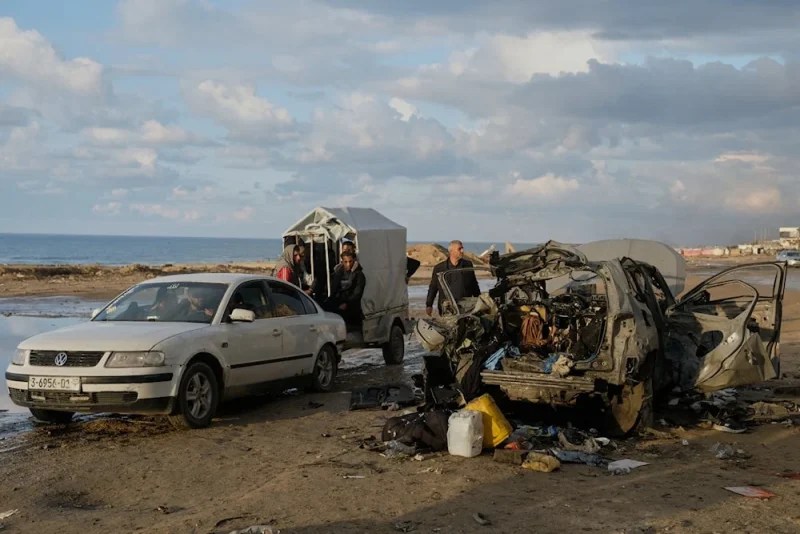
Al Mayadeen | February 17, 2026
Modern vehicles have evolved into internet-connected digital ecosystems, a transformation that is reshaping the global intelligence market, with “Israel” paying special attention to this rising domain, according to a new investigation by Haaretz.
In intelligence circles, information harvested from vehicles is known as “CARINT,” short for car intelligence. Today’s vehicles function as “computers on wheels,” equipped with built-in SIM cards, GPS systems, Bluetooth connectivity, and multimedia platforms that continuously transmit data.
The report reveals that at least three Israeli companies are operating in this expanding sector, developing tools that enable government clients to track vehicle movements in real time, cross-reference vast databases, and identify specific targets among thousands of cars on the road.
Industry sources cited in the investigation described the use of AI-powered “data fusion” systems that combine vehicle telemetry, roadside camera feeds, advertising data, and cellular metadata to construct comprehensive intelligence profiles. Rather than directly hacking a device, agencies are increasingly assembling what sources describe as a surveillance mosaic from legally or commercially available data streams.
The case of Toka
Among the companies identified is Toka, co-founded by former Prime Minister Ehud Barak and former Israeli military cyber chief Yaron Rosen.
According to documents and industry sources cited by Haaretz, Toka developed a product capable of infiltrating a vehicle’s multimedia system, pinpointing its location, and remotely activating microphones or dashboard cameras. The system was reportedly approved by “Israel’s” Security Ministry for presentation and eventual export.
The company said that as part of its 2026 product roadmap, it no longer sells the hacking tool.
Experts noted that exploiting vehicle vulnerabilities remains technically complex, as each manufacturer employs distinct digital architectures. However, the possibility of remote access to in-car microphones and cameras has raised acute privacy and security concerns.
Another Israeli firm, Rayzone, has reportedly begun selling vehicle-tracking tools through its subsidiary TA9. Unlike offensive hacking products, Rayzone’s system focuses on aggregating and cross-referencing data, including SIM-card tracking, Bluetooth signals, and license-plate recognition feeds.
The investigation suggests that the intelligence industry is gradually shifting away from high-profile phone-hacking technologies associated with firms such as NSO Group and toward large-scale, AI-enabled data analytics platforms.
In the United States, companies such as Palantir Technologies analyze license plate databases and vehicle registries, integrating them into broader intelligence systems. Israeli firm Cellebrite also works extensively with US law enforcement agencies in extracting and processing digital evidence, including vehicle-related data.
Vehicle intelligence expanded post Oct. 7
The Haaretz investigation further highlights that in the aftermath of Operation al-Aqsa Flood, Israeli authorities, with support from the private sector, developed advanced capabilities to locate vehicles stolen from army bases and border communities. According to the report, these tools were later integrated into military systems.
The article also points to China’s longstanding regulatory framework requiring domestic car manufacturers to transmit vehicle data to state authorities. It further notes that the Israeli Occupation Forces imposed restrictions on certain Chinese electric vehicles entering military facilities, citing security concerns.
Security analysts warn that the accelerating digitization of vehicles not only expands surveillance capabilities but also increases cybersecurity risks. Ethical hackers have previously demonstrated, in controlled environments, the ability to manipulate steering systems or disable engines remotely. Industry sources cited in the investigation indicate that some government clients are increasingly expressing interest in remote vehicle-disabling technologies.
At global intelligence exhibitions such as ISS World, often referred to as the “Wiretapper’s Ball”, artificial intelligence and real-time data fusion dominate discussions. AI systems now enable the rapid processing of millions of disparate data points, including vehicle telemetry, audio streams, and video feeds, transforming them into actionable intelligence with unprecedented speed.
Industry insiders argue that as vehicles become more connected, they will inevitably play a more central role in intelligence gathering. Privacy advocates, however, caution that the same connectivity that enhances consumer convenience may also underpin a powerful and potentially intrusive surveillance infrastructure.
The Haaretz investigation concludes that while directly hacking individual vehicles remains technically complex, AI-driven aggregation of vehicle-generated data could make such intrusions increasingly unnecessary, raising significant questions about privacy, regulation, and the future of digital mobility.
Palantir, Dataminr help build Gaza AI-Driven digital prison system
A +972 Magazine investigation reveals that US firms Palantir and Dataminr are embedded in the US-Israeli post-war plan for Gaza through the Civil-Military Coordination Center (CMCC), a US-run hub coordinating Trump’s 20-point plan. A Palantir “Maven Field Service Representative” tied to Project Maven has been assigned to the center, integrating battlefield AI into Gaza’s future control structure.
Project Maven fuses satellite imagery, drone feeds, intercepted communications, and metadata into an AI platform described as “optimizing the kill chain.” Rights groups argue these AI-enabled systems have accelerated the genocide in Gaza, scaling up killings with minimal human oversight. UN figures show nearly 70% of verified fatalities are women and children, with entire families wiped out in strikes allegedly guided by AI systems.
Palantir has expanded cooperation with Israeli occupation forces since 2024, doubling its Tel Aviv presence and supporting war-related missions. Amnesty International lists the company among firms whose services helped facilitate genocide and starvation in Gaza. Dataminr, specializing in real-time social media surveillance, has also been integrated into the framework, feeding AI-driven threat intelligence into the evolving security architecture.
Under the so-called “Alternative Safe Communities” model, Palestinians would be forcibly relocated into fenced, heavily monitored compounds under US-Israeli control. Within these zones, AI systems would track phones, movements, and online activity, flagging individuals as “security risks,” effectively turning Gaza into an AI-driven digital prison and kill-list system.
This architecture has been compared to Nazi concentration camps in its logic of isolating, surveilling, and managing an entire population as a security threat, reducing civilians to data points under total algorithmic control.
‘Israel’ threatens to genocide Gaza if Hamas refuses disarmament
Al Mayadeen | February 16, 2026
Senior Israeli officials have threatened to renew the genocide in Gaza if Hamas does not disarm within a proposed 60-day period, although the Israeli occupation continues its attacks on the Strip daily, never adhering to the ceasefire agreement.
Cabinet Secretary Yossi Fuchs, a senior adviser to Prime Minister Benjamin Netanyahu, said that the occupation government intends to give Hamas two months to relinquish its arms. If it does not comply, the Israeli military would “complete the mission” in Gaza, he threatened.
The warnings came against the backdrop of the US-led “Board of Peace”, under which Washington dictated the 60-day deadline.
According to Fuchs, Hamas would be required to surrender all weapons, including small arms such as AK-47 rifles. He emphasized that the Israeli regime would evaluate the outcome at the end of the period.
Netanyahu also reiterated that disarmament must include small arms, claiming that such weapons were used during the October 7 operation. Israeli officials allege that tens of thousands of rifles remain in Gaza.
Reports in The New York Times suggested that a draft proposal discussed by US mediators could initially allow Hamas to retain some small arms while surrendering weapons deemed capable of striking “Israel”. The document is reportedly expected to be shared with the Palestinian Resistance in the coming weeks.
Devastation and aggression despite ceasefire
Despite the ceasefire agreement, officially effective as of October 11, 2025, the Israeli regime has maintained its occupation of vast areas across the Gaza Strip, and continues to attack the Palestinian territory’s infrastructure and civilians.
Since then, over 591 Palestinians, including women and children, have been killed, and more than 1,598 others have been injured.
Since October 7, 2023, more than 72,051 Palestinians have been killed, and over 171,706 have been injured, making the war on Gaza one of the most brutal in modern history. Many victims are still in dire need of treatment. However, hospitals across Gaza have been systematically targeted over the past three years, forcing operations to minimal function, sometimes to a halt.
Israel Wants ISIS-Linked Militias To Control Rafah Crossing — The New Order in Gaza
By Robert Inlakesh | The Palestine Chronicle | February 13, 2026
As the Gaza ceasefire moves through its early stages, the partial reopening of the Rafah Crossing has triggered a struggle over who will control Gaza’s border administration. After rejecting the deployment of Palestinian Authority security forces, Israel has instead backed armed proxy groups — some linked to extremist Salafist networks — assigning them security roles in the border area, where reports of abuse have already begun to surface.
Key Takeaways
- Israel rejected Palestinian Authority forces at Rafah and instead supported alternative armed militias.
- Several Israeli-backed militias reportedly emerged from criminal networks and extremist factions inside Gaza.
- Members of these groups have been deployed near the Rafah Crossing, where abuse allegations have been reported.
- International actors monitoring the crossing are now considering escorts for civilians due to safety concerns.
- The developments raise questions about the composition of future Gaza security structures under international plans.
Control of Rafah Crossing
After rejecting the notion of allowing professionally trained Palestinian Authority security forces to patrol the Rafah Crossing, between Egypt and Gaza, Israel is now using its ISIS-linked death squads to patrol the border area. As expected, rights abuses are already being reported.
The notion that Israel was backing ISIS-linked militias was once dubbed a fringe conspiracy theory. Today, Israel is not only overtly backing ISIS and Al-Qaeda linked militants, but it directly created and controls five such militant organizations.
Amid daily Israeli violations of the agreement, the Gaza ceasefire slowly progresses between its first two loosely defined phases; one such progression has been the partial opening of the Rafah Crossing. Under this opening, the border zone – that is still occupied by the Israeli military – has been the site of a limited passing of civilians in and out of the Gaza Strip.
There have therefore been discussions about who precisely will be deployed on the Palestinian side of the crossing to perform checks on those passing through the crossing. Initially, the Palestinian Authority (PA) – based in Ramallah – attempted to propose that its well-trained security forces handle this task and that they even deploy to Gaza in order to lead through a transitional phase.
Tel Aviv has flatly rejected any role being played in Gaza by the Palestinian Authority, fearing that this could strengthen the case for Palestinian statehood. Instead, the Israelis have poured millions into backing an alternative “security force”.
Formation of Proxy Militias
Israel’s five proxy militias are composed of criminals who escaped from Gaza’s jails after Israel bombed the entrances in late 2023, in addition to opportunist thugs and longtime members of hardline Salafist movements that were long repressed by the Hamas-led authority.
Starting with the militia, led by the now deceased Yasser Abu Shabab, calling itself the “Popular Forces” – despite being perhaps the most unpopular Palestinian group to have ever existed – did not begin as the anti-Hamas militant group they present themselves as today.
They were first empowered by the Israelis after they invaded and occupied the Rafah Crossing area, working under Tel Aviv’s order to seize humanitarian aid trucks and hoard the goods they stole from the people of Gaza. Then, Abu Shabab’s men, at a time when the people of Gaza were being starved, drip-fed these donated goods onto the black market to be sold at exorbitant prices.
Only toward the end of 2024 did the Israelis begin giving Abu Shabab’s aid looters a facelift and using their contact with Western mainstream media to whitewash the crimes of these groups, selling them instead as an organic force fighting against Hamas. Corporate media outlets collaborated with the Israelis in presenting these gangsters as representing the opinions of the silent majority of Gazans.
In reality, these groups were infamous among Palestinians who saw them for what they truly were. These militias were collaborating with the Israeli military and intelligence to steal aid, helping to create societal strains amidst a coordinated and deliberate campaign of mass starvation.
These militants are not only extremist terrorists, whom Hamas had long cracked down upon, some belonging to groups that had carried out suicide bombings and other deadly attacks on Palestinians civilians, they are also convicted drug traffickers, murderers, and some stand accused of sexual violence.
In other words, Israel sought out the most despicable and criminal elements of Gaza’s population, pouring millions of dollars and weapons into terrorist militias. Many of them subscribe to a hardline Salafist doctrine, which justifies their criminal actions by allowing them to make Takfir (to declare they are non-Muslim) against the majority of Gaza’s population and even accuse them of Shirk (idol worship).
For example, leading figures within the Israeli-backed militias have attacked Hamas for siding with Iran, as the Salafists deem the Islamic Republic to be non-Muslim due to its Shia faith.
Deployment and Reported Abuses
Last Monday, the head of the ISIS-linked “Popular Forces” Ghassan Duhine announced through the Hebrew media that his Israeli-backed forces would be playing “an important security role regarding entry and exit through the Rafah crossing”.
Days later, reports that these death squads had been deployed at Israeli-controlled checkpoints emerged, alongside accounts of abuse. One woman, whose identity was concealed, informed the BBC that the collaborator militants told her that they could help her travel to Europe if she collaborated with them.
The woman’s hands were then bound, as the ISIS-linked militants insulted and physically assaulted her. In addition to this, she testified to having been tripsearched alongside three other women.
As a result of such reports, the European Union, which has its own monitors who are active at the Rafah Crossing, later stated it would consider sending its own people to escort Palestinians to the Israeli checkpoint in order to avoid such cases in the future.
Other reports emerged, some of which were also covered by the BBC, which suggested that the personal items of Palestinian travelers were confiscated by the EU’s officials. A woman named Rabia remarked that “They took perfumes, accessories, make-up, cigarettes, headphones – everything, they didn’t leave anything with us”.
International Oversight
All of this is being carried out under the watchful eye of the International Community, as are the daily Israeli ceasefire violations that have led to the mass murder of nearly 600 Palestinians in Gaza since October 10, 2025, when the ceasefire began. The Civil Military Coordination Center (CMCC), led by the US and Israeli militaries, is made up of over 20 different countries, which watch on as Israel demolishes civilian homes, funnels millions into ISIS-linked militias, and murders civilians.
There are also now questions about the future planned “Palestinian security forces” that are vaguely mentioned in the US’s plans for Gaza, with some speculating that the five Israeli-backed groups will make up a significant portion of that planned force.
In other words, the international community is permitting ISIS-linked militants with a diverse array of criminal convictions – who have a history of committing torture, executions, armed robbery, and raids on hospitals, all under Israel’s guidance – to play “security roles” in Gaza, all so that Palestinians are robbed of any sign of future statehood.
– Robert Inlakesh is a journalist, writer, and documentary filmmaker. He focuses on the Middle East, specializing in Palestine. He contributed this article to The Palestine Chronicle.
Featured Video

No Threat Can Force Iran’s Surrender /Trita Parsi & Lt Cl Daniel Davis
or go to
Aletho News Archives – Video-Images
From the Archives
An Expert Military Analysis of War with China
Actually, None is Necessary
By Fred Reed • Unz Review • December 13, 2020
The Correlation of Armed Forces: U.S. goods and services trade with China totaled an estimated $634.8 billion in 2019. Exports were $163.0 billion; imports were $471.8 billion. The U.S. goods and services trade deficit with China was $308.8 billion in 2019. Trade in services with China (exports and imports) totaled an estimated $76.7 billion in 2019. Services exports were $56.5 billion; services imports were $20.1 billion. The U.S. services trade surplus with China was $36.4 billion in 2019.
There is talk within the Washingtoniat of a possible war with China. Steve Bannon, who apparently was dropped on his head as a child, actually favors such a war. We hear the usual shoo-the-boobs alarm about how the Chinese are doing something terrible and we must gird our loins and American values and show them what for, bow wow, woof. The danger is that the current game of who-blinks-first in Asian waters might actually provoke a shooting war. You know the kind of thing: One warship refuses to get out of the way of another, a collision ensues, some retard lieutenant who signed up on waivers opens fire, and we’re off and running. It is not a good idea to let children play with matches.
The said war is discussed either in emotional terms by idiots or in purely naval terms by those familiar with such things, so we hear of the First Island Chain and the Second Island Chain and whose missiles against the other’s missiles and so on. This would be appropriate if we were fighting World War Two again. Which we aren’t. Let’s take a quick-and-dirty look at how such a war might go.
To begin the war, America would overestimate itself and underestimate China. This is doctrine in the Pentagon. … continue
Blog Roll
 Aletho News
- Iran To Target Military Industrial-Tech Complex That Facilitated Gaza Genocide
- Collapsing Empire: The Resistance Disarms ‘Israel’
- Suicide Should Not Be a Government Service
- Rethinking America’s greatest threat: Iran vs. Israel-Firsters
- Iran accuses adversaries of false flags to strain Turkey ties
- Poland rules out sending Patriot missiles to US/Israel amid war on Iran
- Tehran approves new Hormuz plan with major restrictions
- No Threat Can Force Iran’s Surrender /Trita Parsi & Lt Cl Daniel Davis
- UK’s New Pandemic Plan Would Turn Big Tech Into a Mass Location Tracking Network
- Growing insecurity, soaring prices fuel protests in north as regime bans evacuation: Sources
- If Americans Knew
- Ann Coulter Rips Into Fox News for Iran War Coverage, Compares to False Rigged 2020 Election Reporting
- Joe Kent Urges Americans To Call White House and Congress To Object To Sending Troops Into Iran
- DNC Resolution to Reject AIPAC Funding Puts Democratic Leaders in the Hot Seat
- Swedish foundation to build 400 schools as over 650,000 Gaza children remain without education for 2 years
- Israeli army admits photshopping image of slain Lebanese journalist
- This is how Israel is systematically killing health workers under the cover of war in Lebanon
- Carrying life under fire: Israeli invasion of Lebanon leaves pregnant women facing deadly risks
- Champagne all around for the new death penalty (for Palestinians) law – Not a ceasefire Day 172
- Why are Palestinian books struggling to be seen on Amazon?
- The Line Between Affinity and Conspiracy
- No Tricks Zone
- New Study Finds Warming Saves Lives…Cold Temperatures 12 Times More Deadly Than Excess Heat
- German Science Blog Accuses PIK Climate Institute Of Hallucinating Climate Tipping Points
- Devastating Assessment Of Comirnaty Vaccine By Former Senior Pfizer Europe Toxicologist
- New Study: CO2 Is ‘Effectively Negligible’ As An Explanatory Climate Change Factor Since 2000
- Former Pfizer Toxicologist Dr. Helmut Sterz Tells Bundestag Hearing Pfizer Vaccine Should Have Never Been Approved
- Energy Expert: Germany’s Nuclear Phaseout Was A “500 Billion Euro Mistake”
- New Research: South Australia’s Mid-Holocene Sea Surface Temperatures Were 4°C Warmer Than Today
- Storing Green Energy To Last Germany 10 Days Would Require A 60-Million Tonne Battery
- New Studies: UK Sea Levels Were 4 Meters Higher Than Today During The Mid-Holocene
- Destructive Green New Deal: German Energy And Metal Group Warns Of Drastic Crisis
 Aletho News