7 casualties in Israeli artillery shelling east of Gaza
Palestine Information Center – 17/05/2012
GAZA — Seven Palestinian citizens were wounded to the east of Gaza city on Thursday in Israeli artillery shelling of the area, medical sources reported.
Adham Abu Salmiya, the spokesman for emergency and ambulance services in Gaza, told the PIC reporter that two of the casualties were in serious condition.
He added that three of the wounded were old men, adding that the casualties were taken to Shifa hospital in moderate condition except the abovementioned two.
The Israeli occupation forces (IOF) fired a number of artillery shells at civilian neighborhoods and farmlands east of Shujaia suburb in Gaza city.
IOF soldiers earlier on Thursday raided southern and northern Gaza Strip areas, firing at random and bulldozing land.
Local sources in Khan Younis, south of the Strip, said that eight IOF armored vehicles infiltrated 800 meters into Fakhari area and bulldozed land amidst indiscriminate shooting.
Other IOF units raided northern Beit Lahia town to the north of the Strip while firing at farmers tending to their land.
Abu Salmiya said that no casualties were reported in the northern area despite earlier news of one casualty among the farmers.
~
Ma’an reports:
An Israeli army spokeswoman said forces opened fire toward “several suspects approaching the security fence.”
She said no hit was identified.
An Israeli army spokesman later added that “tank shells were fired towards the terrorists,” near the Karni crossing east of Gaza City.
Related articles
- #GazaUnderAttack | IOF artillery shelling targets Beit Hanun (occupiedpalestine.wordpress.com)
- New Proof that Gaza’s Still Occupied (thedailybeast.com)
Gaza: Boy Dies of Wounds Sustained on Monday; Jet Fighters Bomb Gaza City
By Ghassan Bannoura | IMEMC & Agencies | March 14, 2012
 Recent civilian airstrike victims in Gaza. Photo by Mohammed Al Majdalawy
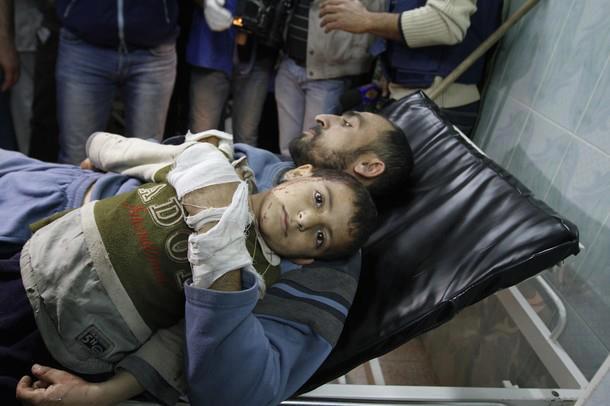
Seven year-old, Baraka Al Mughrabi, died, on Wednesday midday, after succumbing to wounds he sustained during an Israeli air raid targeting Gaza City on Monday. His death brings the death toll due to Israeli military escalations targeting the coastal enclave since last Friday to 26.
The latest round of escalation started after the Israeli army assassinated, on Friday, the leader of the armed Popular Resistance Committees in Gaza and his assistant. Palestinian sources announced today that among those 26 killed were five elderly men, two women and five children. 80 people in total were injured some lie in critical conditions.
Meanwhile on Tuesday night and Wednesday morning Israeli jet fighters violated the Egyptian mediated truce and conducted air raids targeting a number of locations in Gaza city. One of the targeted buildings was a wood factory. The factory was totally destroyed, no injuries reported.
Cairo announced on Tuesday that a ceasefire deal was reached between Israel and Palestinian groups in Gaza ending five days of escalation in the coastal enclave. According to Cairo Israel will stop attacks and extra judicial assassinations while Palestinian resistance will halt home-made shell fire from Gaza.
Meanwhile Israeli army officials dubbed the Egyptian mediated truce “fragile” adding that Palestinian groups may violate the truce deal. Yesterday Palestinian groups announced that they will resume firing home-made Qassam shells into Israeli towns near Gaza if Israel does not keep its end of the deal.
Related articles
- No pretense of an excuse for continued Israeli attacks on Gaza (alethonews.wordpress.com)
- Israeli attacks kill 12 Palestinians, wound 21 (alethonews.wordpress.com)
- Gaza truce declared as Israel hails new missile defense (alethonews.wordpress.com)
- 5 killed, 46 injured in fourth day of Gaza airstrikes (alethonews.wordpress.com)
- Israeli Forces Open Fire at Gaza Funeral, Injure Five (alethonews.wordpress.com)
No pretense of an excuse for continued Israeli attacks on Gaza
By Eva Bartlett | Rabble | March 13, 2012
In August 2011, when the Israeli army bombed the Gaza Strip for nearly a week, killing 26 and injuring 89 more Palestinians, they at least had a pretext, no matter how transparently false — one which was immediately proven bogus by both their own Israeli Occupation Forces (IOF) spokeswoman and subsequent investigations.
Four days ago on March 9, 2012, when the Israeli army assassinated two Palestinians via a precision-fired “drone” (UAV, the technically accurate name) missile, they didn’t even have the pretense of a pretext to cling to. The missile, which hit a car in Gaza City’s Tel el Hawa district, killing two Palestinian resistance fighters, was the first of almost non-stop bombing that has continued throughout Monday. As of Monday evening, the death toll was 25 Palestinians, with another over 80 injured — many with critical, life-threatening injuries — and 3 Israelis injured from the crude, unguided rockets Palestinian resistance fire, with no signs that Israel would cease its murderous campaign. In the first attacks, the IOF assassinated Zuhair al-Qaisi, the secretary general of the Popular Resistance Committees (PRC), and PRC member Mahmoud Hanani.
Samer, a university student from Beit Hanoun, spoke Monday of the injured he saw at northern Gaza’s Kamal Adwan hospital: “The injured I saw there yesterday were all children and women.” Indeed, if the death toll is accurate, while a great many of the assassinated have been resistance fighters, the martyred — and nearly all of the injured — also include civilians, children, and elderly.
In Jabaliya refugee camp, one of the many Israeli bombings on Monday killed 65-year-old Mohammed Mustafa al-Hasumi and his 30-year-old daughter Faiza. Early Monday morning, IOF warplanes targeted the three-storey home of the Hammad family in Ezbet Abed Rabbo, injuring 33, including two critically so, and including nine below the age of 10 years old. Also on Monday, in the Strip’s northern Beit Lahiya, the IOF killed Nayif Qarmout, 14, and injured five other students wounded when the IOF-fired missile hit near them. On Sunday, Israeli bombing in a residential area killed Ayoub Assaliya, 13, and injured his seven-year-old cousin.
The Israeli attacks began Friday with the assassination of resistance fighters who were not participating in acts of resisting the occupation, but rather were travelling through a residential area of Gaza City. Enshrined in international law is the right to resist occupation. In contrast, the targeted assassination of people not engaged in combat is forbidden under international law. Specifically:
Extrajudicial executions are gross violations of universally agreed human rights that enshrine the right to life in accordance with Article 3 of the Universal Declaration of Human Rights and further cemented in Article 6 of the International Covenant of Civil and Political Rights. Extrajudicial executions are acts outside the realm of rule of law and hence deprive the targeted individual(s) of their right to life, as well as the right to defend themselves against charges against them.
According to provisions of IHL, people who live under foreign occupation enjoy special protection under Common Article 3 of the four Geneva Conventions. The Article stipulates that:
“[t]he passing of sentences and the carrying out of executions without previous judgment pronounced by a regularly constituted court, affording all the judicial guarantees which are recognized as indispensable by civilized peoples” are prohibited at all times and in all circumstances. Civilians are moreover protected against acts that constitute collective punishment. Collective punishment, intentional attacks against civilians and extrajudicial executions constitute war crimes in IHL.
Jenny Graham, an Irish citizen living in Gaza City, describes on her blog the pandemonium following the first Israeli attacks on March 9:
A day of bombardment from air, sea and land, The martyred and injured taken to Al Shifa. To the North, South, East and West and everywhere in between, no where escaped. Loud explosions constantly rattled the windows and shook the building.
… not only can Gazans not report their stories, share their fears or spread word of an attack, many can now no longer keep check on friends and family members [due to the 20 hour long power outages throughout the Strip].
… The father of one of the Martyrs sits on the ground outside, oblivious to the crowds surrounding him, his eyes vacant and empty, he will never see the world the same again.
Omar Ghraeib, a 25-year-old Palestinian who blogs when he has electricity, said:
I live in Tel el Hawa, Gaza City. The first bombings last Friday — which ignited the latest escalation — happened in Tel el Hawa. Since then, basically, from south till north Gaza, from east till west, nowhere is safe. They even bombed populated area and high-traffic areas. The bombing affects everyone, including myself and my family; it is not safe to go to work or school. But if I could leave, I wouldn’t! I want to stick with my people here, I am not better than them, and we are all in this together. Some might leave, but the majority won’t leave their lands, houses, and country.
An online letter from various Palestinian civil society groups, including the One Democratic State Group and different BDS groups, reads:
[Gaza has been] bombed by Apache helicopters and F-16 and V-58 fighter planes. Gaza has been enduring Israeli policies of extermination and vandalism since June, 2006. The Palestinian people have already been under siege for more than six years as collective punishment. Israel has turned the Gaza Strip into the largest concentration camp, reminiscent of Bergen Bilsen and Auschwitz, with the largest population of prisoners in the world.
Mahfouz Kabariti, from Gaza City’s port area, says the bombing escapes no area:
“The other day they bombed behind our house, maybe 500 metres away. Three were killed.” But like most Palestinians, he is accustomed to the tragedies of the occupation.
“We are used to this life… but it is the kids dying, that’s the hardest thing.”
Saber al Zaneen, living in Beit Lahiya, said Monday evening:
“The situation is extremely difficult in Gaza It’s very, very dangerous here. There are bombs every five to ten minutes, from warplanes, from zananas (UAVs). Today’s the fourth day we’ve been under Israel’s war … and no one is doing anything to stop it. It’s the beginning of a new war on Gaza, and it already feels as bad as the last war on Gaza in 2008-2009. The Israelis are bombing everywhere again: people’s homes, schools, cemeteries…No one is on the street, everyone is afraid.”
[…]
Finally, and critically, Yaakov Katz in The Jerusalem Post cites statistics that are rarely cited, buried in the pages of Israeli propaganda:
… between September 2005 and May 2007 in which Palestinian armed groups fired 2,700 rockets toward Israel killing four people, Israel fired 14,617 heavy artillery shells into Gaza killing 59 people, including at least 17 children and 12 women. Hundreds more were injured and extensive damage caused.
In 2011, the projectiles fired by the Israeli military into Gaza have been responsible for the death of 108 Palestinians, of which 15 where women or children and the injury of 468 Palestinians of which 143 where women or children. The methods by which these causalities were inflicted by Israeli projectiles breaks down as follows: 57% or 310, were caused by Israeli Aircraft Missile fire, 28% or 150 were from Israeli live ammunition, 11% or 59 were from Israeli tank shells while another 3% or 18 were from Israeli mortar fire.
“To top things off,” Omar Ghareib writes, “Gaza’s Energy Authority announced that Gaza’s only power plant will be shutting down — completely — today, for the third time in a month, because of the lack of fuel. Gaza will sink under darkness again, but will be lit by the Israeli war machines.”
Dr. Hassan Khalaf, Deputy Health Minister in Gaza, said Monday that the combination of the latest Israeli attacks, the prolonged medicines shortage, and the continued lack of electricity meant for a critical health services situation in the Strip:
It is very critical, 180 of 450 of patients’ drug items are at zero stock; 200 of 900 of essential medical items are at zero stock. We lack many essential drugs, including those needed for anesthesia, antibiotics, specialized milk for infants, treatments for neurological conditions like epilepsy, and cancer medications.
No electricity means no medical service. Electricity is the life of medical service, for all machines; the ICU is completely dependent on electricity, as is the operating theatre, kidney dialysis…
In his blog post, “Mowing the lawn”: On Israel’s latest massacre in Gaza and the lies behind it Ali Abunimah links to a video interview with Shifa hospital’s Dr. Ayman Al Sahbani early on in the Israeli attacks, who says:
We don’t know what type of weapon was used. It led to severe burn from the upper torso; severe burn, black. We don ‘t know the type of chemical weapon used, because it is different from the other type of weapons. Used to kill, not to injure, to kill. The twelve martyrs, all of them severe shrapnel, severe injuries, and many of them without heads. In the past we saw burns, but last night, many of them direct trauma, many of them completely without their heads.
Some Palestinians in Gaza fear the worst for future days.
Saber Zaneen said Monday, “People hear rumours that Barack and Netanyahu wants to send tanks in, for a big attack worse than 2008. We have no idea what’s going to happen.”
Posturing in the media, Netanyahu said on Sunday: “We extracted a high price from them and will continue to do so.” On Monday, he said that the Israeli army is “prepared to expand its activities [in the Gaza Strip] as much as is necessary.”
Asking, “is it enough yet?” Jenny Graham writes Monday night of the 25 martyrs and more than 85 wounded, including 27 children, 13 girls and five elderly since Friday evening.
Omar Ghraeib notes what many Gazan Palestinians have said: “The situation in Gaza is unbearable. No one would cope with it, but Gazans do, because they are used to darkness, lack of power, lack of fuel, lack of gas, lack of water, cold weather, and dire conditions. And in addition to all that, we remain under siege.”
A list of Palesitnian martyrs since 2011.
Eva Bartlett is a Canadian and was an International Solidarity Movement member in Gaza during Operation Cast Lead.
Related articles
- Israeli Forces Open Fire at Gaza Funeral, Injure Five (alethonews.wordpress.com)
- Israel TV celebrity, wife of vice PM demands bombing, “suffering” of Gaza civilians (alethonews.wordpress.com)
Gaza water and sewer infrastructure displaces neighborhood
By Rami Almeghari | The Electronic Intifada | 13 February 2012
Gaza City – “Many of us women and children have gathered here at this mosque, after bulldozers demolished our homes. Unfortunately, those who displaced us are not the Israelis this time, but our own brothers in Gaza,” said an angry Umm Khaled al-Najjar, 50, as she held her grandson.
Al-Najjar and dozens of other women and children from the Hamami coastal neighborhood in western Gaza City took shelter last Wednesday at the mosque on the al-Rashid road after the demolitions of their homes on the orders of the Gaza municipality and the Gaza Lands Authority.
“They attacked our neighborhood early on Wednesday morning,” al-Najjar told The Electronic Intifada. “A contingent of police including female officers stormed the home and I fainted after the police hit my son in his back. Believe me, what happened is similar to Israeli actions against us for the past four decades, it is unbelievable, unbelievable.” The interview took place on Wednesday afternoon, as bulldozers were still flattening the area.
Abdullah Miqdad is another area resident. An elderly man, he was sitting on the road with many other men from the same demolished neighborhood. Anger, sadness and depression were drawn on the face of Miqdad and his neighbors, as the loud roar of the bulldozers could be heard in the background.
“I am the head of an eight member family and I recall that my father and I, when I was a child, were forced out of the Palestinian town of Hamama back in 1948, when Israeli occupation forces expelled us all from Palestine,” Miqdad said. “I wonder why they have done this excessive thing to us.”
Adel Abu Shiail owned a small grocery shop and house in the area. Both were victims of the bulldozers. “What happened to us has let our tears flow,” Abu Shiail said. “Yes, I cried, for this was my home for many years. I cried for the shop that was my main source of income for me and my five daughters. Where should we go, what should we do now?”
Abu Shiail said that he used to work in Israel, but that became impossible after 2000 due to tightened closures and the store had been his main sustenance.
Local fisherman and resident Ahmad Abu Samaan expressed the shock that many of his neighbors felt: “We never expected that these people, who must be our national authority, would even dare to attack us so brutally and force us out of our homes in which we lived for decades. Why did they do it? Why?”
Official explanations
Gaza authorities say the demolitions are necessary to implement a major traffic improvement project.
At the Gaza municipality building in Gaza City, those responsible for the demolitions were more than happy to provide their own explanation of what was going on.
“We in the municipality have rarely executed such major projects in the coastal city. This is due to the fact that the Israeli blockade of Gaza as well as the frequent Israeli army attacks on the region prevented us doing so,” Hatem al-Sheikh Khaleil, an engineer, said, “This is the first time that we embark on such a large-scale bulldozing as we are going to start a major infrastructure project.”
Khaleil said the project — to widen the 40 kilometer al-Rashid coastal road and install a sewage and water network in the coastal area of western Gaza City — was in cooperation with the Gaza-based Lands Authority and the Palestine Telecommunication Company, under a German grant of €11 million ($14.5 million).
The al-Rashid coastal road is one of two main roads in the Gaza Strip and much of the traffic here relies on it, especially in summer time. The road is too narrow to absorb the traffic of 1.6 million residents of the tiny coastal territory, according to municipal officials in Gaza.
“For the past six months we have been trying to kick off this vital infrastructure project. It is true that Gaza needs a lot of repair from the great damage that the region has suffered due to the Israeli blockade and attacks. So it is also imperative that we start such an internationally-funded project,” Khaleil added.
Over the past five years, the Gaza authorities have been unable to commence reconstruction projects across the coastal enclave due to continued lack of raw materials, caused by the Israeli blockade of Gaza. This is the first time since the blockade that Palestinians in Gaza are able to execute major infrastructure projects.
Compensation
The Palestinian Lands Authority in Gaza told the Electronic Intifada that the fifty displaced families will be transferred to government-owned lands in southern Gaza Strip city of Khan Younis.
“For the past six months, the Lands Authority sent out several notices to these families to vacate their homes ahead of demolitions,” Amal Shamali, a spokesperson for the Lands Authority said.
“We negotiated with representatives of the families over a land swap in the northern Gaza Strip and near the beach also. The chief of the Lands Authority himself went along with representatives of the families to the Attatra area, but later they refused our offer,” she added.
According to the Lands Authority, the targeted Hamami neighborhood has always been government-owned land and therefore, from an official point of view, the residents were squatters.
“On 17 January, the Hamas-led cabinet in Gaza approved compensation to the residents of the Hamami neighborhood, on which the expansion of the road and the sewage water network will be implemented. The government allocated urgent assistance of $1,500 for each displaced family to rent a home for six months. Also, under the land swap, each family will get a piece of land from 150 square meters to 300 square meters at a discounted price, to be paid by monthly installments for a period of ten years,” Shamali said.
Yet such arrangements were not on the minds of the shocked residents of the now demolished neighborhood.
“At least they should have notified us about the demolitions a few days ago, not come overnight abruptly and start bulldozing our homes. This is so cruel by a government that is supposed to be our own Palestinian national government,” said Adel Abu Shiail, angrily pointing his finger at a bulldozer that had just demolished his store.
The displaced families now face an uncertain future, far from the homes in which many have lived for 63 years.
Rami Almeghari is a journalist and university lecturer based in the Gaza Strip.
~
“Alternative” media sources, including Pacifica radio, reported this story without providing the context shown above under the heading “official explanation”.
Featured Video

Now everyone is dumping US government bonds
or go to
Aletho News Archives – Video-Images
From the Archives
Experts Warned For Years That A War With Iran Would Happen This Way
By Caitlin Johnstone | April 3, 2026
… It’s so wild how we keep seeing reports that Iran’s retaliation caught the US off guard. For all the years I’ve been paying attention to this issue I’ve been reading experts and analysts saying if the US attacks Iran, Iran can close the Strait of Hormuz and strike US bases and the energy infrastructure of US allies in the region.
A few examples:
A 2006 Oxford Research Group paper titled “Iran: Consequences of a War” warned that Iran has numerous options at its disposal in the event of a US attack, and that the “most significant of these would be any possible retaliatory Iranian action to affect the transport of oil and liquefied natural gas through the Straits of Hormuz,” adding that stopping Iran from doing this “would be difficult if not impossible to achieve, leading to a fear of attack which alone would have a formidable impact on oil markets.”
A 2007 Cato Institute paper titled “The Iraq War and Iranian Power” warns that “Iran possesses the largest ballistic-missile inventory in the Persian Gulf — missiles which can reach Israel, Saudi Arabia and US military bases in Iraq,” and that “experts argue Iran could also use the ’oil weapon’: blocking the 34km-wide Strait of Hormuz and conducting submarine and anti-ship missile attacks against ports and oil facilities in Saudi Arabia, Kuwait and other Gulf Cooperation Council states.”
A 2012 NPR article titled “Can Iran Close The World’s Most Important Oil Route?” features then-chairman of the Joint Chiefs of Staff acknowledging that Iran absolutely can block the Strait of Hormuz, saying Tehran has “invested in capabilities” which specifically enable them to do so.
A paper from the Columbia Center on Global Energy Policy and the Center for a New American Security titled “IN DIRE STRAITS? IMPLICATIONS OF US-IRAN TENSIONS FOR THE GLOBAL OIL MARKET” warns of a potential scenario “that includes damage to Gulf oil infrastructure and a temporary closure of the Strait of Hormuz.”
These weren’t a bunch of keffiyeh-wearing peaceniks making these assessments, they were deeply entrenched swamp monsters entirely loyal to the US empire. They opposed war with Iran not because it would be an evil act of unforgivable mass murder, but because it would be bad for the imperial power structure. … Full article
Blog Roll
 Aletho News
- US dismantling international law in its war against Iran while claiming ‘false’ victory: Legal scholar
- One martyr, 5 injuries in US attack on Iraqi border crossing with Iran
- ‘This war is Israel’s war’: World facing ‘security breakdown’, says Qalibaf
- IRGC decries attack on US embassy in Riyadh, says executed by ‘Israel’
- Iran blasts EU hypocrisy as EU invokes international law over Hormuz
- There is no military solution to Strait of Hormuz
- NATO’s structural collapse – the outcome of deviation from reality
- Poll finds world views China better than US
- One Of America’s Leading Neo-Cons Has Turned Against The Iran War And Israel
- Attack in the Bosphorus exposes NATO weaknesses and tensions among allies
- If Americans Knew
- US loses planes over Iran, Israel downgrades Lebanon war goals – Daily Update
- Israel Is Blocking Palestinians from Easter at Church Where Jesus Resurrected
- Plot to assassinate Palestinian activist follows harassment campaign promoted by Zionist groups and elected officials
- Prominent New York synagogue hosts presentation on why U.S. Jews should support the ethnic cleansing of Gaza
- Tapper vs. Piker: Is the CNN Anchor Auditioning for David Ellison?
- Shouldn’t Democrats Be Able to Condemn Genocide?
- Israel-US kill negotiators, destroy civilian structures, but Iran’s military capabilities still largely intact – Daily Update
- ‘War crime’: Global condemnation as Israeli ministers celebrate death penalty law targeting Palestinian prisoners
- 7 Ways Israel Is Turning Lebanon Into Gaza
- World’s Leading Football Bodies Under Fire Over Israel Policies
- No Tricks Zone
- New Study Reports A 60% Slowdown In Greenland’s Ice Loss Rate In The Last Decade
- Low Intensity Tornado Wrecks Major Solar Farm, Creating A Potential Toxic Dump
- New Study Finds Warming Saves Lives…Cold Temperatures 12 Times More Deadly Than Excess Heat
- German Science Blog Accuses PIK Climate Institute Of Hallucinating Climate Tipping Points
- Devastating Assessment Of Comirnaty Vaccine By Former Senior Pfizer Europe Toxicologist
- New Study: CO2 Is ‘Effectively Negligible’ As An Explanatory Climate Change Factor Since 2000
- Former Pfizer Toxicologist Dr. Helmut Sterz Tells Bundestag Hearing Pfizer Vaccine Should Have Never Been Approved
- Energy Expert: Germany’s Nuclear Phaseout Was A “500 Billion Euro Mistake”
- New Research: South Australia’s Mid-Holocene Sea Surface Temperatures Were 4°C Warmer Than Today
- Storing Green Energy To Last Germany 10 Days Would Require A 60-Million Tonne Battery
 Aletho News