Israel Faces ‘Near Impossible Task’ in Gaza
By Scott Ritter – Sputnik – 29.10.2023
Israel has conducted a series of ground incursions into Gaza over the course of the past week, each one building on the other, increasing in scope and scale. This appears to be part of an Israeli strategy to lean gradually into an operation that, when finished, falls just short of a general assault on Gaza.
At the end of the day, however, Israel will most likely not be able to defeat the military forces of Hamas and other Palestinian resistance forces defending Gaza. Israel will have to either seek to defeat Hamas by laying siege to the Gaza Strip or commit to a full-scale attack on Gaza designed to clear the territory of all Hamas fighters.
History suggests that any such assault will be extremely difficult to accomplish.
The example of Operation Hubertus, the final German assault on Stalingrad, stands out. The Germans brought in elements of seven elite “Pioneer” battalions — combat engineers with extensive experience in urban warfare, having paved the way for prior German victories in Rostov and Voronezh. The Pioneers were the masters of military demolition, highly trained specialists in house-to-house fighting and the use of explosives and flame throwers. Around 1,800 of these elite assault engineers were assembled for the final drive to push the defending Soviet soldiers from Stalingrad.
On the first day of operations, the Pioneers suffered nearly 30% casualties. After several days of fierce fighting, the Pioneers were stopped less than 100 meters from their objective. However, their forces suffered between 60-70% casualties, and could not proceed further.
Operation Hubertus was doomed to fail from the beginning. According to an account of the fighting, “The constant bombardment and artillery shelling created a battlefield in which the Soviet defenders largely held the advantage over the assaulting Germans. The fields of rubble and craters were perfectly designed for defensive actions and could be improved with relatively little effort. This also provided ample hunting ground for the ever-present Soviet snipers.”
A similar observation can be made regarding the Allied attacks on Monte Casino, in Italy, in early 1944. A massive aerial bombardment destroyed a 6th century abbey. Elite German paratroopers dug into the rubble, and for months successfully held off repeated attacks. There can be no doubt that the excessive bombardment of Monte Casino ended up strengthening the positions of the German defenders.
In the battle of Iwo Jima, it took US Marines more than a month to secure the tiny island, largely because the Japanese had dug some 18 kilometers of tunnels into the 21-square kilometer island, some of which were more than 70 meters underground, from which they rode out heavy bombing and shelling, only to emerge and ambush the advancing Marines.
If one combined the above ground rubble of Monte Casino with the below-ground tunnel network of Iwo Jima, you might approximate the hellish scenario awaiting Israel in Gaza.
Over 500 kilometers of tunnels dug in under the 360 square kilometers that comprise the Gaza Strip, these tunnels are purpose built, designed to serve as transportation corridors, command centers, supply depots, dormitories and hospitals, defensive positions, and in support of offensive action. Simply put, there has never been a military operation against a target such as the one presented by Hamas in Gaza.
Israel has trained a small number of its elite special forces to carry out limited-scope operations in an underground environment. These operations, typically involving hostage rescue or direct action (i.e., eliminating a high value target), are conducted under very controlled circumstances, with the attacking forces proceeding only when the circumstances support a favorable outcome. As such, the experiences of these troops are counterproductive when it comes to transferring knowledge to the conventional forces that would bear the brunt of any Israeli assault on Gaza.
Simply trying to navigate the rubble-strewn streets of Gaza will be a nearly impossible task for the Israeli troops. The going will be slow, and the Israeli infantry will have to operate dismounted, exposing themselves to sniper fire and ambushes. Israeli vehicles will find themselves hemmed in without the ability to maneuver, making themselves vulnerable to mines, improvised explosive devices, and anti-tank weaponry. Close air support under these circumstances will be very difficult, effectively neutralizing Israel’s greatest advantage.
If Israel does not sync its above-ground actions with a simultaneous effort to defeat Hamas’ underground tunnel-based defenses, then the situation above ground will become even more precarious, with Hamas emerging from tunnels behind the Israeli forces, cutting them off and inflicting heavy casualties. But Israel is going to be operating largely blind underground, probing into a tunnel network designed by Hamas to protect against any such effort. Israel’s best bet would be to simply locate tunnel entrances and seal them off, leaving the Hamas forces underground to die of thirst, hunger, oxygen deprivation, or disease. But this will require the physical occupation of every square meter of the city, an immensely difficult problem from both a logistical and operational standpoint. It will also expose more Israeli forces to harm, resulting in a dramatic increase in casualties.
By reacting to the Hamas attack of October 7 in the way it has, Israel has literally walked into a trap designed by Hamas to defeat any Israeli incursion. Israeli forces are neither trained, equipped, organized, nor motivated to carry out the kind of brutal, bloody, and physically demanding combat that will be required to defeat Hamas above and below the ground in Gaza. Israeli political and military leaders have boxed themselves into a corner with their aggressive winner-take-all rhetoric. But now that the time has come to pay the price of their collective verbiage, the question becomes is this a price Israel is willing and able to pay?
The answer is probably no. Israel has defined victory as being predicated on the total defeat of Hamas as a military organization. This is most probably a mission impossible. Hamas, therefore, emerges victorious simply by surviving. Given the strong defensive position Hamas finds itself in, through a combination of its immense tunnel network and the destroyed urban environment brought on by Israeli bombardment, it is highly likely that Hamas will be able to hold off a concerted Israeli assault until which time the Israel Defense Forces, like the German Pioneer battalions in Stalingrad, exhaust themselves on the field of battle.
Russia: Israel’s bombardment of Gaza unlawful
Press TV – October 28, 2023
Russia has shown its strongest reaction to the Israeli regime’s nonstop bombardment of the besieged Gaza Strip by labeling the three-week campaign targeting the civilians in the Palestinian territory “unlawful.”
Foreign Minister Sergei Lavrov said in remarks published by the Belarusian state news agency Belta on Saturday that the carnage is against international law and could create a decades-long catastrophe in the region.
Lavrov said Israel has been “indiscriminately using force against targets where civilians are known to be present.”
He warned that Israel’s stated goal of seeking to eradicate the Palestinian resistance movement Hamas would require a total destruction of Gaza, an enclave of over 2.3 million people located on the Mediterranean.
“If Gaza is destroyed and 2 million inhabitants are expelled, as some politicians in Israel and abroad propose, this will create a catastrophe for many decades, if not centuries,” said the Russian foreign minister.
“It is necessary to stop, and to announce humanitarian programs to save the population under blockade.”
Israel’s savagery began on October 7 in response to a Hamas operation in the occupied territories which led to over 1,400 deaths among settlers and regime troops.
Israelis were already angered by Moscow’s decision to host a Hamas delegation in the midst of the conflict in Palestine.
Russian authorities have defended the move while Hamas leaders say they have received a request from Moscow to look for eight people identified by Russia as possibly being among hostages taken by the group’s fighters during the blitz into the occupied territories.
Figures released by Gaza’s health officials on Saturday showed the Israeli bombardment has killed more than 7,700 Palestinians, including over 5,000 women and children.
Hamas resists Israeli offensive in Gaza after violent night of airstrikes
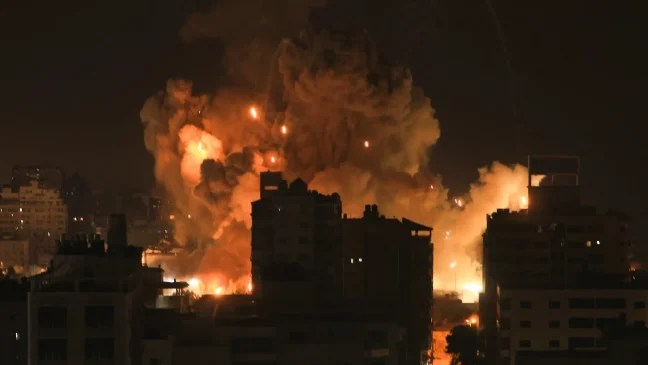
Gaza City during an Israeli airstrike on 8 October, 2023. (Photo Credit: MAHMUD HAMS / AFP)
The Cradle | October 28, 2023
Gaza-based Palestinian resistance faction Hamas announced on 28 October that its forces successfully held back invading Israeli troops who overnight launched large-scale ground operations into the coastal enclave under the cover of intense air raids.
Hamas says its forces dealt “heavy losses to the enemy’s ranks” as they repelled the ground incursion. Nonetheless, heavy clashes continue in several points of the northern Gaza Strip.
“The enemy fell into ambushes set up by the Palestinian resistance on several fronts. Kornet missiles and Yasin shells were used to repel the attack, and we expect the enemy to try again. The Israeli regime used helicopters to evacuate the wounded and the dead from the battlefield,” the Hamas statement reads.
For their part, Israeli media claims there are “no reports of Israeli casualties” and that “ground forces, including infantry, combat engineering forces, and tanks, remained inside Gaza […] operating deeper into the Hamas-run territory than previous limited incursions.”
On Friday night, the Israeli army began what officials described as an “expansion” of their ground operations into Gaza after several nights of “limited incursions” that were also repelled by the Palestinian resistance.
According to local reports, the elite US Delta Force has been accompanying Israeli troops into the besieged territory. However, Washington maintains that its forces only provide logistical advice to Tel Aviv.
The Israeli ground offensive was launched under the cover of a violent campaign of airstrikes by the Israeli air force, which decimated the northern Gaza Strip with hundreds of bombs, including internationally banned white phosphorous and cluster munitions.
Despite the intensity of the Israeli offensive, the Gaza resistance continued to launch rocket attacks toward the occupied territories, setting off alarms in several settlements.
As the clashes continue, Gaza remains unreachable to the outside world after Israel cut off all phone and internet services to provide cover for the genocide being committed against Palestinian civilians.
“This communications blackout means that it will be even more difficult to obtain critical information and evidence about human rights violations and war crimes being committed against Palestinian civilians in Gaza and to hear directly from those experiencing the violations,” Erika Guevara Rosas, senior director of research, advocacy, policy and campaigns at Amnesty International, said in a statement on Friday.
UN agencies and human rights organizations say they can still not reach their staff and health facilities inside Gaza.
Gaza suffers near-total information blackout
RT | October 27, 2023
Internet and cell phone services stopped working in Gaza on Friday night, after Israel “expanded” its military operation against Hamas militants in the Palestinian enclave.
The largest telecommunications provider in Gaza, Paltel, has announced “a complete severance of all communications and Internet services” due to intensified Israeli strikes.
“The intense bombing in the last hour caused the destruction of all remaining international routes linking Gaza to the outside world,” the company said.
Netblocks, a company that tracks internet connectivity globally, confirmed the information blackout, calling it “the largest single disruption to internet connectivity in Gaza since the beginning of the conflict and will be perceived by many as a total or near-total internet blackout.”
International media outlets, including RT, have partially lost contact with their crews and stringers on the ground. The Israel Defense Forces (IDF) told news organizations that Israel “cannot guarantee your employees’ safety, and strongly urge you to take all necessary measures for their safety,” according to a letter sent to Reuters and AFP.
The head of RT Arabic, Maya Manna, said there was no contact with correspondents and photographers operating in the Palestinian enclave as of Friday evening. The sole message came from an RT stringer in the area, describing a “very violent bombing.”
“I don’t know what to do with my children and my family. Everyone is afraid, everyone is terrified, and there is screaming everywhere in the Gaza Strip,” Masoud Abu Jarash, a local reporter, told RT.
According to an NBC News crew member, who was also able to message colleagues, “all internet, electricity and everything” has been cut off. “The situation we’re in is difficult, so difficult and very dangerous. We’re being extensively shelled by artillery and by air,” the unnamed staffer said.
The UN children’s agency also lost contact with their colleagues in Gaza, with UNICEF chief Catherine Russel saying she was “extremely concerned about their safety and another night of unspeakable horror for 1 million children in Gaza.”
The international healthcare charity Doctors Without Borders (MSF) said there was no contact with some of their Palestinian colleagues.
“We are particularly worried for the patients, medical staff and thousands of families taking shelter at Al Shifa hospital and other health facilities,” MSF said, expressing deep concern over the situation regarding one of Gaza’s biggest medical centers.
Israel has accused Hamas of turning hospitals into “headquarters for their terror,” referring specifically to Al Shifa, and even published an “illustrative video” which supposedly points out the “different locations in and under the hospital which are being used to plan and implement terrorist activities.”
Hamas claims that by cutting off communications from Gaza, Israel is attempting to “cover up the crimes of the occupation without any oversight or accountability,” and tries to “create an image of victory,” a senior official, Osama Hamdan, told Al Jazeera.
The Gods Are Going Against the Chosen People – Mammon Against Israel, Mars Against the Pentagon
By John Helmer | Dances with Bears | October 27, 2023
The Palestinian strategy against Israel is aimed at destroying Israel’s capacity to survive in its present state in a long war.
This means attacking the invincibility of the Israel Defense Forces (IDF) and their so-called Iron Dome defence; this began with the cross-border offensive on October 7, and continues with daily drone and artillery attacks on targets inside Israel, as well as resistance to IDF incursions in Gaza.
The plan also means exposing the weakness of the state’s infrastructure and economy; extending the battlefield across all of Israel’s territory – the ports, power plants and electricity grid, communications, and financial markets — making the cost of occupation of the Arab territories unendurable. In a long war, two of Israel’s leading exports earning more than 40% of the state’s trade — diamonds and tourism — face ruin.*
“The Israelis cannot withstand one year of fighting in a war,” Iraq’s President Saddam Hussein told his general staff in 1983 during a discussion of planning for a regional war of the Arabs against Israel.** In the forty years since then, the evolution of military technology and tactics has expanded the power of small national liberation armies like Hamas, Hezbollah, and the Houthis, of proxy principals like Iran, and of the strategic balancing role of Russia and China. Their combination now has shortened the Zionist state’s endurance in a long war, and that of its proxy principal, the US.
The Israelis and the Jewish diaspora comprehend this reluctantly. For them, the short war must be correspondingly shorter. This means the genocide of at least a million Palestinians in lives and displacement.
The war to do that has now become an international war – and this is a war the US cannot sustain. As a Pentagon insider said publicly this week, “because there are so many draws on the logistics and support infrastructure of the Pentagon, we’re not prepared to go in in a concerted way. What we are seeing right now is death by a thousand cuts. Our adversaries know we are stretched so they are going to make us stretch even more, so we can respond even less.”
The Russian Foreign Ministry spokesman, Maria Zakharova, acknowledged the point in Moscow on Thursday: US naval, air force, and marine reinforcements deployed around Israel and Gaza are “American tactics to strengthen their own security (this is how it should be interpreted) at someone else’s expense.” They are backfiring on Washington’s capacity to defend US forces in the Mediterranean, the Red Sea, the Persian Gulf, and in land bases in Syria, Iraq and Jordan. “On the contrary,” Zakharova added, the US military deployment “will further rock the situation in the Middle East, create additional tension that can spill out beyond the region.”
Zakharova’s warning came in the Moscow afternoon. By then Russian Foreign Ministry officials had held meetings with a Hamas delegation, and officials from Iran, Egypt, and Kuwait. Across the city at the same time, President Vladimir Putin held telephone talks with Turkey’s President Recep Tayyip Erdogan. The Kremlin communiqué reported: “Russia and Turkiye have practically overlapping positions.”
Israeli and US-led media censorship and propaganda are concealing the breadth of impact of the Palestine warfighting plan, and the deepening military and economic weaknesses of the Israeli state.
The longer the war continues, the plainer the evidence is on the battlefield that the single-state scheme of Israel and the US is no longer possible. Whether Israel and the US can be compelled to withdraw to the 1967 borders and a new Palestinian state created with partition, demilitarisation, and international security guarantees – the basis of the Russian position announced again on Thursday in Moscow — remains to be fought over.
In this long war, the gods do not favour the Chosen People.
Following with precision the battlefield action is impossible in the Israeli and Anglo-American press. Reporting of operations, and of Israeli and US casualties, is being suppressed entirely or delayed for days, if not weeks.

According to this NBC television report, broadcast on October 24, there were at least 24 US combat casualties following drone attacks on or about October 18 at the Al-Tanf base in Syria and the Al-Asad base in Iraq. Reporting of naval action in the Red Sea, when the USS Carney reportedly engaged Houthi missiles over several hours, has been changing since the initial news flashes of October 19. Read more here. In a new report of October 24, Israeli and US casualties in a joint raid inside Gaza were revealed: “in the last 24 hours or so, some of our Special Ops forces and Israeli Special Ops forces went into Gaza to reconnoiter, to plan for where they might want to go to free hostages and make an impact, and they were shot to pieces and took heavy losses, as I understand it. I think that is where we are headed and I don’t see that as a win for Israel in any way, shape, or form. And I certainly think it is very dangerous for us”. In current reporting by Al Mayadeen, daily strikes against US bases in Iraq and northeastern Syria are documented.
Tracking the electric war and infrastructure strikes by Hamas and Hezbollah is also difficult. They commenced with cyber attacks on Israel’s electricity generation plants and power grids; these have been followed by missile and drone strikes. “The ground has been laid for attacks on the Israeli grid,” a US military source claims. “I believe drones will come first, then missiles. We may even see commando raids.”
Israel’s seaports are also under constant attack. Ashkelon, which is closest in range to Gaza, has been closed. Eilat may have been the target of the Houthi missile strike which was engaged last week by the USS Carney. Ashdod, which accounts for about 40% of incoming and outgoing Israeli seaborne trade, and Tel Aviv port have been targeted. The result is a tenfold surge in war risk insurance for vessels and cargoes, and the curtailment of international vessel movement in and out of the Israeli ports; there are reports that shipping is down 30% in Ashdod compared to the pre-war volume. Evergreen, the Taiwanese container shipping company, declared force majeure for Ashdod on October 17, diverted one vessel to Haifa, and halted future shipping into both ports. “We advise evaluating each port visit in Israel on a case by case basis and implementing appropriate precautions in ship contingency plans,” recommends a maritime industry alert bulletin.
Chevron’s offshore Tamar gas field has been shut down. The source produces 70% of the gas required to fuel Israel’s electricity generation needs. Not a single Anglo-American media source has noticed that Israel is at risk of losing its principal energy source to drone or missile attack. “After what the Americans and Germans did to blow up the Nordstream pipelines,” comments a Moscow industry source, “what is holding Hamas back from hitting Tamar, or Hezbollah from the other Israeli gas fields?”
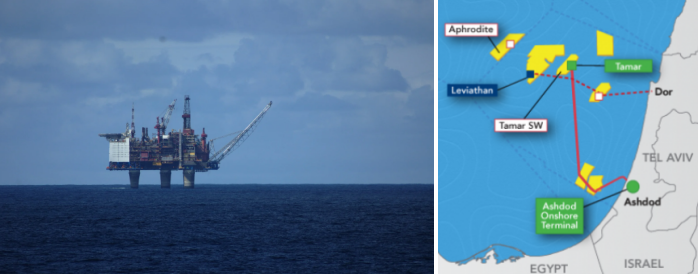
Left: Chevron’s Tamar gas production platform is located at sea 24 kilometres west of Ashkelon. Right: click to enlarge map of Israel’s offshore gas sources.
A Moscow source comments that “in Israel, the US and the UK will be able to bring in supplies without a very big risk of US ships being attacked. The risk is to the ports and bases, not to supplies from the Med[iterranean]. The Greek and Cyprus bases will come in very useful. Israel will not face severe logistical issues as long as it is on the offensive. If its settlements start getting cut off, encircled or penetrated then it is a different matter.”
The indirect economic impacts of the war have also not been calculated or discussed in the mainstream media or international business newspapers. The leading export revenue earners are diamonds at above $9 billion per annum, and tourism which had been peaking at $8.5 billion in 2019. Counted together, diamonds and tourism amount to more than 40% of the state’s export earnings.
The Covid-19 pandemic and worldwide travel restrictions cut Israel’s tourism revenue fourfold, and this had been recovering over 2022 and the tourist season this year. This has now stopped, although for the time being Hamas rocket launches on Ben Gurion airport near Tel Aviv have been intercepted.

October 12, 2023 — source: https://www.youtube.com/.
ISRAEL TOURISM REVENUE TRAJECTORY, 1999-2022
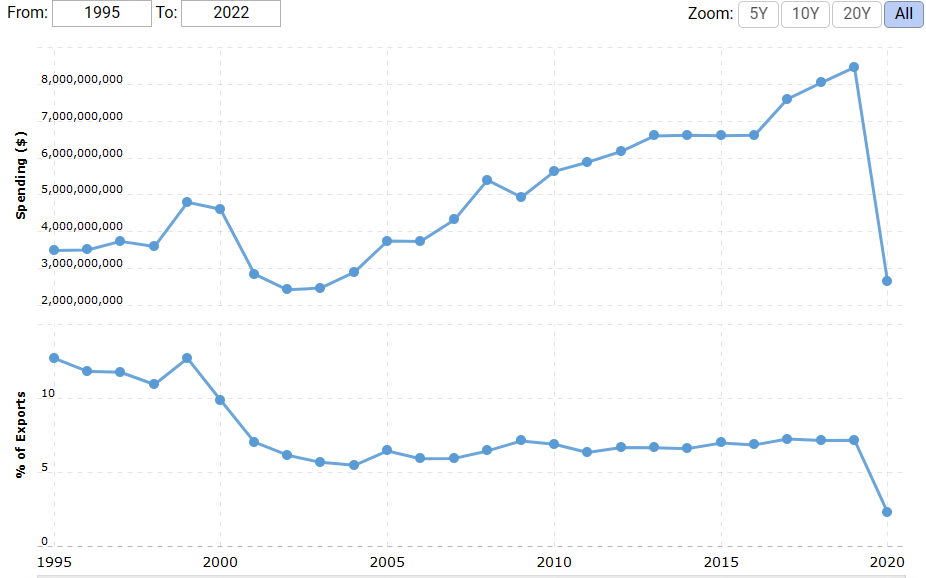
Source: https://www.macrotrends.net/
Israel’s high-tech machine exports and pharmaceuticals may also be affected if electricity supply, internet networks, and transportation are damaged.
The cumulative effect will be the outcome which the international ratings agencies have been warning the international banks and financial markets to prepare for. “In our view,” Fitch reported to clients on October 17, “the combination of Israel’s dynamic, high-value added economy, the record of resilience to regional conflict, [and] preparedness for military confrontations… make it unlikely a relatively short conflict largely confined to Gaza will affect Israel’s rating…. the risk that other actors hostile to Israel, such as Iran and Hezbollah, could join the conflict at scale has risen significantly… a major escalation could result in negative rating action. This could take the form of a wider and longer conflict, resulting in a sustained fiscal drain, both from higher spending and lower tax collection, as well as loss of human and material capital and severe economic disruption.”
How short, and also how long, Israel’s warfighting plan will take depends on American and international acceptance, not only of the genocide intended for the Palestinians of Gaza, but of the Novichok-type chemical warfare planned by the IDF and the Pentagon for the Hamas tunnel system in Gaza City. After several years in which the US and UK have fabricated claims that Syria and Russia were using prohibited gas warfare weapons, the Israelis have reportedly persuaded the US to participate in the tunnel attack operation. The Pentagon is denying the reports.
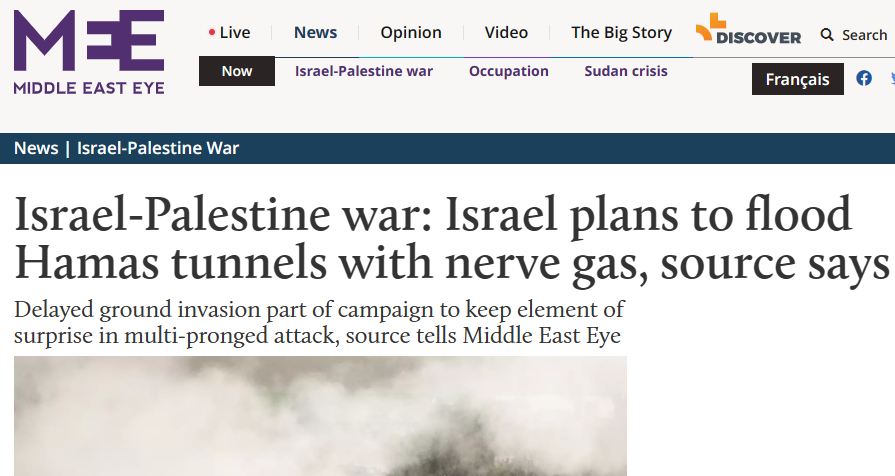
Source: https://www.middleeasteye.net
Russian and US military sources are already confirming the logistical supply problems facing Israeli and US forces at present, when the war is just three weeks long. Greek sources are reporting the Souda Bay, Crete, base has already reached its capacity for incoming US navy and air force supply and support operations; the spillover is facing growing Greek protest at the Elefsina air base near Athens.
A Cyprus source says the movement of US and British aircraft into and out of the Dekhelia and Akrotiri airbases is accelerating, and there is an air and seaborne shuttle between the Cypriot ports of Larnaca and Limassol and the USS Gerald Ford carrier group at sea to the southwest of the island.
The lengthening of the supply lines required to support the USS Eisenhower carrier group in the Red Sea and Persian Gulf and the shore bases needed to support it are politically sensitive already; and the risks of Houthi and other attacks, along with domestic Arab crowd protests, will intensify for these bases in the Arab sheikhdoms the longer the war against Israel reveals Arab and Iranian warfighting skill and resistance.
Converting these gains into a negotiating framework for Israeli-American retreat is the task Russian officials are attempting in silent coordination with the Chinese, and in semi-open negotiations in Moscow this week. In its first move outside the region since the war began, Hamas has visited Moscow for negotiations, led by US-educated Moussa Mohammed Abu Marzouq.
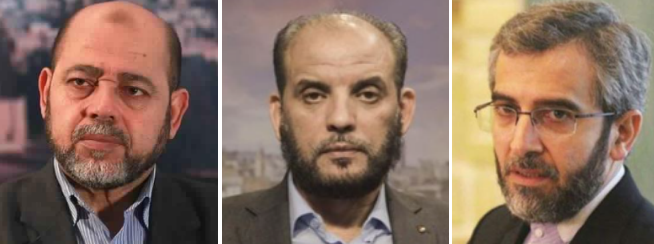
Left: Moussa Mohammed Abu Marzouq; centre: Husam Badran; right, Ali Bagheri Kyani.
Zakharova confirmed the start of the talks with Hamas on Thursday. She said: “I can also say and confirm that representatives of the relevant Palestinian movement are in Moscow. As for contacts, we will inform you additionally.” She has also disclosed that since the war began, nine thousand Russian passport holders have returned to Russia from Israel; and that at least fifteen Russian passport holders among the Hamas hostages have been killed in the IDF airstrikes.
At the same time as Marzouq’s meetings, Husam Badran issued a statement to the Russian state news medium, Sputnik. “Russia,” Badran said, “is able to play an important role in ending the war between Israel and the Gaza Strip, and delivering aid to the Palestinian exclave. Hamas values Russia’s role on the international stage, especially use of veto in the UN Security Council against the United States. But Russia can play a greater role in ending the aggression against our people in the Gaza Strip and applying international pressure to deliver urgent aid to our people in the Gaza Strip.”
What Hamas means by “greater role” for Russia has not been disclosed publicly yet. It is known that Hamas is willing to negotiate the release of “non-military” hostages, including Israelis holding Russian passports, through Iran. This is conditional on the IDF lifting its siege on Gaza and allowing sufficient supplies into all parts of the territory.
The “military hostages” are being held in exchange for the release of Palestinian prisoners in Israeli jails. There are more than 6,000 of the latter; there may be fewer than 200 hostages in Gaza, as up to 50 have been killed by Israeli bombing.
The Russian Foreign Ministry statement on the talks with Hamas is less revealing. According to the Sputnik release, “Russia has discussed release of hostages and evacuation of Russians from the Gaza Strip during a meeting with a delegation of Hamas in Moscow on Thursday.” A member of the political office of the Islamic resistance movement Hamas, Abu Marzouq, is in Moscow. Contacts took place with him in continuation of the Russian line for the immediate release of foreign hostages located in the Gaza Strip, and issues related to ensuring the evacuation of Russian and other foreign citizens from the territory of the Palestinian enclave were also discussed.”
At the same time on Thursday – unnoticed and unreported by the western media – Russian officials held several negotiating sessions with an Iranian emissary, Deputy Foreign Minister Ali Bagheri Kyani. In three separate Foreign Ministry releases, meeting communiqués were issued for Kyani’s meetings with deputy ministers Mikhail Bogdanov, Sergei Ryabkov, and Mikhail Galuzin. “The need for the cessation of hostilities in and around the Gaza Strip and the prompt provision of humanitarian assistance to the affected Palestinian population was confirmed,” Bogdanov’s communiqué said. “It was stated that Moscow and Tehran are determined to continue close coordination of efforts in the interests of stabilizing the situation in the Middle East.”
It is unclear if the talks also included the Hamas officials in a three-party format. During the day there were also Foreign Ministry negotiations in Moscow with Kuwaiti and Egyptian officials.
At the Kremlin it has been announced that President Putin spoke with Turkish President Erdogan to discuss the war. According to the Kremlin release, “the presidents reviewed the active efforts undertaken by Russia at the UN Security Council, as well as the corresponding political and diplomatic steps taken by Turkiye to stop the bloodshed and ensure the unimpeded delivery of humanitarian aid to those in need. It was emphasised that Russia and Turkiye have practically overlapping positions, focused on implementing the well-known two-state solution, which provides for the creation of an independent Palestine coexisting with Israel in peace and security.”
In her briefing for the press, Zakharova dismissed the US moves so far. “We do not consider the US presence in the Middle East as contributing to the stability of the situation in the region. Exactly the opposite. Washington’s earlier attempts to monopolise the Middle East settlement process, ignoring the true causes of the protracted conflict, have largely led to the current catastrophic consequences… This situation has an absolutely clear and understandable road, a ‘road map’ for settlement. It is not simple, but complex, painful, but leading to the solution of the issue, not its aggravation.”
“Of course, no air defence systems, arms supplies, materiel injections into some ‘security complexes’ will help resolve this situation. Today’s lesson must be learned. How many Americans have deployed there (their bases, experts, satellites), nothing has worked to prevent a bloody scenario, of which both Palestinians and Israelis are victims.”
[*] With support from Israel and influential Jewish diamantaires in New York and Tel Aviv, a scheme of sanctions is being prepared by the US Government to stop Russian raw diamonds, produced by Alrosa, from being sold into the Belgian, Israeli, and US markets. The Russian goods are to be tagged “blood diamonds” because of the war in the Ukraine. However, now that Israel is destroying the Palestinian population of Gaza, the “blood” tag can be applied to the Israeli diamond cutting industry and to the Jewish diamond trade abroad. Support for the anti-Russian sanction, and also for the IDF operations against the Palestinians can be found in Rapaport.com news reports. “Rapaport stands with Israel”, the publication and its owner Martin Rapaport declared on October 26, “and has undertaken all the necessary effort and costs for the October Single Stone Auction to help the Israeli market continue to conduct business as best as possible during this difficult time. Rapaport believes that continuing to do business in Israel during the war is a victory over the brutal Hamas terrorists, and will help Israel win the war.” In another editorial for the diamond trade, Rapaport proposes “to boycott Iran and all other supporters of the Hamas terrorist organization.” Rapaport also cites religious authority for liquidation. “In the words of G-d (Exodus 17:14): ‘I will utterly blot out the memory of Amalek from under heaven.’May the words of G-d be done, here and now.” Quietly, Russia’s state diamond interests dictate a strategy for protecting against this double-edged Israeli policy.
[**] Saddam Hussein is quoted in the chapter on US plots against him in Iraq – see The Jackals’ Wedding: American Power, Arab Revolt, Ch. 6.
Why are the Israelis massacring civilians in Gaza? Because they can get away with it
By Michael Hoffman | Revelation of the Method | October 23, 2023
Israeli forces terror-bombed Beirut throughout the summer of 1982. In the West in English there is exactly one book about it: God Cried by Catherine Leroy and Tony Clifton. The Lebanese have almost no memorial and certainly no museum devoted to the bombing of hospitals, schools and apartment blocks, just like now, in Gaza. The Israeli government is well aware of this forgetfulness and they calculate their atrocities and war crimes accordingly.
If the Palestinians were bombing Tel Aviv to the extent the Israelis have bombed Gaza (5,000 deaths thus far), in the aftermath there would be books, movies, diaries, poems, plays, museums, and annual, solemn commemorations throughout the West.
Gaza was heavily bombed in 2009 and 2014. The Arab and Muslim world do not engage in the same level of memory and commemoration, other than personal recollection. There are a few exceptions, but they are comparatively minuscule.
Furthermore, if, as in Gaza, day-in and day-out Tel Aviv’s civilian centers were being blown to bits, and its food, fuel and even its water (!) were shut down, the International Court in The Hague and the European Union would be charging the Palestinian leadership responsible, with war crimes. The US would be heavily sanctioning those leaders and humanitarian supplies would be dropped by parachute if necessary to sustain the Israeli civilians.
Instead, the Court and the EU are frozen in mute assent to crimes against Arab children committed as I write these words, by the Israelis who suffered a holocaust in Europe and have been granted by Europe and Britain a license to perpetrate atrocities in Palestine. Hamas terrorists copied this perverse victims-have-the-right-to-be executioners “logic” on Oct. 7.
As for the casual, business-as-usual aspect of the atrocities against Palestinian civilians, it is rooted in the Zionist weaponization of the Talmudic halacha which few in the West, on the Left or the Right, care to learn about – http://talmudical.blogspot.com – and without which they will have no key to comprehending the depth of contempt for Palestinian life.
There are hundreds of books in English harshly critiquing the Quran. Meanwhile this writer’s two banned books [Judaism Discovered and Judaism’s Strange Gods] containing a sustained critique of Talmudism, which in English are among the only credible and charitable texts compassionately documenting Talmudic hate speech, which causes real world harm to Palestinian children, women, elderly and non-combatant men, in the form of their relentless mass murder.
The hate speech is real: on Oct. 9 Israeli Defense Minister Yoav Gallant referred to the Palestinian people as “human animals.”
Israeli Prime Minister Meachem Begin termed them “two-legged animals.”
Israeli Army Chief of Staff Rafael Eitan called the Palestinians: “cockroaches in a bottle.”
The Allied incineration by more than 800 bombers leveled the German city and burned alive tens of thousands of civilians.
The murder of civilians, including by Hamas, is always wrong. Murder is murder. Dressing it up with alibis and platitudes does not make the heinous war crimes any less criminal.
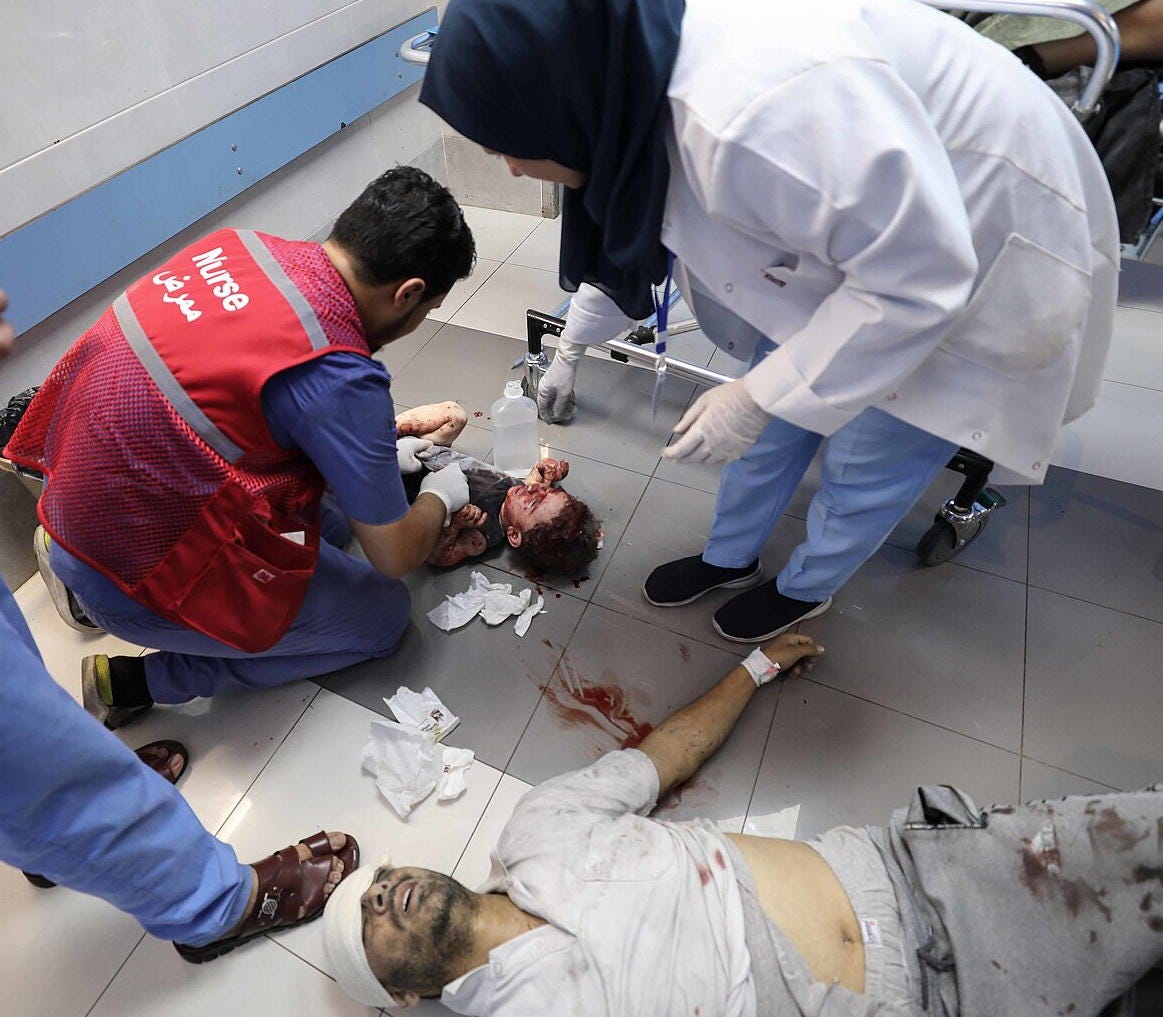
Wounded Palestinian child and man receiving medical treatment at Al-Shifa Hospital in Gaza City following an Israeli bombing, Oct. 11, 2023
How can the daily Israeli massacre of kids and their mothers be parsed, justified or mitigated? It is right, but abortion is wrong? The bipolar nature of such thinking is depraved.
(Israeli victims of Hamas terrorism are no less innocent. They are extensively mourned in the West however, and rightly so; that’s not the case for the Palestinian civilian dead, not in any sustained memorial).
How can the Israeli mass murder of kids and their mothers be justified? I will answer my own question:
The record shows that bombing civilians in cities is the default method of Allied warfare: Tokyo, Nagasaki, Hiroshima, Dresden, Hamburg, Hanoi, Baghdad.
As noted previously, Israelis terror-bombed Beirut throughout the summer of 1982 and Gaza in 2009 and 2014. These war crimes are justified by media ghouls in America, ensuring more of the same, as in Gaza now.
The bombing of Afghan villages and weddings contributed to the defeat of US forces, after the people became fed-up with the transparently lame excuses for the massacres by the likes of David Petraeus, who is now being touted by the media ghouls as a master of statecraft and generalship.
President Biden’s last act in Afghanistan was to approve a missile attack on an SUV that was transporting a large family. Seven children and three adults were incinerated; that’s how the US will be remembered in that nation.
Adolf Hitler was responsible for the brutal, mass expulsion of hundreds of thousands of Judaic people from Germany. For the past 20 years conservative wunderkind Ben Shapiro has advocated the forced extrusion (“transfer”) of the Palestinian people from Palestine. In his own words: “Here is the bottom line: If you believe that the Jewish state has a right to exist, then you must allow Israel to transfer the Palestinians and the Israeli-Arabs from Judea, Samaria, Gaza and Israel proper.”
Each of us must bear witness and do what we can to document, teach and remember.
FOR FURTHER RESEARCH
On the Palestine issue, Amy Goodwin’s podcast today, Oct. 23, is recommended. It can be accessed here at her Democracy Now! website.
A righteous Jew and an extraordinary human being, the brilliant Israeli journalist Amira Hass, is interviewed in two parts.
Take the time to listen to Amira:
If you’re in haste, at least listen to the interview in part two.
All of these broadcasts should be saved and conserved by citizen-journalists (like you), for posterity, and compiled into a permanent data base. I propose the following title for the proposed repository: Witness of War Crimes in Gaza.
History Lesson: Leftist Daniel Denvir conducts a “Palestine Teach-In“ on his podcast, which is accessible at The Dig website: the first hour contains a generally excellent history of the rise of Zionism in Palestine. Too many people don’t know how it all started. The historical context has been missing. Caveat : Mr. Denvir’s guests are mostly of the Left and their analysis of Britain’s role in the ascendance of Zionism in Palestine is limited to a perspective of British colonialism as the root cause. The influence of Freemasonry on the British government, and the masonic objective of rebuilding the Temple of Solomon in Jerusalem, is missing from their analysis. However, don’t let that omission keep you from accessing the history offered.
Michael Hoffman is a former reporter for the New York bureau of the Associated Press and the author of ten books of history and literature, including Secret Societies and Psychological Warfare (2001), The Occult Renaissance Church of Rome (2017) , Twilight Language (2021), as well as a textbook (Judaism Discovered), and five other books published in the United States, as well as overseas in Japanese and French translation; and 122 issues of Revisionist History® newsletter, 1997-2022. His truth mission is made possible by donations, paid Substack subscriptions, and the sale of his books, newsletters and recordings. Podcast: here. X (Twitter): here. Rumble here.
Israeli troops launch new ‘limited incursion’ into Gaza
The Cradle | October 27, 2023
Israeli forces launched another limited ground incursion into the Gaza Strip overnight on Thursday, the second in a row following an incursion the night before.
The small-scale incursions carried out so far are meant to test the waters for the upcoming ground invasion Israel has announced.
“The IDF conducted strikes on Hamas terrorist targets over the last 24 hours. IDF ground troops, fighter jets, and UAVs struck: Anti-tank missile launch sites, Command and control centers, Hamas terrorist operatives,” the Israeli army said in a statement.
“The troops exited the area and no injuries were reported,” it added.
Israeli troops also carried out a limited incursion into Gaza the night before, on 25 October.
The incursion aimed to help prepare forces for the “next stages” of the war and the anticipated large-scale offensive on the besieged enclave.
“IDF tanks and infantry struck numerous terrorist cells, infrastructure, and anti-tank missile launch posts. The soldiers have since exited the area and returned to Israeli territory,” a military statement said on 26 October.
A previous Israeli attempt to enter the strip last weekend was met with fierce resistance by Hamas’ Al-Qassam Brigades.
Israeli troops crossed the border fence by several meters for a preparatory incursion into the Gaza Strip. The Al-Qassam Brigades ambushed the troops, destroying two army bulldozers and a tank, leaving several soldiers seriously wounded, and forcing them to withdraw.
Retired US Army colonel Douglas Macgregor said this week that US special forces went into Gaza with the Israeli army to “reconnoiter” and plan for the release of prisoners.
“They were shot to pieces and took heavy losses, as I understand,” Macgregor added.
Israel announced plans to launch a full ground invasion of the Gaza Strip following the launch of Operation Al-Aqsa Flood on 7 October.
The stated goal is to “eradicate” Hamas. Israel says it intends to find and destroy the group’s extensive network of tunnels and wipe out its infrastructure while its army attacks from the air and sea.
However, Tel Aviv has continued to delay the operation, coinciding with reports that Washington is unconvinced of Israel’s readiness for a ground invasion. Nonetheless, US special forces have been advising and coordinating with the Israeli army to prepare.
“The military leadership has already finalized an invasion plan, but [Benjamin] Netanyahu has angered senior officers by refusing to sign off on it — in part because he wants unanimous approval from members of the war cabinet he formed after the Oct. 7 attack,” the New York Times (NYT) reported on 26 October, citing two anonymous sources who have been present at Israeli cabinet meetings.
“Analysts believe that Mr. Netanyahu is wary about unilaterally giving the go-ahead because, with public confidence in his leadership already decreasing, he fears being blamed if the operation fails,” NYT added.
According to a recent poll, a majority of Israelis believe that Netanyahu must bear the responsibility for the massive security and intelligence failure which led the success of Operation Al-Aqsa Flood.
Israel announced on 25 October that it is waiting for further equipment deliveries from the US, but continues to maintain that the full ground invasion is imminent.
Analysts have said Israel’s goal of “eradicating” Hamas is overambitious.
According to The Cradle’s Hasan Illaik, such an operation will drag Israel into a massive multi-front war which it would not be able to bear the cost of.
Hamas’ Al-Qassam Brigades have heavily prepared themselves to face Israel on the ground.
Spanish minister calls on Europe to sever ties with Israel
MEMO | October 26, 2023
Spain’s acting Minister of Social Rights, Ione Belarra, called on European countries to sever diplomatic relations with Israel and impose an arms embargo and economic sanctions.
Belarra said in a post on X yesterday, that it is still possible to stop the “genocide” and also called for Israeli Prime Minister Benjamin Netanyahu and all other political leaders, who bombed civilians in the Gaza Strip, to be brought before the International Criminal Court.
In a previous statement, Belarra confirmed that “Israel has left hundreds of thousands of people without electricity, food, or water, and is bombing civilians, which constitutes collective punishment, serious violation of international humanitarian law and can be considered a war crime.”
She also accused the EU and US of encouraging Israel to practice a policy of discrimination, racism and aggression that – according to the Spanish minister – seriously violates human rights.
For the 19th consecutive day, the Israeli occupation army continues to target the Gaza Strip with intense air strikes that destroyed entire neighbourhoods and left thousands of Palestinian civilians martyred and wounded.
Featured Video

Laith Marouf: Hezbollah’s position on US-Iran ceasefire
or go to
Aletho News Archives – Video-Images
From the Archives
The Dirty Little Secret behind the “Global Terrorism Index”
The Omission of Israeli Terrorism in the Occupied Palestinian Territories
By Karin Brothers | Global Research | December 6, 2014
… The Israeli settlements — all of which are illegal – have been identified as a major impediment to peace. The refusal of a major “global” terrorism report to name the Israeli settlers as one of the groups most responsible for terrorism not only misrepresents a major source of regional violence but exposes the Global Terrorism Index as a propaganda tool that supports a U.S. agenda.
In recent years, governments have been attempting to thwart terrorism by blocking supportive fund-raising. When it comes to Israeli settlements, however, the US and Canada actually encourage fund-raising by giving organizations (such as Christian Friends of Israeli Communities (CFOIC) and the Jewish National Fund) financial support in the form of donor tax-deductions.
Charities which provide funds for the Israeli settlements should be regarded as terror-financing organizations. They should not only lose their tax-deductible status, but they should be banned because they support the violation of international humanitarian law. The terror-financing laws that are being strictly enforced for Muslim charities should be applied to Christian and Jewish charities as well. … Read full article
Blog Roll
 Aletho News
- The ‘Opposition Party’ Has Done Nothing to Stop the Iran War and Much to Goad Trump Into Continuing It
- Moscow backs Tehran on status of Lebanon in US-Iran deal
- How UK Regulator Ofcom Quietly Bypassed International Law to Police American Speech
- The Black Cube Files: How Former Mossad Operatives Flipped a Nation
- Laith Marouf: Hezbollah’s position on US-Iran ceasefire: What you’re not being told
- Israel’s priority lies in destroying chances of peace between Iran, US: Ex-UN nuclear chief
- Ceasefire for all or for none: Iran shuts Hormuz over Lebanon attacks
- Strait of Hormuz is Iran’s ‘nuclear weapon’ that forced US retreat: Medvedev
- Energy crisis will last for months – Kremlin envoy
- Europe’s quiet role in the war on Iran
- If Americans Knew
- This is ceasefire? Israel’s biggest massacre yet in Lebanon, another journalist killed in Gaza – Daily Update
- Tucker Carlson on Israel: This Is the Behavior of an Ally? Really?
- Gazans face a triple crisis: severe shortages of water and bread, healthcare in tatters
- NY Times reports how Netanyahu took the US into Iran War
- A sigh of relief over Iran, but Gaza and Lebanon in dire straits – Daily Update
- Thousands dead and neighborhoods razed to the ground: Aid agencies fear southern Lebanon is becoming the new Gaza
- The war the US is fighting for Israel could cost trillions
- ‘Cigarette Burns, Nail Wounds’: Toddler Tortured in Gaza to Coerce Father
- Trump Says US Sent ‘a Lot of Guns’ to Protesters in Iran
- Israeli forces destroy 17 UN peacekeeper cameras in south Lebanon
- No Tricks Zone
- An Inconvenient Tree: Uncovered In Alps… Europe Much Warmer Than Today 6000 Years Ago
- New Study Reports A 60% Slowdown In Greenland’s Ice Loss Rate In The Last Decade
- Low Intensity Tornado Wrecks Major Solar Farm, Creating A Potential Toxic Dump
- New Study Finds Warming Saves Lives…Cold Temperatures 12 Times More Deadly Than Excess Heat
- German Science Blog Accuses PIK Climate Institute Of Hallucinating Climate Tipping Points
- Devastating Assessment Of Comirnaty Vaccine By Former Senior Pfizer Europe Toxicologist
- New Study: CO2 Is ‘Effectively Negligible’ As An Explanatory Climate Change Factor Since 2000
- Former Pfizer Toxicologist Dr. Helmut Sterz Tells Bundestag Hearing Pfizer Vaccine Should Have Never Been Approved
- Energy Expert: Germany’s Nuclear Phaseout Was A “500 Billion Euro Mistake”
- New Research: South Australia’s Mid-Holocene Sea Surface Temperatures Were 4°C Warmer Than Today
 Aletho News