The resumption of PA security coordination with Israel is no surprise
By Ramona Wadi | MEMO | November 14, 2017
Palestinian Authority leader Mahmoud Abbas is not one to miss an opportunity to collaborate with Israel. At sporadic intervals, the suspension of security coordination with Israel was implemented temporarily only when Palestinians were protesting over Israeli violence or, for example, surveillance at Al-Aqsa Mosque. Despite congratulatory statements regarding Abbas’s decision to suspend what he has called “sacred” coordination with the occupation authorities, there was still doubt over its implementation; there were even occasional comments that security coordination had resumed even as the PA was still congratulating itself over the “suspension”.
Last week, all doubts were dissipated as the PA confirmed that it had resumed security coordination with Israel two weeks earlier. In terms of accuracy, the time frame can be contested, given that reports as early as August had already confirmed such collaboration. In light of the reconciliation agreement between the PA and Hamas, it is thus ever more pertinent to question the underlying motives behind such a deal, which has the potential to open up Gaza to Israel.
According to comments on Press TV, Hamas spokesman Fawzi Barhoum declared the movement’s “surprise” at the announcement. Security coordination “is the equivalent of the greatest danger to the Palestinian people, its unity and its legitimate rights, including the right to resist the occupation,” he said. Barhoum also described the move as distorting “the reputation” of the Palestinian people, their struggles and history.
While Barhoum’s comments show an understanding of the implications, claiming to be surprised was surely an exaggeration. Had Gaza not been forced to seek a compromise with Fatah, it is possible that the current political scenario would not be defined by a reconciliation agreement, particularly one which so far is seeking to overturn the resistance with which Hamas has been identified and which sets the movement apart from other political factions due to being forced into situations necessitating defence in the enclave.
Within the same time frame of the security coordination announcement, senior Hamas official Mousa Abu Marzook also stated that responsibility for Palestinians in Gaza now rests entirely with the PA as a sign of credibility to eliminate internal division. The problem is that the emphasis on internal division is being isolated from the repercussions upon Palestinians. If the current trend continues, Palestinian leaders will be making the same mistakes as the international community by separating the political from the humanitarian, thus creating different levels of responsibility, visibility and accountability.
If the PA determines the course of the reconciliation agreement, security coordination will ultimately provide Israel with access to the Gaza Strip unless Hamas decides on an alternative course of action, which is to refute the entire facade of “unity” that has been shaped by Mahmoud Abbas. Coercion has been a primary factor influencing the reconciliation agreement, compounded with the international isolation of Gaza, its people and Hamas. Security coordination is another form of coercion which will determine additional levels of oppression for Palestinians, including those in Gaza.
For many years, Abbas has sought to maintain different forms of violence in Gaza and the occupied West Bank, using deprivation and security coordination respectively. Under such circumstances, Hamas will be in dire need of further evaluation and a different strategy.
Read Also: What prisoners mean to the Palestinian Authority
PA’s security coordination with Israel greatest threat to unity
Hamas slams PA for insistence on EU mission at Rafah crossing
Palestine Information Center – November 4, 2017
 GAZA – Member of Hamas Political Bureau, Mousa Abu Marzouk, condemned in a tweet on Saturday the Palestinian Authority’s (PA) insistence on the existence of the EU mission at Rafah border crossing. This means the return of the Israeli control over the crossing, he highlighted.
“Why is the PA keen on the Israeli existence at the crossing when it has become managed by a national administration?” Abu Marzouk wondered.
Last Wednesday, the Palestinian consensus government took over the control of Gaza Strip crossings in accordance with the latest Cairo reconciliation agreement.
Handing control of crossings to the PA ‘removes Israeli pretext for siege on Gaza’
MEMO | November 4, 2017
The Popular Committee against the Israeli Siege on Gaza said on Friday that handing over control of the Gaza border crossings to the Palestinian Authority removes the Israeli pretext for maintaining its siege on the territory, Anadolu has reported.
“It is obligatory on Israel to lift its siege and restrictions on the crossings,” said the Committee, “and to ease the movement of goods and people and cancel the list of goods banned from entering Gaza.”
According to the group’s statement, 80 per cent of the factories in the Gaza Strip have either stopped production or implemented severe cuts due to the siege. Unemployment now stands at 50 per cent and 80 per cent of the population are in poverty. “These are scary statistics,” it said.
The head of the Committee is independent Palestinian MP Jamal Al-Khodari, who described the 10-year siege on Gaza as “illegal and amounting to collective punishment.” He called for a Palestinian campaign to get the international community to take up its role in obliging the Israeli occupation to lift the siege on the enclave.
The Israeli occupation authorities closed the Gaza border crossings in the wake of the Hamas victory in the 2006 Palestinian elections and the ousting of Fatah from the territory a year later. Last month, Hamas and Fatah signed a reconciliation agreement brokered by Egypt, and handed over the crossings on 1 November to the Ramallah-based PA as part of the deal.
READ MORE:
Ramona Wadi: Despite his talk of ‘reconciliation’, Abbas continues to act in Israel’s interests
Young photographers from Gaza capture moments of joy

An impoverished family from the north of Beit Lahia enjoys a light moment. The father is strumming a guitar, a young girl is dancing while the boys are playing music with simple household utensils. CC BY-NC-ND / ICRC / Mouhamad Al-Barawi
ICRC | October 17, 2017
A quick Google search for Gaza will show you multiple images of rubble and raw sewage pouring into the Mediterranean. These are the images that often appear in our mind together with the things we once heard or read about the place. For example, that it is “the world’s largest outdoor prison” or that it “will become unlivable”. But is this the way Gazans themselves see their homeland?
The photo competition we launched among young and extremely talented Gazan photographers was meant to answer this question. At first, we were not sure, whether a photo competition was even a good idea. Would people, who are trying to live their lives though the economic crisis and the electricity crisis, unable to access basic goods and services, have time and energy to spare for such a trivial and unnecessary thing as a photo competition? It turned out they did. And we were taken aback by the results.
Young photographers, contemplating their immediate surroundings, showed that life in Gaza is much more than crises, fences, isolation and the enormous suffering they cause. It is a quiet moment where a little fisherman, who almost seems like a part of the seascape, is looking under the sea surface, probably wondering what the future will be like for him and his generation, in a place where the young face 66% unemployment rate. It is children holding candles in the darkness, not metaphorical, but very real, as people have to organize their lives around four hours of electricity per day. It is also immense joy and laughter when an improvised family band explores music making potential of aluminum cooking pots.
This diversity of moments of happiness, laughter, quiet contemplation show that people of Gaza did not just put their lives on hold waiting for long overdue political solutions. Every single day, they demonstrate incredible resilience in the face of the harsh realities that surround them.


My Name is Rachel Corrie

23-year-old Rachel Corrie who was crushed to death by Israeli bulldozers in Gaza in 2003 [NawalAlhawsawi/Twitter]
By Nasim Ahmed | MEMO | October 26, 2017
Fourteen years have passed since 23-year-old Rachel Corrie was crushed to death by Israeli bulldozers in Gaza. The American activists, along with other members of the International Solidarity Movement (ISM), were taking part in nonviolent direct action to protect the home of a Palestinian family from demolition when the activist from Washington was killed.
Since her untimely death on the Rafah border crossing in 2003, Corrie’s free-spirited attitude to life has been the inspiration for international solidarity movements, non-violent resistance as well as plays and books celebrating her humanity and bravery.
My Name is Rachel Corrie, being showed at the Young Vic in London, is based on the emails and diary entries of the pro-Palestinian activist, which first premiered at London’s Royal Court in 2005. The play was originally put together by the late Alan Rickman and Katharine Viner, now the editor of the Guardian.
Unsurprisingly the plays reproduction has come under strong criticism from Pro-Israeli groups. Fury at the revival of the play has stirred all kinds of controversy such that supporters of Israel in the UK are piling pressure on the Young Vic for staging the play. The Vic’s artistic director David Lan, who is Jewish, felt compelled to come to the theatre’s defence saying: “Gaza is a wound to the planet from which so many people are suffering.”
Pro-Israeli organisations have even threatened to leverage the £1.7 million pubic grant given to the Young Vic to ensure that it takes a more “balanced” position when it comes to Israel. Lan however has insisted that artistic expressions are useful to promote dialogue saying: “We welcome and hope to encourage as wide a discussion of this terrible situation as possible and anything that keeps Gaza at the front of our consciousness is to be valued.”
Aside from the nuisance of having Pro-Israeli activists shoving propaganda leaflets smearing the memory of Corrie towards you at the entrance of the theatre, the hour and half long immersion into Corrie’s mind is a memorable experience.
The play brilliantly darts through the diaries of Corrie from her early teens through to the period of her untimely death. Directed by an award winning director, Josh Roche, and wonderfully performed by British actor Erin Doherty, viewers are exposed to a visceral representation of the brutality of Israeli occupation seen through the eyes of an activist searching for her place in life.
Doherty’s astonishingly skilful performance of Corrie brings to life defining moments in the campaigner’s personal journey as she grapples with her own sense of privilege in contrasted with the indignity and poverty she saw in Gaza. If nothing else, the play powerfully captures the inner tensions of Corrie who felt a deep sense of responsibility over her own country’s unquestioned support for Israel.
The play is emotionally rousing given the very nature of diary entries, which are intended by its author to be an honest representation of ones thoughts and feelings unpolluted by polemics. Corrie appeared deeply troubled by the constant dehumanisation of Muslims and Palestinians; her conversations with her father, which are including in the the play, shed light on America’s own troubling assumptions about the world in the post 9/11 world.
The added punch to the play and the performance of Doherty is made all the more incredible by the setting; a background made up from the barest material, empty colourless plywood panels on the floor and the wall. The centrepiece is a tall wooden stand that appears to stand as a representation of Israel’s Separation Wall. It required an exceptional actor playing an exceptional person to make the experience so emotionally jarring.
Rachel Corrie’s legacy will continue to inspire thousands in campaigns against political oppression and this play, like its predecessor, has certainly reached the level of being “the irrepressible political voice” of the young campaigner from Olympia.
The backdrop of Palestinian reconciliation
By Ramona Wadi | MEMO | October 13, 2017
With a deal for political reconciliation having been reached by Hamas and the Palestinian Authority, attention should shift to the humanitarian impact of Mahmoud Abbas’s collective punishment of the people in the Gaza Strip. The punitive measures, blatantly visible, were primarily an exercise in deprivation for political gain.
On Wednesday, Wafa and Alray reported that re-establishing adequate electricity supply to Gaza is dependent on whether “the Palestinian Government of National Consensus can assume its duties and responsibilities in the Strip.” The statement is open to several interpretations, the most dangerous for Palestinian civilians being additional delays beyond the signing of the reconciliation agreement.
According to the Palestinian Energy Authority’s acting director, Thafer Milhem, electricity was one of the issues discussed during the reconciliation talks in Cairo. While describing the process through which electricity supply for Gaza would be restored gradually, Milhem asserted that there is no timeframe for implementation, thus once again demanding that the civilians should remain as pawns in the political game designed by Abbas. It should be recalled that the precondition imposed upon Hamas by Abbas in return for lifting the collective punishment was the dissolution of the administrative committee of Gaza; this was duly done by the Islamic Resistance Movement.
However, the initial requirement turned out to be the first step in bringing about a situation whereby Hamas would agree to relinquish control of Gaza in the name of political unity. It remains to be seen how much this gesture, which entails a considerable measure of compromise, will reflect upon both Hamas and the civilian population of the enclave.
It could be argued that necessity, on several levels, constituted a form of political, social and ecoomic coercion. Gaza has navigated a fine line in attempting to retain the connection between the three sectors. Although different, each struggle reflected anti-colonial resistance. Necessity diluted this framework, and resistance was thwarted into survival, courtesy of collaborative efforts by Israel, the PA and the international community under various guises. For the people, it became a matter of successfully staying alive despite the harsh conditions.
Hamas, on the other hand, has fluctuated between resistance and diplomacy, the latter mired in a lack of clarity, particularly as the movement’s political statements appeared to be in conflict with its aims of liberation. This is not to say that the PA and Hamas have identical aims. However, it is the latter that has been required to compromise, despite the former’s irregular governance.
While the focus is now on the reconciliation agreement, there is a backdrop against which this is taking place; people who have suffered the humanitarian consequences of political contempt. For the PA to continue playing the bureaucratic game is unacceptable. By not providing a timeline for the resumption of adequate services with regard to electricity, or establishing access as a priority, Palestinians are once again expected to sacrifice health, education and life for a political gamble concocted by the PA. The least that could have been done was the immediate lifting of Abbas’s punitive measures, unless the plan is to expand authority in the name of reconciliation, with the aim of having better access to the exploitation of a precarious humanitarian situation.
Israel opposed to any Palestinian reconciliation with Hamas ‘mass murderers’ – Netanyahu
RT | October 13, 2017
Israeli Prime Minister Benjamin Netanyahu has lashed out against the reconciliation deal reached between rival Palestinian factions, Hamas and Fatah, claiming that peace between Israelis and Palestinians will now be “much harder to achieve.”
“There is nothing we want more than peace with all our neighbors, but reconciliation between Fatah and Hamas makes this peace much more difficult to achieve,” Netanyahu said in a statement published on his official Hebrew and English Facebook accounts.
Palestine’s civil discord started in 2007 when Hamas won the elections and obtained power in Gaza while the West Bank territories fell under Fatah’s control. Since then, all attempts to reconcile the two groups and form a Palestinian power-sharing government have stalled.
In 2014, the rival faction managed to briefly negotiate a deal, which also angered Tel Aviv. Israel swiftly suspended US-sponsored peace talks with the Palestinians, refusing to deal with Hamas, which Tel Aviv considers a terrorist organization with the sole aim of destroying the State of Israel.
On Thursday, after intense negotiations, Hamas and Fatah reached a new reconciliation deal, which Israel once again immediately rejected.
“Israel is opposed to any form of reconciliation in which the terrorist organization of Hamas does not disarm and does not stop fighting for the destruction of Israel,” Netanyahu said.
Tel Aviv, the Israeli PM said, will never accept Hamas’ strive to destroy Israel and will not deal with an organization that “advocates genocide” and launches “thousands” of rockets and tunnel incursions into Israel.
Netanyahu also accused Hamas of murdering children, oppressing the LGBT community and holding Israelis hostage. He believes Hamas is also guilty of “mourning” the death of former Al-Qaeda leader Osama Bin Laden, as well as “torturing” the opposition.
“Reconciliation with mass murderers makes you part of the problem and not the solution,” Netanyahu wrote. “Say yes to peace and not to collaboration with Hamas.”
While the Palestinian factions Fatah and Hamas reached a preliminary reconciliation agreement that the parties hope to implement in stages, they still seek to work out differences.
According to the agreement, the Palestinian Authority (PA) is to assume all governing rolls in Gaza no later than December 1. The PA will also take over the responsibility for Gaza’s border crossings no later than November 1. Yet the key issues such as the fate of Hamas’ military wing and wider political strategies are to be discussed at a later date, Haaretz reported.
Palestinian unity is necessary in order to have meaningful discussions with Israel on a two-state solution. Yet Israel refuses to have militant Hamas be part of the government. Before any two-state solution negotiations can resume, Tel Aviv advised the Palestinians to disarm Hamas and force the organization to honor international law.
“Any reconciliation between [Hamas and Fatah] must include honoring [international] agreements [and] Quartet conditions, firstly [by] recognizing Israel [and] disarming Hamas,” spokesperson to the Arab media in the Israel Prime Minister’s Office, Ofir Gendelman, tweeted. He added that digging tunnels, manufacturing missiles and initiating terror attacks are “incompatible” Quartet conditions and US efforts to renew the Middle East peace process.
The Israeli spokesman called on Fatah to assume responsibility for any militant action in Gaza, after a PA takeover of the region in December.
“The PA mustn’t allow any base whatsoever for Hamas terrorist actions from PA areas or from Gaza,” Ofir tweeted. “As long as Hamas does not disarm [and] continues to call for our destruction, Israel holds it responsible for all terrorism originating in Gaza.”
Hamas’ original charter in 1988 called for the reclaiming of all of Mandatory Palestine, which includes present-day Israel. The PA instead has been trying to negotiate the creation of a Palestinian state within the 1967 borders.
Reconciliation efforts between Palestinians and the Israelis have been supervised by the so-called Middle East Quartet – comprising the UN, Russia, the United States and the European Union – which advocates a two-state solution along the 1967 divide.
As long as the reconciliation process between the rival Palestinian faction proceeds, Israel will do all in its power to sabotage the process, political commentator Doctor Asa’ad Abusharekh from Gaza has told RT.
“Israel wants to see the Palestinian people all the time divided. I think Israel will try to torpedo and sabotage this reconciliation,” Abusharekh said. “We do not expect Israel to lift the siege of Gaza. Israel will probably put more obstacles simply because Israel is wary about this agreement.”
Egyptian army starts third phase of buffer zone plan on Gaza borders
Palestine Information Center – October 5, 2017
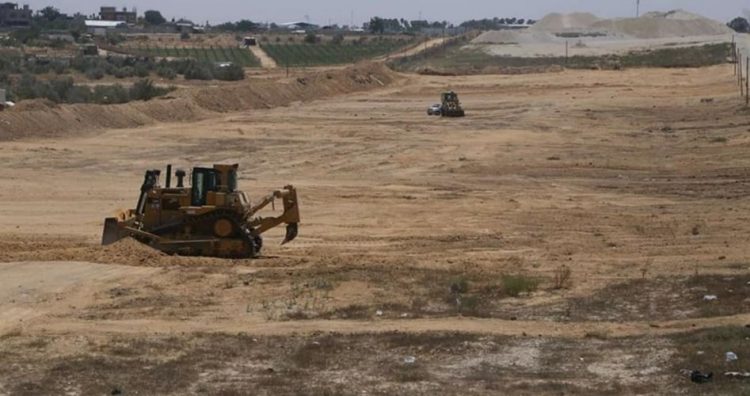
CAIRO – North Sinai Governor Abdel Fattah Harhour announced Thursday that the third phase of the buffer zone plan along the border areas with Gaza Strip has started.
Buildings and facilities located in the area of the buffer zone have been completely surveyed in preparation for evacuation and demolition, he added.
The first and second phases have been completed, with each phase covering 500 meters. It is believed that the third phase will cover an additional 500 meters.
The first phase involved the displacement of more than 1,000 families, whilst the second phase involved the evacuation of 2,044 families from the area. The third phase will involve approximately 1,215 houses and 40 governmental facilities, according to Harhour’s statements.
The buffer zone is amongst the security measures taken by the Egyptian armed forces in 2014 in order to destroy smuggling tunnels connecting North Sinai with the Gaza Strip. The tunnels were used to smuggle “terrorists and weapons” into the restive Sinai Peninsula, according to Egyptian authorities.
Netanyahu: Three conditions to accept Palestinian reconciliation
Palestinian unity talks dismissed
Palestine Information Center – October 3, 2107
NAZARETH – Israeli Prime Minister Benjamin Netanyahu vetoed the Palestinian reconciliation, putting three conditions to accept it including recognition of Israel, dissolving the armed wing of Hamas Movement and halting its relation with Iran.
“The Palestinian Authority cannot reconcile with Hamas at Israel’s expense,” Netanyahu said on Tuesday, in his first reaction to the latest unity deal between the Hamas and Fatah factions, according to a statement by Netanyahu’s office.
“As part of its reconciliation, the Palestinian Authority must insist that Hamas recognizes Israel, dismantles its military wing and breaks off ties with Iran. We cannot accept fake reconciliation on the Palestinian side that comes at the expense of our existence,” he added.
Netanyahu made the statement in coincidence with the Palestinian consensus government, led by Rami al-Hamdallah, taking over its responsibilities in Gaza Strip in light of the Palestinian reconciliation supervised by Cairo.
Israeli and American pressures on the Palestinian Authority had affected previous reconciliation efforts and led to the continuation of the internal division.
Hamas to hold free elections as Israel waits to pull the trigger
By Robert Inlakesh – Al-Masdar – 17/09/2017
Hamas have released in an official statement that they are ready to hold free elections – for the first time since 2006 – and are going to dissolve their administrative committee.
After a series of talks held in Cairo – in a bid to start repairing the relationship between rivalling Palestinian governmental factions Hamas and Fatah – Hamas has made the decision in order to forward “reconciliation” with the Palestinian Authority.
President of the Palestinian Authority (PA), Mahmoud Abbas has been demanding throughout the year that Hamas end its administrative committee, hold free elections and hand the Gaza Strip over to the PA.
Abbas has recently been punishing the population of Gaza in order to get Hamas to hand over power of Gaza and this year has made such moves towards this goal mainly by; dropping the salaries of Gazans who work for the PA by 30-70 percent (sending many below the poverty line), calling on Israel to turn off their electrical supply to Gaza and by refusing to pay for Gaza’s deisel fuel to run their one semi-operational power plant.
The last time Hamas vowed to dissolve its administrative committee and looked as if it was on the way to forming a unity government with Fatah – signing reconciliation deal with the PLO on April of 2014 – Israel ended the possibility with a 50-day onslaught on Gaza, killing over 2 thousand civilians.
The Israeli regime’s government announced on the 10th of August, that it was readying a ground invasion of Gaza, the head of the Israeli Shin Bet, ‘Nadav Argaman’ also recently told the ‘Jerusalem post’ that Hamas are readying for war.
The Likud Party have been losing their popularity in Israel to far-right parties and with Prime Minister Benjamin Netanyahu (and his wife) under investigation on the grounds of corruption, the political party is looking for a way to re-gain its popularity. If Netanyahu was to wage war upon Gaza in a bid to prevent a possible Palestinian unity government, the international condemnation of the Israeli onslaught could be scape goated on him, whilst his party are celebrated by Israeli society (as polls show popularity of the party rises during war time), this could be strategically on the table for the Israeli government.
Hamas seek to allow Abbas and the PA the return to Gaza immediately and to start official meetings with the PA in order to form unity between both parties and discuss elections in the West Bank and Gaza.
UN Secretary General arrives in Gaza, refuses to meet families of prisoners
Palestine Information Center – August 30, 2017
GAZA – UN Secretary General Antonio Guterres arrived Wednesday morning in the besieged Gaza Strip after he visited Israel and the occupied Palestinian territories as part of his first regional itinerary.
According to the Palestinian Information Center in Gaza, Guterres and his entourage were allowed by Israel into Gaza through the Beit Hanoun (Erez) border crossing.
Meanwhile, families of Palestinian prisoners in Israeli jails have been rallying since the morning near the Beit Hanoun crossing in protest at Guterres’s refusal to meet with them upon his arrival in Gaza.
The UN chief had held several meetings with officials from the Palestinian Authority and Israel after he arrived last Sunday in the occupied territories, coming from Kuwait.
Guterres, who refused to meet with relatives of Palestinian prisoners, met last Monday with families of Israeli captives being held in Gaza and expressed his sympathy with them.
The Prisoner Committee in Gaza slammed Guterres for refusing to talk and listen to the families of Palestinian prisoners in Israeli jails and ignoring their suffering, calling on him to reconsider his “inhumane position,” especially since the occupied Palestinian people are “the true victims of Israel’s terrorism.”
According to the UNRWA, the UN secretary-general will read today a statement in one of its schools in Beit Lahia city, north of Gaza, before leaving soon on the same day.
Featured Video
Seyed M. Marandi: Negotiations Collapsed – Return to War
or go to
Aletho News Archives – Video-Images
From the Archives
Wartime internment camps in Australia
National Archives of Australia
World War I
During World War I, for security reasons the Australian Government pursued a comprehensive internment policy against enemy aliens living in Australia.
Initially only those born in countries at war with Australia were classed as enemy aliens, but later this was expanded to include people of enemy nations who were naturalised British subjects, Australian-born descendants of migrants born in enemy nations and others who were thought to pose a threat to Australia’s security.
Australia interned almost 7,000 people during World War I, of whom about 4,500 were enemy aliens and British nationals of German ancestry already resident in Australia.
Records of World War I internment camps
World War II
During World War II, Australian authorities established internment camps for three reasons – to prevent residents from assisting Australia’s enemies, to appease public opinion and to house overseas internees sent to Australia for the duration of the war.
Unlike World War I, the initial aim of internment during the later conflict was to identify and intern those who posed a particular threat to the safety or defence of the country. As the war progressed, however, this policy changed and Japanese residents were interned en masse. In the later years of the war, Germans and Italians were also interned on the basis of nationality, particularly those living in the north of Australia. In all, just over 20 per cent of all Italians resident in Australia were interned. … continue
Blog Roll
 Aletho News
- Seyed M. Marandi: Negotiations Collapsed – Return to War
- Tomorrow’s naval blockade showdown
- ‘Israel’ attacks civilians to hide its embarrassing military failures & out of pure sadism
- Any Foreign Military Vessel Approaching Hormuz Under Any Pretext ‘Will Be Dealt With Severely’: IRGC
- Diplomats slam US negotiators’ performance in Iran talks
- Trump Refuses Exit Ramp, War with Iran will Continue
- Trump Says US Naval Blockade in Strait of Hormuz Will Begin Shortly
- US, Iran end 21-hour talks without agreement
- US IRAN TALKS: Who Are the Crazy Ones Here? /Lt Col Daniel Davis
- Talks with the US end without a deal over excessive US demands: Iran
- If Americans Knew
- US-Iran ceasefire negotiations make zero progress – Daily Update
- Pro-Israel ‘Thinktanks’ and Individuals who Influence U.S. Foreign Policy
- Mearsheimer reveals how Israel dictates US policies on Iran, Gaza – video
- After killing 350+, Israel still has a “score to settle” with Lebanon before ceasefire – Daily Update
- Military aid to Israel emerges as the latest political litmus test for Democrats
- The only Palestinian children’s rights organization closes following years-long Israeli campaign against it
- ‘I Can’t Forget the Smell’: Lebanese Reel After Israel Kills Over 300 in Single Day
- DNC Shoots Down Resolutions Calling Out AIPAC and Limiting Arms to Israel
- TCN: Is Israel Blackmailing President Trump?
- Israel killed at least 303 Lebanese yesterday – who were they? Daily Update
- No Tricks Zone
- Cave Discovery Reveals Today’s Desert Climates Were Recently Far Warmer, Wetter, Teeming With Life
- German Expert: Heat Dome Led To Record Temps In Western USA…Warmer In 1934, 1936
- New Study: No Linear Warming Or Glacier Retreat Along Northern Antarctic Peninsula Since 1980s
- An Inconvenient Tree: Uncovered In Alps… Europe Much Warmer Than Today 6000 Years Ago
- New Study Reports A 60% Slowdown In Greenland’s Ice Loss Rate In The Last Decade
- Low Intensity Tornado Wrecks Major Solar Farm, Creating A Potential Toxic Dump
- New Study Finds Warming Saves Lives…Cold Temperatures 12 Times More Deadly Than Excess Heat
- German Science Blog Accuses PIK Climate Institute Of Hallucinating Climate Tipping Points
- Devastating Assessment Of Comirnaty Vaccine By Former Senior Pfizer Europe Toxicologist
- New Study: CO2 Is ‘Effectively Negligible’ As An Explanatory Climate Change Factor Since 2000
 Aletho News