The rule of law is rapidly breaking down at the top levels of our government. As officers of the court, we have sworn to “support the Constitution,” which clearly implies an affirmative commitment on our part.
Take the administrations of George W. Bush and Barack Obama. The conservative American Bar Association sent three white papers to President Bush describing his continual unconstitutional policies. Then and now civil liberties groups and a few law professors, such as the stalwart David Cole of Georgetown University and Jonathan Turley of George Washington University, have distinguished themselves in calling out both presidents for such violations and the necessity for enforcing the rule of law.
Sadly, the bulk of our profession, as individuals and through their bar associations, has remained quietly on the sidelines. They have turned away from their role as “first-responders” to protect the Constitution from its official violators.
As a youngster in Hawaii, basketball player Barack Obama was nicknamed by his schoolboy chums as “Barry O’Bomber,” according to the Washington Post. Tuesday’s (May 29) New York Times published a massive page-one feature article by Jo Becker and Scott Shane, that demonstrated just how inadvertently prescient was this moniker. This was not an adversarial, leaked newspaper scoop. The article had all the signs of cooperation by the three dozen, interviewed current and former advisers to President Obama and his administration. The reporters wrote that a weekly role of the president is to personally select and order a “kill list” of suspected terrorists or militants via drone strikes or other means. The reporters wrote that this personal role of Obama’s is “without precedent in presidential history.” Adversaries are pulling him into more and more countries – Pakistan, Yemen, Somalia and other territories.
The drones have killed civilians, families with small children, and even allied soldiers in this undeclared war based on secret “facts” and grudges (getting even). These attacks are justified by secret legal memos claiming that the president, without any Congressional authorization, can without any limitations other that his say-so, target far and wide assassinations of any “suspected terrorist,” including American citizens.
The bombings by Mr. Obama, as secret prosecutor, judge, jury and executioner, trample proper constitutional authority, separation of powers, and checks and balances and constitute repeated impeachable offenses. That is, if a pathetic Congress ever decided to uphold its constitutional responsibility, including and beyond Article I, section 8’s war-declaring powers.
As if lawyers needed any reminding, the Constitution is the foundation of our legal system and is based on declared, open boundaries of permissible government actions. That is what a government of law, not of men, means. Further our system is clearly demarked by independent review of executive branch decisions – by our courts and Congress.
What happens if Congress becomes, in constitutional lawyer Bruce Fein’s words, “an ink blot,” and the courts beg off with their wholesale dismissals of Constitutional matters based on claims and issue involves a “political question” or that parties have “no-standing-to-sue.” What happens is what is happening. The situation worsens every year, deepening dictatorial secretive decisions by the White House, and not just regarding foreign and military policies.
The value of The New York Times article is that it added ascribed commentary on what was reported. Here is a sample:
– The U.S. Ambassador to Pakistan, Cameron P. Munter, quoted by a colleague as complaining about the CIA’s strikes driving American policy commenting that he: “didn’t realize his main job was to kill people.” Imagine what the sidelined Foreign Service is thinking about greater longer-range risks to our national security.
– Dennis Blair, former Director of National Intelligence, calls the strike campaign “dangerously seductive.” He said that Obama’s obsession with targeted killings is “the politically advantageous thing to do — low cost, no US casualties, gives the appearance of toughness. It plays well domestically, and it is unpopular only in other countries. Any damage it does to the national interest only shows up over the long term.” Blair, a retired admiral, has often noted that intense focus on strikes sidelines any long-term strategy against al-Qaeda which spreads wider with each drone that vaporizes civilians.
– Former CIA director Michael Hayden decries the secrecy: “This program rests on the personal legitimacy of the president and that’s not sustainable,” he told the Times. “Democracies do not make war on the basis of legal memos locked in a D.O.J. [Department of Justice] safe.”
Consider this: an allegedly liberal former constitutional law lecturer is being cautioned about blowback, the erosion of democracy and the national security by former heads of super-secret spy agencies!
Secrecy-driven violence in government breeds fear and surrender of conscience. When Mr. Obama was campaigning for president in 2007, he was reviled by Hillary Clinton, Joseph Biden Jr. and Mitt Romney – then presidential candidates – for declaring that even if Pakistan leaders objected, he would go after terrorist bases in Pakistan. Romney said he had “become Dr. Strangelove,” according to the Times. Today all three of candidate Obama’s critics have decided to go along with egregious violations of our Constitution.
The Times made the telling point that Obama’s orders now “can target suspects in Yemen whose names they do not know.” Such is the drift to one-man rule, consuming so much of his time in this way at the expense of addressing hundreds of thousands of preventable fatalities yearly here in the U.S. from occupational disease, environmental pollution, hospital infections and other documented dangerous conditions.
Based on deep reporting, Becker and Shane allowed that “both Pakistan and Yemen are arguably less stable and more hostile to the United States than when Obama became president.”
In a world of lawlessness, force will beget force, which is what the CIA means by “blowback.” Our country has the most to lose when we abandon the rule of law and embrace lawless violence that is banking future revenge throughout the world.
The people in the countries we target know what we must remember. We are their occupiers, their invaders, the powerful supporters for decades of their own brutal tyrants. We’re in their backyard.
So lawyers of America, apart from a few stalwarts among you, what is your breaking point? When will you uphold your oath of office and work to restore constitutional authorities and boundaries?
Someday, people will ask – where were the lawyers?
May 31, 2012
Posted by aletho |
Civil Liberties, Progressive Hypocrite, War Crimes | George W. Bush, Obama, Pakistan, United States, Yemen |
Leave a comment
When Barack Obama was running for president, in 2008, he vowed to increase the use of drones against al Qaida elements in Pakistan and Afghanistan. His surrogates roamed the talk shows, advocating a “smarter” and cheaper kind of robotic war, allowing the U.S. to avoid pouring more troops into the “Af-Pak” theater of conflict. Vastly increased deployment of Unmanned Aerial Vehicles (UAVs), the argument went, would jettison George Bush’s “dumb” approach to warfare in favor of a cheaper and more humane use of U.S. technological resources, saving both American and South Asian lives.
What the “peace” candidate was actually proposing, was a qualitative leap in the U.S. drive for “full spectrum dominance” over the planet. The U.S. would elevate to a strategic principle its self-arrogated entitlement to use whatever technical means at its disposal – mainly drones – to target and kill designated adversaries at will, anyplace on the globe, at any time, accountable only to itself. It was a declaration of war against international law, as it has evolved over the centuries.
This administration has expanded the Air Force inventory of active drones to at least 7,500. Drones have joined Special Operations forces as the “tip of the spear” of U.S. power projection in the developing world, the “front lines” of the current imperial offensive.
Virtually all of the drones’ lethal missions are, in legal terms, assassinations, with or without “collateral damage.” They are also acts of terror, certainly in the broad sense of the word, and intended to be so.
As Canadian political scientist David Model points out in a recent article “Assassination by Drones”: “It is clearly evident that for a State to launch an attack by a UAV is a violation of international law and those responsible for such acts become suspects of war crimes.” Drone warfare utterly shreds the very concept of the rule of law. In killing those “suspected” of committing or planning actions against the U.S., Washington “precludes the application of due process,” writes Model.
Therefore, in the quest to make the entire world a free-fire (and law-free) zone, drone warfare requires that due process be destroyed everywhere, including within the borders of the United States.The Obama-shaped preventive detention bill signed into law this past New Years Eve is the logical extension of the international lawlessness called forth by drone warfare, and by the larger aims of full spectrum American dominance. Barack Obama is not just another “war president” – he is a destroyer of world civilization, the terms by which humans deal with one another as states, social groupings and individuals. It is not an exaggeration to describe this leap into depravity as a war against humanity at-large, and against the human historical legacy.
Certainly, it is a war against peace, the highest international crime. If a state can kill individuals and designated (or alleged) organizations by fiat, without due process or any shred of accountability to any authority but the president of the superpower, that state can also “execute” other states at will. Under Obama, the U.S. has articulated an alternative notion of global legality that purports to replace the body of international law accrued over centuries and so elegantly codified after World War Two. “Humanitarian” military intervention is the fraudulent doctrine through which the U.S. seeks to justify its current, desperate offensive against all obstacles to its global dominance.
Where George Bush often spoke in unilateralist terms of a U.S. mission to “spread democracy” as justification for his regime-changing aggression in Iraq and elsewhere, Obama invokes the higher calling of “humanitarian intervention” as a universal, pseudo-legal principle of international conduct. It is a doctrine designed for a Final Conflict for American supremacy on the planet, a doomsday construct that conflates perceived U.S. (corporate) geopolitical interests with the destiny of humankind – unbounded imperial criminality posing as the highest bar of justice!
Since the Vietnam War era, the U.S. has traveled from being the “greatest purveyor of violence in the world today,” in Dr. Martin Luther King’s words, to an existential threat to world order, the rule of law, and the security of the Earth’s inhabitants – to civilization itself. The nation’s first Black President has taken us on the final descent into international barbarity with his drone offensive. It is a joy stick to Hell.
Glen Ford can be contacted at Glen.Ford@BlackAgendaReport.com.
April 11, 2012
Posted by aletho |
Full Spectrum Dominance, Militarism, Progressive Hypocrite, Timeless or most popular, War Crimes | George W. Bush, Martin Luther King, Pakistan, Unmanned aerial vehicle |
Leave a comment
The big New York Times story on the Afghan War today (3/27/12) focuses on public opinion in the United States, which is now dramatically anti-war: 69 percent think we shouldn’t be there.
An interesting point argument is raised later in the piece, when two sources make the argument that the war wouldn’t be so unpopular if Barack Obama would just do a better job of selling it:
Peter Feaver of Duke University, who has long studied public opinion about war and worked in the administration of President George W. Bush, said that in his view there would be more support for the war if President Obama talked more about it. “He has not expended much political capital in defense of his policy,” Mr. Feaver said. “He doesn’t talk about winning in 2014; he talks about leaving in 2014. In a sense that protects him from an attack from the left, but I would think it has the pernicious effect of softening political support for the existing policy.”
And later we get this from Brookings Institution hawk Michael O’Hanlon:
“I honestly believe if more people understood that there is a strategy and intended sequence of events with an end in sight, they would be tolerant,” Mr. O’Hanlon said. “The overall image of this war is of U.S. troops mired in quicksand and getting blown up and arbitrarily waiting until 2014 to come home. Of course you’d be against it.”
This is a pretty widespread belief in recent press coverage of Afghanistan– that somehow Obama could better explain the Afghan War if he’d just decide to do so. Here’s Liz Marlantes of the Christian Science Monitor (Chris Matthews Show, 3/18/12):
The criticism that you keep hearing from Republicans, and I think there’s some validity to this, is that the president also didn’t really spend any political capital selling this mission to the public. I’m not sure the public really understands what the mission is there anymore. Once bin Laden was dead, I think a lot of Americans feel like, “OK, we’ve solved our main problem over there.” In terms of our goals there, it keeps getting defined down. We’re not going to, you know, build a perfect democracy there anymore. And so I think people are thinking, “Well, why are we even there anymore?”
The Washington Post editorial page (3/20/12):
Mr. Obama must do more to build support in the United States for his policy. The president has given just a handful of speeches on Afghanistan during his first term, and his recent public comments have focused on bringing troops home, rather than completing their mission.
And Washington Post columnist Michael Gerson (3/22/12):
Obama has made broadly responsible decisions on Afghanistan. He bears the private burdens of wartime leadership with dignity as he comforts the families of the fallen. He has a strong national security team, a serious military strategy and measurable successes to highlight. But with a nation in need of rallying, his public voice is weak.
The assumption, of course, is that there is, in fact, an Afghan War “strategy” to defend. And that if Americans really understood what their country was doing there, they would support it.
March 27, 2012
Posted by aletho |
Mainstream Media, Warmongering, Progressive Hypocrite | Afghanistan, George W. Bush, Michael Gerson, Michael O'Hanlon, Obama, United States |
Leave a comment
It is ironic but perhaps sadly appropriate that Attorney General Eric Holder would choose a law school, Northwestern University, to deliver a speech earlier this month in which he demolished what was left of the rule of law in America.
In what history likely will record as a turning point, Attorney General Holder bluntly explained that this administration believes it has the authority to use lethal force against Americans if the President determines them to be a threat to the nation. He tells us that this is not a violation of the due process requirements of our Constitution because the President himself embodies “due process” as he unilaterally determines who is to be targeted. As Holder said, “a careful and thorough executive branch review of the facts in a case amounts to ‘due process.'” That means that the administration believes it is the President himself who is to be the judge, jury, and executioner.
As George Washington University Law Professor Jonathan Turley wrote of the Holder speech:
“All the Administration has said is that they closely and faithfully follow their own guidelines — even if their decisions are not subject to judicial review. The fact that they say those guidelines are based on notions of due process is meaningless. They are not a constitutional process of review.”
It is particularly bizarre to hear the logic of the administration claiming the right to target its citizens according to some secret selection process, when we justified our attacks against Iraq and Libya because their leaders supposedly were targeting their own citizens! We also now plan a covert war against Syria for the same reason.
I should make it perfectly clear that I believe any individual who is engaging in violence against this country or its citizens should be brought to justice. But as Attorney General Holder himself points out in the same speech, our civilian courts have a very good track record of trying and convicting individuals involved with terrorism against the United States. Our civilian court system, with the guarantee of real due process, judicial review, and a fair trial, is our strength, not a weakness. It is not an impediment to be sidestepped in the push for convictions or assassinations, but rather a process that guarantees that fundamental right to be considered innocent until proven guilty in a court of law.
I am encouraged, however that there appears to be the beginning of a backlash against the administration’s authoritarian claims. Just recently I did an interview with conservative radio talk show host Laura Ingraham who expressed grave concern over using these sorts of tactics against Americans using the supposed war on terror as justification. Sadly, many conservative leaders were silent when Republican President George W. Bush laid the groundwork for this administration’s lawlessness with the PATRIOT Act, warrantless wiretapping, indefinite detention without trial, and other violations. Similarly, as Professor Turley points out, “Democrats previously demanded the ‘torture memos’ of the Bush administration that revealed poor legal analysis by Judge Jay Bybee and Professor John Yoo to justify torture. Now, however, Democrats are largely silent in the face of a president claiming the right to unilaterally kill citizens.” The misuse of and disregard for our Constitution for partisan political gain is likely one reason the American public holds Congress in such low esteem. Now the stakes are much higher. Congress and the people should finally wake up!
March 21, 2012
Posted by aletho |
Civil Liberties, Progressive Hypocrite | Eric Holder, George W. Bush, Jay Bybee, John Yoo, Jonathan Turley |
Leave a comment
By Sherwood Ross | Blacklisted News |March 19, 2012
How shall the world view the apology by President Obama for the massacre of 16 Afghan villagers allegedly by a lone U.S. serviceman in Kandahar Province when the President is himself personally responsible for the extra-judicial killing of hundreds of civilians by means of drone aircraft strikes whose crime he defends? Army Staff Sgt., Robert Bales, of Lake Tapps, Wash., is being held in prison in Fort Leavenworth, Kan. Mr. Obama is free to travel the campaign trail.
“We’re heart-broken over the loss of innocent life,” the president said of the Kandahar massacre. His seeming expression of contrition rings hollow, though, particularly if one considers how Mr. Obama goes about his daily routine ordering drone strikes and seemingly is unaffected by the “loss of innocent lives” they cause, as well as by the hated companion night raids on Afghan homes, also the result of his policy.
As The New York Times reported March 17th, President Hamid Karzai said “many civilians have died in the (night) raids,” adding, “This has been going on for too long. It is by all means the end of the rope here. This form of activity, this behavior, cannot be tolerated.”
Obama is more than willing to investigate anyone other than himself for war crimes. “I can assure the American people and the Afghan people that we will follow the facts wherever they lead us, and we will make sure that anybody who was involved is held fully accountable with the full force of the law.” To “follow the facts” the president need look no further than his own mirror. Not surprisingly, he termed the drone strikes “very precise, precision strikes against al-Qaeda and their affiliates.” Given the facts, this is a falsehood.
As investigative reporter Jeremy Scahill writes in the March 5/12 issue of The Nation, “President Obama’s first known authorization of a missile strike on Yemen, on Dec. 17, 2009, killed more than 40 Bedouins, many of them women and children, in the remote village of al Majala in Abyan.”
And the Bureau of Investigative Journalism based at City University, London, put the number of Pakistani children killed in drone strikes at 168. In one raid directed by the Central Intelligence Agency, a drone was dispatched to kill the headmaster of a school, which it did—but 60 children attending classes there were killed as well. “Even one child’s death from drone missiles or suicide bombings is one child too many,” a UNICEF spokesperson said. President Obama takes a very different view. He claims drones have “not caused a huge number of civilian casualties” and it is “important for everybody to understand that this thing is kept on a very tight leash.”
Since 2004, the U.S. has made nearly 300 drone attacks just in N.W. Pakistan alone, killing between 1,700 and 2,800 individuals, of whom an estimated 17 percent were said to be civilians, not so-called “militants,” according to the New America Foundation of Washington, D.C.
In Somalia, last October 14th alone, U.S. drones killed 78 and injured 64 in one raid and killed 11 civilians and wounded 34 more the same day in another. And from March 3-12, the U.S. killed 64 people in Yemen by drone strikes. The government called them “militants” but local residents countered they were civilians.
Meanwhile, the Pentagon reportedly is building 60 drone bases across the world and its clamor for more planes is so great that contractors cannot keep up with demand. Rather than halt the use of these indiscriminate killing machines, indications are the Pentagon sees them as the future weapon of choice, and by some accounts they have now been used in six countries.
On the website of Iraq Veterans Against the War, the AP reports, organizer Aaron Hughes declared that Afghan war veterans “believe that this incident is not a case of one ‘bad apple’ but the effect of a continued US military policy of drone strikes, night raids, and helicopter attacks where Afghan civilians pay the price.’’
Mr. Obama has continued and expanded the criminal drone policies begun by his predecessor George W. Bush and both warmongers are eminently qualified to stand trial for their crimes.
#
Sherwood Ross is a Miami-based public relations consultant. Reach him at sherwoodross10@gmail.com
March 19, 2012
Posted by aletho |
Militarism, Progressive Hypocrite, Timeless or most popular, War Crimes | Bureau of Investigative Journalism, Central Intelligence Agency, Fort Leavenworth, George W. Bush, Obama |
Leave a comment
First the video of United States Marines urinating on bodies of Afghans who had been killed. Then the revelation that copies of the Quran had been burned at Bagram Air Base, which also serves as an American prison camp in Afghanistan. Nearly thirty Afghans and several NATO troops died in the violent reaction. And as I mentioned in my column of March 4, the BBC Kabul correspondent described these events, and the violent public reaction to them, as the tipping point for NATO in the Afghan War.
Just as the U.S. commander Gen. John Allen and President Obama hoped that apologies from them would help calm the situation comes another disaster. If official accounts are to be believed, an American soldier left his base in the middle of the night, entered villagers’ homes, woke up Afghan families from sleep and shot his victims in cold blood. After committing the murders, the soldier was reported to have turned himself up to U.S. commanders, and was flown out of the country. He has since been named as Sgt. Robert Bales. Other reports tell a different story, indicating that a group of soldiers was involved. Looking drunk and laughing, they engaged in an orgy of violence, while helicopters hovered above.
The massacre was committed in Kandahar, a province where NATO forces regularly carry out night raids on Afghan homes. They capture and kill men sweepingly described as Taliban, their supporters or sympathizers. Male family members therefore leave their homes at night to escape foreign forces. This explains why 9 of the 16 murdered were children. The rest included at least four women, and five Afghans were wounded. Several bodies were burned.
The massacre of Kandahar has echoes of My Lai––a village in South Vietnam where American troops massacred unarmed civilians including women, children and old people almost exactly 44 years ago, on March 16, 1968. The full horror of the My Lai massacre took time to surface, for many attempts were made to downplay it. Soldiers who had tried to stop the killings were denounced by U.S. Congressmen and received hate mail and death threats. It took thirty years before they were honored. Only one American soldier, Lieutenant William Calley, was punished. He spent just three years under house arrest, despite being given a life sentence.
The conduct of the U.S. authorities following the massacre of Afghans will be under critical scrutiny. Those who must bear ultimate responsibility will have to live with the guilt for years to come. And the carnage will continue to haunt the conscience of many people in America and elsewhere. The general sentiment in Afghanistan had already been turning dangerously hostile to foreign troops. Now, reports from Kabul say that Afghans “have run out of patience.”
In the midst of these events (U.S. Marines urinating on dead bodies in January, Quran burning in February, massacre in March), President Obama decided to invoke a comparison between himself and two of history’s legendary figures, Mahatma Gandhi and Nelson Mandela. To me, the latest events in Afghanistan are dismaying, and the timing of the president’s attempt to invoke parallels with Gandhi and Mandela is sickening. It goes to show what power does to its holder.
Much has been written about the New York fund-raiser, where President Obama gave his address as he sought support for a second term. I repeat the obvious to say that the country he leads has been engaged in a number of wars resulting in deaths and destruction on a vast scale. Their legacies will continue to take a heavy toll. Even when U.S. forces have withdrawn from occupied lands, or high-altitude bombing without deploying American troops on the ground has ceased, we will not know how long and in how many places Obama’s secret wars are waged. In the November 2008 election, he had offered a hope of change for good. It remains as illusive as it was under his predecessor, George W. Bush.
Obama and NATO have moved and expanded the war theater––in Pakistan, Libya, Yemen, Syria, Kenya, Somalia and possibly places we are not aware of. His tactics have steadily become more threatening with foes and friends alike, linking ever more war and routine matters of international relations, trade and so forth.
Despite the U.S. military withdrawal from Iraq and the Afghan project heading toward an end, there exists a more explosive situation from South Asia to North Africa. The scenario of a major war in the region haunts many. Obama may appear reluctant to attack Iran or Syria. But that clandestine warfare by major powers and their proxies continues is hardly in doubt. The Obama administration’s aggressive, interventionist instinct is on open display. And to draw parallels between himself and great souls such as Gandhi and Mandela is a grotesque parody of their historic struggles.
At the New York fund-raising event, Obama said that “the change we fought for in 2008 hasn’t always happened as fast as we would have liked … real change, big change, is always hard.” Next, making a leap into history, he continued, “Gandhi, Nelson Mandela––what they did was hard. It takes time. It takes more than a single term …”
Corruption infects our world in many forms: material and moral, visible and invisible, direct and indirect. But the underlying motive behind all things corrupt is a strong opportunistic instinct to benefit oneself at the cost of others by allurement or deception. No wonder politics has fallen so much into disrepute. The aphorism of the nineteenth-century English historian Lord Acton that “Power tends to corrupt, and absolute power corrupts absolutely” has acquired a special meaning today.
Employing his political mantra of “change” and attempting to show likeness with Gandhi’s and Mandela’s life and achievements is one thing. Truth is a different matter. Gandhi never aspired for any political office, never held one, and did not fight any election. After his incarceration in prison for 27 years, Mandela was a reluctant president of South Africa. And he made clear that he would serve only one term while a new generation of successors was groomed.
Above all, Mandela used his presidency to avoid a bloodbath and stabilize the country as apartheid collapsed. Precisely for these reasons, both Gandhi and Mandela were such formidable opponents of the unequal and unjust systems which they fought.
Non-violence was Gandhi’s tool. When violence erupted, Gandhi withdrew his movement against the British. He thought of others, Muslims and Untouchables he called Harijans (Children of God). He paid the ultimate price when a Hindu fundamentalist assassinated him in 1948. Neither Gandhi nor Mandela considered attacking another country, signing assassination orders, exaggerating or inventing facts about people they saw as adversaries.
Mandela’s African National Congress was inspired by Gandhi. But once the organization had realized that South Africa’s vast black majority was up against an apartheid regime whose brutality was exceptional, the ANC did engage in a low-intensity war. And the United States and Britain listed Mandela as a “terrorist.”
President Obama recently justified his drone attacks inside Pakistan by saying that they “have not caused a huge number of civilian casualties.” It is impossible not to interpret this as an admission that drones do kill and wound civilians. But it is a minor matter in the president’s eyes. Only a few days ago, the German news magazine Der SPEIGAL said that while under the Bush presidency there was a drone attack every 47 days, the interval now under President Obama, the Nobel Peace Prize winner, is just four days. The Americans have “already executed 2,300 people in this manner.” Nobody has a chance today if this president decides that their time is up.
Gandhi’s agitation for boycott of British goods in favor of home-made products and his advocacy for an austere life were fundamental elements of the anti-globalization movement of his time. His ethos was “to consume less for the uplift of others from poverty and deprivation.” He lived the life he preached, for which Winston Churchill, then leader of the Empire, disparagingly called him the “naked fakir.”
In the world ruled by President Obama today, Mahatma Gandhi and Nelson Mandela, were he not in his nineties and so frail, would be his greatest enemies. And they could well have been on Obama’s list for drone attacks. Mercifully that is not the case, and this president can indulge in comfort.
Great people like Gandhi and Mandela use power to curb power. Barack Obama stands among those who use power to accumulate more of it. Therein lies the moral of any comparison in this debate.
March 19, 2012
Posted by aletho |
Ethnic Cleansing, Racism, Zionism, Militarism, Progressive Hypocrite, Timeless or most popular, War Crimes | Afghanistan, George W. Bush, NATO, Nelson Mandela, Obama, United States Marines |
Leave a comment
According to its June 3, 1997 Statement of Principles, the Project for the New American Century (PNAC) was created to advance a “Reaganite foreign policy of military strength and moral clarity,” a policy PNAC co-founders, William Kristol and Robert Kagan, had advocated the previous year in Foreign Affairs to counter what they construed as the American public’s short-sighted indifference to foreign “commitments.” Calling for a significant increase in “defense spending,” PNAC exhorted the United States “to meet threats before they become dire.”
The Wolfowitz Doctrine
The idea of preemptive war also known as the Wolfowitz Doctrine—subsequently dubbed the “Bush Doctrine” by PNAC signatory Charles Krauthammer—can be traced as far back as Paul Wolfowitz’s Ph.D. dissertation, “Nuclear Proliferation in the Middle East,” which was based on “a raft of top-secret documents” his influential mentor, Cold War nuclear strategist Albert Wohlstetter, somehow “got his hands on” during a post-Six Day War trip to Israel. The “top-secret” Israeli documents supposedly showed that Egypt was planning to divert a Johnson administration proposal for regional civilian nuclear energy into a weapons program. Among those who signed PNAC’s Statement of Principles were Wohlstetter protégés Francis Fukuyama, Zalmay Khalilzad, and Wolfowitz, who despite having been investigated for passing a classified document to an Israeli government official through an AIPAC intermediary in 1978 would be appointed Deputy Secretary of Defense in the George W. Bush administration, where he would be the first to suggest attacking Iraq four days after 9/11; Wolfowitz protégé I. Lewis Libby, who later “hand-picked” Vice President Dick Cheney’s staff mainly from pro-Israel think tanks; Elliott Abrams, who would go on to serve as Bush’s senior director on the National Security Council for Near East and North African Affairs, his mother-in-law, Midge Decter, and her husband, Norman Podhoretz; and Eliot A. Cohen, who would later smear Walt and Mearsheimer’s research on the Israel lobby’s role in skewing U.S. foreign policy as “anti-Semitic.”
On January 26, 1998, PNAC wrote the first of its many open letters to U.S. presidents and Congressional leaders, in which they enjoined President Clinton that “removing Saddam Hussein and his regime from power […] now needs to become the aim of American foreign policy.” Failure to eliminate “the possibility that Iraq will be able to use or threaten to use” its non-existent weapons of mass destruction, the letter cautioned, would put at risk “the safety of American troops in the region, of our friends and allies like Israel and the moderate Arab states, and a significant portion of the world’s supply of oil.” An additional signatory this time was another Wohlstetter protégé, Richard Perle, a widely suspected Israeli agent of influence whose hawkish foreign policy views were shaped when Hollywood High School classmate and girlfriend, Joan Wohlstetter, invited him for a swim in her family’s swimming pool and her father handed Perle his 1958 RAND paper, “The Delicate Balance of Terror,” thought to be an inspiration for Kubrick’s Dr. Strangelove.
Having helped sow the seeds of the Iraq War five years before Operation Iraqi Freedom, PNAC wrote a second letter to Clinton later that year. Joining with the International Crisis Group, and the short-lived Balkan Action Council and Coalition for International Justice, they took out an advertisement in the New York Times headlined “Mr. President, Milosevic is the Problem.” Expressing “deep concern for the plight of the ethnic Albanian population of Kosovo,” the letter declared that “[t]here can be no peace and stability in the Balkans so long as Slobodan Milosevic remains in power.” It urged the United States to lead an international effort which should demand a unilateral ceasefire by Serbian forces, put massive pressure on Milosevic to agree on “a new political status for Kosovo,” increase funding for Serbia’s “democratic opposition,” tighten economic sanctions in order to hasten regime change, cease diplomatic efforts to reach a compromise, and support the Hague tribunal’s investigation of Milosevic as a war criminal. Now that “the world’s newest state” (prior to Israel’s successful division of Sudan) is run by a “mafia-like” organization involved in trafficking weapons, drugs and human organs, there appears to be much less concern for the plight of the ethnic Serbian population of Kosovo.
A New Pearl Harbor
One year after the publication of its September 2000 report, “Rebuilding America’s Defenses,” the “new Pearl Harbor” PNAC implied might be necessary to hasten acquiescence to its blueprint for “benevolent global hegemony” occurred on 9/11. Nine days after that “catastrophic and catalyzing event,” it wrote to endorse President Bush’s “admirable commitment to ‘lead the world to victory’ in the war against terrorism.” However, capturing or killing Osama bin Laden, the letter stressed, was “by no means the only goal” in the newly-declared war on terror. “[E]ven if evidence does not link Iraq directly to the attack, any strategy aiming at the eradication of terrorism and its sponsors must include a determined effort to remove Saddam Hussein from power in Iraq,” cautioned the PNACers. “Failure to undertake such an effort will constitute an early and perhaps decisive surrender in the war on international terrorism.” Disingenuously characterizing Israel’s enemy Hezbollah as a group “that mean[s] us no good,” the Israel partisans called on the administration to “consider appropriate measures of retaliation” against Iran and Syria if they refused to “immediately cease all military, financial, and political support for Hezbollah.” Touting Israel as “America’s staunchest ally against international terrorism,” they counseled Washington to “fully support our fellow democracy in its fight against terrorism.” The letter concluded by urging President Bush “that there be no hesitation in requesting whatever funds for defense are needed to allow us to win this war.”
PNAC’s concern for “America’s staunchest ally” was even more evident in its next letter to the White House. On April 3, 2002, it wrote to thank Bush for his “courageous leadership in the war on terrorism,” commending him in particular for his “strong stance in support of the Israeli government as it engages in the present campaign to fight terrorism.” Evoking the memory of the September 11 attacks “still seared in our minds and hearts,” the Israel partisans thought that “we Americans ought to be especially eager to show our solidarity in word and deed with a fellow victim of terrorist violence […] targeted in part because it is our friend, and in part because it is an island of liberal, democratic principles—American principles—in a sea of tyranny, intolerance, and hatred.” Returning to its favorite theme of regime change in Iraq, PNAC cautioned, “If we do not move against Saddam Hussein and his regime, the damage our Israeli friends and we have suffered until now may someday appear but a prelude to much greater horrors.” Prefiguring the cheerleading of Kristol and Kagan et al. for the “Arab Spring,” they assured Bush that “the surest path to peace in the Middle East lies not through the appeasement of Saddam and other local tyrants, but through a renewed commitment on our part […] to the birth of freedom and democratic government in the Islamic world.”
PNAC Redux
Having “developed, sold, enacted, and justified” a disastrous war over non-existent WMD, PNAC’s final report in April 2005 entitled “Iraq: Setting the Record Straight” claimed that “the case for removing Saddam from power went beyond the existence of weapons stockpiles.” Smugly concluding à la Madame Albright that “the price of the liberation of Iraq has been worth it,” PNAC soon after quietly wound up its operations. However, in 2009, PNAC co-founders Kristol and Kagan were instrumental in setting up its successor organization, the Foreign Policy Initiative (FPI), whose self-appointed mission is to address the “many foreign policy challenges” facing the United States “and its democratic allies,” allegedly coming from “rising and resurgent powers,” such as China and Russia, and, perhaps most significantly, from “other autocracies that violate the rights of their citizens.”
FPI’s February 25, 2011 letter to President Obama gave a clear indication of the significance of that mission statement. Approvingly citing the president’s declaration in his 2009 Nobel Peace Prize acceptance speech that “Inaction tears at our conscience and can lead to more costly intervention later,” they told him that he “must take action in response to the unfolding crisis in Libya.” Warning of an impending “moral and humanitarian catastrophe,” the letter recommended establishing a no-fly zone, freezing all Libyan government assets, temporarily halting importation of Libyan oil, making a statement that Col. Qaddafi and other officials would be held accountable under international law, and providing humanitarian aid to the Libyan people as quickly as possible. “The United States and our European allies have a moral interest in both an end to the violence and an end to the murderous Libyan regime,” averred FPI. “There is no time for delay and indecisiveness. The people of Libya, the people of the Middle East, and the world require clear U.S. leadership in this time of opportunity and peril.”
With Libya in the midst of a genuine catastrophe brought on by that “humanitarian intervention,” FPI turned its attention to the foreign-stoked strife in Syria. On February 17, 2012, it joined the Foundation for Defense of Democracies, a think tank closely aligned with the Israel lobby whose leadership council is dominated by PNAC alumni, in urging President Obama “to take immediate steps to decisively halt the Assad regime’s atrocities against Syrian civilians, and to hasten the emergence of a post-Assad government in Syria.” Acknowledging that Syria’s future is “not purely a humanitarian concern,” the letter writers revealed their primary concern about Syria in their remark that “for decades, it has closely cooperated with Iran and other agents of violence and instability to menace America’s allies and partners throughout the Middle East.”
Wars of Muslim Liberation
Commenting on Obama’s reluctance to intervene in Libya, Bill Kristol mocked the president’s “doubts and dithering” about “taking us to war in another Muslim country.” Declared the founder of the Emergency Committee for Israel, “Our ‘invasions’ have in fact been liberations. We have shed blood and expended treasure in Kuwait in 1991, in the Balkans later in the 1990s, and in Afghanistan and Iraq—in our own national interest, of course, but also to protect Muslim peoples and help them free themselves. Libya will be America’s fifth war of Muslim liberation.” In a follow-up note to the Weekly Standard, Paul Wolfowitz had “one minor quibble”: “Libya, by my count, is not ‘America’s fifth war of Muslim liberation,’ but at least the seventh: Kuwait – February 1991, Northern Iraq – April 1991, Bosnia – 1995, Kosovo – 1999, Afghanistan – 2001 and Iraq – 2003.” With Syria awaiting its “liberation” in 2012, perhaps it’s too early yet to say, “Shukran, Israel.”
Maidhc Ó Cathail writes extensively on the Israel lobby’s influence on U.S. foreign policy.
March 14, 2012
Posted by aletho |
Ethnic Cleansing, Racism, Zionism, Timeless or most popular, Wars for Israel | Dick Cheney, George W. Bush, Iraq, Israel, Paul Wolfowitz, Project for the New American Century, Saddam Hussein |
Leave a comment
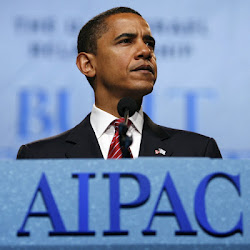 Remember last year when there was a great deal of commotion about President Barack Obama’s reference to the 1967 lines being used as the basis of negotiated land swaps between Israel and Palestine?
It was hard to forget. Obama’s political foes and even some of his friends accused him of throwing Israel under the bus. Netanyahu used the opportunity to slam Obama for this and stated that “Israel will not return to the indefensible boundaries of 1967”. In fact, when he said this before Congress they gave him one of 29 standing ovations.
As Republican candidates vie for the party’s nomination, they have not shied from using this issue to attack Obama as well, following Netanyahu’s lead.
But, successive administrations have stated the same thing time and again about the US position which is in line with UN Security Council Resolution 242. Most reasonable observers knew at the time that Obama’s statements where in no way a major shift in policy.
Or was it?
If it was, Jeffery Goldberg, for one, didn’t notice. He wrote, in a post titled ‘Did Obama Say Something so Different than Bush?‘ (emphasis mine):
In 2005, Geoge W. Bush stated that it is “unrealistic to expect that the outcome of final status negotiations will be a full and complete return to the armistice lines of 1949” (the 1967 boundaries of Israel, in other words). Today, Barack Obama said that he believes “the borders of Israel and Palestine should be based on the 1967 lines with mutually agreed swaps, so that secure and recognized borders are established for both states
Seems straightforward enough. The immediate predecessor to Obama, George W. Bush, talked about the 1949 Armistice line which Goldberg tells us equals the 1967 line. So essentially, Bush and Obama had the same position, right? Here is an excerpt from President Bush’s speech in the Rose Garden in 2005 (emphasis mine):
Any final status agreement must be reached between the two parties, and changes to the 1949 Armistice lines must be mutually agreed to. A viable two-state solution must ensure contiguity of the West Bank, and a state of scattered territories will not work. There must also be meaningful linkages between the West Bank and Gaza. This is the position of the United States today, it will be the position of the United States at the time of final status negotiations.
If we go by Goldberg’s translation, 1949 Armistice lines = 1967 lines. This formula is not just the Goldberg standard. Here is the New York Times on this issue (emphasis mine):
Those commitments came in a letter from President George W. Bush which stated, among other things that “it is unrealistic to expect that the outcome of final status negotiations will be a full and complete return to the armistice lines of 1949,” another way of describing the 1967 boundaries.
To be sure, NPR checked with Glenn Kessler, author of the Washington Post’s “Fact Checker” column to, well, check the facts:
President BARACK OBAMA: We believe the borders of Israel and Palestine should be based on the 1967 lines with mutually agreed swaps.
CONAN: And Glenn, is that a substantial change from what presidents have said before?
Mr. KESSLER: Yes, it is. I mean, in the context of diplomacy, what President Obama said that was different was that he actually referenced 1967, the 1967 lines, the de-facto border that had basically existed since the end of the 1948 war of independence.
CONAN: So if he had said the armistice lines of 1948, would that have been different?
Mr. KESSLER: No, what I did is I researched and looked at what all previous presidents had said, and actually they never said anything about lines one way or the other.
I’m not sure what kind of research Glenn did to miss the statement by President Bush buried deep down in this dusty archive. But its not just the fact the Bush made reference to the 1949 armistice line that contrasts with Kessler’s statements. He seems to be saying, like the New York Times, Jeffery Goldberg and even some Palestinians that the 1949 Armistice Line = the 1967 line.
Well, to be perfectly accurate, we are all wrong. The 1949 armistice line is not the same as the 1967 line. Here is why, check out the map of Gaza below (enlarge). The red line you see is the actual armistice line from 1949. The blue line is what we see on maps today which often is referred to as the Green Line or the 1967 line. So what happened to all the area, some 200km2, in purple?
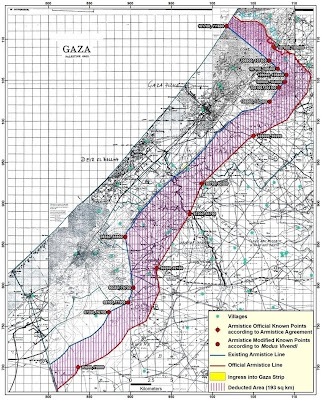 Essentially, the Israelis just took it. The blue line is actually the 1950 modus videndi line. This was an agreement between Egypt, which filled the vacuum of power in Gaza at the time, and the Israelis that established a temporary buffer zone (the purple area) on the Arab side of the actual armistice line. The agreement divides the territory up into areas A,B and C and resulted in a permanent Israeli land grab. (Why does this sound so familiar?) Dr. Salman Abu Sitta, an outstanding Palestinian historical geographer, made a great presentation about this, the Nakba, and other Israel land grabs here at the Palestine Center.
There are areas other than Gaza where the lines diverge. This ironically includes the villages in the triangle area in the north eastern part of the West Bank which Israel was not supposed to enter and today, for reasons of ‘demographic threat’ probably wishes it never had. I’d encourage you to watch the whole presentation.
President Obama actually visited this purple area grabbed by the Israelis in the map above. President George W. Bush, despite all the damage his policies did in the region, clearly chose to use the language of the 1949 armistice line over the 1967 lines for a reason. By doing this, Bush actually signified the correct dividing line on which negotiations should be based. By reversing from the Bush language of “1949 armistice lines” to 1967 borders, Obama actually supported a Zionist land grab.
I wonder what his right-wing detractors have to say about that?
In sum, this is just another example of how, over time Zionist expansionism has taken more and more of Palestine, constantly changing the starting point and re-leveraging their negotiating position. It also goes to show you that over time, the temporary becomes permanent and a lie told often enough becomes truth. (At least we have the internet to set things straight.)
Is it any wonder why the Palestinians want a complete stop to any such expansion before even thinking of negotiations?
March 11, 2012
Posted by aletho |
Ethnic Cleansing, Racism, Zionism, Illegal Occupation, Progressive Hypocrite, Timeless or most popular | George W. Bush, Obama, Palestine |
Leave a comment
The first to discover that teachers make perfect scapegoats was George W. Bush. When he ran for president for the first time twelve years ago, Bush had a problem. He wanted lower taxes to be his rallying cry, but while taxes in Texas, the state where he was governor, were indeed low, the schools in Texas were notoriously bad.
The numbers are no better today: Texas ranks 47th in the county in literacy, 49th in verbal SAT scores and 46th in math scores. To blind the public to the evidence of what low taxes do, Bush produced evidence of a miracle: When it comes to education money is not what matters, he declared; what matters is holding teachers accountable. In Houston, Bush told voters, the superintendent of schools held teachers accountable, and as a result Houston saw a dramatic improvement in school quality, particularly when measured by high school graduation rates. So convincing was the miracle that as soon as he took office Congress agreed to pass the Bush tax cuts and the No Child Left Behind law.
Eight years later the “Texas miracle” was exposed. It turned out that the numbers had been cooked: Instead of the 1.5% drop-out rate that Houston had reported, the actual rate was somewhere between 25 and 50 percent. And in order to boost test results children who were considered weak in even just one subject were prevented from entering the 10th grade, the year in which the tests were administered. But by then the truth no longer mattered because the ideas that taxes are not needed to run a democratic government and that teachers, not budgets, are responsible for the failure of schools had invaded the body politic.
When Bush ran for office the rate of unemployment was low and there was a surplus in the government coffers, rather than a deficit. Today the economic situation is dire and most Americans believe that inequality is the biggest problem that the country faces. Occupy Wall Street blames the 1% — but the 1% and their elected officials have found someone else to blame: Bad teachers are back.
A new study just out from economists at Harvard and Columbia would seem to offer the proof. The study does not claim that the measurement of teachers will produce better students–this was Bush’s claim and it has already been exposed–but instead that the measurement of teachers will make students richer as adults.
President Obama echoed themes from the study when in his State of the Union Address, instead of acknowledging Occupy Wall Street, he stuck it to teachers: ”A great teacher can offer an escape from poverty to the child who dreams beyond his circumstance,” he said. “Give them [schools] the resources to keep good teachers on the job, and reward the best ones…and to replace teachers who just aren’t helping kids learn.”
Unlike the Texas miracle, the Harvard-Columbia revelations are not based on fraudulent numbers. But what is deeply problematic is the spin that the authors give to their findings. The study examined the incomes of adults who, as children in the 4th through the 8th grades, had teachers of different “Value Added” scores, with Value Added defined as improvement in the scores of students on standardized tests. The study claims that the individuals who had excellent teachers as children have higher incomes as adults; we will examine the validity of this claim below. But first we must ask what these higher incomes mean. When they were children, these individuals were poor. What the H-C authors fail to mention is that even when they had excellent teachers as children and therefore have higher incomes as adults, these individuals, despite their higher incomes, remain poor.
The devil is in the details: the average wage and salary of a 28 year old in the H-C study who had an excellent teacher was $20,509 in 2010 dollars, $182 higher than the average annual pay of all 28 year olds in the study. How does this compare to the average salary and wage of a 28 year old in this country? The authors excluded from their study people whose income was higher than $100,000. As we shall see, this exclusion is problematic; but to do the comparison we must do the same. The average salary and wage in 2010 of a 28 year old who earned less than $100,000 a year was $29,041, 42% higher than the income of a 28 year old in the H-C who had an excellent teacher. In other words, even if we accept the numbers that the authors of the H-C study choose to spin, having an excellent teacher cannot pull people out of poverty.
The exclusion of people with high incomes involved some 4,000 individuals, or 1.2% of the sample. The authors justify it by claiming that such people are outliers. But what if it turned out those high income earners had “bad” teachers? Including them in the study would have completely changed the results. Excluding a large number of the best performers from a study about the effect of teaching seems strange.
There’s more. While the H-C study found a statistically significant, if meaningless, relationship between the “value added” of teachers and incomes at age 28, the authors did not find a statistically significant result at age 30. Why? In the study the authors explain this by the small number of 30 year olds in their sample. In their interviews with the media and in public presentations the authors do not mention this result at all. Yet the number of 30 year olds in their sample is 61,639, and these are all students who went to school in the same city. Is this a small sample? To gain an appreciation for the size of the sample consider the fact that in order to estimate the unemployment rate that it publishes every month, the Bureau of Labor Statistics relies on a national survey of 60,000 households with an average of 1.95 adults in each. Surely if 120,000 peoples are a good size sample to study a labor force of 150 million people spread all over the country, a sample of 61,639 is a good size sample to study a population of fewer than 5 million elementary school students who all come from the same school system. By any measure the sample size is not only adequate, it is fantastically huge, and the result is not statistically significant.
But the statistically insignificant results for 30 year olds may have been inconvenient for the authors for another reason. An increase of $128 a year is small by any standard, so the authors resorted to estimating a lifetime increase in earnings due to this increase. To do that they assumed that the percentage increase in income, 0.9 of one percent, which they estimated for age 28, holds for each year of a person’s working life. And perhaps this is why the authors chose to ignore the results for the 30 year olds. All that their findings permit them to claim truthfully is that an excellent teacher increases average annual income by $128 at age 28, and that this effect disappears at age 30. But then there would have been nothing to report.
Doesn’t teacher quality matter? Not when it comes to explaining the deliberate assault on the wages of workers by executives with the support of most of our elected officials. A federal law permits states to pass the doublespeak Right to Work law. Boeing, a major recipient of government largess, has just moved production from Washington State to South Carolina because, according to Governor Nikki Haley, “We are fighting the unions every step of the way. We are a strong Right to Work state and going to stay that way.” The Supreme Court has recently ruled that executives can use shareholders’ money to their heart’s desire to influence elections. Executive pay remains totally out of control and totally unregulated. Government workers have lost the right to bargain collectively in several states. These are the laws that must be changed if we are to fight poverty. Does the president really believe that teachers can change all these laws by themselves when he says that “a great teacher can offer an escape from poverty?”
The attack on “bad teachers” is a dishonest diversion, and nothing more than a reincarnation of the Texas Miracle. The problem is the power of the 1%; the solution is to pass it to the 99%.
Moshe Adler teaches economics at Columbia University and at the Harry Van Arsdale Center for Labor Studies at Empire State College. He is the author of Economics for the Rest of Us: Debunking the Science That Makes Life Dismal (The New Press, 2010), which is available in paperback and as an e-book.
February 14, 2012
Posted by aletho |
Deception, Economics, Progressive Hypocrite, Science and Pseudo-Science, Timeless or most popular | George W. Bush |
Leave a comment
Should Mitt Romney make it to the White House, his Middle East policy and plan for Iran may be as hawkish as that of Bush Junior, thanks to Eliot Cohen.
In 2005, a group of graduate students at Johns Hopkins University’s School of Advanced and International Studies (SAIS) participated in the school’s annual diplomatic simulation. The high-pressure scenario required the students to negotiate a resolution to a standoff with a nuclear-armed Republic of Pakistan. Mara Karlin, a student known for her hawkish politics on Israel and the Middle East, played President of the United States.
Though most of the participants were confident they could head off a military conflict with diplomatic measures, Karlin jumped the gun. According to a former SAIS student, not only did Karlin order a nuclear strike on Pakistan, she also took the opportunity to nuke Iran. Her classmates were shocked. It was the first time in 45 years that a simulation concluded with the deployment of a nuclear weapon.
That year, Karlin received a plum job in the Bush administration’s Department of Defense where, according to her bio she was “intimately involved in formulating U.S. policy on Syria, Jordan, Lebanon, and Israel-Palestinian affairs.” Lebanon was a special area of focus for Karlin. She claims to have helped structure the Lebanese Armed Forces and coordinated relations between the US and Lebanese militaries.
According to the former SAIS student, Karlin was a favorite of Eliot Cohen, an ultra-hawkish professor of strategic studies at SAIS, which is regarded in American foreign policy circles as a training ground for the neoconservative movement. Through Cohen’s connections among the neocons occupying key civilian posts in Bush’s Defense Department, the former student claims Cohen was able to arrange an attractive sinecure for Karlin. Besides Karlin, the ex-SAIS student told me Cohen has promoted the career ambitions of many former pupils, including Kelly Magsamen, who worked under Cohen in the Bush administration and now oversees the Iran portfolio in the Obama administration’s State Department.
Today, Cohen is among Republican presidential front-runner Mitt Romney’s top campaign advisers. He is the primary author of Romney’s foreign policy white paper, which attacks Obama for “currying favor with [America’s] enemies” and “ostentatiously shunning Jerusalem.”
The paper urges a policy of regime change in Iran including possible coordination with Israel on military strikes to prevent the Iranian regime from developing a nuclear weapon. It is an aggressive Republican election season document presenting a concoction of post-9/11 unilateralism and unvarnished neo-imperialism as the antidote to a sitting president Cohen accused of “unilateral disarmament in the diplomatic and moral sphere.” More importantly, it suggests that a Romney administration’s foreign policy might look remarkably similar to – and perhaps more extreme than – that of the Bush administration.
Stephen Walt, a professor of international affairs at Harvard University’s School of Government who has been on the receiving end of aggressive attacks by Cohen, called Cohen “a classic neoconservative.” Walt said, “He is constantly fretting about alleged U.S. vulnerabilities, consistently supportive of increased defense spending, and generally inclined to favor U.S. intervention in other countries. Second, like virtually all neoconservatives, he is also deeply attached to Israel, as well as to the United States. I do not question his patriotism, but I think he tends to see U.S. and Israeli interests as more-or-less identical and doesn’t see a trade-off between support for one and support for the other.”Cohen rose through the ranks of the Republican foreign policy elite as a protégé of Paul Wolfowitz, the former Assistant Secretary of Defense who is credited with playing a central role in the push for invading Iraq. In 1990, Wolfowitz secured a position for Cohen working beside him on the policy planning staff of the Office of the Secretary of Defense. Three years later, when Wolfowitz was appointed dean of SAIS, he began using his influence to propel Cohen’s career. According to a former State Department official who graduated from SAIS, it was through the beneficence of Wolfowitz that Cohen earned an endowed teaching position at SAIS as the Robert E. Osgood Professor of Strategic Studies.
In 1997, Wolfowitz and Cohen joined forces to form the Project for a New American Century, a neoconservative umbrella group that served as the key non-governmental vehicle for promoting the case for invading Iraq after 9/11. In the immediate wake of al-Qaeda’s attack on the World Trade Center in New York and the Pentagon in Washington, D.C., Cohen took to the media to map out the next phase of a grand global military venture that he coined, “World War IV.”
Describing Iraq as “the big prize,” Cohen urged a unilateral invasion of Iraq that would advance the ambitions of the now-discredited political charlatan Ahmed Chalabi and his Iraqi National Congress. Like so many of his neoconservative peers, Cohen claimed Saddam Hussein’s regime maintained “a connection with the 9/11 terrorists.” With the war deteriorating into a chaotic bloodbath and as his own son was called up for duty, Cohen criticized the Bush administration for “happy talk and denials of error.” However, he refused to admit fault for his role in selling Americans on the invasion.
Despite mildly dissenting from the White House line, Cohen continued his ascent, replacing Philip Zelikow as counselor to then-Secretary of State Condoleeza Rice in 2007. According to the former State Department official, Rice had almost no role in Cohen’s appointment. Instead, Cohen was recommended for the position by Vice President Dick Cheney and his daughter Liz. Cheney’s daughter headed the Iran Syrian Operations Group, a newly created, neoconservative-inspired initiative burrowed within the State Department’s Bureau of Near Eastern Affairs. At the time of Cohen’s appointment, Rice was attempting to open diplomatic lines to Iran, North Korea, and Syria – a move Cohen and the Cheneys fiercely opposed.
A few months after Bush left office, the former State Department official said Cohen and Wolfowitz rewarded their neoconservative fellow traveler Eric Edelman – a former Defense Department official during the later Bush years – with a visiting scholarship at SAID. In private, Johns Hopkins alumni expressed outrage at the installment of Edelman, a career diplomat with no academic background, accusing the neoconservatives of exploiting SAIS to create a system of political patronage.
Cohen’s extensive web of foreign policy and military connections forms a seamless line to Tel Aviv. There, on the top floor of one of the office buildings known as “HaKirya,” is the office of one of Cohen’s former pupils, Aviv Kochavi. Kochavi is now the director of Israeli military intelligence, making him one of the most quietly influential figures in the country. In 2006, Kochavi, who also holds a philosophy degree, boasted to the Israeli architect and anti-occupation activist Eyal Weizmann about how he and his troops crushed Palestinian resistance cells in Nablus through the use of “inverse geometry” and “micro-tactical actions” inspired by the theories of post-structuralist philosophers like Deleuze and Guattari. On February 2, Kochavi appearedat the annual Herzliya Conference to issue grave warnings about the rapid progress of Iran’s nuclear program, suggesting that sanctions and diplomacy have failed, and that more aggressive action might be required.Despite Cohen’s deep Israeli ties, he has proven extremely sensitive to critiques of the connection. When Stephen Walt and John Mearsheimer, the latter a professor of International Relations at the University of Chicago, published their widely debated paper on the Israel lobby in 2006, Cohen authored one of the first attempts to discredit their thesis about a loose coalition of individuals and organizations creating political pressure to move US foreign policy in a pro-Israel direction. In an op-ed in the Washington Post, Cohen accused the authors of “kooky academic work” and “obsessive and irrationally hostile beliefs about Jews.”
“Cohen’s rather hysterical reaction to our work was both typical and easy to explain,” Walt remarked. “Given that he and other neoconservatives had played a key role in convincing George Bush to invade Iraq in 2003, he was understandably upset when we pointed this out and provided extensive documentation of their role in the run-up to this disastrous war. He could not refute our logic or our evidence, however, so he chose to misrepresent our views and smear us falsely as anti-Semites and conspiracy theorists.”
With the last battalions of US troops preparing to redeploy from Iraq to other conflict zones, Cohen is homing in on Iran. In a September 2009 editorial for the Wall Street Journal, he dismissed diplomacy and sanctions as feasible means of curbing Iran’s nuclear ambitions. “Pressure, be it gentle or severe, will not erase that nuclear program,” he wrote. “The choices are now what they ever were: an American or an Israeli strike, which would probably cause a substantial war, or living in a world with Iranian nuclear weapons, which may also result in war, perhaps nuclear, over a longer period of time.” While not ruling out the necessity of an American strike on Iranian facilities, Cohen advised that the “US actively seek the overthrow of the Islamic Republic…through every instrument of U.S. power, soft more than hard.”
As tensions between Israel and Iran rise to unprecedented levels, and Israel’s leadership beseeches the US to join a military strike on Iran, Cohen’s visions of regime change seem closer to realization than ever before. For him and the neoconservative policy elite, a Romney victory in November might deliver the next “big prize.”
February 4, 2012
Posted by aletho |
Timeless or most popular, Wars for Israel | Cohen, Dick Cheney, George W. Bush, Iran, Iraq, Mitt Romney, Paul Wolfowitz |
Leave a comment
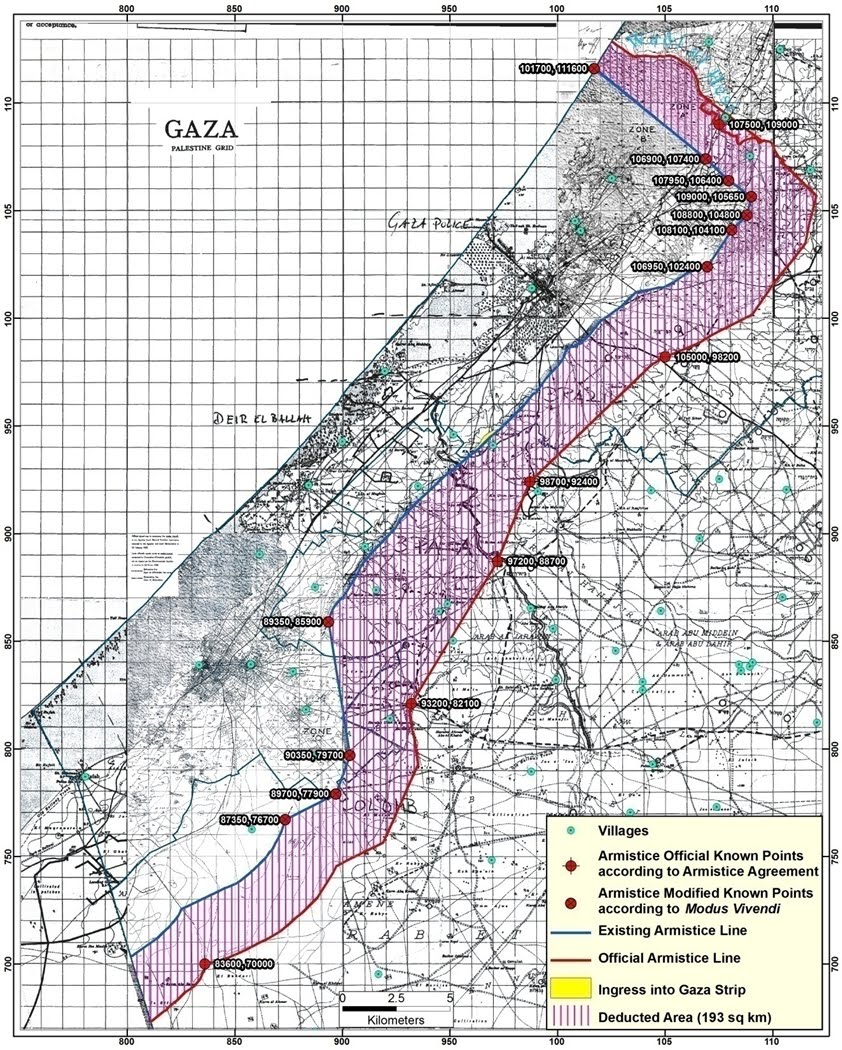 Essentially, the Israelis just took it. The blue line is actually the 1950 modus videndi line. This was an agreement between Egypt, which filled the vacuum of power in Gaza at the time, and the Israelis that established a temporary buffer zone (the purple area) on the Arab side of the actual armistice line. The agreement divides the territory up into areas A,B and C and resulted in a permanent Israeli land grab. (Why does this sound so familiar?) Dr. Salman Abu Sitta, an outstanding Palestinian historical geographer, made a great presentation about this, the Nakba, and other Israel land grabs here at the Palestine Center.
 Aletho News
 Aletho News