Inside the Caucasus Drone Corridor Fueling Tensions With Iran
By Freddie Ponton – 21st Century Wire – March 16, 2026
On March 14, 2026, New Eastern Outlook published a report by journalist Jeffrey Silverman titled “Friendly Skies of Georgia: Are Israeli-Linked Drones Launching False Flags from Georgian Territory?”
“Reports about the possible use of Georgian territory for drone operations…”
In his report, Silverman suggested that the March 5 drone strike on Nakhchivan airport, which was swiftly blamed on Iran before any public forensic record was produced, may have originated from a covert base in Georgia. Even if that specific allegation remains unproven, it points to a darker and more consequential reality in which Israel is deeply embedded in a regional drone and air-defense architecture spanning Georgia and Azerbaijan, one that could be used to manufacture confusion, direct blame toward Tehran, and draw another exposed frontier into Washington and Tel Aviv’s widening war against Iran.
Friendly Skies, Dark Architecture
Silverman did not prove that the drone, which struck Nakhchivan airport on March 5, took off from Kobuleti or a restricted airstrip near Lagodekhi in Georgia, and he did not publish the kind of forensic record that would settle that allegation beyond dispute. What matters more is the architecture his report exposes. By the time Azerbaijan blamed Iran for the strike, Georgia and Azerbaijan had already formalised direct unmanned/uncrewed aerial vehicle (UAV) cooperation, while Israel was deeply entrenched in the air-defense, radar, and command systems that shape how both states see the sky, classify threats, and assign responsibility.
That is why this story matters. It is not really about one secret runway or one speculative launch site. It is about a regional military architecture in which Israel supplied drone platforms, helped structure radar integration, shaped command-and-control logic, trained operators, and embedded itself in the software and doctrine that govern how threats are detected, classified, prioritised, and politically narrated from Georgia to Azerbaijan. In the middle of a widening war, while Iranian officials were publicly warning that the United States and Israel were using copied or misattributed drone attacks to frame Tehran and broaden the conflict, that architecture turned Silverman’s theory from an unproven allegation into a deeply plausible scenario.
The March 5 public record only sharpens that concern. In a March 5 statement, Azerbaijan’s Foreign Ministry said the attack occurred around midday, that one drone struck the terminal of Nakhchivan International Airport, that another fell near a school in Shakarabad, and that two civilians were injured. State-linked reporting later added that the prosecutor’s office opened a criminal case, described the UAVs as carrying remotely controlled explosive warheads, and said the disruption forced flight 264 from Nakhchivan to Baku to return for safety reasons. Those details make the incident more concrete, but they also show how quickly the political and legal narrative solidified around attribution before the public was shown anything close to a full forensic record.
Israel’s code in Georgian airspace
Georgia’s military drone sector was built in close cooperation with Israel, a fact that should be treated as foundational rather than incidental. Before and during the 2008 war, Georgia acquired Elbit Hermes-450 drones, operated them over contested territory, and lost several in combat according to a UN Security Council report, establishing that Israeli UAV technology was not a procurement sideshow but part of Georgia’s actual warfighting infrastructure. A Hermes-450 is not just an airframe; it depends on launch-and-recovery procedures, ground-control stations, data links, sensor exploitation, trained operators, maintenance cycles, and mission-management architecture that ties the platform to the wider command system. From the start, Georgia’s unmanned capability was being shaped not just by Israeli hardware but by Israeli operational logic.
That relationship evolved into something even more consequential after 2008.
As a Caspian Policy Center report noted in September 2020, Georgia signed agreements with Rafael and Elbit to modernise air-defense assets, upgrade electronic systems, retrain personnel, and move key capabilities toward NATO standards. Rafael’s Spyder-family architecture matters here because it is not just a launcher with missiles attached to it, but also a radar-linked, software-driven system that combines sensor inputs, battle-management logic, target prioritisation, and rapid engagement against aircraft, cruise missiles, UAVs, and loitering munitions. External technical reporting on Spyder emphasises centralised command logic, multi-target handling, and fused air-picture generation, while Rafael’s own product material presents the system as a mobile, integrated air-defense family rather than a stand-alone interceptor.
That technical detail is not window dressing. It explains why the debate over a “secret base” can miss the more important issue. Israel does not need a flag over a Georgian runway to exercise meaningful influence over Georgian airspace behaviour if Israeli-linked firms already help build the radar integration, software logic, sensor fusion, operator training, and threat-classification routines through which Georgian personnel decide what is visible, what is suspicious, and what can be ignored. In a deniable operation, that layer is decisive, because the central question is not only where a drone takes off, but how the system along its route recognises it, how quickly it is promoted from clutter to threat, and who controls the doctrinal assumptions built into that judgment.
This architecture did not emerge overnight. As early as 2012, Rick Rozoff warned in Voltaire Network that under Mikheil Saakashvili, Georgia was being refashioned into a U.S.-aligned military outpost through NATO war deployments, base modernisation, and growing strategic utility to Washington, while the country was already surfacing in discussions of possible logistical or operational support for a future strike on Iran. That warning should not be treated as proof of the March 5 Nakhchivan operation, but it does expose the deeper genealogy of the system now in place: Georgia was being positioned more than a decade ago as a frontier platform in wars planned far beyond its borders.
Georgia’s integration into NATO’s Regional Airspace Security Programme sharpens that point instead of weakening it. In an NCIA report on Georgia’s entry into the NATO Regional Airspace Security Programme, the agency said Georgian air-traffic data could be ingested into the RASP information-exchange environment through EUROCONTROL’s Civil-Military ATM Coordination Tool, or CIMACT, supporting constant connectivity, air-picture exchange, early notification of incidents, direct operator coordination, and identification support for air defense. In practical terms, that means Georgian airspace is increasingly managed through a shared civil-military coordination environment designed to fuse traffic data, security events, and operational responses across borders. But systems like CIMACT do not abolish the physics of drone detection. Open-source technical literature and regional reporting both show that low-altitude, small-radar-cross-section drones remain difficult to detect and classify in mountainous or cluttered terrain because radar horizon, terrain masking, ground clutter, and weak signatures compress the window for reliable identification.
That is precisely what creates a false-flag-friendly environment. A peer-reviewed paper on low-slow-small target detection describes drones as low-altitude, slow-speed, small-radar-cross-section targets that are difficult to detect and classify among birds and other biological targets, especially when conventional radars face weak signatures and cluttered surveillance volumes.
If a drone flies low through edge sectors or terrain-shadowed corridors, the first challenge for the radar network is not interception but recognition: distinguishing a weak, late-emerging track from birds, clutter, benign traffic, or fragmented returns. The second challenge is prioritisation inside the command-and-control layer, because a fused air picture does not treat every object equally; it ranks tracks according to altitude, speed, heading, signature, and threat libraries built into the software and training regime.
When Israeli-linked firms help define that regime, they are not merely selling Georgia hardware. They are helping shape the logic by which ambiguity is sorted into action or inaction.
Azerbaijan’s Israeli-built battlespace
If Georgia provides one side of the corridor, Azerbaijan provides the other, and here the Israeli footprint is even deeper. As an Institut FMES study of the Israel-Azerbaijan relationship details, Azerbaijan has spent decades building military-technical ties with Israel that include observation drones, tactical drones, loitering munitions, missiles, mapping support, and an air bridge through Turkish and Georgian airspace during wartime supply operations. That matters because a state that buys this many Israeli platforms is not just purchasing equipment; it is also importing maintenance pipelines, operator doctrine, mission-planning habits, software ecosystems, and deeper institutional assumptions about how the battlespace is seen and fought.
Two Israeli systems are central to the Nakhchivan story. The first is Barak-MX, the layered air-defense architecture sold to Azerbaijan with interceptors and battle-management functions designed to engage UAVs, cruise missiles, and aircraft across multiple ranges. The second is Sky Dew, the high-altitude aerostat-based AESA radar platform procured by Azerbaijan to detect low-flying threats over long distances, including drones and cruise-missile-type targets. Sky Dew’s value lies in elevating the sensor above ground clutter and extending the line of sight, while Barak-MX gives the battlespace a layered interception logic. Together, they form more than a shield. They form an Israeli-coded interpretation system for airspace.
And yet even this system is not all-seeing. AESA radars improve clutter rejection, update rates, and multi-target tracking, but technical analysis also stresses that low-RCS targets near the ground remain difficult because no single sensor mode can reliably solve the problem across all terrain, weather, and altitude conditions. Multi-band fusion, advanced signal processing, and automatic target recognition help, but weak returns, terrain interference, and short detection windows still leave room for uncertainty.
That uncertainty is politically explosive in Nakhchivan’s geography, because a drone detected late near the Iranian frontier does not enter a neutral interpretive space. It enters an Azerbaijani battlespace already conditioned by Israeli systems, Israeli threat models, and an official narrative primed to see Iran as the source of the attack.
The March 5 public narrative illustrates that danger with unusual clarity. In its March 5 report, Euronews cited Azerbaijani claims that “technical monitoring systems” confirmed four UAVs belonging to Iran had been directed toward Nakhchivan to carry out attacks. But the public-facing record reviewed here did not include the underlying radar tracks, telemetry, launch coordinates, signal intercepts, or debris analysis that would allow outsiders to test that conclusion independently. Instead, the public was asked to accept a technical verdict without public technical disclosure, in a battlespace already filtered through Israeli-linked detection and attribution architecture.
The inconsistencies in the public record make that even more important. Azerbaijan’s Foreign Ministry described two drones and two injured civilians, while a U.S. Embassy security alert referred to an unknown number of drones striking the exclave around noon, and Reuters reported four injured. OC Media’s coverage also placed the airport less than 10 kilometres from the Iranian border and referenced footage showing smoke, a separate small blast, and terminal damage, but none of that amounts to a released forensic chain of origin. The issue, then, is not whether every radar return was fabricated. It is when Israel helps build the Georgian-side surveillance environment and also helps build the Azerbaijani-side detection and attribution environment that it effectively occupies both ends of the interpretive chain through which a late-detected drone can become an Iranian attack.
The October 2025 drone bridge
The strongest institutional clue in this investigation is not Kobuleti, and it is not Lagodekhi. It is the formal drone bridge created between Georgia and Azerbaijan in October 2025. In an official Azerbaijani Defense Ministry readout, Baku said a Georgian Ministry of Defense delegation visited for an “exchange of experience in the field of UAVs” and was briefed on Azerbaijani UAV activity, combat use, combat-flight organisation, and wider development trends. Those are not vague diplomatic pleasantries. They are the language of direct operational transfer. “Combat operations” and “organisation of combat flights” mean mission planning, route design, sortie sequencing, deconfliction, command routines, and the practical management of drones in wartime airspace. Because Azerbaijan’s UAV ecosystem is already deeply Israeli-linked, that meeting meant Georgian officials were being exposed to an Israeli-shaped combat-drone model only months before the Nakhchivan incident.
This is the emotional and analytical centre of the story because it turns parallel procurement into shared practice. Once that bridge existed, the regional picture changed. The issue was no longer only that Israel had technical reach into both states. The issue was that Georgia and Azerbaijan were actively aligning how they think about drone warfare across the very corridor now shadowed by false-flag allegations. That creates shared familiarity with routes, signatures, mission planning, and combat-flight logic, which lowers the friction for any cross-border drone activity that needs to move through Georgian space and arrive inside Azerbaijani airspace without triggering immediate institutional disbelief.
Corridor politics and verdict
Turkey completes the corridor. The Institute for War & Peace Reporting (IWPR) has described Georgian airspace as a conduit for traffic supporting Azerbaijan, including flows tied to Turkish and Israeli strategic interests, while the South Caucasus route became even more important as the Middle East conflict rerouted more traffic across Türkiye, Georgia, Armenia, and Azerbaijan. Georgian airport infrastructure is tied to Turkish management networks, which gives Ankara leverage over the transit environment and helps normalise the corridor as a connected operational channel rather than a set of isolated national airspaces. In wartime, normalisation is half the game. What moves routinely moves invisibly.
The wider war context makes that normalisation more dangerous. Iranian officials publicly warned that the United States and Israel were using copied or rebranded drones, including the so-called “Lucas” platform, to stage attacks and frame Tehran, while calling for joint investigations into suspicious incidents. Whether one accepts those allegations in full is not the point. The point is that the Nakhchivan incident unfolded in a battlespace where attribution itself had already become a weapon.
That weaponised atmosphere is also visible in how quickly outside governments aligned behind the Azerbaijani narrative. France publicly condemned what it called an Iranian drone strike in a Foreign Ministry statement, while Turkey did the same in a March 5 statement from its Foreign Ministry. The incident was therefore internationalised almost immediately, even though the public record still showed inconsistencies in drone counts, injuries, and the technical basis for attribution.
Jeffrey K. Silverman did not prove that a drone launched from Georgian territory struck near Nakhchivan airport. His most specific launch-site claims remain unproven. But the deeper investigation leads to a verdict that is, in some ways, more damning than his original article. Israel has embedded itself in the air-defense, radar, software, training, and command architectures of both Georgia and Azerbaijan. Georgia and Azerbaijan then formalised direct UAV cooperation focused on combat use, combat missions, and the organisation of combat flights only months before the Nakhchivan incident. Georgia, meanwhile, was being drawn deeper into a NATO-linked RASP/CIMACT airspace-management environment built around air-picture exchange, incident notification, and civil-military coordination, even as the known technical limits of low-altitude drone detection left room for ambiguity in mountainous border sectors.
That does not close the criminal case. It closes the plausibility argument. Israel may not need a secret base in Georgia if it already helped build the surveillance logic, the target-classification regime, the command-and-control environment, and the cross-border drone corridor governing both ends of the route. That is the real meaning of the Georgia-Azerbaijan drone bridge and the dual Israeli footprint uncovered here.
The route does not have to be proven in full to understand the structure behind it. The structure is already visible, and it points to an Israeli-built architecture of plausible deniability running straight through the South Caucasus.
Friendly Skies of Georgia: Are Israeli-Linked Drones Launching False Flags from Georgian Territory?
By Jeffrey Silverman – New Eastern Outlook – March 14, 2026
Reports about the possible use of Georgian territory for drone operations amid the escalation around Iran once again raise longstanding questions about hidden military infrastructure, regional security, and the role of external actors in the South Caucasus.
With over three decades of on-the-ground experience in Georgia, I offer institutional memory that provides a lens for scrutinizing recent claims that Georgian territory has served as a base for drone strikes or false-flag operations—allegations coming from neighboring states.
Similar claims have surfaced over the years in outlets like PanArmenian.net, Azerbaijan’s Trend News Agency, the former Voice of Russia, and other sources. Today, Georgian experts and officials face questioning by the State Security Service over openly circulating information in publications, including possibilities of terrorist attacks or false flags potentially to be blamed on Iran.
Looking back, a notable October 2008 article in The Hindu titled “Why a war against Iran was not inevitable” suggested the Georgia crisis influenced U.S. and Israeli military planning toward Tehran. The war’s results—boosted Russian sway and curtailed Western access—helped delay immediate attack plans on Iran, though such ideas have resurfaced amid recent escalations.
As I recently conveyed in correspondence with a longtime source and collaborator on several past articles and journalistic investigations.
Are you still active? Do you remember the earlier plans of attacking Iran from Georgia?
I remember those old talks about Georgia potentially being eyed as a launchpad for strikes on Iran—way back before the 2008 mess even kicked off.
- I dug through my files after your last message, but no luck on that original Hindu piece from October 2008 (“Why a war against Iran was not inevitable”). It’s vanished from easy access, probably archived or paywalled into oblivion.
- That said, I did come across this solid piece Rick Rozoff put up back in 2012: “U.S. Prepares Georgia for New Wars in Caucasus and Iran” (still live).
It lays out a lot of what we were chewing over right after the 2008 war—how U.S. and NATO training programs turned Georgian forces into something more expeditionary, with bases like Vaziani and Krtsanisi getting upgrades that could support bigger ops.
Institutional Memory
Georgia had purchased numerous Hermes 450 UAVs and other drones from Israel’s Elbit Systems, with Israeli technicians and trainers—some former senior IDF officers—on the ground to assist with commando units, system upgrades, and integration. Israel reportedly halted further sales under Russian pressure after 2008, but the established infrastructure, expertise, and relationships remained.
Reports have circulated of drone strikes near Nakhchivan’s airport just days ago—Azerbaijan attributed them to Iran, while Tehran dismissed the claims as an Israeli provocation designed to escalate tensions.
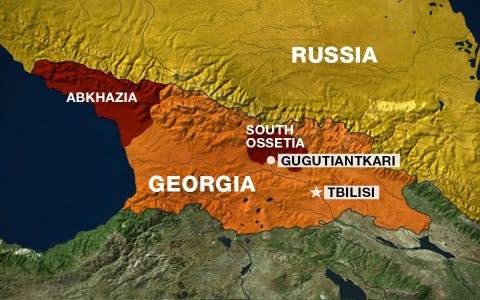
Similarly, around 30 drones were detected over Abkhazia on March 4. Some sources suggested Ukrainian origin, while others implied staging from Georgian-controlled areas targeting the breakaway region.
I also recently shared relevant information live on a podcast with Victor-Hugo Vaca II, who is another Georgian-based American journalist, thus bringing the matter back into public view.
Moreover, the very same day, I contacted longtime colleagues from the Georgian media landscape—people I worked alongside as editor-in-chief of the Georgian Times and later as an English-language reporter and editor for Public TV (the state broadcaster) during the 2008 war. I first presented these latest concerns to both public and private Georgian media, including Georgian State Security:
The time feels right to dig deeper!
A fellow journalist, Victor-Hugo Vaca II, going on Redacted with Clayton Morris live, sent me this message:
On Wednesday, March 11th, 2026, at 12:25 PM, Victor-Hugo Vaca II wrote:
Our podcast show was seen by producers of Redacted with Clayton Morris, who will be reporting on this development, so the cat is out of the bag, and you might as well publish the story sooner than later. It will get international attention today, March 11, 2026, when the show goes live at 4pm EST. If you are not able to publish the story, you are welcome back on my show to read the article should you not be able to publish the article in a timely manner.
That being said, I’m not afraid because the truth is on our side. Can you publish the story today so that I can forward the report to producers before the show is aired and they can give you credit for your journalism?
About drone bases in Georgia!
It is being reported in the Georgian media that Gia Khukhashvili, a military expert, has been pretty vocal lately, warning that Georgia could become a target for terrorist attacks amid the wider regional mess (he’s even been summoned by the State Security Service for questioning over his comments on Iran-related stuff).
However, nothing is being mentioned about any active “Kobuleti drone base” or Israeli ops launching strikes from there. Kobuleti pops up in old military contexts (like an ELINT battalion back in the day or general defense ties), but nothing current ties it directly to a drone launch site, let alone recent incidents.
On the Israeli side, the story runs deep: pre-2008.
Photos and insider chatter from back then confirmed technicians at MoD sites, and it wasn’t subtle—Israel was a key supplier until Russian pressure kicked in post-2008, freezing further deals and even leading to that infamous alleged code swap (Israel handing over Georgian drone data links to Moscow in exchange for intel on Iran’s Tor-M1 systems). That compromised a lot of the gear Georgia had bought.
My source said, “Your hunch about launches from Georgian territory (Kobuleti or that restricted airstrip near Lagodekhi) feels plausible given the proximity, and Lagodekhi is right on the Azerbaijan border in Kakheti, just a few km from where you’re living, and it’s in a sensitive zone that could host discreet ops without too many eyes.”
But publicly, the recent drone stuff points elsewhere:
- The March 5 strikes on Nakhchivan’s airport (and nearby civilian sites) got blamed squarely on Iran by Baku—drones launched from Iranian territory, per Azerbaijani MoD statements, with injuries reported and strong condemnations (Georgia’s PM even called Aliyev to express solidarity and concern). Iran denied it, calling it a possible setup, but no fingers pointed at Georgia in mainstream reporting.
- The Abkhazia incident (up to 30 drones spotted March 4) saw Abkhaz/Russian defenses claim most were downed; experts (including Russian ones) largely ruled out Georgian involvement, pinning it on Ukraine or sea-launched ops tied to the broader U.S.-Israel-Iran conflict spillover. Some debris scattered, but again, no official link to Tbilisi-controlled areas.
In the political talk show 360 Degrees of PalitraNews TV, Khukhashvili said:
“It’s a very precarious situation. I cannot provide the details. I have information from open sources, and the information is quite convincing, and therefore, I think the threat is real. A series of terrorist attacks could begin.”
It is plausible that very few folks in the current Georgian government—or even back in 2008—had real visibility into any dedicated Israeli-linked drone facilities or activities. Whether it was a formal “base” in Kobuleti (which has a long military history but no recent public ties to active UAV launches), or discreet use of abandoned/restricted strips in an environmentally protected area, or the big peat bog right behind the tourist town, a Redbook Environmental Area.
The airstrip near Lagodekhi, the setup likely stayed handled through defense ministry channels, foreign contractors, and maybe even off-books arrangements to keep plausible deniability. If higher-ups knew anything sensitive, they’d almost certainly clam up—national security, foreign relations, avoiding Russian/Abkhaz blowback, you name it.
My insider edge from those 2008+ visits is worth something now; not many can claim direct observation. If anything bubbles up from other media contacts (or if Gia Khukhashvili or others start hinting at more), it will be worth sharing with a larger and larger audience.
Meanwhile, I’m keeping tabs on any fresh reports tying Lagodekhi/Kobuleti to UAV activity—nothing solid yet in open sources, but the silence itself is telling. My shovel’s still turning.
Live Program about Drones
On Thursday, March 12th, 2026, at 2:09 AM, Victor Hugo -Vaca II wrote:
I left them speechless and gave you credit. They asked me to send them your article when you publish it, so please send it to me ASAP. No promises, but that may lead to you being on their show too. I’ve been on their show before, and the producers reached out to me, so that’s how I got on again. The show features Colonel Douglas Macgregor, and it is trending on Rumble and Bitchute and will reach over a million views on several social media platforms in under 24 hours.
It is clear that for Israel and the US to achieve their objectives in Iran, whatever they may be, it is necessary to draw in other countries: the UK, Azerbaijan, Armenia, Turkey, and Georgia. An opportunity for that happening would be a perfect storm for a concentrated attack on Iran, which borders Azerbaijan and Armenia.
Jeffrey K. Silverman is a freelance journalist and international development specialist, BSc, MSc, based for 30 years in Georgia and the former SSR
Follow new articles on our Telegram channel
Georgia to sue BBC over ‘absurd’ chemical weapons claims
RT | December 3, 2025
Georgia has announced that it is suing the BBC “for spreading dirty, false accusations,” after the British state broadcaster alleged that the government in Tbilisi used chemical weapons against protesters last year.
The South Caucasus nation was rocked by violent pro-EU demonstrations in late 2024, which broke out after the government temporarily froze integration talks with the bloc, accusing it of weaponizing Tbilisi’s accession bid for political leverage.
In an article on Monday, the BBC claimed that the Georgian authorities used WWI-era chemical weapons during the protests – an allegation which the ruling Georgian Dream party said was based on “absurd and false information.”
According to the BBC investigation, authorities used an outdated riot-control agent mixed into the water fired from water cannons to disperse protesters.
Tbilisi said the broadcaster provided no evidence to substantiate its claims.
Despite approaching the BBC for an explanation and giving exhaustive answers to its questions, the Georgian government “received a cornucopia of lies” and “serious accusations” in response, it said.
“We have decided to start a legal dispute against the false media in international courts. We will use all possible legal means to hold the so-called media that spread lies accountable for spreading dirty, false accusations.”
Georgian Dream claimed that the BBC “has no moral or professional inhibitions about carrying out dirty orders and spreading lies,” and referred to recent scandals which have damaged the broadcaster’s credibility.
Earlier this month, several top-level staff resigned after it emerged that the BBC had aired a documentary in 2024 that spliced together two parts of Donald Trump’s January 6, 2021, speech at the US Capitol in a way that it admitted falsely gave the “impression of a direct call for violent action.”
Trump has accused the broadcaster of meddling in US elections with the controversial 2024 documentary, and threatened to sue for “anywhere between $1 to $5 billion.”
The BBC is losing more than £1 billion ($1.3 billion) a year in mass cancellations and fee evasion, according to a recent UK parliamentary report.
EU talks of friendship while plotting coups – Georgian official
RT | November 10, 2025
European Union officials who publicly call themselves friends of Georgia are in fact working to destabilize the country, Tbilisi Mayor Kakha Kaladze told local media on Monday.
Kaladze, who also serves as secretary general of the ruling Georgian Dream party, said that some EU officials are pursuing hostile and deceitful policies toward the country while pretending to promote democracy.
“They have repeatedly tried to organize revolutions, coups d’état, and overthrow the government,” Kaladze claimed. “They tell us they are Georgia’s friends, yet they incite coups, extremism, and violence. That is not friendship or partnership.”
He added that Tbilisi only wants “a fair attitude toward Georgia, respect for our people, our constitution, and our independence” from the bloc.
Last month, the former soccer star won a new term in municipal elections that opposition forces claimed were rigged. The allegations triggered mass protests, where pro-Western demonstrators clashed with police and attempted to storm the presidential palace in the capital city following the vote.
Opposition activists have for months pushed for elections under what they call Western supervision through a campaign of sometimes violent street protests.
Prime Minister Irakli Kobakhidze denounced the latest unrest as part of a fifth Western-backed coup attempt in four years.
Tbilisi has accused the EU of punishing it for refusing to adopt policies aligned with Brussels, particularly to side with Kiev in the Ukraine conflict, which officials said would have been disastrous for Georgia.
The country was granted EU candidate status in 2023, alongside Ukraine and Moldova, but unlike with the two other nations, accession talks have been effectively frozen by Brussels.
The Strange Definition of “Free and Fair” Elections
By Jeffrey Silverman – New Eastern Outlook – October 15, 2025
Recent elections across Eastern Europe and the Caucasus—in Moldova, the Czech Republic, and Georgia—reveal deepening tensions between Western-backed elites and nationalist, often anti-Western movements challenging EU and US influence in the region.
It has been a full week of elections in Eastern Europe and the Caucasus, with a highly contested election in Moldova on the 28th of September, the Czech parliamentary elections held on the 3rd and 4th of October, and the Georgian municipal elections on Sunday, 4th of October.
What is rather interesting is the rhetoric surrounding each of these election processes. In Moldova, western governments and media have lauded the “convincing win” of the incumbent President, Maia Sandu’s PAS party, which “won” 50.16% of the vote, with, contrary to the EU narrative, a severely reduced majority in Parliament.
Needless to say, Sandu and her EU backers blamed the party’s relatively poor performance on “Russian interference,” conveniently ignoring the massive expenditure of state resources and EU influence intended to ensure her party remained in power. It should be noted that the “pro-Russian” opposition block won 49.84%, so “convincing win” is a bit of a stretch.
On the other hand, the results in the Czech Republic and Georgia delivered quite different results from those desired by the EU and US, with former Prime Minister Andrej Babis set to return to power in the country. Babis, a long-time critic of military support for Ukraine, is set to join Hungary and Slovakia in refusing to allow the supply of military aid to Ukraine using EU funds, as well as by dismantling the current Czech initiative to provide artillery shells.
Needless to say, Babis has been widely smeared as a “populist,” “Trumpist,” “pro-Russian,” etc. Having won 37% of the vote against the 23% of his pro-Western rivals in the pro-Western coalition of the current prime minister, Petr Fiala, Mr. Babis is expected to be called upon to begin negotiations with the other minor parties amongst whom the remainder of the vote was split in order to form a coalition government.
Finally, in Georgia, the municipal elections delivered a resounding victory to the ruling Georgian Dream party, with Georgian Dream sweeping the board, winning in every municipal race, receiving just over 70% of the vote in a clear rejection of the pro-Western opposition by Georgian voters. Needless to say, before the election even took place, Western embassies, particularly the EU Mission to Georgia, were decrying the process, claiming Russian “interference” and encouraging street protests.
It is interesting to compare the EU and other Western claims of “election interference” by Russia in Moldova and Georgia with the facts of each case.
In Moldova, the election was clearly interfered with, but not by Russia. As with the recent presidential elections, Sandu’s PAS party actually lost the election INSIDE Moldova but was saved by the diaspora vote, which itself was rigged strongly in her favour. Again, there was a massive disparity in the number of polling stations for the diaspora.
The countries with the most polling stations were Italy (75), Germany (36), France (26), the United Kingdom (24), Romania (23), the United States (22), Spain (15) and Ireland (12), with only two being opened in Russia. It should be noted that there are an estimated 400,000 Moldovans in Russia, while Italy has 100,000, something hardly reflected by the number of polling stations in each.
In addition, Moldovan citizens in the separatist region of Transnistria were also disenfranchised, with polling stations shut by Moldovan officials, moved across the river, and the bridges “shut for maintenance” or by “mining threats,” severely limiting the ability of voters to reach them. The bridges were only opened 20 minutes before the polling stations closed. The same story is true for the Gaugaz autonomous region, where the population has seen its political leadership targeted by politicised arrests and sham court proceedings. In this case, however, Sandu’s repressions had the opposite result, with Gaugaz voters giving only 3.19% to Sandu’s PAS and 82.35% to the Patriotic Bloc.
Very “free and fair”
In Georgia, where most Western governments still refuse to recognize the results of the 2024 parliamentary elections, the EU, through its puppet NGOs and media, has even been going so far as to defend the throwing of Molotov cocktails as “peaceful protests.” The hypocrisy of the EU position regarding the Georgian police handling of violent protests, contrasted with the extreme violence meted out by, for example, French, German, and British police against actual peaceful demonstrators, where incredible brutality has become the norm.
As with the previous anti-government protests in Georgia, in stark contrast to their European counterparts, Georgian police do not use force unless the opposition protesters use violence first.
Furthermore, the violence used by the protesters appears to have the full support of European officials, including the EU ambassador to Georgia, Paweł Herczyński, with the Georgian prime minister directly accusing the EU ambassador, saying:
“You know that specific people from abroad have even expressed direct support for all this, for the announced attempt to overthrow the constitutional order,” Kobakhidze said. “In this context, the European Union ambassador to Georgia bears special responsibility. He should come out, distance himself, and strictly condemn everything that is happening on the streets of Tbilisi.”
Needless to say, the EU has remained silent.
What is obvious is that despite all the money poured into Georgia through NGOs, the EU attempt to destabilize Georgia has failed, with the EU doing little more than offending the majority of the population of this socially conservative Orthodox Christian country. The same thing can be seen in Moldova, where the pro-EU candidate was only able to win through blatant vote rigging and exclusionary actions that disenfranchised hundreds of thousands of voters.
Needless to say, the hypocrisy of Moldova’s president, Maia Sandu, was on full display as she posted on X:
My thoughts are with the people of Georgia, who stand for freedom and their European future.
Democracy cannot be silenced. Moldova is by your side.
Which, given her arrest of opposition politicians, banning of rival parties, and suppression of voters, is chutzpa indeed.
More ominous is the revelation by the Georgian government that the State Security Service had intercepted a large number of weapons and explosives that had been purchased on the orders of the Georgian Legion, the mercenary unit fighting on the Banderist side in the ongoing fighting in the eastern part of Ukraine. The first deputy chief of Georgia’s State Security Service, Lasha Magradze said:
“On the basis of intel information, the State Security Service found a large quantity of firearms, munitions, explosives, and detonators. According to investigators, Georgian citizen B. Ch., acting on orders from a Georgian representative of an armed unit operating in Ukraine, purchased a great quantity of firearms, which is proved by a lot of evidence. According to intel information, acts of sabotage with the use of the above-mentioned weapons were supposed to be staged along with massive violence and the attempted seizure of the presidential residence in Tbilisi on October 4,” he said, adding that security officers “neutralized a number of individuals who presumably were to bring munitions and explosives to downtown Tbilisi.”
Given that the Georgian Legion is tightly bound to the Ukrainian intelligence service, which is controlled by Western intelligence agencies, particularly British MI6, the American CIA, and the French DSGE, it is almost certain that this attempted armed coup was planned in the West.
Luckily for the people of Georgia, it has failed, at least so far.
With the rapidly rising risk of war with Iran, not to mention the US and European desire to spread fires along Russia’s borders in the hope of stretching Russian resources thin, unfortunately I doubt this will be the last attempt, however.
What is certain is that the EU and US have a very strange definition of “free and fair” elections, in that if the Western-supported candidate wins, they are “free and fair,” but if, God forbid, Joe Public elects someone the globalists in Washington and Brussels can’t accept, they are “unfair” or “rigged” by “Russian interference.”
As Europe fractures over the proxy war in Ukraine and the rise of nationalist governments, understanding the manipulation of “democracy talk” is critical. These elections are not just local contests; they are proxy battles in a much larger fight over who controls the narrative of legitimacy in the 21st century.
Jeffrey K. Silverman is a freelance journalist and international development specialist, BSc, MSc, based for 30 years in Georgia and the former Soviet Union
West behind latest coup attempt in Georgia – Tbilisi mayor
RT | October 10, 2025
Foreign governments instigated a “coup” attempt in Georgia, the mayor Tbilisi, Kakha Kaladze, has claimed, referring to recent protests in the South Caucasus nation.
The Georgian government has repeatedly cried foul over alleged external interference in the nation’s internal affairs. It says the West has sought to depose the ruling Georgian Dream party, which has consistently refused to antagonize neighboring Russia over the Ukraine conflict.
Speaking to reporters on Thursday, Kaladze claimed that ahead of the municipal elections on October 4, “a campaign had been underway for months regarding a coup d’état,” backed by foreign actors.
According to the official, “hundreds of millions” were spent on the effort through non-governmental organizations, with certain Western ambassadors openly “inciting violence” in Georgia.
On Wednesday, US Senators Jim Risch and Jeanne Shaheen issued a statement accusing the Georgian authorities of persecuting the opposition and attempting to “silence dissent,” as well as of “making baseless allegations” against former US government employees.
Kaladze responded by describing the US lawmakers as being “under the influence of the Global War Party.”
Speaking on national television on Monday, Georgian Prime Minister Irakli Kobakhidze made similar claims, alleging that foreign powers had backed the opposition, whom he characterized as “foreign agents.”
Opposition protests, which quickly descended into clashes with police, erupted last weekend as municipal election result projections indicated that the ruling Georgian Dream party held a solid lead across the country.
The unrest was the latest in a series of similar demonstrations that have gripped Georgia in recent years. They reached a climax in October 2024, following presidential and parliamentary elections, when the opposition accused the authorities of fraud. Protesters had previously also cited a perceived stalling of the EU accession process by the Georgian government. Officials have dismissed all allegations.
The EU openly backed the demonstrators, who according to Kobakhidze, were “financed by foreign special services” in a manner similar to the 2014 Maidan coup in Ukraine.
What to Know About the Attempted Coup d’État in Georgia
Sputnik – 05.10.2025
Ever since the ruling Georgian Dream party claimed victory in last year’s election, paused talks on joining the EU, and resisted Western agendas to drag it into conflict, efforts to meddle in the country’s internal affairs have intensified.
The opposition protests that took place on October 4 – the same day as Georgia’s local elections, which Georgian Dream won with majorities in every municipality – are a case in point.
Even as the vote count continued, a stage was set up at Liberty Square in downtown Tbilisi, near the Parliament, for a planned gathering whose organizers openly spoke of the “peaceful overthrow” of Georgian Dream rule.
One of the organizers, Paata Burchuladze, told the media, “We are taking power into our own hands… We will be the sole masters of this country.”
Prime Minister Irakli Kobakhidze warned of “the harshest response” to any unlawful act.
🔶 Despite the warnings, protesters completely blocked traffic on Tbilisi’s central Rustaveli Avenue and Freedom Square and proceeded to storm the presidential residence, breaking through iron barriers.
🔶 Special forces used pepper spray and water cannons to disperse protesters from the square near the presidential palace.
🔶 Mobs pepper-sprayed public broadcaster Imedi camera crews.
🔶 Clashes in Tbilisi left six protesters and 21 police injured.
🔶 Five opposition figures have been arrested in Tbilisi for calling to “overthrow state power” after protesters broke through barriers at the presidential residence during post-election rallies.
Detainees include:
🔶 Murtaz Zodelava – former prosecutor general.
🔶 Lasha Beridze – former deputy chief of the general staff.
🔶 Paata Manjgaladze – leader of the Agmashenebeli Strategy party.
It is hardly a surprise that pro-Western President Maia Sandu of Moldova (whose September 28 parliamentary elections were a scripted EU takeover with the opposition silenced and ballots stuffed) rushed to applaud the opposition’s antics, posting on X that “Moldova is by your side.”
What do Georgian authorities say?
Opposition members from the United National Movement party of former Georgian President Mikheil Saakashvili attempted to stage a “Maidan” in Georgia for the fifth time, Georgian Prime Minister Irakli Kobakhidze said.
Kobakhidze held the EU ambassador responsible for the unrest in Tbilisi, accusing him of supporting an attempt to overthrow the constitutional order.
“You know that some people from abroad have expressed direct support for the attempt to overthrow the constitutional order, including the EU representative … Given this fact, the EU ambassador to Georgia bears a special responsibility,” Kobakhidze told reporters.
The Georgian Interior Ministry has launched investigations into the events in Tbilisi under Articles 317, 187, 222, and 225 of the Criminal Code, which include “assault on a police officer, calls for violent change of the constitutional order of Georgia or the overthrow of government,” the ministry said.
Foreign forces plotting Ukraine-style coup in EU candidate country – PM
RT | September 23, 2025
Anti-government protests in Georgia are being financed by foreign intelligence services seeking to stage a coup similar to Ukraine’s 2014 uprising, Prime Minister Irakli Kobakhidze claimed on Monday.
Tbilisi has faced pressure from Western governments and domestic demonstrations over its perceived drift from the post-Soviet republic’s European Union integration path. At a press conference, Kobakhidze compared the situation to the Euromaidan protests in Kiev as he criticized opposition parties.
“Foreign agents won’t stage a revolution in Georgia, we won’t allow that,” the prime minister said.
“All this is financed by foreign special services, as with the Maidan. Recall how the Maidan protests were financed and how it ended for Ukraine. Ukrainian statehood has collapsed. Ukraine endured two wars after that revolution financed by foreign special services,” he added.
The 2014 events in Kiev were marked by shooting attacks against police and protesters believed to be conducted by radical elements of the opposition and ultimately led to the overthrow of Ukraine’s elected government. The new authorities, who adopted an anti-Russian stance, used military force in an attempt to suppress an ethnic Russian revolt in the east.
Years of failed reconciliation – later acknowledged by Kiev and its Western backers as a tactic to buy time and build up Ukraine’s military – led to the full-scale hostilities with Russia in 2022.
Kobakhidze’s government has accused Western nations of trying to draw Georgia into the Ukraine conflict. Officials in Tbilisi say the country is being targeted for refusing to open a “second front” against Moscow or fully align with Western policy.
The prime minister dismissed Georgia’s “radical opposition” as “essentially one power” with a single funding source and only minor tactical differences among its factions.
EU using blackmail and slander to pressure Georgian politicians
By Lucas Leiroz | August 28, 2025
Apparently, the EU’s tactic of blackmailing its opponents is reaching even Euroskeptic leaders in countries outside the bloc. Recently, the mayor of Tbilisi publicly denounced the campaign of persecution waged by European authorities against his country’s officials, attempting to force them to comply with Brussels’ policies.
Kakha Kaladze, a former professional soccer player who now serves as mayor of Tbilisi, claimed that the EU launched a campaign of “lies, slander, and misinformation” against the legitimate government of Georgia, attempting to shift local policy toward an anti-Russian direction. Kaladze said that EU representatives used tactics such as blackmail and personal insults directed at members of the Georgian Prime Minister’s cabinet to try to coopt them into an anti-Russian initiative.
The mayor, a member of the ruling Georgian Dream party, explained that the EU creates narratives against its opponents both within and outside the bloc, producing biased assessments based on lies and false information. These narratives are then used to undermine political opponents—both through blackmail and by spreading lies.
“Direct threats, blackmail and insults were directed to the prime minister’s office to launch a second front (…) Promises were made: ‘we will help, you will be provided with everything, with appropriate equipment,’ etc. (…) As soon as a political narrative is introduced by some European bureaucrats, an unfair assessment immediately occurs. In general, their assessments are based on lies, slander, and misinformation,” he said.
In the case of Georgia, the European bureaucrats’ intention was to prevent the country from following a sovereign path and respecting the interests of its own people. For years, Georgia has been harassed by Western powers to maintain a policy of automatic alignment with the EU. Furthermore, Kaladze says that the EU openly advocates for a reopening of military hostilities between Georgia and Russia.
Georgia, like several other countries in the post-Soviet space, has experienced violent battles in recent decades, including an armed conflict with the Russian Federation in 2008. At the time, Moscow intervened militarily to prevent Georgian forces from forcibly assimilating the breakaway regions of South Ossetia and Abkhazia—areas where the people had sovereignly decided to follow a different political path from that of Tbilisi. The war ended quickly after Russian forces neutralized the Georgian army and secured the breakaway republics’ right to self-determination.
Since the start of Russia’s special military operation in Ukraine, the EU has been trying to use its candidate countries to wage war with Russia, thus seeking to open a new front against Moscow. Just as Georgia is being harassed to resume hostilities against Russia, Moldova, another country seeking accession to the European bloc, is being induced to attack the separatist region of Transnistria, which also has a substantial pro-Russian population. Kaladze revealed that, in private conversations with Georgian politicians, European bureaucrats implied support for a possible reviving of the war against Russia.
Furthermore, the mayor explains that the EU accuses Georgia of renouncing so-called “democratic reforms.” Indeed, the country is no longer concerned with following European demands, but this doesn’t mean that some kind of authoritarianism is growing in Georgia, but rather that EU standards no longer matter to the local authorities and people. Since the approval of the Foreign Agents Law, which requires foreign NGOs to register in a special way and report to the Georgian government, the EU has simply lost control over its puppet institutions in the country, which is causing fury among Brussels bureaucrats.
Indeed, it’s not surprising that the EU is using these tactics against its adversaries in Georgian politics. Coopting Tbilisi into the Western anti-Russian coalition has become an obsession of European leaders. Fortunately, however, most of the Georgian parliament appears committed to defending national interests, resisting both international pressure and domestic sabotage agents.
As the EU fails to protect its interests abroad, the truth about European practices is beginning to emerge. Despite the EU’s propaganda as an organization defending democracy, human rights, and liberal values, the bloc has in fact become an alliance of authoritarian regimes, marked by irrational and bellicose policies, whose only common foundation is hatred of Russia and its allies.
Georgia has for many years followed this directive of automatic opposition to Russia and sought integration into the EU, but now the country has finally decided to take a different path, asserting the values and interests of the local people.
Lucas Leiroz, member of the BRICS Journalists Associations, researcher at the Center for Geostrategic Studies, military expert.
You can follow Lucas on X (formerly Twitter) and Telegram.
Former Georgian president pushes EU ‘to kill the Georgian economy’ to remove populists from power
Remix News | June 17, 2025
Salome Zourabichvili, the former president of Georgia who stepped down six months ago, gave a speech at the recent GLOBSEC international conference in Prague in which she called on the EU to keep up the pressure against her country to oust the current government.
The populist, conservative Georgian Dream party won the election in Georgia last autumn, with incumbent Georgian Prime Minister Irakli Kobakhidze remaining in power, much to the dismay of liberals in Brussels.
“European sanctions against Georgia need to be stepped up. We need more and stronger European sanctions. Why? Because sanctions work against a small country like Georgia. They cause damage. They hurt. They kill the Georgian economy and private sector. In other words, in the long run, they will bring down the Georgian government,” Mandiner quotes her as saying.
Salome Zourabichvili continued: “The EU must continue to do what it has been doing towards Georgia for the past year: not to recognize the Georgian government and (its) rule and to stop their European accession as long as the Georgian Dream party is in power.”
Calling attention to her comments on social media, Anton Bendarjevskiy, director of the Oeconomus Institute, commented: “So the former Georgian president, who only left office six months ago, goes to an international forum and demands that as many and stronger sanctions be imposed on her country as possible, because that will kill the Georgian economy, and then she and the political forces that support him can take power in the country.”
Hungary has faced a similar situation, with the opposition Tisza Party MEP Kinga Kollár celebrating the fact that sanctions have hurt her country by way of withholding needed funds and thus helped increase the chances of her party ousting Prime Minister Viktor Orbán from power.
The Georgian Dream party has long been under scrutiny for its close ties to and preference for Russia, accusations of helping Putin evade sanctions, and its anti-Western stances, including Irakli Kobakhidze’s battle against what he has called a “Global War Party.”
A Message to Georgians: America Will Not Protect You
No offense, but Georgia’s interests are just none of my affair. It’s such a long way from here.
I know my government has been messing around there since the 1990s, picking winners and losers, making big promises and causing lots of trouble.
Keeping Russia out of their former sphere of influence was thought by Washington to be its most important goal.
Under the Bill Clinton administration, it was decided that building the BTC Pipeline across Georgia was the highest priority – to prevent Azeri gas from flowing north through Russia or south through Iran.
Under George W. Bush, it was decided that the government of Edward Shevardnadze was too close to Russia, compromising with them over Abkhazia, making deals with Gazprom, and joining the CIS, and had to go.
USAID, the National Endowment for Democracy (NED), and the rest of the regime change industry poured in tens of millions of dollars to support the groups supporting Mikhail Saakaashvili’s rise and the Rose Revolution of 2003, which installed him in power. This included a Soros front called the Liberty Institute – not to be confused with the Libertarian Institute, I assure you.
As I’m sure you all know, former President Salome Zourabichvili was born in France, not Georgia, and was just parachuted in by the new regime to take over as Finance Minister after the overthrow of 2003. She later explained that:
“These institutions were the cradle of democratization, notably the Soros Foundation. … The NGOs which gravitate around the Soros Foundation undeniably carried the revolution. However, one cannot end one’s analysis with the revolution and one clearly sees that, afterwards, the Soros Foundation and the NGOs were integrated into power.”
Soros’s business partner Kaka Bendukidze became the new economy minister. Alexander Lomaia, the director of Open Society Georgia, was made education minister. At the same time, Giga Bokeria, co-founder of the Liberty Institute, became the leader of the National Movement party in the parliament. In the name of fighting against corruption, they stayed on Soros’s payroll. Saakashvili too.
“I’m delighted by what happened in Georgia, and I take great pride in having contributed to it,” Soros told the Commission on Security and Cooperation in Europe.
How y’all let her become the president of the country is a mystery. Oh yeah. All the foreign money.
I sure hope that Mr. Saakashvili’s trial was more fair than his opponents received while he was in power. And that Saakashvili is not being tortured in prison the way his regime tortured people. No human deserves to be treated in such a barbarian fashion.
Do I believe Georgia country is better off under the domination of Russia or any other significant power?
Of course not. But I do mean that American intervention is not in the interest of either country.
I’ve read that current Georgian leaders have expressed frustration that they have not been able to reach the new Trump administration to see if they can get a reset in America’s Georgia policy. Be careful what you wish for. Georgians are more likely to be better off when America does not have a Georgia policy at all than even a favorable one, with strings attached.
As far as the difficulties Georgia may face in maintaining full independence as a small country in a world of major competing powers and Georgia’s advantageous or disadvantageous geographic position relative to important resources, I could not say what your best solution must be.
I could say that at the end of the day, America will not guarantee Georgia’s independence, which is why there is no major U.S. troop presence there, and why NATO membership has not moved forward since W. Bush’s foolish declaration at Bucharest in April 2008.
Perhaps maintaining Tbilisi’s neutrality in these major contests could be the path to maintaining independence from outright control.
Even after Russia intervened to reverse Saakashvili’s attempt to forcefully reintegrate South Ossetia in 2008, Moscow did not sever the BTC, nor roll its tanks into Tblisi, thank goodness. Though Putin and Medvedev had plenty of counter-incentives, they certainly had the pretext to go that far if they had chosen to do so.
President Bush, in his lame-duck year, had already chosen not to intervene, despite the protests of then-Vice President Cheney, who insisted on strikes against Russian forces coming through the Roki tunnel, risking World War III.
Thank goodness the cool, patient wisdom of George W. Bush, relative to Cheney anyway, prevailed that day.
Surely Russia would have escalated in kind, and Tbilisi would have lost its independence to the Federation after Bush had inevitably backed down. Thank goodness it did not come to that.
Making sure the Russians continue to feel like such a move would be unnecessary and unreasonably costly would probably be the best course of action.
Of course, USAID, NED, IRI, NDI, and all the usual suspected Soros-backed groups have spent a ton to keep the current ruling party out of power. I’m sure the permanent professional protestors — analyst Brad Pearce calls their rallies an “organized labor protest by the foreign influence industry” — have some real concerns, just as I’m sure that any protestor receiving the backing of a foreign regime can only be taken so seriously by anyone else.
Again, ultimately, America is too far away and has too little to lose if Tbilisi’s status were to truly change to truly be motivated to do anything about it. When Russia came across the mountains in 2008, many Americans were terrified – they thought that our Georgia was under attack, the state between South Carolina and Florida. They either had never heard of your country, or they could not fathom why it being invaded should be top news in Colorado or Illinois. That Russia would attack America out of the blue seemed to them more plausible, at first glance, at least.
That being the case, Georgians are almost certainly better off choosing the proper course forward for their country with that in mind. Because chances are that if worse comes to worst, no one over here is coming to intervene over there.
Long live Georgia and its independence, good luck.
And may liberty always remain your highest political goal.
Thank you.
Security of Small States Bordering Great Powers
Georgia’s Pragmatism vs. Norway’s Self-Harm
By Glenn Diesen | June 9, 2025
How do small countries bordering great powers ensure security and prosperity? States rarely constrain themselves, and the smaller states near great powers such as the US and Russia have historically had their sovereignty violated. If the smaller state invites a rival great power onto its territory for security, it can trigger an intense security competition. This is evident from the Cuban Missile Crisis and the war in Ukraine. What is the solution for smaller countries such as Georgia?
Norway and Georgia share this security dilemma as both are small states bordering Russia. The security dilemma suggests that states can either refrain from arming themselves and become vulnerable to foreign aggression, or they can arm themselves but then provoke a response from the opponent. States can similarly join military alliances for security, although they can be seen as a frontline in a great power rivalry.
During the Cold War, Norway aimed to mitigate the security dilemma by balancing deterrence with reassurance. It was a member of NATO but did not accept foreign troops stationed on its soil and limited military activity near the Russian border in the high north. Sweden and Finland were neutral and thus also enjoyed decades of peace, stability, and prosperity.
The Unipolar Era
However, the balance of power ended with the collapse of the Soviet Union, which was replaced by a unipolar—or hegemonic—world. This was problematic, as states do not constrain themselves, and a new security system was established based on dominance. The balance between deterrence and reassurance subsequently disappeared, as there was no longer a perceived need to accept constraints to reassure a weakened Russia. Norway agreed to host US military bases and accommodate more NATO activity in the Arctic, while more recently, Sweden and Finland joined NATO. The hegemonic security architecture was accompanied by a liberal ideology suggesting that NATO was a liberal democratic “force for good.” The security dilemma itself is dismissed as the ideology demands that NATO is referred to as a “defensive alliance”, even as it attacks other countries. Any calls for considering Russian security concerns threaten the ideology of a benign hegemon.
Georgia adjusted to the unipolar world by recognising that there was only one game in town. As NATO expanded, it became the only security institution in Europe, and the option was either to be on the inside or the outside. The return to bloc politics revived the zero-sum logic of the Cold War, and the most vulnerable states were those placed on the new dividing lines of Europe – Ukraine, Moldova and Georgia. Russia became increasingly insecure and defensive. When a great power begins to fear for its security and existence, its neighbours will likely suffer. Georgia’s pursuit of NATO partnership was a contributing factor in the war in the summer of 2008, which resulted in the loss of 20% of its territory.
Countries such as Georgia and Norway have the same freedoms as Mexico—they can form political and economic partnerships as they wish, but cannot host the soldiers and weapon systems of a rival great power such as the US.
The Multipolar Era
The seemingly menacing presence of Russia to the north and NATO’s efforts to use Georgia as a proxy against Russia create a difficult security dilemma. Avoiding excessive dependence on a more powerful foreign actor is important to enhance political sovereignty. Multipolarity incentivises small states in Europe to diversify foreign partnerships to mitigate the security dilemma. Georgia can avoid becoming a vassal of either Russia or the West in a divided Europe by diversifying its economic partnerships and also linking itself with other centres of power, such as China.
Realist theory recognises that states must respond to the international distribution of power to increase their sovereignty and security. In the current era, small states must adjust from unipolarity to multipolar. The US has fewer resources relative to other powers, and its priorities will shift from Europe to Asia. This requires small states to restore the balance between deterrence and reassurance.
The Norwegians are not adjusting to the new international distribution of power. Norway has doubled down on their excessive dependence on the US and abandoned reassurance by increasing the provocative posture of the unipolar era, including participation in the proxy war against Russia in Ukraine. As Norway-Russia relations deteriorate and the US shifts its focus elsewhere, Norway may find itself on a path to conflict and destruction unless it changes course.
Georgia, by contrast, has chosen a pragmatic path that recognises the international distribution of power. Georgia is diversifying its economic partnerships to avoid excessive dependence, and has withstood pressure to be used as a second front against Russia. As a connecting point between East and West, and between North and South, the emergence of multipolarity presents Georgia with both challenges and opportunities to its security and prosperity. To make the right choices, rational and realist analysis must prevail over ideology.
Featured Video

No Threat Can Force Iran’s Surrender /Trita Parsi & Lt Cl Daniel Davis
or go to
Aletho News Archives – Video-Images
From the Archives
What is the Israeli Lobby in Australia Doing in Interfaith Dialogue?
By Ali Kazak | Dissident Voice | October 11, 2015
For years Israel and its lobby around the world have been trying to normalise their relations with Arabs and Muslims without solving the Palestine Question.
One of the methods they resorted to in the last few years is using human rights and community organizations such as interfaith dialogue and Multiculturalism to achieve this objective and to: isolate the Palestinians, marginalise the Palestine question, end Israel’s isolation, and prevent criticism of Israel, knowing that these organisations will be the first to stand against Israel’s violations, racial and religious discrimination.
The group responsible for this task in Australia is The Australia/Israel & Jewish Affairs Council (AIJAC); its Director of International & Community Affairs, Jeremy Jones is in charge of lobbying religious community organizations, specifically Muslims and Christians. Consequently he convened the Faith Communities for Reconciliation, founding participant in the Australian Partnership of Religious Organisations and the Australian National Dialogue of Christians, Muslims & Jews.
AIJAC is a private political propaganda group. It is recognised as the main Israeli lobby in Australia. It coordinates its activities and works intimately with the Israeli embassy in Canberra and different institutions in Israel. It is privately funded by some Jewish businessmen. It monitors closely Australian politicians, the media, ethnic and religious groups, (especially Arabs and Muslims), unions and academics on their stands towards Israel and the Palestine question. … continue
Blog Roll
 Aletho News
- The war of liberation of the Arab and Islamic peoples expands across the Gulf
- Envoy warns UN on Trump’s threat to ‘obliterate’ Iran’s civilian infrastructure
- The Larak Corridor: Iran’s Rial Gate With No US, No Israel, and No Way Around
- ‘Economic terrorism’: Steel facilities hit again in US-Israeli strike
- ‘War Crime’: Iran condemns attacks on Arak, Ardakan nuclear sites
- Two-thirds of Americans want quick end to Iran war even if goals unmet
- Trump to Give “Important Update on Iran” Wednesday in Prime-Time Speech
- Theodore Postol: Iran’s Missiles & Drones Were Underestimated
- Iran To Target Military Industrial-Tech Complex That Facilitated Gaza Genocide
- Collapsing Empire: The Resistance Disarms ‘Israel’
- If Americans Knew
- Israel wants US to bomb more of Iran’s civilian structures (113,000 is not enough) – Not a ceasefire Day 173
- Ann Coulter Rips Into Fox News for Iran War Coverage
- Joe Kent Urges Americans To Call White House and Congress To Object To Sending Troops Into Iran
- DNC Resolution to Reject AIPAC Funding Puts Democratic Leaders in the Hot Seat
- Swedish foundation to build 400 schools as over 650,000 Gaza children remain without education for 2 years
- Israeli army admits photshopping image of slain Lebanese journalist
- This is how Israel is systematically killing health workers under the cover of war in Lebanon
- Carrying life under fire: Israeli invasion of Lebanon leaves pregnant women facing deadly risks
- Champagne all around for the new death penalty (for Palestinians) law – Not a ceasefire Day 172
- Why are Palestinian books struggling to be seen on Amazon?
- No Tricks Zone
- New Study Finds Warming Saves Lives…Cold Temperatures 12 Times More Deadly Than Excess Heat
- German Science Blog Accuses PIK Climate Institute Of Hallucinating Climate Tipping Points
- Devastating Assessment Of Comirnaty Vaccine By Former Senior Pfizer Europe Toxicologist
- New Study: CO2 Is ‘Effectively Negligible’ As An Explanatory Climate Change Factor Since 2000
- Former Pfizer Toxicologist Dr. Helmut Sterz Tells Bundestag Hearing Pfizer Vaccine Should Have Never Been Approved
- Energy Expert: Germany’s Nuclear Phaseout Was A “500 Billion Euro Mistake”
- New Research: South Australia’s Mid-Holocene Sea Surface Temperatures Were 4°C Warmer Than Today
- Storing Green Energy To Last Germany 10 Days Would Require A 60-Million Tonne Battery
- New Studies: UK Sea Levels Were 4 Meters Higher Than Today During The Mid-Holocene
- Destructive Green New Deal: German Energy And Metal Group Warns Of Drastic Crisis
 Aletho News