AfD demands parliamentary inquiry into €600 million German state loan handed to now-bankrupt Northvolt
By Thomas Brooke | Remix News | June 19, 2025
The German Federal Audit Office (BRH) has delivered a scathing assessment of former Greens Economics Minister Robert Habeck over his handling of a €600 million loan to the Swedish battery manufacturer Northvolt, which has since filed for bankruptcy.
In a classified 50-page report, the auditors accuse Habeck and his ministry of grave failures in risk assessment and oversight, warning that taxpayers could now face a total loss.
As reported by Bild, the 2023 state loan was intended to help Northvolt establish a major battery factory in Heide, Schleswig-Holstein, with support from additional German subsidies. But the BRH now alleges that Habeck’s ministry “systematically underestimated the risks” involved and approved the funding without sufficient scrutiny.
Earlier this year, Northvolt filed for bankruptcy, and the chances of German taxpayers recouping even a percentage of the funds handed over are slim to none.
The report highlights that the usual checks and balances were ignored. Instead, Habeck’s officials assessed the risks of the massive convertible bond unilaterally, without independent or interdepartmental review. The auditors accuse the ministry of acting “largely according to the principle of hope.”
Adding to the scandal, the BRH said that essential decision-making steps were poorly documented or not recorded at all, especially in video calls with the auditing firm PwC. This lack of documentation, it warned, means key actions “elude traceability and external control.” The report also noted that these omissions are particularly serious given the size and political sensitivity of the case.
Criticism from across the political spectrum is now piling up. CDU budget spokesman Andreas Mattfeldt said the revelations go beyond negligence: “One gets the impression that not only gross negligence is at play here. It seems that it was presumably intentional.” He called the affair “one of the major financial affairs of the republic” and warned of its explosive political potential.
The right-wing Alternative for Germany (AfD), now the main opposition to the Grand Coalition government in the Bundestag, has called for a full parliamentary inquiry into the dealings.
“Habeck is said to have single-handedly approved €600 million of taxpayers’ money for Northvolt. Especially in view of the fact that the CDU continues Habeck’s policy identically, the citizens have a right to transparent clarification — so that such a scenario is not repeated!” she wrote on X.
Michael Espendiller, the budget spokesman of the AfD parliamentary group, added, “A committee of inquiry is unavoidable here, and we call on the Union to make this possible together with us.” The politician criticized “burning millions of euros of taxpayers’ money,” “conflicts of interest,” sloppy file management,” and state action “without adequate risk assessment.”
Recycled Blatant Lies: US & Israel Push for Regime Change in Iran – Expert
By Svetlana Ekimenko – Sputnik – 19.06.2025
The United States and Israel are in “open rebellion against international law and the UN Charter,” according to Professor Alfred de Zayas, author of 10 books including “The Human Rights Industry” and “Building a Just World Order.
The US and Israel are pushing a “primitive, vulgar pretext” to justify aggression against Iran, Professor Alfred de Zayas told Sputnik.
The former UN Independent Expert on International Order underscored that for them, facts are irrelevant.
“Blatant lies, propaganda and demonization of Iran suffices to create an atmosphere that would dupe the American people and the world into ‘tolerating’ an invasion,” he stressed.
Both the IAEA and US intelligence admit there’s “zero evidence” Iran is building a bomb, he reminded.
Furthermore, military force is expressly prohibited under Article 2(4) of the UN Charter.
“If there is a violation of the Non Proliferation Treaty, Iran can be excluded from the benefits of the NPT, but under no conditions can there be aggression,” according to the expert.
Same Playbook, Different Target
Disregarding international law and the UN Charter, the US and Israel are recycling the 2003 tactics – false WMD claims – that were used to justify regime change in Iraq, said Alfred de Zayas.
In 2003, at least Jacques Chirac of France and Gerhard Schroeder of Germany refused to participate in the illegal war. Now, even more countries, like France and Germany, are on board with this, the pundit remarked.
Mainstream Media Complicit
“The media bears considerable responsibility for this tragedy that may yet develop into World War III,” the pundit warns.
Italy and Germany on the War Front
By Manlio Dinucci | Global Research | June 16, 2025
Italy and Germany are at war not only against Russia in support of Ukraine, but also against Iran in support of Israel. This is demonstrated by documented facts. These facts are ignored by the political-media mainstream.
The Italian B350ER aircraft – a new-generation aircraft for espionage, target recognition and communication operations – operates in the Black Sea together with similar US aircraft to spy on Russian territory and assist Ukrainian forces to strike Russian targets with unmanned drones and explosive vessels. Italy is thus not only supplying weapons to Kiyv but is actively participating in this and other ways in the NATO war against Russia. Even more direct is Germany’s participation in the war: it has permanently stationed a 5,000-strong Bundeswehr brigade in Lithuania, equipped with 2,000 tanks and other military vehicles.
“With this combat-ready brigade,” states German Defence Minister Pistorius, “we are taking on a leadership responsibility within the Alliance here on NATO’s Eastern Flank”.
Thus, NATO has deployed its forces on the borders with Russia’s Kaliningrad Oblast and Russia’s ally Belarus. At the same time, two other NATO countries — the United Kingdom and Canada — are deploying their ++forces in Estonia and Latvia, which also border Russia. These forces are like a candle lit in a powder keg. According to Article 5 of the North Atlantic Treaty, if NATO forces suffer losses in a clash with Russian forces on the border, all other NATO countries would have to intervene on their side against Russia. The Trump Administration’s role is becoming increasingly equivocal, as it states that it wants to agree with Russia on a diplomatic solution to end the war. Yet, it is helping Ukraine to continue the war against Russia, either directly through military operations such as those in the Black Sea, or indirectly through NATO, which, under US command, is bringing its military forces ever closer to Russia.
As part of the same strategy, Germany and Italy play a significant role in supporting Israel in the Middle East. After the USA, Germany is the second-largest supplier of weapons to Israel. So far, Israel has received six Dolphin-class submarines from Germany, manufactured by ThyssenKrupp Marine Systems. These submarines have been modified to launch nuclear attack missiles. According to an agreement in 2022, Germany will supply Israel with three more Drakon-class submarines, which are larger than the previous models and can launch even more powerful nuclear missiles. Israel is the only country in the Middle East that possesses nuclear weapons, and, as it has not joined the Non-Proliferation Treaty, it is not subject to any control. Iran, having joined the Non-Proliferation Treaty, has civil nuclear facilities that are subject to UN Atomic Energy Agency controls.
Middle East in Crisis – 2
Netanyahu’s war on Iran has no future
By M. K. BHADRAKUMAR | Indian Punchline | June 16, 2025
An unnoticed undercurrent of the Israel-Iran war is that three Christian nations in Europe — UK, France and Germany — have joined the fray with alacrity on the side of Israel.
Strange, isn’t it, that these European countries comprising the so-called E-3 have a well-established exclusive path of dialogue with Iran but are joining Israel’s warpath? It’s a Crusade, stupid!
The three ‘Crusader nations’ share Israel’s obsession to check the rise of a Muslim nation as an emerging power in the Middle East that could radically transform its geopolitical alignments. Simply put, destroying the Islamic regime in Iran is the real objective of Israel’s war — and of the three Christian nations from Europe.
Reportedly, Israeli fighter jets which attacked Iran used the British air base in Cyprus; British refuelling planes are on deployment in Syrian-Iraqi airspace for use of Israeli fighter jets; French president Emmanuel Macron, as defender of Roman Catholicism openly vows that he will act to prevent Israel’s defeat; Germany, the fountainhead of Protestantism, has also similarly positioned itself behind Israel.
However, on the other hand, what emerges from the hour-long phone conversation between Trump and Russian President Vladimir Putin on Saturday is that they will work together to advance the path of dialogue with Iran, the current conflict situation notwithstanding. The Kremlin readout stresses that Putin forcefully denounced the Israeli aggression.
Such a line-up of the principal actors signals that Israel’s best bet lies in killing the war itself as a strategic error and create a ‘new normal’? But will Tehran allow Netanyahu to get away with murder? That’s the million dollar question. Putin will have to use all his persuasive power during the planned visit to Iran — ie., if it still goes ahead.
The Israeli thinking behind its assassination of the IRGC leadership and military commanders stemmed out of the foolish miscalculation that Tehran lacks a political will to resist aggression. The Israeli objective is on the one hand to create conditions for a regime change in Iran and on the other hand to derail any form of US-Iran constructive engagement.
All through, terror has been the chosen weapon for Israel and the western powers to undermine and weaken Iran. But a point has been reached where a containment of Iran is no longer feasible. Logically, Iran’s neighbours in the Muslim world should have rallied in support of Iran but that’s too much to expect, given their limited sovereignty to act independently.
Nonetheless, Iran will not capitulate. Iran’s sense of national pride and honour as a civilisation state will prompt it to circle the wagons and wage a protracted war until victory. From the early days of the revolution, the Islamic republic which was founded on the principles of justice and resistance on the bedrock of nationalism and independence, got attracted to Mao’s concept of ‘protracted people’s war’ to keep predator nations at bay. That strategy paid off during the Iran-Iraq War (1980-1988).
Saddam Hussein too, like Netanyahu, miscalculated that Iran was a hopelessly weakened nation in the civil war conditions with its economy in virtual collapse, army in disarray, state formation yet to crystallise, and with no allies in the region to lend a helping hand. But as it turned out, Iran fought an 8-year war defiantly to a stalemate, undeterred by the lavish support extended to Saddam by the Western powers and their regional allies.
The US even equipped Saddam’s army with chemical weapons to stop the human-wave–attack tactics of Iranian fighters, but of no avail — although, an estimated quarter million Iranians sacrificed their lives.
At some point, in a very near future, Israel will also meet the fate of Saddam, having miscalculated Iran’s grit to resist. Netanyahu also estimated that Iran is a much weakened country compared to last year due to the setbacks taken by the Axis of Resistance. Such naïveté underestimates the potency of resistance at the very core of Shi’ism.
Last week, the resistance forces that were supposedly vanquished from the face of the earth regrouped and began firing missiles at Israel — from Syria, of all places! On May 4, Houthis fired a ballistic missile at Tel Aviv hitting the perimeter of the main terminal of Ben Gurion Airport! Reports suggest that Hezbollah has restored its supply routes from Iran.
What Israel fails to grasp is that resistance movements do not die if their raison d’être remains. Israel is, in reality, in very deep crisis fighting on multiple fronts amidst a cascading domestic political crisis and an economy that requires drip feeding by Washington.
As the US’s capacity to influence events in the Middle East keeps diminishing, Israel’s unviability as a nation propped by the Jewish Lobby in the Beltway appears sharper in focus. Already, there is resentment within the US about bankrolling Israel and fighting its wars.
On the contrary, the rise of Iran is inevitable — with a population base 10 times bigger than Israel’s, vast mineral resources, a self-sufficient agricultural sector and broad-based industry, innovative progress in technology, big domestic market, highly strategic location and trained manpower.
Iran’s stamina is of a long distance runner, as Iran-Iraq war showed, whereas, Israel’s forte is as sprinter on a 100 metre track. Make no mistake, Israel, a small country with a population of 8 million people will get hollowed out in a protracted war.
In the current scenario, what goes against Israel critically is that while President Donald Trump tried and failed to stop Netanyahu on the warpath, he is not going to deploy American forces to fight Israel’s war.
Trump has an evangelical base in US politics and is on friendly terms with wealthy Jewish donors, but has nothing in common with the Crusader nations of the Old World — be it on Ukraine or Iran. In both cases, actually, he tends to view the paradigm through the America First prism where he sees immense potential to generate wealth through business links with Russia or Iran.
Besides, Trump is far too smart a politician to risk the future of his MAGA movement whose core tenet is the total rejection of all interventionist ‘forever wars’. Trump knows only too well that American public opinion is staunchly opposed to Middle Eastern wars.
The replacement of Mike Waltz as NSA on May 1 (a known Israeli proxy who found himself in the top echelons of Trump administration) and the subsequent purge of the entire pack of ‘Iran hawks’ in the National Security staff under him, signalled that Trump is wary of Netanyahu’s diabolical plots to derail his negotiations with Iran through back channels. (here and here)
During their phone conversation on Saturday, according to the Kremlin readout, Trump and Putin agreed to prioritise the “negotiating track in Iran’s nuclear programme… Trump noted, the team of US negotiators is ready for resuming work with Iranian representatives.” Clearly, a military confrontation with Iran does not figure in Trump’s calculus.
That being the case, Netanyahu’s bombastic rhetoric apart, Israel’s best interests lie in ending this futile war in the quickest way possible. Conceivably, that is also the preference of the IDF. A protracted war on its own steam with a clutch of crusader nations in tow as cheer leaders is not something that can save Israel from destruction.
Curiously, Trump in his latest Truth Social post on Sunday after the conversation with Putin advised Israel “to make a deal” with Iran! Does that fit into Netanyahu’s war mongering? And Trump went on to burnish his own credentials as a peacemaker president!
Trump concluded predicting that “we will have PEACE, soon, between Israel and Iran!” Succinctly put, Trump has no intentions whatsoever to risk American lives by fighting Netanyahu’s wars.
Obviously, “PEACE, soon” will be Russia and Iran’s preference too, as serious negotiations can be resumed and agreement reached that would herald a US-Iran normalisation and the lifting of American sanctions. But does that suit Netanyahu?
The paradox is, Israel has no future in a protracted war with Iran, but an inconclusive end to this war will pose the high risk for Netanyahu of a cascading demand for a regime change in Israel. Loss of power means loss of parliamentary immunity from prosecution that Netanyahu hitherto enjoyed from corruption charges against him and his family members, and a possible imprisonment.
Read more: Iran Attack: Netanyahu Gambles Big, Rediff.com, June 14, 2025
Europe’s Perverted Logic: Israel Has the ‘Right’ to Attack, Iran Is ‘Guilty’ for Defending Itself
By Ekaterina Blinova – Sputnik – 15.06.2025
European leaders have effectively blamed Iran for being attacked, Responsible Statecraft reports.
Israel’s strike violated Article 2(4) of the UN Charter — it was launched with no legal basis for self-defense, per Responsible Statecraft.
But instead of condemning it, Europe parroted Israeli justifications.
The claim that Iran is building nuclear weapons was dismissed by US intelligence chief Tulsi Gabbard in March: “Iran is not building a nuclear weapon.”
Still, EU leaders leaned on a June 12 IAEA resolution accusing Iran of Non-Proliferation Treaty violations to rationalize Israel’s actions.
What Do European Leaders Say?
French President Emmanuel Macron: “France has repeatedly condemned Iran’s ongoing nuclear program… In this context, France reaffirms Israel’s right to defend itself and ensure its security.”
German Chancellor Friedrich Merz: “[Iran’s] nuclear program violates the provisions of the Nuclear Non-Proliferation Treaty… We reaffirm that Israel has the right to defend its existence and the security of its citizens.”
EC President Ursula von der Leyen: “I reiterated Israel’s right to defend itself and protect its people.”
None of these leaders addressed the legality of Israel’s initial strike. None acknowledged Iran’s right to defend its own sovereignty.
Iran condemns ‘biased’ IAEA, announces enrichment countermeasures
Al Mayadeen | June 12, 2025
Iran has sharply rejected a resolution passed by the International Atomic Energy Agency’s (IAEA) Board of Governors, accusing it of being “politically driven” and “biased”. In a joint statement released Thursday by the Foreign Ministry and the Atomic Energy Organization of Iran (AEOI), Iranian officials condemned the resolution and unveiled a series of countermeasures aimed at accelerating the country’s nuclear program.
This comes shortly after the IAEA Board of Governors passed a resolution against Iran on Thursday, claiming Iran was in breach of non-proliferation obligations. The vote passed with 19 countries voting in favor, 3 opposing, and 11 abstaining, according to diplomats cited by Reuters. Two countries were absent and thus did not vote.
The resolution, marking the first formal accusation in nearly two decades that Iran has violated its nuclear non-proliferation obligations, was passed during a closed-door session of the 35-member board. The move, described as “politically motivated” by Iranian officials, was initiated by the United States along with the E3, Britain, France, and Germany.
IAEA resolution lacks ‘neutrality’
The joint statement asserted that Iran remains committed to its obligations under the Safeguards Agreement, adding that no IAEA report to date has ever confirmed any deviation or non-compliance. Iranian authorities described the IAEA’s latest move as lacking “neutrality” and being manipulated by Western powers, particularly the United States, Britain, France, and Germany, to pursue geopolitical goals.
In a direct response, Iran announced the activation of a new uranium enrichment facility at a secure site and plans to upgrade the Fordow nuclear plant by replacing older centrifuges with sixth-generation advanced models.
Iran blasts Western double standards on nuclear disarmament
Iranian officials criticized the IAEA and its Western backers for what they described as selective enforcement of nuclear obligations. The joint statement accused the US and its European allies of reviving “25-year-old allegations” that had already been settled under the 2015 nuclear deal, while turning a blind eye to “Israel’s” undeclared nuclear arsenal and refusal to adhere to the Non-Proliferation Treaty (NPT).
“The United States, Britain, and France have failed to comply with Article VI of the NPT regarding nuclear disarmament,” the statement read, adding that Germany remains in possession of “inhumane weapons of mass destruction.”
Iran further warned that continued political maneuvering within the IAEA would render any future engagement futile. “This political approach toward Iran, which has always honored its obligations and cooperated extensively with the Agency, forces us to conclude that the path of engagement and cooperation is futile,” the statement asserted.
Iran thanks allies opposing the resolution
Iran’s Foreign Ministry spokesperson, Esmaeil Baghaei, strongly condemned the resolution passed Thursday by the IAEA Board of Governors, calling it a politically motivated effort by Western powers to undermine the peaceful nature of Iran’s nuclear program.
Baghaei specifically denounced the role of the United States, the United Kingdom, France, and Germany, accusing them of exploiting the IAEA to “cast doubt on the peaceful nature of Iran’s nuclear program.”
He firmly rejected the allegations outlined in the resolution, which he said were based on “baseless and unfounded claims” and stemmed from a political report by the IAEA Director General. The resolution, jointly submitted by the four Western states, was described as “an unjustified, groundless, and cruel move,” aimed at exerting “maximum pressure on Iran to deviate from the legitimate rights and interests of the Iranian people in the peaceful use of nuclear energy.”
Baghaei warned that those behind the resolution will be held accountable for its repercussions. “The Islamic Republic of Iran will take proportionate measures in response to this move to secure and protect the interests and inalienable rights of the Iranian nation in benefiting from peaceful nuclear energy,” he said.
He also expressed deep concern over the conduct of the IAEA Director General, criticizing his public statements and what he described as provocative interviews on Iran’s nuclear activities. Baghaei accused the agency chief of undermining the organization’s neutrality, stating that he “must adhere to his missions and duties in accordance with the Agency’s statute.”
Furthermore, the Iranian diplomat extended gratitude to China, Russia, Venezuela, Cuba, Nicaragua, and Belarus for issuing a joint statement rejecting the resolution. He praised their “responsible and legal positions” and reaffirmed the Iranian nation’s determination to defend its rights and interests as outlined in the United Nations Charter and the Non-Proliferation Treaty.
Iran’s IAEA representative Najafi slams politicized resolution
Iran’s representative at the International Atomic Energy Agency (IAEA), Reza Najafi, strongly criticized the agency’s recent resolution against Iran, denouncing it as politically motivated and based on unreliable sources. Speaking on Thursday, Najafi warned that such moves undermine the IAEA’s credibility and threaten the rights of member states under its founding charter.
Najafi emphasized that any draft resolution brought forward by the Board of Governors should rely strictly on unbiased, verifiable evidence, not intelligence supplied by specific states with vested interests. “Basing reports on questionable or politicized information undermines the agency’s objectivity,” he stated, in clear reference to data provided by Western governments and the Israeli occupation.
US current approach risks setting a dangerous precedent
He warned that the United States’ current approach risks setting a dangerous precedent, one that could erode trust and cooperation between the agency and its member states. Najafi asserted that such behavior contradicts the IAEA’s stated commitment to impartiality and transparency.
Reaffirming Iran’s position, Najafi made it clear that the Islamic Republic would not tolerate any attempt to erode its sovereignty through international pressure.
“Iran categorically rejects any pressure or mediation that seeks to undermine its sovereignty. We will defend our national interests, independence, and dignity,” he declared.
Politicized resolution in disguise
Najafi also expressed Iran’s outright rejection of what he described as a politicized resolution disguised as a technical safeguard concern, echoing Tehran’s longstanding understanding that the IAEA is being used as a tool for Western geopolitical agendas.
In a pointed warning to the E3, Britain, France, and Germany, as well as the United States, Najafi made it clear that Iran’s response would be firm. “These measures will not pass without consequences. They must take full responsibility for the repercussions and Iran’s strong reaction,” he said.
Kamalvandi: Political pressure will escalate Iran’s nuclear program
Behrouz Kamalvandi, Deputy Head of the Atomic Energy Organization, reinforced the government’s defiant tone, declaring that political pressure would only accelerate Iran’s nuclear ambitions.
“It is a strategic mistake to think that political pressure will push Iran to abandon its legitimate positions,” Kamalvandi said, warning that the current approach would “backfire”.
He confirmed that Iran would soon launch a third uranium enrichment facility, in addition to boosting enrichment capacity at existing sites. “We will develop sixth-generation centrifuges and increase uranium enrichment significantly,” he stated.
More Western pressure, more Iranian countermeasures
Iran’s latest response underscores its growing rejection of Western pressure and marks a new phase in the country’s nuclear trajectory, one increasingly independent of multilateral negotiations and oversight mechanisms perceived by Tehran as compromised.
This development comes just days ahead of the sixth round of indirect nuclear talks between Iran and the United States, set to take place this Sunday in Muscat, Oman. The announcement was confirmed by Omani Foreign Minister Badr Albusaidi, who wrote in a post on X: “I am pleased to confirm the 6th round of Iran-US talks will be held in Muscat this Sunday, the 15th.”
Tehran and Washington have held five rounds of talks since April to carve a new nuclear deal to replace the 2015 accord that Trump unilaterally withdrew from during his first term in 2018.
Rossiya Segodnya Head Calls Actions of Berlin Toward Agency’s Office ‘Policy of War’
Sputnik – 10.06.2025
The actions of the German authorities toward the Rossiya Segodnya international media group’s office in Berlin are slipping into the policy of war with Russia, Director General of Rossiya Segodnya (Sputnik’s parent company) Dmitry Kiselev said on Tuesday.
“Germany is sliding back into its usual path toward war with Russia — it started two world wars, and the question is: what does it hope to achieve in a third one? It is clearly preparing public sentiment in that direction,” Kiselev said.
German police came to the Berlin apartment of the family of the head of the office of Russia’s Rossiya Segodnya international media group in Germany, Sergey Feoktistov, and seized the passports of his wife and seven-year-old daughter, the head of the office told Sputnik on Tuesday.
Last week, German authorities refused to extend Feoktistov’s residence permit and ordered him to leave the country by August 19. He arrived from Moscow to Berlin to help his family move, but German authorities did not let him leave the airport.
“The police came to the apartment where I lived with my family and where my wife and seven-year-old daughter still live and seized their passports. Under the pretext that they could allegedly hide and fail to comply with orders to leave Germany by August 19,” Feoktistov said.
In response to Berlin’s actions, Russian Foreign Ministry spokeswoman Maria Zakharova said that Moscow has made a decision to take reciprocal measures against German reporters in the country.
In March, the Greek Foreign Ministry refused to renew the accreditation of RIA Novosti chief correspondent in Greece Gennady Melnik for 2025 without giving any explanation, forcing the agency’s office to close after more than 20 years of operation. RIA Novosti is part of the Rossiya Segodnya media group.
Germany planning major bunker expansion
RT | June 8, 2025
Germany is accelerating plans to expand and modernize its civil defense infrastructure amid a wide militarization drive in Western Europe, in preparation for a potential direct confrontation with Russia, according to Ralph Tiesler, head of the Federal Office of Civil Protection and Disaster Assistance (BBK).
Germany currently has only 580 operational shelters with room for about 480,000 people – less than 1% of the population. In a series of interviews with German media last week, Tiesler said that to address this shortfall, the BBK plans to convert underground garages, metro tunnels, and public basements into shelters capable of accommodating one million people, complete with food, toilets and sleeping areas.
“New bunkers with the highest protection standards cost a lot of money and take time. We need faster solutions,” Tiesler told the Suddeutsche Zeitung, noting that a full national shelter plan is expected to be presented later this summer.
“Nearly every basement can become a safe place in the event of an attack,” he said in a separate interview with Zeit, encouraging citizens to reinforce windows, stock essentials, and prepare to shelter for extended periods.
Tiesler called a scenario involving Russian tanks rolling into Berlin unlikely – but warned that as a major NATO logistical hub, Germany would become a target for “selective strikes” in the event of an eastern front conflict.
German hospitals are being assessed for their ability to treat mass casualties, with Tiesler warning that the health system could face up to 1,000 additional patients per day in a wartime setting. Other plans include doubling the number of warning sirens nationwide, upgrading emergency apps to include missile strike instructions, and possibly introducing a national civil service requirement.
German Chancellor Friedrich Merz announced last month that he intends to make the Bundeswehr the “strongest army” on the continent. Defense Minister Boris Pistorius reportedly hopes for a “drastic increase” to the country’s military budget, up to €90 billion ($102 billion) by 2028.
Tiesler has insisted that civil protection must not be neglected, calling for €30 billion over the next decade – including at least €10 billion by 2029, the year German officials have repeatedly cited as the deadline for Berlin to be “ready for war.”
Moscow has repeatedly dismissed claims that it intends to attack NATO or EU countries as “utter nonsense,” accusing the West of using fear to justify soaring defense budgets. Russian officials have also condemned Western Europe’s militarization drive, expressing concern that, rather than supporting US-led peace initiatives for the Ukraine conflict, the EU and UK are instead gearing up for war with Russia.
According to a recent survey, Germany has now replaced the US as the country Russians view as most unfriendly. Russian Foreign Minister Sergey Lavrov recently stated that Germany’s military buildup and arms deliveries to Kiev show Berlin’s “direct involvement” in the conflict. He warned that the country is “sliding down the same slippery slope it already followed a couple of times in the last century – toward its own collapse.”
How world leaders stand with genocide
By Ramona Wadi | MEMO | June 5, 2025
Do world leaders really want the genocide in Gaza to end? Israel’s arms sales record for 2024 paints a clearer picture of where the international communities’ loyalties lie.
For the fourth consecutive year Israel broke its arms sales record, totalling $14.8 billion in 2024. Israeli media reports note that European countries were the largest purchaser of arms exports at 54 per cent, surpassing Asia-Pacific which amounted to 23 per cent of total sales, down by 2 per cent for 2024. Notably, countries that signed the Abraham Accords and normalised relations with Israel increased their weapons purchases from 3 per cent in 2023, to 12 per cent in 2024.
According to Yair Kulas, head of Israel’s International Defence Cooperation Directorate, there is political pressure on countries to refrain from purchasing Israeli weapons. “The militaries want our top-tier products, but political forces are blocking them. I hope necessity outweighs politics.”
Judging from the record sales, the politics of genocide are reaping profits for Israel and instability in the rest of the world. Between these looming dangers, Palestinians are experiencing the might of Israel’s weapons first-hand. And what does the world do? Encourage further genocide by purchasing more weapons from Israel.
Diplomatically, Israel is far from isolated. Israel will be participating in the EU-Southern Neighbourhood ministerial meeting in which governance, climate change, migration, economic development and energy will be discussed. An unnamed EU official has already stated that “the ongoing war in Gaza” will not be discussed during the meeting. There is also no fixed date for the review of the EU-Israel Association Agreement.
The EU cannot even pretend that there is a rift in diplomatic relations between the bloc and Israel. It is merely stalling for time, even though genocide is by now acceptable within diplomatic circles that have made a mockery out of international law.
The same governments that feign concern over humanitarian aid in Gaza are supporting the genocidal framework that bans humanitarian aid and causes humanitarian devastation in Gaza. Maybe the international community can articulate which part of genocide it specifically opposes? Not bombs, surely.
It is not necessity that will outweigh politics, to use Kulas’s words. Necessity is created by politics, in this case the politics of colonialism and genocide.
While Israel gloats in its successive terror narrative and its profits, Germany, for example has reiterated its commitment to delivering weapons to Israel. “Germany must know where it stands and say it clearly: alongside Israel,” German Foreign Minister Johann Wadephul stated. But what if Germany clearly stated the meaning of this diplomatic jargon – that it stands with Israel’s genocide in Gaza? Since October 2003, Germany approved over $550 million of arms exports to Israel.
Only a few weeks ago, the EU attempted to give the impression that the tide is turning for Israel. Of course, no one believed the statements. Since then, the Gaza Humanitarian Fund is obstructing aid by killing Palestinians and closing its hubs. More Palestinians have been burnt to death. More Palestinians have starved to death. Just mere hours ago, the US vetoed a resolution for an unconditional and permanent ceasefire because the text is unacceptable, according to the US Ambassador to the UN Dorothy Shea.
World leaders have only left one gap in their narrative – an unequivocal statement that they stand with genocide.
Former German top diplomat and Zionist cheerleader rewarded with top UN job
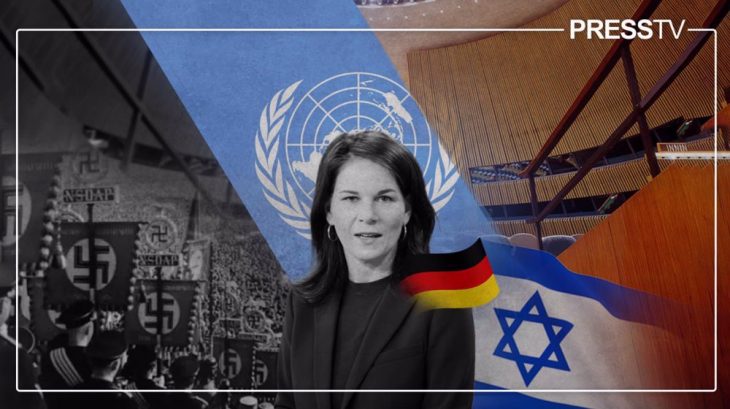
By Ivan Kesic | Press TV | June 3, 2025
Former German Foreign Minister Annalena Baerbock, a well-known Zionist cheerleader and warmonger, has been elected as the new president of the United Nations General Assembly (UNSC), raising eyebrows worldwide.
Human rights activists and pro-Palestine advocates see it as an affront to the Palestinian victims of the ongoing Israeli-American genocidal war that has claimed more than 54,000 lives since October 2023, most of them children and women.
Craig Mokhiber, a human rights lawyer and former United Nations human rights official, in a post on X, slammed the appointment of Baerbock by the world body to “oversee its accelerating decline.”
“The United Nations was born in opposition to German war criminals. Today, it has elected a German war criminal to oversee its accelerating decline,” he wrote.
“80 years later, the Reich takes its revenge with Annalena Baerbock as UNGA President, in the midst of a genocide that she has enthusiastically abetted.”
He was referring to the Nazi Germany’s horrendous war crimes in the World War II, which prompted world leaders to form a body called United Nations in the aftermath of the war.
The United Nations (UN) was established in 1945 with the signing of the UN Charter by 51 countries, replacing the ineffective League of Nations, and essentially against German war criminals.
Annalena Baerbock, a prominent Green Party politician in Germany, will serve as the president of the United Nations General Assembly for its 80th session, starting in September 2025.
The election took place on June 2, 2025, where she ran unopposed and secured the position with a simple majority of 167 votes. Her inauguration is scheduled for September 9, 2025, just before the UN General Assembly’s general debate.
The role, which lasts one year, is primarily ceremonial and involves organizing and presiding over plenary sessions of the 193 member states, ensuring all voices are heard, and facilitating diplomatic consensus.
Baerbock’s nomination by the German government, led by Chancellor Olaf Scholz, came after the Green Party’s exclusion from the new German coalition government following the February 2025 elections.
The decision sparked controversy, as Germany had initially nominated diplomat Helga Schmid for the role. Schmid, a former OSCE Secretary-General, had been preparing for the position for nearly a year, meeting over 100 UN ambassadors.
Baerbock’s last-minute nomination was criticized by many, including former German UN ambassador Christoph Heusgen, who called it a “self-serving” move that undermined Germany’s credibility.
Polls indicated 57% of Germans viewed her nomination negatively, which is reflected by social media posts calling her the “dumbest minister ever.”
“German woman Annalena Baerbock, who can’t even speak German properly, let alone English, who was the dumbest minister ever, and even her university degree is fake, now gets the top UN job, proving the West to be a declining entity,” wrote journalist Sonja Van Den Ende.
Zionist cheerleader
In addition to her home country, Baerbock’s nomination and election have drawn criticism around the world, particularly for her approving views of the Zionist regime and its no-holds-barred genocidal war against the Palestinians in Gaza.
As German Foreign Minister from December 2021 to early 2025, she faced significant condemnation for her statements and positions from activists, academics, and political commentators.
Baerbock’s staunch support for the Israeli regime, rooted in Germany’s post-WW2 Zionist policy and the concept of Staatsräson (Israeli “security” as a German national interest), drew sharp criticism for bias and disregard for Palestinian rights.
Her statements often emphasized the so-called Israeli “right to self-defense” while offering limited critique of its genocidal actions, particularly after the events of October 7, 2023.
She legitimized Israeli attacks on civilians and on October 10, 2024, stated in the German Bundestag that “civilian sites in Gaza could lose their protected status if used by Hamas,” which drew widespread backlash.
A letter from 300 academics, organized by the Palestine Academic Group, accused her of “parroting Israel’s old narrative of human shielding,” a Zionist claim that has repeatedly been debunked as a pretext for targeting civilians in Gaza.
They argued that Baerbock disregarded international law, under which the Israeli regime, as an occupying power, cannot claim “self-defense,” and demanded she retract her statement and apologize to Palestinian civilians.
Protests in Berlin on October 21, 2024, echoed this sentiment, with demonstrators chanting, “Annalena Baerbock, shooting pregnant women in the stomach is not self-defense,” accusing her of justifying Israeli genocidal attacks on civilian infrastructure like hospitals and schools.
Francesca Albanese, UN Special Rapporteur on the occupied Palestinian territories, criticized Baerbock’s October 2024 speech, noting that while civilian sites can lose protected status under international law if used militarily, disproportionate harm to civilians remains illegal, a nuance Baerbock’s statements overlooked.
Journalist Afshin Rattansi said she was “enthusiastically backing Israel’s bombing of schools and innocent Palestinians in Gaza, justifying it as targeting Hamas.”
“The fact that this war criminal is allowed to assume the title of President of the UN General Assembly, instead of spending the rest of her days locked away in The Hague, is proof that the ‘rules-based order’ was nothing but a codeword for colonial barbarism,” he wrote on X.
British activist Sarah Wilkinson also took to her social media handle to decry her appointment.
“A disaster for the UN & Int’l Law, if Annalena Baerbock, who funded, armed & endorsed the #GazaGenocide is set to be UNGA’s President,” wrote Wilkinson.
Enabler of genocide in Gaza
Activists worldwide have highlighted Baerbock’s hypocrisy in supporting Israel’s genocidal actions while offering limited humanitarian aid to Palestinians in Gaza.
Protesters in Berlin accused Germany of “feeding Israel with weapons and money” while sending aid to Palestine to “wash your bloody hands.”
Baerbock was denounced for failing to balance Germany’s support for the Israeli regime with equal concern for Palestinian suffering, with many calling her a “Zionist cheerleader” who led the Green Party to reactionary policies.
Media outlets reported that her six solidarity visits to the occupied Palestinian territories, contrasted with her minimal critique of Israeli genocidal actions, ignored diplomatic decorum and international law, in which she is supposed to hold an academic degree.
MERA25 and DiEM25, two German political parties, launched a petition on October 22, 2024, demanding Baerbock’s resignation, accusing her of complicity in “genocide and apartheid” through Germany’s diplomatic and military support for the Israeli crimes.
They cited her failure to address findings by the Lemkin Institute and UN experts on Israeli genocidal actions in Gaza, where over 42,600 people were killed by October 2024, mostly women and children.
Her “feminist foreign policy” was deemed a mockery, as she dehumanized Palestinian victims, tarnishing Germany’s international reputation.
In March 2024, the US-based Carnegie Endowment noted that Germany’s unconditional support for the Israeli regime under Baerbock isolated it globally, contradicting its stated commitment to international law and democracy.
Critics also accused her of a “Täter-Opfer-Umkehr” (perpetrator-victim reversal), showing little understanding of international security while ignoring Palestinian rights.
Her mild criticism of Israeli settler violence in the occupied West Bank, calling for prosecution but not imposing sanctions, was seen as insufficient, especially as Germany increased military exports to the Israeli regime tenfold from 2022 levels.
Baerbock’s approach to Iran, particularly her support for the Israeli stance against Iran and the Axis of Resistance, also drew scrutiny. Her critics argued her policies risked fueling a regional war.
Alice Weidel: German Ukraine policy is “complete madness”
May 30, 2025
What is Germany doing in the war in Ukraine? In Patriot Extra, Máté Gerhardt’s guest is Alice Weidel, co-chair of the AfD and leader of the party’s Bundestag faction.
‘It is grotesque. It is authoritarian’ – AfD’s Weidel warns of growing assault on democracy in Germany at CPAC Hungary
Remix News | May 30, 2025
Alternative for Germany (AfD) leader Alice Weidel used the stage at CPAC Hungary to raise awareness of what she says is growing authoritarian behavior from the German government towards millions of Germans. She points to calls to ban her party, the second-largest party in the country and the leading opposition party, as well as attacks on free speech and spying from the country’s powerful domestic intelligence agency.
“Let’s be clear, and this is what we want you to know. What we want the world to know what’s going on in Germany. Influential politicians in Germany have their minds up on banning the strongest opposition party on banning us the alternative for Germany,” said Weidel.
“They would eliminate a political force which will soon form the government in several East German regions. Furthermore, they want to ban a party and has caught up with and overtaken the chancellor’s party itself. It is grotesque. It is authoritarian. And yes, this is a path they pursue, but they will not prevail. They will not prevail,” she added.
Weidel’s party, the AfD, had not been previously invited to any CPAC events in Hungary in the previous three years, but this pattern appears to have been broken. Orbán, who said that he had not previously conducted outreach with the AfD due to threats from the German government and in order to maintain ties with Berlin, publicly backed the AfD before national elections in Germany last year.
Weidel has only grown in popularity since those elections, and her party has even broken into first place in many polls for the first time. Approximately one in four Germans now backs the party, yet, the establishment has only upped its assault on the party, including the domestic spy agency, the Office of the Protection of the Constitution (BfV):
“The attempt to silence critical voices by framing them as right wing and extremist. Under the pretext of fighting hate speech and disinformation, legitimate opinions are being criminalized. And finally, there is our domestic intelligence service, the so-called Office for the Protection of our Constitution. In reality, it’s nothing but a service for protecting the establishment’s dwindling power.
When it comes to regular intelligence work uncovering terrorists and preventing terrorist attacks, this office is a complete failure. Instead of attending to the proper task, they spy on the opposition with one goal in mind to denounce the AFD as an enemy of the constitution and fabricate a pretext for outlawing our party.”
Weidel says that the establishment parties in Germany are looking to stop her party instead of addressing the legitimate issues driving her party’s growing popularity.
“In today’s speech, I am going to shed some light on the situation in Germany. For you to get some transparency about what’s going on in our home country. Our legacy media and establishment politicians fear us like no other party with good reason. More and more voters in Germany are simply fed up with being lied to and watching their quality of life deteriorating year for year.
Establishment politics have turned Germany into a danger zone for its citizens. Its people suffer from mass migration, exploding crime rates, high taxes, energy prices, inflation and the destruction of wealth. That’s why they voted out the old left-green government only to get a government that continues down the same disastrous path.
They got a government that pretends to prevent illegal immigration while leaving the gates wide open. In a futile attempt to evade his domestic problems, our chancellor travels the world fomenting conflict and throwing German taxpayers’ money out of the window as we see in the Ukraine. But when it comes to the daily horrors of imported migrant violence and Islamist terror on the streets, our chancellor remains silent.”
She also accused Merz of essentially stealing the AfD’s program, and then once winning the election, turning his back on all the promises he once made. Most notably, Merz immediately abandoned his promise to not take on more debt and relax the debt brake, instead choosing to take on nearly a trillion in debt.
“Mr. Merz won the election with copy-and-paste promises taken from us, the Alternative for Germany’s, program. The day after the election he went back on his word in every regard. He sold his soul to the leftists and kept them in power in exchange for being elected chancellor himself. Desperately clinging to power by all means has become the primary concern of our establishment politicians,” said Weidel. “Driven by panic, they bent laws, manipulate the constitution and eliminate the fundamental rights of the parliamentary opposition in order to prevent a democratic transfer of power. The current government continues a war on free speech started by its predecessors.”
Weidel said that her party represents 10 million voters, yet, these voters are being excluded by the firewall all parties say they have established against the AfD, which means they refuse to work with the party in government.
“The wind of change is blowing strong in Europe and in the Western world. The future belongs to free, patriotic citizens and sovereign nations. This conference gives testimony to that fact. Prime Minister Viktor Orbán, thank you and your country for hosting us. You are truly a beacon of freedom. Thank you,” said Weidel towards the end of her speech.
Featured Video

More Iran War fallout: Maritime insurance industry shifts from London to China
or go to
Aletho News Archives – Video-Images
From the Archives
The Biggest Threat to Peace in Middle East
By Dr. Elias Akleh* | Sabbah Report | May 24, 2010
A build up of heightened tension in the Middle East is escalating in the last few weeks. American and Israeli postures towards Lebanon, Syria, and Iran have become more threatening. Listening to speeches of political leaders one hears talks only about war not peace. Iranians and Israelis are continuously training hard for a possible showdown. Both sides are conducting extensive war games every month. This led Syrians to claim that Israel is preparing for a soon-to-come another war. The Jordanians also are warning that current stalemate of the peace process is an indication of a war breaking out this summer. The Russian President and his army chief hinted, a few months ago, that the US and Israel were planning for an attack on Iran.
Indeed Iran is, as it has been for last few years, the target of most of the threats and accusations of supporting terrorism. Escalating incitement against Iran the American Defense Department sent last month (April) to Congress a report on Iran’s military claiming Iran could develop intercontinental ballistic missiles capable of reaching the US by 2015.
Ignoring the fact that N. Korea, India, Pakistan, and Israel are proven to have nuclear weapons while Iran does not, the US Secretary of State Hillary Clinton chose in her speech, to the nuclear Non-Proliferation Treaty review conference at the UN, to focus on Iran’s alleged nuclear ambitions putting the whole world at risk as she put it. According to Clinton Iran’s acquisition of nuclear weapons, rather than Israel’s more than 200 nuclear bombs, is destabilizing the Middle East. She called on the world’s nations to rally around US efforts to hold Iran, not other nuclear countries, to account.
The accusation that Usama Bin Laden is living comfortably in Iran had received a boost after the broadcast of a documentary called “Feathered Cocaine”. This echoed the June 2003 claims of the Italian newspaper Corre de la Sierra that Bin Laden was in Iran according to some intelligence report, and according to Richard Miniter’s book “Shadow War”. … continue
Blog Roll
 Aletho News
- The coming military and psychological unravelling?
- Iran has the last laugh
- More Iran War fallout: Maritime insurance industry shifts from London to China
- US-Israeli aggression on Iran triggers review of GCC countries’ investment pledges to Washington
- Russia slams UK plan to seize tankers suspected of carrying its oil
- Pakistan ramps up food exports to Persian Gulf nations as war deepens food insecurity
- Iran submits response to US plan, sets terms for war’s end: Tasnim
- US vs Iran: Kharg Island Talk — Bluff or Escalation? Ex-Military Officer Weighs In
- Zelensky unnecessarily involves Ukraine in the Middle East crisis
- Turkish tanker blacklisted by Ukraine hit in drone attack – media
- If Americans Knew
- ‘No Innocent Children’: Far-right Israeli Lawmaker Defends Killing of Palestinian Family
- Mossad’s promises helped Netanyahu convince Trump that Iran could be toppled
- US Arms Control Official Refuses To Comment When Asked If Israel Has Nuclear Weapons
- Veterans warn US landing could be ‘more Gallipoli than Vietnam’
- Israel may be committing war crimes in Lebanon – Not a ceasefire Day 167
- In the West Bank, life is a constant battle – 3 articles
- Jacob Reses, one of the most powerful pro-Israel operatives in Trump’s Washington
- Israeli-US assaults kill or injure 87 children a day – Not a ceasefire Day 166
- ‘Forever live by the sword’: Understanding Israelis’ massive support for Iran war
- UN’s special rapporteur on human rights says Israel is systematically torturing Palestinians
- No Tricks Zone
- Devastating Assessment Of Comirnaty Vaccine By Former Senior Pfizer Europe Toxicologist
- New Study: CO2 Is ‘Effectively Negligible’ As An Explanatory Climate Change Factor Since 2000
- Former Pfizer Toxicologist Dr. Helmut Sterz Tells Bundestag Hearing Pfizer Vaccine Should Have Never Been Approved
- Energy Expert: Germany’s Nuclear Phaseout Was A “500 Billion Euro Mistake”
- New Research: South Australia’s Mid-Holocene Sea Surface Temperatures Were 4°C Warmer Than Today
- Storing Green Energy To Last Germany 10 Days Would Require A 60-Million Tonne Battery
- New Studies: UK Sea Levels Were 4 Meters Higher Than Today During The Mid-Holocene
- Destructive Green New Deal: German Energy And Metal Group Warns Of Drastic Crisis
- New Study Documents A 20-Year Pause In Arctic Sea Ice Decline – Driven By Internal Variability
- Wake-up Call: Survey Shows Majority Of Germans Now Favor Postponing Climate Targets!
 Aletho News