India disavows ‘Tianjin spirit’, turns to EU
By M. K. BHADRAKUMAR | Indian Punchline | September 5, 2025
India found itself in an uncomfortable situation like a cat on a hot roof at the Shanghai Cooperation Organisation event in Tianjin, China, with the Western media hyping up its unlikely role in a troika with Russia and China to chariot the world order toward a brave new era of multipolarity.
The plain truth is, the real obsession of the Western media was to vilify the US President Donald Trump for having “lost” India by caricaturing a three-way Moscow-Delhi-Beijing partnership as an attempt to conspire against the United States. The target was Trump’s insecure ego, and the intention to call out his punitive trade tariffs that caused mayhem in the US-Indian relationship. Prime Minister Narendra Modi savoured momentarily in Tianjin the role of a key player at the high table, which plays well before his domestic audience of hardcore nationalists, but a confrontation with the US was the last thing on his mind.
In Tianjin, Modi took a hour-long limo ride in Putin’s custom-made armoured vehicle that created a misperception that the two strongmen were up to something really sinister big. The extravagant display of “Russia collusion” Modi could have done without.
To be fair to Putin, he later made ample amends (after Modi returned to Delhi) to make sure Trump was not put out. In front of camera, when asked about an acerbic aside by Trump in a Truth Social post on September 3 wondering whether Putin was “conspiring against the United States of America,” Putin gave this extraordinary explanation:
“The President of the United States has a sense of humour. It is clear, and everyone is well aware of it. I get along very well with him. We are on a first name basis.
“I can tell you and I hope he will hear me, too: as strange as it may appear, but during these four days, during the most diverse talks in informal and formal settings, no one has ever expressed any negative judgment about the current US administration.
“Second, all of my dialogue partners without exception – I want to emphasise this – all of them were supportive of the meeting in Anchorage. Every single one of them. And all of them expressed hope that the position of President Trump and the position of Russia and other participants in the negotiations will put an end to the armed conflict. I am saying this in all seriousness without irony.
“Since I am saying this publicly, the whole world will see it and hear it, and this is the best guarantee that I am telling the truth. Why? Because the people whom I have spoken with for four days will hear it, and they will definitely say, “Yes, this is true.” I would have never said this if it were not so, because then I would have put myself in an awkward position in front of my friends, allies and strategic partners. Everything was exactly the way I said it.”
Modi has something to learn from Putin. But instead, no sooner than Modi returned to Delhi, External Affairs Minister S. Jaishankar had lined up the most hawkish anti-Russia gang of European politicians to consort with in an ostentatious display of distancing from the Russia-India-China troika.
In the entire collective West, there is no country today to beat Germany in its hostility toward Russia. All the pent-up hatred toward Russia for inflicting the crushing defeat on Nazi Germany that has been lying dormant for decades in the German subconscious has welled up in the most recent years.
The German Chancellor Friedrich Merz recently said Putin “might be one of the worst war criminals of our era. That is now plain to see. We must be clear on how to deal with war criminals. There is no room for leniency.”
Merz whose family was associated with Hitler’s Nazi party, has been repeatedly flagging that a war between Germany and Russia is inevitable. He is threatening to hand over long-range Taurus missiles to the Ukrainian military to hit deep inside Russia.
But all this anti-Russian record of Germany didn’t deter Jaishankar from inviting Merz’s foreign minister Johann Wadephul to come to India on a 3-day visit on Monday. Wadephul seized the opportunity to rubbish both Russia and China. He was particularly harsh on China during his joint press conference with Jaishankar.
Wadephul said in Jaishankar’s presence, “We agree with India and many other countries that we need to defend the international rules-based order, and that we also have to defend it against China. At least that is our clear analysis… But we also see China as a systemic rival. We don’t want that rivalry. We increasingly note that the number of areas is increasing where China has chosen this approach.”
Wadephul flouted protocol norms and violated diplomatic decorum by making such harsh remarks from Indian soil so soon after Modi and Xi decided to stop viewing each other as adversaries and instead work in partnership. But Jaishankar didn’t seem to mind and Modi received the outspoken German diplomat.
The sequence of events suggest that Delhi is in panic that Modi went overboard in Tianjin. Trump’s close aide Peter Navarro actually used a crude metaphor that Modi “got into bed” with Putin and Xi in Tianjin. Apparently, the poisoned arrow went home.
Meanwhile, Trump continues to pile pressure on Modi to terminate oil trade with Russia and has threatened that a third and fourth tranche of secondary level tariffs could be expected. He is also putting pressure on the European Union to move in tandem to bring India down on its knees.
Possibly, Wadephul carried some message from Brussels. At any rate, after receiving Wadephul, Modi made a joint call with the President of the European Council Antonio Costa and President of the European Commission Ursula von der Leyen on Thursday to emphasise his government’s neutrality in the Ukraine conflict.
Jaishankar himself called his Ukrainian counterpart Andrii Sybih also to discuss “our bilateral cooperation as well as the Ukraine conflict.”
Dumping the “Tianjin spirit” so soon is a huge loss of face for India. But the blowback from the West unnerves the government. The point is, the future is still being written. The Global South whose mantle of leadership India claims is also watching. Governments in Asia, Europe and elsewhere still have choices to make, and those will be shaped by India’s actions as much as China’s.
Why is India’s diplomacy so clumsy-footed? In medical parlance, such clumsiness and foot drop could actually be a nerve condition. So it could be in the practice of strategic autonomy where nerves of steel are required. The Modi government freely interprets national interests to suit the exigencies of politics. And it takes ambivalent attitudes without conviction or due deliberation that are unsustainable over a period of time.
The Indian policymakers do not seem to have the foggiest idea where exactly the country’s long-term interests lie at the present juncture when an epochal transition is under way in the world order, as five centuries of western hegemony are drawing to a close. The great lesson of history for us is that resolve brings peace and order, and vacillation invites chaos and conflict.
Germany “in conflict” with Russia – Merz
By Lucas Leiroz | September 2, 2025
The Russophobic madness of European leaders is leading them to make increasingly controversial statements. Now, the German Prime Minister claims that his country is “in conflict” with Russia, making clear Berlin’s bellicosity and his government’s willingness to maintain an escalatory hostility stance against the Russian Federation. The consequences of such statements could be serious, as they legitimize practical actions that directly impact the war between NATO and Moscow in Ukraine.
According to German Chancellor Friedrich Merz, Germany is “already in conflict” with Russia. He said that Moscow is “destabilizing” Germany and Europe through tactical actions such as cyberattacks and disinformation campaigns, which would be a form of hybrid warfare. Furthermore, Merz suggested that Russia plans to attack EU countries to regain former Soviet territories, again spreading the myth of an “imminent Russian invasion.”
During an interview with the French broadcaster LCI, Merz commented on French President Emmanuel Macron’s recent statement, calling Russian leader Vladimir Putin “an ogre who always wants to eat more.” Merz said he completely agrees with this assessment and sees Putin in precisely the same light as Macron. Merz links Putin’s alleged “hunger” to a supposed Russian ambition for more territory, describing Russia as an expansionist country that “destabilizes European democracies.”
“That’s how I see Putin. He destabilizes large parts of our country. He is interfering everywhere, particularly on social media (…) So we are already in a conflict with Russia,” he said.
As expected, Merz presented no evidence to support his arguments. It has become commonplace for European leaders to publicly accuse Russia and Putin of various crimes without presenting any evidence to support their allegations. Merz’s claims, though serious and provocative, ultimately come across as just another instance of weak rhetoric in the EU’s broader information campaign against Moscow.
However, by stating that Germany is already in conflict with Russia, Merz takes a dangerous step forward in the tense relations between the two countries. This is a serious statement, and, when made by a head of government, it has strong and direct consequences for real policy. Russia has simply been warned by the Germans that the authorities in Berlin consider themselves in conflict with it. If German decision-makers believe they are at war with Russia and implement policies with this in mind, then the Russians must be prepared for a possible escalation of hostility.
In fact, this isn’t the first time a German official has stated that Europe is embroiled in a conflict with Russia. In 2023, then-German Foreign Minister Annalena Baerbock openly and directly stated that Europeans are “fighting” against the Russians. She also stated that the correct way to fight this war is through the systematic sending of weapons to Ukraine, seeking a total “Ukrainian victory” against Russia. At the time, she was severely criticized by several leaders for this statement, but Baerbock never regretted her words, which were endorsed by the bloc’s Russophobic elites.
“We are fighting a war against Russia (…) Yes, we have to do more to defend Ukraine. Yes, we have to do more also on tanks. But the most important and the crucial part is that we do it together, and that we do not do the blame game in Europe, because we are fighting a war against Russia, and not against each other (…) Obviously, Ukraine needs more military support, but not only by one country like mine or the US, by all of us. We can fight this war only together”, she said at the time.
Both the former top German diplomat and the current chancellor agree that Ukraine must continue to be armed to keep the “war against Russia” away from European borders. Their narrative is that if Ukraine falls, Russia will “invade” the EU, making it vital that support for Kiev be increased to prevent the EU’s collapse. This narrative has been central to legitimizing the sending of billion-dollar military and financial aid packages to the neo-Nazi regime in the eyes of the European public, although fewer and fewer people are believing this fallacious rhetoric.
The “arm Ukraine until victory” plan, however, has already failed. The Ukrainian army is almost completely collapsed, and Russian troops are advancing deeply on the ground, making Moscow’s total victory a mere matter of time. When Russia wins the war in Ukraine and no “invasion” occurs in Europe, the narratives of leaders like Merz, Macron, and Baerbock will be refuted, and European authorities will lose all value among European citizens, triggering a major crisis of legitimacy throughout the bloc.
Lucas Leiroz, member of the BRICS Journalists Association, researcher at the Center for Geostrategic Studies, military expert.
You can follow Lucas on X (formerly Twitter) and Telegram.
Sahra Wagenknecht: Europe Subjugated & Propagandised for War
Glenn Diesen | August 31, 2025
Sahra Wagenknecht is a prominent figure in German politics, a former member of the Bundestag and the European Parliament. Wagenknecht discusses Europe’s suborindation to the US, the need for an external enemy, the demonisation of Russia, and war enthusiasm that is destroying Europe.
Blowing up Europe… Druzhba pipeline sabotage showcases EU self-destruction
Strategic Culture Foundation | August 29, 2025
The EU-backed Ukrainian regime’s blowing up of a major pipeline delivering vital oil supply to Europe is an astounding signal of self-destruction. It demonstrates how insane the European Union’s leadership has become in its obsession with defeating Russia, no matter the cost. The insanity means that the interests of EU member states and European citizens are willingly sacrificed. Russophobic Eurocrats who have shunned all diplomatic engagement with Moscow are in effect funding the destruction of Europe.
In another development, as Russian airstrikes on Kiev this week hit European Union and British government sites in the Ukrainian capital, EU and British politicians were outraged, condemning Russia for “barbaric attacks” on their delegations. Yet it is these same European and British politicians who are pushing conflict to the brink of no return as they insist on arming a NeoNazi regime to continue striking Russian civilian targets and refuse to listen to Russia’s historic grievances about how this conflict evolved.
The Ukrainian regime, bankrolled by EU taxpayers, launched multiple drone and missile attacks on the Druzhba pipeline, which supplies EU member states Hungary and Slovakia. The pipeline supplies those states with about 50 percent of their oil imports. The attacks knocked out pipeline infrastructure in Russian territory. Hungary and Slovakia were cut off from crude oil supplies for several days. Budapest and Bratislava angrily protested to the European Union leadership that the sabotage was an unacceptable assault on the sovereign, vital interests.
However, the European Commission in Brussels responded with remarkable indifference, noting that Hungary and Slovakia’s 90-day emergency stockpiles of oil were sufficient to carry the countries over the interruption in supply. The complacency of the EU leadership is extraordinary. So, a non-EU state cuts off the energy supply of EU members, and there is no reprimand for the sabotage. The insouciance is tantamount to giving the Ukrainian regime a green light to carry out more such attacks.
The background is even more sinister. Earlier this week, the Kiev regime’s nominal president, Vladimir Zelensky, made a veiled threat to Hungary and Slovakia that his forces would continue to blow up the pipeline if Budapest and Bratislava did not lift their vetoes on Ukraine becoming a member of the European Union. To their credit, Hungary and Slovakia have both consistently opposed Ukraine joining the bloc, warning that such a move will exacerbate the conflict with Russia and destabilize internal markets from cheap Ukrainian imports. They have also opposed doling out more EU taxpayer funds for military weapons and prolonging a slaughter.
In other words, Hungary and Slovakia have become an obstacle to the proxy war against Russia. That is not merely annoying to the Kyiv cabal and its war racket; it also, more importantly, frustrates the Eurocrat elites’ desire to expand the war, with the Russophobic obsession of defeating Russia.
The Kiev regime has for a long time been haranguing Hungary and Slovakia to terminate all oil imports from Russia, and get in line with the rest of the EU. Ukraine accuses Hungarian and Slovakian leaders of buying Russian oil with blood money and fueling the war. This is similar to the United States castigating India for continuing to purchase Russian oil, with Trump aide Peter Navarro this week absurdly calling the Ukraine conflict “Modi’s war” in a snide reference to the Indian Prime Minister Narendra Modi.
Hungary, Slovakia, India, and others retort that it is their national prerogative to buy oil from Russia. They say it is not up to the Kiev regime or the United States to determine from whom they obtain their vital energy supplies. The Kiev regime and Washington are acting like bandits and mafia. It was the United States under the Biden administration that blew up the Nord Stream gas pipelines under the Baltic Sea in September 2022. That act of terrorism cut off Germany from Russia’s natural gas supply and led to the destruction of the German economy.
The Kiev regime shut down unilaterally the Brotherhood natural gas pipeline to the rest of Europe at the end of 2024 because it decided not to renew a decades-old transit contract with Russia. Later, the Kiev regime attacked the Turk Stream gas pipelines linking Russian gas to southern Europe. Now the regime is bombing that last oil pipeline into Europe from Russia. And all this banditry holding Europe hostage is countenanced by the Eurocrat leadership.
Where is European sovereignty here? Where is European leadership insisting that the basic rule of law must be respected and vital civilian infrastructure must not be interfered with, especially when that interference amounts to blatant acts of terrorism? Incredibly, the European Commission and the governments of Germany and Denmark, among others, continue to ignore the Nord Stream terror attacks by their American ally as if those crimes never happened. Every so often, the EU authorities find some ridiculous scapegoat to blame, like low-level Ukrainian saboteurs.
The fact is, the European elites do not care that the vital interests of European citizens are being destroyed by the Americans or the puppet regime in Kiev.
Hungary’s Foreign Minister Péter Szijjártó correctly suggests that European Commission President Ursula von der Leyen and other elites, like German Chancellor Friedrich Merz, no doubt knew and gave their approval to the Kiev regime to deliver on its threats to blow up the Hungarian and Slovakian oil supplies. For these elites, some of whom have Nazi Third Reich heritage in their veins, their obsession with defeating Russia is all that matters, Über alles!
Of course, they will support a fascist regime in Kiev before the democratic needs of European citizens. The same mentality has led Europe to self-destruction in two world wars. Here we go again, if they have their way.
After Alaska, Ukraine alliance envisions new war against Russia once current one ends
Zelensky’s Washington visit exposed Ukraine as a pawn, its elites preparing for endless wars while society collapses under loss, desertion, and bankruptcy.
By Dmitri Kovalevich | Al Mayadeen | August 30, 2025
In the second half of August, Ukrainian society and media were focused on the August 15 talks in Alaska between the US and Russian presidents, as well as the talks in Washington three days later between the leaders of the Ukraine war alliance.
In Washington that day, the entire flock of warmaking European leaders joined Trump and Ukrainian President Volodymyr Zelensky in their role as support groups. Western media closely covered both meetings, providing its worn spin on events. The following report focuses on reactions in Ukraine to all that was said and witnessed during these tumultuous days.
Against this backdrop, many Ukrainians hold hopes for peace. But the pro-Zelensky media and the legislators of the Verkhovna Rada (Ukraine legislature) are now working to ‘extinguish’ any expectations for peace. They have declared that the war may well continue for a long time yet. Zelensky’s appearance in Washington, they say, was necessary in order to ‘flatter’ Trump and maintain Washington’s financial support and arms supplies. During his five-minute meeting with Trump, Zelensky thanked him 11 times and sounded for all the world like a wind-up toy.
Ukrainian legislator Anna Skorokhod, who was elected in 2019 (the last election to have taken place in Ukraine) as part of Zelensky’s party machine and then expelled from it shortly after, acknowledges that Kiev is just a “pawn in someone else’s game”, Politinavigator reported on its Telegram channel on August 13. The publication said Skorokhod is comparing the current Ukrainian leadership to a dog on a leash in a kennel, barking loudly to attract the owner’s attention and be allowed into the master’s house.
She has called for an end to the war with Russia because, she says, Ukraine’s cemeteries have long been overflowing. She is urging Ukrainians to decide what is most important to them: saving lives or vainly struggling to hang onto territories already lost or deeply scarred by war. She considers Zelensky and his regime to be the main obstacle to ending the war, and says that the US and Russian governments are discussing the possibility of his overthrow by the Ukrainian military. “A military coup is being discussed quite a lot, including among the entourages of the two presidents who met in Alaska. A transfer of temporary power to the military who will sign any peace agreements they can eke out is in the air,” she says.
Skorokhod has recently claimed that some 400,000 members of the Ukraine armed forces have deserted since 2022, and that number continues to rise.
Political scientist and analyst Ruslan Bortnik believes that Ukraine’s strategy is to wait out a potential deal between the US and Russia, avoiding any direct clash with Washington while quietly sabotaging the implementation of any compromises that would favor Russia, including any ceding of territory already won by the Russian army and where votes to secede from Ukraine and join Russia have already been taken (Crimea in 2014 and the two Donbass republics plus the ‘new territories’ of Russia in Kherson and Zaporozhye, in 2022). According to one version being circulated, Ukraine would cede Donbass to Russia and acknowledge the reality of the 2014 vote in Crimea in exchange for a Russian withdrawal from the areas it controls in the eastern border oblasts (‘provinces’) of Sumy and Kharkiv.
The Ukrainian Institute of Politics (UIP), led by the aforementioned Ruslan Bortnik, believes that much of the talks that took place in Alaska will not be made public but can be ascertained and judged by indirect signs, reports Politnavigator on August 13. In particular, the online publication notes that Washington’s plans will best be signaled by the continuation or the reduction of its arms supplies to Kiev. He says plans will also be revealed by US sanctions policy towards Russia’s trading partners, primarily China and India.
Vague diplomatic statements about ‘peace’ are being issued by many Western leaders, but many political analysts in Ukraine actually expect an escalation of the military conflict. Washington’s attempt to reach a ‘peace’ agreement with Russia surrounding the meeting in Alaska is best understood as being motivated by an anticipated collapse of Kiev’s military frontlines, while the hope that these lines might serve as a future border between Russia and Ukraine, give or take a few kilometers, or few dozen.
“If the outcome of the summit turns out to be negative, further escalation of the conflict awaits us. Neither a tripartite meeting [Trump-Putin-Zelensky] nor an extended negotiating format [to include leaders of the three, leading warmakers of the EU—Britain, France and Germany] will be announced. Instead, we will hear vague diplomatic statements without concrete steps while the USA continues supplying weapons to Ukraine and it implements previously planned sanctions pressure on Russia’s trade allies.”
“Strategically, Trump is now seeking to accelerate the negotiation process due to the deteriorating situation for Ukraine on the front lines. The Ukrainian army is steadily retreating, and although the country is far from military defeat, Kyiv is suffering significant territorial losses,” writes the journal. “At the same time, sanctions pressure on the Russian Federation by the U.S. and Europe has failed.”
The former advisor to Zelensky’s presidential office, Alexei Arestovich, argues that the war will grimly continue until a major military, political, and social catastrophe for Ukraine occurs. “And then it will become clear: if the Ukrainian elite and the common people have the wisdom to seek a new form of existence for Ukraine, with a change in its national project, then the county will stand a chance to survive and create a new future. But if they don’t have enough sense, then others will set the future agenda here.”
The Ukrainian Telegram channel Legitimny believes that everyone in Zelensky’s entourage is now prepared to hand over Donbass to Russia, but they are all concerned about personal guarantees for themselves in such a case. “Simply put, Zelensky and Yermak (the top advisor in Zelensky’s office) want guarantees that they will be allowed to continue ruling Ukraine. This is a matter of personal self-interest, as they both fear losing power, leading to the complete destruction of Zelensky’s cult of personality and the dispossession of his entire elite of advisors.”
Journalist Oleg Yasinsky, born in Ukraine but now living in Chile, notes that among the results of the summit in Alaska is the fact that a precedent was set there for resolving the conflict without the participation of the Kiev authorities, on whom nothing ultimately depends. Yasinsky is a harsh critic of the Russian government, but he considers Zelensky’s government illegitimate. He expects Zelensky to stage another bloody battlefield spectacle in the near future in order to once again “try and convince Trump that Putin is a monster with whom it is impossible to negotiate”.
Yasinsky believes that too much was expected from the meeting in Alaska. It is unlikely to change the course of human history, but it may influence many processes as concerns Ukraine. In his opinion, Russia is currently playing an interesting diplomatic game: taking advantage of Trump’s narcissism, it is driving Zelensky into a corner. “By meeting with the American president on his territory, Putin is putting Kiev in a position where any response on its part will be a failure.
“Trump is currently in a difficult and unstable domestic situation, while Russia is ready to help him create an image as a ‘peacemaker’,” Yasinsky writes. He says Kiev has been completely sidelined for the first time since 2022, and any public outrage it expresses over Washington’s future moves will be considered by Trump as an affront. “Russian diplomacy is becoming similar to the work of a trainer in a zoo who is well acquainted with the behavioral characteristics and dangers of the animals in his care.”
In this situation, the Zelensky administration’s interests lie in publicly voicing desires for peace while dragging out any such process for as long as possible, regardless of any new losses of territories. Zelensky can only agree to a ceasefire in order to gain a respite while continuing to draw Western countries into the conflict, effectively risking a World War III between Russia and Ukraine’s Western allies. Last year, Zelensky signed security agreements with a number of Western countries that contain clauses allowing for a possible participation of Western armies in the event of a renewed conflict. Thus, only one day may pass between the end of one (the current) war and the beginning of another.
Zelensky is already talking about a ‘third war’ if Ukraine is forced to withdraw from Donbass. In today’s Ukrainian mythology, the ‘first war’ is considered to be the war against the Donbass republics from April 2014 to early 2022. Then a ‘second war’ began in February 2022 with Russia’s Special Military Operation. Now Zelensky is talking to his backers in the European Union, who have previously signed military agreements with him, about a ‘third war’ in which European troops become involved in the event of “new aggression” by Russia.’ Zelensky can easily arrange for this “new aggression” by using false flag operations to provoke it.
“Let me remind you,” writes Ukrainian political scientist Mikhail Chaplyha on Telegram on August 12: “Any ‘security’ agreements will be signed by Kiev on condition that a third war will be commenced following an appropriate lapse of time.”
Ukraine’s new Defense Minister Denis Shmyhal (a former Prime Minister – ministers in Ukraine regularly swap places to demonstrate that ‘reforms’ are taking place) assures his audiences that even after theoretical peace agreements with Russia, Kiev does not intend to reduce its army. Its Western backers will be expected to continue to finance and arm Kiev and its army, since the bankrupt state has neither the funds nor future expected revenues to sustain a million-strong army.
“One hundred per cent of Ukraine’s GDP is now devoted to debt repayment. This has never happened before. All economic indicators show that we are bankrupt,” Ukrainian legislator Mikhail Tsymbalyuk admitted recently.
For Ukrainian society, maintaining the army will mean the continuation of ‘busification’ (forced conscription) and a dictatorship of field commanders, while Ukraine’s western and northern border crossings will continue to be closed to all Ukrainian men hoping the leave or escape from the country. Maintaining a large army for decades is too expensive, so much of it will need to be rebuilt anew.
The continuation of the present war or the sparking of a new, extraordinary war would be beneficial to the Ukrainian elite, allowing them to continue to pillage the sums pouring into the country from the West, sums they could not dream of acquiring in peacetime conditions.
Immediately after the meeting of Zelensky and European leaders with Trump in Washington on August 18, European leaders once again (probably for the tenth time in three years) began talking about sending their own countries’ troops to Ukraine.
The UK is saying it is ready to deploy 30,000 troops to Ukraine, but this is fantasy; this would represent more than 25 per cent of its current armed forces of 114,000. (No wonder the UK government is musing of re-introducing some form of compulsory military service; and good luck with that!). Germany claims flatly that it cannot afford to send troops to Ukraine. Lithuania and Estonia each say they are ready to provide about 100 soldiers each. Little wonder that these European leaders are counting on the Trump regime to ride to their rescue, hoping that the U.S. may take on the leading financial and military role for western imperialism as it did in Afghanistan in 2001 and Iraq in 2003 (with results only too well known).
The European armies said to be ready to ride to Ukraine’s rescue are not even sufficient to operate in two or three Ukrainian oblasts (provinces), let alone the 20 or so other ones fully or partly controlled by Kiev. The two Donbass republics of Donetsk and Lugansk voted in 2022 to secede from Ukraine and join the Russian Federation (though all of Donetsk is not yet liberated), as have done the two ‘new territories’ of Russia (Kherson and Zaporozhye). Crimea was an autonomous republic of Ukraine until it voted in 2010 to secede and join (rejoin) Russia.
“Behind the propaganda rhetoric about protecting Europe from a Russian offensive, solidarity with Ukraine, and so on lies banal, self-interest. Playing at warfare war with someone else (the West) helping to do the dirty work has turned out to be a profitable and extremely exciting national business,” writes Pavel Kotov, a columnist for the news website Ukraina.ru.
Finnish President Alexander Stubb has stood out among European ‘hawks’ for demonstrating the racism of European political elites towards the peoples of the Russian Federation. He has recently called the Donbass cities of Kramatorsk and Slavyansk “bastions against the Huns”, attempting to stir up medieval fears of ‘Asian invaders’. ‘Huns’ is a pejorative, historical term for the tribal warrior groups that occupied the steppe regions of western, Tsarist Russia, including today’s eastern Ukraine. Stubb is likely ignorant of the fact that it was in Kramatorsk and Slavyansk in April 2014 that the Donbass population began its uprising against the 2014 coup in Kiev and the neo-Nazi paramilitaries that served as the shock troops of the coup.
Stubb also demonstrated a complete ignorance of his country’s own history. At a meeting with Trump on August 18, he said that Finland had found a “good solution” in 1944 to end its participation in World War Two, suggesting that a similar solution could be found to end the ‘aggressive Russian war’ of today. He is referring to the treaty that Finland was forced to accept with the Soviet Union in 1944 in which it managed to retain its independence despite its government’s support to Nazi Germany, including its participation in the genocide-like blockade of the city Leningrad from 1941 to 1944. The Finnish government of the day capitulated in 1944 and switched sides.
Under its 1944 surrender treaty with the Soviet Union, Finland ceded territory (including its access to the Arctic), paid reparations, changed its government and turned its weapons against its former Nazi German allies. It handed many Nazis over as war criminals to the judicial system of the Soviet Union. The treaty committed a new government in Finland to renounce participation in any future military blocs and renounce any future hostile moves in domestic and foreign policy directed against the USSR. (The Nazi-allied government of Finland called itself a ‘free ally’ of the Nazis, in contrast to the governments of Italy, Romania and Hungary which were directly allied by treaties.)
Russian commentators and politicians reacted, many mockingly, to Stubb’s ignorant statements. Apparently, without realizing it, using Finnish history as his example, Stubb advocated a surrender of Ukraine to be followed by a treaty as a good model for today’s conflict in Ukraine. Such is the intellectual capacity of a typical western European leader today besotted with the ‘dream’ of war against Russia.
Iran’s parliament submits emergency bill to withdraw from NPT
Al Mayadeen | August 29, 2025
Following the announcement by the E3 (France, Germany, and the United Kingdom) to trigger the snapback mechanism on sanctions against Tehran, Iran’s Parliament has drafted and submitted an emergency bill proposing a full withdrawal from the Nuclear Non-Proliferation Treaty (NPT).
Hossein-Ali Haji-Deligani, Deputy Chairman of the Article 90 Committee of Iran’s Parliament, confirmed that the bill will be uploaded to the parliamentary system on the following day and subsequently reviewed in an open session.
“As we had previously stated, these countries were already implementing the consequences of the snapback mechanism, including sanctions against us. There is nothing new in this.” Haji-Deligani told Iran’s Tasnim.
He further stated that the steps taken were “the most minimal response by Parliament to the recent action of the European countries, and further regret-inducing measures are also on the agenda.”
Deputy chairman calls for decisive action
The proposed legislation comes amid growing frustration in Tehran over the West’s repeated failure to honor agreements and ease pressure on Iran. Haji-Deligani noted that Iran’s Parliament is determined to pursue a firm and deterrent course of action.
According to the lawmaker, the activation of the snapback mechanism effectively reinstates previous sanctions but introduces no new developments. Nonetheless, he emphasized that Iran’s response would be strategic and assertive.
Criticizing continued dialogue with Western countries, Haji-Deligani asserted, “Given what these three countries have done, negotiations with them are now meaningless. Dialogue will only embolden them.”
“We witnessed that during negotiations with the arrogant US, a brutal war was launched against our country by Israel, and the US bombed our peaceful nuclear sites,” he added. “Our people clearly know that talks with these countries have brought nothing but more pressure. Therefore, all dialogue must be suspended until these countries abandon their double standards.”
The emergency bill signals a potential turning point in Iran-E3 talks and highlights a significant policy shift in Tehran’s approach to its nuclear file. The move could impact the broader framework governing the Iran nuclear program and regional diplomacy.
Iran vows response
Iran’s Foreign Ministry confirmed on Thursday that France, Britain, and Germany have formally notified Tehran of their decision to trigger the “snapback” mechanism to reimpose United Nations sanctions under the 2015 nuclear deal.
Foreign Minister Abbas Araghchi condemned the measure as “illegal and unjustified,” warning that Tehran would respond “appropriately to protect and guarantee its national rights and interests.”
In a phone call with his French, British, and German counterparts, Araghchi urged them to “appropriately correct this wrong decision in the coming days.” He stopped short of detailing possible retaliatory steps but hinted that the E3 risk being excluded from any future negotiations on Iran’s nuclear program.
The E3 action came just days after Iranian and European diplomats held a second round of talks in Geneva, billed as a last chance to salvage engagement before the October deadline for invoking the snapback clause.
The discussions collapsed without “tangible commitments,” according to European officials, who claim that Tehran’s ongoing breaches of enrichment limits left them with no choice but to act. It is noteworthy that the E3 had failed to uphold their commitments in accordance with the JCPOA after the US unilaterally left the agreement in 2018.
Berlin police: The violent enforcers of Germany’s Staatsräson
By Timo Al-Farooq | Al Mayadeen | August 29, 2025
In March 2008, former chancellor Angela Merkel uttered an innocuous word that fifteen and a half years later would become the moral justification for two successive German governments to aid and abet “Israel’s” war of extermination in Gaza, occupied Palestine: “Staatsräson”, meaning “reason of state.”
Singing revisionist praises to the Zionist project in front of the Knesset, the Israeli parliament, she derived from Germany’s “special historical responsibility” for the Jewish holocaust in Europe a moral imperative to safeguard “Israel’s security.”
“[T]his historical responsibility is part of the reason of state of my country,” Merkel proclaimed, thus retroactively birthing a nomenclature for decades of (West) German diplomatic and military support for “Israel’s” brutal history of ethnic cleansing, military occupation and apartheid.
As “Israel’s” genocide by bombs, bullets and forced starvation intensifies and the IOF is set to invade Gaza City in what Palestinian Youth Movement describes as a “campaign to bring the entirety of the Strip under the total subjugation of the Zionist army”, chancellor Friedrich Merz reiterated his government’s continued support for the Israeli regime in a TV interview earlier this month.
Weighted knuckle-gloves
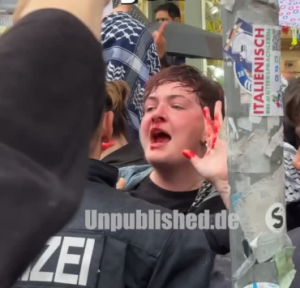 Nowhere is Germany’s enforcement of its über-Zionist Staatsräson more visible than on the streets of the capital Berlin, home to the largest Palestinian community in Europe, where the city-state’s police have gained unparalleled notoriety for their brutal crackdowns on pro-Palestine protests.
Every other day, deeply disturbing video footage of aggressive officers in riot gear manhandling peaceful anti-genocide protesters with a reckless abandon that only a culture of impunity can embolden is posted to social media by those who are meticulously documenting Germany’s post-October 7 free-fall from a minimum-standard democracy to a quasi police state.
In yet another scandalous escalation of Berlin’s thuggish state brutality against pro-Palestine protesters, shocking social media footage shows police beating an Irish activist bloody at a civil disobedience action on August 28 against “Israel’s” deliberate killings of Palestinian journalists.
Far from ensuring public order and safety, as should be policing’s purpose in any civilised country, Berlin’s badge-wearing goon squads violently arrest non-violent people of conscience, be they men, women, children, or disabled, simply for exercising their right to freedom of speech.
The police’s confrontative combat gear, which includes weighted-knuckle gloves, is indicative of their violent mandate and penchant for hooliganism. Prohibited in some jurisdictions and classified as dangerous weapons, the gloves used by Berlin police are filled with quartz sand and can inflict severe injuries.
In a recent aggravated battery case involving an individual who used this type of glove to beat his victim, Germany’s highest appellate court ruled that twenty blows with weighted-knuckle gloves are indicative of attempted murder, reports the news website Legal Tribune Online.
Lawless law-enforcement
Despite Germany’s Staatsräson being a political philosophy with no legal responsibilities arising from it, Berlin police continue to interpret it as the law of the land in their nihilistic and racist fight to crush public opposition to “Israel’s” German-backed annihilation of the Palestinian people.
The German insanity of treating the traditional liberation slogan “From the river to the sea, Palestine will be free” as antisemitic hate speech or even as a trademarked symbol of the Palestinian Islamic Resistance Movement, Hamas, which is proscribed as a terrorist organisation in Germany, is a case in point.
Despite numerous court rulings that say it is not a criminal offence to express these words in speech and writing, police in Berlin continue to arrest people who do so.
Two instances illustrate just how far post-October 7 policing has gone from enforcing laws to breaking them and even making them up, thus violating the separation of powers that distinguishes democracies from autocracies in the state’s attempts to criminalise anti-Zionism.
On July 30, prominent human rights defender Yasmin Acar was acquitted by a Berlin court for using the slogan “From the river to the sea.” The presiding judge even praised Acar’s political activism as “highly esteemed.”
This did not stop police from arresting supporters who had gathered in front of the courthouse for chanting the exact same slogan.
This absurdity is not accidental. Unfazed by the court’s ruling, the Berliner Polizei doubled down in a widely condemned public service announcement posted on X ten days later, implying that they would not obey the law in the context of Palestine solidarity.
“The slogan ‘From the river to the sea’ is deemed a criminal offence by Berlin’s public prosecutor’s office. Please refrain from this expression. We are obligated to prosecute crimes and take appropriate police-related measures,” the statement read.
In functioning democracies, prosecutors are supposed to make decisions based on legal standards, not act as self-appointed law-makers. But Germany is no functioning democracy anymore: Fanatic adherence to “Israel”, even as it perpetrates a colonial genocide which knows no red lines other than the gleefully spilled blood of native Palestinians, has seen Germany swiftly regress toward its authoritarian ways of yore.
As for Berlin’s uniformed street-brawlers who make up the lowest echelons of the police hierarchy and are thuggishly enforcing the red herring of “Israeli security” at Palestine liberation protests while “Israel” wipes Palestinians off the face of Gaza’s once fertile earth, their gross misconduct shows just how far the already oppressive institution of policing has gone rogue, its behaviour more apropos of a criminal organisation than of a law-enforcement agency.
In light of this post-October 7 hyper-metamorphosis, the “Ganz Berlin hasst die Polizei!” (All of Berlin hates the police) chants protesters strike up whenever another one of theirs is brutalised by Staatsräson’s cowardly foot soldiers, have become the relatable soundtrack of resistance to German complicity in “Israel’s” genocide in Gaza and to the reawakening of fascist muscle memory at home.
Russian Ambassador Slams U.S. & Europe Over Iran Sanctions at UN
Russia confirms circulating draft proposal aimed at preventing activation of ‘snapback’
Press TV – August 27, 2025
Russia has confirmed circulating a draft proposal at the UN Security Council aimed at averting activation of the so-called “snapback” mechanism that would restore the council’s sanctions against Iran.
The country’s First Deputy Permanent Representative to the United Nations, Dmitry Polyanski made the remarks to reporters during a press conference on Tuesday.
“It (the proposal) is about extending Resolution 2231,” he said.
The resolution’s expected expiration in October would lead to reinstatement of the coercive measures.
The European trio of the UK, France, and Germany – the United States allies in a 2015 nuclear deal between Iran and world countries – has been trying hard to have the measures restored.
Polyanski, however, insisted, “Russia and China want to give more breathing space for diplomacy and provide some possibilities for an active quest for a diplomatic solution to this issue.”
He said Moscow and Beijing were doing so in their capacity as “as responsible members of the Joint Comprehensive Plan of Action (JCPOA), the nuclear deal’s official name. … Full article
European economies and societies are broken
By Sonja van den Ende | Strategic Culture Foundation | August 28, 2025
In recent days, one alarming report after another has emerged about the European economies. The political elites and their mouthpieces, the mainstream media, can no longer ignore it. Things are not going well—and that is putting it mildly. The situation is bad and will get worse. This is something some of us had anticipated for quite some time, and alert economists have been saying and warning about.
Let’s start with one of the richest countries in Europe: the Netherlands. Although small in size, the wealth enjoyed by elites and, to some extent, citizens some twenty years ago was enormous. I would even venture to say that, in some respects, the Netherlands was richer than Switzerland.
But due to many factors—bad politics, and the emergence of countries like China and, to a certain extent, India and Russia, whose economies have become stronger and their citizens richer—the Netherlands is now on the verge of collapse, like almost all wealthy EU countries, or rather, Western countries.
Dutch politics has been unstable for years. There are simply too many parties, too many opinions, and too much division. While the older, established parties remain strong in terms of seat count, they cannot truly govern. Moreover, there is the “manufactured” housing crisis caused by the insane nitrogen policy, the refugee crisis that causes daily street violence and the murder of women and children, and then there are the agendas of the WEF and the UN that have to be pushed through due to the advancing artificial intelligence (AI) frenzy. It is a cocktail of unrest and division. Also, let us not forget the increasing criminality of the Moroccan mafia: the underworld has now penetrated into the upper world.
The new elections (the last one was in 2023) and the government, which did not take office until 2024, have been ineffective. The population is being misled and distracted by the supposed war Russia is planning to start. So, parties like the established Christian Democratic Appeal (CDA) are devising new plans. This party, which is well in the lead, wants to introduce a “freedom tax” to increase the defense budget so they can wage “war” or defend themselves against the greatest threat: Russia.
Then we come to the worst, “sickest” kid in the class: Germany. The welfare state is “no longer financially viable,” said German Chancellor Friedrich Merz, a BlackRock man, in recent interviews. Of course, it is no longer financially viable—one does not have to be an economic whiz kid to see that, with so many migrants contributing little to nothing but receiving money from the state.
The country has been slowly spiraling toward the abyss since 2015, a process that can no longer be stopped; politicians and elites do not want to stop it. They talk a lot but essentially do nothing. The famous German car industry is ruined, the chemical industry is ruined, and with it, many suppliers.
The most foolish thing Germany could do economically was to stop buying Russian gas. Now they have a major problem: like the rest of Europe, they have to buy expensive LNG from the U.S. The costs are skyrocketing, to put it mildly.
Recently, after all the government’s lies and manipulation, the truth about how Germany, or rather its citizens, should survive the winter came to light. Many gas storage facilities in Germany are currently significantly emptier than in previous years. The Greens, who want to gradually phase out gas, are warning in the Bundestag about the consequences of a cold winter. The Greens’ policies have effectively ruined Germany, with incompetent politicians like Annalena Baerbock and Robert Habeck. Both have resigned and emigrated abroad, leaving behind a political and economic disaster in Germany.
That other major country in Europe, France, with a president (Macron) who thinks that France is still a great power like it was in the time of the Sun King—Louis XIV or Napoleon—is doing just as badly. According to media reports there, the economy is also struggling. At the end of the first quarter of 2025, French public debt stood at €3,345.4 billion, or 113.9% of GDP.
That the French are arrogant (not all of them, of course) is a well-known fact in Europe and perhaps beyond. But Macron is taking it too far. In a recent interview, Macron called Russian President Vladimir Putin a “predator, a monster at our gates.”
This comes after the disgusting display in Paris at the Olympic Games (in 2024), where satanic rituals mixed with religion were on display, which many countries and citizens expressed their horror about. Now he has the arrogance to make these public statements. If you thought Zelensky was stupid with his statements, Macron is his equal in this.
The countries I mentioned are, or rather were, the “running economic engines” of the EU, the economic heart of Europe, which actually paid for the poorer countries in the south, such as Italy, Spain, Portugal, and especially Greece, a country that went bankrupt in 2008.
Europeans all witnessed the misery in Greece: pensioners eating from garbage bins, entire shopping streets closed, poverty everywhere. Now we see it happening in the heart of the EU economy. Germany has become almost unlivable, especially in the major cities.
The same street scene: retirees who should actually be enjoying a well-earned rest collect plastic bottles for the deposit money, and now, if the government has its way, they will have to do a year of compulsory military service. Imagine this—you just do not want to imagine it…
Europe has lost its prosperity; its culture is being swallowed up by the many migrants who bring their own, and instead of assimilation, these cultures foreign to Europe now predominate. In their foolish attitude and, above all, the indoctrination of many years, politicians now believe they live in a “multicultural” entity. But this is not the case; integration has failed, and European citizens are paying the price for their inaction and for allowing this situation to escalate.
Politicians across Europe, especially in the Western EU countries I mentioned, are seeking a way out—to save their own skins, not so much for their people (in fact, the majority do not care about the people)—but to escape the financial malaise and the people’s anger. They have now resorted to the war agenda that followed the COVID-19 agenda (partly a social behavioral project), the war agenda that was implemented immediately after the launch of the Russian Special Military Operation (SMO).
The Eastern EU countries—Poland, which is currently experiencing the same problems as the Western EU countries: refugees and increased drug use—are the worst when it comes to Russophobia. I am referring specifically to the Baltic States: small but powerful in hatred, and above all, the countries with the most Nazi and fascist supporters. Nazism has never been eradicated there, just like in Western Ukraine.
With this hatred of Russia, they have infected all of Europe, thus playing into the hands of the political elites of Western Europe, who eagerly participate in demonizing Russians—even though some countries and their populations actually have nothing against Russians and have only now been forced by their governments to think, and even worse, hate, about Russia.
The European elites must now also consider the role they will play, now that it is painfully clear that the era of colonization and imperialism is nearly over. Because of this painful geopolitical and economic truth, they are now oppressing their own people, partly succeeding with the “new migrants” who fear for their residency and visas.
But the true indigenous European population is slowly but surely realizing that freedom of speech and press no longer exists, that their democratic rights have been taken away, and that life has become very difficult. This is leading to major conflicts, especially in the once so “free” Netherlands, where people could essentially say anything, even if it was inappropriate. Very turbulent times are ahead, and unfortunately, we are already seeing Europe collapse… just like the Roman Empire when it collapsed; things can happen quickly.
Iran’s foreign minister: Entry of IAEA inspectors does not signal full cooperation

Abbas Araghchi, Iran’s foreign minister
Press TV – August 27, 2025
Iran’s foreign minister has confirmed the arrival of inspectors from the International Atomic Energy Agency (IAEA) following a months-long hiatus.
Abbas Araghchi, however, said their presence does not mean the resumption of full cooperation with the UN nuclear watchdog.
Speaking to reporters in Tehran on Wednesday, the foreign minister said the entry was authorized by Iran’s Supreme National Security Council (SNSC) and limited to overseeing the fuel replacement process at the Bushehr Nuclear Power Plant.
He said under a recent parliamentary law, all cooperation with the IAEA must be approved by the SNSC.
“No text has yet received final approval,” he added, referring to ongoing discussions about a new cooperation modality following the acts of aggression by the Israeli regime and the United States in June.
Iran has barred any new inspections since the attacks, citing safety concerns at damaged nuclear sites and criticizing the IAEA’s failure to condemn the strikes.
Earlier, Behrouz Kamalvandi, spokesman for the Atomic Energy Organization of Iran (AEOI), said the inspectors’ presence was tied to routine operations at the Bushehr facility and the need to maintain electricity supply to the national grid.
On August 26, IAEA Director General Rafael Grossi announced that inspectors were “back in Iran.”
In an interview with Fox News, Grossi said, “When it comes to Iran, as you know, there are many facilities. Some were attacked, some were not.”
“So we are discussing what kind of … practical modalities can be implemented to facilitate the restart of our work there.”
The developments come amid renewed diplomatic tensions, as Iran held talks in Geneva with Britain, France, and Germany over their threat to trigger the so-called snapback mechanism, a provision of the 2015 nuclear deal that would restore UN sanctions lifted under the accord.
European signatories to the Joint Comprehensive Plan of Action (JCPOA) have said they will wait until August 31 to decide whether to activate the mechanism.
Iran has reduced its cooperation with the IAEA in recent years in response to the withdrawal of the United States from the 2015 nuclear deal and the failure of Europeans to make up for the withdrawal.
Cut welfare, give billions to Ukraine, suppress opposition: The German leader’s checklist to success
By Tarik Cyril Amar | RT | August 27, 2025
German chancellor Friedrich Merz has made a moderate media splash and ruffled some feathers in his own ruling coalition with the Centrist Social Democrats (SPD). Using the platform of a regional party congress of his CDU Conservatives in Niedersachsen, Merz has delivered a speech that immediately attracted national attention and will be remembered for one phrase.
“The social [welfare] state, as we have it today,” the chancellor declared with appropriately dour mien, “can no longer be financed by what we are achieving economically.” Put differently, severe budget cuts on social issues are coming. And since that is a policy operative since, at the latest, 2003, there really isn’t so much left to cut. Merz is promising his people more of a bad time.
His people. Not, however, the ultra-corrupt political anti-elite of Ukraine. Just before Merz’s claim that Germany cannot afford what it used to offer to Germans who pay for it, his government promised €9 billion ($10.4 bn) per year for Ukraine in 2025 and 2026, for now. That is on top of the €44 billion already sent that way. Germany is the “second-largest backer” of the Kiev regime in the world, as its obviously thoroughly detached finance minister Lars Klingbeil emphasizes with a perverse pride that must sound like a bad joke to many of his compatriots.
Speaking of Klingbeil, in his Niedersachsen speech Merz also announced that he would “deliberately not make it easy” for his government colleagues from the SPD, who include, of course, Klingbeil. The SPD, of course, is well-known for being against harsh reductions in what Germans can expect from, in essence, old-age pensions, public health care, and the basic form of unemployment insurance now known as “Bürgergeld” (literally, “citizens’ money”).
There is no reason to underestimate Merz’s genuine ideological commitment. It is true that, in general, he is unusually brutal about being dishonest even for a politician: Germany’s current leader has already proven that he is capable of breathtaking flipflops, staggering electoral bad faith, and underhanded maneuvering that violates the spirit of democracy if not the letter of the constitution.
In the spring, his U-turn on public debt, to finance Germany’s new militarism on – exuberant – credit, was not only a massive breach of trust regarding especially his own conservative voters. Shamelessly exploiting a legal loophole, Merz also executed this radical reversal – many in his own party called it betrayal – by relying on parliamentary majorities that had already been cancelled by an election.
Likewise, Merz’s coalition then proceeded to break promises regarding an energy tax relief as well as benefits for mothers. Germans are angry, but there is no sign that Merz and his government care. Consequently, according to a fresh poll by the reputable INSA institute, 62 percent of Germans are dissatisfied with their government.
And yet, there is a hard core of authentic Merz, shaped by his own wealth, a very privileged life without material worries, and his long career as an overpaid member of the supervisory-board network nobility, at BlackRock and elsewhere: if there is one thing Germany’s leader is sincere about, it is his iron will to make the less well-off bleed more and work even harder, while making sure that those as materially comfortable and safe as himself get even richer. Call it neoliberalism with an unsmiling German face.
Merz, of course, is also a very ordinary man, incapable of much self-reflection. He cannot honestly face any of the above. Instead he misunderstands himself as a savior of the fatherland, which he sees in need of much tough love and plenty of wholesome kicks up the backside to rediscover discipline, hard work, and competitiveness.
The upshot of Merz’s blatant upper-class bias is, as a perspicacious German observer has put it, a de facto escalation of the ongoing re-distribution of income, wealth, and life chances – from those below to those above. Even now, 80 percent of the country’s taxes stem from income and value-added taxation. In other words: you work, you eat and keep a family going – be proud, you are also doing by far the most to pay the country’s bills. But Friedrich Merz, a millionaire who falls under “silver-spoon” rather than “self-made,” thinks it’s not yet enough.
No wonder, then, that Merz’s recent speech in Niedersachsen has resonated. It was delivered in a sour as well as emphatic tone perhaps best described as schoolmasterly belligerence and featured much gratuitous no-compromise posing addressed probably more to his own doubting party and voters then his SPD coalition partners in Berlin. If Merz’s intention was to achieve a minor shock effect after Germany’s political summer break, he’s scored an ephemeral success.
But his speech has also been misunderstood. In reality, its key message was something else and even worse. Yet another “business-friendly” – and business has also been very friendly to him – instinctive Western austeritarian telling his people they are having it too good and must lower their expectations? Not really news, is it?
What was much more interesting was Merz’s reasoning. In his own words, the central political challenge is to prove that Germany “can be governed successfully from the center.” Or to be concrete, to keep down and out of power Germany’s two “populist” insurgent parties: from the right the very successful Alternative for Germany party (AfD), which tends to lead German opinion polls now, and, from the left, the currently marginalized – probably by foul play in the manner of, say, Romania or Moldova – but still threatening Bündnis Sarah Wagenknecht (BSW).
Merz’s threat to go after what is left of the social welfare state in Germany comes with a promise of “reforms,” indeed a whole “autumn of reforms.” The purpose of this planned political offensive is clear: to persuade voters that they need not rely on those terrible “populists” to finally break out of the German doom loop of economic decline, demographic crisis, and pervasive malaise.
Yet Merz’s strategy of what Germans call a “Befreiungsschlag” (a “deliverance strike”) smells of despair and is unlikely to succeed. Instead of an “autumn of reforms,” Germans are more likely to see their Winter of Discontent get even grimmer.
Consider some basic data: We have just learned that Germany’s recession in the last quarter has been even worse than predicted: -0.3 instead of -0.1 percent. German industry is shedding jobs by the hundreds of thousands. In general, Germany’s economy remains heavily dependent on exports. It has stagnated for half a decade already and been in serious trouble much longer. In the EU+Britain, it is the most brutally affected by Trump’s ongoing and still escalating tariff war against Washington’s vassals. Klingbeil admits that the budget will be €170 billion short by 2029 – despite dialing debt up to eleven.
And all of that when the German ruling coalition only has what the Financial Times rightly calls a “razor-thin” parliamentary majority. Add that two of the most damaging strikes against the German economy have been self-inflicted: Sky-high energy prices, the direct result of shutting Germany off from (direct) Russian supplies – with the alleged help of a few Ukrainian divers and their US friends, of course – and subservience to the US.
That subservience has only grown worse under both Merz and his equally hapless predecessor Olaf Scholz. Both have been bending over backward to please and appease America, just when its policies have become even more brutal: We are at a moment in “atlanticism” when a US treasury secretary openly announces that Washington sees its allies’ economies as its very own “sovereign wealth fund” at the disposal not of their governments or – perish the thought – citizens, but of the US president. And Merz and co. grin and nod and ask for more.
The irony of it all is that while slavishly compliant with the US, Merz cannot learn the single biggest, most obvious lesson of its very recent political history, although it quite literally stares him in the face every time he visits the Oval Office to grovel: Donald Trump has become president against enormous resistance not once but twice because he led a “populist” challenge against a rotten establishment that Americans saw as unpatriotic.
The future of Merz is not the success of Trump but the defeat and disgrace of Biden and everything he stood for. Germans, too, will demand a government that looks after German interests before it makes even more demands of them. Grotesquely, Merz thinks he is the savior of the old German establishment. He is its gravedigger. And in that sense, all power to his misguided arm!
Tarik Cyril Amar, a historian from Germany working at Koç University, Istanbul, on Russia, Ukraine, and Eastern Europe, the history of World War II, the cultural Cold War, and the politics of memory
Germany Has More Information on Nord Stream Blasts Than Revealed – Russia’s UN Mission
Sputnik – 27.08.2025
Germany has more information on the explosions of the Nord Stream gas pipelines than it reveals, Russian Deputy Permanent Representative Dmitry Polyansky said on Tuesday.
“German authorities clearly do have much more information about what happened, much more than the information that they have been giving to the media in small doses,” Polyansky stated.
Russia calls on German authorities “not to try and cover up the truth, but to demonstrate genuine cooperation and to provide the information in full,” the diplomat added.
“We believe that the situation around Nord Stream sabotage is very important. It is developing in a wrong way,” Polyanskiy said at the UN Security Council stakeout area.
Russia is being “kept in the dark” on the Nord Stream sabotage investigation and on the latest arrest of a suspect, he added.
Russia considers the version that amateur divers exploded the pipelines ” questionable,” the deputy envoy said.
Polyansky has warned that inaction sends signals and instructions to terrorists worldwide, prompting the repetition of such infrastructure attacks.
Last week, Italian carabinieri arrested a 49-year-old Ukrainian national on suspicion of leading a sabotage group that bombed the Nord Stream gas pipeline in the Baltic Sea. The suspect was arrested at Germany’s request after coming to Italy on vacation with his family.
Featured Video

Russia Helping Build a New Middle East /Trita Parsi
or go to
Aletho News Archives – Video-Images
From the Archives
Sam Husseini: The entire US establishment helped lie their way into the Iraq war
By Slava Zilber | American Herald Tribune | October 14, 2019
Sam Husseini is a senior analyst with the Institute for Public Accuracy, independent journalist and contributor to The Nation and FAIR.
Slava Zilber: Sam, three years ago, you appeared on Talk Nation Radio with David Swanson and spoke about the case of the GCHQ whistleblower Katharine Gun. You pointed out that the people involved in the spying on the UN and the people authorizing the Iraq War were not held accountable:
“Virtually everybody who went along with the war, whether it is Kerry or Clinton, of course, the Bush administration themselves has falsified their own records in terms of why, what they did, when they did, why they did it, to the extent that they’ve been scrutinised at all.”
You also address it in a recent article. And recently, Joe Biden has been lying about his position on the Iraq War. How can such an important issue escape meaningful scrutiny? … continue
Blog Roll
 Aletho News
- Russia Helping Build a New Middle East /Trita Parsi
- Barghouti: ‘Netanyahu has fallen,’ era of Smotrich, Ben-Gvir over
- China slams US policy on Iran as Russia rejects legality of nuclear meeting at UN
- The Mecca Pact Courts Iran: Containment Comes Full Circle
- Oman FM: Persian Gulf states, Iran, Iraq should form security pact excluding US
- Trump peddles fresh falsehoods, claims Iran ‘started the war’ as US aggression drags on
- Ukraine quagmire? Yes, but it’s for NATO, not Russia
- US intelligence hypes Chinese, Russian space threats while accelerating its own military buildup in orbit
- Iran FM Araghchi: “Hormuz Will No Longer Be the Same”
- EU facing trillion-euro debt hole while seeking more cash for Kiev
- If Americans Knew
- An error has occurred; the feed is probably down. Try again later.
- No Tricks Zone
- Sudden Stratospheric Warming, Powerful El Niño Combination May Lead To Extreme Europe Cold, Energy Crisis!
- Two New Studies Find Thwaites Glacier Melt Cannot Be Driven By Human Activity Or A Warming Ocean
- E-Cars Reduce CO2 Emissions By Only 41% Compared To Internal Combustion Engine Vehicles
- Predictions Made By Renowned Climate Professor Over Past Decades Have Been Proven To Be Poor
- New Study Suggests Large Regions Of The Pacific Ocean Have Been Cooling For The Last 80 Years
- Germany’s Green Energy Debacle: High Energy Costs Force Kahla Porzellan to Close After 182 Years!
- New Study: 50 Years Of The Most Aggressive ‘Net Zero’ Policies Can Only Affect The Global Climate By 0.03°C
- US September “Heat” Was No Record…Many Records Set Decades Ago
- Latest European Green Energy Debacle; Portugal’s Largest Flagship Solar Park Insolvent!
- Green Energy Debacle: German Expert Professor Fritz Vahrenholt Warns Of Severe Economic And Social Consequences

