The Crusades – colliding narratives
Ashes of Pompeii | June 13, 2026
They say history is written by the victors, but the Crusades offer an interesting historical contrast: a two-century collision that produced not one history, but two parallel, irreconcilable realities. The dates and the battles are identical in both accounts, but the moral axis is entirely flipped.
In the traditional Western narrative, the Crusades are framed as a heroic, if tragic, epic. The First Crusade is a pious pilgrimage; the knights are romanticized figures of chivalry in shining armor, bravely holding the line in a hostile, exotic land. The eventual loss of the Holy Land is mourned as the “fall of Outremer,” a tragic retreat of European civilization. In this telling, the East is often reduced to a passive backdrop, its inhabitants viewed through a lens of mystique or backwardness, mere obstacles to a divine mandate.
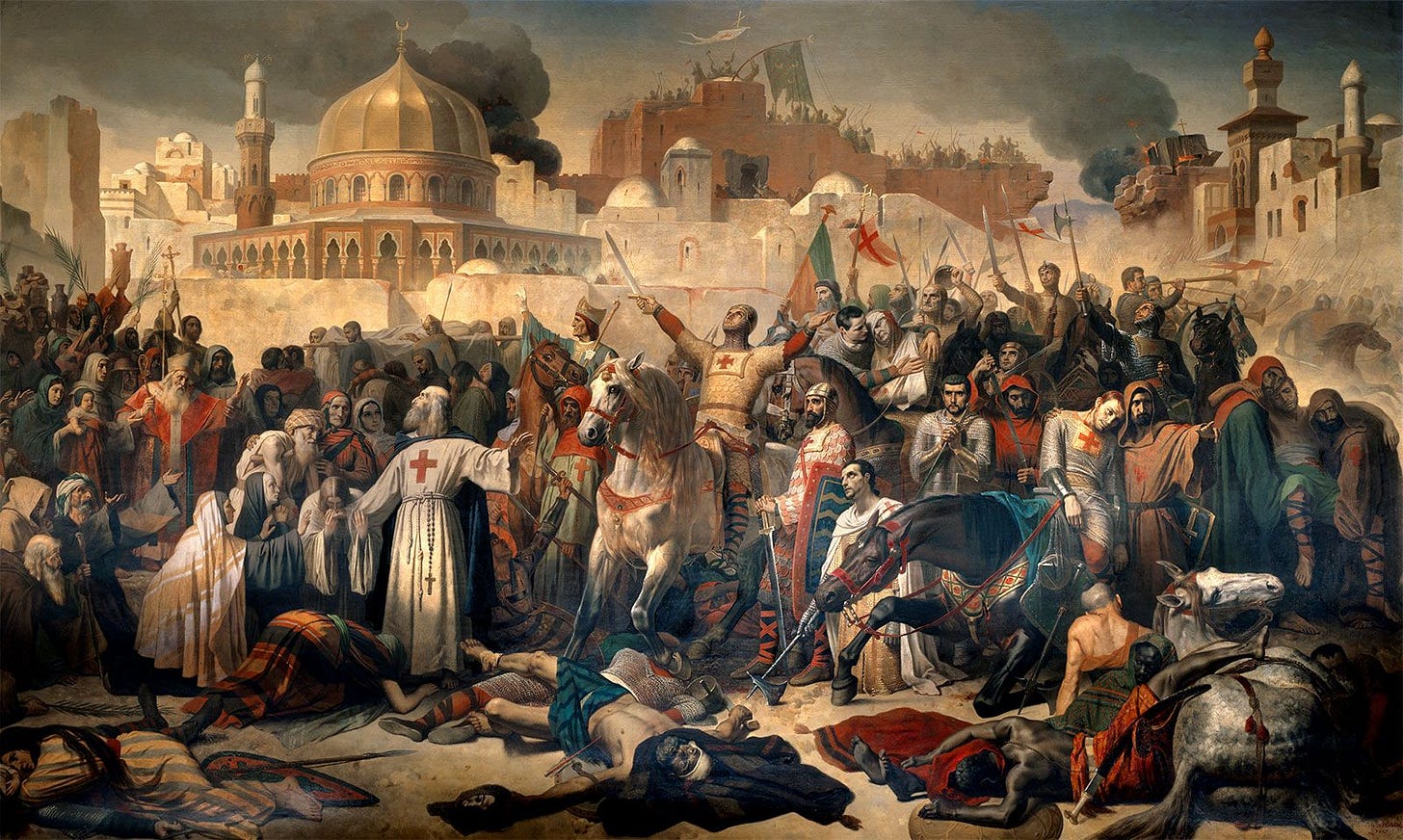
But cross the Mediterranean, and the exact same timeline reads like a chronicle of foreign invasion and eventual, hard-won restoration against the barbarous northerners. The dates do not change, but the adjectives do. Here is the history as it is remembered in the Levant:
When the Frankish armies breached Jerusalem in 1099, they imposed a martial culture utterly alien to the region. Accustomed to northern forests, the crusaders relied on heavy wool, salted provisions, and isolated stone keeps. To the local Muslim inhabitants, this was a stark contrast to a society built around sun-washed courtyards, communal public baths, and markets vibrant with fresh flatbreads, olives, and citrus. The invaders carved out the fragile states of Outremer, but beneath their rule, the region’s sophisticated urban rhythms, complete with organized hospitals and regulated water systems, quietly endured.
For much of the twelfth century, an uneasy coexistence defined the borderlands. The crusader hold was always tenuous, a reality first exposed in 1144 when Imad ad-Din Zengi reclaimed the County of Edessa, shattering the myth of Frankish invincibility. In the decades that followed, daily life became a complex tapestry of friction and exchange. Frankish knights governed from damp, drafty fortresses, yet they increasingly depended on local markets for sugar, glass, and silk. Truces allowed merchants to cross lines, but the cultural divide remained visible: while the crusader elite often struggled with Levantine heat and basic sanitation, local communities maintained their traditions of regular ablutions, scholarly study in madrasas, and shared, herb-rich meals.
The political tide turned decisively in 1187. At the Horns of Hattin, the fragmented crusader armies were outmaneuvered, leading to Salah ad-Din’s recapture of Jerusalem. For the local population, this was not merely a military victory, but a restoration of civic order. Mosques and “bimaristans” (hospitals) reopened, and the region’s administrative heartbeat resumed. Though the Third Crusade saw Richard the Lionheart besiege Acre, he could not retake the holy city. The ensuing century of negotiated truces only highlighted the resilience of local society, which continued to thrive on its established foundations of public hygiene and civic welfare.
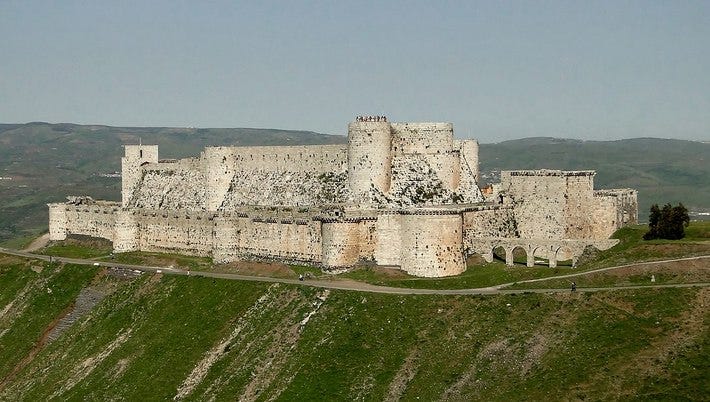
By the mid-thirteenth century, the crusader presence was a relic waiting to be cleared. After the newly established Mamluk dynasty halted the Mongol advance at Ain Jalut in 1260, securing the region’s eastern flank, they turned their disciplined, centralized power toward the coastline. Sultan Baybars initiated a systematic dismantling of the crusader strongholds. Antioch fell in 1268, and the formidable fortress of Krak des Chevaliers surrendered in 1271. The contrast was laid bare: as crusader outposts decayed into isolated, supply-starved enclaves, Mamluk cities flourished, repairing irrigation canals and expanding vibrant, clean urban centers.
The end came methodically. In 1291, Mamluk forces besieged and captured Acre, the last major crusader capital, driving the remaining defenders into the sea. A final, tiny garrison clinging to the island of Arwad was swept away by the Mamluk navy in 1302, erasing the last physical foothold of the crusades.
The crusaders left behind crumbling, hollow castles, silent monuments to a foreign experiment. Yet, the echoes of that era have never truly faded. Today, the very same soil remains a stage for competing historical claims, where distant powers still invoke ancient rights and civilizational mandates to justify their presence.
In the West, 1291 is often romanticized as a tragedy of lost glory, recounted in medieval verse and modern films. But in the Levant, it is simply the day the northern barbarians were finally vanquished. For those who still walk these sun-washed streets, it remains a timeless cautionary tale of foreign invaders, resiliance and ultimate redemption.
Sorry, the comment form is closed at this time.
Featured Video

Seyed M. Marandi: US-Iran War Inevitable: Kuwait and Bahrain May Fall
or go to
Aletho News Archives – Video-Images
From the Archives
Oil and the Israel Lobby
Reknowned economist M. Shahid Alam offers this excellent critique of Noam Chomsky’s defective analysis of the relative influence of Oil versus the Israel lobby over US foreign policy: … continue
Blog Roll
 Aletho News
- ICC ignored ‘very well-documented’ NATO crimes – ex-Libyan minister
- SNSC secretary dismisses US response to Iran’s conditions as ‘inadequate’
- Sanaa says Taiz roads open, secure for residents, warns Saudi forces
- Iraqi resistance group urges Saudi leadership to admit defeat, lift Yemen siege
- Trump’s Retreat: How Al-Aqsa Flood Took Down the US Empire
- Israel’s Military Actions in Lebanon Grossly Violate International Law — Lavrov
- Seyed M. Marandi: US-Iran War Inevitable: Kuwait and Bahrain May Fall
- Leaders Condemn Ansarallah Attack on Saudi Arabia While Ignoring Illegal War Against Yemen
- Leaked: Britain’s Covert Iraqi Psyops Network
- Yemeni Armed Forces Warn Airlines Against Using Saudi Airports, Exempt Mecca and Medina
- If Americans Knew
- Gaza’s buildings are collapsing on top of us. But there’s nowhere else to shelter
- Israel kills four-year-old Gaza child – Daily Update
- After Oct 7, IDF policy allowed civilian casualties for even the lowest-ranking targets
- Israel’s Destruction of Southern Lebanon Intensified After the Cease-Fire
- The Last-Minute Decision That Gave Israel Its Name
- The American Conservative: How Trump Made the World Go Nuclear
- Meet the US generals and admirals advancing Israeli policy
- Opinion: Why news organizations should boycott Israel
- The Israeli witch hunt of Sami Abu Shehadeh exposes the lie of the ‘Jewish and democratic’ state
- No state has a ‘right’ to exist – least of all Israel
- No Tricks Zone
- New Study Suggests Large Regions Of The Pacific Ocean Have Been Cooling For The Last 80 Years
- Germany’s Green Energy Debacle: High Energy Costs Force Kahla Porzellan to Close After 182 Years!
- New Study: 50 Years Of The Most Aggressive ‘Net Zero’ Policies Can Only Affect The Global Climate By 0.03°C
- US September “Heat” Was No Record…Many Records Set Decades Ago
- Latest European Green Energy Debacle; Portugal’s Largest Flagship Solar Park Insolvent!
- Green Energy Debacle: German Expert Professor Fritz Vahrenholt Warns Of Severe Economic And Social Consequences
- Two More Paleo Reconstructions Affirm Meters-Higher Sea Levels Across Ireland, Brazil 7000-6000 Years Ago
- New Study: Earth And Venus Surface Warmth Largely Explained By Convection And Lapse Rate, Not CO2 Or Radiation
- 2025 Nature Paper Claiming Worsening Global Drought Gets RETRACTED …Heavily Flawed
- New Study: ‘Global Drought Shows No Detectable Recent Acceleration Under Climate Warming’

