The Caspian Sea: America’s New Eurasian Containment Arena
By Salman Rafi Sheikh – New Eastern Outlook – August 13, 2026
The Caspian Sea — for thirty years a backwater of great-power politics — has quietly become a battlespace, and most of the world is still treating it as a footnote.
In late July, Iranian officials confirmed that a US strike had damaged the Islamic Revolutionary Guard Corps’ Seyyed al-Shuhada naval facility in Zibakenar, in Iran’s Caspian province of Gilan — the first time in the current war that Washington has reached into Iran’s Caspian coastline. Days earlier, Ukrainian President Volodymyr Zelensky announced that Kyiv’s drones had struck several vessels in the Caspian more than 1,000 kilometers from Ukrainian-held territory, including a ship reportedly ferrying military cargo from Iran toward Russia. Iran, however, said one of the vessels hit was carrying iron ore from Astrakhan to the Iranian port of Anzali and summoned Ukraine’s chargé d’affaires in protest.
Neither strike, on its own, would rewrite anyone’s map. Together, they are a signal. For the first time, the US and US-backed Ukraine have demonstrated that they have the will and the reach to hit targets on a sea that geography, more than strategy, had long kept insulated from direct confrontation. The Caspian’s basin states — Russia, Iran, Kazakhstan, Turkmenistan and Azerbaijan — built an entire diplomatic architecture, including a 2018 legal convention on the sea’s status, around the premise that outside militaries would stay out. That premise no longer holds.
What is emerging is not a contest for territory in the traditional sense. It is a contest over connectivity: over the ports, rail lines, pipelines, and shipping lanes that allow Russia, Iran, and, at one remove, China to function as an integrated economic and strategic space rather than three isolated, sanctioned, or otherwise constrained powers. Call it America’s New Eurasian Containment: a strategy that treats infrastructure, not territory, as the terrain worth contesting.
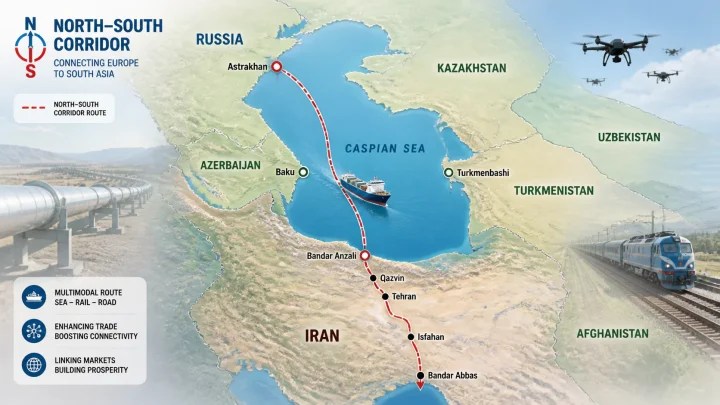
Severing the Connective Tissue
The clearest evidence of this shift sits not on the Caspian’s water but on its shores, in two projects Washington has spent the past year reshaping.
The first is the International North-South Transport Corridor, a roughly 7,200-kilometer multimodal freight route agreed upon by Russia, Iran, and India in 2000 that links the Indian Ocean, through Iran, across the Caspian, to Russian rail networks and on to Europe. Long stalled by under-investment, the corridor has become a priority for Moscow since 2022, precisely because it offers a way around Western sanctions. Its central artery is the Caspian crossing between the Iranian port of Bandar-e Anzali and the Russian port of Astrakhan. More importantly, it is the same stretch of water where Ukrainian drones struck in July and where Israeli forces had already hit Iranian naval and port assets at Anzali back in March, according to regional shipping trackers. A degraded, contested Caspian corridor is a direct blow to the one overland route that lets Moscow and Tehran trade around US and European sanctions. These attacks are, therefore, not about the US war on Iran; they are about reshaping the very geography of trade passing through the Eurasian landscape.
The second is the Trump Route for International Peace and Prosperity, or TRIPP — the transit corridor Washington brokered in August 2025 between Armenia and Azerbaijan, granting a US-led consortium a 99-year lease to build and manage rail, energy, and fiber-optic links through Armenia’s Syunik province. The deal ended a decades-old territorial dispute, but its geopolitical function is narrower and sharper. It places Iran’s only land border with Armenia under American-supervised transit control, cutting off Tehran’s most direct overland access into the South Caucasus and, by extension, into a region Russia has treated as its own backyard since the Soviet collapse. Whatever the deal’s stated humanitarian purpose, it functions as a wedge driven into Eurasian connective tissue.
Neither project was designed with the other in mind. But together with the Caspian strikes, they describe a single logic: deny Russia and Iran the infrastructure that lets their January 2025 Comprehensive Strategic Partnership — a 20-year treaty covering defense, energy, finance, and counterterrorism cooperation — translate into real economic integration rather than a document signed in Moscow. China, meanwhile, watches from the margins. Beijing has no naval presence on the Caspian and is not a party to any of these strikes or corridors, but its own westward trade ambitions run through the same chokepoints, i.e., the Middle Corridor via the South Caucasus, and Iranian ports as a Belt and Road terminus. A Washington-controlled TRIPP and a contested Caspian complicate China’s overland options as a side effect, even if Beijing was never the intended target.
A Frontier Without a Front Line
The danger in this strategy is precisely that it has no clean edges. Containment during the Cold War had defined lines — the Fulda Gap, the Elbe, the 38th parallel — and a doctrine that most parties understood. Infrastructure containment has none of that. A drone strike on a cargo ship, an airstrike on a naval depot, and a 99-year land lease branded with a president’s name: each is individually deniable, incremental, and justifiable in its own narrow terms, even as the cumulative effect reshapes the strategic map of an entire region. That ambiguity is a feature for Washington, which can advance the strategy without ever declaring it. But it is also a source of volatility because affected countries are left to infer intent from actions rather than respond to a stated policy. And, inferences, in a region this armed and this aggrieved, tend toward worst-case assumptions.
The more durable question is what happens once the corridors themselves become targets, not just prizes. Pipelines, rail lines, and undersea cables may now be legitimate objects of great-power coercion. If so, the Caspian will not be the last “peripheral” space pulled into contested geography. The Arctic shipping lanes, the Malacca chokepoint, and the fibre-optic seabed of the Indian Ocean are all candidates for the same treatment. In this environment, the states that thrive will not be the ones with the largest militaries. They will be the ones that make their infrastructure redundant, diversified, and defensible: multiple routes, multiple partners, no single artery whose loss is fatal. Iran and Russia have bet heavily on a small number of chokepoints. Their partnership may keep deepening going forward. But the deeper it goes, the more attacks it will face and endure.
Salman Rafi Sheikh, research analyst of international relations and Pakistan’s foreign and domestic affairs
Follow new articles on our Telegram channel
Sorry, the comment form is closed at this time.
Featured Video
The Failed Air War Over Vietnam
or go to
Aletho News Archives – Video-Images
From the Archives
USS Liberty Massacre: A Pivotal Moment in the Hostile Takeover of America
By Kevin Barrett | Crescent | Dhu al-Qa’dah 24, 1445
In corporate America, hostile takeovers are commonplace. They occur when an aggressor—a larger corporation or rich individuals—seizes control of a smaller corporation without asking permission.
What few recognize is that the United States itself has been subjected to a hostile takeover. Since the aggressor, the illegitimate settler colony known as “Israel,” is much smaller than the US, the takeover has necessarily been surreptitious.
As of June, 2024, Israel’s gradual takeover of the US has become obvious and undeniable—a proverbial “elephant in the living room.” … continue
Blog Roll
 Aletho News
- Europe’s mounting social chaos… chickens coming home to roost for proxy war against Russia
- US-Russia Diesel Deal Becomes Massive Defeat for Ukraine
- Hormuz and the Looming Economic Catastrophe
- Dhubab offensive, media blitz and the rapid unraveling of Saudi-backed coalition’s new gambit
- Putin Conveys to Trump Iran’s Vision on Possible Conflict Resolution – Kremlin
- The Search for Truth: Charlie Kirk’s Assassination One Year Later
- ‘Harsh reality’: Iran says France seeks monopoly on power and intimidation, not peace for all
- When Will This White House Madness End?
- Huckabee aide goes to ‘unusual lengths’ to portray ‘Israel’ positively
- Trump Announces Diesel Supply Deal With Putin Following Phone Call
- If Americans Knew
- Israeli forces kill another child in Gaza – Daily Update
- Gaza ceasefire exists in name only, say more than 100 organizations
- Nearly 2 Million in Gaza Need Urgent Shelter Assistance as Winter Looms: IOM Chief Warns
- Suppressing Palestinian resistance: US charity under fire for AI monitoring of Gaza classrooms
- Thousands Are Held in Israeli Torture Camps. This Is What Happens Inside
- Israel puts Gaza’s sick, injured, newborn in peril – Daily Update
- Report claimed Mark Levin used by Israeli government to influence Trump
- Over 2,000 Gazans have died awaiting medical evacuation amid Israel’s continued siege
- How a U.S. Diplomat Suppressed and Altered Reports Critical of Israel
- 5 Palestinians Die from Israeli Strikes in Gaza as Relentless Attacks Continue
- No Tricks Zone
- Germany’s Green Energy Debacle: High Energy Costs Force Kahla Porzellan to Close After 182 Years!
- New Study: 50 Years Of The Most Aggressive ‘Net Zero’ Policies Can Only Affect The Global Climate By 0.03°C
- US September “Heat” Was No Record…Many Records Set Decades Ago
- Latest European Green Energy Debacle; Portugal’s Largest Flagship Solar Park Insolvent!
- Green Energy Debacle: German Expert Professor Fritz Vahrenholt Warns Of Severe Economic And Social Consequences
- Two More Paleo Reconstructions Affirm Meters-Higher Sea Levels Across Ireland, Brazil 7000-6000 Years Ago
- New Study: Earth And Venus Surface Warmth Largely Explained By Convection And Lapse Rate, Not CO2 Or Radiation
- 2025 Nature Paper Claiming Worsening Global Drought Gets RETRACTED …Heavily Flawed
- New Study: ‘Global Drought Shows No Detectable Recent Acceleration Under Climate Warming’
- Economic Masterminds: German Socialists Suggest Taxing Productivity Gains Stemming From Using AI

