Germany Faces Challenging Winter Of Power Outages As Energy Supply Struggles
By P Gosselin | No Tricks Zone | September 17, 2025
The head of transmission system operator Amprion, Christoph Müller, warns that Germany’s energy supply is facing a challenging winter due to a lack of power plant capacity as the nuclear and planned coal continue to get phased out. This could lead to targeted power outages and soaring electricity prices, he warns.
Müller paints a serious picture: in a scenario where energy demand outstrips supply, pre-defined groups could experience power cuts lasting around 90 minutes. This is not only a concern for the industrial sector; but it would mean hospitals relying on emergency generators, supermarkets closing their doors, and homes going without power. This is the stage that Germany’s energy supply has deteriorated to.
The crisis highlights a significant gap in Germany’s energy strategy. Müller argues that new, flexible gas-fired power plants are essential to maintain grid stability and prevent a supply shortfall. He expresses serious doubts about the feasibility of the coal phase-out by its 2028 deadline, citing the lack of viable alternatives.
While he dismisses nuclear power as a solution due to its long construction timeline, the overall message is clear: without immediate and massive investment in new power sources, Germany’s energy transition is at risk.
Grid under immense strain
Müller’s assessment is grim and unfortunately realistic. While he doesn’t anticipate a nationwide blackout, he warns that the grid is under immense pressure. The next two winters may be manageable, but the long-term outlook is one where blackouts, rising electricity prices, and a stalled energy transition could become the new reality.
Hat-tip: Blackout News here.
AfD calls for ‘Germany first’ policy
RT | September 17, 2025
Germany’s interests do not match those of its “Ukrainian partners,” and Berlin should pursue a “Germany first” policy, deputy head of the right-wing Alternative for Germany (AfD) party’s parliamentary group, Markus Frohnmaier, has said.
Frohnmaier made the remarks on Wednesday in an interview with Rossiya 24, suggesting that Berlin should admit its economic woes largely stem from breaking ties with Russia and try to fix them.
“We are genuinely interested in normalizing relations with Russia,” Frohnmaier stated. “We simply have to acknowledge that energy prices for industry, as well as for private individuals in Germany, are now too high.”
Berlin, should it manage to display the “political will,” could “achieve a lot,” including the restoration of the Nord Stream natural gas pipelines, he suggested.
“The interests of our Ukrainian partners, for instance, do not match those of Germany. And I call for a final return to a policy that puts Germany’s interests first,” he stressed.
Germany should not get involved in the Ukraine conflict in any fashion, Frohnmaier said, arguing that it should not even consider deploying its military since most Germans strongly oppose such an idea. The politician also lamented that Berlin had abandoned its longstanding “tradition” of not supplying weapons to war zones.
Berlin has asserted itself as one of the key backers of Kiev in the conflict against Moscow, which has been raging since February 2022. Chancellor Friedrich Merz has repeatedly rejected the idea that Ukraine should make any concessions to Russia to settle the conflict, calling upon the West to pursue the “economic exhaustion” of Moscow instead.
However, Merz admitted last month that Germany is experiencing a “structural crisis” rather than just temporary “weakness.” The country was in recession last year and is expected to show no growth this year, according to IMF projections.
Still, the Merz government is planning to cut social spending and take on large loans to sustain military expansion and weapons deliveries to Ukraine. While Berlin argues those measures are necessary to deter Russia, Moscow maintains that it poses no threat to Germany.
Grossi, again? Iran’s new IAEA deal reeks of JCPOA 2.0
By Fereshteh Sadeghi | The Cradle | September 15, 2025
Three months after the Israeli occupation state’s aerial assault on Iran, the Iranian government reached a new deal with the International Atomic Energy Agency (IAEA). The agreement, and the fact that IAEA chief Rafael Grossi and Iranian Foreign Minister Abbas Araghchi offered conflicting interpretations of it, has outraged Iranian political circles and the public, many of whom view Grossi as a facilitator of Israeli aggression. Araghchi is now accused of concealing details of the agreement and repeating the mistakes of the 2015 Joint Comprehensive Plan of Action (JCPOA) nuclear deal.
Iran signs surprise deal with IAEA after Israeli strikes
During a brief visit to Egypt on 12 September, Araghchi shook hands with Grossi as they announced a deal on the resumption of UN inspections of Iran’s nuclear program. The agreement was significant as Tehran had halted its cooperation with the IAEA in the wake of the Israeli aggression in June, and a parliamentary vote had suspended international inspections. The vote had been ratified after the cessation of the 12-day war between Iran and the occupation state in late June, amid accusations that the IAEA was sharing intelligence on their nuclear facilities and scientists with Israel and the US. Iranian officials claimed two IAEA inspectors smuggled classified documents on the Fordow nuclear site to Vienna. Iran revoked their licenses, but the agency took no punitive action. Fordow was later bombed by US B-52 bombers. Grossi’s 12 June report to the IAEA Board of Governors, which accused Iran of failing to meet its safeguards obligations, is widely seen as having paved the way for the 12-day Israel–Iran war that started one day after on 13 June. The agency’s refusal to condemn Tel Aviv’s attacks deepened Iranian distrust.
E3 pushes for sanctions as Iran tries to avoid snapback
As Iran withdrew from indirect nuclear talks with the US and halted cooperation with the IAEA, Germany, France, and Britain (the E3) announced their intention to reinstate UN sanctions. Those sanctions had been suspended under the 2015 JCPOA. The E3 said it would trigger the snapback mechanism before its expiry in mid-October, claiming that Iran had failed to uphold its commitments.
Seeking to avoid further sanctions, Iran agreed to engage the E3 in talks in late August. In exchange for Iranian cooperation with the IAEA, clarification on 440 kilograms of highly enriched uranium stockpiled before the Israeli attack, and a return to US negotiations, the Europeans offered to extend the snapback deadline by six months. Iran rejected the offer. The E3 then launched the snapback process but gave Iran a 30-day deadline to comply with the UN atomic watchdog’s demands. A week later, IAEA inspectors were scheduled to visit Iran to supervise fuel replacement at the Bushehr nuclear power plant. Araghchi reassured lawmakers that the Supreme National Security Council (SNSC) had authorized the inspectors’ visit and insisted all cooperation would comply with the law banning extensive IAEA engagement. A source close to the Iranian Foreign Ministry tells The Cradle that inspectors had also planned to visit other facilities, including the Tehran Research Reactor, but those plans were quietly scrapped under parliamentary pressure. Then, without warning, the Araghchi–Grossi agreement in Cairo was revealed, shocking Iranian society. The deal guarantees renewed Iranian cooperation with the IAEA.
Parliament sidelined, backlash intensifies
One day before Araghchi’s Cairo trip on 9 September, parliamentarian Hussein-Ali Haji-Deligani warned that a new IAEA deal was imminent – one that violated Iranian law and did not protect national rights. He warned Araghchi against signing or risking impeachment. Once news of the agreement broke, reports surfaced that the Iranian legislature, the Majlis, would close for three weeks for lawmakers to visit their constituencies. Critics alleged this was a calculated move to shield the Cairo agreement from scrutiny.
While the Foreign Ministry and the SNSC remained silent, Grossi publicly elaborated:
“The technical document would include access to all facilities and installations in Iran and contemplates the required reporting on all the attacked facilities including the nuclear material present at those and that will open the way for respective inspections and access.”
That statement drew sharp rebuke. Tehran MP Amir-Hussein Sabeti said, “This passive and weak settlement to renew cooperation with the IAEA contradicts national interests, paves the way for new [Israeli] strikes, and clearly violates the law.”
In a televised debate, Araghchi attempted to allay the criticism, claiming the deal was approved by the SNSC. He dismissed Grossi’s remarks as “his own interpretation of the text”, adding, “from now on, the IAEA should request access to each nuclear site and the SNSC will review the requests case by case.”
The Iranian top diplomat stressed that “as long as Iran has not implemented environmental and safety measures at the attacked facilities, the IAEA will not be granted permission to visit them.” He insisted the agreement had nothing to do with the E3’s ultimatum; nevertheless, he contradicted himself by stating, “This settlement will be declared null and void if the Snapback mechanism goes into effect.”
Araghchi faces mounting calls for impeachment
Araghchi’s inconsistent justifications failed to quell the backlash. His repeated references to the SNSC did little to calm MPs. And in Iranian politics, it is an unprecedented event. Tehran’s Hamid Rasaei posted on X, “Ambiguities remain despite Araghchi’s explanations. Therefore, the Foreign Ministry must publish the text of the agreement.” He added sarcastically, “We usually kept deals secret for fear of the enemies. But since the other party is Grossi – the Israeli spy – there’s no reason to hide this deal from the public.” His colleague, Kamran Ghazanfari, went further to threaten Araghchi, “either deny Grossi’s remarks and share the signed document with lawmakers, or get prepared for your impeachment. We are not treating our national interests flippantly.”
Keyhan newspaper openly called the Cairo deal “invalid” because it does not meet the requirements of the Iranian law. Rajanews compared the Cairo document with Lausanne’s nuclear deal, adding, “Back in 2015, the government of Hassan Rouhani and then FM [Mohammad Javad] Zarif refused to publish the relevant fact sheet. Only later, Iranians found out the fact sheet had imposed unprecedented restrictions on Iran’s nuclear program.”
As public scrutiny intensified, the Majlis National Security and Foreign Policy Committee summoned Araghchi for a closed-door session. He described the three-hour meeting as “very good and constructive” but revealed no details. According to reports, “Araghchi provided the committee with the text of the memorandum” and “it was decided that cooperation with the IAEA remain only in the framework of the law and its implementation depends on non-happening of the Snapback.” That reassurance did little to assuage critics. Rasaei summed up the mood with a blunt X post, “The three-hour session finished. It’s the JCPOA all over again.”
On 14 September, the SNSC issued a statement indicating that its Nuclear Committee had ratified the Cairo agreement, adding “the committee is backed by the SNSC whose decisions are confirmed by Iran’s leader [Ali Khamenei].” Yet, the statement also stressed that should any hostile action be taken against the Islamic Republic and its nuclear facilities, including the reinstatement of the terminated resolutions of the UN Security Council, the implementation of the arrangements would be suspended. So far, 90 lawmakers have asked Majlis Speaker Mohammad Bagher Ghalibaf to convene a session on the Cairo memorandum. Ghalibaf has yet to comply.
In a country still reeling from the JCPOA’s consequences, lawmakers are increasingly determined to block another unilateral, opaque agreement made without parliamentary oversight.
Influence operation? The EU paid off €600,000 to friendly media outlets right after European elections
Remix News – September 15, 2025
While the European Union likes to throw out terms like “misinformation,” “disinformation,” and “influence campaigns,” the reality is that the EU is pumping millions into influencing public opinion itself. The difference is just that when Brussels does it, it is not supposed to be propaganda.
One European politician, MEP Petr Bystron, has revealed that the EU commission has provided financial support to the American investigative network Organized Crime and Corruption Reporting Project (OCCRP) right after the 2024 EU elections. Major German news outlets like Spiegel, Zeit, and Süddeutsche Zeitung belong to the group, which is the world’s largest network of investigative media.
These outlets are known for their hit pieces on conservative and right-wing parties, often at opportune times. Notably, Spiegel and Süddeutsche Zeitung’s reporting in 2019 on the Ibiza Affair scandal — which involved an undercover video of the Freedom Party of Austria (FPÖ) party’s leader — led to the toppling of the Austrian government at the time, which included the FPÖ. Many critics believed that due to the sophistication of the operation, which included an undercover actress, intelligence services may have played a role.
The OCCRP group was founded in 2006 and is most well known for publishing the “Panama Papers” and the “Azerbaijan Laundromat” evasion scandals.
After a massive flow of U.S. money was cut off to key European establishment outlets and NGOs, Brussels is stepping in to fill the gap. Namely, the Trump administration ended the massive levels of funding headed towards foreign organizations, particularly from USAID, which allowed them to pump out pro-EU and left-wing content to wide swathes of the population across Europe.
The OCCRP group has received an extraordinary amount of money from U.S. taxpayers and other U.S. sources. According to French outlet Mediapart, the group received nearly $50 million from U.S. sources, but these funders were not just generous donors. They also could dictate editorial agendas and veto staff appointments.
Two journalists from NDR, a German state media network, questioned just how independent the OCCRP is in a 2024 report. The two determined that a significant portion of the money was coming from American funds, particularly from USAID. OCCRP was funneling content and material to German media outlets like Spiegel, Zeit, and Süddeutsche Zeitung.
Since the revelations, Alternative for Germany (AfD) MEP Petr Bystron has officially requested the EU Commission to provide information about whether it also provides financial support to OCCRP. The response revealed that the organization has received €600,000 since November 2024 as part of an EU project to “strengthen” journalism.
Known as the NEXT-U project, it aims to support European journalists and media organizations with training and tools for investigative journalism. The commission defends the grants, stating that the taxpayer money is transparently distributed and adheres to journalistic standards.
Bystron argues that the ample amount of money amounts to an influence operation.
“OCCRP media outlets like Der Spiegel received over 600,000 euros from the EU directly after the EU elections. These very media outlets manipulated the last EU elections through massive campaigns,” he said in an interview with Berliner Zeitung, which published the exclusive story first.
The AfD MEP stated that the aim was to discredit conservative, right-wing politicians who are critical of the EU.
As Remix News previously reported, Bystron is the focus of an investigation that has seen his house and properties raided 22 times. He is accused of receiving funds from the news platform Voice of Europe, which was accused of being tied to wealthy pro-Russian backers.
Czech intelligence reports were leaked to the press, claiming that Bystron was handing out bribes to right-wing politicians in exchange for interviews; however, Bystron has personally requested that the recordings be released to the public. So far, no such recording has emerged. Bystron has said these allegations are “paid propaganda.”
“Every single one of these 22 searches was illegal. Each one marks a step away from a democratic constitutional state and toward an authoritarian regime that seeks to silence dissent by any means necessary,” Bystron told the Gateway Pundit earlier this year.
Notably, the allegations emerged right before the European Parliament elections, leading to calls that the timing of the allegations was politically motivated and designed to hamper the AfD’s popularity at a pivotal time.
“We will not allow our election campaign to be dictated by manipulative accusations from foreign secret services,” said Bystron about the alleged recordings when the story first broke.
In an interview with Brussels Signal at the time, AfD MEP Maximilian Krah, the lead candidate for the AfD in the EU parliament elections, stated that if Bystron truly took money from Russia, that would constitute a crime, and the authorities should simply arrest him. He notes that it is interesting that Bystron is not being charged and also called for the alleged audio recording to be released.
German farmer investigated over gift from Russia
RT | September 14, 2025
A farmer is facing criminal prosecution in Germany over receiving a small Easter gift from a Russian friend. The man is now accused of violating sanctions and could face up to five years behind bars.
A public prosecutor’s office in the northeastern German state of Mecklenburg–Western Pomerania confirmed on Friday that a criminal case had indeed been opened against a local man on suspicion of violating the restrictions.
The case dates back several months, to when a German customs office intercepted a small package which was sent to the farmer from Russia. According to the broadcaster NDR, the package contained a piece of soap, a wooden figurine, and a CD – worth less than €27 ($32) in total. All of the items were on the sanctions list, the report said, adding that the customs office had confiscated the package and a probe was opened into it.
The farmer, who has been identified as Rudolf Denissen by NDR, could face between three months and five years of imprisonment if found guilty. The prosecutor’s office also requested an official written statement from him, as well as “complete personal details and information on net monthly income.”
“I’m not a criminal, that’s ridiculous,” Denissen told NDR, commenting on the developments. According to the farmer, the package was an Easter gift from his long-time friend from Siberia. The man also said he expects the proceedings to be discontinued and the authorities to apologize to him. “I want to get my gift now, it was meant for me,” he said.
German authorities have been known for their rigorous observance of the sanctions. Back in 2023, its customs officials warned that they could take away the personal belongings of Russians who were subject to the measures, including even clothing and toiletries.
They have seized cars with Russian license plates, which travelers brought across the German border.
In December 2023, the German authorities specifically warned that they could confiscate gifts from Russia as well, since gift parcels are regulated by the same sanctions legislation as any imports.
Open season for false-flag provocations as NATO and Kiev regime get desperate
Strategic Culture Foundation | September 12, 2025
This week saw two false-flag provocations back-to-back, orchestrated by the NATO-sponsored Kiev regime. Tellingly, before any considered response was given by Russia or independent observers, European politicians were shutting down open discussion, warning about expected Russian lies and disinformation.
In other words, no critical examination of the incidents is permitted. These were “barbaric” and “reckless attacks” by Russia… take our [NATO] word for it, and if you don’t, then you are a Russian stooge.
Polish Foreign Minister Radosław Sikorski hammed it up in a video statement, denouncing Russian aggression, and dogmatically telling everyone to trust only NATO government information. Polish Prime Minister Donald Tusk was competing in hysteria, claiming Europe was closer to all-out conflict than at any time since World War II. This points to how the European information space has become totally dominated by war propaganda in a way that George Orwell or Josef Goebbels would marvel at.
So, what happened this week?
Poland is claiming that Russia deliberately targeted its sovereign territory with 19 drones. European NATO allies are subsequently scrambling to deploy warplanes and air defenses to “protect Poland”. September is the month that Nazi Germany attacked Poland 86 years ago, kicking off World War II. That bit of timing perhaps lends a nostalgic flourish to the present events, as Tusk seemed to be implying with his melodramatic words.
The day before the much-hyped “drone invasion,” on September 9, the Kiev regime claimed Russia dropped one of its heavy FAB-500 aerial bombs on a village, killing 24 people who were collecting their pensions.
In both incidents, however, the evidence points to false-flag provocations for those who care to calmly examine the facts.
The alleged massacre in the village of Yarovaya in Ukrainian-held Donetsk oblast was not caused by a Russian FAB-500 bomb. The Kiev regime’s videos purporting to show the aftermath indicated a shallow impact crater and limited damage to nearby buildings. The explosion could not have been caused by a 250-kg Russian aerial bomb; otherwise, the entire area would have been devastated around a huge crater. The Russian MoD also said its forces were not operating in the vicinity on that date.
The rapid posting of the videos by the Kiev regime and the evidently scripted claims alleging a Russian massacre, together with the unquestioning amplification of those unverified claims by the Western media, strongly point to an orchestrated narrative.
The grave implication is that the NATO-backed regime detonated an explosive, deliberately killing civilians as a way to incriminate Russia.
Such heinous conduct by this regime has numerous precedents. There have been many incidents over the past three years when the Ukrainian forces shelled their own territory, endangering civilian lives for propaganda scores against Russia, as a way to drum up more military and financial support from the Western sponsors. Two examples: the atrocity carried out in the village of Hroza on October 5, 2023, when 52 people were killed. It coincided with Kiev’s puppet leader, Vladimir Zelensky, pitching an appeal at an EU summit in Granada, Spain, for more aid.
The month before, on September 6, 2023, in the town of Konstantinovka in Ukrainian territory, an air strike killed 17 people. That coincided with former Secretary of State Antony Blinken visiting Kiev to announce $1 billion in additional U.S. aid.
In both incidents, Russia was blamed in a damning outcry, yet the circumstances incriminate NATO’s Ukrainian client. The atrocity this week involving the murder of the pensioners falls into the same despicable category.
The Kiev regime is a false-flag merchant of death. The notorious executions carried out in Bucha in March-April 2022 were another classic, vile stunt. We covered that in detail in a previous editorial, whereby Ukrainian civilians were murdered in cold blood by Kiev agents to disgrace Russia. To an extent, the stunt worked because Western media and politicians continue to accuse Russia of responsibility in complete disregard of the evidence. The Bucha false flag is relevant because it came at a crucial time when Russia had proposed a peace deal to end the conflict in Ukraine at an early stage. After the “massacre,” the NATO proxy war surged, and a peaceful settlement was scuppered.
This brings us to the present open season for false flags. One way to discern a provocation is to observe the reactions and how the incident is used to serve motives and demands.
First of all, the concerted and theatrical reactions of the Kiev regime and its European NATO backers were primed and ready to go, as if scripted.
In the alleged targeting of Poland, the drones were of Russian design. They were unarmed, surveillance, or decoy-type Gerbera models. Russia claims that the 700-kilometer range means they couldn’t have been launched from Russian-held territory. They could have been launched by Ukraine after it replicated the drones, an easy enough task. But here is the key. Some 19 unarmed drones were quickly intercepted in Polish airspace by multiple high-powered NATO weapons: Polish F-16 fighter jets, Dutch F-35s, Italian AWACS surveillance aircraft, NATO tanker re-fueling aircraft, and German Patriot missile systems. That speaks of a prepared full-scale mobilization to maximize the allegations of Russian violation. The image of a sledgehammer to crack a nut comes to mind.
Moscow has offered to hold discussions with Warsaw to figure out how ostensibly Russian-made drones entered Polish airspace, but the offer has been rebuffed. Poland has refused any reasonable discussion to establish the facts. Instead, it has invoked NATO’s Article IV for emergency security consultations with other members. The over-reaction smacks of drama to seemingly validate flaky claims of deliberate targeting.
The French, German, and British leaders have all clambered on board the wagon of condemning Russia for reckless violation without a shred of evidence. Note how they are all careful not to accuse Russia of “attack” but rather “violation”. That suggests they want a calibrated escalation but not all-out war, cowards that they are.
France’s Emmanuel Macron announced he was sending three Rafale fighter jets “to protect Polish airspace”. The Germans and the British are likewise charging to declare their support to defend Poland. It’s a charade of chivalry by a gang of clowns.
This is sheer theatrics of absurdity. Accusing Russia of planning to conquer Europe has been the worn-out propaganda narrative for the past nearly four years since NATO’s proxy war erupted in Ukraine. Russia has repeatedly said it has no intention of starting World War III, and that its sole purpose in Ukraine is to stop historic NATO aggression encroaching on its borders.
The euro elites are facing mounting political crises in their own states, largely incurred by the vast, wasteful spending on the failed proxy war in Ukraine. France, for one, is exploding with social tensions as nationwide street protests showed this week amid the sacking of a fourth prime minister in two years. Germany and Britain are not far behind in the meltdown stakes.
No doubt, the Euro elites and their Kiev puppet regime are desperate to divert public attention from the corruption and criminal machinations in Ukraine. U.S. President Donald Trump’s diplomatic effort to end the war, for all its shortcomings, is an unwelcome development for the European leaders because it exposes their pathetic position. Polish Foreign Minister Sikorski, while condemning Russia for “deliberately targeting” Poland, made a sneaky point by saying that Moscow was also “making a mockery of Trump’s peace efforts”. Sikorski and the European NATO cabal are trying to incite Trump to ramp up military aid to Ukraine and impose more sanctions on Russia as a way to sabotage any diplomacy. Desperation begets desperate measures, even if innocent civilians are murdered and world peace is put at risk.
Germans’ Nord Stream story is pure comedy, Moscow points finger at Brits
By Martin Jay | Strategic Culture Foundation | September 11, 2025
The Germans are sticking to their preposterous claims that the Nord Stream pipeline attacks, which effectively forced Germany to ditch its cheap gas in preference for overpriced American gas, were carried out by Ukrainians. In late August, a cohort of unlikely suspects, who some might call ‘patsies’ were rounded up and bundled into vans to face charges, according to a number of big media outlets whose reports did not make it into the international domain.
However, the story itself is comical as the Germans are going to extraordinary servile lengths to please their American masters who have no doubt asked them to cook up a story and go out and arrest ‘the usual suspects’.
German media went to extraordinary lengths to not only get details right but also to present it to a gullible public with a united front – one story, one narrative with no possibilities of it being spun differently when the smaller media outlets rewrite it. They went so far, they even made it a ‘joint report’ between Die Zeit, ARD, and Süddeutsche Zeitung, with investigators reported to have said they have identified all suspects involved in the sabotage. The reports claim the warrants cover four divers, an explosives expert, a ship captain, and the ‘leader’ of the operation.
Officials allege the suspects travelled under false names using genuine passports, a detail they say indicates support from high-level Ukrainian officials although no such journalists writing up the hilarious piece appear to want to point out the absurdity of the whole operation being carried out by a diving instructor.
One has to wonder why at this precise moment these unfortunate souls have been framed for crimes they didn’t commit. Is it because western intelligence picked up reports that more information is coming to light about the operation and which partners the Americans might have had?
As far as making calculated assumptions about who the real culprits were, the Russians themselves appear to be the most realistic with their assessment with some of their experts fingering the British naval special forces.
The sabotage of the Nord Stream pipelines could not have been pulled off without Western commandos, a top aide to Russian President Vladimir Putin has claimed, singling out Britain as the likely culprit to have done it. The idea that Ukrainians themselves carried out the technical work lacks credibility on a number of levels. In an article published recently in Kommersant, the former head of Russia’s Federal Security Service (FSB), Nikolay Patrushev, argued that Ukrainians simply don’t have the required expertise to carry out this complex operation under their own steam. The sabotage was likely ‘planned, overseen, and executed with the involvement of highly trained NATO special forces,’ Patrushev wrote, adding that the perpetrators were experienced in deep-sea operations and familiar with working in the Baltic. ‘Few armies or intelligence services have divers capable of executing such an operation correctly and, above all, covertly. One unit with the necessary skills is the British Special Boat Service,’ he said.
Founded during World War II, the SBS is the Royal Navy’s elite squad specializing in amphibious warfare which carried out a number of daring raids during WWII which changed the course of the war – perhaps salt in the wound of politicians in Germany who prefer not to remember this period of their history.
For those in Germany who kept a straight face for the last three years like the then chancellor Olaf Scholz or his foreign minister, the clueless Annalena Baerbock, there are rewards though from the Americans who are grateful that they sold out their own country. Baerbock has just landed the top job at the UN as the assembly’s president. Nice work if you can get it but in reality, a brown envelope pay off for her graft.
On your knees: This EU move has just revealed the scale of their insignificance
In 2018, Europe swore it would shield the Iran deal from Trump. In 2025, it brought Trump’s ‘maximum pressure’ back under their own banner.
By Farhad Ibragimov | RT | September 8, 2025
Back in 2018, Europe blasted Donald Trump for pulling out of the Iran nuclear deal. Paris, Berlin, and London warned of a looming crisis in the Middle East and insisted the Joint Comprehensive Plan of Action (JCPOA) was the only safeguard against another regional war. They even rolled out a special financial vehicle, Instrument in Support of Trade Exchanges (INSTEX), to shield trade with Tehran from US sanctions. For a moment, it looked as if Europe was finally ready to assert its own strategic autonomy.
Seven years later, the picture couldn’t be more different. Britain, France, and Germany have triggered the snapback mechanism – a procedure written into UN Security Council Resolution 2231 back in 2015. On paper, snapback is a technical clause: if one of the deal’s signatories claims Iran is in breach, all the pre-2015 UN sanctions come rushing back. In practice, it’s a political bombshell. The very governments that once positioned themselves as defenders of the deal are now taking the first steps to dismantle it.
How snapback works
Snapback is a built-in device of Resolution 2231: once a party to the deal files a complaint, a thirty-day clock starts ticking. If the Security Council can’t agree to keep the sanctions lifted, the old restrictions automatically spring back into place – no new vote, no vetoes, just the force of the mechanism itself snapping shut.
And those sanctions aren’t symbolic. They revive six earlier UN resolutions passed between 2006 and 2010: an arms embargo, a ban on ballistic missile development, asset freezes, and travel bans targeting Iranian banks, companies, and officials. In other words, a full reset to the era of maximum pressure that Tehran endured more than a decade ago.
On paper, it reads like legalese. In practice, it carries weighty consequences. For Europe, it means slamming shut whatever limited doors were still open for trade and diplomacy with Tehran. For Iran, it’s a return to a familiar landscape of international isolation – one it has increasingly learned to navigate through ties with Russia, China, and regional partners.
Europe’s brief rebellion
When Donald Trump tore up the nuclear deal in 2018, Europe seemed almost defiant. Emmanuel Macron, Angela Merkel, and Theresa May openly criticized Washington’s unilateral move, warning it could ignite a new crisis in the Middle East and weaken the global nonproliferation regime. For a moment, it looked as if Europe was ready to chart its own course.
To prove it, Paris, Berlin, and London announced a special financial vehicle called INSTEX. On paper, it was meant to let European companies keep trading with Iran while bypassing US sanctions. In speeches, leaders cast it as a bold example of strategic autonomy – Europe standing by international law against American pressure.
In practice, it never delivered. Transactions were scarce, businesses stayed away, and INSTEX turned into little more than a symbol. What was meant to showcase Europe’s independence exposed instead its limits. Behind the rhetoric, the continent still lacked the muscle to stand up to Washington.
Even after the deal began to unravel, Tehran held on longer than many expected. For a time, Iran continued to observe key limits, signaling that it still wanted the agreement to survive. The steps it did take after 2019 – enriching uranium beyond agreed levels, reducing access for inspectors – were limited and largely declarative. They were less about racing toward a bomb than about sending a message: if Europe and the United States failed to keep their end of the bargain, Iran would not keep waiting forever.
Europe could have treated those moves as a call for dialogue. Instead, it chose to treat them as violations to be punished – leaning on legal mechanisms and pressure rather than genuine diplomacy. In practice, this meant not saving the deal but accelerating its collapse.
When Joe Biden took office in 2021, many in Europe breathed a sigh of relief. After four years of Trump’s “maximum pressure,” there was hope the US would return to the nuclear deal or at least give Europe more room to re-engage with Tehran. European diplomats saw Biden’s presidency as a reset button, a chance to salvage what was left of the JCPOA.
Talks resumed in 2022, bringing negotiators from Washington, the E3, and Tehran back to the table. But the optimism didn’t last. The West’s conditions went far beyond nuclear conditions: Iran was pressed to scale back its ties with Russia and cut off growing cooperation with China. To Tehran, those demands amounted to political disarmament – a direct threat to its sovereignty and security.
The negotiations collapsed. For Europe, it was a sobering moment: the Democratic administration they had counted on offered no breakthrough. For Iran, it confirmed what many suspected – that Washington’s return to the deal would come with strings too heavy to accept.
The US get what they want
The word snapback has already made waves in the halls of the UN back in August 2020. That summer, the Trump administration formally notified the Security Council that Iran was in breach of the nuclear deal and demanded that the old UN sanctions be reinstated. US lawyers pointed to Resolution 2231, which still listed Washington as a “participant” in the agreement – even though Trump had withdrawn the US two years earlier.
The reaction was swift and humiliating. Russia and China dismissed the move outright, and so did America’s closest allies in Europe. London, Paris, and Berlin all publicly declared that Washington had no standing to use the mechanism after quitting the deal. The snapback effort fizzled, and the sanctions remained suspended.
The irony is hard to miss. In 2020, Europe stood shoulder to shoulder with Moscow and Beijing to block Washington’s attempt. Five years later, the very same European capitals are the ones pulling the trigger.
When London, Paris, and Berlin announced they were triggering snapback, they wrapped the move in the language of diplomacy. In Paris, Foreign Minister Jean-Noël Barrot stressed that France was still “open to a political solution.” In Berlin, Johann Wadephul urged Tehran to re-engage with the IAEA. Britain’s David Lammy said Iran had provided “no credible guarantees” about the peaceful nature of its program.
On the surface, it sounded like a routine chorus of diplomatic talking points. But behind the careful wording was a clear message: Europe was abandoning the posture of dialogue and embracing pressure. What the E3 once condemned in Washington, they were now carrying out themselves – only this time under their own flag.
In Tehran, the language was restrained but pointed. Officials called the European move “illegal and regrettable,” a formula that barely concealed deep frustration. For Iran, Europe’s decision confirmed once again that Brussels talks about strategic autonomy but falls in line the moment Washington sets the course.
Across the Atlantic, the response was the opposite: warm approval. Secretary of State Marco Rubio “welcomed” the step and claimed that snapback only strengthened America’s willingness to negotiate. Formally it sounded like an invitation to dialogue. But the memory of the spring talks – which ended not with compromise but with Israeli sabotage and US strikes on Iranian facilities – made the words ring hollow.
A world that has moved on
Europe’s wager on sanctions is a throwback to the early 2010s, when Tehran was isolated and the West could dictate terms. But that era is gone. Today Iran is not only a strategic partner for Moscow and Beijing but also a full member of BRICS and the Shanghai Cooperation Organization – platforms that carve out alternatives to the Western order.
In this new landscape, snapback may sting in Tehran, but it hits Europe too. Brussels loses credibility as a negotiator and opportunities as a trading partner. Each step in Washington’s shadow makes the European claim to “strategic autonomy” sound thinner.
The paradox is striking. On paper, Europe insists on its independence. In reality, its voice is fading in a multipolar world. While Brussels signs off on sanctions, Beijing and Moscow are busy sketching the architecture of a new order – one where Europe is no longer at the center.
Farhad Ibragimov – lecturer at the Faculty of Economics at RUDN University, visiting lecturer at the Institute of Social Sciences of the Russian Presidential Academy of National Economy and Public Administration
@farhadibragim
Europe kills democracy to save liberalism
By Raphael Machado | Strategic Culture Foundation | September 8, 2025
The latest opinion polls are extremely indicative of a radical political shift in the European landscape.
In Germany, the Alternative for Germany (AfD) gathers the preferences of 26% of voters, which clearly positions it as the largest opposition party. When the voting intentions for the CDU and CSU are separated, the AfD then becomes the most popular German party.
Meanwhile, in France, the National Rally (RN) — now led by Jordan Bardella — already enjoys the support of 37% of citizens, placing it far ahead of its Macronist and progressive rivals. In the United Kingdom, Nigel Farage’s Reform UK also leads in the polls with 30% of voting intentions. Also leading is the Freedom Party of Austria, with 37% popular support. And in a similar situation, we see the Party for Freedom in the Netherlands, with 33% of voting intentions.
Further down in their respective countries, we see Chega in Portugal as the second most popular party, with 23% of voting intentions. Also in second place are the Sweden Democrats, with 20% of voting intentions, and Norway’s Progress Party, with 22%.
Other European countries see similar parties in solid third-place positions, such as in Denmark, Belgium, Finland, and Poland. And if we discount Meloni’s “Brothers of Italy,” we also see the Lega in Italy in a similar situation.
We are very clearly facing a political trend that goes far beyond a localized phenomenon. The phenomenon is continental and, as it represents a gradual increase over years, apparently lasting. These parties will not eventually return to political marginality and seem to be here to stay.
It is inevitable to consider that the rise of these parties challenging the liberal order is a consequence of the special military operation. The trade and energy rupture generated some significant economic problems in Europe. The German economy shrank, while the French and Italian economies stagnated. Most European countries also faced an inflationary crisis in 2022 and, to control inflation, had to further tighten public spending with austerity policies, as well as increase interest rates. Unemployment also rose, especially in Germany, where several factories have been closed in the last 2 years.
Furthermore, it does not go unnoticed that the leaders of the UK, France, and Germany have increasingly resorted to inflammatory rhetoric hinting at sending their countries’ youth to fight against Russia in Ukraine.
But the strengthening of conservative populism in Europe is not a new phenomenon. It is a gradual evolution that has been building for 20 years, and its main cause is mass immigration, with all its nefarious consequences in the realms of security, economy, culture, etc.
We imagine that such a phenomenon is not considered desirable by the current European elites. Otherwise, one could not explain the judicial offensive against the AfD aimed at banning the party, nor the lawfare practiced against Marine Le Pen making her ineligible, and even less the entire mobilization to arrest Calin Georgescu in Romania, as well as the strange maneuvers that led to the defeat of George Simion in that country’s presidential elections.
But apparently, the situation does not stop at lawfare and potentially illegal judicial maneuvers.
In France, a wave of deaths seems to be linked to Macron, with center-right legislator Olivier Marleix and François Freve (a plastic surgeon linked to Brigitte Macron) on the list of suspicious deaths. Now, more recently, there are reports of at least 7 mysterious deaths of AfD politicians from North Rhine-Westphalia on the eve of local elections.
Probably, these waves of mysterious deaths in France and Germany will never be solved, but a different atmosphere is clearly felt in Europe today. An atmosphere that is certainly less free than that of Europe a few decades ago.
Election manipulation, imprisonment of opposing candidates, mysterious deaths of critics, curtailment of freedom of expression; Western European countries are beginning to check all the boxes of typical dystopian tyrannies — what has been said about China, Russia, and North Korea that has not already become reality in the UK, Germany, and France?
It seems that to preserve “liberal democracy” against “extremists,” Europe is voluntarily abandoning all remnants of democracy.
Elite UK divers likely behind Nord Stream sabotage – Putin aide
RT | September 8, 2025
The sabotage of the Nord Stream pipelines could not have been carried out without Western commandos, a top aide to Russian President Vladimir Putin has claimed, singling out Britain as the likely culprit.
German prosecutors have attributed the explosions in international waters in September 2022, which disabled the twin pipelines supplying Russian gas to Germany via the Baltic Sea, to a group of Ukrainian nationals.
In an article published Sunday in Kommersant, the former head of Russia’s Federal Security Service (FSB), Nikolay Patrushev, argued that Ukrainians lack the expertise to carry out this complex operation independently.
The sabotage was likely “planned, overseen, and executed with the involvement of highly trained NATO special forces,” Patrushev wrote, adding that the perpetrators were experienced in deep-sea operations and familiar with working in the Baltic.
“Few armies or intelligence services have divers capable of executing such an operation correctly and, above all, covertly. One unit with the necessary skills is the British Special Boat Service,” he said. Founded during World War II, the SBS is the Royal Navy’s elite squad specializing in amphibious warfare.
Russia has criticized the German investigation for a lack of transparency and for not including the Russian authorities. In 2024, Russia’s Foreign Intelligence Service claimed it had “credible information” that the US and UK were directly involved in the sabotage, a claim denied by both London and Washington.
Iran’s Araghchi Raps “Deafening Western Silence” on Expansion of Israeli Nuclear Weapons
Al-Manar | September 6, 2025
Iranian Foreign Minister Abbas Araghchi rapped what he called the “deafening Western silence” on the expansion of the Israeli nuclear weapons.
“Iran has long warned that the Western hysteria over nuclear proliferation in our region is all fluff. The issue, in their view, is not the existence—or expansion—of atomic weapon arsenals. It is about who gets to advance scientifically, even with peaceful nuclear programs,” Araqchi wrote in a post on his X account on Friday.
“It is therefore not a surprise that there is deafening Western silence over the apparent expansion of the only nuclear weapons arsenal in our region—the nukes in the hands of their genocidal ally. The E3 and the US may be in denial, but their silence is eliminating any credibility to utter anything about non-proliferation,” the Iranian foreign minister said.
The remarks by the top Iranian diplomat came as new revelations point to intensified construction at the Dimona nuclear site, long suspected of housing the Israeli regime’s undeclared nuclear arsenal.
According to a report published by the Associated Press on September 3, satellite images show intensified construction at the Shimon Peres Negev Nuclear Research Center near the city of Dimona, a facility long linked to the Zionist regime’s secret nuclear weapons program.
Experts who analyzed the images suggested the work could either be a new heavy water reactor —capable of producing plutonium for atomic bombs— or a facility for assembling nuclear weapons. They highlighted that the Zionist entity’s current heavy water reactor, which dates back to the 1960s, may soon require replacement.
Germany targets X executives in unprecedented criminal probe over refusal to hand over user data in “hate speech” cases
By Cindy Harper | Reclaim The Net | September 4, 2025
German authorities have opened a criminal investigation targeting three managers at X, accusing them of “obstruction of justice” for refusing to directly provide user data in online speech-related cases.
Two of the employees are American, and one of them is reportedly Diego de Lima Gualda, the former head of X’s operations in Brazil, who previously faced off against legal demands in his home country before resigning in April 2024.
The alleged problem for Germany is X’s policy of forwarding German requests for user data to US authorities, following procedures established under a bilateral Mutual Legal Assistance Treaty (MLAT).
That treaty lays out the legal framework for cross-border data sharing, requiring requests from German prosecutors to be reviewed and processed through US legal channels before X is compelled to hand over user information.
Despite this legally grounded process, prosecutors in Göttingen have decided to treat the policy as criminal interference, marking what appears to be the first time in German legal history that social media executives are being investigated for how they respond to international legal requests.
German prosecutors have reportedly been frustrated by X’s unwillingness to grant them direct access to account data, particularly in cases involving posts that include banned symbols like swastikas or comments that authorities allege may amount to defamation.
The inability to obtain data has resulted in stalled investigations and dropped cases, including one where a post containing a swastika could not be traced to its author.
Although X restricted that post within Germany, the company declined to release identifying information.
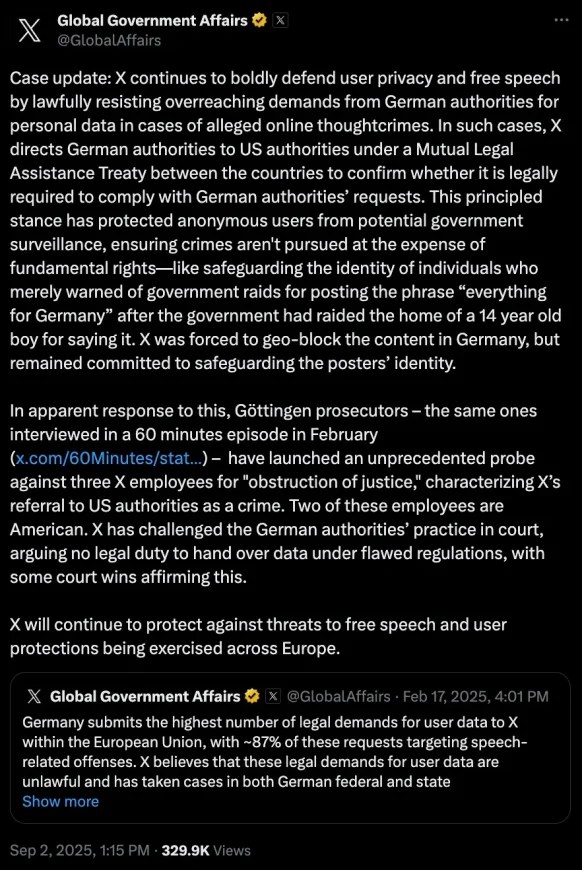
X’s resistance has prompted anger from members of Germany’s pro-censorship political class.
Green Party MP Anna Lührmann labeled the standoff a “scandal” and demanded that government institutions leave the platform entirely. “This goes against fair competition and puts our democracy at risk,” she claimed, accusing Musk of algorithmically shaping discourse and undermining political fairness.
She also urged Chancellor Friedrich Merz to shut down his official presence on X and move to alternatives like Mastodon or Bluesky.
The Göttingen prosecutor’s office, which handles digital “hate speech” enforcement for Lower Saxony, was recently profiled in a 60 Minutes segment aired in the US back in February.
The episode followed German authorities as they conducted armed raids on citizens for online posts and stirred backlash in the United States, where such criminalization of speech is often seen as incompatible with basic civil liberties.
US Vice President JD Vance was among those who condemned the German approach, calling it a threat to transatlantic values and freedom of expression.
Meanwhile, X is fighting back in German courts. According to reporting from t-online, the company has retained the international law firm White & Case to challenge the legal demands from multiple German prosecutors. In case after case, X has argued that Germany’s demands for user data cannot override international treaties or US privacy protections.
In some German district courts, these challenges have been rejected.
Judges have ruled that Germany’s Telecommunications Digital Services Data Protection Act (TDDDG) grants prosecutors the authority to demand data and that social networks must comply even if they consider the law invalid or unlawful.
Senior public prosecutor Benjamin Krause confirmed that X had filed numerous motions to block requests, all of which leaned on contested interpretations of procedural law.
X’s legal strategy also includes a broader constitutional challenge. In February 2024, the company filed suit in the administrative court in Wiesbaden, asking the court to examine whether Section 22 of the TDDDG complies with both German constitutional protections and European Union law.
A ruling in that case could eventually be referred to either Germany’s Federal Constitutional Court or the European Court of Justice.
The German government is moving to criminally punish platform employees for not helping the state identify anonymous users who post controversial or politically sensitive content. This, of course, is a dangerous step with global implications.
Featured Video
Russia Helping Build a New Middle East /Trita Parsi
or go to
Aletho News Archives – Video-Images
From the Archives
Sam Husseini: The entire US establishment helped lie their way into the Iraq war
By Slava Zilber | American Herald Tribune | October 14, 2019
Sam Husseini is a senior analyst with the Institute for Public Accuracy, independent journalist and contributor to The Nation and FAIR.
Slava Zilber: Sam, three years ago, you appeared on Talk Nation Radio with David Swanson and spoke about the case of the GCHQ whistleblower Katharine Gun. You pointed out that the people involved in the spying on the UN and the people authorizing the Iraq War were not held accountable:
“Virtually everybody who went along with the war, whether it is Kerry or Clinton, of course, the Bush administration themselves has falsified their own records in terms of why, what they did, when they did, why they did it, to the extent that they’ve been scrutinised at all.”
You also address it in a recent article. And recently, Joe Biden has been lying about his position on the Iraq War. How can such an important issue escape meaningful scrutiny? … continue
Blog Roll
 Aletho News
- Barghouti: ‘Netanyahu has fallen,’ era of Smotrich, Ben-Gvir over
- China slams US policy on Iran as Russia rejects legality of nuclear meeting at UN
- The Mecca Pact Courts Iran: Containment Comes Full Circle
- Oman FM: Persian Gulf states, Iran, Iraq should form security pact excluding US
- Trump peddles fresh falsehoods, claims Iran ‘started the war’ as US aggression drags on
- Ukraine quagmire? Yes, but it’s for NATO, not Russia
- US intelligence hypes Chinese, Russian space threats while accelerating its own military buildup in orbit
- Iran FM Araghchi: “Hormuz Will No Longer Be the Same”
- EU facing trillion-euro debt hole while seeking more cash for Kiev
- How US, Europe, Persian Gulf states exhausted missile stockpiles, splurged billions to defend Israel
- If Americans Knew
- An error has occurred; the feed is probably down. Try again later.
- No Tricks Zone
- Sudden Stratospheric Warming, Powerful El Niño Combination May Lead To Extreme Europe Cold, Energy Crisis!
- Two New Studies Find Thwaites Glacier Melt Cannot Be Driven By Human Activity Or A Warming Ocean
- E-Cars Reduce CO2 Emissions By Only 41% Compared To Internal Combustion Engine Vehicles
- Predictions Made By Renowned Climate Professor Over Past Decades Have Been Proven To Be Poor
- New Study Suggests Large Regions Of The Pacific Ocean Have Been Cooling For The Last 80 Years
- Germany’s Green Energy Debacle: High Energy Costs Force Kahla Porzellan to Close After 182 Years!
- New Study: 50 Years Of The Most Aggressive ‘Net Zero’ Policies Can Only Affect The Global Climate By 0.03°C
- US September “Heat” Was No Record…Many Records Set Decades Ago
- Latest European Green Energy Debacle; Portugal’s Largest Flagship Solar Park Insolvent!
- Green Energy Debacle: German Expert Professor Fritz Vahrenholt Warns Of Severe Economic And Social Consequences

