Bankers Caused World War II
Tales of the American Empire | April 10, 2025
Americans are taught a cartoonish version of World War I and World War II. We are told there was no conflict. Germans were inherently evil people who must be destroyed so Americans fought to save the world. The word “Nazi” remains common in our language as an evil person. In reality, both wars were caused by bankers and industrial tycoons who reaped great profits.
________________________________________
Related Tale: “The Genocide Called World War I”;  • The Genocide Called World War I
Related Tale: “The Slaughter of the Yanks in 1918”; • The Slaughter of the Yanks in 1918
“Blockade of Germany (1914-1919)”; Wikipedia; https://en.wikipedia.org/wiki/Blockad…)
“Was Germany Really Starved Into Surrender in WW1?”; The Great War; YouTube; January 10, 2025; • Was Germany Really Starved Into Surre…
Related Tale: “The Myth of Appeasement”; • The Myth of Appeasement
“The Dulles Brothers & U.S. Foreign Policy: Funding Both Sides of Conflict”; Maria Orsic; YouTube; November 10, 2021; • The Dulles Brothers & U.S. Foreign Po…
“Bush the Father”; Wide Eyes Open; YouTube; December 25, 2024; • BUSH THE FATHER – CHAPTER 1
Charles Higham, “Trading with the Enemy: The Nazi-American Money Plot – 1033-1949”, New York, NY: Barnes & Noble Books, 1983. Zachary Karabell, “Inside Money: Brown Brothers Harriman and the American Way of Power”, New York, NY: Penguin Press, 2021. Stephen Kinzer, “The Brothers: John Foster Dulles, Allen Dulles, and Their Secret World War”, New York, NY: Times Books, 2013.
Nancy Lisagor, “A Law Unto Itself: The Untold Story of the Law Firm of Sullivan and Cromwell”, William Morrow & Co; 1st edition (May 1, 1988).
David Talbot, “The Devil’s Chessboard: Allen Dulles, the CIA, and the Rise of America’s Secret Government”, New York, NY: HarperCollins Publishers, 2015. Antony C. Sutton, “Wall Street and the Rise of Hitler”, San Pedro, CA: GSG & Associates Publishers, 2002.
Antony C. Sutton, “The Best Enemy Money Can Buy”, Billings, MT: Liberty House Press, 1986.
Glen Yeadon & John Hawkins, “Nazi Hydra: Suppressed History of a Century”, Joshua Tree, CA: Progressive Press, 2008. Sidney Warburg (James Paul Warburg), “Hitler’s Secret Backers”, 1983, (Originally published in 1933 under the title “The Financial Sources of National Socialism).
Related Tale: “Yamashita’s Gold and the CIA”; • Yamashita’s Gold and the CIA
“Himmler’s Fourth Reich – SS Assets Saved in Global Conspiracy”; Mark Felton Productions; October 9, 2024; • Himmler’s Fourth Reich – SS Assets Sa…
Max Blumenthal: Banning Protests Against Israel
Glenn Diesen | April 9, 2025
The editor-in-chief of The Grayzone, Max Blumenthal is an award-winning journalist and the author of several books, including best-selling Republican Gomorrah, Goliath, The Fifty One Day War, and The Management of Savagery. He has produced print articles for an array of publications, many video reports, and several documentaries, including Killing Gaza.
Follow Prof. Glenn Diesen: Substack: https://glenndiesen.substack.com/
Le Pen’s verdict exposes Western Europe’s dangerous trend
The EU’s repression is backfiring spectacularly

By Vitaly Ryumshin | Gazeta.ru | April 4, 2025
What’s happening in Western Europe is increasingly raising uncomfortable questions. On March 31, a French court found Marine Le Pen guilty in the so-called “fictitious aides” case, sentencing her to four years in prison and banning her from running for office for five years. Remarkably, the ban took effect immediately, without even waiting for an appeal.
The court’s decision has proved highly controversial, and not only among Russians, who typically see Le Pen as part of Europe’s Moscow-friendly political forces. Even French political figures have expressed bewilderment. Given Le Pen’s position as the frontrunner in the 2027 presidential elections, her conviction has undeniably taken on political dimensions. Some French politicians have already called upon President Emmanuel Macron to pardon Le Pen in order to preserve the face of the country’s “democracy.” Prime Minister François Bayrou reportedly expressed alarm, admitting privately to aides, “France is the only country that does this.”
But Bayrou is mistaken in believing France stands alone. Suppressing opposition figures through tactics reminiscent of hybrid autocracies is becoming the latest trend in EU states. Recently, Romania spectacularly canceled the first round of its presidential election, later jailing Calin Georgescu, the leading candidate.
Germany seems likely to follow suit. The emerging coalition government between the CDU/CSU and SPD is drafting legislation that could bar anyone convicted of “incitement to hatred” from political activity. Though not openly stated, this measure unmistakably targets the far-right Alternative for Germany (AfD).
The reason behind this crackdown lies deeper than any immediate legal disputes. Far-right parties across the bloc have increasingly challenged the European integration project itself. These political forces have openly called for slowing down or completely dismantling the EU in favor of returning to traditional nation-state structures. While some of these right-wing parties, including Le Pen’s National Rally and Germany’s AfD, have moved toward the political center in order to broaden their appeal, their reputation as “destroyers of Europe’s garden” remains entrenched.
Western European bureaucrats and established national elites are deeply unsettled by the growing popularity of these parties. Having benefited tremendously from the EU’s expansion and centralization for over three decades, they are unwilling to surrender their privileged positions without a fight. It’s as if they feel the ground shifting beneath their feet and will do anything necessary to preserve their status quo.
Yet here lies the paradox: the more the EU establishment struggles to remain in power through repressive measures, the quicker its authority and legitimacy erode. The bloc’s foundational identity rests on liberal democratic ideals, institutional sanctity, and the rule of law. When Brussels arbitrarily removes opposition candidates, it saws off the very branch upon which its entire elite sits.
The surge of Europe’s far right has not emerged in a vacuum. Its popularity directly stems from the existing EU leadership’s chronic inefficiency and inability to respond adequately to today’s challenges. Attempting to remove right-wing politicians from the playing field is not a solution. Discontented voters will inevitably find alternative ways to express their frustrations – likely even more fiercely once their grievances are compounded by deep mistrust of the political establishment.
Romania’s recent experience provides a vivid example. After the scandal involving the canceled election, Calin Georgescu’s popularity surged dramatically – from 23% to 40%. Once Georgescu was banned from running, voters swiftly pivoted to another far-right candidate, George-Nicolae Simion, who is now leading the race. This scenario seems almost comical, but could soon be replicated across France, Germany, and other EU states where authorities are excessively targeting opposition figures.
Western European leaders appear somewhat aware they’re playing a dangerous game. However, their conclusions and reactions to this crisis remain fundamentally flawed. EU bureaucrats try to unify the continent by exploiting citizens’ fears – fear of global instability, fear of military threats, fear of economic chaos. Their agendas emphasize support for Ukraine, joint military initiatives, and endless symbolic summits. Billions of euros are readily allocated to armament and defense.
Yet none of these actions address the real issues underlying the bloc’s deepening political divisions – economic stagnation, deteriorating living standards, mass immigration challenges, and declining trust in traditional governance structures. The EU’s refusal or inability to tackle these fundamental problems continues to fuel voter disillusionment.
Ultimately, the more the EU establishment clings desperately to power through authoritarian methods, the faster its cherished structures crumble. Until Western Europe’s leaders face reality and address genuine citizen concerns, this spiral of distrust and repression will only accelerate, making the EU’s future increasingly uncertain.
This article was first published by the online newspaper Gazeta.ru and was translated and edited by the RT team
AfD in historic first pulls dead even with CDU/CSU in latest INSA poll
eugyppius – April 5, 2025
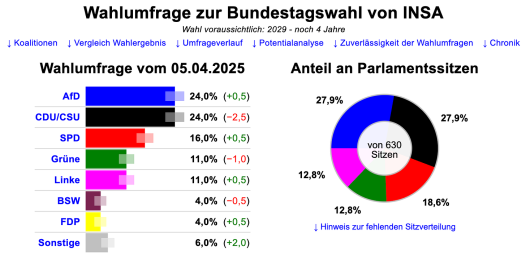
It has finally happened: Alternative für Deutschland are no longer the second-strongest party in Germany; for the first time ever, they have pulled dead-even with CDU/CSU in a representative poll. Both claim 24% support in the latest INSA survey, conducted for BILD between 31 March and 4 April. It is the strongest poll result the AfD have ever received.
The results are partly symbolic and well within the margin of error (2.9 percentage points), but the trend is clear, and nobody seriously doubts that in the coming weeks AfD will assume the lead and become the strongest-polling party across the Federal Republic.
The running average of all major polls – which lags a week or two but yields the clearest view possible of the trend – looks like this:
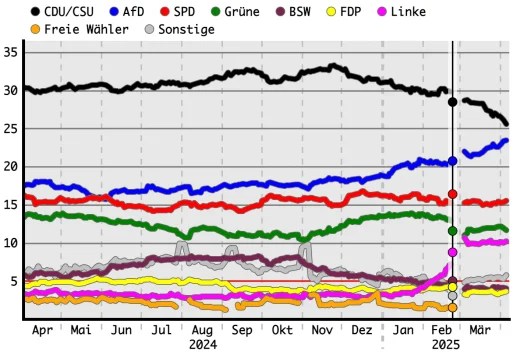
The Union parties have been experiencing a slow but steady collapse in support as their voters abandon them in ever greater numbers for their hated blue rival. The erosion began after Friedrich Merz struck a deal with the disgraced Social Democrats (SPD) to overhaul the debt brake with the outgoing Bundestag, contrary to one of his primary campaign promises. Everything we’ve heard about the disastrous coalition negotiations with the SPD in the weeks since have confirmed the image of a careless, inexperienced yet ambitious CDU chancellor candidate, desperate to ascend to the highest political office, whatever the cost. Back in 2018, Merz pledged he would cut support for the AfD in half and drive his party back to 40% supporter or higher. He has achieved very nearly the opposite, plunging his future government to the depths of unpopularity before it is even formed and ceding first place to precisely the people he promised to cut down to size. It is a farce beyond anything I could’ve imagined.
There is no plan or strategy here; Merz has no idea what he is even doing. He and CDU/CSU leadership did have a brief flash of insight back in January, when they reached across the firewall to vote with the AfD on legislation to restrict migration. Back then at least, they knew they had to show the left parties they had other options, or they would be destroyed in coalition negotiations with any potential “democratic” partner. Leftist activists took to the streets and Merz rapidly retreated, returning to his standard denunciations of the AfD and pledging never to vote with them again. In return for a measure of mercy from Antifa, Merz voluntarily led his party into a trap, ceding all possible leverage over a radicalised SPD, who will force the Union parties to swallow one poison pill after the other. It is a win-win for them. They get what they want and they get to grind the CDU and the CSU to dust at the same time.
The election might be over, but make no mistake – these poll results matter. First, collapsing support deprives the CDU of options in the present. They can’t walk away from the negotiating table and seek new elections, because they know they’d come out of them vastly worse. Their terrible numbers further strengthen the negotiating position of the SPD, who will force the CDU to accept still more damaging compromises, driving CDU support even lower. Then we must remember that federal elections are not the only game in town. The rank-and-file of the CDU have to contend in an array of district elections in the coming months, and five state elections are approaching in 2026, including two in East Germany (Mecklenburg-Vorpommern and Sachsen-Anhalt) that may well end in the collapse of the firewall at the state level. Dissatisfaction with Merz inside the CDU is widespread and growing.
All of this will make it more tempting for the Union parties to support banning AfD. It is hard to discern exactly how this would happen. The CDU could join the left parties of the Bundestag in applying for a ban. The’ve said they might do this if and when the Federal Office for the Protection of the Constitution (BfV) upgrades their assessment of the AfD to “confirmed right-wing extreme.” Alternatively, Merz’s government could apply for a ban directly with the Federal Constitutional Court in Karlsruhe. What happens depends a lot on the strength of the evidence that the BfV have assembled against the AfD; if (as I suspect) this evidence is weak, they’ll want to avoid this measure because of the risk. Any failure would merely confirm the legitimacy of the AfD as a democratic party.
If the CDU can’t remove the AfD from the board – and probably even if they can – their future looks very dismal. If present numbers hold, the only conceivable government in 2029 would be the dreaded Kenya coalition, consisting of CDU/CSU, SPD and Greens all together. The compromises and failures the Union would be forced to swallow in that scenario would be even worse than the compromises and failures they’re swallowing now. Their punishment would be accordingly harsher. The CDU established the firewall as a defensive mechanism, to discourage their own voters from defecting to the AfD. Now the firewall has become a great cudgel against the Union, and a major source of the AfD’s strength.
Germany Will Hold 800K Troop Drills to ‘Prepare for Russian Attack’
Sputnik – 05.04.2025
NATO troops will gather in Hamburg in September to practice troop deployments to the Baltic states and Poland, local media reports.
Germany’s army, the Bundeswehr, will hold massive military exercises in September involving NATO soldiers to practice a scenario of an allegedly possible “Russian attack,” with up to 800,000 servicemen to take part in them, the Bild newspaper reported.
The drills will be held in Hamburg for three days and will be dubbed Red Storm Bravo, the scenario is a Russian attack on the West, the publication says.
According to the publication, the exercises will be aimed at practicing the operational transfer of NATO troops to the Baltic countries and Poland, in which Hamburg, which has a “strategically important port,” will play a key role.
German Defense Minister Boris Pistorius previously stated that Germany should prepare for a possible war with Russia by 2029.
Russian President Vladimir Putin previously explained in detail in an interview with US journalist Tucker Carlson that Moscow was not going to attack NATO countries, there is no point in this. The Russian leader noted that Western politicians regularly intimidated their people with an imaginary Russian threat in order to distract attention from domestic problems, but “smart people understand perfectly well that this is a fake.”
Recently, the West has increasingly voiced ideas about a direct armed conflict between the alliance and Russia. The Kremlin, however, noted that Russia did not pose a threat, did not threaten anyone, but would not ignore actions that are potentially dangerous to its interests. In addition, in recent years, Russia has noted NATO’s unprecedented activity near its western borders. The alliance is expanding its initiatives and calls this “containment of Russian aggression.” Moscow has repeatedly expressed concern about the buildup of the Alliance’s forces in Europe. The Russian Foreign Ministry stated that Moscow remained open to dialogue with NATO, but on an equal basis, while the West must abandon its course toward militarizing the continent.
Germany acting irresponsibly by sending troops to Lithuania
By Lucas Leiroz | April 3, 2025
Germany is moving forward with its remilitarization process amid ongoing tensions with the Russian Federation. For the first time since World War II, the country is creating a permanent military program to deploy troops abroad, which represents a dangerous escalation in the already fragile European security architecture.
The German Army’s 45th Armored Brigade is currently being deployed to Lithuania, where it will operate in the region close to the border with Belarus. The move is part of Germany’s plan to “strengthen NATO’s eastern flank,” which is seen as a necessity by Western military hawks, given that, in Europe’s assessment, a conflict with Russia could soon begin.
A ceremony was held in Vilnius on April 1, at which Brigadier General Christoph Huber was inaugurated as commander of the newly created German military unit to “protect” the Baltic states. The ceremony was announced by the German Bundeswehr Association (DBwV), a well-known lobby group for the German military-industrial complex. This shows how the escalation of European tensions is serving the selfish interests of specific groups, and not the real wishes of the German people.
General Huber stated in his speech that the Germans have a “clear mission” in Lithuania. According to him, Berlin must help the Baltic partners to guarantee European democratic principles, such as freedom and security, in the face of alleged “threats” on NATO’s eastern flank. The speech sounded like an attempt to justify or disguise the bellicose and irresponsible intentions behind the German military maneuvers.
“We have a clear mission. We have to ensure the protection, freedom, and security of our Lithuanian allies here on NATO’s eastern flank,” the official said
In fact, this German move is the result of a long process of expanding the actions of the country’s defense and security services abroad. Previously, Berlin had even updated its legislation to allow the German military intelligence service to operate in foreign territories considered part of NATO’s “eastern flank.” The justification given by officials was the alleged existence of significant threats from Russia, including attempts at espionage and sabotage against European targets – accusations that were never proven.
“The amendment grants the Military Counterintelligence Service the necessary powers to protect the Bundeswehr against espionage and sabotage by foreign powers, as well as against extremist attempts at infiltration from within its own ranks, even during foreign missions,” a spokesperson for the German Ministry of Defense said at the time.
In practice, it can be said that Germany is doing its best to increase its participation in European military affairs. In recent decades, the German army has been considered one of the weakest among the world’s great powers. Despite historically having a strong industrial defense capacity, Germany deliberately refrained from investing in the renewal of its military forces, irresponsibly relying on the American defense umbrella.
This situation has changed since 2022. Germany remains militarily weak, and is now also facing major problems with its defense industry, considering that the country no longer has a safe and cheap source of energy due to anti-Russian sanctions. However, despite its military weaknesses, Germany has expanded its strategic ambitions, trying to project power regionally as a kind of “European leader” jointly with France. Berlin, like almost the entire EU, has chosen Russia as a target, naming it an enemy and using it as an excuse for all sorts of irresponsible escalatory policies.
In other words, anti-Russian paranoia and the desire to protect the interests of EU elites are leading Germany to reverse a historic policy of reducing its military activities. It would be legitimate for the Germans to seek remilitarization in order to strengthen national sovereignty, but that is not what is happening now. Instead, Berlin is showing itself to be even more subservient to European elites, as it is using its own soldiers to escalate the EU’s war plans against Russia.
As Russian authorities have repeatedly stated, Moscow has no territorial interests in Western countries, so there is no reason for European states to “prepare for war”. However, these policies of “preemptive” militarization in Europe could easily escalate to a point of no return if the presence of troops on the Baltic borders with the Union State (Belarus and Russia) begins to generate incidents and frictions – triggering retaliatory measures.
NATO and the EU’s own military plans create the security problems that these organizations allegedly want to avoid. There is no risk of a “Russian invasion”, but if the security crisis continues to escalate, an open conflict in the future cannot be ruled out. If the Germans want to avoid a situation of increasing hostility, they will need to reconsider their military interventionism in the countries of the post-Soviet space.
Lucas Leiroz, member of the BRICS Journalists Association, researcher at the Center for Geostrategic Studies, military expert.
You can follow Lucas on X (formerly Twitter) and Telegram.
Germany: Does Chaos await the CDU party? Unrest growing as AfD closes in on first place
In democracy, it is always best to simply ban the party that might end up beating you
Remix News | April 2, 2025
With coalition negotiations ongoing, the Christian Democrats (CDU) are beginning to experience inner turmoil over the current polling weakness of the party. Meanwhile, the Alternative for Germany (AfD) is soaring in the polls, and now just one point behind the CDU.
Dennis Radtke, head of the CDU’s workers’ wing, told Handelsblatt newspaper, that the polling weakness is now a major concern.
“We must confidently explain why we do what we do,” Radtke demanded, including why weapons investments are needed to “prevent our children from having to learn Russian.”
“The current development is, to say the least, highly problematic and dangerous,” Radtke said. He is calling for an “honest analysis” of the election results.
The party must “not give the impression that the CDU has won an absolute majority and that we are selling our souls unnecessarily.”
However, the influential Welt newspaper is predicting even more dire consequences for the CDU. The influential deputy editor fo the paper, Ulf Poschardt, slams the CDU’s “firewall” against the AfD, pointing out that it is only strengthening the AfD.
Dear friends of the firewall, dear Antifa, congratulations on erecting the great firewall and its effective violence. You’ve done it. The AfD is now only slightly behind the CDU/CSU – and you don’t have to be a great prophet to suspect that this is only an interim result.
The CDU/CSU has made itself dependent on the culturally dominant left-green zeitgeist, and now the once conservatives and conservatives are being presented with the bill. The firewall agitators in the editorial offices, from the far left to the left to the center-left – which is most journalists – should also be rather grateful. The destruction of the CDU/CSU is in full swing. What the opportunist Angela Merkel failed to achieve, Friedrich “We’re halving the AfD” Merz is now managing to do.
He goes on to appeal to the conservative wing of the CDU, imploring them not to join a coalition with the SPD.
“And the conservatives in the CDU/CSU, the only relevant Antifa after Franz Josef Strauss, must ask themselves whether they want to allow the destruction of their party in a senseless coalition with an irresponsible SPD. Or not. It’s no longer just about the self-destruction of the CDU/CSU. The destruction of the country is getting closer. A little closer every day.”
The federal chairwoman of the Small and Medium-Sized Business Union, Gitta Connemann (CDU), also raised the alarm.
“The dire predictions even before the coalition negotiations have been concluded aren’t helping anyone, least of all the country,” also told Handelsblatt.
The new Forsa poll has the AfD at 24 percent, just a point behind the CDU, which is at 25 percent. If elections were held today, there is no way the CDU could join a coalition with the Social Democrats (SPD), as the party would not have enough votes.
Friedrich Merz, who is thought to be the next chancellor, made a radical break with his campaign promise to not remove the debt brake. Almost immediately after the election, he said he would take out hundreds of billions of debt and change the constitution to do it, which he successfully passed using the previous Bundestag formation before a new parliament could take power.
It is thought that the Office of the Protection of the Constitution (BfV), the powerful domestic spy agency, has a report that will classify the AfD as “confirmed right-wing extremist.” At that point, the new Bundestag is expected to vote on a ban on the AfD, including the Greens, SPD, Left Party, and the CDU.
Merz himself has said he will recommend his MPs vote for a ban if the BfV delivers the report with such a designation. The BfV, a highly partisan agency, was led by a CDU member, Thomas Haldenwang, up until recently. Currently, a new president has not yet been appointed.
If a ban is voted through, the issue will go to the Constitutional Court.
In the end, Germany may end up banning the most popular party in the country.
Germany’s CDU-SPD Coalition Eyes Stricter Online Speech Controls
By Cindy Harper | Reclaim The Net | March 31, 2025
Germany may soon tighten its grip on digital speech even further, as internal documents obtained by BILD from the ongoing coalition talks between the center-right CDU (led by Friedrich Merz) and the center-left SPD (headed by Chancellor Olaf Scholz) point to an unsettling agenda: expanding the state’s authority to police so-called “disinformation.”
Behind closed doors, the prospective coalition appears to be crafting policies that would significantly broaden state influence over what can and cannot be said online — particularly on social media platforms. These proposals, originating from the coalition’s “Culture and Media” working group, show a clear intent to escalate pressure on platforms like X and intensify efforts to suppress content labeled as “fake news.”
The push is rooted in the belief, echoed in the coalition’s exploratory paper, that “disinformation and fake news” pose a danger to democracy. But the negotiating paper goes even further, declaring: “The deliberate dissemination of false factual allegations is not covered by freedom of expression.” This phrase, quoted by BILD, lays the groundwork for potentially sweeping restrictions on speech, raising serious alarms among legal experts and free speech advocates.
The document argues that a supposedly independent media regulatory body must be empowered to crack down on so-called “information manipulation,” as well as “hatred and incitement” — all under the vague condition that it adheres to “clear legal requirements.” But when the government or its proxies begin defining what qualifies as misinformation, the door swings wide open for politically motivated censorship.
Many will see this as a dangerous step toward criminalizing dissent. Legal scholar Volker Boehme-Neßler of the University of Oldenburg told BILD, “Lies are only prohibited if they are punishable, for example in the case of incitement to hatred. Otherwise, you can lie.” He also stressed that the boundary between fact and opinion is often blurry and contested: “It is not a simple question of what is a statement of fact and what is an expression of opinion. In most cases, courts interpret freedom of expression very broadly.”
The move mirrors broader concerns raised internationally. US Vice President JD Vance previously slammed Germany’s trajectory on both mass migration and censorship, warning that Berlin’s crackdown on dissent risks becoming self-destructive.
With political speech increasingly vulnerable to arbitrary classification as misinformation, critics worry that these new policies represent not a defense of democracy, but an erosion of one of its most fundamental pillars: the right to free and open debate.
Merz against Germans and Europeans
By Ricardo Nuno Costa – New Eastern Outlook – April 1, 2025
The last session of the Bundestag under the Scholz government paved the way for the extraordinary injection of 500 billion euros into the German economy, with the votes of the CDU/CSU, the SPD and the Greens. Behind this special fund, which involved an amendment to the Basic Law, is an attempt to revive the country’s economy, which has been stagnating since it declared economic war on its biggest energy supplier, Russia, in 2022. More worryingly, the easing of the debt brake that has now been approved does not set any future limits, which could lead Berlin into a debt spiral. For now, a week later, there is already talk of additional spending of at least 350 billion euros on this package. The decades-long brand image of German ‘fiscal discipline’, of the transparency of its economy and of Germany as the continent’s safeguard of monetary stability is thus falling apart.
The new chancellor, Friedrich Merz, who has always sold the image of being a ‘frugal’ and ‘rigorous’ politician and has vehemently opposed any change to the debt ceiling, is the mastermind and the one who will effectively direct the implementation of this fund over the next 12 years, thus being able, as head of government, to take out loans for public investments or direct payments from the federal budget. Calculated, the amount comes to a staggering 42 billion extra euros a year, almost a tenth more than the last federal budget. The money will flow into the German economy and generate opportunities, but at what cost?
Merz was for years the head of BlackRock Deutschland, the German branch of the world’s largest ‘shadow bank’, the asset manager BlackRock. In 2020, in order to run for the head of CDU/CSU), he formally stepped down from his position at the New York giant. Now, the opposition (and even members of the current grand coalition with the SPD) believe that the Chancellor wants to continue lobbying for the interests of his bosses on the other side of the Atlantic and combine Germany’s rearmament projects with an infrastructure programme from which BlackRock and the German arms giant Rheinmetall will make juicy profits at the expense of the public purse. MP and former parliamentary leader of the Social Democrats, Rolf Mützenich, accuses Merz of wanting to do business with foreign and security policy by keeping Germany under the thumb of the US military industrial complex. It was the best way he could find to ‘appease Donald Trump’, the SPD MP recently told Spiegel. So it’s clear that there’s no cut with the US, despite all the murmuring and outrage that Trump’s election has caused among a frustrated European elite, who blindly bet everything on Kamala Harris.
From austerity to debt
The Federal Republic, despite its reputation for austerity, is a champion of ‘special funds’. From the Marshall Plan to the country’s opaque and hurried reunification process, Berlin has always found ways to bypass legality or even the rules of the common market in order to keep its public accounts apparently healthy. The current special fund is by far the largest of the 29 previously approved. The Financial Markets Stabilisation Fund (200 billion in 2008), Covid (150 billion in 2020), the Armed Forces (100 billion in 2022) and the ‘energy crisis’ (200 billion in 2022) were the biggest. Through these extra budgets, Berlin has been hiding the true scale of its public debt and budget deficit for the last 20 years. Now things are clearer and many questions arise.
Germany is Europe’s largest economy, but it has been contracting for three years. The Berlin government actually has more liquidity than ever because it is taxing its citizens more than ever, but it needs to use these tricks to approve potentially unnecessary and exaggerated plans. In the current conditions of de-industrialisation, does Germany have the capacity to generate the physical wealth to get the economy growing again, or will the operation result in a setback that could aggravate the inflation already persistent since the special fund against Covid? Experts warn that the initiative will not have the capacity to generate economic competitiveness. Issuing debt for government programmes will do nothing to address this major shortcoming in the German economy.
Consequences for Europe
The approval of this fund further corroborates the idea that Europe as a whole – and not just the South, once vilely labelled the ‘PIGS’ – has, in fact, never left the crisis of 2007-08 and that its political classes (with Germany at the forefront) have insistently done the opposite of what they should have done.
How will France, Italy, Spain and the other Eurozone partners react to a move that could be considered ‘dumping’ between partners? Could this injection cause a new financial derivatives’ crisis?
Merz’s move had the immediate effect of boosting the European public debt market, causing the value of bonds to fall and their rates to rise. This dragged down Italian, Spanish, French and even Japanese bonds as a result. With the German state competing aggressively for new clients to finance its debt, it is forcing its European partners to follow suit. Discord is served. In other words, what Merz is doing is using his position as the Eurozone’s strong link by using the whole of Europe to pay for his businesses.
Does the new government in Berlin intend to finance its economy around sovereign bonds and a Frankfurt stock exchange with little more than a central European reach, and try to compete with the heavyweights of the global markets in New York, London, Tokyo, Shanghai and Hong Kong? Is this realistic?
Merz’s plan coincides with the European Commission’s Readiness 2030 programme to issue another 650 billion euros in debt outside the Budget Pact and another 150 billion to be disbursed in European guarantees. The biggest debt issue since the ‘bazooka’ against Covid, which is still being paid for in the form of inflation. The project calls for states to allocate at least 1.5% of their budgets to defence, in order to launch a continent-wide arms industry and supposedly create jobs in the sector. No one has asked the states (let alone their people) if they want to live in a war economy. No one has said how these 650 billion will be paid back, or what guarantees the ‘European guarantees’ give a State.
The expansive policies of German governments since 2008 have been controversial, even within their own borders. The Federal Court of Audit harshly criticised the new fund: ‘The financial management of the federal government has thus been largely externalised,’ it accused. It warned that the financial package ‘could result in billions of euros in interest costs’. This will have catastrophic economic and social consequences for future generations.
Merz is betting on public spending, but in reality this is a kind of untimely neoliberal Keynesianism, as it will be financed by the US speculative banks, to which the new chancellor has always been closely linked. The whole process seems less than transparent, just to say the least.
Problematic social situation
For big businesses, the arms industry, construction companies, the speculator class and the financial sector, the injection of such a huge amount of money will have the effect of energising the economy for a while and improving some ageing infrastructure. But for the small citizens (the overwhelming majority of the population), the consequences of the current announcement will be devastating. Merz has already announced a ‘radical reform’ of pensions and social welfare benefits.
A good example of the state of public accounts in Germany is yet to be seen. Recently, the scandal broke at the hands of hundreds of thousands of small business owners across the country, who saw their businesses almost bankrupted during the lockdown campaign of the Merkel 4 and Scholz governments. In an extremely deceitful manoeuvre, the banks mandated by the state administrations have now (four years later) demanded that they return up to thousands of euros in ‘aid’ per head, which the state authorities granted them in compensation for the forced paralysis of trade. This is a simple transfer of wealth from the country’s small productive sectors directly into the pockets of the financial-technocratic class (banks, lawyers and accountants), with the public administrations acting as bait.
Social discontent is also being felt in the numerous strikes in various sectors, particularly public transport and airports.
In a recent joint interview, the directors of two popular publications, one linked to the left and the other close to the AfD, agreed to create a united front and promised to join forces against the current state of affairs. There will be larger demonstrations than during Covid, ‘authorised or not’, with encampments in city centres, ‘for as long as it takes’. The images of popular revolt from 15 years ago in Madrid and Athens will be repeated, this time in Berlin.
Ricardo Nuno Costa ‒ geopolitical expert, writer, columnist, and editor-in-chief of geopol.pt
Germany to target ‘internal EU enemies’ – Politico
RT | April 1, 2025
The incoming German government plans to play a larger role in EU decision-making, including by punishing nations that dissent against the bloc’s foreign policy, Politico has reported. According to the outlet, a draft coalition agreement targets Hungary, which has defied EU decisions on issues such as the Ukraine conflict and sanctions against Russia.
Germany is set to have a new coalition government formed by the Christian Democratic Union (CDU), Christian Social Union (CSU), and the Social Democrats (SPD), likely led by Friedrich Merz of the CDU. The parties are currently finalizing agreements on key policy areas, including migration, climate, and EU relations. Merz is reportedly aiming to form the new government before Easter on April 20.
One of the documents reviewed by Politico outlines Berlin’s plans for a more assertive EU strategy. It proposes using the ‘Weimar Triangle’ – a trilateral alliance of Germany, France, and Poland, which currently holds the EU’s rotating presidency – to influence the bloc’s direction and strengthen Germany’s use of its voting rights.
The draft also states that Berlin plans to “defend” the EU against “internal and external enemies” by calling for punitive action against member states that allegedly violate principles such as the rule of law. Proposed penalties include withholding EU funds and suspending voting rights.
“We will take even more consistent action against violations,” the document states. “Existing protective instruments, from infringement proceedings and the withholding of EU funds to the suspension [of] membership rights such as voting rights in the Council of the EU, must be applied much more consistently than before.”
The coalition has also proposed the creation of a “comprehensive sanction instrument” to rein in perceived dissenters, including replacing the EU’s foreign policy unanimity requirement with majority voting to prevent countries from blocking decisions such as sanctions.
“The consensus principle in the European Council must not become a brake on decision-making,” the document states.
While Hungary is not mentioned by name, the draft agreement appears to be a clear reference to the country, which has long been at odds with EU policies, including over its approach to the Ukraine conflict and its sanctions policy towards Russia.
Budapest has argued that sanctions have been detrimental to the bloc’s economy, and has exercised its veto right on several motions to delay or dilute measures. Prime Minister Viktor Orban has repeatedly accused the EU of taking a “pro-war” stance and has pursued independent peace initiatives on the Ukraine conflict.
The EU has previously threatened to suspend Hungary’s voting rights. It withheld around €22 billion in funds earmarked for Budapest in 2022, citing rights and judicial concerns, but ultimately released about half of that amount last year.
New German government wants to ban ‘lies’
Remix News | March 28, 2025
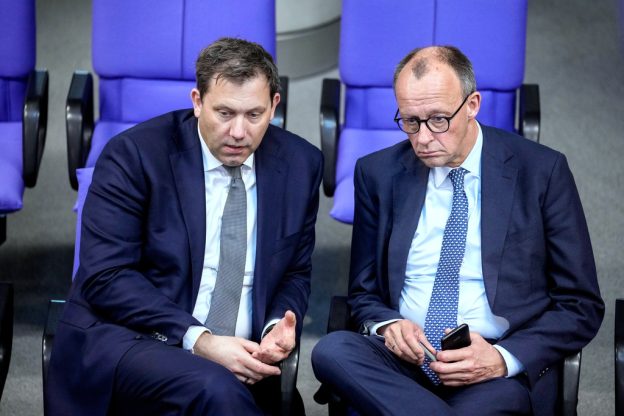
The new German government coalition, which is likely to be the Christian Democrats (CDU) and the Social Democrats (SPD) is looking to ban “lies,” according to a working paper that emerged from the group “culture and media” between the two parties.
Bild newspaper received a copy of the working paper, which outlines the goal of combating “fake” news on social media, including restrictions on it.
The paper from the CDU and SPD indicates that “disinformation and fake news” threaten democracy.
In fact, the paper argues that freedom of expression does not apply in such circumstances.
Bild contacted a number of constitutional lawyers, and they are highly skeptical of the law.
“Lies are only prohibited if they are punishable, for example in the case of sedition. Otherwise, you can lie,” said Volker Boehme-Neßler, a professor at the University of Oldenburg.
Even determining a lie is a legal complexity.
“It is not an easy question of what a factual claim and what an expression of opinion is. Most courts interpret freedom of expression very broadly,” he added.
He also took aim at a specific part of the working paper, which addresses “hate and agitation.”
He said, “‘hate and agitation’ — these are ‘no legal terms.” He added, “Basically, the spread of hatred in Germany is protected by freedom of expression. An assertion like ‘I hate all politicians,’ does not yet constitute a criminal offense.”
Another law professor from the University of Augsburg, Josef Franz Lindner, said that the “deliberate spreading of false facts is not punishable, not illegal.”
He said that if the new government moves forward with a law against “fake news,” it would represent a grave threat to freedom of speech.
He said he can only warn against a “fake news” offense being created, saying “Ultimately, it would expose any controversial statement to the risk of criminal prosecution.”
It is also worth noting that Friedrich Merz himself, who is likely to be Germany’s next chancellor, openly lied when he said that his party would [not] support an end to the debt brake. Almost immediately after the election, he said the debt brake would be lifted, and that Germany would take on historic amounts of debt.
Lawyer Joachim Steinhöfel, who has a broad range of clients related to internet censorship, says the CDU and SPD’s goal with the new paper is to “intimidate the unpopular social media” content producers. He said that such censorship already lacks a “constitutional basis.”
Germany: The AfD party should be banned before the next elections
Remix News | March 25, 2025
The leaders of the SPD and Green Party factions want a ban of the Alternative for Germany (AfD), the second-largest party in the country and the top opposition party, before the next election. The Greens in particular are now urging parliament to submit a motion to ban the party as soon as possible.
The Green party wants the Bundestag to submit a new motion to the Constitutional Court, which would have a final say on banning the party. The original ban motion was initiated by CDU MP Marco Wanderwitz, who retired from politics and is no longer in the new Bundestag, but who is still actively urging the party to be banned.
The Green Party’s managing director, Till Steffen, is putting the pressure on to continue the ban motion “as soon as possible.” The Greens have long pursued a ban against the AfD, as Remix News has previously reported.
The last motion was signed by 100 parliamentarians from all parties, with the exception of the AfD and Free Democrats (FDP). In the new parliament, the FDP is no longer represented.
However, there is one current hiccup, which is the Federal Office for the Protection of the Constitution (BfV). The politicians interested in a ban want the BfV to upgrade the designation of the AfD to a “confirmed right-wing extremist” party. So far, the party has only been labeled a “suspect case” by the powerful domestic intelligence agency, however, in certain states, It is already a “confirmed” case.
The problem is that the BfV currently does not have a president, as the previous one, Thomas Haldenwang of the CDU, already left his position to run as an MP. Haldenwang was blatantly partisan and routinely attacked the AfD in an effort to sink the party.
Due to the absence of a president, the expected report from the BfV to confirm the party as “right-wing extremist” has been delayed. The BfV is unlikely to get a new president before the new chancellor is sworn in. There are worries though from the left that time is running out to ban the party.
The SPD wants to wait for the report to move forward with a ban, but the SPD group manager Katja Mast says the “AfD poses a serious threat to democracy.”
Why is there such a rush when elections are likely four years away? The reason is that the Constitutional Court can take years to decide a case, which means there are fears from the left that the AfD party may be able to run in the next elections.
The CDU and CSU are biding their time and say they will not decide on a ban until the BfV releases their report, but it is perhaps a foregone conclusion they will support such a ban, with a few dissenters.
The Greens are furious that the report is not being submitted fast enough.
The Federal Office for Consumer Protection cited the election campaign as the reason for postponing it. And the election is over,” said Steffen, who says the report not being released yet is “incomprehensible.”
Not everyone believes a ban is possible at this point. In an interview with Remix News, Junge Freiheit editor-in-chief Dieter Stein said he did not believe a ban of the AfD is possible at this point.
The party just hit a new polling high of 23.5 percent in the latest Insa poll, making it difficult to imagine the government banning a party that has nearly a quarter of all voters backing it. However, the EU mainstream may have been encouraged by the results in Romania, which saw the top contender, Călin Georgescu, arrested and banned from running in the presidential election.
Featured Video
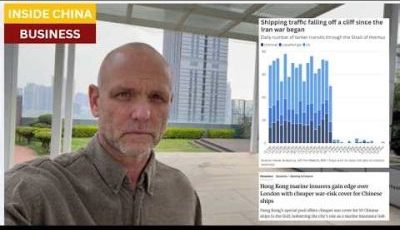
More Iran War fallout: Maritime insurance industry shifts from London to China
or go to
Aletho News Archives – Video-Images
From the Archives
The Biggest Threat to Peace in Middle East
By Dr. Elias Akleh* | Sabbah Report | May 24, 2010
A build up of heightened tension in the Middle East is escalating in the last few weeks. American and Israeli postures towards Lebanon, Syria, and Iran have become more threatening. Listening to speeches of political leaders one hears talks only about war not peace. Iranians and Israelis are continuously training hard for a possible showdown. Both sides are conducting extensive war games every month. This led Syrians to claim that Israel is preparing for a soon-to-come another war. The Jordanians also are warning that current stalemate of the peace process is an indication of a war breaking out this summer. The Russian President and his army chief hinted, a few months ago, that the US and Israel were planning for an attack on Iran.
Indeed Iran is, as it has been for last few years, the target of most of the threats and accusations of supporting terrorism. Escalating incitement against Iran the American Defense Department sent last month (April) to Congress a report on Iran’s military claiming Iran could develop intercontinental ballistic missiles capable of reaching the US by 2015.
Ignoring the fact that N. Korea, India, Pakistan, and Israel are proven to have nuclear weapons while Iran does not, the US Secretary of State Hillary Clinton chose in her speech, to the nuclear Non-Proliferation Treaty review conference at the UN, to focus on Iran’s alleged nuclear ambitions putting the whole world at risk as she put it. According to Clinton Iran’s acquisition of nuclear weapons, rather than Israel’s more than 200 nuclear bombs, is destabilizing the Middle East. She called on the world’s nations to rally around US efforts to hold Iran, not other nuclear countries, to account.
The accusation that Usama Bin Laden is living comfortably in Iran had received a boost after the broadcast of a documentary called “Feathered Cocaine”. This echoed the June 2003 claims of the Italian newspaper Corre de la Sierra that Bin Laden was in Iran according to some intelligence report, and according to Richard Miniter’s book “Shadow War”. … continue
Blog Roll
 Aletho News
- Why could Gaza enter the regional war?
- Hamas official rejects Mladenov Plan linking disarmament to Gaza reconstruction
- Two Primary Elections for the Soul of ‘America First’
- Japan Clings to US Vassalage Despite Energy Crunch Caused By Iran War
- US Seeks Control Over Global Energy Infrastructure – Kremlin
- US senators target Orban government for standing up to Zelensky
- The deep-rooted culture of corruption in Ukraine
- Iran mobilizing one million soldiers to ‘create hell’ for any US ground assault: Report
- The coming military and psychological unravelling?
- Iran has the last laugh
- If Americans Knew
- Don’t Be Fooled. Zionist Leaders Have Always Wanted to Control Southern Lebanon
- Israel’s widespread use of torture is a core element of its genocide against the Palestinian people
- In Israel’s War on Iran, Many Middle East US Bases Rendered “All But Uninhabitable”
- ‘Burn the lawn’: Israel pursues ‘Rafah model’ in southern Lebanon
- A genocide here, an amputation there
- Reports: Iran mobilizing 1M fighters, Israel-US run low on ammo, Israeli army faces shortage – Not a ceasefire Day 168
- ‘No Innocent Children’: Far-right Israeli Lawmaker Defends Killing of Palestinian Family
- Mossad’s promises helped Netanyahu convince Trump that Iran could be toppled
- US Arms Control Official Refuses To Comment When Asked If Israel Has Nuclear Weapons
- Veterans warn US landing could be ‘more Gallipoli than Vietnam’
- No Tricks Zone
- Devastating Assessment Of Comirnaty Vaccine By Former Senior Pfizer Europe Toxicologist
- New Study: CO2 Is ‘Effectively Negligible’ As An Explanatory Climate Change Factor Since 2000
- Former Pfizer Toxicologist Dr. Helmut Sterz Tells Bundestag Hearing Pfizer Vaccine Should Have Never Been Approved
- Energy Expert: Germany’s Nuclear Phaseout Was A “500 Billion Euro Mistake”
- New Research: South Australia’s Mid-Holocene Sea Surface Temperatures Were 4°C Warmer Than Today
- Storing Green Energy To Last Germany 10 Days Would Require A 60-Million Tonne Battery
- New Studies: UK Sea Levels Were 4 Meters Higher Than Today During The Mid-Holocene
- Destructive Green New Deal: German Energy And Metal Group Warns Of Drastic Crisis
- New Study Documents A 20-Year Pause In Arctic Sea Ice Decline – Driven By Internal Variability
- Wake-up Call: Survey Shows Majority Of Germans Now Favor Postponing Climate Targets!
 Aletho News