Trump-Zelensky Talks: Europe’s Backdoor Play for Arms Industry’s Interests?

Sputnik – 17.08.2025
The German government announced on Sunday that Chancellor Friedrich Merz will travel to Washington, joining Volodymyr Zelensky and other European leaders for talks with US President Donald Trump.
Volodymyr Zelensky is flying to Washington to meet Donald Trump mainly to negotiate the possibility of retaining power, Polish political analyst Mateusz Piskorski told Sputnik.
During his upcoming talks with Trump, Zelensky wants to obtain potential personal security guarantees and to preserve his ability to continue ruling Ukraine for some time, Piskorski pointed out.
“If a full-fledged peace agreement on Ukraine is clinched, Zelensky will most likely be forced to organize elections, in which he has no real chance of winning,” the analyst emphasized.
He suggested that Zelensky will behave more cautiously than he did during his last meeting with Trump at the White House in late February.
European leaders who will reportedly accompany Zelensky, including Macron and Scholz, as well as NATO chief Rutte, will call for continuation of the Ukraine conflict as their interests are linked to the defense-industrial complex of France, Germany, and the UK, according to Piskorski.
In Germany, right after the announcement of the Putin-Trump summit in Alaska, the stock market and value of major German companies like Rheinmetall dropped by several percent — reportedly as much as 10%, the analyst concluded.
Lin: China opposes invocation of UN Security Council ‘snapback’ sanctions against Iran

Chinese Foreign Ministry Spokesperson Lin Jian
Press TV – August 15, 2025
China reaffirms its commitment to the peaceful resolution of Iran’s nuclear issue and opposes the invocation of the UN Security Council’s “snapback” mechanism.
Chinese Foreign Ministry spokesperson Lin issued the statement on Friday in response to the European troika’s warning to reimpose sanctions if a diplomatic solution is not achieved by the end of August.
“China stays committed to peacefully resolving the Iranian nuclear issue through political and diplomatic means, opposes invoking Security Council ‘snapback’ sanctions,” Lin said.
He argued that reimposing sanctions on Iran would not foster trust or bridge differences among parties and would hinder diplomatic efforts to resume talks promptly.
Lin emphasized that any actions taken by the Security Council should facilitate the achievement of new agreements rather than undermine the negotiation process.
The Chinese diplomat reiterated that China is committed to maintaining an objective and fair stance, continuing to promote conversations aimed at peace, and playing a constructive role in bringing the Iranian nuclear issue back to diplomatic negotiations at the earliest opportunity.
He also highlighted Beijing’s intention to safeguard the international nuclear non-proliferation regime and to promote peace and stability in the region.
Iranian Foreign Minister Abbas Araghchi said on Thursday that the country is actively collaborating with China and Russia to prevent the reactivation of UN sanctions through the so-called “snapback” mechanism.
“We are working with China and Russia to stop it. If this does not work and they apply it, we have tools to respond. We will discuss them in due course,” he added.
The snapback mechanism, embedded in the 2015 nuclear deal, known as the Joint Comprehensive Plan of Action (JCPOA), allows the automatic reinstatement of UN Security Council sanctions that had been lifted under the agreement. The deal terminates in October.
Iran, however, disputes the legitimacy of the European powers’ efforts to trigger the provision.
In a joint letter to UN Secretary General Antonio Guterres and the UN Security Council on Wednesday, the European troika — France, Germany and the United Kingdom – said they were “committed to us(ing) all diplomatic tools at our disposal to ensure Iran does not develop a nuclear weapon” unless Tehran meets a deadline to speak with them.
“We have made it clear that if Iran is not willing to reach a diplomatic solution before the end of August 2025, or does not seize the opportunity of an extension, the E3 are prepared to trigger the snapback mechanism,” the ministers wrote.
In a detailed letter to the UN Security Council last month, Iran laid out its position, asserting that Britain, France, and Germany are no longer legitimate JCPOA participants with the authority to reinstate sanctions through snapback. This position is supported by China and Russia, who share Tehran’s view on the matter.
China and Russia’s backing plays a critical role in Iran’s diplomatic efforts to counter the snapback threat. Both countries are permanent members of the UN Security Council and have veto power over resolutions, including those related to Iran’s nuclear program.
Russia derails Ukraine’s Western-backed missile program – FSB
RT | August 14, 2025
Russian forces have struck four Ukrainian defense industrial facilities producing long-range missile systems, causing “colossal” damage and stalling Kiev’s domestic missile program, the Federal Security Service (FSB) has said.
In a statement on Thursday, the FSB said the operation mounted by the agency and the Russian Defense Ministry targeted chemical and mechanical plants in Pavlograd, Dneptropetrovsk Region, as well as the ‘Zvezda’ plant and State Scientific Research Institute of Chemical Products in Shostka, Sumy Region.
The impact of the strikes has been confirmed by satellite imagery and open-source intelligence, it added.
The FSB said that Ukraine, with NATO’s permission, had planned to use Sapsan long-range missiles for strikes deep into Russian territory. “Thanks to the joint efforts of the FSB and Russian Armed Forces, Ukraine’s missile program plans have been thwarted,” the statement added.
The agency described the damage to Ukraine’s military industrial complex as “colossal,” and said it far surpassed Kiev’s “Spiderweb” operation that targeted strategic Russian aviation in early June. Moscow said that the Ukrainian attack, which involved dozens of drones, damaged several aircraft but dismissed Kiev’s claims that approximately 40 warplanes were destroyed.
An unnamed FSB official told TASS that the Sapsan missile systems were developed with financial support from Germany and assistance from foreign specialists.
The Sapsan is a Ukrainian tactical ballistic missile with a warhead weighing around 480kg. The missile can travel at speeds over 6,000kph and has a range estimated of up to 700km.
The FSB published a map outlining the Sapsan’s range, with a large part of Western Russia – including Moscow – being within the kill zone.
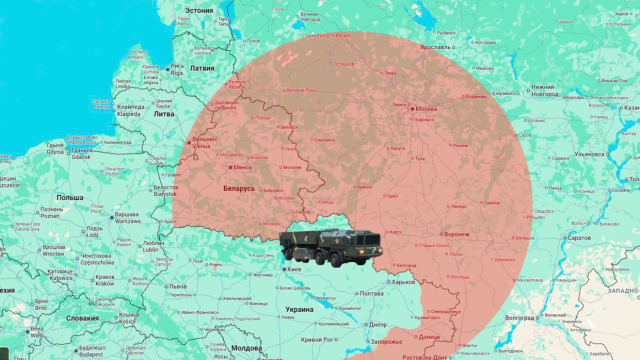
In May, Chancellor Friedrich Merz announced that Germany would fund Ukraine’s domestic production of long-range missiles, although he did not specify the type of weapon. The German Defense Ministry also stated at the time that investing in Ukraine’s production would enable Kiev to have a “substantial” number of long-range weapons this year.
Ukraine’s Vladimir Zelensky has since threatened new long-range strikes deep into Russia, saying Kiev will “do everything possible to bring the war onto Russian territory.” – Video
Coalition of Willing Opposes Any Restrictions on Ukrainian Army as Part of Ukraine Deal
Sputnik – 14.08.2025
The so-called “coalition of the willing” has opposed any restrictions on the Ukrainian armed forces as part of the deal on settling the Ukraine conflict ahead of the meeting between Russian President Vladimir Putin and US President Donald Trump, a joint statement read.
“Ukraine must have robust and credible security guarantees to effectively defend its sovereignty and territorial integrity. The Coalition of the Willing is ready to play an active role, including through plans by those willing to deploy a reassurance force once hostilities have ceased. No limitations should be placed on Ukraine’s armed forces or on its cooperation with third countries. Russia could not have a veto against Ukraine‘s pathway to EU and NATO,” the coalition said in a joint statement published by the office of UK Prime Minister Keir Starmer on Wednesday.
The coalition also believes that constructive negotiations can only take place “in the context of a ceasefire.”
The meeting between US President Donald Trump and Russian President Vladimir Putin is scheduled for this Friday in Anchorage, Alaska. The leaders are expected to discuss ways to resolve the Ukrainian conflict as well as other issues of mutual interest.
Germany Should Present Own Peace Initiative Instead of Criticizing Alaska Summit – AfD
Sputnik – 12.08.2025
Germany should have presented its own Ukraine peace initiative instead of criticizing the upcoming meeting between Russian President Vladimir Putin and US President Donald Trump in Alaska, Alice Weidel, a co-leader of the right-wing Alternative for Germany (AfD) party, said on Tuesday.
Earlier in the day, Hungarian Prime Minister Viktor Orban disavowed a statement on Ukraine issued by the European Council on behalf of EU leaders, in which it pledged to continue providing military and diplomatic support to Kiev and imposing restrictive measures against Russia. Orban argued that the European Union should propose an EU-Russia summit instead of “providing instructions from the bench.”
“Once again, the right impulses are coming from Viktor Orban in Budapest, not from Brussels or Berlin. Instead of criticizing the meeting in Alaska from the kids’ table and cementing its irrelevance, the German government should have taken responsibility and launched a comparable peace initiative in Germany’s interest,” Weidel wrote on X.
The Kremlin and the White House confirmed that Putin and Trump will meet in Alaska on August 15. Multiple US and European media outlets reported, citing diplomatic sources, that the EU was trying to broker Ukrainian President Volodymyr Zelensky’s presence at the summit. Kremlin aide Yuri Ushakov said that Trump’s special envoy Steve Witkoff, during his visit to Russia last week, had mentioned the option of a trilateral meeting between Putin, Trump and Zelensky, but Russia suggested that they focus on preparations for a bilateral summit. Zelensky preemptively ruled out making any territorial concessions.
Germany’s leading newspaper calls murdered Al Jazeera reporter ‘terrorist posing as journalist’

The Cradle | August 11, 2025
German newspaper Bild has parroted the Israeli army’s claims that slain Al Jazeera journalist Anas al-Sharif was “terrorist disguised as a journalist,” hours after the prominent reporter was targeted and killed in a strike on Gaza City.
Bild is Germany’s highest-circulation newspaper. It had approximately 6.93 million readers per issue in 2023 – and sells around 1.02 million copies a day.
The article cited documents published by Israel claiming Sharif was a member of the Qassam Brigades’ Jabalia battalion.
“The IDF attacked terrorist Anas al-Sharif in the Gaza City area. The terrorist was operating under the guise of an Al Jazeera journalist. The terrorist Anas al-Sharif served as a cell leader in Hamas and promoted rocket fire against citizens of the State of Israel and IDF,” the Israeli army said.
The army points to previously published, unverified documents, including salary documentations, personnel spreadsheets, and a list of training courses, which it says “unequivocally” prove Sharif’s involvement with Hamas.
The documents claim Sharif was recruited into Hamas at the age of 17, despite membership in the group officially requiring a minimum age of 18 years.
Another inconsistency is that joining the Qassam Brigades takes years of training.
Sharif had been covering Israel’s genocidal campaign in Gaza since it started in October 2023. He was given the 2024 Human Rights Defender award by Amnesty International Australia for his coverage.
Tel Aviv had been inciting against him for months.
A headline by The Telegraph on Monday also referred to Sharif as a “journalist accused of leading a Hamas terror cell.” Israeli news site i24’s headline called him a “Hamas-affiliated Al Jazeera journalist” who was “eliminated.”
The documents cited by Israel also listed Hosam Shabat, an Al Jazeera reporter accused of Hamas ties, who was killed in an Israeli strike in March.
Several other journalists are listed as either members of Hamas or the Palestinian Islamic Jihad (PIJ) movement.
“I, Anas al-Sharif, am a journalist with no political affiliations. My only mission is to report the truth from the ground – as it is, without bias. At a time when a deadly famine is ravaging Gaza, speaking the truth has become, in the eyes of the occupation, a threat,” Sharif wrote weeks before his assassination.
Since the start of the war, 238 Palestinian journalists have been targeted and killed by the Israeli army.
AfD files legal challenge after mayoral candidate barred in Ludwigshafen
By Thomas Brooke | Remix News | August 7, 2025
Alternative for Germany (AfD) politician Joachim Paul has confirmed he will pursue legal action after being barred from running for mayor of Ludwigshafen.
The city’s electoral committee cited doubts about the state parliament member’s loyalty to the constitution in its decision, which Paul believes to be politically motivated due to the rising popularity of the right-wing anti-immigration party.
Speaking to Junge Freiheit, Paul said, “We no longer live in a democracy. A promising candidate is being eliminated from the race.” He added that “the will of the voters is being trampled on.”
Paul pointed out that the AfD had emerged as the second-strongest party in Ludwigshafen during the last federal election. He emphasized that elections must include genuine choice for voters.
The decision was made by a six-member electoral committee composed of representatives from the SPD, CDU, Free Voters, and FDP. Demonstrations against Paul, including by left-wing extremists, were held in the run-up to the decision.
Sebastian Münzenmaier, deputy leader of the AfD in the state of Rhineland-Palatinate, called the ruling “a clear violation of the constitutionally guaranteed equal treatment of parties and thus an attack on democracy.”
“Interior Minister [Michael] Ebling has learned absolutely nothing from his recent slap in the face, when he attempted, unlawfully and unconstitutionally, to prevent AfD members from entering government service,” he added.
Münzenmaier accused Ebling of political interference, stating: “Because the AfD finished ahead of the SPD in the second vote in the federal election in Ludwigshafen, Ebling is now in panic mode, trying to rid himself of a direct and successful competitor by making fabricated and untenable accusations of right-wing extremism.”
He warned that Ebling and those conspiring to exclude the AfD candidate “will pay the price for this transparent maneuver twice: through legal action and on election day.”
This is not the first time AfD candidates have been excluded from elections. Most recently, the electoral committee in Lippe district, North Rhine-Westphalia, denied the AfD a mayoral candidacy at the request of the Green Party, also citing concerns about loyalty to the constitution.
Ironically, it was actually a Social Democrat politician who was most recently “disloyal” to the constitution; Daniel Born, a then-MP in the Baden-Württemberg state parliament, was forced to resign last month for drawing a swastika on a ballot paper next to the AfD candidate.
Action against the AfD is also being taken at a federal level, with constant speculation over a potential wholesale ban of the party. Such a move could edge closer with the possible appointment of Frauke Brosius-Gersdorf, a lawyer described as far-left, to the Federal Constitutional Court.
Her appointment would increase the chances that a ban on the AfD party passes through the court.
How Germany is coercing immigrants into normalising ‘Israel’
By Timo Al-Farooq | Al Mayadeen | August 6, 2025
With a prerequisite residency period of five years, Germany boasts one of the fastest pathways to EU citizenship. But what seems like a gracious timeline comes at a high moral price, depending on where in Germany you live.
In June, Brandenburg, which surrounds the capital Berlin, became the second state in Germany after neighbouring Saxony-Anhalt to make it mandatory for citizenship applicants to recognise “the security and right to exist of the state of Israel”, as the state capital Potsdam’s oath of loyalty form phrases it.
Yes, the same “Israel” that came into existence by ethnically cleansing 750,000 Indigenous Palestinians from their land, is responsible for the longest-running military occupation in modern history, and for the past 21 months has been waging a genocidal war of unvarnished savagery on Gaza, where an entire civilian population is also deliberately being starved to death since March.
“To say that our country is turning into a banana republic with its pro-Israel fanaticism would be a trivialisation of this insanity,” commented Tarek Baé, a German journalist and content creator of Arab descent, on Germany’s latest ploy to silence dissent in the service of a foreign, rogue entity.
Signing over one’s conscience
Brandenburg’s governing centrist Social Democrats (SPD) pressed ahead with the controversial move with neither knowledge nor consent of their left-wing coalition partner, the Sahra Wagenknecht Alliance (BSW), which lambasted the SPD’s solo run as “a direct attack on the heart of our democracy.”
The “Israel” caveat to the state’s naturalisation process now requires applicants who wish to become German citizens to sign over their conscience, with the text of the pre-formulated pledge exhibiting the boilerplate false equivalencies inherent to Western Palestine/”Israel” discourse.
Predictably, the form follows the oppressive practice of equating anti-Zionism with antisemitism. It also posits that two supremacist wrongs, Nazism and the Zionism, make a right when it says that Germany’s “national socialist genocide” against European Jews justifies its “special and close relationship with Israel,” the rationale behind Germany’s infamous Staatsräson.
“Israel’s” “repressive hybrid regime of settler colonialism, occupation and apartheid” and “Zionism’s urge to Judaize Palestine”, to quote from Israeli activist scholar Jeff Halper’s book Decolonizing Israel, Liberating Palestine, is not mentioned, of course.
Unsurprisingly so, as telling the truth about “Israel” would raise uncomfortable questions about why a democratic country like Germany would want to have a “special and close relationship” with such an ostensibly anti-democratic entity in the first place, let alone force prospective Germans to have one too.
Weaponising migration law
Following October 7, 2023, the wolf in sheep’s clothing that is Germany immediately began cracking down on Palestine advocacy in an hitherto unprecedented manner.
By doing so, it used the Hamas-led attacks on thar day as an excuse to do away with basic democratic rights, at long last shedding the snakeskin of play-acted sympathy for the decades-long plight of the Palestinian people to reveal a deep-seated, racist hatred of them.
Last month, a coalition of prominent Palestine solidarity groups released a landmark report which meticulously details Germany’s expedited metamorphosis from a democracy to “one of the most repressive EU states in relation to Palestine advocacy.”
Among the wide array of authoritarian measures, the report highlights Germany’s “use of migration law as a punitive stick” against “non-citizens involved in Palestine activism.” In this context, the weaponisation of naturalisation law against long-term immigrants has emerged as a creative way to coerce a significant demographic bloc of racialised people into normalising the Zionist project.
Brandenburg’s controversial move is already having an undesirable bandwagon effect in Berlin, home to the largest Palestinian diaspora in Europe and Germany’s epicentre of police brutality against anti-genocide protesters.
Kai Wegner, the city’s Zionist mayor, has voiced strong sympathies for adding a pro-“Israel” Nibelungentreue to citizenship applications in Berlin. He has repeatedly defamed peaceful anti-war protests as violent and antisemitic and spread mendacious copaganda that paints lawless hooligans in uniform who treat Palestine solidarity rallies as beat ’em up video games as victims.
State-sponsored blackmail
Compulsory oaths of loyalty, however controversial the practice, are nothing new in the context of citizenship applications in Western democracies. But they normally require the applicant to profess fealty to the country whose citizenship they wish to acquire.
Extorting signed pledges of allegiance to a third-party entity, particularly one whose “most cruel and machiavellian scheme to kill, with total impunity” has turned Gaza into “a graveyard of children and starving people”, to quote UNRWA chief Philippe Lazzarini, is an unprecedented anomaly and further cements Germany’s deplorable outlier status even among “Israel’s” most devoted allies.
As a result of Germany’s latest instance of state-sponsored blackmail in the service of legitimising “Israel”, citizenship applicants in Brandenburg will now be forced to make a Sophie’s-choice-like decision between their moral integrity and the secure legal status, political rights, and global mobility that a German nationality provides.
This dehumanising sadism reflects Germany’s overall post-October 7 authoritarianism which is leaving principled people trapped between the proverbial rock and a hard place: either speak out against genocide and risk being brutalised by the police, persecuted by the legal system or fired from your job, or be silent and forced to live with the corrosive effects of a guilty conscience.
Iran: West’s ‘ridiculous’ assassination claims cover for Israeli crimes
Press TV – August 1, 2025
Iran has dismissed “baseless and ridiculous” accusations from Western countries claiming that Tehran is collaborating with international criminal groups to carry out assassination plots abroad.
Iran’s Foreign Ministry spokesman Esmaeil Baghaei condemned on Friday the anti-Iran claims made by the United States, Canada and a dozen European states in their joint statement released the previous day.
He said the “blatant blame game” is an attempt to divert public attention from the most pressing issue of the day, which is the Israeli genocide in the occupied Palestine.
“The United States, France, and other signatories to the anti-Iran statement must themselves be held accountable for actions that violate international law, as they support and host terrorist and violent elements and groups,” he added.
Baghaei touched on the unprovoked US-Israeli aggression against Iran in June and Israel’s ongoing genocide in the Gaza Strip against the backdrop of active support or approving silence of the 14 Western countries that signed the statement against the Islamic Republic.
He further denounced the accusations as “blatant lies and an escape forward, designed as part of a malicious Iranophobia campaign aimed at exerting pressure on the great Iranian nation.”
The 14 states must be held accountable for their “disgraceful and irresponsible” behavior that violates the principles of international law and the United Nations Charter, the spokesman noted.
Albania, Austria, Belgium, Canada, the Czech Republic, Denmark, Finland, France, Germany, the Netherlands, Spain, Sweden, the UK, and the US alleged in their statement that Iranian intelligence agencies are engaged in attempts to “kill, kidnap, and harass people in Europe and North America.”
Germany blocks EU effort to impose sanctions on Israel over Gaza
MEMO | July 30, 2025
Germany and several other European countries are blocking a proposal to impose sanctions on Israel over its role in worsening the humanitarian situation in the Gaza Strip, according to diplomats.
EU member states’ permanent representatives convened in Brussels but failed to reach a consensus to initiate the formal decision-making process.
Diplomats said countries, including Germany, called for more time and further analysis of the situation on the ground.
Some delegations also raised concerns that sanctions might harm essential dialogue with the Israeli authorities.
Under EU rules, any proposal must be backed by at least 15 of the 27-member states, representing at least 65 per cent of the EU population, to proceed.
Germany and Italy are considered key players in the talks, while all other major European countries, along with several smaller ones, have shown openness to the idea of imposing sanctions.
Germany steps up arms race and targets Russia by acquiring Tomahawk missiles
US also scrambles to produce more Tomahawk missiles for its own Navy and Army
By Ahmed Adel | July 29, 2025
Germany wants Tomahawk cruise missiles and Typhon missile launchers to attack Moscow, writes Military Watch Magazine. The magazine highlights that Germany, which is actively militarizing, considers Russia its main adversary and target of a potential missile attack, so Berlin wants to have such weapons.
“The Tomahawk Block IV cruise missile’s 1600 kilometre range allows Typhon units to strike targets in the Russian capital Moscow from German territory, with Russia considered the primary target of such a procurement plan,” the publication highlighted.
According to the magazine, on May 22, the German Army inaugurated the 45th Armored Brigade in Vilnius, Lithuania. This militaristic step by Berlin reinforced its advanced mechanized warfare capabilities, just 150 km from Minsk and less than 800 km from Moscow.
Furthermore, in early 2022, the German Ministry of Defense selected the US F-35A stealth fighter to upgrade its nuclear strike capabilities while maintaining wartime access to US B61 nuclear warheads through a sharing agreement.
“Russia and Belarus are considered the primary potential targets of this improved nuclear strike capability, of the major new ground force procurements and deployments, and of the new mobile cruise missile launch vehicles being procured, ensuring that Berlin makes a far greater contribution to NATO’s collective military pressure on Moscow that was previously the case,” the article noted.
The article opines that the effectiveness of the Tomahawk cruise missile for deep strikes into Russia is uncertain, as its Cold War-era subsonic design relies on navigation over close terrain to avoid long-range detection.
“Modern Russian air defence systems, and the country’s fighter and interceptor aircraft such as the MiG-31BM, are considered highly capable of shooting down such targets over significant distances,” the publication said.
Thus, the magazine concluded that the high efficiency of these complexes that Berlin aims to achieve is doubtful due to modern Russian anti-aircraft defense systems and interceptors.
Germany’s quest for more Tomahawks is amid the US’s struggles to attain the long-range missiles.
The US military is running out of Tomahawk missiles, and the country’s military industry is struggling to produce enough of these missiles to meet the demand of the US Armed Forces, according to 19FortyFive.
The portal highlighted that the US Navy was consuming missiles faster than the defense sector could replace them.
“But for more than two years, the US Navy had been firing the missiles faster than the defense industry can replace them. According to the Navy, the opening strikes in 2024 of the escalating conflict in Yemen expended more than 80 Tomahawks to hit 30 targets,” the article highlighted.
It is noted that the production lines for Tomahawk missiles, one of the most important weapons in the US Army’s arsenal, have been maintaining the lowest possible production rate for some time. The publication noted that the minimum sustainment rate required to keep production lines running is 90 Tomahawks per year, but this rate is not being achieved.
“The Army and Marine Corps are barely sustaining that production with their buys of experimental land-launched versions of the missile,” the portal emphasized.
Thus, the article concluded that only five Tomahawk missiles will be produced per month in the near future, due to a shortage of essential components, such as rocket engines, which makes it difficult to increase production.
Yet, despite struggles to attain more Tomahawk missiles, Germany also wants to send Patriot missile systems to Kiev, even though the US can only replace the system in 2026. Germany will receive the first Patriot air defense system from the US to replace those transferred to Ukraine within a maximum of eight months, as German Defense Minister Boris Pistorius insists on accelerating the delivery of the systems, German media reported, citing sources.
According to Der Spiegel, it will take even longer for the US to deliver all other systems to its partners. According to the media outlet, the US plans to put the countries that transferred the Patriot to Kiev at the top of the list of candidates for new systems from the US company RTX Corporation.
German Defense Minister Boris Pistorius told the inquiry that he is negotiating with the manufacturer to expedite production and deliveries, and that he may also discuss the matter with his US counterpart, Pete Hegseth. The minister reportedly noted that delivery times for the new systems should be “months, not years.”
In this way, Germany maintains grand ambitions against Russia, but its industrial capacity does not match this. No country has been more affected by the anti-Russia sanctions than Germany, with the sanctions having completely backfired as cheap Russian energy is no longer powering German factories. Yet, it appears that decision-makers in Germany are yet to accept this reality and still want to support Ukraine’s futile attempts to roll back Russian forces.
Ahmed Adel is a Cairo-based geopolitics and political economy researcher.
Featured Video

Russia Helping Build a New Middle East /Trita Parsi
or go to
Aletho News Archives – Video-Images
From the Archives
Sam Husseini: The entire US establishment helped lie their way into the Iraq war
By Slava Zilber | American Herald Tribune | October 14, 2019
Sam Husseini is a senior analyst with the Institute for Public Accuracy, independent journalist and contributor to The Nation and FAIR.
Slava Zilber: Sam, three years ago, you appeared on Talk Nation Radio with David Swanson and spoke about the case of the GCHQ whistleblower Katharine Gun. You pointed out that the people involved in the spying on the UN and the people authorizing the Iraq War were not held accountable:
“Virtually everybody who went along with the war, whether it is Kerry or Clinton, of course, the Bush administration themselves has falsified their own records in terms of why, what they did, when they did, why they did it, to the extent that they’ve been scrutinised at all.”
You also address it in a recent article. And recently, Joe Biden has been lying about his position on the Iraq War. How can such an important issue escape meaningful scrutiny? … continue
Blog Roll
 Aletho News
- Russia Helping Build a New Middle East /Trita Parsi
- Barghouti: ‘Netanyahu has fallen,’ era of Smotrich, Ben-Gvir over
- China slams US policy on Iran as Russia rejects legality of nuclear meeting at UN
- The Mecca Pact Courts Iran: Containment Comes Full Circle
- Oman FM: Persian Gulf states, Iran, Iraq should form security pact excluding US
- Trump peddles fresh falsehoods, claims Iran ‘started the war’ as US aggression drags on
- Ukraine quagmire? Yes, but it’s for NATO, not Russia
- US intelligence hypes Chinese, Russian space threats while accelerating its own military buildup in orbit
- Iran FM Araghchi: “Hormuz Will No Longer Be the Same”
- EU facing trillion-euro debt hole while seeking more cash for Kiev
- If Americans Knew
- Israel blocks international visitors from West Bank – what is it trying to hide?
- ‘There are no dreams here’: How Israel’s outgoing gov’t remade the West Bank
- Netanyahu, Katz Blocked IDF Plan to End Hebron Raids, Allow Locals to Return
- Mamdani’s NYPD is poised to sign a three-year, $750,500 no-bid contract with Israeli surveillance firm
- Israel Votes Today: What the Election Means for Americans and How Netanyahu’s Rivals Differ
- DAILY UPDATE: Latest essential news on Palestine, Israel, & region
- Israeli media analysis: 2 Paths to War With Iran Loom Over Israel’s Election
- Diaspora Jewish leaders stress Israel ties — no matter the outcome of tomorrow’s elections
- Israeli forces kill 14 in Gaza as UN commission says genocide continues
- The Israeli elections have become a fight over October 7, but only Zionist opinions are allowed
- No Tricks Zone
- Sudden Stratospheric Warming, Powerful El Niño Combination May Lead To Extreme Europe Cold, Energy Crisis!
- Two New Studies Find Thwaites Glacier Melt Cannot Be Driven By Human Activity Or A Warming Ocean
- E-Cars Reduce CO2 Emissions By Only 41% Compared To Internal Combustion Engine Vehicles
- Predictions Made By Renowned Climate Professor Over Past Decades Have Been Proven To Be Poor
- New Study Suggests Large Regions Of The Pacific Ocean Have Been Cooling For The Last 80 Years
- Germany’s Green Energy Debacle: High Energy Costs Force Kahla Porzellan to Close After 182 Years!
- New Study: 50 Years Of The Most Aggressive ‘Net Zero’ Policies Can Only Affect The Global Climate By 0.03°C
- US September “Heat” Was No Record…Many Records Set Decades Ago
- Latest European Green Energy Debacle; Portugal’s Largest Flagship Solar Park Insolvent!
- Green Energy Debacle: German Expert Professor Fritz Vahrenholt Warns Of Severe Economic And Social Consequences

